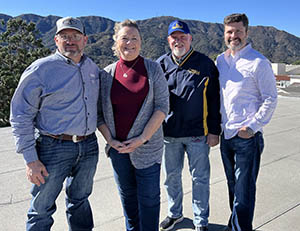
Margie Ann Mines, long-time Southern Baptist missionary, died Dec. 29. She was 89. She was born April 10, 1935, in Fort Worth to J.T. and Genevieve DeLoach. After graduating from Stephen F. Austin High School in Houston, she earned a bachelor’s degree in elementary education and English at Baylor University. She met her future husband, Donald Mines, when they went on a blind date to see a movie. Despite the fact Friendly Persuasion was on the screen that night in 1956, the first-year seminary student later recalled his date would not let him hold her hand. However, she did invite him to be her guest at a Baylor student dinner. They dated for a year before marrying at North End Baptist Church in Beaumont, where her father was pastor. The Mines served in churches in Southeast Texas before they were appointed in 1965 as Southern Baptist missionaries to Argentina. They served in Córdoba, Bahía Blanca and Buenos Aires until 1997. She was active in the work of the Baptist Women’s Union. In later years, she was involved in an English-language Bible study group that extended her ministry to families from around the world. She often said moving to Argentina was one of God’s most gracious gifts in her life. After 33 years in Argentina, the Mines retired and settled in Pflugerville in 1998. In retirement, Margie Mines was active in prayer and Bible study groups at both First Baptist Church in Austin and First Baptist Church in Round Rock. She was preceded in death by daughter Danna, who was killed in a vehicle accident in 1981. She is survived by her husband of 66 years Don; son Steve; son David and his wife Melissa; granddaughter Sarah; grandson Benjamin; and brother Roy. Memorial gifts in her honor can be made to Children At Heart Ministries or No More Violence/No Mas Violencia.
Daniel Ritchie nominee for SBC first vice president
January 16, 2025
APEX, N.C—Evangelist and author Daniel Ritchie will be nominated for first vice president of the Southern Baptist Convention during the 2025 SBC annual meeting in Dallas.
Matt Capps, lead pastor of Fairview Baptist Church in Apex, N.C., told the Biblical Recorder he plans to nominate Ritchie.
“Daniel Ritchie is among the most faithful, consistent, and passionate witnesses for Christ that Southern Baptists have seen raised up in this generation,” Capps said.
“I am eager to see our convention recognize this gospel servant and unapologetically champion the vital ministries of vocational evangelists like Daniel by electing him to serve as first vice president.”
A native of Greensboro, N.C., Ritchie previously served as a student pastor at churches in North Carolina and Arizona before answering a call to become a vocational evangelist and speaker.
For the past 20 years, Ritchie has traveled the country speaking to churches, schools, camps, conferences, colleges, corporations, sports teams and more, according to his website.
Ritchie also preached during the 2022 SBC Pastors’ Conference in Anaheim, Calif.
Ritchie has written two books—My Affliction for His Glory: Living Out Your Identity in Christ and Endure: Building Faith for the Long Run. He also has been a contributing writer to other online ministry outlets and publications.
In My Affliction for His Glory, Ritchie shares his life story, which includes being born without arms and struggling with a sense of value and worth while growing up. After placing his faith in Christ during a church youth event at age 15, Ritchie discovered God had a plan and purpose for his life.
“A man with no arms was never going to fit in a world where everyone has two arms,” Ritchie wrote. “But God had more in store for me than to be a victim of a life defined by the things that I was never going to be.”
Ritchie’s life story and testimony have been featured on Fox News, Focus on the Family and other media outlets.
Ritchie holds a bachelor’s degree in biblical studies from the College at Southeastern, now known as Judson College. He currently is pursuing a master of divinity degree from Southeastern Baptist Theological Seminary.
Ritchie has been married to his wife, Heather, 18 years, and they have two children. The Ritchies reside in Raleigh, N.C., where they are members of The Summit Church, a multisite congregation in the Raleigh-Durham area.
According to the most recent data available, The Summit Church reported an average worship attendance of 7,891 and 448 baptisms in 2023. The church reported $810,000 (2.45 percent) given through the Cooperative Program based on $33,061,224 in undesignated receipts. The church also gave $368,500 to the Lottie Moon Christmas Offering and $154,000 to the Annie Armstrong Easter Offering.
“As a model husband, father, ministry leader, and church member, Daniel Ritchie lives the gospel he preaches, calling hundreds of thousands every year to follow Jesus by both his life-changing testimony and his determination to make Christ known through a bold preaching ministry,” Capps added.
The 2025 SBC annual meeting is scheduled June 10-11 at the Kay Bailey Hutchison Convention Center in Dallas.
Laws guarding kids from online porn at risk in appeal
January 16, 2025
WASHINGTON (BP)—Laws in 20 states aimed at shielding minors from online pornography are under fire as the U.S. Supreme Court hears a legal challenge Jan. 15, with the Texas Baptists’ Christian Life Commission joining the Southern Baptist Ethics & Religious Liberty Commission among many interceding for the Texas law at the center of the case.
At issue in the case, Free Speech Coalition, Inc. v. Paxton, is Texas House Bill 1181, one of a string of 20 such laws passed since Louisiana began the charge in 2022 to require websites containing at least 33 percent pornographic materials to verify that a user is at least 18 years old.
The Free Speech Coalition, an adult entertainment industry trade association, is challenging the laws and has a hearing before the High Court, arguing the regulations endanger free speech and privacy rights of site users. The Texas case is appealed from the U.S. Fifth Circuit, which upheld for Texas.
The public policy organizations’ brief said the U.S. Constitution does not prohibit states from regulating materials that are obscene to minors and presented historical evidence dating to the 17th century.
“The Fifth Circuit’s decision aligns with the history of State regulation of obscenity and this Court’s tradition of respecting the broad police powers enjoyed by the States to protect minors from obscene entertainment,” the brief stated.
“While Texas might have done more, it legislated only as much as was necessary to protect children from exposure to harmful, obscene sexual materials. H.B. 1181 accords with the history of State regulation of material that is obscene for minors, and so it is plainly constitutional.”
Tennessee’s law, originally scheduled to take effect Jan. 1, was allowed to take effect late in the day on Jan. 13 when the U.S. Court of Appeals for the Sixth Circuit stayed an injunction the Free Speech Coalition had secured in December to block the law’s implementation. In Georgia, a law passed in 2024 is set to take effect in July.
In response, the most-visited adult website Pornhub has blocked access to its site in most of the states where age verification laws have been passed, leaving access available in Georgia, Louisiana and Tennessee, CNN reported.
Much support for Texas law
Nearly 60 lawmakers from 15 of the states where laws are in effect jointly filed an amici brief in support of the Texas law—and by extension their own.
“In sum, speech regulations are scrutinized more leniently, and First Amendment protections are at their weakest when children are at risk; where no criminal prosecution or total ban or prior restraint or viewpoint discrimination is present; where the law regulates conduct; and where the content is sexually graphic and is broadly disseminated in a manner that may expose children,” reads the brief submitted by lawmakers. “H.B. 1181 is just such a law. Its sole purpose is to restrict children’s access to sexually graphic material.”
Legislators signing the brief, filed Nov. 15, 2024, represented Alabama, Arkansas, Florida, Idaho, Indiana, Kansas, Kentucky, Louisiana, Mississippi, Montana, Nebraska, North and South Carolina, Tennessee and Utah. In addition to the aforenamed states and Texas, similar laws are in effect in Virginia, South Dakota and Oklahoma.
“As articulated in their statement of faith, Southern Baptists believe that God gave all of humanity free choice when it comes to questions of morality,” the ERLC wrote. “But minors often lack the developmental capacity or moral maturity to know how to exercise that free choice responsibly.
“Thus, Southern Baptists believe it is important to structure society and society’s rules to maximize the ability to educate and train minors on their social and moral responsibilities.
“And while it is primarily the role of families to provide this education and training, the States certainly have an important role to play in this process—most significantly by protecting the ability of families to perform their role.”
Scholars from the Wheatley Institute at Brigham Young University and the Institute for Family Studies—affiliated with the Church of Jesus Christ of Latter-Day Saints—recently analyzed research studies of pornography use conducted over the last 20 years, documenting “trends in pornography use among children and teens and to identify how its use may be harmful to their development in significant ways,” a press release explained.
The researchers used their findings to submit an additional amicus brief to the U.S. Supreme Court in Free Speech Coalition, Inc. v. Paxton.
The report, released Jan. 14, concludes that “not only is pornography linked to development risk for minors, but it is actually more dangerous for young people than acknowledged in some research studies,” the press release reads.
Laura Schlegel, a Republican Louisiana representative who authored the first successful online age verification law in the nation, is also a licensed professional counselor and certified sex addiction therapist. Exposure to porn harms children and adolescents, she said in her brief.
Girls who view pornography are more likely to see themselves as objects of male pleasure, struggle with self-esteem issues, have higher rates of self-harm and suffer more vulnerability to sexual exploitation. Boys develop unrealistic and harmful attitudes toward sex and relationships that lead to increased aggression and difficulties in forming genuine intimate connections, Schlegel said.
Anxiety, depression and engagement in risky sexual behavior are pronounced.
“Protecting minors from obscene content isn’t just a compelling interest legally,” Schlegel noted. “It is a compelling, bipartisan issue at every kitchen table in this country.”
With additional reporting by Calli Keener.
One global Christian in seven faces high-level persecution
January 16, 2025
(RNS)—Driven by Islamic extremism, authoritarian regimes and war, high-level persecution and discrimination impacted 380 million Christians around the world in 2024, according to the annual World Watch List report by the evangelical nonprofit Open Doors released Jan. 15.
The World Watch List ranks the 50 countries where Christians experienced the most persecution and discrimination.
A map of the 2025 World Watch List Top 50 compiled by Open Doors. (Image courtesy of Open Doors via RNS)
The 2025 report draws concerns about escalating violence in sub-Saharan countries, authoritarian regimes targeting Christians, conflicts forcing Christians to flee their homes and churches forced underground.
North Korea topped the list for the 23rd year, followed by Somalia, Yemen, Libya, Sudan, Eritrea, Nigeria, Pakistan, Iran and Afghanistan.
The report also counted 209,771 Christians displaced because of their faith and 54,780 Christians physically or mentally abused, 10,000 of whom lived in Pakistan. In total, 1 in 7 Christians faced “high-level” persecution.
“While the numbers and rankings only partially tell the story, they do help draw the world’s attention to the 380 million believers who are suffering for their faith. This presents an opportunity for us to communicate the rest of the story,” said Ryan Brown, CEO of Open Doors US.
Since it debuted in 1993, the Open Doors’ World Watch List relies on data provided by on-the-ground local researchers and attributes a persecution score to countries based on the evidence collected.
How the list is determined
Countries in the “extreme” category scored between 81 and 100 points. Scores between 61 and 80 points are associated with a “very high” level of persecution, and scores between 41 and 60 with a “high” level.
The report defines persecution as “any hostile action towards a person or community motivated by their identification with the person of Jesus Christ.”
It takes into consideration insults, abuse and workplace discrimination. It also distinguishes “smashes”—cases of physical violence, bombings, shootings and sexual violence—from “squeezes”—policies and laws forcing Christians into isolation and underground practices.
(Graphic courtesy of Open Doors via RNS)
Several countries have pushed more Christians to worship underground, the report found, including Afghanistan, ranked 10th, and China, ranked 15th. World Watch List researchers found more Christians in China feared online and real-life surveillance than in previous years.
The report also mentions cases of churches facing ideological pressures and new laws enrolling pastors into indoctrination sessions.
In Eritrea, called the North Korea of Africa for its internet and phone surveillance of citizens, Christians were arrested en masse in house-to-house raids. Only certain denominations are allowed, excluding evangelicals and Christians from a Muslim background.
Algeria, ranked 19th, has forced its Protestant churches to close or operate secretly. This caused its score to decrease by 2 points, as it lowered the number of persecuted churches to observe. The report also notes the number of Christians awaiting trials and sentencing for faith-related allegations in Algeria is at an all-time high.
The persecution score of Kyrgyzstan increased by 7 points, pushing its rank on the list to 47th, the most dramatic increase of all countries. The government there has taken an authoritarian turn and used laws against public criticism to target Christian minorities, explained the report.
In Kazakhstan, which is ranked 38th and gained 3 points on its persecution score, churches have been attacked by police and security services, and Christian women have been forced to marry Muslim men.
Like in past years, the report reiterates Islamic terrorism remains the main threat to Christian communities worldwide. In sub-Saharan countries, jihadist militants have benefited from unstable governments to seize control of specific areas.
‘Extremely-high’ sub-Saharan persecution
All 15 countries of the sub-Saharan region were among the top 50 list, and 13 had “extremely high” persecution scores.
With more than 106 million Christians, Nigeria, ranked seventh, remains “among the most urgently dangerous places for Christians on earth,” according to the report, primarily because of violent attacks by Islamic, ethnic Fulani militias in the country’s northern states. The attacks are meant to drive Christian communities off the land they farm.
According to the Observatory for Religious Freedom in Africa, quoted in the report, 30,880 civilians have been killed in Nigeria from 2020 to 2023, including 22,360 Christians and 8,315 Muslims.
Groups such as Boko Haram and the Islamic State West Africa Province also remain influential and have tightened their control over certain areas.
The report also flagged the emergence of a new armed jihadist group, Lakurawa, affiliated with the al-Qaida splinter group Jama’at Nusrat al-Islam wal-Muslimin, which operates on the Nigeria-Niger border.
In Burkina Faso, where armed groups control about 40 percent of the territory, a local Open Doors researcher identified as Pastor Soré described repetitive attacks against farming communities by jihadist groups that led him and his family to flee to a refugee camp.
The Sudanese civil war has dashed hopes for religious freedom and caused the world’s largest hunger and displacement crisis. Out of a population of 49 million people, more than 7.7 million had fled in mid-2024.
Islamic extremists have taken the opportunity to destroy more than 100 churches and abduct and kill Christians, the report’s researchers found.
Violence in India’s northeastern state of Manipur has caused tens of thousands of Christians to flee their homes. India was ranked 11th for the increasing popularity of Hindu nationalism and laws that discriminate against Christians.
In Yemen, the conflict that has raged between the government and Houthi rebels since 2015 also left Christian communities more vulnerable to attacks.
In Houthi-controlled areas, Christians face numerous persecutions and also are targeted by Yemeni laws outlawing non-Muslim practices.
Since their involvement in the Israel-Gaza war, Houthi rebels have gained more power in Yemen and tightened their restrictions on churches, impeding dozens of assemblies from gathering.
The persecution of the countries ranked closer to 50th echoes much of the same occurring in the first 10.
In Chad, also located in the Sahel region, Christians are caught in the middle of a conflict opposing jihadist groups and military power. They are targeted on allegations of being affiliated with the opposing party. Chad is ranked 49th on this year’s list.
While Gaza and the West Bank were not ranked, the report collected stories from there too.
Since the beginning of the Israel-Hamas war, Christian communities in Gaza are on the brink of extinction, with nearly all their houses destroyed.
Christians in the West Bank, who represent about 1 percent of the population, also have been affected by stricter travel limitations imposed by the Israeli government.
Texans on Mission disaster relief units head to California
January 16, 2025
DALLAS—Trucks and trailers rolled out of Texans on Mission headquarters in Dallas early on Jan. 15 to support California churches responding to devastating wildfires.
Shower/laundry units are on the way. A semi-truck load of supplies also left Dallas with masks, water filters, Tyvek suits, Bibles, cots and gloves.
The four-member advance team of Texans on Mission serving in Southern California is (left to right) Mitch Chapman, director of Texans on Mission Water Impact; Ann and Curt Neal, volunteer disaster relief coordinators; and Rand Jenkins, chief strategy officer. (Texans on Mission Photo)
A Texans on Mission team already is in California meeting with church partners to determine how best to respond.
The churches have asked Texans on Mission to help establish on-site services, thus “creating a respite for people that don’t have another place to go to get away from the stress, be encouraged and have someone pray with them,” said Chief Strategy Officer Rand Jenkins.
“Their children will have a place to play,” Jenkins said. “They’ll have their clothes washed for them. They’ll get a hot cup of coffee and be able to talk to some of our volunteers and some of the local pastors.”
While Texans on Mission focuses now on helping churches provide respite for weary residents, fire recovery efforts—commonly called “ash out”—likely will emerge in the coming weeks.
“As with the 2023 fires in Maui, authorities have to keep sites secure for a time,” said Texans on Mission Chief Mission Officer John Hall. “And, in this situation, fires are still blazing and battling the flames is a top priority.
“Recovery time will come, and Texans on Mission will continue to work with churches in how best to be of support. As we like to say, we’re bringing help, hope and healing now, and we will need to do so for quite some time.”
In a video for Texans on Mission supporters, Jenkins said: “Thank you for what you’re doing. Thank you for the prayers you’re sending this way. This is an amazing need, and you are an amazing group of people that come together every time.”
To give financially to support Texans on Mission disaster relief, click here.
House bill bans transgender students from girls’ sports
January 16, 2025
WASHINGTON (RNS)—Speaker Mike Johnson celebrated the House passage of a bill banning transgender students from girls’ sports on Jan. 14 by linking opposition to transgender rights with a passage from the biblical book of Genesis.
Johnson made the comments shortly after the House passed the Protection of Women and Girls in Sports Act in a 218-206 vote, with all House Republicans and two Texas Democrats—Reps. Vicente Gonzalez and Henry Cuellar—voting in favor of the bill.
The legislation bars transgender athletes from competing in girls’ and women’s sports from elementary school through college.
Johnson points to Genesis
“We know from Scripture and from nature that men are men and women are women, and men cannot become women,” Johnson said in a news conference immediately after the vote.
He spoke while flanked by Rep. Greg Steube, who introduced the bill, as well as Riley Gaines, a former college athlete who is known for advocating against transgender women in sports.
Gaines has credited a Christian “spiritual awakening” with informing her activism and likened her work to fighting a “spiritual battle.”
Johnson said he was referring to a passage in Genesis, and when asked by RNS how he responded to different interpretations of that passage by Christians, including traditions that ordain openly transgender people, he said the Bible was “pretty clear.”
“Well, it goes back to the first book—Genesis. Male and female, he made them,” Johnson said. “I’m not sure there’s another interpretation, but everybody’s open to interpreting Scripture however they will.”
Johnson then argued that the bill “comports with common sense as well.”
“We know it from our religious tradition, which I believe is the truth. I’m a Bible-believing Christian and make no apology about that,” he said. “But whether you regard that as truth or not, it’s also nature. It’s biology, and biology is not bigotry, as we say.”
Johnson, a Southern Baptist, voiced the same scriptural claim in November during debate over whether to bar people from using bathrooms that do not correspond with their sex assigned at birth.
The debate was tied to then-incoming Rep. Sarah McBride of Delaware, a Democrat and a Presbyterian, who became the first openly transgender member of Congress when she was sworn in earlier this month.
‘About bullying children’
Johnson, who ultimately did institute the ban, quickly garnered pushback from religious leaders such as Bishop Gene Robinson, the first openly gay Episcopal bishop. Robinson preached a sermon in defense of McBride at the Washington National Cathedral in November and derided Johnson’s interpretation of Scripture as “absurd” in an interview with RNS.
On Jan. 14, shortly before the vote, Democrats spoke out against the bill, including Reps. Alexandria Ocasio-Cortez of New York, who is Catholic, and Greg Landsman of Ohio, who is Jewish.
Ocasio-Cortez condemned Republicans for what she said amounted to pretending to “care about women,” and Landsman, a Harvard Divinity School graduate, likened it to bullying.
“This bill is about bullying children,” Landsman said.
The bill, which advocates said President-elect Donald Trump is willing to sign after he is inaugurated next week, now moves to the Republican-controlled Senate.
National Baptists’ new president seeks to be inclusive
January 16, 2025
BIRMINGHAM, Ala. (RNS)—Boise Kimber officially was installed as president of the National Baptist Convention, USA, Inc., during the midwinter board meeting of the predominantly Black denomination—which he hopes will become more inclusive of women and young leaders.
A marker memorializes Addie Mae Collins, Cynthia Wesley, Carole Robertson and Carol Denise McNair—four girls who were killed by white supremacists in the terrorist bombing of 16th Street Baptist Church in Birmingham on Sept. 15, 1963. (Photo / Ken Camp)
National Baptists and guests filled the 2,000-seat sanctuary of the historic Sixteenth Street Baptist Church in Birmingham, Ala., for a three-hour service Jan. 13. About 500 people planned to attend a sold-out inauguration ball on Tuesday.
Kimber, pastor of First Calvary Baptist Church in New Haven, Conn., was greeted by officers of other Black Christian organizations, including the Lott Carey Foreign Mission Convention, the Conference of National Black Churches and Full Gospel Baptist Fellowship.
He was installed into his new role by his predecessor, Jerry Young, who reminded Kimber of the importance of having a strong spiritual life as a leader.
“You can’t lead Black Baptists without orders from Jehovah,” Young, who concluded two five-year terms, advised his successor. “That’s all I got to say. Just spend your time with God.”
The installation service was held in the church that was bombed by members of the Ku Klux Klan more than 60 years ago, resulting in the deaths of four girls readying for a Sunday church service. Kimber, 65, also chose the church as the location for his 2023 announcement to run for the top role of his denomination.
Kimber outlines goals
“My main goal now is, one, to restore our headquarters in Nashville, Tenn.; two, to focus on Christian education, which our convention was founded upon,” Kimber, the former president of the Connecticut State Missionary Baptist Convention, said in an interview hours before his installation.
“Three is to have a better and a greater relationship with our young people of our convention; four is to have women to become a part of the administrative parts of our convention.”
National Baptists gathered at the Birmingham Jefferson Convention Complex for sessions to handle denominational business and participate in worship services and planned to conclude the gatherings Jan. 16 with a mental health workshop on “trauma-informed ministry.”
Kimber was elected in September in a contentious election process, where he was the sole candidate on the ballot after officials determined the Connecticut pastor had received the necessary 100 endorsements from member churches and other National Baptist entities to qualify to run for president.
He won 69 percent of the vote at the National Baptist Convention, USA, annual session in Baltimore, with 31 percent voting “no.”
Alvin Love, a Chicago-area pastor and one of the four other ministers who had wanted to be on the ballot, said his concern was with the election process and not Kimber.
“He’s a good guy. I have no issue with him,” said Love, joining others in welcoming Kimber’s emphasis on including younger and newer pastors and women leaders in positions in his administration.
“I don’t know if it’s moving as fast as it should or is going as high as it ought,” said Love, who would have liked to see a woman named vice president. “But he’s doing much more than anybody before him ever did in that area.”
‘We’re making progress’ regarding women in leadership
Asked about the lack of female vice presidents in the National Baptist Convention, USA, Kimber responded in the interview: “We will get to that. We’re making steps. We’re making progress, and so we will continue to work towards that goal.”
Michael Charles Durant, 64, the new chairman of the convention’s board of directors, said there has been an expansion in women’s leadership roles.
“In the past, there were areas of concentration, say in Christian ed, the women’s auxiliary, missions, but this will be far broader,” he said.
During the installation service, Valerie Thompson, pastor of a Columbus, Ga., church and a new member of the National Baptist Convention, USA, Executive Committee, said a prayer.
Nicole Guns, one of several people appointed as assistant secretaries, introduced the convention’s officers as they processed into the church. Shevalle T. Kimber, co-pastor of First Calvary Baptist Church in New Haven, sat next to her husband, the new president, not far from the pulpit where speakers took turns congratulating him during the installation service.
Guns, 43, said in an earlier interview she was enthusiastic about being part of Kimber’s cabinet, along with other millennials.
“In the Black Baptist church you can be 60 years old and considered young,” said Guns, who was one of the preachers at a young adult revival held on Sunday at the Birmingham church.
Be ‘intentional about creating space’ for young leaders
Christopher Davis, the new convention general secretary, said under Kimber’s leadership there are deliberate efforts to give younger clergy spaces to preach on the main stage of National Baptist meetings or teach in its workshops and classes.
“In a few years, they will ultimately transition into leadership as some of those of us who have been around for a while begin to age out,” said Davis, 52. “If you’re not intentional about creating space for them, then what incentive do they have to stay? And if they all leave, then there’s no one to lead the work after we’ve passed off the scene.”
Beyond choosing people for his administration and convention committees, Kimber issued a statement marking the death of former President Jimmy Carter, whom he cited as an example of “living one’s faith through action.”
He also announced the convention would send “10 truckloads of supplies to aid in the recovery efforts, a small but meaningful step to bring comfort and support to those in need” after the wildfires in California.
Talk about diversity, equity and inclusion initiatives
On the day of the installation, Kimber announced that he had created an economic development committee to meet with politicians and major corporations that have been rolling back their initiatives to address diversity, equity and inclusion.
“Many of our people buy from Walmart, Target, McDonald’s, and so those people certainly would have to come to the table to talk about the diversity and talk about the inclusion of Blacks in their business,” he said in the interview.
The committee will be led by Chicago philanthropist and businessman Willie Wilson, who began at McDonald’s as a custodian and later became a franchisee of the fast food restaurant.
Kimber signed a memorandum of understanding with Gamaliel National Network to support the National Baptists’ work on social justice.
Kimber said he was pleased to see the range of people in the halls of the convention center as the midwinter gathering began its four-day series of meetings on Monday.
He said the denomination is still recovering from the heights of the COVID-19 pandemic, which “really hurt the American fiber of business and religious institutions,” leading to losses in membership.
“We are rebuilding what we’ve lost and bringing people back to our denomination and to our local churches,” he said, as he headed to his next meeting.
“A lot of young people and pastors are here, and so we’re excited. A lot of women are here. A lot of seniors are here. There’s a variety of people here at our board meetings.”
Around the State: HCU students win entrepreneurial award
January 16, 2025
Houston Christian University International students, Ruth and Deborah Ortega, put their thinking caps on to pitch a business idea in a McNair Center for Entrepreneurship and Free Enterprise competition. The siblings won first place in PitchFest, a Shark Tank-like competition that allows students to pitch their ideas to a panel of judges with a chance to win funding to bring their ventures to life. They received a $1,500 check to fund their idea for a platform called “Oportunilab,” a job training and preparation service to equip individuals in their native country of Honduras with skills for in-demand jobs. “The issue in our home-country, Honduras, is that there are many companies offering job opportunities and there are many individuals looking for employment; however, there is a gap between the labor market demands and the preparation that many Hondurans have,” said Ruth, an HCU junior, pursuing a degree in business management. Her sister Deborah, an HCU freshman, is pursuing a degree in finance. The duo are no strangers to entrepreneurship. Their parents run multiple family businesses, including a screen-printing business that services one of the biggest clothing brands in Honduras. The sisters presented a polished business plan and concept to win the competition. The panel of judges included Elizabeth Lewis, former program coordinator of the McNair Center; Ed Borges, assistant provost for student affairs; and Ciro Calderon, an HCU senior.
Baylor University has been awarded a $2.48 million grant from Lilly Endowment through its Religion and Cultural Institutions Initiative to support a major expansion of the Black Gospel Archive at Baylor University Libraries. (Photo / Baylor Photography / Robbie Rogers)
Baylor University has been awarded a $2.48 million grant from Lilly Endowment through its Religion and Cultural Institutions Initiative to support a major expansion of the Black Gospel Archive at Baylor University Libraries. The award represents one of the largest foundation gifts to support Baylor Libraries and will underwrite an expansion of the Black Gospel Archive and Listening Center, create a four-year concert series and hire staff positions beginning in 2025, in addition to several other important projects aimed at furthering the goals of the BGA. “Lilly Endowment’s support for the next phase of the Black Gospel Archive represents a game-changing opportunity for the Baylor University Libraries,” said Jeffry Archer, dean of University Libraries, Museums and the Press at Baylor. “After 20 years of groundbreaking work to locate, preserve and make accessible America’s Black Gospel music heritage, this gift will propel the Black Gospel Archive to a new level of national visibility and further our understanding of the impact of African American worship on religious culture at large.” The Black Gospel Archive encompasses the Baylor Libraries’ numerous programs, projects, archival collections and resources that identify, collect, preserve and make accessible Black sacred materials. The archive was born from the Black Gospel Music Preservation Program, a nationally recognized effort that has preserved and made publicly available thousands of Black Gospel recordings since its founding in 2005. Learn more about the BGA and its programs on the Baylor Libraries’ website.
DBU will hold its annual MLK Walk of unity on Jan. 20. (DBU Photo)
The annual MLK Walk at Dallas Baptist University, honoring the legacy of Martin Luther King Jr., offers students, faculty and staff an opportunity to come together to walk in unity, reflecting on King’s message of equality and justice. The event will take place Jan. 20. The next day, DBU will kick off the spring semester with its annual spring Welcome Back party on Jan. 21. Many campus organizations will be featured, offering a chance to discover and learn about the diverse groups that make up DBU.
Hardin-Simmons University will host its 3rd annual Big Country MLK Prayer Breakfast at 7 a.m. on Jan. 20. The breakfast will be held at the Johnson Building on the HSU campus. Matthew Lubin, pastor of Macedonia Baptist Church, will be the guest speaker. The community begins its day in prayer and fellowship while enjoying a complimentary breakfast at the yearly event hosted at HSU. Attendance is free and open to the entire Abilene community. While RSVPs are not required, they are greatly appreciated. Kindly confirm attendance by emailing president@hsutx.edu.
The University of Mary Hardin-Baylor College of Visual and Performing Arts invites high school students considering a future in art or music to campus Jan. 24 for a full day immersed in the arts. The ArtsRush 2025 experience will include specialized activities and performances to inspire and expose prospective college students to the arts at UMHB. Attendees will have opportunities to meet faculty and current students, tour campus and experience many art and music activities on campus. The day ends with a public art exhibition of the work created throughout the day and musical performances. Check-in and breakfast begin at 8:30 a.m. in the lobby of the Baugh Center for the Visual Arts. Music participants should bring their own instruments. Registration is $30 and includes breakfast, lunch, snacks, a hand-screen printed t-shirt and a swag bag with UMHB-branded items. Registration is required for attendance. The last day to register is January 21. Visit www.umhb.edu/visual-performing-arts/artsrush for more information and to register.
Texans on Mission join California churches in fire response
January 16, 2025
LOS ANGELES—A four-person Texans on Mission team is in California working to multiply the ministry of churches and chart a long-term relief effort in the area devastated by raging fires.
The four-member advance team of Texans on Mission serving in Southern California is (left to right) Mitch Chapman, director of Texans on Mission Water Impact; Ann and Curt Neal, volunteer disaster relief coordinators; and Rand Jenkins, chief strategy officer. (Texans on Mission Photo)
“The situation here is heavy,” said Rand Jenkins, a team member and chief strategy officer for Texans on Mission. “We’re striving to find a way to multiply efforts to meet needs in the name of Christ.”
About 150,000 people have evacuated as a result of the fires already, and 50 mph to 65 mph winds are forecast in the area this week. More than 99 percent of those people have taken shelter with family or friends or are staying in hotels.
“Texans on Mission is partnering with local churches to meet needs,” Texans on Mission Chief Executive Officer Mickey Lenamon said in a letter to supporters. “As these families left their homes, they had no idea what they would return to. Even if their house isn’t burnt to the ground, it’s highly likely it will be so covered by ash that it will need rebuilding.
“Working through these church partners, the strike team is discovering ways to meet expanded physical, emotional and spiritual needs. The weight of the fire literally hangs in the air everywhere these families turn.”
Lenamon said the government has “designated regions that have been burned as hazardous areas and have significantly restricted access for safety.”
“We expect our fire recovery teams will not get access to the area for at least four weeks. It may be longer. If you remember, there was a similar waiting period after the Maui fires,” he stated.
‘A beautiful image of the body of Christ’
Chief Mission Officer John Hall noted that Texans on Mission has been “working on these California church connections for over a year, thinking about how we could help them respond to a disaster. Now, the time has come.”
The local churches are saying: “We want you to train us how to do the fire recovery. We want to do this together” Hall said. “It’s a beautiful image of the body of Christ.”
Texans on Mission is focusing on an “area that is varied economically,” he said. “A lot of people, even more well-off ones, have had their fire insurance coverage dropped. Needs are and will be significant for a long time ahead.”
The Texans on Mission team now in California is working specifically on possible needs regarding water filters, meals, showers and laundry, and fire recovery.
“As we always do, we’re taking a step of faith,” Hall said.
Lenamon, in his note to Texans on Mission supporters, said: “We are early in this disaster. The situation is evolving each day.”
He asked people to pray specifically for:
A swift end to the fires.
Those who have been affected by the fires.
Strength for the firefighters who are valiantly serving.
The churches serving with Texans on Mission to minister to people impacted by the fires.
The clear proclamation of the gospel.
To give financially to support Texans on Mission disaster relief, click here.
Promise Keepers founder Bill McCartney dead at 84
January 16, 2025
(RNS)—Bill McCartney, a former college football coach who became one of the most influential religious figures in American life during the 1990s after founding the Promise Keepers movement, died Jan. 10. He was 84.
“It is with heavy hearts that we announce the passing of Bill McCartney, beloved husband, father, grandfather, and friend, who left this world peacefully at the age of 84 after a courageous journey with dementia,” his family said in a statement.
In March of 1990, not long after his University of Colorado Buffaloes missed a chance at the national championship by losing to Notre Dame in the Orange Bowl, McCartney hopped in a car with a friend, Dave Wardell. They drove from the university’s campus in Boulder to Pueblo, Colo., where he was scheduled to give a speech at a Fellowship of Christian Athletes banquet.
While on the road, McCartney talked about his concerns that American men were losing their faith in God, and as a result, the nation’s families were suffering. During that drive, the idea of Promise Keepers was born.
Within a year, McCartney had grown Promise Keepers from a relatively small group of followers to a gathering of 4,000 men at the University of Colorado’s basketball arena. Along the way, he also led the Buffaloes to a national championship after beating Notre Dame in a rematch.
Promise Keepers drew tens of thousands to events
A few years later, Promise Keepers was drawing tens of thousands of worshippers to arenas and stadiums around the country—and eventually more than half a million men to the National Mall in Washington in 1997.
More than 65,000 men attended the Promise Keepers meeting at the Georgia Dome in Atlanta, June 30, 1995. The message is one of Christian faith, family and fatherhood. (AP Photo/Leita Cowart)
The group’s prominence sparked a national debate about the role of faith in public life and the evolving relationship between men and women, especially in religious communities.
During Promise Keepers gatherings, McCartney preached a mix of traditional Christian gender roles, known as complementarianism—with men as the spiritual leaders of their homes and societies—and a softer, kinder approach to masculinity, where men did the dishes, listened to their wives and were known for kindness rather than toughness.
“A real man, a man’s man, is a godly man,” McCartney said in a 1995 press conference before a packed-out event in Washington, D.C., The Washington Post reported. “A real man is a man of substance, a man that’s vulnerable, a man who loves his wife, a man that has a passion for God, and is willing to lay down his life for him.”
Butler said McCartney’s message resonated with both evangelical men and women—as it portrayed what the movement hoped to be at its best—but often clashed with the broader culture, especially with those who saw the group’s message as an attack on women’s rights.
“The Promise Keepers speak about taking back America for Christ, but they also mean to take back the rights of women,” Patricia Ireland, then president of the National Organization for Women, told The Washington Post in 1997, when Promise Keepers was at the height of its popularity.
“Their call for submission of women is one that doesn’t have a place in either the pulpit or the public sphere in the 1990s.”
Promise Keepers also was known for opposing LGBTQ rights, which also made McCartney controversial.
Strong emphasis on racial reconciliation
But the movement also stirred dissension in Christian circles for focusing on racial reconciliation, often in blunt terms.
“Racism is an insidious monster,” McCartney said in a 1996 rally for clergy in Atlanta, in announcing Promise Keepers’ move to focus on issues of race. “You can’t say you love God and not love your brother.”
He preached a similar message the following year before the rally in Washington, linking religious revival in the country with racial reconciliation.
“The church has been divided, and a house divided cannot stand,” he said, according to Religion News Service reporting at the time.
The movement faltered in the late 1990s, in part due to a move away from stadium events to smaller rallies in more places, which led to financial woes, as the income from the stadium events had paid the organization’s bills for years.
Less than a year after the “Stand in the Gap” event at the National Mall, the group laid off most of its staff. A move to focus on racial reconciliation proved less popular with evangelicals than the focus on how to be a good dad or husband, with some Christian leaders labeling it as “divisive.”
The group went through several attempts to reinvent itself—including a partisan turn during the Trump era—but has long failed to regain its former influence.
‘A shift in the American religious landscape’
Paul Emory Putz, assistant director of Truett Seminary’s Faith & Sports Institute at Baylor University, and author of The Spirit of the Game, said that there had long been a connection between Christianity and football.
But until McCartney, few sports figures from the charismatic movement in evangelicalism had much of a public presence. But McCartney, who had been part of a charismatic Catholic parish and called himself a “born-again Catholic” and was later part of a Vineyard church, brought that community into the sports world.
“He marked a shift in the American religious landscape where that form of faith became more mainstream,” Putz said.
Putz also said McCartney lived out his beliefs, leaving the University of Colorado in order to pay more attention to his family
Born Aug. 22, 1940, McCartney grew up in Riverview, Mich., where he played football, basketball and baseball in high school, before getting a scholarship to play football at the University of Missouri.
After graduating from Missouri in 1962, McCartney coached high school in Joplin, Mo., before becoming coach of the basketball team at Holy Redeemer High School in Detroit and then football coach at Divine Child High School in Dearborn, Mich.
His success at the high school level led to an assistant coach job at the University of Michigan. In 1982, McCartney, known as “Coach Mac,” was named the football coach at the University of Colorado, where he led the team to 10 winning seasons in a row and made the Buffaloes a national powerhouse.
He resigned as coach in 1994, in part due to his wife’s ill health. He would step down as leader of Promise Keepers in 2003 but returned for a while in 2008.
His last season with the Buffaloes was 1994, when the team went 11-1 behind a roster that included Kordell Stewart, Michael Westbrook and the late Rashaan Salaam.
That season featured the “Miracle in Michigan,” with Westbrook hauling in a 64-yard touchdown catch from Stewart on a Hail Mary as time expired in a road win over the Wolverines, according to The Associated Press. Salaam also rushed for 2,055 yards and won the Heisman Trophy.
Praised as coach and role model
A conversion experience in his 30s changed the course of McCartney’s life, his family said in announcing the former coach’s death, and led him to devote the remainder of his life to living out his Christian faith.
Former colleagues and players testified to McCartney’s impact on their lives as both a coach and a role model.
“Coach Mac was an incredible man who taught me about the importance of faith, family and being a good husband, father and grandfather,” Rich George, University of Colorado athletic director, said on the university’s website.
Alfred Williams, a star player for the Buffaloes who later went on to win Super Bowls in the NFL as a member of the Denver Broncos, also paid tribute to McCartney.
“His unwavering faith and deep love for his family were the foundation of his life—values that always mattered more to him than the game itself,” Williams posted on X. “Coach Mac will be forever missed and deeply loved by all who had the privilege of knowing him.”
McCartney has been mostly out of public view in recent years. His family announced in 2016 that he had been diagnosed with dementia and Alzheimer’s.
“Coach Mac touched countless lives with his unwavering faith, boundless compassion and enduring legacy as a leader, mentor and advocate for family, community and faith,” the family said.
“As a trailblazer and visionary, his impact was felt both on and off the field, and his spirit will forever remain in the hearts of those he inspired.”
McCartney remains the winningest coach in Colorado history, with a record of 93-55-5. He was inducted into the College Football Hall of Fame in 2013.
He was preceded in death by Lynne, his wife of 50 years, who died in 2013. Survivors include four children, 10 grandchildren and three great-grandchildren.
Texans on Mission volunteers served two-thirds of 2024
January 16, 2025
Texans on Mission volunteers spent about two-thirds of last year—235 days—in the field, ministering to survivors of a variety of disasters.
Volunteers deployed 18 times to 25 sites. At one point in 2024, teams worked 131 consecutive days with eight overlapping deployments, offering help, hope and healing to people in need.
During 2024, Texans on Mission volunteers deployed 18 times to 25 sites. Heavy equipment operators logged more than 4,850 hours, and chainsaw crews completed 1,157 jobs. (Texans on Mission Photo)
“The many disasters last year stretched us,” said David Wells, Texans on Mission disaster relief director. “But our volunteers didn’t bat an eye. They would work hard, think they were about to get some rest and then have to go right back out again.
“That’s commitment. It’s commitment to our Lord and to serving people who are experiencing terrible needs. It is amazing to watch these men and women at work.”
Texans on Mission volunteers contributed more than 15,000 volunteer days—about 128,000 volunteer hours.
They presented the gospel about 350 times, resulting in 63 recorded professions of faith. Volunteers distributed 1,125 Bibles and more than 100 evangelistic tracts, and they made more than 4,800 personal contacts.
“We’ve had great years of service in the past,” said Mickey Lenamon, Texans on Mission chief executive officer. “But last year stands out for the cumulative impact accomplished in helping people and leading them to Christ.”
Volunteer teams prepared more than 200,000 meals and distributed 54,000 bottles of water.
‘We made ourselves available to God’
Heavy equipment operators logged more than 4,850 hours, and chainsaw crews completed 1,157 jobs.
Texans on Mission volunteers completed more than 100 tear-out jobs—removing soaked sheetrock and damaged flooring—after floods, as well as 120 mold remediation jobs. They sifted through the ashes of homes consumed by fire more than three dozen times, helping homeowners reclaim lost keepsakes.
They performed more than 50 structural demolitions and cleared 87 sites after disasters, in addition to covering more than 50 buildings with temporary roofing.
Texans on Mission teams washed about 3,600 loads of laundry for volunteers and about 2,000 loads for the public. They provided access to showers to more than 6,400 volunteers and 5,600 others at disaster sites.
“Some people like to talk about the good old days,” Lenamon said. “But these are the good old days for us.
“We have made ourselves available to God and for service through his churches, and that willingness to serve means God keeps raising us up to help others.”
With additional reporting byFerrell Foster of Texans on Mission.
Act of kindness leads to long-term partnership
January 16, 2025
When Serenity Center, a residential 12-step rehabilitation center in West Texas, experienced extended power outages in 2021, Primera Iglesia Bautista in Plainview stepped in to help, not fully realizing they would be forging a long-term partnership that would benefit both organizations.
Pastor Jonathan Silva explained the owner of Serenity Center, Paul Walker, is a member of the congregation. Walker reached out to Silva when it became apparent an extended power outage from an ice storm in 2021 would require alternative accommodations for the residents.
Approximately 35 men, women and children would need a place to stay. The church stepped in to provide them a place for about three weeks.
Additionally, church members cooked for their guests and brought food and clothing items, as needed, while powerlines to the center were being repaired.
While the residents only temporarily called the church “home,” the Serenity Center has continued an arrangement of shuttling residents to Primera Plainview on Sunday mornings for worship and on Wednesday nights for a discipleship group.
“They take about two trips, back and forth” Silva said. “One for the men. Then they’ll go back for the women with the children.”
The cooperation between the two organizations has been fruitful, Silva explained. Last year the church observed 24 baptisms. Twenty of those were of individuals from among the group who attend from Serenity Center.
Some choose to stay
Some who have completed the 12-step program, have chosen to remain in Plainview so they can continue to serve with the church.
Xandrea Pierce. (Courtesy Photo)
One of several newer members who came to the church by way of Serenity Center, Xandrea Pierce, has become a vital member of the church. Silva said he tries to give her plenty of opportunities throughout the year to share the story of how God is working in her life.
“Now she’s about three years strong,” coming to the church, he continued, explaining she lived in Lubbock before, but decided to stay in Plainview.
Pierce, whom Silva noted the congregation lovingly calls “Sister X,” said she’d made six attempts with Serenity Center in 2022 to beat her addiction. But on the seventh attempt, she noted, “God went with me,” meaning she allowed God to go with her that time, she explained.
All of the first attempts, she didn’t really want to be there, but wanted to give up and leave, Pierce noted. Eventually, her mother had told her she couldn’t come back home.
Serenity Center offered her several extensions to complete the program. Pierce recalled every time an extension was offered, she sensed God asking, “Will you trust me?”
The first time she got an extension, and she heard God ask, “Will you trust me,” Pierce said, “I just blew it off.”
The next time she got an extension, when she heard God asking if she trusted him, she ignored it again.
The third time an extension was offered, Pierce recalled when she “heard God ask, ‘Will you trust me,’” she gave him a different answer. This time, “I thought, ‘You know what, God, I’m going to trust you,’” Pierce explained.
Not long after her decision to stay until she completed the program, Pierce began going with the group to church at Primera Iglesia. A man from Serenity sang in church the first week she visited.
She’d always loved to sing, she said, so Pierce began singing at the church, too.
But after she sang a few times, Pierce said, “Something in me said, ‘I should get baptized.’” Silva asked her if she wanted to become a member, and she joined the church, she fondly recalled.
“And in March, it’ll be three years that I’ve been clean and three years that I’ve been attending the church. And I sing at the church,” she said.
Pierce noted at other churches she knows, there’s always been at least one person in the church who “turns their nose up” at addicts. But she’s never felt like her past had any bearing on her treatment at Primera.
“Everyone there welcomes them (addicts) with open arms. They welcomed me with open arms. And everyone that goes there, they welcome them with open arms. And they don’t treat anyone any different.”
Pierce said she loves that about her church, noting that quality of being welcoming and the ministry of the church are what has kept her there.
Observable impact
Pastor Jonathan Silva (left) addresses newly baptized believers. (Courtesy Photo)
Silva, who has pastored the church since 2020, said the partnership with Serenity Center has made an impact on his congregation.
“I believe the desire for servanthood has really hit another level compared to where we were at,” he noted.
“Seeing the growth that each individual member has had and their contributions—we have individuals who sign up for donuts or breakfast burritos on Sunday mornings, and we never have a problem looking for help.”
Silva noted everyone in the congregation is eager to help and to serve. After baptisms, the congregation hosts a church meal.
“That desire has really built over the years. So, I would say that growth has really come from these encounters that we’ve had over the years,” Silva said.
The community has noticed Primera’s commitment to Serenity Center, too. The first two years of the partnership, “things were pretty quiet,” he said, with the congregation just going about its regular commitments to ministry.
But as Serenity Center residents have completed their stays with the center and reentered the workforce in the past year and a half, word has spread about the church’s care for this population.
Silva estimated at least five first-time visits a year are a direct result of the church’s ongoing partnership with Serenity Center. He’s spoken with community members who’ve shared how their new employees who’ve completed the 12-step program and remained active in their churches are excitedly sharing their faith.
“There’s a spark beginning to take place,” Silva said. “That’s what I’m really focusing on next year is really just bridging—that you go out and make disciples. I’m really excited about that.”
Primera is a small congregation, with about 25 members, Silva noted. But with Serenity Center, worship services run about 55. They are a big part of the church, Silva noted.