DALLAS (BNG)—Cliff Temple Baptist Church in Dallas ministered to the needs of its surrounding Oak Cliff neighborhoods long before the term “missional” came into vogue and before Brent McDougal became senior pastor.
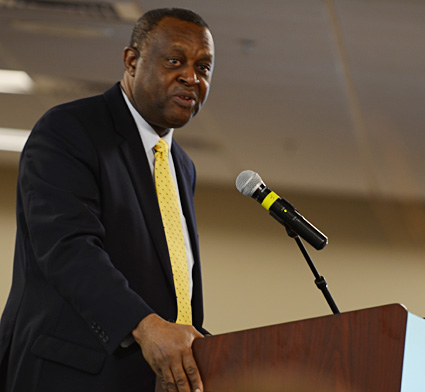
 Brent McDougalBut since McDougal’s arrival five years ago, the historically Anglo congregation has moved beyond traditional ministries to the Hispanic communities around it to embrace a variety of cultures.
The congregation embraces Hispanics in leadership and a growing Spanish-speaking membership that’s leading Cliff Temple to adopt more policies and practices to make people of all nationalities feel welcome.
The church simply continued to take steps that confront it as a crossroads for different kinds of people in Dallas, McDougal said.
“The word ‘missional’ is a catchall for anything outside the church walls,” he said. “Where we are, it just means responding to the context that God has placed us in.”
Within a one-mile radius of the church campus, the population is 85 percent Hispanic, with Anglo and African-American neighborhoods located just beyond.
 Multi-cultural missions projects are a staple at Cliff Temple. (Photos courtesy of Cliff Temple Baptist Church)Historically, Cliff Temple responded to that context through a number of outreach ministries to Hispanics. While helpful in some respects, many of those ministries reinforced the reality of separation between the church and its neighbors. A Spanish-speaking congregation it hosted largely had the same effect.
Seeing that challenge, Cliff Temple decided several years ago to merge the two congregations.
“We were going to think of one another as one church with two different expressions of worship, as opposed to being a congregation that has a mission to Spanish-speaking people or just with a ministry that’s programmatic in scope,” McDougal said of the decision made before his arrival.
But soon after he became pastor, McDougal said, he realized the idea hadn’t been implemented.
So the church got busy. Early changes included adding Spanish to exterior signage and holding joint worship several times a year.
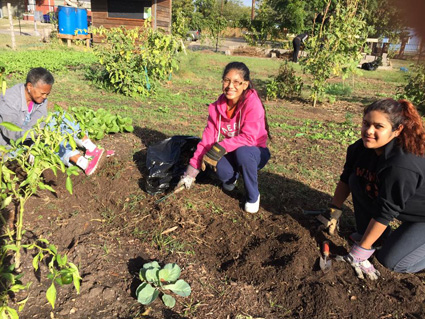 Cliff Temple members work in the church’s community garden.Cliff Temple also boosted its outreach to meet the practical needs of those living near the church. It created ministries providing food, clothing, job training, English instruction and gardening classes.
The church also offers small-group encounters in the community. Neighbors are invited to members’ homes for simple meals and services as a way of widening the Cliff Temple circle, McDougal said.
Another piece, he added, involves recognition and celebration of Mexican holidays, including hosting an annual Mexican Independence Day party.
“We embraced the Mexican subculture in a Mexican context,” McDougal said. “We don’t lose any of our (U.S.) patriotism, but gain great credibility among those who have found a home in a foreign land.”
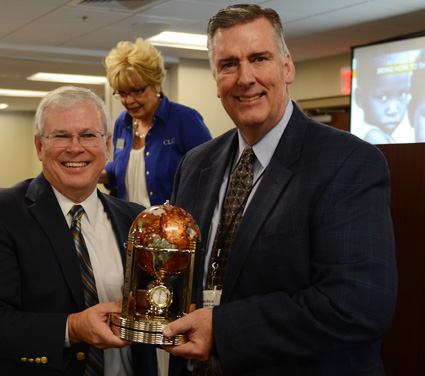
 Porfirio BasThe church went even further to embrace Mexican culture when it called Porfirio Bas as pastor two years ago.
Initially, the church considered Bas as pastor of just the Hispanic portion of the congregation, but that changed to more fully accept the concept that Cliff Temple is just one congregation, McDougal said.
Before, there had been no mixing of leadership between the different ethnicities at the church, and it contributed to a segmented feeling at Cliff Temple, he noted. That shifted when Bas’ title was changed.
“He’s pastor now. He works as a co-pastor with me,” McDougal said. “We really need that kind of relationship because of our context.”
But context is just as important—and challenging—to the Hispanic members of Cliff Temple, Bas said.
Bas, who was a soap opera star in Mexico during the 1970s and 1980s before eventually becoming a minister, said Anglo Christians aren’t the only ones who struggle to overcome misconceptions about other cultures.
“What I see … is that groups like to be with their ethnicities and with their cultures—that happens with blacks, Hispanics, Koreans,” Bas said.
 Cliff Temple’s summer KidzKlub provided children in the community with about 2,000 meals, several hundred books and bookcases, fun activites and Bible study. That’s changing at Cliff Temple, where African-Americans, Hispanics and whites are gelling as a congregation, he noted.
Despite the difficulties, the church is pursuing that growth because it’s actually called for in the Bible, Bas said.
“I can see in Scripture that we should love everybody,” he said. “The Lord is inviting us to the ends of the Earth, and that means all ethnicities and all different groups. Here, we are moving in that direction.”
Local and international mission projects conducted by the full array of the church’s ethnicities solidifies the multicultural bonding at Cliff Temple, McDougal said.
Those projects convey to all members that everyone is valued at the church, he said.
“Churches need to rethink assimilation—the idea that when one joins, they need to be more like us,” he said. “What a missional congregation says instead is, ‘How do we connect with people, whoever they are?’”
What works at Cliff Temple may not work at another church, McDougal acknowledged. Every congregation needs to discern the needs of the community around them and go from there.
“It’s not better or worse,” he said of the multicultural approach. “It’s just different—and the willingness to be open to that which is different is critical for cross-cultural ministry.”
 Older Americans (11 percent) and those with college degrees (13 percent) were among the least likely to say “yes.”
 About half (47 percent) of Protestant senior pastors say their church currently helps immigrants. And most (79 percent) agree with the statement: “Christians have a responsibility to assist immigrants, even if they are in the country illegally.” One in six (17 percent) disagree.
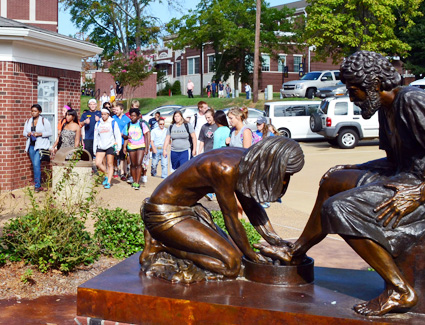

 Brown spoke about the need for conservation and Christians’ responsibility to protect God’s creation. Brown has written two books, Our Father’s World and When Heaven and Nature Sing.