Israel likely to have a longtime advocate as ambassador

WASHINGTON (RNS)—Mike Huckabee’s journey to becoming the U.S. ambassador to Israel began 50 years ago.

The former Arkansas governor, presidential candidate and Fox News host first visited Israel with a friend on a tour of the Middle East not long after graduating from high school.

“This is a place I’d never been, but I felt at home,” Huckabee said in a podcast interview at the National Religious Broadcasters convention earlier this year, about his experience as a teen.

“I felt an overwhelming spiritual reality of understanding this is the land that God has given to the Jews,” he told Paul Lanier, board chair of the International Fellowship of Christians and Jews, for the “Nourish Your Biblical Roots” podcast.

Has visited Israel more than 100 times

Huckabee—a former Southern Baptist pastor—said he began hosting his own tours of Israel in the 1980s and has visited the country more than 100 times. He’s a longtime supporter of pro-Israel groups like IFCJ—a nonprofit that seeks to strengthen ties between Christians and Jews and does humanitarian work in Israel—and has helped raise money for the group.

Huckabee has also long articulated staunchly pro-Israel political views. As a candidate for president in 2008, Huckabee said he believed there is “no such thing as a Palestinian,” according to CNN. He argued that the very concept of Palestinian identity is “a political tool to try and force land away from Israel.”

When he ran for president again in 2015, he held a fundraiser in one of the Israeli settlements in the West Bank, which are considered illegal under international law.

In his conversation with Lanier, Huckabee compared the origin of Israel to the founding of the United States, saying both were started by people who moved to a new land to find peace and security. He also said the growth of Israel since 1948 is like biblical prophecies come true.

“I’ve seen Scripture come to life,” he said. “The desert has bloomed before my eyes.”

If confirmed by the Senate, Huckabee may be the first political appointee—as opposed to interim career foreign service officers—to come to the U.S. Embassy in Israel from a group known as Christian Zionists, who back Israel for theological as well as geopolitical reasons.

The current U.S. ambassador is Jack Lew, an American Jew who served as secretary of the Treasury under Barack Obama.

How Christian Zionists view Israel

Many Christian Zionists view the creation of the modern state of Israel as a necessary precondition for the second coming of Jesus and the apocalyptic purification of the world in the end times. Israel, along with the occupied territories it captured in 1967, is considered given by God to the biblical patriarch Abraham, who is told in the Book of Genesis, “God will bless those who bless you and curse those who curse you.”

Former Arkansas Gov. Mike Huckabee prays for political leaders at an American Renewal Project pastor luncheon in Henderson, N.C., Sept. 24, 2024. (RNS photo/Yonat Shimron)

Huckabee’s own biblical approach to Israel shows up in his habit of referring to the West Bank as “Judea and Samaria”—a way of signaling a belief that the land has always belonged to the Jewish people.

That divine patrimony, believers say, should shape how nations, including the United States, treat Israel and how individual Christians should view the nation. Over the past 30 years, evangelicals, including Southern Baptists like Huckabee, but also growing groups of charismatic nondenominational Christians, have duly formed strong alliances with Israeli leaders and Prime Minister Benjamin Netanyahu in particular.

They give more to Israeli causes than Jewish Americans do and have formed strong support groups. With 5 million members, Christians United for Israel, led by San Antonio pastor John Hagee, is thought to be the largest pro-Israel nonprofit in the United States.

In 2017, when then-President Donald Trump moved the U.S. Embassy in Israel from Tel Aviv to Jerusalem, the move was applauded by Christian Zionist supporters, and Hagee spoke at the dedication of the new embassy.

Likely to be welcomed by Netanyahu administration

Mordechai Inbari, a professor of religion at the University of North Carolina at Pembroke, said Huckabee’s appointment as U.S. ambassador to Israel would be greeted “with open arms” by the Netanyahu government.

“Huckabee belongs to the network of supporters of Netanyahu and his government among evangelicals and is considered to be a strong supporter of Israel,” Inbari said.

Huckabee was pressed by Israeli radio Nov. 13 on whether he believed the Trump administration would support annexation by Israel of the occupied territories, principally the West Bank, but also Gaza. He demurred but made it clear that he sees his job as following the decisions made by the president.

“There’s never been an American president,” he added, “that has been more helpful in securing an understanding of the sovereignty of Israel—from the moving of the embassy, recognition of the Golan Heights, and Jerusalem as the capital, no one has done more than president Trump and I fully expect that will continue,” Huckabee said.

Expressed interest in expanding Abraham Accords

Inbari, for one, didn’t think the new Trump administration would rush to see Israel annex the territories. Trump has shown a desire to expand the Mideast peace deal known as the Abraham Accords, inked in his first administration, to include Saudi Arabia.

The accords, signed in 2020, normalized Israeli relations with the United Arab Emirates and Bahrain, and later Sudan and Morocco.

Israel and Saudi Arabia appeared close to a deal in 2023, but the negotiations were derailed by the Oct. 7, 2023, Hamas attack on Israel. Saudi Arabia now insists it will only normalize ties with Israel if there is a pathway for a Palestinian state, which the Israeli government currently rejects.

“I think Trump would want peace with Saudi Arabia rather than Israel annexing the West Bank,” said Inbari. “And so I don’t think that this is something that’s going to happen.”

Yael Eckstein, president of the IFCJ, who traveled to Israel with Huckabee earlier this year to deliver humanitarian aid there, said the former governor has the best interests of the United States and Israel at heart and she views his new role as ambassador as a good thing.

“I think it’s wonderful news, not just for Israel, but for America and the entire world,” she said. “Because I think the stronger Israel and America are in their bond and relationship, the stronger the entire world is.”

Role of Pro-Palestinian protests on election

Luke Moon, executive director of the Philos Project, a pro-Israel group, likewise called Huckabee a good choice. Moon cited Huckabee’s past support for Israel and the fact that as an evangelical, he’s not involved in the internal politics of the American Jewish community.

Moon also said that the Oct. 7 Hamas attack and the war in Gaza—and the campus protests in the U.S. against that war—likely played a role in the 2024 election.

Whether people were voting for Israel or they were opposed to pro-Palestinian protesters on college campuses, Moon said, “either way I’ll take it.”

Brent Leatherwood, president of the Southern Baptist Convention’s Ethics and Religious Liberty Commission, said he was encouraged Huckabee was one of the first ambassadors to be named by Trump.

“That shows that Israel is top of mind for President-elect Trump,” he said. “I think that is a good thing.”


What evangelicals say they want from Trump’s second term

WASHINGTON (RNS)—Shortly after President-elect Donald Trump finished his victory speech in West Palm Beach, Fla., the room burst into a rendition of the Christian hymn “How Great Thou Art.”

Baptists participate in presidential inauguration
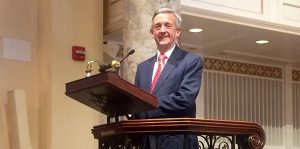
Robert Jeffress, pastor of First Baptist Church in Dallas, posted this image on Twitter, along with the tweet: “Honored to deliver sermon ‘When God Chooses a Leader’ for Trump/Pence private family service at St. John’s Church before ‪#Inauguration‬.”

The moment, captured on video, was a reminder of Trump’s robust support among conservative evangelical Christians, who have consistently backed the former president with upward of 80 percent voting for him in all three of his elections.

Among the crowd in Florida on election night, Nov. 5, was longtime Trump supporter Robert Jeffress, the pastor of First Baptist Church in Dallas, who preached a sermon to the businessman on the morning of Trump’s 2017 inauguration.

Jeffress described the atmosphere at Trump’s victory party as “electric” and suggested the vibe was similar when he returned to his church last Sunday.

“Our people were elated, for the most part, over the election results,” Jeffress said.

Conservative Christians have long celebrated what they see as the landmark successes of Trump’s first term, particularly his appointment of three conservative justices to the Supreme Court and their overturning of Roe v. Wade to end nationwide abortion access.

Hoping for more

This time, however, Jeffress and other evangelical advisers of Trump say they are hoping for more—although exactly what form those policies will take appears to be the subject of debate.

For Jeffress, a key policy concern for Trump’s second term is “protecting the religious freedom of all Americans.”

“The things (Trump) is most interested in is anything that will prohibit not only pastors from preaching what is in their heart, but what would keep laymen from exercising their faith in the workplace, whether it be doctors being forced to perform abortions or high school football coaches not allowed to pray before a football game,” Jeffress said.

Trump, for his part, promised during his campaign to create a federal task force to fight “anti-Christian bias,” saying if he didn’t win, Democratic presidential nominee Vice President Kamala Harris would “come after Christians all over the country.”

He also promised to get rid of the Johnson Amendment—a part of the tax code that prohibits churches from endorsing candidates—“permanently the next time,” after signing an executive order that weakened the restriction during his first term as president.

“They didn’t want you to speak to people, and if you did they take away your tax-exempt status,” Trump told a group of mostly pastors in Powder Springs, Ga. “And I said, ‘But these are the people that me and others want to hear from, and you’re not letting them speak. What’s that all about?’”

Foreign policy concerns

Franklin Graham, son of famed evangelist Billy Graham and head of the Billy Graham Evangelistic Association, said he hoped Trump would address a myriad of foreign policy concerns.

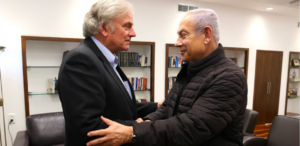
Franklin Graham meeting with Israel’s Prime Minister Benjamin Netanyahu Nov. 15, 2023, during a visit to Israel. (Screen shot from Franklin Graham’s Facebook page)

Graham said he was especially hopeful Trump would “find a way to negotiate an end to the war in Ukraine,” suggesting there should be a special ambassador appointed to go to Russia, which invaded Ukraine in 2022, to speak with Russian President Vladimir Putin.

“Democrats demonized the Russians so much that if you talk to them, it looks like you’re doing wrong,” said Graham, who also praised Trump’s efforts to forge a relationship with North Korean leader Kim Jong Un.

Graham also said he hoped Trump would work to establish peace amid the ongoing Israel-Hamas war in the Gaza Strip that has spread to southern Lebanon and the surrounding region. He noted the president-elect helped bring about a bilateral agreement on Arab-Israeli normalization known as the Abraham Accords during his first term in office.

Trump criticized Biden’s handling of the Israel-Hamas war and has urged Israel to “finish the job” and destroy Hamas.

“Now (Trump’s) got somebody who can help restart that and come up with a comprehensive peace deal for that region,” Graham said, referring to Trump’s decision to appoint real estate tycoon Steven Witkoff as his Mideast envoy.

Transgender students

Samuel Rodriguez

Samuel Rodriguez and Tony Suarez, the president and vice president of the National Hispanic Christian Leadership Conference, and both Trump faith advisers, listed a desire for Trump to act on “children’s and parental rights.” They especially noted transgender children who seek out gender affirming surgery, something conservative Christians have grown increasingly vocal in opposing.

Trump campaigned on the issue, pledging to roll back civil rights protections for transgender students and running an ad that declared “Kamala is for they/them. President Trump is for you.”

The president-elect has not detailed his plans to address the topic, although some conservatives have floated excluding transgender students from Title IX protections.

Doing so could alter policies in public schools regarding bathrooms, locker rooms and which pronouns students use. Since Trump was elected, transgender youth have flooded crisis hotlines, according to The Associated Press.

“We want policies that prevent government intrusion into children’s medical and personal development, particularly regarding sensitive issues like gender identity,” Rodriguez wrote in an email.

Evangelicals and other conservative Christians, he argued, oppose state-level policies that have “enabled government involvement” in “matters that should remain private and family-centered, respecting faith-based values in both education and public spaces.”

Rodriguez also wrote he hoped Trump would protect religious liberty in the United States and globally, including “policies that protect people of faith from government overreach and hostility.”

“Additionally, on the international stage, we hope to see the administration champion religious liberties, building a robust defense against all forms of totalitarianism, whether religious or secular,” Rogriguez stated.

Abortion still a major concern

Virtually every conservative Christian leader RNS spoke with mentioned abortion as a key issue of concern, although there were differences in terms of policy focus. The discrepancy may be a byproduct of the Republican Party’s struggles since Roe v. Wade was overturned in 2022.

Since then, multiple red states have either rejected attempts to curtail abortion rights or backed ballot initiatives that enshrine abortion rights in the state’s constitution. This election, advocates for abortion rights achieved victories in seven of the 10 states where abortion was on the ballot.

Even so, many conservative Christians are unwavering in their opposition to abortion. Suarez conveyed he hoped Republicans would be firmer in their anti-abortion stance despite recent political setbacks.

Doug Wilson, a pastor in Moscow, Idaho, who has advocated for Christian nationalism and become a rising star among conservative figures in Trump’s orbit such as Tucker Carlson, said he hoped the next president would focus on appointing conservative judges and justices, adding that he hopes “the pro-life issue” would “become an explicit litmus test” for any Supreme Court nominees.

Evangelical leaders were less uniform when discussing a potential national abortion ban, a policy some believe could happen now that Republicans have regained control of the U.S. House, along with the Senate and the presidency.

Trump distanced himself from the idea during his campaign, although he responded vaguely when asked during a debate whether he would veto a ban were he to occupy the Oval Office.

Ralph Reed, the head of the Faith and Freedom Coalition, dismissed the plausibility of a national abortion ban in a conversation with reporters last week, saying the policy is unlikely to get approved by Congress in the first place.

But Jeffress was more precise. He focused on the need for exceptions in abortion legislation.

“I think the majority of Americans … do not support banning abortion with no exceptions,” Jeffress said. “They may disagree on what those exceptions should be, but most people I know, including evangelicals, don’t believe that a mother ought to be forced by government to give up her life to possibly save the baby.”

He added: “I think what the president will do is what the president has said, and that is no national abortion ban—certainly (not) one that would outlaw abortion with no exceptions. He believes in the exceptions.”

The faith leaders also noted support for other policies that are not tied explicitly to faith, such as a desire to reduce immigration, which Trump has paired with a plan to enact mass deportations. Rodriguez and Suarez also said they hoped Trump would help pass a form of immigration reform.

But no matter what, for Jeffress and other evangelicals, there is trust Trump will pursue policies that reflect the support they’ve given him throughout his political career.

“I think what appeals to many evangelicals about Trump is they believe that President Trump will do effectively what (God) has commanded government to do,” Jeffress said.

“God never commanded government to lead a spiritual revival in America. That is not the responsibility of government. It’s the responsibility of the church and the responsibility of government, according to Romans 13 and 1 Timothy 2, to keep citizens safe from evildoers and leave Christians alone to practice their faith. That’s it.”


Individual approaches needed to engage Gen Z for Christ

Young people in Gen Z have little interest in religious systems and institutions, but they crave acceptance and meaningful connections, a campus minister and a college pastor told a Texas Baptist gathering in Waco.

Megan Trotter, Baptist Student Ministry director at Tarleton State University, and Manny Silva, college pastor at Renew Church in Waco, participated in a conference on “Engaging Gen Z with the Gospel” during Texas Baptists’ annual meeting.

Jordan Villanueva, instructor in Christian studies at Howard Payne University and facilitator of the panel discussion, explained Generation Z typically is understood as the cohort of young people born between 1997 and 2012.

While senior adults traditionally have been considered “the loneliest generation,” that label now best describes young people in Gen Z, Trotter asserted.

“They are dating less. They are seeing friends less,” she said.

Digital natives who prefer online interaction

Many of them feel awkward in social settings where they need to relate to people in person, rather than online, Silva observed.
“The in-person dynamic is intimidating to them,” he said.

Gen Z grew up with smartphones, computers and high-speed wi-fi access to the internet.

“They haven’t known life without social media,” Silva said.

Consequently, they also have grown up with access to pornography and were exposed to it much earlier than previous generations, Trotter added. Some 20-year-old students who come to faith in Christ have to break 10-year habits of daily pornography use, she noted.

“They lost their innocence a lot earlier than the generations that have gone before,” she said.

Gen Z also is accustomed to instant access to information from a variety of sources.

“They are used to a rapid response and want immediate results,” Silva said.

As a result, they often struggle with decisiveness, he observed.

“There is so much access to information, they think there’s always another answer,” he said.

Paradoxically, Gen Z is both isolated and globally connected, Trotter observed.

“They have more in common with people their own age on the other side of the planet than they do with people who are not their age right where they live,” she said.

‘Cautious of what they step into’

That makes them more empathetic to other cultures and concerned about social issues at some level. But at the same time, they have a strong distrust of social systems, Trotter noted.

Many have been marked by a “doomsday” mentality that numbs them to tragedies such as school shootings, she said. Life experiences have led them to adopt a defeatist attitude when it comes to sweeping social movements.

“They value what they can control,” Trotter said. “They value individualism. They say they want to be true to themselves—whatever that means. They value their truth, not other truth.”

Many in Gen Z did not grow up in stable families or in a church. So, they are hungry for the family-style belonging churches and small groups may offer, but they distrust institutions.

“They are mindful and cautious of what they step into,” Silva said.

‘Gen Z values authenticity’

Before a member of Gen Z visits a church, he or she will have done some online research—not just a Google search, but a close look at posts on YouTube, Instagram and TikTok, he added.

Since Gen Z values individualism, churches can use that to their advantage on social media if they emphasize people rather than programs, Trotter observed.

“The church is made up of individuals. Share the testimonies of individuals, and use pictures,” she suggested. “Tell who you are, not what you are doing. Emphasize human beings, not human doings.”

At the same time, don’t try to manipulate the church’s image by making it look more ethnically and generationally diverse that it really is.

“Gen Z values authenticity,” Trotter said.

Members of Gen Z favor a rough but real worship service led by honest amateurs over a polished production led by professionals, Trotter and Silva agreed.

Be patient and make lasting connections

Young people in Gen Z often don’t understand religious jargon and references to biblical stories or concepts, they added.

So, evangelism and discipleship with Gen Z requires patience, Silva said. At the same time, members of Gen Z are inquisitive about spiritual matters and open to talking about them at a deep level. Christians can plant gospel seeds if they invest time in young people.

Silva challenged Christians to open their homes to students in Gen Z, inviting them to share meals and family times, noting many are “missing that family dynamic.”

“Gen Z is receptive to faith-based conversations,” he said. “You’re working with good soil.”

Trotter agreed members of Gen Z thrive on individual connections, once adults have earned their trust.

“Many in Gen Z feel trapped in their isolation,” Trotter said. “They want to be accepted. They want to be mentored. Once you connect with them, they are easy to reach. Just don’t over-complicate the connection.”


Marriott: GC2 task ‘requires great unity’

WACO—Division is not hard to find in society, Baptist General Convention of Texas President Ronny Marriott, pastor of First Baptist Church in Richardson, told Texas Baptists at their annual meeting.

Pointing to business and politics as examples of societal division, Marriott urged Texas Baptists to remain committed to unity and love to make a difference in the world.

“Two of the pillars that help establish the kingdom of God are unity amidst diversity and the radical love of Jesus. We have diversity, and that causes conflict at times, but it can actually strengthen us at times,” Marriott said in his president’s message to Texas Baptists.

Displaying a photo of two Texas Baptists staff members in jerseys of opposing sports teams, he explained churches and leaders still can get along despite their differences.

Marriot pointed out “even our theology” can be a point of division. He cited pastor/author Greg Dutcher, who likens theology to looking at a sunset through a windshield. Dutcher says windshields work best when nobody notices they’re there.

“Good theology is like a clean windshield, allowing us to see the beauty and glory of God more clearly,” Dutcher explains. Individuals can still see the sunset through a dirty windshield, but maybe believers can work together to clean it and make the view clearer, when the theology obscures some of God’s glory.

Marriott, however, noted his concern that some “do little more than celebrate how wonderfully clear their theological windshield is.”

But theology isn’t an end in itself, any more than a windshield is. “It is simply a window to the awe-inspiring universe of God’s truth, filled with glory, beauty and grace.

“We must make sure that we know the difference between staring at a windshield and staring through one,” Marriott asserted.

Scriptural call for unity

Marriott drew from two Scriptures to drive home the importance of unity, including Jesus speaking in John 17:21: “May they all be one…that the world might know you have sent me.”

He also noted that the prophet Jeremiah warned God’s people how to live in exile. They were to get along and help the city to thrive.

“He encouraged them to be a good citizen and represent … God well. His kingdom is an upside-down kingdom to this world. Jesus said love your enemies,” Marriott said.

“Jesus said in my kingdom to bless those who curse you. If you want to be first, you have to be last and serve everybody. It doesn’t make sense. But we are citizens of that kingdom, and it is an eternal kingdom.”

Noting the many challenges believers face, Marriott said Texas Baptists’ emphasis on the Great Commandment and the Great Commission requires great unity.

“It is an unsurmountable task, but that’s why we need each other and need this convention to work together,” he said.

“When we gather together like this, we are a beautiful, bright tapestry of what it means to work together, to draw the eye to God. We are committed to diversity, but will our disagreement be more prominent than our cooperation? I pray not.”

Marriott also said the radical love of Jesus Christ is required to impact God’s kingdom.

“We are called to love the way Jesus did, even those who see us as enemies and persecute us. What does it say when the kingdom allows differences to get in the way of loving our brothers and sisters?” he said.

“The radical love of Jesus Christ changes people’s lives. It has transformed you and me, and it will change the world. I am convinced we will never carry out the Great Commission until we get better at the Great Commandment,” he added.

“I’m proud to be a Texas Baptist, and I’m proud of our convention. I believe the world needs the BGCT. They need us to be a strong life-giving convention that touches the ends of the earth.”

With additional reporting by Calli Keener.


Missions Foundation celebrates student ministry

WACO—At its annual luncheon during Texas Baptists’ annual meeting, the Texas Baptist Missions Foundation celebrated the work of Baptist Student Ministries around the state and offered updates on efforts to construct a new BSM building at Baylor University.

“According to the Apostle Paul, (God) is building a kingdom, with Christ Jesus as the chief cornerstone that’s in places where Jesus is King and where his ministry continues,” said Jerry Carlisle, president of the Texas Baptist Missions Foundation.

Joel Bratcher, BSM director at Texas A&M for 20-plus years, spoke of how the College Station facility—completed in 2001 with help from the foundation—has meant enlarged capacity for ministry.

“Student ministry is incredibly important because it validates what they are hearing about God when they see it lived out by other students,” Bratcher said, noting their building is surrounded by bars and student housing.

“We have a midnight pancake breakfast once a month on a Thursday night, and our students just sit down and talk with other students as they eat. You would be amazed at how those doors are opened for conversations,” he said.

Eric Bean, BSM director at the University of North Texas, said having a building accessible to students offers “an identity for our ministry.”

“At UNT, it is one of the most strategic building locations on any of our campuses, and I’m so thankful for donors that made this possible,” Bean said. “We are directly across from the Student Union Building, where around 6,000 students pass through every day. And it’s the largest bus stop on our campus, so about 5,000 students are dropped off for class right here.”

Bean said that location means more students drop in for lunches or other events and stay to build relationships.

“When we have our own space, it really does enhance the ability to do ministry,” he said.

Something similar has happened at Texas Tech University, where Jeff Kennon serves in the facility completed in 2019 with help from the foundation. Tech BSM’s ministry to international students particularly has been growing thanks to increased space.

“The building has screamed to students that we are there for them, that we care, and it looks like Texas Tech. Every week there are dozens of nationalities who come to our building, some that have never read the Bible,” Kennon said.

“It’s the Great Commission in reverse. We just open our doors. I’m not sure we could have pulled off these events in our old building. Not only is it about them coming to us, it’s also a place where we send students all over the world. Our building is a gift because you made that happen.”

Need for a BSM facility on the Baylor campus

Baylor BSM Director Will Bowden spoke of the program’s growth in his seven years and the great need for a dedicated facility.

The new building, which will be constructed on Baylor’s campus thanks to a land gift from the university, costs $7 million total.

Already, nearly $3.3 million has been raised. The Texas Baptist Missions Foundation has been awarded a $1.3 million challenge grant from the Mabee Foundation, to be received when the remaining $2.4 million is collected. The facility will be owned by Texas Baptists, who will have exclusive rights to its operation.

“I sometimes sit and pinch myself when I look at what God is doing here. There was a revamp (of the BSM at Baylor) in 2017, and we’ve been seeing God work,” Bowden said. “God is doing amazing things through Gen Z, and revival has begun.”

Quoting Mark 3:14, Bowden said students are learning both how to be with God and how to be sent out to preach. They have also taken advantage of students’ love for prayer, hosting the FM72 emphasis with prayer tents on campus for 72 hours and seeing 3,000 to 4,000 students come through to worship and pray for hours.

Pathway, a new ministry to freshmen, started with 50 students and had 410 attend this fall in its fifth year, comprising 12 percent of the freshman class.

The new building, Bowden said, will help accommodate leadership training events the current space simply won’t handle due to growth. Bowden noted his first year of ministry had 14 student leaders, while this current year the number has passed 200.

“We often have to find space on campus and compete with everything else. We have a lot of leaders, and sometimes we don’t get access. God still works, and he is moving, but I don’t know what it’s like to have a building for this ministry,” he said.

Eric Wyatt, vice president of the Texas Baptist Missions Foundation, encouraged support for the ministries that have a ripple effect across the world.

“God is moving on college campuses across our state,” Wyatt said. “BSM changes lives across the world. So, thank you for being here and supporting these projects. This building will be made a reality by a movement of God’s people.”


Trump taps Huckabee as ambassador to Israel

WEST PALM BEACH, Fla. (BP)—President-elect Donald Trump announced Nov. 12 he will appoint former Arkansas Gov. Mike Huckabee—a Baptist minister—as ambassador to Israel during Trump’s second administration, which will begin upon his inauguration Jan. 20, 2025.

“I am pleased to announce that the Highly Respected former Governor of Arkansas, Mike Huckabee, has been nominated to be The United States Ambassador to Israel,” Trump said in a statement.

“Mike has been a great public servant, Governor, and Leader in Faith for many years. He loves Israel, and the people of Israel, and likewise, the people of Israel love him. Mike will work tirelessly to bring about Peace in the Middle East!”

Huckabee, a former Southern Baptist pastor, is an outspoken supporter of Israel, especially in its ongoing conflict with Hamas in the wake of Hamas’ attacks in October 2023. He has endorsed the International Fellowship of Christians and Jews, and he has led several Christian tours of the Holy Land.

In an interview with Jewish News Syndicate earlier this year, Huckabee called Hamas’ actions “not just criminal, but evil.”

“I tell people this is not a political, sociological, economic battle. This is a spiritual battle,” he said. “This is as clear a definition between good and evil as we have seen in our lifetime and one of the most profound in all of history.”

Huckabee has been vocally opposed to a cease-fire in the conflict.

“This is like trying to negotiate with the Nazis in World War II. You just don’t,” he told NewsNation in June. “You beat them. You defeat them. You eradicate them.”

Huckabee sought the Republican presidential nomination in 2008 and 2016 in campaigns focused on social issues.

“We witnessed the slaughter of over 55 million babies in the name of choice, and we are now threatening the foundation of religious liberty by criminalizing Christianity and demanding that we abandon biblical principles of natural marriage,” he said in launching his 2016 campaign.

In 2017, he launched a self-titled television show on religious broadcaster Trinity Broadcasting Network. He told Baptist Press at the time that he hoped the show would be a vehicle for civil discourse.

“I want people to help me understand, not so much the ‘what’ of their belief system; tell me the ‘why,’” he said. “How’d you get there? What was it that led you to the conclusion? Whether it’s healthcare or a tax policy, tell me how that makes the country better and why you believe it does.”

Before his political career, Huckabee was pastor of churches in his native Arkansas. He served as president of the Arkansas Baptist State Convention from 1989 to 1991. He is a graduate of Ouachita Baptist University.


Texas Baptists panel discusses women in ministry

WACO—A panel discussion on the role of women in ministry—attempting to offer a space to listen to a diversity of views on women in ministry and learn from each other’s biblical interpretations—closed out the Baptist General Convention of Texas annual meeting.

Almost 700 stayed after the close of business to attend the panel discussion.

“We have had conversations about the role of women in ministry for the last 25 to 30 years … and the place that we consistently land on is local church autonomy,” said Executive Director Julio Guarneri, who moderated the discussion.

Texas Baptists have held that whatever position a church takes on this issue, it is not a “test of fellowship.”

Yet, convention leadership wanted to offer an opportunity to hear from diverse individuals on the topic “in a way that is friendly and respectful,” Guarneri explained, “so that we can have mutual understanding as a Texas Baptist family.”

The panel included Baylor’s Truett Theological Seminary Dean Todd Still and Malcolm Yarnell III, research professor of theology at Southwestern Baptist Theological Seminary, presenting academic positions.

Panelists providing pastoral perspectives were Dwight McKissic, pastor of Cornerstone Baptist Church in Arlington; Maddie Rarick, pastor of Meadow Oaks Baptist Church in Temple; Miguel Lopez, pastor of First Baptist Church Duncanville; and Steve Bezner, pastor of Houston Northwest Church.

All the panelists said they affirmed the dignity of men and women and some level of support for women to minister and serve within the church.

Discussion of differences

Guarneri asked panelists if the institutions or churches where they serve held an official position on women in ministry and how they reconcile their personal views with that position.

Truett Seminary has taken a clear position affirming both men and women are called by God to serve as pastors, ministers and in other ministerial vocations, Still responded. He referred those interested in a fuller statement to the seminary’s Women in Ministry link, a pamphlet he wrote on the subject.

Additionally in that pamphlet, Still said he finds “no or clear compelling biblical grounds to preclude and ample scriptural materials to support women’s full and free participation in the church’s ministry as God might gift and guide.”

Yarnell said Southwestern Seminary, as an institution governed by the Southern Baptist Convention, affirms the 2000 Baptist Faith and Message and its 2023 revision related to this issue, and he “resonates with that confession.” But his current church, Lakeside Baptist Church in Granbury where he is teaching pastor, affirms the 1963 Baptist Faith and Message.

Pointing to his mentor, Leo Garrett’s, conviction that there was “no substantial confessional reason the Southern Baptists, Baptist General Convention of Texas and Southern Baptists of Texas or Baptist Missionary Alliance should be divided” on different revisions of the Baptist Faith and Message, Yarnell said he agreed with Garrett’s position.

McKissic said he coined the term “kingdomarian”—versus egalitarian or complementarian—as a better descriptor for how women and men ought to function within the kingdom of God.

“It ought to be a partnership, … and men and women would partner together to advance the kingdom of God, sort of like Paul and Pheobe, or Priscilla and Aquilla. I see many models in Scripture of men and women partnering together advancing the kingdom.

“And I don’t recall all these theological debates in the Bible about what a woman can and cannot do,” McKissic said. The highest paid people on his church staff are women, and women preach there often, he noted.

McKissic also pointed out he believes 1 Timothy 2:12 speaks into a context where men were being excluded from church participation, so the text’s intention was to say “don’t exclude the males,” not to silence women for all time, bringing it back to a kingdom partnership between men and women.

Rarick said her church affirms the 1963 Baptist Faith and Message, and women serve in leadership in all areas of her church. The church is firmly congregational, so “I always joke that I really don’t have very much power there,” she noted.

The church’s congregational model lends itself to a strong emphasis on the gifts of its members to serve where they are spiritually gifted to serve, and she agrees with that.

Lopez said his church affirms the 2000 Baptist Faith and Message. He cited creation order and redemption order as weighty pieces in understanding “what we should or shouldn’t do.”

While his church invites all men and women “to grow to their fullest redemptive potential,” he asserted the church should look different than the world, saying 1 Timothy limits the office of elder to males.

Lopez reconciles this through his conviction that Jesus is the head of the church, and the “head of the church is the God-man, not the God-human, the God-man forevermore. If we can all submit to this man, maybe we can all submit to each other.”

Bezner explained his background is in ministry contexts where women were seen as fully equal to men. Yet the church where he serves was a church where women’s participation in worship was extremely limited.

Despite reservations, both he and the church believed the Holy Spirit was leading him to serve there. Some aspects of women’s service they were able to change quickly and easily when he arrived.

Other changes, however, required a larger conversation. Through a committee and ground rules to help build trust, the church eventually decided they would affirm women serving in any role except that of elder.

Bezner was able to reconcile his own views with this compromise by spending hours of time over multiple years examining the texts with people whose views differed from his own.

“But I came to recognize that they love Jesus, and they love the Scripture. And I could worship with those individuals,” he said.

Panelists also provided biblical justification of their positions.

McKissic noted in Revelation 2:18, “Jesus addressed the content of what was taught, not the container.” In the passage, Jesus had ample opportunity to say she shouldn’t have been preaching because she was a woman, but he didn’t.

“If the fundamental problem was that she was a female, I think he would have addressed that as being the core issue. … If Jesus could approve of a woman in a coed group in a New Testament church, why can’t I?” McKissic noted. Then he literally dropped the mic.

Additional responses

But the discussion continued.

Rarick recalled meeting with the panel a few weeks earlier and appreciating the diversity of views along a continuum. But, she noted, “It’s important when we hear about women in ministry that we hear from a variety of women in ministry.”

Bezner stated he will feel at home with Texas Baptists for as long as the BGCT remains a place where the “words of life are proclaimed.”

There are no perfect churches or denominations, but “I heard Al Curley preach the words of life. I heard Meghan Hendrickson preach the words of life. Dr. Joel Gregory preached the words of life. And even though he said it wasn’t a sermon, Dr. Ronnie Marriott preached the words of life. … So, why would I leave?”


Keynote addresses focus on Jesus’ kingdom agenda

WACO—Keynote speakers at Texas Baptists’ annual meeting expounded on various aspects of Jesus’ “kingdom agenda” as revealed in the Gospels.

“The kingdom of God was never designed to stop with us,” said Meghan Hendrickson, director of the Dallas Baptist University Baptist Student Ministry.

“I’m convinced that everything God pours into us, he desires to pour out through us. Jesus poured his life out for us. So surely, we should do the same.”

Hendrickson preached from Matthew 13:1-23 about the Parable of the Sower.

“On the day of our salvation, we were marked by good soil,” Hendrickson said, referencing the seeds that were cast on various types of soil in the parable.

“But my concern is that somewhere along the way, as we get older and busier, the soil of our souls has become shallow, rocky and surrounded by thorns as the worries and cares of this life are crowding out our greatest love and truest purpose.”

Invest time to make disciples

Hendrickson encouraged Texas Baptists to spend time with God, reminding them that without him, they cannot effectively disciple others.

She talked about a Hebrew class she struggled with in seminary. When she set apart some time with her teacher for individual instruction, she understood the concepts quickly and was able to excel.

Similarly, without concentrated time with the Lord, Christians are unable to produce meaningful discipleship, she said.

“Apart from him, we can do nothing, and yet sometimes we think we can produce something even though we’re disconnected from the vine,” she said.

Hendrickson talked about the difference individual and small-group discipleship is making among students involved in the BSM at DBU.

She also warned against being tempted to expedite discipleship by simply proclaiming a message broadly to the masses. Though culture lauds widespread, broad efforts to share information, it seldom brings about change.

“If we want to see the reign of Christ on college campuses and beyond, we have to be willing to go small to grow big. Some of Jesus’ more memorable moments are times with individuals that others did not have time for. A small seed grows into a big plant,” she said.

She described the amazing work already happening on campuses across the nation, where students are open and hungry to learn more, she said.

“God is at work among this generation of college students, and he’s going to do it whether we join him or not. But don’t we want to join a God like that?” Hendrickson asked.

“All of us have been assigned a field by God that he expects, invites and equips us to go out into and sow gospel seeds. Are we joining him in the harvest?”

Make the invisible kingdom observable

Joel Gregory, retired professor of preaching and evangelism at Baylor University’s Truett Theological Seminary, said the kingdom of God is a gift.

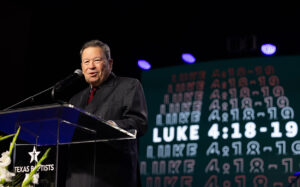
Joel Gregory preaches at Texas Baptists’ annual meeting in Waco. (Photo / Texas Baptists)

“We don’t build the kingdom. The kingdom builds us,” Gregory said.

Jesus is sovereign over the everlasting kingdom of God. While the reign of earthly kings eventually comes to an end, “The King of Kings has no expiration date,” he said.

The kingdom comes without observation, Gregory noted.

“It’s our job to make visible that invisible kingdom so that people are born from above and see the kingdom of God,” he said.

The kingdom of God possesses inherent power with a “principle of life in it.” It is a “remarkable power we can’t explain,” Gregory said.

God’s kingdom arrived when the King of Kings entered human history, but it awaits its consummation at the Second Coming of Christ, he noted.

“The kingdom of God is already but not yet,” he said.

Some preachers shy away from preaching on the Second Coming because of the excesses of some date-setters, but Gregory reminded Texas Baptists: “You don’t preach the whole gospel if you don’t preach that blessed hope.”

‘The clarity of the gospel’s agenda’

Al Curley, III, executive pastor of Cornerstone Church in Arlington, preached on “the clarity of the gospel’s agenda.”

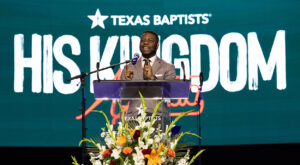
Al Curley, III, executive pastor of Cornerstone Church in Arlington, preached on “the clarity of the gospel’s agenda.” (Photo / Texas Baptists)

The clear source of the gospel is the Spirit of God in his people, Curley said.

“Without the Spirit, we are at most successful in the eyes of man, but not in the eyes of God,” he said. “When the Spirit of the Lord is on you, the Spirit should be able to do some work in you and through you because the gospel has an agenda.”

Curley said the system of the gospel is clear: “to preach the good news to the poor and to proclaim release to the captives” (Luke 4:18).

“Beautiful feet are sticky feet—feet that seek to get in and get on and get around those they encounter with the gospel,” he said.

The strategy and the subject of the gospel similarly are clear, Curley noted. They are “to preach the good news to the poor, to proclaim release to the captives, recovery of sight to the blind, to set free the oppressed” (Luke 4:18).

“But the gospel imposes on all humanity the need for a chain-breaking Christ to provide grace to the oppressed, mercy to the oppressor, forgiveness for the sinner that they might have freedom in new life,” he said.

Finally, Curley pointed to the significance of the gospel, which is that “scripture has been fulfilled in your hearing” (Luke 4:21).

“The significance of the gospel is found in the sufficiency of Christ, that God has already done the work,” he said.

‘Peace, healing and justice’

Albert Reyes, president and CEO of Buckner International, said the kingdom Christians are offering the world is “a kingdom of wholeness” that “offers peace, healing and justice.”

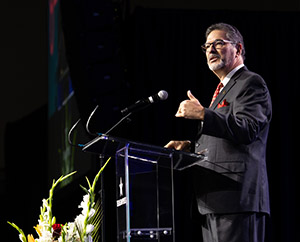
Albert Reyes, president and CEO of Buckner International, preaches at Texas Baptists’ annual meeting in Waco. (Photo / Texas Baptists)

Referencing John 14:27, Reyes said Jesus is the Prince of Peace who gives peace “not like the world gives.”

“The world gives you peace in the absence of conflict, in the absence of difficulty, in the absence of problems,” said Reyes. “[Jesus] gives you peace in the presence of conflict, in the presence of animosity and the presence of difficulty … That’s when the Prince of Peace steps up when it doesn’t make sense, and so he gives you the peace that passes all understanding.”

Reyes noted the healing Jesus offers often is a gradual, therapeutic type of healing.

He compared it to the response of the Good Samaritan to the man who was lying wounded by the roadside.

“It’s a Samaritan investment that says, ‘We’re going to help you now, and I’m coming back for whatever’s needed to get you to the point [where] you have wholeness and healing and restoration,’” he said.

The kingdom of God offers justice, Reyes said, noting “when the kingdom comes near, things change.”

“When we invade the space of people who need hope, we take the King and the kingdom with us. And when we see things that are wrong, we start to ask, ‘What would the King want done in this situation?’ And then we get to work,” Reyes said, describing the church as “the sign and the agent of the kingdom of God”

Compiled from reports by Bonnie Hirschfeld of Texas Baptists Communications, with additional reporting by Managing Editor Ken Camp.


Matt Queen resigns pastorate after guilty plea

GREENSBORO, N.C. (BP)—Three weeks after pleading guilty to a charge of making false statements to federal investigators as part of a sexual abuse investigation stemming from his time as a seminary administrator, Matt Queen has resigned as pastor of Friendly Avenue Baptist Church, the church announced Nov. 8.

In a press release, the church said: “Dr. Matthew Queen is stepping down from his role as Lead Pastor at Friendly Avenue Baptist Church, effective immediately. While this has been a challenging season, we continue to trust in God’s sovereignty and remain focused on our mission. As we move forward, we encourage our congregation and the wider community to stay focused on Jesus, the author and perfecter of our faith.”

Queen pleaded guilty to making false statements to federal investigators on Oct. 16 after he had previously pleaded not guilty to federal charges in May.

Sentencing for Queen is set for Feb. 26, 2025.

Church leaders placed Queen on administrative leave after his initial plea of not guilty in May. After Queen changed his plea in October, church leaders said in a statement that they were “reviewing these recent developments as it works to complete its investigation and submit a recommendation to the church membership concerning Dr. Queen’s status and relationship with Friendly Avenue Baptist Church, all in accordance with the church’s governing documents.”

Prior to being called as pastor of Friendly Avenue Baptist Church in February, Queen served as interim provost at Southwestern Baptist Theological Seminary.

During Queen’s tenure at Southwestern, the seminary was part of a broader investigation by the U.S. Department of Justice into allegations of sexual abuse and misconduct involving the Southern Baptist Convention and its entities.

The investigation included Southwestern Seminary’s handling of a report of an alleged sexual assault by a student. Investigators said Queen provided false information to them in the form of written notes in a notebook during the investigation.

Following Queen’s guilty plea in October, Southwestern issued a statement that said, in part: “From the beginning, Southwestern Seminary has fully cooperated with the Department of Justice in its investigation of sexual abuse in the Southern Baptist Convention. We remain resolute in our commitment to continue to do so.”

The statement said the seminary is praying for “victims of sexual abuse and remains committed to doing everything possible to protect all members of the seminary community from sexual abuse and harassment.”

The statement also offered prayers for “Matt Queen and his family, as well as for others who have been involved in this process.”


Hispanic Texas Baptists encouraged to follow Jesus’ agenda

WACO—Albert Reyes, president and CEO of Buckner International, challenged leaders of Hispanic Baptist churches in Texas to look to the beginning of Jesus’ public ministry to learn his agenda and adopt it as their own.

Reyes addressed a gathering sponsored by Texas Baptists en Español immediately prior to Texas Baptists’ annual meeting in Waco.

Drawing from the passage in Luke 4:14-30 where Jesus reads from the Prophet Isaiah, Reyes urged Hispanic Baptist church leaders to look at and learn from the words that launched Jesus’ public ministry.

“First, we see that Jesus went to Nazareth to the synagogue to begin his ministry after he had been tempted. Some of your best ministry days will happen after a tough time,” Reyes said.

“Second, he was full of the power of the Spirit. If you don’t have the power of the Spirit upon you, you have nothing to offer.

“Finally, he starts with the word of God. If Jesus starts with the word of God, we need to start with the word of God.”

Meeting needs opens doors to share hope

The passages Jesus chose outlined his agenda clearly, Reyes said.

Jesus was anointed to “bring good news to the poor,” which Reyes said points to providing for physical needs that open doors to share hope.

“When you have redemption, you do have life. [Being in church] puts you in a community where people that see that you don’t have things will see that you do,” he said, sharing some of his father’s story growing up in poverty.

Reyes also noted Jesus’ agenda included “healing the brokenhearted” and proclaiming “freedom for the captives” by offering hope.

Physical healing also was part of Jesus’ ministry, noted through his reference to “recovery of sight for the blind.”

Next, Reyes said Jesus sought to bring “liberty to the oppressed,” noting, “If you find someone oppressed, you should help them.”

“The people were oppressed by the Romans. … And Jesus said he was coming to help them. They thought they would have an army to conquer them, but that’s not what Jesus was concerned with,” Reyes said,

Instead, Jesus brought spiritual liberty through his death and resurrection, bringing salvation to all who proclaim his name.

Jesus’ agenda included proclaiming “the year of the Lord’s favor.” Reyes said the reference was to the year of jubilee, when all debts were forgiven. He encouraged attendees to count their blessings and the favor the Lord has given.

‘You don’t have to wait’

Reyes noted Jesus brought the kingdom near, saying what he meant to do and then doing all those things.

“This scripture is fulfilled in your hearing,” Jesus said.

“The kingdom is here now. … He was announcing a new era,” Reyes said. “I think the kingdom was when Jesus said it was. In the kingdom of God, people get healed, have peace, get blessings and when did that happen? Right then.

“The kingdom is already and yet to be. You don’t have to wait. You can have it now. He makes all things new on that day that we see him. That’s the someday. But we get to taste it now. Don’t live your life thinking the kingdom is just someday. It’s today.”

Also at the rally, Armando Virgen, pastor of Primera Iglesia Bautista Waco for 53 years, received the Gary Cook Leadership Award from Dallas Baptist University for his 61 total years of pastoral ministry.

“We praise God for the countless lives blessed in his ministry,” Gus Reyes of DBU said. Virgen baptized more than 450 believers, helped the church build a sanctuary and started an adopt-a-student ministry with colleges.

Vidal Muniz, Texas Baptists en Español specialist, also spoke briefly about the Pave program of church revitalization, and he recognized pastors who have been participating in that process of helping grow their congregations.

Rene Maciel, missions pastor at First Baptist Church of Woodway, described “Esperanza de Dios,” his church’s three-year effort to reach the community by sharing hope through practical ministry to the area.

“Everything we do, we have a chance to be involved in the community, like our laundry ministry,” Maciel said. “We go into the laundromat and pay for their laundry, and we take drinks and snacks, sit around and just talk to people. It’s not about us, but God opens doors and conversations where they ask what we are doing. We want to love our community.

“Everything we do when we visit is to share the hope of God. It’s about the church of Jesus Christ being present.”


Guarneri: Partnerships key to kingdom work

WACO—Strategic partnerships and cooperation are key as the Baptist General Convention of Texas looks to the future, Executive Director Julio Guarneri told Texas Baptists.

“The challenges before us are enormous,” Guarneri said in his first report to a BGCT annual meeting as executive director.

However, he noted in his Nov. 11 report to Texas Baptists’ annual meeting in Waco, Texas Baptists long have recognized they are one part of a much larger movement—the kingdom of God.

He cited Article II of the BGCT Constitution, which states the object of the convention is to “awaken and stimulate among the churches the greatest possible activity in evangelism, missions, Christian education and benevolent work and enterprises; to cultivate a closer cooperation among the churches and promote harmony of feeling and concert of action in advancing all the interests of the Redeemer’s Kingdom.”

Texas Baptists have “had a kingdom agenda from the very beginning,” he said.

Guarneri offered a report from a study group that has been working over the past year to clarify Texas Baptists’ calling and values and the GC2 initiative,

Texas Baptists’ new missional theme is “strengthening a multiplying movement of churches to live out the Great Commandment and Great Commission in Texas and beyond,” he announced.

‘We want to be known by what we value’

The study group identified seven values to guide Texas Baptists’ work moving forward.

Texas Baptists seek to be “biblically faithful, gospel-centered, historically rooted, future-thinking, beautifully diverse, servant-hearted and kingdom-collaborating,” he said.

“These are the values that will inform our work. They describe our unique identity as Texas Baptists,” he said. “We want to be known by what we value.”

Guarneri also presented a two-pronged approach for the GC2 Pathways—churches and connections.

“Whether churches are in the planting stage or ready to thrive, or expanding or multiplying, Texas Baptists wants to come alongside and strengthen this movement of GC2 churches,” Guarneri said.

The clarified mission, values and GC2 Pathways are all to help Texas Baptists continue to meet the needs of a growing state, he emphasized.

By 2050, Texas’ population is projected to double, he noted. If trends continue, there will only be one Baptist church for about every 16,000 people in the state, he said.

“A multiplying movement of GC2 churches is not an option. It’s a must,” Guarneri said.

Through GC2 Pathways, Texas Baptists will focus on meeting churches where they are and working together for God’s kingdom, he explained.

Importance of networking and partnerships

The goal is to connect churches to the resources they need to continue their development, he said. Those resources not only include Texas Baptists’ programs and ministries, but also networking with institutions and entities in Texas and beyond that share the same passion for advancing.

The Southern Baptist Convention’s International Mission Board and North American Mission Board continue to be key partners with Texas Baptists and most BGCT-affiliated churches, he said.

While NAMB’s unwillingness to fund churches planted within Texas by uniquely affiliated BGCT congregations has been a matter of concern, Texas Baptists and NAMB leaders have “gained greater mutual understanding” through meaningful conversations in recent months, he reported.

As evidence of Texas Baptists’ desire to collaborate with other groups beyond the state in kingdom enterprises, Guarneri concluded his report by publicly signing partnership agreements with representatives of eight groups.

They are the National Baptist Convention of Mexico, the Brazilian Baptist Convention, the Baptist Union of Ukraine, the National Baptist Convention of America, the Baptist Convention of Argentina, the Baptist Union of Scotland, the GlocalNet church mobilization and multiplication movement and the Baptist World Alliance.

With additional reporting by Bonnie Hirschfeld.


BGCT rejects call to affirm 2000 Baptist Faith & Message

WACO—Messengers to Texas Baptists’ annual meeting soundly defeated a motion affirming the 2000 Baptist Faith & Message, the Southern Baptist Convention statement of faith that limits the role of pastor to men.

Jeff Williams, pastor of First Baptist Church in Denton, made a motion “that the Baptist General Convention of Texas affirm the 2000 Baptist Faith & Message.” (Photo / Calli Keener)

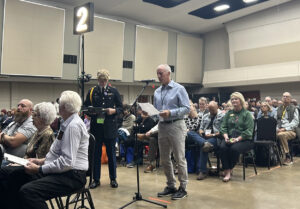
During the Nov. 12 business session, messengers debated a motion by Jeff Williams, pastor of First Baptist Church in Denton “that the Baptist General Convention of Texas affirm the 2000 Baptist Faith & Message.”

North American Mission Board President Kevin Ezell raised the issue of the Baptist Faith & Message in response to a question from a Texas Baptist pastor at the SBC annual meeting in June.

Ezell said NAMB will not fund church starts within Texas in partnership with uniquely BGCT-affiliated congregations and suggested Texas Baptists change their statement of faith. He said NAMB’s “longstanding commitment” is to start churches in partnership with state conventions that affirm the 2000 version of the Baptist Faith & Message.

“I cannot and will not change that standard,” Ezell said. “But I would love for you to consider and for your state convention to adopt the Baptist Faith & Message 2000.”

Williams was one of several Texas Baptist pastors involved in an Aug. 15 meeting in Dallas involving BGCT and NAMB representatives.

Speaking in favor of his motion from the floor of Texas Baptists’ annual meeting, Williams said his intention was not for the 2000 Baptist Faith & Message to replace the 1963 Baptist Faith & Message as the BGCT statement of faith, but that it would stand alongside it.

Williams pointed out statements in BGCT Executive Director Julio Guarneri’s report noting the rapid population growth in Texas.

“I think we’d all agree we need hundreds—if not thousands—of new churches here in Texas to reach those people with the gospel of Jesus Christ,” Williams said.

“I believe we need to give our churches every opportunity—every resource available—to help them to start those churches in the decades to come.”

Williams voiced his belief NAMB has done “a wonderful job in the last couple of decades in helping churches start churches, and I think we need to do all we can to help our churches work with NAMB to start those churches.”

Debate for and against the motion

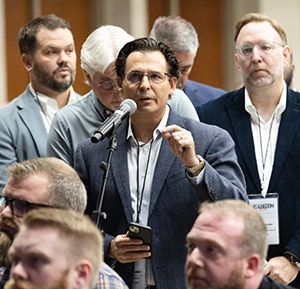
Long lines quickly formed at each microphone on the floor of the convention center hall as pastors and other messengers prepared to present arguments for and against the motion.

Randel Everett, former BGCT executive director and messenger from First Baptist Church in Waco, noted he has spent the last 10 years with 21Wilberforce advocating for believers globally who are persecuted for their faith.

As his organization stood alongside persecuted people of faith, he noted, members of the persecuted church globally asked for prayer, but they never asked about a statement of faith.

“I pray that we’ll not be distracted by debate over a 25-year-old controversial statement of faith but that we’ll focus on what we’ve focused on here this week—the Great Commandment and the Great Commission,” Everett said.

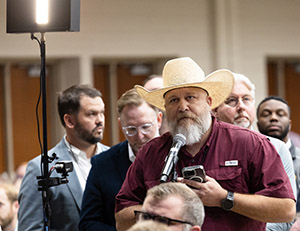
Pete Pawelek, pastor of the Cowboy Fellowship of Atascosa County, spoke in favor of the motion to affirm the 2000 Baptist Faith & Message. (Photo / Texas Baptists)

Pete Pawelek, pastor of the Cowboy Fellowship of Atascosa County, spoke in favor of the motion, saying it honors the principle of local church autonomy by leaving the decision of a statement of faith up to individual congregations.

Currently, the BGCT includes churches that affirm the 1963 Baptist Faith & Message, the 2000 Baptist Faith & Message and the 19th century New Hampshire Confession of Faith, he noted.

“While our convention has affirmed these other confessions in various ways at various times in our history, we—to my knowledge—have never officially affirmed the 2000 BFM,” Pawelek said.

“Since we accept it in practice and allow our churches to adopt it, it only stands to reason that we would affirm it on this day and put on paper what we practice.”

He further asserted: “A ‘no’ vote on this motion will put our convention in a very challenging and precarious position. If we proclaim to the world that we do not affirm the BFM 2000, we risk distancing ourselves from many of our Texas Baptist churches that not only affirm it but that have adopted it as their confession.”

Brent Gentzel, pastor of First Baptist Church in Kaufman, spoke against the motion, saying his church encourages its members to exercise the kind of gifts named in Ephesians 4:11-12 for the building up of the church. For a quarter-century, he noted, his church has used the term “pastor” to refer to people who are doing the work of a pastor, without regard to gender.

“So you can imagine my surprise when three of the women of our church staff found their names and faces plastered on the SBC blacklist that was blasted out to tens of thousands of churches across America a year and a half ago,” Gentzel said.

The SBC has been “weaponizing” the 2000 Baptist Faith & Message to declare that no woman can pastor in any capacity in any church, he said.

Taylor Lassiter, pastor of College Heights Baptist Church in Plainview, spoke in favor of the motion on the grounds of “biblical clarity and gospel cooperation.” Affirmation of the 2000 Baptist Faith and Message would strengthen Texas Baptists’ clear commitment to Scripture and to partnerships that advance the spread of the gospel, he asserted.

“Let’s do what it will take to link arms with other Baptists committed to the Great Commission and the Great Commandment,” he said.

‘It wasn’t written for us’

David Lowrie, pastor of First Baptist Church in Decatur, spoke against the motion. While he identified himself as a Southern Baptist pastor, he noted a significant minority of churches affiliated with the BGCT are not related to the SBC.

“Many of our brothers and sisters cannot in good conscience affirm this Baptist Faith & Message,” Lowrie said. “It was written by Southern Baptists for Southern Baptists. It represents well many of the values of Southern Baptists, but it wasn’t written for us. It doesn’t represent us.”

Regarding the issue of cooperation, Lowrie noted, the BGCT forwards more money—about $72.8 million—to the SBC than the Southern Baptists of Texas Convention. NAMB willingly cooperates with SBTC in church planting, but not with the BGCT.

“How do you define cooperation if $72.8 million does not represent a good faith commitment to the mission of the Southern Baptist Convention?” he asked. “Our Texas Baptist Southern Baptist churches are being treated as second-class citizens—even as stepchildren—and that is simply not appropriate.”

Daniel Perez, pastor of First Baptist Church in Los Fresnos, spoke in favor of the motion, saying churches that allow women to serve as pastors are departing from “God’s design.”

“You’re not helping the kingdom. You’re not breaking chains and setting women free to serve as pastors. You’re breaking God’s heart,” he said.

Failing to limit the pastorate to men is a “downward spiral” that leads to compromise with “clear” biblical principles in other areas, Perez insisted.

Ross Chandler, pastor of First Baptist Church in Marble Falls, spoke against the motion to affirm the 2000 Baptist Faith & Message. (Photo / Texas Baptists)

Ross Chandler, pastor of First Baptist Church in Marble Falls, spoke against the motion, saying Texas Baptists have “thoughtfully and prayerfully” not adopted the 2000 Baptist Faith & Message on biblical and theological grounds.

He noted the 2000 version of the statement of faith removed an important sentence that was part of the 1963 Baptist Faith & Message: “The criterion by which the Bible is to be interpreted is Jesus Christ.”

At the same time, the 2000 statement of faith added language limiting the pastorate to men as if biblical teaching about the role of women is beyond debate, he said.

“It’s not that clear,” he asserted, citing New Testament verses that could be used to support women in ministry, alongside others that are used to place limits on women.

“The SBC has gotten it wrong. The SBC and NAMB are hurting the kingdom of God,” Chandler said. “It’s not biblical or right to push that on us.”

2000 BF&M ‘fundamentally different’

After a motion to stop debate failed, the chair recognized Matt Snowden, pastor of First Baptist Church in Waco, who spoke against the motion, saying it would “draw a circle” that would exclude many churches, as well as exclude institutions such as Baylor University’s Truett Theological Seminary.

“That represents a fundamental shift in our identity, our culture and our purpose,” Snowden said. “I ask you, I plead with you, don’t do something unnecessary and potentially devastating. It doesn’t make much sense.”

Jordan Velazco, pastor of Lone Oak Baptist Church, spoke in favor of the motion, insisting it would not infringe upon local church autonomy. He also said the 2000 Baptist Faith & Message affirms other important matters not dealt with in the 1963 statement of faith.

Bruce Webb, pastor of The Woodlands First Baptist Church, spoke against the motion, saying Texas Baptists have opposed the 2000 Baptist Faith & Message on the basis of their commitment to the authority and sufficiency of Scripture and the lordship of Jesus Christ.

Earlier confessions of faith made it clear they were simply expressions of commonly held beliefs, not a binding creedal statement, but the 2000 Baptist Faith & Message is “fundamentally different,” he asserted.

“I have PTSD from serving on a committee with God-fearing Southern Baptist missionaries who were fired 25 years ago because this document was used to fire them,” Webb said. “It was written by a group of partisan Baptists with the purpose to control and divide.”

Texas Baptists intentionally have rejected the 2000 Baptist Faith & Message for more than two decades, and they should continue to do so, Webb asserted.

They did, by a clear margin.

In other miscellaneous business, messengers approved without opposition a motion by Steve Vernon of First Baptist Church in Belton to grant the BGCT Executive Board authority “to review and act on its behalf regarding the change of Baptist University of the Américas status from a single-member corporation to a nonmember corporation.”

During the morning business session, messengers also elected Bill Arnold of Park Cities Baptist Church in Dallas as secretary of the corporation and Michael Evans of Bethlehem Baptist Church in Mansfield as registration secretary.

EDITOR’S NOTE(11/13/24): Lone Oak Baptist Church’s pastor’s name was corrected from John to Jordan Velazco.