Do pre-Christians need to belong before they can believe and become?

It’s emblazoned on the sign outside Gayton Baptist Church in Richmond, Va.—Belong. Believe. Become.

Those three verbs—in various word orders — crop up frequently in discussions on evangelism and a congregation’s role in it. For some, it’s a promising harbinger of new approaches to reach non-Christians.

“I’m hopeful about the discussion on belonging, becoming and believing,” said Keith Herron, pastor of Holmeswood Baptist Church in Kansas City, Mo.

The belong/believe/become sequence could result in congregations with deeply connected members—but who have not yet professed faith in Christ.

A different word sequence—believe, become, belong—described the normative pattern of coming to faith in the 20th century, said Mark Tidsworth, president of Pinnacle Leadership Associates, a church consulting group.

Converts “first gave intellectual assent to a body of beliefs,” Tidsworth wrote at EthicsDaily.com late last year. “Then pilgrims ‘belonged’ to a church as members. Then we worked to develop them as believers, growing and maturing in the faith.”

That progression isn’t adequate in a postmodern world, Tidsworth maintained.

“First, postmodern people need to experience Christ through real-live people before they can move toward belief,” he said. “When they experience this genuine faith, observing Christ-followers giving themselves in love for the good of the world, then they think there may be something to this. Then they are interested in participating with this group.

“After experiencing this group actually loving one another, then they come to identify with the group,” he said. “Thus, the opportunity to believe unfolds. Based on this experience, on belonging with this group, and becoming a different person, then I am willing to risk that Jesus Christ is real and trust these beliefs.

“The outcome is the same—faith in Christ—but the predictable pathway we plaster on signs is all a-jumble.”

The new pattern suggests something different from the seeker-sensitive worship services that bloomed at the end of the 20th century. The belong/believe/become sequence could result in congregations with deeply connected members—who have not yet professed faith in Christ.

Jim Somerville, pastor of First Baptist Church in Richmond, Va., finds something of that pattern in the Gospels.

Jesus “is not trying to make converts; he’s trying to make disciples, a word that could also be translated apprentices,” said Somerville. “And so he calls some fishermen to follow him, and they do. They listen to him preach and teach. They watch him help and heal. He sends them out to try their hand at the same kind of work he’s been doing. Finally, halfway through the Gospel (of Matthew), he asks, ‘Now who do you say I am?’ And that’s when Peter is able to answer, ‘You are the Christ, the Son of the Living God!’”

“Suppose we made disciples like that?” Somerville asked. “Suppose we simply invited people to come and join us in the kingdom work we were doing as we, ourselves, followed Jesus’ example? And when they asked: ‘Why are you doing all this? Why are curing the sick, cleansing the lepers, raising the dead, casting out demons, and preaching the good news of the coming kingdom?’ … We would say: ‘Because of Jesus. Because it’s what he did. Because it’s what he taught us to do.’”

That approach might overcome a significant obstacle to evangelism, church consultant George Bullard said. “Most Christians don’t have unbelieving friends,” he said.

What’s more, he cited studies indicating new Christians typically lose their unchurched friends within five years after their conversion.

But how a congregation identifies its members, or belongers, isn’t the only characteristic of evangelistic-savvy churches, say some. Size matters, too.

The widespread assumption that large churches—which Bullard defines as those with a weekly attendance of 1,000 or more—are reaching significant numbers of “pre-Christians” isn’t supported by research, he said.

They are growing at an average of 8 percent each year, according to a study by the Hartford Institute for Religion Research. “But when you do the hard analysis of additions, upwards of 90 percent are biological or transfer growth,” said Bullard. “Ten percent or less is conversion growth.”

The Hartford study found a similar dynamic: Only 6 percent of attenders at megachurches—which it defines as those with a weekly attendance of 2,000 or more—never had attended worship services before. “It is clear that the majority of megachurch attenders are not necessarily new to Christianity,” the study concluded.

Typically, megachurches’ transfer growth is from small- to medium-sized churches, Bullard said. Smaller churches are better at reaching “pre-Christians,” he said—a pattern consistent with his belief that evangelism is more effective in one-on-one and small-group settings.

Most effective of all? New churches, Bullard reported. “One of the biggest reasons to start new churches is to reach pre-Christians and the unchurched,” he said. “Churches full of churched people often have too many barriers.”


Book, sermon series explores ‘God Behaving Badly’

COLUMBIA, Mo. (ABP)—Kevin Glenn began hearing the grumbling about a nine-week sermon series on “God Behaving Badly” even before it started.

“I have people complaining about the title,” said Glenn, pastor of Memorial Baptist Church in Columbia, Mo. “They say there’s no way God can behave badly.”

Author and Old Testament scholar David Lamb.

Even so, author David Lamb kicked off the series when he visited Memorial Baptist to preach on his 2011 book God Behaving Badly: Is the God of the Old Testament Angry, Sexist and Racist? 

The book delves into Old Testament passages many Christians would rather ignore—such as a group of boys being mauled by bears at Elisha’s request in 2 Kings—and many in the New Atheist movement love to extol.

Glenn decided to take on the controversial subjects raised in the book to equip himself and his church to better handle critics who focus on such texts.

“New Atheism builds their whole argument on passages like that,” Glenn said. “The series is a way for me to address some of the questions I get from nonbelievers and nervous Christians about these things.”   

That’s also why Lamb, a professor of Old Testament at Biblical Seminary in Hatfield, Pa., decided to write the book. “It frustrates me a little bit because we need to dig deeper,” Lamb said. “There is a lot more to the Bible than the ‘mean God’ of the Old Testament and the ‘nice God’ of the New Testament.”

Lamb talked about his his book and the issues that inspired it in a recent interview.

Q: To start, what is your own faith background?

A: I was born going to a Baptist church, but then deviated from that path. For a while I went to an Evangelical Free church, then Presbyterian and a Vineyard (church). I’m a denominational mutt. Now I go to a non-denominational church.

Q: What’s the general reaction to the book?

A: The title makes some people mad, particularly people within the church. People say, “God doesn’t behave badly.” Then there are people who are attracted to the title, a lot of them Christians, but for a lot of people outside the church this also resonates deeply. Like the smiting of Uzzah who tries to stabilize the ark—people don’t understand why God does this.

Q: How is “God Misbehaving” expressed in our culture?

A: Through (Richard) Dawkins and (Christopher) Hitchens, the so-called New Atheists have a lot of critiques of God that come particularly from the Old Testament. … They look at the Canaanite genocide, for example, and ask why would God, even if the Canaanites are not good people, tell his people to wipe out this entire race?

Q: How do Christians generally handle such passages?

A: A lot of Christians are afraid of those texts. … People will say, “I grew up going to church, and my college religion professor was the first to expose me to these texts.” They didn’t even know those verses were in the Bible, and they get mad at their church for not exposing them to the entire Bible. … What I am saying is, we need to not ignore these texts.


Q: What texts do you examine in the book?

A: It’s those passages where God seems to be angry, or denigrating to women; where he seems to be racist, or violent. I also examine if God is legalistic or gracious, rigid or flexible. Is God distant or is God near? Some texts say yes, some texts say no. I look at these problematic issues.

Q: Where do you begin in addressing all of that?

A: Genesis is foundational to our understanding of God—of the entire Bible. … The first thing we learn about humans is they are made in God’s image, and the first thing God does is bless them. … That tells me that my God is a generous God, a God who wants to provide for me and bless me. I’m not talking about a prosperity gospel or anything like that, but a good God who really wants to bless humans and who wants us to bless other humans.

Q: For some Christians, the Sandy Hook school massacre evoked images of the angry, wrathful God. Is that inspired by these kinds of biblical texts?

A: One of the things you learn from the Old Testament is that we need not underestimate people’s propensity to sin. … God sometimes judges those acts severely, but sometimes he doesn’t. What happened at Sandy Hook was a deranged person shot a lot of people.

Q: Do events like that tend to bring out the Old Testament prophet in some people?

A: I think we need to be careful about speaking for God in these situations. The Old Testament speaks a lot about false prophets. I think before we speak categorically about any disaster, we need to make sure that we are speaking humbly and acknowledging the world we live in is fallen—and that we are part of that.


CERI serves 6,600-plus in Moldova

Children’s Emergency Relief International teams visited more than 60 Moldovan orphanages, foster-care and transitional-care centers recently, serving more than 6,600 children, youth and adults. They also were the recipients of a couple of miracles straight from the hand of God, participants insisted.

CERI—a ministry of Baptist Child & Family Services in San Antonio—raised more than $167,000 to purchase boots valued at about $320,000. During the two-week Winter Kids ’n’ Boots mission, Moldovan television covered the event extensively, and U.S. Ambassador William Moser visited one of the orphanages to witness CERI teams in action.

About 100 volunteers journeyed to Moldova to outfit every child and youth living in an orphanage with a new pair of socks and warm winter boots. The team also visited adult orphanages and provided socks and slippers to adults with disabilities.

The teams returned home with stories not only of their ministry, but also God’s provision.

One team battled heavy snow as they attempted to make their way to a remote orphanage. They began to pray God would clear a path for them, but their driver told them they needed to turn around—the snow was just too deep to drive through. Then—as if from nowhere—a snowplow appeared and cleared the way to the orphanage.

Near the end of the trip, several boot sizes had been depleted from inventory. As the team ministered at Moldova’s only orphanage for youth who are blind or disabled, participants discovered a boy needed a boot size the team had run out of several orphanages before.

The team searched the truck in hopes of finding one more pair but to no avail. Finally, CERI Executive Director Dearing Garner said, “Let’s pray that they boy’s size is on the truck, and look again.” As he finished his statement, a team member returned confirming no pair of boots that size were on the truck.

Garner looked at the volunteer, pointed toward the truck and said, “Go look on the truck again. It’s there.”

In a few moments, with tears in his eyes, the volunteer returned with the boy’s boots in hand.


Baptist Briefs: Are pastors prepared to die?

Are Southern Baptist pastors prepared to die? While the majority of pastors in the Southern Baptist Convention have a will, nearly 40 percent possess no type of estate planning document. A recent survey conducted by LifeWay Research on behalf of the Southern Baptist Foundation found 37 percent of SBC pastors do not have a trust, will, living will, electronic will, legacy story or durable power of attorney with health care directives. According to the survey, pastors age 18-44 are the least likely to have durable power of attorney with health care directives (12 percent), a will (32 percent), or a living will (13 percent). Seventy-one percent of respondents have a child at least 18 years old and 35 percent are a parent of a child under age 18. Twelve percent have children below 18 and children 18 or older. Among pastors with a child under age 18, 58 percent do not have a will, and 96 percent do not have a trust. The questions were asked as part of a mail survey of SBC pastors conducted April 1-May 11, 2012, that included the option of completing it online. The mailing list was drawn randomly from a stratified list of all SBC churches. The 1,066 completed surveys were weighted to match the actual geographic distribution and worship attendance of SBC churches. The sample provides 95 percent confidence that the sampling error does not exceed plus or minus 3.0 percent. Margins of error are higher in subgroups.


BTSR plans to sell much of campus. Baptist Theological Seminary at Richmond will sell a significant portion of its campus to a private secondary school by June 30 and is exploring options for a new location to hold classes in the fall. Trustees voted at a called meeting to sell two of BTSR’s four buildings to Veritas Classical Christian School for an undisclosed price, completing part of a process begun in 2011 to change its business model to adapt to changing trends in theological education. Veritas also has right of first refusal on an apartment facility for students, and another seminary building is on the market but not part of the sale to Veritas. BTSR enrolls about 100 students and has an operating budget of $3.4 million and endowment of $4.5 million. Earlier this year, the school successfully completed a $1 million matching gift fund-raising campaign and received another $1 million donation from the Eula Mae and John Baugh Foundation of San Antonio, to be distributed over five years.


Baptism: How young is too young?

SMITHFIELD, N.C. (ABP)—Something just clicked for Charity Roberson when she knew it was time for her to be baptized. Roberson, now pastor at Sharon Baptist Church in Smithfield, N.C., was 9 at the time.

Some of the memories are vivid.

“I clearly remember leaving church one Sunday and looking up at my mom and saying, ‘When do I get to go down front?’” she said.

Other memories are hazy.

“I think later that afternoon, I had a long conversation with my dad,” she said. She recalls a meeting with her pastor, but not much about the conversation.

Fuzzy memories around baptism form a core argument against allowing child conversions in many churches—but not for Roberson, who baptized her 5-year-old nephew, Caleb, in 2011.

She may not have understood the theological complexities and depth of conversion at 9, but Roberson at the time knew her decision was Christ-centered.

“I had always known that Jesus loved me, and I always knew I belonged to him. So, this was just a logical next step to take.”

That’s problematic for many in Baptist and other Protestant churches where believer’s baptism is the goal. And children’s ministry and other experts are reporting anecdotal evidence that the practice of baptizing younger children—kindergarten age and even younger—is on the rise and has been for years for reasons ranging from boosting church membership to peer pressure.

The tricky part is what to do about it, and those same experts caution against fixing hard age limits. Instead, they promote counseling designed to discern a child’s true motive in seeking conversion.

John Starke

In many cases, the trend is fueled by a church culture that overvalues growth, said John Starke, an editor for The Gospel Coalition and lead pastor of All Souls Church, a nondenominational congregation in Manhattan.

“The error in evangelical churches, post-World War II, is to make it as easy as possible to become baptized and affiliate with church culture,” he said.

Civil religion also played a part in congregations and denominations that equate “being a good American” with having a strong faith, he said.

But Starke is not opposed to the practice and penned a blog in 2011 arguing the New Testament is silent on probationary periods or putting potential converts through extensive tests.

The proper safeguards will appear in congregations that feel responsible for their members and where membership is viewed as a reflection of gospel values, Starke said.

“You are going to have a greater caution of how quickly you baptize someone or how quickly you bring someone in.”

Starke recently baptized a 10-year-old, but only after speaking with the child’s parents and Sunday school teachers—and with the child.

The key is not to be rigid, he added.

“In Scripture the pressure is more … to baptize those who profess—and then if necessary respond to false profession—rather than holding someone back.”

Yet, ministers must be thorough in determining whether a child has come forward with spiritually healthy motivations, said Janice Haywood, adjunct professor of Campbell University Divinity School and director of its preschool and children’s ministry certification program.

Janice Haywood

Developmental issues also must be taken into account, said Haywood, the author of an instructional booklet titled Children and Conversion: How to Talk with a Child About Salvation.

The younger the children, the stronger their desire to want to please authority—such as parents and ministers—and also to impress or emulate other children, she said. If a popular child goes down the aisle “then the next few Sundays others will follow,” Haywood said. “They want to be part of the crowd.”

They also are more susceptible to fear and pressure from adults. “There are some people who have manipulated children for their own numbers and anxieties, and parents in particular who don’t ever want their children to be lost,” Haywood said.

But Haywood said it’s a bad idea to set arbitrary age limits on conversion.  “I don’t believe there is an age,” she said. “I believe there is a time.”

That time is when a child can express in his or her own words what a life of discipleship really means. “If you can’t give up what you want for what your little brother or sister wants, how can you give up your way for God’s way?” Haywood said.

That’s a principle that applies to teens and even adults seeking baptism, she added. “I don’t counsel adults much differently than I do children,” she said.

Roberson’s experience with her nephew illustrated for her that age limits are a bad idea. It began when the boy began bringing up faith issues, such as sin and his love of Christ. Then he asked to be baptized.

Charity Roberson and her nephew, Caleb, 5.

“The family had months of really in-depth conversations with him,” Roberson said, and she followed suit by asking her own questions and consulting with friends who are children’s ministers. Most important: Caleb initiated the questions.

“Let the child drive those conversations,” Roberson said. “I finally said, ‘How would it feel if he said he’s ready, and we said, ‘No’?’ I think as a church we have always looked at it just as an age thing, an age of accountability, rather than understanding a person’s heart.”

After her baptism, Roberson grew into deeper understandings of what her own conversion meant, she noted.

Many concerns can be alleviated “if you look at baptism as part of the journey, not the end-all, be-all,” she said.


Campolo sees future ‘red-letter’ church

GEORGETOWN, Ky. (ABP)—The church of the future will focus less on saving souls for eternity and more on following Jesus here and now, author and sociologist Tony Campolo told a ministers’ conference on the campus of Georgetown College in Kentucky.

“The reality is the vision for the future does not come from old guys like myself,” Campolo, professor emeritus at Eastern University and author of more than 30 books, said in a keynote address at the conference on “Following the Call of the Church in Times Like These.”

“There’s a whole array of young people who are emerging on the scene who are not willing to be preoccupied with issues that are preoccupying our attention.”

Campolo noted a shift over the decades away from a faith composed primarily of beliefs about Jesus toward taking Christ’s teachings both literally and seriously.

“I grew up at a time when the church was organized around the theologies of the Apostle Paul,” Campolo said. “Every Bible study I ever went to growing up was on Paul. We studied Ephesians and Philippians and Romans, and we went through Paul verse by verse.

“Being solid theologically was of crucial significance. It still is. The shift that has taken place, however, is a shift away from the Pauline epistles to the Gospels.”

Campolo emphasized he doesn’t want to minimize teachings about how to be saved and go to heaven after you die, but it isn’t the major emphasis in the teachings of Jesus. Instead, Jesus emphasized a kingdom relevant in the here and now, he said.

“As young people are forcing us to shift to the red letters of the Bible—to the words of Jesus highlighted in red—the first thing we have to deal with is the kingdom of God,” Campolo said. “This has incredible ramifications, because the kingdom of God stands in opposition to the kingdoms of this world.

“Now that sounds good when you say it theologically. But when you say the kingdom of God stands over and against the value system of the United States of America, you’re in trouble. But it does. You can’t read through the Sermon on the Mount and believe in war. … When he said love your enemies he probably meant that we shouldn’t kill them.”

Campolo added he has great respect for the military, because he recognizes his right to make countercultural statements is the result of brave men and women who sacrificed their lives to defend it.

“But to be a follower of Jesus is to say whether it’s safe to do it or whether it’s not safe to do it, to quote Scripture, you must obey God rather than man,” he said.


Georgia guns-in-church ban upheld

WASHINGTON (ABP)—Georgia’s law banning carrying guns in churches will remain on the books after the U.S. Supreme Court’s refusal to revive the case of a Baptist minister who claimed it burdens his free exercise of religion.

In addition to a Second Amendment claim, Jonathan Wilkins, pastor of Baptist Tabernacle in Thomaston, Ga., argued the First Amendment’s “free exercise” clause prohibits states from banning activities in churches when such activities generally are permitted elsewhere in the state.

By declining to review the case, the Supreme Court upheld a ruling last July by the 11th U.S. Circuit Court of Appeals that the First Amendment protects only “sincerely held religious belief” and not “personal preference and secular beliefs.”

Wilkins filed a complaint in 2010 after Georgia law was changed to ban firearms in certain places, including houses of worship, without the owner’s permission. Wilkins, who is licensed to carry a weapon, said he often worked alone in the church building after hours and would like to have church members armed for protection of members attending worship and other events.

“The handgun is the quintessential self-defense weapon in the United States,” the lawsuit stated, citing Americans’ constitutional right to keep and bear arms.

The appellate court said, however, churches are not public places, and the Second Amendment does not give an individual the right to carry a firearm on private property without the owner’s knowledge and permission.


Texas Baptist students meet needs globally

A break between semesters didn’t mean Texas Baptist students took a step back from their faith. Instead, they put their faith into action globally.

Through Baptist Student Ministries and Texas Baptists’ Go Now Missions, college students participated in mission trips during their Christmas break—from North Texas to East Asia.

Made possible in part by gifts to missions through the Texas Baptist Cooperative Program, college students ministered in Indian slums, to women working in East Asian brothels, strengthening the ministry of missionaries, building homes in Jamaica, putting boots on the feet of orphans and providing Christmas food and presents for Texas families in need.

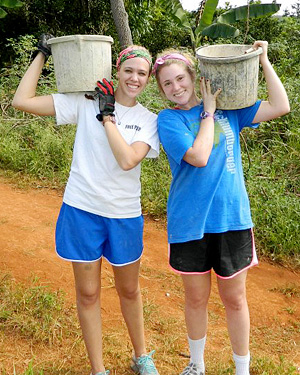
Rachel Blankenship (left), a student at Howard Payne University who served with Go Now Missions, and Millie Pool, a student at Texas Christian University who served with a mission group from First Baptist Church in Nacogdoches, work in Jamaica during a break between the fall and spring semesters. (PHOTO/Courtesy of Go Now Missions)

The mission efforts transformed students’ lives as they saw God use them for his glory, said Brenda Sanders, who leads Go Now Missions.

“Our students are changed in the process of serving others,” she said. “Sometimes. it is through the example of the Christians on the field with whom they work. Other times, it is in sharing their faith for the first time, seeing a prayer answered or a specific need met. They come back to our Texas campuses changed. They have exercised their faith and grown as disciples. And in the process of being changed, God has used them in his greater work.”

Stephen Alexander, Texas Tech University BSM associate director, led a student team who ministered through Won by One, a ministry that helps impoverished people in Jamaica.

Students worked alongside Jamaicans to construct house foundations and houses. The work was grueling, Alexander said, but the young adults saw how their effort enabled families to have a safe place to live.

The students were encouraged by the Jamaicans, particularly a man named Ganga who sang worship songs throughout the day, no matter how hard the work was.

“We would be hauling crushed limestone up a mountain, and yet once Ganga showed me how to let God into the workforce, there was no pessimism with me,” wrote Kenny Chadwell, a West Texas A&M University student.

“It even made me work harder, and even though I was all sweaty with sore muscles at the end of the day, I would just turn back and thank God for blessing the group.”

The group helped many single mothers, Alexander said. Despite financial restrictions, their faith in Christ is deep.

“They don’t have much,” Alexander said. “Where we were at is 80 percent unemployment rate. But they have joy. That hit home for many of us.”

Students with Go Now Missions help Mission Arlington deliver food to apartment complexes. (PHOTO/Courtesy of Go Now Missions)

Kilgore College BSM Director Shelly Web led a team of 11 students to serve at Mission Arlington, a multifaceted ministry started by First Baptist Church in Arlington. The team unpacked and sorted donated items Mission Arlington would give away through a free Christmas store for the community.

Team members also connected with a family through a food-distribution effort in an apartment complex. The students gave away turkeys and side dishes to parents who were having to choose between buying food or presents for their children. One boy kept coming back for more and more food, which the team happily provided.

“His father finally came out and said, ‘You just fed my entire family for a month,”’ Web said.

The Go Now Missions team later met another family who described their needs and what their children wanted for Christmas. The students took the list back to Mission Arlington, where they tried to fill every desire. What the young people couldn’t find at the mission, they purchased at a nearby store.

“They gave up that week to serve the needy and share the message of Jesus with those who didn’t know, who needed help,” Web said of her team.

“I think that’s what Christianity is about. Serving and being a disciple of Christ means helping other people.”

Go Now Missions facilitates mission trips and longer-term mission opportunities for college students throughout the year. For more information, visit www.gonowmissions.com


Olson named to endowed professorship honoring Valentine

WACO—Roger Olson, professor of theology at Baylor University’s Truett Theological Seminary, has been named to the Foy Valentine Professorship of Christian Ethics.

The newly endowed professorship was created through a gift in honor of the late Baptist ethicist Foy Valentine. The gift, made by Valentine’s family and friends, will help support specialized courses in Christian ethics at Truett.

“Dr. Olson has an incredible publishing record and is highly regarded as a historical theologian whose books have won many awards and are widely used as textbooks,” said David Garland, professor of Christian Scriptures and dean at Truett Seminary.

roger olsen200“He has always been concerned about ethical issues, and these concerns surface in all of his teaching. He will continue the legacy of Foy Valentine in helping students to wrestle conscientiously and straightforwardly with the ethical dilemmas of our day from a solid theological foundation.”
Olson is the author of 16 books, with areas of research and writing including the history of Christian theology, modern theology, evangelical theology and Christian ethics.

“I’m very honored to be named to the Foy Valentine professorship at Truett Seminary,” Olson said. “Foy Valentine is one of my Baptist heroes, a very courageous crusader for ethical living and action by Christians. I hope to live up to his legacy in my life and teaching.”

Dennis Tucker, Truett’s associate dean for academic affairs and an associate professor of Christian Scriptures, said that Olson’s work “exhibits an abiding passion for the life of the church, its theological confession and its work within the world.

“These continue to be pressing issues for the church in the 21st century, and I am grateful that Dr. Olson will continue to lead in that conversation,” Tucker said. “Like Foy Valentine before him, Dr. Olson represents well critical reflection and thoughtful engagement from the Baptist tradition.”

Olson went to Truett Theological Seminary in 1999 from Bethel University, a Baptist institution in Minnesota, where he taught 15 years. He is a graduate of North American Baptist Seminary and Rice University and carried out research under theologian Wolfhart Pannenberg at the University of Munich as part of his Ph.D. studies. His latest book—The Journey of Modern Theology: From Reconstruction to Deconstruction—will be published by InterVarsity Press this year.

Olson has taught a course in Christianity and Social Ethics every semester he has been at Truett Seminary.

Valentine, who died in 2006 at age 82, graduated from Baylor in 1944 and earned master of divinity and doctor of theology degrees from Southwestern Baptist Theological Seminary.

During his ministry, Valentine worked for racial justice and religious liberty through leadership roles in the Baptist General Convention of Texas and the Southern Baptist Convention. He was chair of the Commission on Christian Ethics of the Baptist World Alliance and served more than 30 years as trustee of Americans United for Separation of Church and State. Valentine wrote 13 books on applied Christianity and was the founder and editor of the journal Christian Ethics Today.


Paynter nominated for top CBF post

ATLANTA—Suzii Paynter, director of Texas Baptists’ Christian Life Commission, will be nominated as the next executive coordinator of the Cooperative Baptist Fellowship.

If approved by the CBF Coordinating Council Feb. 21-22 in Atlanta, she will succeed Daniel Vestal, who retired last June after 16 years in the executive coordinator’s position.

Paynter has served as director of public policy in Austin for the Baptist General Convention of Texas ethics agency since 2001, and she has been director of the Christian Life Commission since 2006. She also heads the BGCT Advocacy Care Center, which includes community ministry and chaplaincy.

suzii paynter200George Mason, pastor of Wilshire Baptist Church in Dallas, who chaired the executive coordinator search committee, characterized the group’s selection of Paynter as “the culmination of a joyous journey” of discovery that involved 171 phone calls to pastors, as well as input from laity and state Baptist leaders.

Mason characterized Paynter as “the person of the moment” and a proven leader who has helped shape CBF, often working “beneath the radar.”

“I am excited about the future of CBF,” Paynter said, pointing particularly to the work of the 2012 task force that proposed a new governance model and an organizational structure that includes councils for missions and ministry.

“I come to this place out of a sense of call and a sense of preparation,” she said.

In her role with the CLC—particularly spearheading efforts for the Texas Baptist Offering for World Hunger, which helps fund some CBF economic development initiatives—Paynter noted she met many CBF global field personnel. She also worked closely with CBF partners such as the Baptist Joint Committee for Religious Liberty, in Washington, D.C., the Baptist Center for Ethics and various schools.

“God has been preparing me and allowing me to build relationships with missions and ministry partners,” she said. “I am coming from a good place and going to a good place.”

If the term of founding CBF Executive Coordinator Cecil Sherman emphasized the “Baptist” part of the group’s name, focusing on distinctive identity, and if Vestal’s term stressed the “Fellowship” aspect, creating a sense of community, Paynter said, she hopes the next chapter of CBF life will emphasize the “Cooperative” nature of their work.

Social justice issues and advocacy for the vulnerable particularly present the CBF opportunities to relate to and cooperate with other Christian groups with shared concerns, she added.

Paynter characterized her nomination as “absolutely a milestone for Baptist women in ministry.”

At the same time, Mason emphasized the search committee felt no pressure to select a woman for the leadership role. The fact that “the best person for the job” is a woman and a layperson simply is “a double blessing,” he said.

BGCT Executive Director David Hardage expressed appreciation for Paynter’s service to Texas Baptists.

“She has served with integrity and diligence and has been a positive, effective Texas Baptist voice in Austin and beyond,” he said. “She will be greatly missed and difficult to replace. However, I’m confident she’s following the Lord’s guidance and pray for God’s blessings on her during this time of transition.”

A committee will “help discern” how the BGCT fills the CLC leadership post, Hardage added.

“Currently, we are developing a plan for the CLC, with our initial attention being given to make sure Texas Baptists are well represented during this current legislative session,” he said.

Stephen Reeves serves in Austin as legislative counsel for the CLC. He is a former staff attorney at the Baptist Joint Committee.

“Any future adjustments and appointments will be made in a timely fashion and with sharing the gospel in Texas and meeting the needs of Texans at the forefront of any decisions,” Hardage said.

A San Antonio native, Paynter earned her undergraduate degree at Baylor University and her master’s degree from Stephen F. Austin State University. Last year, she received an honorary doctorate from Dallas Baptist University.

She worked 25 years as a reading specialist, literacy professional and educator in public schools and at the university level.

She has served on the religion and public policy team of the Council on Foreign Relations.

She has been a board member and officer of the Baptist Joint Committee and its Religious Liberty Council, as well as the Whitsett Baptist Heritage Society. She also has served on the CBF Coordinating Council, both for the national and state organizations, and has been a representative to Baptist World Aid with the Baptist World Alliance.

Other volunteer service includes board membership on the T.B. Maston Foundation for Christian Ethics, Stop Predatory Gambling, Baptist Child & Family Services, Texas Impact, the Literacy Coalition of Central Texas, Samaritan Counseling Centers of Central Texas and the Coalition for Public Schools.

Her husband, Roger, is pastor of First Baptist Church in Austin. They have two adult children, Grayson and Mary.

“Roger plans to stay at First Baptist in Austin for the foreseeable future. Both of us feel a strong calling to our ministries,” she said. “I have been commuting six years between Austin and Dallas. Now the trips will just be longer.”


Texas Baptists ‘an answer to prayer’ in Louisiana

LAFITTE, Louisiana—When Hurricane Isaac rolled across South Louisiana, the steeple of Barataria Baptist Church suffered the consequences. It opened a hole in the roof that allowed rain to pour into the congregation’s sanctuary 36 hours, devastating the structure. Four months later, the congregation still needed assistance.

The church found help this month when about 40 orange-vested Disaster Recovery Corps volunteers from the Baptist General Convention of Texas arrived to help clear the destruction in the sanctuary and work in a nearby home.

“It was an answer to prayer when these guys came from Texas,” Pastor Eddie Painter said.

Volunteers cleared debris, removed mold-ridden drywall, cleaned damaged structures and began the repair process. They spent long hours in bitterly cold temperatures trying to get a congregation and a family back on their feet.

The cooperation was beautiful, said Michael Evans, pastor of Bethlehem Baptist Church in Mansfield and president of the African-American Fellowship of Texas. The Texas volunteer group consisted primarily of African-Americans who helped an Anglo congregation.

“We’re here as partners,” Evans said. “In this thing, that’s how we make it. That’s how we save our communities as partners. Not as blacks, not as whites, not as Hispanics, but as people of faith, people of God.”

When Randy Ray, a member of First Baptist Church in Salado, heard about the opportunity to minister in Plaquemines Parish, he knew he had to be in that area where he lived and made many friends as a child.

“It struck a heartstring for people I grew up with in Port Sulphur and stuff,” he said. “I figured I’d give it a go.”

God honored his willingness to respond to the call out, Ray said. He was able to provide help for a family desperately seeking it.

“A lady yesterday said she’d been praying and praying for someone to come help,” he said. “To know that God used you to answer her prayer, that’s what it’s all about—being his hands and feet.”

Evans shared a similar feeling of being obedient to God’s desires. In the midst of the destruction, Texas Baptist volunteers set out to provide practical help and point to eternal hope.

“We need to know that when storms come, the effects are lingering,” he said. “We believe we were inspired by God to come and serve our fellow pastor here. We just want to bring a little hope.”

The impact of Texas Baptists’ ministry will be felt long after they are gone, Painter said.

“We’re grateful to have your people here,” he said. “I believe it will not only help us to bear fruit in the sense that we will have our building back, (but) this building is going to be used for a lot of ministry. It provides for a lot of opportunities for us to share Christ in this community.”

Another disaster recovery trip is scheduled March 9-16 south of New Orleans. For more information, visit www.texasbaptists.org/disaster.

“Communities and people’s lives are still in a state of disaster,” said Gerald Davis, Texas Baptists’ disaster recovery and development specialist. “They need our help. This is what we’re calling our Texas Baptist family to do. We did well in immediate relief, but we want to keep going.”

Texas Baptists’ Disaster Recovery ministry is supported by designated BGCT disaster response funds. To contribute, visit www.texasbaptists.org/give


Giglio out of inauguration

An evangelical preacher withdrew acceptance of his invitation to pray at President Obama’s inauguration after coming under fire when an old sermon denouncing homosexuality circulated on the Internet.

WASHINGTON (ABP)—An evangelical preacher withdrew acceptance of his invitation to pray at President Obama’s inauguration after coming under fire when an old sermon denouncing homosexuality circulated on the Internet.

A day after the White House announced the invitation to Passion Conference founder Louie Giglio, the liberal blog Think Progress linked to one of the Baptist preacher’s archived sermons from the 1990s titled “A Christian Response to Homosexuality.”

“Homosexuality is not an alternate lifestyle,” Giglio is heard saying in the sermon audio. “Homosexuality is not just a sexual preference. Homosexuality is not gay. Homosexuality is sin. It is sin in the eyes of God and it is sin according to the word of God.”

Giglio said the sermon was “not intended to be a homophobic attack on those who are in the homosexual lifestyle that would maybe foster fear or intolerance” but to address “a critical subject for our world.”

He referenced as a current event a Hawaii court ruling that the state’s refusal to grant marriage licenses to same-sex couples is discriminatory, adding that recognizing gay marriage would “run the risk of undermining the whole order of our society.”

Giglio urged compassion for individuals struggling with same-sex attraction but warned about an “aggressive element in the homosexual movement” seeking to normalize homosexuality.

“You’ve got to be able to respond lovingly yet firmly to this aggressive element in the homosexual community,” he said. “And I dare say you’ve got to be willing to be called an intolerant bigot or a homophobe in our society, because you will. I daresay as a result of sharing this talk I will.”

Negative reaction to Giglio’s comments was reminiscent to four years ago when the inaugural committee stood by a similar invitation to Rick Warren, a Southern Baptist mega church pastor criticized for his support of California’s Proposition 8 aimed at prohibiting gay marriage and comparing same-sex marriage to incest or pedophilia in a media interview.

Giglio, 54, grew up attending First Baptist Church in Atlanta and got his M.Div. from Southwestern Baptist Theological Seminary in Fort Worth. In 1985, he began Choice Ministries as a campus-based student ministry at Baylor University in Waco. After 10 years, he and his wife, Shelley, moved to Atlanta, where he organized the first Passion gathering in 1997.

The most recent Passion Conference, Jan. 1-4, drew 60,000 18-to-25 year-olds to the Georgia Dome to listen to Christian rock music and sermons, while raising more than $3 million to fight human trafficking.

He reportedly got on the inaugural committee’s radar for his advocacy against human trafficking.

“We were not aware of Pastor Giglio’s past comments at the time of his selection, and they don’t reflect our desire to celebrate the strength and diversity of our country at this Inaugural,” the Presidential Inaugural Committee said in a statement to media. “As we now work to select someone to deliver the benediction, we will ensure their beliefs reflect this administration’s vision of inclusion and acceptance for all Americans.”