Texas Baptist delivers 60 tons of corn to North Korean orphans.

DALLAS—A Korean Texas Baptist recently delivered 60 tons of corn to North Korea, where he visited three schools for orphans and a hospital that will benefit from the shipment.

Yoo Jong Yoon—director of the Korean-American Sharing Movement of Dallas and former Korean mission field consultant with the Cooperative Baptist Fellowship—inspected a factory in Pyongyang that turns the corn into noodles delivered primarily to schools, orphanages and a hospital in Won-San City in Kangwon Province. 

Each ton of corn costs $460 and provides about 2,300 meals, he said. 

Yoon has made 21 relief visits to North Korea in the last 17 years. Texas Baptist Men, CBF, various church congregations and individual donors help support the ongoing ministry.

Yoon noted North Korea launched a long-range missile in mid-December, an action condemned by the United Nations Security Council.

“But we Christians ought to love our enemies and feed them when they are hungry. I pray that our relief mission plays a big role to help avoid conflicts like the wars in Iran and Afghanistan,” he said.

“More than anything else, this mission is to convey the love of Christ to the starving people in remote areas such as Won-San City and the sick in Won-Son’s People’s Hospital through feeding them with corn noodles and providing medical supplies.”


Why do the innocent suffer? It’s a modern question as old as the Book of Job

WACO (ABP)—Many criticized prominent evangelicals like James Dobson and Mike Huckabee for claiming December’s Connecticut school massacre was God’s punishment of a morally disobedient nation, but don’t expect such views to change.

Scholars insist the belief in divine retribution for personal and national transgressions not only goes back as far as the Old Testament Book of Job, but also is a concept fused into the American worldview.

“This is a recurring pattern in American history since the Puritans,” said Barry Hankins, professor of history and resident scholar in religion at Baylor University. “They believed God is in covenant with nations and in covenant with America.”

Theologians call it theodicy—beliefs that seek to explain why a just God allows human beings to suffer. In the United States, biblical theodicy becomes intertwined with civil religion.

“It’s hard to tell where one begins and the other one ends,” Hankins said.

Both have been in full display since the Dec. 14 murders of 20 first graders and six adults at Sandy Hook Elementary in Newtown, Conn., he noted. Naturally, people, including the victims’ families, are asking, “Why?”

For former presidential candidate and Arkansas governor Mike Huckabee, a Southern Baptist minister, the answer is that God is punishing the nation because schools do not sanction prayer and religious instruction. Huckabee later added the use of abortion pills to the list of causes.

Focus on the Family founder James Dobson said gay marriage and secularism forced God’s hand to allow the slaughter at the school in Newtown.

Those are just the latest examples. Some Christians have blamed everything from 9/11 to Hurricane Katrina on Americans living what they consider to be unbiblical lives.
“It’s all born of this idea that God judges America on a case-by-case basis,” Hankins said.

That’s an idea straight out of the Old Testament, said Matthew Baldwin, associate professor in the department of religion, history and philosophy at Mars Hill College in North Carolina.

Baldwin teaches theodicy and historical biblical theology and sees both in the recent comments of Huckabee and Dobson. But he said their God-punishes-America view is a narrow one, even by biblical standards.

The early Hebrew prophets interpreted calamity as God’s punishment of Israel for the misbehavior of individuals, Baldwin said. But the prophet Jeremiah offers a view in which the nation is not held accountable for the actions of a few or even many. In the Book of Job, meanwhile, Baldwin said, “The author says, ‘Look, sometimes suffering just happens.'” The belief that God smites the many for the sins of the few is even further dissipated in the Gospels, he added.

But that evolving message is not reflected in the theology of some conservative American Christians, Baldwin said.
“The theodicy these guys are working with … holds God responsible for both natural disasters and these human-made tragedies,” Baldwin said. “It’s rooted in the ancient Israelite conception that God is in control of every single thing that happens.”

Dennis Sansom, professor and chair of philosophy at Samford University, said it also is rooted in human nature. “It’s part of the human condition to ask why and look for explanations” when disasters and suffering occurs, he said.

It’s also natural for those who believe in a good, loving God to ask why evil exists—and what behaviors can be adopted or modified to prevent disasters. It’s why he predicts more of the same in the future—especially in the United States, where theodicy is woven in the social and political fabric.

“I think such comments will be with us, regardless of how secular or non-churched the society becomes,” Sansom said.


Baylor Health Care plans merger with Scott & White

DALLAS—Baylor Health Care System plans to merge with Temple-based Scott & White Healthcare to create the largest nonprofit health system in Texas.

The boards of the two health care systems each unanimously voted to approve letters of intent to merge, said Joel Allison, Baylor president and chief executive officer. The systems now enter a period of due diligence and securing approval from necessary entities—a process expected to take a minimum six to nine months.

Baylor Scott & White Health will have total combined assets of about $8 billion.

Top officials of the two health systems announced the proposed merger during news conferences in Dallas and Temple.

Implementation of the Affordable Care Act creates “major changes in health care,” including reduced reimbursement for providers, Allison noted.

“We are going to create a new model of health care delivery that truly focuses on the patient,” he said, characterizing opportunities offered by combining the two Texas-based health systems as “transformational.”

Baylor and Scott & White are like-minded organizations, each with a more than 100-year heritage, he added. The two institutions discussed a potential merger for about a year.

Assuming the merger proceeds as anticipated, governance for Baylor Scott & White will be provided by a board with half its members drawn from each of the current boards for the two existing health systems.

Allison will serve as chief executive officer of Baylor Scott & White. Robert Pryor, president of Scott & White, will serve as the merged health system’s chief operating officer.

Drayton McLane, chair of the Scott & White board, will become chair of the combined board, and Jim Turner of Dallas, chair of the Baylor board, will be designated chair-elect of the new board.

“What is unique about all of this is our Christian heritage of healing,” said McLane, a Baptist layman from Temple.

He also noted the two hospital systems have no overlapping geographic coverage. Baylor’s facilities are located throughout North Texas, and Scott & White’s are clustered to the south, primarily along the I-35 corridor from Waco to just north of Austin and east toward Bryan/College Station.

Texas Baptists launched the institution that became Baylor Health Care System. In 1903, George W. Truett, pastor of First Baptist Church in Dallas, challenged a group of North Texas community leaders by asking, “Is it not now time to begin the erection of a great humanitarian hospital, one to which men of all creeds and those of none may come with equal confidence?”

Truett joined R.C. Buckner, who had pioneered a small-scale hospital in an annex of the Buckner Orphans Home in east Dallas, and wealthy Dallas layman C.C. Slaughter in giving birth to the Texas Baptist Memorial Sanitarium in Dallas—predecessor of what is now Baylor Health Care system.


Baptist Briefs: Alliance of Baptists founder dies

Founding Alliance president Crouch dies. Alliance of Baptists founder William Henry Crouch, 84, died Dec. 29 at his home in Asheville, N.C. Crouch, pastor emeritus of Providence Baptist Church in Charlotte, N.C., was elected the first president of the group initially known as the Southern Baptist Alliance. Last year, on the 25th anniversary of its founding, the Alliance presented Crouch the “Heart of the Alliance” award for his contribution to the organization. Crouch was pastor of churches in Kentucky, Mississippi and North Carolina, and he later served as director of development for the Baptist Theological Seminary at Richmond. He was preceded in death by his wife of 60 years, Janice Young Crouch, who died in January 2010, and a daughter, Deborah Crouch McKeithan, who died in 2003. Survivors include four children, Sarah Crouch Tucker of Macon, Ga.; Thomas L. Crouch of Asheville, N.C.; William H. Crouch Jr. of Georgetown, Ky.; and Rebecca Hobbs of Milledgeville, Ga.; 12 grandchildren and 10 great-grandchildren.

British Baptist school gets new leader. Roger Standing, a professor and administrator at Spurgeon’s College in London, has been named the next principal of the historic college started by 19th century preaching legend Charles Haddon Spurgeon. Spurgeon’s College, the largest of seven colleges affiliated with the Baptist Union of Great Britain, selected Standing to succeed Nigel Wright, who is retiring in August after 13 years in the post.
Standing, a former pastor who has taught at the London school in the areas of mission, evangelism and pioneer ministry since 2007, served as deputy principal since 2011. Trained as a Methodist minister before switching to the Baptist faith in 1990, Standing previously was regional minister in the Southern Counties Baptist Association.

National CBF disaster response leader named. Tommy Deal, former associate coordinator for CBF of Florida, succeeds Charles Ray as national disaster response coordinator for the Cooperative Baptist Fellowship, effective Jan. 1. Deal will manage field responses during and after events and coordinate a national response in cooperation with state and regional efforts. Since May, Deal has served as disaster response coordinator for CBF of Georgia. He will continue in this role as part of a collaborative relationship between CBF of Georgia and national CBF. In addition to his role with CBF of Florida, Deal has served as a chaplain to numerous police and fire departments and a state board member for Voluntary Organizations Active in Disaster. Deal also received training in disaster response from FEMA.


Christians urged to pray for end to human trafficking

Christian organizations across the country — including Woman’s Missionary Union of Texas — are encouraging believers to pray Jan. 11-13 for an end to human trafficking, the world’s third-largest criminal activity.

The consortium of groups is asking Christians to pray for victims, trafficking survivors, customers and traffickers themselves. The weekend of prayer coincides with the national Human Trafficking Awareness Day on Jan. 11.

“From our perspective, human trafficking is a heart issue,” said Carolyn Porterfield, Texas WMU multicultural consultant. “The sinfulness of a human heart drives someone to sell another, for someone to buy a human being and use that person as a commodity. Human trafficking is evil. The hope we see is that God is able to break into this darkness. Lives can be redeemed and restored — trafficker, user, victim. Prayer is a powerful weapon in this fight. Jesus taught us to pray for his kingdom to come. We are to pray that we will be delivered from the evil one. Prayer is being on the frontlines.”

The fight against trafficking has reached new heights in Texas Baptist life during recent years as various congregations have responded in diverse ways to trafficking within the United States, as well as abroad. Ministries are helping survivors recover, attempting to build safe houses for victims, training law enforcement and beginning preventative ministries in neighborhoods where children are seen as being at higher-risk of being trafficked.

Last year, the Texas Baptist Christian Life Commission and Texas WMU brought together many groups for a roundtable discussion that eventually led to the forming of the Freedom Ring Alliance Against Human Trafficking, which is supported by the Mary Hill Davis Offering for Texas Missions .

About 27 million people are modern-day slaves. Between 14,500 and 17,500 people are trafficked into the U.S. each year. Pimps recruit women and children into sex trafficking at parks, playgrounds, homeless shelters, bus stations, schools and on the Internet.

Tomi Grover, who leads the Texas-based TraffickStop , hopes the weekend will usher in a decline in trafficking.

“Several ministries from across the U.S. have joined forces to engage God's people to pray beginning on that day and through the weekend to intercede on behalf of victims and those that perpetrate this horrific criminal enterprise,” Grover wrote. “We are praying that God will compel a mighty movement to end human trafficking.”

For more information about the weekend as well as resources to use, visit www.weekendofprayer.net .


Missiologist Justice Anderson dead at 83

FORT WORTH—Justice Anderson, veteran Baptist missionary and retired seminary professor of missions, died Dec. 29. He was 83.

Anderson—known as “Uncle Justo” to friends and students worldwide—served 17 years in Argentina with the Southern Baptist Convention Foreign Mission Board as a church planter and professor at International Baptist Theological Seminary in Buenos Aires.

He taught 27 years at Southwestern Baptist Theological Seminary in Fort, including 20 years as director of the seminary’s World Missions Center.

On sabbatical leaves, he taught and preached in Nigeria, Spain and Mexico City, and he also lectured in Taiwan, Korea, Singapore, Thailand, Cuba, Dominican Republic, Mexico, Russia, Peru, Colombia and Canada.

After he retired, he continued to teach classes as an adjunct professor at Dallas Baptist University, Truett Theological Seminary and the B.H. Carroll Theological Institute.

He is the author of a three-volume Spanish-language history of the Baptist movement, in addition to numerous other books and articles in both Spanish and English.

He and his wife of 63 years, Mary Ann, worked with the Karen refugee community at Agape Baptist Church in Fort Worth.

Born in Bay City, Anderson was ordained to the ministry at age 19. He earned his undergraduate degree and master’s degrees in English literature and history at Baylor University. He earned his master of divinity and doctor of theology degrees from Southwestern Seminary while serving student pastorates at churches in Stranger, Osage and Franklin.

He is survived by his wife; children, Sandi Phillips and husband, Thomas, Timothy Anderson and wife, Aurora Pulido, Brad Anderson and wife, Ann, and Suzie Person and Husband, Kirk; numerous grandchildren; two great-grandchildren; and a brother, Gene Anderson.

Memorial services will be at 10 a.m., Jan. 2, at Agape Baptist Church in Fort Worth, with interment at 4 p.m. at New Baden Cemetery near Franklin.


Mike Toby, FBC Woodway pastor, dies

Mike Toby, pastor of First Baptist Church of Woodway in Waco, died Dec. 29 at his home with his family.

His funeral service will conducted at 1 p.m. Friday, Jan. 4, at First Baptist Church of Woodway with Terry Graham officiating. Burial will follow at Oakwood Cemetery. 

Mike Toby

Toby will lie in state Sunday through Thursday and the family will receive visitors from 6 to 9 p.m., Thursday, Jan. 3, at Wilkirson-Hatch-Bailey Chapel in Waco. 

He was pastor of First Baptist Church of Woodway 35 years.

Toby woke up Sunday morning, Oct. 14, with his left hand completely numb. That was the first indication of what doctors described as a particularly aggressive type of cancer that offered few treatment options.

Toby, who grew up in Pasadena, served on the staff of churches in Louisiana, Florida, Arkansas and Texas. Before he went to Woodway, he was pastor of Pleasant Grove Baptist Church in Texarkana.

He served on the Baptist General Convention of Texas Executive Board and as a trustee of Howard Payne University and Hillcrest Baptist Medical Center, among other charitable institutions. He served three times as president of the pastors' conference of Waco Regional Baptist Association.

He is survived by his wife of 45 years, Jackie; sons, Josh and Scott; sister, Linda Burchfield; and four grandchildren.


From nuns to ‘nones,’ religion shaped the news in 2012

WASHINGTON (RNS)—From the nuns to the “nones,” religion dominated the headlines throughout 2012. Faith was a persistent theme in the presidential race, and moral and ethical questions surrounded budget debates, mass killings and an unexpected focus on religious freedom.

Here are ways religion made news in 2012:

Suffer the children: Gun violence as a new “pro-life” issue


A shooting rampage that killed 12 and injured more than 50 others inside a crowded movie theater in Aurora, Colo., couldn’t do it. Neither could a gunman who murdered six people at a Sikh temple in Oak Creek, Wis. But a hail of bullets inside Sandy Hook Elementary School in Newtown, Conn.—which took the lives of 20 first-graders, and six adults—finally mobilized religious activists on gun control after years of failing to gain traction.

“Those who consider themselves religious or pro-life must be invited to see that the desire to prevent gun-related deaths is part of the religious defense of the dignity of all life,” wrote James Martin, a Jesuit priest and contributing editor at America magazine.

‘None of the above’: America’s fast-growing nonreligious community

A startling one in five Americans (19 percent) now claim no religious affiliation, up from 6 percent in 1990. The so-called “nones” include unbelieving atheists who staged a massive “Reason Rally” in Washington, but two-thirds of the unaffiliated say they believe in God or a universal spirit. Almost nine in 10 say they’re just not looking for a faith to call home.

An April study found that among the under-30 set, the only religious group that was growing was the “unaffiliated,” with an increasing tide of young Americans drifting away from the religion of their childhood. By year’s end, a study from the Pew Forum on Religion & Public Life found that there are about as many religiously unaffiliated people in the world (1.1 billion) as there are Catholics, and they’re the third-largest “religious” group worldwide, behind Christians and Muslims.

Nuns on the bus and in the spotlight

The “nones,” however, shouldn’t be confused with the other big newsmaker of 2012—the nuns, who found themselves facing a Vatican crackdown and accusations that the umbrella group of most U.S. sisters was embracing “radical feminist themes” and not working strongly enough against abortion and same-sex marriage. The reform of the Leadership Conference of Women Religious was seen as a hostile takeover by many rank-and-file Catholics, who rallied to the sisters’ defense.

A separate group of sisters, meanwhile, dubbed themselves the “Nuns on the Bus,” and embarked on a 2,700-mile tour to advocate for the poor. Sister Simone Campbell, whose group Network organized the tour, landed a prime-time speaking slot at the Democratic National Convention, where she slammed the budget drafted by GOP vice presidential nominee Paul Ryan, a fellow Catholic.

The “Mormon moment”

Even though he ultimately lost his White House bid, Republican Mitt Romney nonetheless made history as the first Mormon to win a major party’s presidential nomination. He also exceeded in overcoming significant evangelical wariness of his Mormon faith—he won more evangelical support (79 percent) than Sen. John McCain did in 2008 (73 percent). What’s more, evangelicals dropped some of their long-harbored suspicion of Mormons, according to surveys, and some even viewed the faith more positively as a result of Romney’s campaign.

Even ailing evangelist Billy Graham made a late and somewhat surprising entry into campaign politics, vowing to “do all I can to help” Romney and later scrubbing his ministry’s website of all references to Mormonism as a “cult.” Despite frosty ties with the U.S. Catholic hierarchy, President Obama carried the critical Catholic swing vote, largely on the support of Hispanic Catholics. The largest share of his “religious” coalition came from an unexpected source: religiously unaffiliated voters, at 23 percent.

Goin’ to the chapel: Unprecedented strides for gay rights

Gay rights made unprecedented strides in 2012 when voters in Washington, Maryland and Maine approved gay marriage, while Minnesota voters rejected a constitutional amendment to ban it. But a series of events in May showed Americans’ mixed feelings on the issue: North Carolina approved a constitutional ban while President Obama finished his evolution and endorsed same-sex marriage. The United Methodist Church upheld its teaching that homosexuality activity is “incompatible with Christian teaching,” while a Gallup Poll found that a majority (54 percent) of Americans now see homosexual relations as “morally acceptable.”

All eyes are now on the U.S. Supreme Court, where justices in 2013 will consider challenges to a 2008 California referendum that stopped gay marriage, and the 1996 Defense of Marriage Act that prohibits the federal government from recognizing legal same-sex marriages performed in nine states and District of Columbia.

A bitter pill: Rallying against contraception in the name of “religious freedom”

One of the more unexpected entrants into the 2012 campaign was a fierce debate over birth control, centered around Catholic and evangelical resistance to the Obama administration’s mandate for free employee coverage of contraception. Even as Obama vowed to carve out exceptions for religiously affiliated institutions like hospitals and universities, Catholic bishops and evangelical colleges launched a full-throated assault on the mandate as a threat to “religious freedom.” So far, more than 30 lawsuits have been filed to stop the mandate.

But LifeWay Research showed that almost two-thirds of Americans believe businesses should be required to provide the coverage for free, even if contraception conflicts with the owner’s religious ethics. Earlier polling found that 58 percent of Catholics support the mandate; another found that Catholics rejected the idea that religious liberty is under siege.

10 years later: The long shadow of sexual abuse

As U.S. Catholics marked the 10th anniversary of the clergy sex abuse scandal that erupted in Boston, the U.S. Conference of Catholic Bishops was confronted with two landmark criminal convictions: Monsignor William Lynn, found guilty of child endangerment for shuffling abusive priests around the Archdiocese of Philadelphia, and Kansas City, Mo., Bishop Robert Finn, convicted of failing to tell police about a priest suspected of sexually exploiting children.

Even as the Penn State abuse scandal showed that abuse is not just a “church problem,” popular Franciscan priest Benedict Groeschel was forced to retract statements that seemed to defend priests who sexually abuse children and blamed some victims for “seducing” them. The chairman of the bishops’ National Review Board warned the prelates: “If there is anything that needs to be disclosed in a diocese, it needs to be disclosed now. No one can no longer claim they didn’t know.”

New threads in America’s diverse religious tapestry

The 2012 campaign marked the first time that neither major party ticket included a white Protestant, but there were other signs of America’s growing racial and ethnic diversity. New Orleans pastor Fred Luter was elected the first black president of the Southern Baptist Convention, which was formed in 1845 in the defense of slavery. Rep. Mazie Hirono, D-Hawaii, will become the first Buddhist member of the Senate; her House seat was won by Democrat Tulsi Gabbard, the first Hindu member of Congress.

The number of mosques in America has jumped 74 percent since 2000, up to 2,106. “Islam,” said David Roozen of the Hartford Institute for Religion Research, “is one of the few growth spots in America’s religious mosaic.”

Among the big names topping the religion headlines in 2012:

Evangelist Franklin Graham apologized for questioning President Obama’s Christian bona fides in February, when he couldn’t say whether Obama was a Christian, in part because, “under Islamic law, the Muslim world sees Barack Obama as a Muslim.”

ABC canceled its short-lived saucy church drama GCB after viewers lost faith in the bedazzled desperate housewives in choir robes. Then-candidate Newt Gingrich called the show “anti-Christian.”

Crystal Cathedral founder Robert H. Schuller left his California megachurch and lost a bid to recover assets as part of the church’s bankruptcy. The iconic glass building is now scheduled to become a Roman Catholic cathedral.

The Dalai Lama won the prestigious $1.7 million Templeton Prize for his efforts to bridge the divide between science and religion.

Southern Baptist public policy guru Richard Land lost his radio show, and later announced his retirement, after he was accused of plagiarizing racially and politically charged remarks in the Trayvon Martin case.

Former Alabama Supreme Court Chief Justice Roy Moore won his old job back, nearly a decade after losing it when he refused to remove a 5,200-pound granite Ten Commandments monument from his courthouse.

Yale theologian Sister Margaret Farley was publicly rebuked by the Vatican for her book Just Love: A Framework for Christian Sexual Ethics, which was deemed “not consistent with authentic Catholic theology.”

Metropolitan Jonah, the leader of the Orthodox Church in America, was sacked for failing to report or remove a priest accused of rape.

Jesus may or may not have had a wife, at least according to a 4th-century papyrus fragment that includes the cryptic line, “Jesus said to them,’My wife…” The Vatican dismissed it as a “clumsy fake.”

Paolo Gabriele, the trusted butler to Pope Benedict XVI, was sentenced to 18 months in a Vatican jail for leaking private papal documents in an attempt to rid the Vatican of corruption out of his “visceral love” for the church and the pope.

The U.S. got its first Native American saint, Kateri Tekawitha, a 17th-century Mohawk woman who practiced extreme acts of religious devotion despite torment for her baptism and conversion.

Justin Welby will be the next archbishop of Canterbury, and the first task of the former oil executive will be finding a way for the Church of England to reconsider its vote this year not to allow women to become bishops.

Passages

2012 saw the passing of several leading religious figures, including: William Hamilton, the theologian behind Time magazine’s famed “Is God Dead?” cover story in 1966, at age 87; Coptic Orthodox Pope Shenouda III, at age 88; Christian artist and “painter of light” Thomas Kinkade, at age 54; Watergate felon and evangelical icon Charles Colson, at age 80; Leontine T.C. Kelly, the first black woman to be elected a United Methodist bishop, at age 92; March for Life founder and anti-abortion activist Nellie Gray at age 88; Unification Church founder Sun Myung Moon at age 92; and anti-hunger activist and 1972 Democratic presidential nominee Sen. George McGovern, at age 90.


Christmas Eve fire damages church in Fort Worth

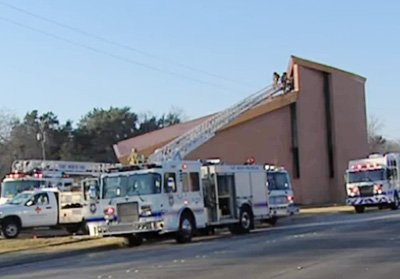
The fire that heavily damaged Chinese Baptist Church of Fort Worth on Christmas Eve has left its congregation shaken during one of the most sacred seasons of the year.

Firefighters respond to the early-morning fire that destroyed the sanctuary of Chinese Baptist Church in Fort Worth on Christmas Eve. (WFAA-TV Image)

It’s an emotionally searing experience that another community — Hendricks Avenue Baptist Church in Jacksonville, Fla. – understands all too well.

“Oh no,” HAB member Sylvia McQuaig said Tuesday morning after learning of the Texas fire. McQuaig’s mind immediately raced back to the night of Dec. 23, 2007, when a friend called to say HAB’s sanctuary was ablaze.

Turning on the television, her disbelief turned to shock.

“My first thoughts were, it’s so surreal,” she said. “Then we came to the church and saw it – the flames were so big. It was such a traumatic feeling.”

But neither McQuaig nor HAB got stuck in those feelings. Led by Pastor Kyle Reese, the church immediately embarked on an $8.5 million capital campaign to rebuild.

And the congregation did rebuild. The first service in the new sanctuary was held on the two-year anniversary of the fire.

News reports about Monday’s fire in Fort Worth do not indicate whether Chinese Baptist will be able to rebuild, or how soon. But television and newspaper stories, plus the Southern Baptist congregation’s web site, indicate that church members are being sustained by their faith.

For the time being, the congregation will have to meet in the undamaged fellowship hall instead of the sanctuary (above). (WFAA-TV Image)

“First, we are thankful that no one was injured,” a statement on the church homepage said. But most of all, they are grateful “that in whatever circumstances, good or bad, God is still God for He promises not to forsake us.”

The congregation celebrated its 20th anniversary this month and last worshiped in the sanctuary on Sunday, The Dallas Morning News reported.

No cause has been given for the fire, which was reported shortly after 7 a.m. on Christmas Eve morning. Firefighters told WFAA-TV in Dallas/Fort Worth that first and smoke damage occurred throughout the building.

For the time being, worship services will be held in the church fellowship hall, which was not damaged in the blaze. And that’s just fine with one member of Chinese Baptist Church.

“The fellowship hall may not be big enough, but I think it will bring us closer together,” M.C. Leung told the television station.

Finding the silver lining in the HAB church fire helped McQuaig get through the ordeal.

“I think the biggest thing that helped me was the way the community responded,” she said. On that morning, a Lutheran church across the street emerged to sing “Silent Night” to devastated HAB members, and contributions from a range of other faith traditions in the community were tangible expressions.

“When you see that, you have the strength to go and be the presence of Christ.


Texas Baptist delivers 60 tons of corn to North Korean orphans

DALLAS—A Korean Texas Baptist recently delivered 60 tons of corn to North Korea, where he visited three schools for orphans and a hospital that will benefit from the shipment.

Students at a school for orphans in North Korea wait for a meal. Texas Baptist Men, the Cooperative Baptist Fellowship and several Texas Baptist churches and individual donors help support food donations for schools like this one. (PHOTOS/Courtesy of Yoo Jong Yoon)

Yoo Jong Yoon — director of the Korean-American Sharing Movement of Dallas and former Korean mission field consultant with the Cooperative Baptist Fellowship — inspected a factory in Pyongyang that turns the corn into noodles delivered primarily to schools, orphanages and a hospital in Won-San City in Kangwon Province.

Each ton of corn costs $460 and provides about 2,300 meals, he said.

Yoon has made 21 relief visits to North Korea in the last 17 years. Texas Baptist Men, CBF, individual congregations  and other individual donors help support the ongoing ministry.

Texas Baptist minister Yoo Jong Yoon shakes hands with a diminutive 16-year-old high school student in Won-San City, North Korea. Malnutrition stunted the girl’s growth. (PHOTOS/Courtesy of Yoo Jong Yoon)

Yoon noted North Korea launched a long-range missile in mid-December, an action condemned by the United Nations Security Council.

“But we Christians ought to love our enemies and feed them when they are hungry. I pray that our relief mission plays a big role to help avoid conflicts like the wars in Iran and Afghanistan,” he said.

“More than anything else, this mission is to convey the love of Christ to the starving people in remote areas such as Won-San City and the sick in Won-Son’s People’s Hospital through feeding them with corn noodles and providing medical supplies.”


Huckabee links violence to removal of God from public square

NASHVILLE (ABP)—Former presidential candidate turned talk-show host Mike Huckabee stood by controversial comments blaming the deadly Dec. 14 shootings in Connecticut on the lack of religion in public schools.

Mike Huckabee

The day 27 people, including 20 children, died in a mass shooting at Sandy Hook Elementary School in Newtown, Conn., Fox News host Neil Cavuto asked the former Arkansas governor, an ordained Southern Baptist minister and former pastor, to respond to the inevitable question, “How could God let this happen?”

“Well, you know, it’s an interesting thing,” Huckabee said. “We ask why there’s violence in our schools, but we’ve systematically removed God from our schools. Should we be so surprised that schools would become a place of carnage?”

“We’ve made it a place where we don’t want to talk about eternity, life, what responsibility means, accountability; that we’re not just going to have to be accountable to the police if they catch us, but one day we stand before a Holy God in judgment,” said Huckabee, a past president of the Arkansas Baptist State Convention. “If we don’t believe that, then we don’t fear that.”

Criticized for attributing the mass murder/suicide to the removal of prayer and Bible reading from public schools, Huckabee opened his own Fox News program Dec. 15 with a rejoinder to “the predictable left.”

“It’s far more than just taking prayer or Bible reading out of the schools,” Huckabee said. “It’s the fact that people sue a city so that we aren’t confronted with a manger scene or a Christmas carol, that lawsuits are filed to remove a cross that is a memorial to fallen soldiers, churches and Christian-owned businesses are told to surrender their values under the edict of government orders to provide tax-funded abortion pills.”

“We carefully and intentionally stop saying things are sinful, and we call them disorders,” he continued. “Sometimes we even say they’re normal. And to get to where that we have to abandon bedrock moral truths, then we are asked, well, where was God?

“And I respond, that as I see it, we have escorted him right out of our culture, and we’ve marched him off the public square, and then we express our surprise that a culture without him actually reflects what it’s become.”

Huckabee further addressed the controversy in a monologue that he posted on his website and Facebook.

“I would never say that simply taking prayer and Bible reading from our institutions or silencing Christmas carols is the direct cause of a mass murder,” Huckabee said. “That would be ludicrous and simplistic.”

“But the cause and effect we see in the dramatic changes of what our children are capable of is a part of a cultural shift from a God-centered culture to a self-centered culture,” he continued. “We have glorified uninhibited self-expression and individualism and are shocked that we have a generation of loners.

“We have insisted on a society where everyone gets a trophy and no one loses and act surprised that so many kids lack self-esteem and feel like losers.

“We dismiss the notion of natural law and the notion that there are moral absolutes and seem amazed when some kids make it their own morality to kill innocent children.

“We diminish and even hold in contempt the natural family of a father and mother creating and then responsibly raising the next generation and then express dismay that kids feel no real connection to their families or even the concept of a family.

“We scoff at the need for mothers and fathers to make it their priority to train their children to be strong in spirit and soul and responsible for right and wrong and exalt instead the virtue of having things and providing expensive toys, games, and electronics that substitute for parenting and then don’t understand why our kids would rather have ear buds dangling from their ears, fingers attaching to a smart phone and face attached to a computer screen than to have an extended conversation with their family at dinner.

“And we don’t teach them there is a Creator God who sets immutable rules, a God who is knowable, and to whom we are ultimately responsible. Instead we teach that God was not involved in our origins, that our very lives are biological happenstances and in fact are disposable should they be inconvenient to us, and that any outrageous behaviors are not sin, but disorders for which we should be excused and accommodated.”


Newtown shooting galvanizes religious gun control advocates

WASHINGTON (RNS)—The shooting deaths of 26 children and adults at a Connecticut elementary school has revived religious support for gun control, galvanizing a movement that has struggled to gain traction against the powerful gun lobby.

A banner proclaiming,”Together We are Strong,” is displayed in Newtown, Conn., in memory of the children and adults who died at the Sandy Hook Elementary School. (RNS PHOTO/Arthur McClanahan/Iowa United Methodist Conference)

“We are going to win this and save lives, and faith leaders will not need to be pulled into that,” said Ladd Everitt, spokesman for the Washington-based Coalition to Stop Gun Violence. “They will be at the forefront of that.”

Rank-and-file people of faith have flooded his office’s email and social media accounts, Everitt said, giving donations and offering to volunteer in their communities following the Dec. 14 shootings at Sandy Hook Elementary School in Newtown, Conn.

Even though the gun control debate has been relatively dormant in recent years—despite high-profile mass shootings in Arizona, Colorado and elsewhere—religious voices have been a key part of the gun control coalition.

“Any time this movement has made a push, whether you’re looking at the Brady bill, the assault weapons ban or the 1968 Gun Control Act, faith leaders have been at the forefront of that,” said Everitt, whose coalition was started by religious activists. “We can’t win without them. We need them.”

Faiths United to Prevent Gun Violenceworked earlier this year to prevent passage of the National Right to Carry Reciprocity Act, which would have made it easier for people to carry concealed weapons, said Vincent DeMarco, the group’s national coordinator.

In the wake of the Newtown shootings, DeMarco said “the possibilities are much better” to try again to renew a Clinton-era ban on assault weapons that expired in 2004.

“The faith community is committed to doing this and it makes sense and it will happen,” he said, “and this sad tragedy in Connecticut is only going to add to the commitment.”

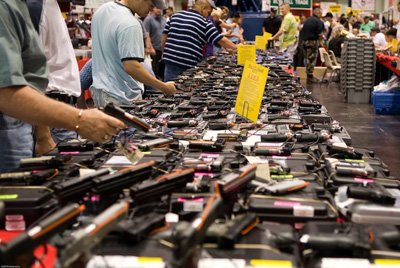
Guns for sale at a Houston gun show. (Wired Photo: Flickr/M Glasgow, 2007)

His coalition of 39 Christian, Jewish, Muslim and Sikh organizations launched in 2011 after the shooting in Tucson, Ariz., that killed six and injured then-Arizona congresswoman Gabrielle Giffords. It is affiliated with the Brady Campaign to Prevent Gun Violence.

Rabbi David Saperstein, director of the Religious Action Center of Reform Judaism, said religious leaders already are discussing possible next steps after the killings in Connecticut.

“The immensity of the tragedy and the strong religious mandate to protect the innocent and the children clearly have created conversations in the religious communities all across America about, ‘What can we do?’” he said.

Religious groups alone cannot move new legislation forward, said Saperstein, a longtime gun control advocate, but, “If political leaders move, the religious community will galvanize to support it.”

Speaking at an interfaith vigil in Newtown on Sunday, President Obama said “these tragedies must end,” and religious coalitions and denominations quickly urged the White House and Congress to act. For example:

• The African Methodist Episcopal Church urged Congress not to be intimidated by the gun lobby and to reform gun laws. “The times in which we live, and the consequences of reckless gun use, demand courage and determination from our political leaders, the faith community and individual citizens to change them,” the denomination said in a statement.

PICO National Network, a coalition of faith-based social justice groups, asked its members to petition Obama to send legislation to Congress to renew the assault weapons ban and to require background checks for all gun buyers.

• Episcopal Bishop Mariann Edgar Budde of Washington is teaming up with the Gary Hall, dean of Washington National Cathedral, to “dedicate ourselves to the work of passing national legislation to ban the sale of assault weapons and ammunition in this country,” and asked congregants to join them.

Despite the groundswell, not all religious leaders are convinced that stricter legislation is appropriate.

Joseph Mattera, presiding bishop of the New York-based evangelical group Christ Covenant Coalition, wrote in Charisma News that he doesn’t agree with New York Mayor Michael Bloomberg’s call for improved background checks and tighter gun laws. Mattera, instead, is concerned about the secularization of U.S. society.

“I also believe blaming guns would be to skirt the deeper issues the humanists don’t want to touch,” he wrote in a Dec. 15 commentary. “Blaming guns for this and other tragedies like Columbine and Virginia Tech massacres would be like blaming automobiles for the thousands of deaths that occur every year due to accidents on highways and streets.”