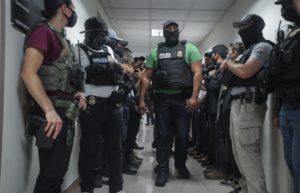
Ministry offers trauma healing to women in Ukraine

More than 1,000 women in Ukraine recently attended conferences, workshops and seminars designed to offer Christ-centered trauma healing.

Leonid Regheta, pastor of River of Life Church in Plano, facilitated the events in Kyiv, Odesa and Kharkiv in his role as Eastern European missions director for Hope International Ministries, with support from Texans on Mission and several Texas Baptist churches.
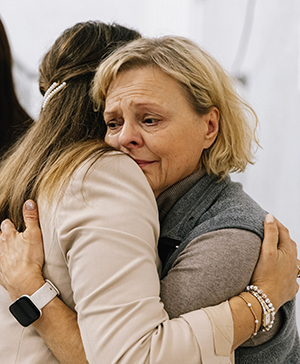
“We were able to see how God moved. There were a lot of tears. There were a lot of prayers. There were a lot of hugs. There were a lot of testimonies,” said Leo Regheta, Eastern European missions director for Hope International Ministries. (Photo courtesy of Leonid Regheta)

While wailing sirens warned Ukrainians of approaching drone missiles and cities experienced rolling blackouts, women gathered from around the war-torn country looking for emotional, psychological and spiritual peace.

“We had a strong prayer team here in the U.S., as well as locally in every place we went to. Sometimes, we had a conference or seminar going on as the prayer teams were uplifting us and asking God for protection,” Regheta said.

“We were able to see how God moved. There were a lot of tears. There were a lot of prayers. There were a lot of hugs. There were a lot of testimonies.”

One woman told Regheta she attended hoping to receive some help in coping, but she never expected the “breakthrough” she experienced.

Over the last three and a half years, Hope International has conducted 10 conferences in countries with large concentrations of Ukrainians—Poland, Germany, Latvia, Italy and Belgium, as well as in Ukraine.

Park Cities Baptist Church in Dallas and LakePointe Church in Rockwall were among the first congregations to provide start-up financial support for Hope International’s trauma healing ministry in Ukraine, Regheta noted.

The trauma healing events follow a “culturally nuanced and accepted format,” while also incorporating “best practices” from outside of Ukraine, Regheta said.

Encouraging long-term ministry locally

Rather than bringing in large teams from the United States, Hope International works with local Christian mental health professionals—as well as local churches and pastors—to support their work.

“One of our main approaches to ministry is to encourage long-term, sustainable, efficient ministry locally,” Regheta said.

As part of that emphasis on supporting local churches, Hope International has worked in partnership with the Baptist Union of Ukraine to offer summer retreats for pastors and their families the past two years.

At the same time, while trauma healing events sometimes are scheduled in churches, they often meet in a “neutral site” such as a civic center, making them more accessible and inviting to non-Christian participants.

Mental health professionals who lead sessions follow a “Christ-centered, biblically based approach,” he noted.
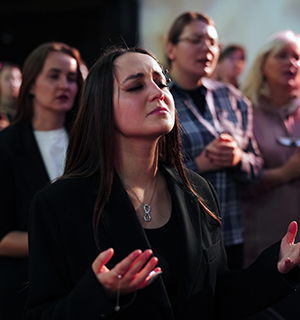
Prayer constitutes a significant part of the trauma healing events in Ukraine. While non-Christians are not compelled to receive prayer, “many of them do,” said Leo Regheta, Eastern European missions director for Hope International Ministries. (Photo courtesy of Leonid Regheta)

“We understand true healing comes from Jesus,” Regheta said. “New life comes from him.”

He recalled one woman who told him she felt like she was “in the Sahara Desert,” because it seemed as if everything in her experience had become dry and lifeless.

“Sometimes resurrection needs to happen—emotional, spiritual resurrection,” he said. “And that is something only Jesus can provide.”

Prayer constitutes a significant part of the events. While non-Christians are not compelled to receive prayer, “many of them do,” Regheta said.

He recalled praying with some women who lost a husband in the war and others who had a son who was killed. The trauma of living in a nation at war and suffering loss drives some people to seek God, while it drives others to become angry with God or doubt his goodness, he said.

“We come with Jesus to invite others to become closer to him,” Regheta said.

Hope Trauma Healing Center opens in Kharkiv

In addition to participating in the three events in Kyiv, Odesa and Kharkiv, Regheta joined in the formal opening of the Hope Trauma Healing Center in Kharkiv on Oct. 7.

Leo Regheta, pastor of River of Life Church in Plano and Eastern European missions director for Hope International Ministries, joined in the formal opening of the Hope Trauma Healing Center in Kharkiv on Oct. 7. (Photo courtesy of Leonid Regheta)

“We realize there are only so many trips per year we can make. So, why not pray and work on establishing something on the ground locally that will be manned by local psychiatrists, psychologists, trauma healing therapists and Christian volunteers,” Regheta said.

The center, built in partnership with Kharkiv’s mayor and with financial support from Texans on Mission, will provide consistent, localized mental health support to people dealing with trauma.

“It takes time to walk alongside somebody. It takes intentional effort to help them deal with their emotions, with their feelings, with their devastation, with their grief. And it takes time for all that to be processed,” Regheta said.

Rand Jenkins, chief strategy officer for Texans on Mission, sees involvement in trauma healing in Ukraine as part of the mission organization’s decades-long commitment to disaster relief and recovery.

“Texans on Mission is supporting trauma healing work in Ukraine because we recognize that true recovery after war goes beyond physical rebuilding—it requires tending to the mind and soul,” he said.

“In Ukraine, where families are still reeling from the psychological scars of invasion, displacement and loss, we understand that trauma doesn’t fade on its own. It fractures relationships, silences hope and paralyzes communities.”

‘Restoring dignity, rebuilding relationships, rekindling faith’

Texans on Mission works with Hope International Ministries because the two groups share a common commitment to working with pastors and churches in the communities being served.

“These leaders speak the language, understand the cultural context, and carry the trust of their people,” Jenkins said.

Rather than “parachuting in solutions,” Texans on Mission and Hope International are “equipping local ministers with trauma-informed care tools so they can walk alongside their congregations with compassion and competence,” Jenkins said.

“Healing trauma isn’t just about counseling. It’s about restoring dignity, rebuilding relationships and rekindling faith amidst brokenness. By empowering local leaders, we are helping to plant sustainable, Spirit-led recovery that will outlive any short-term aid program.”

Jenkins views the work in Ukraine as “a quiet but powerful witness—that even in the darkest valleys, the church can be a place of refuge, restoration and resurrection.”

Regheta expressed appreciation for the support Texas Baptist churches, ministries and individuals have provided. He requested their continued prayers as Hope International seeks to bring comfort to hurting people in Ukraine.

“Pray for the reality of God’s presence in the midst of war, in the midst of grief, in the midst of tragedy and in the midst of trauma,” he said. “We don’t just want to talk about Jesus. We want Jesus to manifest himself in the midst of what we do.

“We’re trying to do what we can. But we’d rather let Jesus speak through us.”



Call to ban foreign entities from targeting churches

Texas Baptists’ Christian Life Commission is urging church leaders to sign a letter to U.S. Attorney General Pamela Bondi calling on the Department of Justice to prohibit foreign governments from using tracking technologies to send targeted messages to worshippers in U.S. churches without their consent.

On Sept. 27, Show Faith by Works—an organization acting as an agent of Israel’s Ministry of Foreign Affairs—filed disclosures with the Justice Department as required by the Foreign Agents Registration Act.

The disclosures revealed the organization’s intent to use geolocation and geofencing technology to send targeted messages to the mobile devices of individuals on the property of 465 churches—including more than 200 in Texas—without their knowledge and consent.

‘Crosses a line that should concern all Americans’

“We recognize the importance of diplomatic relations and the legitimate interests of allied nations. However, the surreptitious targeting of American worshipers on the grounds of their churches crosses a line that should concern all Americans who value religious freedom and privacy,” the letter to Bondi from Texas Baptists states.

John Litzler

John Litzler, CLC director of public policy and general counsel for the Baptist General Convention of Texas, noted most smartphone apps request user permission before accessing a user’s geographic location.

“Because of privacy rights, users typically have a choice whether to deny access to their location, always grant access to their location, or grant access to their location only while using the application. In these instances there is a knowing and voluntary decision by the user,” Litzler explained.

“If I allow a restaurant to know my location, for example, I may be able to place mobile orders and receive an occasional free chicken sandwich.

“In contrast, the targeting described in this filing would be done without the knowledge or consent of pastors and congregants.”

The letter to Bondi raises five key issues:

  • Violations of religious liberty, freedom of association and free assembly.

Houses of worship historically have been “protected spaces where Americans gather freely to practice their faith without government surveillance or foreign interference,” the letter states.

“Allowing government-sanctioned foreign surveillance and influence operations within church sanctuaries fundamentally undermines this separation by entangling houses of worship with state-approved foreign political campaigns.”

Targeting individuals in places of worship also can have a “chilling effect” on the freedom to assemble and freely exercise faith, the letter notes.

“Allowing a foreign government access to geolocation data to every phone located on a church premises is akin to requiring the churches to turn over their membership lists,” the letter states.

  • Violations of property and privacy.

Most of the places of worship listed in the filing are the private property of the faith communities that assemble there, the letter notes.

“Property rights are built on the principle that property owners should have the right to exclude others from their property,” the letter states.

“Geofencing, without the knowledge or consent of the property owner, circumvents these ownership rights by tracking individuals’ whereabouts everywhere on church property from the prayer room to the bathroom.”

  • Lack of informed consent.

Individual worshippers “have no knowledge they are being targeted and are provided no ability to opt out,” the letter states.

  • Violation of religious autonomy.

Houses of worship and their leaders “should have the right to determine what outside influences, particularly from foreign governments, are permitted to communicate with their congregations on church property,” the letter states.

  • Sets a dangerous precedent.

“Allowing agents of foreign governments to use surveillance technology to target faith communities sets a troubling precedent that could be exploited by any foreign actor, whether allied or adversarial to the United States,” the letter states.

‘Potential for gross violations’ of civil rights

Two years ago, Calvary Chapel in San Jose, Calif., sued Santa Clara County for geofencing its premises to track congregants who attended worship services during a COVID-19 pandemic “shelter-in-place” order.

The claims in that lawsuit “demonstrate the potential for gross violations of Americans’ civil rights when foreign or domestic governments are allowed to use this technology to track church attendees,” Litzler said.

“If a local, state or federal government entity tried to compel churches to turn over their membership lists, Christians would rightly be concerned about infringement on our rights of religious freedom and freedom of association,” he said.

“By setting a geofence around a church and collecting information about who enters that area each Sunday, foreign actors will gain enough information about church attendees that it’s tantamount to turning over a membership list to them.”

The letter from Texas Baptists to Bondi asks the Department of Justice to:

  • Prohibit agents of foreign governments from using geolocation, geofencing or similar tracking technologies “to target individuals at houses of worship in the United States without their consent.”
  • Establish an opt-in requirement that would allow foreign governments and their agents to use tracking technologies only at places of worship that have “explicitly and voluntarily consented in writing.” It would require full disclosure of “the foreign entity involved and the nature of the messaging to be delivered.”

“Houses of worship should remain sanctuaries free from uninvited foreign government surveillance and influence,” the letter to Bondi states.

“We ask that you act swiftly to protect the integrity of our religious institutions and the rights of all Americans to worship freely according to their conscience.”

Church leaders can sign the letter by clicking here.


Growing number believe religion gaining influence in U.S.

(RNS)—After years of decline, a growing number of Americans believe religion’s influence is on its way back, a new study from Pew Research Center suggests.

The report, published Oct. 20, found about a third of Americans (31 percent) said religion is gaining influence in the country—up from 18 percent a year ago.

“While this remains a minority view, it is increasingly held by adults across several demographic groups—with gains of at least 10 percentage points among Democrats and Republicans, adults in every age category and in most large religious groups,” the report described.

Jewish Americans (44 percent) were most likely to say religion’s influence is on the rise, followed by white evangelicals (36 percent) and atheists (38 percent).

Black Protestants (26 percent), Catholics (27 percent) and those with no particular religion (27 percent) were less likely to agree.

The idea that the influence of religion is declining in American culture has paralleled the rise of so-called nones, or those who have no religious affiliation. In 2007, 16 percent of Americans claimed no religion, according to Pew. That number continued to climb until leveling off at about 30 percent in recent years.

In 2002, 52 percent of Americans said religion’s influence was declining. That number reached 80 percent last year before dropping to 68 percent this year.

Positive view of religion on the rise

The report, based on data from Pew’s American Trends Panel collected in February and May, also found a growing number of Americans (59 percent) said they have a net-positive view of religion’s role in society, up from 49 percent in 2022. Twenty percent have a net negative view, while 21 percent indicated an unclear or neutral view.

President Donald Trump made returning religion to power in American life a key part of his campaign to return to the White House. Republicans and those who lean Republican were most likely (78 percent) to claim a positive view of religion in society. Democrats and those who lean Democratic were much less likely (40 percent) to say it had a positive impact.

Individuals ages 65 and older were more likely (71 percent) to indicate a positive view of religion in society than those younger than 30 (46 percent).

Atheists (6 percent) and agnostics (11 percent) were the least likely to say they have a positive view of religion in public life.

White evangelicals (92 percent) and Black Protestants (75 percent) were most likely, among faith groups. Jews (36 percent) and those with no particular religion (33 percent) were somewhere in between.

Overall, positive views of religion were on the uptick.

“The share of Americans expressing positive views of religion in 2024 and 2025 are up significantly from 2022 and 2019, indicating an overall shift toward more positive views about religion’s role in American life over the past five years or so,” researchers wrote.

Majority say their religious views at odds with culture

For the study, researchers asked Americans a number of questions about the intersection of religion and society, including whether being patriotic was an essential part of their faith and if they saw a conflict between their faith and broader culture.

Researchers found 58 percent of Americans say their religious views are at odds with mainstream culture—including 21 percent who said they feel great conflict—up from 42 percent in 2020.

White evangelicals (80 percent), Jews (62 percent) and atheists (61 percent) reported the highest level of conflict. Agnostics (48 percent) and those with no particular faith (37 percent) reported the lowest conflict.

While Americans see patriotism as important, few saw it as an important part of their faith.

“Among U.S. Jews, 22 percent say loving your country is essential to Jewish identity, while 32 percent say it is important but not essential. And 46 percent say loving your country is not important to being Jewish,” according to the report.

Researchers found similar attitudes among Christians and the unaffiliated. Twenty-nine percent of Christians overall said being patriotic was essential to their faith, while 47 percent said it was important but not essential. Sixteen percent of the unaffiliated said loving your country was essential to being a good person, while 43 percent said it was important.

“Republican Christians are somewhat more likely than Democratic Christians to say loving your country is essential to being Christian (33 percent vs. 23 percent),” researchers wrote. “Still, far fewer than half of Christians in both parties say loving their country is core to their religion.”

What is viewed as essential?

For Christians, traits like being honest (86 percent), treating people with kindness (85 percent), believing in God (85 percent), having a personal relationship with Jesus (75 percent) and helping others in need (66 percent) were seen as essential by respondents.

Attending religious services (28 percent) was seen as least essential, followed by continuing family traditions (29 percent) or being part of a community (33 percent).

Overall, Americans said they were open-minded about religion. About half (48 percent) said many faiths may be true, while just over a quarter (26 percent) said only one faith is true. But a similar number (24 percent) said there is little (18 percent) or no truth (6 percent) in any religion.

Atheists and evangelicals were most at odds over the truth claims of religion. Eighty-seven percent of atheists said there was little or no truth in religion—as opposed to 4 percent of evangelicals. While 38 percent of Republicans said only one religion is true, only 16 percent of Democrats agreed.

For the report, Pew relied on findings from a survey of 9,544 Americans conducted Feb. 9-13 and a survey of 8,937 Americans conducted May 5-11. Both groups were drawn from Pew’s American Trends Panel.


Around the State: UMHB dedicates new golf facility

The University of Mary Hardin-Baylor celebrated the dedication of the Jane and Mac Hickerson Crusader Golf Club with a ceremony and ribbon cuttings on Oct. 17. Hundreds of guests—including two-time Masters champion Ben Crenshaw—attended the event, which was held at the site of the new facility on University Drive at the UMHB campus.

Wayland Baptist University students in Emily Dyson’s Best Achievement Strategies for College class invite the community to join them in making a difference this fall through their “Share the Warmth” Coat and Sock Drive. BASC is a course taken by first-year students to help them acclimate to college life. The class focuses on academic success, campus engagement and community service. The student-led service project will collect gently used adult and child-sized coats and new packages of socks to benefit local families in need during the cold winter months. The drive runs through Nov. 3 and donations can be made at the Moody Science Building on the Wayland campus between 9 a.m. and 4 p.m., Monday through Friday. A drop-off box will be located at the main entrance nearest the parking lot for convenient access.

Wayland Baptist University will recognize three new doctoral graduates from its Ph.D. in Management program during the Dec. 13 commencement ceremony on the Plainview campus. Graduates will be hooded in recognition of their academic achievement and contribution to the field of management research. The three new Ph.D. recipients—James McGregor of Euless, Nathaniel McKenzie of Rio Rancho, N.M., and Santos Navarrette Jr. of Rule—recently completed their dissertations and met all requirements for the degree offered through Wayland’s School of Business.

East Texas Baptist University celebrated Homecoming 2025 by welcoming alumni and friends to on-campus festivities Friday, Oct. 17 through Saturday, Oct. 18. Throughout the week, the university held a variety of events that engaged students in faith and friendship, including pumpkin painting, conversations with the President, trivia Tuesday, Powder Puff games and Western dancing.

Hendrick Health in Abilene held its annual Leadership Development Institute for 80 elementary students. More than 350 leaders attended a morning and afternoon institute session at the Abilene Convention Center. The event included keynote speaker Dan Collard, co-founder of Healthcare Plus Solutions Group and author of Rewriting Excellence. Leaders welcomed student team members from elementary schools in Abilene, Wylie and Brownwood. The teams put together bikes that were a surprise gift to the students who participated.


Panelists identify dangers of religious nationalism

Religious nationalism “cheapens” religion and exchanges genuine love of country for a blank check that justifies any action a country takes, panelists said during the Global Religious Freedom Gathering at Dallas Baptist University.

Randel Everett, director of DBU’s Center for Global Religious Freedom, moderated a panel discussion Oct. 20 on “Religious Nationalism Globally and Its Effect on Minorities.”

Panelists were Jack Goodyear, dean of the College of Humanities and Social Sciences at DBU; Anna Lee Stangl, head of advocacy for Christian Solidarity Worldwide; and Katie Frugé, director of Texas Baptists’ Christian Life Commission.

Christian nationalism—which conflates Christianity and national identity—“compromises the faith, and it compromises the gospel,” Frugé said.

“This nationalistic merging with your faith cheapens the faith. It cheapens your experience with the Holy Spirit,” she said. “Really, at the end of the day, it becomes something that’s not even a true gospel. It’s a hindrance to your spiritual health.

“So, if our goal is human flourishing as a society, the best way for that to happen is to have faithful, real, authentic relationships with our Creator. And the best way toward that is not nationalism.”

Distinction between patriotism and nationalism

Goodyear drew a distinction between healthy patriotism—loving one’s country enough to hold it accountable when it fails to live up to its ideals—and unhealthy nationalism, particularly religious nationalism.

“Nationalism would tend to justify anything your country is doing, and anybody who opposes that are the ones who are [seen as] wrong,” he said. “Healthy patriotism allows you to love your country while still calling to account your country.”

Stangl agreed true patriotism means “speaking truth into what is happening” in a country and what it is doing abroad.

That becomes problematic when national identity and religious identity are combined, she observed.

Hindu nationalists in India, Buddhist nationalists in Myanmar and Sri Lanka, and Orthodox Christian nationalists in Russia offer contemporary international examples of how religious nationalism leads to “othering” and persecution of minorities, she said.

Furthermore, the parameters for acceptable religion continually shrink, she observed.

“When you raise up one group, that group will inevitably narrow,” Stangl said.

In Russia, for instance, the Orthodox Church is linked to Vladimir Putin, but dissident Orthodox groups are not, she said. So, only one dominant group within the Orthodox Church is recognized as legitimate.

Grants permission for ‘dehumanization’

Similarly, Frugé said, the rise of Christian nationalism in the United States begs the question, “Which version of Christianity?”

Eventually, the field narrows and one dominant group prevails at the expense of all others, she observed.

“It has the dynamic of ‘us versus them,’” Frugé said. “You have to have an ‘other’ who becomes the enemy, the target of the opposition. It creates a permission structure of dehumanization—to treat others as ‘less than.’”

That approach “chips away” at the fundamental Christian idea of each person bearing the image of God and possessing inherent worth, she asserted.

“It’s an unsustainable system,” she said.

Christian nationalism often “promotes fear” of those who are different, Stangl said.

Simply “being in proximity” to people of other faiths and recognizing they do not present any danger can help dispel those fears, she noted.

Same terminology, different meanings

Panelists acknowledged the challenge of confronting religious nationalism when it uses some of the same language and terminology of traditional religion while redefining terms and reshaping identity.

“For me, sometimes it begins with a gentle conversation of just establishing our terms and what we mean,” Frugé said.

For Baptists, it means “rooting the conversation in historicity” and making it clear an insistence on religious liberty for all is “who we’ve always been,” she added.

Goodyear emphasized the importance of telling stories about religious liberty that allow individuals to “see the human element and how it impacts people” instead of simply presenting hard facts.

Churches can help promote conversations that bring together people from diverse backgrounds to “mellow extremism” and help them see the viewpoints of others, he suggested.

Stangl offered an international example of churches teaching basic democratic principles to members.

She cited the example of a pastor in an authoritarian country who taught his people the importance of voting on simple decisions affecting the congregation and abiding by the will of the majority.

The pastor intentionally was preparing church members for the time when they might have the right to vote on national matters, she said.

Stangl also emphasized the value not only in telling stories from history, but also stories about what is going on around the world.

“It’s important to be talking about what’s happening in Burma and what’s happening in Russia and then tying it to here,” she said.

“I think a lot of Christians here who may be falling in love with the idea of Christian nationalism would immediately say, ‘It’s horrible what’s happening there.’”


Is there religious revival among Gen Z?

PITTSBURGH (RNS)—It’s 9 p.m. on Oct. 13, a Monday, on the University of Pittsburgh’s campus. There are two NFL games on TV and fall midterms are this week. But roughly 300 students are packed into a room in the student union building, clapping or raising their hands in worship.

“No treasure of this life could ever satisfy,” the students sing, some standing, others kneeling in the back. “God, you are my everything.”

Moments later, the group’s founder, 34-year-old Jordan Kolarik, grabs a mic and heads to the front of the room to deliver a message on devotion. He’s nearly buzzing with energy as he reads aloud a passage from Matthew 26 about a woman anointing Jesus with expensive perfume.

“You can believe the right things, you can say the right things, you can kind of go to church, but never have real devotion to Jesus,” he says.

In fall 2022, Kolarik, a Pittsburgh native and former high school teacher, launched this chapter of Chi Alpha with just eight volunteers. This year, the student chapter, affiliated with the Assemblies of God, has 77 student small group leaders leading hundreds of students.

“It’s sort of like a pyramid scheme for Jesus,” Kolarik joked.

Evidence of spiritual renewal on other campuses

Though the chapter’s growth is striking, students say it’s part of a broader stirring on campus. The Pittsburgh Oratory, a Catholic campus ministry serving several Pittsburgh universities, recently began hosting Sunday Mass in a larger chapel due to surging student attendance.

In September, the University of Pittsburgh football team made national headlines for spearheading what some called a campuswide “revival.” About 65 students reportedly professed faith in Christ and 80 were baptized.

And the displays of devotion aren’t exclusive to Pittsburgh. The Ohio State football team has drawn national attention for baptizing dozens of students at public “Invitation to Jesus” events.

The campus movement UniteUS, which brings large-scale evangelical worship and baptism events to colleges, reports 13,000 college students have made faith commitments to Christ since 2023.

Now, in the wake of the assassination of conservative activist Charlie Kirk, claims of nationwide revival are escalating.

“Charlie started a political movement but unleashed a spiritual revival,” Defense Secretary Pete Hegseth declared at Kirk’s memorial service.

Political commentators, Turning Point USA spokespeople and Christian worship leaders also linked Kirk’s passing with revival, especially among young people.

Looking for ‘sustained, significant, substantive revival’

But while Fox News has claimed that members of Generation Z are returning to church in astounding numbers, religious trends researcher Ryan Burge said assertions of revival are largely overblown

“We’re not seeing anything at the scale that would even begin to point me in the direction of a sustained, significant, substantive revival in America right now,” he told RNS. “It’s not a return to religion among Gen Z. It’s just they’re not leaving as fast as millennials did when they were in their late teens and early 20s.”

Recent data from the evangelical Christian polling firm Barna Group has been widely cited to support revival claims.

While most data about religion and young people shows Gen Zers are the least likely to attend services, Barna’s model found among those already attending church, Gen Zers attend more regularly than other generations of churchgoers—1.9 times per month, just slightly more frequently than millennial churchgoers (1.8 times).

Barna CEO David Kinnaman also told RNS there’s “a higher percentage of Gen Zers today than five years ago who are saying they have made a commitment to Christ.”

Still, while Kinnaman said he’s personally praying for revival, as a researcher he’s using the language of “renewal” to describe what he’s seeing so far. And Barna has also reported counter trends, with Gen Z women being increasingly likely to identify as religiously unaffiliated.

How is ‘revival’ defined?

Conflicting claims of revival could be due in part to different definitions of the term. Some use “revival” to describe a high-octane religious event. Adam Miller, a pastor of Pittsburgh’s Life Church and mentor to several Pitt football players, said revival is, “at a base level,” a movement “from death to life” that also “goes beyond a moment.”

From a research standpoint, it would require overwhelming evidence from multiple sources to demonstrate revival, Burge said.

“If we talk about the First Great Awakening and the Second Great Awakening … the entire trajectory of religion in America changed in those moments,” Burge said.

“My definition of revival is a whole lot more people going to a house of worship this weekend than a year ago. And by a whole lot, I don’t mean 100,000 nationwide or 500,000 nationwide. I mean 5 million, 10 million, 15 million. That’s what a revival is like.”

Gen Z engages religion differently

Still, on the ground, there seems to be a shift in how Gen Z is engaging with religion. Liz Bucar, a professor of religion at Northeastern University in Boston, said that from where she sits, it’s clear the syncretic, ad hoc, New Age approach to spirituality by some older generations “has not been satisfying” to Gen Z.

In response to the instability of today’s world—global wars, climate change, COVID-19—she’s seeing a desire for more structured community, and for moral frameworks that can help Gen Z navigate a suffering world.

Some Gen Zers are seeking that outside the institutional church, she said, while others may be attracted to the unambiguous answers offered by more traditional faith communities.

Jake Overman, a 6-foot-4-inch senior tight end on the University of Pittsburgh football team, told RNS the gospel of Jesus has been a source of purpose and fulfillment among his teammates. Overman grew up in a nondenominational Christian church and said that while praying in his room earlier this year, he clearly heard God tell him, “It’s time.”

In response, he started a Bible study with his teammates. Called “The Pitt Men of God,” the group meets weekly, typically in the football facilities after practice.

“It was so clear that there was a hunger on this team for God,” said Overman, who also launched the Pitt for Jesus campus event that made national headlines last month. “They’ve tried girls, they’ve tried drugs, they’ve tried alcohol, they’ve tried parties, they’ve tried going to see therapists. … They’ve tried all of these things, yet they still were coming up empty.”

‘There has to be something more’

Joshua Raj, a 20-year-old junior and Chi Alpha small group leader at the University of Pittsburgh, said he thinks faith has appealed to many of his Gen Z peers amid the “chaos” of global events.

“There has to be something more,” he said.

Joshua Raj is a 20-year-old junior and Chi Alpha small group leader at the University of Pittsburgh. (RNS photo/Kathryn Post)

Raj was among several Chi Alpha students RNS spoke with who said they’d developed a transformational relationship with God, saying they felt deeply known and loved.

They also said that transformation has had outward manifestations, too. Chi Alpha small group leaders pledge to refrain from alcohol, and, according to senior small group leader Katie McLean, the group sends out evangelism teams on Friday nights and hosts tailgates and Halloween parties free from alcohol.

Though Pitt’s Chi Alpha chapter has been home to a handful of new Christian converts, most participants were once “culturally Christian,” according to group founder Kolarik. The group is known for its high-energy events such as glow-in-the-dark parties and flag football tournaments and for its intentional discipleship of student leaders.

“We are excellent at reaching kids from a Christian home, but they themselves are not really following Jesus,” he said.

‘Gen Z is hungry’

The renewed Christian devotion among some Pittsburgh college students could be a microcosm of what Burge calls a “concentration of commitment.” He compared the phenomenon to a reduction on the stove.

“The amount of liquid goes down, but the concentration of flavors goes up,” he said. “That’s what’s happening with young Christianity in America. It’s fewer people, but they’re much more committed to what they believe, much more engaged in the behavior of being religious.”

Miller, the pastor who mentors Overman and several other Pitt football players, said the team’s devotion also was reflective of broader demographic trends among Gen Z.

While historically, women have been more religiously devout than their peers, researchers are pointing to a closing of that gender gap, with Gen Z women now leaving the church at faster rates, while men are staying.

As researchers continue to map out where these religious shifts are happening and to what degree, it remains to be seen whether they are tied to political changes and which pockets of Christianity are stabilizing or seeing growth.

Though the data doesn’t support narratives of a nationwide, youth-led surge in church attendance, the plateauing of religious decline in America is noteworthy. And while local stories of renewal may not be linked currently to quantifiable revival, they provide a glimpse of the desires and motivations shaping the spiritual lives of Gen Z.

“Gen Z is hungry. And I think when people show up with passion and purpose, Gen Z responds loudly,” Kolarik said. “Gen Z really does want to make their life count.”


Morris Chapman, longtime SBC leader, dead at 84

NASHVILLE (BP)—Morris H. Chapman, former pastor, former Southern Baptist Convention president, former SBC Executive Committee president and champion of the Cooperative Program, died Oct. 20, at age 84.

The last SBC president during the so-called conservative resurgence to be opposed by a moderate candidate, Chapman led the SBC to remain focused on the Great Commission as moderates broke away.

Under his leadership as Executive Committee president, Cooperative Program giving reached a record high yet to be matched.

Chapman was given the honorary title of president emeritus of the Executive Committee upon his retirement in 2010.

“In a world where so many have fallen, he was faithful to the end,” current SBC President Clint Pressley posted on social media in tribute to Chapman. “Southern Baptists like me owe men like him a debt of gratitude. Praying the Lord is close to his family and especially his widow Jodi in the days ahead.”

“Morris Chapman led with passion and integrity,” said current SBC Executive Committee President Jeff Iorg. “He was a champion for cooperation and our global mission. He was also a friend who encouraged me for many years—including after my election as president of the EC. We honor him and pray for his family in their loss.”

Born in Kosciusko, Miss., on Thanksgiving Day, 1940, Chapman professed faith in Christ at age 7 at First Baptist Church in Laurel, Miss., was called to ministry at age 12 and recognized a call to preach at age 21.

After graduating from Mississippi College, Chapman earned master of divinity and doctor of ministry degrees from Southwestern Baptist Theological Seminary. He was ordained to the ministry at Bellevue Baptist Church in Memphis, Tenn., when Ramsey Pollard was pastor.

Chapman served as pastor of four churches in Texas and New Mexico during a span of 25 years: First Baptist Church in Rogers from 1967 to 1969; First Baptist Church in Woodway from 1969 to 1974; First Baptist Church in Albuquerque, N.M., from 1974 to 1979; and First Baptist Church in Wichita Falls from 1979 to 1992.

Along the way, Chapman was active in denominational life, serving two terms as president of the Baptist Convention of New Mexico and as a member of the Executive Board of the Baptist General Convention of Texas.

In 1984, Chapman felt a growing burden for revival among Southern Baptists and led First Baptist in Wichita Falls to pray by name for each of the 36,000 Southern Baptist churches as well as SBC entities.

During that five-month period and beyond, the church received hundreds of responses from across the nation testifying to the impact of the effort.

During Chapman’s pastorate in Wichita Falls, First Baptist was consistently in the top 1 percent of Southern Baptist churches for giving through the Cooperative Program as well as for baptisms. Under his leadership there, Cooperative Program gifts reached 16 percent of total undesignated receipts and baptisms each year averaged more than 160.

SBC presidency

After serving as president of the SBC Pastors’ Conference in 1986 and preaching the convention sermon at the SBC annual meeting in 1989, Chapman’s peers looked to him as the conservative nominee for SBC president in 1990.

While Adrian Rogers in 1979 was the first in a string of conservatives elected over moderate candidates during the so-called conservative resurgence, Chapman was the last. His election marked the end of moderates’ attempts to win the presidency, and the following year he ran unopposed.

When he was elected in 1992, Morris said he saw his role as rallying Southern Baptists together.

“I see myself as carrying out the will of the majority and carrying out genuine healing among Southern Baptists,” Chapman said after his election was announced during a February 1992 meeting of the Executive Committee, according to Baptist Press archives.

As president of the SBC, he also emphasized the need for the SBC to focus on evangelism and prayer and called churches around the country to pray while he was SBC president.

“The desperate need for spiritual awakening in this nation has been ever present in my thoughts,” he said at the time.

Chapman appointed two task forces as president: one on spiritual awakening and the other on family ministry. He warned that the “moral fiber of our nation will soon be shredded beyond repair” if the erosion of the family was not reversed.

James Merritt, another former SBC president, said Chapman helped the denomination get back on track after the end of that battle by focusing on the Cooperative Program, the SBC’s long-running program for funding missions and national ministries.

He referred to Chapman as a “Christian gentleman” devoted to the SBC.

“Morris came out at a very strategic time,” said Merritt. “Healing needed to take place. He struck a good chord, trying to bring people together.”

When moderate Southern Baptists began to explore options for redirecting their Cooperative Program gifts to bypass the SBC Executive Committee, Chapman opposed “any deviation from this proven practice of cooperation.”

Moderates officially formed the Cooperative Baptist Fellowship while Chapman was SBC president in 1991. At that year’s meeting in Atlanta, Chapman pushed for extending Southern Baptist outreach in the host city for the annual meeting each year. It became a week-long effort and was renamed “Crossover” at Chapman’s suggestion.

Executive Committee leadership

With Chapman championing cooperative giving, the Cooperative Program allocation budget receipts distributed to SBC entities grew by 44 percent during Chapman’s 18 years as Executive Committee president.

Receipts exceeded the annual Cooperative Program allocation budget 15 years in a row from 1994 through 2008, falling off slightly during a global economic crisis.

Total giving through the Cooperative Program to state Baptist conventions reached a record high of $548,205,099 in 2007-08. Even without an adjustment for inflation, that is 23 percent higher than the most recent year.

In his role at the Executive Committee, Chapman led the implementation of the conservative resurgence vision, preaching throughout the convention and emphasizing the full authority, inerrancy and infallibility of the Bible.

To prepare Southern Baptists for the 21st century, Chapman initiated a study committee that led to the Covenant for a New Century in 1995, a plan that streamlined convention entities for improved effectiveness.

Ben Cole, a longtime friend of the Chapman family, referred to Chapman as a denominational statesman.

“Dr. Chapman never saw himself as the commanding officer nor the Executive Committee as the flagship of the Southern Baptist Convention,” Cole said in a text message. “Neither did he serve as captain of a denominational battleship forever stirring waters of strife among his brethren.

“He will be fondly remembered by honest churchmen as a trustworthy ballast during seasons of theological retrieval and institutional realignment.”

Unlike other leaders of the so-called conservative resurgence whose ministries ended in scandal, Chapman was known for his personal integrity.

He was not above controversy, though, especially when clashing with those he thought might undermine the SBC or the Cooperative Program.

In 2009, during his speech at the Southern Baptist Convention, he criticized then-popular megachurch pastor Mark Driscoll as someone whose behavior was unfit for pastors.

He also criticized a move to cut funding to the Executive Committee.

Chapman, while he denounced abusers, opposed starting a database to track abusive church leaders.

Chapman is survived by his wife Jodi, his son and daughter-in-law Chris and Renee Chapman, his daughter and son-in-law Stephanie and Scott Evans, eight grandchildren and three great-grandchildren.

With additional reporting by Bob Smietana of Religion News Service.


Prior emphasizes living in purpose without AI

DALLAS—The craft of writing and the ethics of writing, just as with spiritual growth and maturity, offer no shortcuts, author Karen Swallow Prior said during her Oct. 16 lecture sponsored by the Institute for Global Engagement at Dallas Baptist University.

Using AI never can replace the skills or purpose of writing and reading, and there are risks such as plagiarism and stolen sources, Prior said.

“You have to know enough of the craft to recognize whether or not a tool’s effects are correct or good,” said Prior, author of The Evangelical Imagination, On Reading Well and You Have a Calling.

The purpose of reading and writing

To refresh her mind, Prior said, she often goes for runs around her neighborhood, fulfilling her purpose to keep her mind and heart clear.

To Prior, to read and write are ways to connect spiritually with God and others and to fulfill the purpose God has given.

 “You don’t get writing assignments because your professor needs more work to do. It all goes back to purpose. And shortcuts to fulfilling our purpose only can defeat the purpose,” Prior said.

Both reading and writing are important, Prior said, because we are made in the image of God, and he spoke the sky, land, sea and all of creation into existence with words.

“We, too, are made to use language to steward, to create with our words, and not just poems and stories and songs and final papers. We were made to create with words to offer love to one another, to ourselves, to our neighbors … to bring light and clarity,” Prior said.

“AI is just stolen words jumbled together and spit back out by a machine,” she continued.

“[AI] may be artificial, but it is not intelligent,” Prior noted.

“People were right about the printing press, too. I am hoping that AI becomes something better. But it is not there yet,” she added.

During the Q&A following the lecture, Prior agreed reading multiple works of literature help build empathy toward others.

Soulless versus meaningful

Prior told a story about one of her students who turned in a paper written with the help of ChatGPT, a program she was unfamiliar with at the time.

Familiar with searching for plagiarism and citation errors, Prior searched throughout the perfectly written paper and was astonished by how accurate and perfect it was. But the paper lacked a soul, a point Prior made to the audience while comparing writing with and without AI.

“We are meaning-making creatures. This is what we are made to do, and this is what we do,” Prior said.

“We are constantly searching for and trying to make meaning. And that’s what reading is literally and metaphorically. It is the effort to make meaning, whether you’re a 5-year-old … or whether you’re reading dense works of philosophy or reading the Bible to interpret it or reading each other’s faces,” Prior continued.

“I write because I don’t know what I think until I read what I say,” Prior said, quoting author Flannery O’Connor.

Prior told the audience to practice reading a lot of different things, from children’s material to classic fiction to written works encouraging intellectual thought.

Reading and writing are part of the larger journey of our own story and purpose in life, Prior said, and over time, a person can learn to read and write better if one doesn’t use AI.


Christians called to combat all religious persecution

Christians are commanded, commissioned and called to combat all religious persecution, international human rights attorney Knox Thames told a gathering at Dallas Baptist University.

Two-thirds of the global population live in countries that restrict the free practice of faith, Thames informed the Global Religious Freedom Gathering, sponsored by Christians Against All Persecution and DBU’s Center for Global Religious Freedom.

Thames, author of Ending Persecution: Charting the Path to Global Religious Freedom, distinguished genuine persecution from the loss of privileged status enjoyed by a specific group.

“Persecution is violence or severe punishment on account of victims’ belief or non-beliefs or membership—real or perceived—in a religious community, combined with a lack of accountability,” he said.

Thames identified four forms of persecution:

  • Authoritarian persecution occurs when the state exercises power against religious activity or religious groups, such as in China.
  • Extremist persecution takes place when non-state actors and individuals are allowed to commit acts of violence against those who practice a particular religion or fail to adhere to the state-sanctioned religion, such as in Pakistan.
  • Terrorist persecution occurs when extremist groups commit acts of extreme violence against particular religious groups, such as ISIS targeting Yazidis and Christians in Iraq.
  • Democratic persecution happens when the dominant religious community uses majority rule to trample the rights of adherents of minority religions, such as in India.

The global “pandemic of persecution” does not affect followers of only one religion, said Thames, senior fellow at Pepperdine University.

Rather, it “goes after everyone” and endangers freedom of thought and practice of all wherever it occurs, he stressed.

‘Be light in the darkness’

The global “pandemic of persecution” does not affect followers of only one religion, international human rights lawyer Knox Thames told a gathering at Dallas Baptist University. (Photo / Ken Camp)

Christians have the responsibility to pray for all persecuted people and advocate for the religious freedom of every person, Thames emphasized.

“Advocacy demonstrates God’s love in a tangible way,” he said.

Jesus commanded his followers to love their neighbors and commissioned them to make disciples of all people groups everywhere—not just those who are like them, Thames said.

Citing both the Hebrew prophets and the New Testament, he pointed to ways God calls his people to stand up for the rights of the oppressed and vulnerable.

“One small light can pierce the darkness,” Thames said. “We are called to be light in darkness.”

During the gathering at DBU, participants not only prayed for a Christian pastor from Turkey and a Nigerian pastor, but also a representative of Pakistan’s Ahmadiyya Muslim community and a Shia Muslim from the Hazara people of Afghanistan.

Lead with love, start with service

Non-Christians find the gospel more compelling when Christians lead with love and start with service, rather than seek power and exercise privilege, former Houston pastor Steve Bezner said.

Non-Christians find the gospel more compelling when Christians lead with love and start with service, rather than seek power and exercise privilege, Steve Bezner told participants at a Dallas Baptist University chapel service. (Photo / Ken Camp)

Bezner, now associate professor at Baylor University’s Truett Theological Seminary, spoke in the DBU chapel service during the Global Religious Freedom Gathering.

History, diplomacy and theology should lead Baptists in the United States to care about religious persecution and advocate for the religious freedom of all people, he said.

Baptists in colonial America learned early what it meant to be “on the receiving end of persecution,” said Bezner, citing pastors Roger Williams, Obadiah Holmes and Isaac Backus as examples.

On a practical level today, when Christians in the United States insist on religious freedom for all people domestically, appeals by U.S. diplomats for international human rights carry greater weight, he added.

Theologically, true faith demands the freedom to choose freely, not coerced conformity to mandated religion, said Bezner, author of Your Jesus is Too American: Calling the Church to Reclaim Kingdom Values Over the American Dream.

“Jesus wants all to freely come to him,” he said.

Establish relationships

Bezner recalled the backlash against Muslims when an Islamist extremist killed 49 people and wounded 58 others at the Pulse nightclub in Orlando in 2016—the deadliest mass shooting in American history up to that point.

At the time, Bezner had been pastor of Houston Northwest Church about three years. He felt God leading him to stop at a Houston mosque in the immediate aftermath of the mass shooting and seek to befriend the imam there.

A frank and honest exchange—in which the pastor and the imam each affirmed their distinctive beliefs—provided the foundation for mutual respect and resulted in Bezner receiving invitations to speak at three local mosques.

“The gospel runs on the rail of relationships,” he said.

He also described how members of Houston Northwest Church spent two months in “mud-out” work after Hurricane Harvey hit their city in August 2017.

Church volunteers worked in the flooded homes of their neighbors—many of them non-Christians—clearing out mud, discarding debris, removing damaged drywall and disinfecting surfaces to eliminate mold.

Christians make a lasting impact not by “taking over the White House” but by “going house to house” serving their neighbors, Bezner said.

Peacemaking group receives award

Wissam al-Saliby, president of 21Wilberforce,  presented the Frank Wolf International Freedom Award to Churches for Middle East Peace. Mae Elise Cannon, executive director of CMEP, accepted the award on behalf of the organization. (Photo / Ken Camp)

The Global Religious Freedom Gathering at DBU also featured panel discussions involving pastors, international students and advocates from human rights groups focused on religious freedom.

At a dinner held in conjunction with the gathering, the 21Wilberforce human rights organization presented its annual Frank Wolf International Freedom Award to Churches for Middle East Peace. Mae Elise Cannon, executive director of CMEP, accepted the award.

The coalition—representing more than 30 national communions and organizations—mobilizes Christians in the United States to advocate holistically for equality, human rights, security and justice for Israelis, Palestinians and all people of the Middle East.

Previous award recipients include Bob Roberts, co-founder of the Multi-Faith Neighbors Network; Bob Fu, founder of ChinaAid; Sam Brownback, former U.S. ambassador-at-large for international religious freedom; Archbishop Ben Kwashi and Gloria Kwashi of Nigeria; and the city of Midland.

EDITOR’S NOTE: The third paragraph from the end was edited after the article initially was published.


Hispanic Trump adviser acknowledges widespread fear

(RNS)—Samuel Rodriguez, a Hispanic evangelical adviser to President Donald Trump, is urging government leaders to recognize the “innocent people” who are being swept up in detention quotas.

Rodriguez, president of the National Hispanic Christian Leadership Conference and pastor of New Season Church in Sacramento, Calif., cited significant drops in church attendance in the face of immigration raids and mass deportations.

Masked federal agents wait outside an immigration courtroom on Tuesday, July 8, 2025, in New York. (AP Photo/Olga Fedorova)

In an Oct. 16 interview, he noted some churches in the NHCLC network are seeing Sunday attendance drop by 25 percent to 35 percent due to fear of immigration raids.

Other leaders of Latino and immigrant congregations throughout the United States have reported drops in Sunday attendance, especially in Washington, Chicago and Los Angeles, where the Trump administration has launched major federal operations.

“In my conversations with the White House, with members of Congress and so forth, there is a constant affirmation that the priority is deporting the criminal element,” Rodriguez said.

 But, in his view, “the 25 percent to 30 percent that are being deported that are not the criminal element are a direct result of a daily quota of 3,000 deportations,” referring to goals set by the Department of Homeland Security.

Urging support for the Dignity Act

Rodriguez said he has been mobilizing Latino evangelical Christians to support the bipartisan immigration reform known as the Dignity Act, urging them to gather at church to pray for Congress to pass the bill, led by U.S. Reps. María Elvira Salazar, R-Fla., and Veronica Escobar, D-Texas.

Department of Homeland Security spokesperson Tricia McLaughlin said in late September, 70 percent of Immigration and Customs Enforcement detainees are “criminal illegal aliens who have been convicted or have pending charges in the US,” but data at the time of her statement shows 36 percent of those arrested have no criminal record.

Rodriguez supports the deportation of criminals but claimed ICE is forced into making arrests of criminals and non-criminals alike, because leaders in blue states won’t grant ICE access to their incarcerated populations.

“Let’s say, hypothetically speaking, they reach 2,500 a day that are complete criminals, gang bangers, pedophiles, rapists, drug dealers, et cetera,” Rodriguez said.

“If the blue states primarily don’t cooperate and give ICE access to their prisons and jails, then they have to find the other 500 because they have a quota of 3,000. … Not that I’m affirming that. I’m not celebrating that.”

Hold asylum seekers in ‘humanitarian campuses’

At the NHCLC’s annual summit on Oct. 14, the organization heard from Salazar, whose bill would increase enforcement resources at the U.S. borders while allowing unauthorized immigrants without criminal records who have been in the country more than five years to earn legal status if they pay taxes and $7,000 in restitution.

The bill would expedite the asylum process but would hold asylum seekers in “humanitarian campuses,” rather than releasing them into the United States while they wait for a court decision, as has been the practice for decades.

It would pay for U.S. citizens to receive workforce training, funded by the immigrants’ restitution payments. It would also make changes to immigration visas.

“There’s never been a more conservative proposal. None ever, ever, ever,” Rodriguez said. “This does not grant citizenship. This is the opposite of amnesty.”

‘Don’t have to live in fear’

Instead, he said, it offers the chance for immigrants who have entered illegally to work legally.

“You don’t have to live in fear,” he said. “It gives people dignity, and that dignity status to me is beautiful. It’s because we’re all created in the image of God.”

Rodriguez did not express confidence in the bill’s swift passage.

“Right now, I think I have faith, and hopefully that faith will convert to hope, because faith is the conviction of things hoped for and the assurance of things not seen.”

He asserted “the same administration that brought an end to a war in Gaza” was capable of immigration reform, calling it “a layup in comparison.”

Focus on antisemitism

The Dignity Act is just one priority of the NHCLC’s newly launched Center for Public Policy, which will focus on antisemitism through a partnership with the Anti-Defamation League.

“Latino evangelicals must be at the forefront of protecting our Jewish brothers and sisters around the world, speaking up on behalf of the nation of Israel,” Rodriguez said.

“It doesn’t mean that we are in perfect alignment with everything (Israeli Prime Minister) Benjamin Netanyahu says or does. That’s silly. No politician is perfect. No administration is above criticism, but we are in favor of the state of Israel.”

Another partner will be the Faith & Freedom Coalition, an evangelical voter-turnout organization long aligned with the GOP.

“We don’t lean right. We don’t lean left,” Rodriguez said. “We stand on the finished work of Christ.”

The center’s other priorities will include “issues that impact life from womb to tomb,” family tax credits, early childhood education and parental rights, a priority often intertwined with anti-LGBTQ+ positions.

Last year the organization launched the Center for Ministerial Health, which hosted 15 mental health symposiums in the past year.

“The response has been more than amazing, literally saving families, marriages, ministries and lives,” Rodriguez said.

The NHCLC celebrated its recent expansion internationally, an effort to establish chapters in Latin America, Spain and Latino diasporas in other Western countries, led by Colombian pastor Iván Delgado Glenn.

Build a ‘firewall’ against encroaching Marxism

“We’re going to build a firewall against ideologies that take away our rights, our freedom of speech, our freedom of religious liberty, and so if the church rises up, light wins and darkness loses because we believe in the image of God,” Rodriguez told RNS.

“The majority of countries already have the national evangelical alliances. We’re not there to replace them at all. We’re there to resource them.”

The new initiative will assist in “building a firewall against the encroachment of Marxism” in foreign policy, including in Venezuela, said Rodriguez.

On this score, Rodriguez blamed the leftist President Luiz Inácio Lula da Silva for the seizure of prominent Brazilian pastor Silas Malafaia’s passport, calling it a religious liberty issue.

Malafaia, who has been linked to dominion theology—the idea that Christians should control all aspects of society—is an ally of former Brazilian President Jair Bolsonaro, recently sentenced to 27 years in prison for planning a coup.

While fighting on these fronts abroad, Rodriguez advised his organization’s constituents to brave the pressures of immigration enforcement at home, telling them to go to church.

“Church is the safer space. There is no safer space than the church,” Rodriguez said. “We need to come together and believe that the God of the impossible who changed the hearts and minds of leaders in the Old and New Testament will do it again for us.

“He doesn’t change. So, we believe the Holy Spirit is still moving. He can change hearts and minds. So, go to church.”


Hearing focuses on state control of religion in China

WASHINGTON (BP)—Chinese Pastor Ezra Jin Mingri—one of 22 pastors jailed in China on erroneous charges—lived in the United States with his wife Chunli Liu and their children before returning to China in 2007 to plant Zion Church.

His wife, who has remained in the United States to raise their children, who are U.S. citizens, is appealing for prayer as the United States advocates for her husband’s release.

The U.S. Commission on International Religious Freedom noted Chunli’s comments Oct. 16 among testimony of the Chinese Community Party’s religious persecution, including transnational aggressions, during the virtual hearing it hosted on the atrocities.

Chinese Communist Party officers raided the home of Zion Church Pastor Sun Cong in its increasing crackdown on unregistered churches. (CSW Photo)

Commission Chair Vicky Hartzler, joined by Vice Chair Asif Mahmood, is among those condemning the persecution of Jin and others.

“I condemn these arrests and I call for the release of Ezra Jin and of all those who have been detained by the CCP for exercising their right to practice their faith,” Hartzler said in opening the hearing. “China’s treatment of religious groups blatantly contradicts international human rights standards.

“No government has the right to dictate the beliefs of its citizens. No government has the right to choose which religious leaders are legitimate.

“No government has the right …  to impose its political interest onto its citizens’ conscience and its citizens’ faith. And no government has the right to imprison religious leaders for leading their religious communities.”

Christians branded as ‘disruptors’

Among those appearing before the commission was Jin’s friend Corey Jackson, founder and president of The Luke Alliance, advocating for the religious freedom of persecuted Christians in China.

“The CCP intends to control every area of your life including your heart, your mind, your soul and your emotions. They want to control your gathering in public, in private, online, even gathering with your own children to teach them about your faith,” Jackson told USCIRF.

“So how should we respond? Our concern should go beyond prisoners of conscience to the 99 percent of other Christians who do not make the headlines. There are between 80 (million) and 100 million Protestants in China, maybe 10 million Catholics, potentially more. Xi (Chinese President Xi Jinping) brands Christians as disruptors, and in reality, they are a cohesive force for good in society.”

Jackson, a former North Carolina Presbyterian pastor who served several years in China in ministry, documents on the Luke Alliance website the arrest of Jin and 21 others held at Beihai No. 2 Detention Center in Guangxi Province.

The Luke Alliance also posts an open letter from Chunli, describing Jin’s commitment to the ministry. Before his arrest and since 2018, Jin had been forbidden to leave China under a CCP-issued exit ban, and he had been subjected to constant surveillance.

“I feel a mixture of shock, sadness, worry, anxiety and anger,” Chunli wrote. “I firmly believe that Pastor Jin simply did what any good pastor would do. In whatever circumstance, online or in-person, he did what every pastor in the universal church does: preach the gospel to everyone and proclaim his faith in Jesus Christ. He is innocent!”

‘Dissent is occurring … every single day’

In the hearing, “State-Controlled Religion in China,” Commissioner Stephen Schneck posed the question of whether USCIRF’s advocacy under the International Religious Freedom Act, as well as sanctions imposed by the U.S. State Department, has exacted any improvements for persecuted Christians and other religious adherents in China.

Schneck, who is in his fourth year at the commission, said: “I have to say that in the course of those four years, I’ve seen things only get worse and worse in regards to China. Sinicization is continuing apace. The genocide of the Uyghurs and the cultural genocide of the Tibetans is continuing apace.

“And I’m really wondering if, over these four years, USCIRF has had any effect at all. If any of the recommendations that we’ve made to Congress, if any of the recommendations that we’ve made now to two different administrations, have had any success at all in changing the situation of religious freedom in China.”

Annie Wilcox Boyajian, president of Freedom House and a speaker at the hearing, assured commissioners of their positive impact.

“I would jump in and say ‘yes, and.’ There are a whole bunch of recommendations that the religious community has made for decades that haven’t ever been fully implemented,” Boyajian said.

“The other thing to remember is dissent is occurring, and just because we don’t necessarily see it from where we sit here in the United States, it happens every single day.”

Advocacy makes a difference

Boyajian noted Freedom House’s China Dissent Monitor, sourced from on-the-ground contacts and others, to document dissent from religious communities.

“We have seen more than 400 instances over the last three years where people see religious restrictions and choose to worship anyway, or where they’re even actually protesting,” Boyajian said. “This comes back to, from our perspective, the deep and utter importance of raising individual cases because we do hear that it makes a difference.

“And when USCIRF encourages the State Department to designate China as a Country of Particular Concern, it matters. The Chinese government cares about that. They raise it in meetings.”

The commission’s hearing followed U.S. Secretary of State Marco Rubio’s Oct. 12 statement urging China to release Jin and others.

At its hearing, USCIRF also heard from additional advocates and Congressional leaders including U.S. Sen. James Risch, chairman of the Senate Foreign Relations Committee; U.S. Rep. James McGovern, a member of the Congressional-Executive Commission on China and the bipartisan Tom Lantos Human Rights Commission; Rushan Abbas, founder and executive director of the Campaign for Uyghurs, and chairwoman of the Executive Committee of the World Uyghur Congress; and Norgay Tenzin, a research analyst with the International Campaign for Tibet.


One-fourth of U.S. adults consider Bible ‘just another book’

PHILADELPHIA, Pa. (BP)—About a quarter of surveyed U.S. adults think the Bible is “just another book of teachings written by people,” the American Bible Society said in its latest release from the 2025 State of the Bible.

More people are skeptical of the Bible’s teachings than those who think the Bible is “totally accurate in all the principles it presents,” the American Bible Society said Oct. 14 in releasing the study’s chapter focused on trust.

“A half-century ago, Americans generally trusted the Bible. Attitudes are more complex these days,” John Plake, ABS chief innovation officer and State of the Bible editor-in-chief, said of the findings. “Our latest survey finds a mixture of belief and questioning in the American public.”

Research revealed:

  • 24 percent think the Bible is just another book of instruction.
  • 18 percent think the Bible was written to control and manipulate people.
  • 36 percent agree the Bible is totally accurate.
  • 39 percent disagree that the Bible is totally accurate.

“It’s true that nearly one in five Americans think the Bible was written to control and manipulate, but twice that many trust the Bible as ‘totally accurate in all the principles it presents,’” Plake said. “The numbers show a nation grappling with Scripture—and its meaning for our lives.”

The non-religious—or the 25 percent of U.S. adults considered Nones—are more distrustful of Scripture, with 60 percent believing the Bible is just another book of advice and stories written by others, and half of Nones saying the Bible was written to control and manipulate others.

Majority say Bible has transformed their lives

Despite the numbers, most Americans—58 percent—say the Bible has transformed their lives. The percentage statistically represents 148 million adults, researchers said.

“They might define those terms in various ways, they may understand the message differently, the transformation might be big or small,” researchers wrote of the 148 million, “but these people … are willing to say on a survey that they’ve been changed by the Bible’s message.”

In the chapter focused on interpersonal and institutional trust, researchers not only queried levels of trust in Scripture, but also asked how much respondents trust institutions to do what they’re intended to do, including medicine, education, the government, religion, arts and entertainment, banking and business, and the media.

Researchers gauged interpersonal trust in family and other individuals, and how variables such as Scripture engagement, age, political beliefs and trauma impact institutional and interpersonal trust.

Scripture-engaged individuals are more trusting of others, researchers said, with 35 percent of Scripture-engaged adults have a high level of interpersonal trust, compared to 23 percent of Scripture-disengaged, and 24 percent of those in the movable middle, a category of people whose Bible use falls between Scripture-engaged and Scripture-disengaged.

“It appears that many of those who read and apply the Scriptures are trying to practice Christian love by thinking the best of people, by giving them the benefit of the doubt, by trusting them,” researchers wrote.

Regarding trust in institutions, the Scripture-engaged register higher levels of trust in families, religion, and banking and business, lower levels of trust in arts and entertainment, and slightly lower or about the same levels of trust as Scripture-disengaged and the movable middle in medicine, education, government and media.

Trust is ‘often a casualty of trauma’

Trust—in Scripture, in institutions such as the church and in interpersonal relationships—“is often a casualty of trauma,” the report states.

Nearly half of Americans (46 percent) have “experienced or witnessed physical, psychological or emotional trauma,” and trauma continues to impact individuals “far into the future,” researchers wrote.

Assault, abuse and unwanted sexual contact damage interpersonal trust, researchers found.

“These traumatic events all happen at the hands of other people, often people whom the sufferer knows and perhaps has trusted,” researchers wrote. “For people who rate the continuing effects of these traumatic events ‘moderate’ to ‘overwhelming,’ there’s a significant drop in interpersonal trust.”

But suffering the violent or sudden death of a friend impacts interpersonal trust only minimally, researchers said, and suffering a life-threatening illness or injury actually improves interpersonal trust, “suggesting that perhaps they have learned to depend on other helpful people.”

Researchers also explored the link between forgiveness and trust. Two-thirds of all respondents (66 percent) agreed—at least somewhat— with the statement, “I am able to sincerely forgive whatever someone else has done to me, regardless of whether they ever ask for forgiveness or not.”

“Trauma survivors often need to travel a long, hard road toward forgiveness,” researchers wrote. “Volumes have been written on what forgiveness is and isn’t; it’s a worthy study.

“Yet we find that the ability to forgive is connected to higher levels of interpersonal trust. Just as trauma damages trust, forgiveness may restore it.”

The State of the Bible is based on a nationally representative online survey of 2,656 adults in all 50 states and the District of Columbia, conducted Jan. 2 -21 for ABS by NORC at the University of Chicago, using its AmeriSpeak panel.

With additional reporting by Managing Editor Ken Camp.