Marie Beam said she’s always liked working on cars. She found out early on that she didn’t like being stranded. She’d rather be able to do something about it when her car had problems.
“I started learning how to do it myself,” she said.
Then she started helping the women in her apartment complex, who frequently had car trouble.
“It’s something I love to do,” Beam said. “So, I started thinking maybe I could do it as a career too.”
Through Christian Women’s Job Corps of Tyler, she’s had the support to enroll in college and start making that happen.
“I’ve got six classes left,” she said.
And thanks to the Faye Dove Scholarship, a gift provided by the WMU Foundation to help a CWJC graduate further her education, Beam now has money to buy the tools to finish her associate’s degree in automotive mechanics at Northeast Texas Community College.
The scholarship also will help her continue to provide support for her four children, who range in age from 2 to 12.
“Everything I learn, I get out there and show my kids what I learn,” she said. “Hopefully, it’s the gift that keeps on giving.”
Beam was one of two recipients of the Faye Dove Scholarship this year—Evelyn Ribeiro, a graduate of Begin Anew Nashville, Tenn., also received funds to put toward tuition at Middle Tennessee State University.
Ribeiro got connected with Begin Anew after coming to the United States from Brazil just as the COVID-19 pandemic hit. Through the program there, she earned her GED and began pursuing a career in nursing.
“Every opportunity that comes my way, I can see that God is behind it,” Ribeiro said.
Additional recipients
Two other CWJC graduates—Laurien Assis of Begin Anew Nashville, Tenn., and Jacklyn Powell of Heart & Hands of East Texas in Lindale—also received a CWJC Academic Scholarship.
Assis will use the funds to continue to pursue her degree in business administration and management at Williamson College in Franklin, Tenn.
Studying there “aligns with my desire to fulfill God’s mission for my life, and I am confident that the college’s educators and resources, combined with the support from Begin Anew, will continue to guide me toward realizing this purpose,” she said.
Powell’s scholarship will help her pay for tuition and books at Tyler Junior College. After losing her husband, she walked through some dark times, including a night in jail and a journey to sobriety. At Heart & Hands of East Texas, she gained skills and confidence and surrendered her life to Jesus.
Currently, Powell lives with her parents while raising her two children, one of whom has special needs. Her goal is to become a counselor who can help others experience the love and hope of Jesus no matter what they’re walking through.
“My journey is not done yet, and I still have some things to do, but God is showing up and showing out daily,” Powell said. “I am blessed and have been born again through Christ.”
Peggy Darby, president of the WMU Foundation, said the gifts that fund the scholarships for Powell and the three other recipients make a difference.
“Your gifts to the Sybil Bentley Dove endowment help to support Christian Women’s Job Corps by providing scholarships to participants, program development grants for sites and a grant for Dove award recipients,” she said. “Whether you make a one-time gift or become a monthly donor, your support will help to change lives forever.”
Christian Women’s and Men’s Job Corps are compassion ministries of Woman’s Missionary Union. Through more than 100 sites across the country, CWJC/CMJC seeks to equip women and men for life and employment in a Christian context.
Forty-three of those sites are in Texas, where lives are impacted through high school equivalency diploma preparation classes, English as a second language classes, computer training, Bible study, mentoring and job readiness skills. These ministries are supported through gifts to the Mary Hill Davis Offering.
With additional reporting by Calli Keener, news writer for Baptist Standard.
Appeals court rules against Dave Ramsey’s company
August 12, 2024
(RNS)—A federal appeals court has ruled in favor of a former employee who claimed Ramsey Solutions, the company run by Christian personal finance guru Dave Ramsey, discriminated against him during the COVID-19 pandemic.
Brad Amos, a former video editor at the Tennessee-based company, sued Ramsey Solutions in 2021, saying he was fired for not agreeing with Ramsey’s faith-based views about how to respond to the pandemic.
During the pandemic, Dave Ramsey downplayed the risk of COVID-19, referred to those who wear masks as “wusses,” barred employees from working at home and said his company would be guided by faith not fear.
At the Lampo Group—which does business as Ramsey Solutions—wearing a mask or social distancing was seen as “against the will of God,” Amos’ attorneys alleged, and employees were required to agree with Ramsey’s beliefs about the pandemic.
Attorneys for Amos also claimed his faith, including Amos’ belief in the Golden Rule—doing unto others as you would have them do unto you—required him to mask, social distance and comply with other CDC recommendations during the pandemic.
His insistence on doing so, Amos alleged, led to his firing.
Religious discrimination?
“Amos says that his termination was based on his failure to submit to Lampo’s religious practices and his expression of his own religious beliefs with regard to COVID measures.
“These facts form the basis for Amos’s religious-discrimination claims,” according to a ruling from the U.S. Court of Appeals for the Sixth District.
Amos’ attorney also claimed Ramsey Solutions had committed fraud by allegedly lying to him about the “cult-like” atmosphere at the company.
In December, a U.S. District Court had dismissed both the discrimination and fraud claims before they went to trial, saying Amos had failed to show he was discriminated against.
In the lower court ruling, U.S. District Court Judge Eli Richardson wrote that “it is not enough that a plaintiff’s sincerely held religious beliefs do not align with the religious beliefs that underlie the employment policy (requirement) that the plaintiff was terminated for non-complying with.
“Instead, the plaintiff needs to have alleged a religious belief that conflicts with an employment requirement,” Richardson wrote.
Dismissal overruled
On Aug. 8, the Sixth District ruled the district court had erred in dismissing Amos’ discrimination claim. The court ruled federal law protects employees from discrimination based on “religious non-conformity”—also known as reverse discrimination—or requiring an employee to follow a religious belief or practice.
The Sixth District Court also ruled a belief in the Golden Rule qualified as a religious claim and was protected from discrimination.
During the appeal, the Equal Employment Opportunity Commission filed a friend of the court brief, urging the appeals court to reverse the lower court ruling—saying Amos had made a plausible claim for religious discrimination.
The EEOC also argued the term “reverse religious discrimination” was not accurate and said the term “religious non-conformity” was more accurate in cases like the one involving Amos.
“As with all other types of religious-discrimination claims, the employer is accused of discriminating against the employee on the basis of religion,” the EEOC wrote.
“Here, however, it is the employer’s religion that is the focus. But that doesn’t make the discrimination ‘reverse.’”
“We’re happy with the result and look forward to the opportunity to continue fighting for our client,” Jonathan Street, an attorney for Amos, told RNS. The case now will return to the lower district court for trial.
Ramsey Solutions did not respond to a request for comment.
Company disputes discrimination claims
The company’s lawyers, in a brief filed as part of the appeal, said the disagreement between the company and Amos was about how to apply safety protocols. Religion, they argued, had nothing to do with it.
“This lawsuit should never have been filed,” an attorney for Ramsey wrote. “At the heart of it is an aggrieved employee who disagreed with his employer’s approach to the COVID-19 pandemic.”
Ramsey’s attorneys also argued Amos had failed to make his religious discrimination claims in a clear and timely manner and so those claims were invalid.
“Because Plaintiff-Appellant failed to plead reverse religious discrimination, it is not properly before the Court on appeal,” Ramsey’s attorney argued.
Eugene Volokh, a senior fellow at the Hoover Institute at Stanford and a long-time UCLA law professor, was skeptical about the Sixth District ruling. Volokh—who often discusses First Amendment cases at “The Volokh Conspiracy,” his long-running legal blog—said Amos would have to prove that religion was at the heart of his trouble with Ramsey.
An employer, Volokh said, could have secular reasons for disagreeing with vaccine mandates or other COVID-related restrictions. If that is the case, then religious discrimination is not involved. Nor would it matter if an employer’s skepticism was motivated by religion.
He also said most religious discrimination cases are more straightforward—for example, if someone is fired for their religious identity or if an employer fails to offer an accommodation to a religious employee for their religious practice.
Complicated to prove
Determining if a secular firing decision—a disagreement over COVID rules—was motivated by religion is more complicated, he said. He said the court may suspect agreement on COVID was used as a kind of religious test to screen out the wrong kinds of Christians.
“You don’t go along with our views on COVID—well that means to us that you are not our kind of Christians,” said Volokh, speculating on what could constitute religious discrimination in a case like this.
“And therefore, we are really going to fire you because of that.”
That kind of approach would be harder to show but could constitute discrimination.
Ramsey Solutions has faced a series of lawsuits and controversies in recent years—largely from staff who have run afoul of faith-based rules about sex and gossip—including an ongoing lawsuit filed by an unmarried employee who was fired after telling her boss she was pregnant.
In that case, Ramsey argued the employee was fired for breaking a rule that barred all unmarried employees from having sex—rather than for being pregnant.
The company is also dealing with a class-action lawsuit prompted by its ties to a troubled time-share exit company.
Ramsey did get some legal good news this week. The appeals court upheld a lower court’s ruling dismissing Amos’ fraud claims.
Amos had claimed leaders of Ramsey Solutions promised a “drama-free” work environment and had dismissed concerns that Ramsey Solutions had a “cult-like” work culture and was run more like a church than a company. Amos alleged he had moved from California to Tennessee based on those assurances, which he later claimed were untrue.
The district court ruled Amos knew there had been complaints about Ramsey Solutions but did not do enough to vet those complaints. Instead, he had relied solely on assurances from leaders at Ramsey Solutions.
“Amos even avers that he was put on notice that Lampo’s statements about the company were potentially inaccurate,” the appeals court ruled.
“According to his complaint, Amos’s only real attempt to investigate or guard against rumors about Lampo’s workplace culture was to ask Lampo employees about it.”
Medical team serving migrants, refugees in Mexico
August 12, 2024
A medical team member asked a patient about his diet. The patient responded, “I eat when I can, when somebody can give me some food. I ate today because they gave me breakfast.”
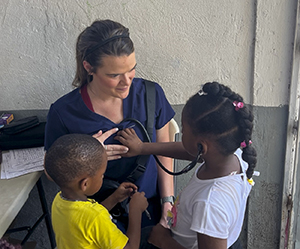
A nurse helps children not to be scared by letting them listen to her heartbeat. (IMB Photo)
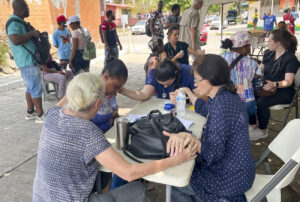
This wasn’t a typical doctor’s appointment. This happened last year on the southern border of Mexico, near Guatemala and the Pacific Ocean. A medical mission team of eight went to offer care to migrants, refugees and displaced peoples.
Another team member treated a young man who injured his knee. The young man said he was running from a gunman who killed his mother in front of him. He fell into a hole which caused his injury. After his treatment, the young man made a profession of faith in Christ.
International Mission Board missionaries Charlie and Robin Janney, who focus on human needs in Mexico, coordinated this team, knowing how great the medical needs are in this area.
“God gave them medical abilities and the intelligence to help others,” Robin Janney said of the team made up of doctors, nurses, physician assistants and physical therapists. “There are people in serious need and have no one else. They are desperate.”
She explained how grateful people were for this medical team to offer them care, considering how difficult it can be to afford treatment. She said it was a “huge honor” for them to receive medical attention and not be charged.
Over five days, the team met with more than 300 patients. For many of the medical professionals, this was the start of their involvement in mission work.
Robin Janney said one of the team members is heading for training to be a Journeyman, a two-year missions program for young adults.
“Another feels called to Africa,” she said. “So, we put her in contact with a missionary there who also uses medical personnel.”
A doctor on the team is close to retiring. He and his wife may consider taking advantage of IMB’s Master’s program, a missions pathway for singles and couples 55 years of age and older who want to give the first two-to-three years of their retirement to the nations.
Visiting medical team makes an impact
The Janneys met most of the members of the medical team last year at MedAdvance, a medical missions conference that allows hundreds of medical professionals, students and church leaders to connect with IMB missionaries and leaders. This year’s MedAdvance will meet September 12-14 at Houston’s First Baptist Church.
Attendees discover how God is at work through medical missionaries and how they can pair their healthcare training with a love for international missions.
“We went in not sure what to expect, and God decided to show us a lot of things at MedAdvance,” Charlie Janney said. “It exceeded our expectations.”
Missionary Robin Janney (in foreground) and members of the medical team pray with a woman who made a profession of faith in Christ. The medical team examined 80 patients this day at a shelter. (IMB Photo)
The Janneys participated in MedAdvance’s Affinity Marathon, as part of the Americas affinity group. This activity allows attendees to connect with missionaries on the field and hear about different IMB health strategies around the globe.
“We had many seek us out,” Robin Janney said. She explained that six of the eight medical professionals on last year’s trip had been at MedAdvance.
“The team did not know each other beforehand, but they worked as if they had worked together for years. It was one of the best teams that we have had.”
Not only did the medical team impact patients, but they had great fellowship with the host church.
Robin Janney said a woman from the church came up to her.
“She told me, ‘Our ladies of the church want to take them out for coffee.’ [The medical team] connected with the host church. They went out for coffee at least three times,” she said.
She also shared a story of a retired IMB missionary who served in the Middle East as a medical doctor and now serves in Mexico. The doctor was a great encouragement to the medical team, and she and a team member led another woman to Christ.
Team members helped both the church and patients learn about different health topics. One led a session on dehydration.
“A nurse talked to a group of Haitian refugees about dehydration, what were the symptoms and how to prevent it,” Robin Janney said. “We now have a recipe of how to rehydrate someone quicker.”
A physical therapist on the team taught patients different stretching exercises that gave them some relief and helped them sleep better.
The Janneys experienced how God used MedAdvance to strengthen their field ministry. They plan to return this year.
“There are so many medical needs all over the world,” Charlie Janney said. “MedAdvance helps connect those in the medical field with those on the mission field.
“They can make an impact in so many ways. It may not be medically. It might be through encouragement. They might inspire a church.”
Belonging tops faith as draw for all but evangelicals
August 12, 2024
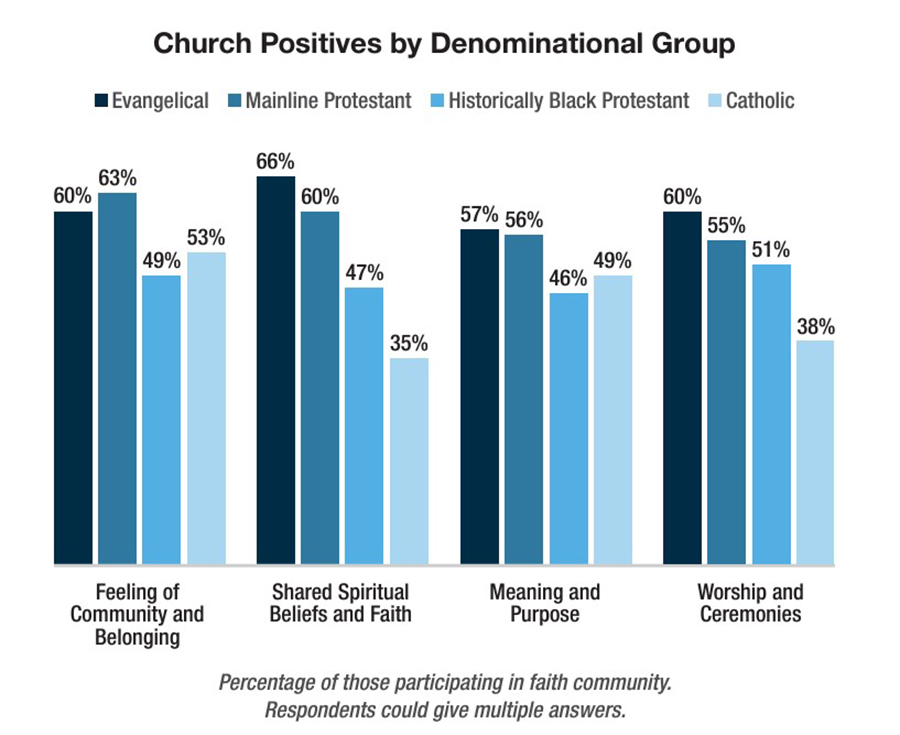
PHILADELPHIA, Pa. (BP)—A sense of community and belonging inches out shared spiritual beliefs and faith as a church draw for all groups but evangelicals, the American Bible Society said in its latest release from the 2024 State of the Bible.
Of the respondents in the study who attend church, 55 percent said they do so because of a feeling of community and belonging, followed by 53 percent who attend because of shared spiritual beliefs and faith, and 51 percent because of meaning and purpose.
But two-thirds of evangelicals—66 percent—are drawn to church by a shared sense of faith, the American Bible Society stated April 8 in releasing the fifth chapter of the 14th annual study.
Participants in mainline Protestant churches are most likely to identify a feeling of community and belonging (63 percent) as a draw, while active Catholics are more likely than other groups to be drawn by cultural or family tradition (43 percent).
Less than half of all respondents combined, 48 percent, said worship and ceremonies draw them to church, the American Bible Society stated.
“The top answers, for both positive and negative responses, are about belonging. When churchgoers feel that they belong, they participate more,” said John Farquhar Plake, American Bible Society chief innovation officer and State of the Bible editor-in-chief.
“And when they feel excluded by cliques, they drift away. So, what can your church do about that? This new chapter offers a few ideas.”
A sense of community and belonging is still a top draw among evangelicals at 60 percent, joined by worship and ceremony at 60 percent, and meaning and purpose at 57 percent.
Falling below 50 percent for evangelicals are religious education and learning, 47 percent; community service and outreach, 36 percent; culture or family tradition, 20 percent; and conversion or religious experience, 17 percent. The aspects are also less than top draws for other denominations cited in the findings.
While the findings come from a nationally representative AmeriSpeak panel of the University of Chicago’s NORC research organization, 42 percent of the 2,506 subjects chose not to answer, saying they did not attend church or participate in a faith community.
Those who did respond selected from nine provided choices of things that attract to church or faith community, the American Bible Society said.
Among other findings:
20 percent, or 50 million people, said a feeling of exclusion or the presence of cliques within faith communities deterred their participation.
19 percent said the church judged or condemned their lifestyle choices, a feeling more common among Gen Z and Millennials (23 percent and 24 percent, respectively).
12 percent are deterred by unresolved conflicts within faith communities.
5 percent said they haven’t felt safe in church or the faith community, most common among Gen Z (8 percent).
Denominations seemed equally impacted by adverse perceptions that drive away attendance, researchers said, with the exception of 15 percent of evangelicals and 14 percent of mainline Protestants who cited conflicts within faith communities that were not resolved satisfactorily, compared to 8 percent of historically Black denominations and 6 percent of Catholics.
Active church volunteers more often expressed a feeling of community and belonging than nonvolunteers, 68 percent to 55 percent, researchers said, and also expressed a deep care for those communities they actively support.
The study was conducted online in January 2024 among adults in all 50 states and the District of Columbia. Additional results from the findings will be released monthly through December, focusing on the Bible’s impact in restoring hope; spiritual nones and nominals; loneliness and the Bible, philanthropy and other topics.
Rwanda government shuts more than 5,600 churches
August 12, 2024
NAIROBI, Kenya (RNS)—In a crackdown, Rwanda has shut down more than 5,600 places of worship over failure to meet the conditions required for operation.
Churches, mosques, caves and tents affected by the shutdown were found to have fallen short of the standard requirements set by 2018 laws, according to officials conducting the two-week process that started July 29.
The law requires clerics to have theology degrees and faith organizations to register with the government and have clear statements indicating their doctrine.
The statements should be deposited with the Rwanda Governance Board, the government agency that registers houses of worship and other civil society organizations. Houses of worship also must pass safety and hygiene codes.
“I think what was introduced—not today but five years ago—is good for the church. The government gave us five years to comply and kept giving us reminders. That ended last year in September,” Anglican Archbishop Laurent Mbanda of Rwanda told Religion News.
“I think this was enough time to comply. We need to look at this from a positive side.”
The Rwanda Governance Board introduced the rules and standards to tame what officials viewed as an unregulated proliferation of churches.
Mbanda said the rules were good for the improvement of congregations and the people’s worship environment.
“We are talking about aeration, sound control … toilets for men and women,” Mbanda said. “I think there is nothing out of the ordinary about these.”
Justifying the crack-drown
Most affected by the shutdowns were small Pentecostal churches and some mosques, reportedly operating on riverbanks and in caves. Many of these had no address, and according to some claims, were prone to indoctrinating their followers and exploiting congregants.
“I think most people agree with this. There has to be training of clergy, order and sanity in the churches’ operation, so that religion serves its purpose,” Innocent Halerimana Maganya, a Congolese Catholic priest at Tangaza University in Nairobi, told RNS.
“In the current state of affairs, it is the poor who are suffering exploitation.”
Rwanda—an East African country with 12 million people—is largely Christian. According to the 2022 census, about 48 percent of its citizens are Protestants. But, the Roman Catholic Church forms the largest single denomination, with 40 percent of the population identifying as such.
The country, approximately the size of Maryland, had 15,000 churches in 2019, according to official figures. Only 700 were legally registered at the time.
After the 1994 genocide, which killed an estimated 800,000 people—mostly members of the Tutsi ethnic group and some moderate Hutus—the country’s churches widely were accused of complicity in the violence.
Some of the churches were sites of massacre where fleeing civilians had sought refuge. Priests and pastors faced accusations of killing or aiding the murders.
Later, some of the clerics faced charges of crimes against humanity at the International Criminal Tribunal for Rwanda in the city of Arusha, in neighboring Tanzania.
Paul Kagame, now Rwanda’s president, and then the general hailed for stopping the killings, has frequently raised concerns over the proliferation of churches.
In August last year, Kagame threatened to arrest Catholic pilgrims visiting sites in the country, accusing them of worshipping poverty. He voiced a concern that many young people were spending more time praying at prayer sites than working to end their impoverishment.
“No one must worship poverty. Do not ever do that again. … If I ever hear about this again, that people traveled to go and worship poverty, I will bring trucks and round them up and imprison them, and only release them when the poverty mentality has left them,” Kagame, a Catholic, was quoted in the press as saying recently.
Some critics fear the government is infringing on people’s freedom of worship, but clerics and officials say it is about the safety and protection of worshippers.
“Rwanda has freedom of worship,” said Mbanda.
“I think we are starting churches where they should not be. Sometimes we are having church structures that a god cannot live in, let alone a person.”
The archbishop also highlighted the rise of unlicensed preachers, cautioning that some were taking their followers to dangerous caves, rivers and forests for prayers and retreats.
At the same time, Rwanda’s approach to regulating religious groups is influencing action across the East African region.
In Kenya, a task force was formed to investigate the recent Shakahola starvation massacre in the coastal region.
The task force has recommended the formation of a Religious Affairs Commission, renewed registration of all religious organizations, and the establishment of educational standards for religious leaders, among other actions.
Houston layman seeks to transform health care in Ukraine
August 12, 2024
A Ukraine-born Houston Baptist layman is seeking to help his homeland rebuild its health care system by offering young Ukrainian medical professionals continuing education opportunities in the United States.
In addition to professional development, Rostyslav Semikov also makes sure the Ukrainian health care workers are exposed to the gospel as they interact with Christian medical specialists and educators.
Visiting health care professionals from Ukraine receive a warm welcome at West University Baptist Church in Houston. (Courtesy Photo)
“I invite them to church. And I invite them to visit with outstanding Christian professionals in the field, who share not only their professional expertise, but also about their spiritual path and their faith—their testimony of how they combine science and their faith,” he said.
When they return to Ukraine, Semikov—a physician, cancer researcher and bioscience entrepreneur—hopes the medical professionals will “be salt and light” in their nation.
“They are the future leaders of our country,” Semikov said.
Semikov, a member of West University Baptist Church/CityRise Church in Houston, is the co-founder and director of the Peace and Development Foundation.
The foundation brings Ukrainian health care professionals to the United States for two- to three-week learning experiences at institutions such as the University of Texas MD Anderson Cancer Center and Johns Hopkins University.
Since 2022, the foundation has enabled about 80 Ukrainian medical personnel to spend time at more than 20 top U.S. medical and educational institutions and attend several professional conferences.
Inspired by similar ministry nearly 20 years ago
Semikov found inspiration in the work of Ronald Hoekstra, a neonatal-perinatal pediatrician from Minneapolis, Minn., nearly two decades ago.
Hoekstra first traveled to Ukraine to introduce medical personnel there to a multispecialty team approach to caring for prematurely born babies. Semikov served as his translator and helped him connect with hospitals in Ukraine.
With Semikov’s assistance, Hoekstra then selected two neonatal pediatric doctors, two gynecologists and two nurses from Ukraine to travel to Children’s Minnesota Hospital in Minneapolis for training.
“Besides sharing professional experience with them as a top expert in the field, he was also a follower of Jesus—a committed believer—and he brought them to the church where he goes,” Semikov said. “He shared with them what he does and told them he was doing it for God’s glory.”
The program continued to grow and made a significant impact on neonatal care in Ukraine, he noted.
Semikov saw the opportunity to use a similar approach for other health care workers, as well as professionals in other fields such as business and law.
In 2011, he was instrumental in the formation of the Alliance of Christian Professionals to help young doctors, lawyers and entrepreneurs “grow professionally and also develop spiritually, to serve God and people through our professions,” he said.
Peace and Development Foundation formed
When funding conferences and training opportunities became challenging, Semikov and a few others saw the need to create a charitable foundation to carry on the work and expand its mission to include peacemaking initiatives.
Rostyslav Semikov is co-founder and director of the Peace and Development Foundation. (Screen capture image)
The Peace and Development Foundation first was formed in Kyiv in July 2016 and then established in Houston in 2020 after Semikov relocated to Texas.
In the immediate aftermath of the heightened Russian assault on Ukraine in February 2022, the foundation also raised about $200,000 to provide humanitarian and medical aid for displaced people in Ukraine.
In December 2022, Bill Frist—a transplant surgeon and former majority leader in the U.S. Senate—worked with Seth Karp, surgeon-in-chief of the Vanderbilt University Medical Center, to facilitate a visit of Ukrainian health care professionals to Nashville, Tenn.
The Peace and Development Foundation enabled eight Ukrainian doctors to make the trip to observe health and lung transplant operations and learn transplant protocols at the Vanderbilt University Medical Center.
Last year, in addition to several visits to major hospitals in the United States, the foundation helped:
Five Ukrainian doctors attend the annual meeting of the American Association for Cancer Research in Orlando, Fla.
10 Ukrainian physicians attend the American Society of Clinical Oncology annual meeting in Chicago.
A group of Ukrainian surgeons and cancer researchers attend the Society of Immunotherapy for Cancer annual meeting in San Diego.
Some of the visiting physicians were from Okhmatdyt National Children’s Hospital in Kyiv. In July, a Russian attack on the children’s hospital claimed the lives of 27 civilians, including four children. Another 117 people, including seven children, were injured.
Visited Houston in the spring
In April, seven Ukrainian oncologists and cancer scientists attended the American Association for Cancer Research annual meeting in San Diego.
They also visited the Stanford University Medical Center, the Louisiana Cancer Research Center and MD Anderson Cancer Center in Houston.
Other visiting Ukrainian family physicians visited several educational institutions and hospitals in the Houston area.
During their visits to Houston, Semikov invited the visiting medical professionals to attend the West University Baptist Church campus of CityRise Church with him.
Stephen Spann (center), founding dean of the Tilman J. Fertitta Family College of Medicine at the University of Houston, hosts a meal for visiting young health care professionals from Ukraine. (Courtesy Photo)
He arranged for them to meet two other members of West University Baptist—Stephen Spann, founding dean of the Tilman J. Fertitta Family College of Medicine at the University of Houston, and James Tour, professor of chemistry, computer science, materials science and nanoengineering at Rice University.
The group of Ukrainian family physicians toured the Fertitta Family College of Medicine, met with Spann in his workplace and enjoyed a meal with him.
Tour, who teaches a Sunday school class at West University Baptist, and his wife Shireen host students for lunch after church every Sunday. Sometimes, they meet in the Tours’ garage to accommodate the large numbers who are eager to discuss spiritual issues with a renowned scientist.
James Tour (2nd from left), professor of chemistry, computer science, materials science and nanoengineering at Rice University, visits with a group of visiting young health care professionals from Ukraine in his “gospel garage.” (Courtesy Photo)
“He is a great example for our young people,” Semikov said.
The Ukrainian visitors enjoyed a question-and-answer time with Tour in what Semikov called his “gospel garage.”
In particular, interacting with dedicated Christians such as Spann and Tour who are experts in their fields enables the Ukrainians to see how intellectual inquiry and faith in God can coexist, he said.
During seven decades of Soviet communist domination of Ukraine, its people were indoctrinated in atheistic teaching, and professing Christians were denied educational and occupational opportunities, Semikov noted.
For example, after his father—who was pursuing a Ph.D. in physics—became a Christian, he was given an ultimatum. He either could renounce his faith, or give up the opportunity to defend his dissertation and receive his doctorate.
“He had to withdraw from the Ph.D. program,” Semikov said.
The Peace and Development Foundation actively seeks to bring together professional excellence, scientific inquiry, Christian faith and moral integrity, he added.
“I believe if we have leaders who are experts and who are people of integrity, that’s the way we can be salt and light in society,” he said.
Investing in the professional development of the rising generation—and introducing them to the gospel—can make a huge impact on Ukraine, he asserted.
“There may be few of them, but they can make a big difference to impact other people’s lives and bring glory to God,” he said.
Obituary: Nina Flo Roe
August 12, 2024
Nina Flo Roe of Cleburne, supportive wife to a pastor and associational director of missions, died Aug. 4. She was 91. She was born March 3, 1933, and grew up attending South Fort Worth Baptist Church. She graduated from Pascal High School and attended Texas Wesleyan University. She married Bill Roe in June of 1952, and he was drafted soon after. In 1955, their first child, Susan, was born and her husband was called to the gospel ministry. After he completed his studies at Southwestern Baptist Theological Seminary and their second child, Dwight, was born, Nina became a full-time pastor’s wife. Their third child, Melissa, was born in 1962. For more than 50 years, the Roes’ lives intertwined with different churches and people. Nina stood by her husband’s side throughout his ministry as a pastor of churches in North Texas and North Central Texas, during his time working for the Baptist General Convention of Texas and during his service as an associational director of missions. She is preceded in death by her husband of 65 years, Bill Roe; daughter, Susan Lauderback; and son, Dwight Roe. She is survived by daughter Melissa Powell and her husband; eight grandchildren; and nine great-grandchildren. In lieu of flowers, the family suggests donations in her honor to Field Street Baptist Church, 201 N. Field St. Cleburne, TX 76033.
After controversies, SBC turns to a low-key leader
August 12, 2024
CHARLOTTE, N.C. (RNS)—As he stepped up into the old-fashioned wooden pulpit on a recent Sunday, Pastor Clint Pressley wasted no time.
After quickly thanking the student discipleship minister who had brought many of the church’s Camp Paradise teens to the 11 a.m. service at his church, Hickory Grove Baptist, Pressley turned to the task at hand.
“Mark chapter 14,” he intoned in his Southern drawl. “If you’re a guest with us, we read the Bible, and then we just talk about the Bible. You’re going to find it feels a lot like a Bible study. Mark 14 starting in verse one …”
After relating the first 10 verses that tell the story of the woman who anoints Jesus with a bottle of expensive perfume, he drives home the passage’s lesson with a series of questions.
“You have one life to live,” he said. “Pour it out. Have you done what you could? What’s holding you back? I want your life to be all-out devotion to God.”
This was Pressley’s third sermon of the day. He preached the 8 a.m. service, drove 13 miles to the church’s second campus to preach the 10 a.m. service, and then drove back to the main campus for the 11 a.m. service.
When he concluded 40 minutes later, he shed his jacket and stood outside the doors of the cavernous chocolate-brick sanctuary, greeting worshippers on their way out—among them, his parents.
Pressley, 55, the newly elected president of the Southern Baptist Convention, is a hard-working pastor of North Carolina’s fifth-largest Baptist church—whose main campus lies on a busy commercial corner of a modest suburban neighborhood of 1950s ranch homes. A K-12 private Christian school is part of the main 56-acre campus.
Pastoring a church is what he’s wanted to do since he was a kid growing up in the state’s Queen City. He’s been devoted to the task ever since, building a multiracial, multigenerational megachurch that draws some 3,000 people each Sunday.
Pastor Clint Pressley likes to preach from a Colonial-style pulpit at Hickory Grove Baptist Church in Charlotte, N.C., on July 21. (RNS photos/Yonat Shimron)
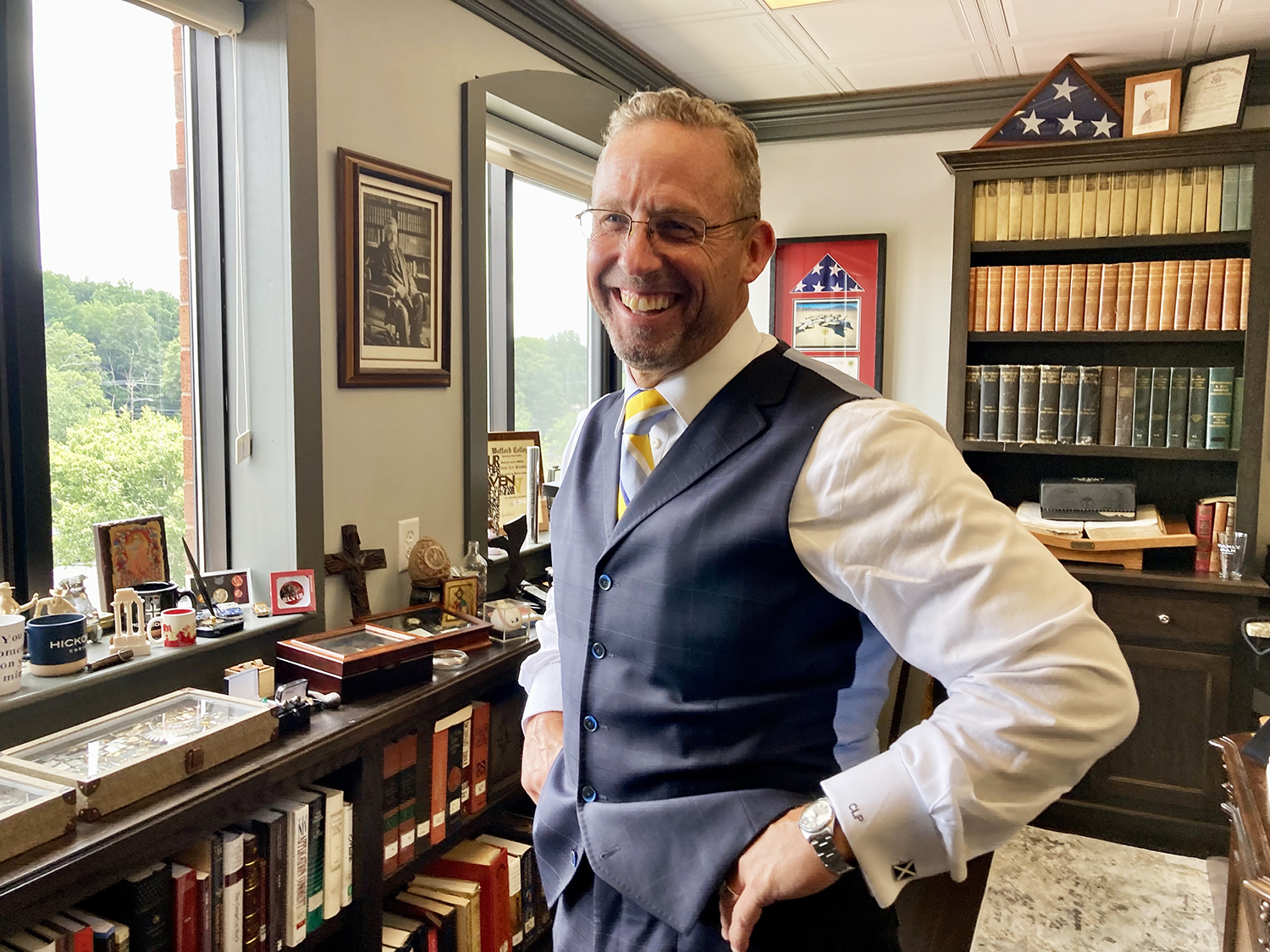
Yet at its last meeting in June, its members elected a traditional preacher who wears three-piece suits, a tie and monogrammed cuffs—and mostly stays out of the limelight.
“In a time where we have so much cultural chaos, Clint’s steadiness and his reputation for integrity really impress a majority of Southern Baptists,” said Nathan Finn, a professor of faith and culture at North Greenville University in South Carolina and the recording secretary for the SBC.
Pressley does not have a national following or a big social media presence. Though he is a trustee of Southern Baptist Theological Seminary and has served in various other denominational roles, he is not trying to use the presidency—which he may serve for a maximum of two consecutive one-year terms—as a platform for influence.
“Really, my hope is to clear some of the fog of negativity and get us back on those two things we have: our confession and our mission,” he said of his mostly symbolic new role.
Pressley is the second North Carolina pastor to lead the SBC in less than a decade.
J.D. Greear, who served as SBC president from 2018-2021, has a national following and leads the largest SBC congregation in North Carolina, the Summit Church—with an average attendance of more than 12,000 people spread out across 13 campuses.
Bart Barber, Pressley’s immediate predecessor—who led a small, rural Texas church but was known for his expertise on denominational governance—had a large social media following and an opinion about everything.
Pressley, by comparison, is low-key. His church does not hold voter drives, and he will only refer to current events if it relates directly to the Bible passages he is preaching on.
“He has said publicly, his goal is not to embarrass the convention,” said Chris Justice, pastor of Lee Park Church in Monroe, N.C., who nominated Pressley in June.
“His answer to things will be short, biblical and delivered in such a way so as not to generate a fight. He’s looking to guide carefully and steward the convention with humility.”
Pressley wants to tone down the acrimony.
Pastor Clint Pressley stands for a portrait in his office at Hickory Grove Baptist Church in Charlotte, N.C., on July 21. (RNS photos/Yonat Shimron)
Family and religious background
The new Southern Baptist president became a Christian in the liberal Presbyterian Church (U.S.A.), where his parents belonged, when he was 11.
But on a vacation to Roanoke, Va., a few years later, a friend the Pressley family met at the beach invited them to their Baptist church. The preacher spoke with conviction. He was authoritative and passionate.
“I’d never heard anything like that, and I thought, ‘That’s what I wanted to do,’” Pressley said.
When the family returned home to Charlotte, he encouraged his parents to seek out a Baptist church. They tried Hickory Grove and, after attending for two weeks, became members.
Pressley kept his ties to Hickory Grove while he was at Wofford College in Spartanburg, S.C., where he also played football. After graduating, Pressley’s Hickory Grove pastor suggested he go to Southwestern Baptist Theological Seminary in Fort Worth.
There he met Connie, the daughter of a Mississippi Baptist pastor, who was in her last year studying for a Master of Divinity degree with the hope of becoming a missionary. After a nine-month courtship, they were married.
“I told the Lord I was not going to marry a pastor,” Connie Pressley said. “But I was well prepared. My mom was a great pastor’s wife and was a good example for me.”
Even before they married, Connie told Clint she probably couldn’t have children. She suffered from endometriosis, a condition in which tissue similar to the uterine lining grows outside the uterus, making it difficult to conceive.
The couple considered in vitro fertilization but felt like adoption was a more biblical choice. The New Testament uses adoption as a metaphor for becoming rooted in the family of God.
Pressley completed his Master of Divinity degree at New Orleans Baptist Theological Seminary, which was closer to Mississippi where he was pastoring two small churches and where he and Connie adopted two boys, brothers ages 2 and 6 months, Mack and Nate.
In 1999, he came back to Hickory Grove in Charlotte as associate pastor. Five years later he became senior pastor of a midsize church in Mobile, Ala., before returning to Hickory Grove as senior pastor in 2011.
Once he became its top leader, Pressley streamlined many of the church’s offerings and cut out some of the trendier, seeker-friendly outreach programs—such as cookouts and guest appearances from professional athletes.
He also sorted through the church’s long list of members to winnow out hundreds of members who were no longer active.
“We kind of pared back on trying to get more people in and really tried to get the people that were there more rooted in the word” of God, said Mark Foster, a deacon and Sunday school teacher.
Pastor Clint Pressley has worked with a handful of different churches throughout the South but returned for the second time to Hickory Grove Baptist Church in 2011. (RNS photos/Yonat Shimron)
He bucks trends
Services at Hickory Grove, like most contemporary Baptist services, feature a modern band that performs praise songs with drums and a synthesizer.
But unlike those pastors who stand in front of the stage, beside a stool or a chair, Pressley has kept the traditional Colonial-style wooden pulpit.
He also has bucked the recent trend of pastors dressed in khakis or jeans and a T-shirt.
He may prefer the buttoned-up look, but Pressley is warm and outgoing—a people person.
“He’s an incredibly encouraging person and incredibly authentic,” said Al Mohler, the president of Southern Seminary and a prominent conservative voice in the SBC.
“The public Clint Pressley and the private Clint Pressley are exactly the same man.”
Last August, Pressley’s 24-year-old son, Nate, who had been estranged from the family and living in the Washington, D.C., area, died of an apparent drug overdose. Church members said the Pressleys grieved with dignity and grace.
This year, a volunteer was arrested after church leaders learned he had been accused of sexual abuse by a student at the church’s Christian school.
The church reported the disclosure to Child Protective Services and the city’s police. Pressley notified the entire congregation by letter.
“We do not tolerate abusive behavior of any kind,” said Pressley in his letter.
Pressley is a creature of habit, and he sticks to a routine. He said he rises at 5 a.m. most days, reads the Bible, prays and then works out—lifting weights with a group of men, mostly from the church, in his backyard shed.
He doesn’t watch much TV and prefers reading books about history. He and his wife vacation—typically at a beach—with other pastor friends.
That commitment to routine serves him well and keeps him focused, said Eric Little, a member of his church with whom he also lifts weights.
“I think the reason I am drawn to pastor Clint is just his model of consistency—of what it means to be a leader, not just in the church, but in the home, in the community,” said Little.
Pressley keeps his eye trained on the long view. His favorite Bible passage is from the prophet Isaiah.
He has it engraved on the pulpit as well as painted on the wall of his office: “The grass withers, the flower fades, but the word of our God stands forever.”
On the Move: Coffey, Gartman, Hewlett, Lynch, Martin, McKelvy
August 12, 2024
Aaron Coffey to Lake Fork Baptist Church in Alba as minister to students and families starting Aug. 11, from First Baptist Church in Homer, La., where he was minister of education and youth.
Brandon Gartman to First Baptist Church in Big Spring as minister to students from Greenwood Baptist Church in Midland, where he was youth pastor.
John Hewlett, executive pastor of Valley Ranch Baptist Church in Coppell, was called as senior pastor July 14.
Ralph Lynch to First Baptist Church in Big Spring as pastor to the Deaf.
Barry Martin as minister of contemporary worship and children/church pianist at Community North Baptist Church in McKinney from Hickory Tree Baptist Church in Balch Springs, where he was worship leader.
Kyle McKelvy as minister of contemporary worship and students/digital outreach, at Community North Baptist Church in McKinney. He and Barry Martin will co-lead worship in the church’s contemporary service.
Stark College president called as co-pastor in Georgetown
August 12, 2024
GEORGETOWN—After nearly 30 years with their beloved pastor, Crestview Baptist Church in Georgetown decided on a novel approach to moving forward with a successor.
Pastor Dan Wooldridge and Tony Celelli, president of Stark College and Seminary in Corpus Christi, will co-pastor for the next year, until Wooldridge’s retirement.
Dan Wooldridge
The church needed a new associate pastor a couple of years ago, Wooldridge said. However, he suggested to the personnel committee that the church specifically consider hiring an associate pastor with the intent of becoming his successor as senior pastor, because he planned to retire in the not-too-distant future.
According to Wooldridge, the church put a lot of research and thought into the succession plan, because they knew the transition to a new pastor after a long-term pastor can be quite difficult.
“When a long-tenured pastor retires,” Wooldridge said, “the transitions often, maybe not every time but often, have been very rough.
“We wanted a continuity,” Wooldridge explained, where the handoff could go more smoothly.
The church wanted the new pastor to have time to understand the congregation and why it does what it does, with the outgoing pastor there to provide support, both to the congregation and the new pastor as they get to know one another.
Lead up to co-pastoring
Last summer, at the Texas Baptists Family Gathering in McAllen, Wooldridge ran into Celelli, who had served as youth minister at Crestview Baptist Church in 1995, not long after Wooldridge was called there as pastor.
He’d kept up with Celelli, but he’d never asked Celelli back to Crestview to preach after he moved on to other ministries. He asked Celelli if he’d fill in for him for a couple of weeks in August 2023.
On one of the days Celelli was to preach, the son of a young man Celelli had served as youth minister in the 1990s was set to be baptized. The family was delighted to have Celelli perform the baptism, Wooldridge said.
The personnel committee began to ask whether they might be able to call Celelli, Wooldridge said. But knowing his dedication to Stark College and Seminary, Wooldridge doubted that course would be likely.
Because it was not his desire to choose his successor, Wooldridge told the selection committee, while they certainly could try to pursue Celelli as a candidate, he would not be part of that process.
He may have favored Celelli, but the church needed to call who God led them to, he asserted.
Crestview Baptist Church Photo
Before he became a candidate, Celelli provided consulting to the church on how to go about the co-pastor transition they had decided upon. Celelli had expertise in this area from working with several churches who’d attempted similar transitions, Wooldridge explained.
During the course of working together in a consulting capacity, the call to the church became clearer and clearer to the candidate, Wooldridge suggested, and culminated with Celelli accepting the call as the new co-pastor of Crestview Baptist Church on Aug. 5.
Transition year explained
A release to the congregation explained: “You will begin to see Pastor Tony around campus starting August 12, 2024.
“During the initial phase of the transition period, Tony will concentrate on getting to know the church, its members, ministries, and the community here in Georgetown, TX. During this period of orientation, you will also see Pastor Tony in the pulpit as he and Pastor Dan will share preaching duties among other aspects of ministry.
“During the second phase of transition, co-leadership, Pastors Tony and Dan will share all pastoral duties. In the final phase of transition, as we celebrate 30 years of faithful service of Pastor Dan, Pastor Tony will take on the leadership of Crestview Baptist Church with the support of Pastor Dan.”
Each of the phases will last four months, Wooldridge said. In the third phase, responsibilities will switch so that he will function essentially as Celelli’s associate pastor. At the end of the transition year, Wooldridge’s ministry at Crestview will conclude.
The church release also stated Celelli will remain president of Stark College and Seminary during the transition and expressed gratitude to the school for its mission.
During the call process, Celelli explained to the congregation the technology he utilizes and the trust he has in the vice-presidents at Stark—with whom he has worked for 11 years—which will support his efforts to lead both the seminary and the church effectively.
As long as he is doing both satisfactorily, Celelli will hold both the title of Stark College and Seminary president and co- /senior pastor of Crestview Baptist Church, he said in an email.
Celelli explained to the congregation he will manage this task “carefully,” “intentionally,” “honestly” and “humbly.”
Wooldridge named First Baptist Church in San Antonio, Fielder Road Baptist Church in Arlington, Pioneer Drive Baptist Church in Abilene and Green Acres Baptist Church in Tyler as other Texas Baptist churches who have adopted a similar co-pastor transition model.
Most pastors have little work experience outside ministry
August 12, 2024
BRENTWOOD, Tenn.—A pastor’s resumé might include multiple churches and ministry roles, but most don’t have much job experience other than ministry listed.
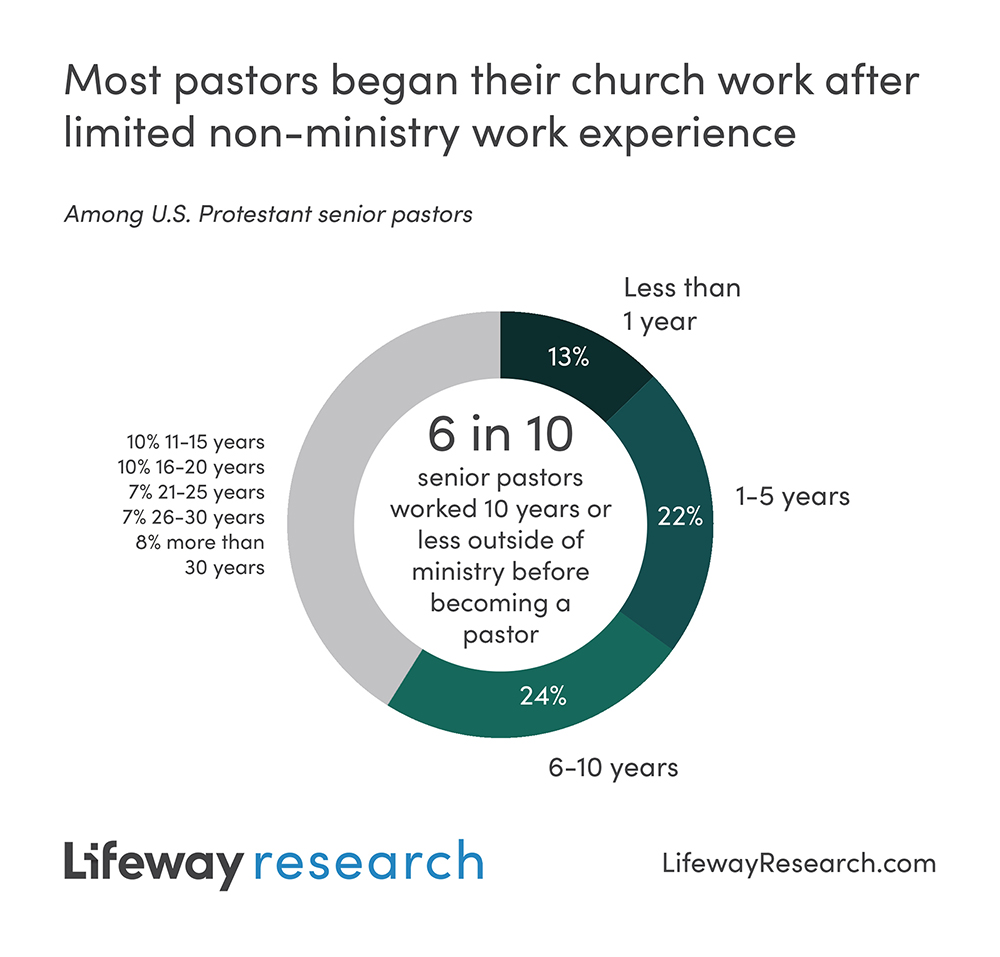
Most current U.S. Protestant senior pastors worked outside of ministry as adults for only a short time, according to a study by Lifeway Research. Only 3 in 10, however, began vocational ministry as the senior pastor.
“A person’s journey to the pastorate can happen at almost any age, but the majority of pastors are in a ministry job by their early 30s,” said Scott McConnell, executive director of Lifeway Research.
“Ministry skills are typically developed in more junior positions at a church, but some senior pastors learn on the job.”
In the period between graduating high school and becoming a senior pastor, a third of pastors (34 percent) say they spent five years or less working in a nonministry job, including 13 percent who have less than a year of secular work experience. Another quarter (24 percent) say they worked outside ministry for six to 10 years.
Fewer have longer nonministry careers before becoming a senior pastor, including 10 percent who worked for 11 to 15 years outside the church, 10 percent 16 to 20 years, 7 percent 21 to 25 years, 7 percent 26 to 30 years and 8 percent who spent more than 30 years in nonministry jobs.
“Years of work experience in nonministry roles can help pastors relate to the experiences of those in their congregations and to develop relationships with people outside their churches,” McConnell said.
As older pastors are the ones who have lived long enough to have decades of post-high school experience, pastors 65 and older (20 percent) are the most likely to say they worked outside of ministry more than 30 years.
Additionally, most younger pastors have worked outside of ministry for a brief time. Pastors aged 18-44 are the most likely to say their secular work experience before coming to the church as a pastor lasted six to 10 years (35 percent) or one to five years (29 percent).
Pastors without much formal education probably also spent time working outside the church. Those with no college degree are the most likely to say before they became a senior pastor, they worked in nonministry employment for 26-30 years (15 percent) and more than 30 years (17 percent).
White pastors (23 percent) are more likely than African American pastors (6 percent) to have a brief 1-year to 5-year nonministry work experience.
One in 5 Lutheran (20 percent) and Restorationist movement pastors (20 percent) say they worked outside the church for less than a year, compared to 11 percent of Baptists and 7 percent of nondenominational pastors.
Ministry experience
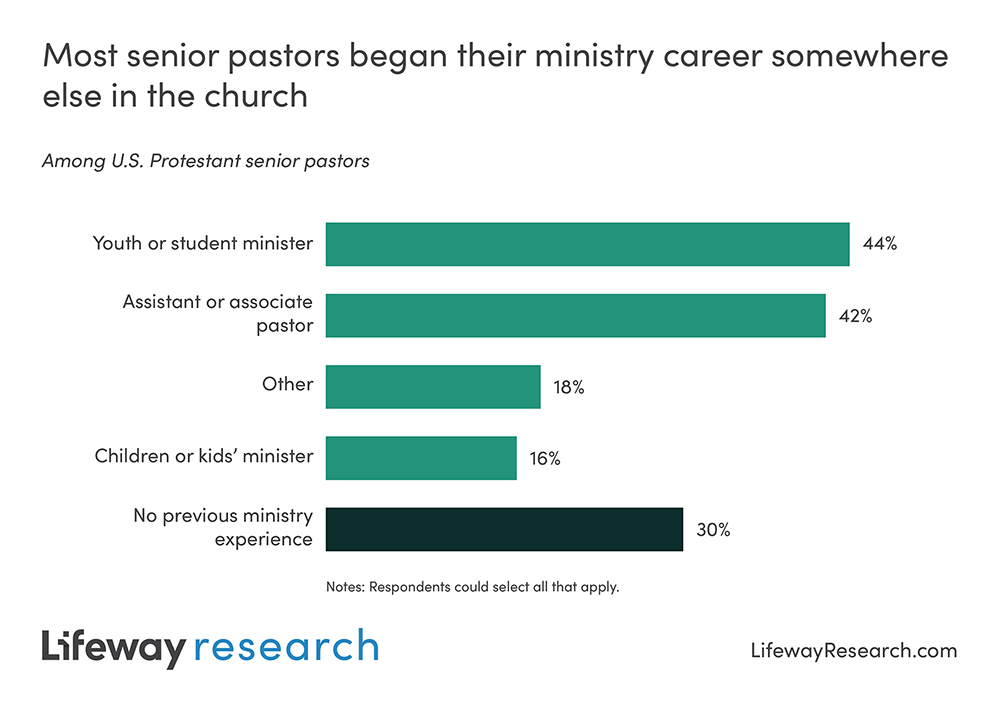
Most senior pastors didn’t step immediately into a lead pastor role as their first ministry position. Seven in 10 started somewhere else in the church. On average senior pastors held 1.7 other ministry roles before their current position as a senior pastor.
More than 2 in 5 say they previously served as a youth or student minister (44 percent) or an assistant or associate pastor (42 percent). Fewer say they worked as a children or kids’ minister (16 percent) or another church ministry position (18 percent). Three in 10 (30 percent) say they had no previous ministry positions before becoming a senior pastor.
“Leading, teaching, equipping, and caring for people are skills all ministers utilize,” McConnell said. “So, regardless of the age or specific ministry within the church there are opportunities to develop skills senior pastors need.”
Pastors 65 and older are the least likely to say they’ve served as an assistant or associate pastor (33 percent) or as a youth or student minister (28 percent). Younger pastors, those 18-44, are the least likely to say they had no previous ministry positions before becoming a senior pastor (20 percent).
Hispanic senior pastors are the most likely to say they previously worked as an assistant or associate pastor (54 percent) and among the most likely to say they were a children or kids’ minister (29 percent).
African American pastors are the least likely to say they served as a youth or student minister (30 percent) and the most likely to say they had no previous ministry experience (44 percent).
Pentecostal (56 percent) and nondenominational pastors (52 percent) are among the most likely to say they worked as an assistant or associate pastor.
Pentecostal (54 percent), nondenominational (54 percent) and Baptist pastors (49 percent) are among the most likely to have spent time as a youth or student minister. Pentecostal senior pastors are also among the most likely to have been a children or kids minister (27 percent).
Lutherans (41 percent) are among the most likely to say they had no ministry experience before becoming a senior pastor.
Pastors of the largest churches, those with 250 or more in worship attendance, (61 percent) are more likely than pastors of small churches, those with less than 50 in attendance, (38 percent) and normative churches, those with 50-99 for worship services, (41 percent) to say they previously served as a youth or student minister.
Pastor search
Around 4 in 5 senior pastors (83 percent) say their church spent less than a year without a pastor before they started. For 2 in 5 (42 percent), the church waited less than a month. A quarter (23 percent) say the time without a pastor was one to six months.
Another 18 percent say it lasted for at least seven months but less than a year. Fewer senior pastors say the church spent 13-18 months (7 percent), 19-24 months (6 percent) or more than two years (5 percent) without a pastor before they arrived.
“Many churches utilize a pastor search process that can sometimes be lengthy,” McConnell said. “Pastors reporting there was little to no time between pastors when they arrived may include situations in which the church had an interim pastor, the pastor leaving stayed until the new pastor was found or leaders in their denomination quickly appointed a pastor.”
Larger churches don’t spend long between pastors. Those at churches with 250 or more are the most likely to say their congregation spent less than a month without a pastor before they started (67 percent).
Different types of churches have different processes for filling vacancies. Some denominations appoint pastors to churches, while other congregations are autonomous and select their own. Methodist pastors (81 percent) are the most likely to say their congregation spent less than a month without a pastor.
Nondenominational (59 percent) and Pentecostal (53 percent) pastors are more likely than Presbyterian/Reformed (30 percent), Baptist (28 percent) and Lutheran pastors (24 percent) to say their church was without a pastor for less than a month before they began serving.
The phone survey of Protestant pastors was conducted Aug. 29, 2023 to Sept. 20, 2023. Responses were weighted by region and church size to reflect the population more accurately. The completed sample is 1,004 surveys, providing 95 percent confidence the sampling error does not exceed plus or minus 3.2 percent. Margins of error are higher in sub-groups.
Obituary: Dennis Brooks Linam
August 12, 2024
Dennis Brooks Linam, who served more than three decades in various administrative roles at Dallas Baptist University, died Aug. 3 in Arlington. He was 83. He was born on July 12, 1941, in Waco to Raymond and Evelyn Brooks Linam and grew up attending Seventh and James Baptist Church in Waco, where his father was a deacon and his mother taught Sunday school. During his senior year at Waco High School, he met a newly arrived sophomore student, Gail Green. He immediately was smitten when she bought a football spirit ribbon from him. He invited her to sit with him on the bus ride from Waco to Temple for a football game when she was 15 and he was 17. They never dated anyone else and were married on Aug. 15, 1964. He attended Baylor University and graduated from the University of Texas in Austin with a degree in architecture. He worked as an urban planner with the City of Waco. In that role, he was instrumental in the development of Indian Spring Park and amphitheater, designed the Freedom Fountain at the Waco Convention Center, and helped coordinate the Waco Bicentennial Celebration at Baylor Stadium. He also hosted President Gerald Ford when he visited Waco’s historic Suspension Bridge. During this time, Gail served as the minister of childhood education at Calvary Baptist Church in Waco, where Dennis taught the young adult Sunday School class. He was ordained as a deacon in 1971. He resigned his position at the City of Waco to support his father in managing a large cattle ranch. In 1988, Gary Cook invited the Linams to join him at Dallas Baptist University, where he had just been named president. Despite the university’s financial peril, Cook shared his conviction that daily fervent prayer by the university family and friends would lead to a transformed institution. For more than 30 years, Linam played a significant role in the life of DBU, serving as a friend, mentor, administrator and leader to many. He supported various campus infrastructure projects, utilizing his experience as an architect and city planner. He also served as the university’s liaison to alumni of Decatur Baptist College, which later became Dallas Baptist University. In 1990, he was named vice president for external affairs. In this role, he offered ongoing support, encouragement and friendship to pastors across the Dallas-Fort Worth area. In 1992, he became director of the John G. Mahler Student Center, coordinating and hosting countless events over many years. Dennis also worked with the Independent Colleges and Universities of Texas in their efforts to encourage Texas State legislators to support the Texas Equalization Grant. Every year, he took outstanding DBU students to Austin to meet with state representatives and senators to highlight the value of this important program. In recognition of his tireless efforts, the Independent Colleges and Universities of Texas presented him with the President’s Award in 2004. He was named a DBU Honorary Alumnus, a Decatur Baptist College Honorary Alumnus, DBU Staff Member of the Year, and DBU awarded him an honorary Doctor of Humanities degree. He served as a deacon and in a variety of other leadership roles at First Baptist Church in Arlington. He is survived by his loving wife of 60 years, Gail Linam; his daughters, Angela Linam and Diane Linam; his son, Brooks Linam; beloved grandson, Spencer Brooks Linam; his mother, Sherri Linam; and his brother, Ronald Linam and wife, Lin Hai. Memorial gifts may be sent to the Dennis Linam Endowed Scholarship Fund at Dallas Baptist University, 3000 Mountain Creek Parkway, Dallas, TX 75211.


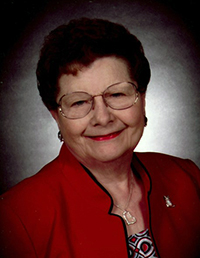 Nina Flo Roe of Cleburne, supportive wife to a pastor and associational director of missions, died Aug. 4. She was 91. She was born March 3, 1933, and grew up attending South Fort Worth Baptist Church. She graduated from Pascal High School and attended Texas Wesleyan University. She married Bill Roe in June of 1952, and he was drafted soon after. In 1955, their first child, Susan, was born and her husband was called to the gospel ministry. After he completed his studies at Southwestern Baptist Theological Seminary and their second child, Dwight, was born, Nina became a full-time pastor’s wife. Their third child, Melissa, was born in 1962. For more than 50 years, the Roes’ lives intertwined with different churches and people. Nina stood by her husband’s side throughout his ministry as a pastor of churches in North Texas and North Central Texas, during his time working for the Baptist General Convention of Texas and during his service as an associational director of missions. She is preceded in death by her husband of 65 years, Bill Roe; daughter, Susan Lauderback; and son, Dwight Roe. She is survived by daughter Melissa Powell and her husband; eight grandchildren; and nine great-grandchildren. In lieu of flowers, the family suggests donations in her honor to Field Street Baptist Church, 201 N. Field St. Cleburne, TX 76033.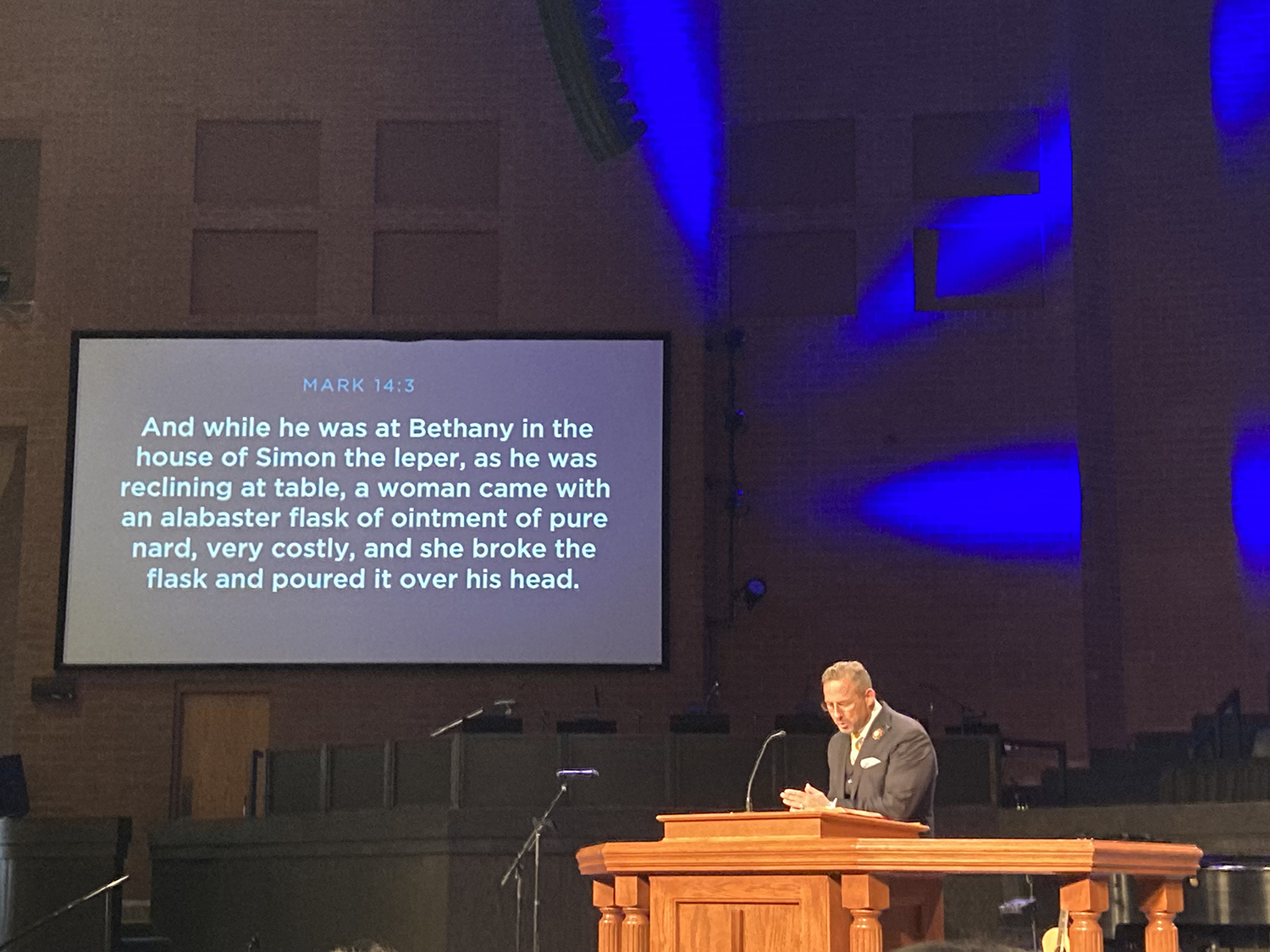


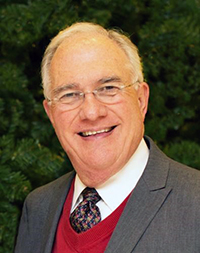 Dennis Brooks Linam, who served more than three decades in various administrative roles at Dallas Baptist University, died Aug. 3 in Arlington. He was 83. He was born on July 12, 1941, in Waco to Raymond and Evelyn Brooks Linam and grew up attending Seventh and James Baptist Church in Waco, where his father was a deacon and his mother taught Sunday school. During his senior year at Waco High School, he met a newly arrived sophomore student, Gail Green. He immediately was smitten when she bought a football spirit ribbon from him. He invited her to sit with him on the bus ride from Waco to Temple for a football game when she was 15 and he was 17. They never dated anyone else and were married on Aug. 15, 1964. He attended Baylor University and graduated from the University of Texas in Austin with a degree in architecture. He worked as an urban planner with the City of Waco. In that role, he was instrumental in the development of Indian Spring Park and amphitheater, designed the Freedom Fountain at the Waco Convention Center, and helped coordinate the Waco Bicentennial Celebration at Baylor Stadium. He also hosted President Gerald Ford when he visited Waco’s historic Suspension Bridge. During this time, Gail served as the minister of childhood education at Calvary Baptist Church in Waco, where Dennis taught the young adult Sunday School class. He was ordained as a deacon in 1971. He resigned his position at the City of Waco to support his father in managing a large cattle ranch. In 1988, Gary Cook invited the Linams to join him at Dallas Baptist University, where he had just been named president. Despite the university’s financial peril, Cook shared his conviction that daily fervent prayer by the university family and friends would lead to a transformed institution. For more than 30 years, Linam played a significant role in the life of DBU, serving as a friend, mentor, administrator and leader to many. He supported various campus infrastructure projects, utilizing his experience as an architect and city planner. He also served as the university’s liaison to alumni of Decatur Baptist College, which later became Dallas Baptist University. In 1990, he was named vice president for external affairs. In this role, he offered ongoing support, encouragement and friendship to pastors across the Dallas-Fort Worth area. In 1992, he became director of the John G. Mahler Student Center, coordinating and hosting countless events over many years. Dennis also worked with the Independent Colleges and Universities of Texas in their efforts to encourage Texas State legislators to support the Texas Equalization Grant. Every year, he took outstanding DBU students to Austin to meet with state representatives and senators to highlight the value of this important program. In recognition of his tireless efforts, the Independent Colleges and Universities of Texas presented him with the President’s Award in 2004. He was named a DBU Honorary Alumnus, a Decatur Baptist College Honorary Alumnus, DBU Staff Member of the Year, and DBU awarded him an honorary Doctor of Humanities degree. He served as a deacon and in a variety of other leadership roles at First Baptist Church in Arlington. He is survived by his loving wife of 60 years, Gail Linam; his daughters, Angela Linam and Diane Linam; his son, Brooks Linam; beloved grandson, Spencer Brooks Linam; his mother, Sherri Linam; and his brother, Ronald Linam and wife, Lin Hai. Memorial gifts may be sent to the Dennis Linam Endowed Scholarship Fund at Dallas Baptist University, 3000 Mountain Creek Parkway, Dallas, TX 75211.