Religious freedom harmed by government-fostered lies

WASHINGTON (BP)—When Russia attacked Ukraine in 2022, Russian President Vladimir Putin claimed the invasion was to “denazify” Ukraine.
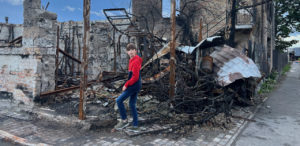
Ukrainian teenager surveying destruction in Irpin, Ukraine, after Russian troops retreated (Photo courtesy of Leonid Regheta).

Putin asserted President Volodymyr Zelenskyy, who is Jewish, is a Nazi hellbent on committing genocide against Russians and Russian-speaking Ukrainians.

In Iran, the government regularly disseminates misinformation on state-linked media channels about religious minorities, including statements that Christian converts from Islam are part of a “Zionist” network that poses a national security risk.

China uses several tactics to “manipulate global opinion about its ongoing genocide and crimes against humanity targeting predominately Muslim Uyghurs and other Turkic peoples in the Xinjiang region.”

They include favorable fake grassroots campaigns on social media and fabricated positive news stories, according to the U.S. Commission on International Religious Freedom.

Misinformation hinders religious freedom

Such government-fostered misinformation and disinformation are hindering religious liberty in several places globally, the commission stated in an August factsheet, and spreading societal religious persecution including violence.

The U.S. Commission on International Religious Freedom defined misinformation as a claim that is false or inaccurate, and disinformation as a false or inaccurate claim that the government deliberately disseminates.

“Increasingly, governments are promoting both misinformation and disinformation through campaigns targeting religious communities and by denying the existence of official policies targeting such groups,” the commission stated Aug. 8 in releasing the report, “Misinformation and Disinformation: Implications for Freedom of Religion or Belief.”

“Governments are increasingly using such tactics to threaten, harass, intimidate, and attack individuals and communities on the basis of their religious beliefs. The U.S. government, collaborating with like-minded governments, should continue to develop strategies to counter governments using misinformation and disinformation to encourage or justify restrictions on FoRB (freedom of religion or belief).”

Propaganda campaigns amplify intolerance

Government actions in India and Pakistan also are highlighted in the report, including accusations in Pakistan that religious minorities will deteriorate law and order.

Kim Neineng, 43, a tribal Kuki, cries as she narrates the killing of her husband, at a relief camp in Churachandpur, in the northeastern Indian state of Manipur, Tuesday, June 20, 2023. (AP Photo/Altaf Qadri)

In India, the government-established National Council of Education Research and Training published new textbooks in 2023 that removed references to Muslims, including the 2002 riots in Gujarat that resulted in the deaths of hundreds of the religious group.

In addition to targeting Zelensky, Putin has accused the West of putting an “ethnic Jew” in charge to cover up Ukraine’s “anti-human nature,” the commission stated, and has further justified its accusations by saying, “wise Jewish people say that the most ardent anti-Semites are usually Jews.”

Russia has further characterized its war as the “desatanization” of Ukraine and its “nontraditional” religious groups, characterizing the evangelistic Protestant Word of Life Church and the Chabad Lubavitch Synagogue on par with the Church of Satan. The U.S. State Department issued a report in February 2023 on Russia’s misinformation related to the war.

Such government narratives “can amplify intolerance from individuals who may believe the content of these campaigns and harass, intimidate, or threaten the targeted religious groups,” the commission said, and “signals to targeted religious communities that governments will not ensure their freedom of religion or belief and may actively seek to restrict it.”

The U.S. Commission on International Religious Freedom pointed to the U.S. State Department’s Framework to Counter Foreign State Information Manipulation, released in January, as a positive counter strategy and encouraged the department to continue to develop such strategies to combat the rise of government propaganda that restricts religious freedom.

Canada, Germany and the United Kingdom already have endorsed the State Department’s framework, and it is also the basis of Memoranda of Understanding with several countries, the commission said, including Bulgaria, Japan, Albania, Latvia, Moldova, Korea and Poland.

“In its ongoing promotion of this framework,” the commission stated said, “it is critical that the U.S. government and its multilateral partners also emphasize the profound harms that government misinformation and disinformation have on the ability of targeted religious groups to exercise their right to FoRB (freedom of religion or belief).”


Around the State: UMHB students partner with H-E-B for Love CTX

As part of this year’s Welcome Week, University of Mary Hardin-Baylor students participated in Love CTX on Aug. 10. The annual event is designed for students to discover service opportunities and grow closer to their Cru Groups by serving the community. For the fifth year, UMHB’s Love CTX event supported One More Child, which provides Christ-centered services to vulnerable children and struggling families. Approximately 400 UMHB students packed 21,000 meals and wrote notes for Belton ISD students. This year, the local H-E-B in Belton donated all food items for the meals, equaling $11,000 of in-kind donations. The meals will go to Belton ISD’s Project Heartbeat program to help students who may not have food at home and will be distributed throughout the school year.

HPU students engage in a healthcare simulation in the university lab. (HPU Photo)

The Howard Payne University School of Nursing will receive a $312,000 grant this fall from the Texas Higher Education Coordinating Board to aid in reducing the professional nursing shortage in the state of Texas. The funds will help HPU enroll and retain nursing students, as well as develop innovative methods for instructional or clinical space and other resources to strengthen the program. HPU’s school of nursing recently was recognized for a 100 percent pass rate on the National Council Licensure Examination for Registered Nurses. The nationwide standardized exam assesses nursing knowledge and skills that are required to provide safe and effective patient care. The recognition was for May 2023 graduates and was confirmed by the Texas Board of Nursing. HPU’s BSN program is one of only six BSN programs in Texas to achieve a 100 percent pass rate on the exam. The program has held national nursing accreditation from the Commission on Collegiate Nursing Education since 2020. The Nursing Shortage Reduction Program grant was established in 2001 by the 77th Texas Legislature to address the statewide nursing shortage in Texas. Grants are awarded to public and private colleges and universities with qualifying nursing programs.

A land donation from DeJuan Strickland has pushed Wayland Baptist University’s Thrive Campaign past the $16 million mark and closer to the anticipated goal of at least $18 million. Strickland gifted land in South Dakota through estate planning, with the intent that it would benefit students and enhance the financial resources of the university. The Thrive Campaign is designed to elevate Wayland’s status as a leader in higher education through substantial investments in academic excellence, recruitment and retention, campus improvements, and athletics.

Early literacy group. (HCU Photo / Carnegie)

Houston Christian University has been awarded a $100,000 grant from The Cullen Trust for Higher Education to enhance early literacy at two area Title I elementary schools in the Houston Independent School District. The grant helps fund an early literacy program developed and facilitated by faculty and students in HCU’s College of Education and Behavioral Services in partnership with Lovett Elementary School and Neff Early Learning Center for the 2024-2025 school year. Through the program, HCU students will provide one-on-one reading instructional support for early childhood through 4th grade students identified as performing below grade level and writing support for 4th grade students at designated schools. Participating HCU students also will assist with Book Buddy programs, Literacy Nights, Reading Clubs and after-school tutoring and reading sessions at partnering schools. The early literacy initiative, guided by faculty facilitators, not only will provide elementary school students with supplemental support to reach grade-level reading benchmarks and reinforcement of their reading and writing skills, but also allows HCU students to participate in experiential learning in a real-world setting. The grant covers the cost of student orientation, training and background checks, the salaries of program coordinators, student tutors and instructional, motivational and after-school resources for each campus.

Dallas Baptist University President Adam Wright (center) awarded an honorary doctorate to David Hardage (2nd from right), pictured with his wife Kathleen. BGCT Executive Director Julio Guarneri (2nd from left) and his wife Monica attended the ceremony. (Courtesy Photo)

David Hardage was presented an honorary doctorate of divinity degree from Dallas Baptist University for his lifetime of servant leadership at the DBU summer graduation ceremony, Aug. 2.  Hardage served as executive director of the Baptist General Convention of Texas for 11 years, from 2012 until 2022. In this role, he led Texas Baptists by serving churches, staff and institutions across the state and beyond. His focus on the Great Commission and the Great Commandment laid the foundation for the continuing work of Texas Baptists. Hardage’s ministry began with pastoring small churches in Texas and Oklahoma. In 2004, he became the director of the Waco Regional Baptist Network. Then in 2007, he became director of development at Truett Theological Seminary at Baylor. Hardage has served as interim pastor for several churches and with Texans on Mission (formerly TBM). 

San Antonio Baptist Association is opening a Kairos University extension campus this fall. Key features of Kairos University include competency-based assessment, personalized learning, integration of theory and practice, mentorship and coaching and outcome-focused curriculum. San Antonio already is home to Baptist University of the Américas, a Wayland Baptist University campus and a branch of Baylor University’s Truett Theological Seminary.

Anniversaries

Roger Yancey, executive director of Tryon Evergreen Baptist Association, 20 years.

Northview Baptist Church in Lewisville will celebrate its 60th anniversary Sept. 29th. Kenneth Wells is pastor. He has served the church 44 years. The church will hold celebration services on that day at 9 and 10:30 a.m., joined by former members and staff, as well as receiving state and local recognition.

Ordination

James Mann was ordained to the gospel ministry at Valley Hi First Baptist Church in San Antonio.


BWA names director of Global NxtGen Leadership Initiative

The Baptist World Alliance named Tim McCoy, former executive minister of Canadian Baptists of Ontario and Québec, as director of its new Global NxtGen Leadership Initiative.

BWA created the position to develop and implement a strategic new BWA initiative for leaders ages 18 to 35. The aim of this initiative is to enhance existing programs with BWA member partners around the world and provide an additional global opportunity to strengthen the skills and experience of next-generation leaders.

McCoy also will serve as team leader for the NxtGen Leadership Summit, where the initiative will be launched in July 2025. The summit will be offered July 7-8 next year as a pre-conference leading up to the 23rd Baptist World Congress in Brisbane, Australia, convening July 9-12.

“We are blessed to welcome a seasoned leader like Tim to our BWA team and anticipate how the Lord will use his gifts to engage young leaders and further God’s global mission,” BWA General Secretary Elijah Brown said.

“As a participant myself in the BWA’s first emerging leaders initiative 20 years ago, I am excited to see next-generation leaders from around the world experience the joys of learning, serving, and growing with our global family and us with them.”

McCoy has served in various church and denominational ministry roles since 1994. He was ordained in 1995 and served more than a decade as the associate pastor for youth ministry and leadership at Independence Hill Baptist Church in Mecklenburg County, N.C.

He relocated to Canada in 2006 to serve as the director of youth ministries for Canadian Baptists of Ontario and Québec. During his four years in the role, he coached and mentored 65 full-time and part-time youth ministry leaders and managed conferences for youth and youth workers.

From 2010 to 2023, he led Canadian Baptists of Ontario and Québec as executive minister, serving 320 churches by providing resources, leadership development and spiritual guidance.

“I am deeply grateful for the opportunity to serve God by serving the BWA family. It is an exciting venture to work with global leaders to find and make known the high-capacity young leaders in our Baptist family,” McCoy said.

He also has held international leadership roles with North American Baptist Fellowship, one of the six regional fellowships of the Baptist World Alliance, as well as serving as a member of the BWA Youth Committee, its Executive Committee and the BWA Commission on Transformational Leadership.

McCoy holds a Master of Arts degree in Christian education, organizational leadership and structural change from Pfeiffer University in North Carolina and a Bachelor of Arts degree in religion, communications and journalism from Mars Hill University.

In addition to his role with the BWA, McCoy serves as interim director of the Mentored Ministry program and an adjunct lecturer at Acadia Divinity College in Wolfville, Nova Scotia. Canada. He and his wife Julie live in Nova Scotia.


Latino evangelicals push for immigration reform ahead of election

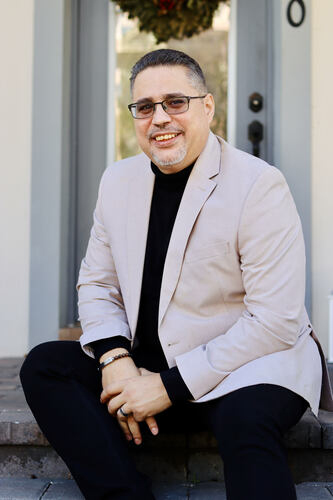
(RNS)—On Good Friday, March 29 this year, Pastor Tony Suarez, founder of the evangelical Christian ministry Revival Makers, drove a stake into the ground in the middle of a tent in McAllen.

“This entire southern border belongs to Jesus,” he declared to a crowd of mostly Latino Texans.

Suarez’s stop in McAllen was one of a series of tent revivals on the southern border that his ministry said have drawn more than 9,000 people.

He doesn’t just preach: As vice president of the National Hispanic Christian Leadership Conference, Suarez advocates with politicians for immigration reform that prioritizes border enforcement, assimilation and a non-amnesty path to legal status.

A member of Donald Trump’s informal evangelical advisory board since 2016, Suarez endorsed the former president in June as one of the campaign’s “Latino Americans for Trump.”

Suarez has, however, at times expressed disappointment in the Republican party’s policies at the border. In this he is representative of Latino evangelical leaders who lack trust in either major political party’s action on the issue, while pushing them for reform.

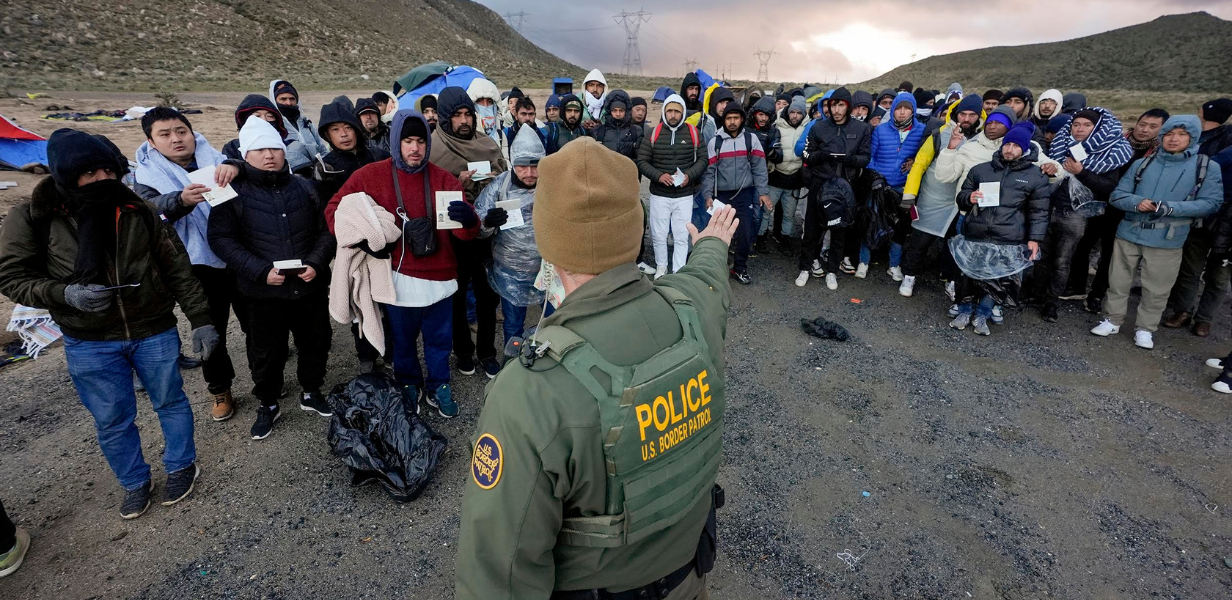
A Border Patrol agent asks asylum-seeking migrants to line up in a makeshift, mountainous campsite after the group crossed the border with Mexico, Friday, Feb. 2, 2024, near Jacumba Hot Springs, Calif. (AP Photo/Gregory Bull)

“We went to the border, and we asked the Lord to intervene, to be in the midst of this, to give wisdom to legislators and to give patience to frustrated citizens,” Suarez told RNS earlier this month.

“In Genesis chapter 2, there was an angelic guard at the Garden of Eden. And so, we prayed and asked the Lord to do something similar at the southern border.”

For Suarez and the National Hispanic Christian Leadership Conference, the “free flow” of migrants crossing the border is an “unprecedented crisis” that led the National Hispanic Christian Leadership Conference to launch its immigration reform campaign, “The Urgency of Now,” in March.

Even as illegal border crossings have dropped following Biden’s recent changes to asylum policy, Suarez said the border remains in crisis, “with no real resolution or end in sight,” calling Biden’s actions “politically motivated but really just empty words.”

“We are a nation of immigrants. We love immigrants and we support immigration reform, but we have to know who’s in the country,” Suarez said.

Latinos not a unified bloc

Since the last presidential election, nearly 4 million more Latinos are eligible to vote, putting the United States’ 36.2 million eligible Latino voters at about 14.7 percent of the electorate.

As the Trump campaign has made reducing immigration a number one campaign issue, Latinos, especially those who call themselves evangelical, are far from a unified bloc.

In 2022, Pew Research Center found 15 percent of Latinos are evangelical Protestants—half of whom are Republican or Republican-leaning—and 44 percent are Democrats or Democratic-leaning. That represents a much higher percentage of Republicans than among Latino Catholics.

Suarez said immigration is just one of the issues the 40,000 member churches in the National Hispanic Christian Leadership Conference are concerned about in this election, saying that Democrats’ “woke ideology” on marriage, life and gender are the “No. 1 issue.”

Gabriel Salguero. (Photo courtesy The Gathering via RNS)

But Gabriel Salguero, president and founder of the National Latino Evangelical Coalition, said poverty and education are the most important issues for Latino evangelicals, putting emphasis on the child tax credit, earned income tax credit and nutrition assistance programs like WIC and SNAP.

“Protecting the poor is an issue for the gospel, because Jesus told us that,” said Salguero, a pastor at The Gathering, an Assemblies of God church in Orlando, Fla. “Latino evangelicals are not one-issue voters, and we’re certainly not a monolith.”

The National Latino Evangelical Coalition has also kept up a “sustained outreach and advocacy effort” on immigration reform, calling for bipartisan legislation to provide more resources for border enforcement and processing asylum cases while prioritizing family unification.

“Latino evangelicals are looking for people who know how to balance justice and mercy, law and humane treatment of people,” Salguero said of the election.

Bishop Jesus Santos Yáñez, a lifelong Republican whose family settled in Texas before it became part of the United States, now leads a region of the Church of God of Prophecy covering Iowa, Colorado, Nebraska and Minnesota.

He tells the pastors in his multiethnic and multiracial Pentecostal Holiness denomination they must prioritize helping people without judgment in addition to following the law.

Recently, he accompanied advocates from Mission Talk, a Florida coalition of Latino evangelicals, on a visit to Tallahassee to speak out against new laws that raise penalties for immigrants lacking permanent legal status who are caught driving without a license.

On the National Day of Prayer in May, Yáñez prayed over Iowa Gov. Kim Reynolds, a Republican, but like other evangelical Latino leaders, he said he cannot support former President Donald Trump because of the former president’s anti-immigrant and racist rhetoric.

Juan García. (Photo courtesy CBF via RNS)

Juan García, pastor of the Hispanic congregation of First Baptist Church in Newport News, Va., said he spends a lot of time countering the right’s narrative that immigrants don’t belong.

“The idea that we’re not loved, we’re not wanted or we’re not valued may be seeded or planted in the minds of people,” said García, who is Puerto Rican.

And García also reminds them of their own worth, saying they spiritually have the “blood of Christ” running through their veins.

Pushing back against problems

García, moderator for the Cooperative Baptist Fellowship, was one of many Latino Protestant leaders who pushed back against Trump’s claims that immigrants are “poisoning the blood of our country.”

The people Trump is targeting, Garcia said, are those who are “making the economy run.”

Elket Rodríguez, an attorney and global migration advocate for the Cooperative Baptist Fellowship, lamented “the lack of seriousness” that lawmakers display when speaking about immigration reform, which he said is about more than U.S. aspirations and responsibilities.

Rodríguez said “a highly intellectual and honest conversation” would address the root causes driving migration and the impact of immigration on questions around the future funding for Social Security, the nation’s aging population and job openings in agriculture and other sectors.

“If you ask me, misinformation is the biggest threat to migrants and those who want to host them,” Rodríguez said.

Some Latino faith leaders say the term “evangelical” has become too politicized to represent them. Yáñez, García and Rodríguez all said while “evangelical” describes their congregations accurately from a theological perspective, they now shy away from identifying that way.

“Evangelical and evangélico are not the same thing,” said Rodríguez, explaining the word in Spanish has a strong theological component.

“The word evangelical in the U.S. has evolved, especially in the past 10 years, into more of a political ethno-national concept.”

But the National Latino Evangelical Coalition’s Salguero said he prefers to make the term bend to what he believes it should represent. “Why should I give up a perfectly good historical definition?” he asked.

“Some of us in the evangelical world have compromised truth for proximity to power, and that’s idolatry. That’s sin,” Salguero said.

“One of the tragic temptations of evangelicalism in America is that we have become captive to partisan talking points and instead of going to our primary source, which is Scripture.”

“Our hope is in the gospel, not in politicians,” Salguero said.


Lamar University student drowns at BSM retreat

A 23-year-old Lamar University graduate student drowned Aug. 10 while attending a Baptist Student Ministry retreat at the Toledo Bend Reservoir.

According to reports, the student was swimming in a cove with a group when he went underwater and did not resurface.

The Newton County Sheriff’s Office identified the student as Noah Roden. The sheriff said Roden drowned at 4:36 pm on Saturday, and his body was recovered at 9:25 am on Sunday.

“We are devastated by this student’s passing,” said Darin Ford, director of the Lamar BSM. “What was supposed to be a time of fellowship and growth has turned into a tragedy. We are just in shock right now.”

The Lamar BSM had been hosting a two-day leadership retreat at a lake house on the reservoir in advance of the upcoming fall semester.

Classes are scheduled to begin on campus on Thursday, Aug. 22. The home where the students gathered was about a two-hour drive from the university.

Ford said Roden had been an active member of the Lamar BSM for about a year.

Mark Jones, director of Texas Baptists’ Center for Collegiate Ministry, said he was thankful Ford was able to personally connect with Roden’s family members.

“Darin was able to speak directly with the student’s family and expressed our deepest condolences from the Texas Baptists family,” Jones said.

“Right now, we just want to love on these family members, BSM students and leaders and anyone touched by this horrific accident.”

Jones was working with Lamar BSM leaders to mobilize counselors to be available to meet with BSM students and others impacted by the tragedy.

A memorial service honoring Noah Roden will take place in the coming days.

“Our hearts are broken, but we sense God’s presence and are so grateful for this student’s faith walk through the Lamar BSM,” Jones said.

“Though we may not understand why this tragedy occurred, we know that God is good, he is in control, and we have an opportunity to point others to him, even in their grief.”

EDITOR’S NOTE: When the article originally was published on Aug. 14, the student’s name was withheld to allow time for all family members to be notified. It was updated at 5 p.m. on Aug. 15 to identify the deceased student.


Azerbaijan accused of torture and ethnic cleansing

A global human rights organization called on the United States to enforce sanctions against Azerbaijan for torturing prisoners of war and targeting Armenian Christians.

Meanwhile, the president of another human rights group blasted the International Olympic Commission for giving tacit support to Azerbaijani perpetrators of “ethnic cleansing.”

International Christian Concern, an ecumenical Christian group focused on the persecution of religious minorities, filed formal sanctions requests against Azerbaijan with the U.S. Department of State and the U.S. Department of Treasury.

Filed under the Global Magnitsky Human Rights Accountability Act, ICC asked the government agencies to ban Azerbaijani travel to the United States and freeze assets of high-level officials.

ICC cited the torture and other mistreatment of Armenian prisoners of war and accused the Azerbaijani government officials of stirring up hatred against Armenian Christians.

“The reported cruelty committed against the POWs was consistent and atrocious,” said ICC’s lead investigator for what the organization termed “a comprehensive, months-long investigation” into Azerbaijan’s treatment of Armenian POWS from 2020 to 2021. The investigation included reviewing hundreds of pages of sworn testimony by victims.

“While we recognize the complexities and longstanding hostility between Azerbaijan and Armenia, the blatant attacks and targeting of POWs and Christians were undeniable,” the lead investigator said.

International Olympic Committee criticized

Azerbaijan and Armenia have battled for decades over the disputed Nagorno-Karabakh region, also known as Artsakh. Azerbaijani military forces—aided by foreign mercenaries—attacked Armenian forces stationed in the region in September 2020.

Even after agreeing to a Russian-brokered peace treaty, Azerbaijan blocked humanitarian aid to Nagorno-Karabakh for nine months before eventually seizing control last September. More than 100,000 Armenians were displaced.

After the close of the 2024 Paris Olympic Games, Christian Solidarity International President John Eibner criticized the International Olympic Committee for “providing political support to the perpetrators” of “ethnic cleansing” in Nagorno-Karabakh.

CSI noted the IOC banned Russian and Belarusian national teams from participating in the Paris Games because of Russia’s invasion of Ukraine, but it took no action against Azerbaijan for its actions in Nagorno-Karabakh.

In June, CSI had launched its “#BanAzerbaijan” campaign in response to the military campaign against Nagorno-Karabakh’s ancient Armenian Christian population. CSI maintained the campaign was ordered by Ilham Aliyev, president of Azerbaijan and of the nation’s Olympic committee.

After a French television announcer referred to “the fall of Nogorno-Karabakh” during the entry of the Armenian athletes, CSI said David MacLeod, director of national Olympic Committee relations for the IOC, wrote an Aug. 2 letter of apology to Azerbaijan’s ministry of sport and its Olympic committee.

MacLeod reportedly assured Azerbaijan “clear indications have been delivered to avoid any future references using similar terms.”

“It is clear from this message that the IOC is using its influence to cover up the Aliyev regime’s atrocity crimes in Nagorno-Karabakh. It is a shameful indication of the IOC’s true priorities,” Eibner said.

“CSI will continue to campaign for accountability for the architects of the Karabakh Genocide, for the right of Karabakh Armenians to return to their homeland and live there in freedom, and for the freedom of Armenian hostages.”

Azerbaijan named among worst offenders

In its annual report, the U.S. Commission on International Religious Freedom added Azerbaijan to its list of 17 “worst of the worst” violators of freedom of religion or belief. The report cited a nongovernmental organization that documented 183 individuals who were “wrongly imprisoned in connection with their religious beliefs, activities or activism.”

“In addition, authorities are regularly accused of torturing or threatening sexual violence to illicit false confessions from detainees, with those perpetrating such violence facing no accountability,” Commissioner Stephen Schneck said.

The commission recommended the U.S. Department of State designate Azerbaijan as a Country of Particular Concern—a category reserved for a nation in which the government has engaged in or tolerated systemic, ongoing and egregious violations of religious freedom.

Last year, the State Department added Azerbaijan to its Special Watch List for the first time—a second-tier designation for nations that engage in or tolerate religious freedom violations but not in a “systemic, ongoing or egregious” manner.


Obituary: Joe Keith

Joseph Francis “Joe” Keith, longtime Texas Baptist church musician and denominational worker, died Aug. 3 in Conroe. He was 83. He was born Feb. 1, 1941, to Paul and Winnie Keith in Longview. After graduating from McAllen High School, he attended the University of Corpus Christi, where he met his future wife Lynn. They married in 1962. He graduated in 1963 with a Bachelor of Music Education degree and then enrolled at Southwestern Baptist Theological Seminary in Fort Worth, where he earned his Master of Church Music degree in 1974. He served Baptist churches throughout Texas most of his life, beginning with playing the piano and organ for church services in Marfa as a young teen. In the 1960s, he spent summers leading youth revivals around Texas. While a student at the University of Corpus Christi, he led the music at First Baptist Church in Rockport. He later served churches in Kerens, Portland, Alvin, Houston and Huntsville in the areas of music, youth, education and administration. In 1987, he began working with the Church Information Services division of the Baptist Sunday School Board. Later, he transitioned to helping churches with their literature needs until he retired in 2007 after 20 years at what became Lifeway Christian Resources. He also served several churches around the Fort Worth and Houston areas as an interim music minister during these years. He sang with the Singing Men of Southeast Texas more than 30 years, played handbells with the RingForth handbell choir at The Woodlands First Baptist Church and was a member of the Southern Baptist Religious Education Association. He was preceded in death by his brother, Paul Keith Jr., and sister, Yvonne Pitts. He is survived by his wife Lynn; daughter Kathy Taylor and her husband Paul; son Alan Keith and his wife Linda; daughter Kay Campbell and her husband Jason; seven grandchildren: and three great-grandchildren. Memorial gifts may be made to The Woodlands First Baptist Church,Texans on Mission or Mission Dignity at GuideStone.


Southern Baptists in NC participate in week of service

RALEIGH, N.C. (RNS)—About 100 mostly homeless men lined up outside Oak City Cares, a multi-service nonprofit on the downtown’s edge, by 9 a.m. on Aug. 9. Anne Bazemore was there by the door to offer them a hot cup of coffee.

Bazemore, 25, was one of a handful of volunteers from Imago Dei Church who spent the week of Aug. 3-10 volunteering with various civic organizations as part of ServeNC, a statewide project launched this year by the Baptist State Convention of North Carolina.

A total of 1,169 mostly Southern Baptist churches in 92 of North Carolina’s 100 counties participated in the effort, fielding volunteers for a week of service helping vulnerable populations, including homeless people, orphans, prisoners, refugees and the elderly.

By Friday, Bazemore knew the names of some of the regulars and how they liked their coffee—black, with cream and sugar, or extra sugar. On a counter just beside the door were two insulated 5-gallon coffee urns. Bazemore poured out coffee until there was no more.

She had spent two hours each morning this past week at Oak City Cares, an organization that offers the unhoused a place to shower, do laundry and get medical and case management services.

“Just as I was once far off and have been saved and given a family and given hope by the grace of God, I love getting to love and serve the marginalized in my city,” Bazemore said. “And I count it a great gift that I get to do it.”

Nearly half of SBC churches in NC participated

Summers are often a time when congregations send out people to far-off mission work. This year, Southern Baptists in North Carolina envisioned something closer to home.

“In my almost 20 years of being a Christian, I can’t remember a time that a group of churches this large was doing something like this together,” said Todd Unzicker, executive director-treasurer of the Baptist State Convention.

There are approximately 2,800 congregations that partner with the state convention. Nearly 45 percent participated.

“I think that’s pretty historic,” Unzicker observed.

Despite a tropical storm that scuttled some outdoor projects, the churches managed a range of aid initiatives.

In Winston-Salem, Calvary Baptist Church packed 750 school backpacks. First Baptist Church of Raeford built a wheelchair ramp for a couple in the community. Friendship Southern Baptist Church in Concord put on a “Senior Prom Night” at a local nursing home. Salem Baptist Church in Dobson stocked shelves and bagged groceries at a local food pantry.

The Southern Baptist Convention has faced a series of challenges in recent years: declining membership, a sexual abuse crisis, a crackdown on women pastors, a condemnation of in vitro fertilization, an embrace of Trump and MAGA politics.

ServeNC was a local effort to get out from under those challenges and serve the communities.

As Baptists who have taken strong anti-abortion stands, many congregations enlisted their members to volunteer at unlicensed anti-abortion centers that counsel women against terminating their pregnancies. The North Carolina legislature has spent about $49 million since 2013 to support anti-abortion centers.

Projects focused on communities in need

But mainly, the ServeNC projects were intended to help communities in need.

Wesley Knapp and his wife, Conner Waldrop, volunteered at a weeklong Vacation Bible School in a Raleigh apartment complex that houses refugee families from several different countries.

The young couple—he is 25, she is 24—are members of Imago Dei Church and said the experience of playing with the children, many of whom were just learning English, was fun and eye-opening. On Saturday, they planned to take the children to a trampoline park.

“I think we both left this experience with more of a pull toward fostering and adopting down the road,” Knapp said. “It was just so cool to interact with those kids and again, just the humility that that brought into our lives during that week was super impactful.”

For Zac Lyons, the pastor for missions and evangelism at Imago Dei, the weeklong service project was a way to cultivate a deeper commitment to helping others.

“The real focus is to have people regularly serving in the community,” Lyons said. “It’s a catalytic tool to see they can do this on a regular basis.”


Scholarships help CWJC graduates take next steps

Marie Beam said she’s always liked working on cars. She found out early on that she didn’t like being stranded. She’d rather be able to do something about it when her car had problems.

“I started learning how to do it myself,” she said.

Then she started helping the women in her apartment complex, who frequently had car trouble.

“It’s something I love to do,” Beam said. “So, I started thinking maybe I could do it as a career too.”

Through Christian Women’s Job Corps of Tyler, she’s had the support to enroll in college and start making that happen.

 “I’ve got six classes left,” she said.

And thanks to the Faye Dove Scholarship, a gift provided by the WMU Foundation to help a CWJC graduate further her education, Beam now has money to buy the tools to finish her associate’s degree in automotive mechanics at Northeast Texas Community College.

The scholarship also will help her continue to provide support for her four children, who range in age from 2 to 12.

“Everything I learn, I get out there and show my kids what I learn,” she said. “Hopefully, it’s the gift that keeps on giving.”

Beam was one of two recipients of the Faye Dove Scholarship this year—Evelyn Ribeiro, a graduate of Begin Anew Nashville, Tenn., also received funds to put toward tuition at Middle Tennessee State University.

Ribeiro got connected with Begin Anew after coming to the United States from Brazil just as the COVID-19 pandemic hit. Through the program there, she earned her GED and began pursuing a career in nursing.

 “Every opportunity that comes my way, I can see that God is behind it,” Ribeiro said.

Additional recipients

Two other CWJC graduates—Laurien Assis of Begin Anew Nashville, Tenn., and Jacklyn Powell of Heart & Hands of East Texas in Lindale—also received a CWJC Academic Scholarship.

Assis will use the funds to continue to pursue her degree in business administration and management at Williamson College in Franklin, Tenn.

Studying there “aligns with my desire to fulfill God’s mission for my life, and I am confident that the college’s educators and resources, combined with the support from Begin Anew, will continue to guide me toward realizing this purpose,” she said.

Powell’s scholarship will help her pay for tuition and books at Tyler Junior College. After losing her husband, she walked through some dark times, including a night in jail and a journey to sobriety.  At Heart & Hands of East Texas, she gained skills and confidence and surrendered her life to Jesus.

Currently, Powell lives with her parents while raising her two children, one of whom has special needs. Her goal is to become a counselor who can help others experience the love and hope of Jesus no matter what they’re walking through.

“My journey is not done yet, and I still have some things to do, but God is showing up and showing out daily,” Powell said. “I am blessed and have been born again through Christ.”

Peggy Darby, president of the WMU Foundation, said the gifts that fund the scholarships for Powell and the three other recipients make a difference.

 “Your gifts to the Sybil Bentley Dove endowment help to support Christian Women’s Job Corps by providing scholarships to participants, program development grants for sites and a grant for Dove award recipients,” she said. “Whether you make a one-time gift or become a monthly donor, your support will help to change lives forever.”

Christian Women’s and Men’s Job Corps are compassion ministries of Woman’s Missionary Union. Through more than 100 sites across the country, CWJC/CMJC seeks to equip women and men for life and employment in a Christian context.

Forty-three of those sites are in Texas, where lives are impacted through high school equivalency diploma preparation classes, English as a second language classes, computer training, Bible study, mentoring and job readiness skills. These ministries are supported through gifts to the Mary Hill Davis Offering.

With additional reporting by Calli Keener, news writer for Baptist Standard.


Appeals court rules against Dave Ramsey’s company

(RNS)—A federal appeals court has ruled in favor of a former employee who claimed Ramsey Solutions, the company run by Christian personal finance guru Dave Ramsey, discriminated against him during the COVID-19 pandemic.

Brad Amos, a former video editor at the Tennessee-based company, sued Ramsey Solutions in 2021, saying he was fired for not agreeing with Ramsey’s faith-based views about how to respond to the pandemic.

During the pandemic, Dave Ramsey downplayed the risk of COVID-19, referred to those who wear masks as “wusses,” barred employees from working at home and said his company would be guided by faith not fear.

At the Lampo Group—which does business as Ramsey Solutions—wearing a mask or social distancing was seen as “against the will of God,” Amos’ attorneys alleged, and employees were required to agree with Ramsey’s beliefs about the pandemic.

Attorneys for Amos also claimed his faith, including Amos’ belief in the Golden Rule—doing unto others as you would have them do unto you—required him to mask, social distance and comply with other CDC recommendations during the pandemic.

His insistence on doing so, Amos alleged, led to his firing.

Religious discrimination?

“Amos says that his termination was based on his failure to submit to Lampo’s religious practices and his expression of his own religious beliefs with regard to COVID measures.

“These facts form the basis for Amos’s religious-discrimination claims,” according to a ruling from the U.S. Court of Appeals for the Sixth District.

Amos’ attorney also claimed Ramsey Solutions had committed fraud by allegedly lying to him about the “cult-like” atmosphere at the company.

In December, a U.S. District Court had dismissed both the discrimination and fraud claims before they went to trial, saying Amos had failed to show he was discriminated against.

In the lower court ruling, U.S. District Court Judge Eli Richardson wrote that “it is not enough that a plaintiff’s sincerely held religious beliefs do not align with the religious beliefs that underlie the employment policy (requirement) that the plaintiff was terminated for non-complying with.

“Instead, the plaintiff needs to have alleged a religious belief that conflicts with an employment requirement,” Richardson wrote.

Dismissal overruled

On Aug. 8, the Sixth District ruled the district court had erred in dismissing Amos’ discrimination claim. The court ruled federal law protects employees from discrimination based on “religious non-conformity”—also known as reverse discrimination—or requiring an employee to follow a religious belief or practice.

The Sixth District Court also ruled a belief in the Golden Rule qualified as a religious claim and was protected from discrimination.

During the appeal, the Equal Employment Opportunity Commission filed a friend of the court brief, urging the appeals court to reverse the lower court ruling—saying Amos had made a plausible claim for religious discrimination.

The EEOC also argued the term “reverse religious discrimination” was not accurate and said the term “religious non-conformity” was more accurate in cases like the one involving Amos.

“As with all other types of religious-discrimination claims, the employer is accused of discriminating against the employee on the basis of religion,” the EEOC wrote.

“Here, however, it is the employer’s religion that is the focus. But that doesn’t make the discrimination ‘reverse.’”

“We’re happy with the result and look forward to the opportunity to continue fighting for our client,” Jonathan Street, an attorney for Amos, told RNS. The case now will return to the lower district court for trial.

Ramsey Solutions did not respond to a request for comment.

Company disputes discrimination claims

The company’s lawyers, in a brief filed as part of the appeal, said the disagreement between the company and Amos was about how to apply safety protocols. Religion, they argued, had nothing to do with it.

“This lawsuit should never have been filed,” an attorney for Ramsey wrote. “At the heart of it is an aggrieved employee who disagreed with his employer’s approach to the COVID-19 pandemic.”

Ramsey’s attorneys also argued Amos had failed to make his religious discrimination claims in a clear and timely manner and so those claims were invalid.

“Because Plaintiff-Appellant failed to plead reverse religious discrimination, it is not properly before the Court on appeal,” Ramsey’s attorney argued.

Eugene Volokh, a senior fellow at the Hoover Institute at Stanford and a long-time UCLA law professor, was skeptical about the Sixth District ruling. Volokh—who often discusses First Amendment cases at “The Volokh Conspiracy,” his long-running legal blog—said Amos would have to prove that religion was at the heart of his trouble with Ramsey.

An employer, Volokh said, could have secular reasons for disagreeing with vaccine mandates or other COVID-related restrictions. If that is the case, then religious discrimination is not involved. Nor would it matter if an employer’s skepticism was motivated by religion.

He also said most religious discrimination cases are more straightforward—for example, if someone is fired for their religious identity or if an employer fails to offer an accommodation to a religious employee for their religious practice.

Complicated to prove

Determining if a secular firing decision—a disagreement over COVID rules—was motivated by religion is more complicated, he said. He said the court may suspect agreement on COVID was used as a kind of religious test to screen out the wrong kinds of Christians.

“You don’t go along with our views on COVID—well that means to us that you are not our kind of Christians,” said Volokh, speculating on what could constitute religious discrimination in a case like this.

“And therefore, we are really going to fire you because of that.”

That kind of approach would be harder to show but could constitute discrimination.

Ramsey Solutions has faced a series of lawsuits and controversies in recent years—largely from staff who have run afoul of faith-based rules about sex and gossip—including an ongoing lawsuit filed by an unmarried employee who was fired after telling her boss she was pregnant.

In that case, Ramsey argued the employee was fired for breaking a rule that barred all unmarried employees from having sex—rather than for being pregnant.

The company is also dealing with a class-action lawsuit prompted by its ties to a troubled time-share exit company.

Ramsey did get some legal good news this week. The appeals court upheld a lower court’s ruling dismissing Amos’ fraud claims.

Amos had claimed leaders of Ramsey Solutions promised a “drama-free” work environment and had dismissed concerns that Ramsey Solutions had a “cult-like” work culture and was run more like a church than a company. Amos alleged he had moved from California to Tennessee based on those assurances, which he later claimed were untrue.

The district court ruled Amos knew there had been complaints about Ramsey Solutions but did not do enough to vet those complaints. Instead, he had relied solely on assurances from leaders at Ramsey Solutions.

“Amos even avers that he was put on notice that Lampo’s statements about the company were potentially inaccurate,” the appeals court ruled.

“According to his complaint, Amos’s only real attempt to investigate or guard against rumors about Lampo’s workplace culture was to ask Lampo employees about it.”


Medical team serving migrants, refugees in Mexico

A medical team member asked a patient about his diet. The patient responded, “I eat when I can, when somebody can give me some food. I ate today because they gave me breakfast.”

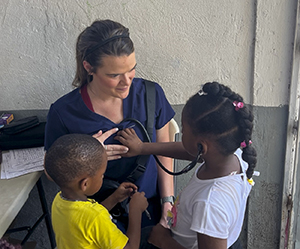
A nurse helps children not to be scared by letting them listen to her heartbeat. (IMB Photo)

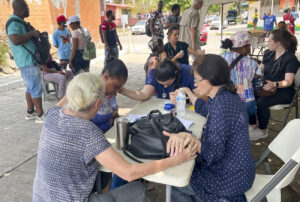
This wasn’t a typical doctor’s appointment. This happened last year on the southern border of Mexico, near Guatemala and the Pacific Ocean. A medical mission team of eight went to offer care to migrants, refugees and displaced peoples.

Another team member treated a young man who injured his knee. The young man said he was running from a gunman who killed his mother in front of him. He fell into a hole which caused his injury. After his treatment, the young man made a profession of faith in Christ.

International Mission Board missionaries Charlie and Robin Janney, who focus on human needs in Mexico, coordinated this team, knowing how great the medical needs are in this area.

“God gave them medical abilities and the intelligence to help others,” Robin Janney said of the team made up of doctors, nurses, physician assistants and physical therapists. “There are people in serious need and have no one else. They are desperate.”

She explained how grateful people were for this medical team to offer them care, considering how difficult it can be to afford treatment. She said it was a “huge honor” for them to receive medical attention and not be charged.

Over five days, the team met with more than 300 patients. For many of the medical professionals, this was the start of their involvement in mission work.

Robin Janney said one of the team members is heading for training to be a Journeyman, a two-year missions program for young adults.

“Another feels called to Africa,” she said. “So, we put her in contact with a missionary there who also uses medical personnel.”

A doctor on the team is close to retiring. He and his wife may consider taking advantage of IMB’s Master’s program, a missions pathway for singles and couples 55 years of age and older who want to give the first two-to-three years of their retirement to the nations.

Visiting medical team makes an impact

The Janneys met most of the members of the medical team last year at MedAdvance, a medical missions conference that allows hundreds of medical professionals, students and church leaders to connect with IMB missionaries and leaders. This year’s MedAdvance will meet September 12-14 at Houston’s First Baptist Church.

Attendees discover how God is at work through medical missionaries and how they can pair their healthcare training with a love for international missions.

“We went in not sure what to expect, and God decided to show us a lot of things at MedAdvance,” Charlie Janney said. “It exceeded our expectations.”

Missionary Robin Janney (in foreground) and members of the medical team pray with a woman who made a profession of faith in Christ. The medical team examined 80 patients this day at a shelter. (IMB Photo)

The Janneys participated in MedAdvance’s Affinity Marathon, as part of the Americas affinity group. This activity allows attendees to connect with missionaries on the field and hear about different IMB health strategies around the globe.

“We had many seek us out,” Robin Janney said. She explained that six of the eight medical professionals on last year’s trip had been at MedAdvance.

“The team did not know each other beforehand, but they worked as if they had worked together for years. It was one of the best teams that we have had.”

Not only did the medical team impact patients, but they had great fellowship with the host church.

Robin Janney said a woman from the church came up to her.

“She told me, ‘Our ladies of the church want to take them out for coffee.’ [The medical team] connected with the host church. They went out for coffee at least three times,” she said.

She also shared a story of a retired IMB missionary who served in the Middle East as a medical doctor and now serves in Mexico. The doctor was a great encouragement to the medical team, and she and a team member led another woman to Christ.

Team members helped both the church and patients learn about different health topics. One led a session on dehydration.

“A nurse talked to a group of Haitian refugees about dehydration, what were the symptoms and how to prevent it,” Robin Janney said. “We now have a recipe of how to rehydrate someone quicker.”

A physical therapist on the team taught patients different stretching exercises that gave them some relief and helped them sleep better.

The Janneys experienced how God used MedAdvance to strengthen their field ministry. They plan to return this year.

“There are so many medical needs all over the world,” Charlie Janney said. “MedAdvance helps connect those in the medical field with those on the mission field.

“They can make an impact in so many ways. It may not be medically. It might be through encouragement. They might inspire a church.”


Belonging tops faith as draw for all but evangelicals

PHILADELPHIA, Pa. (BP)—A sense of community and belonging inches out shared spiritual beliefs and faith as a church draw for all groups but evangelicals, the American Bible Society said in its latest release from the 2024 State of the Bible.

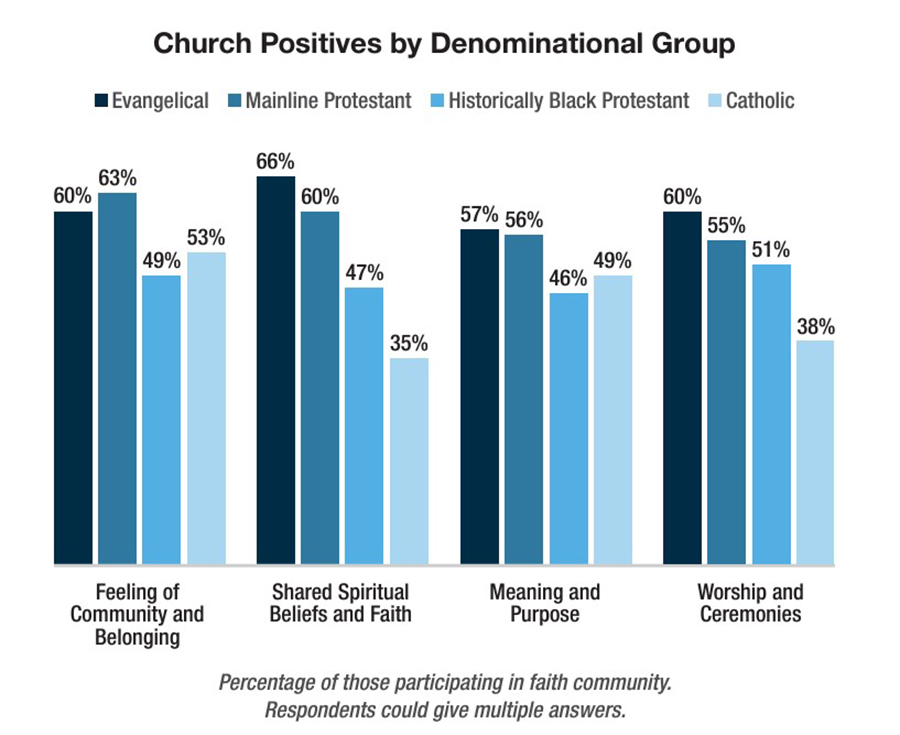
Of the respondents in the study who attend church, 55 percent said they do so because of a feeling of community and belonging, followed by 53 percent who attend because of shared spiritual beliefs and faith, and 51 percent because of meaning and purpose.

But two-thirds of evangelicals—66 percent—are drawn to church by a shared sense of faith, the American Bible Society stated April 8 in releasing the fifth chapter of the 14th annual study.

Participants in mainline Protestant churches are most likely to identify a feeling of community and belonging (63 percent) as a draw, while active Catholics are more likely than other groups to be drawn by cultural or family tradition (43 percent).

Less than half of all respondents combined, 48 percent, said worship and ceremonies draw them to church, the American Bible Society stated.

“The top answers, for both positive and negative responses, are about belonging. When churchgoers feel that they belong, they participate more,” said John Farquhar Plake, American Bible Society chief innovation officer and State of the Bible editor-in-chief.

“And when they feel excluded by cliques, they drift away. So, what can your church do about that? This new chapter offers a few ideas.”

A sense of community and belonging is still a top draw among evangelicals at 60 percent, joined by worship and ceremony at 60 percent, and meaning and purpose at 57 percent.

Falling below 50 percent for evangelicals are religious education and learning, 47 percent; community service and outreach, 36 percent; culture or family tradition, 20 percent; and conversion or religious experience, 17 percent. The aspects are also less than top draws for other denominations cited in the findings.

While the findings come from a nationally representative AmeriSpeak panel of the University of Chicago’s NORC research organization, 42 percent of the 2,506 subjects chose not to answer, saying they did not attend church or participate in a faith community.

Those who did respond selected from nine provided choices of things that attract to church or faith community, the American Bible Society said.

Among other findings:

  • 20 percent, or 50 million people, said a feeling of exclusion or the presence of cliques within faith communities deterred their participation.
  • 19 percent said the church judged or condemned their lifestyle choices, a feeling more common among Gen Z and Millennials (23 percent and 24 percent, respectively).
  • 12 percent are deterred by unresolved conflicts within faith communities.
  • 5 percent said they haven’t felt safe in church or the faith community, most common among Gen Z (8 percent).

Denominations seemed equally impacted by adverse perceptions that drive away attendance, researchers said, with the exception of 15 percent of evangelicals and 14 percent of mainline Protestants who cited conflicts within faith communities that were not resolved satisfactorily, compared to 8 percent of historically Black denominations and 6 percent of Catholics.

Active church volunteers more often expressed a feeling of community and belonging than nonvolunteers, 68 percent to 55 percent, researchers said, and also expressed a deep care for those communities they actively support.

The study was conducted online in January 2024 among adults in all 50 states and the District of Columbia. Additional results from the findings will be released monthly through December, focusing on the Bible’s impact in restoring hope; spiritual nones and nominals; loneliness and the Bible, philanthropy and other topics.