As wildfires rage, Texas Baptists minister to hurting neighbors
BASTROP—When Leticia Lybarger learned her house burned to the ground, she was devastated. Her property was uninsured, and she had lost everything her family wasn't able to stash quickly in their vehicles.
In seven days, the Texas Forest Service responded to 176 fires affecting more than 126,000 acres statewide. An estimated 1,600 homes were lost to wildfires.
Spicewood Baptist Church in Spicewood has at least five families who have been affected by the fires.
BGCT and Texas Baptist Men disaster ministry efforts are supported by designated gifts. The organizations already have used some of those funds in responding to a series of disasters, including the Japan earthquake, earlier this year.
To give to Texas Baptist Men, visit www.texasbaptistmen.org. To give to the BGCT disaster response, visit www.texasbaptists.org/give.
Churches and individuals who would like to assist people affected by Texas wildfires can contact Texas Baptist disaster response specialist Marla Bearden at (214) 537-7358 or go to www.texasbaptists.org/disaster for more information.
–With additional reporting by Rex Campbell
TBM volunteers provide meals for firefighters
TBM has been asked to cook 5,000 meals per day for the firefighters and first responders on the scene. TBM volunteers will work 24-hour shifts to prepare the meals, according to a notice on the TBM website.
About 30 volunteers serving with the Tarrant Baptist Association feeding unit began providing emergency food service on Labor Day.
Interfaith understanding remains elusive 10 years after 9/11
WASINGTON (RNS)—In a post-9/11 bid to better relations with local Muslims, Pastor Bob Roberts invited Muslims to his NorthWood Church in Keller for question-and-answer sessions, a cooking club and to help on a few home remodeling projects.
The result: Roberts lost "a bunch of church members," he said.
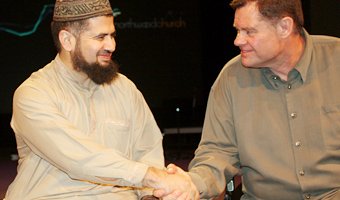
Pastor Bob Roberts lost "a bunch of church members" after he invited local Muslims leaders, including Imam Zia ul Haque from the Islamic Center of Irving, to Northwood Church in Keller for dialogue. (RNS PHOTO/Courtesy Northwood Church)
|
In Denver, Pastor Max Frost asked volunteers from his Roots Vineyard church to help paint a local mosque. Friends and family told him it was a bad idea.
And at Hillsboro Presbyterian Church in Nashville, Tenn., Nancy McCurley started an interfaith Scripture study with local Muslims, only to be told by a critic that "in a year's time, this church will be a mosque."
In the 10 years since the 9/11 terrorist attacks exposed the deep divide between America's Judeo-Christian majority and American Muslims, a host of projects have tried to foster interfaith understanding.
To be sure, there have been signs of hope for the future of interfaith relations. But along with progress has come polarization—threats of Quran burnings, protests of proposed mosques and fears of Islamic law in the U.S. legal system.
A month after the 9/11 attacks, an ABC News/Washington Post poll found that 47 percent of Americans had a favorable opinion of Islam. By 2010, that figure had only gotten worse, dropping to 37 percent.
That begs the question: Has the flurry of activities aimed at interfaith understanding actually accomplished anything?
Eboo Patel, founder of the Chicago-based Interfaith Youth Core, said the furor over the proposed Park51 Islamic cultural center near Ground Zero highlighted the need to gauge the quality, not just quantity, of interfaith efforts.
"Tens of thousands of people in the country who were participating in interfaith projects basically were watching this on TV, … saying, 'What difference does our work make on a national level?'" said Patel, who is Muslim.
As activists like Patel push to foster meaningful relationships between Islam and other faiths, there has been pushback from groups who have no interest in such relations, or who question aspects of Islam.
Gustav Niebuhr, author of Beyond Tolerance, said the divide reflects three types of Americans—the pro-interfaith crowd, the anti-Muslim segment and "the-don't-know-too-much middle" that can be swayed by either side.
Recently, the two poles have debated the possible influence of Shariah, or Islamic law, even though there has been no concerted effort by American Muslims to introduce it into American courtrooms.
"The problem is when people think of Shariah, the only image that comes to mind is the Taliban stoning some poor woman to death in Afghanistan," said Niebuhr, a professor at Syracuse University. "That's the outer limit."
In a growing circle of evangelical churches, there has been a sort of reverse pushback by leaders who are turned off by fellow Christians trying to block mosque construction and blaming Islam for 9/11.
Joseph Cumming, an evangelical who directs the Yale Center for Faith and Culture Reconciliation Program, said more evangelicals are asking what Jesus would do when it comes to relating to Muslims.
"There's a hunger in churches to ask that question," he said. "That wasn't being asked before 9/11."
Mahan Mirza, vice president of academic affairs at Zaytuna College, a new Muslim school in Berkeley, Calif., said Christian-Muslim relations generally are better on the local level, where he has seen an increase among evangelicals who think the Bible requires such outreach.
"Sometimes that's couched in the language of love your enemy so … it's not done in spite of Christian teachings; it's done because of Christian teachings," said Mirza, a former professor at the University of Notre Dame.
Last year, Rick Love started Peace Catalyst International in Chandler, Ariz., which sponsored dinners with members of a local mosque and his Vineyard church to foster what he calls "Jesus-centered peacemaking communities."
He cautions fellow evangelicals to be humble before criticizing the harsh punishments demanded by others' scriptures: "I praise God that we don't live under the Old Testament," he said.
Yet some evangelical leaders, including Southern Baptist agency executive Richard Land, have been condemned for supporting Muslims.
"Southern Baptists were comfortable with me advocating that Muslims have the right to have mosques," said Land, who supported a proposed mosque in Murfreesboro, Tenn. "What they were not comfortable with was me being part of a coalition that was filing a suit in order for them to have these mosques."
Suhail Khan, a Muslim member of the advisory council of the interfaith Buxton Initiative, said he is alarmed Americans' declining favorable views of Muslims.
He blames a "cottage industry of hate" for the shift and finds himself answering more questions about Shariah than the basics of what Muslims believe when he visits evangelical churches.
"I'm having to undo all kinds of misinformation and very hateful misinformation," said Khan.
Undeterred, Patel puts much of his hope in the 200 colleges and seminaries—including nine evangelical schools—that participated in a recent White House event kicking off yearlong interfaith service projects. He expects many of the students will eventually launch similar projects at companies and in cities where they move after graduation.
"I think that college campuses are going to be models of interfaith cooperation, and I think they're going to graduate a generation of interfaith leaders," he predicted.
TBM sending teams to New England; preparing for Gulf storm
DALLAS—Texas Baptist Men disaster relief has been asked to send two assessment teams to Vermont and four chainsaw teams to North Carolina to serve in the wake of Hurricane Irene, which recently struck the country’s Eastern seaboard.
The assessment teams, which will report what kind of ministry is needed where in the coordination of teams, is set to fly to Vermont on Saturday, Sept. 3.
Texas Baptist Men sent out the call for chainsaw teams, and organizers believe teams will be en route to North Carolina early next week.
“People often ask why we do what we do,” said Mickey Lenamon, TBM associate executive director. “The Bible tells us to love our neighbors as ourselves. We don’t necessarily know each person affected by Hurricane Irene, but we hope to care about them as our neighbors in a trying time. We want to be the presence of Christ. That’s what we do wherever we go.”
Meanwhile, TBM disaster relief leaders are watching closely as Tropical Storm Lee forms in the Gulf of Mexico. The storm, which could reach hurricane intensity, likely will make landfall along the Gulf coast this weekend.
TBM has nearly 10,800 trained volunteers that can be called upon to serve, Lenamon said.
TBM’s disaster response efforts are supported by designated gifts. To support the organization’s efforts, visit www.texasbaptistmen.org .
Aledo church seeks to be ‘radical’ in its mission for Christ
ALEDO—When God calls people to follow, it's a call live differently, said Pastor Lee Brewer—radically different. And Brewer is encouraging First Baptist Church in Aledo to be just that.
Last year, Brewer challenged every adult member of the congregation to be involved in hands-on missions efforts, and members have responded.
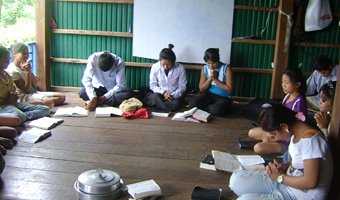
Cambodian teenagers pray during a Bible study. First Baptist Church in Aledo has partnered with a Cambodian Baptist church to minister in Cambodia, one of several places the congregation has served in the past year as it seeks to be radical in its commitment to Christ. (PHOTO/Courtesy of Kyle Vuthy)
|
About 190 people from the church have participated in mission work during the past 12 months, seeing hundreds of individuals around the globe come to faith in Christ. Members have served in Peru, Cambodia, Austria, Hungary, Egypt, Panama, Venezuela, Portugal and Jamaica, as well as Colorado and Vermont.
Their service opportunities have been as varied as the locations. Members shared the hope of Christ through remodeling a building used by a camp for children with special needs. They also participated in an evangelistic crusade, conducted a football camp, led a children's camp, remodeled a parsonage bathroom and taught English.
Margie Manthei, who helped teach a biblically based sexual purity program in Peru, said the church's venture beyond its community has revolutionized the way members think about the world and interact with it. They see how God is moving globally and want to participate in what he is doing.
"We have stopped being a local church and become a global church," Manthei said. "We're no longer Aledo First Baptist. We are now part of a global body of believers. Half our heart is in Peru. Half our heart is in Cambodia."
Following many of the trips, the church has allotted time for people to tell about their experiences during worship services, Brewer said. Some of the testimonies brought the speakers and the congregation to tears. Individuals were inspired to action by their friends' willingness to serve. People who participated in the trips were encouraged to go on another trip after seeing people come to faith in Christ.
"It's just brought people to life. A lot of people, by their testimonies, say, 'This woke me up,'" said Brewer, who based his challenge to the congregation on biblical passages and David Platt's book Radical. "When people get outside themselves, something happens. I don't know how to explain it."
The Baptist General Convention of Texas Partnership Missions office helped the church connect with several of the missions opportunities, including the efforts in Hungary, Austria and Venezuela. Texas Baptists' partnership efforts are supported by gifts to missions through the Cooperative Program, the primary giving channel for Texas Baptists.
"When we started our Radical year last September, I presented several Texas partnerships projects for the church to consider for involvement. Very quickly, four teams were formed to accept these projects, including Venezuela direct evangelism, Austria children's ministry, Hungary church planting, and Vermont construction. In each project, the mission teams were impacted and touched as much as those among whom they went to serve," said Steve Seaberry, who leads Texas Baptists' partnership missions efforts and is a member of First Baptist Church.
"I am so grateful to be a member of a Texas Baptist church where hands-on mission involvement is so much a part of their identity. We are constantly challenged and encouraged to be radical for Christ, to find our place of ministry in our personal Jerusalem, Judea, Samaria and the ends of the earth."
Each missions experience provided an in-depth discipleship opportunity for the participant, Brewer said. A weeklong experience where a person can focus solely on what God calls followers to do can transform a life, he noted.
"I believe it's the best discipleship money you can spend," Brewer said.
Brewer has seen the transformation take place. One person who financially supported mission work faithfully decided to go on a trip because of the church's challenge to serve. He now has served in multiple mission capacities and has taken on an extended volunteer position that recruits other people to foreign mission work.
People who were reluctant to share their faith in Aledo discovered how easy it is to share their faith while overseas, Brewer said. They return home passionate about sharing the hope of Christ with their friends, family and neighbors.
"They come back ready to witness here. I don't have a good explanation for that, but that's what I'm seeing."
Debate over Adam and Eve continues
LOUISVILLE, Ky. (ABP) – Recent comments by a Southern Baptist seminary president that belief in a literal Adam and Eve is necessary to correctly understand Christ’s saving work continues to prompt debate.
|
Brian McLaren
|
Brian McLaren, author of A New Kind of Christianity, linked recently in his blog to an Associated Baptist Press article headlined “SBC leader says much at stake in debate over Adam and Eve.” McLaren described quotes attributed to Albert Mohler, president of Southern Baptist Theological Seminary as “recycling of the Scopes Monkey Trials in Christian higher education.”
Mohler said in the story that without a literal Adam and Eve “we will have to come up with an entirely new understanding of the gospel meta-narrative and the Bible’s storyline.”
“I firmly agree (in an ironic sort of way) with the good Dr. Mohler,” McLaren commented. “I think the conventional Constantinian ‘understanding of the gospel meta-narrative and the Bible's storyline’ is wrong, misguided, and dangerous. We do in fact need ‘an entirely new understanding’ — new, that is, compared to the status quo, but actually more ancient and primary than the conventional approach. In the process we'd better learn what a meta-narrative actually is and realize that it's not actually a great label to apply to the gospel. ‘The Bible's storyline’ is much better. That's what I've been writing and speaking about for the last decade, and hope to keep advocating for and contributing to for the next.”
Mohler rejoined in his own blog Aug. 31: “Indeed, McLaren has been writing about and calling for just such a theological revolution. In his 2010 book, A New Kind of Christianity, McLaren explicitly denies that the Bible reveals Adam as a historical figure. He also denies that we should believe in a Fall into sin that leads to a divine verdict against sinful humanity.”

Al Mohler
|
Mohler said debate over whether Adam and Eve were historical figures has served to “clarify, once again, what is at stake.”
“The denial of a historical Adam and Eve as the first parents of all humanity and the solitary first human pair severs the link between Adam and Christ which is so crucial to the gospel,” Mohler concluded. “If we do not know how the story of the gospel begins, then we do not know what that story means. Make no mistake: a false start to the story produces a false grasp of the gospel.”
Mohler is a conservative theologian often quoted in media to counterbalance more progressive views. McLaren is a leader in the “emergent” church, which claims Christians need to become culturally relevant in order to be successful in their witness.
The two men have traded barbs before. In 2010 Mohler labeled McLaren’s just-published A New Kind of Christianity a “straightforward rejection … of the Christian meta-narrative” and a “false gospel.” He later described “postmodernism,” a catch-phrase used by the emergent church, as being just as dangerous yet “more seductive” than classical liberalism.
In March McLaren defended author Rob Bell against attacks by Mohler on Bell’s newest book, Love Wins, which questioned the traditional view of a literal and eternal hell. McLaren said he decided to speak out because “it’s not the attacks of your critics but the silence of friends that hurts the most.”
“If some like Dr. Mohler want to reserve the terms evangelical, orthodox and even Christian for those who hold fast to the traditional view of hell, they seem to have the power and moxy to do so,” McLaren wrote. “Those of us who can’t in good conscience defend that view any longer are certainly not condemning people who can’t in good conscience stop defending it. But we are hoping at least to be given the courtesy of a fair hearing.
“To impugn our motives (that we are selling out the Bible for the pottage of popularity), to reduce our concerns about love and justice to sentimentality, to dismiss us with the ‘L’ word and a questionable narrative surrounding it, and to demean as ‘secularized’ our attempt to articulate a fresh vision of the gospel probably won’t pass muster as a fair hearing.”
–Bob Allen is managing editor of Associated Baptist Press.
Student adopts 30-days-on-$30 fast to identify with global poor
LONDON—Bland, boring food tastes like a gourmet treat to a person subsisting on $1 a day, Nathan Adair discovered.
“When you are really hungry, one raisin is like eating an ice cream sundae. Twenty-five-cent canned vegetable soup tastes like it came from a five-star restaurant,” said Adair, 10 days into a 30-days-on-$30 fast.

Nathan Adair's evening meal consists of two scoops of rice, tomatoes, half a potato and some green peas –at a cost of about 21 cents–while his 3-year-old daughter, Emerson (left); wife, Lindsay, and even 7-month-old Payton enjoy more typical fare. Adair is spending 30 days living on $1 a day–the lifestyle of one-third of the population in India. (PHOTO/Courtesy of Nathan Adair)
|
Adair, a Baylor University graduate who grew up at First Baptist Church in Arlington , began his 30-day experience to identify with the more than 1 billion people globally who live on $1 a day or less.
In particular, he wanted to focus attention on the living conditions of one-third of the people in India, hoping to raise awareness—and money—for a solar micro-enterprise project to benefit an orphanage there.
When Adair began selecting a dissertation project for his master of business administration degree at London’s University of Westminster, he wanted to do something that would make a difference in people’s lives.
“I did not want to simply piece together an academic report that would benefit no one,” he said.
When Adair and his wife, Lindsay, attended West University Baptist Church in Houston , they met Kirby Trapolino, director of Peace Gospel International , and began to support his ministry, which seeks to improve the lives of people in the developing world.
So, when he started to consider an MBA project, Adair contacted Trapolino to talk about initiatives Peace Gospel wanted to implement. He learned about an orphanage in India located in a community where electricity is unreliable at best. He and Trapolino agreed a micro-enterprise initiative there would be a worthy project.
“In an effort to resolve this issue and generate much needed revenue for the orphanage, we are designing a solar system that will power the facility as well as charge batteries,” Adair said. “These batteries will be rented by members of the community to power lights, fans and small appliances in their homes, drastically improving quality of life.”
Adair views his decision to tackle the project in India—and enter a 30-day experiment in simple living—as God’s design.
“Growing up in a Christian home and attending Baylor allowed me to go beyond my comfort zone and trust God’s plan for my life. It is not a coincidence that I became involved with Peace Gospel, studied for an MBA and began working on this project. It is clear that this is God’s path for me,” he said.
“I knew that to truly commit to this project, I needed to empathize in some small way. Peace Gospel’s mission is to speak up for and support those without a voice. Throughout the Bible, many verses speak of exactly that. The 30-day challenge was a way to put myself in their shoes and raise awareness and funds for this important project.”
Based on the first 10 days of the 30-day experiment, Adair found the initial four days the most difficult.
“A combination of eating approximately 35 percent of the calories normally consumed and giving up caffeine made for a miserable beginning,” he acknowledged. “Overwhelming support and prayer were the only way I did not give up. My wife and family have been very supportive.”
With a 3-year-old, Emerson, and 7-month-old, Payton, at home, mealtime presents its own challenges, since it essentially means preparing four distinct menus.
“The logistics and planning have been difficult to sort,” he said. “Also, the lack of energy has been substantial. Two young daughters only amplifies this fact.”
But Adair insisted it is worth the effort, because he is gaining a new understanding of how much of the world lives. People who live on $1 a day or less “see food as an essential fuel to stay alive,” and they don’t take that for granted, he noted.
“Some of these people may not have a guaranteed next meal waiting for them. This cycle becomes an obsession,” he said. “One thing that has helped me tremendously is a never-ending supply of clean water to drink. This is not the case for these people.”
To spread the word about his experience, Adair began writing a daily blog at http://indiasolarproject.blogspot.com . He posts his daily menu—typically small portions of rice, potatoes, peas, tomatoes and pasta—as well as his experiences.
One recent series of entries recorded his impressions during a four-night family camping trip.
“My favorite part about camping has always been the food—hot dogs, beans, breakfast taquitos and, of course, s’mores,” he wrote at the beginning of the trip. While his family enjoyed typical campfire fare, he ate eggs, rice and oatmeal.
But at the end of the trip, he reported, “With much support and blessing, I made it through our camping trip without falling into temptation.”
On his blog, Adair has challenged his readers to join him for one week the experience of living on $1 a day or at least taking part in some act of self-denial. Whether they participate or not, he hopes simply reading about his experience opens their eyes to needs around the world.
“I hope people choose to look outside their bubbles and realize that this very moment, kids are digging through trash looking for food—that children are being sold into slavery and prostitution this very minute—that widows are being spit on in the street because they are seen as unclean and worthless,” he said.
“I want them to realize that the Western way of life is luxurious compared to most. I have been very blessed in this life, and I want to give back as much as possible. We can’t take anything with us.”
Fort Bend pastor nominated for BGCT 2nd VP post
SUGAR LAND—Byron Stevenson, founding pastor of The Fort Bend Church in Sugar Land, one of the fastest-growing churches in the state, will be a candidate for second vice president of the Baptist General Convention of Texas this fall.
Stevenson's fellow pastor Phil Lineberger, a former BGCT president, announced he will nominate Stevenson when the convention holds its annual session in Amarillo, Oct. 24-26.
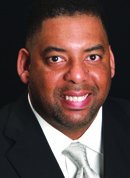
Byron Stevenson
|
"Byron is an outstanding preacher and a really fine pastor," noted Lineberger, pastor of Sugar Land Baptist Church. "I've known Byron since about 1996—quite a few years. …
"He established The Fort Bend Church in 2004 at Sugar Land Middle School. When we built our building here, he asked me several times if he could use it for major functions. Today, they have over 3,000 members and a fabulous church plant. It's one of the fastest-growing churches in Fort Bend County."
Despite the demands of a rapidly growing congregation, Stevenson has maintained his pastoral focus, Lineberger added, noting: "I've seen him tend to them as pastor. He's very relational."
Sugar Land Baptist and The Fort Bend Church have welcomed each other's pastors into their pulpits, he said. "I've preached over there, and Byron has preached over here. He's got a hummin' church; they preached me to death."
Stevenson would make a fine BGCT officer because of his leadership skills and his love for and commitment to the convention, Lineberger stressed.
"Byron is a Baptist—a Texas Baptist," he said. "He serves on the BGCT Executive Board and has been secretary of the African-American Fellowship of Texas. He's strongly supportive of our convention."
Stevenson's wife, Sonya, is executive director of The Fort Bend Church, and they have worked well together to lead their congregation, Lineberger said, adding: "He really has done a magnificent job. He and Sonya both."
Stevenson said he sees service to the convention as returning a blessing, and that is a motive for his willingness to serve as a vice president, if elected.
"This is an opportunity for me to give back to the BGCT, because the BGCT has been such a blessing to me and to my church since our inception," he explained, noting the church was launched with financial support from the convention. "I feel in a sense obligated to give back."
Both Stevenson and his church are "pro-BGCT," he said, particularly citing the convention's focus on missions and starting churches.
""My church has been a BGCT church since its inception," he said. "We believe in the mission of the BGCT and have been in support of missions since Day One.
"At the core of the BGCT is starting new churches. I'm one who can share insight—having planted my church—with new pastors and churches who are wanting to branch out and plant new churches themselves."
Advocacy on behalf of the convention is an aspect of the vice presidency Stevenson would embrace, he said. "If elected, I want to continue to be an ambassador for missions throughout the state. I want to increase the awareness of what the BGCT is doing in the lives of churches throughout the state and continue to forge partnerships amongst the affinity groups … to continue to promote the life of the BGCT.
"The BGCT is a vibrant entity and one that must continue to grow."
Stevenson earned an undergraduate degree from Southern University in Baton Rouge, La., and a master's degree in theological studies from Houston Baptist University. He also studied at Southwestern Baptist Theological Seminary in Fort Worth.
Before entering vocational ministry, he was an accountant. Prior to founding The Fort Bend Church, he was minister of program development at Brentwood Baptist Church in Houston.
He has traveled in Italy, Egypt, Jordan and Israel.
The Stevensons are parents of two daughters, Claire Alexandra and Cydney Victoria.
New gardening approaches have Mexican group home seeing green
MEXICO CITY—The Pan de Vida foster group home in Mexico City recently harvested more than 1,000 pounds of tomatoes, but residents are not exactly digging in or getting their hands dirty.

A resident of the Pan de Vida group home tends tomato plants in the rooftop garden in Mexico City, the first incarnation of Buckner Mexico's experiment in hydroponic gardening. (PHOTOS/Buckner International)
|
The project grew from a seed planted in the mind of Juan Carlos Millán, Buckner International's Mexico program director, at the suggestion of his wife. When he first heard about hydroponic gardening—growing plants in water rather than soil—Millán wasn't sure how it could be applied to Buckner Mexico's ministries.
"My wife personally knew a hydroponics expert and invited him to dinner so that he could further explain how he was able to harvest enough habanero chilies to make an enormous profit," Millán said. "It changed my mind about hydroponic gardening."
His staff attended a training program, and the possibilities bloomed.
The project began in Mexico City. With no fertile ground available for cultivation in the sprawling city of nearly 20 million people, Buckner planted its first greenhouse garden on the flat roof of the Pan de Vida group home in March 2010.
"We began to use that greenhouse as an educational piece to teach families in the community to grow vegetables for their families as a food source and later, for ones who got better at it, to sell surplus produce to the market and generate income for their families," said Dexton Shores, regional director of Buckner in Mexico, the Dominican Republic and Peru.
"The big greenhouse on the roof is also used to provide food for children at the foster group home and the community feeding program."

Buckner Mexico staff has had success growing tomatoes using hydroponic techniques, harvesting more than 1,000 pounds of the fruit in their first growing cycle. (PHOTOS/Buckner International)
|
In the first growing cycle of the project, Buckner Mexico staff planted 150 cucumber plants and 150 tomato plants. They produced 661 pounds of cucumbers and 1,404 pounds of tomatoes.
In the second cycle, the greenhouse was only planted with tomatoes and finished the cycle with a production total of 1,774 pounds. Of that, 358 pounds were consumed at the foster group home and in the feeding program, and more than 1,300 pounds were sold at the market, helping the home become more sustainable.
Buckner Mexico employees have experimented with several hydroponic gardening methods. They have grown heads of lettuce atop a sheet of Styrofoam floated on water. They have also had success with a tiered planter—a good solution for city dwellers without space for a large garden.
With a grant from the Mexican government, Buckner Mexico has been able to help 20 families begin their own small gardening operations in Oaxaca, about a six-hour drive southeast of Mexico City. The government grant provided funding to build 20 small greenhouses, purchase seeds and install extra water tanks where hydroponic solution could be stored separately from water for daily household use.
These greenhouses were built in July 2010, and families are growing spinach, carrots, tomatoes, chilies, radishes, lettuce and cucumbers for their own consumption. Shores said the method is very affordable, with the initial investment for a smaller greenhouse at $200 to $250.
"Once the greenhouses are started, the families are responsible to keep it going," Shores said. "With any profits they make selling the surplus from their first crop, they have to buy seeds for the next crop."
In February 2011, Buckner also built a greenhouse at the Arcelia Community Transformation Center, about 170 miles southwest of Mexico City. Millán said the staff recently started working on a new project to help alleviate the problem of infertile soil in the area—worm composting. "So far, we have built brick beds for composting where we will develop fertile soil from biodegradable organic material, using worms for rapid decomposition," Millán said. "This produces the proper amounts of carbon and nitrogen in six months. Two tons of fertilizer will be produced at the end of the six month period. The beds have been built, but we are waiting for the shipment of worms to begin the project."
This year will also see the beginning of a program to help families start raising hens for eggs and meat.
"The overall goal of these projects is to provide job training, to teach people to provide food for themselves and their families and to help people generate extra income to move toward self-sufficiency," Shores said. "We want to empower families."
For more information on how to help families in Mexico with sustainable food solutions, contact Buckner Foundation at (214) 758-8050.
TBM gears up to serve after Hurricane Irene
Texas Baptist Men received requests to provide disaster relief in North Carolina, and leaders expect to be called on to serve in Vermont, as well.
“We know there is a need in the New England/Vermont area,” said Dick Talley, TBM logistics coordinator. “We want to respond to the need. We’re waiting for the data from the assessment teams.”
Vermont officials said the state is suffering its worst flooding since 1927. One person has been confirmed dead there, and officials expect to find additional loss of life. More than 260 roads have been damaged.
In North Carolina, about 34,000 people remain without power, down from more than 440,000 immediately after the storm.
TBM disaster relief ministry is supported by designated gifts. To make a donation, visit www.texasbaptistmen.org .
Religious leaders laud MLK in memorial service
WASHINGTON (RNS)—An earthquake and a hurricane interrupted plans to honor Martin Luther King Jr. in the nation's capital, but religious leaders and civil rights veterans said King's legacy is unshakable.
The Aug. 27 interfaith service was the last official event to mark the dedication of the new King memorial on the National Mall after Hurricane Irene caused officials to postpone Sunday's official dedication.
 "If Martin Luther King was anything else, he was an obedient servant of the Lord," said Bernice King, who was 5 when her father became a modern-day martyr in the fight for civil rights.
"He often did things not because it was popular, not because it was expedient. … The daddy that I came to know was a servant of the most high God who was obedient to the call of Christ on his life and who moved in the power of the Holy Spirit."
Saturday's religious service was moved to the Basilica of the National Shrine of the Immaculate Conception after a magnitude 5.8 earthquake damaged the Washington National Cathedral. The memorial's official dedication was postponed until September or October as the hurricane threatened the East Coast.
Organizers had anticipated 2,500 people for the invitation-only service but about a thousand sat beneath the basilica's stained glass windows and colorful domes as storm clouds gathered overhead.
Former Ambassador Andrew Young, who worked as a key aide to King, drew on the symbolism of the memorial, in which King's 30-foot sculpture on a "Stone of Hope" emerges from a "Mountain of Despair."
King worked to defeat racism and militarism, he said, but he died fighting poverty.
"As we leave this place of celebration, the statue, remember that the mountain of despair is still there and now it's thrust on all of us," said Young, a former president of the National Council of Churches.
"And as we see his statue hewing out of that mountain of despair, a vision and a stone of hope, you and I must become stones of hope."
The service, which was equal parts solemn and celebratory, became particularly hushed when the lights dimmed and King's own voice was heard, first speaking of the danger of "sleeping through revolution" and later his confidence that "we shall overcome."
Designers of the memorial along the Tidal Basin said they tried to invoke King's "spiritual presence" with inscriptions that include quotes from his sermons and speeches.
"If we are to have peace on earth, our loyalties must become ecumenical rather than sectional," King said on Christmas Eve 1967 in Atlanta, in one of the 14 quotations inscribed on the sloping walls on the memorial site.
"Our loyalties must transcend our race, our tribe, our class, and our nation; and this means we must develop a world perspective."
Joseph Lowery, a civil rights veteran who worked closely with King, said he anticipated the memorial even as he gave the benediction at the 2009 inauguration for the nation's first black president.
"You know, God moves in a mysterious way, his wonders to perform," said Lowery, who co-founded the Southern Christian Leadership Conference with King. "We have come to the joy of a new beginning."
Baptist relief agencies begin Mid-Atlantic cleanup in wake of Irene
RICHMOND, Va. — As Hurricane Irene continued its destructive track north Aug. 28, Baptist relief agencies in the Mid-Atlantic began deploying volunteers in the region, which was left with rising water and little electricity in the wake of the storm.
|
Volunteers prepare vast quantities of brunswick stew at a feeding unit in the parking lot of the Virginia Baptist Resource Center in Richmond, Va. (Photo by Robert Dilday)
|
At sites along the Virginia and North Carolina coasts, recovery teams readied themselves to offer hot meals, remove downed trees and clean up flooded homes and businesses.
Though Irene proved to be far less damaging than originally predicted, at least 24 deaths were attributed to the storm and it cut electricity to more than 1 million customers in Virginia and North Carolina, and several hundred thousand in Maryland and the District of Columbia. Storm surges and heavy rainfall caused extensive flooding along the coast and beside rivers.
Virginia Baptists’ disaster relief ministry sent a feeding unit Aug. 29 to hard hit King and Queen County, Va., near the Chesapeake Bay, which the American Red Cross will use to distribute about 7,000 meals daily over the next week. A shower unit was deployed to Richmond County, just across the Rappahannock River, for the army of repair crews attempting to restore power to residents there.
Another feeding unit was set up late Aug. 28 on the parking lot of the Virginia Baptist Resource Center in Richmond, Va., which began preparing meals for distribution in several counties south of the city will without electricity.
“Some of our people are out making assessments right now, but thankfully the situation isn’t as bad as we thought even as late as Saturday afternoon [as the storm hit the region] it would be,” said Dean Miller, who coordinates disaster relief for the Virginia Baptist Mission Board.
“There’s a lot of power outage. A lot of downed trees. And there’s some concern about the Blackwater River flooding near Franklin [Va.]. That may crest late Monday or Tuesday, and if so we’ll probably be in that area as well.”
North Carolina Baptist Men deployed recovery units Aug. 28 at four locations on or near the North Carolina coast — Greenville, Manteo, New Bern and Williamston — and likely will set up feeding units in all but Greenville, where the recovery unit will be stationed at The Memorial Baptist Church.
“Those four locations are pretty centrally located,” said Richard Brunson, director of North Carolina Baptist Men. “We can house volunteers there and they can be at the worst hit areas within 30 to 40 minutes.”
Brunson said there was considerable flooding in communities along the Albemarle and Pamlico Sounds, and extensive tree downings.
In New Bern, where First Baptist Church is hosting the disaster relief operation, there is widespread flooding within five miles of the church, said Steve Winn, a church member who is working closely with North Carolina Baptist Men.
“All the way from Morehead [City, N.C.] to the Virginia border there’s flooding,” Winn said. “We’ll be helping with that and also working to get trees off the roofs before any additional rains come through.”
Like many congregations across the region, First Baptist in New Bern cancelled worship services Sunday morning. From North Carolina to Maryland, lack of electricity and streets blocked by downed trees and power lines prompted churches to close for the day. Others — encouraged by the blue skies and mild weather on the morning after the storm — worshipped in sanctuaries with open windows and doors.
Zoar Baptist Church in Deltaville, Va. — whose sanctuary was destroyed by a tornado last April — cancelled Sunday services, which are being held on the beach while the church is rebuilt. The hurricane caused no significant damage to the church’s renovation project, said Juanita Glascock, Zoar’s administrative assistant.
In Washington, D.C., which was lashed by Irene, the District of Columbia Baptist Convention was assessing damage to its affiliated churches to determine of a response was needed from outside partners, said executive director Ricky Creech.
Creech, who was elected to the position last March, said he is in the “middle stages” of designing the convention’s first disaster response units.
“The [Aug. 23] earthquake and Irene have given leverage to this new venture,” he said.
While neither the Virginia nor North Carolina affiliates of the Cooperative Baptist Fellowship are first responders, both were urging volunteers to work closely with Baptist relief agencies in their states.
Rob Fox, CBFVA field coordinator, said he was in contact with the national CBF as it assessed the situation in the Mid-Atlantic.
CBFNC’s executive coordinator, Larry Hovis, said his staff had “tried calling all pastors of churches located on or near the coast to assess damage and assure them of prayers and support.”
“We haven’t discovered significant damage or need yet but will continue to reach out to the churches,” he said.
In an Aug. 29 e-mail communication, CBFNC said, “We continue to value our partnership with North Carolina Baptist Men and encourage partner churches to participate in relief and recovery efforts through them.”