Houston church eases transition for Bhutanese refugees

HOUSTON—Imagine being forced—under threat of oppression and violence— to abandon home and familiar luxuries for a bamboo hut on a crowded strip of land in the middle of a river.

A boy hands out DVDs titled "New Life in Jesus." Every youth received a copy of the movie, which portrays the life of Jesus and carries the gospel message. (PHOTOS/Grace Gaddy/Communications Intern)

Rain causes the water to rise, forming barriers that block any escape route, and the flimsy tarp roof proves inadequate. Food consists of a bowl of rice, while clean water and electricity run scarce amid unstable health conditions. Then, imagine being catapulted across thousands of miles into an unfamiliar society with only six months to learn the language, find employment and establish a new home within the foreign land.

That’s reality for Bhadra Rai and hundreds of other Bhutanese refugees coming to the United States.

Since relocating to America three years ago, Rai, 27, has been reaching out to members of the Bhutanese community, hoping to aid their transition and share the gospel with them. In 2009, he helped start the Canaan Bhutanese Church, where he serves as pastor. The church is located in southwest Houston. On average, 20 percent of Bhutanese refugees settle in Texas each year, with two-thirds of that percentage residing in Houston—most within a two-mile radius of each other—according to Mark Heavener, intercultural strategist for the Baptist General Convention of Texas. Often, refugees arrive with no concept of where they are, seldom daring to travel outside of those two miles, he said.
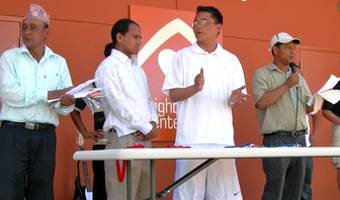
Bhadra Rai (center), pastor of Canaan Bhutanese Church in Houston, seeks to make immigrants from Bhutan feel at home in Texas—and reach them with the gospel. (PHOTOS/Grace Gaddy/Communications Intern)

In order to connect locals, Rai founded the Bhutanese Community of Houston. Welcoming all members regardless of faith, the nonprofit organization assists refugees with finding income, health and a successful place in society.

“There’s nobody else working across the state to try and connect the Bhutanese refugees together like (Rai) is,” Heavener said. “He has been recognized by the federal government’s work among refugees as a key leader.”

Rai testified in Washington before the federal Office of Refugee Resettlement about the challenges and difficulties of resettlement. He was also invited to attend a training workshop in California about developing community group organization and resources.

He regularly advises the Houston mayor’s council on refugee issues and leads evangelism efforts through collaboration with the Baptist General Convention of Texas office of intercultural ministries. Funds from the Mary Hill Davis Offering for Texas Missions support various outreach events.

Members of Bhutanese soccer teams from Austin and Abilene listen for their names to be called during the award ceremony. (PHOTOS/Grace Gaddy/Communications Intern)

His wife, Ruth Rai, spoke for the Bhutanese community, “We all are new in America, so we don’t know what’s going on here.”

She explained refugees need help, so the mission becomes one of provision, whether it’s clothing, kitchen utensils, doctors appointments or something else. Then, the door opens for Christians to connect with nonbelievers and share the gospel, she said. “We know more than them, so we can go (help) them … After that, we can say: ‘Can you come to our church? If you want, you are welcome.’”

And it’s working.

Dhan Tamang, 26, was a Buddhist when he first arrived in the United States. “I used to think about the Christian religion, and I used to go to church informally… just with friends,” he said.

After connecting with Rai, he decided to attend church more, thinking it might benefit his children’s future. He got more than he bargained for however, after coming to know Jesus himself.

Angel, 2, was the first Bhutanese child born in Houston in February 2009.

“I find peace in him, and happiness in him, joy and all these things. Right now I’m not having any kinds of problems,” Tamang said, his face aglow with the brightest of smiles.

After committing his life to Christ and being baptized, “everything got solved,” he testified. He chronicled examples of God’s goodness to him—his ability to buy a car, have a computer with Internet access and see his 3-year-old daughter recover from illness. He credits all to Jesus.

“I never thought my life would be like this,” he said. “If we believe in (Christ), definitely everything will be solved.”

Recently, Rai helped organize a one-day summer camp filled with food, fun and friendly competition for Bhutanese youth. More than 135 children and teenagers attended from Austin, San Antonio, Abilene, Fort Worth and Houston. The event included a soccer tournament, the personal testimony of a Cambodian refugee pastor and a cultural celebration sponsored by local refugee agencies featuring traditional Bhutanese dancing and an awards ceremony.  

Three young men perform a traditional Bhutanese dance. Their hats symbolize leadership of tribal elders. (PHOTOS/Grace Gaddy/Communications Intern)

“After events like this, people start to come to the church and just get connected,” Heavener said. “A lot of this stuff that his church is doing up front is very clearly Christian. …Whenever his church is up there, it’s presenting the gospel at this program through song and dance.”

Thirteen-year-old Deepa Adhikari, a dancer from Canaan Bhutanese Church, came to faith in Christ after connecting through local community.

“When I came here, I met my friends, and my friends are all Christians,” she said. Describing the church, she added, “Everybody works together, stays together—we’re like family.”




YEC participants hear truth, serve the cities

DALLAS—Texas Baptist Youth Evangelism Conference included a new feature this year, as 35 churches joined with nine area ministries to take to the streets and “serve the cities,” sharing the hope of Christ in a tangible way.

Nicky Pizana, lead vocalist for the band 3 Point C, leads in worship at Youth Evangelism Conference. (PHOTOS/Lauren Capps)

“Oftentimes, when we get together at conferences, we do a lot of talking about evangelism and outreach, but students rarely get to see it in practice. … With this built-in opportunity, students were able to go around and see how the local ministries were meeting people’s needs and sharing the gospel with the lost,” said Leighton Flowers, youth evangelism director with the Baptist General Convention of Texas.

Thirty-one junior high school students who traveled to YEC with First Baptist Church in Perryton served at Mission Arlington .

“I think it was really good for this group of kids who have not yet gone on mission trips. It really opened their eyes to people’s needs and how they can meet them,” Youth Minister Clay Carter said.

Students crowd around the stage to join in praise and worship during the Youth Evangelism conference, held at the Dallas Convention Center. (PHOTOS/Lauren Capps)

“I believe YEC is good for the kids, as far as getting away from our small town. They grow closer together and closer to God. We always have kids who rededicate their lives to Christ and a number who get saved. It’s a ministry that has shown a lot of fruit for our church.”

On the evening before the students began their days of community service, Lance Shumake, president of iGoGlobal, spoke briefly to students about Acts 1:8 and how they are called to live that out. Conference participants commissioned several student missionaries.

Illusionist Brock Gill performed stunts and tricks with the goal of providing students an opportunity to bring their lost friends for some fun and truth. Between shooting arrows across stage blindfolded and pouring seemingly endless pitchers of water into a bucket, Gill shared his testimony and a gospel presentation.

The general session also included a concert by the Grammy Award-winning Christian band Switchfoot .


Refugees at Myanmar-Thai border joyful despite persecution

KUALA LUMPUR, Malaysia — Blooming Night is a Myanmar refugee living just across the Thai border who has spent most of her 50-something years hiding in the jungle. But when she isn’t in actual hiding, she is bringing relief to her people — the  Karen — through physical supplies and through the gospel of Jesus Christ.

“She is a missionary to her own people,” said John Upton, executive director of the Baptist General Association of Virginia and president of the Baptist World Alliance.

refugee camps

Refugee camps along Myanmar border.

Upton was part of a seven-member BWA delegation that visited refugee camps along the volatile border recently. Organized by Patsy Davis, executive director the BWA’s women’s department, the visit preceded the global organization’s week-long annual gathering in Kuala Lumpur, Malaysia.

The Karen are among several minority ethnic groups in the remote mountains and jungles of Myanmar (formerly known as Burma) who have been fighting government control since the country’s independence from Britain in 1948 – one of the world’s longest-running separatist insurgencies.

For decades thousands of refugees have fled the conflict, landing in camps just across the border in Thailand. The Thailand Burma Border Consortium, an NGO that works in the region, estimates as many as 150,000 people live in temporary settlements. Thai officials say they want to return them to Myanmar.

“The conditions there are like something you would imagine from 200 years ago,” Upton said.

Davis agreed the conditions are grim. “The people literally have nothing. Nothing. We went to offer humanitarian aid, but mostly we went to encourage Blooming Night. We wanted to show her that Baptist women around the world support her.”

In recognition of her birthday next month, the delegation presented Blooming Night with a large birthday cake and presents.

“Here is a woman who is hunted by two governments, who swims across the river at the border at the risk of her own live, who has to navigate mine fields, who knows the hardness of life, who has seen women horribly treated — raped by soldiers of the Myanmar army,” said Upton. “She has seen all this, but when she opened her birthday card that played music, she jumped and then she laughed and then she cried. And for a few minutes this woman that I just described turns into a little girl.

“Playful, giddy, hugging, laughing, she goes to leave but can’t. She goes around the circle one more time before she could leave. She turned into the little girl that she was never able to be. That transformation is a memory I will always take with me.”

An estimated 30 to 40 percent of Karens are Christians, and Davis said for many of the refugees, “Their only joy is Jesus.”

Davis said the number of churches in the camp has increased from 12 two years ago to 20, in addition to the church where the BWA delegation worshiped.

That worship service, attended by about 500 people, was a wet one, she and Upton said. It had rained torrentially all night but had cleared by morning. The sanctuary was flooded when debris clogged the river and it spilled over its banks.

“Water started coming in the back of the church,” said Upton. “During a prayer, it would advance another pew. During one long prayer it moved up three rows. It came all the way up to the front row of pews. People in the back were sitting in water almost knee-deep and nobody knew how deep it was going to get. But nobody left.”

He added, laughing, “It started receding while I was preaching, so I figure I preached the flood back.”

The singing in the two-hour service is what impressed Davis and Upton most, as well as the palpable joy in the faces of the worshipers.

“One lady, whose husband and child were killed by the soldiers, greeted us with such a smile you would never know the tragedies she experienced,” Davis said.

The day started at 5 a.m. “when they were singing during the prayer time,” Davis added. “At 6:30 was the women’s Bible study, and that was just the beginning of the day!”

Davis said the churches in the camps include descendants of Karen converted to Christianity by Ann and Adoniram Judson, American Baptist missionaries who spent 40 years in Burma during the first half of the 19th century.

“They [the churches] learned well the lesson of sacrifice,” said Davis. “Three of the 20 churches gave an offering of $500 to the BWA women’s department. These are people who have nothing who did this. We should be totally ashamed.”

Christians in the camps have started a Bible college and seminary and are ministering to abused women and children. In addition, Blooming Night and others have helped resettle refugees in other countries, including the United States.


Buckner partners with baseball club, academy to collect shoes

The Dallas Patriots, a select baseball club, and Premier Baseball Academy of Plano—working in partnership with Buckner International—hope to hit a home run for needy children this month by collecting a record number of new shoes for orphans and vulnerable children worldwide.

Dallas Patriots President Logan Stout chose to work with Buckner and its Shoes for Orphan Souls ministry after seeing pictures of children without any shoes and learning how a simple pair of new shoes can affect a child’s health, education and overall well-being.


“I asked them, ‘What’s the biggest donation of shoes to date?’ And they said 25,000. So, that’s why we decided to do 25,000 plus 1,” Stout said. “In today’s world, there is so much pressure for kids to complete, to win. … I think it’s equally important to teach these kids the importance of servant leadership and giving back.”


Multiple drop-off locations where donated new shoes are being collected have been established throughout North Texas throughout July. They include select Payless ShoeSource stores, PrimaCare, LifeWay Christian Stores, Travis Avenue Baptist Church in Fort Worth, First Baptist Church in Richardson and Cornerstone Baptist Church in Dallas.

For an interactive map showing a complete listing of drop-off locations, visit http://www.shoesfororphansouls.org/dropoff-patriots.shtml .


Since 1999, Shoes for Orphan Souls has collected and distributed more than 2.2 million pairs of new shoes to needy children in North Texas and 72 countries worldwide.

Shoes for Orphan Souls is the largest humanitarian aid project of Buckner International. To learn more, visit www.buckner.org .


Baptists travel to Malaysia for annual meeting

FALLS CHURCH, Va. (ABP) – Baptist leaders from around the world are traveling this weekend to Malaysia for an annual gathering of the Baptist World Alliance.

More than 300 Baptist leaders and delegates will converge on Malaysia’s capital of Kuala Lumpur for a series of meetings July 4-9.

The annual gathering involves meetings of a number of BWA groups. They include the BWA General Council and the Executive Committee, along with sub-committees and divisional advisory committees, women's, men's and youth departments; regional groupings and commissions.
 
One of the first events is a communication training seminar aimed at leaders and communicators from conventions and unions in the Asia/Pacific region and interested delegates. Topics include how-to skills -– such as writing press releases and news stories; producing a newsletter; news and social media; developing a strategic communication plan for conventions and churches and using audio visual media for more effective communication.
 
Forums will highlight Baptist work and witness in the Asia-Pacific region; the recent crisis in Japan following the earthquake, tsunami and radiation leakage from a nuclear plant; and a discussion on the topic, "The Bible and Religious Pluralism."
 
The Denton and Janice Lotz Human Rights Award will be presented to Wati Aier, principal of the Oriental Theological Seminary in Dimapur in Nagaland state in Northeast India. Aier, convener of the Forum for Naga Reconciliation, is being recognized for his efforts over nearly two decades in seeking to broker peace between various Naga factions. The conflicts, which began more than 50 years ago, have led to political instability and more than 2,300 insurgency-related fatalities between 1992 and 2009.
 
Updates of the meetings will be posted on the BWA website at www.bwanet.org, as well as Twitter, Facebook and Flickr.


Americans distinguish between politicians’ financial, sexual failings

WASHINGTON (RNS)—Americans are tougher on politicians for their financial misdeeds than their sexual ones, and men are more willing than women to tolerate sexual misbehavior in their elected officials.

The findings, part of a detailed survey by the Public Religion Research Institute, show Americans across religious groups consider it worse for a politician to cheat on taxes or take bribes than to commit adultery or send sexually explicit messages to someone.

“There’s a dramatic difference when people are evaluating public officials’ financial versus sexual misbehavior,” said Daniel Cox, the institute’s research director. “A significant number of folks think they can separate public officials’ personal and public lives,” and tend to think of sexual misbehavior as personal and therefore private.

More than nine in 10 Americans say it’s an “extremely” or “very serious” moral problem for a public official to take a bribe, and more than eight in 10 say the same for a politician who cheats on taxes.

But fewer than seven in 10 Americans say it’s a serious moral problem for a public official to have sex with a prostitute.

Former Rep. Anthony Weiner of New York resigned after lying about, and later admitting to, inappropriate relationships with women he met online. (RNS FILE PHOTO/Courtesy Office of Rep. Anthony Weiner)

The poll was conducted in the wake of several high-profile cases of politicians making headlines for their sexual behavior, including U.S. Rep. Anthony Weiner, D-N.Y., who resigned after he lied about sexually explicit texts he sent to women he met online.

The poll also showed Americans resent politicians lying about sexual behavior more than the behavior itself.

While three in four (77 percent) of those polled consider lying to cover up an immoral sexual act a serious moral problem, only two-thirds believe a politician who has sex with a prostitute had committed a serious moral transgression.

“This is what we’ve been hearing about Anthony Weiner,” Cox said. “He may not have done anything illegal, but he went out of his way to conceal it, and people are saying that this is what got him into trouble. This is rated more serious than sexual misbehavior.”

There are no significant differences, however, in Americans’ views of virtual and actual sexual misconduct. Roughly two-thirds of those polled said it was a “serious moral problem” for a politician to send a sexually explicit message to someone other than a spouse or to have sex with a prostitute.

White evangelicals, however, are more likely than other religious groups to consider immoral personal behavior a disqualification for public office: 64 percent of evangelicals said a politician who commits an immoral act in private life cannot behave ethically in public life, compared to 43 percent of white mainline Protestants, 49 percent of Catholics and 26 percent of the religiously unaffiliated.

Significant gender differences emerged from the poll on views of politicians’ sexual behavior.

Sixty-three percent of women say a politician who has sex with a prostitute should resign, compared to 46 percent of men. And 64 percent of women said a male politician who cheats on his wife should resign, compared to 50 percent of men.

Women were somewhat less willing, however, to condemn a female politician who cheats on her husband, with 56 percent of women calling for her resignation, compared to 51 percent of men.

Other findings from the poll include:

• Republicans (71 percent) are more likely than Democrats (53 percent) to say a politician who has sex with a prostitute should resign. Republicans and Democrats are in closer agreement on whether a politician should resign for financial improprieties.

• Americans are split—44 to 44 percent—as to whether politicians who misbehave in their personal lives can behave ethically in their public lives. The remainder say “it depends” or are unsure.

• More than six in 10 Americans say public officials should be held to a higher moral standard than people in other professions.

• Nearly two-thirds of respondents say the moral behavior of politicians is about the same today as in the past, with 28 percent deeming it worse and 6 percent considering it better.

• By a margin of 54 to 33 percent, younger Americans (ages 18 to 34) are more likely than those over age 65 to believe a politician can behave honorably in office despite a personal moral failing.

The poll, conducted by PRRI in partnership with Religion News Service, is based on telephone interviews with 1,006 U.S. adults between June 16 and 19, with a margin of error of plus or minus 3 percentage points.


Texas Tidbits

BWIM honors Texans. At its annual meeting in Tampa, Fla., the Baptist Women in Ministry group presented its Addie Davis Awards to two female Texas Baptist seminary graduates. Griselda Escobar received the award for outstanding leadership in pastoral ministry, and Kyndall Renfro received the award for excellence in preaching. Escobar is a graduate of Hardin-Simmons University’s Logsdon Seminary and currently is completing clinical pastoral education and serving as a chaplain at Trinity Mother Frances Hospitals and Clinics in Tyler. Renfro is a graduate of Baylor University’s Truett Theological Seminary. Her winning sermon was titled “Sight for Sore Eyes”—based on the story of Jesus’ healing of the 10 lepers in Luke 17. The awards are named in honor of Davis, who in 1964 became the first Southern Baptist ordained woman. Davis died at the age of 88 in December 2005.

HSU names Hammack VP. Mike Hammack, a member of the Hardin-Simmons University development team for the past four years, has been named vice president for institutional advancement at HSU. Hammack, who has 18 years experience in fund-raising, served previously as director of the Gracewood program for single mothers, part of Children at Heart Ministries. Hammack earned both an undergrad-uate degree in Bible and a master’s degree in business administration from Hardin-Simmons. He served as president of the Alpha Phi Omega Alumni Association and received the Outstanding Young Alumni Award from Hardin-Simmons in 2006. He is married to the former Marsha Pruet, an elementary schoolteacher and chaplain for the HSU Alumni Association. They have two children—Myles and McKenna.

Deadline nears for missions awards. The nomination deadline for the 2011 Texas Baptist Missions Foundation Mission Awards is Aug. 1. The awards, selected by the foundation’s council, include the Pioneer Award for service in missions, the Innovator Award for creativity in missions and the Adventurer Award for leadership in missions. The awards will be presented during the Texas Baptist Missions Foundation’s luncheon Oct. 24 at the Baptist General Convention of Texas annual meeting in Amarillo. The Pioneer Award goes to a long-time leader in missions or someone who played a key role in beginning mission work that affected Texas Baptist life. The Innovator Award is bestowed upon a church or individual who provided a model for missions others can adopt. The Adventurer Award honors an individual who advanced missions through direction of significant mission activities, outstanding financial support or leadership in ministry opportunities. Nominations may be submitted to Bill Arnold at the Texas Baptist Missions Foundation, 333 N. Washington, Dallas 75246 or bill.arnold@texasbaptists.org.

Baylor business competition receives $2 million gift. A $2 million gift to Baylor University’s Hankamer School of Business from a donor who wishes to remain anonymous will endow the Baylor Entrepreneurship Innovation Challenge, a business plan competition that will provide opportunities for students nationwide as they seek to develop their business ideas. The spring of 2012 will mark the inaugural Baylor Entrepreneurship Innovation Challenge. Teams of four people are eligible to compete in the contest. Each team must include two current undergraduate or graduate students or recent graduates from an accredited university. Winning teams will receive prize money to assist them in the continued development of their business ventures, as well as advice from financial investors about how to enhance and realize their ideas. In rankings conducted for Entrepreneur magazine in 2010, The Princeton Review placed Baylor’s undergraduate Entrepreneurship program as No. 2 in the nation. Business plan competitions have become a significant measure of program quality and an important criterion that national publications use to assess and rank program strength.


Howell memoirs at HSU.  The memoirs of Texas Baptist River Ministry founder Elmin Howell have been presented to Hardin-Simmons University, where a collection of River Ministry memorabilia is on permanent display in the Connally Missions Center. The memoirs consist of two volumes filled with the oral history of the ministry, transcribed from more than 21 hours of interviews with Howell by the Baylor Institute of Oral History. Baylor professor Bill Pitts conducted an initial set of interviews in May 1980 and completed follow-up interviews in June 2008. HSU now retains the original corrected first draft of the oral history, which will be held in the Richardson Library’s Research Center for the Southwest for examination. A copy is available for checkout in the library, and another copy will be held at HSU’s Logsdon Seminary, to be studied along with the collection in the Connally Missions Center.


Patriotism, spiritual ties may pull Christians in opposite directions

RICHMOND, Va.—When war erupted between Russia and Georgia in 2008, repercussions included more than the 2,000 deaths and tens of thousands of refugees attributed to the conflict. Casualities also included relations between the two countries’ Baptist fellowships, torn between patriotism and historic spiritual ties.

Russian and Georgian Baptists later pledged to “facilitate the process of forgiveness and reconciliation between our peoples.” But the dispute highlights one of many challenges political realities pose for Christians around the world in balancing love of country and loyalty to a higher authority.

First Baptist Church in Gori, near Georgia's border with Ossetia, last year baptized nine new believers—the church's first baptism service in a decade. The church was at the center of fighting during the war between Russia and Georgia in 2008. Bishop Ilia Osefashvili of the Evangelical Baptist Church of Georgia baptized the converts.

In the 15 years before fighting broke out in the Caucasus, friendship between Baptists in Russia and Georgia was strained by the collapse of the Soviet Union and Georgia’s subsequent independence. Georgian Baptists’ new national loyalty led them out of the Union of Evangelical Christians-Baptists and to the creation of the Evangelical Baptist Church of Georgia.

The brutal war might have severed ties completely. But in November 2008, Baptist leaders—Malkhaz Songulashvili and Merab Gaprin-dashvili for the Georgians, and Yuri Sipko and Vitaly Vlasenko for the Russians—set aside nationalism in order to “promote mutual cooperation in the mission of God.”

Christians’ ability to transcend national pride while maintaining an appropriate patriotism especially is fraught in countries such as Russia, where national identity is associated closely with religion. Minority faiths frequently find themselves relegated to second-class status.

Last spring, a leader of the increasingly influential Russian Orthodox Church told a national television audience, “It is obvious today that the nation and church are one.”

“The Russian people will again become a Christian nation, even if this does not please everyone,” said Archpriest Vsevolod Chaplin, who chairs the church’s Synod Office for Mutual Relations between Church and Society. What’s more, he continued, the West—including the United States—has lost its Christian distinctiveness and only Russia can offer “the most positive future.”

William Yoder, a spokesman for Russian Baptists’ external church relations department, said some members of his denomination are ambivalent in their response to a patriotism with religious overtones. On the one hand, many “see in the struggle for ‘traditional Christian values’ a common cause for cooperation with the Orthodox,” he said. On the other, the “views of Protestants and conservative Orthodox on the interpretation of the Russian past and present are far apart.”

Still, Russian history retains a strong pull on the country’s Baptists and their patriotism. Last year, a bomb seriously damaged a statue of Lenin in front of St. Petersburg’s Finlandsky Station, one of the city’s main train terminals. In response, Vitaly Vlasenko of the external church relations department said: “I think monuments should remain in place, even if they represent ideologies and leaders different from our own. We need to honor our past, regardless of its negative aspects.”

In contrast to Russia’s religious-tinged patriotism, China remains an officially atheistic nation. Nevertheless, China’s burgeoning Christian population—now numbering in the millions—often reflects pride in the nation’s economic advances and  growing world stature.

Last year, during 60th anniversary celebrations of the Three-Self Patriotic Movement—China’s government-regulated Protestant church organization—admonitions to “love the country, love the church” were frequent.

“Chinese society is experiencing enormous and historic change at present,” claimed an editorial in the church monthly magazine Tian Feng.

“Chinese Christianity cannot stand aloof from these changes, but in fact has already become a part of them. Christians must not only connect with God, but must act in accordance with God’s teaching and connect with their homeland, society and people from all walks of life.”

Lin Manhong, a minister affiliated with Nanjing Union Theological Seminary, told the magazine, “Guiding our believers to identify with and share a common destiny with their country and compatriots and to join with them in building a harmonious society—this is what it means to love the country.”

Expressions of patriotism might be expected from leaders of China’s state-controlled churches. But even targets of recent crackdowns on illegal “house churches” maintain their national loyalty.

“We are not anti-government,” Wei Na, choir director of the embattled Shou-wang Church told the New York Times this spring. “But we cannot give up our church family and our faith.”

The 1,000-member Shou-wang Church in Beijing, which operates outside the state-controlled system but had benefitted from the government’s wary tolerance of big-city, unregistered congregations, was evicted from its meeting place in a new wave of crackdowns. Rather than disband or go back underground, the church determined to worship outside, sparking confrontation with police.

Even so, church supporters stress their patriotism in asking the government to change its tactics.

“We hope … the government will be able to handle the Shouwang incident in a rational and wise manner on the basis of the principles of ‘putting the people first and ruling the country by law’ and in the gracious spirit of serving the citizens …,” a petition to authorities said.


One Nation Under God

When American Christians pledge allegiance to their nation and its flag—sometimes in worship services—does that reflect narrow nationalism or proper patriotism? Some Baptists believe it all hinges on how they interpret “one nation under God.”

Nationalism, by context and common usage, has come to mean a narrow, self-justifying jingoism,” said James Dunn, resident professor of Christianity and public policy at the Wake Forest University School of Divinity. “Patriotism can be a healthy appreciation for the values, history, people and heroes of a particular country.”

Nationalists see their country as exceptional—the one and only nation under God’s exclusive protection and superior to all others. And that’s a position contrary to the biblical understanding of God as greater than any single nation or people, he noted.

“As I read it, the Scripture says all nations are under God, or at least they should be seen as so,” Dunn said.

But Rob James, retired professor of religion at the University of Richmond and chair of the Baptist General Association of Virginia religious liberty committee, believes the phrase “one nation under God” rightly expresses an important principle—God must be valued more than one’s country.

“As Christians, our worship and allegiance belongs to God, who is revealed to us in Christ. Love of one’s nation cannot take more than second place,” James said. “To give it higher place is to violate the first commandment.”

Church historian Jim Spivey agreed.

“I think God has wired all people to have an innate love of country—a deep and abiding affinity for kinsmen and neighbors of common heritage and like values. It is healthy and right for Americans to love America, to think of it as a great nation, and to be proud of its stand for liberty and equal opportunity. It is natural for citizens of any nation to feel this way as long as their homeland stands for values that are honorable and just,” said Spivey, senior fellow and professor of church history at the B.H. Carroll Theological Institute.

“However, it becomes idolatry when people take their eyes off the very God who has blessed them and has enabled their nation to become great, when they wrap the Bible in the American flag and when their pursuit of the American dream compromises the basic principles of the kingdom of God. In short, it becomes idolatry when people allow any form of civil religion to replace heartfelt devotion to God.”

Two theological principles should inform a Christian’s attitude toward his or her nation—creation and incarnation, Dunn explained.

Christians should recognize the image of God in every human being and realize that common connection to the Creator “ought to trump all other distinctions,” including those of nationality, he said.

At the same time, belief that God entered human history in the person of Jesus Christ “blesses the idea of being in a particular place and part of a particular nation,” he added.

Love for country characterizes both patriotism and nationalism, and some people use the terms interchangeably. But nationalism moves into the realm of extreme super-patriotism, said Brent Walker, executive director of the Baptist Joint Committee for Religious Liberty.

“The patriot says: ‘I love my country, right or wrong. And I want to try to make it better.’ The nationalist says: ‘I love my country. It cannot be wrong,’” Walker said.

Christians must hold in tension the kind of allegiance to country that good citizenship requires and the ultimate allegiance due to God alone, he said.

“My position is that patriotism and piety are both good things, but they are not the same thing,” Walker said. “Allegiance to Caesar always must be subservient to our allegiance to God.”

When love for country takes the place of utmost devotion that rightly belongs only to God, it becomes “sinful and idolatrous,” Walker said.

But sometimes Christians can lapse into idolatrous attitudes toward their country without even realizing it.

“There is a clear, definitive line that distinguishes healthy devotion from idolatry. But this line is hard to recognize, especially if we are not looking for it,” said Spivey, former assistant chief of chaplains of the U.S. Army, who retired as a brigadier general after more than 30 years military service.

“Unfortunately, even people of conscience who would never knowingly cross that line sometimes are lured across by a gradual, almost imperceptible, and seductive process.”

Even people who in principle recognize the importance of seeing every person as made in God’s image and guarding the religious liberty rights of all people can lapse into viewing their own country and kindred as superior to others, Dunn added.

“We all have a smidgen of the nationalist in us,” he acknowledged. “The idolatry of nationalism is one of those darling sins we can slide into without bad intentions. In fact, it’s almost accidental and often even with good motives.”


Justices rely on standing in church-state disputes

WASHINGTON (RNS)—As the U.S. Supreme Court ends its 2010-2011 term, legal scholars say one decision is likely to resonate within church-state debates for years to come.

The justices rejected a challenge to an Arizona school tuition credit program that largely benefits religious schools, saying taxpayers did not have legal grounds to challenge a tax credit as government spending.

At the heart of the decision was an arcane yet essential legal term—“standing,” or a plaintiff’s right to sue. Critics say the court increasingly relies on standing to dismiss church-state challenges without addressing the merits of the complaints.

Writing for the 5-4 majority in the Arizona case, Justice Anthony Kennedy defended the reliance on standing: “In an era of frequent litigation, … courts must be more careful to insist on the formal rules of standing, not less so.”

The Arizona ruling already is influencing other cases that touch on the First Amendment’s prohibition on a government “establishment” of religion:

• A Wiccan chaplain lost a religious discrimination case in a federal appeals court on June 1, which cited the Arizona decision in its ruling.

• Two weeks later, the Freedom From Religion Foundation voluntarily dropped its case challenging tax exemptions for clergy housing in light of the Arizona decision.

• That same atheist group now is carefully mulling whether to seek an appeal in a case it lost trying to declare the National Day of Prayer proclamation by President Obama unconstitutional.

Annie Laurie Gaylor, co-president of the Freedom From Religion Foundation, said by focusing on the standing issue, the court’s conservative majority has reduced its ability to hear cases on their merits.

“They are slamming the door shut, and they do not want any examination of the constitutionality of governmental support for religion,” she said. “It’s just rendering our Establishment Clause meaningless, because we cannot enforce it.”

Conservative Christian legal groups like the American Center for Law & Justice hope the April decision in Arizona Christian School Tuition Organization v. Winn will help them in future cases.

Melissa Rogers, a church-state expert at Wake Forest University Divinity School, said standing is not just a dry legal concept.

“It can make the difference between whether the Establishment Clause is a vibrant source of values that protect us and protect the religious liberty that we enjoy, or whether it’s a paper promise that theoretically bars certain things but not in practice,” she said.

With losses in federal court, church-state separationists hope for better success in state courts. Barry Lynn, executive director of Americans United for Separation of Church and State, estimates three dozen states have constitutions that prohibit “even more clearly the expenditure of government funds for religious purposes.” So he hopes plaintiffs may have a greater ability to sue at the state level.


Texas Baptists recruiting people to serve in Joplin, Tuscaloosa

DALLAS—Texas Baptists’ Disaster Response is attempting to recruit 100 people for a mission trip July 25-30 to Joplin, Mo., and another 100 people who will serve in Tuscaloosa, Ala., Aug. 1-6.

The need for new volunteers particularly is acute now as the people who have been serving suffer from fatigue as long hours are catching up to them, said Marla Bearden, Church2Church Partnerships coordinator with the Baptist General Convention of Texas.

A tornado destroyed this Walmart in Joplin, Mo.

“Our hope is that Texas Baptists can come together, at least 100 strong, in both of these areas and make a real difference in the lives of those who have been hurt so badly,” she said.

“While in Joplin, I met Mary, a church administrator, working to house and feed volunteers. She was tired and worn down. I prayed for her. She said, with tears in her eyes: ‘I have to go on. There is no one else to do this work, and it has to be done.’ She went on to say: ‘Most of us have a nice home, with a comfortable chair and a good TV to go home to at night. These people in Joplin affected by the tornadoes have nothing. I have to do it, and God will see me through.’”

Volunteers who participate in the trips will be involved in a variety of ministries, including construction projects, working in a distribution center and clean-up efforts.

“The people of Joplin, Mo., and Tuscaloosa, Ala., need our brotherly love,” Bearden said. “They need our fervent spirit and they need the hope of Jesus. Please join with other Texas Baptists to volunteer for one week to share your devotion with those who have been affected by this tragedy.”

Cost for the trip to Joplin is $100. Cost for the trip to Tuscaloosa is $50, and participants are asked to pay another $50 to the church where they stay in Tuscaloosa. The latter funds will cover their food during the trip. Participants will stay and be hosted by churches in each location. For more information and to register, visit www.texasbaptists.org/disaster. Individuals also can call Bearden at (888) 244-9400.


Hispanic Convention creates its own governing board

SAN ANTONIO—Standing at the start of its second century, the Hispanic Baptist Convention of Texas is seeking to move “adelante”—forward—making an impact on communities across the state with the gospel.

Throughout the annual statewide gathering at Trinity Baptist Church in San Antonio, speakers implored Hispanic Texas Baptists to be people of action known for sharing the gospel, caring for people and participating in mission work.

Messengers and guests at the Hispanic Baptist Convention of Texas join in worship as speakers challenge the group to move forward in reaching their communities for Christ.

In business, messengers voted to incorporate the body into a nonprofit organization with its own executive board.

Initial members of the board are Carlos Alsina, pastor of Primera Iglesia Bautista in Austin; Frances Barrera, member of Crossroad Baptist Church in Plainview; Baldemar Borrego of Wichita Falls; Alfonso Flores, pastor of Primera Iglesia Bautista Mexicana in San Antonio; Abraham Garcia, Hispanic pastor at First Baptist Church in Kaufman; Bea Mesquias, member of Second Baptist Church in Harlingen; Johnnie Musquiz, pastor of Primera Iglesia Bautista in Houston; Juan Puente, pastor of Primera Iglesia Bautista in Texarkana; Sabrina Sariles, youth minister at Iglesia Bautista Getsemani in Fort Worth; Ortega; Angel Vela, pastor of Iglesia Bautista Westway in El Paso; and longtime leader Rudy Camacho of Fort Worth.

Convention president Jesse Rincones, pastor of Alliance Church in Lubbock, said the decision allows the Hispanic convention to govern and receive funding for its own ministries designed to make an impact on communities while remaining in cooperation with the Baptist General Convention of Texas.

Currently, the Hispanic Baptist Convention receives most of its financial support from the BGCT, which provides the funds for the Hispanic convention through the Texas Baptist Cooperative Program, the primary giving channel of Texas Baptists.

Rincones encouraged continued cooperation with the BGCT, including asking messengers and congregations to increase their gifts to missions through the Cooperative Program during the next three years.

“The question has been asked, ‘Are you separating from the BGCT?’” Rincones said. “The answer is no.”

President Jesse Rincones of Lubbock.

The two conventions will continue to partner and work together on designated ministries, but each body will have its own ministries facilitated by each convention, Rincones said. Growth of the Texas Hispanic population requires increased ministry.

“This is an opportunity for Hispanic churches to administrate ministry that will impact churches,” Rincones said.

Hispanic Baptist Convention messengers also elected officers: Rincones, president; First Vice President Daniel Dominguez, pastor of Community Heights Church in Lubbock; Second Vice President Vela; Third Vice President Ruben Chairez, pastor of Primera Iglesia Bautista in Del Rio; and Secretary Rafael Munoz, member of Waves of Faith Church in Fort Worth.

Martin Ortega, pastor of Iglesia Bautista Emanuel in Midland, urged Hispanic Baptists to push through any obstacles they may encounter in the next 100 years and mirror the heart of God. To do so, they must lean on the promises of God, constantly obey the teachings of the Bible and put all their strength into kingdom work.

If they are determined and faithful, Hispanic Baptists will reflect the nature of God who delivered the Israelites, Ortega said. Likewise, God calls his followers to share the hope of Christ with others, allowing them to be delivered spiritually.

Les Hollon, pastor of Trinity Baptist Church, encouraged convention messengers to move from awareness to action and achievement for God’s kingdom.

Hispanic Baptists cannot stop at simply knowing the need, he said. They must seek to meet it by sharing the gospel in ways the people who need it understand.

David Tamez, regional coordinator of Latin American and Hispanic initiatives at Saddleback Church in Lake Forest, Calif., pushed messengers to seek God’s vision for their lives. When believers can see that vision clearly, they can create a way to make that vision a reality in faith and perseverance.

“Forward, forward, forward,” he said. “When I can see the end, I can plan the way to get there.”