Nuclear threat complicates Japan relief efforts

TOKYO (BP)–The danger of radiation from damaged nuclear reactors has greatly complicated Southern Baptist disaster relief efforts in Japan, one member of the assessment team reported.

A third explosion at a nuclear plant March 15 exposed fuel rods for several hours, sending radiation levels soaring to 163 times previous levels, the United Nations reported. The government responded by ordering people living within 19 miles of the nuclear complex to stay indoors to avoid exposure.

Japan relief

Baptists from North Carolina and Hungary unload boxes of food at an evacuation shelter in Japan. (Photo by Csaba Lukacs)

"The crisis at the nuclear power plant further complicates the situation," said one member of the Baptist Global Response disaster relief assessment team who arrived in Tokyo March 12. "Presently our ability to respond to the tsunami is minimal because access to the coastal areas is severely curtailed as the government responds to the crises in the area. We are concentrating our assessment on non-coastal areas where damage was caused by the earthquake."

The Japan disaster relief situation is unlike any other in recent history, noted Pat Melancon, BGR's disaster management specialist.

"When most disasters occur, a single event is normally accompanied by a fairly set list of accompanying effects. Floods will leave mud, destroy crops, damage homes, contaminate water supplies and cause sicknesses," Melancon said. "When earthquakes occur, you see some of the same results, with additional problems like interrupted transportation, widespread structural damage or destruction and the like.

"The Japan event, however, is different. Here we have three catastrophic events — the earthquake, which did much damage in areas not being featured in the news; the tsunami, which hit the low coastal areas of Japan especially hard; and now an additional unfolding event — the demise of nuclear power plants."

In a complex humanitarian crisis, different events affect the total situation in such a way that a response to one event must be considered in context with the others, Melancon noted.

"Each situation affects the others. The response becomes very complex," Melancon said. "You have to identify the most current critical factor in the response that will diminish the severity of the combined events and begin with that response. Eventually all the issues will be addressed.

"This event is unlike any other in recent history," Melancon said. "BGR will respond methodically, with the aid of Southern Baptists and other Christians from around the world. To do this effectively, we need your prayers and support."

"We all grieve about the images we are seeing on television," said Jeff Palmer, executive director of Baptist Global Response. "Our inclination is to jump on a plane and go. When we have a disaster response, we usually tell people they can help by praying, giving and going. Right now, the best way they can help is by praying, giving and waiting.

"This will be a very long-term response," Palmer said. "We need to let our experts, trained people and Japanese partners lead us in our efforts."



Sanctity of life bigger than one issue, Gushee tells UMHB

BELTON—Sanctity of human life transcends politics and reaches far beyond one or two hot-button issues, Christian ethicist David Gushee told students and faculty at the University of Mary Hardin-Baylor.

“Sanctity of life is the biblical conviction that all human beings are to be perceived as sacred, as persons of equal and immeasurable worth and of inviolable dignity,” said Gushee, distinguished university professor of Christian ethics at Mercer University.

Christian ethicist David Gushee addresses sanctity of human life as a multi-faceted issue during a lecture series at the University of Mary Hardin-Baylor. (PHOTO/Jennifer Jones/UMHB)

“This includes human beings at any and every stage of life, from womb to tomb; in any and every state of consciousness; of any and every race, color, and ethnicity; of every level of intelligence; whatever their religion, language, nationality, or gender; of every type of character and behavior, physical ability or disability, potential, class and social status; and whether they are friends, strangers, or enemies to us. Everyone. No exceptions.”

Early Christian writings reflect a strong commitment to recognizing the sanctity of all people, said Gushee, speaking in a lecture series sponsored by the UMHB Center for Baptist Studies and the university’s honors program.

“Christians once changed the world through their Christ-drenched love for the abandoned of the world—lepers, slave, prostitutes, beggars, abandoned infants, and those condemned to die,” he said.

Today, many people associate sanctity of life only with discussions of abortion or capital punishment, but its implications actually are more far-reaching than those issues, Gushee emphasized.

“The sanctity of life is not a slogan,” he said. “It cannot be confined to a single issue, and it is not owned by any political party. The sanctity of life is God’s will for the world he has made.

“Honoring that sanctity is our comprehensive moral obligation as Christians. If God has decided that each and every life is sacred, then God’s people have no choice but to do the same.”


New IMB chief insists he has ‘no intention of being an interim’

DALLAS—International Mission Board trustees elected as president of the missions agency Tom Elliff—a 67-year-old longtime Oklahoma pastor, one-time missionary and former president of the Southern Baptist Convention. And despite his age, Elliff insists he has "no intention of being an interim."

Elliff received a unanimous vote by secret ballot at the trustees’ March 16 meeting in Dallas, said IMB Trustee Chairman Jimmy Pritchard, pastor of First Baptist Church in Forney, who led the presidential search committee.

Tom Elliff

The committee received 80 names of missionaries, pastors and educators submitted by about 300 individuals before bringing in four men for second interviews, but members could not reach consensus until Elliff’s name came up in a Dec. 13 conference call, Pritchard reported.

“God spoke to every one of us. God’s peace settled upon us. This is God’s man,” Pritchard said in a telephone press conference with representatives from Baptist newspapers.

Southern Baptists have entered “a new day” in terms of “an incredible unity of partnership” between the IMB, the North American Mission Board and the convention-related seminaries, Pritchard said, adding, “Dr. Elliff is the glue that will hold it together.”

Elliff dismissed concerns about his age, saying, “I have no intention of being an interim.”

Looking at biblical examples, Elliff concluded: “When God calls a man, the issue has never been his age. It has been his obedience.”

Elliff acknowledged he “had to pray about whether to pray about it” when Pritchard initially contacted him. But once he “sensed God’s favor” and responded positively, he added, “God began to paint a vision on the walls of my heart.”

Three questions will guide the IMB as long as he is the agency’s president, Elliff pledged:

• Is it biblical? Unless every decision is measured against the “plumb line” of Scripture, missions agencies risk being “carried away by the stream of sentimentalism” or “the stream of pragmatism,” he asserted. Elliff noted he hopes to bring on administrative staff “someone to wave the banner for theological cohesion.”

• Is it balanced? Specific strategies change, but every IMB program should be evaluated to ensure a balance between evangelism, discipleship and church planting, he said.

• Is it bold? “We don’t have time not to be bold,” he insisted. “Being bold is not always neat and clean. Sometimes it’s messy.”

The greatest challenges the missions agency faces are the world’s overwhelming spiritual lostness and the urgency of mobilizing churches to take the gospel of Christ to all people groups, Elliff said in an interview with Erich Bridges, an IMB global correspondent.

“We must realize that we’re in a world that is hostile to the message of the gospel, yet there are so many people who are longing to hear,” Elliff said. “That’s why we must go to the uttermost now. Frankly, I think we live in a generation of students who are asking: ‘Why do we keep hearing about these unreached people groups? Why don’t we just go reach them?’ I believe we are seeing, even in our own convention, a groundswell of men and women of all ages who have the heart and are willing to go to the unreached now.”  

Elliff succeeds Jerry Rankin as president of the mission board, which serves Southern Baptists and the 5,000 missionaries they send worldwide. Rankin retired July 31, 2010, after 17 years as IMB president. Executive Vice President Clyde Meador has served as interim president during the search for a new leader.

Rankin, who recruited Elliff to a high-level IMB assignment during his tenure, praised his successor.

“Tom brings an amazing combination of qualities to the task,” Rankin said. “He has a deep personal walk with the Lord that inspires and challenges others. His heart for missions grows out of a personal calling. His understanding of mission strategy comes from years of involvement as a missionary, pastor and senior executive team member at IMB. He has great communication skills, genuine passion to reach a lost world, the favor and respect of missionaries and IMB staff, and he is well-connected with the churches and Southern Baptist Convention leadership.”

Southern Baptist Convention President Bryant Wright, who attended the trustee meeting, also praised Elliff’s election.

“Tom Elliff is a pastor, a missionary, a godly man and a prayer warrior,” said Wright, pastor of Johnson Ferry Baptist Church in Marietta, Ga. “The preparation of God in this is just fantastic. I’m excited, and I’m thankful that the search committee kept waiting on God, for God’s timing and God’s man. They are to be commended.”

Born in Northeast Texas, Elliff is a third-generation pastor. He served with his wife, Jeannie, as a missionary to Zimbabwe in the early 1980s. They resigned in 1983 after their daughter, Beth, was seriously injured in a car accident there.

Elliff was elected president of the Southern Baptist Convention in 1996 and 1997. He has led several churches in the denomination, including First Southern Baptist Church of Del City, Okla., where he was pastor from 1985 to 2005.

Elliff served as IMB senior vice president for spiritual nurture and church relations from 2005 to 2009. In that role, he taught and counseled missionaries and helped mobilize Southern Baptist churches for missions involvement.

Since then, he has led Living in The Word Publications, a writing and speaking ministry he founded. He is the author of numerous books about prayer, spiritual awakening and family life.

I have a huge burden on my heart for spiritual awakening,” Elliff said. “Perhaps God may be gracious enough to choose the IMB as a catalyst for spiritual awakening in our nation.”


Will 3/11 will be Japan’s 9/11?

ATLANTA (ABP) — A Japanese Baptist leader predicted the March 11 earthquake and tsunami disaster would leave its mark on Japan the same way that America was changed after the terrorist attacks on 9/11.

"3/11 will be etched on our heart and psyche just as 9/11 is imprinted on the American psyche," wrote Makoto Tanno, general secretary of the Japan Baptist Union. "The reasons are totally different, but it is a single event which determines how we as a nation will live for many years to come."

A sign informs customers this gas station in Japan is out of fuel. Japanese government officials have warned the country’s gas shortage is only going to worsen. (BP Photo by Susie Rain)

Two Baptist conventions in Japan assessed damage to churches and awaited word on the safety of many pastors and church members in the days following the disaster.

Makoto Kato, executive director of the Japan Baptist Convention, said in a letter dated March 14 that attempts had been made to communicate with all 17 churches in the stricken area of northeast Japan. In general, inland churches and mission points suffered earthquake damage in smaller structures but larger buildings were not severely damaged. Several members of Baptist churches living near the Pacific coastline remained unreachable due to communication and travel outages.

The Cooperative Baptist Fellowship set aside an initial $5,000 for the Japan Baptist Convention, which formerly related to the Southern Baptist Convention and now has a mission partnership with the Atlanta-based CBF. Future aid will be divided between the convention and Asia Baptist Pacific Aid, the Asian arm of Baptist World Aid in order to maximize the effectiveness of disaster response.

Kato said the "most urgent concern" facing the Japanese people right now is the danger of a nuclear disaster from nuclear power facilities. Making matters even worse, temperatures plunged to sub-freezing levels immediately after the storm, while many people lay trapped in debris awaiting rescue.

A Baptist World Aid rescue team comprised of members from Hungary, North Carolina and Japan, arrived Saturday, March 12, at Narita International Airport north of Tokyo, but with all means of transportation broken down did not arrive in the main stricken city of Sendai until late Sunday, March 13. Early Monday morning, the team immediately began inspection and assessment of needs.

The Japan Baptist Union, which relates to American Baptist Churches USA, worked to compile a list of churches reporting damages to buildings and tolls of human suffering. As of Saturday, March 12, leaders still had not heard from six pastors, reported Tomoko and John Armagost, International Ministries missionaries in Japan. American Baptists have already sent $20,000 for relief efforts in Japan through the One Great Hour of Sharing offering for humanitarian aid.

Another American Baptist missionary, Roberta Stephens, noted with sadness that victims included Tomoko Kamada, the only charter member of a preaching point in Shichigahama still able to attend. Baptized with her husband — who later left Christianity to become a Buddhist — around 1960, she was driving to or from helping her disabled older sister when her car was washed away and overturned into a pond. Her body has not been found.


Previous coverage:

Baptists prepare response to Japan quake, tsunami


Texas Baptists commit $25,000 to Japanese relief effort

DALLAS – Texas Baptists have committed $25,000 to the Japanese Baptist Convention to help with the response effort in the wake of the March 11 earthquake and subsequent tsunami that devastated parts of the country.

Chris Liebrum, who leads Texas Baptist disaster response, said the funds will help Japanese Baptist leaders respond to immediate needs following the disaster. The funds will provide a way for Japanese Baptists to respond quickly and cost-effectively to the needs the see immediately. The Japanese convention is hoping to raise $100,000 to assist with the response effort.

Disaster casualties are still mounting, with latest media reports indicating nearly 1,900 people are dead and at least 3,000 people are missing. It’s estimated 450,000 people are living in shelters. Parts of the country do not have electricity or water. One nuclear power plant remains unstable.

“These funds are just the beginning of aid Texas Baptists hopes to provide to our brothers and sisters in Japan,” Liebrum said. “We are in regular contact with our partners working in the area, including Baptist World Aid, the Japanese Baptist Convention, Southern Baptist Convention International Mission Board and Cooperative Baptist Fellowship. As advanced teams do their work, they will identify needs and service opportunities that Texas Baptists will seek to meet as effectively and efficiently as possible.”

Texas Baptist Men stands ready to serve with two volunteers who are ready to travel to Japan to help serve as point people for Texas response efforts. Texas Baptist Men has committed $5,000 to help the Japanese Baptist Convention with its relief effort as well.

Yutaka Takarada, pastor of Japanese Baptist Church of North Texas in Dallas and member of the convention’s Executive Board, is communicating with Japanese Baptist leaders daily.

“Texas Baptists are truly blessed to have Yutaka Takarada,” Liebrum said. “His relationships with Japanese Baptists, his insight into Japanese culture and willingness to serve the convention already have proved invaluable in this process. We are grateful to him and for him.”

Mission opportunities will arise in the coming weeks and months, Liebrum said. As those opportunities become available, they will be posted at www.texasbaptists.org/disaster.


Reciprocity or dependency?

Relationship is the heart of mission involvement, and the form that relationship takes determines whether believers minister “with” or “to” others, missiologists insist. Today, they add, relationship translates as partnership, collaboration and reciprocity.

Access to safe drinking water means healthier families, more time to care for them and the possibility for children to spend their days learning to read instead of walking to fetch water, says Passport Executive Director David Burroughs. Watering Malawi, a ministry of Passport, Inc., provides access to clean water, simple irrigation and sanitation by digging wells like this one in regions of Malawi hardest hit by cyclical drought.

“I definitely see more cooperation, partnership and collaboration,” explained Michael Stroope, associate professor of Christian missions at Baylor University’s Truett Theological Seminary. “A number of people describe it … as a two-way street with benefit going in two directions.”

Sending mentality

Developing a more cooperative spirit requires first letting go of past patterns. “I think that in the past, we had a confessional approach. … Those who agreed with us were welcome to go with us,” said Keith Parks, president of the Southern Baptist Convention’s Foreign Mission Board from 1980 to 1992 and later the coordinator of global missions for the Cooperative Baptist Fellowship.

Credited for leading the mission board to work with unreached people groups in Asia and Africa, Parks acknowledged, “We were … strong on starting Baptist churches, but we didn’t expect those we worked with to always agree with us.”

Then in 2001, Southern Baptists shifted to a creedal approach, Parks said. “That changed the nature of missions. Missionaries would go in, and if nationals didn’t agree, the missionaries would not work with them.”

American Christians’ understanding of their own culture plays into their approach to missions. “Many of us think of ourselves as coming out of the sending mentality … the sending west,” noted Rob Nash, coordinator of CBF global missions. “We think we are enlightened and have moved beyond the sending mentality, but the reality is that we need to see ourselves in the mirror.”

Culturally, Americans see themselves as objective observers, Nash believes. “But we need a confession of who we are, and we need to get in touch with the culture,” he said. “We are future-oriented, pragmatic, linear and action-oriented. We don’t realize how these things affect our relationship with others. If we are not in touch with who we are, we tend to devalue the opposite.”

Paternalism & dependency

The sending concept can lead to a paternalistic approach to missions—doing for people and taking the gospel to them, rather than participating in ministry with them. While more Christians have adopted a reciprocal approach to missions, paternalism hasn’t completely been overcome, Nash believes.

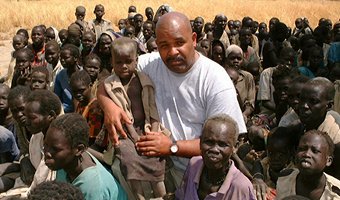
Radio talk show host Joe Madison, seen here in a 2001 visit to Sudan, has helped raise the visibility of the Sudan crisis among black churches in the United States.

“Paternalism is difficult to recognize. Often, we can’t see it when we’re doing it. This is where I think those of us who work with missions have to really become listeners much more than people who fill up the air with words,” he said. “We live in a day when we need to be taught. … There are others at the table doing missions in far better ways than we are right now.”

Churches and missionaries can fall prey to financial paternalism in which the community being helped must rely on the congregation or sending agency for the money to continue ministry. Or groups can be doctrinally paternalistic when they insist on controlling beliefs, Parks said.

How does a congregation know when it’s worked too long with a particular community? That depends on the relationship between them, said Rick McClatchy, CBF coordinator in Texas. “The partnership has to be evaluated to make sure dependency isn’t developing, … but coming in for just a short time doesn’t build the trust and relationship necessary for ministry.

“Dependency is a legitimate thing, but you don’t want to go too far the other way because those long-term relationships … lead to trust and transformation. … You don’t want to drop relationship or not take the time to build relationships.”

Stroope believes as long as the relationship is built on collaboration and reciprocity, dependency becomes less of an issue, especially if each side is honest with the other. “It works when there are good partners on the ground who aren’t afraid to say no and who aren’t afraid to set the terms of participation,” he said.

“Sometimes the relationship is not open enough for limits to be set. Volunteers need to know that what they are doing is part of a strategy and that it is ongoing. That understanding must become part of why they are going and how they go.”

Reciprocal ministry

Chris Thompson, coordinator for Liberty, Mo.-based Together for Hope West, looks at all the entity’s endeavors through the lens of reciprocity and collaboration. Together for Hope West helps coordinate the national CBF Together for Hope Rural Poverty Initiative in areas west of the Mississippi River.

“Rather than using an historic model of bringing in mission teams to do for people, we develop relationships for sustained empowerment for locals,” he explained.

Together for Hope West relies on four “R’s” of community development and cross-cultural ministry—reciprocity, relationship, reconciliation and respect. Staff also make sure ministry is guided by a core-value model—local visioning, leadership, project development, long-term sustainability, local expertise in education and engagement, and an emphasis on the process rather than on the outcome.

The organization builds on relational ministry. “It’s the relationship that’s important—to listen and share the person’s story and to hear the voices silenced by circumstances … even when what we hear is hurtful,” he said. “We must be a part, be a presence in people’s lives. Sometimes that’s a challenge.”


BWA sets goals to fulfill priorities

FALLS CHURCH, Va.—The Baptist World Alliance took steps toward implementing its new structure and fulfilling its new priorities during the global organization’s Executive Committee meeting March 7-9.

The event marked the first gathering of the Executive Committee—as well as about 15 related groups—since the BWA reorganized itself last summer at its every-fifth-year World Congress in Hawaii.

The reorganization streamlined the BWA’s governing body, the Executive Committee, reducing the size of its membership by more than 50 percent. The change was designed to improve the Alliance’s decision-making process, leaders said.

In addition, the BWA identified five major priorities, or “clusters of commitment” to guide its work. They are:

• Promoting worship, fellowship and unity.

• Nurturing the passion for mission and evangelism.

• Responding to human need through relief and sustainable community development.

• Defending human rights and justice.

• Promoting relevant theological reflection.

BWA General Secretary Neville Callam rolled out 43 goals associated with more than 200 tasks that will guide the Alliance in fulfilling those priorities. Together, the priorities and goals comprise a “work plan” for ministering in Jesus’ name around the globe, he noted.

Although the BWA works directly with its membership—222 Baptist unions and conventions worldwide—and not individual churches, the priorities are geared toward enabling the Alliance to strengthen congregations, Callam said.

“As the Body of Christ, the church is permanent, but the structures surrounding it are not,” he said. “BWA is an agency that seeks to further God’s work in the world. … Our program and work have the ministry of the churches at its core. … Participation of all our constituents will be required to make the plan work.”

Baptists’ ministry around the world is recognized and appreciated by national and global leaders, BWA President John Upton reported.

In South Africa, Upton attended a banquet where he met both national President Jacob Zuma and Goodwill Zwelithini kaBhekuzulu, king of the Zulu Nation.

“You Baptists spoke out for us (black South Africans, during Apartheid) when not many around the world would do so. I’m proud of you,” Zuma told Upton.

“You Baptists are stubborn,” kaBhekuzulu added. “We didn’t treat you well, but you kept coming—with your hospitals and schools. Thank you. You did good work.” The Zulu king told Upton he now is a Christian and a Baptist minister.

In another meeting, United Nations General Secretary Ban Ki-moon of Korea expressed appreciation for how Christians care for and serve hurting people around the world, Upton reported. Ban asked for prayer, and former BWA President Billy Kim and Upton prayed for him on the spot.

In business sessions, the BWA Executive Committee:

• Granted membership to three organizations—the Association of Evangelical Baptist Churches in the Congo, the Baptist Churches Union Community of the Congo and the Free Baptist Churches in Burundi. Their addition brings BWA total membership to 222 organizations.

• Elected Wati Aier, principal of the Oriental Theological Seminary in Nagaland, India, as the recipient of the Denton and Janice Lotz Human Rights Award.

Aier convened the Forum for Naga Reconciliation and worked for 20 years to mediate for peace between three armed nationalist groups in Nagaland, located in northeastern India. He has been credited as the central figure in reaching a peace accord between the groups, which was signed last year.

Aier is a former vice president of the Asia Pacific Baptist Federation, one of six regional fellowships of the BWA, and a former member of the BWA Commission on Freedom and Justice and the Academic and Theological Education Workgroup. He is a current member of the BWA Commission on Peace and the BWA Congress Committee.

• Agreed to conduct “bilateral dialogues” with Pentecostals and the Seventh-day Adventist Church.

Such conversations, especially with the Pentecostals, will be enormously valuable in Latin America, where Pentecostalism is a rapidly growing faith group, noted Daniel Carro of Argentina, the Alliance’s first vice president.

• Received a 2010 financial statement that showed $2,038,098 in revenue, enabling the BWA to finish the year $15,084 in the black.

The positive financial report prompted the human resources committee to recommend the BWA resume paying the full amount of employee health insurance premiums and provide staff with a 4 percent pay increase, effective July of this year.

In recent years, financial constraints have forced the Alliance to freeze salaries, reduce retirement pension contributions and cut back on medical benefits.

• Learned that Paul Montacute, director of BWAid, the Alliance’s relief and recovery unit, will retire in July 2012. The Executive Committee is expected to elect a successor in March of next year.

• Voted to conduct the 2012 BWA Annual Gathering—a summer meeting of the Executive Committee, related groups and Baptists from various regions around the globe—in Santiago, Chile. The 2011 Annual Gathering will be held in Kuala Lumpur, Malaysia.


Baptists prepare response to Japan quake, tsunami

ATLANTA (ABP) — Baptist groups prepared March 11 to meet human needs caused by a magnitude 8.9 earthquake that spawned tsunami waves as high as 23 feet in Japan and prompted tsunami warnings in Hawaii and watches as far away as the West Coast of the United States.

The Cooperative Baptist Fellowship announced it was sending an initial $5,000 for immediate relief needs and opening a channel for designated giving for Japanese victims of the disaster. The Atlanta-based CBF does not have any missionaries in Japan but will be responding through the Japan Baptist Convention.

Japan Quake

Houses swept out to sea following an earthquake and tsunami in Natori city in northeastern Japan on March 11. (Photo/Reuters/ Yomiuri Yomiuri courtesy of BWA and http://www.trust.org/alertnet)

The CBF and Japan Baptist Convention entered into a three-year partnership in 2009 for church-planting and educational exchanges. Fellowship officials said early Friday that "our thoughts and prayers are with our brothers and sisters in Japan as they respond to this devastating event."

A Google translation of the Japan Baptist Convention website indicated that leaders there were still assessing damages to church buildings and the safety of church leaders in the hours after what is believed to be one of the most powerful quakes in Japan in more than a century.

American Baptist missionaries now in Japan were all reported to be safe, according to an update on the International Ministries website.

They are Roberta Stephens, who coordinates a volunteer program in Tokyo; Gordon and Lee Ann Hwong, who serve with their family in Yokohama; John and Tomoko Armagost who work with churches and live with their family in western Japan; and David and Leslie Turley and their family on the island of Okinawa.

"Please keep Japan and the victims in your prayers," John Armagost said in an e-mail to International Ministries headquarters. "Pray for our Baptist churches in the hard hit area," he said. "We have not yet made contact with our friends, but pray that they are OK."

Phones were out in many areas, but word was trickling out of Japan through Facebook and Twitter. Stephens said airports were closed and trains were not running, leaving many residents on foot or stranded away from their homes.

American Baptists began collecting funds for Japan relief through One Great Hour of Sharing, a relief program jointly funded by nine Christian denominations including American Baptist Churches USA.

Baptist Global Response, which coordinates relief work with Southern Baptist missionaries, allocated an initial $100,000 to prepare for initial response. Officials said in a news release they were still assessing needs and hoped to have a person on the ground Saturday for initial assessment and contact with mission partners.


–Bob Allen is senior writer for Associated Baptist Press.


Ethnic WMU leaders equipped, encouraged at summit

BIRMINGHAM, Ala.— Leaders representing 11 cultures met with a common goal—to increase missions involvement in their churches through Woman’s Missionary Union.

National WMU in Birmingham, Ala., hosted more than 50 missions leaders from 13 states for an Ethnic Leadership Summit. Texas Baptists had the largest representation with 10 ethnic leaders participating.

Participants share various approaches to missions education through Woman’s Missionary Union during breakout sessions at the Ethnic Leaders Summit. (Photo/WMU)

“Living in an increasingly multicultural world, we all benefit from learning about one another from one another,” said Carolyn Porterfield, multicultural consultant for Texas WMU and event organizer.

“As God has called our leaders, we have a unique opportunity to walk alongside them and help them develop to their full God-given potential. These leaders dream about what could be for their churches, and we’ve seen many of those dreams become reality.”

Leaders also encourage and inspire one another as they share new approaches and ideas, Porterfield added.

“For example, the creation of Korean bilingual missions education materials for preschoolers and children encouraged other groups to dream, and at this summit, a missions plan book in Vietnamese was introduced,” she noted.

Keynote speakers Patty Lane, director of intercultural ministries for the Baptist General Convention of Texas, and Linda Clark, former California WMU executive director, offered insights on cultural differences and ways to nurture relationships with multicultural audiences.

During breakout sessions, participants shared their own experiences and ideas to learn from each other and gain a deeper understanding of ways to serve multicultural churches.


Band wants to help students find direction

NASHVILLE, Tenn.—When Mike Donehey, lead singer for Tenth Avenue North, uses concerts to deliver a message to young people about living for what matters most, he speaks with the authority of one who knows firsthand how a near-death experience helps put things into perspective.

Tenth Avenue North band members Jason Jamison, Ruben Juarez, Mike Donehey and Jeff Owen recently traveled to Honduras to visit children sponsored through Compassion International.

At age 18, Donehey broke his back in two places and needed more than 90 stitches after being thrown out of a car in a near-fatal accident. Convinced God had spared him for a reason, Donehey committed himself to being used for God’s glory. 

During the two months he spent at home recovering from his injuries, he asked his parents for a guitar and began practicing.

“It was the first time in my life that I actually slowed down and spent time reflecting on things,” Donehey said. “Anytime you have a near-death experience, it wakes you up to bigger things. This experience definitely made me take inventory of my life and forced me to evaluate what was important and what was not.”

After he recovered, Donehey attended Palm Beach Atlantic University in West Palm Beach, Fla., and started leading worship for youth and college ministries at local churches. During this time, he met drummer Jason Jamison and guitarist Jeff Owen.

Donehey and his friends began to play at local coffeehouses and other venues. Their group name derives from a major road near their college campus. Bass player Ruben Juarez III recently joined the lineup.

As Tenth Avenue North began touring, band members committed themselves to sharing messages about God’s grace that would challenge young audiences to a deeper walk of faith. 

“As more people are hearing the songs, it provides greater opportunities to let them know about the grace and love offered to them through Jesus Christ,” Donehey said. 

Their concerts benefit mission organizations such as Compassion International, a child-sponsorship organization dedicated to meeting the physical and spiritual needs of children living in poverty around the world. As a result of Tenth Avenue North’s fall 2010 tour, Compassion International secured sponsors for 1,700 children.

Immediately following the tour, band members traveled to Honduras to witness the impact of these sponsorships. They enjoyed spending time getting to know the children, playing with them and hearing stories about their lives. 

Their latest album, The Light Meets the Dark, focuses on how a relationship with Christ can help overcome personal struggles and obstacles. 

“Our hope is that as people encounter truth of the gospel through these songs, they would be moved and changed as they desire to live for Christ,” Donehey said. “Through our music and message, we want to lead people into the presence of the Lord and help people to know Christ as their Savior, Lord and treasure.”


Do Christian athletes strike out on big-dollar contracts?

ST. LOUIS (RNS)—As contract talks broke down between Albert Pujols and the Cardinals, St. Louis baseball fans nervously began asking themselves a host of questions.

He’s a Cardinal for life, right? He wouldn’t go to Wrigley Field, because he likes winning too much, right?

St. Louis Cardinals’ Albert Pujols celebrates as he crosses home plate with a grand slam against the Chicago Cubs. Some Christian fans wonder whether Pujols’ evangelical faith conflicts with his quest for a $200 million-plus contract. (RNS PHOTO/Chris Lee/The St. Louis Post-Dispatch)

But a particular group of Cardinals fans—those who share Pujols’ evangelical faith—asked a different kind of question: What does holding out for the largest contract in the history of baseball say about his Christian testimony?

Pujols and his wife, Deidre, are evangelical Christians. They describe their charity, the Pujols Family Foundation, as “a faith-based nonprofit organization” and participate in Christian events around the city.

So, as Pujols began looking to many like a typical mega-wealthy superstar athlete angling for a record payday, some asked how Pujols’ public, God-fearing image squares with a private quest for wealth.

Team officials declined to describe the details of their offer to Pujols, but it’s widely believed to have been worth about $200 million.

Darrin Patrick, pastor of The Journey, a church in St. Louis that counts a number of professional athletes as members, said Jesus warned against greed.

“Nobody really confesses to that sin,” Patrick said. “Lust, anxiety—sure. But very few people say, ‘I’m greedy,’ and I absolutely think that (Pujols) should be on guard for that.”

A verse from 1 Timothy says, “The love of money is a root of all kinds of evil, and in their eagerness to be rich some have wandered away from the faith and pierced themselves with many pains.”

That’s the fear of many people who love Pujols, both as fans and as Christians. They fear, as Jesus said in Matthew 6:24, that no one can serve two masters. “You cannot serve God and wealth.”

Sean Michael Lucas, a former professor at Covenant Seminary in Creve Coeur and current pastor of a Presbyterian church in Hattiesburg, Miss., describes himself on his Twitter page as, among other things, “Cardinals fan, lover of Jesus.”

At the end of January, Lucas tweeted, “… how is AP’s testimony affected if he holds the Cards hostage for $30m/10yrs? @ what pt does 1 Tim 6:10 apply here?”

In another tweet, Lucas wrote, “Unless there is a big part of this contract that goes to Pujols Foundation ($30-50m) he’s open 2 the question. Legitimately.”

Baptist pastor Scott Lamb, the co-author with Tim Ellsworth of a new Pujols biography called Pujols: More Than the Game that focuses on the first baseman’s faith, said the contract talks have opened up an interesting debate in Christian circles that goes beyond baseball to the uncomfortable intersection of the New Testament and capitalism.

“Consumption mentality is very American, but it’s not very biblical,” Lamb said. “People are asking whether (Pujols) should grab all he can get, and what his moral responsibilities are in terms of what to do with that money.”

What to do with a lot of money is a relatively new problem for Pujols. In 2000, when he was in the minor leagues in Peoria, Ill., and Memphis, Tenn., he was bringing in $125 a week.

By 2005, he and his wife set up their foundation to help children with Down syndrome and children living in poverty in his native Dominican Republic. In 2010, the foundation spent $800,000 on its programs, according to Todd Perry, its executive director.

“Albert and Dee Dee are extremely generous, not just to the Pujols Foundation but to other charities in the community,” Perry said. “Their foundation is their passion.”

Several pastors emphasized the more important point for Pujols is not how many millions he makes, but how he spends it.

“What you do with your money is a factor,” Patrick said. Pujols “has a track record of generosity that is without question. God does use money to help people, and I see God doing that with Pujols.”

Ultimately, Christian Cardinals fans and others who benefit from the Pujolses’ largesse are praying for a big payday for No. 5, and for his generosity to continue, even grow.

“I reject any idea that a person’s Christianity should cause them to step away from what the market would demand for them,” Lamb said. “Albert will go down in history as one of the great ones—someone who grabbed the money and gave it away at the same time.”


‘Love your neighbor’ more than a slogan, Garland tells Wayland event

PLAINVIEW—In the Parable of the Good Samaritan, Jesus gave the perfect example of what it means to love outcasts, recognizing all people as “fellow travelers” on life’s journey, New Testament scholar David Garland told a gathering at Wayland Baptist University.

Garland, dean of Baylor University’s Truett Theological Seminary in Waco, offered his insights on the parable from Luke’s Gospel during a banquet to open the annual Willson Lecture Series at Wayland.

“The magic of parables is that they give us a glimpse of the transcendent from the lens of the ordinary,” he said.


David Garland

While the conversation between Jesus and the expert in Jewish law might have looked like a casual exchange about eternal life and neighborly behavior, Garland said, the parable sheds light on the cultural biases of the day and the question of character.

The legal expert’s question—“What must I do to inherit eternal life?”—was meant to put Jesus to the test, but Jesus turned it around by asking how the law is written. Citing Deuteronomy, the lawyer noted commands to love God and love one’s neighbor as oneself. But wishing to test Jesus more, he asked, “Who is my neighbor?”

He raised the question not out of a desire to serve but out of a desire to build additional boundaries and limits on the law that he must follow, Garland observed. But Jesus expanded the boundaries.

While the priest and the Levite in the parable passed the beaten and robbed man on the other side of the road and refused to help, the Samaritan took pity and helped the injured man, providing resources to ensure the man’s recovery and comfort.

“Samaritans understand themselves to be under the same Mosaic law as the Israelites. He had no way of knowing who the man was or what he was,” Garland said. At the end of the parable, “Jesus requires the answer of ‘Who is my neighbor’ from the perspective of the man in need, which is a twist Jesus often invokes in his parables in Luke.”

The question then becomes whether a Jew in need would allow help from a Samaritan, for whom the Jews had little respect.

Theological conclusions from the parable include the pointlessness of the lawyer’s question to Jesus, since one cannot do anything to receive an inheritance, Garland said. “He is either an heir or he isn’t.”

The lawyer’s questions also reflect a misconception about what eternal life is, seeming to miss the point of the relationship with God that begins in this life, he noted.

Christians must see all humankind as their neighbors, as Jesus often modeled, Garland noted.

“This story really leads people to realize the ‘kin-dom’ of God that includes all fellow travelers on this journey,” he said. “Love your neighbor is not a slogan or a proverb. It is a divine command.”