Hardin-Simmons national NCAA champs in women’s soccer

SAN ANTONIO—Hardin-Simmons University’s women’s soccer team won the NCAA Division III National Championship with a 2-1 win over Messiah at the Blossom Athletic Complex in San Antonio.

“This is big for our whole school and our conference,” said Marcus Wood, HSU head coach. “Our girls came out and I thought took it to them early in the game. We got the two goals, and then even after that, I thought we held our composure and were able to do a lot of good things in the game. Messiah is a great team. We definitely earned the win tonight.”

Image

The Hardin-Simmons University team receives the trophy as NCAA Division III National Champions.

HSU's Erin Low was named the offensive MVP of the tournament, and her teammate Rebecca Roth was named the defensive MVP.

“Erin Low played the best game of her life,” Wood said. “I have coached Erin since she was 11 years old as a club player. I have never seen her play better than she did this weekend. She was a senior, and I started a freshman over her for most of the season. Erin didn’t like it, and she told me that, but I told her to stay with us that we would need her. The freshman got hurt, and Erin played great throughout the playoffs. She took advantage of her time.”

Roth finished the night with six saves, including four in the second half.  

“As a goalkeeper, you live to have the ball hit at you,” said Roth. “I am so proud of my teammates, and we are so excited to be national champions. Our whole team just beat a very good soccer team. We made the plays we had to over and over tonight.”

Messiah came into the tournament as the two-time defending NCAA champion. The team had not lost since the 2007 final against Wheaton. They finished the year with a record of 24-1.

Hardin-Simmons finished the season with a 24-0-1 record. The one tie was in the semifinals, and HSU advanced on penalty kicks. The NCAA title was the first for Hardin-Simmons as a member of Division III. The university joined Division III in the 1996-97 school year.


American Baptist leaders return from study tour in Middle East

VALLEY FORGE, Pa. (ABP) — A delegation of 12 American Baptist leaders recently returned from a 13-day study tour in the Middle East. Goals of the trip included helping American Baptists become more familiar with the life of the church in the Middle East, learning how Christians and Muslims in the Middle East are building bridges in the face of the rise of radical Islam and better understanding the forces at play that make the Holy Land a powder keg.

Roy Medley

Roy Medley, general secretary of American Baptist Churches USA described the Nov. 28-Dec. 13 trip as "an excellent learning experience."

Highlights of the trip included a day-long visit with Prince Ghazi, a member of the royal family of Jordan, at a recently opened center on the Jordan River marking the spot where Jesus is believed to have been baptized.

Medley delivered a major address Dec. 2 to a predominantly Sunni Muslim crowd about Baptists' role in defending religious liberty in the United States.

The tour began with intensive study at the Arab Baptist Theological Seminary in Beirut facilitated by author Colin Chapman, an expert on Christian-Muslim relations in the Middle East. Prior to making the trip the Americans read books including Chapman's Cross and Crescent and Blood Brothers by Elias Chador.

In addition to dialogue with Muslims, the group had opportunities to interact with Arab Christians in the Middle East. "It is clear that our Arab sisters and brothers need our continued prayers as they faithfully strive to serve Christ under extreme and challenging conditions that tear apart their daily lives," the group stated in a press release.

One message driven home more than once was that when derogatory or inflammatory statements are made about Islam in the West, the churches in the East suffer as radicals use those statements to inflame others.

Medley said delegates also came away keenly aware of negative effects of Christian Zionism — a view that Israel has absolute right to the land because the Bible says so — and the complexities of U.S. policies in the region.

In a blog written on the road Dec. 5, Medley said the path to peace and reconciliation in the Mideast is not an easy one.

"The attitudes towards Israel vary from 'we can never accept its existence' to 'we can live with Israel as a state if there is justice for the Palestinians,'" he wrote. "The appeal for justice for Palestinians, both Christian and Muslim, demands our attention."

"Just as Christians do not accept uncritically every action of our government as in accord with our faith, nor can we accept every action of Israel as worthy of support," Medley said. "As U.S. Christians we are rightly challenged to develop a more balanced view of the Israeli-Palestinian conflict and the justice issues present in those communities."

The group said it found a "genuine desire" among many Islamic leaders for improved relations between Muslims and Christians. Arab Baptist Theological Seminary received high marks for its efforts to promote dialogue and reconciliation between the two faith communities.

While dialogue among religious leaders and scholars is important, participants agreed the real need is to get similar conversations going on in villages and communities to bring people together locally to better understand one another and work together for the good of all.

"I came on the trip with an open mind, wanting to learn as much as I could," said participant June Peters, "but there is much more to learn and much more work to be done in this part of the world."


Poll: Americans split on ‘Happy Holidays’ vs. ‘Merry Christmas’

WASHINGTON (RNS)—While more than nine out of 10 Americans say they plan to celebrate Christmas this year, they are divided on whether businesses should use messages like "Season's Greetings" rather than "Merry Christmas," according to a new poll.   

The latest PRRI/RNS Religion News Poll , released Dec. 16, found Americans are split, 44 percent in favor and 49 opposed, on whether retailers should use generic holiday greetings out of respect or people of different faiths.   

The so-called "War on Christmas" has been a rallying cry for conservatives in recent years as they resist attempts to remove nativity scenes from town squares, Christmas carols from public schools and the words "Merry Christmas" from sales flyers. 

The poll found a significant number of people engaging in secularized celebrations of Christmas, with Americans more likely to watch Christmas movies like It's A Wonderful Life (83 percent) than attend religious services on Christmas Eve or Christmas Day (66 percent). 

The holiday season is also slightly interreligious: One in 10 Americans say members of their families also celebrate another December holiday, such as Hanukkah or Kwanzaa. 

Researchers said the range of ways that Americans celebrate Christmas could explain why the holy day is taking on a less religious feel.

Robert P. Jones, CEO of Public Religion Research Institute, which conducted the poll in partnership with Religion News Service, said Christmas has always evolved, from its Dec. 25 date claimed from a Roman pagan festival, to the decorated tree from German tradition.

The fact that significant numbers of Americans read both the biblical story of Jesus' birth and "`Twas the Night before Christmas" is a continuation of that tradition, he said.

The PRRI/RNS poll also found:

• College graduates, Democrats and people with no formal religious ffiliation are more likely to have family celebrating more than one December holiday.

• Slightly more Americans (43 percent) read "'Twas the Night Before Christmas" than read a Christmas story from the Bible (40 percent).

• Half of Republicans, three in four white evangelicals, and two in three black Protestants say they read the Christmas story from the Bible. Fewer portions of Democrats (34 percent), white mainline Protestants (37 percent) and Catholics (26 percent) do likewise.

• Most white evangelicals (79 percent) and Catholics (82 percent) attend Christmas Eve or Christmas Day services, compared to 63 percent of white mainline Protestants.

• White evangelicals (69 percent) and Republicans (64 percent) are most likely to say stores should use "Merry Christmas," while a majority of Democrats (58 percent) and Catholics (55 percent) prefer generic holiday greetings instead.

• People in the Midwest (56 percent), South (54 percent) or rural areas (53 percent) are more likely to object to generic holiday greetings than those living in the Northeast (33 percent) or urban areas (47 percent).

While some Christians bemoan the commercialization of Christmas, interfaith organizations and Christmas advocates see reason to cheer its wider appeal.

Robert Putnam, a Harvard scholar and co-author of American Grace: How Religion Unites and Divides Us, said he found it surprising that nearly half of Americans choose "Happy Holidays" as their preferred consumer greeting.

"That represents a major change over the last 50 years toward greater interfaith sensitivity," he said.

Although there's no long-term data on the trend — "because no one would even have thought to ask that on a survey," he said — Putnam
suspects it closely mirrors American's growing acceptance of intermarriage.
  
Phil Okrend, president of MixedBlessing, a company that makes interfaith and multicultural holiday cards, said it makes sense to consider regional demographics regarding December behavior.

"If you live somewhere with a majority of Christians, then you can say `Merry Christmas,' and if you're in a more diverse area, you can say
`Happy Holidays,'" he said. "It's not diminishing anything, because we're more alike than not."

The PRRI/RNS Religion News Poll was based on telephone interviews conducted Dec. 9 to 12, with 1,015 U.S. adults. The poll has a margin of error of plus or minus 3 percentage points.


Wayland students, staff care for platoon 6,500 miles from home

PLAINVIEW—Students and staff at Wayland Baptist University’s student leadership and activities office turned their attention far from the Plainview campus, hoping to spread Christmas cheer to troops overseas.

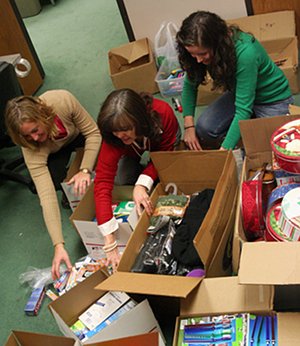
They scurried to pack boxes for a military platoon stationed in Afghanistan, facing harsh circumstances and the holidays away from home. The 33-member platoon includes the son of Denton Lankford, associate professor of justice and public administration at Wayland.

Wayland Baptist University student activities coordinator Ericka Miller (left) works on packing boxes of items for a military platoon in Afghanistan, with help from office secretary Brenda Huckabee (center) and Wayland sophomore Carissa Nichols, a student worker in the office. Twelve boxes will be shipped to the platoon of 33 for Christmas. (WAYLAND PHOTO)

When he mentioned his son’s situation to Tommie Quebe in the Wayland president’s office, she in turn called Ericka Miller, coordinator of student activities, to askabout a service project.Students and staff at Wayland Baptist University’s student leadership and activities office turned their attention far from the Plainview campus, hoping to spread Christmas cheer to troops overseas.

“When Tommie called us, we started thinking about what we could do for these guys and how we could get students, as well as faculty and staff involved,” Miller said.

Lankford provided Miller more information about what the troops needed—basic toiletries, coffee, tea, heavy socks and T-shirts, Bibles, hard candy and snacks, sports magazines, and envelopes and stamps. She and her students then assembled notes and e-mails to spread the word about Operation Care Package.

“We went to the store and bought a box full of different things that could be a care package for one person to use as a sample. Then we decided to set up a place for students to take photos and make Christmas cards to send with the boxes,” Miller said. The students were invited to bring items to include in care packages, donate money or just make a photo card.

For the two days before Thanksgiving and two days after the break, students filed through the McClung Center parlor and posed in Santa hats, reindeer ears and other holiday accessories for photos. Then they signed cards, many writing a brief note of thanks and encouragement to the troops, creating 60 cards.

“At first, they were a little unsure about writing cards to total strangers, but then they got into it more,” she said. “I think it’s going to mean more than the students think it will, just seeing faces and reading their notes.”

Although she doesn’t know any of the troops personally, Miller said, it was an easy decision to jump into the project with both feet and get students involved.

“They were telling me about these guys being on a mountain in zero-degree weather, where it’s rat-infested and they don’t get a shower but about once a month. I was thinking about myself being cold-natured, hating rats and loving my showers and thought we had to do something to help,” Miller said.

“The sacrifice they make is so great, and the troops are often out of sight, out of mind. I can just imagine being over there and being so grateful for any one of these things.”

While the original goal was to create 33 individual boxes for each member of the platoon, as items began arriving from employees and students, the office opted to just fill larger boxes with the items and send them on their way, Miller explained.

The money donated was used to purchase enough of each personal item for the troops to have their own. In the end, about 12 boxes will be shipped to Afghanistan.

Student worker Carissa Nichols, a sophomore from Taos, N.M., said working on the project was special to her.

“I think it’s a cool opportunity for us. You don’t always get to do things that you know will help people, and we know they are dedicated and serving for us. This is a chance to give a little back to them,” Nichols said.

Lankford was impressed by how the simple conversation about his son’s situation turned into a major care package effort.

“I was amazed when I walked in and saw all they had collected. It’s astounding, and I just praise the Lord for this,” he said. “I want to personally thank all the students, faculty and staff who contributed to this effort. It’ll make their Christmases a lot brighter and happier under the circumstances. I know it’ll brighten their day 6,500 miles away.”

Lankford also encouraged continued prayer for the platoon, noting that they face ambush and extreme circumstances daily, with about a year left on their assignment in Afghanistan.


Report details hopeless conditions in Gaza

LONDON (ABP) — Residents of Gaza see no hope for a brighter future — and that's one of the most distressing aspects of the situation in the Middle East, according to an international Christian aid-and-development group’s advocacy officer for the region.

Hanan Elmasu of the United Kingdom-based organization Christian Aid worked on a new briefing detailing the impact of Israel's measures to ease the blockade of Gaza after six months.

Map of GazaElmasu, a regular visitor to Gaza, told the British Baptist newspaper The Baptist Times, “Life for Gaza civilians is very traumatic. There is very little economic activity, high unemployment and much of the population are dependent on handouts.”

She continued: “I’ve been going to Gaza for several years and have seen how life has changed. What’s distressing is the destruction of the people there. There used to be a glimmer of hope but now there is an inability of people to plan for the future. Parents can’t provide for their children, children aren’t going to school because of a lack of construction materials and you put all that together and it's a hopeless position.”

Christian Aid was part of an international coalition of 22 development, human-rights and peace-building organizations that compiled a report looking at the effects of Israel's measures to ease the blockade of Gaza. The Israeli government announced in June that it would soften the blockade to improve conditions in the tiny, densely populated strip of land that hugs the Mediterranean between Israel and Egypt.

The report, Dashed Hopes: Continuation of the Gaza Blockade, says that little has changed for Gaza's 1.5 million residents, because “not only has Israel neglected to address major elements of the blockade in its easing measures, such as lifting the ban on exports from Gaza, but it has failed so far to live up to key commitments it did make.”

For instance, Israel promised to expand and accelerate imports of construction materials for U.N. and other international projects such as schools, health centers, houses and sewage plants. Many of those facilities were damaged or destroyed during the military attacks Israel launched on Gaza in December 2008 and January 2009. 

But in reality progress has been “slow and limited” since Israel’s pledge, says the report.

An average of only 715 truckloads of construction materials have entered the Gaza Strip per month since the easing announcement. The United Nations has estimated that Gaza needs 670,000 truckloads of construction materials for housing alone.

Exports from Gaza remain banned, which continues to “cripple” the local economy, while the movement of people has also seen little change, adds the report.

The coalition is calling for renewed international action to ensure “an immediate, unconditional and complete lifting of the blockade.”

Israeli officials have criticized the report, saying the groups — many of them international Christian organizations — that compiled it are politically disposed in favor of the Palestinians and against Israel.

"The claims of the organizations, as they appear in the report, are biased and distorted and therefore mislead the public," Maj. Guy Inbar, spokesman for Israel's Coordinator for Government Activities in the Territories, told CNN shortly after the report was released Nov. 30.

"The number of truckloads entering the Gaza Strip every day via the Kerem Shalom Crossing has increased by 92 percent," Inbar said. "Despite the fact that Israel has increased the capacity so that 250 trucks could enter Gaza every day, the Palestinians themselves have not reached this capacity. From the beginning of August 2010, the average number of truckloads entering Gaza each day stands at 176."

But the report notes that, although Israel has allowed more goods into Gaza since June, it's not enough to repair the damage done by the 2008 and 2009 raids.


–Paul Hobson is news editor of The Baptist Times , the weekly newspaper of the Baptist Union of Great Britain. ABP Managing Editor Robert Marus contributed to this story.

Read more:

Report on efforts to ease Gaza blockade

Related ABP stories:

Interfaith leaders urge Obama to act quickly on Middle East peace (1/22/2009)

Baptist groups send aid to Gaza victims (1/8/2009)

Gaza Baptist Church caught in crossfire (1/6/2009)


Review: Film depicts struggle for peace in modern Bethlehem

(ABP) — Serene manger scenes and Magi represent the extent of most American Christians’ understanding of Bethlehem. But EGM Films’ powerful new documentary, Little Town of Bethlehem, tells the story of a Bethlehem that doesn’t lie so still. The movie provides a glimpse into the lives of three remarkable individuals who have committed to non-violence as a way of bringing peace to a troubled land.

A Nativity scene painted as a mural on the wall that divides Israeli and Palestinian parts of the Bethlehem area. (EGM Films)

These three men — a Palestinian Christian, a Palestinian Muslim, and an Israeli Jew — tell their stories. Instead of using policy or history experts from a particular ideological bent or an all-knowing narrator to guide the audience through the movie, the filmmakers wisely allow all of the narrative and exposition to come from the lives of these three men.

Sami Awad is a Palestinian Christian who directs Bethlehem’s Holy Land Trust. His Christian faith, along with his respect for Gandhi and Martin Luther King, Jr., informs his convictions on non-violence. Throughout the movie, Sami provides powerful interpretations of the Christian message that have been deepened by living where there are daily challenges to that faith.

Ahmad Al’Azzeh is a Palestinian Muslim who has lived his entire life in the impoverished Azzah refugee camp. His commitment to non-violence puts him at odds with many in his own community who blame their desperate situation on failed peace movements in the past. Ahmad faces a personal cost as well. His convictions could have could have dire consequences for his infirm young son. But in spite of the danger to himself and his family, Ahmad continues to teach in the non-violence program at Holy Land Trust.

Men near the wall that divides Israeli from Palestinina parts of Bethlehem. (EGM Films)

Yonatan Shapira was an Israeli Defense Forces helicopter pilot. After the Second Intifada in 2000, he joined with other pilots who refused to fly sorties that put Palestinian civilians at risk. The courage of his convictions set him at odds with his government and his own family. Yonatan’s father was a well-respected squadron commander in the Israeli Air Force. The obvious pride Yonatan feels for his heroic father stands in conflict with the shame he feels for acts his fellow countrymen have committed.

Each of the men struggles in his own community. Sami reflects on friendships that go back to elementary school. Those same friends have participated in violent acts to have their voices heard. Ahmad reflects on how, typically, “non-violence” in his community is a synonym for “cowardice” and “weakness.” Yet, as a native member of the Azzah community, he speaks with a voice that his neighbors cannot simply dismiss. Yonatan reflects on the irony that it was the principles of the Israeli Defense Force of “defense” and “human dignity” that led him to convictions that put him at odds with those in command of the IDF.

Each man’s story is woven together with stirring sounds and visuals. Images of European Jewish ghettos appear next to Bethlehem’s security fence. The barbed-wire fences of Auschwitz are juxtaposed with barbed-wire security checkpoints in the Bethlehem area. In the movie’s soundtrack, Israeli and Palestinian instruments effectively blend with Memphis blues, underscoring the parallels between the American Civil Rights Movement and struggle for peace in the Middle East (along with scenes from the movement paralleled — stunningly — with modern Middle Eastern scenes). Many of these images flash quickly, presented without interpretation.

Palestinian Christian Sami Awad, dressed as Santa Claus at a Bethlehem protest. (EGM Films)

No single movie can fully capture the tragedy of a conflict as diverse and historic as the Israeli-Palestinian situation. This movie helps to combat the ignorance that exists in much of American Christian culture about this issue. It provides faces for those who suffer and names for those who struggle.

The filmmakers ask: “Can the cycle of violence be broken?” If more individuals have the courage and hearts of these three wise men, then the world can have hope.

Little Town of Bethlehem, directed by Jim Hanon and produced by Ethnographic Media, 2010. 75 minutes. Rated PG-13. Information about scheduled screenings in North America and elsewhere and information on purchasing the film can be found on the film’s website.

–Robert Wallace is a professor of biblical studies at Judson University in Elgin. Ill.


Suspects plead guilty to East Texas church arsons

TYLER (ABP) — Two men accused in a string of East Texas arsons fires early in 2010 pleaded guilty Dec. 15 to burning five churches in a Smith County court.

Bourque

McAllister

According to the Tyler Telegraph, Jason Bourque, 20, pleaded guilty to five counts of arson. Daniel McAllister, 22, pleaded guilty to two counts of arson and two counts of attempted arson. Prosecutors said they will seek life in prison for the duo when they are sentenced Jan. 10.

The charges stemmed from fires that destroyed Dover Baptist Church, Tyland Baptist Church, First Church of Christ, Scientist, Prairie Creek Fellowship Church and Clear Spring Missionary Baptist Church, all in Smith County.

In all the men are suspected of setting 10 churches on fire in three counties between Jan. 1 and Feb. 8. They were arrested Feb. 21 after more than a week of surveillance after calls to a tip line. The investigation included state, local and federal law enforcement.

A Smith County grand jury indicted both men for the crimes in May. Since their arrest they have been held in the Smith County jail on bonds of $10 million apiece.

On Dec. 9 they waived their right to a jury trial. They entered guilty pleas Dec. 15 to all of the charges against them, with of the charges reduced or dropped.

As teenagers Bourque and McAllister attended youth group together at First Baptist Church in Ben Wheeler, Texas. McAllister dropped out of church and started hanging out with the wrong crowd after his mother died from a heart attack and a stroke in October 2007. Bourque's attendance dropped off after family moved to another town about 20 miles away.

Previous ABP stories:

Grand jury hears evidence in Texas church-arson cases (5/14)

Two former Baptist youth-group members suspected in church arsons (2/22)


Study says recession catching up to churches

NASHVILLE, Tenn. (ABP) — After two years of only moderate impact on offerings, the recession has caught up with America's churches, according to new figures by LifeWay Research.

One in three Protestant churches reported receiving less money this year than in 2009, the division of the Southern Baptist Convention's publishing firm found. That makes 2010 the third consecutive year that the number of churches reporting reduced income has grown.

Just one in five, meanwhile, reported 2010 giving above 2009. That is down from 43 percent who reported larger offerings last year and 47 percent who did better in 2008 than in 2007.

"The reality has been that the economic downturn has not hit churches as hard as it hit other sectors of society," LifeWay Research President Ed Stetzer said in a Dec. 14 webcast discussing the poll. "Churches have actually fared relatively well compared to other sectors of the economy."

Stetzer

The National Bureau of Economic Research declared in September that the recession that began in December 2007 ended in June 2009, but Stetzer said, "Now we're kind of having church recession."

"The pattern in churches tends to be tied more to unemployment than the stock market," Stetzer said. "Many churches are supported by people who give proportionately. When a high percentage of our congregations are unemployed, that impacts the giving."

In a survey of 1,000 pastors polled in October, 66 percent said the economy is having a somewhat negative impact on their church. That's up from 54 percent in March. Thirteen percent described the economy's impact as very negative, up from 8 percent in March. Forty-six percent said their churches are running behind budget, 10 percent more than in November 2009.

Stetzer said he doesn't expect the recession to be over for churches for quite a while, especially if the jobless rate remains high. More than half of the pastors surveyed (58 percent) said more people in their churches have lost jobs than in the past, and 30 percent said more parishioners have moved away to find work.

Seven percent more churches reported freezing staff salaries — 54 percent in October 2010 compared to 47 percent in 2009. One in five (19 percent) delayed a building project or other large capital expenditure. That compares to 14 percent in November 2009.

Sixteen percent delayed hiring that was planned, 14 percent reduced salaries from last year's levels and 10 percent laid off one or more employees. More churches also reduced insurance benefits for staff.

Stetzer said the news about the economy is not all bad. Historically church attendance increases during an economic downturn, and it also creates opportunities to minister.

Half of the pastors said there is a greater sense of excitement in their church about opportunities to minister to the needy and 49 percent said more people are volunteering their time in community service.

In light of the new data, Stetzer urged church leaders to "quantify" the economy's impact in planning their budget. "Scarcity brings clarity," Stetzer said. "This is actually an opportunity to stop doing some things you probably needed to stop doing anyway."

He encouraged church members to approach budget planning with an eye toward what is "mission critical" for the church. He discouraged short-term solutions like cutting back on global missions. "I'm not seeing this as a time to retreat," he said. "We may have less as a church but do more for the kingdom."

Another positive thing that comes out of economic hard times is that churches become less clergy-driven and more dependent on volunteers. Instead of viewing the pastor as CEO and lay people as customers, Stetzer said, clergy and laity must work as "co-laborers" in order to get the job done.

He also reminded church leaders that the recession is an opportunity for Christians to focus on higher things than the economy.

"Our faith is not built upon the monetary system," he said. "Our faith rests upon the Rock that is Jesus. These are opportunities God is giving us to give Him glory."


Executive director search committee nominated

DALLAS—Elected leaders of the Baptist General Convention and the BGCT Executive Board on Dec. 14 nominated 15 people to serve on a committee to recommend a new executive director for the convention.

Texas BaptistsThe chair and vice chair of the executive board nominated seven members of the search committee, and BGCT elected officers nominated eight. The recommendations were sent electronically to the executive board for their approval Dec. 14.

The nominees for search committee members are:

• Ron Lyles, pastor of South Main Baptist Church in Pasadena and BGCT Executive Board member. He is nominated to serve as chairperson of the committee.

• Jerry Dailey, pastor of Macedonia Baptist Church in San Antonio and BGCT Executive Board member.

• Charlotte Young, member of First Baptist Church in Dimmitt and BGCT Executive Board member.

• Ernestine Haas, member of Park Cities Baptist Church in Dallas and BGCT Executive Board member.

• Fred Roach, member of The Heights Baptist Church in Richardson and BGCT Executive Board member.

• Jay Abernathy, pastor of First Baptist Church in Palestine and BGCT Executive Board member.

• John Wheat, pastor of First Baptist Church in Kenedy and BGCT Executive Board member.

• David Lowrie, pastor of First Baptist Church in El Paso and immediate past president of the BGCT.

• Jesse Rincones, pastor of Alliance Baptist Church in Lubbock.

• Charles Price, director of missions for San Antonio Baptist Association and member of First Baptist Church in San Antonio.

• Gloria Mills, Texas WMU president and member of First Baptist Church in Henderson.

• Frank Sanchez, member of the Cowboy Church of Ellis County in Waxahachie.

• Frances Barrera, member of Crossroad Baptist Church in Plainview.

• Jason Lee, pastor of Tallowood Chinese Baptist Church in Houston.

• Michael Evans, pastor of Bethlehem Baptist Church in Mansfield

Four people have been put forward as non-voting advisers to the committee:

• Jerry Bradley, president of Children at Heart Ministries in Round Rock.

• Paul Armes, president of Wayland Baptist University in Plainview.

• Bill Arnold , president of Texas Baptists Mission Foundation.

• Joyce Ashcraft , regional ministry director for Texas Baptists’ Collegiate Ministry.

In a letter to the executive board members that presented the nominations, BGCT Executive Board Chair Debbie Ferrier said the elected officers worked together to formulate the nominations, noting they sought Texas Baptists “who live their lives every day according to what the Scriptures teach” and “who affirm Hope 1:8 and who are living their lives every day reaching the world for Christ.”

Hope 1:8 is a convention campaign based on Acts 1:8 that seeks to encourage each Texas Baptist and each Texas Baptist church to share the hope of Christ locally, across the state and around the world.

“My request is that Texas Baptists will be mindful of the search committee and pray for them daily,” Ferrier said. “Pray for the staff and employees of the BGCT. Pray for the officers of the convention.  Pray for the executive directors. Pray for our institutions and their leaders. Pray for the churches and pray for those who are still seeking the hope that only comes from Jesus Christ.”

On Dec. 13, the board electronically voted to empower Steve Vernon, associate executive director, “to assume all responsibilities and authority related to the role of executive director in the absence of an executive director.”

Vernon will take on that role following the departure of Executive Director Randel Everett, who will become pastor of First Baptist Church in Midland on Jan. 16.

The board overwhelmingly approved the motion regarding Vernon, with only one member voting against it.


Dip in baptisms due to soccer practice?

ATLANTA (ABP) — The real culprit behind declining baptisms in the Southern Baptist Convention might be youth soccer, says historian Bill Leonard.

Because of nightly requirements for church-going families — including children's sports — weeklong and two-week revivals that were once a mainstay of Baptist life are becoming a thing of the past, Leonard says in the summer/fall 2010 issue of the journal Baptist History and Heritage.

Bill Leonard

Leonard, professor of church history at Wake Forest Divinity School, says revival movements of the 19th and 20th centuries not only propelled Baptists from a small sectarian community to America's second-largest denomination but also bore impact on Sunday mornings.

Concepts like walking the aisle, surrendering to preach and rededicating one's life to Christ, Leonard says, were all born on the sawdust trail. That "liturgy of conversion" served generations of Baptists as a mechanism for determining church membership.

As revivalistic techniques have waned in recent decades, Leonard says Baptists, particularly in the South, have struggled to make their evangelistic case and articulate a process of conversion that holds the attention of the larger population.

Leonard cites several factors in the decline of the revival system.

One is the understanding of conversion itself. Leonard says as early as the 1930s H. Richard Niebuhr criticized a "mechanical conception of conversion" used more often "for enforcing prevailing standards" than producing followers of Christ.

Another factor, Leonard says, is that more Baptist congregations have turned to the nurture of persons in faith in ways that produce alternative entry points to revival-style conversion. As the church and its ministers assumed the role of spiritual mentors, the need for a celebrity evangelist diminished.

Leonard says that shift is behind a concern expressed in a 2008 article in Baptist Press that blamed a "Bill Hybels-style of seeker-friendly evangelism" for fewer evangelistic opportunities in local churches.

A third factor, Leonard says, is simply that the culture has changed. "While revivals remain forceful in other cultures and some American religious subcultures, the revival system has increasingly become the exception, rather than the norm, in much evangelical life," he writes.

Leonard says many Baptists were a long time in recognizing that revivals were not accomplishing what they once did. The practice of re-baptizing church members, for example, spawned a class of evangelists well known for leading large numbers of congregants to doubt the validity of their first profession of faith. Leonard surmises the phenomenon is either "a terrible indictment" of earlier revival methods or "one way of propping up the tradition."

Leonard predicts that Baptist congregations will continue to utilize "event evangelism" in ways that mirror traditional revivals. Some congregations continue to use traditional revival practices without acknowledging their declining impact, he says, but that seems to be a "dwindling constituency."

A larger question, Leonard says, is how Baptists will make their evangelistic case amid the diversity of spiritualities and church models in the larger culture. He says that might require "niche evangelism" where clergy and laity actually listen to an increasingly secularized and pluralistic culture rather than simply pointing the way.

In another article in the same issue, Loyd Allen, professor of church history and spiritual formation at McAfee School of Theology, argues that "revivalism is dead, or at least on life support" among Baptists in North America. 

Allen blames a shift away from a "revivalist motif" that relied on a high level of emotion to an "intellectual conversion" that invites an individual to agree with a set of certain beliefs.

While useful to restrain emotional excesses and aberrant beliefs in a community of faith, Allen says, intellect alone "is woefully inadequate to the task of preparing candidates for personal encounter with Christ."

Baptist History and Heritage is published three times a year by the Baptist History and Heritage Society in Atlanta.


Midland church calls Everett; search for replacement to begin

DALLAS—First Baptist Church of Midland voted unanimously Dec. 5 to call Baptist General Convention of Texas Executive Director Randel Everett as senior pastor, and he accepted.

Everett, 61, has served several months as interim pastor of the West Texas church. He becomes pastor effective Jan. 16.

{youtube}LVwtQnHexEY{/youtube}

BGCT leaders will name a 15-member search committee to find Everett’s successor as executive director. Seven members will be named by BGCT Executive Board officers and eight members by convention officers, and the Executive Board then will vote on that committee and initiate the search, said BGCT Executive Board Chair Debbie Ferrier.

Convention leaders are recommending to the Executive Board that Associate Executive Director Steve Vernon be empowered to assume all authority and responsibilities related to the executive director’s role while the position is vacant.

For updates on the search process, visit baptiststandard.com.

The board elected Everett as executive director in February 2008, and he assumed the post several weeks later. Everett came to the position from First Baptist Church in Newport News, Va.

In addition to serving as president of the John Leland Center for Theological Studies in Arlington, Va., his previous places of service included Columbia Baptist Church in Falls Church, Va.; First Baptist Church in Pensacola, Fla.; First Baptist Church in Benton, Ark.; University Baptist Church in Fort Worth; Inglewood Baptist Church in Grand Prairie; and First Baptist Church in Gonzales.

In a video statement posted on the convention’s website, Everett thanked Texas Baptists for the opportunity to serve them as the BGCT executive director and indicated he believes Texas Baptists are poised to continue reaching the state for Christ.

“I want you to know how excited I am to continue being a part of the Texas Baptist family,” he said. “In these past three years, I’ve been able to see face-to-face what’s going on in many our churches and in our institutions.

“I’ve never been more ex-cited to be part of the Texas Bap-tist family than I am right now. God has brought together a wonderful resource of people, of institutions, a great heritage and a great future. When we really cooperate together, we can do things like end hunger in Texas or share the hope of Christ with every person in our state.”

During Everett’s tenure as executive director, Texas Baptists launched Texas Hope 2010, an initiative to share the gospel with every person in Texas by Easter 2010. The effort emphasized praying for non-Christians, caring for people in need and sharing the gospel.

As a result of the emphasis, Texas Baptists distributed more than 860,000 multimedia gospel compact discs, as well as multitudes of Bibles, throughout the state.

Texas Baptists gave more than $1.8 million to feed the hungry through the Texas Baptist Offering for World Hunger. The Texas Baptist Christian Life Commission partnered with the Baylor University School of Social Work to launch the Texas Hunger Initiative, an effort to end Texas hunger by 2015. An initial project involved recruiting Texas Baptist churches to serve as summer feeding sites for children in school reduced- or free-lunch programs.

The BGCT recently began building on the Hope 2010 momentum by launching Hope 1:8, an initiative based on Acts 1:8 that encourages Texas Baptists to share the hope of Christ locally, statewide and around the world.

Based on reporting by John Hall of Texas Baptist Communications


Joy to the World?

Ever since an angel announced good news to shepherds working the night shift, Christians have associated the birth of Jesus with joy.

But some people who have experienced significant loss in the recent past find a season of celebration observed against a soundtrack of “Joy to the World” a bit hard to handle.

Churches can help reduce the pain for grieving people by dialing back expectations and not heightening the pressure, Chaplain Mark Grace said.

When Grace, vice president of mission and ministry at Baylor Health Care System, speaks to churches about grief and bereavement during the Christmas season, he begins by urging congregations not to buy into the holiday hype.

“On the one hand, the majority of human beings manage to survive the holidays. It isn’t pre-ordained that the holidays are going to be terrible just because someone lost a loved one. On the other hand, the holidays are a time like no other when people’s buttons are being pushed—mashed like all get out—in the free-for-all attempt to squeeze money out of people,” Grace said.

“Emotion-laden messages fill the airwaves, print media and billboards at every turn. One of the reasons that makes it so hard to navigate the holidays as a griev-ing person is the fact that the frequency and intensity of emotionally laden symbols, images, and messages is way off the charts.

“Churches ought to be places where leadership is seriously asking the question: Do we want to join the hordes who are seeking to manipulate people, or do we want to help them find ways to cope, using their faith?”

Some churches seek to help people handle grief during the Christmas season by offering worship services marked by moments of remembrance, sponsoring support groups and providing seminars focused on grief recovery.

South Main Baptist Church in Houston has a longstanding tradition of offering a worship service of hope and remembrance during Advent, said Erin Conaway, associate pastor of South Main Baptist Church in Houston.

The service includes a time when each person who is grieving the death of someone can light a candle in that person’s memory, pronounce his or her name and ring a bell. Each participant is given a rose as a reminder of the precious life that has been remembered.

In addition to the worship experience, the church in recent years also has provided a time where people who have sustained a loss can share their experiences and process their grief.

“There is a bond grieving people have. It is not one of their choosing, but it can be a powerful blessing,” Conaway said.

Some years, the small-group experience has been scheduled as a series of “handling the holidays” seminars on Sunday afternoons. More recently, the church has offered “gathering stones” lunches—a series of weekly informal gatherings around a shared meal.

“People need space to own the fact that in an Advent season of hope, joy, love and peace, the words don’t jibe with what they’ve feeling in their hearts,” Conaway said.

In a season of lights, people experiencing the darkness of loss may feel out of place. Pastor Mark Bumpus began a remembrance service at First Baptist Church in San Angelo a couple of years ago with a quote by Buckner Fanning, longtime pastor of Trinity Baptist Church in San Antonio: “Why do you suppose Jesus was born at night? Why was Jesus born to starlight instead of sunlight? … Because it is the darkness that frightens us … and Jesus came to dispel our darkness.”

Bumpus offered assurances to the assembled worshippers that Christian loved ones who had died live in eternal light, and God’s light abides even in life’s darkest times.

“Have you ever noticed, if there is a shadow in the valley of death, there is at least enough light in that valley to create that shadow?” he asked, quoting a retired minister who voiced the question at a graveside ser-vice in Lampasas he attended more than 30 years ago.

Near the end of the remembrance service, people who had lost a loved one to death within the last couple of years were invited to place a star on an evergreen tree in the sanctuary as a symbol of eternal life and hope.

“It was a very moving time in which a good bit of catharsis took place, especially for those who had lost a loved one since the previous Christmas, ” Bumpus recalled. “There were silent tears shed which seemed to bathe the emotions of the participants, and there was some release of deep grief. 

“Rather than holding the service in our large sanctuary, we held it in the chapel which was more intimate. And people felt connected with one another, sharing the same plight of grief and were not distant due to the smaller size of the sanctuary. The setting seemed to cause each participant to lose some of their isolation, and they were among people with whom no words needed to be exchanged. There was an understanding between them because of the common experience of recent grief.”

First Baptist Church in Richmond, Va. , has offered a similar remembrance service for at least a dozen years, Senior Associate Pastor Lynn Turner said. In a church that averages close to 50 deaths a year, the service has meant a great deal to grieving family and friends, she noted.

“The most meaningful part of the service is when those who have lost someone approach a table set up with candles, light a candle in their memory and pronounce the name of their loved one,” Turner said.

“There is something special about the group gathered for that service who have something in common—the loss they have experienced—and who participate in that simple, single act. It’s a powerful thing.”

On the first Sunday evening of Advent this year, South Garland Baptist Church in suburban Dallas held a worship service focused on dealing with loss—particularly at Christmas. When people suffer any significant loss, they naturally experience grief, Pastor Larry Davis said.

“Grief is a process—a time for the body, mind and soul to catch up with one an-other and heal,” he said. “You can’t cheat the process by trying to short-cut it or go around it. You can only go through it.”

Grief becomes unhealthy when it ceases to be a process and de-velops into a lasting state of being, Davis said.

But if it is handled in healthy ways, grief can be a transformative experience of personal growth, he added.

“Grief forces us to redefine ourselves and to discover some things we can learn to do,” he said.

Loneliness can be a byproduct of grief, and that particularly may be acute at Christmas and other special occasions. But churches can walk alongside hurting people through their grieving time and quietly remind them of God’s presence “through the valley of the shadow of death,” he said.

“Christmas is God’s reminder to us we are not alone,” Davis said. “God is with us.”