Baptists provide corn, noodles for hungry Koreans

DALLAS—North Koreans suffering from a longstanding food shortage in their nation received $25,000 worth of food and grain provided by Texas Baptist Men, the Cooperative Baptist Fellowship and Baptist churches and individuals.

Yoo Yoon of Dallas stands near a truck of corn purchased in Dandong, China, for shipment to North Korea as part of an ongoing relief effort by Texas Baptist Men, the Cooperative Baptist Fellowship, and churches and individuals in Texas.

Yoo Yoon, CBF Korean initiative consultant and pastor of Glory Korean Baptist Church of Dallas, traveled to North Korea recently to deliver 60 tons of corn and three tons of noodles.

“I visited a corn warehouse in Dandong, China, where I purchased the corn. Corn is the main food for the people—not because they like it, but it is the most inexpensive,” Yoon reported.

After he arrived in North Korea, Yoon visited a noodle factory, where he observed a shortage of corn due to rising prices and a “scanty harvest this year.”

Yoon also visited an elementary school and several villages to observe living conditions.

“I have felt their hunger for God while they have lived in hunger” physically, he noted.


East Texas church offers hot chocolate and hope

LUFKIN—Members of First Baptist Church brought hope, hospitality and hot chocolate to go along with the twinkling lights and festive floats of the city’s Christmas parade.

As thousands of people bundled up in coats and lined the streets, members of the congregation distributed about 1,000 free cups of hot chocolate and 2,000 Texas Hope 2010 multimedia gospel compact discs on a chilly night when the parade circled downtown, passing in front of and behind the church’s facilities.

“We’re always trying to get people to come to the church,” said Deacon Kurt England. “Well, this is a great opportunity because there are 7,000 to 8,000 people coming to the church each December when they have the parade.”

Members of First Baptist Church in Lufkin gave away free hot chocolate, cookies and Texas Hope 2010 multimedia gospel CDs to spectators at the Lufkin Christmas parade. (PHOTOS/Texas Baptist Communications)

Shauna Pittman, wife of Pastor Andy Pittman and a volunteer who helped hand out hot chocolate and CDs, said the outreach provided a way for the congregation to connect with the community further, help children and adults stay warm on a cold night—and share the reason for Christmas.

“I think it’s really important we grasp as a church and a community that Christmas is about Christ and it’s about Jesus’ birth,” she said.

“We get so far away from that in the busy-ness of Christmas. I think it’s really important to bring people back to that, to point them to God and point them to Christ at this time of year. I think that’s what this is about.”

The service ministry is part of the congregation’s involvement in Texas Hope 2010, an initiative to share the hope of Christ with every Texan by Easter 2010 and place Scripture in every home. One way Texas Baptists are doing that is through multimedia CDs like those the Lufkin church distributed during the Christmas parade.

By linking the hot chocolate with CD distribution, England said the event provided a natural, relaxed way for Christians to share the hope of Christ with others.

“I’m not one of those who is really is an evangelist in terms of going around and just really beating someone over the head with the Bible. But yet this is a great opportunity to spread God’s word by giving them a CD they can to listen to at their leisure, but also having access online to getting more than 350 languages downloaded with the New Testament,” England said.

“Evangelism in this form and fashion is not hard. You serve some people some hot chocolate, tell them, ‘Merry Christmas,’ and give them a CD and tell them they can learn about God by putting it in their car CD or just putting it in their computer at home.”

Andy Pittman walked up and down the parade route, offering people the gospel CDs. Most people expressed appreciation for the gift. One person asked for another copy to give to a friend who would like it. Only one person declined Pittman’s offer of a CD.

“I’ve gotten a great response from everyone we’ve given them out to,” he said.

For more information about Texas Hope 2010, including information about gospel CDs, visit www.texashope2010.com.


Christians need ‘theology of power,’ sociologist insists

ARLINGTON—Christians need to develop “a theology of power,” sociologist Michael Lindsay concluded after interviewing 360 evangelicals who hold influential positions in politics, business, entertainment and academia.

In particular, Lindsay noted, evangelical Christians need a theological basis for answering questions such as “How do we appropriately leverage the possibilities that arise when we accrue advantages?” and “How do we avoid the perils of privilege?”

Michael LIndsay

Lindsay, associate professor of sociology at Rice University and author of Faith in the Halls of Power: How Evangelicals Joined the American Elite, spoke to the B.H. Carroll Theological Institute’s winter colloquy about “Understanding the times, knowing what to do.”

Lindsay received his undergraduate degree at Baylor University before going on to complete a master’s degree from Princeton Theological Seminary, serve as a Rotary Ambassadorial Scholar at Oxford University and earn a Ph.D. from Princeton University.

His doctoral research focused on how evangelical Christians in the elite circles of government, commerce, the arts and higher education are shaped by their vision of moral leadership.

People he interviewed included two presidents of the United States—Jimmy Carter and George H.W. Bush—as well as two-dozen cabinet secretaries and senior White House staffers. They also included Hollywood movie producers, university presidents, CEOs of Fortune 500 companies and members of Forbes 400 wealthiest families.

The Elites

But Lindsay told the Carroll Institute participants—primarily ministers in the doctoral program—that compared to the rest of the world and the broad sweep of human history, American Christians as a whole are “among the most wealthy people ever to walk the planet” and rightly could be classified as “the elite of the super-elite.”

So, they need biblical foundation for understanding how to use their influence and exercise authority for the greater good, he stressed.

“The calling of Jesus on our lives means we are to use power to serve those who do not have it,” Lindsay said.

More than one-third of the leaders he interviewed mentioned service as the model for their leadership style, he noted. Servanthood demands working “not just for our own interests, but for the common good,” Lindsay emphasized.

From the White House to corporate boardrooms to local communities, influential Christians possess “convening power—the ability to bring people together to get things done,” he emphasized.

'Convening Power'

Carter’s role in bringing together Israeli Prime Minister Menachem Begin and Egyptian President Anwar Sadat and brokering the Camp David peace accords provides the classic example of convening power, Lindsay noted.

But at the local level, ministers who are perceived to be acting with moral authority for the greater good rather than their own interests also have tremendous convening power in their communities, he asserted.

Lindsay also observed the powerful people he interviewed tended to distance themselves from the evangelical subculture, noting, “They went out of their way to say they had never read Left Behind or purchased a painting by Thomas Kinkeade.”

He characterized the people he interviewed as “cosmopolitan evangelicals” who “signal their faith in warm and winsome ways” rather than confronting people who do not share their beliefs.

Christians who exercise their power wisely have the capability of influencing the larger culture—not just by making individual conversions to Christianity but by molding powerful institutions. He noted the example of executives such as Truett Cathy, whose faith has shaped the corporate culture at Chick-fil-A.
“Change happens when institutions are rightly ordered,” he said. “Great institutions make and shape great people.”

However, lasting change grows out of moral influence, not coercion, he warned. It is not legislated or “rammed down people’s throats,” Lindsay said. “Authority comes from what we give up.”

Pitfalls of Power

Concerning the pitfalls of power, Lindsay pointed to potential problem areas—sex, salary and status.

“Accountability and transparency are key to integrity,” he said.

Privilege carries with it relational hazards, he warned, noting many people in positions of power have “a long line of broken relationships.”

Success also breeds the temptation to make one’s one achievements an idol, fostering what Lindsay called “a self-sufficiency that can be corrosive to the soul.”

People in positions of power and privilege also have a tendency to become isolated and calloused to people in need because they do not have regular contact with them. Wasted opportunities and poor stewardship may be prevalent, but some CEOs have resisted that by practicing what he calls “executive asceticism.”

“It means consciously living beneath one’s means,” he explained—a practice he endorsed for all Christians in the United States. “Consumerism is the besetting sin of American Christianity.”


Supreme Court to deal with rights of religious groups at state schools

WASHINGTON (ABP) — The Supreme Court agreed Dec. 7 to hear a case dealing with sticky questions about whether religious groups at state schools can be forced to either comply with non-discrimination policies or forego the access to funding and other benefits that go along with official school recognition.

The justices agreed to hear the Christian Legal Society’s appeal of a lower court’s decision saying the group’s student chapter at the University of California’s Hastings College of Law had to, like other school-recognized student groups, follow the university’s non-discrimination policy. The policy includes provisions prohibiting discrimination on the basis of sexual orientation or religion.

In 2004, the chapter asked for exemptions from those two aspects of the non-discrimination rules, saying the national Christian Legal Society’s policies prohibit non-Christians and people who engage in non-marital sex from being voting members or officers of the organization.

But the school denied the exemption, saying the non-discrimination requirement is a neutral rule that applies to all student groups and it would be unfair to treat the society differently. The society — a national networking organization for Christian judges, attorneys and law students — sued, saying the denial was a violation of its rights of association and comprised viewpoint discrimination against its religious views.

“Public universities shouldn’t single out Christian student groups for discrimination. All student groups have the right to associate with people of like mind and interest,” said Kim Colby, senior counsel for the Christian Legal Society’s Center for Law & Religious Freedom, in a press release on the high court agreeing to hear the case. “We trust the Supreme Court will not allow Hastings to continue to deprive CLS of this right by forcing the group to abandon its identity as a Christian student organization.”

Two lower federal courts sided with the school, saying the non-discrimination policy was viewpoint-neutral and that the legal society had not proven that its ability to carry out its mission would be harmed if it either allowed gays or non-Christians to become members or chose to forego the benefits of official registration. As attorneys for the school have noted in legal filings, the predecessor to the Christian Legal Society chapter comported with the school’s non-discrimination provisions prior to 2004, when it adopted the national organization’s policies on membership. The school’s lawyers have also noted that other religious student organizations on campus — including another Christian group and Muslim and Jewish organizations — comply with the non-discrimination policy.

In hearing the case, the Supreme Court could clarify the rules for what sorts of stipulations, if any, state schools may place on religious student organizations wanting to enjoy the benefits of official registration or recognition.

It also provides the court one of its first chances under Chief Justice John Roberts to deal with the difficult constitutional questions at the intersection of religion, public policy and sexuality.

The case is Christian Legal Society v. Martinez (No. 08-1371).


–Robert Marus is managing editor and Washington bureau chief for Associated Baptist Press.


Judge in Tajikistan orders Baptist church to close

OSLO, Norway (ABP) — A judge in Tajikistan has ordered a Baptist church in the capital city, Dushanbe, to cease meetings in a private home, saying that housing codes and a new religion law require houses of worship to register with the government.

Members of the church told Forum 18, a Norway-based news service that focuses on religious-liberty disputes, that the Baptists do not want to register as a matter of principle and that Tajikistan's Constitution allows individuals to worship according to their conscience.

Judge Soliya Ismailova of Somoni District Court told Forum 18 the law requires all non-governmental organizations to register and rejected the Baptists' contention that it violates their religious freedom.

Idibek Ziyoyev, chair of the Culture Ministry's Head Department for Religious Affairs, said it is the first time he has ever heard of anyone refusing to register. "If they asked us for registration we would assist them," Ziyoyev told Forum 18 Dec. 1.

The trouble started when authorities raided the church during its regular Friday-evening service Oct. 9. Later the judge told one of the church members that if the meetings continued it would be treated as a criminal matter. Three Baptists were called as witnesses at a trial Oct. 26, but they were not personally penalized.

The Baptists argued that according to the law they do not have to register. A new religion law went into effect in April requiring re-registration of religious bodies. The new law also limits the number of mosques that can be built, censors religious literature, requires state approval for inviting foreigners for religious visits and restricts religious activity for children.

One of the poorest countries in the world, Tajikistan is 97 percent Muslim. Protestants comprise less than 1 percent of the population. The Union of Evangelical Christian Baptist Churches of Tajikistan numbers 14 churches with 350 members.

Baptist work in Tajikistan started in 1929, but the Baptist union basically has rebuilt itself since the late 1990s. Before then the country's Baptist churches were almost entirely composed of Russians and the descendants of German settlers. With encouragement from the European Baptist Federation's Indigenous Missionary Project, however, several native Baptist churches have been planted.

Forum 18 said Baptists in Dushanbe have appealed the judge's ruling against them.
 

–Bob Allen is senior writer for Associated Baptist Press.


Fort Worth church helps foster teens’ transition to adulthood

FORT WORTH—University Baptist Church in Fort Worth believes in investing itself in the lives of young adults to give them a greater opportunity for success.

The church gives 18- to 21-year-old young adults who have aged out of the foster-care system much-needed support as they begin life on their own.

Toby Owen, a member of University Baptist who worked at the All Church Home foster-care facility in Fort Worth more than 14 years, observed an alarming failure rate among teens who grew too old to stay in the foster-care program.

Bryans Fitzhugh, minister of missions/administration at University Baptist Church in Fort Worth, stands outside the duplex the church has transformed into transitional housing for teens who have aged out of the foster-care system.

“The odds of them becoming homeless are very, very high,” Owen said.

For years, the home tried to secure funding for a transitional housing program but never was able to make it happen. While discussing the problem with University Baptist Church’s minister of missions/administration, Bryans Fitzhugh, Owen learned if he could find a way to use a duplex the church owned for ministry, the church would be open to it.

The federal government’s stimulus package included funding to help the homeless find housing. Owen and two other workers at All Church, Katie Tilley and Carla Storey, wrote a grant request and received the funding.

The collaborative effort involved not only All Church Home and University, but also the Fort Worth Independent School District and surrounding school districts that make referrals.

Owen now is executive director of Presbyterian Night Shelter in Fort Worth, where 700 homeless men, women and children a night find temporary lodging.

Numerous high school seniors become homeless each year, he noted. The Fort Worth ISD reported 27 high school seniors became homeless during the 2007-2008 school year due to a myriad of circumstances. Statewide, the Texas Department of Family and Protective Services noted more than 2,000 aged out of the foster program in 2008.

In addition to providing young people a place to live, the church also will provide a caring support mechanism, Fitzhugh said.

{youtube}tgVWJnwNcVg&hl=en&fs=1&rel=0{/youtube}
Bryans Fitzhugh talks about a plan by his church, University Baptist Church in Fort Worth, to help 18- to 21-year-old young adults who have aged out of the foster-care system get much-needed support as they begin life on their own.

“We are having some of our people trained as mentors to work with the youth. We’ll have some of our people who will do life-skills training with them, and we’re asking other groups like Sunday school classes and small groups to adopt the duplex for a month at a time to make sure they have the food they need, the personal items, cleaning things and things like that,” he said.

“One of the things that the life skills training course will be about is: ‘How do you go to the grocery store and shop? How do you keep your house clean and neat and orderly?’”

While the University Baptist Church transitional living house is set up for four people, two live there now—a male high school senior from Arlington and a young woman attending Everest College to become a medical records technician.

“She is exactly who we are trying to get into this program—people who have some motivation, or who are at least willing to be motivated to continue their education or get a job. Hopefully while she’s in the program, we will help her establish herself so that when she’s able to go out on her own, she’ll be able to be successful,” Fitzhugh said.

Storey concurred. The ideal client is someone who either is going to school or has a job and can say, “This is what I want to do and this is how I’m going to get there,” or “This is what I want to do, but I don’t know how to get there and I need someone to show me,” she said.

Residents of the duplex also have a caseworker, Anne Marie Lamendola, who will help them to achieve their goals and stay on task.

The partnership that enables the church to help these young people to adulthood fits well with church’s goals as well, Fitzhugh said.

“One of the main things we’re trying to do is to minister to somebody eyeball-to-eyeball, so that you know them well enough to know their name and they know your name. That way you’re able to help them accomplish some of the things they need to accomplish,” Fitzhugh said. “This gives us a great opportunity to invest in another person’s life.”


Texas Hope 2010 effort must be based on prayer, bathed in prayer

HOUSTON—Texas Hope 2010 is possible, but not without God’s people spending ample time on their knees, said Paul Powell, dean emeritus of Baylor University’s Truett Theological Seminary in Waco, during a workshop at the Baptist General Convention of Texas annual meeting.

Texas Baptists are focused on Texas Hope 2010, an effort to share the hope of Christ with every Texan by Easter 2010 through praying for the lost, caring for the hurting and hungry, and sharing the gospel in ways and languages where all Texans can relate and respond.

Paul Powell

“There never comes a great awakening or spiritual revival unless people hunger for more,” he said. “And that desire will soon concentrate itself in prayer. Out of dissatisfaction, we will be driven to our knees. And we will never be able to do Texas Hope 2010 unless we are on our knees.”

Powell called Texas Baptists to action, saying they must pray, step out of the church walls and be active in sharing their faith.

“The time is upon us that we need to get serious with sharing the gospel with everybody before Easter,” Powell said. “And there are ways of doing that, but prayer is basic, fundamental to all we do.”

As Powell stressed the importance of prayer being the basis of everything done by believers, he noted great leaders of faith like John Wesley, Jonathan Edwards, Charles G. Finney, D.L. Moody and Charles Spurgeon saw thousands come to Christ, and they began on their knees.

“These men were able to make a difference because they had a salvation experience with God, believed the Bible, had a passion for souls and were a people of prayer,” he said.

Not only do individuals need to embrace a higher level of prayer like these great leaders but churches need to as well.

 “The prayer meetings are the Cinderella of the church—unloved and unwooed by the church,” Powell said. “It is very difficult to get people to pray today. And when we do pray, we usually only pray for sick people. When was the last time that you were in a prayer meeting where you earnestly prayed for lost people?”

As people begin to pray, many make a mistake just praying for people to find Christ, Powell said. Prayers need to include so much more.

“We don’t need to pray for the average Joe and Mary to be saved,” Powell said. “What we need to pray is for God to open a door of opportunity for you to share with Joe or Mary. Then, when that door is open, pray that you will have the courage to share with Joe or Mary and that their hearts will be receptive.”

Prayer that makes a difference is consistent, not only the basis of ministry but the activity that guides personal life.

“You will do well to make prayer the first thing you do every day,” he said. “You don’t ever forget to brush your teeth or comb your hair or dress or eat. Well, don’t forget to pray, and make it the first thing you do every day. And that is the way we will reach Texas for Christ.”


Cedar Hill church gives apartment residents Thanksgiving food

CEDAR HILL—Hillcrest Baptist Church in Cedar Hill gave an apartment complex a reason to be a little more thankful this Thanksgiving season.

The congregation’s Jerusalem Ministry Team recently distributed 186 boxes of food in an apartment complex where it has been ministering regularly. Each box included 12 nonperishable food items to help people provide for their families.

Mary Fae Kamm, who leads the church’s local ministry team, said the outreach is one way the church is trying to share the gospel with residents of the complex. Many of them have fallen on hard times, she said.

Distributing food allows church members to meet both physical and spiritual needs. Each box of food included an evangelistic Texas Hope 2010 multimedia gospel compact disc. The CD includes audio and video gospel presentations, as well as a link to the Bible in more than 350 languages.

“When we had kid’s club, I’d have two or three people come down and say, ‘I just don’t have any food,’” she said. “Every day, it seemed like we were putting together some boxes.”

The congregation is attempting to share the love Christ commands each of his followers to have for others, Kamm said.

“We love them for Jesus,” she said. “And they know that. They call us the church people, even in the office. We have ministered to the staff. When they’ve had crises in their life, they’ll call us.”


Chair notes ‘enormous progress’ by SBC task force

ATLANTA (BP)—The Great Commission Resurgence Task Force has made “great, enormous progress” and plans to present a substantial report during the February meeting of the Southern Baptist Convention’s Executive Committee in Nashville, Tenn., Chairman Ronnie Floyd said.

At the Nov. 30-Dec. 1 meeting in Atlanta, the 23-member task force heard reports from North American Mission Board leadership; Ed Stetzer, director of LifeWay Research; and Morris Chapman, president of the SBC Executive Committee, Floyd said. The NAMB updates came from trustee Chairman Tim Patterson, Interim President Richard Harris, and Ted Traylor, chairman of the board’s presidential search committee and a member of the task force.

Stetzer’s presentation focused on church planting in North America. Stetzer had been co-chairman of a 24-member task force appointed by NAMB’s then-president, Geoff Hammond, to “take a fresh look at how Southern Baptists should look at the Great Commission in times such as these.” But that group dissolved after Hammond’s resignation Aug. 11.

Chapman, who has announced plans to retire from the SBC Executive Committee Sept. 30, 2010, updated the task force on the status of the Executive Committee, shared this thoughts about the future of the SBC and responded to questions, Floyd reported.

Task force members engaged in “a lot of open dialogue” during their meeting, he said.

“It was lively but never in the wrong spirit, by any means,” Floyd said. “We want to see our convention serve our churches in a greater capacity, to help them do the commission Jesus has given them.

“We’re wrestling through issues. These are not easy issues.”

The task force has notified Chapman’s office they intend to present a substantial report to the Feb. 22-23 Executive Committee meeting in Nashville, Floyd said.

“Our goal would be to get what I would call the body of the report—the things that would require cooperation and understanding of why we are doing what we want to do and this is what we want to do and how do we get there,” he said.

Prior to that February meeting, the task force plans to work on its report through a process of conference calls and e-mails, in addition to a Jan. 26-28 meeting in San Antonio, Floyd said.

“And we may have to do something after that,” he added.


Volunteers share gospel with fans of life in the fast lane

FORT WORTH—Brightly colored cars whiz by at speeds nearing 200 mph in front of 200,000 cheering fans at the Texas Motor Speedway. And since the speedway opened in 1997, more than 100 volunteers with Texas Alliance Raceway Ministries have ministered to those race fans, sharing the love of Christ with them.

{youtube}hGCev1jS9oA&hl=en&fs=1&rel=0{/youtube}
Texas Alliance Raceway Ministries reach out to racing fans at Texas Motor Speedway.

“We recognize our primary reason for being here is to carry out the Great Commission in this unique mission field of motor sports entertainment,” said Roger Marsh, director of Texas Alliance Raceway Ministries and former pastor of First Baptist Church in Tioga.

“We create all kinds of opportunities through activities and service to interact with people and tell them about the Lord, either one-on-one or through the chapel services we have.

“We feel like this is a strong segment of the world. Our research has disclosed that one of every six people in the world will attend a motor sports event this year. In the United States, approximately one-fourth of the population is race fans. We believe since there is such a large segment of the population that ascends on this place on race weekend that it is a good place to carry out the Great Commission.”

Speedway administrators have given the ministry 20 motor home plots, a large tent and an office in the midst of the largest recreational vehicle park at the speedway so the team can build relationships with fans.

Two volunteers help race fans at the speedway information booth. In exchange for volunteering their time, speedway administrators allow Texas Alliance Raceway Ministries to hand out gospel information along with the raceway schedules.

The group uses children’s pinewood derby races, craft projects, horseshoe tournaments, concerts, snacks, golf cart rides for the disabled and morning hot chocolate and coffee giveaways for employees stationed around the speedway to share the hope of Christ with race fans.

Volunteers also staff official speedway information booths where they distribute racetrack schedules and gospel presentations. The ministry fits the goals and strategy of Texas Hope 2010, an initiative to share the hope of Christ with all the people in Texas in their own language or cultural context. Texas Alliance Raceway Ministries volunteers understand the culture of racing fans.

“We have had many people say they couldn’t come to the race if it weren’t for the golf cart rides,” Marsh said. “During the 20-minute ride on that golf cart, it is a great opportunity to talk with them and get to know them and share the gospel with them.”

More than 40,000 people descend on the speedway more than a week in advance of the race. A makeshift city appears on the property, complete with a temporary grocery store, hospital, neighborhoods, police force and administration, with the raceway volunteers becoming the church for the week, Marsh said.
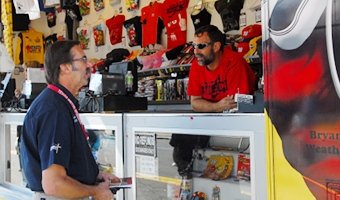
Texas Alliance Raceway Ministries Director Roger Marsh (left) discusses plans for the Sunday morning worship service with Brian Watts (right). Watts and his wife, Susan, travel the country working the M&M raceway store and hosting a church service at every race they work.

Through consistency and care shown by volunteers, fans and employees have realized God’s presence at the track. During the past few years, Marsh and the other volunteers have built relationships with the speedway employees.

Rickey Glenn, a self-proclaimed racecar nut and volunteer from First Baptist Church in Cason, said he parti-cipates in the ministry because it allows him to combine his hobbies with his passion for serving the Lord.

Seeing lives changed at the speedway motivates Glenn to serve year after year. A couple of years ago, he was able to share Christ with a young man while giving him a golf cart ride back to his campsite.

When the young man asked how Glenn could avoid drinking, Glenn used the opportunity to tell how he had surrendered his life to God. He asked the man if he wanted to do the same.

“I pulled the cart over and asked if he minded praying,” Glenn recalled. “By the time we were done praying, we were both crying.”

Other encounters are about planting seeds and praying that growth will occur at the proper time, said Pat Cude, a volunteer from Holly Brook Baptist Church in Hawkins.

“We don’t always see a lot of salvations, but we see that we are planting seeds on the track. We pray that sometime or another they will open up. And we know that some have because they come back and share with us,” Cude said.

Volunteers provide six chapel services on the Sunday during race week. Brian and Susan Watts of Weatherford, who travel the country running the M&M raceway store, open up their truck to lead a chapel service for all the traveling vendors at the speedway.

Twelve trained chaplains also volunteer with the ministry. Because of their positive influence, the speedway has asked these men and women to serve in the In-Field Care Center where injured drivers or fans in crisis are taken during race week. Chaplains also respond to any emergency call that takes place on the premises that week.

A family paints pinewood derby cars at the raceway ministry tent. The Texas Alliance Raceway Ministries engages race fans through children’s activities, horseshoe tournaments, golf cart rides for the disabled and concerts to share the hope of Christ.

Although the main focus of the ministry is to carry out the Great Commission, Marsh also sees it as a great way to train Christians in evangelism.

“We consider this a training ground for people who want to get involved with missions outreach,” Marsh said. “A new Christian could come out here and simply hand out literature to people coming in the gates. But if the church has someone who is skilled in one-on-one conversation, pastoral skills or crisis counseling, we would encourage them to send their volunteers out here.”

Texas Alliance Raceway Ministries is supported by Texas Baptists’ Mary Hill Davis Offering, as well as the Denton, Tarrant and Harvest Baptist associations and other churches in the state. The ministry also sponsors raceway outreach at tracks near Austin, Stephenville and Decatur.


Volunteers repair Hope House Houston while the ministry repairs lives

HOUSTON—Hope can come in many forms—a genuine conversation, a hug, a prayer or a warm meal. For a handful of Houstonians, it comes through a house that offers stability, love and independence.

A resident of Hope House Houston, who is a recovering addict and member of Deer Park Baptist Church, helps put sheet rock up in one of the homes.

Earlier this year, Dave Dozier, director of Hope House Houston, purchased a drug and alcohol rehab center including 13 dilapidated homes in Houston’s low-income Kashmere Garden neighborhood. Dozier realized Houston needed a ministry to help people recovering from addictions—as well as families needing help to get back on their feet—make the transition to independent living.

Dozier partnered with Robert Kennard, who now is the property manager at Hope House Houston, to create stable transitional housing for families and individuals attempting to gain independence. The men “stepped out in faith,” knowing only God could bring the volunteers and funding needed to make the ministry a reality.

“We are here to rebuild lives and relationships,” Dozier said. “We feel like God has called us to do urban ministry, and part of that is to offer stability and teach (residents) to become missionaries to their own people.”

Out of the 13 Hope House residences, seven are repaired and occupied. Residents are required to pay subsidized rent, attend weekly community meetings, be a member of a local church and show a desire to develop independence while a part of the ministry.

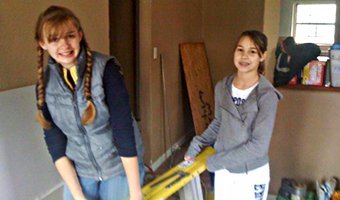
To help with repairs on three homes, more than 25 volunteers from Metropolitan Baptist Church and Northwest Baptist Church, both in Houston, participated in a workday as part of City Reach Houston, a series of more than 20 outreach events held in conjunction with the Baptist General Convention of Texas annual meeting. The BGCT community development office provided funding for the efforts. Volunteers installed sheetrock and insulation and landscaped one of the yards.

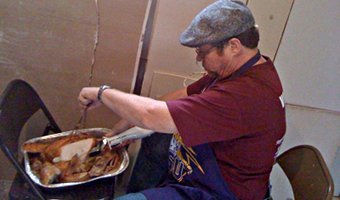
Dave Dozier (bottom right photo), director of Hope House Houston, carves a turkey for a holiday meal with the residents.

Christian Miller, a youth worker at Metropolitan Baptist Church and a volunteer during the workday, said helping at the ministry not only provided a service to Hope House, but also helped his students see they can make a difference at any age.

“The good thing is that the age range can vary,” Miller said.

“We had adults all the way down to seventh grade. Some were very timid at first, but by the time we stopped, we were in a great group, and everyone had a job they were doing. They were definitely getting into the project and enjoying what they were doing.”

Miller also sees the groups’ involvement as a way to grow their faith and see God move in tangible ways.

“It’s been my experience working with the youth in our church that the kids who grow up in the church know all the stories of the Bible, but (times) in their lives where they can see God move or discuss this with others are really lacking,” Miller said.

“If we can continue with the movement and with what God has called us to do, which is loving others, I think we will be able to grow their faith through it.”

Besides having more churches and individuals volunteer time and skills to help repair the remaining homes, the ministry’s biggest need is to have a 200-foot hurricane fence rebuilt so the 1.5-acre plot where the houses sit can be enclosed and secured for the safety of the residents.

“That fence is vital, and we need to secure what we have as winter is coming,” Kennard said. “People tend to seek refuge in abandoned houses. We need to secure the wall, like in Nehemiah where he needed to rebuild the wall.”

Two volunteers from Metropolitan Baptist Church in Houston clean one of the three houses being renovated by Hope House Houston.

Eventually, Hope House Houston expects to renovate one of the houses as a community center, offering residents a place to wash clothes, learn computer skills and build relationships with other residents.

Kennard said that living on the property has presented an opportunity to provide a stable, loving relationship to people who may not have had that in the past.

“It is becoming a trusting community where we are slowly gaining respect,” Kennard said. “When you are with them, they sense you really care. They see you doing it out of the love of your heart that God has given.”

Ultimately, Dozier and Kennard want the residents to begin a relationship with Christ or experience that relationship on a deeper level. They want to produce Christians who are ready to care for others in the way they have been cared for.

“My vision is that ministry will come out of Hope House so that they will feel they have to go to the front line where we don’t look for safety or calm but where the ministry needs to be,” Kennard said.

“We want to produce ministers who aren’t afraid to get their hands dirty and to model Jesus.”

Dozier agrees, adding he desires to see people gain hope and stability in Christ so they will be able to help others out of the same situations they once faced.

“We are a bridge to the other side, helping people not fall through the cracks again,” Dozier said.


University offers model for transforming a neighborhood

HOUSTON—Five years ago, the neighborhood north of Hardin-Simmons University was a scene of broken windows, cars littering yards, lawns turned into weed-filled jungles and paint peeling from houses. But Hardin-Simmons University placed a family in the neighborhood with one goal—living missionally. And transformation began in the area.

Danyel Rogers de-scribed her family’s experiences during a workshop on missional living held at the Baptist General Convention of Texas annual meeting in Houston. Rogers directs the Friendship House in Abilene’s Northpark neighborhood—a place where children can play safely and where the door almost always is open. Linda Carleton, who served as Hardin-Simmons’ dean of student, adapted the idea from a similar model in Shreveport, La.

Students from Hardin-Simmons University volunteer in reading stories to neighborhood children at the Friendship House.

“I ask myself every day, ‘What am I doing to invest in other peoples’ lives?’” Rogers told the workshop. “Think about whom you encounter each day and think, ‘What can I do to reach out to them’”

At its heart, Friendship House practices a ministry of reconciliation, she said.

“In my neighborhood, we eat meals together, take care of each other’s children and work on recycling as a community,” Rogers said.

“What we do to practice reconciliation is to provide a place of support where neighbors get to know each other.”

Each afternoon, children visit the Friendship House to play games with students from Hardin-Simmons University.

“It is all about transformation,” Rogers told the workshop.

“Take what you already know about Christianity and put it into practice. Don’t just have good intentions. Live what you know. The way you start is to ask God to open your eyes to see the needs of the people around you.”

The initial Friend-ship House has sparked creation of several others in Abilene, all managed by Connecting Caring Communities, a nonprofit organization.

A new Friendship House is being constructed in the Northpark neighborhood, supported in part by continued funding from Hardin-Simmons University.