Texas Baptists offer well water, living water in Peru

CHICLAYO, Peru—Fourteen-year-old Thalia bounces around her school’s campus with a smile as bright as the Peruvian sky. Among her peers, she’s clearly a leader, pulling them in with her optimistic brown eyes and light laughter.

Texas Baptists Advocacy/Care Center Director Suzii Paynter visits with two young boys in a Cajamarca, Peru orphanage. (PHOTOS/Texas Baptist Communications/John Hall)

For her, the campus near Chiclayo, Peru, is a steppingstone to what she hopes will be something bigger and better. She dreams of trading in her white school uniform for the similarly colored overcoat of a doctor.

Those dreams are being made possible in part by the generosity and ministry of Texas Baptists.

Gifts through the Texas Baptist Offering for World Hunger supplied the necessary funds for Villa Milagro—a ministry in Peru led by Larry and Joy Johnson of First Baptist Church in San Angelo—to drill a well for the school and its surrounding community.

The well has transformed the campus, providing clean water for the students to drink and drastically improving the health of children who regularly suffered from dysentery. The water also serves as the life stream for crops grown on the school’s campus, giving young people enough food to eat and a place to learn agricultural skills.

Water pours from a pipe connected to a Villa Milagro-dug well. The water nourishes crops that feed students at a Peruvian school and provides clean drinking water for the young people as well.

Thalia’s school was one picture of success 16 Texas Baptists witnessed during a recent mission trip to a variety of Villa Milagro ministry points. The organization, which seeks to share the gospel while meeting physical needs, has seen multitudes come to faith since 1994 and has dug more than 200 wells, helped start more than 85 churches and built numerous roads.

“For the last few days we’ve seen how the Texas Baptist offering has helped drill wells for schools and communities, and it literally transforms lives,” said Bobby Broyles, pastor of First Baptist Church in Ballinger and second vice president of the Baptist General Convention of Texas.

“It saves lives because children who once were dying of dysentery and dehydration are now living healthy lives. Obviously, it has changed their lives physically. Hopefully, we’ll also have the opportunity to change their lives spiritually.”

The act of providing clean water to schools and regions has created avenues through which the gospel has been shared repeatedly, said Carolyn Strickland, member of Wilshire Baptist Church in Dallas and BGCT first vice president. Lives and communities are being altered in the present and in eternity.

In Matara and the surrounding villages, a series of new wells is providing clean drinking water for several thousand people and has sparked economic growth and development in the area. The success of the efforts led to Villa Milagro sending medical mission teams into the area to meet additional needs. As they continue to serve, additional opportunities arise, as do chances for volunteers to share their faith.

Marilyn Davis from South Garland Baptist Church offers high fives to students at a school near Chiclayo, Peru.

“It’s vital,” Strickland said of ministry that connects people with clean drinking water. “It’s the most important thing you can give a child, you can give a community. It’s water that’s nourishing. It’s living water. It’s what we believe in in our faith. It’s what Christ would do.”

During their trip spent primarily near Chiclayo along the Peruvian coast and near Cajamarca in the Andes Mountains, Texas Baptists saw transformed lives, but they also were confronted by vast needs and large projects trying to meet those needs.

They saw a government-run orphanage where—thanks to Villa Milagro—children have enough to eat. But their homes need significant renovation. Texans saw wells that had been dug to provide clean water, but still needed pumps to push the water throughout communities. They witnessed churches reaching into their neighborhoods, some through constructing a medical clinic and holding a youth Baptist meeting.

Grant Lengefeld from First Baptist Church in Hamilton and Van Christian, pastor of First Baptist Church in Comanche, visit with students at the Monte Scion Christian School in Cajamarca, Peru.

“I saw a lot of needs,” said Grant Lengefeld, member of First Baptist Church in Hamilton. “My eyes were opened. I have to tell you the most difficult thing for me on this trip was to see the Pharisee inside myself. These folks here have a very sacrificial faith. I look at the things they are facing with poverty, with hunger, with family abuse issues. I was amazed at the sincerity of the prayer and the sincerity of their faith.”

Throughout the trip, Texans talked about facing crises of belief. When confronted with a trying situation—an orphan in need, a church searching for the resources to do what God has called it to or a student without clean water to drink—participants were challenged to decide how they would respond to the needs before them.

Texas Baptist Christian Life Commission Director Suzii Paynter said that was precisely the point of the trip. Seeing the faces of hungry children helps people understand the gravity of the situation. It challenges them to put the principles of their faith into action.

Giving through the Texas Baptist Offering for World Hunger empowers believers to support effective ministries like Villa Milagro around the globe. Christians also can get involved further through direct missions work, some of which will happen as a result of the trip, Paynter said.

“I want people to see the world hunger offering as a stepping stone to missions,” Paynter said. “It’s not simply an offering that we take up and give away. It’s a partnership with ministries who would welcome congregations to come along and serve alongside them.”

A young boy rides on the shoulders of Bobby Broyles, pastor of First Baptist Church in Ballinger, in a Cajamarca, Peru orphanage.

The responses of trip participants will vary, Paynter said. Some people will give more through the Texas Baptist Offering for World Hunger. Others gave during the trip and will give more directly to Villa Milagro for specific efforts. Baptists will take the needs back to the congregations and try to organize a wider response, possibly even recruit volunteers to serve through Villa Milagro. Trip participants will be more mindful of the hungry around them and advocate for assisting those in need.

No matter the response, it begins with an individual’s response to how God is moving in one’s heart, Lengefeld said.

“I think my responsibility is first off to go home to my church and get my church involved in the story,” Lengefeld said. “I think my job is to serve as an advocate. And I’m going to start in my Sunday school class. I think that’s important. Hopefully it will start in our Sunday school class and have it move throughout the church, then to the community and other churches. I think that’s how great things start.”

For more information about the Texas Baptist Offering for World Hunger, visit www.bgct.org/worldhunger . For more information about Villa Milagro, visit www.villamilagro.net .


Cuban Baptist leaders in custody; charges unclear

DELTONA, Fla. (ABP) — Two Cuban Baptist leaders arrested Oct. 3 in the city of Santiago de Cuba remain in jail, reportedly without formal charge and with few details of why they are being held.

Rubén Ortiz-Columbié, coordinator for special projects of the Eastern Cuba Baptist Convention, and Francisco "Pancho" Garcia, director of the convention's teen department, were reportedly carrying out church work when nabbed by authorities.

Ortiz' son, also named Ruben, is a pastor in Florida. He said the two men were on their way to distribute money donated for Baptist work. He said his church, Primera Iglesia Bautista in Deltona, Fla., regularly sends funds to the convention for mission projects in Cuba.

Rubén Ortiz-Columbié is pictured here in disaster relief responding with the Eastern Baptist Convention for Hurricane Paloma last year in Santa Cruz del Sur, Cuba.

Observers in the United States familiar with the situation said they don't know why police targeted Ortiz and Garcia. Ortiz is a well known Baptist leader in Cuba and worldwide. He is former general office manager of the Eastern Cuba Baptist Convention and taught stewardship at the Baptist Seminary of Eastern Cuba 20 years. Since retiring from the convention, he has continued to visit churches to determine project needs and help them to secure necessary funds and labor to get the jobs done in a volunteer capacity.

In 2008 the Cooperative Baptist Fellowship of Florida entered into a partnership with the Eastern Cuba Baptist Convention to support the work of Ortiz and Garcia. As of mid-September, the Florida CBF had received and transferred a total of $7,000 to help restore and repair structures used for religious services, camps and education.

With 320 churches, the Eastern Cuba Baptist Convention is the largest of four Baptist groups in Cuba. It has a long-standing fraternal relationship with American Baptist Churches USA.

Jose Norat-Rodriguez, area director of Iberoamerica and the Caribbean for ABCUSA International Ministries, said Ortiz and Garcia were allowed to see their wives Oct. 9, but the women were not told why their husbands were being detained. He compared the two Baptists to Paul and Silas, two missionaries delivered from prison though the power of prayer in the Book of Acts, and asked fellow Baptists to pray both for their release and for their families.

The Spanish conquistadors brought Catholicism to Cuba, imposing their culture and beliefs, and it was the only official religion in Cuba and other Spanish colonies for 400 years. The first permanent Protestants in Cuba were repatriated refugees converted to Protestant faiths during exile in the United States.

After the Spanish-American War, however, missionaries poured into Cuba. With so many entering at the same time, denominations sat down together to give order to their missionary ventures. Some, like Baptists, zeroed in on geographical areas.

In 1898 the home mission boards of the American and Southern Baptist denominations met in Washington and agreed to divide Cuba between east and west for the purposes of missionary work.

In addition to the smaller Western Cuba Baptist Convention, historically tied to the Southern Baptist Convention, there is also a Free Will Baptist convention. And the Fraternity of Baptist Churches in Cuba, which broke off from the western convention in 1989 over theological and administrative differences, has a partnership with the Alliance of Baptists.

In recent years the four groups have worked more closely together than in the past. All are members of the Baptist World Alliance, the global umbrella group for Baptists. In 2000 the BWA General Council met in Havana — the first-ever international Baptist gathering held in the communist nation. During that meeting a Baptist delegation met with Cuban President Fidel Castro. The meeting opened doors for projects including Bible distribution and open-air services in 1999, allowed for the first time in four decades.

Though difficult, Baptist work in Cuba has exploded in recent years. In 2004, Denton Lotz, who has since retired as BWA general secretary, reported that more than 2,500 house churches had been started in the previous eight years. That more than doubled the number of churches, and the number of worshipers had grown from 80,000 to 200,000.

The eastern convention is involved in an evangelistic push with a goal of reaching 500,000 people by 2010. The western convention aims to plant 1,000 new house churches during the same period.

Christians in Cuba endured hardships after Castro took power in 1959, but he relaxed restrictions in the 1990s, saying it was a mistake to make atheism the official religion of the Cuban Revolution. In 1994, he opened membership in the Communist Party to Christians. Pope John Paul II visited Cuba in 1998.


–Bob Allen is senior writer for Associated Baptist Press.


One American in five may be secular by 2030, study shows

WASHINGTON (RNS)—The number of American adults who do not identify with a particular religion is growing and may comprise more than 20 percent of the population in two decades, according to a new study.

Conducted by researchers at Trinity College, the study, titled “American Nones: The Profile of the No Religion Population,” showed that people who profess no religion, or “Nones,” are similar to the general public in marital status, education, racial and ethnic makeup and income.

One in five Americans may put themselves in the “None” category by 2030, research showed.

“We are here. We are like everybody else. We are part of the community.” said Jesse Galef, communications associate at the Secular Coalition for America .

Galef hopes that this trend will dispel stereotypes that Nones have no morals because of their lack of religion and help them gain a political voice.

The study indicated a large percentage of Nones also decline to identify with a political party. More than 40 percent call themselves independents; 34 percent say they are Democrats; and 13 percent identify themselves as Republicans.

“If the Republican Party wants these votes back, they can’t be dominated by the religious right,” said Galef.

Barry Kosmin, head researcher for the study, said the spread of the Nones is a national and historical phenomenon. He cited examples from the Founding Fathers, such as Thomas Jefferson’s version of the Bible, in which he cut out reference to Jesus’ divinity.

The most notable difference between Nones and the religious population is the gender gap. Only 12 percent of American women are Nones, while 19 percent of American men claim no religion.

According to the study, women who grew up in nonreligious homes are less likely to stay nonreligious. Women are also less likely to switch out of religion.

“Why, now, I have no clue,” said Kosmin. The study “raises as many questions as answers.”

Most Nones would not consider themselves atheists. More than 50 percent believe in either a higher being or a personal God, while only 7 percent are self-proclaimed atheists. One in three say they “definitely” believe that humans developed from earlier species of animals.

In the conclusion of the Trinity study, researchers say Nones are the “invisible minority” in the U.S. “because their social characteristics are very similar to the majority.” The shift to secularism in the 1990s largely happened “under the radar,” the researchers said.


Baptists in Uzbekistan stand trial

PHILADELPHIA (ABP) — A trial for three Baptist officials in Uzbekistan charged with tax evasion and illegally teaching children religion was scheduled to enter its third week Oct 12.

If convicted, Pavel Peychev, president of the Baptist Union of Uzbekistan; Yelena Kurbatova, the union's accountant; and Dimitry Pitirimov, director of a Baptist-sponsored youth camp, face up the three years in prison.

"Camp Joy" has been held each summer for at least 10 years in Uzbekistan, but there was never a complaint until this year, said Peychev's brother-in-law, Stuart Quint. Quint and his wife, Tatyana, are following the trial from Philadelphia through reports from contacts in Tashkent and public court documents written in Russian.

Supporters of the three Baptists have been denied access to parts of the trial and have accused the prosecutor of falsifying documents. They say it is part of a tightening noose around the necks of Baptist, Pentecostal and Presbyterian minority groups resulting from two widespread beliefs that the national identity is tied in with Islam, and that the Russian Orthodox Church is the only acceptable "Russian" denomination for Uzbekistan's Christian minority.

One document quotes Peychev describing his experience growing up in a Baptist family under communism in the Soviet Union. "They did not give us the opportunity to study, neither did they give us good work," he said. "Today the same thing is happening: they are persecuting Baptists, and this trial is a clear demonstration of my point."

The trio's defense is that as a registered religious organization, the Baptist Union is exempt from paying taxes. Besides, they say, the camp does not have any profits to tax. The only money campers are asked to bring is to offset food and transportation costs. The bulk of expenses are paid with donations.

The presiding judge said he could not understand how it is possible for the director and personnel at the summer camp to do their work without earning profits from the campers.

"We are Christian believers and do not think like other people amongst whom we live," Kurbatova answered. "Our Lord Jesus Christ gave everything for free and never demanded money from anyone. That is how we work."

The Baptists say they believe witnesses quoted in complaints against them were either coerced into making false accusations or did not understand what they were signing.

Pitirimov, the camp director, said there were children of Uzbek nationality at the camp, but he always asked newcomers if they are Muslims. Those who said they are Muslim or didn't want to hear Christian teaching were driven home. He said there were between five and 10 such cases in 2008.

The three Baptists were arrested in July after a government-sponsored news agency ran articles that included charges of illegal activity. The defendants deny doing anything wrong.

Last year Camp Joy had 538 campers. The camp lasts eight days and features rock-climbing, hiking and other recreation. 

Uzbekistan's constitution provides for freedom of religion and for the principle of separation of church and state, but a religion law passed in 1998 restricts many rights only to registered religious groups and limits which groups may register.

The United States Commission on International Religious Freedom labels Uzbekistan a "Country of Particular Concern," ranking it as one of the world's worst violators of religious liberty.

Observers do not know how long the trial is expected to last.


–Bob Allen is senior writer for Associated Baptist Press.

Previous ABP stories:

Uzbek Baptist head, two other leaders face 3-year prison term (9/15)

Uzbekistan charges Baptist camp with crimes (7/29)


Updated: Corsicana pastor Edwards killed in auto accident

David Edwards, 51, pastor of Corsicana’s First Baptist Church, died Friday, Oct. 9, from injuries suffered in an automobile accident near Hubbard.

David Edwards

Edwards was involved in a two-car collision about 4:20 p.m. Friday on State Highway 31, about 2.5 miles west of Hubbard, according to the Department of Public Safety. He was pronounced dead at 5:20 p.m. at Hillcrest Hospital in Waco.

Investigators said Edwards was westbound on Highway 31 when his 2001 Explorer was struck head-on by a truck.

The driver of the truck is at Hillcrest Hospital and is said to be in stable condition.

Edwards is survived by his wife, Lyndy; daughters, Emily of Pennsylvania, and Kate Mullaney and her husband Brian; and a son, Evan, who is a sophomore at Corsicana High School.

Edwards and his wife were preparing to adopt two children from Taiwan later this year, a brother and sister. They were scheduled to leave Tuesday for a trip to Taiwan.

Visitation will be from 6 to 8 p.m. Monday, Oct. 12, at Corley Funeral Home, 418 N. 13th Street in Corsicana. A memorial service will be conducted at 2 p.m. Tuesday, Oct. 13, at First Baptist Church, Corsicana. Milton Cunningham will officiate, along with Logan Cummings.


-adapted from a report in the Corsicana Daily Sun


European Baptists ponder future of international seminary

PRAGUE, Czech Republic (ABP) — European Baptist leaders gathered in Prague, Czech Republic, Oct. 1-2 to discuss the future of the cash-strapped International Baptist Theological Seminary.

The seminary is owned and operated by 51 Baptist unions and conventions that make up the European Baptist Federation. The school has been hit hard by a weak dollar diminishing the value of gifts from the United States, rising maintenance and energy costs and a global banking crisis that has eroded endowment funds.

Leaders said finances could force IBTS to sell all or part of its campus in Prague, where it relocated from Ruschlikon, Switzerland, in 1995. The first preference is to remain on the current campus, a 19th-century estate renovated in the 1990s with the labor of hundreds of mission volunteers from the United States. But leaders said that will require significant cost cutting and increasing income, possibly requiring the appointment of a development officer.

If leaders determine the school must move, options are to either seek a more affordable site in Prague or relocate to another EBP partner union, possibly changing the language of instruction and accreditation.

Formed in 1949 to train pastors for southwest Europe, the seminary at Ruschlikon faced a financial crisis in 1991. The then-Foreign Mission Board of the Southern Baptist Convention ceased funding the school, claiming the teaching there was more liberal than what was being tolerated in the increasingly conservative SBC.

Facing rapidly increasing costs of operating in Switzerland, trustees voted to sell the campus and to move to a less-expensive location. With costs in Prague about half those in Switzerland, a sale price of more than $20 million allowed the seminary to move with only a bridge loan pending final payment on the Swiss property.

The relocated seminary took a new name, International Baptist Theological Seminary, along with a new vision. During the days of the Iron Curtain, Baptists in much of Europe were cut off from the rest of the world and denied opportunities for higher education. A new political climate allowed seminaries and Bible schools to reopen, but without a clear understanding of how they would be accredited and recognized as official Baptist institutions.

Long having had a smattering of Baptist students from Eastern Europe and now geographically located at the midpoint between Baptists in Eastern and Western Europe, IBTS in 1997 began focusing efforts on graduate studies and recruiting top graduates from unions and seminaries across Europe and the Middle East. The seminary awarded its first doctorates in 2007 and celebrated its 60th anniversary in 2008-2009.

The SBC defunding of Ruschlikon drew outrage from moderate Southern Baptists, prompting many churches at the time to redirect their mission gifts to the newly formed Cooperative Baptist Fellowship. Many SBC missionaries assigned to Europe switched to the CBF's new global-missions enterprise. Today IBTS is one of 15 seminaries, theology schools and Baptist-studies programs identified as ministry partners of the Atlanta-based CBF.

EBF representatives overwhelmingly affirmed the need for IBTS to continue but said serious issues remain about reducing costs and increasing income.

About 1,200 men and women — most from the United States and many from North Carolina — came to Prague at their own expense to repair dilapidated buildings on the seminary's new campus in 1994 and 1995.

Now, officials say, the cost of looking after historic buildings dating to early 19th century is starting to take its toll. Twelve years after renovation, the seminary now has capital needs to replace worn-out equipment. Utility costs have risen astronomically.

The Czech crown, meanwhile, is a currency of speculation and therefore very strong against the Euro and dollar, dramatically affecting the value of donations from Western Europe and the United States. A recent newsletter described the combination as "really quite critical."

The seminary houses one of the largest English-language theological libraries on the continent of Europe, with about 69,000 volumes. In 2008 IBTS was host to the annual gathering of the Baptist World Alliance.

A fund-raising campaign during the seminary's Diamond Jubilee in the 2008-2009 academic year raised the equivalent of about $75,000 in U.S. currency.


–Bob Allen is senior writer for Associated Baptist Press.


Evangelical group endorses immigration reform

WASHINGTON (RNS)—The National Association of Evangelicals has endorsed comprehensive immigration reform, saying new policies should reflect “biblical grace to the stranger.”

“We seek fair and human treatment for those who are immigrants,” NAE President Leith Anderson told reporters on Capitol Hill, shortly before testifying with other religious leaders at a Senate subcommittee hearing on faith-based perspectives on immigration reform.

The NAE board adopted the resolution as growing numbers of immigrants fill the pews of churches affiliated with his organization, which includes 40 denominations and scores of other evangelical groups, Anderson said.

“Many of the immigrants in America are us,” he said. “That is, the growing edge of evangelical churches and denominations in the United States is the immigrant community.”

The resolution, approved overwhelmingly by voice vote of the NAE board, calls for the government to safeguard national borders, recognize the importance of family reunification and establish an “equitable process toward earned legal status for currently undocumented immigrants.”

Asked for specifics of NAE’s suggestions about undocumented immigrants, Anderson said the process should be a reasonable one that might require, for example, undocumented immigrants to pay back taxes.

“We are not suggesting that those that are already in the United States without documentation are automatically granted either residency or citizenship status,” he said.

Samuel Rodriguez, president of the National Hispanic Christian Leadership Conference, commended the NAE for passing the resolution. He said it demonstrates that the issue is one that concerns not solely Latinos but a wide range of Americans, and represents a “Christian” rather than a political agenda.

“At the end of the day, immigration reform is an issue of justice firmly grounded on biblical truth,” he said.


City Reach 2009 offers hope to Houston

HOUSTON—When the Baptist General Convention of Texas holds its annual meeting in any city, participants hope to leave the community in a better spiritual and physical state than before it came. And the convention’s attempting to do just that through City Reach, a series of evangelistic events geared toward sharing the hope of Christ with the people of Houston through prayer, care and share efforts.

Members of Templo Bautista in South Houston embraced friends and neighbors with a back-to-school fiesta as part of City Reach.

Reach is focused on partnering with Houston churches to host evangelistic endeavors, attempting to reach the 2 million unchurched people in the area with the gospel.

“When we go into the city with a convention of Christians, we need to leave the city better than we found it,” said Jon Randles, BGCT evangelism director.

“One way we do that is to go in and help reach the community for Christ.We basically are trying to help all our churches and leaders realize that if they will be intentional about evangelism, build trusting relationships with the community, then hold a variety of events and bath it in prayer, they will see results.”

To reach out all types of people groups and cultures in Houston, City Reach volunteers are partnering with Street Life Ministries, Bill Glass Champions for Life, Real Life Outreach and Hope House to share the hope of Christ through hurricane relief, a multicultural fair, a medical clinic, block parties and an extreme sports youth rally.

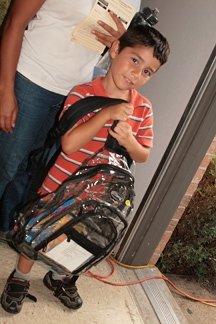
As an early CityReach event designed to meet community needs, Templo Bautista in South Houston sponsored a back-to-school fiesta.

Although the majority of events will take place between a two-week period before Annual Meeting, some efforts began in September with back-to-school outreaches. Through these efforts, 81 people began a relationship with Christ.

“Much of City Reach is based on event evangelism, but they are based on building relationships,” Randles said.

On Nov. 1, Baptists will come together for a prayer rally to energize believers around the city to participate in the City Reach events leading up to annual meeting.

City Reach also will include ministry to school-age children as the youth evangelism team brings Real Encounters Outreach to schools in the area. A team of extreme sports athletes will lead a three-day program in several public schools, inviting students to attend a rally on the last night where the gospel will be shared.

Templo Bautista provided families backpacks filled with school supplies. (PHOTOS/Courtesy Templo Bautista South Houston)

Bill Glass Champions for Life also is helping Texas Baptist minister to those incarcerated in Houston prisons. The organization leads Christian pro athletes into prisons to host an entertaining program while share the gospel in the process. Volunteers partner with the athletes and become counselors for the event. This weekend endeavor is expected to be the largest on in Bill Glass Champions for Life history with goal of working beside several hundred volunteers and churches.

Participants will receive evangelism training on the night before the event and then work alongside the organization to minister in the prisons the following two days. Champions for Life will be taking a similar program into public schools the week before annual meeting in hopes to reach students with the gospel as well.

City Reach will not be able to make an impact on the Houston area unless Baptists from all over Texas become involved in the planned projects, Randles said.

“Most pastors and churches want to reach their communities for Christ but they don’t know how to build relationships or make an impact,” Randles said. “City Reach is teaching them how to do things in the community to share Christ with the lost. It’s about training people in evangelism, walking beside them and then giving them a chance to share how Christ has changed them.”

Volunteers are still needed to help with the array of City Reach projects taking place. Learn more about City Reach events by calling the BGCT Church Evangelism office at (214) 828-5126 click here or sign up to help with one of the projects.


Intercultural Christians in Texas have passion to reach people in homelands

DALLAS—Intercultural Christians know the language and customs to connect with their own people. And the Baptist General Convention of Texas is giving them an opportunity to use their knowledge to share the gospel with a culture they know inside and out.

Sudha Jayaprabhu (left) stands with one of the church planters trained through the funds she received from the Intercultural Strategic Partners. Jayaprabhu was able to spend three months in her native country of India training seven pastors. Through these efforts, 49 villages in the area will hear the gospel this semester. (PHOTOS/BGCT)

Many intercultural Christians in Texas have a passion to reach their own people back in their native lands. The BGCT Intercultural Ministries is helping to make that possible through a new Intercultural Strategic Partners initiative.

After nearly three years of planning, the BGCT Intercultural Ministries office and a board of seven intercultural pastors ministering in Texas formed Intercultural Strategic Partners.

With $65,000 allotted from worldwide church-directed cooperative giving, the BGCT launched the initiative to provide support for the work of indigenous Christians.

“It is high time we start trusting local missionaries and raising indigenous missionaries from local people due to the financial cost and the time,” said Bedilu Yirga, pastor of the Ethiopian Evangelical Baptist Church in Garland and a board member of Intercultural Strategic Partners. “We have an urgent message to share. With indigenous missionaries, you don’t have to spend the time to teach culture.”

Patty Lane, director of BGCT Intercultural Ministries, said Intercultural Strategic Partners is about backing intercultural leaders and letting them use their knowledge, ingenuity and connections to further the gospel in their homelands.

A core group of believers stands by the church planter (center). They became followers of Jesus through the church planters work and will serve as a nucleus for new churches in the area, according to Patty Lane, director of BGCT Intercultural Ministries. (PHOTOS/BGCT)

“It’s really about connections and indigenous strategies,” Lane said. “We are letting the indigenous leaders living here in Texas call the shots. What they go and do matches with what the local group needs. It’s about connectivity. The connections are already there. It’s a matter of seed money and a person who can bless and validate the work there in their home area.”

Since the beginning, Intercultural Strategic Partners has funded seven projects involving church planting, church planter training, orphan relief, medical missions and community development and education in Africa, South East Asia, South Asia and Eastern Europe.

In May, Intercultural Strategic Partners approved funding for Sudha Jayaprabhu, an Indian Christian living in North Texas more than 20 years.

Jayaprabhu spent the summer in her hometown in India encouraging seven national pastors and training them in church planting. Each pastor will minister to seven villages, working to share the gospel by starting core Bible study groups.

Intercultural Strategic Partners funding helped with the training, as well as providing bicycles for the pastors so they can travel from village to village sharing the gospel and encouraging other Christians.

These three people became followers of Jesus through a church planter trained by Sudha Jayaprabhu (not pictured) to be part of a seven-person core group that ministers to 49 villages in their home area of India. Now they are part of a core group that helps one of the church planters share the gospel with villages in their area. (PHOTOS/BGCT)

Yirga and his church also received funds from Intercultural Strategic Partners to help with church planting and community ministries in his home county of Ethiopia. Through Yirga’s connections and networking with ministries and pastors there, he is able to support and train 23 indigenous missionaries for only $60 per person per month.

“It’s very much encouraging, because we are receiving reports from the field,” Yirga said. “It is a blessing to hear that so many people heard the gospel for the first time, and we have people committing their lives to Jesus. We want to be culturally sensitive to the work out there and to engage ethnic churches in mission work and to be good stewards of what we have been given.”

Yutaka Takarada, pastor of the Japanese Baptist Church of North Texas in Dallas and an Intercultural Strategic Partners board member, agrees the new initiative is helping further and improve ministry that is already in place in their home countries.

“Some of the leaders from different countries are already working with the people from their countries, like starting churches or sending missionaries or educating pastors in that country,” Takarada said. “The ISP enlarges the ministry we already have done (in a few places) because we can do more with the financial support of the ISP.”

To receive support from Intercultural Strategic Partners, individuals and churches must complete an application to state their intentions for the funding. Qualified projects must be focused on growing the kingdom of God, be connected to a BGCT-affiliated intercultural church, involve local Christian leadership in an indigenous setting, be within the financial capability of Intercultural Strategic Partners and state an accountability process.

Once the application is submitted, the board meets once a month to discuss the proposed project. The board does not vote on the endeavors but continues discussion until a consensus is made. Lane said this approach has allowed the Holy Spirit to guide the group’s decisions in the best way possible.

“It helps us be more sensitive to God’s leadership and build trust with others in the group,” Lane said. “It’s done more on a relationship basis than a time-efficiency basis. We need to build the relationships and that helps us be effective as a group.”

Current projects deal with intercultural individuals and churches partnering with indigenous believers, churches and missionaries in their home countries. The board would like to see intercultural churches as well as Anglo churches taking advantage of the wisdom and cultural knowledge that each congregation possesses to form cross-cultural ministry projects.

“ISP links cultural knowledge and missional strategy to change the way we think about and do missions,” Lane said. “Creativity in strategy and innovation in networking are proving that even very limited financial resources in the hands of the right people will change the world. I hope that every intercultural church that has a heart and passion to reach their people around the world knows they have a friend at ISP.”

To learn more about Intercultural Strategic Partners, contact the BGCT Intercultural Ministries office at (888) 244-9400.


Linked by breast cancer battle, Wayland employees forge bond

PLAINVIEW—If you ask Beverly Steed or Debbie Parker who has been one of their biggest help during their ongoing struggles with breast cancer and they would likely name each other.

Ironically, the two have never met in person. They work on Wayland Baptist University campuses 460 miles apart. But that didn’t keep Steed and Parker from developing a tight friendship and support system across the state as they encouraged each other on the journey toward wellness.

Beverly Steed works as an assistant to the athletics department at the Laney Center on Wayland Baptist University’s Plainview campus. (PHOTO/Courtesy of Pamra Culp, Rolls of Fun Photography, Lubbock)

Parker, who works as office manager for business and financial aid for Wayland’s San Antonio campus, was diagnosed in August 2008 with breast cancer, discovered in an enlarged lymph node. After a lumpectomy, she started chemotherapy and later underwent a bilateral mastectomy, finding out later there was cancer in the right breast as well.

With the tough road ahead of her, early on in the journey Parker asked for Wayland to include her on the employee newsletter prayer list circulated to all system employees across seven states. Right about that time, Steed was waiting on results of her own biopsy, with breast cancer later diagnosed.

“When I saw the listing for Debbie, I was compelled to write her immediately. I think it was God telling me to write her right then,” recalled Steed, who is the administrative assistant for Wayland athletics.

Steed sent a quick e-mail to Parker, telling her about her own situation and offering her prayers. That was the first of many correspondences between the pair as they have laughed, cried and encouraged each other over the past 16 months. The distance doesn’t seem to deter the friendship. Cards and letters, e-mails and packages travel both directions as part of the sunshine the two try to shed on each other.

Steed recalled an e-mail Parker sent a few days before her surgery that included a prayer for God’s angels to surround the surgeons during the procedure. Steed printed the note, took it with her to the hospital and found immense encouragement from her friend’s words.

Parker and Steed have been able to share information, advice and experiences with each other. Steed’s bilateral mastectomy actually came a month before Parker’s, so she was able to tell her frightened friend what to expect.

On the flip side, Parker had already experienced some of what Steed faced, so she was able to offer her fresh perspective. Though both women say they have supportive friends, family and coworkers in their lives, they noted something special about the bond with a sister who is traveling the path at the same time.

“Throughout this, we’ve sent each other cards and notes, and it just seems like every time I needed to hear words of encouragement, I’d go to the mailbox and there would be a card or an e-mail from Debbie,” Steed said. “It’s like we were holding each other’s hands through this whole thing.”

Debbie Parker works at the San Antonio campus of Wayland Baptist University. (PHOTO/Deanna Spruce, Wayland San Antonio)

“Beverly sent me a book called Cancer and the Lord’s Prayer, and I have ordered a few myself to give to people I know going through the same thing,” Parker said. “It was no accident that we met. God planned that. I really believe that.”

The journey is not completely over for either Steed or Parker. Steed went through chemotherapy first, and her mastectomy uncovered many lymph nodes that were cancerous. She finished up six additional months of chemo at the end of August and is waiting for radiation, although she recently received word that the cancer seems to be in remission.

After her mastectomy—performed five years to the day after her mother underwent the same procedure—Parker went through radiation and is now doing chemo and hormone therapy while waiting for reconstructive surgery. Both remain optimistic, fueled in large part by their friendship and by their strong faith.

“Once you have sat in an office and someone has told you ‘you have cancer,’ you look at life totally different than you ever have before,” Parker said. “Although I was a Christian, God has really changed me in this last year.”

Steed shares that sentiment.

“I didn’t get a personality transplant, but he has changed me. I’m a lot more patient; things that were bothering me ceased to matter anymore… immediately,” Steed said. “I’m not a hero and am very uncomfortable when people say I’m strong or brave, but I just say that God did it.”

Both indicate that experiencing cancer changes one’s perspective on life and what is truly valuable.

“You know the things that are the most important in your life. You just have to trust in the Lord. And, hopefully, you have lots of friends that are praying for you and lifting you up,” Parker said.

The pair also lauded their Wayland family, from student athletes to administrators, for being so supportive during their hardest times. Steed noted she continued to work as much as possible during her cancer journey because of the encouragement she found on the job.

And both say the experience has made them champions for breast health and preventive measures that may lead to early detection and a higher survival rate. They stress the importance of mammograms for women they know, and Steed says she preaches regularly to the female athletes at Wayland the value of self-exams while they are younger.

Steed and Parker believe they one day will be able to meet and share a physical hug to match the emotional ones they’ve shared over the past year. And even though their cancer journey will someday end, they believe their friendship will remain true.

“We probably never would have met otherwise,” Steed said. “Now we can say that we’re friends and have blessed each other on this journey we never wanted to go on.”


Venezuelan spends three months in church-planting effort in Laredo

LAREDO—Since Venezuelan Baptist Patrick Weller began serving as a missionary eight years ago, he’s taught at a mission school in Venezuela, ministered in Germany and planted churches in Argentina. But he never thought the next step in his journey would take him to South Texas.

For three months, Weller labored under the direction of Mario Garcia, River Ministry coordinator and Laredo Baptist Association director of missions, to take part in church planting, lead Vacation Bible Schools and encourage believers in Laredo.

As part of a relationship between the Baptist General Convention of Texas and the Venezuelan Baptist Convention through Texas Partnerships and the River Ministry, Weller served as the first Venezuelan to take part in the evangelistic work happening with Spanish-speaking ministries in Texas.

Patrick Weller of Venezuela worked with Laredo Baptist Association three months in church planting.

In 2008, Texas Partnerships committed to send teams to work with Venezuelan outreach events during the next three years. Venezuelan Baptists also committed to take part in evangelistic efforts in Texas.

Plans for Texas Hope 2010 

“The Venezuelans are serious about the reciprocating nature of our relationship,” said Steve Seaberry, director of the BGCT Texas Partnerships. “We are currently working on plans for Venezuelans to come help with Texas Hope 2010,” the Texas Baptist emphasis to share the gospel with every Texan by Easter 2010.

At a national Venezuelan Baptist meeting, Weller became aware of the convention’s commitment to help in Texas, but he had no desire to leave his ministry in Venezuela at that time.

“There was a national convention in Venezuela, and they said they needed help in Laredo,” Weller said. “It was not in my plans to come here. At the time, I was helping with a church with some missionaries in Venezuela. We prayed together, and I felt that this was from God—an opportunity to help this area.”

Since Weller served as the intercultural mission director and taught classes at a mission training school in Anaco, Venezuela, he needed to find someone to cover his duties while he was away in addition to raising support for the Laredo endeavor.

"God confirmed everything" 

“God confirmed everything,” Weller said. “I felt peace in the decision even though I had a lot of things to do there in Venezuela. God helped me fill up the training in different ways, and I had a few friends in Venezuela and two churches that chose to support me.”

Weller then traveled to Texas in June. Even though he was from a Spanish-speaking country, he had much to learn about the culture, climate and colloquialisms of Laredo once he arrived since the majority of the Spanish-speaking population was of Mexican heritage. But through God’s help, he conquered the learning curve and was able to minister to many people in the area, he said.

“Because I’m from another country, especially another country where people know about our president and the petroleum, God used that to open doors to meet people, to share,” Weller said. “I love opportunities to speak with different people.”

Weller’s main duty was to encourage the seven members of Discipleship Ministry, a Bible study that ministers to Los Presidentes, an area of Laredo without any churches. Through Weller’s leadership and the hard work of the members, the group grew to more than 30 people and is now considered a church plant.

Growth began in outreach to children 

Much of the group’s growth and progress spurred from outreach to the children in the area. Gracie Roath, a member at Discipleship Ministry who opened her home and allowed Weller to stay with her family during his time in Laredo, said she has seen many beneficial changes in the children who attended the Vacation Bible School at their home during the summer.

“We have a lot of changes in the children’s lives as far as they are more loving and more open to discuss their life at home,” Roath said. “They’ve changed in the aspect as some children had issues with anger and depression, and they are now so alive. Even if there isn’t a Bible study going on, the kids want to come over.”

In addition to his work at the church plant, Weller worked with visiting summer mission teams and preached at various Hispanic churches each Sunday and Wednesday.

“He showed us a whole lot about the way of mission work is to be done,” Roath said. “He would go out and minister to people, feeding some families and preaching at some churches. It just motivated us to want to do God’s work.”

Roath and her husband, Donald, assumed the church planting work when Weller returned to Venezuela at the end of August to resume his duties at the mission school. Garcia also shared his hopes that Weller’s time spent in Laredo encouraged him and will help his ministry in Venezuela.

“Whatever experience he had here, he can do there in Venezuela,” Garcia said. “I know Laredo is different. The culture is different, but I hope that his time here three months will encourage him to do this where he is. It takes a lot of effort, a lot of dedication, a lot of time to do what he has done. And I think he learned from those experiences.”


Texans plant one-of-a-kind church in Pacific Northwest

PULLMAN, Wash.—Leaders of Resonate Church in Pullman, Wash., believe church planters should never underestimate the power of genuine relationships, prayer, creativity—and good coffee.

Resonate Church, a congregation in Pullman, Wash., planted by Texas Baptists, offers ministries to students at Washington State University and the University of Idaho. (PHOTOS/Danielle Gallup)

Resonate Church has no permanent building—just three trailers filled with audiovisual systems and dozens of plastic buckets that transport everything needed to set up for worship. Leaders conduct worship in two cities on either side of the Washington/Idaho state line.

Most church business is conducted in a coffee shop. An illusionist, geologist, teacher and musician make up half of the staff, and all of the church’s deacons are under age 35.

Instead of going through a membership class, newcomers to the congregation go through an “ownership” class. And many of those new members are college and graduate students.

Resonate Church in Pullman, Wash., grew out of the vision of Paige and Keith Wieser, graduates of Stephen F. Austin State University in Nacogdoches.

Together with two East Texas Baptist University graduates—Josh Martin and Drew Worsham—and a couple of Washington State University graduates, the small group prayed for and helped to plant the church just two years ago.

In 2008, Resonate launched a second service in Moscow, Idaho. Matthew and April Young from Nacogdoches came aboard staff to shepherd the Moscow site.

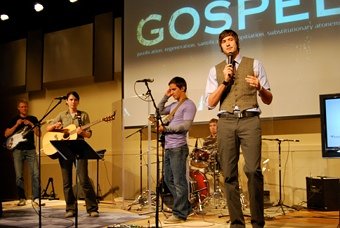
Creative Arts Pastor Drew Worsham (with mic) and Worship Pastor Josh Martin (on guitar)—both graduates of East Texas Baptit University—welcome worshippers to Resonate Church in Pullman, Wash.

The Southern Baptist Convention’s North American Mission Board provides some funding for most of the Resonate staff. Several Texas Baptist churches—primarily Central Baptist in Livingston, First Baptist in Crosby, First Baptist in Nacogdoches and Heights Baptist in Alvin— also support the church’s mission.

Washington is one of the top two unchurched states in the nation, according to the Southern Baptist Convention’s North American Mission Board. More than 19,000 Washington State students live in Pullman, and another 12,000 students live a few miles down the road in Moscow, where they attend the University of Idaho.

This unchurched generation is waiting on God’s love to be demonstrated, Pastor Keith Wieser believes.

Resonate is on mission to reveal the story of Jesus in a powerful and meaningful way to college students—not through systems or programs, but through authentic relationships in an inviting community.

Essentially, Resonate Church relaunches every fall when the school year begins.

Pastor Keith Wieser—a graduate of Stephen F. Austin State University in Nacogdoches—preaches at Resonate Church in Pullman, Wash.

After the church served both campuses for a week by offering barbecues, concerts, magic shows and free breakfasts, about 300 students showed up the first Sunday to find out more about Resonate.

“This is my first time to ever attend a church service,” one girl commented. The experience radically changed her preconceived notions about church, she added.

“Jesus does not have to be made relevant for a new generation and mindset. He already is,” Wieser said. “We seek to find ways to communicate and interpret the unchanging and authoritative truth of the Bible into the mindset of this generation.”

Intentional, compassionate relationships draw people, Resonate members note.

“If you come to Resonate, you can not slip out the backdoor or go unnoticed. People sincerely want to know your name and your story,” Kate-Lynne Logan said.

Resonate small groups meet in homes and are called villages. After enjoying a home- cooked meal, a village provides a safe environment where small-group participants wrestle with difficult questions and engage in spiritual dialogue.

Ten villages meet each week, with specific villages geared toward particular affinity groups such as college freshmen or international students. Resonate desires for 80 percent of the people who attend worship on Sunday to be involved in a village.

“The backbone of Resonate is how village functions,” Wieser said.

In villages, participants can move to a deeper level in their relationship with God and each other, Jessica McFaul noted.

“You get to dig deep into the sermon, meditate on the biblical principles presented on Sunday, and encourage one another to practically live out God’s plan for your life. It is a rare treasure,” she said.

Revealing biblical relevancy, missional living, authentic community and ongoing spiritual discovery are core values of Resonate.

“The reason I carve out time to be involved in Resonate is because it is a God- based community that makes an effort to draw people in and show them what following Christ can look like,” said BrynnWhitman, who has attended the church since its launch two years ago. “The church as a whole exudes love for people and the people who make up the church support, encourage, and inspire me to trust Jesus unreservedly.”