Lowrie to seek 2nd term as BGCT president

CANYON—David Lowrie will seek a second term as president of the Baptist General Convention of Texas when the BGCT conducts its annual meeting in Houston Nov. 16-17.

Lowrie’s decision to serve a second one-year term could reverse a recent trend in BGCT politics. Although presidents historically served two terms as the convention’s leader, his five immediate predecessors did not seek re-election, each voluntarily serving a single term.

David Lowrie

Ken Hall, whose term began that recent trend, articulated the rationale. Since the BGCT is large and enjoys a bounty of qualified leaders, single-year administrations enable the convention to elect twice as many presidents, he explained.

During the short succession of one-year presidencies, the BGCT broke ground on several fronts:

• Albert Reyes became the convention’s first Hispanic president in 2004.

• The BGCT elected Michael Bell as its first African-American president in 2005.

• In 2007, Joy Fenner ventured where no woman had gone before, becoming the convention’s first female president.

• Last year, for the first time in more than two decades, Texas Baptists Committed—a political group formed to protect the BGCT from fundamentalists who gained control of the Southern Baptist Convention—did not endorse a presidential candidate.

Lowrie, pastor of First Baptist Church in Canyon, based his decision to seek a second term on conversations with convention leaders, prayer and a sense of God’s leadership, he said.

“I did consult with a large number of leaders from all different parts of Texas Baptist life,” he said. “Listening to their advice and looking at what had been happening and what I hoped would happen in years to come, I felt this was a unique situation and time and opportunity to serve a second term. …

“My wife and I prayed long and hard about it,” he said. “Clearly, it’s the people’s decision. I can’t say without a doubt this is God’s will. God will either affirm it or not, but I feel a peace.”

So does Bobby Dagnel, pastor of First Baptist Church in Lubbock, who plans to nominate Lowrie for the presidency at the BGCT annual meeting.

“David is someone I’ve gotten to know during my days here in West Texas and in Lubbock,” Dagnel said. “I appreciate his work and the efforts he’s made the past year. He’s made great strides serving as president.”

Dagnel noted the previous five presidents served single terms and said he was struck by how that trend conflicts with advice he heard at a “best practices” seminar at Baylor University, where he serves on the board of regents.

“Part of the panel discussion focused on extended terms for officers,” he said. “If you serve one term, by the time you learn the ropes, your time is up.”

Lowrie entered the presidency without previously serving as a convention vice president, and Dagnel said he decided much could be gained if Lowrie has another year to lead.

“He’s doing a great job and just now getting traction,” Dagnel said. “A second year lends itself to continuity.”

“David also has represented a broader tent in Texas Baptist life,” Dagnel added. “He’s doing a good job and is deserving of another year.”

Lowrie cited several factors that indicate a second term would benefit the convention.

“My hope would be, if I were re-elected, I would be able to continue the work we’re doing on Texas Hope 2010,” he noted.

Texas Hope 2010 is the BGCT’s campaign to present the Christian gospel to every Texan and to combat hunger statewide by Easter 2010. It’s the brainchild of BGCT Executive Director Randel Everett and was launched last year, not long before Lowrie assumed the presidency.

“Texas Hope 2010 will be on the front page. That’s where we need to put all our energy,” Lowrie said. “I feel there’s an up side to the continuity of having the same president for the second year of the initiative. … If I’m elected in November, we will have six to seven months to get after it.”

Another benefit to a second term is the opportunity to build on the reconciliation and harmony the BGCT has enjoyed recently, he added.

“I feel we have made a lot of strides in the past year—getting the groups of the convention working together and moving forward. I would like to continue that,” he said.

For example, he cited how he and the BGCT’s vice presidents, Carolyn Strickland and Bobby Broyles, “have done a good job of appointing members of our convention to serve on various committees and in places of leadership that represent well the face of Texas Baptists.”

“I also feel we have made strides in helping churches who felt they weren’t a part of what we were doing to feel a part—particularly churches that continue to have a relationship with the Southern Baptist Convention,” he said.

Also, another year without endorsed presidential candidates could benefit the BGCT, Lowrie surmised, noting this second year of non-endorsements would set the stage for a broad range of presidential candidates at the 2010 annual meeting, when his term would expire.

“I want to make sure my service will help and not hurt our cause,” he said. “I truly believe, talking to other leaders, that it will help.

“I feel I can make a difference next year and help us accomplish Texas Hope 2010, and that’s a high commitment on my part. If the people decide otherwise, I will support the new president.”

Among other priorities of a second term, Lowrie would focus on engaging the rising generation of Texas Baptists.

“One of the things I’ve already started is to try to build connections with our younger generation of leaders—both men and women,” he said. “If we don’t reach them, we will lose opportunities to be all God wants us to be.”

Because of its nine universities and two seminaries, the BGCT should reap a perpetual bumper crop of young leaders, he explained. “We ought to be at the forefront of reaching young leaders and engaging them in the process.”

Similarly, Lowrie wants to involve a broader range of Texas Baptists in the life of the convention.

“We must try to help our affinity groups to step up and nominate leaders and be part of the process,” he said. “Because the BGCT is such a wonderful, diverse, strong convention, we need to represent that in our leadership. … That has been part of who we have been, and I want to continue that.”

In addition, Lowrie hopes to strengthen the convention’s financial base, which has been stricken by a weak economy and disaffection of many churches.

“I would like to build connections with churches to help them see clearly our vision and, hopefully, to get them to be more part of our convention,” he said, noting he wants to help churches understand the value of their engagement in the convention and to see they can shape how the convention allocates its resources.

Whether it lasts one or two years, Lowrie set his BGCT role in context. “The presidency is somewhat symbolic,” he said. “Randel Everett has been the guy who has helped mobilize this progress. I’ve seen a lot of exciting things under Dr. Everett’s leadership. I believe our future is really bright.”

Lowrie is the first second-generation BGCT president. His father, D.L. Lowrie, was president in 1982-83.

Lowrie is a graduate of Baylor University and Southwestern Baptist Theological Seminary and earned a doctorate from Bethel University.

He is a member of the Howard Payne University board of trustees and the BGCT Future Focus Committee.

He and his wife, Robyn, are the parents of four children—Kalie, Lorin, Jamie and Madison.


Howard Payne elects president; two nominees presented

BROWNWOOD—Howard Payne University’s board of trustees elected as the school’s president Bill Ellis, who has served as provost and chief academic officer at Hardin-Simmons University since 2001.

But when it came to a vote, board members chose between two nominees—Ellis, who was recommended by the presidential search committee, and veteran denominational worker Chris Liebrum, who was nominated from the floor. Trustees elected Ellis over Liebrum by a 19-14 vote.

The search committee, chaired by Brad Helbert of Abilene, unanimously recommended Ellis. The committee included four trustees, four Howard Payne University faculty and staff, the alumni association president and the student body president.

Bill and Diana Ellis

Bill Ellis, pictured with his wife, Diana, has been elected 19th president of Howard Payne University. (PHOTOS/Kalie Lowrie/Howard Payne University)

Trustee Rick Akins of Salado nominated Liebrum, director of the Baptist General Convention of Texas Education/Discipleship Center and a Howard Payne alumnus.

After trustees spoke in favor of each nominee, board members voted by secret ballot. Ellis received 58 percent of the votes, and Liebrum received 42 percent.

Ellis expressed his appreciation to the board for the opportunity to lead the university.

“Howard Payne has a long and illustrious heritage, and I am tremendously excited by the opportunity to serve at such a distinguished institution,” Ellis said.

He added he and his wife, Diana, “look forward to joining the excellent faculty and staff at HPU in doing the important work of providing the highest quality education to our students.”

Randall Grooms of Tyler, chairman of the board of trustees, voiced confidence in the president-elect’s ability “to lead Howard Payne University into the future.”

“Howard Payne University is extremely fortunate to have a man of Dr. Ellis’ experience and credentials as president,” Grooms said. “He has served in various capacities within Baptist higher education for over 30 years.”

Lanny Hall, past president of Howard Payne and current president of Hardin-Simmons University, hailed Ellis as “a proven and dedicated academic leader” and offered his congratulations.

A loss for HSU 

“While his leaving represents a major loss for HSU, we are happy for him and very glad that he will still be in Texas, leading another well-respected institution with which we have close ties,” Hall said.

“We were not at all surprised that the board of Howard Payne pursued him to be the new leader there. We wish him the very best as he moves to Brownwood.”

Akins, who practices law in Round Rock, noted both his rationale for offering an alternate candidate at the board meeting and his support for the trustees’ choice.

“In nominating Chris Liebrum from the floor to serve as Howard Payne’s next president, I reflected the sentiments of some other trustees, many Howard Payne alumni and many Texas Baptist friends who sincerely felt Chris Liebrum was the best choice for the next president of Howard Payne University,” he said.

“Although the trustees may have been divided in our feelings as to who could be the most effective leader to serve Howard Payne University at this time in her history, we are united in our support of Dr. Bill Ellis as our new HPU president, and all trustees look forward to a bright future for our school under his leadership.”

Jim McEachern of Midlothian characterized himself as “a strong supporter of Chris Liebrum,” calling the veteran denominational worker “a wonderful and awesome man.” He noted Liebrum had not actively sought the position but was presented as a candidate by trustees who knew him well and respected his years of service.

However, McEachern voiced his desire to see the Howard Payne community unite around the university’s newly elected president.

“I want to give my wholehearted support to Dr. Ellis,” he said.

Trustee David Currie of San Angelo praised board members for the cordial manner in which they conducted themselves when they differed, calling it “a spiritual experience.”

Dignity and Class 

“The meeting was handled with dignity and class in every way,” said Currie, executive director of Texas Baptists Committed.

“Persons spoke with passion for their candidate, but no negative words were spoken regarding either candidate, and no one was defensive or tried to cut off discussion. A vote was taken and a candidate chosen, and then the board united behind the new president via a formal motion of support.”

In fact, Currie noted, a trustee who had spoken in favor of the losing candidate asked for the privilege of leading the closing prayer for unity.
“It was an incredible experience to be a part of—a Christlike experience,” he said.

In an e-mail to the trustees, Liebrum expressed his appreciation to the board and likewise pledged his support to Ellis

“Although I never personally sought the position at HPU, I was humbled by those who encouraged my candidacy. A few of those encouragers sought my permission in submitting my name, but many acted independently and on their own to recommend me to the search committee and the board. Either way, I am humbled by their support,” he wrote.

Liebrum, who was attending the Baptist World Alliance meeting in Amsterdam, noted he immediately contacted Ellis after being informed about the trustees’ action.

“I expressed not only words of congratulation, but pledged to him my prayers and support.  After a few hours, we exchanged e-mails. I do not know Dr. Ellis but look forward to meeting him in the near future. We will all work hard to ensure his success. His resume is impressive, and he will lead us well,” Liebrum said.

Ellis holds a bachelor’s degree from Hardin-Simmons University, a master’s degree from Texas Tech University and doctor of philosophy degree from the University of Colorado at Boulder.  

He also has pursued post-graduate study at Southwestern Baptist Theological Seminary.

Diana Ellis is professor of voice and opera at McMurry University in Abilene. The Ellises are members of Lytle South Baptist Church in Abilene and have two adult children, Emily and Brett.


Scholar says Jamaican slave revolt has lessons for all

EDE, Netherlands (ABP) — The story of an African-Caribbean Baptist slave's 19th-century revolt holds theologically liberating implications for all Christians, an international Baptist scholar said July 29.

Presenting a paper as part of the Baptist World Alliance Annual Gathering in the Netherlands, Caribbean-American scholar Delroy Reid-Salmon assessed the theological insights he gleaned from writing a book about Sam Sharpe, the main leader of the 1831-32 "Baptist War" slave rebellion in Jamaica.

Sharpe, a Baptist deacon, and hundreds of others were arrested and summarily executed for organizing a general strike at sugar-cane-harvesting time that turned into an attempted rebellion against their owners. Sharpe is now considered a Jamaican national hero.

Delroy Reid-Salmon presents paper at BWA annual gathering in the Netherlands. (BWA photo)

Some accounts say that Baptist missionaries and pastors helped Sharpe stir the upheaval, which came after a series of prayer meetings and Bible studies in which the future rebels studied the liberation themes found in Scripture.

Reid-Salmon, a pastor in New York and fellow at Regent's Park College at Oxford University in England, said the work of God in history is evident in Sharpe's story.

"It is undisputable that this rebellion has played a major role in the abolition of slavery," he said. Abolition came to Jamaica and the rest of the British Empire a few years after Sharpe's rebellion and, nearly 30 years later, in the United States.

The slaves' decision to strike and, eventually, to revolt, was consistent with the Bible's passages on freedom, justice and oppression, Reid-Salmon said. "The biblical witness consists of the Exodus story, the prophetic tradition and of course the gospel of Jesus Christ," he said.

During the gathering's morning worship service in which participants remembered Baptist prophets, Reid-Salmon read part of Sharpe's defense of his actions.

"They may put some of us to death, but they cannot hang and shoot us all," he quoted Sharpe as saying. "In reading my Bible, I found that the white man had no more right to make a slave of me than I have to make a slave of the white man. I would rather go out and die on that gallows than to live as a slave."

After Sharpe was arrested, powerful white religious leaders told him he was wrong not to be content with the station in life in which God had placed him.

But accepting such oppression would not have been in line with God's nature, Reid-Salmon said.

"In the final analysis, Christians either behave as if they believe humanity is made in the image of God, or else they practice a theology that essentially asserts God is a creation of human freedom," he said. "Human beings take responsibility for re-ordering society in response to God's freedom."

Reid-Salmon delivered the remarks on the second day of the BWA's Annual Gathering in Ede, Netherlands. Hundreds of Baptists from around the world came to conduct BWA General Council business as well as observe the 400th anniversary of the Baptist movement, which began in the summer of 1609 in nearby Amsterdam.


— Robert Marus is managing editor and Washington bureau chief for Associated Baptist Press.


Uzbekistan charges Baptist camp with crimes

TASHKENT CITY, Uzbekistan (ABP) — Authorities in Uzbekistan cracked down on Baptists after a government-sponsored news agency ran articles alleging illegal religious activity at a summer camp for children.

Forum 18, a Norway-based news service that monitors alleged violations of religious freedom, reported July 28 that Pavel Peichev, head of the Union of Evangelical Christian Baptists of Middle Asia, faces criminal charges of unlawfully teaching children religion and misusing resort facilities.

Local Baptists fear huge fines, confiscation of the property, imprisonment or some combination of penalties if Peichev is convicted.

Uzbekistan is located in Central Asia. (Wikipedia image)

Details of the investigation were sketchy, but Forum 18 said charges include violating rules of maintenance and fire safety, unlawfully using Baptist property for a children's camp and "involving under-age children in religious organization as well as teaching them religion against the will of the children, their parents or persons substituting them."

Camp Director Dimitry Pitirimov told Forum 18 that all parents whose children attend the Camp4Joy summer camp know it is run by Baptists and sign an agreement to allow children to be taught. He said most children who attend are children of members of Baptist churches.

Uzbekistan's law says only registered religious groups can engage in religious activity. In April a deacon of a Baptist church in Tashkent received a 15-day jail sentence for allegedly teaching Baptist beliefs to children in his home and giving them food.

Pitirimov says the Camp4Joy is legal because the Baptist union is a legally registered religious organization. Baptists have been holding the camp in the mountain district about an hour-and-a-half's drive from Uzebekistan's capital city of Tashkent for several years.

Pitirimov denied several allegations in two articles published by the news agency Gorizont.uz under a headline "Grievous and Criminal Acts of 'Joy,' including that he receives large amounts of money from foreign sponsors.

Last year Camp4Joy had 538 campers. The camp lasts eight days and features rock-climbing, hiking and other recreation.

Uzbekistan's constitution provides for freedom of religion and for the principle of separation of church and state, but a religion law passed in 1998 restricts many rights only to registered religious groups and limits which groups may register.

The U.S. Commission on International Religious Freedom labels Uzbekistan a "Country of Particular Concern," ranking it as one of the world's worst violators of religious liberty.


–Bob Allen is senior writer for Associated Baptist Press.


VBS spans generations in East Texas church

NACOGDOCHES—Vacation Bible School for children is the highlight of the summer for many churches, and some even hold an adult Vacation Bible School. Austin Heights Baptist Church in Nacogdoches is one of the few, however, to host an intergenerational VBS.

Austin Heights Baptist Church in Nacogdoches had an intergenerational VBS this year in part because "we believe the church is to be this community where everybody is connected to everybody else in Christ," Pastor Kyle Childress said.

Vacation Bible School is geared toward everyone at the East Texas church, with participants ranging from 2-year-old toddlers to some who have seen many Vacation Bible Schools in their more than seven decades.

The church-wide evening VBS is partly from necessity and partly a reflection of the church’s identification of community as one of its primary goals, Pastor Kyle Childress said.

“To be honest, we ended up doing it this way because we tried some other things that didn’t work,” he acknowledged.

A traditional daytime Bible school for children wasn’t working because the children’s parents had a difficult time arranging transportation and it also was hard to find an adequate number of workers with daytime availability.

“We needed everyone in the church to take part because we’re small,” Childress said. The congregation averages about 60 to 70 during the summer months and from 90 to 100 the rest of the year, he said.

Also, an intergenerational VBS meshes well with the church’s philosophy, he added.

“Over time, we began to realize that we believe the church is to be this community where everybody is connected to everybody else in Christ,” he said.

It especially is important for children, Childress believes. He points to research that indicates exposure to and caring relationships with other adults outside the family is key to the spiritual growth of children. It is even more important in a society where many children grow up in single-parent homes or are separated geographically from their grandparents.

{youtube}b724Bg_EWq4{/youtube}
Austin Heights Baptist Church in Nacogdoches offered an unusual Vacation Bible School this summer. It was for all ages, not just kids.

The church used a curriculum called “The Good Life” from Alternatives for Simple Living. Session titles include “Do Justice,” “Cherish the Natural Order” and “Nurture People.”

“Cherish the Natural Order” focused on appreciating the world God had created and the role of humans as caretakers of that world.

The evening kicked off with church members, predominantly children and young families, but adults of all ages in the mix, bringing food. Some brought food from a local farmers’ market to illustrate the evening’s theme, but one wise father brought pizza to satisfy the tastes of the children and more than one adult.

Following the meal, Education and Children’s Minister Jane Childress, the pastor’s wife, led the group in a time or reflection of memorable times spent in nature.

Those times ranged from a boy recalling a time harvesting watermelons with his grandfather to a young girl talking of playing in her backyard with her brother to a young father recalling a hiking trip in Colorado to a senior adult couple remembering a canoe trip.

Mrs. Childress then led the group through a responsive reading and dramatization of Genesis 1. Beginning without lights outs until God created it, various members brought items such as tea lights to a central table to signify the creation of the moon and stars, and fruit and plants and stuffed animals as their part in God’s creation was read.

The group of about 40 then divided into two groups for game time. Each group took an inflated globe and began tossing it around the circle to simulate the earth’s orbit, being careful not to let it drop. As the game continued, however, the facilitators added such things as clothing, cell phones and books to the thing the players had to take care for in addition to the earth.

The point was, the group was told, that while most people want to be good stewards of the earth, many times the things people want make it harder to live up to the ideal.

Participants of all ages in Vacation Bible School at Austin Heights Baptist Church in Nacogdoches recycle discarded items from home to make decorative crosses.

The evening ended with small groups using things brought from home to make crosses. The idea was that recycling was a means of being a good caretaker of the earth and a way to bring glory to God by honoring his creation.

George Patterson, a member of Austin Heights who is a retired minister of education and also the son of a minister of education, acknowledged a difference from a conventional VBS.

“My father was ‘Mr. VBS,’” he said. “The lack of structure here he just wouldn’t have understood, but for this time and especially this congregation, it works.”

Childress acknowledged a little less structure is present, but he’s OK with that. “You can’t do a straight Bible lecture like you would with adults, but that’s all right. I want our kids to learn by pray by watching and listening to our older adults pray,” he said.

The closer the relationships between children and adults, the more responsibility it places on adults, he pointed out.

“There is a greater responsibility in peoples’ lives because these kids get to know you, and they start to watch how you get mad, how you pray, how often you show up at church,” Childress said.

The additional responsibility is worth it, however, because of what is at stake, he said.

“We need to raise Christians, because if we don’t do it here at the church, it won’t get done anywhere else. And growing relationships and building relationships is the essence of it all,” Childress said.


Holy Communion ministers to the ‘guttermost’

DALLAS—With the number of homeless in Dallas hitting almost 6,000 in 2008, a pastor felt called to not only meet their spiritually needs but their physical needs, as well.

Micah Phillips, pastor of Holy Communion Baptist Church, has a heart for the people in his community, especially the ones who do not have a home.

On a public transit train, Micah Phillips, pastor of Holy Communion Baptist Church in Dallas, talks to Jaime, a homeless alcoholic who recently was released from jail.

When in California, he saw people from all different backgrounds come together. He wants to see this happen in Texas.

“Dallas will be restored depending on how we treat the homeless,” Phillips said.

The church provides food and lodging for each homeless person for up to six months to help them get on track. Residents can attend transitional-living classes three days a week, and the church will soon offer classes every day, Phillips said.

“It’s part of God’s vision,” he said. “He needs someone who’s going to go to the uttermost. You must go to the guttermost to go to the uttermost.”

About 100 homeless people a month contact the church looking for assistance. More than half of Holy Communion’s membership consists of homeless people who attend the church, said Eloisa Mariscal, Phillips’s executive assistant.

“We’re getting people to get reconnected with the source, which is God,” Phillips said. “We don’t do hand outs. We do hand ups.”

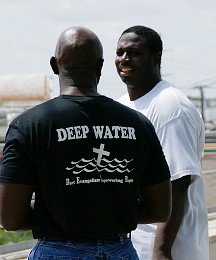
Robert Brown, former evangelism coordinator with Holy Communion Baptist Church in Dallas, helps a man looking for spiritual guidance.

Phillips named one success story after another of people who have gone from being homeless with drug problems to having jobs and being a part of the church. The program has an 80 percent success rate.

“They’re changing,” Phillips said. “I can see the change in them.”

This ministry opened his mind and gave him more respect for people who end up in this predicament, he said.

Phillips and members from his church also ride public transit trains and witness to the riders. “It’s one of the most fertile grounds I’ve ever seen for evangelism,” Phillips said. “Everyone we asked accepted Christ,” he said. “Most of the people on trains are struggling.”

About 22 people began a relationship with Christ in the few hours the church members ministered on the trains. The members rode as regular customers.

Phillips’s other job helps him be even more involved with his community. He works with the Dallas Fire Department where he sees life-and-death situations.

“It gives you a chance to see for yourself,” Phillips explained. “A pastor gets the people in the church and sees them there. When you’re hands on, you’re able to be in the community.”

“It feels like I’ve put out physical fires and spiritual fires,” Phillips said while assisting a person over the phone with an emergency.

On a public transit train, Micah Phillips, pastor of Holy Communion Baptist Church in Dallas, prays with a single, homeless mother of three.

Phillips wants to be more than a preacher and firefighter, though. He wants to film a reality show, which will portray the people in the program, so people will see the transformation and how successful residents become.

He also wants to publish a book about the ministry.

“I enjoy getting the message out,” Phillips said. He recently met with the pastors in the city. “If we collectively came together, we could really change the community.”

Holy Communion has received a van and other support from Inner Faith, a housing coalition that provides transitional housing, services and programs to the homeless in Dallas, said Linda Hall, executive director of Inner Faith.

“We see the tossed away people,” Hall said. “It’s through our service we show our Christian love.”

Hall and Inner Faith work to help homeless people learn how to support themselves, and working with these people has made her faith stronger, she said.

“Ministry to the homeless strengthens any community,” she said.


ETBU, Buckner work together to show Christ’s love in Honduras

SAN PEDRO SULA, Honduras—While world leaders focused their attention on a Summit of the Americas meeting here that attracted top officials from the Organization of American States, a group of East Texas Baptist University students quietly served two orphanages just outside the city.

East Texas Baptist University student Brittany Walters is all smiles with her new friend. (PHOTO/ETBU Public Relations)

The 15 students and a sponsor worked daily at Casitas Adolescente Home and the Heart of Mercy. And while their activity didn’t draw widespread media attention, participants believed they experienced God’s loving attention as they served the less fortunate.

“The most important thing God revealed to me was that it is not about us or what we did in Honduras; it’s what he did,” said junior Brittany Walters of Longview.

“God did not need us to accomplish his will in Honduras, but he allowed us to have the amazing privilege to be a part of his plan in sharing his word and his love with the people there.”

Working in cooperation with Buckner International, the ETBU group went to Casitas, an orphanage for sexually abused teenage girls, during the morning hours. The afternoons were spent at the Heart of Mercy orphanage for HIV-positive children.

Despite having a language barrier to overcome the group was able to communicate.

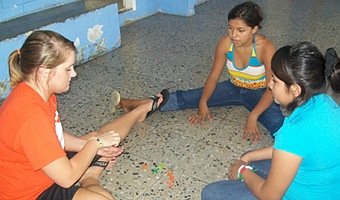
East Texas Baptist University student Kristen Cole (left) plays jacks with two teenage girls. A group of 15 from ETBU spent a week in Honduras ministering to children and teenagers in two separate orphanages. (PHOTO/ETBU Public Relations)

“God showed me that I did not have to be able to speak their language to build relationships with them,” said junior Mallory Harrell of Houston. “All I had to do was show God’s love as well as mine.”

“God did amazing things and took all of our plans, and turned them into something completely different,” said junior Christina Southard of Hallsville.  As the week unfolded, the group came to the understanding that their mission was to express love to the ones they came to serve.

“We did some Vacation Bible School activities with both homes, but we mainly just played, hugged, and talked with the kids,” said Rena McDaniel, a senior from Monroe, La. “It is truly amazing what God can do when you just love on people. Love speaks loudly in every language.”

Dane Fowkles, East Texas Baptist University director of major gifts, works with children on a Vacation Bible School project. (PHOTO/ETBU Public Relations)

“I saw the Lord reach these kids in a way that they may not have been reached before,” said Kenna Luttrell, a sophomore from Boise, Idaho. “Our group was able to give them more attention than they normally receive.”

“Every day we spent with the girls at Casitas and the children at Heart of Mercy, we did our best to smile and bring a little sunshine into their day,” Walters said.

“I have never been so proud of our ETBU students,” said Dane Fowlkes, ETBU director of major gifts, who accompanied the students to Honduras.

“Without exception, all 15 students pulled their weight and displayed sacrificial and cooperative spirit throughout the experience.”

Susan Williams, a graduate of ETBU and an office manager at Buckner International, also accompanied the group to Honduras.

“I loved working with this team because they were so willing, so eager to get to know the kids we were working with,” said Williams, who leads two or three mission trips a year. “I never saw anyone act like they were there to be an observer.”

A group of 15 students and one sponsor from East Texas Baptist University spent a week in Honduras this summer. The group worked in two orphanages that have a relationship with Buckner International. (PHOTO/ETBU Public Relations)

“The students ministered in heart-breaking circumstances, yet did so with love and compassion. They held children that many would have been afraid to touch,” Fowlkes said. “Most important was the hope they communicated with the adolescent girls as they developed meaningful relationships with them.”

The orphanages were located in a poverty-stricken area. “Poverty is everywhere,” Walters said. “Even on the streets where you see nice cars just like home, you could look to your right or left and see children driving horses and buggies trying to make money for their family.”

“I can tell you that the things we saw and experienced in Honduras were awful. And yet, at the same time, they were beautiful,” said senior Krystle Renfrow of New Caney. “It was heart-wrenching to see some rather severe living conditions and to have come to terms knowing that we were leaving soon to escape back to our lives of comfort in Texas.”

“It was so hard to leave those teenage girls, but I had to remember that his plans for them are better than any of mine could ever be,” Southard said. 

The ETBU students decided to collect an offering among them to meet a need in the girl’s home they discovered. Casitas Adolescente Home has a budget for 40 girls but had 92 in residence the week the students visited. The students collected enough money to buy chicken feed for five weeks.

“This offering was critical because they raise chickens to provide the eggs they need,” Fowlkes noted. “The offering also provided several weeks worth of powdered milk, processed meat, beans, and other food items.”

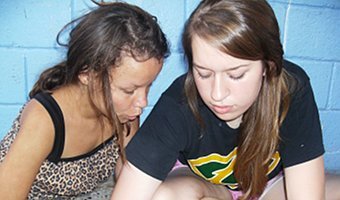
Hope Hodel, East Texas Baptist University student from Shreveport, La., teaches Sarahi some English. A group of 15 students from ETBU in cooperation with Buckner International spent a week in Honduras ministering to children and teenagers in two orphanages.

Not only was God at work during the groups time in Honduras, his activity also was seen in how the mission trip was formed and funded. 

“Our group is the first college aged group to do a mission trip to Honduras for Buckner,” said ETBU Great Commission Center Allan Thompson. “Dane in his work for the University was introduced to Lee and Susan Bush of Athens, who provided a major portion of the funds for the trip.” 

Lee Bush serves as a trustee of Buckner International. The Bushes, owners of Red Dot Building Systems, provided half the costs for each student to go. 

“Initially we were planning to send 10 students and a sponsor,” said Thompson. “I thought it would be difficult for the Great Commission Center to even find enough students willing to go to Honduras.  By the time plans were finalized for this trip, many of our students were committed to travel study abroad opportunities, the Concert Choir European tour, as well as other mission endeavors.”

“Lee and Susan became keenly interested in the vision and work of our Great Commission Center,” Fowlkes said. “They came up with the idea of providing seed money for 10 of our students to do a pioneer partnership mission trip with Buckner.”

“Honduras was chosen because it is a new venue for Buckner’s work internationally. A team from Red Dot Buildings preceded us in Honduras,” Fowlkes added.

“Our applications to go and serve in Honduras were more than we expected.” Thompson said. “The Bushes responded by providing additional funds to take 15 students to Honduras instead of 10.”

After the student group returned East Texas, several expressed hope it only marked the beginning of many trips to Honduras. 

“This new relationship with Casitas is an opportunity for ETBU to get involved in changing the world in a very specific, tangible way,” McDaniel said.

“We came back having been blessed beyond measure,” said junior Hope Hodel, of Shreveport, La. “No one wanted to leave, but now that we are back, all we want to do is continue to help them.”

Renfrow summed up the trip for many of the participants, saying, “We had the privilege to be the hands and feet of Jesus serving beautiful people who needed to be loved.”


Health science nominees live private faith behind public careers

WASHINGTON (RNS)—When President Obama named his choices for his administration’s two top medical posts, he chose people of private faith and public acclaim whose positions may put them out of lock step with fellow believers.

Francis Collins, 59, Obama’s nominee to head the National Institutes of Health, has differed from fellow evangelicals by supporting evolution and embryonic stem cell research.

Francis Collins, who mapped the human genome, counts riding his Harley-Davidson among his many eclectic interests. President Obama has nominated Collins, an evangelical Christian, to head the National Institutes of Health. (PHOTO/RNS/Peter Sachs)

Surgeon General nominee Regina Benjamin, 52, is a Roman Catholic who attended Catholic schools and was awarded a papal medal but, according to the White House, agrees with the president on “reproductive health issues.”

Obama’s choices reflect his hopes to “break the mold” of Washington politics and forge an administration with a wide range of perspectives, said Emilie Townes, associate dean of academic affairs at Yale Divinity School. In fact, she said, the choices of Collins and Benjamin demonstrate “big tent” evangelicalism and Catholicism.

“They’re going to be able to speak to a variety of people about a variety of issues,” she said. “They’re not going to be lambs to the slaughter or ideologues. They’re pragmatic people who understand how to get things done but also bring a vision for something more than just how things have been done.”

Philip Clayton, a theology professor at Claremont School of Theology in California, agreed. “Both choices reflect Obama’s pragmatic idealism,” he said.

Although Collins and Benjamin are known most for their scientific accomplishments— he headed the Human Genome Project, and she was the first African-American on the board of the American Medical Association—they have each publicly addressed their personal faith.

“When as a scientist I have the great privilege of learning something that no human knew before, as a believer I also have the indescribable experience of having caught a glimpse of God’s mind,” Collins said at the 2007 National Prayer Breakfast, during which he described his transition from atheist to believer.

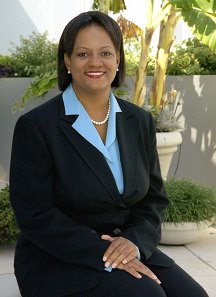
Regina Benjamin, a community doctor from rural Alabama, was nominated by President Obama to be the next surgeon general. (PHOTO/RNS/Courtesy Dept. of Health and Human Services)

He authored a book called The Language of God and more recently started the BioLogos Foundation, which aims to bridge divisions between science and religion. BioLogos officials said Collins would step down from its leadership if confirmed.

“Church was always a very important part of my life,” Benjamin told Catholic Digest in 2007. “I believe I am carrying on the healing ministry of Christ. I feel obligated to help continue his works.”

In the rural community of Bayou La Batre, Ala., Benjamin runs a medical clinic, which does not perform abortions. The 2008 MacArthur Fellow is a board member of the Catholic Health Association and has done missionary work in Honduras.

Still, the nominations of Collins and Benjamin have drawn some criticism.

While groups like Focus on the Family hailed Obama’s selection of an evangelical for the NIH post, its newsletter noted that anti-abortion proponents cannot completely affirm his stances, “particularly since he supports destructive human embryonic stem cell research.”

Bill Donohue, president of the Catholic League, initially gave Benjamin a ringing endorsement, saying, “Her tireless and selfless efforts are a model for all physicians.” But he opposed any possible support she might give “mandated abortion coverage” in pending health reform legislation.

Catholic leaders from her native Alabama say they have not heard Benjamin voice support for abortion rights.

“She is a practicing Catholic and faithful and, to the best of my knowledge, in all those questions that have arisen so far, there has never been a conflict in her practice and in her conversation with regard to what the church expects of medical practitioners,” said retired Archbishop Oscar Lipscomb of Mobile, Ala., who nominated her for the Pro Ecclesia et Pontifice papal medal she received in 2006.

Former Surgeon General David Satcher, who taught Benjamin as a student at Morehouse School of Medicine, said it is inappropriate to expect a surgeon general to act on religious beliefs.

“While the religion of the surgeon general may very well influence his or her … approach, the message has to be the public health science,” he said. “It’s not a religious message. It’s a public health science message.”

Some scientists, including University of Chicago ecology professor Jerry A. Coyne, have expressed qualms about Collins. “I’d be much more comfortable with someone whose only agenda was science, and did not feel compelled to set up a highly publicized website demonstrating how he reconciles his science with Jesus,” he wrote in his blog.

But others familiar with Collins’ work say there’s no reason to fear his faith.

“Francis is first and foremost a scientist, and he adheres to the highest standards of research and scientific integrity,” said Ted Peters, author of Playing God? Genetic Determinism and Human Freedom. “These standards are shared with people of different religious faiths as well as others who have no religious faith.”

Robert John Russell, director of the Center for Theology and the Natural Sciences at the Graduate Theological Union in Berkeley, Calif., said there’s no difference between elected officials serving as people of faith in a government position than what will be asked of Collins and Benjamin.

“If you get someone who’s exemplary in their profession and they are comfortable with their own faith stance and can be appreciative of other faith stances, then that’s an added value,” he said.


Venezuelan Baptists learn about Hands On Ministry

VALENCIA, Venezuela—Trying times are universal—as is the need for Christ, Chaplain Joe Jaime noted.

In Venezuela, Baptist churches are growing exponentially as people respond to the hope of Christ there. Christians are sharing their faith with their neighbors, testifying to the effect a relationship with God can have, he reported.

Venezuelan Baptists recently completed the Baptist General Convention of Texas’ Hands on Ministry course, a resource to help Christians minister in difficult times and crises. This is the first time the course has been taught in South America. (BGCT PHOTO)

But they want to do more. They want to be the hands of feet of Christ for those around them, a caring compassionate presence that reflects God’s love and draws them to him, Jaime said.

To help them, nearly 200 Venezuelan Baptists in two cities recently completed the Baptist General Convention of Texas’ Hands on Ministry course, a resource to help Christians minister in difficult times and crises. It marked the first time the course has been taught in South America.

The effort is part of an ongoing partnership between the BGCT and the Venezuelan Baptist Convention. Oscar Quintana taught the first courses in January and Jaime completed the instruction in June in Valencia and Maracaibo. Both are chaplains endorsed by the BGCT.

“We’re teaching pastoral skills, pastoral ministry, how do you reach the heart of the person, how do you respect their religious background, their religious identity,” Jaime said. “We’re helping them understand when you can provide this kind of respect to them, they will ask questions about your faith.”

The trip provided an opportunity for Jaime to share some of what he’s learned as he has served as a chaplain in the Valley Baptist Health System. The chaplaincy field is relatively new in Venezuela and is expanding across the nation.

“I was interested in going and teaching,” Jaime said. “I like to teach. The idea of sharing some of the experiences and knowledge I’ve accumulated—I’ve served for 36 years as a chaplain at Valley Baptist Health System and worked every corner of this hospital—was exciting to me.”

Jaime believes the Hands on Ministry course will be helpful as Venezuelan Baptists reach out to hurting people around them. It will strengthen their ministry and help more people come to Christ.

“The churches are evangelistic,” he said. “They’re reaching out. They’re sharing the gospel. But they’re also concerned with social needs.”

For more information about the BGCT’s Hands on Ministry courses, call Reba Gram at (888) 244-9400. For more information about mission opportunities in Venezuela, contact Steve Seaberry at the same number.


Texas Baptists test-launch statewide Bible distribution plan

EL PASO, Texas (ABP) — Baptists in El Paso distributed nearly 250,000 CDs containing selected Scripture passages and Christian testimonies in a pilot launch of a campaign to share the gospel with every un-churched person in the state by Easter 2010.

Texas Hope 2010 is the brainchild of Randel Everett, executive director of the Baptist General Convention of Texas. The project aims to put bilingual multimedia discs into all of the state's 8.8 million homes. 

"We want to make sure every person in Texas has an opportunity to respond to the gospel of Christ, regardless of their ethnicity, language or socioeconomic status," Everett said.

This is the cover for the CD.

Each disc includes the Gospel of John in English and Spanish that can be played on either a CD player or a computer. Those with computers can watch video testimonies of individuals describing the difference Christ makes in their lives. With Internet access, they can link to a website where they can download the New Testament in any of more than 350 languages and a 24/7 live online chat about becoming a Christian.

Baptists in El Paso are distributing CDs through churches, which hand them out door-to-door or by mail to every household in their community. The project goes statewide in January, along with statewide discipleship follow-up to continue through 2010.

The Bible distribution effort is just one part of Texas Hope 2010. It also urges Texas Baptists to pray daily and to raise $1 million for the state's hungry in each of the next two years.

Texas has the second highest rate of food insecurity in the nation. More than 3.1 million people in the state don't know where they will get their next meal, and nearly a quarter of the state's children live in food insecure households.

"One in 10 people in Texas is a Texas Baptist," Everett said. "With those kinds of resources, if one person in this state goes to bed hungry, it's our fault."

Everett acknowledged that sharing the gospel with 11 million people might seem daunting, but he noted there are 2.3 million members of churches affiliated with the BGCT. That means each Texas Baptist would need to share his or her faith with six un-churched people by April 4, 2010, which Everett believes is possible.

Everett, elected as executive director in February 2008, launched Texas Hope 2010 in a staff meeting in May 2008. 

The program will be implemented by an 82-member iHope Activation Team made up of a cross section of Texas Baptist associational directors of missions, ministers and laypeople from across the state. It is broken into smaller groups with specific expertise and passion about an area such as prayer, caring outreach and evangelism. 

"We're just casting a vision for what it would look like if the followers of Jesus engaged in His model of prayer, care and share for the community," said Gary Singleton, pastor of The Heights Baptist Church in Richardson and co-chair of the activation team.

Everett says the key to the effort is for all Texas Baptists to follow God's calling upon their lives and to cooperate with the other Texas Baptists for maximum impact. If that happens, he said, the state could be radically changed.

"I pray that church attendance, baptisms and giving will go up," he said. "I hope crime will go down. I hope legislation is passed to help the children in need in our state. I hope it makes a transformational impact on the state. I think it will if we can do this."


This story was compiled from news releases by John Hall, news director for the BGCT. Bob Allen also contributed.


Baylor search committee develops presidential profile

WACO—Baylor University is looking for a mature Christian, a Baptist and a “servant leader” committed to academic excellence to become the school’s next president.

Baylor’s president should possess “a firm and comprehensive understanding of the Christian intellectual tradition and an appreciation for Baylor’s Baptist heritage,” according to a profile approved by the presidential search committee.

While the university’s 14th president may hold a doctorate, the search committee also apparently would consider a leader who has demonstrated solid executive leadership experience, including financial management.

Baylor’s next president should “possess a terminal degree and a successful record of academic administration or demonstrated success in executive leadership with an understanding and appreciation of the nature and goals of institutions of higher education,” the profile says.

The president also needs to have “a proven record of working in a collaborative manner with a governing body,” which in Baylor’s case means the board of regents.

The search committee worked with Jerry Baker—head of a national search firm based in Atlanta, Ga.—with the help of the presidential search advisory committee and with input provided during listening sessions with students, faculty, staff, alumni and community members, to develop the profile.

A presidential search prospectus has been developed, and personal contact with prospective candidates and paid advertising for the position will begin next month, the committee reported following a recent meeting, held to coincide with the Baylor University board of regents summer retreat.

“We’ve enjoyed a collaborative process with discussions that have been spirited, thought provoking and, ultimately, very instructive,” said Joe Armes of Dallas, chair of the presidential search committee.

“We are indebted to the members of our advisory committee who have sacrificed so much of their time to participate in the composition of the presidential profile, and we look forward to benefiting further from their involvement as our search continues.”

Ken Hall, president and CEO of Buckner International and chair of the presidential search advisory committee, praised the inclusiveness of the process.

“Having been engaged in the listening sessions, the presidential search advisory committee actively participated in the development of the presidential profile,” Hall said.

“We spoke for the views that were expressed during the listening sessions, as well as the views of the individual groups we represent. Throughout the process, our input was welcomed and is now reflected in the presidential profile. As we begin the call for nominations, members of the advisory committee will solicit and welcome the suggestions of our various constituencies.”

The committee learned much from the listening sessions, Armes noted.

“Each participant’s contribution has informed the writing of the position description,” he said. “Additionally, the committee has received a number of recommendations for the position which have been forwarded to the search firm for inclusion in the consideration process. We again thank everyone who came forward and spoke out of their deep love for and commitment to Baylor University.”

Listening sessions were held in locations throughout Texas in April and May. An online form also was posted at http://www.baylor.edu/president/search/ for the “Baylor family” to provide input regarding the university’s next chief executive.

Baylor’s president is expected to “articulate and exemplify the mission, foundational assumptions and core convictions” of the university, according to the presidential profile. The profile outlines desired qualifications regarding academic vision, professional experience, leadership style and personal attributes.

The next president should “be fully committed to and supportive of faculty as teachers and scholars” and possess a commitment to undergraduate, graduate and professional education, the profile says.

Baylor’s president also should “be able to engage, shape and, where appropriate, challenge the nation’s dominant intellectual discourse” and “understand global trends in higher education and be committed to enhancing Baylor’s national preeminence in Christian higher education.”

The president should be an effective communicator who is able to represent Baylor to donors,  “be able to inspire all constituencies to support the institution” and possess the ability to “build a strong leadership team to manage a large, complex academic institution and work effectively with diverse constituencies,” the profile says.

In terms of leadership style, the search committee is seeking “a servant leader, able to lead, inspire and encourage” people to follow. The president also should be “humble, approachable, a good listener” and possess a sense of humor, and be transparent and collaborative.

The president needs to be committed to racial, ethnic, economic and gender diversity and be able to “bring all constituencies to actionable consensus,” the profile says.

Baylor’s next president should be a Baptist and “a mature Christian with a vibrant faith” who possesses “a powerful affinity for and commitment to the mission, foundational assumptions, core convictions and traditions of the university.”

The university’s chief executive also should be willing to take on community leadership roles, have a love for students from diverse backgrounds and “possess a deep sense of calling and vocation to the presidency of Baylor.”


Baylor regents seek to learn ‘best practices’ of governance

WACO—A panel of national experts discussed “best practices” for governing boards of universities at the Baylor University’s board of regents annual retreat.

Panelists for the “best practices” discussion included:

•    James Huffines of Austin, chairman of PlainsCapital Bank and senior executive vice president of PlainsCapital Corp. Huffines has served on the University of Texas System Board of Regents since 2003 and was chairman from 2004 to 2007.

•    David Laney of Dallas, an attorney with a law and transportation consulting practice who served as chair of the Texas Transportation Commission. Laney was appointed to the board of directors of Amtrak in 2002, and was elected chair of Amtrak’s board in 2003. He served on the Stanford University Board of Trustees from 1998 to 2003.

•    Drayton McLane Jr. of Temple, chairman of the McLane Group and chairman/CEO of the Houston Astros. McLane served on the Baylor Board of Regents from 1989 to 2006. He was chair of the Baylor board from 2002 to 2004.

•    Philip W. Norwood of Charlotte, N.C., president and CEO of Faison Enterprises. Norwood was a member of the board of trustees of Washington and Lee University from 1998 to 2008, serving as the chair from 2003-2008.

Among the topics discussed were developing vision and strategy for a university, aligning board priorities with university vision and strategy, implementing effective committee practices, recruiting board members and university fundraising.

In regular business, regents approved $3.9 million in requests that comprised the 2009 summer review, part of the university’s ongoing practice of reviewing current budget savings and making reallocations to enhance university programs and services.

“At a time when many other private and public universities nationally are delaying projects, deferring maintenance of university facilities and postponing the hiring of needed faculty and staff, Baylor is moving forward to ensure that our students continue to receive the highest quality education that we can provide,” Regents Chair Dary Stone of Dallas said.

“This is due in large part to sound business practices at the university, and the generosity of Baylor’s many alumni and friends. I commend President David Garland and the administration, faculty and staff for being responsible stewards of the resources entrusted to them, and I thank Baylor’s many supporters for their continued commitment to Baylor.”

New staff positions were approved in geology, art and enrollment management, among others, while non-personnel requests were approved for the build-out of space for the environmental science department on the fourth floor of the Baylor Sciences Building along with initiatives to improve security and accessibility in several areas of the campus.

Baylor selected competitive cheerleading to become its 11th women’s intercollegiate athletics sport program, effective with the 2010-2011 academic year. Baylor, which currently fields 18 varsity teams, will become the first Big 12 institution to implement a varsity competitive cheer program and one of three Bowl Championship Series members nationally, joining the University of Maryland and the University of Oregon.

A recent survey of Baylor’s female undergraduate students revealed that competitive cheer was the overwhelming choice to become the school’s next varsity sport for women.

The meeting also included the presentation of the university’s annual report for the previous year. Garland offered updates on progress made in achieving the imperatives of Baylor 2012, the university’s 10-year strategic plan. Among the highlights of the past year were:

•    Increasing the number of doctoral programs. Doctoral programs grew from 19 to 21 in the past year.

•    Making progress for fiscal support of research. Total research and sponsored activity expenditures grew to more than $14 million.

•    Meeting the growing demand for on-campus housing. The percentage of undergraduates living on campus increased to 39 percent during the past year, showing that students are eager for the Baylor residential experience.

•    Creation of the university’s ninth living-learning center, which allows students to enhance their education by connecting their residential experience with their academic major or a related interest. The Entrepreneurship Living-Learning Center has been created for students from the Hankamer School of Business.

•    Increasing minority enrollment. Undergraduate minority enrollment grew to 28.8 percent.

•    Increasing the focus on community service. Students contributed almost 70,000 hours to community service projects, up from 56,400 hours the previous year. The university also created the office of community relations.

•    Enhancing alumni engagement.  From June 1, 2007 through May 31, 2008 the Network hosted 555 events in 55 communities in Texas and six communities outside Texas. A total of 17,347 constituents registered for these network activities.

•    Construction of the Simpson Athletics and Academic Center and the McMullen-Connally Faculty Center.  The Simpson Center houses innovative athletic training equipment and academic programs for all student-athletes. The McMullen-Connally Center provides state-of-the-art meeting space for faculty and staff interaction and features more than 300 pieces of art.

Another feature of the three-day meeting was a dinner for regents and welcomed guests hosted by Waco residents and Baylor supporters Nell and Jim Hawkins at their home.

Among those in attendance were Jay Allison, president and CEO, Comstock Resources Inc., of Frisco and Jenny Allison, past-president, Baylor Women’s Council of Dallas; Ken Carlile, co-chairman, Carlile Companies, his brother, Steve Carlile, chairman/CEO, Home and Garden Party, and Penny Carlile, president of Home and Garden Party, all of Marshall; Paul Foster, president/owner, Western Refining Co., El Paso; Bob Perry, chairman of the board at Perry Homes Ltd., Houston; Walter Umphrey, senior managing partner, Provost & Umphrey Law Firm, Beaumont; and John Eddie Williams, founding partner and attorney, Williams Kherkher, Houston.
 
 Based on information provided by the Baylor University office of media communications.