




A fertilizer plant explosion on April 17, 2013, forever changed West, a small Central Texas town just north of Waco. Its impact also is still felt by First Baptist Church in West and its pastor.
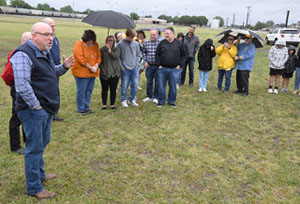
Four days after the explosion that claimed 15 lives and damaged or destroyed more than 150 buildings, First Baptist Church was unable to worship inside its building, because that area was cordoned off by law enforcement. So, the congregation worshipped outdoors in a field on the other side of town.
Each year since then, the church has continued to meet for worship in that same field on the Sunday following April 17 for a service of remembrance.
This year, rain and cold wind compelled the congregation to move the worship service to the church sanctuary. But after the benediction, Pastor John Crowder and a small group went across town to that familiar field for a brief time of prayer, even as rain fell.
“We just felt like we had to be there,” said Crowder, who has been pastor 28 years at First Baptist in West.
‘A lot of emotional healing’
Driving around town, the changes in West 10 years after the deadly explosion are readily apparent, he noted.
Nearly all of the buildings in the north part of town—the area in the blast zone—have been constructed in the past decade. West has three new schools, a new Emergency Medical System and many newly built homes.
“It’s good to see that people here wanted to stay and rebuild,” Crowder said. “And we have a lot of new people who have chosen to move here.”
Fraternal orders, service organizations, social agencies and faith communities in West that operated independently before the explosion function more cooperatively now, he noted.
Sign up for our weekly edition and get all our headlines in your inbox on Thursdays
“Now there’s greater communication with each other and a willingness to work together. We support each other more,” Crowder said.
Below the surface, the town’s longtime citizens who went through the trauma of the explosion also were shaped by the experience, he noted.
“A lot of emotional healing has taken place,” he said.
Church committed to community impact
First Baptist Church was transformed not only by the disaster, but also by the experience of relief and recovery, Crowder observed.
“It has brought us closer together,” he said. “A lot of times, families will say it took a tragedy to bring them closer, and that can be true of the church, also. I think we trust each other more and are more supportive of each other.”
When the explosion occurred, First Baptist Church responded rapidly, he recalled.
“We didn’t have any meetings to decide what to do. We just got busy,” Crowder said.

Through its partnerships with Waco Regional Baptist Association, TBM and Texas Baptists, the church was able to offer resources to neighbors in need.
First Baptist Church—which had always been seen as almost peripheral to the predominantly Catholic community—became known as a hub of activity.
From hosting TBM disaster relief volunteers to housing student missions groups who helped with recovery and rebuilding efforts, the community saw a church that opened its doors and its heart to serve its neighbors.
“It gave us a clear vision of serving our community,” Crowder said. “It kind of defined us in the community. We earned trust.”
In the process, the church gained a clearer sense of mission and purpose, he noted.
“We want to be salt and light—to make an impact on our community in a positive way, Crowder said.
In fact, community impact now is one of the “five plumblines” First Baptist Church uses to keep itself true to its vision, along with giving God their best, focusing on church health, small-group involvement and God-centered worship, he noted.
The church experienced “somewhat of a spiritual awakening” as a result of the tragedy in its community and the ministries that resulted from it, Crowder said. Individual church members gained a new perspective, he added.
“When somebody’s world is shaken, you see what is really important,” he said.
Share lessons learned
Crowder acknowledged he also gained a new sense of purpose.
“I already had a clear sense of calling to the pastoral ministry and to this particular community,” he said. “But after what we experienced, I have a real desire to help other churches in other communities benefit from what we learned.”
Crowder has written about the process of moving from disaster relief to disaster recovery. In light of the COVID-19 pandemic, he wrote about the nature of life-changing events and the importance of being truthful about the long recovery process. After a school shooting in Uvalde, he offered counsel on ways to help grieving communities.
“If you look around the typical pastor’s library, you will see books on theology, counseling, administration and leadership. You’re not likely to see books on what to do when your world falls apart,” he said. “That’s understandable. We don’t want to think about it.”
Crowder makes no claims about being an expert, but does want to help other pastors learn what they can from his experiences.
“Maybe I can just give them a little bit of a head start,” he said. “Instead of reinventing the wheel and learning from scratch, maybe we can help them start out a few steps ahead.
“Then, when they share their experiences with a pastor in the next community that has a disaster, they might even be able to start two or three more steps down the road.”






We seek to connect God’s story and God’s people around the world. To learn more about God’s story, click here.
Send comments and feedback to Eric Black, our editor. For comments to be published, please specify “letter to the editor.” Maximum length for publication is 300 words.