Power central to tension between Jesus and Pharisees

Misreading the tension between Jesus and the Pharisees historically fostered antisemitism and contributed to the Holocaust, New Testament scholar Scot McKnight told a gathering at East Texas Baptist University.

“I believe we have misunderstood the Pharisees—misinterpreted the Pharisees—to significant and substantive damage in culture and society, and the Holocaust is connected to this,” McKnight said.

Delivering the Frank and Pauline Patterson Lectures at the Spring Colloquy of ETBU’s B.H. Carroll Theological Seminary, McKnight encouraged Christians to adopt an “empathy for people of the past” as they seek to understand the truth about the Pharisees.

“Truth is found by those who risk it all in its pursuit, and I contend it cannot happen without empathy,” he said.

Consider a ‘constellation’ of issues

Rather than focusing on a single issue, such as sabbath observance, the tension between Jesus and scribes, Pharisees and temple officials may be understood best as a “constellation” of issues.

“The conflict between Jesus and the leaders at Galilee, including the Pharisees, was multilayered, complicated, religious, social, political and economic,” McKnight said. “In other words, it was about power.”

Those who held power viewed with suspicion and distrust the kingdom of God vision of Jesus as outlined in Luke 4, he noted.

“To understand Jesus, one has to begin where he himself staked his claims—with a vision of radical social and economic justice, with Jubilee, with his vision to turn the nation into an agent of economic generosity and justice,” McKnight said.

The temple authorities were the incumbent elites who held power, while the “kingdom network” of Jesus was an insurgent movement of the common people, he observed.

“We ought to emancipate the Pharisees from the relentless Christian stereotype of hypocrisy and rediscover them as but one actor in a complicated network of power, negotiation, beliefs, practices and social stability,” he said.

Different perspective on Pharisees

Looking at nonbiblical sources from the first century, McKnight painted a different picture of a Pharisee than the stereotype of a legalistic hypocrite.

“When you think of a Pharisee, think of a spiritually formed person. Think of an idealistic person who is passionate about God and the Bible,” he urged.

“Think of ordinary folks whose lives embodied holiness and justice. And think of those who had the capacities of influencing society.”

Christians have tended to view the conflict between Jesus and the Pharisees as focused on theology and the doctrine of salvation, he observed. Instead, he suggested, the differences centered more on how faith is lived.

Judaism—particularly the law as understood by the Pharisees—should not be viewed as a systematic theology but as a way of life and system of practices, McKnight said.

‘Woe unto you …’

Many of the Christian stereotypes surrounding Pharisees—and Jews in general—have grown out of a misreading of Matthew 23, New Testament scholar Scot McKnight told a group at East Texas Baptist University. (Screen Capture Image)

Many of the Christian stereotypes surrounding Pharisees—and Jews in general—have grown out of a misreading of Matthew 23, he asserted.

Too often, Christians’ stereotypes of Jews as legalists and hypocrites have given rise to antisemitic rhetoric and violent actions, ultimately leading to the Holocaust, he insisted.

“Matthew 23 is not an oracle of doom but an emotion-laden lament. It is the heart cry of a prophet who had delivered the message of God to an unresponsive people of God,” McKnight said.

“Jesus really did disagree deeply and dramatically with the scribes and Pharisees, but he was not spewing hatred. He was weeping over the culture the scribes and Pharisees had formed.”

Law book or life book?

Jesus actually agreed with the Pharisees that the law had to be interpreted, expanded and amplified, McKnight observed. But Jesus disagreed deeply with the way in which the Pharisees did it, without compassion and pastoral care.

“Jesus lamented that the expansions of the Torah by the Pharisees were burdensome to ordinary people,” McKnight said.

“The interpreters of the law were doing damage to walking in the true way of the law.”

The scribes, Pharisees and temple authorities viewed the Torah as “both a life book and the law book,” he said.

Jesus agreed the law needed to be applied to everyday life, but he gave greater weight to its principles of justice, compassion and faithfulness.

“The foundational difference between the Pharisees and Jesus was communal,” McKnight said.

It was a conflict between the temple community who possessed power and Jesus’ “kingdom network,” he said.

As McKnight emphasized at several points, “Power is always at the heart of social conflicts.”



House abolishes Lottery Commission, moves game

The Texas House of Representatives voted to dissolve the Texas Lottery Commission and move the operation and administration of the lottery to the Texas Department of Licensing and Regulation.

Texas State Capitol (Bigstock Image)

Rep. Charlie Geren, R-Fort Worth, presented the House substitute to SB 3070, the bill approved unanimously by the Texas Senate. Geren said he wanted to put “guardrails around the operation of the lottery,” while ensuring its continued operation.

Sen. Bob Hall, R-Edgewood, author of SB 3070, previously had introduced legislation to do away with the state lottery altogether. In presenting SB 3070 in a Senate Committee on State Affairs hearing, Hall called the compromise bill “the next best thing.”

Put the lottery ‘under a bright light’

Among other reforms, the bill in both its House and Senate versions bans lottery couriers—third-party companies that enable customers to purchase lottery tickets through their websites or mobile phone apps.

The bill requires retailers to develop age verification tools to prevent the sale of lottery tickets to minors.

It also makes the lottery subject to regulatory review, although the House and Senate versions of the bill set different dates by which the review must be completed.

Rob Kohler, consultant with Texas Baptists’ Christian Life Commission, said the lottery will be operating “under a bright light” under the Texas Department of Licensing and Regulation.

Differences between the House and Senate versions of the bill will need to be reconciled before it goes to Gov. Greg Abbott to sign into law.

Before voting to approve the bill moving lottery operations and oversight to the Texas Department of Licensing and Regulation, the House rejected an amendment by Brent Money, R-Greenville, to abolish the lottery altogether.

Even when state lotteries operate as they are intended, they still are “shameful,” Money said, because they “disproportionately burden low-income Texans who spend a higher share of their income chasing false hopes.” The House defeated Money’s amendment 71-58.

Mired in investigations and lawsuits

The Texas Lottery Commission is the subject of several investigations and lawsuits.

In February, Gov. Greg Abbott ordered the Texas Rangers to investigate both an April 2023 bulk purchase of lottery tickets that enabled a group to claim a $95 million jackpot and a more-recent $83.5 million win involving lottery couriers.

Attorney General Ken Paxton also announced his office was launching its own investigation into the Texas Lottery to determine whether any state or federal laws were broken.

Ryan Mindell resigned on April 21 after one year as executive director of the Texas Lottery Commission. About that same time, several news outlets reported Gary Grief—who served more than 30 years as executive director of the commission—went missing, and some authorities feared he fled the United States.

Two former executives with Lottery.com who have been linked directly to Grief and other former high-ranking Texas Lottery Commission officials recently pleaded guilty to participating in a complicated securities fraud scheme.


House approves Ten Commandments display mandate

The Texas House of Representatives voted to approve a bill mandating the display of the Ten Commandments in every public-school classroom.

The Texas House voted 88-49 on May 24 to give its initial approval to the bill. It granted final approval to an amended version by an 82-46 vote the next day.

Rep. James Talarico, D-Austin, pointed out the initial vote in the House was being held on the Jewish Sabbath and the final vote on the traditional Christian day of worship, in spite of the commandment to remember the Sabbath and keep it holy.

“Is that ironic or what?” the bill’s sponsor, Rep. Candy Noble, R-Lucas, responded.

Talarico, a seminary student, asked Noble, “Would you be willing to postpone your bill so that we’re not breaking the Ten Commandments by working on the Jewish or Christian sabbath?”

Noble said lawmakers were under a time “crunch.” She observed the House already would have voted on the measure several days earlier if Talarico had not raised a point of order that delayed its consideration.

Talarico later posted on X, the social media platform formerly known as Twitter: “Texas Republicans just passed a bill forcing every teacher to post the Ten Commandments in their classroom. They passed it on the Sabbath … breaking the 4th Commandment. Maybe they should try following the Ten Commandments before mandating them.”

Emphasis on ‘history and tradition’

Noble, a member of Prestonwood Baptist Church in Plano, stressed the bill is “about honoring our historic educational and judicial heritage.”

“The displaying of the Ten Commandments in our Texas classrooms will bring back the historic tradition of recognizing America’s foundational heritage in both our educational and our judicial systems and remind students of the importance of this cornerstone of American and Texas law,” she said.

She cited the Supreme Court’s ruling in Kennedy v. Bremerton School District, in which the court established a “history and tradition” test to determine if government actions violate the Establishment Clause of the First Amendment.

“Nothing is more deep-rooted in the fabric of our American tradition of education than the Ten Commandments,” Noble said.

The bill stipulated the exact wording of the Ten Commandments—an abridged version of Exodus 20:2-17 from the King James Version of the Bible.

Jews, Catholics and Protestants number the commandments differently, and their wording varies.

Noble said the prescribed wording of the Ten Commandments included in the bill replicates the words inscribed in a monument near the Texas Capitol.

“This monument and the words on it have already been approved and upheld by the Supreme Court in a 2005 case, so the wording won’t need to be subject to a new court case objection,” she said.

Still needs final Senate approval

The final amended version of the House bill stipulated the state will be responsible for legal fees if a local school district is sued over the Ten Commandments display.

The amended version must go back to the Senate for final approval, since it differs from what the Senate approved 20-11 in March.

SB 10, sponsored by Sen. Phil King, R-Weatherford, requires each public school classroom to display a poster at least 16 by 20 inches with the prescribed wording of the Ten Commandments.

If the amended bill passes the Senate, it advances to Gov. Greg Abbott, who is expected to sign it into law.

A federal court ruled unconstitutional a similar bill in Louisiana, saying it violates the Establishment Clause of the First Amendment. The state is appealing that decision.

Earlier in the session, Texas lawmakers approved a bill that allows school districts to set aside a prayer or religious study period in school.


Bill requiring air conditioning in Texas prisons passes House

The Texas House passed May 16 a bill requiring prisons to have air conditioning by the end of 2032.

Lawmakers passed 79-39 House Bill 3006 by Terry Canales, D-Edinburg. If the Legislature or the federal government allocates funding, it will require the installation of climate control in phases to be completed by the end of 2032. The bill now will face its last hurdle in the Senate.

“The bill targets key housing units and medical spaces, kitchens, and administrative offices in state prison facilities to ensure the most critical spaces are temperature-controlled,” said Rep. Eddie Morales Jr., D-Eagle Pass, a co-sponsor of the bill, told lawmakers.

The bill mandates the Texas Department of Criminal Justice purchase and install climate control systems to ensure temperatures are maintained between 65 and 85 degrees in certain areas. The installation will occur in three phases, capped at $100 million per phase, and completion is set for 2028, 2030 and 2032.

However, advocates are only a little bit hopeful the bill survives the Senate and even if it does, they worry the phased process will take too long.

“People are being hurt and tortured by the Texas heat and it’s simply not good enough to have a phased-in approach. We have the funding. Just get it done as quickly as possible,” said Erica Grossman, a Colorado attorney, who represents inmates who are suing Texas over its lack of air conditioning in state prisons.

This session, four prison heat-related bills filed by House members have been referred to the House Corrections Committee: HB 1315, HB 2997, HB 3006 and HB 489. However, Canales’ bill was the only one to make it out of committee.

Officials from the Texas Department of Criminal Justice, which oversees the state’s 101 prison facilities, asked lawmakers for $118 million over the next biennium to install air conditioning in about 11,000 units. Even if lawmakers grant that request, millions more will be needed to get to the at least $1.1 billion the TDCJ says will be needed to fully air condition its prisons.

Since the House Corrections Committee wrote in its 2018 interim report to the Legislature that TDCJ’s heat mitigation efforts were not enough to ensure the well-being of inmates and the correctional officers who work in prisons, lawmakers have tried to pass bills that would require the agency to install air conditioning. None of those bills made it to the governor’s desk.

Slow progress

During that time, TDCJ slowly has been installing air conditioning. The department also has added 11,788 “cool beds” and is in the process of procuring about 12,000 more.

The addition is thanks to $85.5 million state lawmakers appropriated during the last legislative session. Although not earmarked for air conditioning, an agency spokesperson said all of that money is being used to cool more prisons.

Still, about two-thirds of Texas’ prison inmates reside in facilities that are not fully air conditioned in housing areas.

Indoor temperatures routinely top 100 degrees Fahrenheit, and inmates report oppressive, suffocating conditions in which they douse themselves with toilet water in an attempt to cool off. Hundreds of inmates have been diagnosed with heat-related illnesses, court records state, and at least two dozen others have died from heat-related causes.

“For years, there has been a huge understaffing crisis in the Texas prisons, a crisis that will not be fixed until there is air conditioning. I encourage anyone who questions these bills to spend five minutes in one of these prisons. Officers are suffering along with the inmates,” Grossman said.

“Texas will be spending millions of dollars either way: They will be paying lawyers and settlements to the people they hurt and kill, or they could finally just fix the problem,” Grossman added.

The pace at which the state is installing air conditioning is insufficient, U.S. District Judge Robert Pitman wrote in a 91-page decision in late March. The lack of system-wide air conditioning violates the U.S. Constitution, and the prison agency’s plan to slowly chip away at cooling its facilities—over an estimated timeline of at least 25 years—is too slow, he wrote.

Sen. Joan Huffman, a Houston Republican who chairs the Senate Finance Committee, said in an emailed statement the supplemental appropriations bill will include the $118 million TDCJ requested to fund approximately 11,000 new air-conditioned beds. It also will include $301 million to construct additional dorms—which the prison agency requested to accommodate its growing prison population—and those new facilities all will be air-conditioned.

An internal investigation also found TDCJ has falsified temperatures, and an investigator hired by the prison agency concluded some of the agency’s temperature logs are false.

Citing that report, Pitman wrote: “The Court has no confidence in the data TDCJ generates and uses to implement its heat mitigation measures and record the conditions within the facilities.”

Ways to help

John Litzler, Texas Baptists’ CLC Public Policy director, has been advocating for HB 3006, hoping to help get temperature controls in Texas prisons into law this legislative session.

As of May 22, the bill has yet to be assigned to a committee in the Senate, and that’s “not a good sign,” he said.

Texas Baptists and others who are concerned about humane conditions for all Texas prisons still can make a difference, he noted.

Two actions could help, Litzler said. First, concerned individuals can “call the lieutenant governor’s office and ask that HB 3006 be assigned to a Senate committee, so it can be set for a hearing.” That number is (512) 463-0001.

Litzler suggested it also might help to call the offices of Sen. Huffman and Rep. Greg Bonnen, R-League City, who chairs the House Appropriations Committee. Sen. Huffman can be reached at (512) 463-0117 and Rep. Bonnen at (512) 463-0729. Litzler urged callers to ask these legislators to put “every available dollar they can put into the appropriations bill for that purpose.”

With additional reporting by Calli Keener.


Renewed vision helps Waco church reach next generation

WACO—Over the past 12 years, revitalization and a renewed vision at Highland Baptist Church in Waco have served as the catalyst to help bring revival among their community and a desire to reach “a new and next generation with the gospel.”

“Highland is 102 years old, but it is filled each Sunday with 18- to 25-year-olds,” said Pastor John Durham.

Since Durham began serving at Highland in 2013, the church has seen tremendous growth, as it strategically shifted its efforts toward reaching this demographic.

“Revitalized churches are the wave of the future if the American church is going to continue to reach others for the gospel,” Durham said. “Highland has grown from 1,400 to 4,400 in 11 years, and the major growth has taken place with middle school, high school, college students and young families.

“Some decisions had to be made to reach a new and next generation. Some of the decisions were common sense, but others were difficult to make and navigate.”

The church set a goal of creating a healthy church that is multigenerational and multinational, Durham explained.

“Some of the strategies toward that goal included being very intentional about forming a sense of family and warmth and hospitality, celebrating the different nationalities of members at Highland, putting a high value on authenticity and accessibility of leadership and then dialing down stoicism and formality and dialing up a high view of Scripture, corporate prayer and expressive worship,” he said.

Durham notes the church now has 61 nationalities represented in its membership. He also said that this year the church is on track to baptize 150 people, and the vast majority of those are in the 15- to 25-year-old range.

Love for Waco, love for students

As someone who grew up in Waco and graduated from Baylor University, Durham holds two things close to his heart—the Waco community and college students. He returned to his hometown after serving for almost 12 years as the senior pastor at First Baptist Church in Irving. Before that, he served for 10 years as the student pastor at First Baptist Church in Houston.

“That age window of 18 to 25 is so formational,” Durham said. “Students and young adults are making decisions on faith, friendship, calling, scriptural authority, local church priority and what is real.

“If that demographic can move beyond faith information into Christ-honoring transformation, you will see another great awakening in our nation. And if prayer, evangelism and passion for Jesus are indicators of awakening, I believe we are on the threshold.”

The years between age 18 and age 25 were “formational” for Durham as a Baylor student and young student pastor, he noted.

“So of course, as a church we want to invest a lot of resources, love, support and discipleship into that generation,” he said. “On a given Sunday morning at Highland, about one in three worshippers are in that age range of 18 to 25, so about 1,500.

“And when you add in our preschool ministry, kids ministry, shine ministry for kids with special needs, middle school ministry and high school ministry, that is closer to 2,200 people under the age of 25 on a Sunday morning. That is exciting.”

Unity, prayer and a sense of expectation

While reflecting on the changes he has seen in Waco through the years, Durham is encouraged and sees renewed opportunities to reach the community with the gospel.

“There is a spiritual condition of unity and prayer and expectation that is very new,” he said. “When I talk to those who have been around for decades here, they sense it and agree that there are some undercurrents of spiritual renewal here in Waco that is based on prayer movements and unity movements and new converts to Christ.”

Before beginning to preach three services on Sundays, Pastor John Durham of Highland Baptist Church in Waco gathers weekly with a group of 80 to 100 men to pray at 8 a.m. The majority of the men are college age. (Submitted photo)

Before beginning to preach three services on Sundays at 8:40 a.m., 10 a.m. and 4 p.m., Durham gathers weekly with a group of 80 to 100 men to pray at 8 a.m. The majority of the men are college age.

The church is intentional in its community outreach, Durham said, building a Wellness Center to address neighbors’ needs.

The Wellness Center provides urgent care for medical needs and assessment, ESL classes, birthing classes, citizenship classes, finance classes, computer training and more. The center has resulted in salvations, church connections and new friendships with Highland Baptist’s community.

The center is for “outreach to the people God has put around our church,” Durham said.

‘A place for help and hope’

“It is a place of help and hope. We really wanted to draw basically a 1-mile circle around our church campus and begin to feel the responsibility of caring for those families and people,” he said.

“I would love to see Highland continue to use our Wellness Center as a launching place for continued and increased ministry. I believe we have just begun to consider all the ways we can leverage this building and the hundreds of volunteers to love, reach, serve and share Jesus with our neighbors.”

Durham also noticed increased unity among the churches in the surrounding area over the past few years.

“The city of Waco has experienced some incredible unity within the churches,” he said. “Monthly prayer gatherings, city events, events for colleges and more have all come out of partnerships between the churches. There are about 60 churches who take biblical stands together, who come together for Last Thursdays where the leaders gather to pray for the city and revival.

“For almost two years now, a group of Christians, pastors and leaders across Waco will meet at a different church on the last Thursday of the month and pray for three things: revival in our city, unity of believers across our city and for spiritual awakening and salvation for Generation Z, those who are in middle school through young adults.

“I believe that has been the catalyst for growing churches in our city, hundreds of baptisms, salvations across our city, and of course, the reality that churches are wanting to support one another and cheer one another on.”


Texas RAs challenged to raise funds for Kenyan churches

A Kenya pastor and a Texas deacon drove through Tharaka County northeast of Nairobi and realized there was only one Baptist church to serve the county of almost 400,000 people.

Twelve years later, there are 47 Baptist churches in the county, and 25 of them have buildings in which to meet. The Texas deacon has led in building all 25 structures, and more are needed.

The Kenya Challenge, as the church-building effort is called, is this year’s Texas Royal Ambassadors mission project. Boys attending RA camps around the state this summer will learn about the effort and raise money for building more churches, with the effort concluding at the annual RA Campout and Missions Mania on Nov. 8-10.

Sam Dunkin, a deacon at McDade Baptist Church, east of Austin, began going to Kenya in 1995 as part of a Southern Baptist International Mission Board effort. He continued to go and build churches after IMB stepped away.

The Kenya Challenge is not an official nonprofit or formal organization. It’s an effort centered around Dunkin’s commitment to a group of Baptist churches led by Linus Ngaine, the Kenyan pastor who in 2013 identified the need in Tharaka County.

Seven church buildings planned this year

Dunkin, who gives his age as “just 82,” plans to build seven church structures in Kenya this year, and each will cost about $4,000. Money raised by Texas RAs and their churches will go toward those costs, which will continue into 2026.

Savion Lee, Texas RA coordinator, said he chose The Kenya Challenge as this year’s mission project because God “just kind of laid on my heart.”

“Sam has been a faithful servant there in Kenya over these past number of years,” Lee said, and he offers regular progress reports to RA and Challengers groups throughout the year.

In the early days of Dunkin’s work in Kenya, three RA camp “state staffers” went on mission projects to the East Africa country, Lee said. Now, those men are missionaries serving overseas.

Dunkin also has maintained consistent yearly involvement in Alto Frio Baptist Camp, which is about 200 miles from Dunkin’s home and church in McDade.

He also leads training in varied outdoor skills at the state RA Wilderness Camp and Leadership Training Camp.

‘Work with others in sharing Christ’

As Dunkin talks about the varied things he does in Texas and Kenya, it becomes obvious he likes to work with people. There are the camp staffers and attendees in Texas, and in Kenya there are Ngaine, other pastors and a team of workers who build the church structures.

“I now have a crew that can put up one (church) in two days,” Dunkin said. The tin buildings are all the same—20 feet by 40 feet, roofed and walled with a double door, single door and five windows,” Dunkin said. “It’s plumb. It’s square. It’s beautiful.”

Each building also has a dirt floor. Dunkin leaves the floor for church members because the process of pouring and finishing the concrete creates a sense of ownership.

“I do not name the churches and don’t finish them,” he said. “I want them to take possession. … It will be their building.”

Lee said Dunkin’s church-building effort fits into the pledge all RA boys learn. One phrase of the pledge says they will “learn how to carry the message of Christ around the world.” Another says RAs will “work with others in sharing Christ.”

Those two lines of the pledge point RAs toward opportunities through their local churches and missionaries, “which help further the gospel of Christ around the world,” Lee said.

“Sam is working with others to share Christ in Kenya, and Texas RAs are working with Sam in that effort to carry the message of Christ around the world.”


Texans on Mission respond after Gordon tornado

GORDON—When an EF-1 tornado hit Gordon, damaging the community’s only school, canceling classes for the week, and affecting dozens of homes in the area, Texans on Mission assessors were on site the next day.

The following day, chainsaw and temporary roofing teams rolled in to begin helping families recover from the damage.

Mark Randall is the disaster relief volunteer coordinator for the Rolling Timbers Disaster relief chainsaw team. (Screen Capture Image)

The Rolling Timbers Disaster Relief chainsaw team began removing a huge tree from the roof and yard of a home, one of an expected 15 families Texans on Mission volunteers have identified for help, said Mark Randall, disaster relief volunteer coordinator for Rolling Timbers.

“The tornado kind of came from the west-northwest, and it kind of crossed town,” Randall said, “Most of the damage is at the football field. It pretty much flattened their equipment room, their weight room and tore up the bleachers.

“There are a lot of trees on the ground, and we’re working on the ones that are on the homes first, so that people can get a temporary roof put on.”

As a Texans on Mission temporary roof crew arrived, a chainsaw crew was “trying to clear the stuff off the roofs, so they can get up there, so the homeowner doesn’t have any more damage than they already have,” Randall said.

“I would say the estimate on the number of jobs, including temporary roof, would be about 15. When it takes two to four hours for each job, that’s quite a bit of work.

“And if you think about that, that’s that many homes and that many people that we get to come in contact with, and that’s what we’re here for.”

The homeowner is a local saddle maker. The volunteer team assessed his home, then went over to his saddle shop to discuss their work and pray with him.

“He said he felt it was unbelievable that we just showed up, but he’s very thrilled that we’re here,” Randall said.

‘We’re going to make it secure’

Across town, Texans on Mission volunteers Gary Emory and Mike Pickel began replacing metal roofing sheets on survivor Sassy Vicchio’s home in preparation for temporary tarping. The two are part of a team that mixed volunteers from Georgetown and Cross Plains.

Gary Emory (left) from First Baptist Church in Georgetown helps reattach roof panels. (Texans on Mission Photo / Russ Dilday)

Emory, a member of First Baptist Church of Georgetown, and Pickel a member of Crestview Baptist Church in Georgetown, were carefully attaching the blown-off panels 15 feet up on the roof. Heat waves already were shimmering in the morning sun.

 “The house has three panels ripped off,” Emory explained. “We’re trying to replace what we can, and then we’re going to make it secure. And then we’re going to come back over it with a tarp to try and keep it dry until they can get permanent panels back up here that are watertight.”

Vicchio looked up to the pair as they were working, grateful for the help.

“This is such a blessing,” she said. “Y’all are a godsend, and I am so thankful right now, because I was devastated and not quite sure what I was going to do.”

She said the family still is recovering emotionally from the storm.

“It was very scary—very loud,” she said. “We heard a lot of tin rattling, and thank God that was it. The house right behind us was destroyed.”

Standing in her front yard, she was surrounded by the effects of the tornado’s violent winds. Tubular framing and roofing from a carport 200 yards away were wrapped in her cottonwood tree and surrounded the house.

Aledo couple serves together to offer hope

Volunteer Tom McMillan, a member of Parker County Cowboy Church in Aledo, is part of the chainsaw relief effort, along with his wife, Lorrie. (Texans on Mission Photo / Russ Dil;day)

Volunteer Tom McMillan, a member of Parker County Cowboy Church in Aledo, is part of the chainsaw relief effort, along with his wife, Lorrie. He said he felt compelled to respond “to help people in need.”

“There’s a lot of people, when something like this happens … they don’t know where to start,” McMillan said. But “we show up,” and suddenly they discover a gleam of hope, he said.

While directing highway traffic around her husband Tommy’s skid steer, Tanya Prosise, a member of Stonewater Church in Granbury said they instantly responded when the call came needing the skid steer to remove debris from homes.

“And I always come with him. I’m part of the package,” she said.

She said she wants Gordon to know others care for them in tough times.

“We have it in our hearts to go and do and help for disaster relief,” she said. “I think they’re overwhelmed with the support. They just can’t believe that people come from other communities to help.”

Texans on Mission show community ‘we care’

Pastor Albert Oliveira of First Baptist Church in Gordon saw the tornado, its after-affects and the response as a potential time for “restoration” in the town.

“I know that for a lot of the victims, it’s scary. It brings a lot of sense of unknown, but it also brings people together,” he said.

Some residents who barely talked to each other before the disaster have called to ask, “Hey, are you OK?” Others who didn’t know each other are now “inside their neighbors’ homes helping them,” Oliveira said.

He said he sees the storm as “an opportunity for the churches to be there and not only preach we’re the hands and feet of Jesus, but be the hands and feet of Jesus.”

Texans on Mission is part of the restoration, showing the community “we care,” he said.

“I was talking to somebody earlier in the office about how awesome it is that we have a God that doesn’t just care for the big city, doesn’t just care for the big guys, doesn’t just care for the rich, doesn’t just care for the high-status,” he said.

“But we have a God that will send people like Texans on Mission to take care of this small town without caring if there’s a lot of people to vote, without caring that there’s a lot of people to give recognition, to pay, to make the big news.”

Instead, he noted, Texans on Mission offer the ministry of presence, showing up and saying, “We’re going to serve you guys because you need it, and we’re going to serve because we can.”


BGCT Executive Board affirms GC2 strategy preview

ABILENE—Texas Baptists’ Executive Director Julio Guarneri previewed his new GC2 Strong plan, fielded questions and received a unanimous vote to affirm the initiative he brought to the Baptist General Convention of Texas Executive Board at the close of his May 19 address.

While Jesus and the gospel do not change, in a changing world, “our approach to ministry sometimes needs to change,” Guarneri said.

Assumptions about how conventions operate may need to be questioned, along with the idea that conventions do “missions on behalf of the church,” when missions should be church-driven.

“Conventions should facilitate churches, but not do it for them,” Guarneri asserted.

Assumptions that churches have uniform programming also may need to be challenged. Conventions may be looked to for mentor/practitioners more than as experts.

So conventions may need to shift, providing customized resources and support to individual churches, in contrast to the “plug-and-play” model of the past.

Guarneri said Texas Baptists are building on the Pastor Strong Initiative piloted in San Antonio by beginning cohorts in College Station, Houston and Dallas-Fort Worth to invest in the lives of pastors and encourage them. The expectation is the pastors will be transformed and in turn, so will their churches.

New GC2 initiative introduced

In addition to these expanded cohorts, Texas Baptists are in “the process of developing and launching something we’re calling GC2 Strong,” Guarneri said. The initiative will be led by Guarneri, Associate Executive Director Craig Christina, Treasurer and CFO Ward Hayes, and Sergio Ramos, director of the GC2 network.

GC2 Strong will have three areas of focus: churches, leaders and missions. Convention leaders want to see “multiplying churches.”

Currently, 85 percent to 90 percent of Texas Baptists churches are plateaued or declining, but to reach Texas for Christ, churches need to be revitalized—church strong, Guarneri said.

“We want to focus on leaders, develop ministers, connect them so that they can be encouraged. We want to be leader strong,” he said.

Convention leaders also want the BGCT to be mission strong and “our churches getting involved in local missions, partnering with others,” he said.

A GC2 church is a church that loves God, loves their neighbors and is making disciples. GC2 was originated by David Hardage, past executive director of Texas Baptists, as a “missional mindset,” Guarneri said.

The Great Commandment found in Matthew 22:37-38 and the Great Commission found in Matthew 28:19 fuel the new strategy for GC2—to love God, love neighbors and make disciples.

Guarneri explained GC2 has been understood as applying to churches outside of Texas who cooperate with the BGCT, but “we don’t want to have two categories of churches. We want to have one category of churches,” whether in Texas or beyond.

One component of GC2 Strong will be an assessment, or “discovery process,” of walking alongside churches to help them discover where they are in the “process of being a Great Commandment, Great Commission church” and customizing support to help them move to the next level.

A small group of churches will comprise the first group of GC2 Strong churches, who want to take on the commitment to go through the process, while “we continue to have a big family of Texas Baptists churches.”

“Hopefully, it’ll be the kind of thing that other churches get excited about and want to be a part of in the future,” Guarneri said.

Action items

Guarneri asked the BGCT Executive Board to take up two action items related to the new GC2 Strong initiative: to promote Texas Cooperative Program giving in the churches where they serve and to pray.

The BGCT staff plans to develop a resource to help Texas Baptist churches join in a season of prayer next spring, initiated by the Baptist World Alliance.

Texas Baptists will join the global Baptist family in prayer from Easter Sunday to Pentecost Sunday in 2026—praying for God to move as he did in the first century and “to help us reach the nations in our state and around the world,” Guarneri said. “So, be looking for that resource.”

In a time for questions, Guarneri addressed when GC2 Strong will begin, noting he hopes to roll it out at the BGCT annual meeting in Abilene in November.

He fielded several other questions, clarified GC2 Strong churches would have no special status within the convention, and noted the initiative is still under development.


Executive Board advances church insurance program

ABILENE—The Baptist General Convention of Texas Executive Board at its May 19-20 meeting advanced its efforts to provide affordable property and liability insurance coverage for Texas Baptist churches.

At the Executive Board’s meeting on the campus of Hardin-Simmons University, BGCT Associate Executive Director Craig Christina announced the Texas Baptists Indemnity Program hopes to begin allowing the first round of churches to apply for a quote for coverage later this summer.

Craig Christina

Within the next 10 days, leaders of the program will have completed the process of applying for a certificate of authority with the Texas Department of Insurance, Christina said, and they anticipate receiving approval within 30 days.

Once the insurance program is operational, churches will contract with Texas Baptists Risk Management—a separate nonprofit corporation—to receive coverage through the Texas Baptists Indemnity Program.

Christina explained legal experts advised Texas Baptists to create the two nonprofit entities separate from the BGCT to provide “layers of separation to protect” the state convention.

After major insurance carriers left the Texas market, many churches reported either being unable to renew their policies or had to absorb steep premium and deductible increases.

So, the BGCT conducted a feasibility study last year to explore forming a captive insurance pool for participating churches—a practice already adopted by some school districts and nonprofit organizations.

In response to previous action by the Executive Board last September and a motion approved at the BGCT annual meeting in November, the board in February authorized investing up to $12 million from the convention’s undesignated investment fund in Texas Baptists’ insurance program to fund the necessary insurance reserve.

Begin with churches in the feasibility study

After the certificates of authority are received from the Texas Department of Insurance and other requirements are met, the 241 churches that completed the feasibility study that led to the insurance program’s creation will be the first eligible to apply for a quote for coverage, Christina said.

As soon as possible, the Texas Baptists Indemnity Program wants to expand to receive applications from any church that gives or sets a goal to give at least 1 percent of its undesignated receipts to Texas Baptists’ Cooperative Program.

The Texas Baptists Indemnity Program plans to offer Texas Baptist churches property coverage for facilities, auto insurance and workers’ compensation.

In addition to general liability coverage, the program also plans to offer professional liability insurance to protect ministers from lawsuits, directors and officers liability insurance for lay leaders in their church roles, sexual abuse coverage to reduce risks and help churches with proper responses, and cyber liability insurance to protect against security breaches or data theft.

At its May 19-20 meeting, the Executive Board granted authorization to secure a letter of credit from Inwood National Bank for the capitalization of the Texas Baptists Indemnity Program. Legal requirements demand capitalization of at least 25 percent of the first year’s premiums.

The board also voted to approve ex-officio positions for the Texas Baptists Risk Management nonprofit corporation—the BGCT associate executive director as president and chairman of the board and the BGCT chief financial officer as treasurer and board secretary.

The Executive Board also appointed Keith Warren, executive pastor of Northside Baptist Church in Weatherford as vice president and vice chair of the board of Texas Baptists Risk Management.

Christina reported both he and BGCT CFO Ward Hayes have been certified as risk managers by the State of Texas. In addition, Christina said, he has passed the examinations to become a licensed property and casualty insurance agent.

New relationship with DBU

In other business, the Executive Board approved a recommendation from its Institutional Relations Committee that would allow Dallas Baptist University to relate to the BGCT through a special agreement, pending approval by messengers to the BGCT annual meeting in November.

The new relationship agreement reduces the proportion of trustees directly elected by the BGCT to 25 percent. However, it continues to require 51 percent of the board to be members of BGCT-affiliated churches. The new agreement still requires 100 percent of the trustees to be Baptists.

AdamWright 130
Adam Wright

“Although this reflects a change from the current 51 percent elected by the BGCT, it strengthens DBU’s ability to respond more effectively to external pressures and regulatory changes, while preserving our Baptist identity and shared mission,” DBU President Adam Wright and a group of university trustees wrote in a letter to Texas Baptists sent after the board vote.

“Please know this decision is not a departure from our support of Texas Baptists. On the contrary, we believe this adjustment will strengthen our longstanding partnership and allow DBU to thrive as a Christ-centered institution committed to academic excellence and gospel advancement.”

The letter closes with the “hope and prayer that DBU and Texas Baptists will continue to labor together in the work of the kingdom for many years to come.”

If approved by messengers to the BGCT annual meeting in Abilene, DBU will join Baylor and Houston Christian University as educational institutions relating to Texas Baptists through a special agreement.

Other educational institutions related to the BGCT are considered “affiliated” institutions, meaning at least a simple majority of their governing board is elected by messengers to the BGCT annual meeting.

In other business, the board approved:

  • A recommendation to adopt restated articles of incorporation for STCH Ministries to align language in the document with the requirements of the BGCT constitution and bylaws.
  • Revised policy statements for BGCT staff regarding retirement eligibility, information technology and services usage.
  • A revised policy change for the Hispanic Education Initiative Council.

The board also met in executive session to discuss a personnel matter.


Student-led discipleship impacts Tarleton University

The Paradigm college ministry at First Baptist Church in Stephenville has seen tremendous growth this year. A story featuring pastoral staff perspectives on the ministry can be read here. How do Tarleton students describe the impact of the ministry?

Ella Murray is a senior at Tarleton, set to graduate in December with a degree to teach special education. She has served as a challenge group leader—small discipleship groups for college students that take place around the Tarleton campus and Stephenville—for a couple of years, and she works in the children’s ministry at First Stephenville.

Murray grew up in Stonegate Church in Midland and attended a private Christian high school. However, she didn’t always feel like she understood all that Christianity was or could be before she went to college and a friend invited her to a Paradigm service.

The ministry has helped her to grow in her faith and specifically has helped her understand how to study the Bible effectively, she said.

Ella Murray leads a Challenge group through First Baptist Stephenville’s Paradigm college ministry. (Courtesy Photo)

Murray’s first visit to the Paradigm worship service showed her what worship can be like when everyone who is there is intentional about worship, serious about knowing Jesus and really wants to be there.

She was anxious to become more involved with a ministry like that, she explained.

Becoming involved with Paradigm and First Baptist Stephenville changed her life, Murray asserted.

“I don’t think my life would look the way it does now,” she said, if she hadn’t “gotten plugged in” to Paradigm and First Baptist Stephenville.

She expected to go to college “and party and have all this freedom,” but she’s grateful for God’s compassion in showing her a different path, she said.

Murray believes finding her place in Paradigm hasn’t just changed her time in college, but the overall trajectory of her life.

Murray expects to make disability inclusion in the life of the church a big part of her future. She sees it as a “certain call” now that she “didn’t have before this.”

Catalyst for growth

 She also noted she’s learned to be more intentional about seeing opportunities to share her faith with the people she meets. She doesn’t miss a chance to tell someone she bumps into about Jesus.

The “immense growth” the ministry has seen this year has been notable, she said.

She’s thought about what might have been the catalyst for the extreme growth, and she believes Drake Wayland stepping into the college minster role at First Baptist Stephenville after a period of time without a dedicated college leader has been a key element, she said.

He had vision to focus on sharing Christ with others and “he’s passing that on to us.” She noted, “you can tell it’s not coming from a place of pride,” but a sense of assurance that “God is going to do this through the ministry.”

“It’s just been so cool and exciting,” to see the vision spread and the ministry grow, she noted. “I’ve just never seen anything like it.”

God is moving

Luke Torbert, far right, poses with three other Paradigm ministry mission trip participants. (Courtesy Photo)

Luke Torbert is a sophomore who also has been serving as a challenge group leader this year. He grew up in a Baptist church in Crawford, but he said college is where he began to get more serious about his faith.

He remembers asking God to give him a purpose in college, and “for the rest of my life.” He sees leading a challenge group for freshmen this year as “that purpose being fulfilled.”

“God has just been moving on the campus,” he said. The Paradigm worship service has grown so much it’s had to move out of the Paradigm building where it had been housed and into the worship center at First Baptist Stephenville to accommodate all the students, Torbert noted.

And he personally had several opportunities to have gospel conversations with students this year. He said even people who have no church background at all are demonstrating an openness to Jesus and a “willingness to go all in.”

Torbert said it’s been neat to see the relationship between the older people in the church and Paradigm.

Some adults from the congregation come to Bible study in the Paradigm building with the college students on Sunday mornings. He said he’s never seen that before and he appreciates the wisdom they bring.

The Paradigm ministry at First Baptist Stephenville has made a huge difference in his life, Torbert said. He learned how to lead his brother to Christ, something he noted he didn’t think he ever would have done without the training he received from Paradigm.

He’s also learned how to build discipleship relationships with new believers and “help them in their new walk,” Torbert explained. The new believers’ faith and Torbert’s faith continue to grow through those connections.

Redefining the college experience for a campus

First Baptist Stephenville has become “the place to be on a Sunday morning,” so he has plenty of opportunities to keep building relationships with other dedicated disciples of Jesus.

“I think Paradigm has redefined the college experience,” Torbert said.

People think college is “getting drunk and doing all the drugs and doing all the things,” but Paradigm, “for Tarleton, is turning that culture around.”

“It’s noticeable,” Torbert asserted. Spiritual conversations can be heard all around the campus. Students are wearingshirts with Christian messages. Students are reading the Bible.

“We’re just flipping that culture of, you know, doing all the things that are supposed to be fun” and life-giving and trading them for “what does God say about life?”

And both students are grateful they got to be a part of that at Tarleton this year.


Stephenville college ministry sees major growth

This past school year, the college ministry of First Baptist Church in Stephenville has hosted 400 to 700 Tarleton State University students each Thursday for its Paradigm worship service.

The ministry also has seen more than 136 students make professions of faith.

Students and staff involved in Paradigm college ministry are thrilled to see so many students get serious about faith, said Ken May, senior pastor, and Drake Wayland, minister to college.

Paradigm has been part of First Baptist Stephenville since 2006, when the late Jon Randles who originated the model, helped start a Paradigm ministry at the church. Randles launched Paradigm at Texas Tech in Lubbock and worked in evangelism for the Baptist General Convention of Texas.

Randles discipled a minister at First Baptist Stephenville, who discipled another minister and so on, down to the present college minister, Wayland, May explained.

“It’s just been an incredible pipeline of leadership,” he said. The ministry long has experienced year-over-year growth, but this year has seen “more growth than ever,” he noted.

Wayland said the jump in growth began with the fall 2024 semester.

How Challenge groups work

Twenty-six challenge groups—smaller-group discipleship cohorts—have been meeting weekly on Tuesdays and Wednesdays around Stephenville this year, discipling more than 300 Tarleton students.

Some of the student-led challenge groups are comprised of freshmen. These groups meet on the Tarleton campus and minister to more than 100 faithful, first-year students.

Upperclassmen challenge groups often are held in host homes of church members. Group leaders are selected from Tarleton students who are members of First Stephenville and who were faithfully committed to a challenge group the preceding year.

Leading a challenge group is a yearlong (school year) commitment, and the leaders must apply and pass several weeks of interviews and vetting.

Leaders of the next year’s groups are selected before summer break, May and Wayland explained.

In addition to challenge group leaders, service groups also are formed to help setup for events, help with security or other more task-oriented service.

All the leaders and staff help move students into dorms in the fall and invite new students to attend Paradigm worship and join a challenge group.

Challenge group leaders who show exceptional leadership may move into a leader-to-leader position. These students are responsible for helping Wayland and his college ministry associate disciple and train the challenge group leaders and help them prepare each week’s discussion.

Some students who have been involved in challenge groups since freshman year join the church staff in their senior year as ministers-in-training—interns with a stipend.

“And then we’ve had probably a dozen of them head on to seminary or to some ministry,” May noted.

He explained the congregation has established a relationship with a church in Fort Worth to help it begin a Paradigm ministry for students at Texas Christian University and other college campuses in Fort Worth.

Wayland said he and his staff and Tarleton BSM director Megan Trotter and her staff have been praying together all year on Thursdays, since Trotter reached out about establishing a cooperative prayer time.

Wayland said they pray for each other and for the Tarleton “campus to be reached for Jesus.” But, he noted, while the BSM is campus-based, Paradigm is church-based “to connect every college student to a local church, so they don’t just have faith in college, but they can be trained up and have faith for a lifetime.”

What makes Paradigm unique

“We don’t want to just put on a worship service,” Wayland said, which he noted is different from a lot of growing college ministries garnering attention recently that are strictly campus-based.

Paradigm Worship hosted 400-700 Tarleton students on Thursdays for worship this year. (Courtesy Photo)

They “do the worship service,” at First Baptist Stephenville, Wayland pointed out, but the student-led discipleship groups that intentionally drive students to the local church and intend to “train-up” the students into mature, life-long disciples, set the ministry apart.

“Because not only do we have the ministry and the funding and all that stuff to support the students, but we have the people to support them as well—the church—that will do everything they can to lift up these students,” Wayland said.

He pointed out the congregation’s investment in college students affects not just the campus but the community because of how big a part of Stephenville the university is.

The posture the congregation has taken of being “deeply committed” disciples who make disciples has helped to reduce frustrations in the greater community about the changes that come with Tarleton’s growth, Wayland noted.

Quite a few of the college students involved in Paradigm also are serving in children’s ministry, youth ministry or on the worship team at the church, May noted, “so it’s been neat to see the college kids really integrate into the church and not just attend Paradigm or hang out with just college students.”

Wayland and May agreed that real life is “intergenerational or multigenerational,” and appreciate the way the Paradigm model is a move away from the “affinity groups” that often have characterized church plants in recent years, back toward a multigenerational church setting.

Tarleton is expecting an enrollment of 20,000 next year, May said the university president had informed him. And Stephenville also is growing. Some students are choosing to remain in town at First Baptist Stephenville after they graduate.

But the ministry also has seen many of its alumni go out from Stephenville to build “co-missions” in partnership with churches near colleges lacking a strong Christian presence or a Baptist, Bible-based college ministry on campus, May and Wayland explained.

These “co-missions” are a network of Paradigm-like ministries who work with established churches, or sometimes church plants, but they are not part of First Baptist Stephenville.

They are new ministries established by leaders, “about a dozen guys,” May said, who were discipled and provided discipleship to others through First Baptist Stephenville’s Paradigm ministry. The co-missions are in Texas and in other parts of the country, including Bowling Green, Ky., and Washington, D.C.

“It’s just churches starting churches,” he noted, “which is what Baptists have always done,” May said, and with First Stephenville serving in the role of “sending church,” Wayland clarified.

A full-circle answer to prayer

Wayland noted when the Paradigm ministry was established in 2006, its founders prayed for it to flourish and grow. The incoming freshman last year were born in 2006, so he sees the growth this year as a “full-circle moment,” and as an answer to the 2006 prayers.

The vision for the year was to see 1,000 gospel conversations and see 100 students saved, May and Wayland said. The ministry has recorded more than 800 gospel conversations this year, resulting in 136 decisions for Christ.

Wayland said, “It’s been incredible to watch.” He explained how Paradigm and First Stephenville had been transformative in his own life when he was a student at Tarleton.

He felt called into ministry through all of this, he said, and he “didn’t want a single student” to walk across the campus of Tarleton and “not know who Jesus is and how they need to follow him for a lifetime.”


Dallas soccer outreach scores goal of sharing the gospel

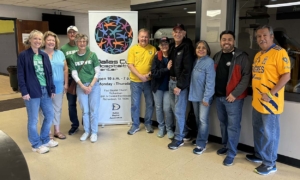
The Dallas Cup Hospitality Center in mid-April received more than 2,000 visits from youth soccer players and coaches from around the world.

It also presented the opportunity for those athletes and their families to see Christians working together for a common goal as volunteers from local churches provided meals and engaged in conversations through an outreach sponsored by the Dallas Baptist Association.

“The nations came to us, and I am proud that our denomination was ready to meet their physical and spiritual needs,” said volunteer Joy Mooneyham of Rockwall. “It was a blessing to be a small part of that.

“My favorite part of this event was getting to be the hands and feet of Jesus. Serving with this team was like getting to take an international mission trip without ever leaving DFW.”

Several Dallas-area Baptist churches covered shifts and provided volunteers to be onsite throughout the week at the Dallas Cup Hospitality Center in mid-April. As a result, 375 decisions were made decisions to follow Christ, and 500 Bibles were given out. (Courtesy Photo)

Several local churches covered shifts and provided volunteers to be onsite throughout the week at the hospitality center, including First Baptist Church in Richardson, First Baptist Church in Rockwall, Hillcrest in Español in Cedar Hill and North Irving Baptist Church.

“We typically have about 75 church volunteers that are utilized throughout the week, just serving at the center,” said Chelsi Hoard, who serves the director of strategy for the Dallas Baptist Association.

“We have eight different shifts, and different churches will take the lead on each shift. We also have a countless number of volunteers at local churches that help prepare meals, donate Bibles, give and specifically pray for this event.”

‘Volunteers represented Christ well’

The outreach event could not have happened without local church volunteers,” she said.

“Volunteers prepare and serve meals, greet teams, set up chairs, clean tables, take out trash, sweep, mop, mix Gatorade and lemonade, refill ice chests, pick up and sort the many Uno cards, checkers, pickleballs and Connect Four pieces that are used, make coffee for the coaches, help with chapel services, go on grocery runs and wash dishes,” Hoard said.

“Most importantly, our volunteers represent Christ well. They create a welcoming environment and connect with the teams that walk through the doors of the center.”

As a result, 375 decisions were made to follow Christ, and 500 Bibles were given out.

“From watching friendships form amongst athletes from different countries over a game of Giant Jenga, teams running to greet familiar volunteers, to someone excitedly looking through a new Bible, there are so many great moments that happen at the hospitality center,” Hoard said.

“One of my favorite things is watching churches come together to tangibly demonstrate the love of Christ to people from so many nations and then seeing these teams experience that love, some for the very first time.

“All throughout the week we hear comments about how the churches are so welcoming, kind, generous and loving. It is so great to watch people from so many nations experience God’s love in this way.”

Seeing God at work

Hoard noted one of the most exciting things during the soccer outreach was seeing how God was at work throughout the week and continuing to make connections with athletes they met last year.

“All throughout the week, we have the privilege of seeing God move, as people make faith decisions, pray together, attend chapel with our chaplain, develop cross-cultural friendships, receive and read Bibles,” Hoard said.

A few returning athletes who had received a copy of the Scriptures from volunteers the previous year returned to say they read the entire Bible, she added.

“We also get to see glimpses of God’s goodness and provision as we start to run out of a specific item during a shift and then see that the previous shift had left just enough extra behind,” she noted.

On some occasions, a volunteer who had been to a specific country was serving “right when a specific country’s team comes through and they are able to talk and connect,” Hoard said.

Other times, the volunteers had “the exact number of chicken sandwiches left for a group that came in at the last minute,” she noted.

“In big and seemingly small ways, God continues to bless.”

Volunteers greatly enjoyed participating in the outreach and look forward to future opportunities to serve at events like this one.

“The gospel was clearly presented to all who would hear, and we were able to show the love of Christ to each person who came through the line,” Mooneyham said.

“We were able to do the hands-on work and provide hospitality and smiles so that others could effectively and boldly present the gospel in the heart language of the players.”