WACO—“Compelled to Serve” is the theme when Texas Baptists gather for the 134th Baptist General Convention of Texas annual meeting, Nov. 17-19 at the Waco Convention Center.
Texas Baptists will emphasize the theme through keynote speakers, workshops on evangelism and discipleship, worship times and business sessions.
David Hardage
“Our annual gathering is such a special time for the Texas Baptist family to join together in fellowship,” BGCT Executive Director David Hardage said. “This year’s focus on evangelism and discipleship is much needed and will strengthen our churches, ministry partners and convention staff for important ministry in the days to come.”
Victor Rodriguez
Featured speakers include Duane Brooks, pastor of Tallowood Baptist Church in Houston; Victor Rodriguez, Hispanic evangelism associate and discipleship specialist for Texas Baptists; and Michael Evans, BGCT president and pastor of Bethlehem Baptist Church in Mansfield.
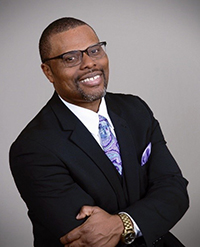
Duane Brooks
Worship leaders include the Singing Men of Texas; Dan Baker, minister of music at First Baptist Church in Amarillo; the Texas Country Boys, a country gospel music band; and Jared Billups and the worship team from Highland Baptist Church in Waco.
Pastor Michael Evans
Texas Baptists’ Hispanic and African American ministries will host worship rallies on Sunday evening. The Hispanic Rally will be at First Baptist Woodway, and the African American Rally is hosted by Greater Ebenezer Baptist Church.
During business sessions, messengers will elect officers and vote on the 2020 proposed budget, nominations for affiliated boards and ministries, resolutions and other matters. For more information on items of business, click here.
About two dozen workshops will be offered on topics including evangelism, preaching, missional culture, foster care ministry, new believer discipleship and church revitalization.
Attendees who visit exhibit halls throughout the three-day event can learn more about Texas Baptists resources, partnering ministries and institutions, as well as enjoy opportunities for networking and fellowship.
Multiple meals and receptions will be hosted by Texas Baptists’ ministries and partners.
Texas Baptist churches can pre-register messengers online here. Additionally, messenger cards can be requested by calling (888) 244-9400. All sessions are open to visitors, who can register on-site at the registration desk.
Seminary president seeks to build bridges
October 17, 2019
FORT WORTH—If Texas Baptist ministers who have felt distanced from a seminary they once called their own notice a change in its leaders’ “tone” and “tenor”—but not in the institution’s “lockstep” commitment to the Southern Baptist Convention’s doctrinal statement—then Adam Greenway will feel like he has made progress.
In February, trustees of Southwestern Baptist Theological Seminary elected Greenway as the school’s ninth president. He assumed the president’s office less than one year after the board cut all ties with former President Paige Patterson, who was accused of mishandling reports of sexual abuse and of using demeaning language toward women.
“I was fortunate to become the president of an institution filled with opportunities cleverly disguised as problems,” Greenway said.
Rather than focusing on difficult days in the seminary’s recent past, Greenway looks back to the vision of founder B.H. Carroll. He wants to connect to what he calls Southwestern Seminary’s tradition as “the big-tent seminary of the Southern Baptist Convention” and connect personally with “legacy servants” on the faculty who influenced generations of Texas Baptist ministers.
“As an alumnus, the first alumnus to serve as president here in the last quarter-century, I am deeply indebted to and deeply committed to the best of our history, heritage and legacy,” he said in an Oct. 10 interview.
Greenway said he recognized “our seminary in more recent years in both perception and, to some extent, some reality has been identified with positions that were more narrow than the Baptist Faith & Message,” the Southern Baptist confession of faith.
Four pegs of the ‘big tent’
Both in the news conference immediately after his election as president and in his first chapel sermon, he referred to a “big-tent” vision for Southwestern Seminary.
Adam Greenway (Southwestern Seminary Photo)
He envisions the tent as anchored by “four pegs”—a high view of Scripture, confessional fidelity, Christ’s Great Commission and cooperation.
Greenway affirmed the Baptist Faith & Message—most recently revised in 2000—as a doctrinal guide for the seminary. The most recently adopted version of the confession limited the role of pastor to men. It also deleted a sentence from the 1963 version’s statement on Scripture: “The criterion by which the Bible is to be interpreted is Jesus Christ.”
“Every iteration of the BFM since 1925 has been the doctrinal position of Southwestern Seminary,” he said. “We are in lockstep solidarity with our convention of churches in terms of where the convention has said we are going to stand theologically.”
However, he added, SBC confessions of faith historically have focused on areas of agreement, while remaining silent on issues where Southern Baptists have disagreed, such as details regarding the End Times or adherence at all points to Calvinist theology.
“For example, on issues related to Calvinism and Reformed theology, the Baptist Faith and Message does not take a position on the extent or the intent of the atonement or on the irresistibility or resistibility of grace,” he said, noting the seminary should “not be defined by” those matters.
Greenway personally embraces the term “inerrancy” to describe his view of the Bible, and he noted the seminary’s board of trustees have affirmed the Chicago Statement on Biblical Inerrancy as an interpretive guide.
However, he acknowledged the history associated with that term in Southern Baptist Convention life—particularly during divisive times beginning 40 years ago when it was used as a rallying cry by one group.
“For some, that language became politically weaponized and personally problematic,” he said.
A faculty member’s adherence to the ideas about biblical authority in the Chicago Statement and a willingness to affirm the high view of Scripture it expresses are more important than the use of the terms “inerrant” or “inerrancy,” he noted.
Not part of the Baptist battles
Greenway’s predecessor as president was one of the key architects of what supporters called the “conservative resurgence” and critics called the “fundamentalist takeover” of the SBC.
In contrast, Greenway was an infant when the “Baptist Battles” began in 1979. He surrendered to the ministry as a high school student in 1994—the same year the Southwestern Seminary trustees summarily fired Russell Dilday as president for criticizing the political movement in the SBC.
So, Greenway noted, he “had nothing to do” with the denominational conflict and events that damaged the relationship between many Texas Baptists and Southwestern Seminary.
“I can’t change the past, but let’s change the future together,” he said.
He pointed to the deep “love and affinity” Texas Baptist ministers historically have felt toward Southwestern Seminary.
“That also means the wounds and the hurts go far deeper. They are far more existential—far more painful,” he said.
As a result, some Texas Baptist churches chose to defund some or all SBC agencies and institutions—including Southwestern Seminary.
Even so, through August this year, Texas Baptist churches directed more than $6.9 million to the Southern Baptist Convention, which means the SBC Executive Committee would have forwarded about $278,000 to Southwestern Seminary.
Greenway expressed thankfulness for the $7.5 million Southwestern Seminary receives through the Cooperative Program and his desire to promote cooperation.
Emphasize residential theological education
He also mentioned his desire to emphasize residential theological education “in the context of a learning, worshipping, serving community” and give greater attention to the master’s level degrees the seminary offers to equip students for ministry in churches.
Last year, Southwestern Seminary reported 1,160 full-time equivalent enrollment, including students in the undergraduate and certificate programs at Scarborough College. Greenway noted the figure was about 2,300 when he graduated in 2002, before the seminary offered an undergraduate program.
When Robert A. Baker’s history of Southwestern Seminary, Tell the Generations Following, was published in 1983, he reported 3,317 full-time enrollment for the 1981-82 academic year. At that time, he noted, the seminary’s leaders were considering whether to cap enrollment at 4,000 students each year until the seminary could increase its resources.
“The enrollment is nowhere near where we want it to be,” Greenway said.
Reach out to retired faculty
A priority for Greenway—and “pastoral burden” he has felt—since he assumed the seminary presidency has been reconnecting with former faculty and staff. He wants current students to recognize their contributions.
“We are living in houses we did not build, and we are drinking from wells we did not dig,” he said.
As part of that initiative to reach out to former faculty and staff, he invited what he calls the “legacy servants” to an event at the seminary in early September. Al Fasol, distinguished professor emeritus, preached in chapel that day.
Greenway noted he also has met individually with retired faculty—some of whom left with hard feelings toward the seminary—to express appreciation for their years of service.
“It’s never the wrong thing to do what’s right, even if it’s years after it should have been done,” he said.
EDITOR’S NOTE: A date was corrected in the 8th paragraph from the end after the article first was posted.
Young leader answers God’s call at RA camp
October 17, 2019
Sometimes God calls in a quiet voice. Other times, it practically knocks a person over, as Savion Lee discovered.
Hustling during a Royal Ambassadors summer camp where he served as a state staffer, God’s call to vocational ministry was so profound he had to sit down on a log. There, he reflected upon all the people God had brought into his life that led to that moment of confirmation.
Lee was raised by his mother and mentored by his grandfather, but had no strong male evangelical Christian figure in his life. That changed when he became involved in the Royal Ambassadors missions program for boys at Faith Baptist Church in Wichita Falls. Each week, men instilled godly values in him and gave him the tools that would guide him the rest of his life.
“When I got involved in Royal Ambassadors, I found other men who were willing to be that godly role model for me. They led me to a path of righteousness,” Lee said.
“I found a group of guys who are unashamedly called to serve God and lead their sons. They indirectly adopted me as one of their own.”
Former RA became a leader
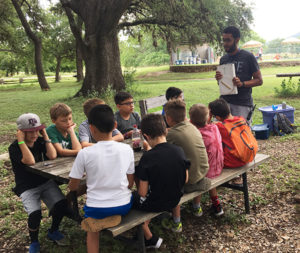
Savion Lee, a recent Rice University graduate who grew up in First Baptist Church of Wichita Falls, credits Royal Ambassadors with opening his heart and mind to God’s calling on his life. (TBM Photo)
The results of the weekly discipleship and missions education efforts began to reveal themselves more the older Lee became. Decisions became tougher through high school and into college, but Lee relied on his strong faith foundation to navigate them. He matured into his faith and became a leader.
He initially sensed God’s call during an RA camp.
“At one of the campfire gatherings, I shared that I felt like God is calling me to full time ministry,” he said.
Gradually, that sense of calling Lee felt as a boy in RAs grew, and it was confirmed during his time as an RA summer camp state staffer. In the four years he served in that role, Lee invested in the next generation of young men, helping lay the spiritual groundwork that has been so crucial to him.
“Savion served as an intern this summer with TBM and did a great job,” said Keith Mack, TBM state director of Royal Ambassadors. “It was great getting to watch Savion share his knowledge and passion for working at camps with the state staffers this summer and also encourage them to do their best as an ambassador for Christ.”
Lee recently graduated from Rice University and is serving as an intern at a campus ministry that shares the gospel and makes disciples. After that, he looks forward to following wherever God leads, knowing he’ll take all he learned through RAs with him.
“I praise God that there are men out there who recognize the importance of God in the lives of young men and boys,” he said.
EDITOR’S NOTE: After the article originally was posted, the third paragraph was edited to correct a church name.
Public schools preserve and protect freedom, Johnson asserts
October 17, 2019
WACO—Public schools in the United States offer the “meeting place for widening diversity” where students learn to live with others who hold different views, a Baptist preacher and advocate for public education told a Baylor University gathering.
Charles Foster Johnson, executive director of Pastors for Texas Children, addressed “Religious Liberty, the Public School and the Soul of America” at the G. Hugh and Beverly C. Wamble Symposium, presented by Baylor’s J.M. Dawson Institute for Church-State Studies.
‘Proving ground for religious liberty’
“I contend that public schools are the proving ground for religious liberty and church-state separation,” Johnson asserted.
In public school classrooms, students learn that their own religious beliefs are not to be given preference over the beliefs of their classmates, nor are their classmates beliefs to be preferred above their own, he said.
In an increasingly pluralistic society, understanding and honoring religious liberty may be more important than ever, he stressed.
“Our neighbor of another faith is right next to us now. … We share this absurdly small space called planet Earth, and we’ve got to learn to love each other,” said Johnson, former pastor of Trinity Baptist Church in San Antonio and Second Baptist Church in Lubbock. “One of the ways we do that is to accord every human being the freedom to follow God by the mandate of conscience.”
He decried any attempt to coerce compliance to any religion or compel religious expression.
“All faith in God is voluntary. If it is not voluntary, it is not faith,” he said.
Liberty of conscience
Charles Foster Johnson
On the one hand, Johnson rejected any undue overemphasis on autonomy that focuses only on the individual without the influence and importance of community. A narcissistic fixation on self produces the kind of “severe psychological and spiritual dysfunction on display today” in high office, he said.
However, he affirmed “the irreducible and inviolate freedom of the human conscience” and called for “a new assertion of individual rights and responsibilities that inculcates individual decision-making power.”
Freedom of religion is a “core component” of individual liberty, and the individual—not the state—is the only entity competent to make a religious decision, he asserted.
Public schools—alongside homes and houses of worship—preserve and protect liberty of conscience in a polarized and pluralistic society, Johnson said.
“The public school is the building block of American democracy. It is the cornerstone of our national life,” he said.
Public schools are ‘a public trust’
In Texas, 90 percent of children attend public schools, and more than 60 percent of the state’s schoolchildren are economically disadvantaged, he noted.
“Universal education is a moral mandate,” he said. “It’s a public trust safeguarded by everyone in the public.”
Johnson framed competing visions regarding education—one that views education as a public trust provided by the public and the other that promotes a privatized approach serving only those who can afford it—as a battle for “the soul of America.”
He contrasted public schools that are open to all students with “corporate chain charters” that are not accountable to local elected officials and private school voucher proponents who treat students as commodities and classrooms as profit centers benefiting only a few.
“The great equalizer in American life is the neighborhood public school,” Johnson said.
Teen and college food insecurity a hidden crisis, research shows
October 17, 2019
WACO—Food insecurity among teenagers and college students represents a hidden crisis, student researchers from two faith-based Texas universities told seminar participants at Baylor University summit on hunger and poverty.
The problem remains largely hidden—even in college towns like Waco and Abilene that have many churches—in part because young people want to avoid the social stigma of acknowledging a need for help, the researchers noted.
Ana O’Quin, an undergraduate social work student at Baylor, and Shannon Que, a graduate student at Abilene Christian University, presented their findings and recommendations during a breakout session at the Together at the Table Hunger conference, sponsored by the Baylor Collaborative on Hunger and Poverty.
O’Quin, who completed her research under the direction of faculty adviser Stephanie Boddie, assistant professor of church and community ministries at Baylor, noted teenagers tend to avoid talking about their lack of access to food—or accept help from agencies and institutions in their communities—because of their desire not to stand out from their peers.
Listen to the ‘real experts’
In some instances, teenagers in food-insecure households forgo meals or share them to ensure their younger siblings have enough to eat, O’Quin reported.
“Effects of food insecurity on teenagers include engaging in risky behavior and transactional dating (trading sexual favors for meals), shoplifting and selling drugs,” she said.
In terms of food insecurity’s impact on academic performance, hungry teens have difficulty focusing and are more likely to be frequently tardy or absent, she noted.
In McLennan County, where 18.9 percent of individuals are food insecure, O’Quin interviewed a focus group of teens from Waco high schools and surveyed 19 community leaders.
O’Quin presented a series of recommendations, including increased funding for the Supplemental Nutrition Assistance Program, and she commended a SNAP outreach program the faith-based non-profit Caritas of Waco conducted in partnership with the Waco Independent School District. In the past five years, 350 McLennan County high school students who are food-insecure or homeless were able to obtain SNAP benefits through the program, which allows them to apply at school.
O’Quin also noted the teens she interviewed offered several innovative ideas such as increasing mentorship programs in schools to break the cycle of poverty, encouraging teens to join after-school programs where food is provided, and encouraging local restaurants and businesses to donate excess food to local pantries or shelters.
“The real experts on food insecurity are the teens themselves who experience it on a daily basis,” she said.
Food insecurity among college students
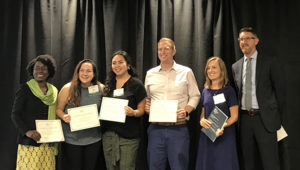
Katie Thompson (2nd from right) with the Center for Public Justice recognized winners of the Hatfield Prize for student-faculty research at Christian colleges and universities. They are (left to right) faculty adviser Stephanie Bodie and undergraduate student Ana O’Quin of Baylor University, along with graduate student Shannon Que and faculty adviser Stephen Baldridge of Abilene Christian University. They are pictured with Jeremy Everett (right), founder of the Texas Hunger Initiative and director of the Baylor Collaborative on Hunger and Poverty. (Photo / Ken Camp)
In Abilene, Que worked with faculty adviser Stephen Baldridge to examine food insecurity on college campuses. Nationally, about one-fourth of the students at four-year universities and more than half of the students in community colleges experience food insecurity, she noted.
Abilene is home to three private faith-based four-year universities—Hardin-Simmons University, Abilene Christian University and McMurry University—and two community colleges—Cisco College and Texas State Technical College.
In response to reports of students experiencing food insecurity, Cisco College launched Food for Thought, an on-campus food pantry. Several local churches, including Pioneer Drive Baptist, offer free weekly meals to the community, including college students, Que noted.
The Center for Public Justice recognized O’Quin, Que and their faculty advisers as winners of the Hatfield Prize for student-faculty research at Christian colleges and universities. The award is named in memory of Sen. Mark Hatfield of Oregon, and it is made possible through the support of the M.J. Murdock Charitable Trust and the Annie E. Casey Foundation.
The student-faculty research reports are published online here.
This is part of an ongoing series about how Christians respond to hunger and poverty. Substantive coverage of significant issues facing Texas Baptists is made possible in part by a grant from the Prichard Family Foundation.
Complaint filed after judge gave Bible to convicted Guyger
October 17, 2019
DALLAS (RNS)—The Freedom from Religion Foundation has filed a letter of complaint with a Texas judicial conduct commission against a Dallas judge for offering a Bible to former police officer Amber Guyger after sentencing her for the murder of her neighbor, Botham Jean.
The actions of Judge Tammy Kemp of Texas’ 204th District Court were captured on video Oct. 3, soon after Kemp sentenced Guyger to 10 years in prison. Shortly before, her victim’s brother had hugged Guyger and told her he forgave her.
The Freedom from Religion Foundation said the judge’s actions were “inappropriate and unconstitutional” because she was acting in an official rather than a private role.
“She was in a government courtroom, dressed in a judicial robe, with all of the imprimatur of the state, including armed law enforcement officers, preaching to someone who was quite literally a captive audience, and even instructing her on which Bible verses to read!” wrote Dan Barker and Annie Laurie Gaylor, co-presidents of the organization, in an Oct. 2 letter to the State Commission on Judicial Conduct.
“We understand that it was an emotional moment, particularly when the victim’s brother, Brandt Jean, publicly forgave and hugged Guyger,” the officials wrote. “It is perfectly acceptable for private citizens to express their religious beliefs in court, but the rules are different for those acting in a governmental role.”
Some affirm judge’s actions
Others praised the judge for her actions.
The Freedom from Religion Foundation “is protesting Judge Kemp rather than joining the rest of the nation celebrating the compassion and mercy Judge Kemp demonstrated,” said Hiram Sasser, general counsel of First Liberty Institute. “We should all be thankful the law allows Judge Kemp’s actions and we stand with her and will gladly lead the charge in defending her noble and legal actions.”
A tweet from the Dallas Police Department’s Twitter account said, “Botham Jean’s brother’s request to hug Amber Guyger and Judge Kemp’s gift of her Bible to Amber represent a spirit of forgiveness, faith and trust. In this same spirit, we want to move forward in a positive direction with the community.”
Footage from a Law & Crime Network video, whose link the Freedom from Religion Foundation included in its complaint, shows Kemp crossing the courtroom, Bible in hand, to where Guyger was seated.
“This is the one I use every day,” she can be heard saying. “This is your job for the next month. You read right here: John 3:16. And this is where you start, ‘For God so loved the world that he gave his one and only Son, that whosoever.’ You stop at ‘whosoever’ and say, ‘Amber.’”
At some points in the face-to-face conversation, Guyger nods. Kemp hugs her twice during the exchange, which lasted more than four minutes.
The Freedom from Religion Foundation asked the commission to investigate Kemp’s actions for possible violations of the Code of Judicial Conduct and “take all appropriate steps to ensure no future misconduct.”
‘Crossed an ethical line’
Asked what kind of action the group was hoping the commission might take, Gaylor told Religion News Service: “We would trust the commission to determine any sanctions, but we would certainly like to see a pronouncement that this behavior crossed an ethical line and was improper.”
Rachel Laser, president of Americans United for Separation of Church and State, agreed with the Freedom from Religion Foundation’s stance and said that proselytizing by a judge violates religion-government separation.
“By distributing a Bible and telling the defendant it is her ‘job’ to read a religious text as she’s on her way to prison, Judge Kemp has sent a message to all defendants who come before her that their religious beliefs could affect the outcomes of their cases and their sentences,” Laser said.
Gaylor said there have been other instances when her organization considered judges’ religious actions to be inappropriate.
“Over the years there unfortunately have been ethics violations of this nature, such as a judge sentencing someone to attend church, ruling in favor of a religious parent for custody because the other parent is an atheist, or invoking the Bible to jurors or in sentencing,” said Gaylor.
In May, the group refiled a suit against a Montgomery County justice of the peace who has a practice of inviting local clergy to appear as guest chaplains to offer prayers at the start of court sessions.
In 2013, then Tennessee magistrate Lu Ann Ballew ordered that an infant’s first name be changed from “Messiah,” to “Martin” because Messiah is “a title that has only been earned by one person and that one person is Jesus Christ.”
Ballew was removed from her magistrate post and later censured after the Freedom from Religion Foundation sought an investigation by the Tennessee Board of Judicial Conduct. She has since lost a bid to become a state Circuit Court judge.
Summit speakers stress collaboration as key to fighting hunger
October 17, 2019
WACO—Public/private collaboration, innovative partnerships and a relentless effort to find common ground are crucial in efforts to reduce poverty and eliminate hunger, speakers told a summit at Baylor University.
“The issue is too big for any one organization to handle by ourselves,” said Jeremy Everett, founder of the Texas Hunger Initiative and director of the Baylor Collaborative on Hunger and Poverty.
“Figure out where there is common ground. Lean into what you agree on,” Alan Cohen, president and chief executive officer of the Child Poverty Action Lab in Dallas told summit participants.
The Child Poverty Action Lab seeks to develop partnerships “to work collaboratively to reduce by half child poverty in our generation,” he explained.
“We attack the problem from multiple angles,” Cohen said, addressing issues related to basic needs, family structures, safe surroundings, education and living-wage jobs.
Some individuals and organizations are motivated to eliminate child poverty because they recognize it as a moral imperative, he noted. Others see it as an economic issue, recognizing that childhood poverty costs the U.S. economy more than $1 trillion annually, and every $1 spent to fight child poverty lowers future costs by $7.
Demanding that everyone approach the problem from the same perspective and for the same reason is “a collaboration killer,” Cohen said.
“We can fundamentally change the future,” he insisted, but it only happens when people are willing to find areas of agreement.
‘Stop working in silos’
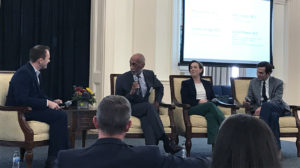
Michael Hole (left) from the University of Texas at Austin moderated a panel discussion on health and hunger featuring (left to right) Donal Wesson, president of the Baylor Scott & White Health and Wellness Center at the Juanita J. Craft Recreation Center in South Dallas; Valerie Smith, director of the Community-Centered Health Home Initiative at St. Paul Children’s Foundation in Tyler; and Jackson Griggs, chief executive officer of the Heart of Texas Community Health Center. (Photo / Ken Camp)
Cristal Retana, manager of government and community relations with Children’s Medical Center of Dallas, likewise emphasized the importance of creating public/private partnerships and working in cooperation to achieve shared goals.
“Stop working in silos,” she urged. “Make sure the right people are in the room.”
Physicians who participated in a panel discussion on hunger and health also emphasized the importance of working with multiple partners and being sensitive to community concerns to meet common objectives.
Valerie Smith, who leads the Community-Centered Health Home Initiative at St. Paul Children’s Foundation in Tyler, described the importance of encouraging dialogue. She pointed to her own experience when she began working in Tyler.
“There were amazing people who were providing food. There were amazing people providing health care. And they were not talking to each other,” she said.
Consider ‘collective impact’
Jackson Griggs, chief executive officer of the Heart of Texas Community Health Center, stressed the “collective impact” that occurs when partners work together.
“The greatest progress we have made is collaborative,” he said.
Griggs pointed to a “food as medicine” partnership with World Hunger Relief. Doctors at a family health clinic serving low-income individuals write a prescription for fresh produce, and patients are able to fill those prescriptions by picking up half-bushel boxes of farm-fresh vegetables down the hall from the examining room.
Each box includes recipes in English and Spanish to help patients know how to prepare meals using the vegetables, and the health center also offers cooking classes.
Since the program started, the center has distributed 4,300 boxes of farm-fresh produce, Griggs reported.
Listen to people in the community
Donald Wesson, president of the Baylor Scott & White Health and Wellness Center at the Juanita J. Craft Recreation Center in South Dallas, talked about managing chronic disease such as diabetes, kidney disease and high blood pressure by improving access to good nutrition and developing health lifestyles.
To accomplish that goal, the health and wellness center learned it must establish partnerships and learn to “leverage trusted agents in the community,” Wesson said.
He applauded the “tremendous resources within the faith community in South Dallas,” and the importance of listening attentively to the ministerial advisory board the center established.
Angela Olige, addressed the Together at the Table Hunger and Poverty Summit at Baylor University. (Photo / Ken Camp)
For example, Wesson noted several ministers said their church members liked participating in a Zumba fitness class, but they were uncomfortable with the “secular music.” The ministers suggested using familiar praise and worship music from African-American churches instead.
“In case you don’t know, Black Gospel music rocks,” Wesson said. “So, we renamed the Zumba class ‘Praise and Flow.’”
Angela Olige, assistant commission for the Texas Department of Agriculture, similarly stressed the importance of listening to each other and finding ways to work together.
“There is nothing like collaboration,” Olige said. “It’s easy to identify our differences. It takes more effort to discover where we agree.”
Olige encouraged people who share a common commitment to ending hunger to find ways to bridge differences and find common ground.
“Find that sweet spot,” she urged.
This is part of an ongoing series about how Christians respond to hunger and poverty. Substantive coverage of significant issues facing Texas Baptists is made possible in part by a grant from the Prichard Family Foundation.
Summit: Deterrence not the answer to humanitarian crisis
October 17, 2019
WACO—The Migrant Protection Protocols—better known as the “Remain in Mexico” policy—drastically reduced the number of asylum-seekers seeking help from ministries in Texas border cities. But the policy change has not solved the humanitarian crisis along the Rio Grande, speakers told a conference at Baylor University.
Instead, it shifted the problem to northern Mexico, where people seeking asylum must wait their turn for court hearings. There, people who often fled their homes to escape violence are forced to wait in cities plagued by violence.
“These are incredibly vulnerable people in incredibly dangerous places,” Victor Hinojosa, associate professor of political science in the honors program at Baylor, told the Together at the Table Hunger and Poverty Summit.
Hinojosa directs the Baylor Migration Project, a social innovation laboratory that brings together an interdisciplinary team of faculty and students to address the challenges of child migration from Mexico and the Northern Triangle of Central America—El Salvador, Guatemala and Honduras.
Hinojosa joined John Garland, pastor of San Antonio Mennonite Church, in a panel discussion at the summit in Waco.
‘Get down to the root’ of the problem
In mid-summer, San Antonio Mennonite Church was housing 200 to 300 asylum-seekers, immigrants and refugees, Garland said. A few nights ago, seven people received shelter from the church.
“Our country has responded to a disaster with deterrence,” Garland said, comparing it to people along the Texas Gulf Coast fleeing a hurricane, only to be turned back when they reach Central Texas.
“Punishing families is not a good way to respond to a humanitarian disaster. It just dramatically increases the disaster. We must get down to the root to address it.”
Critics of ministry to immigrants, refugees and asylum-seekers typically ask the same three questions, Garland noted: “Why should we take care of all these people? Aren’t we a nation of laws? Aren’t they a threat to our health, a threat to our economy, a threat to our way of life?”
“Those are good political questions. … Those are not good Christian questions,” Garland said.
Factors driving immigration explored
Jeremy Everett, founder of the Texas Hunger Initiative and director of the Baylor Collaborative on Hunger and Poverty, addresses a panel who spoke on immigration issues. (Photo / Ken Camp)
Participants at the hunger and poverty summit explored varied aspects of the complex humanitarian crisis.
“Welcoming the stranger is something our nation periodically has done well,” said Jeremy Everett, director of the Baylor Collaborative on Hunger and Poverty, which sponsored the event. “But we’re not doing it well now.”
Hunger is one of at least four factors driving the massive wave of immigration from Central America, Hinojosa explained, along with violence, lack of economic opportunity and climate change, particularly as it affects farmers in the region’s drought corridor.
Often, multiple factors combine to prompt families to make the decision to leave their homes and make the risky journey north, he noted.
“It’s rarely one thing,” he said.
Asylum-seekers experience trauma
Many times, specific attacks or threats prompt families to risk everything to begin a long trek to the United States, Garland noted. Along the way, they constantly face risks from thieves, extortionists and human traffickers, he added.
“The trauma of Central America is dramatically exacerbated by the journey across Mexico,” Garland said.
When they arrive at the U.S./Mexico border, many of them see it as a miracle—standing at the threshold of “the Promised Land,” he noted.
Because the information they possess about U.S. policies regarding asylum and immigration is weeks or months old by the time they reach the Rio Grande, the news that they must wait in Mexico for their number to be called is “horrifically stunning,” he said.
“They have sacrificed everything for their children,” Garland said, pointing out that many of the adults were community leaders in their homelands.
“Trauma is a trap,” he said.
About 80 percent of the asylum-seekers San Antonio Mennonite Church sheltered are evangelical Christians, whom Garland calls “the pilgrim church.” So, the church incorporated Scripture and prayer into trauma therapy as it offered healing hospitality, he noted.
‘Push-pull’ factors examined
Elaine Hernandez, South Texas regional director for the Texas Hunger Initiative, moderated a panel discussion on immigration. (Photo / Ken Camp)
Elaine Hernandez, South Texas regional director for the Texas Hunger Initiative, moderated the panel discussion and participated in a related breakout session at the summit focused on “push-pull factors” that lead to migration out of Central America and Mexico.
Hernandez noted the average worker’s income in the United States for 2017 was $3,300, compared to $354 in Guatemala, $319 in El Salvador, $317 in Mexico and only $110 in Honduras.
According to the Pew Research Center, remittances—money sent from migrants working in the United States back to their families in their countries of origin—totaled $30 billion to Mexico in 2017, compared to $4.6 billion to El Salvador, $7.7 billion to Guatemala and a little less than $3.8 billion to Honduras, Hernandez reported.
However, she noted, while remittances from citizens living abroad were equivalent to only 2.6 percent of Mexico’s Gross Domestic Product in 2016, they were equal to 20 percent of Honduras’ GDP.
While one-third of employment in Central America is linked to agriculture and the majority of migrants from Central America’s Northern Triangle come from rural areas, the United States has failed to emphasize investment in rural development in the region, Hernandez said.
This is part of an ongoing series about how Christians respond to hunger and poverty. Substantive coverage of significant issues facing Texas Baptists is made possible in part by a grant from the Prichard Family Foundation.
Man forgives brother’s killer, offers her Christ
October 17, 2019
DALLAS (BP)—Sobbing erupted in a Dallas courtroom Oct. 2 as 18-year-old Brandt Jean offered forgiveness and Christ to Amber Guyger, the woman convicted the day before of murdering his older brother Botham in 2018.
“I forgive you. And I know if you go to God and ask him, he will forgive you,” Jean said during the sentencing hearing. “I love you just like anyone else. I’m not going to say I hope you rot and die just like my brother did, but I personally want the best for you. … I think giving your life to Christ would be the best thing that Botham would want you to do.”
A Dallas jury unanimously convicted former police officer Guyger of murder for shooting Botham Shem Jean in his apartment Sept. 6, 2018. Guyger had said she mistook Botham’s apartment for her own after her police shift that night, killing the unarmed 26-year-old Church of Christ choir leader because she thought he was an intruder. Her apartment was on another floor.
“I don’t know if it’s possible, but can I give her a hug please … please?” Jean asked Judge Tammy Kemp, who herself was among those crying.
“Yes,” Kemp replied, based on a video of the hearing posted at NBC 5 in Dallas-Fort Worth.
Jean and Guyger embraced at length as she cried, the two whispering words not audible on video.
Jean’s mother Allison said her son’s forgiveness was indicative of his upbringing.
“What my son did was a true reflection of what we’ve practiced all our lives. That’s what he’s been taught, to forgive,” she told NBC 5 after a Wednesday worship service at Church of Christ Dallas West where Botham had been a worship leader. “My son (Brandt) is 18-years-old, and he will have to live with the loss of his brother for all his life, so he needs to move on. I think that was the beginning of the cleansing and a new beginning.”
Guyger was sentenced to 10 years in prison out of a possible life sentence, Dallas County prosecutor Erin Hendricks told NBC 5, and will be eligible for parole after serving five years. Outside the courthouse, crowds protested and proclaimed the sentence too short. Police were on hand with riot gear but no injuries were reported, according to NBC 5.
Kemp gave her Bible to Guyger to read in prison.
Jean’s father Bertrum, in his remarks at the sentencing hearing, said his Sundays have changed with his son’s death.
“Sunday is not a good day for me, because I know he would be song leader,” the father said, “because I’m not hearing his voice. … It hurts me that he’s not there.”
Botham, who had worked as a risk assurance associate at PricewaterhouseCoopers, also is survived by a sister Allisa Findley, president of the Botham Jean Foundation formed in his honor.
For responses to Amber Guyger’s sentencing and Brandt Jean’s victim impact statement, read here and here.
Atchley nominee for re-election as BGCT 2nd VP
October 17, 2019
Jason Atchley, pastor of Bacon Heights Baptist Church in Lubbock, will be nominated for another term as second vice president of the Baptist General Convention of Texas.
Cory Hines, president of Howard Payne University, will nominate Atchley at Texas Baptists’ annual meeting, Nov. 17-19 in Waco.
Hines—who first met Atchley when they both were students at HPU—praised him as “a godly husband and father” who has “admirably served Texas Baptists.”
“I have known Jason for 25 years and have always admired his ability to serve others from a heart of humility,” Hines said, pointing out Atchley’s service both in his local church and in his community.
Atchley grew up as a Texas Baptist in Midland and received his higher education in Texas Baptist schools, he noted.
“Having served throughout our state as a youth minister, a music minister, a discipleship and family pastor and a lead pastor, he understands the needs of our state and our churches. … I pray our graduates would aspire to honor the Lord much like Dr. Atchley has throughout his life,” Hines said.
Continuity in time of transition
Atchley joins incumbent President Michael Evans of Mansfield and First Vice President Jason Burden of Nederland in agreeing to serve a second one-year term as a BGCT officer if elected.
Jason Atchley preaches a chapel sermon at Howard Payne University.
“It is truly an honor and blessing to be asked to serve another term,” Atchley said.
The current “brotherhood of officers” have an opportunity to provide continuity during a transitional time for Texas Baptists’ senior executive staff leadership, he noted.
Jill Larsen resigned earlier this year as Texas Baptists’ treasurer and chief financial officer, and Steve Vernon announced plans to retire as associate executive director at the end of the year. Craig Christina will succeed Vernon as associate executive director.
“Beyond that, I believe in what Dr. Evans has done and the vision of unity he has promoted, with Texas Baptists of all backgrounds and cultures serving together,” Atchley said.
Encourage involvement by the next generation
Furthermore, Atchley wants to encourage young pastors and church leaders to become more involved in Texas Baptist life.
“I think there has to be a generational shift,” he said. “I believe I can be a change agent, to influence the next generation to be engaged in the life of our convention.”
Texas Baptists “have a great story to tell,” he asserted. Young leaders will be drawn to the BGCT when they find out about the opportunities to learn, grow and network available in Texas Baptist life, he added.
“I’m a firm believer in lifelong learning. If you stop learning, you stop growing,” he said.
Atchley has been pastor at Bacon Heights Baptist Church in Lubbock about four years and has served part-time on the HPU faculty.
Previously, he was pastor of adult and family ministries at First Baptist Church in Decatur for two years. He also has served as pastor to students at Jonesboro Baptist Church near Gatesville, First Baptist Church in Hamlin, First Baptist Church in Canyon and First Baptist Church in Round Rock.
In addition to earning his undergraduate degree from HPU, he holds both a Master of Divinity degree and a Doctor of Ministry degree from Hardin-Simmons University’s Logsdon Seminary.
He and his wife Heather have two daughters, Hallee and Chloe.
Pastors and churches challenged to reprioritize discipleship
October 17, 2019
The church has a discipleship deficit, declared Dr. Wanda Bolton-Davis.
The problem is not the quality of offerings but that “the church has lifted up so many things in order to draw the masses” while neglecting to lift up Jesus, she said. If a church uses “dog and pony shows” to draw people, it has to “keep doing dog and pony shows to keep them,” and the people’s expectations for those shows grow continuously.
By focusing on getting people in the door of the church, churches have not engaged people sufficiently in the “ongoing process of becoming more and more like Jesus,” Davis noted.
Davis suggested eight reasons for the discipleship deficit and eight correctives.
Eight causes of discipleship deficit
1. Churches have given more emphasis to evangelism than to discipleship. The result is that the church grows in numbers but not in maturity. It grows “wider but not deeper.”
2. Many churches lack a discipleship process. They may teach people ways of evangelizing, but they don’t have a strategy for maturing those who respond to the gospel.
3. Churches are not setting discipleship goals and lack a method for reaching any spiritual goals they set.
4. “Church calendars are overtaxed and consumed with wrong priorities,” Davis said. They are over-programmed with busyness—like committee meetings—leaving the people little or no time for discipleship.
5. Many pastors and leaders lack personal discipleship and therefore are unable to model discipleship.
6. Churches focus on membership instead of discipleship. They are concerned with people becoming members of the church and may give little thought to those same people becoming disciples.
7. “Churches mistakenly believe they are making disciples when they are not,” Davis said. Worship services and Bible studies are not sufficient for discipleship. More than a couple of weekly events, discipleship requires a whole environment.
8. Discipleship all too often is offered as one of many options, but it’s not an option; it is integral to the Christian life, Davis said.
Eight ways to correct a discipleship deficit
The way to correct a discipleship deficit in the church is to do the opposite of the above eight causes.
Begin with prayer, and champion discipleship. Give discipleship emphasis at least equal to evangelism.
Be intentional, and develop a “visible, clear and measurable strategy.”
Start discipling new members immediately, and evaluate those discipleship efforts.
Use small groups for discipleship. Pastors often are scared small groups will become separate churches, “but so what?” Davis challenged.
Three advantages of the discipleship vs. membership-focused model
Churches focused on membership tend to count their success by the numbers: bodies, buildings and budgets. They are concerned with the number of programs being offered.
Churches focused on discipleship tend to be concerned with producing ever more mature followers of Jesus Christ.
Davis named three reasons churches should be discipleship-focused rather than membership-focused.
1. Growing mature followers of Jesus Christ prevents the few from carrying the entire load—what is known as the “80/20 rule.” Eighty percent of the work is done by 20 percent of the people.
2. Focusing on discipleship promotes the inclusion of new people in the life and work of the church and prevents an entitlement mentality among longer-tenured members.
3. Such focus creates the “expectation and accountability” for spiritual growth, “cultivating an environment that is conducive for growing fruit-bearing disciples,” Davis said.
Discipleship is about life change. “You don’t want to hear, ‘Preacher, that was a great sermon,’” Davis said. “You want to hear, ‘Preacher, that sermon changed my life.’”
Christina elected as BGCT associate executive director
October 17, 2019
DALLAS—Craig Christina, pastor of Shiloh Terrace Baptist Church in Dallas, was elected as the next associate executive director of the Baptist General Convention of Texas.
The BGCT Executive Board approved Christina’s nomination by an electronic vote on Oct. 2 following the recommendation of a selection committee led by Executive Director David Hardage that included board Chair Dennis Young and BGCT President Michael Evans.
“It is with great confidence and excitement that we announce Dr. Craig Christina as the next associate executive director of Texas Baptists. After a careful review of all candidates, it was the sense of the committee that Dr. Christina would best be able to serve and lead us well into the future,” said Hardage. “Personally, I’m looking forward to serving with Dr. Christina. He is a great man, pastor, husband, father and Christ follower.”
Christina has been senior pastor of Shiloh Terrace Baptist Church in Dallas for 10 years. He will follow associate executive director Steve Vernon, who served in the position 11 years and will retire Jan. 2.
Endorsements of Christina
“Dr. Christina is the man for this very exciting time in the life of our convention,” said Evans, pastor of Bethlehem Baptist Church in Mansfield. “He is a consummate professional and compassionate presence. Craig seems to be the kind of servant-leader that will assist Dr. Hardage and our entire team of denominational servants in fulfilling their call in assisting our churches in their providential assignments. I am enthusiastic about his answer to this call.”
In his role as associate executive director, Christina will plan, direct and administer the integrated operational activities of BGCT in accordance with the priorities and policies developed by the executive director and BGCT Executive Board. He also will work to ensure the accomplishment of goals, objectives and strategies in the most effective and cost-efficient manner.
“Dr. Christina understands the BGCT, has served on several BGCT committees and has an undergrad degree in business, as well as fund-raising experience,” said Young, pastor of Missouri City Baptist Church near Houston. “He expressed his vision for BGCT, can relate to older and younger individuals and is well respected.”
Christina’s background and experience
Christina was born and grew up in Corpus Christi and has 25 years of experience as a pastor of churches in Indiana, Oklahoma, Tennessee and Texas.
He earned a Bachelor of Business Administration degree from Baylor University and Master of Divinity and Doctor of Philosophy degrees from Southern Baptist Theological Seminary in Louisville, Ky. He has served as an adjunct professor at Union University and Southern Seminary.
From 2017 to 2019, Christina was vice chair of the BGCT Executive Board. He also previously chaired the Great Commission Council and the Missions Funding Council.
In May 1992, Christina was licensed for ministry by First Baptist Church in Corpus Christi. Two years later, he was ordained by Heritage Southern Baptist Church in Vincennes, Ind.
Christina has held numerous positions in denominational service, including his role as director of Baptist causes for the Prichard Family Foundation; a member of the administration and finance committees for Dallas Baptist Association; a trustee at Union University; and a member of the Southern Baptist Conventions’ resolutions committee and committee for nominations.
Christina ‘blessed and honored’ to serve
Christina expressed excitement about the new appointment, saying he felt “blessed and honored” to serve.
“Under the strategic leadership of Dr. David Hardage, Texas Baptists continue to expand their impact and influence around our state, nation and world for the gospel of Jesus Christ,” Christina said.
“I am excited about the opportunity to implement the vision of Dr. Hardage and the Executive Board as we continue to serve the needs of the local church. At the same time, I celebrate the ministry and legacy of Dr. Steve Vernon whose ‘good and faithful’ service has left an indelible mark on the kingdom of God. He and Donna will be greatly missed.”
Christina and his wife, Tracy, have two children and live in Dallas.