Politics—difficult but not inherently dirty, panelists agree

AUSTIN—A former White House insider and a Texas Baptist pastor with a long track record of public service agreed Christians have a responsibility to become politically engaged and to advocate for the common good.

“Politics matters” because elected officials deal with “great issues of moral consequence,” Michael Gerson, syndicated columnist and former top aide to President George W. Bush, told a Texas Baptist gathering. And politics matter most to people who are denied justice, he asserted.

“Politics can be difficult business but not dirty business,” Gerson said. “It actually impacts people’s lives at a fundamental level. It’s a noble pursuit. … It can embody moral purpose.”

Gerson and Michael Evans, pastor of Bethlehem Baptist Church in Mansfield and president of the Baptist General Convention of Texas, participated in a panel discussion during a Christian Life Commission Advocacy Day event at Woodlawn Baptist Church in Austin. Ferrell Foster, director of ethics and justice with the Texas Baptist CLC, moderated the dialogue.

Evans, who has served on his local public school board and on a community college board, recalled speaking frequently at public hearings prior to pursuing public office.

However, he realized about 15 years ago he could make the greatest difference for the common good by helping to craft policies, not just critique them.

“I learned if I became an elected official, I could do more than just talk,” he said.

‘Advocate for the least and the lost’

Evans affirmed the role of the Christian Life Commission in speaking to moral issues and challenging Texas Baptists to advocate for those who otherwise would go unheard.

“I appreciate being part of a body that has the courage to advocate for the least and the lost,” he said.

At the same time, he urged Texas Baptists to “leverage” their diversity and encourage people from varied racial and ethnic groups to speak from their distinct perspectives.

Challenging times offer opportunities for “individuals who allow themselves to be used by God to be a prophetic voice,” Evans said.

Speaking broadly about evangelicals in the United States, Gerson raised concern about those whose views about issues in the public square are determined more by party affiliation and political orientation than by distinctively Christian principles.

“It is so easy to be a tool in the power games of others rather than an authentic voice—a critical and prophetic voice—that is determined from a set of assumptions about the moral influence and impact of Christian faith,” he said. “The question is: What is driving what? I’m afraid politics is driving too much and morality driving too little.”

Evans emphasized the importance of “allowing truth to stand against hypocrisy” and living by “a true moral compass.” He stressed the importance of keeping Christ central and understanding who Christ is.

Looking at the economy, Gerson characterized it as a “mixed bag,” with some areas experiencing growth while others struggle. He identified the lack of social mobility in the United States—the inability of Americans to advance socio-economically—as a significant problem.

Evans voiced agreement, saying, “We still find ourselves in a place where we have individuals who are caught on an island of hopelessness.”

Find hope in ‘unexpected coalitions’

Gerson voiced hope in the possibility of building “unexpected coalitions” that transcend party lines around issues such as efforts to eradicate human trafficking, AIDs and hunger.

In spite of the difficult and divisive atmosphere in political life today, it is neither as bad as it could be or as bad as it has been, he added.

“The divisions are deep and real, but they are not unprecedented,” Gerson said.

He pointed to the birth of the Civil Rights Movement in the African-American church as a picture of how Christian faith can shape society positively.

“Sometimes the people who need justice are the carrier of the ideal itself,” Gerson said.

Africans came to the United States as slaves and adopted the religion of their masters. In time, their ancestors demonstrated an understanding of Christianity far beyond that of their oppressors, he noted. And in the process, ancestors of slaves enabled the nation to “save its soul” by reclaiming the vision of its founding documents, he concluded.

“That’s the best moral story outside the Bible, as far as I’m concerned,” Gerson said.


To be pro-life, we need to be whole-life

AUSTIN—Kelly Rosati’s mother was 16, not married and at the top of her class when she first became pregnant with Rosati. Despite the challenges and what she would need to give up, she chose life. By age 18, she had a daughter and a son.

Rosati’s mother was very scared, but she had good support and knew people loved her and would continue to love her, including the nun who helped her tell her parents she was pregnant.

For Rosati’s mother, love and support made all the difference.

Rosati’s parents did marry … and then separated and came back together five times before finally divorcing when Rosati was in high school. Years earlier, though, Rosati met Jesus while participating in AWANA in the third grade.

From her experience in childhood and youth, Rosati knew she wanted to advocate for life, and during her 20 years doing so—including 10 years with Focus on the Family, she has learned important lessons for advocacy. She offered these lessons in her workshop during the Texas Baptist Christian Life Commission advocacy training event on March 26.

How to be a better advocate for life

• Good advocates learn how to feel others’ discomfort. Put yourself in the other person’s place. Grow in empathy. Attribute “the very best motives” to people with whom you disagree, Rosati said.

• Attitudes about those who chose abortion must be governed by compassion and love for the mother and the child and must communicate the love and grace of Christ. The majority of women considering abortion are terrified, Rosati said. “Our logical arguments [against abortion] do not work” in that moment. What works is long term care and support.

• “To be pro-life, you must live pro-life,” Rosati said several times throughout the workshop. One way to live pro-life is to support a local pregnancy center.

The problem of neglecting the whole life

Rosati chastised evangelicals who spend a lot of time in Bible studies and worship services without applying what they learn to how they live. “We are a huge part of the problem,” she said, because evangelicals have considered some others as unworthy.

For example, evangelical passion for opposing abortion stands in stark contrast to their virtual ignorance of or silence about catastrophes like genocide in Darfur. Evangelicals need to be just as passionate about issues facing the born—homelessness, human trafficking, foster care, hunger and end of life issues—as they are about the unborn.

Evangelicals are good in crisis and immediate assistance but quickly weary in chronic situations, she asserted.

Evangelicals place high value on sanctity of life, a value demonstrated by living sanctity of life in a way that makes one’s own life uncomfortable, she added.

Rosati isn’t wagging her finger, though. She and her husband have four adopted children. All are teenagers. At least one has bipolar disorder. Another was born with fetal alcohol syndrome, addicted to meth and has schizophrenia. And, she said, “we would do it again and again and again.”


Biblical justice informs approach to criminal justice reform

AUSTIN—Christians should pursue justice because the Bible teaches it is an essential part of God’s character and is at the heart of the gospel, said Kathryn Freeman, director of public policy for the Texas Baptist Christian Life Commission

kathryn freeman 130
Kathryn Freeman

Furthermore, James 1:27 identifies the pursuit of justice as a mark of discipleship, Freeman told a workshop during an advocacy training event in Austin.

In addition to these biblically rooted reasons, Freeman cited four things the Bible teaches about justice:

1. Humans are created in the image of God and therefore possess dignity endowed by their Creator (Genesis 1:26-27).

2. God expects impartiality in the distribution of justice (Deuteronomy 16:19).

3. The goal of justice is restoration, demonstrated throughout the biblical narrative in such stories as Jacob and Esau, David and Bathsheba, the prodigal son, the woman at the well, and Jesus’ restoration of Peter.

4. The pairing of justice and mercy is a biblical imperative (Amos 5:23-24, Micah 6:8, Matthew 23:23).

These overarching principles of justice inform a Christian’s approach to the specific area of criminal justice reform, which enjoys bipartisan support during these times of deep political divisions.

With an eye to justice writ large, criminal justice advocates in Texas are working on the following initiatives, among others.

Women’s dignity act (HB650) to provide trauma screenings and treatment to women entering incarceration, to ensure family unity and to improve healthcare

Occupational licensing reform so that convicts, who must pay for the licensing classes they take while incarcerated, actually can obtain licenses once released

Raise the Age and Second Look to provide protections for incarcerated teenagers


Gerson calls for a hopeful alternative to polarized culture

AUSTIN—Polarization, confirmation bias and dehumanization damage public life, syndicated Washington Post columnist and social observer Michael Gerson told a Texas Baptist Christian Life Commission gathering in Austin.

However, Christians can offer a hopeful alternative through a commitment to the common good grounded in the conviction that all people are made in the image of God, said Gerson, former speechwriter and policy adviser to President George W. Bush.

Gerson, keynote speaker at the CLC Advocacy Day conference at Woodlawn Baptist Church in Austin, said politicians he knows “complain about a political atmosphere more toxic than any they can remember.”

Polarized Americans self-segregate

Polarization grows out of a culture in which people live in “increasingly homogenous political communities in silos of the mind,” Gerson said.

Americans self-segregate politically, culturally and geographically, “and our views of people in the opposing camp become increasingly more negative,” he observed.

“The result is the careful weaving of cocoons,” Gerson said, noting an increasing number of people in the United States who live in “cultural bubbles” where they cannot imagine how anyone could live differently or think differently they do.

“The politics of polarization can win an election but wreck democracy,’ he said.

Resisting polarization begins with a change in attitude, Gerson insisted, calling for Christians to understand and love both those who are inside and those who are outside their group.

A polarized culture leads to confirmation bias that affects how people view reality, he added. Citizens in a polarized nation not only seek out information that confirms their preconceived ideas, but also interpret information through a lens that distorts facts to fit into their pre-existing ideas.

“Group commitments become more powerful than reason itself,” he said.

An antidote to this malady, Gerson asserted, is the willingness to “call out your own side.” While few are persuaded when people with opposing views criticize each other for distorting facts, “it is different and powerful to police your own,” he said.

“The hardest thing is to confront confirmation bias in ourselves,” Gerson acknowledged. “All of us have a tendency to see an enemy when we really need a mirror.”

Moral polarization demands a spiritual solution

The ultimate destination of a polarized society gripped by confirmation bias is dehumanization, and that can lead to violent acts, he said.

“There is no denying dehumanization has become part of our public discourse,” Gerson said, confessing his fear that the ideals that shaped the nation’s founding could be replaced with different and lower principles.

“There may be structural reasons, but there aren’t structural answers for moral polarization,” he said. “The answer will be spiritual—not in the sense of piety but in the sense of mutual grace. There is only one force that than overcomes moral polarization, and it is empathy.”

Religion traditionally has been a source of healing and truth, but it also can fall prey to embracing fear of those who are different, he asserted. Gerson—a conservative evangelical Christian—pointed to the danger of evangelicals becoming too closely identified with “one populist nativist party.”

“The predominant narrative of white evangelicals is tribal rather than universal,” he said. “The very thing that should repel evangelicals—the dehumanization of others—is sometimes what seems to fascinate and attract them. …

“Pro-life arguments are discredited by an association with misogyny. Arguments for religious liberty are discredited when we say Muslims shouldn’t have any religious rights. Arguments for family values are discredited by nativist disdain for migrant families. And the ultimate harm here is to the reputation of faith itself.”

Failure in moral formation

This represents not only a failure of Christian leadership, but also “a failure of the Christian church in the moral formation of its members,” Gerson asserted.

“It would be helpful for Christian political engagement to at least have some roots in Christian ideals,” he said.

Christian political engagement should begin with “a certain anthropology—a transcendent view of human rights and dignity” grounded in the belief that all people are created by God and loved by God, he insisted.

While there is no specifically Christian position on how to ensure border security, for instance, “religious leaders have a solemn moral duty to oppose the dehumanization of migrants,” Gerson said.

If Christians truly believe each person bears the image of God, then “cruelty, bullying and oppression are cosmic crimes,” he added.

Christian approach to political engagement

A distinctively Christian approach to social engagement should be characterized by a deep commitment to the common good and should take seriously the concept of the kingdom of God, Gerson said.

“The nature of the kingdom determines how it is properly advanced,” he said. “You can’t advance a vision of liberation by oppressing the conscience of others. You can’t advance a vision of human dignity by dehumanizing others. You can’t advance a vision of peace with violent and demeaning language. …

“The proper role of Christians in politics is not to Christianize America. It is to demonstrate Christian values in the public realm.”

Christians who seek to be socially engaged need to “remember our history and recover our heroes,” he said.

Noting “the ability of compassion and generosity to break down walls of contempt,” Gerson pointed to the example of African-American religious leaders during the Civil Rights Movement and members of Emanuel African Methodist Episcopal Church in Charleston, S.C., after a mass shooting perpetrated by a white supremacist.

“Christians gain influence in our culture—real, lasting influence—when we act like Jesus,” Gerson said.

A ‘difficult but not impossible’ moment

In an interview after his keynote address, Gerson emphasized the role of the church in rebuilding the “shared sense of common purpose” in a polarized society.

“The moment is difficult, not impossible,” he said. “The bonds of our country are frayed, not broken. But we need healing influences, and the church should be one of those influences.”

The church must take seriously its teaching role not only by imparting doctrine, but also providing a moral and ethical foundation for its members, he asserted.

“We have 2,000 years of reflection on how Christians should act when they leave the doors of the church,” Gerson said.

Churches can help followers of Christ learn “the framework of values that Christians should bring to public life,” he said.

Christians also benefit from friendships with people who are genuinely seeking answers but hold different views, he noted.

“Out of this community of minds, people are changed,” he said. “They see first of all that people with different views are human beings, not just cut-out figures in a morality play. They’re actually human beings that need to be loved in practical ways.”


Who supports daily fantasy sports? It’s anybody’s bet

AUSTIN—Cue the Broadway cast recording of Hamilton. At the Texas Capitol, it’s “The World Turned Upside Down” in terms of figuring out Republican and Democratic positions on legalization of paid daily fantasy sports businesses.

Special session ends without passing most hot-button bills
BGCT Photo / Kalie Lowrie)

Some things have remained constant in Austin. Rep. Richard Peña Raymond, D-Laredo, still wants to see fantasy sports classified as games of skill, rather than as games of chance prohibited by Texas law. He introduced a bill to that effect in 2016.

Raymond introduced that legislation even after Attorney General Ken Paxton issued an opinion on Jan. 19, 2016, stating his beliefs that “a court would conclude that participation in paid daily fantasy sports leagues constitutes illegal gambling.”

Daily fantasy sports sites permit players to pay a fee to enter a game in which they create a fantasy sports team using real professional athletes. The athletes’ performance in various statistical categories determines how a fantasy league team fares. The fantasy player wins or loses money accordingly, with the sponsor site claiming a percentage.

Paxton drew a distinction between commercial daily fantasy sports operations and “traditional fantasy sports leagues … where no person receives any economic benefit other than personal winnings and the risks of winning or losing are the same for all participants.”

This session, Raymond has introduced HB 1544, which stipulates that “an individual who pays money or other consideration to participate in a fantasy sports contest is not placing a bet for the purposes of application of an offense” under the state’s penal code.

Bipartisan support claimed

While Raymond’s previous attempt to declare daily fantasy sports legal failed to gain traction, this year he claims bipartisan support for the measure.

During a March 12 hearing on HB 1544 before the House Licensing and Administrative Procedures Committee, Raymond said: “I can’t remember the last time that I could stand up and say I appreciated the Republican Party of Texas and the Democratic Party of Texas for both putting in their platforms that they support this legislation.”

Actually, the Republican Party of Texas platform includes two planks on gambling. On the one hand, the platform unequivocally says, “We oppose the expansion of gambling.” However, it also includes the statement Raymond referenced, which says, “We support action by the Texas Legislature clarifying existing state law without attaching new taxes or fees to the fantasy sports industry, which would grow the size and scope of government.”

‘It’s just trickery’

Rob Kohler, consultant with the Texas Baptist Christian Life Commission, wonders how state Republican leaders could have agreed to the seemingly contradictory positions.

“I think some folks have been tricked. I don’t know who tricked them, but it’s a scheme,” Kohler said. “It’s just trickery, and there’s no place for it.”

Ironically, while the state’s Democratic Party has gone on record in support of Raymond’s proposal, it is not included in the party platform. Manny Garcia, executive director of the Democratic Party of Texas, called the difference “just a technicality in phrasing.”

“The Texas Democratic Party’s executive committee passed a resolution in support of Rep. Raymond’s legislation,” Garcia wrote in an email.

When asked if a resolution by the party’s executive committee carried the same weight as a platform approved by delegates to the state convention, he replied: “Both are a representation of our values. Neither is binding to elected officials.”

In spite of a Republican attorney general’s opinion that participation in daily fantasy sports constitutes illegal gambling, Sen. Lois Kolkhorst, R-Brenham, introduced SB 731, a companion bill to Raymond’s proposal in the House.

Kolkhorst did not respond to an email asking how SB 731 could be reconciled with her party’s stated opposition to expansion of gambling.

Skill or chance?

Texas Republican Party Chair James Dickey offered his rationale.

“The resolution is the definition of gambling as participating in games of chance—contests where knowledge/experience/insight/information have no impact. Rolling the dice or selecting a card or spinning a wheel are purely games of chance—as are lotteries,” Dickey wrote in an email.

“There are other situations, though, where dollars paid could result in higher than dollars returning that are not completely dependent on chance: investing in the stock market or real estate, for example. There is of course an element of chance in any effort, but knowledge and experience play a significant role as well.

“The party’s resolution is that fantasy sports is a similar situation—it’s impossible to predict whether or how someone will be injured, but it’s not all impossible to have knowledge about which players are better, or more likely to perform better under certain circumstances. Therefore, since knowledge and insight and experience have an ability to change the probability of outcomes in this activity, it is by definition not gambling.”

Rodger Weems, chair of Texans Against Gambling, rejected that assertion.

“The people of Texas and their legislature must not be fooled by bills that purport to ‘clarify’ the legal status of daily fantasy sports,” Weems said. “Daily fantasy sports needs no clarification because it is clearly illegal. Period. The plain language of the law says so, and an opinion from the Texas attorney general says so.

“If proponents of this bill think they can shortcut the difficult process of expanding gambling in Texas, they are mistaken. The Texas Constitution makes gambling expansion difficult for a reason.”


How do Latin Americans in the U.S. self-identify?

No single term—Hispanic, Latino, Latinx or whatever—fully encompasses all the people in the United States who are of Latin American ancestry.

Design by Alan Paul

The U.S. government has struggled with terminology for decades, first accepting the label “Hispanic” in the 1970s before shifting to “Latino” by the early 2000s. The gender-neutral term “Latinx” gained currency in higher education about 15 years ago, and some in the younger generation adopted it as their preferred self-identification.

Many different identities fit within the Hispanic or Latino/a box, said Albert Reyes, president and chief executive officer at Buckner International.

Generational differences

A variety of nationalities represent extended families’ countries of origin—including “Tejanos” and “Tejanas” who identify their families as native Texans before Texas was part of the United States, he said. Generational differences and religious backgrounds also factor into self-identification, he added.

Albert L Reyes 200
Albert Reyes

“It appears that the closer folks are to their arrival as a first-generation, the more they would identify with their country of origin,” Reyes said. “By contrast, as they become second-, third- and fourth-generation, they would tend to identify more with the U.S.A. and labels that work here.”

Jesse Rincones, executive director of the Hispanic Baptist Convention of Texas, recalled his own experience: “Being a second-generation, born and raised in the Panhandle of Texas, most of my second- and third-gen friends identified more as American.”

While no single term applies to all people of Latin American background, individual preferences typically depend on the particular country where the person or the person’s family originated, said Rolando Aguirre, the president of the Hispanic Baptist Convention of Texas.

Location, location, location

Location also impacts the terms applied to people of Latin American heritage, he added. Mexican-American churches tend to use “Hispanic,” while others use Latino or Latina, especially in Florida, New York, California and North Carolina, he said.

Most people of Latin American ancestry continue to live between two worlds in the United States, since “heritage is more enforced at homes” than in society, Aguirre said.

At home, Hispanics interact more with the culture they left, or the culture their parents left, while outside they are reminded the term that defines them here is “Hispanic,” he said.

Jesse Rincones

In Texas, because of its history and proximity with Mexico, “the Mexican culture has dominated the Latino influence in Texas,” Rincones said. As a result, “the majority of Texans tended to lump all Spanish-speakers or Latinos into the ‘Mexican’ category.”

Because of that, “Latin,” “Latino/a” or “Latinx” may not work as well in Texas as Hispanic would, Reyes added.

“Most communities aren’t large enough to have a Guatemalan Baptist church, Columbian Baptist, Mexican Baptist, etc.,” Rincones said. “So, our Hispanic Baptist congregations that speak Spanish have the privilege—and challenge—of ministering to all those personal Latino identities.”

While Latinos/as tend to distinguish each other’s nationality by the use of Spanish terms and colloquialisms, Rincones said, that would be a difficult differentiation for non-Spanish speakers to make. Food also is a distinguishing characteristic, he added.

Second- and third-generation people in the United States typically identify the least with their family’s native country and are the group that most easily acculturates to non-Hispanic congregations, Rincones added.

‘Tell me your story’

While it is fine for people of non-Hispanic backgrounds to use general terms like “Hispanic” or “Latino/a,” they also must understand those are broad terms, and a greater understanding of a person’s family will lead to a better frame of reference, Reyes explained.

“Those of us that are Hispanic understand that we really do not know each other until we ask about the family history and background,” Reyes said. “We offer grace to each other when using Latino or Hispanic because we know it is an attempt to speak about our collective identity all the while knowing we have distinct backgrounds.”

If individual Hispanics are asked about their histories, then they will be more than willing to share their own stories as well as the stories of their families, he said.

“Tell me your story” may be all the invitation necessary to start a meaningful conversation, as long as a person is willing to take the time to listen, he observed.

“It may always be wise to inquire as to the background or origin to personalize the reference when possible,” Reyes said. “If I am referred to as Latino, I would accept that term but would know the person calling me by that label does not know me.”

Rincones offered similar advice.

“I think a simple and non-offensive way to recognize the culture of a Latino is to ask where their family is from,” he said. “It does take time and relationship to know and appreciate those differences. However, knowing those differences and valuing them can be a great asset to minister effectively to those people groups.”

Certainly, a church’s ministry should focus primarily on Christians’ shared identity in Christ, Aguirre said.

“However, being aware of where we come from and of our heritage will give us a lot of insight in understanding our current context,” Aguirre said. “Our past generations inform our present, which will help us to have a broader perspective of the future.”

Read more articles like this in CommonCall magazine. CommonCall explores issues important to Christians and features inspiring stories about disciples of Jesus living out their faith. An annual subscription is only $24 and comes with two free subscriptions to the Baptist Standard. To subscribe to CommonCallclick here.


ETBU women’s soccer team serves on mission in Costa Rica

Members of the women’s soccer team at East Texas Baptist University led sports clinics, competed in international soccer games, distributed Bibles and shared their faith during spring break mission trip to Puerto Viejo, Costa Rica.

Kristin Cox, head coach of the women’s soccer team, and Lisa Seeley, director of the Great Commission Center and Global Education at ETBU, led 30 student athletes on the Tiger Athletic Mission Experience trip planned in partnership with Youth With a Mission.

“The team grew together and as individuals as we learned more about what it means to use our sport to glorify God,” Cox said. “I enjoyed watching our women eagerly volunteer to lead as they felt God calling.

During a mission trip to Costa Rica, ETBU freshman Kaitlin Word, Head Coach Kristin Cox, freshman Laura Williams, and sophomore Claire Montondon dig and transport soil to build a sustainable greenhouse at the Teen Challenge Center, a globally recognized Christian-based rehab center. The Tigers also helped rebuild a roof, raked leaves, painted, and made chocolate. (ETBU Photo

“Whether we were competing, running soccer clinics, participating in manual labor or traveling through difficult terrain, we worked through each fun adventure and challenging task as a team.”

Cox fondly recalled hearing the young women chant “3:23” during some of their longest days.

“The phrase comes from Colossians 3:23 and serves as a reminder that everything we do, we do it for the Lord,” she said. “I look forward to seeing how the lessons learned during this trip transform the lives of our ETBU student athletes.”

Building relationships

The ETBU women’s soccer team competed against four local teams in Costa Rica. Enjoying the competition, one of the opposing teams asked the Tigers to play again later in the week. Many of the local players also attended the clinics and games hosted by the ETBU team, enabling the Tigers to build close relationships in the community.

“Arriving at the field, I was shocked at the number of fans that showed up to watch,” said Abigail Bath, an ETBU freshman. “I was exhausted, but our coach pointed out all of the people watching. She said that we needed to persevere because we were there to show them we are different because of God. Hearing her say that sparked something in me. We ended up winning the game 1-0 and continued to play small side games the rest of the afternoon.”

Since four players on the ETBU team speak Spanish fluently, they taught their teammates questions and phrases that would help them coach the children at each of the clinics. The Tigers provided a local team with five soccer balls and a set of jerseys for their future practices. At one clinic, more than 60 children and youth participated.

East Texas Baptist University freshman Natalie Kees coaches local youth at a sports clinic during a mission trip to Costa Rica. (ETBU Photo)

“At the soccer clinics, I was welcomed warmly by the children, who I had in my group previously,” said Gabi Henley, an ETBU junior. “We spent time doing soccer drills, playing games, and having a good time with the youth. Before we returned to the YWAM base, we were able to take pictures and exchange information with the kids so we can keep in touch with each other.”

Several members of the ETBU team who can play guitar and sing led late-night worship experiences every evening. They sang in both Spanish and English during Family Night, an evening of worship, testimonies and a sermon open to the local community. ETBU senior McKenna Medders presented her Christian testimony at Family Night.

Servant hearts

“With every delay, the girls were still joking and laughing. This seemed to be the theme for the week,” Medders said. “The overall attitude during the trip was positive. Every time plans changed, the girls would go with the flow without complaining. Through the experience, I found a love for missions and felt a strong calling to go into full-time mission work. On the days where the work seemed to be hardest, I had unexplainable energy. My own joy and the excitement and support of my team and the YWAM staff confirmed my calling.”

From persevering through challenging tasks to initiating fellowship and praising God, the student athletes responded to every situation with a servant heart, team leaders said.

“My favorite part of the trip was having the opportunity to distribute Bibles to Las Palmas, a poor community in Costa Rica,” ETBU junior Ashleigh Rondon recalled. “It was humbling to provide the first Bible in a family’s home. We prayed over each house, and some families welcomed us inside.

“One group of the team visited a house where the father had recently had open-heart surgery. Without being able to work, the family could not afford food. The girls on the team immediately gathered all the money they had, as well as the snacks in their bags, to donate to the family. The experience made me realize how much we take for granted.”

The trip to Costa Rica marked the ninth Tiger Athletic Mission Experience, which provides student athletes the opportunity to use their talents as a platform to connect with people and share the gospel. The ETBU Men and Women’s Tennis Teams will travel on mission to France in late May.


Cory Hines named Howard Payne University president

BROWNWOOD—Howard Payne University named Cory Hines as its next president, effective April 1.

Trustees unanimously elected Hines, a 1997 HPU graduate, at a called meeting March 18.

He will be the 20th president in the school’s 130-year history.

Hines succeeds Bill Ellis, who retired last summer and transitioned to the role of HPU chancellor.

Experienced in Christian higher education

Before Hines assumed his current post as vice president of enrollment at Dallas Baptist University, he served at DBU as vice president in the areas of advancement, graduate affairs, external affairs, and alumni and community relations. He has taught at DBU and provided leadership in the creation of several graduate programs there.

Active in Baptist life, he also has experience in the ministry, having served as executive pastor and student pastor at Ferris Avenue Baptist Church (now The Avenue Church) in Waxahachie.

Hines earned his Bachelor of Arts degree in religious education from HPU, followed by a Master of Arts degree in Christian education from Southwestern Baptist Theological Seminary and the Doctor of Philosophy degree in leadership studies–higher education from DBU.

“Dr. Hines’ combination of education and experience makes him a perfect fit for Howard Payne University,” said Ray Still, chair of HPU’s board of brustees and pastor of Oakwood Baptist Church in New Braunfels.

“As our institution continues to seek to glorify God and prepare our students to fulfill his calling on their lives, Dr. Hines will provide the kind of leadership needed for the next stage in HPU’s long, distinguished history.”

Paul W. Armes, longtime educator, administrator and minister, has served as HPU’s interim president since June 1. His service to HPU ends on March 31.

“Howard Payne University has great days ahead,” Dr. Armes said. “Dr. Cory Hines is already part of the university family and brings a proven track record of excellence and effectiveness in the field of faith-based higher education. We are at a very exciting moment of HPU’s history. Surely God’s hand of blessing is on this university.”

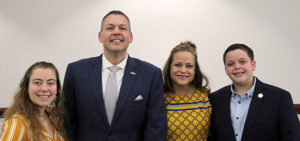
Cory Hines, newly elected president of Howard Payne University, is pictured with his wife, Melinda, and children, Mackenzie and Caleb.

Hines expressed his eagerness to renew his relationship with HPU and the Brownwood area.

“Howard Payne University had a life-changing impact on me as a student, and I’m honored to have been chosen to lead my alma mater as president,” he said. “My family and I are eager to come back home to Brownwood and plant our lives here.”

Hines and his wife, Melinda, have two children, Mackenzie and Caleb.

Culmination of lengthy process

Hines’ election as HPU president marked the culmination of an extensive search that began last summer.

“The search process yielded a wide range of applicants from across the U.S.,” said Trustee David Lowrie, chair of the search committee and senior pastor of First Baptist Church in Decatur. “We are grateful to our associates at CarterBaldwin for their help in securing such an impressive pool of candidates, and we are thankful to God for his leadership through this entire journey. We couldn’t be happier with the outcome.”

In addition to Lowrie, other trustees on the search committee were Ronnie D. Andrews, business executive from Houston; Marc Dingler, attorney from Midland; Carter M. Sharpe, insurance executive from Brownwood; Jonathan “Jonny” Snow, executive recruiter from Waxahachie; and Lesley Collier Wyse, retired educator from Boerne.

Representing HPU employees on the committee were Kylah Clark-Goff, dean of the School of Education and professor of education; Lynn Humeniuk, director of the criminal justice program and associate professor of criminal justice and sociology; and Hunter Sims, athletic director.

“The members of the search committee devoted many hours and countless prayers to this process,” Still said. “Their diligence is a testament to their commitment to our university and the monumental importance of their task.”

Still expressed his thanks to Armes for his service to HPU.

“On behalf of the entire HPU family, I offer my gratitude to Dr. Armes for his willingness to step into this role and serve our university with characteristic warmth, wisdom and grace,” he said. “As he returns to retirement, he takes with him our best wishes and lasting appreciation.”

Based on reporting by Kyle Mize, assistant vice president for communication at Howard Payne University.


Missionaries’ work in Honduras bears fruit in Dallas

Missionaries from the United States planted the gospel seed when they arrived in Honduras 60 years ago. Now their labor continues to bear fruit through the ministry of Ricarte Espinal, pastor of Iglesia Bautista La Promesa in Dallas.

“My dad had a house in a ranch outside the city when the missionaries arrived, and he took them there,” said Espinal.

Ricarte Espinal came to Iglesia Bautista La Promesa in Dallas eight years ago, a congregation that is part of Gaston Oaks Baptist Church. (Photo courtesy of Ricarte Espinal)

Espinal’s mother helped missionaries start the ministry in Honduras and continued it after they left, he noted.

The involvement in ministry of his parents marked his and his brothers’ lives, he said. Now two of his brothers are pastors, as well.

“All of this began from the seed American missionaries planted,” Espinal said. “They came, and they began the work.”

In 1986, Espinal came to the United States with the goal of going back home after one or two years, but that plan changed when God called him to serve in Texas, he said.

Before accepting the pastorate at La Promesa eight years ago, Espinal worked full time as a construction sub-contractor and participated with the music ministry of First Baptist Church in Duncanville.

Both Espinal and his wife continue to work full-time outside the church, and those jobs demand a lot of time, he said.

“One has to listen to the voice of God,” Espinal said. “When God calls you, then you have to also take the challenges.”

And while ministry demands much of the little time he may have, Espinal said, he is in a place where God is at work.

“We became a missionary group,” Espinal said. “We could call it a church, but we do a lot of mission work. There are seven congregations working together now.”

On Sundays, about 800 people attend those seven congregations, and during the week, close to 1,500 people go to Gaston Christian Center, where several ministries are housed, he remarked.

The mission work of La Promesa can be seen internationally, also, since the church ministers in Latin American countries like Mexico and Nicaragua, Espinal noted.

La Promesa’s congregation is small, but it is very involved in missions, he said.

“We could be doing something by ourselves, but together we can do what Jesus called us to do,” Espinal said. “Jesus called us to reach others with the Good News.

“It is not about the number of people you have, it is about what you can do with them,” Ricarte continued. “Jesus did not have a big group, he had 12 disciples and that is the group he sent to do his work.”

As a Christian responds to God’s call, the only things needed are the vision of God, the direction from God and the love to do what God has commanded, he added.

Ministry and missions are not just about the number of people in the church, but it also is not about money, either, Espinal said.

“At La Promesa, we know our calling does not require millions, but it does require giving what we have,” he said.

As Jesus taught with the parable of the talents in Matthew 25, those who use what they are given are the ones who are blessed with more, Espinal said.


Waco Baptist family helps meet needs in Cuba

WACO—Weeks after a tornado ripped through a densely populated section of Havana, a Cuban Baptist seminary continues to deliver much-needed assistance to storm survivors, thanks in large part to ministry spearheaded by a Waco Baptist family.

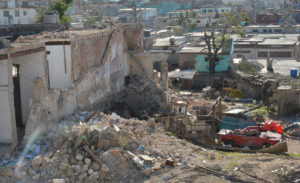
Cuban state media reported a category F4 tornado that hit Havana Jan. 27 claimed six lives and damaged more than 3,500 homes in its seven-mile-long path. (Photo courtesy of L.M. Dyson family)

Cuban state media reported the category F4 tornado, which passed less than two miles south of Havana’s historic downtown district Jan. 27, claimed six lives and damaged more than 3,500 homes in its seven-mile-long path.

In the storm’s immediate aftermath, more than 200,000 lacked access to water. Many people were without electricity at least three days, and even residents whose homes were not seriously damaged lost all their frozen and refrigerated food.

Peter Dyson, a member of First Woodway Baptist Church in Waco, contacted leaders at Havana Baptist Theological Seminary to find out if everyone there was safe and if the seminary had been hit.

Linking resources to needs

Dyson’s father, L.M., a retired business professor at Baylor University, has helped Cuban Baptists for the last two decades, linking stateside resources to ministry needs on the island nation.

The Dyson family delivered water purifiers to Cuba. (Photo courtesy of the L.M. Dyson family)

Peter Dyson learned the seminary escaped any major damage. Recognizing the downtown school was strategically positioned for ministry to tornado survivors, he asked if the seminary might be able to establish feeding stations for displaced people. Seminary officials were willing to make their personnel and facility available, but they questioned whether they had enough food and other resources to minister effectively.

So, L.M. Dyson contacted national Woman’s Missionary Union. The WMU Foundation’s HEART Fund—Humanitarian Emergency Aid for Rebuilding Tomorrow—provided a $3,650 grant for a generator and bulk food to help the downtown Havana seminary meet community needs.

Later, WMU also approved a $3,500 Pure Water, Pure Love grant to purchase water purification systems.  Green Acres Baptist Church in Tyler, First Woodway Baptist Church in Waco and Olmito Baptist Church, between Harlingen and Brownsville, also contributed financially.

Blessings International, an Oklahoma-based ministry, donated 150 lbs. of medicine valued at $5,000.

Delivering supplies

Pregnant women received much-needed prenatal drugs. (Photo courtesy of L.M. Dyson family)

Eight days after the tornado hit, Dyson’s wife, Doralyn, and their daughter, Dawn Henry, traveled to Cuba to deliver the donated ministry supplies—including two tires for the seminary’s van.

“We got every bit of it—including all the medicine—through customs with no trouble. The hand of God was on it,” Doralyn Dyson said.

In addition to a variety of antibiotics and other drugs needed to fight the spread of disease after the natural disaster, they also delivered much-needed prenatal drugs for pregnant women and pediatric medicine.

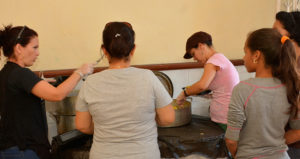
Personnel at Havana Baptist Theological Seminary established four feeding stations after a tornado hit their city. (Photo courtesy of L.M. Dyson family)

Havana Baptist Theological Seminary personnel prepared and served two meals a day for more than a week, meeting the immediate needs of their neighbors.

In the weeks that followed, members of the seminary community and other Baptists in Havana donated items people affected by the tornado would need. Then they began an ongoing community outreach ministry, fanning out from the seminary to deliver the donated goods.

“The Christians pulled together,” Doralyn Dyson said. “They don’t have much to begin with, but they took their own clothing and household items—the little they had—and shared with those who had nothing.”

Lives changed

Christians donated their own clothes and household items to meet the needs of their affected neighbors. (Photo courtesy of L.M. Dyson family)

A few weeks after her initial trip after the tornado, she returned with her son, Peter, to deliver additional supplies—not only in Havana, but also to a Baptist nursing home, a camp in Western Cuba and to Christians in Santa Clara, where First Woodway Baptist has an ongoing ministry relationship.

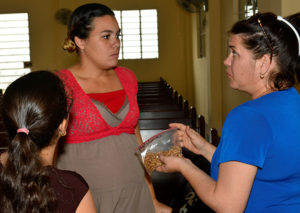
On her second trip, she recalled when her driver stopped to visit a family who had been the recipient of the seminary’s community outreach ministry. Her escort talked with a man in the courtyard outside his house and learned he had just prayed with a pastor who led him to faith in Christ.

“The pastor was taking out two bags of Santeria idols from his house,” she said, referring to an Afro-Cuban folk religion that melds Catholic veneration of saints with indigenous spiritism.

Donated water filters have made a significant difference in the lives of people who have received them, said Rodosvaldo Rodriguez, a professor at Santa Clara Baptist Seminary. (Photo courtesy of L.M. Dyson family)

‘Everybody is very healthy’

On her second trip, she also delivered additional water filters. Last year, Cuban Baptist disaster relief workers—who had been trained by Texas Baptist Men—taught 400 Baptist pastors and church leaders how to use the water purification systems, which they distributed in their own communities.

The water filters have made a significant difference in the lives of people who have received them, said Rodosvaldo Rodriguez, a professor at Santa Clara Baptist Seminary.

“The filter that you brought and gave to each of my family has been a blessing to us,” he said, adding his life before gaining access to purified water was “miserable” and characterized by “very frequent fits” of gastro-intestinal problems.

“Then one day you showed up with the filters. My life changed dramatically,” he said. “I began to drink purified water, and I haven’t had any more fits. Then I got to the conclusion that it was the water I had been drinking that caused all that.

“Furthermore, my daughter had just given birth to a baby girl and had to buy bottled water. Not anymore. Everyone is drinking purified water—even his baby boy who is one month and a few days old. Everybody is very healthy.”


Threads by Nomad celebrates diversity through design

HOUSTON—Atia was born in Kabul, Afghanistan, where she learned to embroider and crochet. To escape violence in her homeland, she relocated to the United States as a refugee in 2015.

Today, she works as an artisan with Threads by Nomad, a Houston-based ministry that celebrates diversity through design, providing refugees who are skilled seamstresses and fiber artists both an avenue for cultural expression and a livelihood.

Passion for responding to needs of refugees

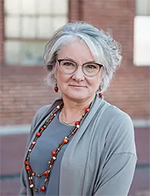
Nell Green

“We have a passion for responding to the plight of refugees and addressing human trafficking and its victims,” said Nell Green, co-founder of Threads by Nomad with her daughter, Christen Kinard. “Faith drives what we do.”

They launched Threads by Nomad in 2016, weaving together their love for Jesus and their love for the beauty of global diversity as expressed in fabric and needlework.

Green has years of personal experience as a seamstress. At age 9, Green’s mother taught her to sew. By the time she was in the ninth grade, she was making her own clothes. Later, she made clothes for her daughter.

As a minister, registered nurse and social worker, Green has a passion for responding to the needs of refugees. She and her husband, Butch, have worked cross-culturally for more than 31 years and the last 20 with refugees.

Having served in West Africa and the Middle East, Nell developed Global Runway, a program that raised awareness of women of other cultures. Part of her work now includes helping churches and other non-profit organizations learn how to address the issue of human trafficking and the needs of refugees at a local level. She also spearheaded regional relief efforts around Houston following the devastation of Hurricane Harvey.

After living and serving in so many countries, the Greens often thought of themselves as “migrants” or “nomads.” And Kinard grew up working with refugees alongside her parents.

Atia, a refugee from Afghanistan, is skilled at crochet and embroidery. (Photo courtesy of Threads by Nomad)

Collaborative effort

“A key component of the production is the hiring of refugees stateside and the enlisting of creators from various countries providing micro-enterprise opportunities,” Green said.

“In our work to develop the collections, we have collaborated with refugee artisans living in the United States from Iraq, Iran, Pakistan, the Democratic Republic of the Congo, Azerbaijan and Afghanistan, as well as craftsmen from West Africa and East Asia.”

All the refugees come into the United States through the United Nations. They are legally vetted and then given a Social Security Number and a work permit. They receive three months financial assistance by the government and are fully employable. After the three months is up, they must be employed and be self-sufficient.

Threads by Nomad seeks to build a business that will provide meaningful and fulfilling jobs to refugees at a sustainable wage.

“As with any business, there are challenges,” Green said. “Finding the people with the right skills for the various tasks is one example. Another is training people to work full time to earn a living.”

‘How can my business make a difference?’

Some artisans bring extensive experience to their jobs.

Hayder, from Iraq, is now the chief tailor at Threads by Nomad. (Photo courtesy of Threads by Nomad)

Hayder, the chief tailor at Threads by Nomad, became an apprentice at age 12 in Iraq, learned the trade and had his own shop in his homeland. He resettled in the United States in 2014.

Artisans are not required to be Christians, but since some of the products they produce have religious meaning, questions and discussions about faith are common.

Some artisans, like Akran, are deeply committed to their Christian faith. She and her two daughters were forced to leave Iran as refugees when they became Christians. They relocated to the United States in 2017.

“Americans are really nice. And I love my church. They are my brothers and sisters,” she said.

Narmin was born in Baku, Azerbaijan. She traveled to the United Kingdom for two and a half years before finally arriving in the United States. She speaks three languages, and she often sings at church and accompanies her husband on the guitar. Narmin appreciates the opportunity to share her culture and her faith through art.

“We want American women to support diversity,” Green said.

She also wants everyone involved—suppliers, artisans and customers—to gain a new perspective on vocation.

“We want people to realize a business can support them, as well as serve a purpose to help others,” she said. “We ask, ‘How can my business make a difference?’”

Carolyn Tomlin writes for numerous Christian publications and teaches the Boot Camp for Christian Writers.


Hispanic ministry demands multicultural awareness

Terms like “Hispanic” or “Latino” may suggest a group of people who share a common language and culture, but leaders of Hispanic Texas Baptist churches know better.

The Pew Research Center reported in 2012 only about one-fourth of adult Hispanics identify themselves as “Hispanic” or “Latino,” preferring instead to identify by their family’s nation of origin—Mexico, Cuba, Honduras, El Salvador or elsewhere.  Only 29 percent said all Hispanics in the United States shared a common culture.

Of the total U.S. Hispanic population, Pew researchers reported people of Mexican family origin accounted for 63 percent in 2015—a clear majority, but down from the high of 66 percent in 2008.

Let individuals tell their own stories

Many pastors of Hispanic congregations in Texas increasingly recognize the need for multicultural awareness.

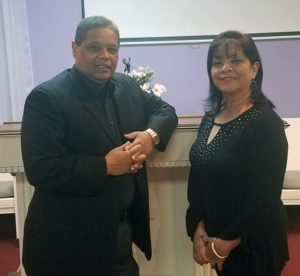
Oscar and Margoth Camacho serve at Iglesia Hispana Antioch in Farmers Branch. (Photo / Isa Torres)

“As Christians, we must go through cultural barriers in order to connect with people,” said Oscar Camacho, pastor of Iglesia Hispana Antioch in Farmers Branch.

Camacho and his wife, Margoth, are from Colombia. Their church includes families from Mexico, Honduras, Puerto Rico, El Salvador, Colombia and other Latin American countries.

“Our stories as Hispanics can be very similar, but there are not two people who are the same in this world,” Camacho said. “We must hear individuals tell their own story.”

Cultural differences can be an issue, but Iglesia Hispana Antioch seeks to help believers recognize their primary identity in Christ, Camacho said.

“That is why we call ourselves an embassy of worship and praise,” he explained. “We want to establish our identity as (a group of people) that worships and praises God.”

(Design by Alan Paul)

To help the congregation pursue that identity, Camacho said, he understands he must let go of his own culture in some regards to improve communication with people from other cultures. As communication improves, relationships grow, he said.

“As a pastor, I can be a mentor and help people develop their faith when I have a close relationship with them,” he said.

But learning to communicate with individuals and with the congregation as a whole is a continuous process, Camacho acknowledged.

“We grew up in a church where we had constant interaction with the pastor, and we were able to develop our leadership skills,” he said. “That is what we aim to do here, too.”

Reaching people from different cultures

Past experiences confirm how God prepares people to serve where they are now, said Kevin Harris, pastor of First Baptist Church in Los Fresnos.

Olga and Kevin Harris moved to Los Fresnos when he became pastor of First Baptist Church there. (Photo courtesy of Kevin Harris)

Although Harris is not Hispanic, his wife Olga is from Venezuela. They met in seminary, and since then, he has grown to understand more what it means to serve people from other cultures, he said. He has been involved in Hispanic churches and learned Spanish throughout the years.

Harris noted he and his wife have talked extensively about the differences between Hispanics from different places and how a church can offer a multicultural ministry that reaches people of varied backgrounds.

While Harris initially served in lay ministry, God prepared him to become pastor of First Baptist in Los Fresnos, he believes.

His experiences with Hispanic congregations in the Dallas-Fort Worth area were different than those in Los Fresnos, a city close to the border with Mexico, he noted.

“As a pastor, I know that means I need to take the time to learn the culture of the congregation,” Harris said. “I must move slowly, take the time to talk to people and understand the way they do things.”

Develop a missional mindset

He also pointed to a book he found helpful, A Future for the Latino Church: Models for Multilingual, Multigenerational Hispanic Congregations by Daniel Rodriguez.

Like the community it serves, First Baptist in Los Fresnos includes both Hispanic families with ties to Mexico and Anglo families.

Due to the town’s proximity to the border, the majority of Hispanic families in Los Fresnos are from Mexico.

In a cross-cultural congregation, members must make a conscious effort to try to understand each other, Harris emphasized.

“Language and culture can be a natural divide unless the leadership of the church is intentional in breaching that divide and bringing healing,” he said. “That’s why we must bring a cross-cultural mindset—a missional mindset.”

He learns from and works alongside his wife, who has a background in marriage and family counseling and has worked with Mexican populations more than 20 years.

Both Harris and Camacho noted the type of Spanish spoken by people from different areas varies widely. Words can carry different meanings, depending on locale.

However, a willingness to learn and to keep an open mind allows people of varied educational backgrounds and cultures to communicate with each other, Harris said.

“We know we must be fully fluid in a multilingual and multigenerational church,” Harris noted. “We must balance well the mix of the cultures.”

Through contextual communication, a pastor can speak effectively of the calling God has given to the church, Harris said.

“It is then we can help the church turn toward the outside,” rather than focusing internally, he said.

Read more articles like this in CommonCall magazine. CommonCall explores issues important to Christians and features inspiring stories about disciples of Jesus living out their faith. An annual subscription is only $24 and comes with two free subscriptions to the Baptist Standard. To subscribe to CommonCallclick here.