Baptists join call to increase public school funding

AUSTIN—A Baptist pastor from Houston joined teachers and administrators at a March 11 rally on the steps of the Texas Capitol, urging lawmakers to increase funding for public education.

Ogletree 150
John Ogletree

Schoolteachers and preachers alike plant “seeds of hope” in young lives, said John Ogletree, pastor of First Metropolitan Church in Houston and school board president for the Cypress-Fairbanks Independent School District.

“You plant seeds of hope in our children,” Ogletree told public educators before offering an invocation at the rally. “You plant these seeds no matter the socio-economic background; no matter the race, creed or color; no matter the dysfunction that they’ve come from in their homes; no matter whether they have limited abilities, physically or emotionally or intellectually. You still do the job and plant seeds of hope.”

Ogletree, who serves on the board of the Pastors for Texas Children advocacy group, noted the challenges public schoolteachers face, but encouraged them to remain hopeful.

“We urge you to remain diligent, remain patient, but whatever you do, remain confident, because we will win this fight,” he said, as reported by EthicsDaily.com. “I’m here to tell you that the seeds of hope that you plant will one day produce a harvest of hope that we’ll see all across this state from the children that you educate.”

Among the governor’s emergency items

In his biennial State of the State address Feb. 5, Gov. Greg Abbott named school finance reform, teacher pay raises and property tax relief as emergency items for the Texas Legislature.

“Texas must recruit and retain the best and brightest teachers to educate our students. This session, we must pay our teachers more,” Abbott told legislators.

In response, lawmakers in both the Texas Senate and the state House of Representatives have introduced bills addressing school finance reform and pay increases for public schoolteachers.

SB 3, introduced by Sen. Jane Nelson, R-Flower Mound, authorizes $4 billion over two years, providing $5,000 annual pay raises for full-time classroom teachers and school librarians. The bill passed unanimously in the Senate.

SB 4, filed by Sen. Larry Taylor, R-Friendswood, offers money for teacher merit pay, as well as incentives for districts to improve third-grade reading performance. It also provides funds for full-day pre-kindergarten and increases funding for low-income students.

HB 3, filed by Rep. Chair Dan Huberty, R-Houston, chair of the House Public Education Committee, and supported by Speaker Dennis Bonnen, R-Angleton, provides $6.3 billion for public education and $2.7 billion for property tax reform.

‘Called to pursue the common good’

Kathryn Freeman 150
Kathryn Freeman

Kathryn Freeman, director of public policy for the Texas Baptist Christian Life Commission, particularly expressed appreciation to Huberty and Bonnen for their efforts “to reform the broken school finance system.”

“HB 3 invests $9 billion into the future of Texas through an investment in our public school children. We are called as Christians to give special attention to the poor and vulnerable, so we are pleased HB 3 targets resources to children most at-risk for failing to obtain a high school diploma, such as students with learning disabilities and living in poverty,” Freeman said.

“The vast majority of Texas school children will attend a Texas public school. As Christians called to pursue the common good, we support HB 3 because we believe it is a step toward ensuring all children—even those in impoverished neighborhoods—have access to quality neighborhood schools.”

‘A step in the right direction’

In a public statement released the day of the rally for public education in Austin, Pastors for Texas Children likewise expressed support for HB 3.

“While still short of what our children need, $9 billion is a significant step in the right direction,” said Charles Foster Johnson, founding executive director of Pastors for Texas Children.

Charles Foster Johnson 140
Charles Foster Johnson

“A budget is an intrinsically moral document, not merely a financial one. We pray that our Texas House and Senate will produce a final school finance plan that puts our children, and the ones who teach them, in the place of highest priority where they belong.”

In a March 12 email, Johnson noted Texas remains about $40 billion behind in funds required “to bring us to the middle of the pack nationally in per pupil funding,” but both the House and Senate bills represent real progress.

While both call for teacher pay raises and include plans for full-day pre-kindergarten classes, he pointed to two significant differences.

“First, the House version does not tie their funding to performance outcomes on standardized tests, like the Senate version does. Second, the Senate version makes some of the pay increases for teachers contingent upon ‘merit’—this is, the academic performance of their students,” he wrote.

“We disagree on our provision [of funds] having strings attached. We will seek to reconcile these two versions into a plan that funds our schools without conditions. It’s our moral duty to do so, especially when we are so far behind.”



Lack of dynamism creates decadence, Ross Douthat asserts

WACO—If Western civilization is mired in decadence, it has less to do with orgies and overindulgence than with sterility and stagnation, conservative Catholic commentator Ross Douthat told a Baylor University crowd.

Douthat, author and New York Times columnist, participated in a public dialogue about “Decadent Societies” moderated by Alan Jacob, distinguished senior fellow at Baylor’s Institute for Studies of Religion.

Flagrant sin and moral depravity are symptomatic of decadence but do not define it, Douthat suggested. While some view a decadent society as one that has failed or faces imminent failure, he sees a society’s decadence and its failure as related but not identical.

“Decadence creates certain vulnerabilities to failure but is not synonymous with failure,” he said.

‘Drift, stagnation and repetition’

Instead, Douthat considers a decadent society as the opposite of a dynamic society. “Drift, stagnation and repetition”—as opposed to dynamism, creativity and originality—characterize a decadent society, he asserted.

The 150-year period from 1825 to 1975 represented a time of dynamic technological change that coincided with revolutionary change in morality, exploration and artistic expression, he observed.

While there is not necessarily a cause-and-effect relationship between economic, technological, moral and artistic dynamism, he believes “some suggestive correlation” exists.

“I don’t think it’s crazy to suggest that there are feedback loops” of creative energy, he said.

‘Simmering discontent’

For most of the last four and a half decades, Western society has appeared “stuck” in a sustainably decadent phase, endlessly repeating without resolving essentially the same arguments, Ross Douthat (right) observed. (Photo / Ken Camp)

A century and a half of dramatic technological advancement created an “expectation of change,” but “the promise that tomorrow will be better than today” failed to materialize significantly in the last four and a half decades, he asserted.

Consequently, Western society is burdened with “the costs of modernity”—including a lack of grounding in tradition—“without its promised benefits,” Douthat said.

“What you’re left with is a simmering discontent,” he said.

The post-World War II era of expansion, particularly the 1960s and early 1970s, marked the last great dynamic period in the United States, he said, pointing to the Apollo space program as its defining symbol.

While not all the “moral revolutions” that occurred in that time had positive outcomes, the creative energy of the era is undeniable, he noted.

‘The stability of the grave’

Dynamism carries an element of danger, whereas decadence offers stability, he asserted.

“It is a stability that is kind of sterile … like the stability of the grave,” he said.

The most pervasive technological advance since the mid-1970s—the Internet—seems to offer both “perpetual stimulation” and the “perpetual illusion of activity,” he suggested.

“It’s possible that the Internet is just play-acting” that leaves users “over-stimulated to the point of numbness,” he said.

On the other hand, it could set the stage for destabilizing change, he added. History will determine whether social media and the Internet generate real change and reflect reality or just offer a substitute for it, he noted.

‘Desire for something better’

For most of the last four and a half decades, Western society has appeared “stuck” in a sustainably decadent phase, endlessly repeating without resolving essentially the same arguments, Douthat observed.

“Even if people have a sense of moral imagination, if they become frustrated with the institutions, that moral imagination curdles,” he said.

Ironically, both Alexandria Ocasio-Cortez’s Green New Deal democratic socialism and Donald Trump’s “Make America Great Again” populism reflect a visceral reaction against decadence, Douthat asserted.

In different ways, both appeal to the idea that the United States “used to do big things” and reflect a desire to “get back to that,” he noted.

“As a conservative, I think there are deep moral problems with the left’s vision. As a Christian, I think there are deep moral problems with Donald Trump’s vision,” he said.

However, both reflect the “desire for something better,” he added.


Speaker challenges Latinas to back up prayers with action

SAN ANTONIO—Unión Femenil Misionera of Texas held its yearly reunion apart from the Hispanic Baptist Convention in San Antonio annual meeting for the first time. However, the focus remained the same—support for missions.

“We are doing more today than before. We are doing more missions than before,” UFM Executive Director-Treasurer Bea Mesquias said.

The group’s work is evident throughout the state, across the country and in other nations, she added.

Raise voices against injustice

Texas Baptist Women in Ministry Coordinator Anyra Cano invited UFM to be more involved in community ministry and act on issues that affect their communities.

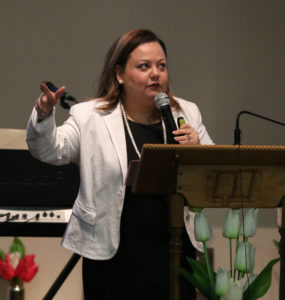
Texas Baptist Women in Ministry Coordinator Anyra Cano urge Latinas to take action to stand against injustice.

In addition to praying, Christians must take action for liberation to happen, Cano insisted. When God places a concern in the hearts of his people, they should recognize it as a call to action.

“If the church just prays without taking action, then it is not effective,” Cano said. “Instead, praying should lead us to take action.”

Churches must pay attention when others suffer and stand up to defend them, she added.

“We have to look at God’s heart and realize we have been invited to raise our voices,” she said.

Letting the voices of marginalized people be heard is not taking a political stance, but it is standing against injustice, Cano said.

When Christians stand up against injustice, they are following biblical examples such as Moses, Esther, the daughters of Zelophehad and Jesus, she noted.

Whether in schools, influencing parents or teachers, or in businesses or government, there is a place for everyone in the church to speak up against injustice, she said.

Jesus sets the example for every Christian in Luke 4:18-19, when he said he came to set the oppressed free, Cano said.

In addition to seeking God’s guidance through prayer, Christians also have a responsibility to become informed and collaborate with others, Cano said.

God can do a lot with a little

Yani de Gutiérrez from Iglesia Bautista Horeb in Mexico City spoke to the Unión Femenil Misionera of Texas reunion. (Photo courtesy of Eder Ibarra)

Those who call upon God need to recognize God’s call on their lives to sacrificial service, said Yani de Gutiérrez from Iglesia Bautista Horeb in Mexico City.

“Those of us who follow God call to him when we are in need,” Gutiérrez said. “But God has also called us to give and to serve.”

All four Gospels present the account of Jesus feeding the 5,000, she noted. After the disciples had ministered in other towns, they found a multitude who demanded more of their time, she said. Since the 5,000 only accounts for the men in the crowd, the number of people probably was at least twice as large, she added.

Feeding a big number of people seemed impossible, but Jesus wanted the disciples to have compassion for these people and trust God would use them if they wanted to serve, she said.

“The disciples had not eaten, or had any rest, and yet the Lord wanted them to serve,” Gutiérrez explained. “And that is when the miracle happens, when they start serving.”

Jesus prayed first and then gave the food to the disciples. When the disciples went to give out the food, they found there was enough for everyone, she pointed out.

Even though feeding thousands of people with five loaves and two fish seemed impossible, Jesus showed people must only be willing to serve in order to see God do the impossible, she said.

“Though what we have to offer might be little, God turns that into a blessing,” Gutiérrez said, encouraging Texas UFM to continue to be faithful with the little they may have and see the miracles God will do.


Buckner inspires four couples to make lifelong commitments

BUCKNER—In a church filled with people, one room stood out. A small group of men gathered inside talking quietly. Occasionally, a bit of laughter broke the tension.

Gaudencio Martinez voiced how all of them were feeling: “Nervous.”

Another room buried even deeper in the church had a significantly different tone. The women there were talking quickly—excitedly. They held still as they put on make-up, then jumped back into action.

The scene was different, but Silvia Lares said the women felt the same emotion as the men: “Nervous.”

Four couples were married in one ceremony at The Village Church in Dallas. All have been involved in programs offered by the Buckner Family Hope Center at Bachman Lake. (Buckner Photo / Aimee Freston)

For the four couples who were married in one ceremony at The Village Church in Dallas, the day was years in the making—19 to be precise, since Gaudencio Martinez and Silvia Lares met at a friend’s house.

Whatever originally brought the four men and four women together as couples, they gathered for the wedding ceremony in large part because of their involvement in the Buckner Family Hope Center at Bachman Lake in Dallas.

All have participated in classes to strengthen their families and their relationships. Their children have been involved in Buckner programs, as well. As families, they have volunteered to help their neighbors through Buckner.

Albert Reyes, president and chief executive officer of Buckner International, and Ricardo Brambila, director of the Family Hope Center, officiated at the joint ceremony for the four couples.

“We serve families at every level,” Reyes said. “We help them work through economic, emotional and spiritual issues. In the process of those conversations, we talk about God’s model for the family. We talk about husbands and wives committing to each other, laying the groundwork for stability for the entire family. These couples today are standing before their neighbors committing themselves and their families to God.”

In spite of feeling nervous, Gaudencio Martinez and Silvia Lares were married at The Village Church in Dallas. (Photo / Aimee Freston)

The moment nearly overwhelmed Martinez in the middle of the ceremony. He fought back tears as he professed his love to his bride. He wants to set an example of what a godly relationship looks like for their teenage sons.

“My wife and I believe it’s a good example for our sons,” he said. “It’s a symbol of unity for the family.”

Buckner programs already have made a tremendous difference in the family’s life, Martinez said.

“The programs Buckner has are focused on the family. They focus on my sons. They’ve helped my sons. They’ve helped me. It’s helped me work toward a better future,” he said.

“Buckner is helping families little by little. People used to know Buckner through a brochure. Now they know Buckner through the people who are involved in it. They see the change in our families. They see the change in our children. As a result, they want to know more about Buckner.”

In some ways, a ceremony years in the making is the start of many years to come.

“I wanted to be more of a family,” Sylvia Lares Martinez said. “Buckner gave us that opportunity.”


Houston churches provide food baskets to refugees

HOUSTON—Next month, 50 refugee families new to Houston will receive a welcome food basket, courtesy of 10 area churches.

“We want these newly resettled refugees to understand we care about them. We want them to know we are there to help them adjust to new customs in our country,” said Butch Green, a Houston-based worker with the Cooperative Baptist Fellowship, who coordinates the ministry to refugees.

A refugee gladly receives a welcome basket from Houston-area Christians. (Photo courtesy of Butch Green)

Interfaith Ministries of Houston provides Green and his wife, Nell, the names and addresses of newly resettled refugees, and they work with volunteers to make them feel welcome, delivering food baskets around Easter and Thanksgiving.

The Greens began the welcoming ministry to refugees eight years ago when they recognized five resettlement agencies were at work in their city.

Although the number of refugees entering the United States has dropped from 80,000 a year to 20,000 or less, those who arrive still have needs. The Greens and the churches with whom they partner are committed to meet those needs in Christ’s name.

People from varied cultures and religions

“In our area, we have families from Iraq, Syria, the Congo, Nigeria, Afghanistan and other countries that represent a variety of cultures and religions,” Green said.

The United Nations High Commissioner for Refugees, the U.S. Embassy or an approved nongovernmental organization refers prospective refugees for resettlement to the United States.

After they are screened, those who receive refugee status are assigned a location for resettlement. They receive a Social Security number and work permit, and they are provided an allowance for up to a maximum six months. At that point, they are expected to have found employment and housing.

Due to the brief time frame, many refugees accept jobs below their educational and skill level. Individuals with engineering backgrounds may stock shelves, and people with degrees in medical fields may work in fast-food restaurants.

Green recalled delivering a food basket to a home. Taped to the front door, he saw a Scripture verse, John 11:25: “I am the resurrection and the life. He who believes in me will live, even though he dies.”

Showing love to people who experienced trauma

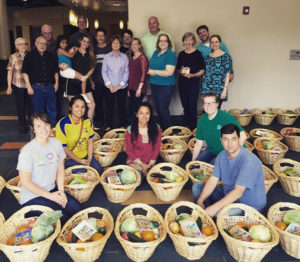
Volunteers at Tallowood Baptist Church in Houston assemble gift baskets for refugees. (Photo courtesy of Butch Green)

Inside, he met an Iranian family who had all come to faith in Christ and fled to Turkey. In the short time the father had been in Houston, he was sharing his story with others, asking, “Why do Americans take all of these freedoms and their faith for granted?”

Green reflected on the trauma many refugees experienced in their homelands. He remembered a man from Syria who spoke in broken English, saying, “Bomb, bomb, bomb everywhere.” Another refugee told how he arrived at his home in Syria to find his wife’s throat cut and his daughter’s leg sliced open. Both survived.

“In our area, we see refugee families where language is a barrier to finding jobs,” Green said. “Often their English is limited and even non-existent. Providing English-as-a-Second-Language classes is a basic need.

“Another urgent essential is finding employment. Imagine being in a new country where everything is different, and you can’t understand the language. Public transportation—riding a bus and finding the right address—can be very stressful to a non-English-speaking person.”

Letting people know God loves them

The Greens enlist volunteers from 10 supporting churches to pack the welcome baskets that contain gift cards, staple food items and contact information.

“I always include my contact number if they have a need. Then, I make this call or pass it on to a volunteer,” said Green.

Volunteers from South Main Baptist Church have assembled welcome baskets to deliver to newly arrived refugee families. (Photo courtesy of Butch Green)

When the Greens or the volunteers who work with them deliver the baskets to apartments, they often discover refugees who need help in making appointments, filling out forms, and finding information about public transportation.

“If they ask, we can tell them about our ministry. And if they ask us to pray, we can,” Green said.

Some families are surprised to learn some Americans want them to feel welcomed.

Green recalled a conversation with one woman. When he presented her a welcome basket, she responded incredulously, “You mean, you’re glad we’re here?”

Those kind of encounters give Green the opportunity to assure refugees that God loves them, and Christians in the area care about them.

The refugee program receives support not only from the 10 Houston-area churches, but also from churches around the state through their gifts to the Texas Baptist Hunger Offering. The offering helps support 134 ministries in 30 countries and 37 Texas communities.

Impact on volunteers

The refugee welcome ministry helps church volunteers get over the initial fear and misunderstanding of refugees, Green noted. As the volunteers pack the baskets and visit homes, they connect with people. Often, refugees invite the volunteers into their home for tea and cookies.

As a result, the volunteers—and the churches they represent—sometimes end up “adopting” refugee families and establishing long-term relationships with them.

The Greens believe God put them in Houston to work with refugees.

“We were overseas in Africa and Europe and worked with refugees for 20 years of a 31-year ministry. Then, God called us to Houston,” Butch Green said. “We didn’t want to start just another program. We wanted to fill in the gaps and partner with other agencies.

“We’ll retire in a couple of years, so we want our church partners to catch a vision and see the needs of these wonderful people who are settling here.”

This is part of an ongoing series about how Christians respond to hunger and poverty. Substantive coverage of significant issues facing Texas Baptists is made possible in part by a grant from the Prichard Family Foundation.

Carolyn Tomlin is a freelance writer who teaches the Boot Camp for Christian Writers.


Conference seeks to create safe space for a woman’s call

ABILENE—Women called to ministry face many questions and obstacles. Texas Baptist Women in Ministry seeks to provide a safe space for women and men to work through these questions and to empower women to overcome obstacles and follow God’s call.

Women from around Texas and elsewhere gathered at Hardin-Simmons University’s Logsdon Seminary in Abilene on Feb. 22 for the 2019 Texas Baptist Women in Ministry Conference.

Women working through God’s call to ministry

Preaching from Jeremiah 1:4-10, the story of God calling Jeremiah to be a prophet to the nations, Ellen Di Giosia, pastor of First Baptist Church in Jefferson City, Tenn., encouraged attendees to see themselves in Jeremiah’s story.

Ellen Di Giosia preaches at the Texas Baptist Women in Ministry Conference (Photo: Hardin-Simmons University)

Jeremiah was from a religious family, presumably with expectations to become a religious leader in Judah. In the midst of that expectation, God told Jeremiah, “Before you were born I set you apart; I appointed you as a prophet to the nations” (Jeremiah 1:5). When he protested, God put words in Jeremiah’s mouth, an event Di Giosia said was accompanied with some pain.

Di Giosia was in college and involved in what was then called the Baptist Student Union when she began to sense God calling her to the ministry. “But I was a woman,” she said, the implication being that her sense was wrong.

“There’s no truth-telling without tears,” Di Giosia said, indicating God’s call comes with discomfort for the person called and for those to whom the called person is sent.

Female ministers know such discomfort all too well. Di Giosia was once told she needed to wear a jacket when she was in the pulpit because her “elbows were distractingly sexy.”

Despite the discomfort involved in being a woman called to ministry, Di Giosia was able to tell her ordination council, “Serving the church is really hard, and I have a lot to learn, but I have a deep conviction I was born to do this.”

Women encouraging women to embody their call to minister

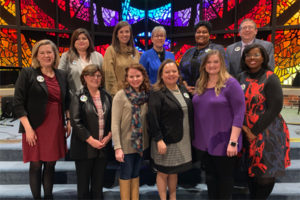
Texas Baptist Women in Ministry board members with coordinator Anyra Cano, center. (Photo by Julie Sorrels)

Pastor Anyra Cano, coordinator of Texas Baptist Women in Ministry, encouraged conference attendees to build bridges. She referred to the bridge between her childhood home in El Paso and her dad’s childhood home in Juarez. That bridge connected her to two people, two cultures, two languages and to the injustice and problems on both sides of the bridge.

Building structurally sound and beautiful bridges takes a lot of work, she said. There must be a plan and a purpose for the bridge. Blueprints are needed. Beauty must be intentional. And both sides must be willing to build the bridge.

Other women offered encouragement to attendees. Meredith Summers, minister to women and singles at Pioneer Drive Baptist Church in Abilene, told how her perspective on ministry changed when her pastor invited a women to pray in church. Prior to that time, Summers only saw men leading in the church, but seeing a woman pray gave her a sense of connection to the church she never felt before.

Now, after Summers preaches, young women often tell her she’s the first woman they’ve seen or heard preach and that the experience empowers them.

Jessica Watson encouraged those hurt by the church to “stop shaking their fists and pointing fingers at the church.” Instead, be part of the solution. Rather than becoming angry and bitter and leaving the church, “be the church, show up and lead,” she said.

Men empowering women to discern and grow in their call

Conference attendees could choose from 10 breakout sessions following a lunch sponsored by the Baptist General Convention of Texas. Sessions covered such topics as navigating controversy, pastoral care and self-care, spiritual formation in difficult times, ministering in the midst of grief and responding to #MeToo.

Rev. Tamiko Jones at the Texas Baptist Women in Ministry conference (Photo: Hardin-Simmons University)

Rev. Tamiko Jones, executive director of Texas Woman’s Missionary Union and a Texas Baptist Women in Ministry board member, and Rev. Dr. Michael Evans, pastor of Bethlehem Baptist Church in Mansfield and current president of the Baptist General Convention of Texas, explained how they navigate the mentoring relationship.

Prior to entering ministry, Jones was a senior level electrical engineer accustomed to being in a supervisory role. Under Evans’ tutelage, she had to learn to be in a subordinate role. This shift was made easier because Evans learned years earlier that when God calls someone, he has to listen to that.

It’s his job to help a person explore a call to ministry because each person has to work out his or her own salvation, Evans said. Furthermore, he has to answer to God for who God sends him to shepherd.

“Time will tell me whether you’re real or not,” Evans said in reference to verifying a person’s call.

Jones and Evans describe the mentoring relationship with the word “submission.” “Submission is your humility on display,” respecting the gifts a person brings to the table, Evans said. Submission is “internal security in action,” Jones said.

Jones learned to submit to the process of mentoring, which required submitting to the culture of the church, building trust and being patient. As an example of submitting to culture, Jones said when she is at a church that does not affirm women in leadership roles, she does not insist on speaking from the pulpit or platform but accepts the expectations of the particular congregation.

Jones called Evans brave and fair. In response, Evans said about himself, “If the under-shepherd mishandles the flock, he has to answer to the Chief Shepherd.” As a result, Evans takes seriously the care of those who are called to ministry.

Hardin-Simmons University provided video livestreams of the main sessions of the conference, available here: Session 1, Session 2, and Session 3.


Young women encouraged to find identity in Christ

SAN ANTONIO—Teenage girls and young women deal with the pressures of living up to standards set by others, but at the Shine Girls’ Conference in San Antonio, they focused on the identity Jesus called them to have.

At the conference, sponsored by Union Feminil Misionera de Texas and the Hispanic Baptist Convention of Texas, young women shared their experiences in leadership and encouraged others to move toward becoming the person Christ wants them to be. Key speakers included social media influencers Edyah Barragan and Kirby Minnick.

Too often, women can grow up in the church without ever receiving the right message of the identity they must have in Jesus, Barragan said.

“Since I never heard about it through the church, I adapted to whatever [identity] the world told me to have,” she said.

Many young women feel safer and more comfortable adapting to the world rather than following Jesus, Barragan explained.

“If we don’t know the words of Jesus, we may believe what the world says,” she added.

God provides real meaning

Kirby Minnick urged teenagers and young women to cling to the truth of Christ rather than “the falsehoods the world is giving us.” (Photo courtesy of Shine Conference)

Sin corrupts who God wishes people to be, Minnick said. Just like the Apostle Paul, who described his struggle with sin in Romans 7, “We continue to fall into sin too,” she said.

When they sin, people trade what is good for what is temporal, Minnick said. But through Jesus, “we can overcome the world,” she added.

Everything the world offers is like vapor, and only God gives meaning to the things people need, she said.

The body image the world demands and the popularity the world says young women need are examples of the empty and temporal identities Satan offers, Minnick observed.

Embracing the understanding the world offers may lead young women into substance abuse, eating disorders and inappropriate understanding of sexuality, she said.

“We need to know the truth so we can differentiate from the falsehoods the world is giving us,” Minnick said.

Like Gideon, the reluctant warrior in the Old Testament book of Judges, God wants people to be more than whom they think they can be, Barragan said.

“We can shine when we believe the words of God,” she said.

As young women find their identity in Jesus, others will criticize and detest them, Barragan noted. But she encouraged them to remember, “You have been called by God regardless of what others say.”

“My identity is in Christ and not in people’s opinions,” Barragan said.


Texas Baptist delivers 180 tons of soybeans to North Korea

DALLAS—A layman told Texas Baptist Men leaders their prayers opened doors that enabled him to document the delivery of 180 tons of soybeans to orphanages, schools and hospitals in North Korea.

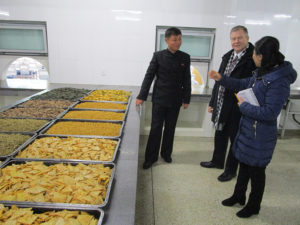
Paul Hinton examines the variety of food products North Korean hospitals, schools and orphanages make from donated soybeans. (Photo courtesy of Paul Hinton)

“I knew I couldn’t go without being covered in prayer,” said Paul Hinton, a layman from Church Project, a Baptist General Convention of Texas-affiliated congregation in The Woodlands.

Hinton described his journey to the TBM board of directors at their Feb. 22-23 meeting in Dallas.

Hinton verified the delivery of 7,200 50-lb. bags of soybeans—120 tons provided through TBM and 60 tons provided by the Korean-American Sharing Movement of Dallas—for children and hospital patients in North Korea.

He visited 12 of the 18 orphanages, schools, hospitals and other sites that received the soybeans donated by Christians in Texas, including First Baptist Church in Midland.

Hinton initially became involved in efforts to provide food for North Koreans several years ago when he met Yoo Yoon, a Dallas-area Korean-American Baptist minister.

Since 1996, Yoon has traveled to North Korea more than 30 times to supervise delivery of food, medical supplies and other resources provided by TBM and other donors.

During his April 2018 trip, Yoon learned he was one of only three Korean-Americans to receive validation to enter North Korea since the U.S. State Department implemented a travel restriction.

‘Why are you here?’

Paul Hinton witnessed the positive impact soy milk and food products made from donated soybeans have made on children in North Korea. (Photo courtesy of Paul Hinton)

Defying the odds, Hinton received the necessary permission to make the trip to North Korea in December. However, since Yoon already had traveled to North Korea earlier in the year, he was not allowed to return eight months later.

“If you want to improve your prayer life, accept a trip to North Korea by yourself,” Hinton said.

Throughout his journey, Hinton noted, several North Koreans he encountered offered the same stunned observation and raised the same question: “You are a Caucasian American. It’s not possible for you to be in North Korea. Why are you here?”

Hinton said he consistently told those who asked, “I’m here to love on people who are in need through no fault of their own.”

He saw firsthand the positive impact the soy milk and food products made from soybeans have made on children in North Korea. He also noted North Koreans in the schools, orphanages and hospitals recognize TBM as the source of the much-needed provision.

“They understand that somebody they don’t even know cares about them. That’s powerful,” Hinton said.

Global ministries

During the board meeting, the TBM board also learned about other missions projects and ministry opportunities around the world:

Drill water wells and teach health and hygiene in Ugandan refugee camps. About 1.4 million people—mostly from South Sudan and the Democratic Republic of the Congo—fill the refugee camps in Uganda.

Up to 5,000 people are dependent on water wells rated to provide for 500 people, said Dee Dee Wint, vice president of TBM’s water ministry. An exploratory group will travel to Uganda in early March at the request of the Southern Baptist Convention’s International Mission Board and Amigos Internacionales, she reported.

Provide washable feminine hygiene pads for women in Kenya. TBM’s water ministry has an ongoing relationship with Mogra Children’s Centre, a children’s home and school that serves vulnerable children and youth from Nairobi’s Mathare slums. Wint noted many young women were homebound several days each month due to their lack of feminine hygiene products.

So, the TBM Camp Builders’ wives sewing ministry committed to provide reusable pads for at least 50 young women and adolescent girls. In three months, the group worked about 1,500 hours to provide 770 pads—enough to supply 77 women with 10 pads each.

Train Israeli emergency personnel in mass feeding. Last year, TBM entered a two-year partnership with the Emergency Volunteer Project in Israel.  Last August, TBM volunteers received training from the Emergency Volunteer Project and the Israeli Defense Force’s Home Front Command to support first responders in Israel after a manmade or natural disaster.

In April, a TBM team will journey to Israel to teach disaster relief workers there how to assemble and use a field kitchen to provide hot meals for large numbers of people.

In other reports, the TBM board learned:

  • Disaster relief volunteers provided more than 98,800 volunteer hours last year. They prepared more than 77,000 meals, logged nearly 2,000 heavy equipment hours and completed more than 630 chainsaw jobs. Through their efforts, volunteer chaplains reported more than 100 people made professions of faith in Christ.
  • Royal Ambassador and Challenger camps drew about 3,000 campers last summer and recorded 295 commitments to Christ.
  • The water ministry drilled 16 wells last year that serve 5,000 people, distributed 396 water purification filters capable of serving 2,480 people, trained 683 people in health and hygiene, and taught 118 people how to make soap—both for their own use and as micro-enterprise.


Baylor regents discuss Christian environment, research

WACO—Baylor University’s board of regents devoted much of its Feb. 22 meeting to discussing how the school can ensure it maintains an “unambiguously Christian educational environment.”

Baylor President Linda Livingstone and various regent committees discussed ways Baylor will maintain its Christian heritage and commitment while expanding institutional focus on research, scholarship and discovery.

“There is a reason why an unambiguously Christian educational environment is the first pillar of our Illuminate academic strategic plan. It’s important that we ensure that this area of distinction will not be lost as we pursue our higher aspirations in the area of research,” Livingstone said.

“Our Christian heritage and Baptist roots form the backbone of who we are as an educational institution. Our distinct Christian mission frames and really gives purpose to all of the work we are doing at Baylor, from the faculty and staff we recruit and hire, to the research we engage in, to how we encourage our students as they discover their unique calling to offer their gifts and talents in the service of God and others.”

Progress reported

In her report to the board, Livingstone updated regents on the university’s goals for the year, among them the implementation of the Illuminate academic strategic plan and progress on Baylor’s $1.1 billion Give Light philanthropic campaign.

As Baylor aspires to achieve top-tier status among universities with the highest level of research activity, Livingstone said faculty have submitted 26 proposals during the first round of project solicitations for Illuminate.

Proposals range from small seed-funding internal grants to suggestions for new institutes, centers or multi-year cluster hire programs to provide partnerships across specific research interests or disciplines.

“I am excited to see how we will continue to flourish as an institution through Illuminate as we grow our influence, not only in higher education but in the world, as a preeminent Christian research university,” Board Chairman Joel T. Allison said. “These signature academic initiatives will amplify and expand our Christian commitment and position Baylor for leadership in fields of national and global importance.”

President Livingstone reported the Give Light campaign—publicly launched in November—already has passed the mid-way point of fundraising, as of Jan. 31, at $563.3 million. The campaign undergirds Illuminate and impacts every aspect of campus life, from academics and athletics to student life and global engagement.

Responding to student food insecurity

In other business, the regent’s student life committee heard from a panel of undergraduate and graduate student leaders on student financial well-being, including a discussion on food insecurity, which can impact the student experience from academics to health.

At Baylor, researchers have estimated between 15 percent and 20 percent of students are food insecure, meaning they do not have reliable access to nutritious food. For at-risk populations such as first-generation, transfer or international students, the research showed more than 92 percent had experienced at least some level of food insecurity. Researchers also found it was difficult for students to admit being hungry at an institution where it appeared that other students had abundant resources.

To address this, the Paul L. Foster Success Center-Student Success Initiatives opened a free student food pantry in December 2017 called The Store, which provides students in need with access to supplemental, nutritious food, normalizing food resources so students can fully thrive in their personal and academic achievements at Baylor.

Other initiatives in place to help students include The Fridge, a series of mini-fridges throughout campus where students who need it most can access quick snacks and healthy meals, and free mobile food pantries and free farmers markets available to students each semester.

The student panel discussion led the full board to commit personally to funding The Store for the next year.

“This is a great example of the Board’s care and concern for our students and the selfless service that embodies our regents,” Allison said. “We are certainly appreciative of our student leaders bringing this transformational program to the board’s attention, and the continued leadership they provide for the student body.”

Other board action

Action taken by the board included the approval of a new student regent. Beginning June 1, Cassidy Parshall, a junior Baylor Business Fellow and finance major on the premedical track from Colleyville, will serve a two-year term on the board. She will serve her first year as a non-voting student regent, while current student regent Malcolm B. Foley, doctoral candidate in religion from Rockville, Md., will serve his second year as a voting member of the board.

In other action, regents approved the closure and demolition of two aging Baylor-owned apartment complexes. Cottonwood and Baylor Plaza I, both built in 1977, and Baylor Plaza II, built in 1979, are being closed after the spring semester due to declining occupancy and increasingly expensive repairs and high maintenance costs.

Current residents have been informed of the closure and offered assistance, including a $250 moving credit, in selecting a residence in other Baylor-owned properties. After demolition this summer, the areas along South Second and Third Streets—about 8.4 acres—will be transitioned to green space.


Latina to lead Christian community development network

Elia Moreno’s journey began ten years ago when she first sought solutions for poverty in West Texas.

She discovered mentors in poverty experts Donna Beegle and Ruby Payne. Then she connected with Jimmy Dorrell, founder of Mission Waco and the Texas Christian Community Development Network, whose poverty simulation opened her eyes to the potential found in Christian community development.

When the Texas Christian Community Development Network recently announced a leadership realignment, Dorrell and Moreno were named co-executive directors of the organization.

“I am so proud and excited to serve as co-executive director,” Moreno said.

Moreno will focus on the Panhandle, West and North Texas, while Dorrell will direct his attention to South, Southeast, Northeast and Central Texas.

Transition in leadership

Rucker Preston, who became executive director of the Texas Christian Community Development Network two years ago, transitioned to a new role as the network coordinator, working on the No Need Among You Conference and other regional training events.

Moreno, founding director of Living Intentionally Ministries and the author of Permission to Rest and Living Intentionally, noted her parents grew up in poverty and immigrated to the United States to seek better opportunities for their children.

She hopes to lead the Texas Christian Community Development Network to expand its advocacy role, particularly on issues related to immigration and the education of poor children.

“We want to learn how to advocate on behalf of education for those students living in poverty that deserve to be prepared to go to college if they choose to,” she explained.

As the Hispanic population continues to increase in Texas, Moreno said the network will seek to reflect that change.

“I will make a conscious effort to reach out to Hispanic churches and that community to engage and involve them in what we are doing,” Moreno said.

Truett grad will lead network’s board

Moreno stepped down from her position as president of the Texas Christian Community Development Network board to accept her new role as co-executive director.

Bethany Rivera Molinar

The board elected Bethany Molinar Rivera, youth and families program director of Ciudad Nueva, as its new president.

The realignment at the network reflects natural changes and a desire to use the strengths of all of the people involved, said Molinar Rivera, a graduate of Baylor University’s Truett Theological Seminary and Diana R. Garland School of Social Work.

“We want to be as diverse as Texas,” she said. “Many times, churches and organizations seem to be 10 years behind everyone else, but we want to be diverse. And more than diverse, we want to be equipping, enabling and fostering leaders.”

Until now, communication between churches and organizations participating in the network and the No Need Among You Conference has been primarily in English. Moreno said that could change in order to communicate with Spanish-speaking churches.

Regional training events are planned in Abilene on April 2 and in Houston on May 2.  Moreno hopes to establish connections for more training conferences in other locations.

Instead of connecting with churches and attempting to get them to follow an agenda, Moreno said, she intends to meet them and listen to what they have to say about their communities.

She hopes Hispanic Baptist churches with connections to other churches in their communities will help arrange meetings with network representatives.

“They are going to know the atmosphere and the temperature in their community—about what their needs are and what the conflicts are,” she explained. “So, we can say, ‘These are the skills that our board has, and we have heard of a speaker before who could address that particular issue.’”


HPU dean takes holistic view of career as calling

BROWNWOOD—Even a brief conversation with Kylah Clark-Goff, dean of Howard Payne University’s School of Education, reveals her passion for learning and serving Christ. In her eyes, these two aspects of life should complement each other to influence life and career.

After earning an education degree at Baylor University and starting a job as a teacher, she sensed a calling to missions. So, she began attending Southwestern Baptist Theological Seminary part-time while continuing to teach.

Call to missions, call to education

Growing up with a mother who was a teacher meant education always felt like a natural fit for Clark-Goff. However, her call to missions was more than coincidental with her skill and background in education.

“Teaching skills work in a lot of contexts,” she said. “Whether it be teaching someone English or the Bible, education has been involved everywhere I’ve done missions.”

While at seminary, she married Sam Goff, who is the minister of missions at Coggin Avenue Baptist Church in Brownwood.

Following the completion of her degree, the couple made a major commitment to God’s calling by moving to Mozambique as missionaries. Clark-Goff ran an English program there, and her husband worked on agricultural development. After several years, they returned to the United States due to the birth of their first child, Mo. The couple then completed their doctoral degrees at Texas A&M University.

‘We’re all ministers if we choose to be’

Although the family now resides in Brownwood, their mission work is ongoing.

“Anything we do can be considered missions, in that our career is really a calling,” Clark-Goff said. “No matter what the career, it is about how God is going to use you to make a difference in the lives of people. We should have a holistic view of careers; we’re all ministers if we choose to be.”

Just as missions should not be confined to a certain profession, she emphasized, education should not be restricted to the classroom.

“Learning is a constant, lifelong process,” she said. “We’ve all got to be in a constant state of learning. If you’re not going forward, you’re taking steps back.”

Serving the university

In addition to serving as the dean of the HPU School of Education, Clark-Goff chairs the Student Learning Success Committee as part of the university’s strategic planning process and serves on the presidential search committee. As HPU seeks its 20th president, Clark-Goff said, the committee and the university as a whole must follow God’s leading.

“God has prepared someone to be HPU’s president, just as he has prepared this position for that person,” she said. “We have to be so prayerful that we’re in the right mindset to recognize who God is guiding to HPU.”

She did not attend HPU, but Clark-Goff said living in Brownwood since the eighth grade meant that the university was an important part of her life. She grew up knowing professors, staff, peers and friends who worked at or attended HPU. This, combined with her time teaching at the university, has accentuated the institution’s uniqueness to her.

“You are going to meet the greatest people here,” she said. “These people will shape your life and then still be there for you in 20 years. That’s what we have to offer—amazing people who are student-focused and centered in Christ.”

Seth Rainey is a senior majoring in communication studies at Howard Payne University.


Grand Prairie church ministers to people on the edge of survival

GRAND PRAIRIE—Pastor Julius Bamibe takes the Golden Rule seriously, and it serves as the guide for Comforter Christian Center International.

A couple of years ago, Bamibe and his wife, Jizell, saw a need in their community and felt God leading them to respond to it.

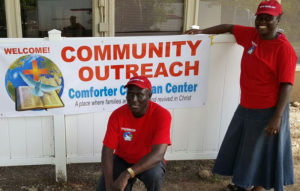
Pastor Julius Bamibe and his wife, Jizell, welcome people in need to receive assistance from Comforter Christian Center International in Grand Prairie. (Photo courtesy of Julius Bamibe)

Comforter Christian Center International serves people who live on the streets—veterans, recently released ex-offenders, single mothers, teens who have aged out of foster care and others who are homeless or living on the edge of survival.

The Bamibes believe so deeply in caring for people in dire need, they have taken money from their own retirement account to help fund it.

Twice a month, between 700 and 900 people receive food and other basic necessities at the church. Volunteers serve meals to those who walk in seeking help. Bamibe also delivers food to places where the homeless gather in Grand Prairie.

During the summer, children who receive free or reduced meals at school eat at the church—often with their parents.

Texas Baptist Hunger Offering

Baptists throughout the state help support the church’s ministry to the homeless and underprivileged in Grand Prairie—along with 133 other ministries in 30 countries and 37 Texas communities—through their gifts to the Texas Baptist Hunger Offering.

“All the funds come from Texas Baptist churches and individuals who care about people impacted by hunger and poverty,” said Ali Corona from the Texas Baptist Christian Life Commission. One hundred percent of the offering goes directly to hunger relief and development ministries, she added.

Bamibe wants to meet both physical and spiritual needs of people who live on the streets or on the edge.

“Although the people who are served by Comforter Christian Center International need food, housing and clothes, they need something much more,” he said. “They need Jesus. They need to know there is hope and that their Heavenly Father loves them, just as they are.”

Comforter Christian Center seeks to honor the dignity of homeless people and restore their self-respect by providing them with new or gently used clothing and a place to shower.

Aging out of foster care

Among other groups, the church helps young women who have aged out of the foster care system at age 18.

With little formal education or job skills training, the girls frequently turn to men for support.  Often these girls are abused and end up pregnant. One 21-year-old girl has six children, Bamibe noted.

“We rent a room for six months and provide food and clothes” for the young women while they receive basic job training at a discount store or fast-food restaurant, Bamibe said. “As they complete the training, they are able to become self-supporting and care for their children.”

Jizell Bamibe takes a personal interest in the young women.

“Often these young girls need a woman to discuss personal issues with,” she said. “They need to see things from a woman’s perspective. Maybe the issues are child care, food preparation or health. I put myself in their place and ask, ‘What would I do’?”

Her husband worked as a physical therapist before he eventually followed God’s leadership and entered the pastorate.

“I resisted God a long time, until he put his hand on me, and I surrendered,” he said. “That’s when I knew I was going to do the work of God.”

Need for partners

Bamibe hopes other churches will come alongside them in ministry to the disadvantaged.

“We need other churches to become involved and realize the homeless population that comes to us are God’s children. Yes, some of them have made wrong choices, but with God’s help, there is hope for them,” he said.

Comforter Christian Center also recognizes it needs more space to accomplish greater ministry. Currently, the congregation and its leaders are praying about a 30-acre lot near the church facility. One idea under consideration is providing transitional housing for recently released ex-offenders.

The church also would like to purchase a van to provide people in need transportation to job training opportunities.

Comforter Christian Center averages about 100 to 125 people in worship on Sundays.

“We are a small church, but we can do big things for God,” Bamibe said, citing the words of Jesus in Matthew 18:20, “For where two or three come together in my name, there am I with them.”

“When Jesus is there, it’s a big church,” he said.

This is part of an ongoing series about how Christians respond to hunger and poverty. Substantive coverage of significant issues facing Texas Baptists is made possible in part by a grant from the Prichard Family Foundation.

Carolyn Tomlin writes for the Christian market and teaches the Boot Camp for Christian Writers.