El Paso-area church shows love by sharing food

EL PASO—Every month, an El Paso-area church with about 60 members prepares food boxes for 50 families in need.

“We want our community to understand we care about them. We want them to know that Jesus loves them. Having a food pantry is one way of showing this love to others,” said Virgie Vasquez, director of the food pantry at Pueblo Nuevo Community Church in Clint, southeast of El Paso.
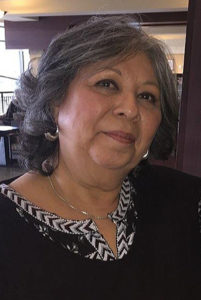
Virgie Vasquez

Vasquez launched the pantry in 2011 when she realized children and families in the neighborhood needed food.

“In our area, we have many single parents raising children,” Vasquez said. “Also, grandparents may be raising grandchildren. … We see veterans who are homeless—no place to go, very little food.

“Many senior citizens live in our community, and they have a limited income. Like in other parts of our country, sometimes they must make a decision to pay the electricity and rent, buy medicine or purchase food. We realize their needs.”

On the third Wednesday of each month, church members distribute boxes filled with dried beans, rice, cereal, canned vegetables and other supplies to 50 families—typically about enough to feed a family for one week.

“There is no need to advertise or post an announcement about when the food is provided. The news travels by word-of-mouth,” Vasquez said.
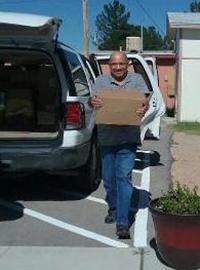
Pastor John Roman helps with the food pantry at Pueblo Nuevo Community Church in Clint, southeast of El Paso.

Seven volunteers work with the food pantry ministry on a regular basis, with additional help from other volunteers and with the support of Pastor John Roman.

Whenever Pueblo Nuevo distributes food, participants are invited—but not required—to participate in a prayer time.

“Catherine came to our church in need of food,” Vasquez said.

However, Catherine found more than meals to serve her family for a week. She found everlasting life.

“She confessed her sins, accepted Christ and was baptized. Soon, her two sons came with her. They too, received Christ as Savior and were baptized,” Vasquez said.

“Since attending our church, she has brought several people and they have become Christians. Catherine clicks with those who have addictions to drugs and alcohol and the homeless.”

Supported by Texas Baptist Hunger Offering

Pueblo Nuevo operates the food pantry on $220 per month. The church contributes $50 each month, and the rest is provided by the Texas Baptist Hunger Offering. It is one of 134 ministries in 30 countries and 37 Texas communities the offering helps support.

“All the funds come from Texas Baptist churches and individuals who care about people impacted by hunger and poverty,” said Ali Corona from the Texas Baptist Christian Life Commission. One hundred percent of the offering goes directly to hunger relief and development ministries, she added.

As part of its commitment to fighting hunger, Pueblo Nuevo also launched a community garden. Organizers hope to find a partner agency or organization to help the church plant and maintain it.

Twice a week, the church opens its doors for community classes in food preparation, nutrition and healthy lifestyle choices made possible by the Texas A&M AgriLife Extension Service.

Often, participants in the classes have raised vegetables in the garden to supplement their food supply.

Schools in the area near Pueblo Nuevo have a high percentage of students who qualify to receive free or reduced meals. The church includes several teachers who know the families. In the blue-collar community, if workers get sick or are laid off, they lack money for basic living expenses.

Pueblo Nuevo provides training to help their neighbors earn high school equivalency diplomas that improve their employment opportunities and help their families become self-supporting. Community members who need assistance filling out forms and help with legal issues also receive aid at the church.

The ministries of Pueblo Nuevo are changing lives and opening doors of opportunity previously closed to people, Vasquez noted.

“People do not want to be homeless or food insecure,” she said. “Often this is due to bad choices, failing health and other conditions. Pueblo Nuevo Community Church is striving to feed the hungry—one person at a time. We ask people to pray for our program, that we will have the resources to minister to more families and individuals.”

This is part of an ongoing series about how Christians respond to hunger and poverty. Substantive coverage of significant issues facing Texas Baptists is made possible in part by a grant from the Prichard Family Foundation.

Carolyn Tomlin is a freelance writer who teaches the Boot Camp for Christian Writers.
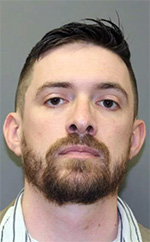


Former associate children’s minister indicted

DALLAS (RNS)—A former associate children’s minister at The Village Church, a Dallas-area Southern Baptist megachurch, has been indicted for indecency with a child involving sexual contact.

Matthew Tonne was arrested on a charge of indecency with a child. (RNS Photo courtesy of Dallas County Jail)

Matt Tonne was indicted by the Dallas County Grand Jury and is being prosecuted by the Dallas County District Attorney’s Office, according to court documents.

In a statement posted Jan. 24 to a page on its website, titled “2012 Kids Camp Update,” The Village Church confirmed Tonne had been on its staff.  The church also said it is cooperating with law enforcement.

“There are no adequate words that can express the pain, sorrow and grief that are wrapped up in this whole situation. We are committed to pursuing healing and justice and will continue to follow the lead of the authorities and experts involved in the case,” the church said in a statement.

“As we all wait for updates, we ask for you to pray for everyone involved, as we look to Christ for hope in such a dark situation.”

Tonne’s indictment was made public in court documents on the Dallas County website. According to those documents, he was released on a $25,000 bond earlier this month on the condition he has no contact with the “complaining witness” or her family and no contact with any child under the age of 17, other than his own three children. He was scheduled to appear in court Jan. 29.

The Village Church’s update page included a video from a September church service, in which its lead pastor, Matt Chandler, said police were investigating a report an adult had allegedly sexually assaulted a minor at a 2012 camp the church had attended, Mount Lebanon Kids Camp. Earlier in the year, the child had reported the alleged incident for the first time, he said.

“It took courage and strength for the child and the family to share this information, and we want to support them in any way possible,” Chandler said.

Chandler did not name Tonne in the video, and the church’s statement did not identify his specific role on staff.

Kent Rabalais, executive director of The Village Church, confirmed Tonne’s title in an email and said the church did not have anything to add to last week’s statement at this time.

The church’s update page also included a statement from the child’s family.

“As parents, our hearts have at times been angered and grieved beyond measure, but we know we have never been left without hope,” they wrote. “Our child and our family have seen the Lord’s abounding love in this through the listening ears and tangible hands of loved ones, our church leadership and staff.”

The Village Church confirmed in its statement it had removed Tonne from church staff in June “for other reasons.” It cautioned that the indictment “is not a declaration of guilt or innocence; it is only the next step in the process.”

An FAQ from the church also advised parents whose children had had contact with the accused that “it would be wise to have a discussion about this situation.” It linked to books, articles, support hotlines and counseling centers to help parents talk with their children about sexual abuse.

The Village Church, a multi-site congregation based in Flower Mound, is part of the Acts 29 church planting network, where Chandler is president of the board of directors.


Put a board in their hand & tell them about the Middleman

A new world opened for John Barnard on Christmas morning in 1985, when he received his first skateboard. Three years later, he found his entire identity, purpose and community in skateboarding.

Skateboarding is a subculture complete with clothing, magazines, music, lingo and values. Barnard describes skateboarding succinctly as “a celebration of irresponsibility.” Teenagers find a home in the “no coaches, no rules” world of skateboarding. They find belonging.

John Barnard, founder and executive director of Middleman Ministries

‘Two roads diverged in a yellow wood’

Skaters are always looking for a new place to ride, especially a place that wasn’t made for riding. This hunt leads them to places like churches, whose parking lots, sidewalks, stairs, railings and planters are skateboarding heaven.

In 1988, when Barnard was in 8thgrade, he and his friends found a slice of heaven near his dad’s house at Park Place Baptist Church in southeast Houston. Some men from the church made their way toward the group of teenagers, who started gathering their things to leave.

Skaters are used to being pushed to the margins. Not even strip malls want them and post signs to prohibit skateboarding. Everywhere skaters turn, authority says, “No.”

To the teenagers’ surprise, Barnard recounts, “They should have told us to go away, but they told us to come inside because the basketball court was smoother.”

That day, instead of rejecting the skaters and sending them away, those men took a different path. They took a risk, represented the church and invited the outsiders in.

Later that year, when Barnard was invited to Disciple Now at Park Place, he went.

Barnard gave his life to Christ in 1988.

Eleven years later, Lake Heights Baptist in Austin called him as their youth pastor. He later served as the youth pastor of Graceview in Tomball, First Baptist in Brenham and First Baptist in Bellville.

While still with Graceview, God gave Barnard an idea. Just like the men of Park Place had given their gym to him and his friends, he would give skateboards away so he could tell other skaters about Jesus.

He bought the first 10 boards on eBay, scribbled “Middleman” on them and gave them away out of the trunk of his car. He told every person who received a board about Jesus.

‘Yet knowing how way leads on to way’

After 17 years as a youth pastor, Barnard sensed God calling him to a new ministry. He and his wife—who happens to be the daughter of a former Park Place music minister—found a home in Waco where they could build a comprehensive ministry.

“Ministry has to have a Swiss army knife mentality” to be able to do what’s needed when it’s needed.

Part of their ministry is providing a sanctuary for those needing one. Another part is restoring vintage vehicles and travel trailers. One trailer—originally built in Fort Worth—is a mobile photo booth named the Texas Photo Bomb.

The guiding principle of the Barnards’ ministry follows what John saw exhibited by the men of Park Place. He saw that they held the church property as something given freely to them by God and as something they were to freely give.

“We started by giving away. We’ll end by giving away,” Barnard said.

“Creativity is consistent with God. God didn’t make [things] just to be practical. He made [them] to be beautiful.”
Middleman Ministries gives away skateboards and Bibles, among other things. The popsicle board artwork is created by Middleman, finished in Brazil and printed in China. The boards are 7-ply, cross-grained, Canadian maple pressed and cut in California. Each board costs $18 shipped. They are distributed to mentors, who give them to skaters with an explanation of the gospel message in the artwork.

The NIV Bibles feature the Middleman helmet logo on the outside covers and a message from Barnard on the inside covers. They are $6 each with shipping. In 2018, Middleman gave out over 300 Bibles, presenting each one to an individual, along with an explanation of the gospel.

“Jesus is the Middleman. He hung between two thieves, and he is our Advocate between us and God the Father.”

A ministry like Middleman requires broad support, and the Barnards have found that support in at least five churches and the North American Mission Board. These partnerships demonstrate what can be accomplished when Baptists and other followers of Christ work together.

The mobile skate park is equipped with nine elements for 75 kids.

Graceview encouraged the Barnards to take Middleman full time and continues to provide support. First Baptist in Bellville, Calvary Baptist in Lubbock, and Park Lake Drive Baptist in Waco also provide support. The North American Mission Board provided the trailer Middleman uses to take its skate park to churches and camps.

A mission team from a fifth church, First Baptist in Malakoff, built the board shop at the Barnard home. Plans for the shop include teaching skaters how to make their own boards.

‘I took the one less traveled by’

Skaters are used to being treated as “less than.” Skateboarding fills a void in them. In light of how they are generally received, skaters aren’t likely to attend church events. So, Middleman goes where skaters are and encourages churches to do the same.

To go where skaters are doesn’t require a church to build a skate park but to be a positive presence in the community and to utilize existing skate parks. If a community does not have a skate park, then a church might consider building one in the community.

Another reason to go where skaters are is that skaters who follow Christ are often indistinguishable from other skaters and therefore have not always found a place of belonging in the church. Middleman seeks these skaters and teaches them to be disciple-makers where they are.

In addition, Middleman is locally based. “Our ministry is where our mentors are,” Barnard said, which includes Corpus Christi, Galveston, Austin, Killeen, Johnson City, Tenn., and Dumplin, Tenn.

In addition to mentors, Middleman relies on volunteers to help with Skate Camp and the mobile skate park. The camp and park bring the ministry of Middleman anywhere, including churches and summer camps. Volunteers can be any age and level of ability—meaning they don’t have to be skaters.

‘And that has made all the difference.’

John Barnard once found his identity in skateboarding. He now finds his identity in Jesus Christ and embodies Christ in word and deed among those cast off by society. All of that might have been different if a group of men from the church hadn’t invited him in.

Headings are from Robert Frost’s poem “The Road Not Taken.”


Baptist Temple in San Antonio builds inclusive playground

SAN ANTONIO—With a grant from the Baptist Health Foundation of San Antonio and additional support from the Texas Baptist Missions Foundation, Baptist Temple in San Antonio built an inclusive playground to serve children on the city’s Southside.

Inclusive playgrounds that allow children of different ability levels to play together are designed to inspire mutual understanding, friendships and a sense of community, church leaders explained.

Studies show many children with disabilities spend less than two hours a week with their peers outside classrooms, they added. Inclusive playgrounds provide children with disabilities opportunities to develop the social, physical and problem-solving skills children gain when they play together.

A community survey estimated more than 1,000 children with disabilities live in the immediate vicinity of Baptist Temple, which also has been identified by the federal government as economically depressed.

‘Making the world a more inclusive place’

Nora Gonzales, the mother of a child born missing arms and parts of his legs, remembers her son, Xavier, playing at an inclusive playground.

“I remember seeing my little boy having a good time. He could explore and excel in his environment,” she said.

Xavier is now a 19-year-old college student, and his mother attributes his growing independence to services that she and Xavier were able to access. They want that access for other children with special needs.

Inclusive playgrounds “are a big step to making the world a more inclusive place,” Xavier said.

The first phase of the playground at Baptist Temple has been completed and features accessible playscapes suitable for children ages 2 and younger. Its construction was made possible by a $7,395 grant from Baptist Health Foundation grant, along with additional gifts through the Texas Baptist Missions Foundation and from Baptist Temple members.

“We are currently raising funds for the second phase for children ages 5 and up,” said Jorge Zayasbazan, pastor of Baptist Temple.

The second phase also will include wheelchair access and features for the mobility impaired.

“We want all children to feel welcome and included,” Zayasbazan said.

Immanuel Motorcycle Ministry will sell barbecue plates for $10 from noon to 5 p.m. on Feb. 9 at Baptist Temple, 901 E. Drexel in San Antonio, to benefit the playground.

“We are asking the biker community as well as the community of San Antonio to help us,” said Armando Acosta, president of Immanuel Motorcycle Ministry.

For more information, call (210) 533-7114.

The Baptist Temple campus is home to seven congregations, two schools and six service organizations that minister to the Southside San Antonio community at all stages of life.


ETBU hockey team serves in Slovakia 

Members of the East Texas Baptist University hockey team competed with international teams, toured significant sites, worshipped with local churches, conducted sports clinics for children and volunteered at homeless shelters during a mission trip to Slovakia.

The team partnered with International Sports Federation to minister to the people of Slovakia as part of the Tiger Athletic Mission Experience program.

Skyler Spiller and other members of the East Texas Baptist University hockey team conducted sports clinics for children in Slovakia. (ETBU Photo)

“We were thrilled to have the opportunity to serve in Slovakia and excited for what the Lord had in store not only for the people we encountered, but also for our Tiger hockey players,” said Ryan Erwin, vice president for athletics at ETBU, who led the group along with Head Coach Alain Savage and Lisa Seeley, director of the Great Commission Center and Global Education at ETBU.

“We are appreciative of the support we received to make the trip possible, both financially and prayerfully. It was rewarding to watch our team use their God-given talents to share their faith.”

International Sports Federation is a faith-based nonprofit organization that has developed an international network for sports missions with more than 750 missionaries around the world.

“During our time in Slovakia, we served in a number of different ministries providing shelter, clothing and food to the homeless of Bratislava,” Seeley said. “You can imagine the great need to help the homeless when the alternative for them is to sleep outside in temperatures that drop into the teens at night.

“It was eye opening for everyone as we met men and women staying in night shelters or improvised shelters of their own making. This trip truly gave us the opportunity to share the love of Jesus with the poor and outcasts of this country.”

From serving at one of the largest homeless shelters in the country in Depaul to a private safe house for the elderly in the home of a community member, the ETBU hockey players gained a new perspective.

“We had the privilege of connecting with a few residents, hearing their stories and the instrumental role God has played in their lives,” said Michael Garvie, a senior at ETBU. “One takeaway I had was a response from one of the older residents to our question, ‘Who is Jesus to you?’ He responded: ‘My faith is everything to me. Without it, I would not have any of this and would not be here.’ This came from a man without money, a job, and with challenging health issues.

“The contrast provided from witnessing how genuinely rich these people were in their faith was uplifting and humbling. Overall, the trip has been a unique platform to serve those in need and play the game we love. It was amazing to share the word of God and act as a vessel for his endless love and care.”

The East Texas Baptist University hockey team competed with international teams during a trip to Slovakia as a part of the Tiger Athletic Mission Experience program. (ETBU Photo)

During the nine-day trip, the Tigers competed against a local junior team, a semi-pro adult team and the 2018 European University Hockey League champion. Following each game, the ETBU hockey team distributed Bibles to the opposing team members. The teams also spent time in fellowship and serving alongside one another.

“Watching our team play and practice in another country was a rewarding experience,” Savage said. “We had the opportunity to interact with and learn from skilled players and coaches. As we move forward, we will use this trip to remind ourselves that even in difficulties, we should remain grateful to the Lord and that whatever we are doing, God is working through us. The most significant part of the trip was watching God take over as we served others in his name.”

The trip to Slovakia was the eighth Tiger Athletic Mission Experience, which provides student-athletes the opportunity to use their God-given talents as a platform to connect with people and share the gospel of Jesus. ETBU Women’s Soccer Head Coach Kristin Cox will take her team to Costa Rica in early March.


Christian Latina Leadership Institute inspires service

BURNET—Alejandra Cervantes Lopez grew up seeing her mother involved in the church and helping others serve.

Her mother led a variety of ministries, from serving as president of Unión Femenil Misionera at Primera Iglesia Bautista Mexicana in San Antonio to directing her church’s Sunday school.

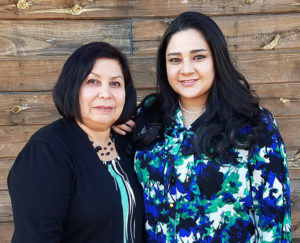
Alejandra Cervantes Lopez (right) invited her mom, Elizabeth Cervantes (left), to the Christian Latina Leadership Institute, hoping she would receive a new vision for ministry. (Photo / Isa Torres)

But after Cervantez Lopez gained a renewed vision for service after attending Christian Latina Leadership Institute training a few years ago, she realized her mother also could benefit—particularly after her father’s death last October.

“You find this inner strength to be who God created you to be,” she said.

So, Cervantez Lopez encouraged her mom to attend the recent Christian Latina Leadership Institute event at Camp Buckner, near Burnet.

Desire to develop leaders

Developing Latina leaders—whether they were just beginning or needing a new source of inspiration—was the goal Patty Villarreal and Nora O. Lozano had in mind when they started the program in 2005. Both Lozano and Villarreal are professors at Baptist University of the Américas.

While BUA students can take institute classes for credit—as Cervantes Lopez did—women not enrolled in the school also can be part of the program, Lozano said.

“Any Christian woman who is ready to work on her leadership skills is welcome to come,” she said.

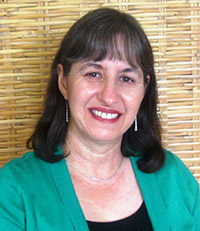
Nora Lozano

Whether that is in the church or in the marketplace, “we will help them to be better leaders,” Lozano explained.

Although Christian Latina Leadership Institute was formed to help Hispanic women develop leadership skills in a culture and a society not shaped to benefit them, any woman from any other ethnic group can also be part of the program, Lozano said. They are welcome as Latinas-at-heart, she noted.

Three-year program

The first year focuses on the individual, the challenges Latinas face and ways they strengthen leadership skills, care for themselves and—if necessary—restore faith in themselves as leaders, Lozano said.

It also teaches women to carefully study biblical passages that speak of the relationship between God, Jesus, the Holy Spirit and women.

Instructors in the institute “along with several older sisters in the faith have helped me in so many different areas,” Cervantes Lopez said.

From the beginning of the program, students are encouraged to develop their calling and express their personal mission statement, Lozano said.

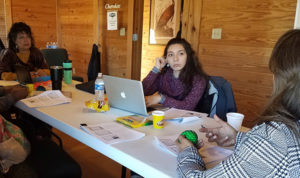
Third-year students at the Christian Latina Leadership Institute participate in a class on leadership in nonprofit organizations. (Photo / Isa Torres)

During the second year of the program, students continue to hone their skills in leading others, learn more about self-care as leaders and build networks, while exploring ways they can project themselves outwardly, Lozano explained.

By the third year, students learn how to project themselves outside, exploring their roles in denominational or community organizations and nonprofits, she noted.

After the three-year program, students receive a certificate in Latina Leadership Studies.

‘A 360-degree transformation’

Christian Latina Leadership Institute students interact and learn from accomplished Latinas in different fields, including ministry, nonprofits and various areas of business, Lozano said.

“For many of the students, this becomes a 360-degree transformation,” she said.

Since one of the main ingredients of such transformation requires women to have time to do self-care and heal, students are part of a retreat-style program encouraging spiritual renewal in their role as leaders, she said.

“We have to find a balance between patience, perseverance, love and kindness, and push through situations or circumstances outside our comfort zone,” Cervantes Lopez said. “We’re paving the way. The road is not set before us, but we hold onto God’s hope and guidance to where he’s leading.”

Each year, Christian Latina Leadership Institute students meet at Camp Buckner for an intensive four-day retreat-style training to develop leadership skills in ministry and in the business world. (Photo / Isa Torres)

For 12 years, Christian Latina Leadership Institute students have attended training at Camp Buckner, where they do not have to worry about anything else other than attend classes, work on assignments, and developing and nurturing relationships with each other.

For many women, the lack of education, taking care of their family, working to sustain the family, language and cultural differences, as well as lack of resources are obstacles to successfully develop themselves as leaders, she said.

“But education helps to clearly see other options you have,” Lozano said. “Through CLLI, many women have been inspired to go and continue their education somewhere else and share what they have learned with others.”

Like Cervantes Lopez, other women have felt empowered at Christian Latina Leadership Institute—often for the first time—and “gone somewhere else to help bring change in the lives of others,” Lozano said.

“This is the power Jesus has to transform the church, and the lives of families, individuals and communities,” she observed.

Christian Latina Leadership Institute has taken its training program to Monterrey and Metepec in Mexico, as well as North Carolina. The institute plans to expand to other cities in the United States and Mexico, Lozano added.

“Together we see that God is in favor of women—God is in favor of us, Latina women,” she said.

Whether women have just now begun their journey, or are exhausted and in need of strength to keep going, Lozano said she hopes Christian Latina Leadership Institute can be a source for them to receive “new dreams, new understanding and new ways to go forward.”


Capitol rally urges end to human trafficking

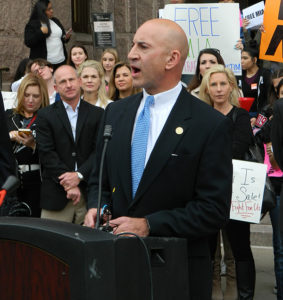
AUSTIN—Lawmakers across party lines joined members of the faith community and other advocates for children and young women at a rally on the steps of the Texas Capitol calling for an end to human trafficking.

Ross Chandler, pastor of First Baptist Church in Marble Falls, prays at rally in Austin designed to raise awareness about human trafficking. Bob Sanborn (left), president and CEO of Children at Risk, was one of the rally organizers. (Photo / Ken Camp)

Ross Chandler, pastor of First Baptist Church in Marble Falls, offered the invocation at the Jan. 22 event, co-sponsored by about a dozen groups including the Texas Baptist Christian Life Commission.

Chandler interceded for the estimated 78,000 vulnerable children and teenagers who are victimized by traffickers.

“We cannot live in peace as long as they are suffering,” he prayed.

Bob Sanborn, president and chief executive officer of Children at Risk, a Houston-based advocacy group, noted 35,000 children attend Texas schools within 1,000 feet of illicit massage businesses, which often operate as fronts for human trafficking.

Sanborn led participants in a chant frequently repeated at the rally, “Stop trafficking now!”

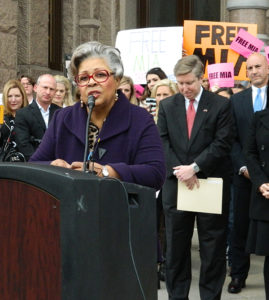
Rep. Senfronia Thompson, D-Houston, urged fellow lawmakers to address “the demand side” of sex trafficking. (Photo / Ken Camp)

Rep. Senfronia Thompson, D-Houston, voiced support for legislation to train classroom teachers and public school administrators to recognize signs of trafficking, as well as initiatives to address the “demand side” of sex trafficking.

“I want (buyers) to feel the pressure. I want them to feel the embarrassment,” she said.

Rep. Matt Shaheen, R-Plano, told the crowd he had filed HB 934, legislation that would make it a second-degree felony, punishable by up to 20 years in prison, to engage the services of a prostitute who is a victim of sex trafficking.

Rep. Matt Shaheen, R-Plano, called the fight against human trafficking “a spiritual battle.” (Photo / Ken Camp)

“This is a spiritual battle,” Shaheen said. He noted the Bible commands “God’s people … to give voice to the voiceless,” particularly vulnerable children.

While human trafficking is a $32 billion business globally, it also is a huge criminal enterprise in Texas, and lawmakers need to address the problem in those terms, said Ana Hernandez, D-Houston.

“We are going after them and hitting them where it hurts—in their pocketbooks,” Hernandez said.

Sen. Joan Huffman, R-Houston, drew cheers from the crowd when she announced the Texas Senate’s proposed budget includes $89 million for trafficking prevention and prosecution—a $64 million increase from the previous legislative session.

Huffman described efforts to end human trafficking both in terms of a journey and a battle.

“This is a nonpartisan fight,” she said. “We are all in this together.”

Rep. Ted Parker, R-Flower Mound, called the prevalence of human trafficking in Texas “a mark of shame on our state.”

Pointing out children in foster care disproportionately are victimized by human trafficking, Rep. Rick Miller, R-Sugar Land, stressed the need for evidence-based trauma-informed training for all Child Protective Services workers and others in the foster care system.

As elected officials spoke, advocates held signs saying “People are not for sale,” “She could be your daughter” and “Free Mia”—a teenager in the foster care system who became a human trafficking victim. She was named as lead plaintiff on behalf of 12,000 children in the foster care system in a 2014 class-action lawsuit.

The day before the Austin rally, about 40 volunteers gathered at the Dallas Baptist Association office for a Martin Luther King Day service project as part of the association’s anti-trafficking initiative. Volunteers filled gift bags with feminine hygiene products and other items the Rockwall-based Poiema Foundation will provide to trafficking survivors.

They also viewed an informational video for churches about human trafficking in the Dallas area. The association produced the “Hear Their Cry” video with funds made possible through the Mary Hill Davis Offering for Texas Missions.


BGCT partners with Northwest and Michigan Baptists

Texas Baptists began the new year by entering missions partnerships with the Northwest Baptist Convention and the Baptist State Convention of Michigan.

The Northwest Baptist Convention serves churches in Washington, Oregon and Northern Idaho. Both three-year partnerships include assisting with church starting and revitalization efforts.

“We aren’t just serving Texas. We are serving Texas Baptists, wherever they want to work,” said Tom Howe, director of urban missions and partnerships for the Baptist General Convention of Texas.

Howe encouraged Texas Baptist churches and pastors to pray about ways they can support missions in Michigan and the Northwest. Opportunities include sending mission teams, contributing financially and committing to pray for specific mission points.

As part of the reciprocal partnerships, church leaders from Michigan and the Northwest plan to support missions efforts in Texas. For example, churches from Michigan are collecting items for hygiene kits to provide to refugees and deportees who are served daily by Texas River Ministry missionaries along the Texas/Mexico border.

Focus on starting and revitalizing churches

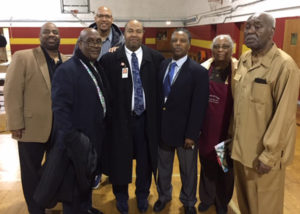
Leonard Hornsby (3rd from left), executive pastor of Bethlehem Baptist Church in Mansfield, and Roy Cotton (3rd from right, director of African-American ministries with the Baptist General Convention of Texas, visit with Detroit-area church leader to discuss community outreach. (BGCT Photo)

The partnership with Michigan Baptists will include church starting support, church revitalization and replanting support, and a specialized focus connecting evangelistic urban pastors of healthy Texas churches with church leaders in the Detroit area.

The new relationship emphasizes forming a strong alliance between the BGCT and Michigan Baptists to facilitate growth and strength in disciple-making churches in Michigan. Additionally, the Detroit Proposal aims to use a three-fold strategy to engage communities, leading churches to be attractional, relational and missional.

“Detroit is a city that has had great decline but that is poised for a great rebound. We can be a part of that,” Howe said. “Besides Detroit, we will be helping churches and pastors throughout all of Michigan to start, strengthen and grow.”

In October, Roy Cotton, director of BGCT African-American ministries, took a group of pastors to Detroit to meet with local ministers and discuss innovative ways to reach communities. Future trips are planned to continue the work of encouraging and strengthening the inner-city churches.

Continuing collegiate ministry in Northwest

BGCT Executive Director David Hardage attended the Northwest Baptist Convention’s annual meeting in November to announce the new partnership.

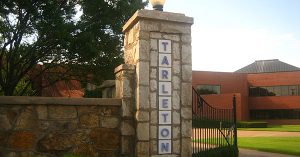
Tarleton State University: The power of prayerTexas Baptists began sending student missionaries to serve in the Northwest in 1958. Go Now Missions student missionaries consistently have served in the region since 1990. Recently, Baptist Student Ministries sent teams from Texas to serve in various capacities to strengthen collegiate ministry and will continue to do so through the new partnership.

Students from BSMs in the Northwest also have participated in mission trips to Texas, on campuses such as Tarleton State University in Stephenville.

In addition to partnering with collegiate ministry, Texas Baptists also will invite affiliated churches and associations to partner with church starts in the Northwest for financial assistance, mission trips, block parties and training for pastoral staff and deacons.

Pastors and associational directors of missions interested in exploring partnerships in either region are invited to attend vision trips this spring: Portland, Ore., Jan. 27-30; Seattle, Wash., Feb. 24-27; Detroit, Mich., April 10-13; Eastern Washington, May 5-8, and Southern Oregon, May 19-22. For more information, email tom.howe@texasbaptists.org or call (214) 828-5278.


Join the fight against racism, Tisby urges Baylor crowd

WACO—The persistent plague of racism in the United States requires conscientious American Christians not just to be non-racist but to become anti-racist, cultural commentator Jemar Tisby told a Baylor University audience.

Most Americans occupy the middle ground of non-racism, between virulent racists and committed anti-racists, but racism is woven into the fabric of American history and culture, he asserted.

So, active engagement in fighting racism is the only way to avoid enforcing the status quo, said Tisby, president of The Witness: A Black Christian Collective and co-host of the Pass the Mic podcast.

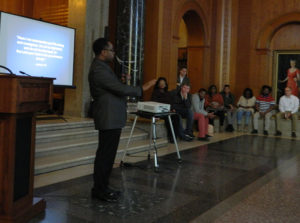
Tisby, author of the newly released The Color of Compromise: The Truth About the American Church’s Complicity in Racism, spoke on “How to Fight Racism” at the invitation of the Baylor Institute for Studies of Religion, addressing a standing-room-only crowd in the Armstrong Browning Library’s McLean Foyer of Meditation.

‘Underlying myth of white supremacy’

Americans in general—and Christians in particular—need to understand how racism works in order to comprehend why it “keeps cropping up like an un-killable cockroach,” he said.

“The simple but effective playbook of racism is based on the underlying myth of white supremacy,” he said. “Systems change, but racism persists because we haven’t changed the narrative of racial difference.”

The “narrative of racial difference” predated Colonial America, and it provided the foundation for 246 years of race-based chattel slavery and 89 years of Jim Crow segregation, as well as the less overt systems of racial injustice still in place, he asserted.

Jemar Tisby is president of The Witness: A Black Christian Collective and co-host of the “Pass the Mic” podcast. (Photo / Ken Camp)

“White supremacy maintains power through violence,” Tisby said. “Taken to its logical conclusion, white supremacy and racism kills.”

During the Jim Crow era, the “narrative of the Lost Cause” presented a romanticized version of the Old South and demonized black people—particularly black men, who were seen as beasts who would prey upon white women unless restrained, he said.

After slavery was abolished, plantations and mines in the South still needed free labor. So, Jim Crow-era vagrancy laws criminalized black men’s inability to find employment, and the convict leasing system provided laborers who literally could be worked to death, Tisby explained.

“It’s sometimes said that slavery was America’s original sin. Slavery was the original symptom. The original sin was greed,” he said.

Although Supreme Court rulings and landmark legislation ended segregation, American culture remains racialized—embedded in the normal operations of institutions and often invisible to white society, he insisted.

Racialization is supported by much of white evangelical Christianity and a “hyper-individualism” that emphasized personal salvation but often pays little attention to public expressions of justice, said Tisby, a graduate of Reformed Theological Seminary.

‘ARC of racial justice’

Jemar Tisby urged a Baylor University crowd to accept the challenge to join the fight against racism. (Photo / Ken Camp)

In response, he urged American Christians to fight racism at the intellectual, interpersonal and institutional levels through what he calls the “ARC of racial justice,” which stands for awareness, relationships and commitment.

To increase awareness, he recommended documentaries such as “13th,” “The African-Americans: Many Rivers to Cross” and “King in the Wilderness,” along with books including Divided by Faith: Evangelical Religion and the Problem of Race in America, Stamped from the Beginning: The Definitive History of Racist Ideas in America and At the Dark End of the Street.

He also encouraged visits to the National Civil Rights Museum in Memphis, Tenn.; the Smithsonian National Museum of African-American History and Culture in Washington, D.C.; and the Legacy Museum and National Memorial for Peace and Justice in Montgomery, Ala.

Tisby encouraged cross-cultural and interracial friendships to build meaningful relationships. He pointed to a study that reveals the average black American has eight white friends, but the average white American has only one black friend.

Finally, he called on people of faith to make a commitment to act against institutionalized injustice and attack systems of oppression. He specifically singled out two initiatives—criminal justice reform and a movement to make Juneteenth a national day of celebration.

Too often, people of faith who know they should stand against injustice fail to act out of fear, he said. In particular, white Christians who should speak up “in places where black people are not present” allow fear of rejection to silence them.

“When you go into battle to fight racism, know that the Lord God is with you wherever you go,” he said, alluding to Joshua 1:8. “You don’t have to be afraid.”


‘Tiny’ Dominguez tackles big job of bridging generations

LUBBOCK—Daniel “Tiny” Dominguez understands the challenge of honoring tradition and embracing change.

His first calling to ministry focused on youth ministry, but after 12 years as pastor of Community Heights Church in Lubbock, he recognizes his role as bridging the older and younger generations and helping them understand each other.

“You are not the church of tomorrow; you are the church now,” Dominguez tells students.

Daniel “Tiny” Dominguez (right), pastor of Community Heights Church in Lubbock, has been a frequent speaker at youth events and conferences.

In turn, he advises adult church leaders, “You must give them the space to participate now.”

Before he became pastor at Community Heights, Dominguez already had extensive ministry experience as a speaker at various youth camps, rallies and student events. He will speak at Congreso, an annual event for Hispanic teenagers and young adults, April 18-20 at Baylor University.

Many of the young people at those events were the sons and daughters of first-generation immigrants from Latin America, he noted.

Since then, Dominguez said, he has worked to help teenagers find their own identity between the world their parents came from and the world where they are growing up.

Because they live between two cultures, Hispanic teenagers may need help finding their own voice, he said.

As a pastor, Dominguez has seen how important it is for churches to open spaces for young men and women to serve. He rejects the idea that youth ministry is just about investing in the church of the future. Rather, it involves being present with students right now, he said.

Dominguez understands his role in the church requires him to help people of all ages understand Christ’s call to serve others. Based on his experience, he believes many young men and women are ready to serve.

“A lot of them are the most giving, but they do not give without a reason,” he said. “They already want to serve, so we need to support them.”

Teenagers and young adults already want to participate in the church, but if older Christians are not willing to collaborate with them, give them space to grow, and mentor them, then churches are not doing all they can to disciple others, he insisted.

“Discipleship is about giving people the tools they need,” Dominguez said. “When we are not willing to give them space to grow, then we are limiting them.”

Dominguez explained he believes churches that are open to listening to younger generations and willing to let them lead are churches that help them grow in discipleship.

“We want to walk with them as they find the identity Christ wants them to have,” he said.


International students find home away from home

ABILENE—Laughs, joy, fellowship and a spirit of home is what the Green’s weekly dinner is all about. Every Friday, Art and Susan Green serve dinner to all the international students from Hardin-Simmons University and Abilene Christian University—at times more than 100 people—making them feel at home even when they are away from their families.

The Green’s home, within walking distance of HSU’s campus, has been the center of activity for international students in Abilene more than 16 years.

The tradition started 31 years ago when another Abilene family cooked dinner for Asian students from ACU each Friday. After that family moved away, the Green’s took the tradition into their home and decided to open their doors to every international student in Abilene.

Every week, Susan Green prepared her best American recipes to serve for the students. She had such good feedback that every time there were more and more students coming for dinner to try her well-known food.

“We used to have 20 at first, then it kept on growing, and there was a time when we hosted approximately 100 people for dinner. Now, we expect around 50 students,” her husband said.

Being part of this event is special for international students because it brings a sense of unity, respect, fellowship and love.

Sharing is intentional

The Greens prepare homemade food served in a buffet for all the students. After dinner, everyone retires to the living room to worship and praise the Lord by singing. Art Green usually offers a short lesson about the importance of sharing, and he makes those present participate by telling their stories before enjoying dessert and departing for the evening.

“I think the Green’s dinner is the best community for international students who are far away from home and for getting to know different cultures. What I like the most is that there are good food and friendly, warm people,” said Chelvy Eunike, a freshman student from Indonesia.

The Greens work hard to make this experience the best they can for students. They want to embrace the family spirit as much as possible, even with small actions like remembering everyone’s names from week to week. That may seem like a small detail, but when a student is far from home, being recognized and welcomed can make a huge difference.

Another weekly tradition is to take a photo with those attending for the first time and write their name and country on the photo so that everyone can remember their visit. Many students are surprised at how well Art Green remembers their names.

“I was very impressed at how welcoming and intentional the Greens were in getting to know each person. Even though there were plenty of students from all over Abilene on any given week, the Greens remembered each student by name and always greeted us with such remarkable hospitality,” said Michelle Chahyadi, a junior from Malaysia.

Sharing is a group effort

The Greens have also been blessed by friends and family who help them bring together the weekly meal. For example, their next-door neighbors go over to the Greens every Friday after all the guests have left to help them do the dishes and clean up.

“We want to bring everyone together. We want to serve all these students no matter where they come from,” Art Green said.

Zoey Abigail, a freshman from Indonesia, shared her experience at the dinner and what it means to her. “The Greens is a good place for international students to know that they are not alone, that there are others that can understand what they are going through, that builds a unique community that I think everyone should have. Plus, they serve free food.”

The message that Art and Susan Green are trying to impart to these students is that sharing is what makes us the best people. They learned to open their home to different cultures and different people with the mission of bringing them together. International students are thankful for having the opportunity to feel like they have a home far away from home.

Lucila Decia, a freshman strategic communications major at HSU, is from Buenos Aires, Argentina.


Good for the long haul: Pastoral sabbaticals offer renewal

Observing the sabbath can be tough for ministers, but taking time away from the demands of ministry can help them maintain emotional, physical and spiritual health.

A 2015 LifeWay Research survey of 1,500 pastors of evangelical and historically black churches revealed 84 percent said they are “on call” 24 hours a day. The survey showed 54 percent found the pastor’s role frequently overwhelming, and 48 percent said they often felt the demands of their job to be more than they could handle.

Some ministers “unplug” on a regular basis by turning off cell phones and computers for a prescribed time each week and taking time away from the church office. Some enjoy periodic retreats at conference centers. Others find it hard to get away from the day-to-day grind.

The 2015 LifeWay Research survey revealed 71 percent of their churches had no plan for a pastor to receive a periodic sabbatical.

The meaning of the term “sabbatical” varies according to the context. In the Old Testament, it meant the ground in ancient Israel was left fallow every seven years. In the academic environment, it refers to the paid leave a college professor often is given every seventh year for research, travel or study.

In the ministerial context, the duration and purpose of a sabbatical may vary widely depending on the congregation.

Thom Rainer

“I am convinced more lay leaders need to insist their pastors take regular breaks even beyond vacations,” Thom Rainer, who announced his plans last August to retire as president and chief executive officer of LifeWay Christian Resources, wrote in a blog post several years ago, Five Reasons Your Pastor Should Take a Sabbatical.

Rainer insisted pastors—and the churches they serve—benefit from time off for rest and/or study. He asserted pastors who have sabbaticals tend to have longer tenure at churches because they are less likely to experience burnout.

Change in the rhythm

Kyle Childress has served Austin Heights Baptist Church in Nacogdoches as pastor about 30 years and taken three sabbaticals.

“An important aspect of sabbaticals, at least in my experience, is that it gives me enough time away to truly renew,” Childress said.

Sundays tend to set the “rhythm” for a pastor’s week, he noted. Even with interruptions and emergencies, the minister’s week follows a certain familiar rhythm of preparation for preaching on Sunday.

“Vacation time comes along and takes us out of that routine for a couple of weeks,” he said. “The vacation is needed and wanted and is gratifying, but my experience is that coming back after vacation is difficult. My rhythm has been broken and getting back to that first sermon is hard.

“Sabbaticals, on the other hand, change the rhythm but last long enough to allow me to truly rest, perhaps even develop a new rhythm, always with the goal of returning to the congregation. So when the time comes to return, I’ve found myself eager to return. I welcome the old rhythm and enjoy being back.”

Childress noted when he arrived in Nacogdoches about 30 years ago, it was up to the church to fund and budget for the pastor’s sabbaticals. Now, various grants are available through denominations or foundations to help congregations subsidize sabbaticals, he observed.

Delegate leadership to others

Brent Taylor

Brent Taylor, pastor of First Baptist Church in Carrollton, realized he needed a plan when he went on a recent sabbatical.

“Because of our size, we have staff to cover in my absence,” Taylor said. “I gave specific leadership responsibilities to several different people and they operated as a team. However, I also knew I needed to have one person who could make ultimate decisions in my stead.”

During his seven-week sabbatical, some major decisions required his consultation, but not all of them demanded that his time away be interrupted.

“I was able to get away from the small decisions that a pastor faces all the time and only weigh in on the bigger issues,” he said.

Taylor believes pastors need to take time away from the responsibilities of church.

“When I was younger, I thought I had to be at the office all the time. This is actually a prideful attitude that communicates that I think the church cannot function without me being there,” he said.

“What I have found is that time away refreshes me and makes me a better leader when I am in the office.”

Carolyn Tomlin is a freelance writer who teaches the Boot Camp for Christian Writers.