Ethical business leadership can have negative consequences, Baylor research shows
February 6, 2018
WACO—Ethical leadership is a good thing, but it can have negative consequences, according to new research from management faculty in Baylor University’s Hankamer School of Business.
A new Baylor study published in the Journal of Business Ethics reveals ethical leadership compounded by job-hindrance stress and supervisor-induced stress can lead to employee deviance and turnover. The research reflects the thoughts of 609 employees surveyed across two studies.
“If someone is an ethical leader but induces stress, our research shows that his or her employees will feel less support,” said lead author Matthew Quade, assistant professor of management. “Thus, employees who do not feel supported are more likely to consider leaving their jobs or engage in workplace deviance—things like coming in late to work, daydreaming, not following instructions or failing to be as productive as they could be.”
Ethical leadership is a good thing and often beneficial in terms of employee resources, Quade said. An example would be a trusted supervisor who listens to her employees and has her employees’ best interests in mind.
Trouble arises when supervisor-induced stress or job-hindrance stress enters the picture, he explained.
“When those stressors are added, there is a depletion of resources,” Quade said. “Many of the gains or benefits from ethical leadership are negated.”
What does stress-inducing ethical leadership look like?
Stress-inducing behavior could be as simple as supervisors setting expectations too high or, in the interest of “following all the rules,” not allowing for any deviation from a process, even if a shortcut, still within the bounds of behaving ethically, would deliver a desired result, Quade said.
The researchers wrote: “Ethical leadership can be an exacting process of sustaining high ethical standards, ensuring careful practice and enforcement of all rules and meeting leaders’ lofty expectations, all of which can consume time and energy and be perceived by employees as overly demanding or an obstacle to job performance.”
As part of the study, those surveyed were asked to what extent they agreed or disagreed with the following statements:
My supervisor makes it so that I have to go through a lot of red tape to get my job done.
Working with my supervisor makes it hard to understand what is expected of me.
I receive conflicting requests from my supervisor.
My supervisor creates many hassles to go through to get projects/assignments done.
Working with him/her thwarts my personal growth and well-being.
In general, I feel that my supervisor hinders my personal accomplishment.
I feel that my supervisor constrains my achievement of personal goals and development.
Quade emphasized his team in no way wants to discourage ethical leadership. Research consistently shows such leadership is very beneficial, he said. But this new research shows there are boundaries to those benefits.
“This places quite an onus on appropriately managing the stress that comes from the leader and the job, in efforts to most fully realize the potential of ethical leadership,” the researchers wrote.
The study listed some tips and takeaways for organizations and leaders:
Strike a balance between promoting ethical behavior and providing resources to help employees meet those standards.
Encourage employees in word and deed by reducing ambiguity in ethical dilemmas that might otherwise drain resources.
Model fair and ethical behavior.
Communicate efficient methods to meet standards and reduce unnecessary steps or procedures.
Equip and train leaders to balance the demands of leading ethically while not overburdening their employees.
Baptist Temple in San Antonio seeks to break cycle of poverty
February 6, 2018
SAN ANTONIO—The more Baptist Temple in San Antonio involves itself in its community, the more the church becomes aware of opportunities to bring about change.
Baptist Temple is located in a low-income neighborhood, and for years, it has provided programs to assist its community. But Pastor Jorge Zayasbazan notes some of those have been temporary solutions, and now the church wants to do more.
Reaching the community
Pastor Jorge Zayasbazan baptizes college freshman Morgan Yarbrough, a third-generation member of Baptist Temple in San Antonio. (Photo / Tracy Zayasbazan)
Zayasbazan arrived at Baptist Temple in 2009, when the church was looking for a missions-minded pastor. Since then, the church has tried and reshaped various ministries to help people in the community.
One of the first efforts involved bringing a truck of food to the church once a month so people could get groceries, Zayasbazan said.
“It might have not been the most efficient, and it caused some problems, but we were feeding the hungry,” he said.
The church “is in the business of turning people’s lives to Jesus,” Zayasbazan said. That definitely means being a light in an area that has been excluded and is challenged by poverty, he insisted.
“We want to break the cycle of poverty,” he said.
Church leaders grew to realize the food truck was just “a maintenance ministry” that failed to address root causes, he acknowledged. The issues of poverty go deeper than not having access to food, and the solutions to poverty have to go deeper, as well, they concluded.
The effects of what that study revealed still can be seen in the city, which segregated populations for decades and cared only for the areas in which Anglos lived, Zayasbazan said. Property deeds stipulated the only people who could use or occupy a “lot, site, structure or dwelling” were members of the “Caucasian or White Race.”
Although the most blatant forms of discrimination have been eliminated, disparity between sections of the city persists, Zayasbazan indicated.
Seeking to transform community
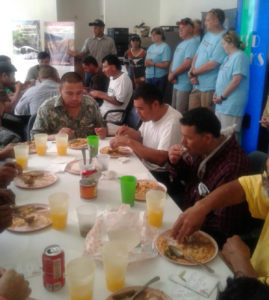
Baptist Temple ministers to immediate needs of people in its neighborhood through its food pantry, community garden, thrift store and a free community meal on Wednesdays.
But most recently, the church also decided to develop a ministry to achieve long-term goals of community transformation.
Zayasbazan views education as key for people to have better access to resources and to help them achieve their own goals.
Where resources already are available, the church can help the community envision the future its residents want, set goals and put those resources to work to achieve their goals, he explained.
If the resources are not present in the community, the church can help residents see what they need and help create those resources, he added.
“What we need is to help them get a picture of themselves as successful people,” Zayasbazan said.
Bridge between church and community
Baptist Temple purchased a house next door to its facility, and Baptist University of the Américas students who live there will receive free food and lodging courtesy of the church while they minister to the surrounding community.
Other churches helped with the project by providing funding for the reparations of the house and buying appliances.
Angello Sanchez, Jacob Peeler and Joshua Hauser enjoy a break during Vacation Bible School, which featured six churches and a mission team from the Baptist University of the Américas. (Photo / Tracy Zayasbazan)
Angello Sanchez, a student at BUA, has been an important part of forming this ministry. Sanchez, and three other BUA students will live at the house and help the church learn more about what the community needs.
In the community, the BUA students will help public school students with their education and mentor them toward a future that breaks the cycle of generational poverty.
While BUA students can relate to the challenges people in the community face, they also can help the neighborhood residents see what could be achieved through education.
“We need to help the people here take advantage of the opportunities that are here,” Zayasbazan said.
Sanchez and the other three BUA students will serve as the bridge between the church and the community, Zayasbazan explained. They will help the congregation discover better ways to serve the community, and they will help enlist volunteers and raise funds.
‘What God has called us to do’
Money is the least of the challenges for the church, Zayasbazan insists. The important part is not how the church pays for the ministry it does; the important part is doing the ministry, he asserted.
“God is the one paying for everything,” he added.
Repairs continue on the house, and Sanchez stays there a few nights a week while he helps with some of those renovations.
One of the goals for Baptist Temple’s new ministry is to help students in the neighborhood graduate from high school and enter college. Higher levels of education will allow young people from the community to increase their earning potential, Zayasbazan noted.
Zayasbazan’s own experience encourages him to see education as a gateway out of poverty, and he hopes BUA students can model that for the children in the community.
While the number of undereducated adults in the neighborhood remains high, the church wants to help bring about change, he insisted.
“This is more than we can do alone,” Zayasbazan said. “But this is what God has called us to do.”
Singing Men plan 2019 mission trip to Romania and Hungary
February 6, 2018
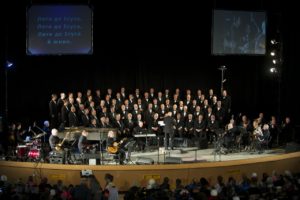
Members of the Singing Men of North Central Texas have begun to make plans for a mission trip to Hungary and Romania next year with international evangelist Michael Gott.
The Texas Baptist church musicians will perform at a major public hall and at several churches in both countries, said Don Blackley, director of the Singing Men of North Central Texas.
The Singing Men will join Gott in Budapest, Hungary, April 29 to begin the 2019 mission tour. Concerts are planned in Budapest, Debrecen and Szeged, among other possible locations in Hungary. In Romania, the Singing Men will perform in Oradea and Timisoara.
The North Central chapter of the Singing Men of Texas began its partnership with Gott 10 years ago, when they traveled together to the Czech Republic and Austria, where the group performed six concerts.
In 2017, the Singing Men of Texas presented concerts in eastern Ukraine, and more than half of the 12,000 who attended made recorded commitments to Christ. (Photo courtesy of Singing Men of Texas)
In the past decade, the choral group made multiple trips to Ukraine. In 2015, the Singing Men performed at eight venues in western Ukraine, and more than 14,000 people heard gospel messages.
Last year, the Singing Men presented concerts in eastern Ukraine, and more than half of the 12,000 who attended made recorded commitments to Christ.
In preparation for the mission trip to Hungary and Romania next year, the Singing Men of North Central Texas will participate in an Aug. 16-17 retreat in Dallas, concluding with a concert at First Baptist Church in Dallas at 7 p.m. Aug. 17.
Some members of the North Central Texas chapter also will join with the five other Singing Men of Texas chapters for a trip to New York City, Oct. 12-17, which includes performances at Times Square and Carnegie Hall.
For more information on the Singing Men of North Central Texas and the group’s partnership with Michael Gott, click here and here to read blogs by John Adams, minister of music at First Baptist Church in Fate.
Cold weather opens doors to minister to homeless
February 6, 2018
DALLAS (BP)—A homeless man froze to death within eyesight of Cornerstone Baptist Church in South Dallas in mid-January, as record-breaking cold temperatures befell much of the United States.
Just like a wheelchair-bound homeless woman who froze the same night half a mile away at a bus station, the man refused to abandon familiar surroundings to accept the warm bed that could have saved his life, Cornerstone Pastor Chris Simmons said.
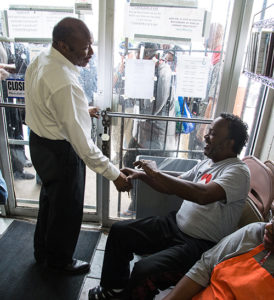
Pastor Chris Simmons of Cornerstone Baptist Church in Dallas greets workers at The Kitchen before opening the ministry’s doors to serve the homeless. (File Photo / David Clanton)
In partnership with other churches and ministries, Cornerstone uses its facilities to serve the homeless 10,000 hot meals a month; provide clothing and showers to 1,000 different individuals a month; and serve 200 individuals a month in weekly vision, dental and medical clinics.
The church refers the homeless to housing sites maintained by other ministries, Simmons said, and it also builds relationships with the homeless and provides spiritual support.
The help Cornerstone, numerous churches, community agencies and others provide the homeless is more crucial when the country freezes. Flu season also increases the need for help, Simmons said.
Irving church continues to minister after fire
In Irving, Bear Creek Community Church provided emergency shelter to the homeless at least two consecutive weeks in this season’s cold temperatures, Pastor Dennis Webb said.
The help continued even when fire destroyed the church’s sanctuary Dec. 28, he said.
“Despite the challenge of the fire, we continued to house the homeless since that day. We now use several classrooms in an upstairs wing for that purpose. It’s not ideal, but we have been able to make it work,” Webb said.
“We lost the entire sanctuary. We renovated the fellowship hall normally used to house the homeless as a main sanctuary.”
Texas in Top 5 for homeless population
Texas is among five states where half of the nation’s homeless population lives, Forbes reported in November 2016, along with New York, Florida, California and Washington. Varying statistics place the national homeless count between 575,000, according to Forbes’ 2016 numbers, and 1.75 million, according to 2017 research by the Statistic Brain Research Institute.
Bear Creek Community Church launched its Neighbor Feeding Neighbor homeless ministry four years ago, providing not only an inclement weather shelter, but hot meals, snack bags, food, clothing, toiletries, Bible study and transportation to the church.
“A Bible study is held before each meal” on Tuesday evenings, Webb said. “The focus has become friendship evangelism. We focus on developing relationships and utilize every opportunity to share the message of the gospel.”
The church’s inclement weather shelter provides mats, cots, blankets, pillows and other necessities to 15 to 20 individuals on average, Webb said, but it has housed as many as 30 or more.
“A safe and warm place to stay is vital to the health, safety and welfare of all humans. No one should have to sleep outside in cold, damp weather,” Webb said. “Most homeless have no financial means to care for themselves. Many we serve can’t afford a simple meal.
“The mental condition of some of the homeless population makes them dependent on others for the basic necessities of life. Without ministries and people helping the homeless, they will suffer with little to no hope.”
New York’s Grafitti Church serves homeless
Among Southern Baptists helping the homeless survive this winter are all five sites of Grafitti Church in New York City and at least five congregations partnering with the Arundel House of Hope in greater Baltimore.
Kareem Goubran, Grafitti’s minister to adults, said the cold weather provides ministry opportunities to the homeless that don’t necessarily exist during warmer months.
“This act of care for the homeless especially during the winter months has been the way we have met people who have then built relationship with us and have often come to know the Lord at a later time,” Goubran said.
“Many people who were once homeless are now leading our ministries to the homeless. We met the need first, and then they have come to know Jesus, gotten baptized and are now leaders at Graffiti Church.”
Unintended consequences of charity
The population is considered difficult to effectively serve. The life of the homeless man who froze to death in Dallas might have been spared, Simmons said.
“The problem is I think well-meaning people end up hurting the homeless” by placing items directly in the hands of those in need, rather than giving donations to agencies trained to help, Simmons said.
“People would drive by and leave him food, leave him money,” Simmons said of the man who froze to death in Dallas. “So I guess in his mind, ‘If I leave this corner, nobody’s going to drop me off financial donations, food donations, clothing donations … blankets and things like that.’”
On the other hand, if people did not provide those items, the homeless would feel compelled to seek assistance elsewhere, Simmons explained.
While neither of the victims in Dallas has been identified, Simmons said, the woman who froze to death refused even to take blankets as temperatures dipped into the teens with single-digit wind chills. And while the man had blankets, he slept on the cold ground.
“We do all we can to try to move people towards shelters,” Simmons said, but agencies and churches cannot force the homeless to accept shelter.
Webb encourages all churches to help the homeless by partnering with others to overcome limited resources in any one congregation.
“Adopt the mindset that the homeless problem is not a government responsibility only,” Webb said. “There are so many resources (facilities, people) in the body of Christ today. Understand the homeless population is a mission field waiting for the body of Christ to infiltrate.”
Pastors must make homeless ministries a priority to ensure ministry success, Webb said.
“The pastor sets the atmosphere for how a homeless ministry goes,” he said. “Develop collaborations amongst churches in a particular area to use the strength of each church to reach the homeless in that vicinity.”
Hispanic church in Houston supports ministry in Senegal
February 6, 2018
HOUSTON—Pastor Moises Flores and members of Iglesia Bautista del Redentor understand their missions calling extends far beyond the Houston city limits—even to West Africa.
Ten years ago, Flores visited the church’s former pastor, Jorge Camacho, who was serving as a missionary in Egypt. Camacho talked about his experience in cultures where Christianity was not the norm, and their conversation inspired Flores. He wanted Iglesia Bautista del Redentor to become a missional church.
“My experience with Camacho was like a school of missions,” Flores said.
Helping the House of Hope
Two years later, Flores traveled to Senegal to see if his church could assist a ministry called House of Hope. He met Gilbert Rowe, a pastor from Costa Rica who relocated to Senegal to work with children known as talibés.
In West Africa, a talibé is a boy who is given over to a marabout, or teacher, to learn the Quran, Flores explained. Often, the talibés are abused and forces to beg for money on the streets, he added.
Pastor Moises Flores of Houston enjoys time with children in a village in Senegal. (Photo courtesy of Moises Flores)
Rowe and his family wanted to offer them an alternative, so they took in 20 boys to live with them at the House of Hope. The boys there learn Spanish, English and French, Senegal’s official language.
Rowe’s goal at House of Hope is to help the children become equipped for a better future by preparing them for college, Flores said. While the children receive a formal education, they also learn vocational skills such as welding, painting and carpentry, and they study the Bible.
As these boys have grown up, many of them have become church planters in the villages where their families live.
Emphasis on starting churches
Flores felt confident his congregation could support the church planting initiative. A few years earlier, he had helped to plant 15 churches in the Houston area, working with Jesus Guillen, pastor of Iglesia Bautista Redencion in Houston, and Abel Aguirre, pastor of Iglesia Cristiana Fortaleza y Esperanza in Sugar Land, and the Baptist General Convention of Texas.
Iglesia Bautista del Redentor has visited House of Hope at least once a year since 2010, helping to develop a medical missions program to assist church planters in each village.
“We provide medical clinics for free, and at night we invite them to hear about Jesus,” Flores said.
While Senegal has freedom of religion, the U.S. Department of State in 2011 reported “societal abuses or discrimination based on religious affiliation, belief or practice.” The State Department report also pointed to preferences the government gives to Muslims it does not grant to members of other religions.
Some families have rejected children who convert to Christianity, Flores added.
Flores and his partners in church planting—Guillen and Aguirre—founded Desafio Mundial—Global Challenge—in 2015. The organization developed an egg farm to support Rowe and his ministry, and it brings in about $1,000 a month.
Iglesia Bautista del Redentor, Iglesia Bautista Redencion and Iglesia Cristiana Fortaleza y Esperanza together contribute $6,500 annually to House of Hope to support 13 staff.
Steps in the missional journey
Iglesia Bautista del Redentor supports five of the staff members at House of Hope—a global outreach the congregation never expected, Flores acknowledged.
However, rather than making plans based on resources the church possesses, the congregation recognizes the importance of “having faith and being obedient,” Flores said.
“The gospel has to be preached to all the nations,” he said. “We want to be a part of that.”
Recently, Iglesia Bautista del Redentor took another step of faith in its missional journey. Oscar Cerna, a member of the congregation, left Houston to serve at House of Hope at least two years. His home church and Desafio Mundial will provide his financial support as he works in Senegal.
Under Rowe’s guidance, Cerna will help disciple 16 young men. Each weekend, he also will assist the ministry of First Christian Church in Babak, which was started in 2016.
“Many of us may think God’s calling in our lives may require too much,” Flores said. “But being faithful is to trust God will provide for us, as well.”
Editor’s Note: The 14th paragraph of this story was edited Feb. 6 to correct an error.
Pastor de Laredo ministra a inmigrantes y deportados
February 6, 2018
LAREDO—Lorenzo Ortiz, el pastor de Iglesia Bautista Emmanuel en Laredo, cree que Dios abrió sus ojos para ver las necesidades de otras personas y eso lo llevo a ministrar a inmigrantes en la frontera del sur de Texas y Tamaulipas.
Desde el 2017, Ortiz a ministrado a inmigrantes—primero empezó trabajando con gente que había viajado desde Cuba hasta Nuevo Laredo y recientemente con inmigrantes indocumentados de México que han sido deportados de Estados Unidos.
El trabaja con el apoyo de su familia—principalmente el de su hija, Ruth, y su hermana Micaela—así como el de su iglesia y otras congregaciones en Laredo y Nuevo Laredo.
Ministrando a Cubanos en Nuevo Laredo
Inmigrantes cubanos recibieron alojamiento en la Iglesia Bautista Emmanuel en Nuevo Laredo. Muchos se quedaron ahí por casi cinco meses. (Foto/Lorenzo Ortiz)
Un entrenamiento evangelístico dado por Texas Baptists hace algunos años en Laredo, abrió los ojos de Ortiz para ver otras formas de compartir las buenas nuevas.
Cuando el presidente Obama termino la póliza de ‘pies secos, pies mojados,’ la cual le daba residencia a cualquier persona cubana que llegara a tierras estadounidenses, muchos cubanos decidieron entrar a Estados Unidos por medio de la frontera con México.
Una docena de iglesias en Nuevo Laredo dieron alojó a cubanos en sus santuarios y les dieron desayuno y almuerzo todos los días. Ortiz orquesto el trabajo con esas iglesias, las cuales incluyen cuatro iglesias bautistas.
Atendiendo a inmigrantes deportados
Últimamente, Ortiz hace su ministerio con inmigrantes indocumentados mexicanos, quienes han sido deportados de Estados Unidos.
“Laredo es la frontera por donde sale el 60 por ciento de los inmigrantes deportados, y ese numero va a incrementar,” dijo Ortiz.
“Ya lo que pasamos aquí son situaciones donde se nos dificulta proveer comida y hospedaje a las personas que están aquí.”
Mas de 150 deportados llegan a Nuevo Laredo cada día, y les puede tomar un par de días en encontrar una manera de regresar a casa, remarco Ortiz.
La mayoría de la iglesias en Nuevo Laredo que trabajaron con inmigrantes cubanos ahora ayudan con los inmigrantes deportados. Las iglesias trabajan con mas de 300 deportados cada día, Ortiz dijo.
Ortiz encuentra alojamiento para inmigrantes, ayuda a que los deportados obtengan documentos, y los conecta con agencias para que puedan regresar al estado de donde vinieron.
Evangelismo encarnacional
El pastor Lorenzo Ortiz, su hija, Ruth Ortiz, y miembros de First Baptist Church de Missouri City, se juntan a orar por la comida que fue dada a inmigrantes deportados. (Foto/Micaela Ortiz)
Pero el ve que su servicio es mas que una acción social. El ve esto como un evangelio encarnacional—el estar con personas en su sufrimiento, en su búsqueda por esperanza y su deseo por justicia.
“Hay una gran diferencia entre compartir el evangelio solo con palabra y lo que es vivir sus experiencias,” Ortiz dijo. “Hay un impacto, a diferencia de solo dar información.”
Así como las personas han dejado sus hogares, sus familias y posesiones con la ilusión de encontrar mejores oportunidades, Ortiz dice que la iglesia tiene que entonces imitar a Cristo y caminar con la gente en su búsqueda de esperanza.
Ministerio del Rio se ha comprometido a dar fondos de asistencia y donar accesorios de cocina para que la iglesias tengan mas facilidad en preparar los alimentos que sirven. First Baptist Church de Missouri City, cerca de Houston, también da ayuda financiera a este ministerio.
Pero las congregaciones cerca de la frontera todavía necesitan mas ayuda, especialmente si el numero de deportados va a incrementar, Ortiz dijo.
Centros de detención en Laredo
El ministerio empieza cuando los que van a ser deportados llegan a uno de los centros de detención en el área, Laredo Processing Center y Rio Grande Processing Center—los cuales son operados por compañías privadas.
En un reporte publicado a mediados de diciembre, la oficina del inspector general del Departamento de Seguridad Nacional notó varios problemas en cuatro de las cinco facilidades en donde se hicieron inspecciones inadvertidas.
Aunque el Laredo Processing Center obtuvo buenos resultados en la inspección, hubo otras que fueron citadas por el trato inapropiado que se daba a reclusos y la demora con la que se daba atención medica—una de esa facilidades esta localizada en Georgia y operada por la compañía que maneja Laredo Processing Center, CoreCivic.
GEO Group, la compañía que maneja Rio Grande Detention Center, tiene varias demandas en su contra por el supuesto maltrato a prisioneros en el centro que esta en Colorado y denuncias de derechos civiles respecto a el abuso en otros de sus centros.
En el reporte del año pasado, la oficina del inspector general recomendó al Servicio de Inmigración y Control de Aduanas (ICE, por sus siglas en ingles) aumentar su vigilancia en los centros de detención y dar mas atención a los operativos de esos centros, después de las quejas que han dado los grupos de derechos del inmigrante y los detenidos.
“CoreCivic esta comprometido a proveer un ambiente seguro, humanitario y apropiado para los que has sido puestos bajo nuestro cuidado, mientras también damos soluciones rentables a los desafíos que nuestros socios en el gobierno enfrentan,” dijo Jonathan Burns, el director de asuntos públicos de la compañía. “Trabajamos cerca de nuestros socios en ICE para asegurar el bienestar de los detenidos en nuestros centros de detención, los cuales tienen un contrato con ICE.”
Los administradores de servicio de ICE, quienes trabajan de tiempo completo en los centros, “tienen acceso total en las facilidades y con los detenidos, y se reportan independientemente al cuartel general de ICE,” añadió Burns.
Ortiz hablo de haber escuchado reportes de los detenidos en Rio Grande Detention Center en los que hablan del maltrato que sufren ahí. GEO Group, no respondió a Baptist Standard cuando fue contactado al respecto.
“Se sienten rechazados”
Inmigrantes deportados reciben paquetes de higiene en Nuevo Laredo (Foto/Micaela Ortiz)
Después de que ICE deja a los deportados en la frontera, ellos cruzan a Mexico y van al Instituto Tamaulipeco para los Migrantes. En la agencia estatal, Ortiz les ayuda con ropa, paquetes de higiene, y a encontrar una manera de regresar a casa.
“Cuando cruzan la frontera, ellos se sienten arruinados. Ellos se sienten rechazados,” dijo Ortiz.
Muchas veces, el significado de regresar al estado de donde salieron es regresar a nada, Ortiz noto. Sus familias ya no están ahí, ya no tienen hogares, y regresan como extranjeros.
“La iglesia tiene que ser responsable por lo que pasa en la comunidad,” Ortiz enfatizo. “La iglesia tiene que dar soluciones a los problemas de la gente.”
Si las personas se sienten en la oscuridad, la iglesia es responsable de darles la luz de Cristo, el insistió.
Las necesidades son muchas, y un escaso numero de iglesias están buscando responder con recursos limitados, menciono Ortiz. Pero las congregaciones confían que Dios engrandecerá sus esfuerzos, el añadió.
“Dios es el que siembra, y Dios es el que da crecimiento,” el dijo.
Ortiz desafío a otras congregaciones a involucrase mas en el ministerio a deportados.
“Solo tienen que salir y mirar la necesidad que esta alrededor de ellos,” el dijo.
Mientras la iglesia se acerca mas a Dios, también se acerca mas a las necesidades de otros, dijo Ortiz. El recalco las palabras de Jesús en Mateo 25 como su guía—el ministerio tiene que ser a los mas vulnerables, las personas con las que Cristo se identifica.
“Nos damos cuenta que Dios no esta trabajando en nuestros ministerios, pero que nosotros estamos trabajando en el ministerio de Dios,” Ortiz dijo.
Buckner partners with Texas Rangers Foundation to strengthen families
February 6, 2018
DALLAS—Buckner International and the Texas Rangers Baseball Foundation entered a partnership to strengthen families in West Dallas by expanding opportunities for boys and girls who use the Texas Rangers MLB Youth Academy.
More than 3,000 student athletes have worked out at the youth academy at the Mercy Street Sports Complex since its official ribbon-cutting ceremony in December, Rangers TV broadcaster Dave Raymond said.
Buckner will establish a satellite Family Hope Center at the academy, where West Dallas families and the larger area can benefit from a variety of programs.
Buckner operates 26 Family Hope Centers throughout Texas and in a half-dozen other countries. Services typically include parenting education classes, job skills training, financial empowerment courses, family counseling and spiritual enrichment.
Albert Reyes, president and CEO of Buckner International, describes how the Family Hope Center at the Texas Rangers MLB Youth Academy in West Dallas will help strengthen families. (Buckner Photo / Aimee Freston)
“Our goal at Buckner is to protect children by strengthening families, and this partnership gives us the perfect opportunity to fulfill that mission,” said Albert Reyes, president and chief executive officer of Buckner International.
During a Jan. 17 dedication ceremony at the facility, Reyes called to mind an iconic scene from Field of Dreams and pointed to way simply playing catch can strengthen family ties.
“Baseball has a way of bringing people together like nothing else on the planet,” Reyes said. “We will be using baseball as a way of strengthening families.”
Love for baseball can draw families to the facility where “there are opportunities to expand their vision and their experiences broader than just the field” of play, said Ken Hall, former Buckner CEO and now a member both of the Buckner International board of directors and the Texas Rangers Foundation.
“One of the visions of this initiative was to be able to reach into families in this community … and seek to make a difference in the lives of boys and girls who come through here, to help them with all the other kinds of empowerment opportunities offered here,” Hall said.
Pitcher Cole Hamels, representing The Hamels Foundation, emphasized the impact the Texas Rangers MLB Youth Academy will have on giving educational opportunities to boys and girls in West Dallas. (Buckner Photo / Aimee Freston)
The 17-acre sports complex includes five outdoor fields and a training center with an indoor practice field, exercise facilities and classrooms.
The Texas Rangers MLB Youth Academy not only offers children and teenagers year-around baseball and softball instruction and playing opportunities, but also provides access to tutoring and mentoring programs, healthy lifestyle classes, drug- and gang-prevention programs and college preparation courses.
“This is a facility that can house a lot of wonderful events, bringing the community together,” said Rangers pitcher Cole Hamels. The Hamels Foundation contributed significantly to the four classrooms at the youth academy.
“Just the way this has turned out has blown our minds,” Hamels said. “We know it is going to reach a lot of individuals.”
Waco Hispanic church expands reach by embracing liturgy
February 6, 2018
WACO—Primera Iglesia Bautista in Waco, the city’s oldest Hispanic organization of any kind, understands the importance of taking risks and trying new approaches—even if some of those “new” practices actually are ancient.
Emmanuel Roldan first visited Primera Iglesia Bautista during his last semester at Baylor University’s Truett Theological Seminary. He planned to remain in Waco after graduation, and he was looking for a church home.
“I wanted to hear Spanish in a congregation and learn from someone in the community,” Roldan said.
Roldan’s arrival attracted the attention of church members. The congregation had been declining in attendance for years, and it had been a long time since anyone new had shown up to worship with them.
Pastor Armando Virgen had served Primera more than 50 years, and he planned to retire soon.
‘Willing to try new things’
Roldan asked just one question: “Are you willing to try new things?”
Members of the 109-year-old congregation said, “Yes.”
Emmanuel Roldan, a graduate of Baylor University’s Truett Theological Seminary, is pastor of Primera Iglesia Bautista in Waco. (Photo / Adrian Moreno)
At Truett Seminary, Roldan had learned about—and grown to appreciate— liturgical practices shared by many Christians for nearly two millennia, such as observing Advent, Lent and the rest of the church calendar.
The ancient Christian traditions Roldan brought to Primera helped to bring more diversity to the church—not only in terms of ethnicity, but also with respect to denominational backgrounds.
The church mostly is home to second- and third-generations Hispanic-Americans, and many are fluent in both English and Spanish. However, the congregation also includes a few first-generation immigrants, so there was some cultural diversity already.
Some of the students Roldan worked with when he was a chaplain at Baylor University started attending the church, and they brought friends with them.
Some did not grow up in the Baptist tradition, so they can relate more easily when they see the church using the liturgical calendar or reciting prayers together in unison.
“It has been good to continue the relationships I’ve made at Baylor,” Roldan said.
Open to change
He credited both the congregation for its openness to change and Virgen, the former pastor who remained at the church as a member, who “made the transition very easy.”
Primera draws between 50 and 80 worshippers each week, and members are involved in ongoing community ministry. They provide food at the monthly parent-and-teacher meetings at Indian Spring Middle School, because they know parents are more likely to attend when food is provided. The church also provides breakfast for teachers during STAAR testing—the state assessment of academic readiness.
On Wednesday nights, the church’s youth group goes to Waco High Lofts to lead a backyard Bible school along with Baylor Missions, part of the university’s office of spiritual life.
While the church is trying new things and working in the community, there is still a lot to learn, Roldan stressed.
Lessons in biblical principles
The church offers one bilingual worship service on Sundays. Even though many of its congregants are bilingual, some speak only Spanish, and new members are arriving who speak only English.
Taking the time to participate in one language and simply hear others participate in another language is a lesson for the church, Roldan said.
“This is a model for what it looks like when different cultures come together,” he said.
Roldan believes the approach Primera takes in worship teaches important lessons to those who participate.
“It takes more time (for a bilingual worship service), but in a way it is training us in bearing with one another,” he said. “It teaches patience, and it shows us there are people other than us. It teaches that we are not worshipping alone.”
Laredo pastor ministers to immigrants and deportees
LAREDO—Lorenzo Ortiz, pastor of Iglesia Bautista Emmanuel in Laredo, believes God opened his eyes to the needs of vulnerable people and led him to minister to immigrants in his South Texas border city and its sister city across the Rio Grande.
Since 2017, Ortiz has ministered to immigrants—first working with Cubans in Nuevo Laredo and more recently with undocumented Mexican immigrants who are being deported from the United States.
He works alongside his family—particularly his daughter, Ruth, and his sister, Micaela—as well as his church and other congregations in Laredo and neighboring Nuevo Laredo.
Ministering to Cubans in Nuevo Laredo
Cuban Immigrants were given lodging at Iglesia Bautista Emanuel in Nuevo Laredo. Many of them stayed there for close to five months. (Photo / Lorenzo Ortiz)
Evangelism training Texas Baptists provided in Laredo a few years ago opened his eyes to ways he could share the gospel, Ortiz said.
When President Obama ended the ‘wet foot, dry foot’ policy, which gave permanent residency to any Cubans who reached American soil, many Cubans instead sought to enter the United States through Mexico.
A dozen churches in Nuevo Laredo provided lodging to Cubans in their sanctuaries and fed their guests breakfast and lunch each day. They included four Baptist congregations, with whom Ortiz worked.
Caring for deported immigrants
Now, Ortiz is seeking to minister to undocumented Mexican immigrants who are being deported from the United States.
“Laredo is the border town from where 60 percent of immigrants are deported, and that number will increase,” Ortiz said.
“It is already difficult for us to provide shelter and food for all of the people. We are not ready to receive more people who are going to be deported.”
More than 150 newly deported immigrants enter Nuevo Laredo every day, and it can take a couple of days for them to find a way back home, Ortiz noted.
Most of the Nuevo Laredo churches that ministered to Cuban immigrants now are helping care for deported immigrants. The churches often provide assistance to more than 300 deportees each day, Ortiz said.
Ortiz finds lodging for immigrants, helps deportees obtain documents, and connects them with agencies that can help them go back to their home state.
Incarnational evangelism
But he sees his service as more than social action. He views it as incarnational evangelism—being with people in their suffering, their search for hope and their longing for justice.
Pastor Lorenzo Ortiz, his daughter, Ruth Ortiz, and members of First Baptist Church of Missouri City, gather to pray for the food they have provided to deported immigrants. (Photo/Micael Ortiz)
“This is what evangelism should be like. It should have an impact on people’s lives,” Ortiz said. “There is a difference between impacting lives and just giving them information about the gospel.”
Just as people have left their home, family and possessions in order to search for hope, the church also must imitate Christ and walk with people in their search for hope, he said.
Texas Baptists’ River Ministry has committed to provide funding assistance and kitchen appliances so churches have better equipment to prepare the food they serve. First Baptist Church in Missouri City, near Houston, also provides financial support.
But the congregations along the border still need more help, especially if the number of deportees is going to increase, Ortiz said.
Processing facilities in Laredo area
Ortiz begins his ministry to deportees when they arrive at two Laredo-area facilities, the Laredo Processing Center and the Rio Grande Detention Center—both operated by private companies.
In a report released in mid-December, the office of the inspector general in the Department of Homeland Security pointed to serious problems discovered in four of the five facilities where they performed unannounced inspections.
Although the Laredo Processing Center received high marks from the inspector general’s office, some others were cited for inappropriate treatment of detainees and delayed medical care—including one Georgia facility operated by the Laredo center’s parent company, CoreCivic.
GEO Group, parent company of the Rio Grande Detention Center, faces class action lawsuits for alleged mistreatment of detainees at a Colorado facility and federal civil rights complaints regarding abuse at some other facilities.
In last year’s report, the office of inspector general recommended U.S. Immigration and Customs Enforcement improve its oversight of detention facility management and operations after hearing concerns from immigration rights groups and complaints from detainees.
“CoreCivic is deeply committed to providing a safe, humane and appropriate environment for those entrusted to our care, while also delivering cost-effective solutions to the challenges our government partners face,” said Jonathan Burns, the company’s director of public affairs. “We work in close coordination with our partners at ICE to ensure the well-being of the detainees at our ICE-contracted detention facilities.”
ICE detention service managers who work full-time at facilities including Laredo Processing Center “have unfettered access to the facility and detainees, and report independently to ICE headquarters,” Burns added.
Ortiz noted he has heard reports from detainees at the Rio Grande Detention Center regarding their poor treatment at the facility. GEO Group did not respond when contacted by the Baptist Standard for comment.
‘They feel cast off’
Deported immigrants received hygiene packets in Nuevo Laredo. (Photo / Micaela Ortiz)
Once deportees are dropped off at the border, they cross over to Mexico and stop at the Instituto Tamaulipeco para los Migrantes , Tamaulipan Institute for Migrants. At that Mexican state agency, Ortiz seeks to make sure the deportees have clothing, food and hygiene items when they try to journey home.
“When they go across the border, they feel ruined. They feel cast off,” Ortiz observed.
Many times, going back to the state they left means returning to nothing, Ortiz said. Their families are no longer there, they no longer have a home, and they return as outsiders.
“The church has to be responsible for what happens in the community,” Ortiz said. “We are the ones who have to present solutions to the problems people have.”
If people feel they are in a dark place, the church has a responsibility to be the light of Christ, he insisted.
Needs are great, and a limited number of churches are seeking to respond with severely limited resources, Ortiz noted. The congregations trust in God to bless their efforts, he added.
“God is the one that plants the seed, and God is the one who gives it growth,” he said.
Ortiz challenged additional congregations to become involved in ministry to deported immigrants.
“All they have to do is go outside and see the need around them,” he said.
As the church grows closer God, it also cares more and more for other’s circumstances, Ortiz said. He points to the words of Jesus in Matthew 25 as his guide—ministry to the most vulnerable, people with whom Christ identifies.
“We realize God is not working in our ministries but that we are working in God’s ministry.” Ortiz said.
Tyler church partners with Hull congregation after hurricane
February 6, 2018
HULL—When Hurricane Harvey hit the Texas Gulf Coast last year, rain began falling in Hull—an unincorporated community about 40 miles northwest of Beaumont—on Friday, Aug. 25.
By Sunday night, water began to invade homes and buildings, compromising the town’s safety. The rain didn’t stop until Wednesday, and the community was paralyzed until Thursday. Fear and heartache remained long after.
Like many congregations in similar circumstances, First Baptist Church in Hull immediately began to respond to needs throughout Liberty County.
“We were focusing on people in their homes here,” Pastor John Guedry said. “When people who already in the last days of August didn’t know if they would be able to afford rent for September 1 and didn’t know where their last few days of groceries would come from, we wanted to keep these realities in mind and at the forefront of what we were doing.”
First Baptist coordinated numerous volunteers, not only from their own congregation, but also from several other churches around the community.
“Broken relationships from years past went by the wayside, and people have jumped back in to work hand in hand with us,” Guedry said.
First Baptist Church in Hull served as a collection site for donated goods after Hurricane Harvey. (BGCT Photo)
In the first week after the hurricane hit, First Baptist served more than 1,700 hot meals and distributed 500 loads of supplies all in a town of 600 people. Churches around the state, food vendors, willing individuals and organizations helped make the ministry possible.
Green Acres provides assistance
However, First Baptist needed assistance making repairs to its own building. Green Acres Baptist Church in Tyler, three hours away, provided the help, working through Texas Baptists’ Church2Church partnership.
“I got a call from Dale Pond, missions minister at Green Acres, and he said they had contacted Texas Baptists to find a church that they could partner with,” Guedry said.
Representatives of the Church2Church partnership office put Green Acres in touch with Ernest Dagohoy, the Baptist General Convention of Texas area representative for Southeast Texas, who already had visited First Baptist in Hull.
“Dagohoy walked through our facilities and was able to tell Green Acres what we were doing in our community, and it fit what they were looking for,” Guedry said.
“Pond contacted me, and then the next day, I got a phone call from David Dykes, pastor of Green Acres, confirming that they would be partnering with us. They collected information, photos and stories from me. They showed a presentation to their church making the partnership official.”
A few weeks later, 20 volunteers from Green Acres arrived in Hull to help First Baptist distribute remaining donated items, assess the damage of both the church and the community, and begin making plans.
That same weekend, students from Green Acres’ college ministry helped finish demolition work at the church.
Encouragement in a dark time
A few weeks later, volunteers from the student ministry and singles ministry at Green Acres helped hold a Second Chance Initiative event for the community that included bounce houses and face painting for children and an outdoor praise service. The volunteers from Green Acres focused on both the physical and spiritual needs of community members in Hull.
“Things were looking pretty deep and dark there for a little while,” Guedry said. “The willingness of Green Acres was, if anything, the encouragement to keep pressing on.”
Green Acres Baptist Church in Tyler moved its shower unit to the parking lot at First Baptist Church in Hull to serve the needs of volunteers and others working in the community. (BGCT Photo)
Once demolition was completed at First Baptist, Green Acres sent experienced construction volunteers to Hull.
Green Acres also moved its shower unit to the parking lot at First Baptist to serve the needs of volunteers and others working in the community.
The church members at First Baptist in Hull “have been a blessing to work with,” said Andria Horton, missions special projects coordinator at Green Acres.
“Every team returns home with glowing reports on the hospitality of the church members, who provide guidance and meals for the team members,” Horton said.
The Bible commands Christians to care for fellow believers and support them in times of need, she stressed.
“It is a blessing that we can give back in our time of surplus and help rebuild Hull into a stronger community,” she said.
Based on his church’s experience, Guedry emphasized the importance of churches being proactive about disaster relief and recovery.
“There are going to always be crises, disasters and needs somewhere near you and somewhere around the world,” he said. “Begin now thinking of the terms of the basic Christian responsibility to respond—to let no one in need go without when we have much. If we have something, we can’t let someone else go without it. Be ready and active and have a plan in place.”
ETBU baseball team ministers in Dominican Republic
February 6, 2018
The East Texas Baptist University baseball team traveled to the Dominican Republic before Christmas to lead sports clinics for children, work on neighborhood renewal projects and share the gospel.
The Tigers also played four games—two against Dominican winter league teams and two facing Dominican national teams.
Fifty-one student athletes participated through the Tiger Athletic Mission Experience program, an ETBU initiative designed to allow students to use athletic talents as a platform to connect with people and share the gospel of Jesus globally.
“Watching Dylan Sumpter share the gospel with the D.R. Naval Academy made me realize that it can be as simple as a game of baseball to bring people closer to Christ,” ETBU junior Kepen Florence said.
The East Texas Baptist University Tigers baseball team prays with the Dominican National Police team at the conclusion of their fourth and final game. The teams competed at Centro Olympico, a formal Olympic training center consisting of a public park, basketball courts, tennis courts, an Olympic swimming pool, pavilions for gymnastics, volleyball courts and three baseball fields. (ETBU Photo)
“I have been reminded what it looks like to play for the love of the game. Throughout the trip, I was humbled because the people of the D.R. do not complain about their circumstances. They were welcoming and always had a smile on their faces. I was blessed to serve in the Dominican Republic.”
The Tigers experienced local culture as they toured the downtown colonial area of Santo Domingo. They learned the history of Christopher Columbus’ discovery of the Americas and the settling of Espanola. They also visited the Fort de Ozama on the Ozama River and spent time in the downtown Spanish cathedral.
Following the excursion, the ETBU team competed in Boca Chica against Los Caneros, a team in the Dominican league.
“After the game, Blaine Parker shared his testimony and our appreciation for allowing us to play against them,” ETBU freshman James Veloff said. “A member of Los Caneros shared with us about his journey in baseball and how we should play the game the right way.
“After dinner, we attended a local church, Iglesias Fe’ Apostolica, where Tiger Infielder Jesse Burns gave a challenging sermon to the congregation from Romans 1:15-17. It was a great experience to witness how the Dominican culture worships the Lord.”
The ETBU baseball team conducted two-hour youth baseball clinics in Boca Chica and Gautier that involved more than 100 children. The clinics consisted of 10 stations, including hitting drills, ground balls, fly balls and a presentation of the gospel.
“It was an absolute joy to watch our Tiger Baseball players serve the people of Dominican Republic,” said Ryan Erwin, ETBU vice president for athletics. “To have a group of student athletes give up part of their Christmas break to travel to a Third World country and use the sport of baseball to impact the kingdom shows what type of dedicated Christian players we have at ETBU. The coaching staff and I were blessed to be able to observe the guys outside of their comfort zone to use their talents in baseball to teach others about Christ.”
The trip to the Dominican Republic was the third TAME project. Head Coach Cameron Burger will take the ETBU bass fishing team to Brazil Jan. 3-12. The team will live on a boat 10 days as they travel along the Amazon River, stopping at various villages to fish and minister to the people. For more information on TAME, click here.
Attorney General opinion clarifies rules on handguns and church security
February 6, 2018
AUSTIN—Licensed handgun owners can pack pistols at church unless congregations post notice they are banned, according to a Dec. 21 opinion from Texas Attorney General Ken Paxton.
In his written opinion, Paxton stated licensed handgun owners legally can carry loaded weapons into churches unless the congregations explicitly prohibit them.
“If a church decides to exclude the concealed or open carrying of handguns on the premises of church property, it may provide the requisite notice, thereby making it an offense for a license holder to carry a handgun on those premises,” Paxton wrote.
“However, churches may instead decide not to provide notice and to allow the carrying of handguns on their premises. Unless a church provides effective oral or written notice prohibiting the carrying of handguns on its property, a license holder may carry a handgun onto the premises of church property as the law allows.”
Churches that hold their worship services in leased or rented property may be subject to contractual agreements between the congregation and the property owner, he noted.
“Thus, to the extent a church operates on property other than its own, it should consult with the owner of the property to determine the extent to which it may prohibit or allow the carrying of handguns on the premises of such property,” he wrote.
Kathryn Freeman, director of public policy for the Texas Baptist Christian Life Commission, noted churches that choose to ban weapons on their premises still are free to do so, but they need to post clearly visible signs in accordance with Texas Penal Code 30.06 and 30.07. For guidance on proper signage, click here.
“Churches who have posted signs are not affected by this opinion,” Freeman said. “Every church has different needs, and whether to ban weapons remains a local church decision.”
Church security exempt from fees
Paxton also ruled churches that create volunteer security teams are exempt from state fees normally required of private institutions with their own security forces,
Texas lawmakers passed SB 2065, providing an exemption to the Private Security Act for volunteer church security teams, because some religious groups asserted the fees imposed a significant financial burden on small-membership congregations.
“The regulations of the Private Security Act, including the fees required thereunder, do not apply to Texas churches when providing volunteer security services” consistent with pertinent sections of the state’s Occupations Code, Paxton stated.
Paxton issued the opinion at the request of Lt. Gov. Dan Patrick, who sent a letter to the attorney general Dec. 1 seeking clarification regarding handguns on church property and a waiver of private security fees for churches.
Patrick asked the attorney general to expedite his responses “so that churches may know what legal options they have to improve security” in the aftermath of the Nov. 5 shooting at First Baptist Church in Sutherland Springs.