WACO—Without compassionate care at its core, a church is just “going through the motions” as it performs all its other ministries, a Houston-area pastor told a workshop at the Baptist General Convention of Texas annual meeting.
“What is a theology of care? How is this appropriate in our church and our lives?” asked Byron Stevenson, pastor of The Fort Bend Church in Sugar Land.
Pillar of compassion
Stevenson anchored his presentation—and his church’s ministries—in Matthew 9:35-36, which describes Jesus was moved with compassion for the multitudes.
“One of the things that blesses our church are the five pillars of faith our church is built upon—trust, faith, kindness, liberal giving and compassion,” Stevenson said. “And without the pillar of compassion and care, our church is merely going through the motions.”
Often in church, the focus can be too heavily emphasized on the preaching and teaching of God’s word, the glitz and glamour of church buildings, and the outward appearance of the entire church, he said.
“That’s when we literally forget how to care about people,” Stevenson said. All other church activities must be rooted in a theology of care to be transformative, he asserted.
Shepherd and sheep
Stevenson outlined principles foundational to his theology.
“A theology of care is always rooted in seeing God as the ultimate shepherd and the church having shepherding qualities,” he said.
“Sheep have poor eyesight, poor eating habits and little strength to defend themselves. Sheep need help. If we are going to embrace a theology of care at our churches, it comes with the risk of getting messy with these sheep.”
A theology of care is rooted in conviction “to make sure that the sheep are cared for,” he explained.
“Lastly, a theology of care is rooted in our compulsion. Compulsion is an irresistible urge to act a certain way. Our care should move us with a burning passion to meet people’s needs.”
‘Take a risk’
Stevenson urged church leaders to take the risks that come with empathy.
“Many of our churches have hurting people in the pews, but the staff isn’t feeling the congregation’s pain. May our hearts never become so numb that we cease to operate with compassion for people,” he said.
“So, get in the game. Get yourself dirty. Take a risk. And remember that when Jesus saw the multitudes, he was moved with compassion. May we always be compelled to allow conviction to draw us to care for our sheep.”
Hispanics challenged to live out their calling in changing times
WACO—Christ’s call compels churches to move forward in missional and evangelistic ways, speakers told participants at a Hispanic rally prior to the 2017 Baptist General Convention of Texas annual meeting.
Ministers from North Texas, South Texas and West Texas invited Hispanic churches to live out that calling in a time of social and political changes.
“A church in action is one that moves in missions,” said Israel Villalobos, associate pastor at Plymouth Park Baptist Church in Irving.
Care about people
But churches cannot simply say they will do missions or evangelism without realizing they have to care about people first, he stressed. The gospel message will not give people hope for a different life unless the church knows people and cares for them,
Rolando Rodriguez, director of Hispanic ministries at the Baptist General Convention of Texas, reminded participants at the rally, held at Iglesia Maranatha in Waco, the Hispanic population is growing in the state. That presents a compelling call for Hispanic churches to be more involved in mission work around the state.
But there is no secret formula for a successful missions ministry, Villalobos said. “Even though it is hard to develop a plan without a tangible formula or example, we do know we just have to follow Jesus,” he said.
Follow Jesus
The love of God in Christians’ lives calls them to imitate that love and demonstrate love to others, said Carlos Alsina, pastor of Westside Baptist Church in Seguin.
“We are to follow the example of Christ, even to our deaths,” Alsina said.
Christians should tell the world what God has done in their lives, he added.
To do that is to be missional, and to be missional is to be the church, said Martin Ortega, pastor at Iglesia Bautista Emanuel in Midland.
“We have to realize that this is what we are called to do, because as the verse in 2 Corinthians says, we no longer live for ourselves, but for the one who died for us,” Ortega said.
Invest in others
While the church has been called out by God to live missionally, it is also the church’s responsibility to invest in others, so they can be compelled to respond to that calling, Ortega said.
One way Texas Baptists are investing in others and helping Hispanics live out their calling is by providing more educational opportunities and training students to be ministers, Rodriguez said. He invited rally participants to gather around Abe Jaquez, new president of Baptist University of the Américas, and pray for him, noting most Hispanic Texas Baptist ministers are trained at BUA.
No place for tepid faith, African-American rally speaker insists
November 15, 2017
WACO—Christians need to “bring the fire back” and reject any tepid commitment to Christ, a Waco pastor told participants at the African-American Fellowship Worship Rally, held prior to the Baptist General Convention of Texas annual meeting.
Samuel J. Doyle, senior pastor at Greater New Light Missionary Baptist Church in Waco preached from Revelation 3:14-22 and warned against “lukewarm” Christianity. In the Scripture passage, Christ describes his disgust with the church at Laodicea, which is described as “neither cold nor hot.”
Doyle offered two insights from the first century cultural context of Laodicea to help understand the reference—one related to wine and the other related to water.
In the time the passage was written, it was considered hospitable to give guests either chilled wine or warm wine, he explained. To give them lukewarm wine would be considered rude.
“The lukewarm church is an insult to Jesus,” Doyle said.
The city of Laodicea received hot water from one neighboring city, and cold water from another. By the time the water traveled through the aqueducts to Laodicea, the water was not only lukewarm but filthy.
“The lukewarm church makes God sick. It is disgusting to him,” Doyle said.
Being lukewarm is disgusting to Jesus, he said, because it causes deception in one’s life. Lukewarm people think they are rich when, in reality, they are poor—“poverty disguised as prosperity,” he said. This is a dangerous place, because it makes people prone to let their riches define them.
“You define a church not by what they do, but by who they belong to,” Doyle said.
“Bring the passion back. Bring the fire back,” he urged.
Cowboy church roundup hears testimony of answered prayer
November 15, 2017
WACO—God hears and answers the prayers of his people, a western-heritage church pastor told a crowd at a cowboy church roundup prior to the Baptist General Convention of Texas annual meeting.
Pastor Glen Null of Stagecoach Cowboy Church in Ellis County offered a personal testimony at the roundup, held at Top Hand Cowboy Church in Valley Mills.
“I hope that tonight you leave encouraged. God has never left you,” Null insisted. “You may feel like you’re tired or that he’s not hearing you, but he’s hearing and he’s answering prayers.”
Null experienced the reality of God firsthand in January 2016, when he suffered a traumatic accident. After he fell off his horse while roping, his friends rushed over to him and quickly noticed he was unconscious. Panicked, they called for help and began performing CPR.
After paramedics arrived at the scene, they rushed Null to the hospital where he was without a pulse 55 minutes. After fervently working, the doctors were able to restore his pulse, and Null underwent extensive testing and observations. The doctors discovered he had a broken neck, severe lacerations to his liver and spleen, and no brain activity.
Just paces away in the waiting room, dozens of family members and friends from his church were ready to battle in prayer for Null, and they did all night. They prayed specifically for miraculous healing.
The next day, the doctors came in with the astounding news that Null’s neck had been completely healed. They were dumbfounded and nothing short of amazed.
However, three days after the accident, Null still remained without brain activity. The doctors were preparing to give Null one last chance to respond. The doctor said to Null’s wife, “Right now would be a good time to continue that praying you’ve been doing all week.”
So, the prayer warriors in the waiting room continued to do just that.
Moments later, the doctor rushed back in to tell the family members Null had shown signs of brain activity. Again, the doctors were astounded. In the following days, Null regained consciousness.
“Two of my doctors were not believers. But as they saw everything unfold before their eyes, they couldn’t believe what they were seeing,” Null said. “One of those doctors wrote in his medical records that my family’s faith and prayers are what healed me.”
Null experienced no major complications from the accident. Other than minor memory troubles, he is a healed and healthy man who boldly proclaimed to the roundup, “God is good.”
He closed by reading Psalm 77:14—“You are the God who performs miracles; you display your power among the people.”
“That’s what he was doing—showing his power among the people,” Null said. “It was a testament to my church that prayer is powerful and important in their lives.
“There is nothing too big for our God. There is nothing we can ask for that he can’t provide. So, don’t be scared to pray big.”
Mancini challenges Texas Baptist churches to dream big
November 15, 2017
WACO—A dream can move God’s people to do incredible things for the kingdom of God, but most churches aren’t dreaming big enough, author and church consultant Will Mancini told Texas Baptists.
In his keynote address to the 2017 Baptist General Convention of Texas annual meeting, Mancini urged leaders to seek clarity and specificity on their “special assignment from God.”
Move from the vague to the specific
Mancini, founder of the nonprofit church consulting group Auxano, said most churches he consults with have mission statements that are too broad and vague, relying on phrases such as “making disciples,” “glorifying God,” or “reaching more people in the next five years.”
A new restaurant concept will never succeed or sweep the nation if its vision statement is “We’re going to serve food!” he said. Likewise, a church cannot taste God’s design with a vague biblical orientation.
“You’re not going to fulfill your potential with just a general sense of where God is calling you,” Mancini said.
Perils of imitation and busyness
Most churches face two barriers to discovering their special assignment from God: they’re imitating the successes of other churches—a “keeping up with the Joneses ministry mentality”—or they’re too wrapped up in the day-to-day busyness to sit down and put in the time to plan and dream.
The templates fall into four categories: “Visions that Advance,” “Visions that Rescue,” “Visions that Become,” and “Visions that Overflow.”
He offered examples such as a “geographic saturation dream,” where a church draws a boundary and vows to reach every person within that border; a “people group penetration dream,” like focusing on meeting the needs of refugees; or a “need adoption dream,” such as ensuring every latchkey kid in a community has a chance to know Christ.
“Naming is how we discharge our God-given authority and power in the kingdom. The first tool Adam used wasn’t a flint. It wasn’t a hammer. It wasn’t a wheel. It was a word,” he said. “Words create worlds.
“Don’t imitate. Don’t be too busy. Name that dream.”
Atchison calls on Texas Baptists to look up
November 15, 2017
WACO—Delvin Atchison urged Texas Baptist not to look longingly at the past or fearfully at the future but rather “look up” for their source of strength and discover unlimited possibilities.
“God invites us to peer at our possibilities from his perspective,” Atchison, director of Texas Baptists’ Great Commission Team, told the closing session of the Baptist General Convention of Texas annual meeting.
Atchison preached from Genesis 15:1-5, a passage that deals with a conversation between Abram and God. It occurred right after Abram won a military victory, but Abram was grappling with his disappointment that God had not yet fulfilled his promise of providing him descendants.
Atchison highlighted four statements from God to Abram that apply to Texas Baptists today.
Fear not
First, God tells Abram, “Fear not.” Atchison pointed out it’s an interesting moment for that particular message, because Abram had just defeated his foes.
“God understands that sometimes we’re not as afraid of confrontation from our enemies as much as we are a consultation with the eternal,” he said. “Sometimes it’s not our failures that frighten us; it’s the possibilities of our successes. Sometimes it’s just easier for us to say what we cannot be rather than see what God is calling us to be.”
Come out
Second, God tells Abram to “come out” of his tent.
“God leads us to unfamiliar places. You can’t go where God wants you to go and stay in the same place,” Atchison said.
“We’re often tempted to stay in the tents of our familiar, to stay in the hut of the comfortable, but God says ‘come out.’ When God tells us to come out, his call to us is to leave what you’re comfortable with.”
That call to Texas Baptists today is to embrace a new world and new challenges in ministry, resting in the knowledge that God is leading his church.
Look up
Third, God tells Abram to “look up” at the stars.
Abram looked around and said, “I don’t have an heir.” He looked ahead to the future and said, “Everything I’ve got will go to somebody else.” He looked back at what God told him and said, “God, you didn’t keep your promise to me.”
God tells Abram to look up instead.
“The way to handle what’s behind you, the way to handle what’s before you, the way to handle what’s around you is by understanding what’s above you,” Atchison said. “Isn’t that the great call of the Christian church?
“In the light of all that’s going on around us, before we succumb to what’s around us, look up to what’s above us. When we allow what’s above us to get in us, we can handle what’s around us. Amazing things happen when you look up.”
Count the unlimited possibilities
Finally, God tells Abram to count.
“The God who offers us unbelievable protection, and the God who invites us to unfamiliar places, and calls us to an uncomfortable posture, now shows us unlimited possibilities,” Atchison said. “He says, ‘Count the stars, and if you can count the stars, you can count your destiny.’
“We have a God who is so amazing that I challenge us not to be comfortable with changing Texas, not even with changing America, but we can change the world if we’re willing to look up.”
Churches kept Sutherland Springs together before and after the shootings
November 15, 2017
SUTHERLAND SPRINGS (RNS)—After the mass shooting at First Baptist Church in Sutherland Springs, a command center was needed to help investigators, disaster relief teams and families of the dead. So, the town turned to the only other civic institution here capable of handling it all—another Baptist church.
In Sutherland Springs, a crossroads hamlet with one flashing red light, two gas station/convenience stories and a Dollar General store, churches are the bedrock of the community. That’s where life is lived and people are cared for.
Within 24 hours of the shooting that left more than two dozen people dead and many others injured, River Oaks Church sprang into action, turning classrooms and meeting spaces into a crisis center for governmental services and disaster relief teams.
Deputy sheriffs guarded the entrance and turned away scores of media organizations to allow victim families to come and go freely.
Interconnected congregations
That the two Baptist churches, about 3 miles apart, form the mainstay of this small town is not surprising. Founded in 1926, First Baptist Church and the much newer River Oaks—originally formed in 1948 and then rebuilt and revitalized in the 1990s—nourish and sustain the town.
First Baptist Church is uniquely affiliated with the Southern Baptists of Texas Convention. River Oaks Church is dually aligned with the SBTC and the Baptist General Convention of Texas.
Extended families—such as the eight members of the Holcombe family, spanning three generations, who died in the shooting—attend one or the other church.
“Our churches are interconnected by families along with friendships,” said Paul Buford, pastor of River Oaks Church. “Some of the people from over there will come and visit here, and some of the people here will go and visit there because they want to be around friends. We work together on everything in the community. We’re the body of Christ, so that’s what we do.”
There are other churches in the area—Mt. Zion Fair Baptist, a mostly African-American church, and Cowboy Fellowship, a nondenominational church. And there’s an Islamic cemetery on the outskirts of town whose members live elsewhere. But River Oaks and First Baptist constitute the town’s core.
Churches benefit community as a whole
Even people who are not members—a sizable group—benefited from the congregation’s ministries. Each Thursday, First Baptist prepared a free meal for the community. It also housed a food pantry. On Sundays, it would treat members and guests alike to breakfast before the church service.
The night before Thanksgiving, the men of the church would cook turkeys. Their wives would come in the following day to prepare side dishes and dessert. After a prayer service, they would eat a noon meal together.
At Christmas, troupes of members would go caroling around town. Each Easter, the church held a sunrise service.
“The people there are completely and utterly nonjudgmental,” said Tambria Read, the chair of the town’s historical museum. “Pastor Frank Pomeroy takes in everybody, whether you have drug troubles or law troubles, domestic troubles. You are taken in with open arms.”
Even Devin Patrick Kelley, the gunman who last Sunday killed 25 members aged 1 to 77, including a pregnant woman, was welcomed into the church. Less than a week before the shooting, Kelley attended the church’s fall festival, said Frank Page, the president and chief executive officer of the Southern Baptist Convention Executive Committee.
Investigators say Kelley may have been motivated by rage against his estranged wife’s mother, a member of First Baptist. She was not among those killed, although her mother was.
‘The realities of this modern age’
Churches aren’t the town’s only institutions. There’s a community building that hosts weddings and family reunions, a post office, a cemetery, and a history museum.
Once upon a time, there was much more.
In the mid-1800s, Dr. John Sutherland settled the town, establishing a clinic that took advantage of the 27 varieties of mineral waters that flow from the springs here. Soon many people were flocking to Sutherland Springs to get treatments for such ailments as rheumatism and diphtheria.
A 52-room hotel was built in the early 1900s and a sulfur-filled swimming pool. At one point there was a bank, a movie theater and a dance hall in town.
A flood and a fire wiped out most of the businesses. Later, during World War II, many left for nearby San Antonio to help with the war effort. The town dwindled in population.
There are still some cattle ranchers in town, and a Purina-owned feedlot called Texana. But many residents commute to San Antonio, about 30 miles away.
What has remained constant is the church.
Rob Hines, who teaches history at Palo Alto College in nearby San Antonio, said the importance of churches in these small Texas communities, both in the past and in the present, cannot be understated.
“Churches and the religious life are strained by the realities of this modern age—job losses, geographic mobility, and the breakup of extended families,” Hines said. “We need each other, and a good church helps fill that need. When a small town loses its schools and churches, it’s the beginning of the end.”
Townspeople say they do not intend to let the town lose its first and central church. Southern Baptist leaders say the congregation plans to raze and rebuild the church.
“We’re not going to let this defeat us,” said Buford, the pastor of River Oaks Church. “That’s not going to happen. Evil does not win. It might give us a punch to the gut. Even in that, we know we’re more than conquerors through Christ Jesus. We’re going to make it and going to be with our Lord and Savior.”
(National Reporter Kimberly Winston contributed to this report.)
Texas Baptists denounce racism and sexual harassment
November 15, 2017
WACO—Messengers to the Baptist General Convention of Texas annual meeting adopted resolutions that denounce racism as “a scheme of the devil” and affirm victims of sexual harassment and assault.
They also approved resolutions expressing support for families who adopt children, grief over the shooting at a church in Sutherland Springs, alarm about international religious persecution and concern about lack of civility in public discourse.
Racial reconciliation
The resolution on racial reconciliation asserted “there is no place in God’s kingdom or domain for racial prejudice or any type of bias based on race or religion.” It acknowledged “the news of our day carries stories of a nation and a world divided by racial prejudice, unrest and hatred.”
The resolution affirmed all people as created in God’s image and emphasized Christians’ responsibility to love their neighbors, putting the messengers to the BGCT annual meeting on record as decrying “every form of racism as a contradiction to the gospel of Jesus Christ.”
“Be it further resolved that we denounce and repudiate every form of racial and ethnic hatred as a scheme of the devil intended to bring suffering and division to the church and our society,” the resolution stated.
The resolution encouraged churches and individual Christians to “build relationships, listen to others, provide education and promote understanding in order to bridge the racial divides in the church and in our culture.”
Sexual harassment and assault
Another resolution noted “our nation has been rocked recently by numerous reports of sexual harassment and assault.”
Although the resolution did not name anyone, messengers approved it the day after a fifth woman accused Senate candidate Roy Moore, former Alabama Supreme Court judge, of sexual misconduct.
It also followed recent accusations of sexual harassment and inappropriate sexual conduct involving Hollywood producer Harvey Weinstein, actor Kevin Spacey, journalist Mark Halperin and comedian Louis C.K., among other celebrities.
Last year, an investigation into Baylor University’s response to sexual assault reports led to the departure of Ken Starr as president, Art Briles as head football coach and Ian McCaw as athletic director at the Waco university. Just last month, an accrediting agency committee confirmed Baylor had implemented all 105 recommendations from attorneys formerly with Pepper Hamilton, the firm regents hired to conduct the investigation.
The resolution acknowledged that “many of the sexual harassment and assault allegations are centered on the behavior of men in the workplace” and “all people in positions of power or authority have a special responsibility to foster a safe and supportive environment out of respect for all people.”
The resolution called on Texas Baptists “to affirm and support persons victimized by sexual harassment and assault” and stressed “the importance of preaching and teaching about proper behavior in order to help church members clearly understand appropriate and inappropriate behavior of a sexual nature.”
It also noted the value of MinistrySafe training, which focuses particularly on preventing the abuse of children and underage teens, and urged congregations to receive the training.
Adoption
A resolution on adoption asserted “in order to protect vulnerable and orphaned children, government should create policies that assist and incentivize the adoption of orphaned children.”
The resolution affirmed the federal adoption tax credit to help families who adopt children, noting “adoption serves as an alternative to abortion, thus saving the lives of children.”
Although the resolution did not specifically mention it, the tax-reform proposal initially presented by leaders of the U.S. House of Representatives eliminated the adoption tax credit, but the House Ways and Means Committee voted to restore it.
The resolution also applauded Buckner International and Children at Heart Ministries for efforts to help find adoptive families for children who need homes.
It also pledged Texas Baptists “will pray for our nation and the broader world because of the widespread prevalence of violence that is the outworking of the sin with which humankind is beset.”
Religious persecution
A resolution on international religious persecution mentioned Christian communities in Nigeria, North Korea, Syria, Myanmar, Iraq, Russia and “more than 60 other countries” who face persecution, prison and the threat of death.
The resolution affirmed the historic Baptist commitment “to religious liberty for all people of faith” and urged Texas Baptists to pray for victims of religious persecution around the world.
Civil discourse
Another resolution noted a decline in civility in American public discourse and said Texas Baptists “recognize the negative effects that such behavior by Christians has on our public witness.”
Messengers also approved resolutions of appreciation to the hosts of the annual meeting and to convention officers and BGCT Executive Board staff.
‘Stay centered on Christ,’ BGCT president urges
November 15, 2017
WACO—In a chaotic society, Christians must stay centered on Jesus Christ, Danny Reeves told the Baptist General Convention of Texas annual meeting.
“How on earth did we ever get into this mess?” Reeves, pastor of First Baptist Church in Corsicana, asked in his presidential message to Texas Baptists.
Racial unrest, terrorist threats, political division, natural disasters and moral depravity can create challenges that exceed Christians’ courage unless they set their hearts and minds on Christ, he said, citing Colossians 3:1-4.
Reeves compared setting one’s heart on Christ to a compass setting.
“Our true north is Jesus Christ himself,” he said.
Reeves related setting one’s mind on Christ to leaving one’s wristwatch set on the time back at home while traveling to a different time zone.
“We should set our mental clock on heavenly time and leave it there,” he said.
Reeves offered a four-fold approach to stay centered on Christ—focus on his connection to his people; focus on his control over everything that concerns his followers; focus on his care for his disciples; and focus on his commitment to his church.
“Our lives are hidden in God. There is no more secure place,” he said. “We must learn the difference between hoping in something and hoping in someone.”
Reeves urged Christians to recognize Christ remains victorious over death and sin and enthroned at the right hand of God the Father. Although the world may seem out of control, Christ has “the whole world in his hands” and remains on his heavenly throne.
“He has not left his post,” he said.
Reeves challenged Texas Baptists to shift from an Earth-centered perspective to a heaven-centered vision.
“Be compelled to seek God’s will,” he urged. “Be compelled to search God’s word. Be compelled to support God’s work.”
Routine business marks BGCT annual meeting
November 15, 2017
EDITOR’S NOTE: This article originally was posted Nov. 13. It was updated Nov. 14 to reflect additional action taken in the second business session.
WACO—Messengers re-elected incumbent officers to second terms, approved a 2018 budget and introduced no items of miscellaneous business at the Baptist General Convention of Texas annual meeting.
Texas Baptists re-elected pastors from Corsicana, Lewisville and Bryan to office by acclamation and approved a $37 million budget during an extraordinarily routine business session at the Nov. 12-14 meeting in Waco.
Officers—who will serve an abbreviated term through the annual meeting in Arlington next summer—are President Danny Reeves, pastor of First Baptist Church in Corsicana; First Vice President Joe Fields, pastor of New Beginnings Church in Lewisville; and Second Vice President Jim Heiligman, pastor of First Baptist Church in Bryan.
Bobby Bell, a district judge and member of First Baptist Church in Edna, nominated Reeves. When Reeves was pastor at First Baptist Church in Edna, he demonstrated “incredible abilities, talents and spiritual gifts,” Bell said.
“Danny truly has the heart of a servant,” he said. “He invests himself in the lives of others.”
Craig Christina, pastor of Shiloh Terrace Baptist Church in Dallas, nominated Fields, saying he possesses “a passion for the fulfillment of the Great Commission and the Great Commandment.”
René Maciel, community life pastor at First Woodway Baptist Church in Waco, nominated Heiligman, describing him as “a passionate servant of Christ” with “a great love for the church.”
Messengers also re-elected Bernie Spooner of Plymouth Park Baptist Church in Irving as secretary of the corporation and Doug Powell of First Baptist Church in Garland as registration secretary.
Budget allows for slight increase
Convention messengers also approved a 2018 budget proposal that projects flat Cooperative Program receipts but a slight increase in funds available through investment income and other sources.
Messengers approved a net budget of $34.25 million, up $250,000 from the current spending plan. It depends on $29.6 million in Cooperative Program receipts from churches, equal to the amount in the 2017 budget. However, the recommended budget anticipates $4.65 million in investment income, compared to the projected $4.4 million this year.
The budget includes more than $2.8 million in additional revenue from the North American Mission Board, conference and booth fees, product sales and other miscellaneous sources, bringing the total budget to $37,135,129, compared to $36,638,274 this year.
Messengers approved $1,161,000 for Texas worldwide missions initiatives and partnerships, compared to $1.3 million in 2017, and they authorized continued division of undesignated receipts from affiliated churches, with 79 percent allocated for the BGCT and 21 percent for worldwide causes. Each church determines the recipient or recipients of its worldwide giving.
Other business
In other business, messengers approved a change in relationship between the convention and Baptist Community Services of Amarillo, allowing the ministry to move from an affiliated institution to a relationship with the BGCT by special agreement. The agreement allows the organization to obtain its own tax-exempt status and gives it greater flexibility in developing programs and electing its directors.
Messengers also elected individuals to committees, boards and commissions as nominated by the Committee on Committees, the Committee to Nominate Executive Board Directors and the Committee on Nominations for Boards of Affiliated Ministries.
Texas Baptists recognized nine congregations as statewide leaders in giving to the Cooperative Program—four as top churches among various ethnic affinity groups and five in categories based on average worship attendance.
They included The Church Without Walls-Brookhollow in Houston, African-American Fellowship; Chinese Baptist Church of Houston, Chinese Fellowship; Northside Baptist Church in San Antonio, Hispanic Fellowship; and Christ the King Vietnamese Baptist Church in Hewitt, Vietnamese Fellowship.
Other top churches are South Seminole Baptist Church in Seminole, congregations with 99 or fewer worshippers; Central Baptist Church in Carthage, congregations with 100 to 199 in worship; Field Street Baptist Church in Cleburne, congregations with 200 to 499 in worship; Pioneer Drive Baptist Church in Abilene, congregations with 500 to 999 in worship; and Green Acres Baptist Church, congregations with 1,000 or more in worship.
The 2017 BGCT annual meeting drew 1,183 registered messengers and 602 visitors.
Rebuild marks new disaster ministry for Texas Baptist Men
November 15, 2017
KATY—When volunteers from First Baptist Church in Frankston began to install insulation and drywall in a storm-damaged Katy home Nov. 6, it represented a new phase of disaster response after Hurricane Harvey and a new era of ministry for Texas Baptist Men.
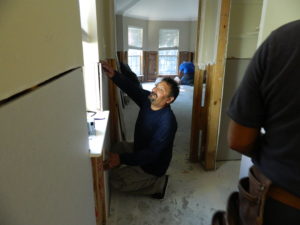
Peggy Hopkins and Pastor Scott Wiley from First Baptist Church in Frankston work on a home in Katy during the TBM Rebuild. (Photo / Ken Camp)
Since the hurricane hit the Texas Gulf Coast in late August, TBM volunteers and their Baptist disaster relief partners from 30 other states have prepared more than 1.5 million meals, removed damaged sheetrock and flooring from 900 homes, and provided about 48,000 boxes to enable affected residents to collect and store their belongings.
Disaster relief continues on a limited scale in several areas, but many South Texas and Southeast Texas residents have moved from a need for emergency relief to long-term recovery and rebuilding.
Fifty years ago, TBM pioneered disaster relief ministry among Southern Baptists. Last year, TBM also assumed responsibility for assistance with long-term recovery, a ministry previously performed by the Baptist General Convention of Texas.
Earlier this year, TBM facilitated several long-term recovery projects BGCT personnel had initiated—notably the Super Week of Caring effort in Houston around the time of the Feb. 5 Super Bowl.
However, the rebuild after Hurricane Harvey represents the first seamless disaster response—from preparing meals for first responders in the storm’s immediate aftermath to helping residents restore their homes—fully implemented by TBM.
“For the individual, the disaster really isn’t over until he is able to lie down and go to sleep in his own house,” said Dwain Carter, deputy director of disaster relief for TBM.
The TBM Rebuild offers volunteers opportunities not only to provide assistance in Christ’s name, but also to build relationships with affected homeowners, Carter noted.
TBM is prioritizing the rebuilding projects, first meeting the needs of elderly residents, families with special-needs children and single parents, he explained. Additional needs-based projects will be scheduled as more volunteers become available.
‘Finding a way to help’
The first TBM Rebuild church groups began working in the area around Kingsland Baptist Church in Katy, which is providing volunteers overnight lodging and access to its facilities.
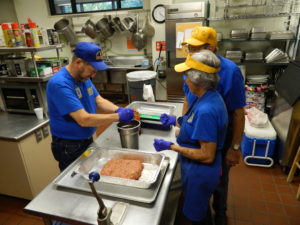
Director of Missions Gene Pepiton and Pat Robbins from Wichita-Archer-Clay Baptist Association prepare meals for TBM Rebuild volunteers, working in the kitchen at Kingsland Baptist Church. (Photo / Ken Camp)
Disaster relief food-service volunteers from Wichita-Archer-Clay Baptist Association working with Director of Missions Gene Pepiton prepared meals in the kitchen of the church’s fellowship hall.
The shower and laundry mobile unit from First Baptist Church in Amarillo, which was in service 38 consecutive days along the Texas Gulf Coast immediately after Hurricane Harvey made landfall, returned to Kingsland Baptist, and volunteers with the unit provided support services for the TBM Rebuild crews.
Over the next few weeks, the TBM Rebuild will expand to two others bases of operation—University Baptist Church in Houston and a county-owned facility in Orange.
The volunteers from First Baptist Church in Frankston originally offered to help with the mud-out phase of disaster relief—removing soaked sheetrock, discarding damaged flooring and disinfecting surfaces in flood-damaged homes.
When the church’s members learned they could serve a greater need at this point by participating in the TBM Rebuild, the volunteers rescheduled their trip to the Houston area and accepted the new assignment.
“This church has a long history of mission trips,” said Pastor Scott Wiley, who has served the Frankston congregation seven and a half years. “From the moment the hurricane happened, our people were interested in finding a way to help.”
First Baptist in Frankston sent two crews to Katy for the TBM Rebuild—eight volunteers who worked Monday through Friday, and seven who arrived on Friday to work through a long weekend.
‘Creating a bond here’
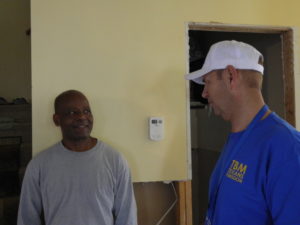
Homeowner Marvin Booker talks with R.L. Barndard, on-site coordinator for the TBM Rebuild in Katy and member of First Baptist Church in Duncanville. (Photo / Ken Camp)
At one house, the Frankston team worked alongside the homeowner, Marvin Booker, a licensed vocational nurse whose job was eliminated a short time before Hurricane Harvey hit, and his 19-year-old son, Morley.
The pair—along with Booker’s wife and their 11-year-old nonverbal autistic son—initially sheltered in place in their home after the hurricane. However, when the floodwater began rising in their neighborhood and totaled their vehicles, they had to evacuate on foot.
“We walked out in waist-deep water until we were picked up by a boat,” Booker said.
The family spent three nights at an emergency shelter established at a local high school before moving in temporarily with friends. After utilities were restored and water-soaked debris was removed, the family moved back into the upstairs of their home.
When Booker signed up for a class at Kingsland Baptist Church to learn how to install sheetrock, he met Carter from TBM, who told Booker he and his family qualified for assistance through the TBM Rebuild.
Booker expressed gratitude not only for the help he received, but also for the friendships he developed with the team members.
“We are creating a bond right here,” he said.
‘Serve the Lord where he sends us’
Pastor Marco Castillo from Grace Temple Baptist Church in Dallas works on a home in Katy during the TBM Rebuild. (Photo / Ken Camp)
While the Frankston team continued its work, volunteers from Grace Temple Baptist Church in Dallas arrived to devote an extended weekend to installing drywall.
“We are big on the Great Commission and doing everything we can to reach out to the community,” Pastor Marco Castillo said.
Members of his predominantly Hispanic congregation have served in the past with student missions groups who traveled to the Dallas area to remodel the homes of senior adults. So, when they learned about the opportunities for service along the Gulf Coast, they wanted to volunteer.
“We want to serve where the Lord sends us,” Castillo said. “He put it on our hearts to come here.”
For more information about volunteer opportunities in response to Hurricane Harvey, click here. To donate financially, click here or mail a check designated “Hurricane Harvey” to Texas Baptist Men, 5351 Catron, Dallas, TX 75227.
Sutherland Springs church to be demolished
November 15, 2017
SUTHERLAND SPRINGS (RNS)—The funerals had not yet been held, and the eulogies had not yet been delivered. But one thing was already clear in Sutherland Springs after one of the worst mass shootings at an American church: First Baptist Church will be razed.
The site where 26 people were shot dead by a lone gunman who sprayed the small sanctuary with hundreds of bullets will give way to a newly constructed church, a Southern Baptist Convention official said.
In what is becoming a grim American ritual, mass shooting sites from Sandy Hook to Columbine have been demolished and then rebuilt. But some churches that experienced horrific killings have sought to reclaim existing sacred spaces.
That’s not the case with First Baptist. Frank Page, president of the SBC Executive Committee, and Steve Gaines, the SBC’s president, confirmed the decision to demolish the church after meeting in Sutherland Springs with Frank Pomeroy, its grieving pastor.
“They did say, ‘We can’t go back in there,’” said Page, referring to Pomeroy’s remaining church members. “It’s going to be a reminder of the horrific violence against innocent people.”
Pomeroy and his wife, Sherri, were not at the church on Sunday when 26-year-old Devin Patrick Kelley opened fire. But their 14-year-old daughter, Annabelle, whom the couple adopted at age 2, was killed.
An anonymous donor agreed to fund the construction of a new church, Page said. The convention’s North American Mission Board has offered to pay for all of the funerals even though Texas’ Crime Victims’ Compensation program would have done so.
“We’re going to take care of our own people,” Page said.
The church structure may be in danger after hundreds of bullets pockmarked the walls. Sheriff Joe Tackitt Jr. of Wilson County described a gruesome scene of “blood everywhere” inside the church.
“You wouldn’t think they’d want to relive that,” said Andy Wyatt, a resident of Sutherland Springs who built themed vacation Bible study sets for children at First Baptist Church though he was not a member. “They deserve something bigger and better. You want to start fresh, anew.”
Not the first
That sort of fresh start after a mass atrocity has a long string of precedents:
Columbine High School, where 13 people were killed and 21 were injured in a mass shooting in 1999, was partially rebuilt, including the library where many of the victims died.
The site of the World Trade Center towers, destroyed on Sept. 11, 2001, is now a rebuilt complex with new skyscrapers, a memorial and museum.
The Nickel Mines, Pa., schoolhouse where five Amish schoolgirls were murdered in 2006 was torn down and rebuilt.
In Utoya, Norway, where 69 people—many of them minors—were killed at a church youth camp in 2011, one of the buildings where victims died was preserved, encompassed by a larger building with a memorial and interpretive center.
Sandy Hook Elementary School in Newtown, Conn., the site of the 2012 shooting that killed 20 children and six adults, was demolished and rebuilt. It reopened last year.
None of those locations were houses of worship, which are meant to be sacred spaces where people turn to the divine to find peace, calm and transcendence. They are also supposed to be places where people can be comforted, supported and healed, not terrorized and murdered.
Reclaim sacred space
Worshippers may feel the need to reclaim their sacred space. But that can be done in different ways.
Michelle Walsh, who teaches courses at Boston University on trauma and theology, studied a Knoxville Unitarian Universalist Church as it recovered after a lone gunman killed two and wounded seven during a children’s play in 2008.
Pews were realigned, walls were repainted, a curtain filled with bullet holes was removed but saved. A week after the killings, the church rededicated the sanctuary in a service that included blessing the spots where the dead fell and the hanging of a plaque. The whole thing concluded with a hymn, “May Nothing Evil Cross This Door.”
“I have said sometimes there is a fierceness for survivors who say, ‘We have survived this and we have a faith that survives even in the face of something like this,’” Walsh said. “It is a reclaiming and it is a marking of a place as not just a place of death, not just a place of loss, but of life.”
Other houses of worship have found ways to reclaim without rebuilding. After nine people, including the pastor, were killed during a Bible study in the basement at Emanuel AME Church in Charleston, S.C., in 2015, church members hung pictures of the victims on the walls and continued to meet on Wednesday nights, their open Bibles before them. Their historic sanctuary was unaffected in the shooting.
And when six people were killed and four were wounded inside a Sikh temple in Oak Creek, Wis., in 2012, worshippers did not abandon the sanctuary and even preserved some of the bullet holes.
“It frames the wound,” Pardeep Kaleka, son of former temple president Satwant Singh Kaleka, who died in the massacre, told The Associated Press. “The wound of our community, the wound of our family, the wound of our society.”
But in the case of the Sutherland Springs church shooting, it may be that the crime was so massive that rebuilding is necessary, said Steven Sewell, a Christian grief counselor who often works with churches experiencing trauma.
“Sometimes what happens in churches (that experience trauma) is they stay in the same place physically and spiritually when really it is impossible,” he said. “No one wants to be known as ‘that church’ where ‘that bad thing’ happened. So their rebuilding is what I like to call hidden greatness. That even in the midst of all of this tragedy, there is a hidden miracle that will come out.”
In any case, First Baptist Church in Sutherland Springs will have to rebuild much more than its sanctuary. About half the congregation, including all its Sunday school teachers and many of its band leaders, were among those who perished, Page, the SBC official, said the pastor told him.