TBM disaster relief volunteers fan out along Texas Gulf Coast
September 6, 2017
Eleven days after Hurricane Harvey made landfall, Texas Baptist Men volunteers were providing disaster relief at two-dozen sites along the Texas Gulf Coast.
Through Sept. 5, TBM—joined by Southern Baptist disaster relief workers from 13 other states—had worked more than 100,000 hours and contributed 3,600 volunteer days.
And as new areas became accessible and new needs become apparent, disaster relief continued to expand.
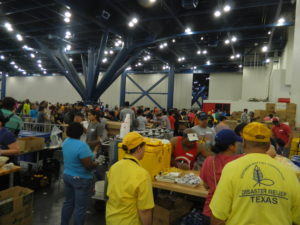
Texas Baptist Men disaster relief volunteers work at a field kitchen set up outside the shelter at Houston’s George R. Brown Convention Center. (Photo / Ken Camp)
In less than two weeks, TBM volunteers and their ministry partners prepared 239,000 meals and delivered 15,000 boxes to help residents collect and store their scattered possessions.
They provided access to 4,200 showers and washed about 2,700 loads of laundry.
The mud-out process of removing damaged drywall, soaked flooring and other debris from homes was in its early stages, but volunteers already had completed 50 tear-out jobs and 54 mold-mitigation assignments.
In the process, TBM volunteer chaplains and other workers distributed 689 Bibles and nearly 500 gospel tracts, and they recorded eight professions of faith.
One TBM crew traveled with Texas Task Force 1 to provide the search-and-rescue team with meals, laundry service and access to showers.
Houston-area residents remove damaged furniture and other debris from their flood-damaged homes after Hurricane Harvey. (Photo / Ken Camp)
In addition to working at sites along the 200-plus miles from Victoria to Nederland, TBM volunteers also provided childcare and chaplaincy for Gulf Coast evacuees who were housed at a shelter at the Kay Bailey Hutchison Convention Center in downtown Dallas.
In the near future, volunteers from Texas Baptist churches who want to provide hands-on assistance to families or churches in the Greater Houston and Southeast Texas areas can find lodging and access to showers at Volunteer Villages.
Churches near affected areas will receive short-term volunteers from other congregations around the state and provide them with basic overnight lodging, typically in a gymnasium or other church facility. TBM will work with the churches to give volunteers their assignments. For more information, click here.
To contribute financially to TBM disaster relief, click here (http://texasbaptistmen.org/GiveNow) or send a check designated “disaster relief” to Texas Baptist Men, 5351 Catron, Dallas 75227.
Momento Oportuno para Ministrar a Inmigrantes
September 6, 2017
En un momento cuando inmigrantes indocumentados en los Estados Unidos viven con un creciente temor e incertidumbre, existen ministerios que buscan ayudarlos a obtener un estatus legal y dar mejores oportunidades a familias para que permanezcan unidas.
Desde su comienzo en el 2013, el Proyecto ISAAC de la Convención Bautista de Texas y de la Universidad Bautista de las Américas ha tenido como meta dar su ayuda para mantener unidas a las familias.
“Ser un cristiano significa amar a otros,” dijo Jesús Romero, director del Proyecto ISAAC. “Y el amar a otros nos debe llevar a representar y defender a quienes están más desprotegidos.”
El Proyecto ISAAC prepara a las iglesias a ofrecer un paquete de ministerios—proveer clases de inglés y ciudadanía, dar ayuda para llenar formas de inmigración y guiar a las personas en el proceso de obtener un estatus legal.
Para marzo o abril del año que viene, Romero no solo va a poder ayudar a personas llenar los documentos de inmigración, pero podrá también representar a sus clientes en las sesiones de corte por el Departamento de Seguridad Nacional (DHS, por sus siglas en inglés).
El proceso para ser un representante acreditado reconocido por el Departamento de Justicia de los Estados Unidos puede tomar mucho tiempo.
Cada junio, el Proyecto ISAAC ofrece un entrenamiento de 40 horas, el cual cuesta $600—este es el primer paso para los que buscan ser representantes acreditados.
Romero buscó la ayuda de abogados de San Antonio para que pudieran dar estos entrenamientos.
Después de estos entrenamientos en San Antonio, cada persona debe de buscar un abogado de inmigración para que le pueda orientar y permitir practicar bajo su supervisión.
Para Solís, el pastor de la Iglesia Bautista Azle Avenue en Fort Worth y el fundador del ministerio Vida Nueva, esto le llevó alrededor de 70 horas de práctica bajo la organización World Relief. Ahí, él aprendió acerca de los documentos requeridos y el proceso necesario para llenarlos.
Romero reconoce que los costos y el proceso para que las iglesias estén involucradas pueden desanimar a muchos. Y aunque varias personas fuera de Texas, y algunos que nos son bautistas, han recibido este entrenamiento de parte del Proyecto ISAAC, en este momento solamente hay cinco entidades Bautistas que son reconocidas y acreditadas en el estado de Texas.
“Es un ministerio que requiere mucho sacrificio,” dijo Romero. “Pero es algo que si se puede hacer, y que definitivamente vale la pena.”
El programa está creciendo, dice Romero, pero siempre hay algo más que hacer. Tener fondos para becas ayudaría a que más iglesias fueran parte de este servicio. Iglesias que son en su mayoría anglas necesitan ver la realidad de este problema con las leyes migratorias. Romero también dice que las iglesias hispanas tienen que buscar poder ofrecer más clases de inglés y de ciudadanía.
Por 10 años, la iglesia Crossing Baptist Church en Mesquite ha ofrecido clases de inglés, y desde hace cuatro años, la congregación provee clases de ciudadanía.
Ahora, cada domingo la asistencia en Crossing Baptist es un tercio hispana, otro tercio es africana o afro-americana, y el otro tercio angla.
Al principio, algunos miembros se preguntaban cómo ellos podrían enseñar inglés a los estudiantes que no hablan inglés. Pero hoy se dan cuenta que tienen la habilidad más importante para enseñar inglés—la cual es hablar y escribir inglés.
Scott Collins, miembro de Crossing Baptist, ha estado involucrado en este ministerio, y él ha visto como varios estudiantes consiguieron su ciudadanía y con ella, la oportunidad de mejorar sus futuros.
“No se trata de lo que uno saque de esto, pero lo que uno dé,” dijo Collins. “Yo puedo experimentar el gozo y la satisfacción con ellos.”
Antes de empezar el ministerio, a varios miembros de la iglesia les preocupaba ser acusados de ayudar a personas que no tenían las mejores intenciones, recordó Collins. Pero ahora ellos ven esto como una oportunidad misionera.
“Ministros han dicho por más de 50 años que el mundo va a venir aquí,” dijo Collins. “Ahora eso ha pasado finalmente.”
At a time when undocumented immigrants in the United States live with increasing fear and uncertainty, ministries that seek to help them gain legal status and keep families united have greater opportunities.
Since its inception in 2013, the ISAAC—Immigration Service and Aid Center—Project of Texas Baptists’ Christian Life Commission and Baptist University of the Américas has aimed to help families stay together.
“Being a Christian means to love others,” said Jesus Romero, director of the ISAAC Project said. “And to love others is to stand with those who are more vulnerable.”
The ISAAC Projects equips churches to offer a continuum of ministries—provide English-as-a-Second Language and citizenship classes, help individuals fill out immigration forms and guide them through the process of obtaining legal status.
Becoming an accredited representative
By March or April of next year, Romero not only will be able to help people file their immigration documents, but also stand in Homeland Security hearings to represent his clients.
The process to become an accredited representative recognized by the U.S. Department of Justice can take quite a bit of time.
Every June, the ISAAC Project offers 40 hours of training that costs $600—the first required step for individuals to become accredited representatives.
Romero has sought the help of San Antonio attorneys to provide these training events.
After the in-class instruction, pupils must seek out immigration attorneys to serve as their mentors and allow them to practice under them.
For Solis, pastor of Iglesia Bautista Azle Avenue in Fort Worth and founding director of its Vida Nueva Immigration Service ministry, it took about 70 hours of practice working with World Relief. There, he learned more about various documents and the process it took to file each one.
The costs and the process may keep many churches from getting involved, Romero acknowledged. And although people who are not Baptists and who live outside Texas have received training from the ISAAC Project, currently there are only about five Baptist entities recognized and accredited in Texas.
“It is a very sacrificial ministry,” Romero said. “But it is doable and definitely worth it.”
The world has come to Texas
The program is growing, Romero said, but there is always more to do. Scholarship funding would allow more churches to join the program. More predominantly Anglo churches need to see the reality of this immigration issue, he added, while Hispanic churches need to also offer more ESL and citizenship classes.
For 10 years, The Crossing Baptist Church in Mesquite has offered ESL classes, and four years ago, the congregation began providing citizenship classes.
On any given Sunday, attendance at The Crossing is about one-third Hispanic, one-third African and African-American, and one-third Anglo.
At first, some members wondered how they could teach English to non-English-speakers. However, they soon discovered they already had the most important skill needed to teach English—the ability to speak and write English.
Scott Collins, a member at The Crossing, has been involved in those ministries, and he has seen people gain citizenship and receive a new opportunity to improve their lives.
Although “it is not what you get out of it, but what you put in it,” Collins said, he gets to “experience the joys and satisfactions of the people” he encounters.
At first, some church members were concerned about being accused of aiding people with bad intentions, he noted. But now they recognize it as a missional opportunity.
“Ministers have said for over 50 years that the world would come here,” Collins said. “Now, it has finally happened.”
Buckner assessing, picking up in Hurricane Harvey aftermath
September 6, 2017
BEAUMONT—Buckner International continues to assess the short- and long-term impact on the families it serves in the aftermath of Hurricane Harvey after the storm pounded Houston and Southeast Texas, areas where Buckner has significant work.
During a two-day tour Sept. 3-4 to the affected areas, Buckner President Albert Reyes visited staff and residents at two Buckner senior living communities, as well as children, families and staff from Buckner Children and Family Services in Beaumont who relocated to Camp Buckner north of Austin.
Buckner President and CEO Albert Reyes greets residents of Parkway Place, Buckner’s senior living community, Sunday evening following their shelter-in-place experience during Hurricane Harvey. Many residents praised Parkway Place staff members, many of whom provided service to residents as their own homes were damaged by floodwaters. (Photo / Scott Collins / Buckner)
“It was both heartbreaking and yet inspiring to visit with our Buckner family,” Reyes said. “Several of our staff have suffered complete personal loss and devastation, and yet they are still caring for the children and senior residents. I’ve never been prouder of Buckner.”
Buckner also has “been blessed by the support and outpouring of generosity from donors and friends who have risen to the occasion and continue donating desperately needed items and financial support,” Reyes said.
Volunteers step up to help at Aldine
At the Buckner Family Hope Center at Aldine in the northern part of Houston, Buckner staff and volunteers served nearly 1,700 people representing 385 families affected by the storm, said Adam McKinney, Buckner gift officer for Houston, who is coordinating relief efforts for the ministry.
About 100 volunteers showed up to help sort and distribute the items, including a team from Houston-based Noble Energy, McKinney said. Noble also is sending about 100 more volunteers to repair damage sustained at the Family Hope Center.
In addition to the outpouring of local support, Buckner received three trucks loaded with supplies from The Church of Eleven22 from Jacksonville, Fla. The trucks arrived at the Family Hope Center in Houston around 2 a.m. Sept. 4 after driving 15 hours straight with 15 church members.
Church members slept on the floor of the Buckner building and then went to work early Monday morning preparing the items for distribution, McKinney said. The group was back on the road as quickly as possible to return to Florida, where members said they were preparing for Hurricane Irma to hit.
“This is an incredible example of what it means for the church to be the presence of Christ,” McKinney said. “For a church to show this level of compassion and care from that distance is a testimony to all of us and an incredible blessing to our families.”
Employees at Calder Woods sustain losses
Buckner President and CEO Albert Reyes leads a devotional service with residents of the Buckner Assessment Center, foster children and parents and Buckner staff Sunday morning at Camp Buckner in the Texas Hill Country. The Buckner hill country retreat and conference center is providing shelter – and a camp experience — for 63 Buckner evacuees. (Photo / Russ Dilday / Buckner)
During a visit to Calder Woods, the Buckner senior living community in Beaumont, Reyes helped staff affected by the storm prepare donated clothes and hygiene products. The items arrived at Calder Woods from the Buckner Family Hope Center at Aldine in Houston.
As of Sept. 4, Beaumont still lacked running water. But Ben Mazzara, executive director of Calder Woods, said seven employees lost everything in the flooding. Clothes and other donations are going to those staff members and others, he noted.
“This is just an incredible demonstration of Buckner’s spirit,” Mazzara said. “We have staff who lost everything, and yet they’re here today, caring for residents and their fellow employees.”
Mazzara, who owns a home in Galveston, worked nine straight days and said he was uncertain whether his home on the island survived Harvey. But help arrived Sept. 5 when Buckner officials sent staff from Buckner Westminster Place in Longview and Buckner Villas in Austin to relieve Mazzara and his team at Calder Woods.
“This is what it means to be part of an organization that is Christ-like and mission-driven,” said Chelsea Musick, assistant director of nursing at Calder Woods. Musick’s family lost their home. Floodwaters reached the roof line. She is living in a local hotel with her husband and children.
During the height of the storm, officials made the decision to shelter-in-place at Calder Woods, fearing moving the 57 residents in nursing, assisted living and memory care would be “too traumatic and devastating for them,” Reyes said. In addition, there are 101 residents in Calder Woods’ independent living apartments.
Residents at Calder Woods are “doing incredibly well,” Mazzara said. “Our decision to stay here was the right decision. We’re safe, and we are fortunate to have plenty of water.”
Calder Woods’ food supplier managed to bring in regular shipments and medicine for residents was delivered from Houston by helicopter, Mazzara said.
Neither Calder Woods nor the Buckner Children’s Village in Beaumont sustained any flood damage, Buckner officials reported.
Families relocated to Camp Buckner
Members of The Church of Eleven22 in Jacksonville, Fla. and volunteers from Noble Energy of Houston load aid at the Buckner Family Hope Center at Houston/Aldine bound for distribution at Buckner ministries in Beaumont. (Photo / Scott Collins / Buckner)
However, because of the shortage of running water, Buckner relocated 63 people from its children and family services division to Camp Buckner in Central Texas. Those included foster families, Buckner Assessment Center children and staff.
The move was made “out of concern for their safety and comfort,” Reyes said. Reyes visited the group Sept. 3 and presented a devotion to them during a worship time.
At Parkway Place, the Buckner senior living community in Houston, staff reported they weathered the storm with no problems. In a meeting with residents at the community, Reyes expressed appreciation for the staff, including many who worked more than five days straight, sleeping at Parkway Place during the storm to ensure the safety of the residents.
Derone Martin, food service director, said he slept at Parkway Place several nights along with others on his team.
“We had to make sure our residents were safe and had regular meals,” he said.
As of Tuesday morning, Sept. 5, more than $30,000 had been donated online to support Buckner children and families affected by Harvey. Officials report more than $16,000 in items donated to the Buckner Center for Humanitarian Aid in Dallas, in addition to shipments that went directly to affected areas in Houston and Beaumont.
South Main Baptist Church in Houston donated more than 10,000 pairs of new shoes collected for the Buckner Shoes for Orphan Souls to storm victims in Houston.
Churches near Camp Buckner provided items to the Buckner evacuees there.
Ministerio de inmigración de iglesia en Fort Worth renueva vidas
September 6, 2017
El Pastor Rafael Solís y los miembros de la Iglesia Bautista Azle Avenue en Fort Worth entienden que los pequeños y fieles actos de fe son los que causan grandes cambios en la vida de las personas—en este caso, la de inmigrantes que necesitan mantener su documentación legal.
Vida Nueva, el ministerio inmigratorio de la congregación, les ha demandado un compromiso y una inversión significante. Pero en lugar de considerar el costo, Solís y los miembros de la iglesia se fijan en lo que realmente cuenta—demostrar el amor de Dios a la gente que está vulnerable.
“Nosotros no hacemos esto para que lo gente nos agradezca,” dijo Solís. “Lo hacemos porque nosotros estamos agradecidos.”
Realizan este trabajo porque hace una diferencia en la vida de individuos, como en la vida de Lorena Ortega.
‘Este es mí hogar’
Ortega, 23, tenía 7 años cuando su madre le dijo a todos en la familia que irían a Estados Unidos a visitar a su papá. Lorena no había visto a su padre en meses, pero sabía que sería más que una visita.
“Mí mama dijo, ‘empaquen sus cosas y despídanse de sus amigos,’” ella dijo.
Con su hermana, su hermano, su mamá y su abuela, Lorena tomo el autobús desde Tijuana a San Diego, y de ahí a Fort Worth.
La familia de Lorena nunca había planeado salir de México, pero las circunstancias los llevaron a tomar esa decisión.
“Mi esposo y yo teníamos una buena fuente de ingresos,” Elizabeth Ortega dijo. “Pero de repente las cosas cambiaron y tuvimos que buscarle por otro lado.”
Los Ortega se sentían atrapados, ya que el padre de Lorena había perdido su empleo en México, y no podía encontrar trabajo donde vivían. Así que después de esforzarse para conseguir sus documentos, él obtuvo una visa para ir a Estados Unidos a buscar más oportunidades. Meses después de que él llego, el resto de la familia pudo unírsele.
Cuando dejaron México, los Ortega dejaron la inseguridad y la frustración de no poder proveer para la familia.
“Yo crecí aquí,” Lorena dijo. “Este es mi hogar, y si yo estuviera en México ahora, probablemente ya no estaría en la escuela.”
Ella es beneficiaria del permiso de la Consideración de Acción Diferida para los Llegados en la Infancia (DACA, por sus siglas en inglés), el cual requiere que los individuos terminen su preparatoria o que hagan su GED, y que no tengan delitos ni condenas.
Aunque el DACA le permite trabajar aquí, Lorena aún se encuentra con discriminación recibida de clientes, otros empleados, y algunos de sus superiores.
“Ellos piensan que yo no hablo inglés, y por eso no me tratan con respeto,” Lorena dijo.
“Algunos supervisores también me han dicho que por mi estatus, ellos podrían correrme en cualquier momento.”
Lorena y su familia han encontrado paz y confort en la Iglesia Bautista Azle Avenue y en el ministerio Vida Nueva.
Un llamado dado por experiencia
Solís, el pastor de la Iglesia Bautista Azle Avenue, es el fundador y director del ministerio para inmigrantes.
Aunque el Servicio de Inmigración Vida Nueva oficialmente empezó hace un año, él y la congregación han estado haciendo este tipo de trabajo por 16 años, cuando Azle Avenue Baptist Church, una iglesia con una población predominante de descendencia anglo, se unió con una iglesia de habla hispana y llamo a Solís a pastorear la congregación.
Pero antes de que Solís pastoreara la iglesia a servir a los inmigrantes, el mismo tuvo que lidiar con algunos problemas migratorios.
Mientras buscaba obtener otra visa que lo dejara seguir viviendo y trabajar en Estados Unidos, descubrió un grave problema el fin de semana antes de se diera el fin del plazo para entregar su documentos. Descubrió que su abogado había estado mintiéndole y no había hecho lo necesario para hacer los documentos requeridos por la agencia federal.
“Fui a entregar mis papeles a las 9 a.m. y para la 5 p.m. me estaban diciendo que tenia la opción de presentar mi caso ante un juez,” Solís dijo.
Mientras estaba en las oficinas de inmigración, Solís se dio cuenta que todo el dinero que había pagado para obtener su visa se había desperdiciado, cuando oficiales de inmigración vinieron a detenerlo.
“Me dijeron que tenía dos opciones,” Solís dijo. “Podía esperar a que un juez escuchara mi caso o podía dejar que me deportaran.”
Si Solís hubiera escogido llevar su caso a un juez, él hubiera tenido que pasar todo el tiempo en el centro de detención hasta que un juez lo pudiera ver, y eso pudo haber tomado meses.
“Había mucho abuso en el centro de detención,” Solís recordó. “Los oficiales maltrataban a la gente. Así que les dije que me deportaran.”
Solís fue llevado a Nuevo Laredo, donde encontró refugio en una iglesia por algunos días, y después regreso a Jalisco, su estado natal. De ahí, él le dijo a su esposa que se fuera con su hija de regreso a casa.
Tres meses después, los tres consiguieron sacar una visa. Esta vez ellos sabían que cosas evitar, con que personas tratar, y como manejar el proceso.
Una vez que consiguió recibir la ciudadanía, Solís ha buscado ayudar a otros por medio de servicios migratorios de muy bajo costo, pero también ha querido ofrecer el servicio en el nombre de Cristo.
Un representante acreditado
Por medio del proyecto del Servicio de Inmigración y Centro de Ayuda (ISAAC, por sus siglas en ingles), el cual es un ministerio de la Convención Bautista de Texas, Solís recibió el entrenamiento para ser reconocido como un representante acreditado por el Departamento de Justicia de Estados Unidos.
“Recibir la acreditación no fue un proceso fácil,” él dijo. “Uno tiene que gastar mucho dinero en libros, y buscar a abogados que estén dispuestos a que tú practiques bajo su supervisión, lo cual no muchos quieren.”
Algunos de los abogados de inmigración no están dispuestos a dejar que otras personas se acrediten porque no quieren competencia, y es por eso que Solís dice que ser un representante acreditado requiere “visión, inversión, y compromiso.”
La Iglesia Bautista Azle Avenue es una de las pocas iglesias de la Convención Bautista de Texas que han aceptado tomar este reto.
Oportunidad de desarrollar relaciones
Desde que Vida Nueva empezó oficialmente el año pasado, han recibido alrededor de 150 clientes, y ahora ellos pueden tener 15 nuevas consultas cada mes.
Cada nuevo cliente que puede continuar el proceso es una persona con la cual la iglesia va a tener una relación por alrededor de un año, dijo Norma Trejo, directora del alcance a la comunidad de Vida Nueva.
Gente viene a Fort Worth desde Austin, Wichita Falls y San Angelo a ver si Vida Nueva puede trabajar con ellos.
Aparte de sus servicios de inmigración, la Iglesia Bautista Azle Avenue ofrece clases de inglés sin ningún costo y clases de ciudadanía a un precio de $25, a través de una asociación con Tarrant Community College.
“Para que las iglesias puedan hacer esto, tienen que entender que esto es un trabajo de tiempo completo,” dijo Trejo.
Aunque pueda tomar mucho tiempo y muchos recursos de la iglesia, Solís insiste que este trabajo es muy hermoso cuando la gente regresa y les dice, “Tengo ahora mi residencia, y voy a poder volver a ver a mi madre, a quien no veo desde hace 20 años.”
Fort Worth church’s immigration ministry changes lives
Pastor Rafael Solis and the members of Iglesia Bautista Azle Avenue in Fort Worth understand small and faithful actions make big changes in people’s lives—in their case, immigrants who need up-to-date legal documentation.
The congregation’s Vida Nueva Immigration Service ministry has demanded commitment and a significant investment. But rather than counting the cost, Solis and his church members focus on what really counts—demonstrating God’s love to vulnerable people.
“We do not do this so people can thank us,” Solis said. “We do this because we ourselves are thankful.”
They do it because of the difference it makes in the lives of individuals like Lorena Ortega.
‘This is my home’
Ortega, 23, was just 7 years old when her mother told her their family was going to the United States to visit her father. Lorena had not seen her dad in months, but she knew this would be more than a visit.
“My mom said, ‘Pack all of your things and go say bye to your friends,’” she said.
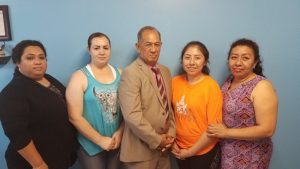
Rafael Solis (center), pastor of Iglesia Bautista Azle Avenue in Fort Worth, is pictured with (left to right) Loyda Rodriguez, Aurora Ramirez, Lorena Ortega and Elizabeth Ortega. (Photo / Isa Torres)
Along with two siblings, her mother and her grandmother, Lorena rode the bus from Tijuana to San Diego and then to Fort Worth.
Lorena’s parents never planned to leave Mexico, but circumstances dictated their actions.
“My husband and I had a good steady income,” Elizabeth Ortega said. “But suddenly we had to look for something else.”
The Ortegas felt stuck, because Lorena’s dad had lost his job in Mexico, and no other employment was available where they lived. So, after working hard, he secured a visa to go to the United States to look for opportunities. Months later, the rest of the family finally was able to join him.
When they left Mexico, they left behind insecurities and the frustration of not being able to provide for themselves. Although not everything is perfect now, the Ortegas are happy to call the United States their home.
“I grew up here,” Lorena said. “This is my home, and if I was back in Mexico, I would probably not be in school anymore.”
She is a recipient of the Differed Action for Childhood Arrivals permit, which requires individuals to finish high school or obtain the GED. To be eligible for a permit, individuals also are prohibited from having any felonies or convictions.
Although the DACA permit allows her to work, Lorena still has faced discrimination from the clients with whom she interacts and from some of her own coworkers and superiors.
“They think that I do not speak English and treat me with disrespect,” Lorena said. “Supervisors have also said that because of my status, they could fire me at any time.”
Lorena and her family found peace and comfort in Iglesia Bautista Azle Avenue and its Vida Nueva Immigration Service.
A calling born out of personal experience
Solis, pastor at Azle Avenue, founded the immigration ministry and serves as its director.
Although Vida Nueva Immigration Service officially started about a year ago, he and his congregation have been involved in similar work 16 years when the predominantly Anglo Azle Avenue Baptist Church and a Spanish-speaking congregation merged and called Solis as pastor.
But before Solis could lead the church to minister to immigrants, he had to deal with some immigration issues of his own.
While trying to secure a new visa that would allow him to continue to remain in the United States and work, he found out a disturbing fact one weekend before his application was due. He discovered his lawyer had been lying to him and done nothing to send the necessary paperwork to the federal agency.
“I went to the office to submit my application at 9 a.m., and at 5 p.m. I was being told that I had the option to defend my case before a judge,” Solis said.
While he was at the immigration offices, Solis found out the money he had spent to get his visa had gone all to waste when immigration officers suddenly came out to detain him.
“They told me I had two options,” Solis said. “I could wait for a judge to hear my case, or I could surrender and be deported.”
If Solis had chosen to take his case to a judge, he would have spent the entire time in a detention facility until a judge was free to hear him, and that could have taken months. “There was a lot of abuse going on in the center,” Solis recalled. “The officers mistreated the people there. So, I told them to deport me.”
Solis was taken to Nuevo Laredo where he found refuge in a church for a few days, and then went back to Jalisco, his native state. He called his wife and told her to bring their daughter back and join him at home.
Three months later, all three applied for another visa. This time they knew what to avoid, how to go to the right people and how to handle the process.
Once Solis and his family became U.S. citizens, they not only wanted to help others through by offering low-cost immigration services, but also wanted to offer the service in Christ’s name.
An accredited representative
Through the ISAAC—Immigration Service and Aid Center—Project, a ministry of Texas Baptists’ Christian Life Commission, Solis received the training to become an accredited representative recognized by the U.S. Department of Justice.
“Getting the accreditation was not an easy process,” he said. “You have to spend a lot of money on books and look for lawyers who are willing to let you practice under them, which a lot of them are not.”
Some of the immigration lawyers’ unwillingness to let a person learn and practice under them may be for fear of competition, but that is why Solis says being an accredited representative requires individuals to have a “vision, a willingness to invest and a commitment.”
Azle Avenue is one of the few Texas Baptist churches that has accepted the challenge, and its leaders are happy to see the fruits of their work.
Opportunity to develop relationships
Since Vida Nueva officially began last year, they have received about 150 clients, and now they are able to consult about 15 new clients each month.
Each new client who moves through the application process is a person with whom the church has the opportunity for a year or more to establish a relationship, said Norma Trejo, Vida Nueva’s community outreach director.
People have come to Fort Worth from as far away as Austin, Wichita Falls and San Angelo to see if Vida Nueva can work with them.
In addition to offering immigration assistance, Azle Avenue has also partnered with Tarrant Community College to offer ESL classes at no cost and citizenship classes for $25.
“For churches to do this, they have to understand that this is a full-time job,” Trejo said.
While it may take a lot of time and resources from the church, Solis insists it is so beautiful when people come back to say, “I have my residence now, and I will finally have the chance to see my mom, whom I had not seen in 20 years.”
Baptists mobilize to meet needs after Hurricane Harvey
September 6, 2017
HOUSTON—Before most Gulf Coast residents returned to their homes, about 175 Texas Baptist Men disaster relief volunteers already had worked more than 5,500 hours and prepared 30,000-plus meals for first responders and sheltered evacuees.
And as the rain stopped and floodwaters receded, Texas Baptists intensified their efforts to minister to people affected by Hurricane Harvey.
Cooking meals at downtown Houston shelter
About three-dozen TBM disaster relief workers set up a field kitchen outside the George R. Brown Convention Center in downtown Houston Aug. 31, where they prepared meals for evacuees inside the mega-shelter.
Texas Baptist Men disaster relief volunteers prepare meals at the George R. Brown Convention Center in downtown Houston. The American Red Cross serves the meals to hurricane evacuees who are sheltered there. (Photo / Ken Camp)
“I remember when the Katrina people were here,” said one of the shelter residents, a homeless man who simply identified himself as James. “I never thought I would be.”
Gene Pepiton, director of missions for Wichita Archer Clay Baptist Association, had served with a TBM crew at the George R. Brown Convention Center after Hurricane Katrina in 2005, when people from New Orleans were evacuated to Houston. He returned to the same site after Harvey with a vanload of TBM volunteers from his association Aug. 30.
Before his crew left the TBM Dixon Missions Equipping Center in Dallas, he reminded the volunteers of the difference they could make as they showed Christ’s love by providing nourishing hot meals people who had experienced trauma.
“For a time, we can take their minds of some of their worst hurt,” Pepiton said.
He recalled incidents after Katrina when volunteers in downtown Houston faced what seemed to be insurmountable challenges. But God opened doors of opportunity when his people ceased to rely on their own resources and depended on him, he noted.
“When we can’t do it, God shows up,” he said.
‘Gospel in motion’
Dwain Carter, deputy director of TBM disaster relief, encouraged the volunteer to look for every occasion to demonstrate the love of God, both through their actions and through words of Christian witness.
Dwiain Carter, deputy director of Texas Baptist Men disaster relief, gives instructions to volunteers before they deploy from Dallas to Houston. (Photo / Ken Camp)
“We are the gospel in motion,” Carter said. “We are the hands and feet of Christ.”
Additional food-service teams worked in Victoria, Katy and in support of the Texas Task Force 1 search-and-rescue team.
Six days after the hurricane first made landfall in South Texas, TBM crew—together with Southern Baptist disaster relief workers from Arkansas, Oklahoma, Louisiana, Missouri, Illinois and South Carolina—had washed nearly 600 loads of laundry and provided access to more than 800 showers in support of shelters and first responders.
Shower and laundry mobile units were deployed to shelters in Angleton, La Grange, Victoria, Katy and Portland, as well as multiple Houston-area sites and with Texas Task Force 1.
Damage assessors, asset protection personnel, chainsaw crews, heavy equipment operators and volunteers who distributed boxes to residents to help them reclaim and store scattering belongings worked in Victoria.
TBM childcare workers ministered to children and volunteer chaplains offered spiritual counsel at the shelter set up at the Kay Bailey Hutchison Convention Center in Dallas.
Victim Relief Ministries—an interdenominational ministry that grew out of TBM’s restorative justice ministry program—also sent chaplains, crisis responders and comfort dog teams to the downtown Dallas shelter and to Refugio County in South Texas.
TBM established mobile command posts in Victoria and Katy, and the group deployed flood recovery units to La Grange and Katy.
‘A marathon, not a sprint’
Thousands of additional TBM volunteers remained on alert, waiting deployment—not only to meet immediate needs, but also to provide care over the long term.
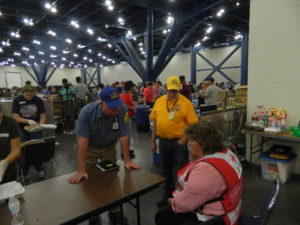
Ray Gann, on-site coordinator for the Texas Baptist Men disaster relief volunteers at Houston’s George R. Brown Convention Center, consults with an American Red Cross official. (Photo / Ken Camp)
“This is a marathon, not a sprint,” said Mickey Lenamon, TBM executive director. “We will still be responding, whether it’s a month from now or a year from now.”
To contribute financially to TBM disaster relief, click here or send a check designated “disaster relief” to Texas Baptist Men, 5351 Catron, Dallas 75227.
More than one-fourth of the congregations affiliated with the Baptist General Convention of Texas—more than 1,200 churches and missions—are located in the region affected by Hurricane Harvey, BGCT Executive Director David Hardage noted.
“While we are saddened by the unprecedented destruction, we are encouraged by the good work of first responders, volunteers, and our churches and partners,” Hardage said.
Making adjustments
Leaders of Bounce—Texas Baptists’ student disaster recovery program—already are making plans to send volunteer teams to the Gulf Coast during spring break and summer 2018, he added.
Spring break mission trips to Houston are scheduled March 7-10 and March 11-14. Summer mission trips are scheduled June 11-16, June 18-23, June 25-30, July 9-14 and July 16-21 at various locations in South Texas and Southeast Texas.
The hurricane hit the Texas Gulf Coast just a few weeks before many Texas Baptist churches collect the annual Mary Hill Davis Offering for Texas Missions. In addition to providing funds for programs such as Bounce, the Woman’s Missionary Union of Texas board of directors voted to dedicate every dollar received over the $3.6 million goal to long-term disaster recovery.
“We anticipate working with Texas Baptist staff, TBM and directors of missions to know where and how funds will best be used,” said Carolyn Porterfield, interim executive director of Texas WMU.
Texas WMU also deployed its own laundry unit to a shelter at Latham Springs Baptist Camp and Retreat Center that housed about 400 evacuees from the Gulf Coast.
Houston churches care for neighbors
Union Baptist Association sustained water damage, but personnel worked remotely to receive reports as Houston-area churches assessed damage, said Tom Billings, executive director of the association.
Several area churches opened their facilities as shelters and many others provided meals and others services to their members and neighbors.
Volunteers from Woodridge Baptist Church of Kingwood in Houston mop up water and clear debris from a flooded home in their neighborhood. (Photo /Ken Camp)
Woodridge Baptist Church of Kingwood, in northeast Houston, lost electrical power but did not sustain any serious damage to its campus. However, the homes of many member families were flooded.
By Aug. 31, members had prepared between 1,500 and 2,000 meals volunteers delivered to affected households, said Matthew Dillingham, executive pastor.
The church received donated cleaning supplies, diapers and other items, and it opened its facility to enable families to eat on-site and pick up the supplies they needed.
Volunteer teams from the congregation fanned out into the neighborhoods surrounding the church campus, helping residents remove water-damaged furniture, rip out soaked flooring and mop up standing water from their homes.
“There are a lot of people who are working really hard,” Dillingham said. “As people
are working, they are meeting neighbors they never would get to meet otherwise, and new relationships are developing.”
Houston resident Davie Vanderwalt marks the water damage line on the interior wall of his home. (Photo / Ken Camp)
One crew from Woodridge joined other volunteers in helping Davie and Bobbie Vanderwalt clear out damaged goods from their home, which took on about three feet of water.
After the area flooded, Vanderwalt talked on the phone with a good friend who is a member at Woodridge. He told his friend, who was traveling in Nevada, about the damage he and his family sustained.
“He told me, ‘We’ll get a team out from our church to help you,’” Vanderwalt said.
‘In God’s timing’
Buckner International is donating about 12,000 pairs of shoes collected through its Shoes for Orphan Souls initiative to survivors of Hurricane Harvey.
“What a blessing it is for Buckner to be able to donate these shoes. In God’s timing, we had just finished a shoe drive in Houston and have 10,000 pairs of shoes at a partner church there,” said Albert Reyes, president and chief executive officer of Buckner International.
The shoes collected in partnership with South Main Baptist Church in Houston will be delivered directly to Houston families.
“That’s great news. But the downside of it is that this donation is now leaving us desperately short on shoes for needy children in other places,” Reyes said.
To make a donation to help replenish Buckner’s supply of shoes for vulnerable children, click here.
Buckner also has initiated a collection of personal hygiene items for families affected by Hurricane Harvey. Requested items include soap, body wash, shampoo and hair conditioner, toothbrushes and toothpaste, razors, deodorant, laundry detergent and fabric softener, diapers and other baby care supplies.
Other needs include packages of underwear in all sizes, pots and pans, paper towels, paper plates, backpacks and school supplies for elementary and middle school students.
One way to donate is by buying items at Amazon.com and directing the company to ship the purchase directly to the Buckner Center for Humanitarian Aid at 5405 Shoe Dr., Mesquite, TX 75149.
A new and improved Baptist Standard
September 6, 2017
We’ve relaunched the Baptist Standard with a new look and improved website experience. We hope you like it.
HSU horseback riders no longer carry Confederate flag
September 6, 2017
ABILENE—Riders of the Six White Horses—equestrian ambassadors for Hardin-Simmons University—no longer will carry a Confederate flag.
Although the student team originated 90 years ago as two riders, one carrying a United States flag and the other carrying a Texas flag, for many years six riders have displayed the six flags that have flown over Texas. The Six White Horses represent the university in parades, rodeos and some sporting events.
The flag representing the Confederate States of America was the “Stars and Bars,” not the more familiar Rebel battle flag that was appropriated by some white supremacist groups.
‘Flags can be divisive symbols’
Even so, Hardin-Simmons announced Aug. 25 the riders will display only the United States and Texas flags, rather than continuing to carry the flag representing the Confederacy.
“Each flag carries with it a context,” HSU President Eric Bruntmyer wrote in a letter to faculty and staff. “In ideal circumstances, flags are unifying symbols, serving as common representations of purpose and pride. In other cases, however, flags can be divisive symbols which create conflict and disunity.”
Hardin-Simmons announced its decision five days after the University of Texas removed four Confederate statues from its Austin campus. It followed one week after the Six Flags Over Texas amusement park announced it would stop displaying the Confederate flag, choosing instead to fly only the United States flag.
The actions followed deadly violence in Charlottesville, Va., where white nationalists and neo-Nazis protested the city’s desire to remove a statue of Robert E. Lee, and they clashed with counter-protesters.
‘We desire to do what is right’
The decision at Hardin-Simmons grew out of discussions involving the president, the board of trustees and the university’s administrative leadership team regarding ways to encourage racial reconciliation.
In the process, university leaders examined “how the practice of using any flag of the Confederacy reflected misalignment with the university’s history, core values and future goals,” according to a statement from HSU. James B. Simmons, a Baptist pastor and abolitionist, founded the university in 1891.
“More than anything, we look to Scripture to inform us on how to live as faithful Christ-followers,” Bruntmyer said. “We desire to do what is right—to be family together and good neighbors to all. We want to stand in unity with the image of God reflected in every person.”
CommonCall: No more dumpster diving
September 6, 2017
“Mama, can we go see what the kids had for lunch?”
Yamile Rocha-Calles couldn’t believe her ears.
As a Parent Teacher Organization officer and president of the site-based decision-making committee at James Bowie Elementary School in Dallas, she spends plenty of time on campus.
So, she had noticed a woman and her preschool daughter, mostly because they—and the third-grader they dropped off each morning and met each afternoon—wore the same dingy clothes in layers every day, regardless of the weather.
One day, she overheard the preschooler ask, “Mama, can we go see what the kids had for lunch?”
She saw the woman and child walk toward the parking lot and approach a dumpster. Then, the mother lifted her daughter into the garbage bin to look for food.
“My heart sunk,” Rocha-Calles said. “I realized they had nothing to eat.”
Prompted to action
She told personnel in the school office what she saw and asked what help the school could offer. She learned about some resources but remained unsatisfied with the answer she received.
“Mama, can we go see what the kids had for lunch?”
“Those words changed my world,” Rocha-Calles said. “That little girl broke my heart. I had to do something. … It was like God told me, ‘You have to do this.’”
So, she asked friends—in person and on Facebook—for ideas about how to respond.
“There just had to be some way for that mother to get food for her children other than digging in the trash,” she said.
She found the answer when she talked to Marsha Mills, director of Mission Oak Cliff, a ministry of Cliff Temple Baptist Church in Dallas, who offered to help start a food pantry at the school.
Rocha-Calles knew to contact Mills, because she had benefited from Mission Oak Cliff personally when injuries from a random drive-by shooting left her hospitalized and disabled for an extended period.
Mission Oak Cliff helps neighbors in need
Marsha Mills became director of Mission Oak Cliff 12 years ago.
Since 1948, Mission Oak Cliff has operated a food pantry for neighbors in need—first at a former fire station and more recently inside the church building.
The ministry also offers a clothing closet and a variety of classes to help break the cycle of poverty—high school-equivalency, English-as-a-Second-Language, citizenship, job-readiness, computer literacy and nutrition.
Mills became director of Mission Oak Cliff 12 years ago after a 27-year career in public education, including 24 years spent teaching at Margaret B. Henderson Elementary School, three miles from Cliff Temple.
“I knew and loved the community and the people, and I felt like teaching was my ministry,” she said. Nonetheless, she began to feel restless.
“It was as if God said: ‘Yes, it is a ministry. But it’s no longer your ministry,’” she said. “I asked for guidance. Unfortunately, he had given up writing on walls a long time ago. I stepped away from teaching, not knowing where I was going.”
As a member at Cliff Temple, she was familiar with Mission Oak Cliff and “peripherally involved” with its ministry.
“I knew nothing about social ministry,” she confessed. Even so, three weeks after she retired from the Dallas school district, she accepted the director’s position at Mission Oak Cliff.
Community gained a sense of ownership
On Labor Day weekend 2005, not long after Mills went to work with Mission Oak Cliff, the ministry’s building burned. Subsequent investigation revealed a client with a history of mental illness set the fire after stealing copper wiring from the facility.
“After the fire, people came out of their apartments and from all over the community in response. They said: ‘You helped us when we needed it. We want to help you,’” Mills recalled. “That was the turning point. That’s when the people in the community gained a sense of ownership.”
Mission Oak Cliff relocated into the church’s facility, but Mills and the committee with whom she worked felt a growing need to move beyond the church’s walls.
“I went to a Christian Community Development Association meeting that opened my eyes,” she said. “I began to see the difference between charity and community development. It’s not just us doing things for people. It’s empowering the community and helping families gain stability and independence.
‘We decided to take the show on the road’
“We realized we needed to get the ministry into the community. This building looks intimidating. It looks like a fortress or a castle to people in the neighborhood. … That’s when we decided to take the show on the road.”
Cliff Temple already had established a relationship with neighborhood schools. So, when Hector Garcia Middle School received requests from families asking for help with groceries, a school official contacted the church.
Mission Oak Cliff started a satellite food pantry on the school campus. The ministry kept the pantry stocked with nonperishable food, and the school let students and their families know about its availability.
When Josey Benavidez became community liaison at Garcia, the food pantry already was in place, and she appreciated the impact it made on the lives of students. However, she recognized another need.
Discovery new needs, proposing new solutions
“We have a lot of homeless students,” Benavidez said, noting the families who lack a permanent address often do not receive the safety-net benefits available to others who live in poverty.
In particular, she recognized many students who received meals on school days lacked food each weekend. At Garcia, more than 93 percent of students are eligible for the free- or reduced-lunch program.
Mission Oak Cliff helped her develop a backpack food program. Homeless students receive a backpack filled with ready-to-eat food each Friday, and they return the backpack each Monday.
“The first week, one student wouldn’t let go of the backpack on Monday until he was promised it would be refilled on Friday,” Mills said.
At W.H. Adamson High School, the counselor’s office realized the need for groceries among students’ families outstripped the ability of the school’s alumni association to supply it. The school’s community liaison contacted Mission Oak Cliff, and the ministry helped launch a satellite food pantry at the school.
“Because the community knows we care, they know where to go when there’s a need,” Mills said.
Starting a satellite food pantry at Bowie Elementary
So, when Rocha-Calles told Mills about the mother and child she saw digging through the dumpster at Bowie Elementary, Mills drew on previous experience at Garcia and Adamson to explain exactly how to start a satellite food pantry at the school.
Yamile Rocha-Calles worked with Mission Oak Cliff to establish a satellite food pantry at James Bowie Elementary School in Dallas. (Photo / Ken Camp)
The school designated an unused classroom as the pantry site. Mission Oak Cliff keeps its shelves stocked. Counselors and principals control access to the locked room, but they make it as easy as possible for families to help themselves to the groceries.
“Teachers are our first point of contact,” Rocha-Calles said. “They are the ones who see the children every day. Homeless children don’t want to be seen by the principal. They don’t want to stand out. But we let all the children and their families know about the pantry.”
In addition to satellite food pantries at Bowie, Garcia and Adamson, Mission Oak Cliff also has responded to requests from Justin F. Kimball High School and John Leslie Patton Jr. Academic Center.
“I don’t know where this is going to end,” Mills said. “Having the satellite food pantries hasn’t lessened the number who come to us (at the church facility). In fact, it’s enhanced the ministry. We have more who come here now.”
Last year, Mission Oak Cliff served about 13,000 people, representing close to 4,000 families. Each family accessed the on-site food pantry about four times on average.
Some parents whose children received food from the satellite food pantry enrolled in ESL, GED or other classes at the church. Some who have benefited from Mission Oak Cliff have returned to volunteer there. Some have started worshipping regularly at Cliff Temple.
“The word is out: “It’s a safe place. You can go there,’” Mills said.
Years ago, when the neighborhood changed and other churches relocated, Cliff Temple chose to stay and minister, she noted.
“This church is committed to the community,” she said. “And for the most part, the community protects us. We’ve never had a problem with graffiti here, even though there are gangs all around.
“The people in this community know. It’s their place.”
This is part of an ongoing series about how Christians respond to hunger and poverty. Substantive coverage of significant issues facing Texas Baptists is made possible in part by a grant from the Prichard Family Foundation.
Read more articles like this in CommonCall magazine. CommonCall explores issues important to Christians and features inspiring stories about disciples of Jesus living out their faith. An annual subscription is only $24 and comes with two complementary subscriptions to the Baptist Standard. To subscribe to CommonCall, click here.
Gulf Coast Texas Baptists hammered by Harvey
September 6, 2017
Many Texas Baptists along the Gulf Coast who normally gather for worship on Sunday had only two choices Aug. 27—pray while they sheltered in place or pray as they evacuated their homes in areas with rising floodwaters.
Hurricane Harvey made landfall Aug. 25 near Rockport as a Category 4 storm. Then it began a slow crawl northeast toward Houston, dumping up to four feet of rain in some places.
Union Baptist Association sustained water damage, and its offices will be closed and events cancelled until remediation can be completed, according to a statement posted on the associational website.
HBU cancels classes
Houston Baptist University cancelled all classes and activities through Labor Day, with plans to resume classes Sept. 5.
“This decision is made in order to allow our faculty, students and staff, as well as their families, enough time to address any concerns at home before beginning the school year,” an announcement on the university website said.
“We ask that you keep HBU and the greater Houston community in your thoughts and prayers. At this time, we are not planning to evacuate any residents on campus.”
Drop-off and distribution site
With close to 300,000 residents without utilities and many areas isolated due to submerged roads, reports about damage to church facilities remain sketchy.
Brandon Webb, pastor of Westbury Baptist Church in Houston, reported on Westbury’s website the church had not taken on water, and it still had electricity. So, the church building would serve as a drop-off and distribution point for food, water, toiletries, blankets and other supplies to assist people whose homes flooded.
Churches provide shelter
Some churches in areas that escaped serious damaged opened their facilities to serve as shelters for people displaced by Hurricane Harvey.
In the Houston area, they included at least two Baptist General Convention of Texas-affiliated congregations, First Baptist Church in Highlands and Golden Acres Baptist Church in Pasadena, and two congregations uniquely aligned with the Southern Baptists of Texas Convention, First Baptist Church in Tomball and Calvary Baptist Church in Cleveland.
“Highlands has one of the highest, if not the highest, elevations in Harris County,” said Tim Edwards, pastor of First Baptist Church.
The church building did not sustain damage, but Edwards noted he and others continued to watch the nearby San Jacinto River carefully.
“I’ve been here since 1996, and even after (Hurricane) Ike hit, I never have seen the water like this,” Edwards said.
First Baptist began providing shelter at its facility Aug. 27. The church housed 65 overnight guests Aug. 28 from Highlands, as well as Baytown, Channelview and other nearby communities, Edwards said.
‘Church being church’
The number of people in the shelter fluctuated greatly from one hour to the next, he said, as new people arrived and others left to return to their homes or move in with relatives.
Church members are preparing meals for guests in the shelter, and people from the community are providing blankets, groceries and other needed items, he said.
“It’s the church being church, loving Jesus and loving people,” he said. “And we’ve just been overwhelmed by the support we’ve received from our community.”
Opening homes to ‘almost-strangers’
Taylor Sandlin, pastor of Sugar Land Baptist Church, southwest of Houston, estimates one-third to one-half of his church members were evacuated from their homes, and others sheltered in place with floodwaters threatening.
Many families opened their homes to provide shelter to people they barely knew, he noted in a post on Facebook. Sandlin and his family—who evacuated their neighborhood—are in Katy with “friends of friends.”
“What a gift to be taken in by almost-strangers just because we are in need,” he said. “There is lots of trouble in the world, but also much grace.”
In an Aug. 29 Facebook post, Steve Wells, pastor of South Main Baptist in Houston, reported his home in Meyerland was spared from flooding.
“Today the plan is: pray for the church; try to answer the volume of email and texts from the congregation and from people who love us; pull carpet from the home of a church member down the street; (and)—if streets allow—go to George R. Brown Convention Center to pray with those who are displaced,” he wrote.
Harvest remains plentiful in the oil patch
September 6, 2017
PLEASANTON—The loneliest places often are locales where people typically gather. Movie theaters. Malls. Bars. There, it’s easiest to blend in, easiest to hide without seeming out of place.
For Gray Hawk, it was a hotel in Pleasanton. Dispatched to South Central Texas to work the oilfield, he was struggling through a divorce. The longer the proceedings dragged on, the more he drank. One night, two half-gallon bottles of Canadian whiskey were his only companions.
Soon, the first bottle was as empty as his soul. Over the next few days, Hawk drained the second. He spiraled deeper into depression.
“I can’t do this anymore,” he said.
It was his time. He went looking for one of his Hi-Point handguns, a 9 millimeter and a .40 caliber.
“There were only two boxes. I knew I’d stuck my guns in one of those two boxes, but I couldn’t find them. The only thing that kept coming up was that oilfield Bible.”
South Texas oil boom
In 2010, the Eagle Ford Shale in South Texas was one of the most actively drilled targets for unconventional oil and gas in the United States. Companies rushed to access the estimated 3 billion barrels of oil it protected. As a result, towns across the region swelled almost overnight.
Hotel room prices surged to more than $500 a night. Home prices boomed. Companies set up “man camps” in the middle of nowhere to house their workers. Increased 18-wheeler traffic caused roughly $2 billion in damage on Texas back roads.
Fred Ater, the Baptist General Convention of Texas area representative in the region, remembers it well. Reports on the activity led most news reports and newspapers. The possibilities for such a reservoir of oil affected the oil market worldwide.
As Ater traveled through the towns impacted by the flood of oil workers, he saw ministry possibility after ministry possibility. Oilfields are known as notoriously hard places to work, worked by hard people. Alcohol often flows feely during free times. Gambling is common as are other vices.
People literally came from all over the world to work the fields. If a church or individual felt called to minister to these roughnecks and crew bosses, they could spread the gospel to the ends of the earth by evangelizing the workers and in turn their families located elsewhere.
Ater prayed fervently for God to raise up a leader who would take the gospel to the oilfields.
“I’d been praying, ‘What in the world can I do?’” he said. “I’d been talking to churches. I just kept on praying. I just said: ‘Lord I cannot do this. I have a job. It does not entail this. Who can do this?’”
It took nearly three years.
‘Never seen a Bible like this’
God’s Word for The Oil Patch was published in 1984 by the Oilfield Christian Fellowship in an effort to convey the gospel in a way that would be more accessible to oilfield workers. It features testimonies from oil patch laborers and a cover featuring an oil rig. Someone at one of the camps gave a copy to Gray Hawk, who was born on a Choctaw reservation. He threw it in a box with his other belongings.
In a drunken stupor at 11:30 p.m., he found it again.
“I’d never seen a Bible like this before,” he said. “In fact, I’d never owned a Bible before.”
He began to flip through the pages.
Responding to God’s call
Driving by an oilfield four years ago, Hollas and Nelda Hoffman sensed their life was about to change. Although neither had experience in the oilfields, both felt called to serve there.
A short time later, they followed that call.
“In June 2013, I turned 70 years old,” he said. “I just sensed that God was about through with me in the church I was serving. On the 28th of August, I resigned. On the next day at noon, we knew we were supposed to go to the oilfield.”
Since then, the Hoffmans have seen what they believe is God at work throughout the oilfields. The couple never actively recruited anybody, yet volunteers stepped forward, each sensing a call to share the gospel in this mission field.
The Hoffmans, who are BGCT-endorsed chaplains, and the volunteers formed Oil Patch Chapel Ministries and spread across the state distributing Bibles, visiting with oil workers and building relationships with people in the industry.
Woman’s Missionary Union of Texas helped the Hoffmans tell their story. Their ministry is supported by the Mary Hill Davis Offering for Texas Missions and encouraged by Texas Baptists.
Doors opened in dramatic fashion. In one instance, the Hoffmans were allowed to share the gospel during a safety meeting of all the employees at one oilfield location. Another time, a road rage incident served as the start of a relationship through which the gospel was shared.
People are coming to faith statewide. Marriages are being healed. Addictions are being overcome. Individuals are praying for the first time in a long time. As the oil boom slowed, families were reunited and strengthened.
“God is the one at work,” Nelda Hoffman said. “He’s using all kinds of people. People are coming to Christ. People are getting saved.”
‘Perhaps there is hope for me’
The testimonies of men who left behind “hellish” lives for holy ones washed over Gray Hawk. They once lived like he was. “Perhaps there is hope for me after all,” he thought as he poured over the pages for hours.
“I came across the sinner’s prayer of repentance,” he said. “I just kept moving on, reading stuff and reading stuff. A couple of testimonies really touched my heart. I stopped worrying about that gun. I got down on my knees and recited that part of the Bible, ‘Lord Jesus, come into my heart.’”
Tucked away in the Bible was a phone number with a note encouraging the reader to call if he or she had any questions. He had plenty of questions, and he wanted some answers.
“I found Jesus at 57 years old—first time in my life. The next morning hung over like a dog, I called Sister Peanut. An hour later, she called back. We talked and prayed together.”
Distributing Bibles
Peanut Scott accompanied a friend to the Hoffmans’ seminar about oilpatch ministry during the WMU of Texas Annual Meeting in 2014. She really went in support of her friend, but soon her interest was piqued. Her husband, Phil, works in the oilfields, and she’d been looking for a ministry they can do together.
“I went to it, and I felt a big calling from the Lord,” she said. “I thought it was so cool. I came home and told my husband.”
Three days later, he unexpectedly met the Hoffmans at a meeting. The time was right, the Scotts sensed. God was calling them to serve.
The Hoffmans introduced the Scotts to God’s Word for The Oil Patch. Peanut and Phil were impressed by what they saw and read. They volunteered to distribute the Bibles.
As time passed, the oilfields became busier and busier. That meant more opportunities to distribute the Bibles. At the boom’s height, Peanut Scott was visiting nearly every hotel in a 300-mile radius, placing as many as 20 cases of Bibles a month in welcome lobbies. She has distributed at least 3,000 Bibles in the area in three years, each with the Scotts’ phone number and a note inside.
“I started in Beeville,” she said. “Then I went a little further and a little further. When the oilfield was really going, I was at about 100 (dropoff locations). I’m probably at about 60 now.”
Along the way, she built relationships with hotel staff members. She knows them by name, and they know her. She’s prayed with many of them. A maid who worked at one of the hotels picked up a Bible and came to faith in Christ. The next time she saw Peanut Scott, the housekeeper gave her a plastic container full of coins to purchase more Bibles.
“I know God’s word is still true,” Peanut Scott said. “People are still hungry for it. You can see it working in their lives.”
Delivered from darkness
The time on Gray Hawk’s knees in prayer left an indelible mark on his life. He’s been sober since. He says God has given him joy. Life hasn’t always been easy, but he sees “one blessing after another.”
“I never knew something like that could happen to someone like me,” he said.
The Sunday after his initial conversation with the Scotts, he was baptized by Pete Navarro, an oil patch chaplain and pastor of Hosanna Baptist Church in Jourdanton. Hawk still calls the Scotts often with questions. They have become a central part of his support system. They even spent Thanksgiving together.
“The Lord has brought so many wonderful brothers and sisters into my life,” he said. “They’ve blessed me with their testimony and their prayers.”
It may have taken five decades and an unbelievable amount of orchestration from above to bring Hawk to Christ. But he’s trying to make up for lost time. He shares his testimony when possible. He even gives out copies of God’s Word for The Oil Patch.
“I lived my life 57 years in darkness—drinking, doing drugs. When I was single, I fraternized with women I wasn’t married to. Jesus probably had bloody knuckles if he had knuckles left at all from knocking on my heart’s door. I made him wait 57 years,” he said.
“My Lord Jesus delivered me from the darkest paths of this life and into the light of the Father.”