Baptists mobilize to meet needs after Hurricane Harvey

HOUSTON—Before most Gulf Coast residents returned to their homes, about 175 Texas Baptist Men disaster relief volunteers already had worked more than 5,500 hours and prepared 30,000-plus meals for first responders and sheltered evacuees.

And as the rain stopped and floodwaters receded, Texas Baptists intensified their efforts to minister to people affected by Hurricane Harvey.

Cooking meals at downtown Houston shelter

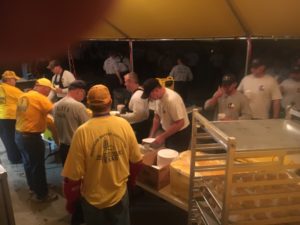
About three-dozen TBM disaster relief workers set up a field kitchen outside the George R. Brown Convention Center in downtown Houston Aug. 31, where they prepared meals for evacuees inside the mega-shelter.
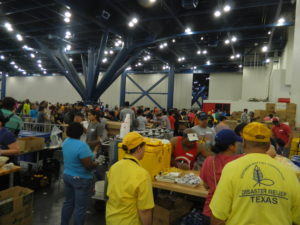
Texas Baptist Men disaster relief volunteers prepare meals at the George R. Brown Convention Center in downtown Houston. The American Red Cross serves the meals to hurricane evacuees who are sheltered there. (Photo / Ken Camp)

“I remember when the Katrina people were here,” said one of the shelter residents, a homeless man who simply identified himself as James. “I never thought I would be.”

Gene Pepiton, director of missions for Wichita Archer Clay Baptist Association, had served with a TBM crew at the George R. Brown Convention Center after Hurricane Katrina in 2005, when people from New Orleans were evacuated to Houston. He returned to the same site after Harvey with a vanload of TBM volunteers from his association Aug. 30.

Before his crew left the TBM Dixon Missions Equipping Center in Dallas, he reminded the volunteers of the difference they could make as they showed Christ’s love by providing nourishing hot meals people who had experienced trauma.

“For a time, we can take their minds of some of their worst hurt,” Pepiton said.

He recalled incidents after Katrina when volunteers in downtown Houston faced what seemed to be insurmountable challenges. But God opened doors of opportunity when his people ceased to rely on their own resources and depended on him, he noted.

“When we can’t do it, God shows up,” he said.

‘Gospel in motion’

Dwain Carter, deputy director of TBM disaster relief, encouraged the volunteer to look for every occasion to demonstrate the love of God, both through their actions and through words of Christian witness.

Dwiain Carter, deputy director of Texas Baptist Men disaster relief, gives instructions to volunteers before they deploy from Dallas to Houston. (Photo / Ken Camp)

“We are the gospel in motion,” Carter said. “We are the hands and feet of Christ.”

Additional food-service teams worked in Victoria, Katy and in support of the Texas Task Force 1 search-and-rescue team.

Six days after the hurricane first made landfall in South Texas, TBM crew—together with Southern Baptist disaster relief workers from Arkansas, Oklahoma, Louisiana, Missouri, Illinois and South Carolina—had washed nearly 600 loads of laundry and provided access to more than 800 showers in support of shelters and first responders.

Shower and laundry mobile units were deployed to shelters in Angleton, La Grange, Victoria, Katy and Portland, as well as multiple Houston-area sites and with Texas Task Force 1.

Damage assessors, asset protection personnel, chainsaw crews, heavy equipment operators and volunteers who distributed boxes to residents to help them reclaim and store scattering belongings worked in Victoria.

TBM childcare workers ministered to children and volunteer chaplains offered spiritual counsel at the shelter set up at the Kay Bailey Hutchison Convention Center in Dallas.

Victim Relief Ministries—an interdenominational ministry that grew out of TBM’s restorative justice ministry program—also sent chaplains, crisis responders and comfort dog teams to the downtown Dallas shelter and to Refugio County in South Texas.

TBM established mobile command posts in Victoria and Katy, and the group deployed flood recovery units to La Grange and Katy.

‘A marathon, not a sprint’

Thousands of additional TBM volunteers remained on alert, waiting deployment—not only to meet immediate needs, but also to provide care over the long term.
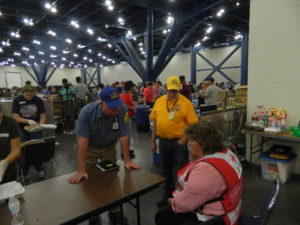
Ray Gann, on-site coordinator for the Texas Baptist Men disaster relief volunteers at Houston’s George R. Brown Convention Center, consults with an American Red Cross official. (Photo / Ken Camp)

“This is a marathon, not a sprint,” said Mickey Lenamon, TBM executive director. “We will still be responding, whether it’s a month from now or a year from now.”

To contribute financially to TBM disaster relief, click here  or send a check designated “disaster relief” to Texas Baptist Men, 5351 Catron, Dallas 75227.

More than one-fourth of the congregations affiliated with the Baptist General Convention of Texas—more than 1,200 churches and missions—are located in the region affected by Hurricane Harvey, BGCT Executive Director David Hardage noted.

“While we are saddened by the unprecedented destruction, we are encouraged by the good work of first responders, volunteers, and our churches and partners,” Hardage said.

Making adjustments 

Leaders of Bounce—Texas Baptists’ student disaster recovery program—already are making plans to send volunteer teams to the Gulf Coast during spring break and summer 2018, he added.

Spring break mission trips to Houston are scheduled March 7-10 and March 11-14. Summer mission trips are scheduled June 11-16, June 18-23, June 25-30, July 9-14 and July 16-21 at various locations in South Texas and Southeast Texas.

The hurricane hit the Texas Gulf Coast just a few weeks before many Texas Baptist churches collect the annual Mary Hill Davis Offering for Texas Missions. In addition to providing funds for programs such as Bounce, the Woman’s Missionary Union of Texas board of directors voted to dedicate every dollar received over the $3.6 million goal to long-term disaster recovery.

“We anticipate working with Texas Baptist staff, TBM and directors of missions to know where and how funds will best be used,” said Carolyn Porterfield, interim executive director of Texas WMU.

Texas WMU also deployed its own laundry unit to a shelter at Latham Springs Baptist Camp and Retreat Center that housed about 400 evacuees from the Gulf Coast.

Houston churches care for neighbors

Union Baptist Association sustained water damage, but personnel worked remotely to receive reports as Houston-area churches assessed damage, said Tom Billings, executive director of the association.

Several area churches opened their facilities as shelters and many others provided meals and others services to their members and neighbors.
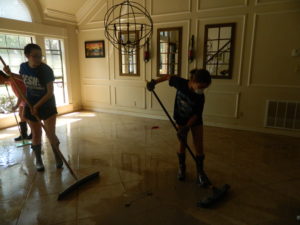
Volunteers from Woodridge Baptist Church of Kingwood in Houston mop up water and clear debris from a flooded home in their neighborhood. (Photo /Ken Camp)

Woodridge Baptist Church of Kingwood, in northeast Houston, lost electrical power but did not sustain any serious damage to its campus. However, the homes of many member families were flooded.

By Aug. 31, members had prepared between 1,500 and 2,000 meals volunteers delivered to affected households, said Matthew Dillingham, executive pastor.

The church received donated cleaning supplies, diapers and other items, and it opened its facility to enable families to eat on-site and pick up the supplies they needed.

Volunteer teams from the congregation fanned out into the neighborhoods surrounding the church campus, helping residents remove water-damaged furniture, rip out soaked flooring and mop up standing water from their homes.

“There are a lot of people who are working really hard,” Dillingham said. “As people

are working, they are meeting neighbors they never would get to meet otherwise, and new relationships are developing.”

Houston resident Davie Vanderwalt marks the water damage line on the interior wall of his home. (Photo / Ken Camp)

One crew from Woodridge joined other volunteers in helping Davie and Bobbie Vanderwalt clear out damaged goods from their home, which took on about three feet of water.

After the area flooded, Vanderwalt talked on the phone with a good friend who is a member at Woodridge. He told his friend, who was traveling in Nevada, about the damage he and his family sustained.

“He told me, ‘We’ll get a team out from our church to help you,’” Vanderwalt said.

‘In God’s timing’

Buckner International is donating about 12,000 pairs of shoes collected through its Shoes for Orphan Souls initiative to survivors of Hurricane Harvey.

“What a blessing it is for Buckner to be able to donate these shoes. In God’s timing, we had just finished a shoe drive in Houston and have 10,000 pairs of shoes at a partner church there,” said Albert Reyes, president and chief executive officer of Buckner International.

The shoes collected in partnership with South Main Baptist Church in Houston will be delivered directly to Houston families.

“That’s great news. But the downside of it is that this donation is now leaving us desperately short on shoes for needy children in other places,” Reyes said.

To make a donation to help replenish Buckner’s supply of shoes for vulnerable children, click here.

Buckner also has initiated a collection of personal hygiene items for families affected by Hurricane Harvey. Requested items include soap, body wash, shampoo and hair conditioner, toothbrushes and toothpaste, razors, deodorant, laundry detergent and fabric softener, diapers and other baby care supplies.

Other needs include packages of underwear in all sizes, pots and pans, paper towels, paper plates, backpacks and school supplies for elementary and middle school students.

One way to donate is by buying items at Amazon.com and directing the company to ship the purchase directly to the Buckner Center for Humanitarian Aid at 5405 Shoe Dr., Mesquite, TX 75149.


A new and improved Baptist Standard

We’ve relaunched the Baptist Standard with a new look and improved website experience. We hope you like it.


HSU horseback riders no longer carry Confederate flag

ABILENE—Riders of the Six White Horses—equestrian ambassadors for Hardin-Simmons University—no longer will carry a Confederate flag.

Although the student team originated 90 years ago as two riders, one carrying a United States flag and the other carrying a Texas flag, for many years six riders have displayed the six flags that have flown over Texas. The Six White Horses represent the university in parades, rodeos and some sporting events.

The flag representing the Confederate States of America was the “Stars and Bars,” not the more familiar Rebel battle flag that was appropriated by some white supremacist groups.

‘Flags can be divisive symbols’

Even so, Hardin-Simmons announced Aug. 25 the riders will display only the United States and Texas flags, rather than continuing to carry the flag representing the Confederacy.

“Each flag carries with it a context,” HSU President Eric Bruntmyer wrote in a letter to faculty and staff. “In ideal circumstances, flags are unifying symbols, serving as common representations of purpose and pride. In other cases, however, flags can be divisive symbols which create conflict and disunity.”

Hardin-Simmons announced its decision five days after the University of Texas removed four Confederate statues from its Austin campus. It followed one week after the Six Flags Over Texas amusement park announced it would stop displaying the Confederate flag, choosing instead to fly only the United States flag.

The actions followed deadly violence in Charlottesville, Va., where white nationalists and neo-Nazis protested the city’s desire to remove a statue of Robert E. Lee, and they clashed with counter-protesters.

‘We desire to do what is right’

The decision at Hardin-Simmons grew out of discussions involving the president, the board of trustees and the university’s administrative leadership team regarding ways to encourage racial reconciliation.

In the process, university leaders examined “how the practice of using any flag of the Confederacy reflected misalignment with the university’s history, core values and future goals,” according to a statement from HSU. James B. Simmons, a Baptist pastor and abolitionist, founded the university in 1891.

“More than anything, we look to Scripture to inform us on how to live as faithful Christ-followers,” Bruntmyer said. “We desire to do what is right—to be family together and good neighbors to all. We want to stand in unity with the image of God reflected in every person.”


CommonCall: No more dumpster diving

“Mama, can we go see what the kids had for lunch?”

Yamile Rocha-Calles couldn’t believe her ears.

As a Parent Teacher Organization officer and president of the site-based decision-making committee at James Bowie Elementary School in Dallas, she spends plenty of time on campus.

So, she had noticed a woman and her preschool daughter, mostly because they—and the third-grader they dropped off each morning and met each afternoon—wore the same dingy clothes in layers every day, regardless of the weather.

One day, she overheard the preschooler ask, “Mama, can we go see what the kids had for lunch?”

She saw the woman and child walk toward the parking lot and approach a dumpster. Then, the mother lifted her daughter into the garbage bin to look for food.

“My heart sunk,” Rocha-Calles said. “I realized they had nothing to eat.”

Prompted to action

She told personnel in the school office what she saw and asked what help the school could offer. She learned about some resources but remained unsatisfied with the answer she received.

“Mama, can we go see what the kids had for lunch?”

“Those words changed my world,” Rocha-Calles said. “That little girl broke my heart. I had to do something. … It was like God told me, ‘You have to do this.’”

So, she asked friends—in person and on Facebook—for ideas about how to respond.

“There just had to be some way for that mother to get food for her children other than digging in the trash,” she said.

She found the answer when she talked to Marsha Mills, director of Mission Oak Cliff, a ministry of Cliff Temple Baptist Church in Dallas, who offered to help start a food pantry at the school.

Rocha-Calles knew to contact Mills, because she had benefited from Mission Oak Cliff personally when injuries from a random drive-by shooting left her hospitalized and disabled for an extended period.

Mission Oak Cliff helps neighbors in need

Marsha Mills became director of Mission Oak Cliff 12 years ago.

Since 1948, Mission Oak Cliff has operated a food pantry for neighbors in need—first at a former fire station and more recently inside the church building.

The ministry also offers a clothing closet and a variety of classes to help break the cycle of poverty—high school-equivalency, English-as-a-Second-Language, citizenship, job-readiness, computer literacy and nutrition.

Mills became director of Mission Oak Cliff 12 years ago after a 27-year career in public education, including 24 years spent teaching at Margaret B. Henderson Elementary School, three miles from Cliff Temple.

“I knew and loved the community and the people, and I felt like teaching was my ministry,” she said. Nonetheless, she began to feel restless.

“It was as if God said: ‘Yes, it is a ministry. But it’s no longer your ministry,’” she said. “I asked for guidance. Unfortunately, he had given up writing on walls a long time ago. I stepped away from teaching, not knowing where I was going.”

As a member at Cliff Temple, she was familiar with Mission Oak Cliff and “peripherally involved” with its ministry.

“I knew nothing about social ministry,” she confessed. Even so, three weeks after she retired from the Dallas school district, she accepted the director’s position at Mission Oak Cliff.

Community gained a sense of ownership

On Labor Day weekend 2005, not long after Mills went to work with Mission Oak Cliff, the ministry’s building burned. Subsequent investigation revealed a client with a history of mental illness set the fire after stealing copper wiring from the facility.

“After the fire, people came out of their apartments and from all over the community in response. They said: ‘You helped us when we needed it. We want to help you,’” Mills recalled. “That was the turning point. That’s when the people in the community gained a sense of ownership.”

Mission Oak Cliff relocated into the church’s facility, but Mills and the committee with whom she worked felt a growing need to move beyond the church’s walls.

“I went to a Christian Community Development Association meeting that opened my eyes,” she said. “I began to see the difference between charity and community development. It’s not just us doing things for people. It’s empowering the community and helping families gain stability and independence.

‘We decided to take the show on the road’

“We realized we needed to get the ministry into the community. This building looks intimidating. It looks like a fortress or a castle to people in the neighborhood. … That’s when we decided to take the show on the road.”

Cliff Temple already had established a relationship with neighborhood schools. So, when Hector Garcia Middle School received requests from families asking for help with groceries, a school official contacted the church.

Mission Oak Cliff started a satellite food pantry on the school campus. The ministry kept the pantry stocked with nonperishable food, and the school let students and their families know about its availability.

When Josey Benavidez became community liaison at Garcia, the food pantry already was in place, and she appreciated the impact it made on the lives of students. However, she recognized another need.

Discovery new needs, proposing new solutions

“We have a lot of homeless students,” Benavidez said, noting the families who lack a permanent address often do not receive the safety-net benefits available to others who live in poverty.

In particular, she recognized many students who received meals on school days lacked food each weekend. At Garcia, more than 93 percent of students are eligible for the free- or reduced-lunch program.

Mission Oak Cliff helped her develop a backpack food program. Homeless students receive a backpack filled with ready-to-eat food each Friday, and they return the backpack each Monday.

“The first week, one student wouldn’t let go of the backpack on Monday until he was promised it would be refilled on Friday,” Mills said.

At W.H. Adamson High School, the counselor’s office realized the need for groceries among students’ families outstripped the ability of the school’s alumni association to supply it. The school’s community liaison contacted Mission Oak Cliff, and the ministry helped launch a satellite food pantry at the school.

“Because the community knows we care, they know where to go when there’s a need,” Mills said.

Starting a satellite food pantry at Bowie Elementary

So, when Rocha-Calles told Mills about the mother and child she saw digging through the dumpster at Bowie Elementary, Mills drew on previous experience at Garcia and Adamson to explain exactly how to start a satellite food pantry at the school.

Yamile Rocha-Calles worked with Mission Oak Cliff to establish a satellite food pantry at James Bowie Elementary School in Dallas. (Photo / Ken Camp)

The school designated an unused classroom as the pantry site. Mission Oak Cliff keeps its shelves stocked. Counselors and principals control access to the locked room, but they make it as easy as possible for families to help themselves to the groceries.

“Teachers are our first point of contact,” Rocha-Calles said. “They are the ones who see the children every day. Homeless children don’t want to be seen by the principal. They don’t want to stand out. But we let all the children and their families know about the pantry.”

In addition to satellite food pantries at Bowie, Garcia and Adamson, Mission Oak Cliff also has responded to requests from Justin F. Kimball High School and John Leslie Patton Jr. Academic Center.

“I don’t know where this is going to end,” Mills said. “Having the satellite food pantries hasn’t lessened the number who come to us (at the church facility). In fact, it’s enhanced the ministry. We have more who come here now.”

Last year, Mission Oak Cliff served about 13,000 people, representing close to 4,000 families. Each family accessed the on-site food pantry about four times on average.

Some parents whose children received food from the satellite food pantry enrolled in ESL, GED or other classes at the church. Some who have benefited from Mission Oak Cliff have returned to volunteer there. Some have started worshipping regularly at Cliff Temple.

“The word is out: “It’s a safe place. You can go there,’” Mills said.

Years ago, when the neighborhood changed and other churches relocated, Cliff Temple chose to stay and minister, she noted.

“This church is committed to the community,” she said. “And for the most part, the community protects us. We’ve never had a problem with graffiti here, even though there are gangs all around.

“The people in this community know. It’s their place.”

This is part of an ongoing series about how Christians respond to hunger and poverty. Substantive coverage of significant issues facing Texas Baptists is made possible in part by a grant from the Prichard Family Foundation.

Read more articles like this in CommonCall magazine. CommonCall explores issues important to Christians and features inspiring stories about disciples of Jesus living out their faith. An annual subscription is only $24 and comes with two complementary subscriptions to the Baptist Standard. To subscribe to CommonCallclick here.


Gulf Coast Texas Baptists hammered by Harvey

Many Texas Baptists along the Gulf Coast who normally gather for worship on Sunday had only two choices Aug. 27—pray while they sheltered in place or pray as they evacuated their homes in areas with rising floodwaters.

Hurricane Harvey made landfall Aug. 25 near Rockport as a Category 4 storm. Then it began a slow crawl northeast toward Houston, dumping up to four feet of rain in some places.

Union Baptist Association sustained water damage, and its offices will be closed and events cancelled until remediation can be completed, according to a statement posted on the associational website.

HBU cancels classes

Houston Baptist University cancelled all classes and activities through Labor Day, with plans to resume classes Sept. 5.

“This decision is made in order to allow our faculty, students and staff, as well as their families, enough time to address any concerns at home before beginning the school year,” an announcement on the university website said.

“We ask that you keep HBU and the greater Houston community in your thoughts and prayers. At this time, we are not planning to evacuate any residents on campus.”

Drop-off and distribution site

With close to 300,000 residents without utilities and many areas isolated due to submerged roads, reports about damage to church facilities remain sketchy.

Brandon Webb, pastor of Westbury Baptist Church in Houston, reported on Westbury’s website the church had not taken on water, and it still had electricity. So, the church building would serve as a drop-off and distribution point for food, water, toiletries, blankets and other supplies to assist people whose homes flooded.

Churches provide shelter

Some churches in areas that escaped serious damaged opened their facilities to serve as shelters for people displaced by Hurricane Harvey.

In the Houston area, they included at least two Baptist General Convention of Texas-affiliated congregations, First Baptist Church in Highlands and Golden Acres Baptist Church in Pasadena, and two congregations uniquely aligned with the Southern Baptists of Texas Convention, First Baptist Church in Tomball and Calvary Baptist Church in Cleveland.

“Highlands has one of the highest, if not the highest, elevations in Harris County,” said Tim Edwards, pastor of First Baptist Church.

The church building did not sustain damage, but Edwards noted he and others continued to watch the nearby San Jacinto River carefully.

“I’ve been here since 1996, and even after (Hurricane) Ike hit, I never have seen the water like this,” Edwards said.

First Baptist began providing shelter at its facility Aug. 27. The church housed 65 overnight guests Aug. 28 from Highlands, as well as Baytown, Channelview and other nearby communities, Edwards said.

‘Church being church’

The number of people in the shelter fluctuated greatly from one hour to the next, he said, as new people arrived and others left to return to their homes or move in with relatives.

Church members are preparing meals for guests in the shelter, and people from the community are providing blankets, groceries and other needed items, he said.

“It’s the church being church, loving Jesus and loving people,” he said. “And we’ve just been overwhelmed by the support we’ve received from our community.”

Opening homes to ‘almost-strangers’

Taylor Sandlin, pastor of Sugar Land Baptist Church, southwest of Houston, estimates one-third to one-half of his church members were evacuated from their homes, and others sheltered in place with floodwaters threatening.

Many families opened their homes to provide shelter to people they barely knew, he noted in a post on Facebook. Sandlin and his family—who evacuated their neighborhood—are in Katy with “friends of friends.”

“What a gift to be taken in by almost-strangers just because we are in need,” he said. “There is lots of trouble in the world, but also much grace.”

In an Aug. 29 Facebook post, Steve Wells, pastor of South Main Baptist in Houston, reported his home in Meyerland was spared from flooding.

“Today the plan is: pray for the church; try to answer the volume of email and texts from the congregation and from people who love us; pull carpet from the home of a church member down the street; (and)—if streets allow—go to George R. Brown Convention Center to pray with those who are displaced,” he wrote.


Harvest remains plentiful in the oil patch

PLEASANTON—The loneliest places often are locales where people typically gather. Movie theaters. Malls. Bars. There, it’s easiest to blend in, easiest to hide without seeming out of place.

For Gray Hawk, it was a hotel in Pleasanton. Dispatched to South Central Texas to work the oilfield, he was struggling through a divorce. The longer the proceedings dragged on, the more he drank. One night, two half-gallon bottles of Canadian whiskey were his only companions.

Soon, the first bottle was as empty as his soul. Over the next few days, Hawk drained the second. He spiraled deeper into depression.

“I can’t do this anymore,” he said.

It was his time. He went looking for one of his Hi-Point handguns, a 9 millimeter and a .40 caliber.

“There were only two boxes. I knew I’d stuck my guns in one of those two boxes, but I couldn’t find them. The only thing that kept coming up was that oilfield Bible.”

South Texas oil boom

In 2010, the Eagle Ford Shale in South Texas was one of the most actively drilled targets for unconventional oil and gas in the United States. Companies rushed to access the estimated 3 billion barrels of oil it protected. As a result, towns across the region swelled almost overnight.

Hotel room prices surged to more than $500 a night. Home prices boomed. Companies set up “man camps” in the middle of nowhere to house their workers. Increased 18-wheeler traffic caused roughly $2 billion in damage on Texas back roads.

Fred Ater, the Baptist General Convention of Texas area representative in the region, remembers it well. Reports on the activity led most news reports and newspapers. The possibilities for such a reservoir of oil affected the oil market worldwide.

As Ater traveled through the towns impacted by the flood of oil workers, he saw ministry possibility after ministry possibility. Oilfields are known as notoriously hard places to work, worked by hard people. Alcohol often flows feely during free times. Gambling is common as are other vices.

People literally came from all over the world to work the fields. If a church or individual felt called to minister to these roughnecks and crew bosses, they could spread the gospel to the ends of the earth by evangelizing the workers and in turn their families located elsewhere.

Ater prayed fervently for God to raise up a leader who would take the gospel to the oilfields.

“I’d been praying, ‘What in the world can I do?’” he said. “I’d been talking to churches. I just kept on praying. I just said: ‘Lord I cannot do this. I have a job. It does not entail this. Who can do this?’”

It took nearly three years.

‘Never seen a Bible like this’

God’s Word for The Oil Patch was published in 1984 by the Oilfield Christian Fellowship in an effort to convey the gospel in a way that would be more accessible to oilfield workers. It features testimonies from oil patch laborers and a cover featuring an oil rig. Someone at one of the camps gave a copy to Gray Hawk, who was born on a Choctaw reservation. He threw it in a box with his other belongings.

In a drunken stupor at 11:30 p.m., he found it again.

“I’d never seen a Bible like this before,” he said. “In fact, I’d never owned a Bible before.”

He began to flip through the pages.

Responding to God’s call

Driving by an oilfield four years ago, Hollas and Nelda Hoffman sensed their life was about to change. Although neither had experience in the oilfields, both felt called to serve there.

A short time later, they followed that call.

“In June 2013, I turned 70 years old,” he said. “I just sensed that God was about through with me in the church I was serving. On the 28th of August, I resigned. On the next day at noon, we knew we were supposed to go to the oilfield.”

Since then, the Hoffmans have seen what they believe is God at work throughout the oilfields. The couple never actively recruited anybody, yet volunteers stepped forward, each sensing a call to share the gospel in this mission field.

The Hoffmans, who are BGCT-endorsed chaplains, and the volunteers formed Oil Patch Chapel Ministries and spread across the state distributing Bibles, visiting with oil workers and building relationships with people in the industry.

Woman’s Missionary Union of Texas helped the Hoffmans tell their story. Their ministry is supported by the Mary Hill Davis Offering for Texas Missions and encouraged by Texas Baptists.

Doors opened in dramatic fashion. In one instance, the Hoffmans were allowed to share the gospel during a safety meeting of all the employees at one oilfield location. Another time, a road rage incident served as the start of a relationship through which the gospel was shared.

People are coming to faith statewide. Marriages are being healed. Addictions are being overcome. Individuals are praying for the first time in a long time. As the oil boom slowed, families were reunited and strengthened.

“God is the one at work,” Nelda Hoffman said. “He’s using all kinds of people. People are coming to Christ. People are getting saved.”

‘Perhaps there is hope for me’

The testimonies of men who left behind “hellish” lives for holy ones washed over Gray Hawk. They once lived like he was. “Perhaps there is hope for me after all,” he thought as he poured over the pages for hours.

“I came across the sinner’s prayer of repentance,” he said. “I just kept moving on, reading stuff and reading stuff. A couple of testimonies really touched my heart. I stopped worrying about that gun. I got down on my knees and recited that part of the Bible, ‘Lord Jesus, come into my heart.’”

Tucked away in the Bible was a phone number with a note encouraging the reader to call if he or she had any questions. He had plenty of questions, and he wanted some answers.

“I found Jesus at 57 years old—first time in my life. The next morning hung over like a dog, I called Sister Peanut. An hour later, she called back. We talked and prayed together.”

Distributing Bibles

Peanut Scott accompanied a friend to the Hoffmans’ seminar about oilpatch ministry during the WMU of Texas Annual Meeting in 2014. She really went in support of her friend, but soon her interest was piqued. Her husband, Phil, works in the oilfields, and she’d been looking for a ministry they can do together.

“I went to it, and I felt a big calling from the Lord,” she said. “I thought it was so cool. I came home and told my husband.”

Three days later, he unexpectedly met the Hoffmans at a meeting. The time was right, the Scotts sensed. God was calling them to serve.

The Hoffmans introduced the Scotts to God’s Word for The Oil Patch. Peanut and Phil were impressed by what they saw and read. They volunteered to distribute the Bibles.

As time passed, the oilfields became busier and busier. That meant more opportunities to distribute the Bibles. At the boom’s height, Peanut Scott was visiting nearly every hotel in a 300-mile radius, placing as many as 20 cases of Bibles a month in welcome lobbies. She has distributed at least 3,000 Bibles in the area in three years, each with the Scotts’ phone number and a note inside.

“I started in Beeville,” she said. “Then I went a little further and a little further. When the oilfield was really going, I was at about 100 (dropoff locations). I’m probably at about 60 now.”

Along the way, she built relationships with hotel staff members. She knows them by name, and they know her. She’s prayed with many of them. A maid who worked at one of the hotels picked up a Bible and came to faith in Christ. The next time she saw Peanut Scott, the housekeeper gave her a plastic container full of coins to purchase more Bibles.

“I know God’s word is still true,” Peanut Scott said. “People are still hungry for it. You can see it working in their lives.”

Delivered from darkness

The time on Gray Hawk’s knees in prayer left an indelible mark on his life. He’s been sober since. He says God has given him joy. Life hasn’t always been easy, but he sees “one blessing after another.”

“I never knew something like that could happen to someone like me,” he said.

The Sunday after his initial conversation with the Scotts, he was baptized by Pete Navarro, an oil patch chaplain and pastor of Hosanna Baptist Church in Jourdanton. Hawk still calls the Scotts often with questions. They have become a central part of his support system. They even spent Thanksgiving together.

“The Lord has brought so many wonderful brothers and sisters into my life,” he said. “They’ve blessed me with their testimony and their prayers.”

It may have taken five decades and an unbelievable amount of orchestration from above to bring Hawk to Christ. But he’s trying to make up for lost time. He shares his testimony when possible. He even gives out copies of God’s Word for The Oil Patch. 

“I lived my life 57 years in darkness—drinking, doing drugs. When I was single, I fraternized with women I wasn’t married to. Jesus probably had bloody knuckles if he had knuckles left at all from knocking on my heart’s door. I made him wait 57 years,” he said.

“My Lord Jesus delivered me from the darkest paths of this life and into the light of the Father.”


Christians pack meals formulated to feed hungry children

Volunteers wearing hairnets and gloves gather around tables, carefully scooping prescribed portions of vitamins, vegetables, soy and rice into plastic bags they carefully seal.

The names of the organizations vary—Feed My Starving Children, Meals 4 Multitudes, Heaven Sent Ministries, Kids Against Hunger and Meals from the Heartland, among others.

But the mission and approach of each is remarkably similar: Enlist volunteers of all ages to hand-pack meals formulated specifically to provide essential nutrients to children in extreme poverty. Then distribute those meals to children in need globally through partner organizations that supply the meals through churches, orphanages, schools, clinics and other established delivery points.

Feed My Starving Children

Feed My Starving Children has operated 30 years and works in 70 countries. The Minnesota-based non-profit Christian organization has earned the highest 4-star rating from Charity Navigator 12 years for its accountability, transparency and efficiency.

By working with established in-country partners, Feed My Starving Children was able to deliver 99.8 percent of the meals it shipped to their intended recipients last year. The organization also supports sustainable development through its MarketPlace program that markets the crafts produced with artisan groups in communities around the globe that receive meal packets.

A mid-August MobilePack event in Dallas drew about 5,500 volunteers who packed 1.53 million meals—more than 77 tons of rice, nearly 26 tons of soy, close to 11,000 pounds of vitamin powder and 4,500 pounds of freeze-dried vegetables.

The event involved volunteer groups from Park Cities Baptist Church in Dallas along with multiple other congregations, a crew from Buckner International and representatives from many Dallas-area businesses.

‘Labor of love’

A few weeks earlier, Green Acres Baptist Church in Tyler sponsored a MobilePack event with a goal of preparing 100,000 meals. The 534 volunteers at the East Texas church surpassed that goal, packing 116,640 meals.

“The energy and enthusiasm of each shift was amazing,” Pastor David Dykes wrote in the church’s newsletter. “These meals will provide enough food to feed 320 hungry children for an entire year. Your labor of love will make a life-and-death difference in the lives of children who are hungry.”

Later, Dykes reported he received word from Feed My Starving Children saying 540 of the boxes the Tyler church packed had been shipped to Salesian Missions, a group that works primarily in schools, orphanages, clinics and churches in The Democratic Republic of Congo.

By next year, Feed My Starving Children plans to open a permanent packing site in the Dallas area—its eighth permanent location nationally. The organization hopes to engage 150,000 each year, with a goal of packing 50 million meals annually.

Last year, Feed My Starving Children engaged more than 1 million volunteers across the United States and produced more than 284 million meals to feed more than 779,000 children daily for a year.

Meals 4 Multitudes

Meals 4 Multitudes shares a similar mission but works on a different scale and scope. Founded by Jim Palmer, missionary in residence at First Baptist Church in Athens, the organization has provided packaged meals to Haiti, Sierra Leone and to Syrian refugees to meet acute needs, but it has worked primarily in Ethiopia and Nicaragua.

The recently reconstituted ministry currently focuses specifically on Ethiopia, working through churches in The Ethiopia Aid Mission Network, a group that has been supported primarily by several Baptist churches in East Texas.

“That way we can say to the host church that from the time the meals are packed at their church ’til the meals reach a hungry child, the meals are never out of our control,” Palmer said. “Our motto is: A church with 60 volunteers can pack 10,000 meals in two hours for $3,000, including all costs to feed hungry children in the name of Christ.”

Palmer’s brother, Joel, a member of The Crossing Baptist Church in Mesquite, now directs Meals 4 Multitudes. He believes the organization occupies a unique niche.

“We will do smaller packing sessions than anybody else I know about,” he said, noting most organizations require a minimum 20,000 to 30,000 meals per session, with a significantly higher cost for the sponsoring church. “We want to make it affordable so a church of any size can participate.”

This is part of an ongoing series about how Christians respond to hunger and poverty. Substantive coverage of significant issues facing Texas Baptists is made possible in part by a grant from the Prichard Family Foundation.


TBM serves first responders after Hurricane Harvey

Even before evacuated residents could return to their homes, Texas Baptist Men disaster relief volunteers were serving meals to first responders on the hurricane-ravaged Gulf coast.

Meanwhile, more than 7,000 trained TBM disaster relief volunteers remain on alert to respond to what some experts are calling one of the worst natural disasters in U.S. history.

Hurricane Harvey made landfall late evening Aug. 25 near Rockport as a Category 4 storm before slowly continuing up the coastline and dumping up to two feet of rain within 24 hours, causing catastrophic flooding in multiple counties.

TBM serves Texas Task Force 1

A TBM rapid-response food-service crew continues to provide meals for about 150 first responders with the Texas Task Force 1 search-and-rescue team in the wake of the hurricane and subsequent flooding.

Texas Baptist Men disaster relief volunteers serve meals to first responders with Texas Task Force 1 on the Gulf Coast. (TBM Photo)

The TBM crew initially served in Robstown, west of Corpus Christi, but the volunteers planned to relocate with Task Force 1 Aug. 28 to somewhere in the Houston area, more than 200 miles to the northeast.

TBM food-service crews from Lubbock Baptist Association and Tarrant Baptist Association also were preparing meals for first responders in Victoria and Uvalde.

Volunteers with TBM shower and laundry units were at work Aug. 27 in Robstown, San Antonio and LaGrange, and other TBM volunteers have been given responsibility to provide childcare at a 5,000-person capacity shelter in Dallas.

TBM also will be one of the service providers at a mega-shelter in downtown Houston, once roadways are clear enough for safe travel in and out of the city.

An additional two-dozen disaster relief units, including chainsaw, mud-out, heavy equipment and blue-tarp temporary roofers, already are scheduled for deployment, and many more will be called on in the future, said Dwain Carter, deputy director for TBM disaster relief.

The Baptist Health Foundation of San Antonio board voted Aug. 25 to provide a $50,000 grant to TBM—along with another $50,000 grant to the Salvation Army—for disaster relief in South Texas.

Long-term commitment after hurricane

Forklift operator Joseph Wallace (left) from First Baptist Church in Purves and Roy Boyer from First Baptist Church in Granbury load insulated food containers onto a tractor-trailer rig bound for the Texas Gulf Coast. (Photo / Ken Camp)

TBM disaster relief leaders expect the duration of response by their volunteers to be measured in months, rather than weeks.

“This will be the largest TBM disaster relief operation in our 50-year history,” TBM Executive Director Mickey Lenamon said.

Lenamon had a message for trained volunteers who are eager to respond immediately: “Don’t be discouraged or frustrated if you are not called out right away. Just wait. You will be needed.”

Southern Baptist disaster relief volunteers from up to 20 states also are on alert, waiting to respond in Texas.

Texas Baptist Men is accepting crates of bottled water for distribution along the Gulf Coast. Donated water can be left at a designated staging area at the Dixon Missions Equipping Center at 5351 Catron Dr. in east Dallas from 8 a.m. to 4 p.m., Monday through Friday.

To contribute financially to TBM disaster relief, click here or send a check designated “disaster relief” to Texas Baptist Men, 5351 Catron, Dallas 75227.

EDITOR’S  NOTE: Three dozen Texas Baptist Men Disaster Relief volunteers left Dallas Wednesday morning, Aug. 30, en route to Houston. They will report to the George R.  Brown Convention Center, where they expect to prepare meals for more than 9,000 people who are housed in an emergency shelter there. 


Special session ends without passing most hot-button bills

AUSTIN—Texas lawmakers passed half of the items on Gov. Greg Abbott’s list of priorities during the special legislative session, and the session ended with lawmakers and some advocacy group assigning blame for why more was not accomplished.

Legislators did not pass a bill that would have restricted where transgender citizens could use the restroom, nor did they approve legislation backed by Lt. Gov. Dan Patrick that would have opened the door to a voucher-like program to benefit private schools.

Lawmakers approved sunset legislation to reauthorize the Texas Medical Board and a maternal mortality task force, and they voted in favor of a bill that requires women to buy separate health insurance plans for abortion.

Failed to deal with governor’s top priorities

However, the Texas House and Senate failed to reach agreement on property tax reform and wrestled over school financing—some of Abbott’s top legislative priorities.

Early in the special session, the House approved a bill that offered a $1.8 billion increase to public schools, but the Senate pared it down significantly. The House eventually approved the version of the bill authorized by the Senate.

“In its final form, this bill does not do nearly enough to help public education, but it does take some steps in the right direction,” said House Speaker Joe Straus, R-San Antonio. “It will help retired teachers struggling with surging health insurance costs, provide needed resources for some school districts facings severe challenges and help schools educate students with certain disabilities.” 

Assigning blame

Abbott publicly blamed the House and its leaders for lawmakers’ inability to agree on his priority issues, but Charles Foster Johnson, executive director of Pastors for Texas Children, placed the blame on the Senate.

Charles Foster Johnson 150Charles Foster Johnson“The failed leadership we presently have in the Texas Senate with regard to our children’s constitutionally protected public education is unacceptable,” Johnson said.

He called the special session “a circus of stubborn wrangling and procedural manipulation,” and he called it “beneath the dignity of every respectable Texan.”

Johnson expressed “deep gratitude for the extraordinary leadership of speaker Joe Straus, Chairman Dan Huberty and the House of Representatives to advance fair and just policy for our 5.5 million schoolchildren.”

“Because of the intransigence of the Texas Senate toward public education, the House was not able to secure significant additional funding for our neighborhood schools in critical need,” he said. “But they did successfully and steadfastly hold the line against private school vouchers—the unjust policy of underwriting private education with public tax dollars.”

In contrast, Texas Values Action praised Patrick and the Senate for “leading the effort to final passage of several key pro-life reforms,” but the group criticized Straus and many in the House.

“The leadership of Gov. Abbott, Lt. Gov. Patrick, the Texas Senate and a few House members are the only reasons why some positive things happened during the special session,” said Jonathan Saenz, president of Texas Values Action.

Accentuate the positive

Kathryn Freeman 150Kathryn Freeman Kathryn Freeman, director of public policy for the Texas Baptist Christian Life Commission, focused on positive results during the special session, while she also voiced hope lawmakers will make more progress during the interim between legislative sessions.

“The CLC is pleased with the progress made on school finance and the passage of significant pro-life measures such as re-authorization of the maternal mortality task force and improved reporting for abortion complications,” she said.

“We hope legislators will, during the interim between sessions, work to make more significant improvements in the public school finance system and in the access to medical care for low-income women.”


Intercultural churches connect people groups to the gospel

DALLAS—The New Testament book of Revelation indicates people of every tongue, tribe and nation will worship together in heaven, but most Christians tend to separate themselves when they congregate on Earth. Some Texas Baptists insist that’s not always bad.

Churches designed to reach specific ethnic groups make perfect sense for recent immigrants who are trying to navigate an unfamiliar culture and an unknown language, said Patty Lane, director of intercultural ministries with the Baptist General Convention of Texas.

“If you go visit a church where you can’t understand the language, and the culture is confusing, how are you going to meet Christ?” Lane asked. “Even if you do somehow meet Christ, how are you going to get discipled when the message of Jesus isn’t communicated in a way that you understand—if it isn’t spoken in your heart language?”

Lane emphasized the importance of giving people the opportunity to serve God in a way that doesn’t feel like “a transplant of Americanism.”  

Some Texas Baptist churches are reaching out to specific ethnic groups in the state. Their ministries are as varied as their native languages and cultural backgrounds.

“These churches are all doing an amazing job serving their community not only here, but also overseas,” Lane said. “A lot of them may come from places where the gospel isn’t easily shared. So, they don’t take that for granted and have used that freedom to reach out to people with the gospel in places where they may otherwise not hear it.”

Caring for refugees as Burmese Americans

When Americans think of a diverse church, they probably think of a congregation where two, maybe three languages are spoken. But the members of Greater Houston Burmese Christian Fellowship speak more than 20 dialects. The church, which focuses on ministering to refugees, has a membership of more than 350.

“Refugee ministry is very important because they are strangers to the land … culturally, socially and emotionally,” Pastor Thong Lun said. “No matter what kind of mindset they bring in, providing hospitality to refugees can change their minds and hearts.

“Whenever a new family or a newcomer visits our church for the first time, we give them rice, cooking supplies, clothes (and so forth). We try our best to show them that we love them, we care for them, and we warmly welcome them.”

Greater Houston Burmese Christian Fellowship rents an apartment to serve as a mission point for their church and a place where partner organizations can offer English-as-a-Second-Language classes and an after-school program.

In addition, Lun provides pastoral care by visiting homes to lead Bible studies and offers guidance on practical matters such as navigating American culture and completing job applications.

Reaching indigenous tribes in the Philippines

Members of First Philippine Baptist Church of Houston were looking for a way to serve and prayed for God’s guidance.

“We asked, ‘To whom are you sending us, and what are we supposed to be doing?’” said Cecile Dagohoy, mission team leader.

The Houston-based congregation is a self-described commuter church, with members traveling from across the city and suburbs for fellowship and worship each week. Through a variety of circumstances and connections, members felt called to the southernmost island of the Philippines.

During the summer, 26 church members traveled to the island to share the gospel with two indigenous tribes—Mamanwaw and Bisayan. The people groups, who are primarily nomadic, walked four to six hours down a mountain to receive medical care, kits of food and school supplies from members of First Philippine Baptist Church and a partnering Filipino church from the area.

While there, the mission group also helped build a community center, provided drug rehabilitation training and hosted a pastors’ conference.

“We see the results of being faithful to (Christ’s) call,” Dagohoy said. “We realize who he is. He is able, and that is powerful. The realization makes for a very dynamic church.”

Uniting Eastern Europeans in service and love

River of Life Church in Plano includes people groups that are not always amicable overseas. The 50-person congregation, which meets at the Hunter’s Glen Baptist Church building, hosts its gatherings in Russian. Members are immigrants or refugees from Ukraine, Belarus, Uzbekistan, Estonia, Armenia, Georgia and Russia, among other nations.

Despite some political conflicts overseas, the congregation members are connected by language, faith and family. The church focuses on what Russian speakers have in common by hosting outreach events that serve families, such as an egg hunt in Easter and a summer camp for children.

“What a beautiful picture of God’s kingdom and his church when we all are working together to see people of all nations and tribes get to know him whether here, in North Texas, or overseas,” said River of Life Pastor Leonid Regheta, who also serves as director of Texas Baptists’ Project:Start Refugee Resource Center.  

Creating a network of Nepali-speaking believers

Bhadra Rai, pastor of Canaan Bhutanese Church in Houston, had a vision to build a worldwide leadership network of Nepali-speaking Christians. While his congregation ministers to Bhutanese Nepali people in their community, he wanted to join together like-minded pastors and leaders around the world to provide encouragement and support.

Rai desired to create a platform for ministers to discuss contemporary issues facing Nepali-speaking Christians and to build a virtual network to connect and partner for kingdom work.

In March, the Global Nepali-Speaking Fellowship was held in Siliguri, India, drawing pastors from 13 different countries.

“Every church has its vision in one way or another to strengthen the believers in faith in Christ and to spread the Good News,” Rai said. “In the same way, we were able to host the Global Nepali-speaking Conference to empower the Nepali-speaking leaders around the globe. My church and I were encouraged by this event to continue this work in future.”


Project:Start helps Kenyan church in North Texas expand refugee ministry

GARLAND—Early this year, members of Upendo Baptist Church in Garland gathered to pray and fast, asking God to grow their church. Only a week later, Pastor Shadrack Ruto connected with 60 people in search of a new church home.

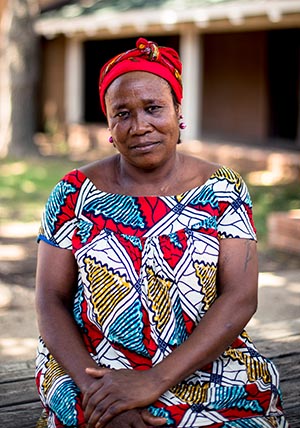
Project Start Refugees 300Moinlari Albertine, a mother of six, moved to the United States in February from the Central African Republic. (Photo by Jordan Parker)The initial three visitors to the church were not from a Kenyan background, like the majority of the church membership, but were refugees from the Central African Republic. The families recently had moved to the United States from refugee camps and lived within 10 miles of Upendo Baptist Church.

Ruto heard story after story of trauma and need from the families and the church leaders gathered to see how they could help.

Transportation to and from church was a necessity, so church members stepped up to provide rides. There also was a language barrier, as the refugees primarily spoke French. One of the refugees was fluent in English and volunteered to translate worship services and conversations. The translator started teaching English classes after church on Sundays to help refugees learn to adapt to American culture.

While Upendo church members thanked God for answered prayers, they realized the refugees’ needs far outweighed the capacity of the church. In March, Ruto learned about Project:Start, a refugee resource center created to connect refugees with churches and ministries. Housed in the Vickery Meadow area, Project:Start began in 2015 to provide a centralized place for refugee resources.

Ruto recognized the value in the center and called Leonid Regheta, director of Project:Start, for help with needs. Regheta connected him with several area churches and ministries who provide resources to refugees, such as food, medical care, furniture and job-search assistance.

As needs arose, the congregation saw fellow believers serve and give far beyond what they anticipated. On one occasion, through Regheta’s help, three members of Park Cities Baptist Church in Dallas drove their personal vehicles to a warehouse in Plano to pick up furniture.

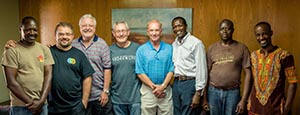
Project Start Furniture Delivery 300Members from Upendo Baptist Church in Garland and Park Cities Baptist Church in Dallas join with Director of Project:Start Leonid Regheta (2nd from left) to provide furniture to refugees from the Central African Republic. (Photo by Jordan Parker)Charles Pyles with the Collin Baptist Association and Win Brown, deputy executive director of Victim Relief Ministries, loaded the vehicles to the brim with bookcases, dressers, desks and other household furniture and drove 10 miles to deliver the gifts to Upendo Baptist Church.

“We are honored to have this as a joint project,” Brown said. “This is a kingdom of God initiative. We are excited this will be a blessing to many.”

The furniture, provided by Victim Relief Ministries, later was given to refugee families. Clothing donations came from Hunters Glen Baptist Church in Plano, and volunteers from First Baptist Church of Corsicana assisted with a ministry day at the church during the summer. Ruto was humbled by the support Texas Baptists offered.

 “This is a true picture of the church of Christ. It is wonderful to be able to see this,” he said.

Ruto views serving refugee families as part of the church’s responsibility to live out the gospel. He also saw his church members grow in appreciation for the missionaries who shared the gospel in Kenya. Many church members also remember arriving in the United States, experiencing culture shock and uncertainties.

“We are happy to help,” Ruto said. “We understand life in America for a newcomer. We came in as strangers and learned. When they come, they don’t feel like strangers. They feel at home.”

The refugee families also added a new vibrancy to the Upendo Baptist Church, leading worship songs and participating in the study of Scripture, Ruto added.

“This is a good testimony for people to see the love of believers from all cultures,” he said.


Robert Jeffress on God, Trump and North Korea: A pastor explains his politics

DALLAS (RNS)—Anyone who knows the Bible shouldn’t take issue with the idea God has given President Trump authority to take out North Korea’s dictator, said Pastor Robert Jeffress, the Dallas megachurch leader who drew sharp rebukes for stating just that.

Jeffress sat down for an interview after his sermon Aug. 13, just days after his words made headlines around the world. Christians and non-Christians accused him of exacerbating an already alarming war of words between Trump and the temperamental, young leader of nuclear-armed North Korea.

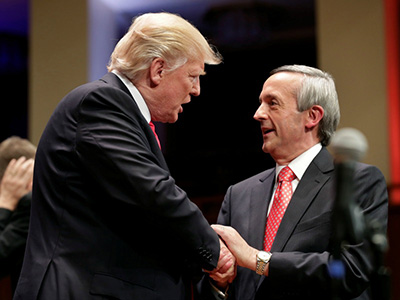
President Trump and Robert JeffressPresident Trump (left) is greeted by Pastor Robert Jeffress of Dallas at the Celebrate Freedom Rally on July 1 in Washington, D.C. (Photo by Yuri Gripas/Reuters via RNS)Critics overreacted, said Jeffress, lead pastor of First Baptist in Dallas, whose public observances on current events have made him a target—and not for the first time. A public pastor with the president’s ear, Jeffress, 61, does not shy away from sharing his belief that Scripture should undergird politics and diplomacy.

“What I said was that the Bible has given government the authority to use whatever force necessary, including assassination or war, to topple an evil dictator like Kim Jong-Un,” said Jeffress, elaborating on an Aug. 8 statement in which he said God has given Trump “authority to take out Kim Jong-Un.”

“That authority comes from Romans 13. Paul said that government has been established by God to be an avenger of those who practice evil,” Jeffress said in an Aug. 13 interview with Religion News Service. “I made it very clear that Romans 12 says we are to forgive one another when people offend us—don’t repay evil for evil, but overcome evil with good.

“But in Romans 13, Paul isn’t talking about individual Christians. He’s talking about government. Government is an organization God uses to bring vengeance against those who practice evil.”

Jeffress said his statement wasn’t the same as saying that “God ordained President Trump to nuke North Korea.”

Widespread negative reaction

But many thought it came too close.

Dallas Morning News columnist Robert Wilonsky questioned “how a man whose calling is supposed to be that of peace could so fervently proselytize in favor of war.”

In a National Review piece, Mark Tooley, president of the Institute on Religion and Democracy, criticized Jeffress’ “bellicosity.”

And Christianity Today editor-in-chief Mark Galli penned an editorial titled “The Use of Nuclear Weapons is Inherently Evil.” After naming Jeffress, Galli wrote: “One would hope that Christian supporters of the president’s views would at least qualify and nuance their statements.”

North Korea did not come up in Jeffress’ public comments Aug. 13 at First Baptist, a Southern Baptist congregation that claims 13,000 members and occupies six city blocks on a $135 million campus at the heart of downtown Dallas.

‘The ultimate answer is the transformed heart’

The pastor—whose sermon focused on Jesus’ Last Supper with his disciples in Luke 22—said he felt compelled to address the violent clashes between white supremacist groups and counter-protesters that left three dead in Charlottesville, Va.

Robert JeffressPastor Robert Jeffress preaches at First Baptist Church in Dallas. (Photo courtesy of First Baptist Dallas via RNS)“Whether it’s immorality, or racism that we’ve seen on display in Charlottesville this week, the ultimate answer is the transformed heart that comes from knowing Jesus Christ,” the pastor told the congregation.

Jeffress grew up in First Baptist Church of Dallas, which will celebrate its 150th anniversary next year. As a boy, he gained spiritual insight from the late W.A. Criswell, First Baptist’s preacher for half a century.

“When I was 5, I started to become interested in becoming a Christian,” said Jeffress, who has served as senior pastor 10 years. “My dad brought me down to Dr. Criswell’s office, and he presented the gospel, and I accepted Christ as my Savior here.”

Not shying away from controversy

While a popular figure at his home congregation, Jeffress is no stranger to controversy outside First Baptist’s walls.

In 2011, he suggested at the Values Voter Summit that Republican Mitt Romney, a Mormon, was part of a “theological cult.”

In 2014, he wrote a book, Perfect Ending, that claimed then-President Obama’s support for same-sex marriage was clearing the way for the Antichrist.

Jeffress’ North Korea statement came after Trump warned North Korea would “be met with fire and fury like the world has never seen” if its leader kept threatening the U.S. In July, North Korea successfully tested an intercontinental ballistic missile that could reach California.

“I believe that the job of a pastor, a preacher of God’s word, is to share what God is saying about issues that are confronting people today,” Jeffress said in the Aug. 13 interview. “The Bible teaches us how to be saved, and to go to heaven, but it tells us more than that.

“It tells us how we are to live in the world, as well. So, whether the issue is the use of force and dealing with an evil dictator, or dealing with racism in this country, I think the job of a pastor is to share what God’s word says.”

‘He takes it right from the Bible’

Patsy Cato, a Dallas real estate agent who has attended First Baptist seven years, said she, like her pastor, voted for Trump.

“We prayed morning, noon and night, and God put him there,” she said. “It could have very well gone the other way, but we prayed, and now he’s there.”

Trump, who identifies as Presbyterian, has embraced white evangelicals and won their support despite concerns about his personal character. He has embraced issues important to them, such as opposition to abortion. More than 80 percent of white evangelicals voted for Trump, according to exit polls.

But Cato said politics—and her pastor’s relationship with Trump—has nothing to do with why she likes Jeffress.

“He doesn’t teach a message that’s about things other than the word of God,” she said. “That’s my favorite part. If you sit in his message, he takes it right from the Bible, and that’s it. That’s why I come here.”

Either ignorance or unbelief

Jeffress says those who doubt his message fall into two camps—“either people who are ignorant of what the Bible says or people who don’t believe what the Bible says.

“But if you had listened to some of the Christian pacifists we’re hearing today in World War II, when Hitler was marching toward world domination, we would all be speaking German and saying ‘Heil Hitler,’” he continued.

“I know President Trump wants a diplomatic solution,” the pastor added. “But if diplomacy fails, he has the God-given authority to use force to remove an evil dictator.”