BGCT receives $1 million grant from Lilly to help pastors

DALLAS—The Baptist General Convention of Texas received a $1 million implementation grant from the Lilly Endowment to participate in its national initiative to address economic challenges facing pastoral leaders.

Through the grant, the BGCT will create a Center for Ministerial Excellence, which will conduct regional financial retreats for pastors and laity, award financial grants of up to $5,000 to pastors facing economic challenges and recruit a statewide network of financial planners to help Texas Baptist pastors seeking financial advice.  

“As a pastor, I am well aware that financial struggles can impact a pastor’s family and their church,” said Steve Vernon, BGCT associate executive director. “The support the grant makes available to pastors will have far-reaching benefits for our Texas Baptist family and encourage our pastors in their fulfillment of the Great Commission and the Great Commandment.”

Lilly Endowment made a $50,000 planning grant to the BGCT in early 2016 to conduct research and provide resources to help church leaders prepare an implementation grant for the initiative.

“From the research, we learned that our pastors are struggling most with low salary, no medical insurance and a lack of retirement savings,” Vernon said.

The purpose of the Lilly Endowment’s initiative is to support national and state church-related organizations in developing new programs or strengthening existing programs that reduce or alleviate key financial pressures inhibiting effective pastors and to improve the financial literacy and management skills of pastoral leaders.

“We are grateful to Lilly Endowment for this partnership and entrustment in the stewardship of their funds. The grant will provide opportunities for us to encourage and serve our pastors and churches,” said Bill Tillman, director of the BGCT Center for Ministerial Excellence.

For more information, call (888) 244-9400.


Wayland lecturer urges a biblical view of money management

PLAINVIEW—A biblical view of money management begins with the understanding that everything belongs to God, Bruce Ammons, author of Conquering Debt God’s Way, told students at Wayland Baptist University.

Ammons, pastor at Sugar Creek Baptist Church in Sugar Land, delivered the annual Willson Lecture at Wayland. Ammons, a 1985 graduate of Wayland, has presented the Conquering Debt God’s Way seminar at more than 500 churches in 24 states. 

Ammons pointed to 1 Chronicles 29, noting in the space of a few verses, King David of Israel proclaimed 15 times that everything belonged to God. David set an example by giving of his own resources in order to build the temple, he noted.

“Whatever (God) has given you, be grateful for it. If he asks for some of it back, give it back,” Ammons said. “Guard against being prideful, even if you do well.”

Ammons encouraged students to develop a lifestyle of generosity and set aside part of what they have to help others.

“Establish a generous heart now, with whatever you have,” he said. “If you can establish this truth in your heart now—it all belongs to God—and you’re going to recognize that by taking action, by being generous off the top of everything God gives to you, it is going to set a foundation for your life that will have a ripple effect and continue to change lives years after you’re dead and gone.”

Ammons warned students the credit card trap that ensnares many young people and told them how to avoid it by paying credit balances in full every month. Credit cards aren’t bad if used correctly, but “credit card math” can lead to tremendous debt if one is not careful, he said.

During a lunchtime question-and-answer session, Ammons provided personal applications for controlling debt. He explained the credit cycle and how credit scores worked, and he gave students some practical information on best practices in investing and saving.

The annual Willson Lecture Series at Wayland was established in 1950 by gifts from Floydada residents James M. and Mavis Willson. 


World Series MVP, DBU alum, gives God the glory

DALLAS—Athletic glory fades, but God’s glory endures, 2016 World Series Most Valuable Player Ben Zobrist told a crowd at Dallas Baptist University.

More than 1,000 people gathered in DBU’s Patty and Bo Pilgrim Chapel to hear Zobrist, a DBU alumnus, recall highlights from the World Series—including his go-ahead RBI double that sealed the Chicago Cubs’ victory in extra innings in Game 7. 

Zobrist spoke at the event immediately following the 25th annual DBU Patriot baseball banquet. Pete Delkus, chief meteorologist at WFAA-TV and a DBU trustee, interviewed Zobrist about his life on and off the baseball diamond.

‘Incredible story that God has put together’

The Houston Astros drafted Zobrist as a shortstop in 2004 and traded him to the Tampa Bay Rays in 2006, where he developed into a “super utility player,” taking on any spot the manager needed him to play. Zobrist played in his first World Series in 2008 with the Rays, and the following year, he was named to his first of three All-Star teams.

After being traded to the Oakland Athletics in 2015, Zobrist headed to the Kansas City Royals later in the year and helped to solidify their postseason run and break a 30-year championship drought by winning the World Series that fall.

This past off-season, Zobrist became a free agent, eventually signing with the Cubs, who won their first World Series championship in 108 years.

“I could never have put together the incredible story that God has put together for my life,” Zobrist said. “But I know that this glory will soon fade. His glory is forever, so I want to give each of these moments over to him.”

Words of advice

Zobrist offered advice to members of the 2017 Patriot baseball team.

“Be better than you were yesterday, in your academics, in your skills and in your walk with the Lord,” he said.

Referencing the Patriot baseball team motto, which calls on players to get 1 percent better each day, he concluded, “Strive for 1 percent daily, and trust the Lord with the rest.”

Smith Heefner Zobrist Teat 350Ben Zobrist (2nd from right), World Series MVP and newly inducted member of the Dallas Baptist University Sports Circle of Honor is greeted by (left to right) (l-r) Connor Smith, director of athletics; Dan Heefner, Patriot baseball head coach; and Jonathan Teat, vice president for administrative affairs. (Photo / Brittni Bean)DBU President Adam Wright expressed his appreciation for the way Zobrist has used the attention his athletic success has drawn to praise to God.

“What is even more important than his incredible athletic performance is how Ben gives God all the glory and fame,” Wright said. “I am so thankful for the platform he has been given.”

Patriot Baseball Coach Dan Heefner offered his own personal words of appreciation for Zobrist, who is his brother-in-law.

“I am so proud of him, not only for his many accomplishments on the field, but for the way he stays true to his faith and strives to glorify God in all he does,” Heefner said. “His character is consistent, whether it is on national television or in his living room, as a husband and a father.”

Connor Smith, director of athletics at DBU, and Jonathan Teat, vice president for administrative affairs, presented a sport coat to Zobrist signifying his induction into the DBU Sports Circle of Honor.

During the program, Heefner presented the highlights from the 2016 season and discussed what the team looks forward to this season.

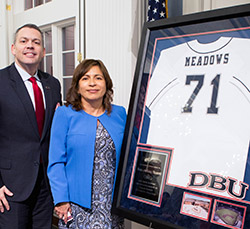
Maria Meadows 250Maria Meadows, widow of long-time Patriot baseball supporter Jaral Meadows, is pictured with Cory Hines, vice president for enrollment at DBU, after accepting the 2017 Patriot Legends Award. (Photo / Brittni Bean)“Our program is focused on development,” Heefner said. “We are concerned with growing our players academically, athletically and spiritually, and these three things are deeply connected. We seek to be champions for Christ in all we do, because Christ is the one true champion.”

At the baseball banquet, DBU posthumously awarded the 2017 Patriot Legends Award to Jaral Meadows, a longtime Patriot baseball supporter, and his widow, Maria, who accepted the award.


BGCT board votes to remove three churches

DALLAS—The Baptist General Convention of Texas Executive Board declared three congregations “outside of harmonious cooperation” with the state convention because of their views on same-sex relationships.

Carrying out a policy adopted at the BGCT annual meeting last November, the board voted 63-6 to consider Wilshire Baptist Church in Dallas, First Baptist Church in Austin and Lake Shore Baptist Church in Waco outside the bounds of harmonious cooperation.

Churches welcome and include LGBT members

Prior to the 2016 BGCT annual meeting, First Baptist in Austin already had performed same-sex weddings and ordained LGBT deacons.

Wilshire voted in mid-November to permit all its members to participate in congregational life on the same basis as other members, regardless of sexual orientation or gender identity.

Soon after the BGCT annual meeting, Lake Shore approved a change to its bylaws declaring the church a “welcoming and affirming community of Christians” that allows all people into its membership and permits them to participate fully in the life of the congregation.

David Russell, board chair and member of First Baptist Church in Amarillo, noted resolutions approved at BGCT annual meetings in 1982, 1992, 2005 and 2009, as well as motions approved at the 2016 annual meeting and at Executive Board meetings in 1996, 1998 and 2010 all indicate “Texas Baptists have consistently held that the Bible teaches that any sexual relationship outside the bounds of a marriage between a man and woman is sin, including same-sex sexual behavior.”

“The 2009 annual meeting resolution reaffirmed that ‘churches should seek to minister to all persons’ and that ‘the love of God embraces all persons and instructs all Christians to share God’s love with others,’” he said. “Sharing God’s love with others requires speaking the truth.

“This (removal of churches) is not something we expect to have to do often. It is not something we relish doing.”

Russell, an attorney, likened the board’s position to the role of jurors who are asked to render a verdict according the law regardless whether they “like the law.”

Even so, some board members expressed concern about voting to remove congregations from the BGCT.

Grant Lengefeld from First Baptist Church in Hamilton emphasized he could not speak for his congregation or the region of the state he represents, but said he could not “in good conscience” vote in favor of the motion.

‘Is there not a third path?’

Doug Diehl, pastor of Crossroads Baptist Church in San Antonio, asked, “Is there not a third path between removal and approval?”

“We believe the Bible is clear about the crucial issue of homosexuality and the related matter of transgender and transsexual people. Yet the Bible is equally clear about the crucial issue of unity of the Spirit, which we are encouraged to make every effort to keep in the bond of peace,” he said.

Diehl cited the biblical example of the Apostle Paul and how he dealt with issues of sexual misconduct in the church at Corinth.

“Paul challenged the individual church to deal with the issue about which he opposed them, but he never suggested rejecting them as a church in fellowship with him or other churches,” he said.

In fact, Paul offered harsh words to the congregation but continued to seek the fellowship and support of the church, he added.

“I don’t believe these churches (in Austin, Dallas and Waco) have made their decisions to thumb their nose at Christ or the Bible,” Diehl said. “They are trying to do missional theology in the same human frailty and limited wisdom in which we do it.

“Rather than remove them from fellowship, could we not state clearly our continued stance on the issues, ask them to consider the tension they are creating in the fellowship and reconsider their stance, and affirm that because of the convention’s stance, we will not place openly gay or transgender/transsexual people on boards and agencies of the convention?

“What appears to be judgmentalism will drive a deeper wedge. Mercy might inspire a way toward peace.”

Wesley Shotwell, pastor of Ash Creek Baptist Church in Azle, noted he understood the BGCT would not accept gifts to the Cooperative Program unified budget from the three churches in question. He asked if the BGCT would accept designated donations—such as to the Texas Baptist Hunger Offering—from those churches.

Precedent set when other churches were removed from fellowship with the convention indicates the BGCT would not accept any financial gifts from the congregations—Cooperative Program or special offerings, Russell responded.

Pastors of affected churches respond

Pastors from the three affected congregations were not at the board meeting, but they responded to a request for comment.

“Wilshire Baptist Church wants to thank Texas Baptists for our 65 years of partnership in the gospel. We regret that selective exclusionary practices based upon differences in scriptural interpretation by autonomous congregations, which first became the norm in the Southern Baptist Convention, have now become operational policy for the BGCT,” Pastor George Mason said.

“We acknowledge the right of Texas Baptists to take this decision, but we do not believe it is right. Churches should at least be shown the courtesy of due process before being voted out of a longstanding cooperative relationship against their will. We should be able to reason together spiritually, talk and listen to one another as we discern the will of God together. Nevertheless, we pray that grief over this parting of the ways will soon give way to a new flourishing of the gospel among all parties concerned.”

Pastor Griff Martin from Austin expressed regret regarding the BGCT action but emphasized new opportunities.

“The First Baptist Church of Austin and her people lament this regressive move by the Texas Baptists, a decision which creates further divisions in Christ’s body and will continue to create divisions. However, as a community, we proudly celebrate who we are and where we are today,” Martin said.

“As a result of this action, we have received countless letters and calls of support, have welcomed many new members who are looking for an open and loving community of Christ following, and we are in several exciting conversations about new and broader ways of doing state fellowship and missions. We believe we are exactly where God has called us to be and will continue to offer inclusive love for all people.”

Lake Shore Pastor Kyndall Rothaus noted she has talked with parents of LGBT children who were “on the verge of giving up on the church because the faith community is not open to a conversation” about sexual orientation and gender identity.

“I’m sad any time the church does anything that will make suffering and alienation and despair worse,” she said. “I firmly believe no one at the BGCT intends to cause suffering. But the unintended consequences of this decision are still very much real. My understanding of Christ is that he ran toward the broken-hearted and the outcasts.”

Rothaus also lamented “an overly narrow fixation on same-sex attraction that dominates the church, while sexual assault is such a huge and widespread evil in our country and yet so rarely addressed from our Baptist pulpits.”

“Why are we so much more worried about same-gendered love than we are about violence and abuse? This is incomprehensible to me,” she said.

Even so, she noted with appreciation Christians who have offered her congregation assurances of continued friendship and support, regardless whether they agree on the matter of same-sex marriage.

“After all, we still share a remarkable bond in Christ our Savior, and that bond will always transcend denominational affiliation,” she said.

Messengers approve two motions at annual meeting

Materials provided to the board noted two motions approved at the 2016 BGCT annual meeting.

The first motion by Steve Wells, pastor of South Main Baptist Church in Houston, stated, in part, “…the convention reserves to itself exclusively, through a two-thirds vote of its Executive Board, the authority to remove a congregation from harmonious cooperation.”

The second motion by Craig Christina, pastor of Shiloh Terrace Baptist Church in Dallas, noted “because of the historic and biblical positions of the BGCT as stated in multiple resolutions, motions and actions, that any church which affirms any sexual relationship outside the bonds of a marriage between one man and one woman be considered outside of harmonious cooperation” with the state convention.

The board treated the first motion as establishing a process and procedure to remove congregations and the latter as setting the criteria for cooperation.

But Wells—who is not a member of the board and was not present at its meeting—insisted, “My intention was, and my position is, that the convention adopted a definition of harmonious cooperation in adopting my motion.”

His motion included a clause stating, “… harmonious cooperation is comprised of three actions on the part of the churches—prayer, financial support of the convention and engagement in the ministry of the convention.”

“While we are at it, my motion also makes clear the time-honored Baptist principles that resolutions of the convention express only the conviction of the messengers present and voting and no one else, and that no convention resolution is binding on any congregation,” he added.

In other action, the Executive Board:

  • Approved a recommendation to the next BGCT annual meeting that the Korean Baptist Fellowship of Texas become a recognized fellowship of the state convention.
  • Filled two vacancies on the institutional audit council by electing Rick Clopton and Russell Dunn, both members of First Baptist Church in Garland.
  • Authorized Executive Director David Hardage, Associate Executive Director Steve Vernon and Treasurer/Chief Financial Officer Jill Larsen to execute documents and sign checks on behalf of the BGCT, and additionally authorized Controller/Assistant Treasurer Jim Reed to sign checks.
  • Approved a partnership with the Baptist General Association of Virginia in chaplaincy endorsement.
  • Agreed to allocate $480,000 in earnings from the J.K. Wadley Endowment, with $100,000 each directed to fund a Houston-area missionary, the Bounce student disaster recovery program and western-heritage ministries; $110,000 to collegiate ministries for maintenance of Baptist Student Ministries buildings; and $70,000 toward the new Texas Tech BSM building.

Baylor regents approve governance changes

WACO—Baylor University regents approved governance changes that increase the size of its executive committee, create a task force for regent selection and grant voting rights to regents who represent certain constituencies.

However, the changes did not include opening board meetings to the public or loosening restrictions on what regents other than the chair can say about board meetings.

Regents also heard an update from the search committee seeking the university’s next president. Ron Murff, chair of the board of regents, noted the committee hopes to have a candidate to recommend before the end of the semester, and regents hope the new president can begin work by June 1.

Murff characterized the board discussion about the governance proposals, presented by an ad hoc governance-review task force, as “robust” and the vote as “overwhelmingly positive.”

“It was in full open session, with both voting and nonvoting regents present, along with members of the administration,” he said.

“Combined with the changes we’ve already taken, these actions today will make Baylor’s governance model one of the most responsive and transparent of any major private university.”

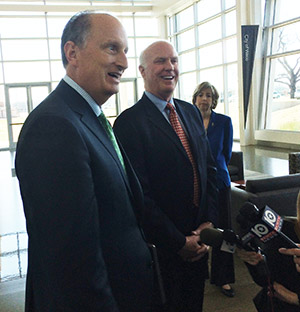
Regents 300Gregory Brenneman, chair of Baylor University’s governance-review task force, and Ron Murff, chair of the Baylor board of regents, respond to reporters’ questions. (Photo/Ken Camp)Gregory Brenneman, executive chairman of CCMP Capital and a non-regent, who chaired the task force, noted the changes give the next president of the university authority to function as chief executive officer.

“We believe these governance changes will built greater trust and confidence within the Baylor community and in the board itself,” Brenneman said.

He commended the board for the freedom it granted the task force.

“We were given complete independence and unfettered access to do our work,” he said.

Brenneman, lead independent director for Home Depot, noted the changes “take Baylor from where it was to best practices.”

Bears for Leadership Reform not satisfied

However, a leader of a group of Baylor alumni and donors who have called for sweeping reform characterized the changes as “baby steps” that reflect “a continuation of failed leadership.”

“We are deeply disappointed that the Baylor board of regents did not adopt more comprehensive reforms,” said John Eddie Williams, a Houston attorney and leader of Bears for Leadership Reform. “These changes are baby steps, not the real reform the Baylor Family wants or deserves from its leadership in response to this crisis.

“The board of regents is still going to appoint itself. It is still going to operate under a cloak of secrecy and gag rules. And it still has failed to share the facts and details of the sexual assault investigation.

“We are 18 months into this tragic crisis, and there seems to be no end in sight. It’s clear that failed leadership was at the root of this tragedy. This vote is sadly just a continuation of failed leadership.”

Regents created task force last November

The governance-review task force suggested recommendations designed to “help build greater trust and confidence within the Baylor community,” and the board voted in favor of bylaws that reflected the recommendations.

Regents departed from the task force recommendations only at one point. The report recommended two nonvoting student representatives on the board. The board granted voting privilege to the student regent who serves his or her second one-year term.

The board of regents’ governance and compensation committee established the task force last November to review Baylor’s board structure and practices—including the relationship between the board and the university administration—and to make recommendations regarding “best practices.” 

The task force reviewed the university’s and board’s governing documents, examined reports from other universities that completed similar reviews, surveyed literature regarding governance and spoke with individuals representing various Baylor constituencies.

A six-member task force—three regents and three non-regents—produced the 27-page report that contains findings and recommendations regarding board composition and procedures, regent selection, board governance and administration, regent giving, the office of the board secretary, and transparency and engagement of the board with key constituencies. 

In addition to Brenneman, other nonregents on the task force were Douglas Bech, chief executive officer and owner of Raintree Resorts, and Paul Foster, chair of Western Refining.

The three regents on the task force were Bob Beauchamp, chair of BMC Software; Jerry Clements, chair and managing partner of the Locke Lord international law firm; and Larry Heard, president and CEO of Transwestern.

“At the outset, the task force acknowledged a widely held perception by many Baylor constituents that the board tends to micromanage university administrative matters and that it has not been open regarding how it has made its decisions, selected regents or chosen its leadership,” the report stated.

“The task force recommendations seek to address this perception by promoting greater transparency, openness, and accountability and effective oversight. The task force believes that these recommendations will help build greater trust and confidence within the Baylor community.”

Rejected call for open meetings

The task force rejected a call from Bears for Leadership Reform for the board of regents to open its meetings to the public.

“After extensive deliberations, the task force concluded that the specific recommendations in this report would sufficiently enhance accountability and transparency and that open meetings would risk unnecessarily disclosing competitive information and detract from the free and open exchange of views and robust dialogue that are necessary to fulfill the regents’ fiduciary duties,” the report stated.

Open meetings of governing board for private institutions of higher education are not considered among “best practices,” Brenneman said, adding, “We think it’s a bad idea.”

Regents approved recommended changes to board committee structure that will increase the size of the executive committee from eight members to no more than 15 members.

One key change the board adopted calls on its governance committee to create a task force for regent selection. It will include members of the governance committee, but at least half of its members should be nonregents with expertise in varied professional fields and who have diverse backgrounds and geographic locations. It also will include as nonvoting members the university president and the vice president for advancement and development.

The board also approved recommendations to:

  • Increase the number of faculty representatives on the board from one to two.
  • Grant voting rights to regents who represent the faculty, the Baylor “B” Association of former athletic lettermen and the Bear Foundation fund-raising organization for athletics.
  • Continue to increase the overall diversity of race, gender and background of regents.
  • Revise the regent removal process, eliminating the clause that regents may be removed only “for cause” and giving the recommendation of removal of nonalumni-elected regents to the governance committee. That committee would make its recommendation to the executive committee, which would then have authority to make the recommendation to the full board.
  • Conduct annual self-assessment of the board, giving each regent the opportunity to suggest ways to improve how the board functions.
  • Provide all regents with all board materials, except when dealing with issues of compensation or—in the case of nonvoting regents—information covered by attorney-client privilege.
  • Require the governance committee to solicit from all regents recommendations for board chair and vice chair, and expand the number of vice chairs from one to three.
  • Require the chair to resign from the board of regents no later than one year after completing his or her term as chair.
  • Create a full-time senior position of board secretary who would serve as the principal officer to the board in the administration of its responsibilities. The secretary—who should be an attorney—would be elected by a majority of the board, serve without a fixed term and report directly to the board.

Regents already implemented one recommendation from the governance-review task force prior to the board meeting by creating a board website. It includes biographical information on each regent, governing documents and information about board meetings.

The governance-review task force recommended no changes regarding the board’s 34-member size or requirements that three-fourths of the regents be Baptist, all must be Christians, half must be Texas residents, 10 percent be elected by alumni and up to one-fourth be elected by the Baptist General Convention of Texas, subject to confirmation by the regents.


Religious leaders seek new trial for Texas death row inmate

More than 500 religious leaders nationwide—including a Texas Baptist seminary professor—have endorsed a petition seeking a new trial for Texas death row inmate Christopher Young because a prospective juror was excluded on the basis of her church membership.

Christopher Young 150Christopher Young In 2006, Young was sentenced to death for the November 2004 fatal shooting of Hasmukh Patel during a robbery at a San Antonio convenience store. Young’s attorneys are challenging the conviction and seeking a new trial based on what they consider a violation of his rights under the “free exercise” clause of the First Amendment and “equal protection” clause of the 14th Amendment to the U.S. Constitution.

During jury selection, Myrtlene Williams, an African-American member of the jury panel, was struck from service based on her religious affiliation and association with the outreach ministries program at Calvary Baptist Church in San Antonio. Although other members of the program ministered to prisoners, the prospective juror was not involved in that aspect of ministry. Last August, the U.S. Court of Appeals for the Fifth Circuit denied Young’s claim.  

On Nov. 29, 2016, Young’s attorneys filed a petition with the U.S. Supreme Court, and the justices are scheduled to confer on the case March 3.

“Unfortunately, the state court issued a ruling saying it is acceptable to exclude someone from serving as a juror in a death penalty trial merely because of the church that person belongs to,” said David R. Dow, Young’s attorney.

“We hope the Supreme Court will agree to review the case and reaffirm that our Constitution and our nation’s commitment to religious liberty means that an individual’s membership in a church does not automatically disqualify that person from acting as a juror.”

Call for a new trial

Texas Baptists who signed the statement seeking a new trial for Young include Roger Olson, the Foy Valentine Professor of Christian Theology and Ethics at Baylor University’s Truett Theological Seminary, and Jerry Dailey, pastor of Macedonia Missionary Baptist Church in San Antonio.

Other signatories include David Gushee, ethics professor and director of the Center for Theology and Public Life at Mercer University; Frederick Douglass Haynes III, senior pastor of Friendship-West Baptist Church in Dallas; Shane Claiborne, leader of Red Letter Christians and The Simple Way; Joel Hunter, senior pastor of Northland, A Church Distributed, in Florida; author and columnist Jonathan Merritt of Brooklyn, N.Y.; and author Brian McLaren of Ocala, Fla.

Some religious leaders endorsed the statement due to a general objection to capital punishment or the manner in which it is carried out in the United States.

“I will sign any petition to save someone from the death penalty, as I do not think the death penalty is ever either just or Christian,” Olson said.

Others signed the statement out of concern regarding religious discrimination.

“It is absolutely unacceptable to strike a juror based on her affiliation with her church,” Hunter said.

Concerns about religious discrimination

The petition state membership in a church or involvement with a specific ministry “is not a fair basis for preventing someone from carrying out her civic duty as a juror” and violates the First Amendment’s “free exercise” clause.

The petition makes no statement about Young’s guilt or innocence, but it asserts his sentencing was “tainted by the decision of the government to strike a juror, not because of her personal beliefs, but solely because she was affiliated with a ministry that works to improve the lives of the poor, the elderly and the incarcerated.”

“Indeed, the government struck this juror even though she did not personally work with prisoners; she was removed, in short, because of her mere association with a church that pursued its mission of aiding the weak,” the petition continues. “We call on the state of Texas to disavow this discrimination on the basis of religious affiliation, and to give Mr. Young a new trial untainted by discrimination against jurors of faith.”


Proposed Baylor governance changes fall short, town hall participants insist

WACO—Governance changes Baylor University’s board of regents will consider Feb. 17 fall short of the drastic action needed to ensure accountability, enhance transparency and restore trust after a sexual abuse scandal, representatives of Bears for Leadership Reform told a town hall meeting in Waco.

“It’s time for us to take major reform steps and not just baby steps,” said John Eddie Williams of Bears for Leadership Reform—a nonprofit group of alumni and donors created last fall to demand greater openness by the university’s regents.

“We think there is a cloud hanging over the university. We don’t have answers. The way to heal is to have full transparency. … The root of all this is lack of leadership, and we believe there need to be changes in leadership.”

Not willing to hold donations ‘hostage’

However, Williams—a major donor to Baylor, for whom the school’s football field is named—emphasized his unwillingness to withhold gifts or ask others to escrow funds until regents implement the changes the reform group desires.

“I have no desire to hold the university hostage,” he said. “We’re not going to call for anybody to do anything to harm Baylor.”

Even so, Williams reported, he knows one donor who planned to leave $25 million from his estate to Baylor who wrote the university out of his will.

About 150 people attended the Feb. 15 town hall event sponsored by the Baylor Line Foundation, successor to the Baylor Alumni Association.

Williams, former regent Randy Ferguson and alumnae Liza Firmin from Bears for Leadership Reform responded to questions posed by Tony Pederson of the Baylor Line Foundation, a journalism professor at Southern Methodist University and former Houston Chronicle editor, and by members of the audience.

Regent participation

Baylor Statue 200Three alumni-elected regents—Dan Chapman, Wayne Fisher and Julie Turner—attended the town hall meeting, along with two other regents, Mark Rountree and Jennifer Elrod. However, they did not participate in the discussion or respond to questions.

Regent Chair Ron Murff did not attend but released a brief statement after the town hall concluded: “We understand the need for continuous improvement. That’s why on Friday, the board will consider the adoption of a slate of previously publicized recommendations that will address how the board does its business and what it shares with the public.” 

The recommendations, developed by the board’s governance review task force, include proposals to increase the size of its executive committee and grant voting rights to regents who represent certain constituencies. Regents already have implemented one task force recommendation—to create an expanded website with board information. 

Representatives from Bears for Leadership Reform affirmed the board for creating the website and posting information on it, but they characterized the actions as inadequate.

Alternative governance proposal

Calling for a more thorough reform process, Williams said. “If self-perpetuating regents have gotten us into this situation, and private meetings have gotten us into this situation, then it’s time for a change.”

In mid-January, Bears for Leadership Reform presented its own governance proposal, which calls for 10 regents elected by the Baptist General Convention of Texas, 10 elected by Baylor alumni and 10 elected by the full membership of the board of regents, with one each elected by the “B” Association board, the Baylor Bear Foundation board, Student Congress and the Faculty Senate. All 34 members would have voting privileges. 

Under the reform group’s proposal, regents would conduct most of their business in open sessions, and the board would not require regents to sign a nondisclosure agreement. During the town hall, members of the Bears for Leadership Reform panel repeatedly referred to the inability of board members to respond freely to questions.

“The chair ought to speak for the board, but the regents ought to be able to speak for themselves,” Ferguson said.

Call for Baylor to set high standard

During questions from the audience, at least two individuals asked why Reagan Ramsower, senior vice president and chief operating officer at Baylor, still is employed—queries that drew applause. Among his other duties, Ramsower oversees the Title IX office and the Baylor police department, which was accused of covering up complaints of sexual violence and failing to respond appropriately to reported incidents.

Former Gov. Mark White, who was in the audience, pointed to the benefits of open meetings at state agencies and state universities.

Governing boards of private universities are not required to conduct open meetings. In fact, the “best practices” recommended by the Association of Governing Boards of Universities and Colleges include urging private schools to close their board meetings to promote robust dialogue and discussion.

However, White urged Baylor to follow a higher standard.

“Why doesn’t Baylor come out of this debacle with the best leadership and the best moves to change our governance, so others can say: ‘See what Baylor did? Let’s follow them’?” he said.

Williams called on the five regents who attended to communicate the concerns voiced at the town hall to the board.

The day after the town hall meeting, the Baylor Line Foundation issued a statement: “Although Chairman Murff has stated that the regents will hold meetings to discuss governance reform after they vote; we ask that they, instead, enter into that dialogue now with the Baylor family before making final decisions that will affect our beloved university.

“We ask that the regents who attended or watched last night’s event passionately advocate for delaying tomorrow’s vote in order to begin holding town hall gatherings like the one we hosted last night. We would be happy to help facilitate those meetings to try to find some middle ground between the BOR and Bears for Leadership Reform proposals.

“Clearly, the life of Baylor, as we know her, may depend on this decision. Surely those responsible for her future will want additional input before voting on something of this magnitude.”

Editor’s Note: The article was edited at 1 p.m. Feb. 16 to add the last three paragraphs, immediately after the Baylor Line Foundation released its statement.


Baylor disinvites former law prof to speak in chapel

WACO—A former Baylor Law School professor planned to speak to a university chapel about clemency reform and ask a released prisoner to tell his story, but Baylor cancelled his invitation, citing two opinion articles he wrote for the Waco newspaper.

Mark Osler 150Mark Osler Mark Osler, now a professor at the University of St. Thomas School of Law in Minnesota, was scheduled to speak at Baylor University’s chapel Feb. 13.

However, according to a Feb. 12 first-person article in the Waco Tribune-Herald, Baylor Chaplain Burt Burleson cancelled his appearance.

Articles on LGBT matters and Pepper Hamilton investigation noted

“He cited as the reason two articles I had written in the Tribune-Herald,” wrote Osler, who serves on the Waco newspaper’s editorial board of contributors. “One, which did not mention Baylor, argued for integrity and rootedness in the Bible as churches struggle with the possibility of gay church members.”

Osler wrote a Nov. 20 article in response to actions the Baptist General Convention of Texas took to exclude any churches that affirm same-sex relationships.

“The other decried the PR-centered approach Baylor had taken regarding the tumult over sexual assaults by students and urged that the Pepper Hamilton report on those assaults be reduced to writing and made available to the students,” Osler continued.

Burt Burleson 150Burt Burleson In a Nov. 6 article, he wrote, “At this point, what people see is a university more committed to PR than to Christian values of accountability, honesty and confession.”

Burleson noted he and the director of chapel exercised “pastoral discernment” in making decisions about chapel speakers.

“Our discernment about this in planning our spring chapels was made last fall as we worked to offer the most fitting programs and presenters for our students in our current context,” he said.

Planned to talk about redemptive work in federal clemency

Osler planned to use his time as a chapel speaker not to address LGBT issues or the Baylor sexual abuse crisis, but rather to talk about his work on federal clemency, “seeking the shorten the sentences of nonviolent narcotics prisoners who have an exemplary prison record and a personal narrative that includes taking active responsibility for what they have done wrong and a fervent commitment to do better,” he explained.

“That work for me is a very satisfying vocation; at its heart is the mercy that Jesus urges us to show one another, balanced with a love for community that calls us to protect it from harm,” he wrote.

Specifically, he wanted to talk about Ronald Blount, a former drug addict arrested when he helped his brother sell crack cocaine, hoping to get some for himself. Because of two low-level prior convictions, Blount received a life sentence without the possibility of parole.

In prison, Blount turned his life around and worked in the prison chapel. In November, his petition for clemency was granted.

“I wanted to bring him up to Waco Hall—he works in Houston—to sit in the audience or behind me,” Osler wrote. “I would tell his story—and the story of this deep vocation—then introduce him and have him speak.

“It gives me chills to think of it. It won’t happen, though.”

Osler expressed his regret Baylor disinvited him, noting he had spoken at numerous other schools, including conservative evangelical Christian universities and seminaries.

“None of them flinched, even when it was clear that some of my views might conflict with some of theirs,” he wrote. “Only Baylor showed this kind of fear, and that is a sad thing, for me and for them.

“At Baylor, it seems that the fragile snowflakes needing a ‘safe space’ free from divergent voices aren’t in the student body—they are in the administration and on the board of regents.”


Coalition wants minors out of adult prisons

AUSTIN—A broad-based coalition that includes the Texas Baptist Christian Life Commission insists tough-on-crime Texas should get smart on crime by raising the age of juvenile jurisdiction from 17 to 18.

Texas is one of only seven states where 17-year-old offenders are treated as adults.

Ogletree 150John Ogletree“At 17, they physically can’t handle it. They are subject to abuse—sexual abuse, physical abuse—that can warp them for a lifetime,” said John Ogletree, pastor of First Metropolitan Baptist Church in Houston, and one of many faith leaders involved in the Texas Smart-on-Crime Coalition and its “Raise the Age” initiative. 

Although the Prison Rape Elimination Act calls for 17-year-olds to be separated from adults, jails and prisons often fail to comply due to overcrowding, Ogletree noted.

He worked as a jailer and bailiff before he entered practice as an attorney, and those memories stick with him as a minister.

“I’ve seen the dark side of the criminal justice system,” he said. “Texas needs to raise the age because it is the good and moral thing to do.”

The Texas Department of Public Safety reports 95 percent of 17-year-olds arrested in 2015 were accused of nonviolent crimes and misdemeanor offenses. 

But in Texas, 17-year-old offenders automatically enter the adult criminal justice system, and if incarcerated in an adult facility, they become more likely to re-offend than their 16-year-old peers in the juvenile justice system.

Differences between juvenile and adult systems

A study by the Centers for Disease Control and Prevention shows young people transferred from the juvenile court system to the adult criminal justice are about 34 percent more likely to be re-arrested than youth who remain in the juvenile system. 

Gene McGuire 150Gene McGuire Gene McGuire understands first-hand the difference between the juvenile system and adult incarceration.

While the juvenile system focuses on rehabilitation, in the adult system, “a lot of it is warehousing,” said McGuire, who became a Christian in prison and now works as a chaplain for a family-owned North Texas chain of restaurants.

At age 17, McGuire accompanied his step-brother and older cousin to a tavern to drink and to shoot pool. That night, his cousin robbed and killed the tavern’s proprietor. Although McGuire was not inside the building when the woman was killed, he received a life sentence for second-degree murder.

After nine months in the juvenile system, he entered adult correctional facilities on his 18th birthday, where he spent nearly 35 years before a judge commuted his sentence to time served.

“In juvie, we had classes available, plenty of counselors and teachers, and they were scheduled for you,” he recalled. “In the adult system, you’re pretty much on your own. It’s not geared toward rehabilitation. You have to ask for help. In the juvenile system, they are more concerned about you as an individual.”

A criminal record limits opportunities for life

Regardless of the age at which they enter the adult criminal justice system, after offenders serve their time, they leave prison with a criminal record that limits their opportunities for education, employment and housing.

DougSmith 150Doug Smith Doug Smith knows about those limitations all too well. Texas lawmakers listen when Smith lobbies for criminal justice reform—not only because of his academic credentials, but also because he speaks with the authority personal experience brings.

“I was the first person in my family to get a master’s degree and the first to go to prison,” said Smith, a policy analyst with the Texas Criminal Justice Coalition

Smith graduated cum laude from St. Edward’s University and earned his master’s degree in social work from the University of Texas at Austin. He also spent nearly six years incarcerated by the Texas Department of Criminal Justice for crimes committed as a direct outcome of his drug addiction.

 “There’s not any reason to dance around it,” he said. “I had a pretty bad problem with addiction, and I found my life spinning out of control.”

Smith’s substance-abuse problems began with alcohol. Then he moved on to prescription narcotics. Before long, he began using illegal street drugs and committed robbery to support his habit.

The support of a faith community inside prison, the influence of a mentor and involvement in meaningful service through the prison chapel and various programs enabled Smith to turn his life around. Even so, he recognized his criminal record would limit future employment opportunities.

“I wondered if I would be able to have a meaningful life after prison,” he said.

Today, he works with the Texas Criminal Justice Coalition to influence public policy decisions to help reduce repeat offenses, keep minors from being incarcerated in adult facilities and make re-entry into free society easier for released ex-offenders.

The organization he serves participates in the Texas Smart-on-Crime Coalition—a network that includes the Texas Baptist Christian Life Commission and Prison Fellowship, as well as the Texas Association of Business, the Texas Public Policy Foundation, Goodwill of Central Texas and the American Civil Liberties Union.

A life-or-death matter

The Texas Smart-on-Crime Coalition views the “Raise the Age” initiative as an urgent life-and-death matter, not just a long-range public policy goal. A 17-year-old prisoner committed suicide in the Fort Bend County jail Jan. 26.

Elizabeth Henneke 150Elizabeth Henneke “A 17-year-old in an adult facility is 36 times more likely to commit suicide than someone in a juvenile facility,” said Elizabeth Henneke, policy attorney with the Texas Criminal Justice Coalition.

Proposed “Raise the Age” legislation would leave in place a certification process that allows prosecutors to charge older minors accused of violent crimes with adult offenses and authorizes judges to transfer cases to the adult system on a case-by-case basis, she explained.

While incarceration in a juvenile facility costs more per day than incarceration in an adult facility because of the rehabilitative services and educational opportunities offered to young offenders, the reduction in repeat offenses offsets results in long-term savings, she noted.

“The state has to pay a little more on the front end, but it’s a cost-effective approach in the long run,” Henneke said.

“More importantly, it’s a moral imperative. Raising the age puts these 17-year-olds in a safer environment with greater opportunities. It’s giving them another chance to rise to their potential.”

To find your state representative or state senator, click here.


DBU dance team spreads gospel in England

DALLAS—The Dallas Baptist University Patriettes spent a week ministering in Northern England, using dance to share the love of Christ.

The trip marked the second time the dance team has traveled overseas as a part of DBU Athletics’ Global Sports Mission Initiative program, which allows athletic teams to travel internationally on mission once every four years. This year, the team connected with UKUSA Ministries and served in Teeside and York.

Ministry in schools

DBU England Group 350The DBU Patriettes dance team, along with DBU staff and sponsors, spent a week ministering in England. (Photo / Brittni Bean)The team spent the week in area schools, assisting as guest instructors in dance, drama and religious education classes. During the evenings, the teams worked with church youth groups and outreach ministries in coffee shops.

“Every day, we prayed that the Lord would provide us with opportunities to be blessings to the schools and churches,” Patriettes Head Coach Brittni Bean said. “And every day, he proved faithful to answer our prayers.”

In the schools, the Patriettes spent much of their time teaching dance and drama, using the lessons as a platform upon which they could begin relationships and conversations with students. Often, conversations that began in a dance class quickly went much deeper than just small talk.

“I was able to share my personal testimony daily with different small groups,” said Alexis Hazelmyer, a freshman from Arlington. “And the children were responsive, curious and eager to learn about the hope that I have in Jesus. They asked challenging questions and some even began to understand a little more of who Jesus is and how deep his love is for us.”

Using a passion for dance as a platform to share the gospel

Dance proved to be a particularly effective way to connect with students. Many of the school children were eager to learn why the members of the Patriettes chose to pursue dance.

DBU England Anjhara 300Patriette Anjhara Garces presented the gospel to these two students during a small-group session. (Photo / Brittni Bean)“One of my favorite parts of the trip was being able to use dance as a way to spread the gospel,” said Mackenzie Lohnes, a freshman from Albuquerque, N.M. “One of the girls asked me, ‘Why do you dance?’ And I just simply said that I dance to glorify the Lord. That exchange opened so many doors in our conversation to be able to discuss the gospel.”

Lindsey Peters, a junior from Waco and co-captain of the Patriettes, discovered ways in which their performances throughout the year connected with the students in special ways.

“We visited the drama classes, and they were studying a play about anorexia,” Peters explained. “The play connected with the themes of a dance we performed for our December Christmas show called ‘No Longer Slaves,’ which served as an expression of the freedom we have found in Christ. It was incredible to be able to share a little bit of our testimony through this.”

New perspective gained

Throughout their time spent with students, dancing, and experiencing the culture around them, the team walked away from the trip with fresh perspectives on their roles as followers of Christ.

“After traveling to Northern England, I was reminded that the gospel truly prevails through all things,” Hazelmyer said. “Though the areas we visited were spiritually dark, it was clear that the work of the Lord was being done. While my heart was often burdened for the people in England, my spirits were lifted by seeing the seeds that were being planted and knowing that they will be watered by the believers currently serving long-term in the area.”

Bria Roberts of Tyler, co-captain of the team, called the experience “an amazing opportunity” to spread the gospel.

“London opened my eyes to see that there are so many moments every day to share Christ’s love everywhere, not just on mission trips,” she said.

The team’s coach noted the joy she experienced on the trip.

“While we want to see every dancer grow in their talent, our true hope is to see them grow in their walks with the Lord,” Bean said. “And seeing how each member of the team responded throughout the trip made me so thankful to be a part of this incredible group of girls.”


Petition seeks sanctuary status for Baylor campus

WACO—Several doctoral students in Baylor University’s religion department have initiated a petition asking the school’s administration to declare Baylor a sanctuary campus for refugees, immigrants and international visitors.

The petition, which gained more than 900 signatures in about 48 hours, asks Baylor to “refuse to comply with immigration investigations or deportations to the fullest extent possible, including denying access to university property.”

Executive order ‘incompatible with Baylor’s Christian commitments’

It declares President Donald Trump’s executive orders on immigration “with their maligning of ‘removable aliens’ and their targeting of Muslim populations, as incompatible with Baylor’s Christian commitments.”

Pat Neff 250The petition calls on Baylor to “publicly communicate a position of zero tolerance on aggressions relating to immigration status and identify particular spaces on campus where those who feel threatened can seek refuge.”

The petition—addressed to David Garland, interim president; Greg Jones, executive vice president and provost; Kevin Jackson, vice president for student life; and Jeffrey Hamilton, vice provost for global engagement—also asks Baylor’s administration to:

  • Guarantee privacy by prohibiting “the collection or release of information regarding the immigration status of Baylor students, scholars and community members by or to any enforcement agency.”
  • Create an office for noncitizen students to coordinate and strengthen on-campus services, including access to free legal counsel; increase financial aid for undocumented students; and allocate funds to assist with the financial and legal repercussions of immigration policy changes.
  • Take a leading advocacy role among Christian universities and partner with other institutions to “defend the dignity and rights of noncitizens.”
  • Advocate publicly for the maintenance of the Deferred Action for Childhood Arrivals program, launched by the Obama Administration in 2012.
  • Create a scholarship program for displaced students, giving preference to students from Iran, Iraq, Libya, Somalia, Sudan, Syria and Yemen—nations targeted in Trump’s temporary travel ban.
  • Meet with representatives of student groups, faculty and staff to plan the implementation of sanctuary initiatives that will “enable Baylor to fulfill its Christian commitments to hospitality, justice and reconciliation and truth.”

“Baylor’s profession of the Christian faith commits it to the formation of a hospitable, just and truth-telling community, especially for the sake of its most vulnerable members, in whom Christians discern the face of Christ,” the petition states.

“These commitments face a direct challenge from the U.S. president’s recent executive orders barring refugees, targeting travelers from Muslim-majority countries, and expanding the criminalization and deportation powers of U.S. immigration agencies, as well as by his campaign promises to deport millions of migrants and terminate Deferred Action for Childhood Arrivals.

“These executive actions are deeply troubling both in themselves and in light of the complex role that the United States has played in the migration of persons from Latin America and the Muslim-majority countries currently affected by the ban.

“Equally concerning is the occurrence of hate crimes and violence against immigrants, persons of Latin American and Middle Eastern origin, and other minority and marginalized persons across the nation and on our own campus. … This pivotal moment can become a time of creative and critical witness for Baylor as a “Christian institution of higher learning.”

Tom Millay, one of the authors of the petition, noted it was “theologically driven,” not politically motivated.

“We have different political opinions, but we all came together in affirming the executive orders are contrary to our Christian heritage,” Millay said.

University responds after executive order

On Jan. 30, Garland—along with Jones, Jackson and Hamilton—sent a letter to students, faculty and staff and posted it online

“We at Baylor University are committed through our Christian convictions to practices that support hospitality, community, respect and the open exchange of ideas across our world,” the letter said.

Noting the presidential executive order, the letter stated: “While immigration laws are understandably complex and inextricably tied to national security, changes in policies and practices as a result of the executive order may affect members of our Baylor community. We have members of our community from some of these identified countries (in the executive order) and others who have significant ties to them.”

The letter noted staff from Baylor’s Center for Global Engagement made personal contact with affected individuals, and it advised students, faculty or staff from any country specified in the executive order to contact the center before traveling outside the United States.

Subsequently, the Center for Global Engagement held an open meeting Feb. 2 with all international students at Baylor to discuss the executive order and how it might affect them.

On Feb. 6, Garland welcomed Baylor students and scholars from the affected countries to a lunch at Allbritton House, the Baylor president’s home, “to continue the open dialogue and demonstrate our firm commitment to supporting our global Baylor family,” a statement from the university said.

“The Center for Global Engagement and university officials are closely monitoring the situation and will continue to provide personal guidance, support and encouragement for our students, staff and faculty who are impacted directly,” the university statement said.

The American Association of University Professors endorsed the sanctuary campus movement after the presidential election last November and encouraged colleges and universities to adopt sanctuary policies. Nationally, at least eight institutions have declared their campuses as sanctuaries—Portland State University, Reed College, Wesleyan University, Pitzer College, Santa Fe Community College, the University of Pennsylvania, Connecticut College, Drake University and Swarthmore College.

A Jan. 27 presidential executive order suspended visas from seven Muslim-majority nations and indefinitely halted refugee resettlement from Syria. On Feb. 3, a federal judge in Washington suspended parts of the order. The Trump Administration subsequently challenged that ruling before the 9th Circuit Court of Appeals.


Some Baylor regents may need to resign, former regents assert

WACO—If any Baylor University regents failed in their responsibility to the school, they need to resign, 14 former regents said in a Feb. 6 letter to the university’s governing board.

Bears for Leadership Reform released the letter that criticizes the regents’ handling of the Pepper Hamilton law firm’s investigation into sexual violence and calls for increased transparency and accountability.

Former regents Mary Chavanne Holmgren, Randy Ferguson, Randy Fields, Gale Galloway, Gracie Hilton, David McCall, Drayton McLane, Jaclanel McFarland, Laree Perez, Ella Pritchard, John Starky, Emily Tinsley, Hal Wingo and John Wood signed the letter.

“The reality is that until regents release the actual ‘agreed-upon scope’ of the investigation, it is very difficult for anyone to determine if the investigation was or was not flawed,” the letter states.

“The details of the assaults certainly should not and do not need to be released. However, we strongly believe that the pertinent facts of the investigation in the form of a written report and the agreed-upon scope of the investigation should be released to the Baylor Family.”

Concerns about governance

The letter particularly focuses on questions raised by recommendations from Pepper Hamilton concerning governance. 

“If current regents on the board have acted inappropriately as suggested in Section III of the Pepper Hamilton recommendations, those regents—no matter how many—should resign from the board,” the letter stated.

Among other matters, the firm recommended the regents “review considerations and standards for new board membership, including actual or perceived conflicts of interest, and implement due diligence in the selection of board members.”

“The selection and election of regents—the ultimate leaders of Baylor University—is perhaps one of the most important actions of the board,” the letter stated. “If the office of regent has been compromised through the lack of exercising proper fiduciary responsibility, lack of appropriate due diligence, or conflicts of interest by regents, the regents responsible for these actions should resign their duties and allow their position to be filled by another person.”

Accrediting agency places school on warning

The former regents also expressed concern the Southern Association of Colleges and Schools Commission on Colleges placed Baylor on a one-year warning for noncompliance regarding student support services, control of intercollegiate athletics and institutional environment. 

“The accreditation of Baylor is certainly one of its most important assets. The fact that SACS has felt it necessary to put Baylor under a “Warning” status appears to be just further indication the regent board is not providing the governance leadership that a major university board should be providing,” the letter stated.

The former regents specifically requested the board:

  • Ensure that all victims of sexual violence are “getting whatever help is necessary for them to move forward with their lives.”
  • Make sure the Baylor campus is safe and that all appropriate Title IX procedures are in place and implemented.
  • Release all the facts from the Pepper Hamilton investigation, including its agreed-upon scope, as a written report.
  • Take seriously the importance of SACS accreditation and “provide the necessary leadership, guidance and governance to remove the accreditation blemish that Baylor has recently received.”

Board of regents chair responds

Ron Murff, chair of the Baylor regents, noted he and his board first learned about the letter from a news release forwarded from media.

“Many of the actions requested in the letter to demonstrate transparency and accountability already are well under way,” Murff said.

“We are passionately committed to ensuring the victims of these horrendous crimes receive the support they need and deserve. That process is ongoing.

“We have begun to implement a range of governance reforms drawn up by both representatives of the Baylor Family and independent experts. We are at the forefront of complying with Title IX policies and procedures after approving the 105 recommendations proposed by Pepper Hamilton. And we take seriously the importance of SACS accreditation. We, of course, thank the BLR for their ongoing input and support throughout this process.”

Town hall meeting scheduled

In a related matter, Murff responded to an invitation from Fred Norton of the Baylor Line Foundation to participate in a Feb. 15 town hall meeting in Waco on governance reform. Representatives of Bears for Leadership Reform already announced they would take part in the gathering.

In a Feb. 6 letter, Murff said he would be unable to participate in the public meeting but was “certainly open to feedback from the Baylor Line Foundation” regarding the report of the regents’ governance review task force, and he offered to set up a conference call for Norton with Greg Brenneman, who chaired the task force.

Murff also noted a new email address—BoardRelationsOffice@Baylor.edu—set up for the board to receive input from the Baylor Family, and he said a new website will launch soon.

“We intend to conduct a media availability session following the upcoming board meeting to discuss Baylor’s governance reforms and our next steps,” he continued. “Additionally, we are considering open forums for the campus community to discuss and understand board governance later this spring.”

Big 12 takes action

On Feb. 8, the Big 12 board of directors announced it will withhold 25 percent of Baylor’s revenue from the conference, pending an independent review of structural changes made in the wake of the sexual violence scandal. The funds will be placed in escrow until the independent audit is completed. 

“While the withholding of conference distributions is an unexpected financial event, we do not deem these actions to materially impact the overall financial position of the university,” Interim President David Garland said. “We pledge our full cooperation, and we will work with the Big 12 Conference to conduct the audit as expeditiously as possible.”

“This third-party review at the request of the Big 12 Conference will provide an opportunity for us to demonstrate our progress to date and our ongoing commitment in establishing Baylor as a leading institution in athletics compliance and governance and for preventing and addressing sexual assaults on college campuses.”

EDITOR’S NOTE: The last three paragraphs were added after the article originally was posted.