Reform group wants independent investigation of Baylor board

DALLAS—A group of prominent donors and alumni wants a comprehensive third-party investigation into events surrounding the sexual violence scandal at Baylor University, including the board of regents’ and administration’s response. And some members of the reform group are willing to help pay for it.

Four leaders of Bears for Leadership Reform met more than two hours Dec. 5 with three Baylor regents for what John Eddie Williams, a Houston attorney, characterized as a “spirited discussion.”
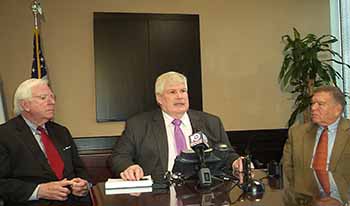
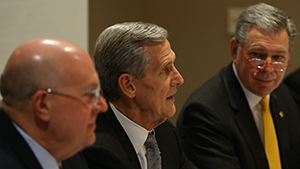
Bears Reform 350Former Gov. Mark White (left), John Eddie Wlliams (center) and Randy Ferguson respond to reporters’ questions after they met more than two hours with three Baylor University regents. Drayton McLane participated in the meeting but had to return to Temple for a civic meeting and was unable to participate in the news conference. (Photo /Ken Camp)Former Texas Gov. Mark White, former regent Randy Ferguson of Austin and regent emeritus Drayton McLane of Temple joined Williams in representing the reform group at the meeting. Attorneys Cary Gray of Dallas and Jerry Clements of Austin and Joel Allison, chief executive officer of Baylor Scott & White Health, represented the regents.

Call for an independent investigation

“We called for them to join us in supporting a joint investigation by an independent third party of all the facts and events surrounding what’s been going on at Baylor,” Williams said, addressing media immediately after the meeting.

“This would be a comprehensive investigation that would also include actions and conduct of the board,” he said, pointing to the “real and perceived” conflicts of interest cited in the Pepper Hamilton report.

“We think it’s appropriate for somebody to look not only at the facts Pepper Hamilton came up with, but take an independent look at the board and the administration so we can start the healing process for the Baylor family.”

‘Find a path forward together’

Regents initiated the meeting with Bears for Leadership Reform representatives to hear their concerns, answer questions as possible and seek to “find a path forward together,” Clements said in a phone interview.

“I would characterize it as very cordial but with a lot of passion and a lot of great discussion,” she said.

“We certainly understand their concerns and will take them to the full board so the board can give them careful thought and consideration and then make decisions that are in the best interest of Baylor University and its students.”

Hopes for rapid action

Williams expressed cautious optimism the board would respond favorably to the call for an investigation.

“If they have nothing to hide, then they should embrace an investigation that will document that they have done the right thing,” he said.

Williams voiced hope the board would respond to the request within a week and an investigator could begin work within 30 days.

Protecting confidentiality or stifling voices?

Regarding the statement of commitment and responsibilities regents sign—which Williams called an “oath of secrecy”—Clements noted it was designed according to guidelines approved by the American Bar Association for directors of nonprofit organizations regarding their fiduciary responsibility to maintain confidentiality.

“All it does is gag people from having an independent voice,” Williams asserted, saying it not only prevents regents from revealing information about meetings, but also prohibits them from criticizing the board.

“Speaking as a Baptist, that’s about as contrary to Baptist doctrine and principles as you can imagine,” White added. “Baptist churches are founded upon the free will and the priesthood of the believer, and that means everybody has an equal voice in decision-making in the church. To extend that, everybody who is associated with Baylor University—staff, faculty or regents—should have the ability to speak out openly about matters of conscience. That’s a very major tenet of faith of the Baptist church, as well as the biggest Baptist educational institution in the world.”

Governance and transparency

Clements pointed to improvements in the governance structure the board already is implementing.

The Bears for Leadership Reform representatives continued their call for greater transparency.

“Before you get to governance reform, you have to get all the facts and have transparency,” Williams said.

Costs and value

The reform group left their meeting with the three regents with “a lot of unanswered questions,” he said. Regents “stonewalled” them on questions about how much the sexual violence scandal has cost Baylor, including payments to the Pepper Hamilton law firm for its investigation, as well as payouts to former employees and legal settlements, he asserted.

Williams raised the question about whether former Head Coach Art Briles and former President Ken Starr were dismissed from their positions “for cause,” and if so, why they received any money from the university.

Information about legal settlements or payments to former employees most likely would be confidential and not subject to disclosure, Clements noted.

Regarding the Pepper Hamilton investigation, she said she did not have access to information about its cost, but she had no question about its value.

“My biggest concern was that we get a thorough and complete investigation that left no stone unturned, and I believe we did,” she said.

‘Incomplete … ridiculous … incomprehensible’

In contrast, Williams called the Pepper Hamilton report “incomplete,” noting the regents confirmed the law firm did not interview any Baylor student athletes. The lack of a printed report is “ridiculous,” and regents’ assertion it would have taken too long to produce one is “a smokescreen,” he added.

“It’s incomprehensible that there is not something in writing,” he said, adding he understands the Pepper Hamilton lawyers used a PowerPoint presentation that could have been made available publically, after redacting information to protect victims’ identities.

“Who asked that it not be in writing? Who does that benefit?” he asked.

‘Let the chips fall where they may’

Bears for Leadership Reform wants input into who conducts an independent investigation, as well as its scope, he added. While the university and its board should bear most of the expense, Williams said, he and some other donors would be willing to help finance the investigation.

“Let’s see what the true facts are, and let the chips fall where they may,” Williams said. “We hope the board will join us in supporting an independent investigation so we can let all the facts be known, hear from all parties involved and then let the healing process begin.

“We emphasized to the regents this issue is not going away. The distrust many of the alumni have toward the board is not going away. They need to solve it, and it is our recommendation that they solve it with an independent investigation.”

A real solution would include bringing facts to light, ensuring policies and procedures are in place to protect students, and making sure quality leaders are on the board of regents, he said.

Need to rebuild trust

The reform group representatives emphasized to the regents their need to rebuild trust with alumni, faculty and other members of the Baylor family, White said.

“The trust issue is extremely important in every institution, but especially in an institution that holds itself out as a Christian university and a Baptist university,” White said.

“I think they understand the urgency,” he continued. “This is not something that can be put off until next semester. It should be and can be solved quickly.”


Arlington church changes with community

ARLINGTON (BP)—Pastor Gary Smith was shocked by what he saw at the opening of a new middle school.

In 1991, when he had been called as pastor of Fielder Road Baptist Church in Arlington, the city was predominantly white. His congregation was made up of middle-class Anglos who drove into Dallas or Fort Worth to work. At school, the cheerleaders were all white.

A dozen years later, Smith saw a cheer squad of 24 girls—all but one African-American. Arlington had changed dramatically, but Fielder Church, as it is known now, was still white—and declining.

Smith knew the church had to change to survive.

Church grew and declined with its community

Like most Southern Baptist churches launched in the mid-1950s, Fielder Church was as segregated as its community. As the city’s population exploded almost six-fold during that era, the church reflected the neighborhoods of white families drawn to the booming North Texas economy. Over the next 40 years, Arlington multiplied another six-fold, and the church grew along with it.

“During those early years, we experienced exponential growth. We couldn’t build buildings fast enough,” Smith said.

“But neighborhoods generally decline. And after about 10 years, we noticed a leveling off of our numbers. People were moving out of Arlington to newer areas.”

Struggled to find models for change

Smith realized Arlington had changed racially without the church recognizing it. He set out to learn what other predominantly white churches had done to adapt and survive.

“I discovered there were no models for it,” Smith said. “In those neighborhoods, 95 percent of those churches die.”

But Smith also knew the issue was larger than just survival.

“I knew that, from the beginning, God wanted to show the availability of the gospel to all the nations of the world,” he said. “God confronted the Jews-only mentality of the early church by calling Paul to the Gentiles and giving Peter a vision at Joppa.”

‘A vibrant congregation in the midst of a changing city’

Fielder church members 300Church members greet one another in preparation for Sunday worship at Fielder Church in Arlington.The segregation of Fielder Church had to be addressed, not just for the survival of the congregation, but also for the good of the community’s lost souls, he realized.

“We felt God wanted us to do whatever it took to become a vibrant congregation in the midst of a changing city,” he said. “None of our staff or church leaders had ever been part of something like this, but we believed it was God’s plan. Many of us could have moved to places where the task was easier, but we felt a calling from God to confront this challenge.”

Confronting prejudice

The move to reverse the segregation met opposition.

“From the beginning, underlying prejudice surfaced,” Smith said. “Prejudiced members chose to criticize the leadership or leave the church. Even some well-meaning leaders departed because they were simply unable or unwilling to build relationships with people who were not like them.

“For me as the leader, this journey proved especially painful at times. Some of my closest friends left the church. We struggled to deal with reduced financial resources and the discouragement of declining attendance. There were many times I felt like a failure and wondered if I should leave as well.”

Fielder Church lost more than 10 percent of its attendance over a four-year period.

Intentional transition to reflect changing demographics

As part of the intentional transition process, Fielder Church hired a young Hispanic minister, Jason Paredes, to lead a Spanish-language mission of the church. During one of the English services, Paredes began singing a song in Spanish. Several church members walked out of the sanctuary as a protest.

Undeterred, church leaders continued to pursue diversity that transcended Arlington’s ethnic, social, economic and age barriers. The church diversified staff at all levels and made intentional efforts to listen to the perspectives of others in the community.

Sermons and testimonies confronted the issue of prejudice. Fielder’s members gathered with diverse churches for joint worship. Community service projects focused on low-income schools, apartments and neighborhoods.

Change in leadership implemented

Then in February 2014, the congregation instituted a 30-month transition from Smith’s leadership by calling Paredes as senior pastor-elect with a 97 percent vote. The 30-month lead-pastor transition concluded in August 2016, when Smith retired as senior pastor of the changing—and changed—church he served 25 years.

Paredes views the success of Fielder’s transition as nothing short of miraculous.

“This was, in my mind, nearly impossible,” he said. “Historically, this was a very Anglo church in a very Anglo city. It seemed like a perfect storm for things not to work.”

Paredes credited the transition’s success to “heroes of leadership” in the congregation and Smith’s willingness to “spend all his chips” in following God’s leadership.

“This was born from Gary’s deep conviction that a church is unhealthy if it is staying in one culture when the city around it is so diverse,” Paredes said. “That conviction led him to consider some outside-the-box thinking.

“At every turn, there was a sense of rightness that brought God’s blessings upon our church family. The more we began to look like heaven in our diversity, the more we sensed the presence of the God of heaven.”

Need to reflect communities

As America’s suburban and established neighborhoods diversity, churches need to be more reflective of their communities, Smith asserted.

“The church is going through a great upheaval,” he said. “Pastors are in a tough spot today. Security, money and buildings often rest with people who don’t want transition. Our journey has been painful and difficult. Six or eight years ago, I felt the challenge was too much, but the Lord wouldn’t let me leave, and I am grateful. Our church is now multi-ethnic and multi-generational, and it is a joy unspeakable for my wife and me.”

Fielder Church is now 30 percent non-Anglo, and Paredes hopes “pastors and church leaders of diversity” will be encouraged by the success of the congregation’s transition.

“This should not have worked out. About 77 percent of pastoral transitions fail in mono-cultural situations,” he said. “But this transition has been phenomenal. People need to know this can and does happen.”

Making a transition into diversity requires a heart that yearns for change and the courage to obey God’s call, Paredes insisted.

“God is raising up leaders of diversity and calling us to step into these things, even if we don’t feel equipped or think it is impossible,” he said. “The church needs this, and when we cry out to God and ask for it, he does move.”


TBM offers pure water and Living Water to Sierra Leone

SIERRA LEONE—Hundreds of people in two villages in Sierra Leone gained access to clean water, and at least 75 accepted the gift of Living Water, thanks to three Texas Baptist Men volunteers.

Dee Dee and Tim Wint from The Village Church in Flower Mound and Billy Joe Wall, pastor of Avenue Baptist Church in Hereford, spent two weeks drilling and installing wells and conducting health and hygiene classes, working in cooperation with the Konoyima Educational Fund

Devastated by civil war and Ebola

The TBM volunteers worked in the Kono District, the easternmost province in Sierra Leone—a region known for its diamond mines but devastated by 11 years of civil war, followed by an Ebola outbreak.

“Schools and churches were closed more than 11 years, and a whole generation of schoolchildren was left without education,” said Dee Dee Wint, vice president of the TBM Water Ministry. “They are behind economically and educationally.” 

More than 70 percent of the people live below the poverty line. About half the men and three-fourths of the women are illiterate.

Providing access to pure water

SierraLeone 400Children in Sierra Leone express appreciation to Texas Baptist Men for the gift of clean water.The Konoyima Educational Fund has started Christian schools and churches throughout the district, but many are in areas that lack clean water, Wint said. The Kono District is experiencing an 80 percent infant morality rate due to water-borne diseases.

“We worked in two villages, and neither had a clean water source,” she said. “The people were either walking long distances to fill containers from a hand-dug exposed well or from a river that is downstream from the mines.”

The TBM team drilled wells in each of the villages at least 40 feet deep, tapping into an aquifer far below the polluted groundwater seepage, she explained.

Global missions rookie but experienced well driller

The trip to Sierra Leone marked Wall’s first overseas experience with the TBM water ministry, but he brought more than three decades of experience as a water-well driller to the mission field.

“I started working as a kid in my family’s water-well-drilling business,” Wall said. “It’s a blessing to be able to use the gifts God put in my life over the years.”

Wall left the well-drilling business to work several years as a Baptist camp manager before he accepted his first pastorate at age 63.

“That’s kind of old to be starting out as a pastor. I’ve learned you don’t question the Lord. You just do whatever he calls you to do,” he said.

‘The Lord was already there’

In addition to applying his well-drilling expertise in Sierra Leone, Wall also preached in two Sunday worship services.

“I wanted to share the love of the Lord with the people, but when we got there, the people were already singing and praising him,” he recalled. “The Lord was already there. We just got to be a part of what the Lord was doing.”

Teaching health and hygiene

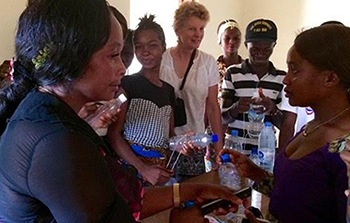
SierraLeone 350Dee Dee Wint (center) teaches health and hygiene in Sierra Leone.In addition to installing wells, the TBM volunteers also led health and hygiene classes. Dee Dee Wint trained 27 church leaders, who in turn led classes in two villages.

Among other lessons, participants learned how to make “tippy taps”—a portable hand washing station constructed from plastic bottles.

“We emphasized the importance of hand washing with soap and running water, as it can reduce diarrheal disease-associated deaths by up to 50 percent,” she said.

At one of the health and hygiene classes led in a community center by church leaders, 209 people attended, and 75 made professions of faith in Christ, including seven women from Muslim homes.

Ministry among Muslims

The volunteers also presented the gospel at dedication ceremonies for the wells—one of them installed next to a church and Christian school built on land donated by a Muslim leader.

“At the dedication, we told the people we were giving the well to Jesus and the community. We made it clear the well is open to everybody—not just the students who attend the Christian school,” Dee Dee Wint said.

A Muslim imam attended the dedication to express gratitude, and children sang thank-you songs, she added.

In spite of the crippling poverty in the region, Wall noted the generosity and kindness of the people he encountered—Muslim and Christian alike.

“The Lord opened my heart up to the people,” he said. “I’m ready to go again. It’s a privilege not only to bring water to people, but also Living Water and the Spirit. That’s what it’s all about.”


Family serves together in East Texas helping flood victims rebuild

DEWEYVILLE—When the Managan family took up residence in Deweyville for the summer to coordinate disaster recovery, each member played a valuable role in helping families rebuild their homes after a devastating flood.

Vaughn and Sunshine Managan served as volunteer coordinators with Texas Baptists’ disaster recovery program, now a part of Texas Baptist Men’s disaster relief ministry.

Throughout the summer, the Managans coordinated church and associational groups, mobilizing more than 200 volunteers as they worked on nine homes.

All in the family

Milo Vaughn Sweeping 350Milo Managan, age 7, works with his father, Vaughn, to sweep away sand after installing a paving-stone porch for a Deweyville family.The Managan’s children—Jax, age 13; Lily, 11; and Milo, 7—accompanied them each day, delivering supplies to work groups, helping tape and float drywall, hauling limbs and debris from yards, playing with homeowners’ puppies and learning what being the hands and feet of Jesus looks like.

The Managans are not expert carpenters or homebuilders. In fact, they learned many skills like floating and mudding drywall alongside the volunteers.

“We are not always called to something we are good at, but in those places, you need God more,” Sunshine said. “This fit our personalities. We like being with people and doing hard work.”

‘Ministry of drywall’

The Monagans first engaged in disaster recovery in 2013, following a fertilizer plant explosion in West. The couple felt called to help coordinate efforts, but having their family along with them was important. Vaughn took a two-month leave of absence from his job as an engineer, and they moved to nearby Waco for the summer while they worked in West.

Three years later, the Managans began saving to spend their summer doing similar work. Following the Deweyville flood in March, just miles from Vaughn’s childhood home in western Louisiana, the Managans felt called to go. They contacted Marla Bearden, disaster recovery specialist, who put them in touch with Pastor John Fortenberry from Calvary Baptist Church in Deweyville, and plans began to fall into place.

“We were doing the ministry of drywall,” Vaughn said of the summer work. “This is what people have needed. Day and night, as long as there were volunteers, we were putting up drywall.”

Living out faith through service

Jax 350Jax Managan removes a fallen tree limb from the yard of a Deweyville family.One of the Managans’ greatest joys in serving was having their children with them and teaching them about living out faith through service to people in need.

Jax served as his dad’s right-hand man for the summer, riding shotgun in his truck on every project. Milo and Lily made innumerable trips to home-improvement warehouse stores with their mom to pick up last-minute supplies for a day’s projects.

“We needed it as a family, and it came at a beautiful time for us to stay connected— sweating together and talking more,” Vaughn said.

God provides

“It is good to hear kids talking about how God is providing,” Sunshine added. “You don’t always see this in regular life, even when God is providing. We are praying the kids don’t forget how God provides here. Even the little stuff matters.”

“Little stuff” includes things like needing an electrician to work on a house and finding a master electrician on the team that just arrived. Or the time a local company donated a truckload of sand to help level paving stones to create a porch for two homeowners. Children at a Vacation Bible School at North Orange Baptist Church donated the money to purchase those paving stones.

Without an operating budget and with minimal funds for supplies, the Managans saw God daily meet needs to accomplish each task set before them.

Building lasting relationships

The Managan family not only helped rebuild homes, but also built lasting relationships with the homeowners they served.

And their children gained several honorary Deweyville grandparents.

At the mention of going to visit Miss Lena, Milo and Lily’s faces radiated excitement. Pulling up her driveway, Lena would wave exuberantly and welcome the children with the same affection and love. As she walked through her home, which was nearing completion in mid-July, Lena explained the work done by each of the Managans. From the closet Milo helped clean out, to the seam in the middle of the wall Lily helped cover with mud and Sunshine sanded down, every ounce of work was met with an overflow of appreciation.

Detailing the many ways God provided for her following the storm, “most of all God sent Vaughn, Sunshine, Milo, Lily and Jax,” Lena said.

The Managans encourage other families to consider taking time to serve with their children in mission work of some kind.

“Jesus gave us everything. How can we not give everything?” Sunshine asked. “People say we are ‘good people,’ but we aren’t. God doesn’t need us, but he chooses to let us be involved, and it is such a privilege.

“It is worth whatever you have to give up. Don’t waste this time when your kids are under the roof of your house. Stop talking about it, and do something they can do with you.”


Advance directives are gifts to loved ones, health care professionals say

Conversations about death and dying may not rank high on the list of preferred topics when families gather for the holidays. But advance directives concerning end-of-life care may be the most precious gifts imaginable for loved ones, some Baptist hospital administrators and chaplains insist.

Joe Perez 200Joe Perez “Letting family and friends know our wishes for this difficult part of the human journey is a tremendous gift to them,” said Joe Perez, vice president for mission and ministry at Valley Baptist Health System.

When a patient faces a terminal illness or irreversible medical condition, the disease or injury victimizes both the patient and the people he or she loves, Perez said.

“But if we don’t make our wishes known in advance and prepare our family for the decision-making associated with that situation, they become victims twice—to the tragedy and to the process,” he said.

Instead of leaving behind victims, Christians can provide advance directives that empower family members to become “informed champions to uphold the wishes” of someone they love.

Important documents

Advance directives include two vital documents, Perez noted.

One grants medical power of attorney—the legal authority for a surrogate to make health-care decisions for someone who is incapacitated.

The other is a directive to physicians and family or surrogates, sometimes called a living will. This document allows an individual to make his or her wishes known about end-of-life medical treatments before a crisis occurs.

Issues include when or how long a person would want to be placed on mechanical ventilation or tube feeding, if and when a person wants to be resuscitated, and how aggressively physicians should seek to extend life through artificial support.

More is not always best

During a panel discussion at a workshop during the Baptist General Convention of Texas annual meeting, three hospital administrators—Joel Allison from Baylor Scott & White Health, Tim Lancaster from Hendrick Health System and Glenn Robinson from Baylor Scott & White-Hillcrest—emphasized the importance of advance directives and end-of-life planning.

hospital administrators 300Hospital administrators (left to right) Tim Lancaster from Hendrick Health System, Joel Allison from Baylor Scott & White Health and Glenn Robinson from Baylor Scott & White-Hillcrest participate in a panel discussion on health care during a workshop at the Baptist General Convention of Texas annual meeting in Waco. (Photo/BGCT Newsroom)“One of the greatest gifts we can give to our children is not putting them in the place of having to make the decisions,” Lancaster said.

Robinson noted 60 percent of an average American’s lifetime expenditures on health care occur in the last six months of life.

“We need to teach Americans how to die differently,” he said. “Giving more health care is not always best.”

Allison offered praise both for the spiritual care chaplains in his system provide and for the palliative care physicians offer, not only at the end of life, but also as a part of chronic disease management.

Understand what is available

As families discuss end-of-life issues, they need to understand what is available, the administrators noted.

Palliative care—sometimes called “comfort care”—is specialized medical attention focused on relief from the symptoms and stress of serious illness. It is designed to improve patients’ quality of life, the administrators explained.

They distinguished between palliative care and hospice care, noting palliative care is one dimension of hospice care but is not limited to it.

Hospice care typically is reserved for terminally ill patients during the last six months of life, assuming a disease follows its normal course, and normally is offered in a home setting. Palliative care helps keep patients as comfortable as possible through various phases of a life-limiting condition, whether in a home, hospital or nursing facility, and it may extend for years.

Families can benefit from the resources Baptist hospitals offer with regard to end-of-life planning—particularly the pastoral care or chaplaincy staff, the administrators noted.

David Cross, director of chaplaincy services for Baptist Hospitals of Southeast Texas, who attended the panel discussion, noted most chaplaincy programs offer advance directive workshops for the communities their hospitals serve. Chaplains also typically are willing and eager to talk to churches about how families can prepare, he added.

Bring the conversation to church

While churches offer messages of hope about everlasting life, too often they shy away from discussions about the dying process, Perez noted.

“We don’t talk about death and dying much. We hope for a miracle, and if that doesn’t happen, we just say it was God’s will,” he said.

Consequently, Christians often are least prepared to take advantage of end-of-life services and most inclined to seek aggressive treatment at that stage, he noted, pointing to a published study of patients with advanced cancer. 

However, spiritual care and end-of-life discussions by the medical team and pastoral care providers can reduce aggressive treatment and increase use of hospice care, the study showed.

The study underscores the importance of chaplains—as well as health-care providers who work in an environment that encourages them to offer holistic care, Perez observed. During the summer, chaplains at Valley Baptist Medical Center-Harlingen led an educational campaign involving more than 900 employees, from physicians to food-service staff, about advance directives and related issues.

But the study also points to the need for more end-of-life education in churches, Perez noted. Congregations can do more to facilitate end-of-life discussions and create an environment that values advance planning, he said.

See what the Scriptures say

A Bible study or sermon could focus on what he called “the first advance directive”—the story of Barzillai of Gilead in 2 Samuel 19:31-39, who received the king’s blessing for making his end-of-life wishes known.

He also pointed to another Old Testament passage, Isaiah 38:1, when the prophet commands an ailing King Hezekiah, “Set your house in order, for you shall die.”

Christians can learn best from the example of Jesus—not only in terms of how he dealt with the awareness of his approaching death, but also in how he talked about it with his closest followers, Perez observed.

“Jesus prepared his disciples for his own death,” he said. “What are we doing to prepare the people we love for that aspect of life? … Have the conversation.”


CommonCall: Rebuild, repair and restore community

FARMERS BRANCH—Royal Haven Baptist Church in Farmers Branch has a vision rooted in Isaiah 58:12—to rebuild, repair and restore its community. 

Lofty goals for a congregation that had dwindled from 2,000 in attendance 30 years ago to about 40 five years ago. That’s when Rick and Carol Dorman returned to the church where they grew up, came to faith in Christ and felt God’s call to ministry.

“We heard God calling us back here,” said Rick, who served nearly four decades as a bivocational church planter, most recently in Denton Baptist Association. At ages 60 and 58, the Dormans were the youngest members at Royal Haven.

Inwardly focused and concentrated on survival

As they drove through the neighborhoods where they spent their childhoods, the couple barely recognized the area.

“The demographics had changed. In the process, the church had become inwardly focused,” Rick said.

The congregation, which historically had a rich history of missions involvement, concentrated on its own survival rather than on serving the surrounding community, he added.

Adopting an elementary school

Renewed community involvement began when the Dormans led their church to adopt a local elementary school, helping provide school supplies and uniforms, and then to expand the ministry by adopting a second school.

Through a conversation with the principal of one of those schools, Carol learned about a need that captured her heart.

CarolDorman 350Carol Dorman rejoices in the way the food-distribution ministry at Royal Haven Baptist Church has served as a launching pad for other ministries. (Photos / Ken Camp)“The children were going home on the weekend, and there was no food for them to eat until they came back to school on Monday,” she said. The Dormans started making trips to a wholesale discount grocer to buy food to fill backpacks for children in need each Friday. In time, the church decided to tap a fund set up in memory of a missions-minded member to provide for 13 children each weekend.

Even so, Carol was haunted by the thought of the hungry children they could not feed and of the children’s families who lacked food. So, she contacted Jana Jackson, director of family and community ministries at Dallas Baptist Association.

Community Distribution Partners

Jackson, one of the leaders of the faith community action team of the Dallas Coalition for Hunger Solutions, told her about Crossroads Community Services and its Community Distribution Partners network. 

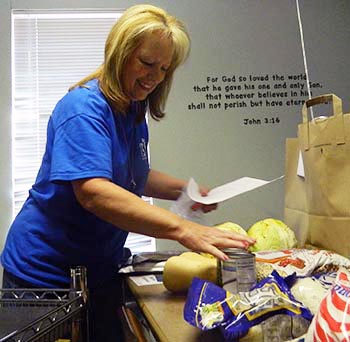
BettyMiser 350Betty Miser checks the shopping list carefully as she gathers groceries a family will receive from the i58 ministry.Crossroads, which grew out of First United Methodist Church in downtown Dallas, developed the network to empower congregations and other nonprofit organizations too small to serve as a North Texas Food Bank agency.

Crossroads serves as the hub, securing food in bulk from the food bank and maintaining a centralized client database. The 80 churches and organizations in the Community Distribution Partners network serve as the spokes of the wheel, providing food to preregistered families once a month at a site near where they live.

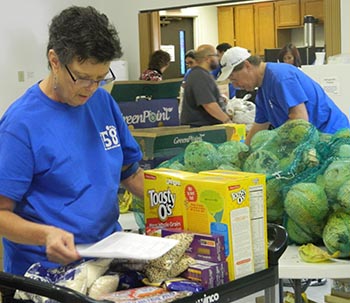
Volunteers pick up food at Crossroads early on the morning of a food-distribution day, transport it to a remote site, package it for pre-approved families and provide it to them.

“I found out we could feed whole families better food for less money,” Carol said.

A center for missions

Royal Haven agreed to become one of the Community Distribution Partners. In the meantime, the congregation sold its old building, secured the property formerly occupied by Brookhaven Baptist Church before that congregation relocated to McKinney, and merged with Valley View Baptist Church.

The building where Valley View Baptist worshipped before the merger became Royal Haven’s missions center—home to a Spanish-language congregation, a Kenyan congregation, a Korean pastor-training center and the once-a-month food distribution site.

Royal Haven provided food to its first 12 families in February 2015. At the October 2016 distribution day, the church served 44 preregistered families and completed the application process for two additional households.

Baptists around the state help support the ministry through their gifts to the Texas Baptist Hunger Offering

Involving volunteers in service

In addition to providing fresh produce and other food, Royal Haven also allows clients to “shop” for free clothing before they pick up their groceries. Volunteers carefully sort all the donated clothing to make sure everything is lightly used, clean and appropriate.

The food distribution and clothes closet initiative—part of Royal Haven’s i58 ministry, based on Isaiah 58:12—involves at least 40 volunteers on any given Saturday, equal to the number of people who attended the church when the Dormans returned five years ago. Today, about 200 people attend Bible study and worship services at Royal Haven.

Likewise, longtime members of Royal Haven—and members of Valley View Baptist who joined after the two congregations merged—rediscovered their passion to meet needs in their community, share the gospel and extend God’s kingdom, Rick said.

WesleyPollet 350Wesley Pollet, a fairly new member of Royal Haven Baptist Church, volunteered with the i58 ministry the first time in October. “They have caught the vision of missions they always had deep down but that had been lost,” he said. Volunteers range in age from pre-teens to members in their 90s.

Wesley Pollet, a relatively new member of Royal Haven, worked with i58 for the first time in October, bringing his children along with him.

“I want my kids to learn to be servant leaders,” he said. “This seemed like the perfect opportunity.”

Developing meaningful relationships

Through the food-distribution ministry, Royal Haven is establishing meaningful relationships with families the church likely would not have reached otherwise, the Dormans noted.

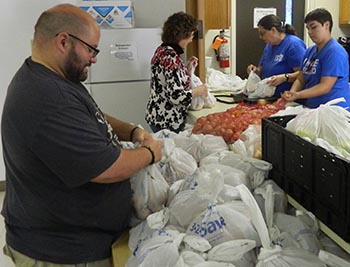
MariaLauraVieraJaymesonAdams 350Jaymeson Adams delivers groceries to the car for Maria Laura Viera.“The food is meeting a real need in the lives of these families, but it’s even greater as a tool to enable us to meet” people in the community, Carol said.

“We are building relationships and establishing trust. They come to us with legal issues and with immigration issues, when their 15-year-old daughter becomes pregnant and when their kids have school issues and the parents don’t know how to communicate with the teachers. They all have my cell phone number.”

Thanks to a Spanish-to-English translation app on her phone, Carol is able to respond and help them find the assistance they need. In the process, she is seeing lives changed.

“There was one woman who had dropped off the grid,” she recalled. “She hadn’t been to the mission center for at least two months. Then one day, she called. She said: ‘I just wanted you to know I’m doing great now. You helped me when I was in such need, and I wanted to thank you.’”

Expanding ministries

In January, Royal Haven hopes to start English-as-Second-Language classes on Sunday mornings for parents to attend while their children attend Sunday school.

“We want to help them be able to obtain better jobs,” Carol said.

Royal Haven also is seeking to intervene early in the next generation by improving the literacy skills of young children. Working in partnership with Literacy Connexus, a ministry of Texas Baptists’ Christian Life Commission, volunteers built 55 bookshelves for children and provided them a basic children’s home library. 

Three couples who participated in the bookshelf-building project had no connection to any church, but they learned about the ministry and wanted to help, Rick recalled.

“We spent a lot of time that day talking to them about the Lord,” he said.

Royal Haven has expanded its involvement with the school district to include five neighborhood schools. Principals and teachers have learned to call the church when they hear about families with needs. And the congregation continues to expand the scope of its community ministries.

“The food has served as a launching pad for all kinds of ministries,” Carol said.

Read more articles like this in CommonCall magazine. CommonCall explores issues important to Christians and features inspiring stories about disciples of Jesus living out their faith. An annual subscription is only $24 and comes with two complimentary subscriptions to the Baptist Standard. To subscribe to CommonCall, click here.


Ten strategies to fight hunger

The Community Distribution Partners program involving Royal Haven Baptist Church is one of 10 proven strategies the faith community action team of the Dallas Coalition for Hunger Solutions identified to fight hunger.

Jana Jackson, director of family and community ministries at Dallas Baptist Association, helps lead the coalition’s action team to engage churches and other faith groups in effective hunger-fighting approaches.

Community Distribution Partners uses a “hub-and-spokes” distribution model to increase the efficiency of food distribution in areas of greatest need. Crossroads Community Services, an urban outreach ministry created by First United Methodist Church in Dallas, serves as the hub, obtaining food in bulk from the North Texas Food Bank. Other churches and community ministries serve as the spokes of the wheel, distributing groceries to clients in their neighborhoods. 

The coalition’s faith community action team identified nine other strategies. While some are specific to the Dallas area, most can be replicated throughout the state. They are:

  • The Summer Meals Program of the U.S. Department of Agriculture provides summertime nutrition for children and teenagers who receive free or reduced-price meals during the school year. Churches can serve as meal sites or can provide volunteers to staff a site in their community, and they can provide enrichment activities for students before or after meals.
  • The Community Partner Program enlists congregations to help people use online resources to apply for and manage public benefits.
  • Cooking Matters is a six-week program that teaches participants how to be smart grocery shoppers, make healthier nutritional choices and cook affordable meals. Churches can offer classes and involve members as teachers.
  • Meals on Wheels (www.mealsonwheelsamerica.org/) delivers nutritious, freshly prepared meals to people who cannot provide for themselves due to advanced age, illness or disability. Congregations can enlist and coordinate volunteers to deliver meals.
  • The Family Garden Initiative helps churches and other groups teach their neighbors—particularly in urban areas—how to grow nutritious food in small gardens in backyards or apartment patios.
  • Community Gardens provide fresh vegetables for families in urban areas and supply produce for food pantries. Congregations are encouraged to turn nonproductive plots of land into community gardens, developed in partnership with the individuals who benefit from what is grown.
  • Congregate Meals offer balanced, nutritious meals for older adults at a senior center. The social setting allows the senior adults interaction with peers, and meal sites also may provide nutrition education classes. Churches can provide volunteers for the senior centers or sponsor a Congregate Meal site.
  • Nourishing Neighbors is a volunteer-driven program of the North Texas Food Bank that delivers groceries to homebound senior adults and mature adults with disabilities. Participants receive at least 10 pounds of nutritious, easy-to-prepare food, including fresh fruit and vegetables, every-other week. Churches can recruit volunteers to deliver groceries or interview applicants for enrollment, and they can become a distribution hub to serve seniors in locations across the 13 counties the North Texas Food Bank serves.
  • Nutrition Education through the Texas A&M AgriLife Extension Service incorporates research-based, practical lessons in basic nutrition, food preparation, food budget management and food safety in settings convenient for participants. The Expanded Food and Nutrition Education Program helps families with children, and Better Living for Texans is designed for adults on public assistance programs. Churches can schedule the programs for their members or serve as host sites for programs in their communities.


CommonCall: Connecting with the community

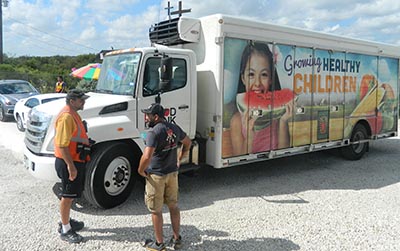
SAN ANTONIO—Pastor Rob Johnson sees the food-distribution program at Christian Family Baptist Church in San Antonio as a vital community ministry—not only to the 1,300 clients it serves, but also to the volunteers who make it possible.

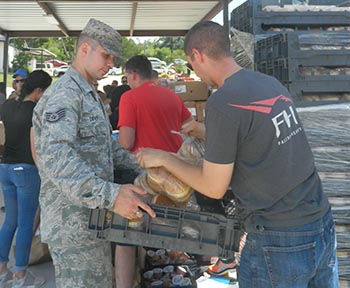
Christian Family Baptist ChurchUSAF volunteer 350Military personnel from San Antonio-area installations volunteer at Christian Family Baptist Church’s food-distribution ministry. (Photos/Ken Camp) averages about 40 people in attendance each Sunday, but the multi-ethnic congregation’s food-distribution program involves about 120 volunteers each month, including many military personnel and others who are not church members. 

“We have about a 90 percent turnover in terms of our volunteers, and it’s quite a mixture of people,” Johnson said, noting many workers are personnel from nearby Lackland Air Force Base and other San Antonio-area military installations.

Opens doors to the community

Johnson and other workers from the church have the opportunity to interact both with the volunteers and with neighbors who receive groceries.

“It’s opening up doors for us, because we’re in constant contact with the community,” Johnson said.

He mentioned one man who started attending worship services and Bible study at the church, accompanied by his wife and daughter. Both husband and wife are in the military, and it marked the first time she attended church with him since they married.

“One young man I’ve been mentoring the last three months is getting ready to take classes at Baptist University of the Américas,” Johnson said.

Provides a place for meaningful service

The church’s involvement in the community also draws Christians who are eager to find a place where their service can make a difference.

David Young 400David Young, who worked more than 30 years in public safety before he retired on medical disability, oversees the volunteers who direct traffic on food-distribution days.David Young lives in the area of far-western San Antonio near Christian Family Baptist Church, but for years his membership was at a church about 20 miles away, on the city’s north side.

“I decided I needed to get more involved in the community here,” Young said. “I met Pastor Rob at a fund-raiser at a shooting range, and I told him I was ready to come serve.

“The name ‘Christian Family’ attracted me. It really is a good family atmosphere, with a real sense of community.”

Young, who worked more than 30 years in public safety before he retired on medical disability, oversees the volunteers who direct traffic on food-distribution days. On a typical distribution day, vehicles line the shoulder of the rural road that leads to the church property, and some clients arrive hours in advance.

Offer prayer for any who want it

Recipients of the food-distribution ministry are not required to attend a worship service or listen to an evangelistic presentation. But church members at the distribution site wear buttons that ask, “How can I pray for you?”

“When people come out to get food, they ask for prayer,” Johnson said. “We take down phone numbers and follow up with them.

“These are opportunities we look forward to. Christ-centered relationships are being built.”

Ministry to the whole person

Veronica Johnson, the pastor’s wife, appreciates the way the church ministers to the “whole person.”

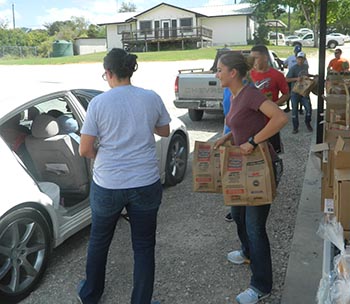
Volunteers load food in cars 350Volunteers load food in cars during a food-distribution day at Christian Family Baptist Church in San Antonio.“It’s so good to be able to reach out to meet the needs of people in our community, both physically and spiritually,” she said. “It’s hard work, but it’s worth it. When you see how what we do is meeting the needs not just of individuals but of whole families, it’s a joy.”

The San Antonio Food Bank presented its Hunger Fighting Team of the Year award to Christian Family Baptist Church for its food-distribution ministry, which receives support from the Texas Baptist Hunger Offering

Trusting God to provide

Rob Johnson expects the church to give away more than 400,000 pounds of food this year.

“We are committed to fighting hunger and malnutrition in this community,” he said.

With that goal in mind, the church eventually hopes to extend its food-distribution ministry beyond once a month.

“We are trusting God will provide the resources,” Johnson said.

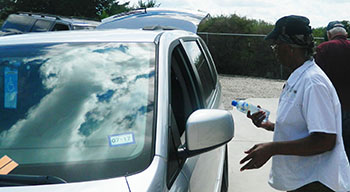
Pearlie Johnson 350Most distribution days, Pearlie Johnson distributes water bottles to clients as they wait their turn for volunteers to load groceries into their vehicles.God already proved faithful, he added. The ministry developed after his mother, Pearlie Johnson, and one of her friends prayed about it for about six months.

“Our seniors started it all. They were 65 and older, and there was no covered pavilion out there then,” he said. “Those senior adults were picking up 40-pound turkeys and loading them.”

Since the church launched the food-distribution ministry, Pearlie said she has missed volunteering “maybe two times.” Most distribution days, she distributes water bottles to clients as they wait their turn for volunteers to load groceries into their vehicles.

“Jesus said whoever gives a cool drink of water in his name will not lose their reward,” she said. “It’s so nice to be able to meet the people. It’s surprising to see so many people come out. It’s amazing to find out there are so many hungry people.”

Read more articles like this in CommonCall magazine. CommonCall explores issues important to Christians and features inspiring stories about disciples of Jesus living out their faith. An annual subscription is only $24 and comes with two complimentary subscriptions to the Baptist Standard. To subscribe to CommonCall, click here.


How to help hungry Texas children

In Texas, one child out of four lives in poverty, and the poverty rates for Hispanic and African-American children are nearly three times higher than for Anglo or Asian children.

“Texas is one of the 10 worst states to be a child,” said Ann Beeson, executive director of the Center for Public Policy Priorities.

Furthermore, food insecurity affects the state’s black and Hispanic children at about twice the rate of white children. In Texas, 38 percent of African-American children and 31 percent of Hispanic children experience food insecurity, compared to 17 percent of white children.

But churches are helping to make a difference, said Jeremy Everett, director of the Baylor University-based Texas Hunger Initiative

Jeremy Everett 300Jeremy Everett, director of the Texas Hunger Initiative at Baylor University, served on the National Commission on Hunger. (Matthew Minard/Baylor Marketing & Communications)Although Texas still has a higher percentage of food-insecure households than the national average, the total number of families in the state struggling to avoid hunger decreased since the end of the last recession, according to a recent report from the U.S. Department of Agriculture. In 2015, the USDA said 15.4 percent of Texas households—about 1.5 million families—were at risk of hunger, but that’s compared to 17.2 percent in the previous year’s report.

“We are thrilled to see individuals and families move beyond hunger to food-secure households,” said Everett, who served on the National Commission on Hunger. “In spite of all the bad news we see reported, this shows that when we choose to be the hands and feet of Christ and to use the gifts of creativity God has bestowed onto his people, that amazing things are happening our world today.”

Everett suggested three actions churches can take to fight hunger:

• Participate in summer meals programs.

The programs benefit children who qualify for free or reduced lunches during the school year.

“A church can be a summer meal site if it is strategically located, or it can help serve at an established site,” he said.

The Texas Hunger Initiative has led the way in enlisting congregations, and participation has increased by 2 million meals since 2011, adding an additional 700 sites.

• Prepare and deliver meals to elderly neighbors and others in need.

Senior adults not only benefit from the nutritious meals, but also thrive on the socialization, he noted.

• Adopt a local school.

“There is no reason not to partner with a local school,” Everett said. “There is a public school with low-income students within easy driving distance of virtually every Baptist church in Texas.”

Churches can provide backpacks filled with nutritious food each Friday for students to take home each weekend. Some churches may offer before-school or after-school programs.

Individual church members also can advocate for students in the schools their churches adopt. Since the 2009-10 school year, Texas has increased free and reduced student participation in breakfast programs by 10 percent, now providing for 1.4 million students. 


CommonCall: Making beautiful music together

BRENHAM—Hands are a marvel. Undoubtedly, the brain is more complex, but the 27 bones, 34 muscles and 123 ligaments of each hand bring ideas to life.

Robert and Martha Haydon have spent decades using the giftedness God placed in their hands for his praise. For the last 40 years, they have played the organ and piano at First Baptist Church in Brenham.

The early years

They met at First Baptist Church in Dripping Springs when she was 15 and he was 16 after the church called her father, Bracy Bledsoe, as pastor.

“Right away, our mothers both started saying: ‘They both play the piano. I bet they’re going to really hit it off.’ Well, we didn’t,” she recalled.

It didn’t take too long, however, before they began to date. At that point, she played the organ at church, and he played the piano.

“Depending on how our Saturday night dates went, that’s how good the music was the next day during the service,” she quipped.

Life as a young married couple

They married in 1968 while he was a pre-med student at the University of Texas at Austin and she was an elementary education major at Southwest Texas State University in San Marcos. They continued to play at the Dripping Springs church throughout their college years.

In 1970, they moved to Galveston so he could attend the UT medical school branch there. In 1972, after playing for a few rehearsals when the regular accompanist was not available, Minister of Music Charles Vance asked him to become the organist and she the pianist at First Baptist Church in Galveston.

The church was much larger than any place they had played before, and the prospect made them both nervous, but they agreed.

“Only God could have orchestrated this huge blessing,” she said.

He played the massive pipe organ there, which Pastor Grayson Glass nicknamed Jezebel, because it often seemed to have a mind of its own.

On to Brenham

They stayed there until 1976, when they moved to Brenham so he could start a family medical practice.

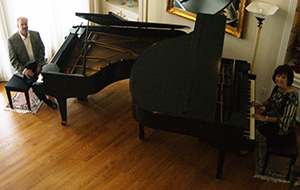
Haydons twopianos GH 300Robert and Martha Haydon have spent decades using the giftedness God placed in their hands for his praise. (Photo/George Henson)First Baptist Church in Brenham already had accompanists leading in worship, so the Haydons they thought they would get a break while he started his practice and she went about the job of mothering two small children.

Within a month, however, the pianist moved to another community, and Martha was asked to take over.

Only a short time later, the organist also decided to quit playing, and the church asked Robert to take over those duties. First Baptist Church celebrated the Haydons’ 40 years of service in September with a reception following a concert.

Four decades of praise at one church

During those 40 years, the Haydons have worked with five pastors and eight ministers of music.

Their zeal for instrumental music has not waned at all.

“Every week, we get excited,” she said. “We’ve had such wonderful people to work with—they’ve kept it exciting.

“Every new music minister brings a whole new set of gifts and talents. He begins to build his team, and that is always our prayer, that we become part of his team and how he sees worship and how he wants to present it. It’s been amazing that we have been gifted with so many great guys.”

Charles Covin, current minister of music at First Baptist in Brenham, calls the Haydons “a dream to work with.”

“From Day 1, they have been the greatest assets in worship. It is such a rare thing to have the ability they have, but also the humble servant-hearted attitude that you are looking for in worship leaders,” Covin said.

Offering a sacrifice of praise

The Haydons do more than play musical instruments, however. They lead in worship by worshipping.

“It’s our gift that we are presenting to God,” Robert said.

“Playing is our sacrifice of praise,” Martha added. “It is what brings us to his throne. Even if it isn’t perfect, that isn’t the important thing. The important thing is the heart that is going into the music. We strive for excellence—I don’t mean that’s not important—but that’s not the No. 1 thing.”

The longevity of their service has made for deep and lasting relationships with many in the congregation.

“What we’ve been through these 40 years is a part of their family, part of their lives,” Martha said. “We’ve help wed them; we’ve played as they have buried their parents. It’s like with Robert in his medical practice—for some families, he sees five generations. We’ve had that same relationship with our church family. It’s such a blessing.”

Communicating with God through music

Throughout the years, from Dripping Springs to Galveston to Brenham, God provided opportunities for the Haydons to minister through their musical talents. They have played so long, it is hard to imagine not playing each Sunday.

“If we weren’t doing it, there would be a huge hole,” Martha said. “ That’s one facet of my communication with the Lord. We all pray, read our Bibles, go to Bible study and church services and any special thing we can to enhance our growth, but we have the privilege also—like anyone who has a talent, because there are so many types of talent—to use that as another venue to communicate and worship—to grow spiritually.

Their talent progressed to a calling.

“When I was 14 and we were at Immanuel Baptist Church in Temple, I felt a definite calling to special ministry,” she said. “I didn’t think it was for mission work, but for a special calling. I think that is what God is still doing—honoring my commitment to do a special service for him.”

In addition to the day-to-day ministry, they also look forward to the large seasonal presentations, such as Christmas and Easter, Robert added.

Forty years is worth celebrating, Covin pointed out.

“Especially to be a husband and wife team that have done it so well for so long, it is really unique,” he said. “Their ministry is appreciated now as much as it has ever been. There have been a number of ministers of music here who have passed the torch to one another, but they have been the one constant. They have been consistently pouring out their abilities, compassion and love for worship and music out into this community and into this church for four decades. That is special.”

Read more articles like this in CommonCall magazine. CommonCall explores issues important to Christians and features inspiring stories about disciples of Jesus living out their faith. An annual subscription is only $24 and comes with two complimentary subscriptions to the Baptist Standard. To subscribe to CommonCall, click here.


Baylor regents to post future board minutes; not enough, reform group says

WACO—Baylor University’s board of regents announced plans to make public the minutes and agendas of all future meetings, but a group of donors and alumni calling for reform at the university wants more.

Bears for Leadership Reform—which includes high-profile donors such as Drayton McLane of Temple and John Eddie Williams of Houston—issued a call Nov. 18 for the regents immediately to release all minutes and agendas from the past five years. The Baylor Bears’ football team plays in a stadium named for McLane and on a field named for Williams.

Board chair pledges increased transparency

In a Nov. 15 update posted on the webpage Baylor created to provide information about its response to reports of sexual violence, Regents Chair Ron Murff wrote, “We are committed to taking immediate action to increase transparency such as posting agendas and minutes of our quarterly meetings.” 

Murff also noted the Nov. 9 creation of a governance review task force that will recommend changes to board practices and procedures.

“We have heard the concerns of our community and pledge to listen and respond to calls for increased transparency and accountability,” Murff wrote.

Regarding the creation of Bears for Leadership Reform, he stated, “We welcome and embrace their recommendations for more transparent leadership.”

‘Not nearly enough or timely enough’

Williams, a Houston attorney who serves on the board of Bears for Leadership Reform, characterized the regents’ response as inadequate.

“The recent announcement by the board of regents is a step in the right direction, but it is not nearly enough or timely enough,” Williams said. “This is just a small, symbolic gesture on the part of the board of regents. What the Baylor family deserves is the full truth—not just bits and pieces dribbled out every few weeks as directed by the board’s California PR firm.”

Ad appears in Waco newspaper

Bears for Leadership Reform purchased a full-page advertisement in the Nov. 19 Waco Tribune-Herald saying, “The Baylor family deserves the facts.” 

The ad states: “It’s time for the board of regents to tell the Baylor family the whole truth about recent tragedies and fully explain its decisions. There’s been too much secrecy. We want transparency. There’s been too much innuendo. We want accountability at the top.

“This is not about football. This is not about a single person. And this cannot be about protecting the brand or the board. This is about restoring integrity in our university. This is about rebuilding trust in our leadership. This is about making sure nothing like this ever happens again. We are calling all Bears to join us today and make your voice heard. We are 10,000 strong and growing.”

The advertisement appeared nine days after Bears for Leadership Reform held its inaugural public meeting in Waco. Speakers at that event included former Texas Gov. Mark White and legendary Baylor football Coach Grant Teaff, who led the opening prayer. 


Foundation salutes excellence in missions

WACO—The Texas Baptist Missions Foundation presented its annual Adventurer, Innovator and Pioneer Awards during a luncheon at Texas Baptists’ annual meeting.

Charles Whiteside from First Baptist Church in Kilgore received the Adventurer Award, given to an individual or organization who has advanced missions through outstanding financial support or leadership in ministry opportunities.

In presenting the award, John LaNoue, veteran Texas Baptist disaster relief leader, remarked how Whiteside always has worked hard and enthusiastically in all he does. He recalled recruiting Whiteside’s help years ago to build a mobile health clinic to send to the Rio Grande Valley.

“We prayed as much as we worked, and we built that mobile clinic in a school bus in about 22 days,” LaNoue said. “Recently, now that he’s retired, he became a chaplain, and now he has an outreach to business groups. You just can’t stop the guy! He started a whole new avenue of service for the Lord.”

John Crowder, pastor of First Baptist Church in West, accepted the Innovator Award, presented to the church by Tim Randolph, director of the Waco Regional Baptist Association.

The Innovator Award recognizes those who provide a model for missions that others can follow and duplicate. First Baptist in West set an example for other churches in its nimble response to the fertilizer plant explosion that rocked its town in 2013.

The church had spent years building trust throughout the community, making it uniquely positioned to respond when the time came. In the wake of tragedy, the church met physical and spiritual needs.

“Our church is experiencing a tremendous revival. In each of the past two years, I’ve baptized more people than probably in the 20 previous years combined,” Crowder said. “It is remarkable to see what God is doing in our community, in our church.”

Kay Bacon, mission associate at First Baptist Church of Temple, accepted the Pioneer Award on behalf of her church. Jerry Carlisle, vice president of the Texas Baptist Missions Foundation, presented this award. The Pioneer Award celebrates individuals or churches who have demonstrated longtime leadership in beginning mission work that has impacted Texas Baptist life.

“They’ve relied on the power of the Holy Spirit, and they’ve embedded and entangled missions,” Carlisle said. “It’s not a program at First Baptist Church of Temple. It’s a theme, a purpose, a vision that influences everything.”

At the luncheon, Texas Baptist Missions Foundation President Bill Arnold announced a fund-raising initiative to build a new Baptist Student Ministries building on the Texas Tech University campus. A $800,000 lead gift has been secured toward this effort, and additional contributions are needed to bring this project to life, he said.

Lauren Sturdy works for Buckner International.