Texas Baptist Hunger Offering marks 20 years of meeting needs

WACO—The Texas Baptist Hunger Offering celebrated its 20th year connecting churches to ministries that meet nutritional needs of people living in poverty and develop long-term solutions.

Through 20 years of giving, Texas Baptists have raised $15.5 million, which has been disbursed through worldwide ministries combatting hunger and poverty.

“I like what Phil Strickland used to say,” said Charlie Whiteside of First Baptist Church in Kilgore, quoting the long-time director of the Texas Baptist Christian Life Commission. “‘Empty stomachs don’t have ears.’ Our first goal should be winning people to the Lord.”

Top givers recognized

Whiteside was recognized as the top individual donor to the hunger offering over the last 20 years during a celebration luncheon immediately following Texas Baptists’ annual meeting.

First Baptist Church of Midland was recognized as the top giving church both for the last 20 years and for 2015. 

“There’s only two miracles all four gospels record consistently—Jesus’ resurrection and feeding the 5,000,” said Darin Wood, pastor of First Baptist. “Jesus knew meeting physical needs was important. The gift to the hunger offering is a reflection of the church’s generosity.”

In addition to First Baptist in Midland, the rest of the top 10 giving churches to the hunger offering in 2015 were Wilshire Baptist Church in Dallas, Pioneer Drive Baptist Church in Abilene, First Baptist Church in Saginaw, Southland Baptist Church in San Angelo, First Baptist Church in Longview, First Baptist Church in Brenham, North Side Baptist Church in Weatherford, First Baptist Church in Kilgore and Macedonia Missioary Baptist Church in San Antonio.

Sandy Mountain Fellowship of Sunrise Beach was this year’s top per capita giving church.

Building relationships

Ali Hearon, hunger and care ministries specialist with the CLC, said in addition to seeing the hunger offering grow in size and scope of service, the future also will include relationship-building.

“These past 20 years have been bright and full,” Hearon said. “Churches have connected with ministries and ministries with churches. Individuals have gathered around the issue of hunger. The future of the offering is to continue to generate opportunities for people who feel called by God through support and ministry.” 

This year, Texas Baptist churches’ gifts to the Hunger Offering supported the work of 182 distinct ministries that met short-term relief needs and developed long-term solutions to poverty. 

“I would love to see the offering be a place for ideas and relationship generation,” Hearon continued. “I would love to see the offering be a hub where people can network and have ideas for more development models.”

Introducing people to Jesus

Carol Dorman runs i58, the food pantry ministry at Royal Haven Baptist Church in Dallas, which receives support from the hunger offering.

Carol Dorman 300Carol Dorman runs i58, the food pantry ministry at Royal Haven Baptist Church in Dallas, which receives support from the hunger offering.“Fourteen years ago, Griselda walked across the Rio Grande with her children to escape an abusive relationship,” Dorman recalled. “We helped with food, rent and clothes (for her children). In the time we’ve known Griselda, she has received a green card, a Social Security card, got a job, started paying taxes, has a Texas driver’s license and insurance.”

Dorman called the ministry a tool for building relationships.

“The most important part is that Griselda and her two oldest daughters, Teresa and Becky, met Jesus Christ as their Lord and Savior,” she said. “We met their physical needs first, we built a relationship, we built trust and then we introduced them to our very best friend.”

Sustaining families

Another ministry recipient is the Buckner Center for Humanitarian Aid, which ships water filtration, medicine, food, shoes and various support materials to nongovernmental organizations all over the world.

“It’s not just about eating,” Buckner President and CEO Albert Reyes said. “It’s about sustaining families.”

Buckner also uses hunger offering support to feed people and to teach gardening and sustainability in Mexico and in colonias along the Rio Grande. 

“I stop and think right now what it must have been like when Jesus had 5,000 people to feed,” Reyes said. “The disciples were encouraging him to make the people go away. Of course, Jesus fed the crowd. Because of the hunger offering, we don’t have to send anybody away hungry.”

During the Baptist General Convention of Texas annual meeting, messengers and guests contributed $4,414.46 toward the Texas Baptist Hunger Offering. 


Strobel encourages Texas Baptists to ‘make people thirst for God’

WACO—Lee Strobel invited Texas Baptists to “live on the evangelistic edge,” where ordinary days can take extraordinary twists as Christians allow God to ambush them with opportunities to share their faith.

Strobel, a teaching pastor at Woodlands Church in Houston and professor of Christian thought at Houston Baptist University, preached at the Baptist General Convention of Texas annual meeting.

Be salt and light

He cited the passage from the Sermon on the Mount in which Jesus calls Christians to be the salt of the earth and the light of the world.

“What did Jesus mean by those metaphors of salt and light?” Strobel asked. “I think he was saying: ‘If you’re a follower of mine, I want you to live lives that are like salt, that make people thirst for God. I want you to live lives that are like light, that shine my message of hope and grace and love and compassion and forgiveness and eternal life, to shine my message of hope into dark areas of despair.’”

Living on the evangelistic edge requires Christ’s followers to engage lost people as Jesus would, Strobel said. When Christians study Jesus’ life, they see many ways he does this, but Strobel honed in on two—prayer and openness to questions.

Pray for the spiritually lost

“I can’t think of anything Jesus embarked upon of significance that he didn’t first bring it to the Father in prayer. In fact, have you ever thought about the fact that Jesus’ prayers for spiritually lost people continued right up until his final gasps on the cross?” he asked.

“In light of that, how can we justify not praying consistently and fervently and expectantly for lost people in our lives? What if tonight you’re alone in your room and Jesus physically appears to you. And what if he looks at you and says, ‘I am going to answer every single prayer that you prayed last week.’ If Jesus said that to you tonight, would there be anybody new in the kingdom of God tomorrow?”

Strobel challenged ministers to apply this principle by asking each member of their congregation to pray for one lost person for one minute at 1 p.m. every day.

Be open to questions

He also urged Texas Baptists to be open to questions. Strobel pointed to John the Baptist, who had been sure of who Jesus was and proclaimed it on many occasions. But even John had doubts and questions after he was thrown in prison. He recruited a few of his followers to find Jesus and ask him point-blank whether he was the Messiah they had been waiting for.

“It’s OK for us, as followers of Jesus, to have questions,” Strobel said. “It’s even OK to have certain doubts, as long as we pursue answers. The problem is too many people get squelched by their church when they ask a question, when they express a doubt.

“We need to create safe places in our churches, in our homes, in our communities, where believers feel free to express honest questions about the faith. And we in our churches need to be ready, as 1 Peter 3:15 says, to help our spiritually confused friends, our lost friends, get answers to the spiritual sticking points that are holding them up in their journey toward God.”

On the evangelistic edge

Living on the evangelistic edge is exciting, Strobel said. It’s always an adventure to follow the guidance of the Holy Spirit as Christians try to reach lost people.

He told the story of one of his evangelism attempts as a new Christian when he was still working as a newspaper editor in Chicago. Easter was coming soon, and he felt led by God to invite his atheist coworker to church.

“I thought: ‘This is great! If God is prompting me to do this, something wonderful is probably going to happen. He’s probably going to repent right there.’ I had a lot of confidence,” Strobel said.

Strobel tried several invitational approaches, but his friend swiftly shut him down each time, finally saying, “I don’t want to go to your stupid church.”

He left the office confused. Why had he felt so compelled to invite his friend, only to be shut down? Strobel said it bothered him for years, because to this day, his friend still is an atheist.

The rest of the story

But the story does not end there.

“Several years after that, I was a pastor of Willow Creek Church, and I just preached, and I went down off the platform and a guy came up to me and said, ‘I need to shake your hand and thank you for the spiritual influence you’ve had on my life,’” Strobel recalled.

The man said several years earlier he’d lost his job. He had no money and was in danger of losing his home and car. He called up a friend who had a newspaper and asked if there were any odd jobs he could do.

“One day, not long before Easter, I was in the business office of the newspaper,” the man told Strobel. “I was on my hands and knees behind a big desk on the floor working on some tile, and you walked in the room, and I don’t even think you knew I was there.

“You started talking to this guy about God, and you started inviting him to your church, and you gave the evidence that Jesus rose from the dead, and this guy was shutting you down. I’m on my hands and knees working on this tile, listening to all this, and I’m thinking, ‘I need God.’ As soon as you left, I picked up the phone and called my wife and said, ‘We’re going to church this Easter.’”

“It’s a new form of evangelism—ricochet evangelism,” Strobel said. “You share your faith, it bounces off a hard heart, and you don’t know where it’s going to go! This is the unexpected adventure of the Christian life. You don’t want to miss this.”

Lauren Sturdy works for Buckner International.


Denison urges churches to prepare before receiving same-sex wedding request

WACO—Ministers and the churches they serve need to be prepared for the time when they will be asked to perform same-sex marriages, theologian and social analyst Jim Denison told Texas Baptists.

Decisions should be made in advance, based on serious biblical study and reflection—not in reaction when a couple approaches the pastor, he suggested.

Timely topic for Texas Baptists

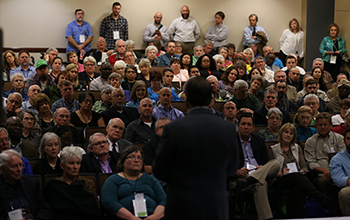
Denison SRO 350A standing-room-only crowd listened to Jim Denison discuss same-sex marriage. (Photo / Robert Rogers / Baylor University Marketing and Communication)Denison addressed a standing-room-only crowd as he led a workshop on “Same-sex Marriage and the Future of the Family” during the Baptist General Convention of Texas annual meeting.

The founding president of the Denison Forum on Truth and Culture began with a three-point summary of his position: “Homosexual activity is wrong. This sin is not unforgivable. God loves us all, LGBT people included.”

He acknowledged the topic’s timeliness but insisted the session was planned long before two LGBT-affirming congregations and their relationship to the BGCT became a matter of concern to Texas Baptists.

A few days before the annual meeting, BGCT officials notified First Baptist Church in Austin and Wilshire Baptist Church in Dallas an affirming stance toward LGBT members would place them outside the bounds of “harmonious cooperation” with the state convention.

Exploring the Scripture

Churches need to understand the issues surrounding homosexuality from a biblical perspective, Denison insisted, focusing on several biblical references traditionally understood as prohibiting homosexual practices.

Genesis 19 tells the story about how and why Sodom and Gomorrah were destroyed, but it does not apply directly to the subject of same-sex marriage, he said. The story describes homosexual rape—not consensual sexual activity in committed relationships, he noted.

Instead, Denison concentrated on two other Old Testament verses and three New Testament passages.

Looking at Leviticus 18:22 and 20:13, he disputed the idea the verses were part of a holiness code applicable only to priests, saying the verses in question applied to the entire nation of Israel.

He also dismissed the argument that the verses do not apply because they were part of the Old Testament law. Unlike dietary restrictions, which were specifically overturned in the New Testament, these verses served as the foundation for several New Testament passages related to the subject, he said.

New Testament teaching

Denison described Romans 1:26-27 as “a critical passage” in forming a biblical view about homosexual behavior. He disputed the arguments of some contemporary interpreters who have applied the passage only to oppressive relationships, such as the abuse of young male servants by their masters.

The passage describes people of the same sex “consumed with passion for one another,” he noted, saying, “That describes consensual, not just oppressive, relationships.”

Two other passages—1 Corinthians 6:9-10 and 1 Timothy 1:8-10—list homosexual behavior in a list of other vices, he observed.

“We are all broken sexually,” he said. The fall of humanity infected every aspect of human behavior, he explained, but Christians for 20 centuries have understood the monogamous union of one man and one woman as the biblical standard.

Refuting arguments

Denison also disputed the argument the biblical writers were unaware of committed and consensual homosexual relationships. Both ancient Canaanite culture and the Greco-Roman world celebrated same-sex relationships.

“Same-sex marriage was legal in the Roman Empire until 342 A.D.,” he noted.

Denison also rejected attempts to frame LGBT rights activism as the 21st century equivalent of the Civil Rights movement.

“Race is inherited. The origin of homosexual orientation is in dispute,” he said. “Race cannot be chosen. Homosexual activity—not orientation but behavior—is a choice.”

Thanks to the First Amendment and separation of church and state, American Christian churches face no immediate threats, but they should be aware of the discrimination Christians who oppose same-sex marriage have faced in other countries, Denison said. For instance, Canadian churches have seen their tax-exempt status threatened, and Denmark requires churches to conduct same-sex marriages, he said.

Once marriage is defined as anything other than one man and one woman, it opens the door to further redefinition, such as polygamous unions, he added.

Suggestions for Christians

Rather than feel threatened by same-sex marriage, Denison offered four suggestions to Christians:

  • “Engage the issue with a positive spirit.”
  • “Be prepared to defend biblical beliefs.”
  • “Make clear the religious liberty implications.”
  • “Engage graciously with same-sex marriage leaders and the LGBT community.”


LaRue urges Texas Baptists to proclaim the gospel to everybody

WACO—When the world recognizes the golden arches of McDonald’s more readily than the Christian cross, the church has work to do, Cleophus LaRue told the Baptist General Convention of Texas annual meeting in Waco.

The story of the gospel is for everyone, and it is every Christian’s job to go tell it, said LaRue, the Francis Landey Patton professor of homiletics at Princeton Theological Seminary.

LaRue based his sermon on Acts 17:16-21, where Paul is found struggling to spread the gospel message in Athens, a proud city widely considered to be the cultural and intellectual capital of the Roman Empire.

“Her artists had filled her streets and temples with statues of the gods,” LaRue said. “Her myriad buildings and innumerable works of art stood in silent testimony to her former grandeur and greatness. Athens was some city, but it was a tough place for the gospel.”

A mission to Athens was not on Paul’s original itinerary. Instead, he arrived there on a wing and a prayer, having been rerouted when things hadn’t gone according to plan at other stops along his journey.

“He did not arrive in Athens fresh and friendly,” LaRue said. “He arrived there disheveled, unkempt, bedraggled, woebegone, battle-scarred and road weary, and because he was already in a bad mood when he arrived in Athens, instead of seeing a city filled with beautiful works of art, he saw a city full of idols.”

Paul might have been better received by the Athenians if he’d taken a moment to appreciate the city’s aesthetics and culture, LaRue suggested, but “when you’ve been stoned in Lystra, jailed in Philippi, threatened in Thessalonica and hounded out of Berea, it’s understandable that you might not be in a sightseeing mood when your friends drop you on the outskirts of Athens.”

Paul’s preaching in the Areopagus didn’t result in a mass revival in Athens. Luke reported some people scoffed, others wanted to hear Paul speak further, and some believed. Even though Paul is one of the greatest theologians and preachers in Christianity, only some believed, LaRue stressed.

LaRue encouraged pastors to remember—no matter how many preaching classes they take or how much homiletical theory they study, not everyone sitting before them on a Sunday morning will believe.

Paul’s apparent defeat in Athens raises a reasonable question: “Why bother? Why not move along to a place where the gospel might be welcomed?”

“The writing on the wall is clear: This gospel is to be proclaimed to everybody, even if only received by some,” LaRue said. “That’s why Paul has to go to Athens. That’s why Paul had to preach under less-than-ideal circumstances. Because this gospel that we proclaim is meant to be preached to all, even if only received by some.”

LaRue encouraged Texas Baptists not to lose heart when ministry gets hard.

“Sometimes we do our best work under life’s most austere and trying circumstances,” he said. “Sometimes we do our best work when the load is heavy. Sometimes we do our best work when life finds us in a place that we would prefer not to be and we hope not long to stay.

“When life finds you there, do not bemoan your plight,” LaRue said. “Like the Apostle Paul, lift up your head and lift up your heart and go forward with the work God has assigned you to do.”

Lauren Sturdy works for Buckner International.


Maciel urges Texas Baptists to give themselves to God

WACO—Baptist General Convention of Texas President René Maciel urged Texas Baptists to ask themselves a penetrating question: “Can you honestly say you’ve given yourself to God this year?”

During his presidential message to the BGCT annual meeting, Maciel called on Texas Baptists to reimagine Christian ministry in the context of living in faith and surrender, saying in light of Jesus’ work, Christians can disagree and still love.

“Is it so much about programs and things and ideas that we lose focus of a God who loves us and wants to have relationship with us?” Maciel asked.

After nearly 10 years as president of Baptist University of the Américas, Maciel took a position as community pastor at First Baptist Church of Woodway in Waco this past September. 

Maciel referenced his service to BUA, saying God developed his understanding of what it means to minister the gospel in service to others during his time at the university. 

“When we do offer ourselves to God, we do so with a divided heart,” he said. “We give more time and attention to other things around us.”

In surrender, the church should not lose sight of what God has called it to do, he said.

“God wants all of us,” he said. “He wants me to surrender all that I am and all that I have. Every day is a worship experience. You cannot fulfill God’s purpose for your life when you focus on your own plans.”

Maciel’s address helped Tamiko Jones, minister of missions and young adults at Bethlehem Baptist Church in Mansfield, reflect on her own journey.

“It made me ask myself, ‘Am I giving my all?’” she said. “These last two years of ministry have been a walk of faith. I was an engineering manager. God called me to ministry, and I didn’t have a job to go to.”

After 16 years of corporate work experience, Jones said, she felt called to full-time ministry. 

“When I know I’m serving in obedience, I have a sense of not having to be in control of things. I am in his providence,” she said. “Surrender is hard. But once you do it, there’s no going back.” 


Executive director highlights new ministries and expanding work

WACO—Texas Baptists are engaging in new outreach opportunities with people groups in Texas and beyond, Baptist General Convention of Texas Executive Director David Hardage reported to the convention’s annual meeting.

“As you know, Texas is a changing state, becoming very diversified, and we can talk about that in a variety of ways,” Hardage said. “Culture and ethnicity are at the top of the list.”

In response to the growing refugee population in Texas, Leonid Regheta joined the BGCT staff to oversee Project:Start, a refugee resource center serving 30,000 refugees in the Vickery Meadow area of Dallas.

A refugee himself, Regheta understands the immediate needs immigrants have when they arrive in the United States. Through Project:Start, refugees are connected with resources such as clothing, food and housing.

“We want these refugees to know Jesus Christ as their Savior,” Hardage said.

Another ministry emphasis aimed at reaching Texans with the gospel is the unApologetic conferences, providing churches with information on how to contend for faith in an ever-changing culture, Hardage said.

“We want to remove the hurdles to evangelism,” said Leighton Flowers, who will oversee the conferences. “Through the art of persuasion, we are appealing to the heart and the mind. It helps people understand why we believe what we believe.” 

More than 147 unreached people groups live along the Amazon in Brazil. To reach people in this region, Texas Baptists entered into an agreement with Brazilian Baptists, Hardage reported. Through the new Missionary Adoption Program, churches can co-sponsor an indigenous missionary in the Amazon, along with a partnering Brazilian church. 

Hardage introduced special guests Vanderlei Marins, president of the Brazilian Baptist Convention, and Fernandao Brandão, executive director of the Brazilian National Mission Board. Jair Campos, originally from Brazil, will work with the BGCT to help connect churches with missionaries. 

“We hope you will prayerfully consider how your church can support a missionary in Brazil, the Amazon and beyond,” Hardage said.

He also introduced staff members working in cross-cultural mobilization and in music and worship.

“It’s going to take more ways and more people to reach the world for Christ than what we are doing now,” Hardage said.


Service essential in following Jesus, Todd Still says

WACO—The last will be first and the first will be last in Jesus’ topsy-turvy kingdom, Todd Still, dean of Baylor University’s Truett Theological Seminary, told a workshop at the Baptist General Convention of Texas annual meeting.

Focusing on Mark 10:35-45, Still reminded his listeners about how two disciples of Jesus, James and John, made a shockingly bold request—to sit at the immediate right and left of Jesus in his glory.

Headed on the road from Jericho to Jerusalem, it seemed to them the ideal time to ask about how the pecking order would soon shake out, Still noted. At this point in his ministry, Jesus was drawing crowds wherever he traveled, and his disciples had “begun to live large,” he said.

“The period of obscurity is followed by the period of popularity,” he said. “The crowds begin to swell, and you think that this is a good gig, because all the sudden, here comes the kingdom and you’re riding in on Jesus’ coattails.”

“James and John were not upstart disciples,” he said. “They had followed hard after Jesus for some three years now, and so it is as surprising as it is disturbing that they would approach Jesus and say, ‘Teacher, we want you to do for us whatever we ask.’”

Their request suggests that they viewed Jesus’ glory as imminent, Still noted. If he were preparing to reign as king, they wanted to be the first to secure a prime spot in his cabinet, he said.

In the verses immediately preceding the passage, Jesus predicts his impending death and resurrection for a third time. In the verses following the passage, Jesus restores sight to a blind, begging man named Bartimaeus.

Jesus foretells his death for the third time in Mark 10:32-34 because his disciples constantly are missing the point, Still noted. They need repetition for the truth to sink in.

The timing of James’ and John’s request for a prominent seat is a strong sign they still “don’t get it,” even after being told repeatedly. They’re quick to assure him they can drink the same cup and be baptized with the same baptism, but they have no clue what they’re asking. They don’t understand the agony that will mingle with Jesus’ glory, Still said.

The healing of blind Bartimaeus in Mark 10:46-52 reinforces the disciples’ blindness. Unlike Bartimaeus, however, they don’t know how in-the-dark they are, Still said.

The other 10 disciples miss the point, too. They become indignant when they hear of James’ and John’s request—not because of how galling it was, but because they wish they had gotten there first. 

At this, Jesus tells them to take a timeout. He explains his kingdom is not like any might-makes-right, militaristic rule they’ve seen before.

“In Jesus’ day, (people) boasted about the Pax Romana, but the Roman peace comes at a price,” Still said, “And it’s usually the Roman boot on the neck of a subject.”

Jesus’ paradigm is different. 

“This (violent expression of power) is not the way we are,” Still said. “This is not the path we trod. Instead, ‘whoever wants to be great among you must be your servant, and whoever wants to be first must be slave of all.’”

Still offered three contemporary applications of Jesus’ teaching on service.

  • First, service isn’t optional; it’s essential. It’s part and parcel of conversion to turn from idols and serve the true God instead.
  • Second, in Jesus’ kingdom economy, service is tantamount to greatness. The woman who anointed Jesus’ feet with perfume is a prime example; the disciples saw her sacrifice as folly and waste, but Jesus declared that wherever the gospel is told, her story would be shared.
  • Third, Christians are never more like Jesus than when they serve.

The attitude of conspicuous consumption has come home to roost in the church, Still said. From nitpicking the worship song selections to complaining about the lack of donuts, too many Christians treat church like an Olympic performance to be scored on a 1-10 scale. 

Matthew 25:40 says: “The King will reply, ‘Truly I tell you, whatever you did for one of the least of these brothers and sisters of mine, you did for me.’”  

“What if we were going to change our habit of mind and say, ‘How might I serve the Lord alongside this church? How might I serve the Lord alongside this convention?,’” Still asked.

Lauren Sturdy works for Buckner International.


BGCT recognizes nine churches for Cooperative Program giving

DALLAS—At the Baptist General Convention of Texas annual meeting in Waco, Texas Baptists recognized nine churches for their giving to the Cooperative Program unified budget.

The BGCT recognized five congregations as top givers based on church size— Green Acres Baptist Church in Tyler, Pioneer Drive Baptist Church in Abilene, Bacon Heights Baptist Church in Lubbock, First Baptist Church in Caldwell and South Seminole Baptist Church in Seminole.

Four churches were recognized for top giving among ethnic congregations—The Fort Bend Church in Sugar Land, Chinese Baptist Church in Houston, Northside Community Church in San Antonio and Vietnamese Baptist Church in Houston.

“South Seminole Baptist Church is a small church in a small West Texas town that has a big heart and a generous heart,” said Ricky Guenther, pastor of the church in Seminole. “Helping people—whether in our town, our state, our nation or our world; it is important to each of our church members.

“And being able to do this through the Cooperative Program allows us to accomplish one of the many tasks our church has. We feel it is our commission to give to help but also to go and help. At South Seminole Baptist Church, we believe in missions, the Cooperative Program and being a Texas Baptist church.”

Bacon Height Baptist Church in Lubbock gives to missions because the congregation values the “collaborative partnership” it represents, Pastor Jason Atchley said.

“Giving and going on mission are the heartbeats of the Cooperative Program and the overall DNA of Bacon Heights Baptist Church,” Atchley said.

In 2015, Texas Baptists churches contributed $30.2 million for causes in Texas, including ministerial scholarships for university and seminary students, financial support to help churches start churches, Baptist Student Ministries on 115 university campuses statewide, chaplaincy, health and human care ministries, and Texas Baptist Men.

“Participating in the Cooperative Program helps us accomplish our mission not only locally, but also globally,” said Stan Allcorn, pastor of Pioneer Drive Baptist Church in Abilene. “Just as Jesus multiplied what was placed in his hands by the young lad, so too, the Cooperative Program multiplies the influence and gospel impact of our congregation worldwide.”

In addition to Texas causes, Texas Baptists churches provided $13.1 million last year to Cooperative Program giving for the Southern Baptist Convention, the Cooperative Baptist Fellowship, and worldwide Texas initiatives and partnerships, for an overall $43.3 million total in Cooperative Program giving.  

“Over the past 91 years, Texas Baptists have seen God do some amazing things through the unselfish giving of partnering churches,” said Chris Liebrum, director of BGCT Cooperative Program ministry.


BGCT approves decreased budget

WACO—Messengers to the Baptist General Convention of Texas annual meeting approved a decreased 2017 budget.

The 2017 operating budget totals $36,638,274, compared to $37,996,806 for 2016.

Messengers authorized 2017 net budget allocations of $34 million, down $1.42 million from the current spending plan. It depends on $29.6 million in Cooperative Program receipts from churches, compared to $31 million in the 2016 budget. The approved budget anticipates $4.4 million in investment income.

In addition, the 2017 budget includes more than $2.6 million in additional revenue from the North American Mission Board, conference and booth fees, product sales and other miscellaneous sources.

Messengers also approved continued division of undesignated receipts from affiliated churches, with 79 percent allocated for the BGCT and 21 percent for worldwide causes. Each church determines the recipient or recipients of its worldwide giving. The division of funds means a projected $1.3 million for Texas worldwide missions initiatives and partnerships, compared to $1.47 million in 2016.

In other business, messengers voted to:

  • Amend the certificates of formation and bylaws for the Baptist Foundation of Texas­—now doing business as HighGround Advisors—and Baptist Health Foundation of San Antonio. In both instances, the BGCT ceases to be the sole member of the corporation, and the entities become no-member nonprofit organizations, like most other BGCT-related institutions. The amendments also allow HighGround Advisors to serve non-Baptist charitable organizations whose mission and purpose are not inconsistent with Baptist faith and belief.
  • Amend the BGCT bylaws to change the name of the Committee on Convention Business to the Committee on the Annual Meeting. The change aligns the committee description in the bylaws with the BGCT constitution.
  • Approve termination of the Hendrick Medical Development Corporation, which no longer serves any purpose, at the request of the Hendrick Medical Center board.


Faith is vital to Christian higher education, BGCT university leaders say

WACO—Faith is a crucial factor in Christian higher education, both for students and for the leaders who guide them, presidents of Texas Baptist universities reported.

Leaders of four of the Baptist General Convention of Texas’ nine affiliated universities participated in a panel discussion, “The Future of Christian Higher Education,” during the BGCT’s annual meeting in Waco, Nov. 14.

Need for spiritual formation

One of the great challenges the schools face is the poor status of spiritual formation among their students, said Eric Bruntmyer, president of Hardin-Simmons University in Abilene.

“Students are not coming prepared spiritually,” Bruntmyer lamented. “We have a responsibility to our students to transform them from being a church-goer to walking with Christ—every day, all day long.”

Pointing to a similar issue, Adam Wright, president of Dallas Baptist University, cited the philosophical challenge of “dealing with students who will reject the very leadership they crave.”

Living with differences

Many students also carry the spiritual challenge of polarization to their campuses, Wright added, noting the schools must “help students understand just because someone is far-left or far-right, they don’t have to hate or reject them.” This pattern illustrates the need for cultivating Christian peacemakers, he added.

Similarly, Bobby Hall, president of Wayland Baptist University, whose historic residential campus is located in Plainview, noted his school conducted a year-long emphasis on “civility in the Christian context” and is following up with an emphasis on “be the solution.”

Faith must be cultivated

Spiritual formation and faithful preparation are not exclusively issues of concern for students, the presidents said, noting these issues present daily challenges for the presidents themselves.

“Knowing and discerning God’s will is the greatest challenge,” said Blair Blackburn, president of East Texas Baptist University in Marshall. Each day, he must seek to understand “what God wants us to do as a university” and follow the Spirit of God, he added.

The presidents’ spiritual conditions are so vital “because people are watching us,” he acknowledged.

“Faith has to be cultivated every day,” Wright said. “Faith precedes and conditions one’s understanding. … If I truly believe what I say I believe, it will shape everything I do.”

Relying on the Bible

Studying and meditating on Scripture every day helps Bruntmyer face challenges, he explained.

“There’s a lot of fear I have about the future—about higher education, about my kids. … That crawls right up on your back,” he acknowledged, adding Scripture keeps fear at bay.

Pondering the Bible’s messages of hope and prayer provide the only way to endure, Bruntmyer said, noting, “I don’t know how people make it without talking to God every day.”

“We wrap our actions and strategies in prayer,” Hall agreed. “We must go to the Lord and seek that discernment. … We know who wins at the end of the day.”

Practical challenges faced

In addition to spiritual issues, the presidents cited several practical challenges Texas Baptist universities face. They include:

• Affordability.

This is the greatest strategic challenge, Blackburn said. “Students are coming to our campuses with hands out, expecting their education to be paid for, (coming) from families who have not prepared very well for paying for higher education.”

This issue is compounded by “the national conversation questioning if higher education is worth it,” Hall added.

The schools are working hard to make higher education affordable, Bruntmyer said, noting they try to deliver education efficiently, cutting costs where possible.

Several schools offer block tuition, so students can take additional courses at a fixed cost. They also try to guide students to take accelerated courses and graduate in fewer than four years, Blackburn said.

The presidents pushed back on advice against taking out student loans.

Bruntmyer compared a $20,000 loan—“less than the cost of a car”—to the additional earning potential of $600,000 to $900,000 that a college degree delivers. He says refusing to take a college loan is ridiculous and assures students, “You can afford it.”

Hall noted 40 percent of students do not buy textbooks and said Wayland is working on a “textbook solution.”

Wright reported DBU Chancellor Gary Cook is trying to raise $100 million for scholarships, and other presidents said adding scholarships is a priority.

Blackburn thanked the BGCT for providing funds to enable ministry students to afford higher education.

• First-generation students.

Wayland educates many students who are the first individuals in their families to seek higher education, Hall said. Other presidents agreed convincing first-generation students to seek a college degree and convincing their families the degree is worth the cost is vital.

• Student mindset.

Disrespect for authority, feelings of entitlement and an attitude of “consumer demand” also are challenges, Blackburn said.

• Religious freedom.

Challenges to religious freedom are huge, Hall reported. He noted, for example, the cost of compliance to federal regulations places a strain on campus budgets.

The central factor in the universities’ religious freedom is Title IX, the federal law that seeks to protect students from discrimination on the basis of sex. The typical flash points are campus response to sexual abuse, as well as potential for discrimination based upon sexual orientation.

The Title IX “train has left the station, and it is not going to change with the change of (presidential) administration,” Blackburn said. “We have a responsibility to be prepared for acceptance. We have a responsibility to stand for God’s truth, but to share an education with students who choose to come to our campuses.”

Baptist and other faith-based schools have received some Title IX exemptions, he said, noting, for example, ETBU will not offer dorms that house both sexes.

Universities must focus on protecting their female students, but they also must teach male students the danger of pornography and how to respect women, Bruntmyer said.

“The tendrils of (Title IX) go to every aspect of our universities,” Hall said. “We’re seeing it at every turn, where faith-based institutions are threatened.” The threat is not simply regarding beliefs but also finances—cost of compliance and threat of removing tax-exempt status, he added.

Still, Title IX provides Texas Baptist universities with an opportunity, Wright said.

“The world is watching to see how we respond,” he said. “We’re taking the truth of Scripture to a hurting world.”

In addition to the four universities represented on the panel, the other BGCT-affiliated universities are Baptist University of the Américas, Baylor University, Houston Baptist University, Howard Payne University and the University of Mary Hardin-Baylor.

Editor’s note: This article has been updated to correct a typographical error in the sixth-to-last paragraph.


BGCT sets view of marriage as criteria for cooperation

WACO—Texas Baptists established affirmation of same-sex marriage as grounds for declaring a church outside the bounds of cooperation with the Baptist General Convention of Texas.

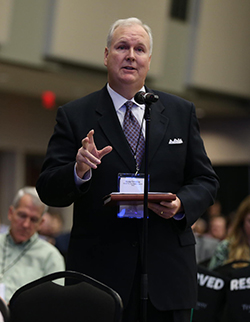
Craig Christina 250Craig Christina, pastor of Shiloh Terrace Baptist Church in DallasMessengers to the BGCT annual meeting in Waco approved a motion from Craig Christina, pastor of Shiloh Terrace Baptist Church in Dallas, declaring, “because of the historical and biblical positions of the BGCT as stated in multiple resolutions, motions and actions, that any church which affirms any sexual relationship outside the bonds of a marriage between one man and one woman be considered out of harmonious cooperation with the Baptist General Convention of Texas.”

Before messengers voted on that motion, they first approved a motion by Steve Wells, pastor of South Main Baptist Church in Houston, which said, “the convention reserves to itself exclusively, through a two-thirds vote of its Executive Board, the authority to remove a congregation from harmonious cooperation.”

Steve Vernon, BGCT associate executive director, explained the committee on convention business interpreted Wells’ motion as establishing a process for declaring a church out of cooperation with the BGCT, while Christina’s motion sets a standard for determining the parameters of harmonious cooperation.

However, Wells’ motion also defined “harmonious cooperation” as “comprised of three actions on the part of the churches—prayer, financial support of the convention and engagement in the ministry of the convention.”

Two churches placed on notice

A few day before the annual meeting, BGCT officials placed two churches on notice that an affirming stance toward LGBT members puts them outside the bounds of cooperation with the state convention.

BGCT Executive Director David Hardage, BGCT President René Maciel and Executive Board Chairman David Russell sent letters Nov. 8 to First Baptist Church in Austin and Wilshire Baptist Church in Dallas. The letter to Wilshire framed the congregation’s relationship to the BGCT in terms of “potential withdrawal,” since a vote by the congregation on full privileges for LGBT members was pending at that point.

Prior to the BGCT annual meeting, members of Wilshire had been in the process of voting on a resolution to affirm the church’s existing bylaws, which provide for a “single class of membership.” The final vote was held the day before the BGCT annual meeting started. Wilshire approved the resolution by a 61 percent favorable vote, Pastor George Mason announced Monday afternoon, Nov. 14.

Give deliberative authority to the board

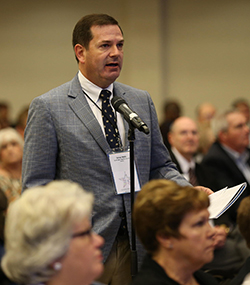
Steve Wells 250Steve Wells, pastor of South Main Baptist Church in HoustonSpeaking on behalf of his motion, Wells characterized it as a “friendly motion” that would help the BGCT make its way through “divisive days in Baptist life” by giving the deliberative authority to the Executive Board and requiring a high threshold of approval.

Wells framed it as the most preferable of three options. To rely on the BGCT Executive Board’s administrative staff to decide if a church is in cooperation places too much pressure on them and gives them too much authority, he insisted. To decide by a vote on the floor of the annual meeting fosters division and draws media scrutiny, he asserted. 

Noting the messengers to the annual meeting unanimously had elected a slate of nominees for the Executive Board, he urged Texas Baptists to “trust the folks we have elected” to handle difficult matters with discernment.

Executive Board Chair Russell joined other messengers in speaking in favor of Wells’ motion. Russell explained he agreed to sign the letter mailed to the Austin and Dallas churches because it was “in keeping with the traditional stands taken” by the convention, but he believed it placed the executive director in an “unfair position” of making the determination whether a church is in cooperation with the BGCT.

Bruce Webb, pastor of First Baptist Church in The Woodlands, questioned whether the motion conflicted with the convention’s bylaws. Vernon replied the bylaws to which Webb referred deal with seating messengers to the annual meeting, but they do not directly address the matter of a congregation’s relationship to the convention between annual meetings.

After lengthy discussion, Wells’ motion passed.

‘Chosen to step outside the circle’

Christina then spoke in favor of his motion, noting it establishes as policy the convictions regarding homosexual behavior Texas Baptists previously expressed in multiple resolutions and through other actions.

“I want to be clear to say we are not drawing the circle (of membership) smaller. The circle remains the same,” he said. “Some churches have chosen to step outside the circle.”

Jackie Baugh Moore spoke against the motion, characterizing it as “impossible to monitor and manage.” She questioned what would be the threshold for determining when a church is seen as affirming and who would make the determination. So, she made a motion to table—or ultimately refer—the matter to the Executive Board for further study.

After discussion and three close show-of-ballot votes, the motion to refer failed.

A defining characteristic?

Returning to discussion of the original motion, Wells spoke against it. He asked whether churches that agreed with traditional Baptist views about key doctrines should be considered outside the circle of cooperation because they hold minority views about homosexuality.

“Does it rise to the level of a defining characteristic of who we are?” he asked.

Ryan Buck, pastor of First Baptist Church in Mason, noted if the BGCT failed to act after becoming aware of affiliated churches that affirm homosexual behavior, it could create a backlash from conservative congregations.

If the BGCT did not take a stand and remove the affirming congregations, he said, “we will have churches that leave the convention voluntarily.”

Taylor Sandlin, pastor of Southland Baptist Church in San Angelo and chair of the Baptist Standard Publishing board of directors, questioned the impact the convention’s action would have on churches as they try to be a witness in a secular society.

“It may make us feel good to take a stand, but it does not help us take a step toward our neighbors,” he said.

Cheryl Kimble, pastor of Highland Park Baptist Church in Austin, asserted the motion violated two key distinctive Baptist principles—the right of the individual believer to interpret and follow Scripture and the autonomy of the local congregation.

On the other hand, Bill Skaar, pastor of First Baptist Church in Grand Prairie, insisted “every Baptist entity is autonomous,” including the state convention.


Texas Baptists consider when and how to exclude congregations

WACO—Texas Baptists will consider whether a church’s affirmation of same-sex marriage is grounds to declare the congregation outside the bounds of cooperation with the Baptist General Convention of Texas.

Messengers to the BGCT annual meeting in Waco also will weigh whether decisions about considering a church out of fellowship with the state convention should require a two-thirds vote of the BGCT Executive Board.

Motions introduced in miscellaneous business

Two pastors introduced motions related to when and how churches should be considered out of “harmonious cooperation” with the BGCT during the introduction of miscellaneous business at the first business session of Texas Baptists’ annual meeting.

Messengers will deal with items introduced during miscellaneous business when they reconvene on Tuesday morning, Nov. 15.

Craig Christina, pastor of Shiloh Terrace Baptist Church in Dallas, introduced a motion stating: “Texas Baptist churches are loving, respectful, and welcoming to all people.  However, our position on biblical marriage has not changed. Therefore, I move that because of the historical and biblical positions of the BGCT as stated in multiple resolutions, motions and actions, that any church which affirms any sexual relationship outside the bonds of a marriage between one man and one woman be considered out of harmonious cooperation with the Baptist General Convention of Texas.”

Steve Wells, pastor of South Main Baptist Church in Houston, introduced a motion clarifying a decision to declare a church outside of “harmonious cooperation” with the BGCT should require a supermajority vote by the Executive Board and stipulating that resolutions adopted in annual meetings are not binding on individual congregations.

Well’s motion states: “Whereas the Baptist General Convention of Texas is composed of autonomous local churches in voluntary, harmonious cooperation to fund and execute ministry for the kingdom of God; and whereas harmonious cooperation is comprised of three actions on the part of the churches—prayer, financial support of the convention, and engagement in the ministry of the convention;

“And whereas from time to time the convention shall make resolutions that express the conviction of the messengers present and voting; and whereas the Baptist commitment to local church autonomy means that no resolution made by the convention is binding on any congregation;

“And whereas there may come, in extraordinary circumstances, a need for the convention to remove a congregation from participation in the funding of and engagement in the ministry of the convention;

“Be it therefore resolved that the convention reserves to itself exclusively, through a two-thirds vote of its Executive Board, the authority to remove a congregation from harmonious cooperation.”

BGCT officials serve notice to two congregations

A few days before the annual meeting, BGCT officials placed two churches on notice that an affirming stance toward LGBT members puts them outside the bounds of “harmonious cooperation” with the state convention. BGCT Executive Director David Hardage, BGCT President René Maciel and Executive Board Chairman David Russell sent letters Nov. 8 to First Baptist Church in Austin and Wilshire Baptist Church in Dallas.

The letter to Wilshire framed the congregation’s relationship to the BGCT in terms of “potential withdrawal,” saying, “Should your church choose to publicly affirm same-sex sexual behavior, the BGCT will no longer be able to accept funds from the church, seat its messengers to the annual meeting, allow the church to express affiliation with the BGCT or allow its members to serve on the BGCT boards, committees or other roles.”

Citing previous actions and resolutions

The letter cited previous Executive Board actions and resolutions adopted by messengers to annual meetings, declaring the Bible teaches any sexual relations outside the bounds of a male/female marriage are sinful.

So, it said, any church that essentially affirms other types of sexual relationships “effectively chooses to withdraw itself from harmonious cooperation with the churches of the convention.”

A resolution at the 1982 BGCT annual meeting stated, “The homosexual lifestyle is not normal or acceptable in God’s sight and is indeed called sin.”

In 1996, the BGCT Executive Board approved a report from its Messenger Seating Study Committee that said: “The Bible teaches that the ideal for sexual behavior is the marital union between husband and wife and that all other sexual relations—whether premarital, extramarital or homosexual—are contrary to God’s purposes and thus sinful. Homosexual practice is therefore in conflict with the Bible.”

In 1998, the convention’s Administrative Committee and Executive Board voted to decline any financial contributions from University Baptist Church in Austin after the congregation ordinated a gay man as a deacon. Messengers to the BGCT annual meeting subsequently affirmed the action. The recommendation as approved dealt not only with University Baptist, but also “any church which openly endorses moral views in conflict with biblical teaching.”

The BGCT Executive Board in 2010 took similar action toward Royal Lane Baptist Church in Dallas, saying the congregation’s decision to ordain gay deacons placed it outside the BGCT understanding of biblical sexual ethics.

First Baptist in Austin welcoming and affirming

A diversity statement on the First Baptist Church of Austin website states the congregation “welcomes and wants people of every race, gender, sexual orientation, marital status, age, physical and mental ability, nationality, and economic station to thrive in the full life of our community; (and) affirms and celebrates all people as created in God’s very image and likeness.”

In a Nov. 2 article in The Clarion, the church’s newsletter, Pastor Griff Martin writes: “It might be helpful for us to think about our history and the bridges that we have crossed: our move from the old property to this new property, the bridge that lead us away from the Southern Baptist Convention, and the bridge from a system of only male leadership to equal leadership between genders. All the way to our most recent bridge of inclusivity, where we bravely walked into a place that too few Baptist churches have yet crossed over, saying that at First Austin, all are welcome and all are equal.

“This bridge has lead us to perform same-sex weddings, ordain LBGTQ+ deacons, and has helped create a safe space in the Baptist world for a group that was often excluded. Crossing that bridge has not come without cost. We have lost folks who did not agree and have begun to understand this stance may cost us our place in some of our affiliations.”

Wilshire extends full participation to LGBT members

Prior to the BGCT annual meeting, members of Wilshire had been in the process of voting on a resolution to affirm the church’s “existing bylaws, which provide for a single class of membership.” The final vote was held the day before the BGCT annual meeting started, but it was not tallied and results were not announced prior to the state convention’s meeting.

Wilshire approved the resolution by a 61 percent favorable vote, Pastor George Mason announced Monday afternoon.

“When Wilshire adopted its vision and values statements during our Vision 20/20 strategic planning process, ‘inclusion’ was the highest value listed by church respondents,” Mason wrote in an email to church members. “Many wondered what that meant and whether it extended to the full participation of members who are lesbian, gay, bisexual or transgender. The answer to that is now ‘yes,’ and LGBT Christian friends inside and outside our church will see this as a sign of deep acceptance by the people of God.”

Call for inclusion

Mason issued a call for inclusion, extending to the sizable minority in the congregation who voted against the resolution.

“Extending full privileges and equal responsibilities to LGBT Christians does not mean restricting or marginalizing anyone else, including those who disagree. Wilshire’s history shows that being found in Christ is the chief way we look upon one another in the church. All other modifiers come after that,” he wrote. “We will not allow our church to become focused on this one issue. We will continue to pursue our whole mission together, along with our vision to be a bold witness for the way of Christ in our time.”

Mason acknowledged the vote placed Wilshire’s relationship to the BGCT in question.

“The BGCT has made public what we have sought to keep a church matter out of respect for them and for those who have struggled with the process within our church,” he wrote. “We will take up the matter of our relationship to the BGCT on our own terms in the near future, as cooperation with such bodies is voluntary and springs primarily from the church to the convention, rather than the other way round.”