Buckner teaches boys ‘what a father looks like’

DALLAS—Dressed in a white T-shirt and bright orange sneakers, Bishop Putney stands out in more ways than one. While five boys glue pieces of wood together, he stands over a two-by-four, his right arms sliding a handsaw across a wooden plank. A flurry of dust falls to the ground.

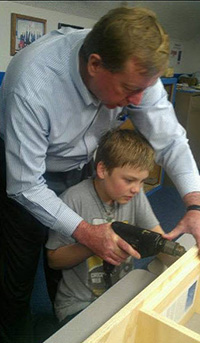
boysclub 300Dan Molinski provides careful and patient instruction to Bishop Putney at the Boy’s Club that meets at the Dallas Buckner Family Hope Center at Wynnewood. (Buckner Photo / Aimee Freston)He focuses intently. The cut must be made at precisely 30 inches, just like Dan Molinski has shown him.

‘Showing us how to be a man’

“He’s very good at fixing stuff, like tables,” Bishop said. “And he’s good at making stuff. He’s showing us how to be a man—a real man.”

Surrounded by young men dressed in a variety of basketball shorts, sneakers and tennis shoes, Molinksi demonstrates, in simple terms, how the base of what will be a lemonade stand is constructed. The Boy’s Club at the Buckner Family Hope Center at Wynnewood in Dallas meets every week with a purpose—to help boys grow as men and have fun. 

‘Learning what a father looks like’

“For many children at the Family Hope Center, emotional and spiritual fatherlessness is the norm,” said Sarah Jones, Buckner’s ministry engagement coordinator. “Consistent, strong, compassionate and reliable men are important to every child, but they leave a powerful impact on boys.

“Dan is teaching the boys valuable lessons about respect, honesty and kindness through these weekly Boy’s Club meetings. The boys are learning more than a cooking or construction skill; they are learning what a father looks like.”

Wanted to help the community

After moving to Dallas from Columbia a year and a half ago, Molinksi wanted to help the community he lived in, so he called Buckner.

“I asked Wynnewood if they needed any help,” he recalled. “I felt like I would be a good fit, and someone had just vacated the position.”

boysclub 350Dan Molinski teaches members of the Boy’s Club at the Dallas Buckner Family Hope Center how to construct a lemonade stand. He also teaches lessons in respect, patience and kindness. (Buckner Photo / Aimee Freston)That was four months ago. Today at the Boy’s Club, Molinski works individually with one boy who is attempting to saw wood and talk at the same time. Molinski and the boys use simple things to construct their projects, like heavy-duty wood glue and nails.

“I buy the supplies myself, but the costs for the lemonade stand will be minimal,” Molinski said. “Most of the wood is from old pallets I find at hardware stores trash bins, and in the junk piles my neighbors leave on their curbs.”

Safety first

Like a magician, he pulls out a power saw and lines it up carefully on a long block of wood. He acts like he’s about to cut, then turns around to the group.

“What did I forget?” Molinski asks animatedly.

“Safety goggles!” the boys scream.

An effective team

The Boy’s Club couldn’t have completed projects like Spaghetti Day, wooden Texas flags and Make-A-Bench Day without the help of Erika Beck and Jennifer Hiland, Buckner life skills specialists.

“The boys are generally attentive in the class only because Ms. Erika and Ms. Jenn are so good at running a tight ship at the center,” Molinski said. “I’m not much of a disciplinarian. So, I’m glad they keep the children in line.”

Together, Molinski, Beck and Hiland work to give the boys the meaningful experiences. One boy in a black T-shirt looks on with a dreamy smile as Molinski cuts the rest of the two-by-fours with power saw. The smell of wood fills the air, making the room seem even more like a rustic cabin in the woods instead of a community center in the southwestern Dallas.

After every piece is taken care of, everyone claps and cheers. Boys Club isn’t a one-man job. They are a team. The boys are grateful to Molinski for taking the time to invest different skills in them.

Lessons learned

“He’s a nice businessman,” Alex Bowman, 12, said with a smile. “He teaches us more than what we could know by ourselves.”

Time is winding down, and it’s time to take a vote about how the stand will be used. One boy, Keyshawn, offers up an idea, and soon, everyone talks over each other. It’s a chaotic democracy of suggestions.

Eventually, everyone agrees they should sell lemonade in two sizes for 50 cents and $1. They plan to give the proceeds to the homeless, they decide, because in the end, it’s better to give than receive. 


Journey to El Paso, Paisano and Alpine: Pioneer Baptists in westernmost Texas

Fourteen people entered the small adobe house on Sunday evening Aug. 26, 1882, doffing their hats and greeting each other with handshakes, nods of welcome and smiles. Maj. W.F. Fewel, a Methodist believer, opened his home for their first meeting with Baptist missionary and church-planter George Baines Jr. They all longed to see a church established in their bustling town on the Mexican border—El Paso, a major railroad stop where people from many cultures had settled.

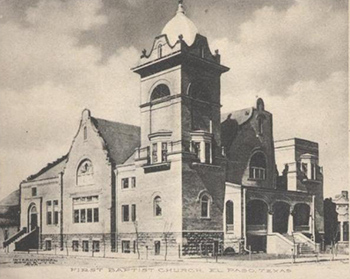
FBC El Paso early 350First Baptist Church in El Paso Baines preached from Genesis 28:10, and the group sang a favorite hymn, “Come Thou Fount of Every Blessing,” and enjoyed warm fellowship. The group met again the next Sunday, Sept. 3, and officially organized a Baptist church with 20 charter members. The church held its first Sunday school Dec. 10, 1882, with three girls, six boys and 15 adults. The first offering totaled 90 cents.

The congregation erected its original “church house” in 1885 at the corner of San Antonio Street and Magoffin Avenue. Twenty years later, the church moved to a spacious building it constructed two blocks east on Magoffin Avenue. In 1922, First Baptist and Central Baptist churches merged and built a new campus at 805 Montana, where it still conducts vital ministry.

FBC El Paso now 350First Baptist Church in El Paso has provided a strong witness for Christ throughout its 134-year history.Today, First Baptist has more than 3,500 members and is known and recognized both for the depth and quality of the ministries and programs it provides to reach El Paso for Christ and for its discipleship of growing Christians. First Baptist has founded many mission churches, and at least a dozen have become self-sustaining. The congregation has thrived under the leadership of its 23 pastors across its 134-year history.

Second Baptist Church El Paso 250Second Baptist Church in El Paso Its sister congregation, Second Baptist Church, is the oldest black Baptist church in the El Paso BaptistAssociation and celebrates its 132nd anniversary this year. Missionary E.M. Griggs, helped to organize this church with the five Baptists among the 25 African-Americans living in El Paso in 1884. At first, the tiny band worshipped in a small rented one-room adobe house, but in 1886, the congregation pooled its financial resources, received help from friends at First Baptist and purchased a lot at 515 Utah St., where the church erected a building, made possible by a loan from the Southern Baptist Convention’s Home Mission Board.

Between 1903 and 1907, Second Baptist built a sanctuary, complete with a bell, at Second and Virginia Streets, not far from downtown, and by 1923, the church membership numbered more than 50 families. Through the years, this church has engaged the larger African-American community of El Paso and earned the respect of the city as it has ministered the gospel, advocated for those without a voice and met the needs of the multi-ethnic community where it has served Christ.

Paisano Baptist Encampment

millican baptism 1923 350In 1879, Texas Baptists appointed “cowboy preacher” Leander Randon Millican (1853-1938) to be a missionary to the state’s far-west regions. From San Saba to El Paso, this circuit-riding minister traveled on horseback, forded rising rivers, faced armed bandits, preached the gospel, started churches and served as pastor of congregations including First Baptist in Midland. He dreamed of a special place where ranchers, cowboys and churches could gather each summer in a “camp meeting” setting for preaching, Bible study and instruction. In 1911, El Paso Baptist Association appointed Millican, cattleman and former Texas Ranger Julius Cancelor Bird and S.C. Holmes, pastor of First Baptist Church in Alpine, to explore the possibility. After much prayer, they founded Paisano Baptist Encampment July 28, 1915.

Paisano 350The faithful gather under trees for a worship service at Paisano Baptist Encampment.In August 1916, George W. Truett, renowned pastor of First Baptist Church in Dallas and Baptist statesman, preached the first Paisano sermon under the trees near the present dining shed, standing on the bed of a wagon with a wooden barrel as his pulpit. Millican also preached during the camp meeting. Families camped in tents or slept under the stars. On Sept. 3-4, 1921, more than 1,000 assembled to hear Truett preach. Area ranchers, including the Kokernots, McCutcheons and Mitchells, brought their chuck wagons, while others cooked over campfires. Millican and other leaders secured the 1,400-acre property, and he was elected president of the encampment’s board of directors, a position he served until his death.

Paisano marker 400From 1916, Truett preached until the year before he died in 1944. B.B. McKinney directed music and composed several works on the Paisano grounds, and Troy Campbell and Euell Porter followed in his footsteps. Famous Baptist churchmen also spoke in the years that followed. J.B. Tidwell, Kyle Yates, W.R. White, Virtus Gideon and Jack MacGorman, among others, taught the Bible. R.G. Lee, F.B. Thorn, Perry Webb, I.E. Gates, Roy Angell, James Landes and many more preached. Funded by love offerings, Paisano Baptist Encampment still continues its ministry to families and friends who seek a refreshing week of Bible study, worship and fellowship in ways largely unchanged for 100 years.

Alpine

Established in 1883 as a railroad stop beside a gurgling spring, the hamlet of Murphyville—now the city of Alpine—took root and flourished in the valley of the northern Chihuahuan Desert. As people came for commerce and settled in, they brought their faith traditions, too. Baptists led the way when, in the spring of 1885, Baptist missionary George W. Baines held a religious service at the Southern Pacific Railroad Depot on his train stopover from El Paso.

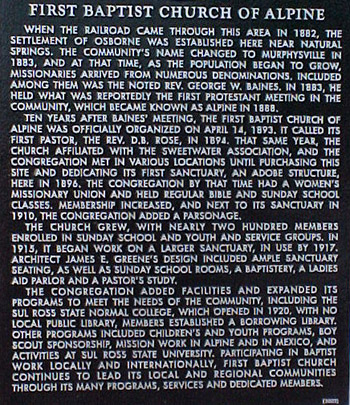
FBC Alpine marker 350First Baptist Church in Alpine was organized April 14, 1893, with nine founding members—eight women and Julius C. Bird. In the next dozen years, the church met in various buildings until members called their first pastor, D.B. Rose, who led them to build an adobe sanctuary in 1895 on the corner of Fourth Street and Avenue D, still the site of the church today.

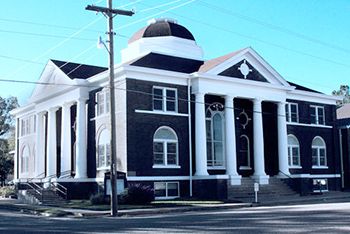
FBC Alpine 350First Baptist Church in AlpineThe church built its present sanctuary in 1916-17 and dedicated it June 13, 1926, with L.R. Millican presiding, just as he had done in 1895. The church has demonstrated its missions heart across the years, founding many missions, daughter churches and ministering to the students at Sul Ross State University, established in 1917. Today, the church continues faithfully to contribute to and participate in the work of an expanding list of ministries as it celebrates its 121st anniversary.

These stalwart Baptists of the far west are samples of God’s continuing grace and work among those whose hearts are determined to follow him.

For more information

  • To learn more about Leander Randon Millican’s life as a cowboy, preacher and church planter, read his story in Sermon and Very Short Life Sketch (1929) and Brief Summary of My Pastoral and Missionary Work (1931). He is buried south of the tabernacle at Paisano Baptist Encampment. Also see Paisano: Story of a Cowboy and a Camp Meeting by Katy Stokes (1980, Texian Press). 

El Paso

  • Visit First Baptist Church at 805 Montana Avenue, El Paso, TX 79902; Phone (915) 533-1465. 
  • Visit Second Baptist Church at 401 S Virginia St, El Paso, TX 79901; Phone (915) 532-7860. Learn more about Second Baptist’s history here.

Paisano Baptist Encampment

Alpine

Marfa

  • Visit First Baptist Church at 205 N Austin St, Marfa, TX 79843; Phone (432) 729-4155.
  • Explore historic Marfa
  • Enjoy Davis Mountains State Park at TX-118, Fort Davis, TX 79734; Phone (432) 426-3337. 
  • For information about art in Marfa, click here. Also visit Donald Judd’s website. Judd’s home and art installations, along with exhibits of other artists, are housed on 340 acres of land on the site of former Fort D.A. Russell at 1 Cavalry Row, Marfa, TX, 79843; Phone (432) 729-4362. Find more details here


Buckner chief elected NABF vice president

The North American Baptist Fellowship elected as vice president Albert Reyes, president and chief executive officer of Buckner International.

The fellowship is a network of 30 Baptist groups from across Canada and the United States that includes 80,000 churches with 15 million members. NABF supports the mission of the Baptist World Alliance, a global group of Baptists from more than 160,000 churches.

“The North American Baptist Fellowship is grateful that Dr. Albert Reyes has agreed to serve as one of the vice presidents of the NABF,” said Elijah Brown, general secretary-elect of the group.

“Dr. Reyes rightly reminds us that our first priority and commitment is to adhere to the Jesus agenda. His proven and effective leadership will help point the NABF to ongoing engagement with those who are most vulnerable. Dr. Reyes brings tremendous national and international leadership, and I am looking forward to working alongside him in continuing to strengthen a public witness for mission and justice.”

Reyes noted he is honored to serve NABF and “shine hope” into the lives of the most vulnerable.

“When God brings Christians together, his message of hope and love is amplified in a world that desperately needs to hear it,” Reyes said. “That’s exactly what God does through the North American Baptist Fellowship. I’m excited to serve with my brothers and sisters in Christ as we seek ways to advance the kingdom of Christ.”


BUA moves from old campus to new home

SAN ANTONIO—Baptist University of the Américas showed off its new home during a grand opening of the San Antonio facility Aug. 2.

BaughBldRibbon 300Baptist University of the Américas President René Maciel and Babs Baugh, president of the Eula Mae and John Baugh Foundation, cut the ribbon to dedicate BUA’s new Baugh Building. (BUA photo)The 69-year-old university recently moved from 12 acres it had called home since 1965. Located off Interstate 35 in South San Antonio, the old campus included eight buildings that were too small to accommodate the school’s recent growth and too expensive to upgrade, BUA leaders said.

So, BUA bought and remodeled a nearby medical office building that had been foreclosed. The university named the 10-year-old facility the Baugh Building, in honor of the school’s largest benefactor, the Eula Mae and John Baugh Foundation. The Baughs, both now deceased, and their family have supported numerous Baptist causes.

The Baugh Building includes classrooms and offices, as well as a library, chapel and student union.

“It’s a turning point in our history,” BUA President René Maciel said of the move. “We are thrilled for our students to be able to experience modern facilities and for the university to have room to grow.”

The Baugh Building will be BUA’s home while the university raises funds to build a campus on 66 acres it owns on the opposite side of Interstate 35. The school’s leaders estimate the building is large enough to accommodate anticipated student growth until the larger campus is built.

BUA trains 300 students from more 20 countries.

The university focuses on preparing women and men for ministry—in congregations and through secular careers. It offers five bachelor’s degrees, in biblical/theological studies, business leadership, human behavior, music, and Spanish language and literature. It also offers an associate’s degree in cross-cultural studies.

BUA affiliates with the Baptist General Convention of Texas. The Association for Biblical Higher Education has accredited the school. AffordableColleges.com has ranked BUA first among the most affordable private schools in Texas and also the most affordable Bible college in the state.

BUA’s Baugh Building is located at 7838 Barlite Boulevard in San Antonio.


Fired Baylor athletics staffer seeks Pepper Hamilton report

DALLAS—A fired Baylor University assistant athletic director has petitioned a Dallas County court to depose three regents and order the school to turn over the report produced by Pepper Hamilton, the law firm that investigated Baylor’s handling of sexual violence.

Thomas Hill worked 28 years at Baylor, most recently as assistant athletic director for community relations and special projects.

“But when the sexual assaults by Baylor University athletes became public, Baylor rushed to judgment,” according to the petition filed by Hill’s attorneys. “Baylor summarily fired Hill, even though Hill did nothing wrong regarding the sexual assaults that occurred at Baylor. While not to the same degree as the courageous women who were victimized in this dark time in Baylor’s history, Hill is yet another—and unnecessary—victim of this controversy.” 

The petition seeks depositions from three regents who live in Dallas County—Chairman Ronald Murff, banker Mark Lavvorn and attorney David Harper.

It also asks the court to compel Baylor’s regents to produce all material related to Hill’s termination, including “written and oral communications Baylor had with the Pepper Hamilton law firm regarding alleged assaults, batteries or wrongdoings committed by Baylor athletes against Baylor students.”

The petition also seeks:

  • Documents, reports and information the regents considered or reviewed—“including any reports from Pepper Hamilton”—regarding alleged assaults or other wrongdoing Baylor athletes committed against other students.
  • Discussions the board conducted regarding Hill and whether he should be fired, and board discussions regarding knowledge by athletics department employees of alleged wrongdoing by athletes.
  • Criteria and standards Baylor used to determine whether to fire any athletics department employee.

Baylor officials did not respond to a request for comment about the petition.

Last September, Baylor regents hired Pepper Hamilton to investigate the university’s response to reports of sexual violence. 

The investigation revealed a “fundamental failure” by Baylor to implement Title IX and the Violence Against Women Reauthorization Act of 2013, according to a 13-page “Findings of Fact” document the regents released. Baylor regents also released a 10-page set of 105 recommendations from Pepper Hamilton. 

However, neither the regents nor the university administration released a full report from the Pepper Hamilton investigation, insisting regents received only an oral presentation.

Two weeks after regents received the “comprehensive briefing” from Pepper Hamilton, the board on May 26 announced plans to demote President Ken Starr, fire Head Football Coach Art Briles and sanction Athletic Director Ian McCaw, who resigned a few days later. 


Journey to Galveston and Houston: Oldest black Baptist churches in Texas

Four-year old Israel, born in Russellville, Ky., held his mother’s hand and squeezed hard. His family had just heard the drop of the wooden mallet sealing their purchase by a Methodist couple from Ohio. This gifted child, born into slavery, grew to become a strong Christian young man, dedicated to Christ and his church, and he impacted Baptist life in Texas like no other.

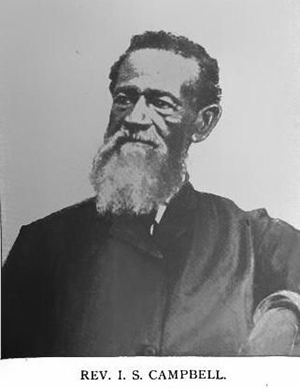
Following his conversion, Israel Sydney Campbell (1815-1898) became a Baptist as a 21-year-old and answered God’s call to preach the next year, even though he still was a slave. Despite great trials, hardships and beatings, he was pastor of churches in Tennessee, Canada and Ohio before his ordination in 1855 at age 40. He then became a missionary in Louisiana and Texas, arriving in the Lone Star State as other missionaries also were arriving to minister here.

Galveston’s Avenue L Missionary Baptist Church

Most of the first Baptists to set foot in Texas came by ship in those days, docking at Galveston Island and trekking inland from the Gulf of Mexico. American Home Missionary James Huckins, William Tryon, George Washington Baines and Robert Emmett Bledsoe Baylor were among these first Baptists to arrive. In 1840, Huckins helped organize First Baptist Church in Galveston the same year several black Baptists first became a part of that church family. Huckins then aided black Baptists in the growing city to organize their own church, the Colored Baptist Church of Galveston, 20 years before the Civil War. This congregation met in the courthouse several years; it was a safe place where slaves could gather to worship and learn to read and write. In 1855, it changed its name to African Baptist Church, but the Civil War began to disrupt services more often than not.

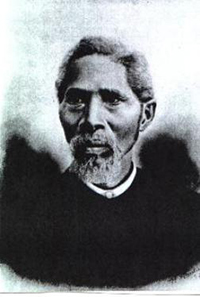
Israel Campbell 300After emancipation and the war’s end, when Gail Borden Jr. and other Baptist brothers bought and deeded land to the African Baptist Church, Israel Campbell and a fellow pastor, I. Rhinehart, went to work. In 1867, Campbell reorganized the straggling membership into a new congregation, called First Regular Missionary Baptist Church, and relocated it to 26th Street and Avenue L. This was the first entirely independent black Baptist church organized in Texas following the 1863 emancipation. It soon grew under Campbell’s leadership to more than 500 members.

In 1868, Campbell, along with Baptist pastor friends John Henry “Jack” Yates and Peter Diggs, organized the first association of black Baptists in Texas, called the Lincoln District Baptist Association. In 1872, they founded the Baptist State Missionary and Education Convention. Financially supported by the American Baptist Home Mission Society of New York, this convention was the first statewide black Baptist organization in Texas. With Campbell as one of its primary leaders, the convention became a success, and, by 1890, the churches of the convention had a membership of more than 110,000. (By 1916, 72 percent of the state’s black churchgoers were Baptists.)

In February 1891, at age 76, and after dedicating a new sanctuary built that year, Campbell retired as pastor of First Regular Missionary Baptist Church. The “Father of Black Baptists in Texas” died in La Marque on June 13, 1898, and was buried in Lakeview Cemetery in Galveston.

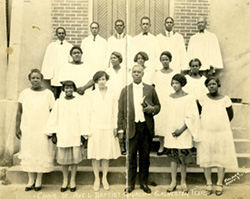
AveLChoir 1926 200A choir from Avenue L Missionary Baptist Church is pictured in this photo from 1926.When the devastating hurricane of 1900 pounded most of the island’s buildings into the ocean, the congregation lost its church home. However, by 1904, the congregation built a new wooden sanctuary and renamed the church, “Avenue L Missionary Baptist Church.” In 1916, the African-American firm of Tanner Brothers Contractors and Architects constructed a red-brick sanctuary on the site, which still stands today at Avenue L, along with the 1904 structure on its west side.

For 149 years, this church has been a faithful witness for Christ in Galveston, ministering to the community and training disciples, guided by the motto: “See a need. Meet a need.” Many of its members are multi-generational descendants of the church’s founders, who worship today with people from many ethnic backgrounds.

Houston’s Antioch Baptist Church

Just north of Galveston was a new township called Houston, which was on the verge of exploding with growth. Huckins had organized a Baptist church there in 1841, and much already had been accomplished. In January 1866, after the Civil War ended, Campbell and his friend Rhinehart spent a year working with newly freed believers in Houston. They organized Antioch Baptist Church with 12 newly emancipated freedmen and women, and Campbell served as interim pastor. Although Antioch received support from the First Baptist and German Baptist churches, Campbell guided the congregation to move to a separate location from the rest of First Baptist Church—to a “brush-arbor” on the edge of Buffalo Bayou.

When Campbell preached a series of revival meetings in 1867, 170 new members became part of the church and built a box-house structure at “Old Baptist Hill,” on the corner of Rusk and Bagby streets. Campbell and Rhinehart participated in the ordination of John Henry Yates. Campbell left Houston and moved to Galveston. Yates became the first full-time pastor of Antioch.

JackYates 200John Henry “Jack” Yates John Henry “Jack” Yates (1828-1897) was born a slave in Glouster County, Va., and arrived in Matagorda County, Texas, sometime during 1863 or 1864. After receiving his freedom, he settled his family in Houston. During his tenure as pastor, the membership of Antioch increased more than four-fold. The box house no longer was able to accommodate the congregation adequately. In 1875, members of the congregation laid a cornerstone for a new structure, made and laid the bricks and, four years later, the congregation marched from “Old Baptist Hill” to the new brick church on Robin Street. Located in the center of Freedmen’s Town, the church was the first brick structure in Houston built and owned by African-Americans.

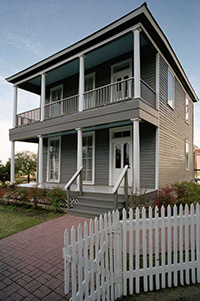
IYates House 200Jack Yates’ house that once stood on Andrews Street is now a museum in Sam Houston Park in Freedmen’s Town in Houston’s Fourth Ward.n 1872, Yates led his congregation to join other former slaves from the Trinity Episcopal Methodist Church to purchase land at Dowling and Elgin streets to found Emancipation Park as a place for blacks to celebrate Juneteenth, the state holiday that marks the 1865 announcement in Texas that legalized slavery had come to an end. This was the first public park in Houston. In 1885, Yates, along with white brothers and sisters, founded Houston Baptist Academy (Houston College for Negroes and now Texas Southern University) and articulated, along with Campbell, the vision for Bishop College, founded in 1881. Jack Yates High School, in Houston’s Third Ward, was named in his honor in 1926, and his two-story house that once stood on Andrews Street is now a museum in Sam Houston Park in Freedmen’s Town in Houston’s Fourth Ward.

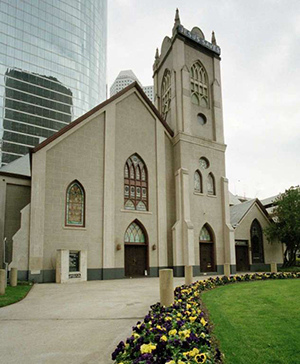
Antioch Houston 300Antioch Misisonary Baptist Church in Houston Through the years and still today, amidst the skyscrapers of Houston, Antioch Missionary Baptist Church continues to serve the needs of her people and community, proudly proclaiming the message: Jesus Saves. Today’s members still worship in the sanctuary’s original handmade pews. They enter to worship and leave to serve their communities with the gospel of Christ in word and actions.

The legacies of Israel Campbell and Jack Yates are found today in the lives of Texas Baptists who minister with vision, courage, endurance and grace in urban settings and cross-cultural and inter-racial contexts.

Visit Avenue L Missionary Baptist Church, 2612 Avenue L, Galveston, TX 77550; Phone (409) 762-8795

Visit Antioch Missionary Baptist Church, 500 Clay Street, Houston, TX 77002; Phone (713) 652-0738

For More Information and Sites to Explore:

  • Visit Lakeview Cemetery, site of Israel Campbell’s grave, at: 3015 57th St., Galveston, TX 77551
  • For many wonderful sites in Galveston, study the African American Guidebook to Historical Sites, including the founding Emancipation Proclamation location, here.  Note the many churches in Galveston that are more than 100 years old and whose origins are connected to Avenue L Missionary Baptist Church.
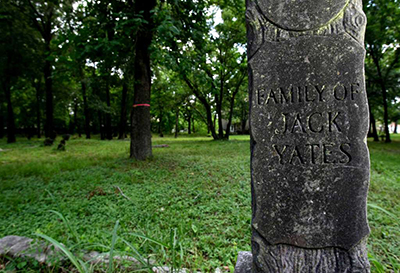
  • Yates Marker 400To learn more about Yates, visit the state historical marker that enshrines his gravesite at the College Memorial Park Cemetery near the old site of the Freedmen’s Town community, 3525 West Dallas, Houston, TX 77019.
  • Visit Emancipation Park, 3018 Dowling St., Houston, TX 77004; Phone (832) 395-7000
  • Visit the home of Yates in Sam Houston Park, 1000 Bagby St., Houston, TX 77002; Phone (832) 395-7000. For more information, click here and here.


Mission Arlington marks 30 years of changed lives

ARLINGTON—Mission Arlington/Mission Metroplex officially began on a Friday 30 years ago when hardly anyone except Tillie Burgin was available at First Baptist Church in Arlington to respond to a need.

She and the ministry she founded have been responding to community needs ever since.

Burgin Family 300Robert and Tillie Burgin served as missionaries in South Korea, along with their sons, Jim and Rick.After returning to her hometown following missionary service in South Korea, Burgin prayed seven years about how God might use her and her church to meet the needs of people in Arlington.

Do missions in Arlington

“When we returned from South Korea, there was no doubt in my heart that God was prompting me: ‘If you can do missions in Korea, why can’t you do missions in Arlington?’ So, I was trying to interpret that by going from pastors to pastors, and people to people, just praying with them for God’s direction of what that meant,” she explained.

“Finally, one day Dr. Charles Wade (then pastor of First Baptist in Arlington) called and said: ‘Why don’t we try whatever this is that you’re talking about for a year. If it doesn’t work, you can go back to your old job at the schools.’”
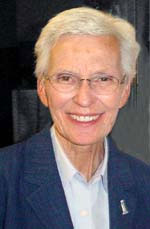
tillie 150Tillie Burgin

On Friday morning, Aug. 1, 1986, Burgin joined the staff of First Baptist Church in Arlington as minister of missions. Her salary for the role—created primarily as part of a Texas Baptist emphasis on church starting—was partly funded by the Baptist General Convention of Texas and Tarrant Baptist Association.

 “I didn’t understand all that, because that wasn’t my background,” she said. “Somebody said something about church planting, and I told them, ‘I don’t know what that is.’”

Her “office” was a closet as far away from the main office as physically possible.

She remembers clearly seeing it for the first time.

“When you first see your newborn baby, that child is the most beautiful child you have ever seen in your life. That is how I felt about that little closet,” she said.

Humble beginnings

“It had orange curtains, one bookcase, one desk, one chair and nothing else. No telephone, no pencils, no nothing. But in my heart, it was the most beautiful thing I could experience.

“But like it didn’t take long for my son, Jim, not to be the prettiest baby I’d ever seen, the journey moves on a little bit.”

Since it was Friday, she was one of the few people in the church building. Even the hallways were dark.

That afternoon, a custodian brought Burgin the address of a woman who lived in an apartment and needed financial assistance to get her electricity turned back on.

The woman received the financial help she needed, and she also agreed to hold Mission Arlington’s first Bible study in her apartment.

‘We didn’t know any better’

“That just sort of happened,” Burgin said. “We never had a goal, never had an objective, never did a survey. When God launched, he launched. We were the most unassuming, ignorant people God could find.

“We didn’t know any better. We didn’t know you couldn’t do church with unsaved, unchurched people in apartments where there was no steeple. We just started a Bible study in that apartment because that’s all I knew.”

She prayed the ministry would be able to start six Bible studies the first year. They started six the first month.

“Apartment people move around a lot, and when they moved, they would say, ‘Come over here,’ because John 3:16 works. They were hearing the gospel as never before, and they were forming their own congregations by inviting their friends,” Burgin said.

building 350That marked the beginning of Mission Arlington, which became a nonprofit organization separate from—but still closely related to—First Baptist Church, It expanded to become Mission Metroplex in 1990 when the ministry started Bible studies and other programs at apartment complexes in neighboring Grand Prairie.

At the end of the first year, Mission Arlington held a celebration in a park with participants of the 12 apartment congregations joining together. Everything went well until a hornet’s nest got stirred up, and several guests had to go the emergency room with their injuries.

“That’s the last time we did that,” she said. “That’s when we decided we’d better just start having revivals.”

‘Get the gospel to the people’

All these years later, the ministry continues to serve as God directs, she said.

rainbow express 350Student volunteers work with Rainbow Express, the children’s ministry of Mission Arlington. “We laugh when we’re out with our Rainbow Express (children’s ministry) and volunteers say, ‘What if it rains?’ Well, the rain plan is the same as the dry plan,” she said.

“Regardless of what day it is, the plan is the same: Get the gospel to the people, help them understand what it means to have a relationship with Christ, regardless of where they are or who they are. Christ didn’t die for 10 percent of the population. He died for everyone.”

A model for missions and ministry

Many churches across the United States have visited to see how Mission Arlington/Mission Metroplex functions so they can take the missions strategy home to meet needs in their own communities.

“That has been happening almost from the beginning,” she said. “Our prayer always is that they can see God. It is not a program. It is not an organization. It is a way of life that God has put together, and you can’t deny it. You also can’t explain it, because you can’t explain God.

“So, our prayer has always been that when they leave this place, they will know they have been in the presence of God and that God has the same plan for every believer, every follower—to multiply.”

From the beginning, Burgin wanted to see the ministry reproduced in other communities, and that commitment has shaped the way it not only developed, but also remained essentially the same.

“One of the reasons we have held on to doing things the way we do (working out of) four old houses back there, is so people can see it is reproducible,” she said. “People have come to us and said, ‘Let us build you a $8 million building,’ but that is not reproducible. Those four old houses back there are reproducible. So, folks come here and say: ‘Wow, we can do that. We’ve got an old house.’”

Focus on apartment-based Bible studies

The small-group Bible studies in apartment complexes remain the starting points for the various facets of the ministry, said Jim Burgin, communications director for Mission Arlington/Mission Metroplex.

“As we were out trying to share Christ’s love, there was such heartache and stress and dysfunction that people couldn’t hear us. You couldn’t just go out and say, ‘Here’s Jesus; we hope you make it.’ For us, authentic faith meant we needed to respond to people’s needs a life at a time,” he explained.  “The twin core values for us are to take the church to the people a life at a time.”

As the needs presented themselves, God consistently supplied the means to meet those needs, he said. Last year, Mission Arlington/Mission Metroplex provided emergency assistance to more than 140,000 people.

Expanding scope of ministry

The ministry includes a medical clinic that supplied $1.19 million in free health care and $1.59 million in free medication to more than 3,700 people last year and a dental clinic that provided close to $1.5 million in services to more than 1,500 people.

It also includes a Christmas store that helped more than 30,500 people last year, Thanksgiving meal deliveries to more than 25,000 people, a summer lunch program at six sites that served 500 children and a program to provide school supplies for more than 9,000 students.

Last year, Mission Arlington/Mission Metroplex recorded 2,664 spiritual commitments.

It takes more than 2,500 volunteers each week to keep the ministry going. More than 100 churches and organizations now contribute to the ministry.

‘This is God’s place, not ours’

“It has just grown and grown, and it is over our heads,” Jim Burgin said. “This is God’s place, not ours. That is why we want so much for him to get credit and glory.

“Every day, prayer is a central part of what we do. We don’t market. We don’t have grant writers. We just allow the Lord to provide, and he has done well.

“We are so grateful to the support we have received from so many churches from across the denominational spectrum,” he said. “The Baptist General Convention of Texas has also been with us from the beginning, and we are so grateful for the support. Texas Baptists have come together to support this ministry and the spread of the gospel in so many ways, it is impossible to count.

“We are just grateful to God and his faithful people. Many have never been here, but they have been a part of this ministry through their cooperative giving.”

Give thanks for God’s faithfulness

To mark the 30th anniversary of Mission Arlington/Mission Metroplex, Burgin just asks churches to thank God for all he has done through the ministry and perhaps show a short video that has been produced to commemorate the milestone. 

“The best birthday gift we feel like we could have would be for God to be glorified in this third decade and for people to pray for us,” he said. “Prayer is how we began and is at the heart of how we want to continue.”

Among the Christians praying for the ministry will be the 349 small-group Bible studies Mission Arlington started, totaling almost 8,000 people.

“There’s been a lot of history, a lot of fun, a lot of tears, but always God has been so faithful,” Tillie Burgin said.

“He’s allowed us to work hard and have a lot of perseverance. We’re open seven days a week. We don’t close. Our passion is as strong today as it was 30 years ago.”


Literacy Connexus worker honored as volunteer of the year

COPPERAS COVE—Pam Moore never expected statewide recognition for her work as a literacy ministry volunteer. Until a few years ago, she never gave literacy much thought.

Moore, a member of First Baptist Church in Copperas Cove, has volunteered more than five years with Literacy Connexus, a nonprofit organization affiliated with Texas Baptists’ Christian Life Commission. Literacy Connexus offers training and resources for English-as-a-Second-Language and literacy ministries. 

Moore—who edits Literacy Connexus newsletters, writes content for its website, submits grant applications on its behalf and provides technical support for its conferences—will receive the Volunteer of the Year Award from Literacy Texas at the statewide organization’s annual conference, Aug. 2 in San Marcos.

“Pam has endeared herself to volunteers by sharing timely information and encouraging stories to undergird our mission of helping churches help persons with literacy needs,” said Lester Meriwether, executive director of Literacy Connexus. “She is an invaluable team member and is very deserving of the recognition of Literacy Texas’ award.”

Morning of missions in McAllen

Moore became acquainted with Literacy Connexus during the Baptist General Convention of Texas 2010 annual meeting in McAllen, when convention organizers encouraged Texas Baptists at the meeting to participate in service projects as part of a “morning of missions.” 

building bookcases 300Pam and Chuck Moore led the fifth- and six-grade boys at First Baptist Church in Copperas Cove to build bookcases for a family reading fair.“I wasn’t sure where to go or what to be involved with, but I prayed that whatever I did would be more meaningful than just a morning activity,” she said.

She selected a Literacy Connexus-sponsored Books for the Border family reading fair. At the event, low-income families received a bookcase and several children’s books, as well as a children’s Bible.

“It’s a blessing to read, and I love books,” Moore said. “I’ve always been surrounded by them, but I realize not everybody is so privileged.”

Gaining a new perspective

Her experience at the family reading fair gave her a new perspective on literacy ministry.

“Seeing what I saw that morning—the joy of those families as they received books and bookcases—was such an eye-opener,” she said. “I had never connected literacy with ministry.”

Chuck Moore 200Chuck Moore helps a boy at First Baptist Church in Copperas Cove make a bookcase for a family reading fair.Recognizing the potential, she went back to her home church with a ministry project in mind. She involved the fifth- and sixth-grade boys she and her husband, Chuck, teach in Sunday school in building bookcases for a reading fair.

“The kids in our class get it,” she said. “They understand. If you don’t have books and you don’t learn to read, how will you ever learn to read the Bible?”

Soon, her interest in literacy ministries expanded beyond the Books for the Border project to include other facets, such as English-as-a-Second-Language classes. Her affinity for that ministry grew out of personal experience when she and her husband were stationed in Germany with the U.S. Army.

“I saw the other side of ESL in Germany when I went to German class for foreigners,” she said. “I came away understanding a little better about what people experience when they are learning English as a second language.”

Committed to serve

Moore offered her services to Meriwether, to help Literacy Connexus in any way possible. As editor of the organization’s newsletter and content provider for its website, she puts to use the journalism degree she earned years ago at California State University.

One of the benefits of her volunteer role as the communications director for Literacy Connexus has been learning more about the varied ministries Texas Baptists offer around the state.

“My focus had been on my church and my community,” she said. “I had been involved in ministries locally, but now I see the bigger picture—of the needs in our state and of the ministries taking place.

“It’s exciting and inspiring. Once I knew, I couldn’t go back to how things were before. I’m committed to serve however I’m needed.”


Former foster kid awarded $90K scholarship

LUBBOCK—Recent high school graduate and Buckner Aftercare alum Tenneil Wallace has plenty of reasons to smile. She recently received the Family Fellowship scholarship award, which grants $90,000 each to 15 young adults across the country formerly in foster care. 

After being referred to the scholarship by a community school program, she went through an extensive screening process that included a Skype interview and trip from Lubbock to California to meet the scholarship board. She waited anxiously for a month to hear the results. When she did, she found it hard to believe she had earned such a prestigious honor.

“I was overwhelmed,” she said. “It took the ride home and for me to get an email saying, ‘Welcome to the family,’ for it to really sink in.”

While the scholarship marks the culmination of years of hard work in school and activities like mock trial, National Honor Society and academic decathlon, in a way, it also marks the beginning of a life full of promise.

Life hasn’t been easy for Tenneil. Her father died when she was 7 years old. Her grandmother, who raised her after her father’s death, died when she was 13.

She and her twin brother, Taylor, entered foster care at 14 and later aged out. The twins didn’t have the support they knew they needed to thrive. That’s when Buckner Aftercare, a program designed to help young adults transition from foster care to independent living, stepped in to fill the gap. 

“When we got to Buckner, they helped us find a place to live,” she said. “We were in a rough situation, but they gave us stability.”

Tenniel plans to study business management at Prairie View A&M University and hopes to apply any remaining scholarship money toward her first year of law school.

Living separately from her twin brother is bittersweet, but she knows he is only a phone call away.

“It’s going to be new, because we’ve always been close,” she said. “It’s going to be a good experience and a hard one. When I’m not strong, he steps up, and I do the same.”

Tenneil offers words of encouragement to other young people in the foster care system and to those who seek to make a difference in their lives.

“I would like to say thank you to Buckner. Your hard work is truly making a difference,” she said. “To kids and foster kids like myself, I would say to believe in your dreams. The only way they won’t come true is if you don’t believe in them.”


Alfa & Omega a base camp for ministry in Spain

DENIA, Spain—When it comes to Christians sharing their faith, people in Spain want to see “real love through real people,” Pastor Antonio Calero Cerrado said.

That’s what they experience through the varied ministries connected with Alfa & Omega Camp in Denia.

For the past 40 years, Cerrado and Jorge Pastor have led Iglesia Bautista La Trinidad, a congregation that meets at the Baptist campground.

Stretch Out Your Hand

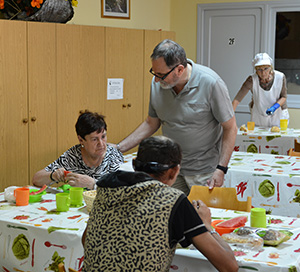
Denia feeding 300Pastor Antonio Calero Cerrado oversees the social ministries of Iglesia Evangelica Bautista La Trinidad and ministers to community members who receive help. (Photos / Kalie Lowrie)In downtown Denia, the church operates a community ministry, Extiende tu Mano—Stretch Out Your Hand. The ministry provides services to individuals and families in the community, including counseling, legal services, addiction-recovery programs, and food and clothing assistance.

The Texas Baptist Hunger Offering provides funds to help support the ministries, including a Monday-through-Friday lunch program that serves 30 to 40 people, many of them homeless.

The volunteers from the church who cook and serve the meals emphasize the importance of protecting the self-respect of every person who receives assistance.

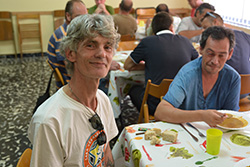
Alcala 250Juan Jose Alcala receives food daily through the feeding ministry of Iglesia Evangelica Bautista La Trinidad in Denia.“They treat us as people,” said Juan Jose Alcala, a regular lunch client. “Outside on the street, they treat us really badly. Here, they treat us with love.”

Thriving ministries

About 60 years ago, American missionaries established Alfa & Omega Camp on Spain’s southern coast. At the time, Christians in the region were persecuted for their faith, and Iglesia Evangelica Bautista La Trinidad began with just a handful of members.

Alfa Omega 300The Alfa & Omega Baptist camp has long history of connections with Texas Baptists and has enjoyed the support of many ministry groups this summer. Now, the church attracts about 400 worshippers each week, and the encampment is thriving. It is home to Spain’s only private evangelical Christian school, with more than 400 students. About 90 percent of the students are unbelievers, but by teaching courses on values and integrating faith and learning, faculty have many opportunities to share the love of Christ with students and families.

During the summer, hundreds of children and youth from around Spain attend organized camps on the grounds of Alfa & Omega.

Go Now 250Go Now missionaries Naraim Enriquez (left) and Priscille Murphy (right) are serving at the Alfa & Omega Baptist camp in Denia, Spain for the summer.
Go Now Missions

Priscille Murphy, a student at Texas A&M-Commerce, and Naraim Enriquez, a recent graduate of the University Texas at El Paso, are serving at Alfa & Omega Camp through Go Now Missions, the Baptist General Convention of Texas student missions program.

Beyond working with children every day, they also help with tasks ranging from cleaning dishes and mopping floors to setting up rooms for use.

Priscille Murphy 200Priscille Murphy helps set up rooms for an incoming camp“One of the greatest things I’ve learned is more humility,” Murphy said. “Some of the work we do—like cleaning bathrooms—is not super fun. Even though it seems like it doesn’t matter, the Lord can still use it.”

Enriquez felt God’s call to serve in Spain following a trip to Mexico last summer and learning about the needs at the Alfa & Omega Camp during Go Now Missions’ Discovery Weekend. She wanted to serve overseas and work with children, and she speaks fluent Spanish, having grown up in Juarez, Mexico.

When she began discussing the possibility with her parents, they were reluctant to send her, but after praying a few weeks, they agreed she should go. Although fund-raising seemed daunting, God provided at every turn, she said.

Finding joy, learning lessons

Enriquez has found great joy working with the preschool children each day.

“They aren’t my siblings or family, but I have a lot of love for them,” she said. “I care about them. It’s sharing God’s love through us—from him to them. We are their family from 8 to 5.”

The Go Now student missionaries have watched God use their experiences in Spain to teach them important lessons, they noted.

“During the first week I was here, a group of American students were here, and I wasn’t able to interact with them, but I prayed for them,” Murphy said. “When they were leaving, one of the girls said: ‘I want to thank you for your kindness. … You encouraged me just seeing your service.’ Knowing the Lord can use things you don’t even view as important is amazing.”

Children exposed to the gospel

About a month into the Go Now student missionaries’ time at the camp, Spanish school children finished their academic year, and the staff began making preparations for weekly campers to arrive.

One week, all the students were from the Denia area. Other weeks drew groups from around the country. Many of the campers are from Catholic homes; others are not involved in any faith tradition. The student missionaries helped lead activities, taught children and shared the love of Christ with all those they encountered.

“With the help of other churches from Texas, we were able to give the kids exposure to the gospel,” Murphy said. “One thing that I really noticed was the power of music with the children. Christian songs are something that really stick with them. It was such a blessing, because there have been several times when I am playing with them on the playground, and I hear a group singing ‘Jesus Loves Me’ or ‘This Little Light of Mine.’ I am praying that the Lord would continue to grow the seeds planted here and produce lots of fruit in the lives of these children.”

In addition to the student missionaries, other Texas Baptists have been involved with the camp this summer. First Baptist Church in McKinney sent a choir to perform at Iglesia Evangelica Bautista. Students from the Baptist Student Ministry at the University of Texas-Rio Grande Valley spent more than a week leading an English camp.

Baylor University has a longstanding partnership and sent a group of students to assist with camps. Dallas Baptist University recently established a partnership, and two students are serving as summer camp staff.


Lawsuit against Baylor amended to add fourth alleged victim

WACO—A federal Title IX lawsuit against Baylor University was amended to assert a fourth woman was gang-raped by some Baylor Bears football players in 2011.

The amendment asserts Baylor knew about the sexual assault by student athletes but failed to respond “promptly and equitably.”

In the original lawsuit filed in March, a former Baylor student reported Tevin Elliott raped her, and she asserted Baylor committed multiple Title IX violations and negligence. Title IX is the law governing universities that prohibits discrimination based on sex and deals with issues of sexual harassment and sexual violence.

Elliott, who had been a Baylor Bears linebacker, is serving a 20-year prison sentence for two counts of sexual assault.

Assertions regarding additional alleged victims were added to the suit after it originally was filed, and the suit was amended again in late July.

The suit names Baylor’s board of regents, former Head Football Coach Art Briles and former Athletic Director Ian McCaw as defendants. 

Pepper Hamilton investigation

Last September, Baylor regents hired Pepper Hamilton, a Philadelphia law firm, to investigate the university’s response to reports of sexual violence. 

The investigation revealed a “fundamental failure” by Baylor to implement Title IX and the Violence Against Women Reauthorization Act of 2013, according to a 13-page “Findings of Fact” document the regents released. Baylor regents also released a 10-page set of 105 recommendations from Pepper Hamilton. 

However, neither the regents nor the university administration released a full report from the Pepper Hamilton investigation, insisting regents received only an oral presentation.

Big 12 Conference responds

In June, the Big 12 Conference’s board of directors requested all written materials from Pepper Hamilton’s investigation and any information the law firm conveyed verbally to the regents, along with internal documents pertinent to the investigation, excluding the names of students involved. 

On July 19, Interim President David Garland, Regents Chairman Ronald Murff and David Harper, chair of the regents’ academic and student affairs committee, met more than two hours with the Big 12 board.

Big 12 Conference Commissioner Bob Bowlsby called the information the Baylor officials provided “a necessary step in helping the entire membership to gain a better understanding of the past actions and how the university plans to deal with the issues identified in the Pepper Hamilton findings.” 

Bowlsby expressed support for Garland’s “efforts for absolute compliance with appropriate rules of all kinds” and for his leadership “during this very difficult period of time.”

Regarding the public release of a full report from Pepper Hamilton—with only the names of students redacted—Bowlsby said: “Even a redacted report on these kind of incidents would likely violate FERPA (Family Educational Rights and Privacy Act) regulations. So, the Findings of Fact represent not only the major components but all components of the findings.”

Regents updated on implementation

At their summer meeting, Baylor’s board of regents heard reports from Garland, Provost Gregory Jones and Chief Operating Officer Reagan Ramsower on Title IX and implementation of the Pepper Hamilton recommendations.

Ramsower leads the university’s sexual assault task force, and Jones leads the spiritual life and character formation task force.

They reported both groups—named in June—have begun work to implement change that leads to improved processes, communication, training and response and that cultivates a culture of respect and character that reflects Baylor’s Christian mission.

“The task forces have been steadily making progress on the recommendations we have adopted as mandates. Their work is moving forward on all fronts,” Garland said.

“We’ve seen additional enhancements in services such as counseling and Title IX and have begun forming expectations for a chief compliance officer, testing software that will help key departments identify trends in student behavior, developing plans for a culture and climate survey, and training employees designated as campus security authorities on Clery compliance obligations.”  

The Jeanne Clery Act, passed in 1990, requires any college or university that receives federal funds to share information about crime on campus, as well as the school’s efforts to improve campus safety.

Regents OK executive committee

Regents approved the creation of an executive committee to improve efficiency and ensure clear lines of communication, effective oversight of university priorities and closer alignment of board priorities to the university’s operational needs.

“As we continue to operationalize the recommendations adopted following the Pepper Hamilton review, it is evident that an executive committee could be helpful to improving the board’s role in oversight and enforcement of governance and fiduciary responsibilities to the university,” Murff said. “We are excited about the opportunities this new structure provides the board in improving its ability to work effectively and efficiently to support the work of the university.”

Information from the regents meeting is based on reporting by Lori Fogleman of Baylor University. The headline and first five paragraphs were revised to reflect additional information and clarification after the article originally was posted July 25.

For a compilation of the Baptist Standard’s coverage of Baylor University’s handling of campus sexual violence, click here.


Baylor regents approve joint degree from Truett Seminary and School of Education

WACO—Baylor University’s board of regents approved a new joint master’s degree program that links the faculties, resources and classes of Truett Theological Seminary and Baylor’s School of Education.

At its annual summer meeting, the board approved the master of divinity and master of science in education/master of arts joint degree program. It is designed to prepare students as ministers who can employ the latest educational philosophies, strategies and methods in congregational ministry, as well as in public and private educational settings.

The new program is expected to begin in summer 2017. It is the fifth joint degree Baylor offers in conjunction with Truett Seminary. Others offer a master of divinity degree along with a graduate degree in music, social work, business or law.

The board also approved $2 million to improve the electrical utility and technology infrastructure along Seventh Street on campus. The work will begin this fall and be completed in spring 2017.

Update on diversity initiatives

During regent committee meetings, the academic and student affairs committee heard a presentation on diversity and collaboration. The report provided updates on new initiatives, progress on priorities identified by students regarding diversity and inclusion, and on coordinated efforts across the university to bring about cultural change among all students, faculty and staff.

“Baylor offers countless opportunities to honor each individual’s experiences, their perspectives and their rich diversity as a part of a transformational educational experience,” Interim President David Garland said.

“As one Baylor family, we must work together to practice inclusion, to live graciously with each other, to listen to each other with empathy and humility and to challenge each other with integrity both academically and spiritually in order to promote the institutional excellence and Christian identity that we all cherish.”

Board sets tuition and fees

The board also set tuition and fees for the 2017-18 academic year. Regents voted to increase undergraduate tuition by 4.25 percent, the lowest percentage increase in more than 20 years and well below the average percentage increase over the last 26 years.

With its flat-rate tuition structure, Baylor’s tuition will be $39,610 for the 2017-18 academic year, or $19,805 per semester for the fall and spring. The general student fee will be $4,180, or $2,090 per semester. Tuition for graduate and professional programs will increase similarly.

The board allocated an additional $15.2 million for merit and need-based scholarships.

“The board is fervently committed to nurturing an environment where academic rigor, spiritual life and character formation can flourish, but also one that provides access and affordability for families and their students who dream of pursuing a high-quality and distinctive Baylor degree,” said Ronald Murff, chair of the board of regents.

“The university is providing more financial assistance to students than at any other time in our history, and we are working hard to attract, retain and graduate young people who are guided by their faith and strengthened by their Baylor education to make a difference in our diverse world as global citizens and leaders.”