CommonCall: Perseverance through struggle

BRECKENRIDGE—Inocenio and Paula Briones understand struggles. They have experienced plenty in their lives, marriage and ministry.

“I’ve cried a lot,” she confessed. “It’s been a challenge. There was one point when we nearly separated. We went through a lot.”

But when they look at how God is blessing Iglesia Bautista Luz del Mundo in Breckenridge, where he is bivocational pastor, and the mission congregation their church started a few months ago in Acuña, Mexico, they also understand the rewards of perseverance.

Early challenges
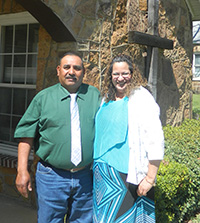
Inocencio Paula Briones 200Since they met 22 years ago, Inocencio and Paula Briones have faced struggles, but they insist God has sustained them. (Photo / Ken Camp)When the couple met more than 22 years ago, she was a single mom living in low-income housing—and she was, by far, more stable than her future husband.

“I used to be really bad into drugs and alcohol,” he admitted. “I was really depressed and didn’t know what to do. Somebody told me to go to church, because there were good-looking girls there.”

He visited the Hispanic ministry of First Baptist Church in Breckenridge and discovered his friend steered him to the right place. Before long, Inocencio and Paula Briones married, but nothing else changed about his life.

“I couldn’t go anywhere in this town without getting into trouble,” he acknowledged.

Making a faith commitment

Hoping for a fresh start, they moved—first to Albany and later to Graham. While they lived in Graham, a life-threatening car accident brought him to the point where he was ready to make a commitment to Christ.

Once he gave his life to Christ, he began traveling to Mexico on evangelistic mission trips, as well as sharing his faith throughout the area where he lived. So, when his pastor started a mission in Breckenridge, the minister sent Briones there to preach. But before long, the pastor withdrew his support.

“That hurt me,” Briones admitted.
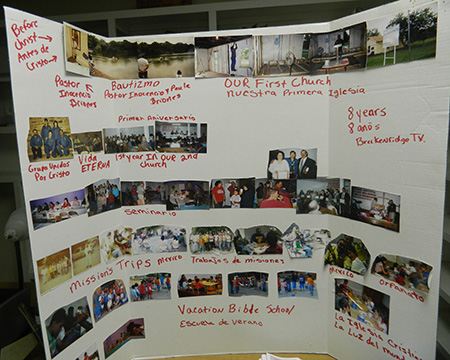
display 450Iglesia Cristiana la Luz del Mundo has faced challenges, but Paula Briones created this display to chronicle the victories God made possible. Even so, he continued to lead the mission congregation, which initially met in an 800-square-foot house and later in the homes or yards of members. Eventually, the congregation secured a storefront corner building downtown, where they worshipped six years.

For three years, Leon River Cowboy Church sponsored La Luz del Mundo, and the mission received financial assistance from the Baptist General Convention of Texas.

“We grew from 20 to 40 in attendance,” Briones recalled. “People were getting saved, and God was blessing.”

Greatest setback

But just about the time the three-year commitment from the BGCT and the sponsor church ended, the church sustained its greatest setback. Multiple families left. Some moved away to other towns; others moved their membership to other churches. Membership dwindled to four—Inocencio and Paula Briones and one other couple, Juan and Janie Martinez.

Between health issues that developed and the drop in membership, Briones decided to quit. So, he discussed it with the other three remaining members of the congregation.

“My wife was happy. The deacon said he understood and would respect my decision. But the deacon’s wife got up in my face,” he recalled.

New beginning

He agreed to continue as pastor, and the church began to rebuild its membership. At one point, he received a phone call letting him know the local Assembly of God church wanted to make its facility available to rent.

“Two years earlier, we had laid hands on that building, asking God for it,” he recalled. “Once we moved, we started growing, and people started getting saved.”

Isign 300Inocencio Briones dreams of a new digital sign at his churh that can let people in town know about activities involving the congregation—and that spells his name correctly.n August, La Luz del Mundo will mark its fifth anniversary in that location. On a typical Sunday, 70 to 80 people gather in the church’s sanctuary, which seats 100 comfortably.
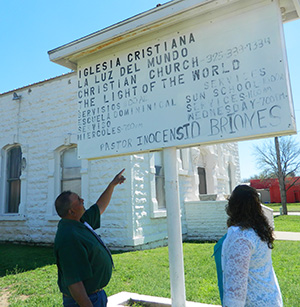
But on several occasions, with chairs lining the aisles, the church has filled with up to 150 worshippers. Nearly all of the congregation’s members were not Christians before they started attending La Luz del Mundo.

“Last year, we had a three-day revival meeting outside,” Briones said. At least 10 people made professions of faith in Christ.

Fellowship and prayer

Briones credits the growth at La Luz del Mundo in part to the warm fellowship at the church, noting, “We have a potluck meal every Sunday.”

But Paula Briones offers another explanation.

“My husband is on his knees every morning at 5,” she said. “Every day, he begins with prayer.”

‘Cross over a river’

For about two years, Briones prayed his church would start a mission congregation.

“God has blessed us, and we wanted to extend that,” he said.

One night, he dreamed he was supposed to “cross over a river” and help start a church. When he shared his dream with the pastor of a church in Acuña, where he had worked on mission trips, the pastor introduced him to a member who felt called to be a church planter.

“When we talked, he told me: ‘I’ve been praying for three months for this. I’ll do it,’” Briones recalled.

In February, Iglesia Evangelica Linage Escosido constituted as a mission with eight members. Within a month, the congregation drew about 40 worshippers.

Dreams for the future

Briones—who works in facility maintenance with the Albany school district—accepts no salary from La Luz del Mundo. He hopes the offerings his church members give each week eventually will enable their congregation to purchase the building where they meet and to expand it.

“God has something else for us,” he said. “It’s been hard, but we want to do what the Lord has told us to do. We are going to keep going and not give up.”

Read more articles like this in CommonCall magazine. CommonCall features inspiring stories about Christians living out their faith. An annual subscription is only $24 and comes with two complementary subscriptions to the Baptist Standard. To subscribe to CommonCall, click here.


Lenamon elected Texas Baptist Men executive director

DALLAS—Texas Baptist Men’s board overwhelmingly elected Mickey Lenamon, 58, as the sixth executive director in the missions organization’s 49-year history.

He has served as interim executive director since Don Gibson retired Dec. 31.

‘Wealth of experience’

Lenamon—whose family has been involved in TBM leadership since its earliest days—joined the organization’s staff as director of resource development in 2006 and was named associate executive director in 2008.

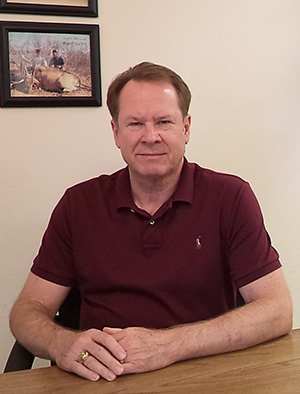
Mickey Lenamon 300Mickey Lenamon, newly elected executive director of Texas Baptist Men, plans to emphasize volunteerism and working in partnership with churches. (Photo / Ken Camp)“Mickey Lenamon brings a wealth of experience and passion for Texas Baptist Men,” said TBM President Kevin Walker of Fort Worth. “Serving as TBM associate executive director for the past eight years has grounded Mickey in how Texas Baptist Men impacts the kingdom through its various ministries. 

“Mickey’s lifelong connection and involvement in TBM gives him a passion to share God’s love through Texas Baptist Men.  His leadership will help propel TBM forward into the next chapter of ministry and service.”

Work in partnership

In his new position, Lenamon wants to emphasize TBM’s role as a volunteer-run organization that exists in partnership—not in competition—with churches.

“We need to focus on volunteerism, and we want to work at getting Baptist churches involved with us,” Lenamon said.

“Texas Baptist Men’s purpose is not to take people out of churches but to make them better church members. We are not here to take the place of the local church but to help take the church and its ministries outside its walls. Being a good volunteer in missions and being a good church member go hand in hand.”

TBM, a self-governing missions affiliate of the Baptist General Convention of Texas that works with volunteers from churches of varied denominational affiliations, engages in 18 ministry areas, including disaster relief, building, church renewal and water purification and well-drilling.

“Texas Baptists have long enjoyed a special relationship with Texas Baptist Men,” BGCT Executive Director David Hardage said. “As TBM begins a new era with a new director, our BGCT family offers our prayer support.

“Personally, I look forward to talking to and working closely with Mickey as, together, we seek to touch Texas and beyond through obedience to the Great Commandment and Great Commission.”

Lifelong involvement in missions

Lenamon grew up in Travis Avenue Baptist Church in Fort Worth, where he was involved in Royal Ambassadors, the missions organization for boys. His father, Joe T. Lenamon, was a state RA leader and was TBM president from 1974 to 1977.

“I was attending my first RA Camp at Latham Springs in 1966 with my father when I met Bob Dixon, who later became and remains my mentor,” Lenamon said. Dixon was TBM executive director from 1970 to 1998.

In his teen years, Lenamon worked as a state RA staff member and served in multiple mission projects, including church-starting in St. Cloud, Minn., and lay renewal events throughout Texas and in Hawaii, Alaska, Minnesota, Wisconsin and Australia.

After attending Texas A&M University, he worked as a personal financial planner in Fort Worth and Phoenix, Ariz., before serving as director of donor relations for Baptist Senior Life Ministries in Phoenix.

From 1999 to 2006, he was vice president of the Texas Baptist Missions Foundation, where he facilitated capital campaigns for Baptist Student Ministries at Texas A&M and Stephen F. Austin State University.

During his tenure as director of donor relations and associate executive director at TBM, he directed a capital campaign to raise $1.2 million to construct the John LaNoue Disaster Relief Complex, and he developed an annual giving program for TBM that raised more than $28 million in 10 years. He also planned and led 12 international mission trips.

Lenamon and his wife, Sallie, are members of Community Life Church in Forney. They have two adult sons—Ryan and Parker.


Armes thankful for his time at Wayland

PLAINVIEW—Paul Armes sits at the small conference table in the corner of his third-floor president’s office in Gates Hall on the Wayland Baptist University campus. The Kenneth Wyatt original painting “House Call” hangs above the table. A grandfather clock, donated to the university in memory of his mother, chimes its hourly song.

Armes will leave Wayland in a few weeks, but plenty of work remains, as evidenced by the paperwork piled on his desk, along with his day planner—open and full. The bookshelf is packed with books and filled with frogs—a favorite collectible.

The 12th president of Wayland Baptist University looks around his office.

“It’s time,” he said. “Nothing here is in any way pushing us away. No one has ever encouraged us to do this. Everyone has been extraordinarily gracious and kind in their response to us. But it’s time.”

Armes will retire effective June 30, leaving behind the university he has served 15 years. His last official duty as president was conducting graduation ceremonies May 7, but he will continue to work through June to accomplish a few personal goals and fulfill some commitments to which he feels obligated.

Years of growth and expansion

Since he was named president in 2001, Wayland’s budget has grown from $25 million to $65 million. Enrollment reached a record high of 6,834 students in 2012. Davis Hall, Jimmy Dean Hall and the Laney Student Activities Center all opened.

Wayland developed a Mission Center in Kenya, where it began offering courses and a religion degree. The School of Music reached All-Steinway School status. Wayland added numerous academic programs to its curriculum, including the doctor of management degree with classes beginning later this year.

Knowing it took a lot of work from a lot of people, Armes is slow to claim credit for any of it.

“The thing I would say that I will always remember about my 15 years at Wayland is that I was surrounded by wonderful folks who worked really hard,” he said. “And together as a team, as a family, including the entire university family, we took some really positive steps in really positive directions.”

Impact of a Christian university

Looking back, Armes said, the people always will be his fondest memories—not just the ones he worked with, but the ones he came in contact with throughout the last 15 years.

“I remember early in my tenure, going to Sierra Vista to participate in commencement,” he said. “I was the speaker that day.”

Armes 300During a conversation after a commencement ceremony, a new graduate told Wayland Baptist University President Paul Armes the required classes in biblical history she took changed her life.After the ceremony, a new graduate named Paula approached Armes to ask about the medallion he wore. The question sparked a conversation that resulted in Paula telling him her story.

As a nontraditional student, she didn’t want to attend Wayland, because she would be required to take six hours of biblical history to graduate. Wayland’s price and schedule, however, were the best fit for her. So, she reluctantly registered to attend. Little did she expect the effect those two Bible courses would have on her life.

“She really came to the point of understanding that what she considered to be faith in her life wasn’t,” Armes said. “At the end of the New Testament class, (campus Dean Jeff Barnes) prayed with her, and she prayed to receive Christ.”

As a result of her decision, she witnessed to her family. Both her children made commitments to Christ, and her husband made a recommitment of his life to Christ. After telling her story, Paula told Armes never to stop requiring those six hours of biblical history.

“That’s really who and what we are,” Armes said. “That is the unique element of Wayland that you can’t always find at other locations and in other schools.”

Never expected to leave the pastorate

Those types of stories have fueled Armes, who never expected to work in higher education. He surrendered to the ministry as a teenager and never saw his career taking him out of the pastorate—especially not into a role in higher education.

“I was not a stellar student in college,” he said. “I did OK but not exceptional.”

That changed when he entered seminary. Armes understood that to be a better pastor, he should be a teaching pastor. To that end, he sought a doctor of philosophy degree at Southwestern Baptist Theological Seminary in Fort Worth.

The pastorate eventually led him to First Baptist Church in Corpus Christi. While there, he served on the board for San Marcos Baptist Academy, a preparatory boarding school affiliated with the Baptist General Convention of Texas.

As the president of San Marcos Academy prepared to retire, several members of the board approached Armes, asking him to resign as a trustee so they could consider him for the president’s position.

“I did resign,” Armes said. “I wanted to give them a fair opportunity to consider me, and I wanted a fair opportunity to consider the possibility.”

Armes said he and his wife, Duanea, loved the church in Corpus Christi, where they had served eight and a half years, and they were not looking to leave. As they prayed about the decision, they did not feel led to pursue the position at San Marcos. But the board was persistent, returning two more times to talk to him.

“We decided we hadn’t prayed quite enough about it,” he said. “As we prayed and thought and reflected, it became clear to us that it was exactly what God wanted us to do.”

Armes accepted the post, and five years later, the Wayland board of trustees asked him to interview for the president’s job at the Plainview campus. At that time, Wallace Davis was moving into a chancellor’s position to oversee the Wayland system. The president’s position would oversee operations of the Plainview campus.

Armes accepted the position in 2001. A year later, Davis retired, and the board of trustees opted to return to a system in which the president oversees the entire Wayland system.

“In a way, all of this has kind of been a surprise to me,” he said. “I never sought to be an educator. I’m still a pastor at heart.”

Looking back and moving forward

Looking back on the last 15 years, Armes wishes he could have raised another $50 million for the university and seen the completion of a new Flores Bible Building. He also wishes he would have done more to celebrate the successes of the university family throughout the years.

“I’m not sure I’ve always celebrated the good things that we have done as a university—not me, but the university—maybe as dramatically or as significantly as we needed to,” he said. “I’m just aware of the fact that everything I have done has been dynamically linked to very special people who I have walked beside—who have given so much of their lives to this university, who have done superb work that I am proud of. But there are times as a university that you ought to celebrate. When good things happen, you need to acknowledge those.”

As retirement grows closer, the Armeses already have begun making plans—mostly revolving around their five grandchildren.

“I would just like to be a part of their lives. I would like to be able to interact with them, and Duanea would, too,” he said. “Duanea is such a wonderful grandmother. She is better at her job than I am at mine.”

Armes couple 200Wayland President Paul Armes insists he cannot overstate the contributions of his wife, Duanea.Armes credits much of his success to his wife, and he gets emotional talking about how their relationship has grown over the past 15 years.

“The delight of the love that we have for each other and the dependence that we have on each other and on the Lord in this journey, particularly at Wayland, has been something that we have learned and experienced together,” he said. “We are closer now than we have ever been. If you had asked if that would have been possible 25 years ago, I would have said absolutely not. But we have grown together.”

Along with traveling and grandchildren, Armes hopes to preach more in retirement. He sees it as an important part of his calling to ministry, and he hasn’t been able to preach as much as he would have liked in recent years.

As for Wayland, he feels that university is on the verge of a prosperous period. He also expects Wayland to remain a beacon for Christian higher education.

“This is a place where life-changing conversations happen—not just about knowledge, but about the spiritual dynamic of life. About a person’s relationship with Christ. About what God’s plan is for life,” he said.

“Those conversations happen every day in classrooms, the cafeteria and other locations. I’m proud of that fact.”


Buckner helps Houston flood victims

HOUSTON—Bettye Mack awoke one Friday morning last month to discover water rapidly seeping under the door of her house. She did everything she could to make it stop, but it was no use.

The water entered her house so fast, she didn’t have a chance to save any of her belongings. By the time she and her adult son evacuated, the water had risen above the top of their living room coffee table.

Greater Houston experienced record-breaking rains that caused flooding throughout the city and killed seven people. Some residents, like Mack, experienced it worse than others.

“My whole house was destroyed,” she said. “It’s depressing. It’s devastating. And it’s overwhelming. My husband passed two years ago, and I had him to help me with the flood in 2001. But now it is on me to do everything. And my sister passed two months ago in California. It’s like everything is coming at me at one time.” 

Everything in her house is gone, she said. She tried to get help from several different places without luck until she found the Buckner Family Hope Center at Aldine, one of the main relief agencies helping Houston-area flood victims.

The Family Hope Center has helped about 100 families affected by the floods, meeting immediate needs such as clothes, food, toiletries, hygiene items, bedding and even school uniforms. 

“We are their community,” said Shawna Roy, director of the Hope Center. “We are here, and that is what community is about—helping those that are closest to us.”

The Hope Center is located next to several schools within the Aldine Independent School District and has partnered with the district to help provide relief to some of nearly 600 families affected by the floods.

As the floods resided, social workers and counselors for the district started referring donations and families still in need to the Hope Center.

“Our counselors and social workers are probably the first responders when they encounter the families,” said Charlotte Davis, director of guidance, counseling and at-risk students for the Aldine Independent School District. “But depending on how badly they were hit, it can take a good six months to a year … for some families to get back to some sort of normalcy again.”

The Family Hope Center’s “vision and their desire to help families is huge with us,” she continued. “That keeps us pumping, because we know they are going to be taken care of with everything they have within their means to work with.”

Workers at the Hope Center daily collect and sort donations to distribute them to families in need.

“We’re really thankful for all the people who have come and donated,” Roy said. “I love the fact that our community has come together. It’s been great to see all the different schools and churches come together to help. I’m really proud of us and our staff for stepping up and meeting that challenge.”

Roy hopes families will continue to come to the Hope Center. Many families they have helped since the floods previously weren’t aware of the Hope Center or the programs they offer.

“It’s not really about what we’re giving them now, but helping to provide some long-term transformation and stability for the people that live right here,” Roy said. “We’re going to hug them and love them. Then hopefully build that relationship, so that we can be there for them long-term to get them where they need to be.”


New multiracial churches best hope for achieving diversity, researchers say

WACO—Congregations that attempt to boost their racial and ethnic diversity may end up with fewer people in the seats, depending on how they handle change, a Baylor University study revealed.

The findings, published in the Journal for the Scientific Study of Religion, are based on an analysis of data from more than 11,000 congregations in the Evangelical Lutheran Church in America from 1993 to 2012, as well as data from the U.S. Census Bureau.

Process of change causes difficulties

While the diversity in the denomination doubled during the study period, average church attendance declined by 22 percent. ELCA churches that experienced the most racial change had the steepest drops in attendance, regardless of congregation age, region of the country or county population.

“Racial diversity itself is not a detriment to growth,” said lead author Kevin Dougherty, associate professor of sociology at Baylor. “It is the process of changing the racial composition of a congregation that causes difficulties.” 

Findings noted

The study, “Congregational Diversity and Attendance in a Mainline Protestant Denomination,” found:

  • Increases in racial diversity were associated with decreases in average weekly attendance, most notably in the 1990s.
  • Older congregations were more likely to decline in attendance. 
  • Congregations in growing, predominantly white counties were more likely to grow.

The study is the first systematic test of a widespread notion that churches with members of the same racial or ethnic group are most likely to grow, with many church leaders believing churches can more efficiently serve members’ needs if they share the same culture. 

Denominational administrative decrees not the answer

“That philosophy for a long time discouraged church leaders from striving for diversity,” said study co-author Gerardo Martí, associate professor of sociology at Davidson College.

“But in coming to terms with the historic racial segregation of American congregations, white pastors in the 1990s aggressively committed to overcoming discrimination, urging members to bring in those from ancestral backgrounds and reaffirm the gospel as rooted in relationships, unity and love. Racial diversity has become a central, and sometimes dominating, ambition for many white churches.

“Our research implicitly evaluates the effectiveness of denominational initiatives to ‘become diverse,’ revealing the extent to which such grand administrative calls for diversification lead to measurable success at the local level.”

In 1993, the ELCA issued a statement calling for leaders and congregations to repent of the sin of racism and advocate for racial justice in the community and congregations. Although the denomination has pushed to become more racially inclusive through ministries, missions and promotion of diversity within church staffs and leaders, still more than 90 percent of ELCA members are white.

New multiracial congregations best opportunity for diversity

As the U.S. population becomes more ethnically diverse, American congregations will face increased pressure to accommodate diversity inside their doors, researchers said.

“We conclude that new congregations started as multiracial represent the best opportunity for diversifying a denomination,” Dougherty said.

“It may be that nondenominational congregations may be more adaptable, since they do not have a denominational heritage to sustain.”

The researchers have begun to test those possibilities with data from other congregations.


Three DBU students killed in pickup truck accident

DALLAS—Three Dallas Baptist University students died in an early-morning one-vehicle wreck in southwest Dallas May 7.

DBU prayer 300The Dallas Baptist University campus community filled Pilgrim Chapel for a prayer service after a single-vehicle wreck claimed the lives of three DBU students. (DBU Photo)Will Smith of Bullard, Justin Schubert of Cleburne and Djorddje (DJ) Sarenac of Belgrade, Serbia, died after the pickup truck in which they were traveling overturned about a mile from campus and hit a utility pole.

Smith, 23, was a few days away from completing his junior year. He was a business information systems major who began classes at DBU last summer as a transfer student.

Schubert, 22, was a communications theory major. He also transferred to DBU and began classes there in the fall 2014 semester.

Sarenac, 19, was a math major who enrolled as a first-year student at DBU last fall.

“Our hearts and prayers are with the families of these students as our university mourns this heartbreaking loss,” a statement issued by DBU said.

DBU administration reached out to the students’ families “to provide love, support and encouragement in the midst of this tragedy,” the statement added.

Students, faculty and others gathered at 9 p.m. May 8 in Pilgrim Chapel on the DBU campus for a prayer service, and the university made grief counselors available.

The fatal accident marked the second tragedy in less than two weeks at Baptist General Convention of Texas-affiliated universities. On April 28, two East Texas Baptist University freshmen student-athletes drowned in an off-campus pond in Marshall.


CommonCall: Nobody left behind

On a Sunday morning more than nine years ago, Pastor Steve Packer looked at his congregation at First Baptist Church in Pittsburg and saw the future.

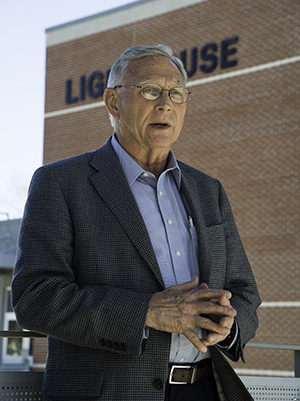
Packer 300At epiphany at age 60 led Pastor Steve Packer to launch a new service for young people and ultimately build a new facility geared toward a young audience. (Photo / David Clanton)Packer—then age 60—counted fewer than two dozen young people among the 250 worshippers. And he recognized since he had arrived at the church in 1995, he had conducted about 300 funerals.

“That’s when I realized we were a dying church,” he said. “I said, ‘If we don’t do something, we’ll be nothing but old people remembering how it used to be.’”

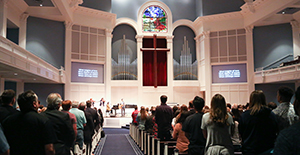
So, after studying growing churches that were reaching young people effectively, he led the congregation to launch a Sunday morning contemporary service in the church’s gymnasium.

“I had been here long enough to say, ‘This is what we’re going to do,’” he recalled.

But he assured longstanding members the new service would be in addition to the traditional worship service in the church’s sanctuary they loved.

“I told them, ‘No person will be left behind,’” he said.

For about seven years, worship leaders and volunteers set up chairs and a platform in the gymnasium every Sunday morning for the contemporary worship service.

‘We need a place for the young people to worship’

About three years ago, Packer talked to lay leader Bo Pilgrim—former chicken magnate, principal shareholder of a bank holding company and philanthropist—about launching a long-delayed capital building campaign at church.

“We don’t need a colonial-style church sanctuary,” Packer recalled saying. “We need a place for the young people to worship.”

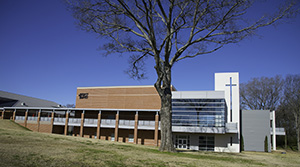
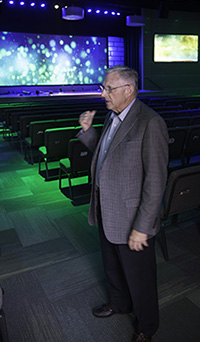
So, First Baptist Church built The Lighthouse, a 27,000-square-foot facility that includes a 350-seat worship center and educational space.

“But every time we spent money on the new building, we also spent on the established facility,” Packer recalled.

PFBC Lighthouse 300First Baptist Church in Pittsburg built The Lighthouse, a $6.5 million facility with a contemporary worship venue and educational space for children and preschoolers. (Photo / David Clanton)Older members gave generously to support construction of the new $6.5 million facility.

“They just knew it’s what we needed to do,” he said, noting the need not only for worship space that would appeal to a younger audience, but also high-quality educational space for preschool and children on Sunday and for the church’s weekday ministry to preschoolers, First Kids Academy.

Drawn by the energy in worship

The contemporary worship service not only attracted young couples with children, teenagers and students at the local junior college, but also drew some older church members.

“A lot of our older adults love the energy here,” Packer said. “They might prefer the traditional music, but they love what they see happening at The Lighthouse.”

The high-energy worship service grew so quickly, the church added an additional worship service at The Lighthouse. First Baptist provides two 9 a.m. worship services—a traditional service in the sanctuary that attracts about 100 members and a contemporary service at The Lighthouse that draws around 190. About 220 attend a second contemporary service at 11 a.m.

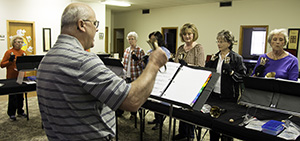
Handbell choir 300Although members of First Baptist Church in Pittsburg praise the energy and excitement of worship in The Lighthouse, the congregation’s contemporary worship venue, the church also offers traditional worship opportunities, as evidenced by its handbell choir. (Photo / David Clanton)Worshippers at each of the three worship services hear a sermon on the same subject and from the same Scripture, with Packer and another minister and staff alternating preaching duties in the two simultaneous 9 a.m. services.

But the worshippers’ experience differs. Christians who enjoy familiar hymns, choral anthems, handbell choirs and established traditions feel at home in the worship service held in the sanctuary. The two services at The Lighthouse, on the other hand, are designed with first-time guests in mind, so nobody attending feels like an outsider, worship planners explained.

Building and planning for people not yet in church

Worship services at The Lighthouse succeeded because the church prioritized them, said John Borum, associate pastor at First Baptist until he left a few months ago to become assistant vice president for enrollment at Dallas Baptist University. He credits the church’s willingness to construct a building and plan Sunday morning worship for people who were not already part of the congregation.

Packer 200The Lighthouse features a 350-seat state-of-the-art worship center, Pastor Steve Packer notes. (Photo / David Clanton)“The church made it as a Sunday morning alternative,” scheduled for the convenience of nonattenders, rather than for the convenience of people already involved in church, Borum observed. “It proved itself. It reached new people.”

While worship services are geared toward guests, the church focuses on integrating new members and frequent attenders into the life of the congregation. Four times a year, First Baptist sponsors a “Service Sunday,” when it invites members to make a “seasonal commitment” to some church-related responsibility.

“We found people would come here, but they were not always consistent. They might attend twice a month,” Borum said. “By giving them a job, they have a reason to be here. Once you’ve signed up, you’ve committed to get up when the alarm goes off on Sunday morning. It’s a way of transitioning people from being guests to becoming hosts.”

First Baptist also offers a class for new members, providing “a safe place to be totally ignorant about the gospel,” he added.

The intentional assimilation process is reaching its objective, Packer observed. “These are people who are sticking.”

New needs with new people

As the church has expanded from its base of older adults who have attended church for decades to include children, teenagers and young adults with little or no church background, ministry opportunities also have expanded.

“If you have a senior adult church, you need a good hospital visitation ministry and somebody to care for the needs of the people. If you have a congregation of young adults, you need to help them deal with all the problems young people face,” Packer said.

The desire to minister to young adults—not only those who attend The Lighthouse, but others in surrounding communities who may need help—prompted First Baptist to launch Life Solutions, a counseling ministry led by George and Mary Ann Winegeart.

Life Solutions offers individual and family counseling in a building near the church campus but separated from all other facilities to protect the privacy of clients, who receive services on a sliding scale based on their ability to pay.

“We had 83 scheduled counseling sessions last year,” said George Winegeart, a licensed marriage and family therapist. “It’s growing faster than I thought it would.”

That’s the same refrain Packer echoes when he thinks about the changes at First Baptist in the last nine years.

“It all started from an epiphany at age 60,” he said.

Read more articles like this in CommonCall magazine. CommonCall features inspiring stories about Christians living out their faith. An annual subscription is only $24 and comes with two complementary subscriptions to the Baptist Standard. To subscribe to CommonCall, click here.


Court rules Muslim inmates may wear beards and skullcaps

Texas prisons must allow Muslim inmates to wear the four-inch beards and knit skullcaps their religion demands, a federal court ruled.

The U.S. Fifth Circuit Court of Appeals in New Orleans ruled in favor of David Rasheed Ali, who sued the Texas Department of Criminal Justice in 2009, saying his faith required him to wear a “fist-length” beard and a white knit kufi.

Ali, an inmate at the Michael Unit near Palestine, asserted the TDCJ policies violated the Religious Land Use and Institutionalized Persons Act. The law bars the government from imposing a “substantial burden” on prisoners’ religious practices unless officials can show a compelling interest, and it requires the government to use the “least restrictive” means possible.

A district court ruled in Ali’s favor, and the appeals court affirmed that decision.

Strong protections for religious rights of inmates

The appeals court opinion demonstrates the “strong protections for the religious liberty interests of prisoners” the Religious Land Use and Institutionalized Persons Act provides, said Holly Hollman, general counsel with the Baptist Joint Committee for Religious Liberty.

“While safety and security are obviously important governmental interests, the Supreme Court has made clear that courts should not give undue deference to prison officials. This case follows that guidance,” she said. 

TDCJ asserted security risks

At the time Ali filed his suit, the prison system permitted inmates to wear religious skullcaps only inside their cells or during religious worship services, and the TDCJ grooming policy required all male inmates to be clean-shaven, aside from certain medical exemptions.

The agency later amended its policy to allow inmates to grow half-inch beards for religious reasons, but the TDCJ insisted longer beards and skullcaps presented a security risk because prisoners could hide weapons and other contraband in them.

Other TDCJ objections to beards focused on issues of identification—beards could cover facial tattoos or other distinguishing marks and could allow inmates to change their appearance, and kufis also could hide gang tattoos.

Not ‘least restrictive’ means

The appeals court ruled the prison system has a compelling interest in maintaining security and eliminating contraband in prison. However, the court ruled, the TDCJ did not demonstrate banning longer beards and restricting when and where inmates could wear kufis was the “least restrictive” means to accomplish its legitimate security concerns.

Under prison system procedures, correctional officers require inmates with long hair to prove it is free of contraband, and the court asserted the prison likewise could require a similar process for long beards.

“TDCJ could revoke an inmate’s beard privilege if he abused it or refused to comply with the searches,” Justice Edward Prado wrote for the three-judge panel.

Make available for inspection

Likewise, the appeals court noted the prison system already allows inmates to own kufis and prayer rugs, and it requires the prisoners to make the items available to correctional officers for inspection.

“TDCJ fails to adequately explain why it can search an inmate’s kufi when he is traveling with it to and from religious services but not if he was to wear it at other times,” Prado wrote. “Further, TDCJ has not shown why it is impracticable to revoke kufi privileges for those inmates that resist such searches.”

The appeals court ruling affirmed a 2014 decision by U.S. Magistrate Zack Hawthorn of Beaumont. He ordered prison officials to allow Ali to grow a longer beard and wear a kufi inside the prison, but the TDCJ appealed.

“We are reviewing the decision and have no further comment at this time,” said Jason Clark, director of public information for the TDCJ.


CommonCall: ‘See the difference love makes’

CISCO—The last time First Baptist Church in Cisco found itself without a pastor, the search committee steered down a road rarely traveled.

Literally, they turned toward Abilene, 48 miles west on Interstate 20, one of the busiest highways in Texas. But in every other respect, they charted a new course for their 138-year-old congregation.

First Baptist, an almost all-white church in an almost all-white farming/ranching/fracking community, called Kelvin Kelley, a black minister/professor/nonprofit entrepreneur, to be its pastor.

When the church’s previous pastor, Craig Curry, left in 2009, pastor-search committee member Delburt Schaeffer asked about recommendations for preachers to fill the pulpit and serve as interim pastor.

“Craig already made the list,” Shaeffer recalled. “He handed it to me and said, ‘The best one is the first one on the list.’ … Dr. Kelley was at the top.”

Kelvin KelleyDr. Kelvin Kelley, pastor of First Baptist Church Cisco (Photo / David Jones)Kelley preached in November, and the committee asked him to become interim pastor. He said no. Not because he wasn’t interested, but because he was too busy.

Kelley taught courses on leadership, Christian education and spiritual formation as a faculty member at Hardin-Simmons University’s Logsdon School of Theology. He also operated FACES—First A Challenge Eventually Success—a ministry to bridge the gap of absentee or disconnected fatherhood for high school and college young men.

Three months later, Kelley became First Baptist’s interim pastor. Three months after that, the search committee told him, “We think you may be the guy,” he remembered. “I said: ‘No way. I can’t add this.’ They said, ‘We’re not listening to anybody else.’”

“People in our church were going to everybody on the committee, saying: ‘Why are you looking? We want this guy,’” Shaeffer said.

The committee acknowledged the significance of an Anglo congregation calling an African-American pastor. “We want to do church unusual,” they told Kelley. They suggested he serve bivocationally—continuing to live in Abilene and teach at Hardin-Simmons.

During a month of prayer, Kelley dreamed about the Apostle Peter’s vision of all kinds of animals lowered from heaven. He interpreted the dream as telling him what Peter heard from God: “Men are looking for you; don’t be afraid to go with them.” Meanwhile, his wife, Kimberly, told him, “I sense it’s time to begin a new chapter.”

So, the search committee recommended Kelley to the church, and 94 percent of the voting members confirmed the call.

Kelley stepped to the pulpit and told them: “Today, we begin. … We’re not going to act like this is normal. We will not stick our heads in the sand; we will not be naïve. There is no precedent for us to follow, and we’ll make mistakes. But we will do things face-to-face.”

James Shields, Kelley’s mentor, longtime religion professor at both Hardin-Simmons and Howard Payne University and twice an interim at First Baptist, told him: “Brother Kelley, I don’t know if I’m more proud of them or you. I remember a time when you would not have been welcome in that church,” Kelley recalled.

They lost three families, but pastor and congregation “have been navigating in that (history-confounding) reality ever since,” Kelley said.

FBC CiscoPastor Kelvin Kelley finds joy in spending time with the children at First Baptist Church in Cisco. (Photo / David Jones)First Baptist’s demographics mirror its community’s—about 95 percent Anglo, 3 percent Hispanic and 1 percent or 2 percent African-American. In addition to the Kelley family, one young woman and the husband of an Anglo wife are the church’s only African-Americans, and one Hispanic woman married to an Anglo man is a member.

“Every time Kimberly and I make a house call, to cross that threshold, we make history,” he said. “And then, to go on a hospital visit and hear a Caucasian man, about 70 years old, say, ‘I love you’ to me—in front of his wife.”

The church’s walk alongside its pastor has required courage and faith, Kelley noted. “They did not let the social dynamics … what their friends said about them having a black pastor, making them the butt of jokes … dictate what God was doing in the ‘church unusual.’”

When people think about the differences in African-American and Anglo churches, they often focus on worship. But Kelley credits his experiences at Hardin-Simmons for helping him bridge that chasm. Professors Jim Heflin and Ronnie Prevost showed him “how people of the dominant culture hear the word of God,” he explained. “I learned how to preach and be relevant by learning how they hear the proclamation.”

And as a Logsdon faculty member, Kelley already had preached to all-white congregations in small towns such as Bangs, Brady and Comanche.

First Baptist and Kelley also figured out how to accept each other, even in their differences. “I tell them, ‘I want you to be who you are, and you to let me be who I am,’” he said.

Race aside, some of the challenges Kelley and First Baptist have navigated—such as balancing contemporary and traditional worship, deciding what kind of dress is appropriate and determining the role of deacons—are common to all kinds of churches.

Five years into the pastorate, the Kelleys decided to move from Abilene into the church parsonage in Cisco. Now, he commutes to Hardin-Simmons for classes, but they live on the church field.

FBC CiscoDr. Kelley with his wife Kimberly, FBC Cisco member Sharon Sellers, and his granddaughter Anna (Photo / David Jones)Before the move, they consulted their children. Kelvin Lamar, a sophomore at Abilene Christian University, admitted the move wouldn’t make much difference for him. Anna, a second-grader, didn’t have a lot at stake. But it posed a major life change for K.J., a 10th-grader who grew up wanting to play football for Cooper High School in Abilene. He faced the challenge with faith. “If that’s what God is doing, then that’s what we need to do,” he told his parents.

So, they made the move and journeyed further down the path rarely taken.

“The church didn’t ask us to do it, … but people have to know you care about them,” Kelley said.

That feeling is mutual, church members reported.

“The people have accepted him really well,” said Lavada Starr, the church’s secretary and receptionist. “He’s easy to work with … God living in our hearts makes it work.”

“First Baptist has always been all-inclusive,” noted Brad Kimbrough, a member 42 years. “When I joined, we had taken in people from a Mexican mission. We had Hispanics in the church. We had a black deacon at the time. … I would say we’re not liberal; we’re very conservative. But it’s always been a church where everyone is welcome.”

Kelley wants to keep it that way. “Love is the greatest gift the world has known,” he said. “I love my people, and they love me, and we want you to see the difference love makes.”

FBC Cisco: Photo SlideshowSee the difference love makes

Read more articles like this in CommonCall: The Baptist Standard magazine. CommonCall features inspiring stories about Christians living out their faith. An annual subscription is only $24 and comes with two complementary subscriptions to the Baptist Standard. Click here to subscribe.


Austin Baptist Chapel serves 3 million meals to needy in three decades

AUSTIN—Life on the streets teaches resourcefulness. Homeless people learn how to survive. So do the ministries that serve them.

Alex 200Alex has learned what it takes to survive on the streets of Austin. (Photo / Ken Camp)Alex moved to Austin a couple of years ago to “do music,” but the prospects proved less promising that he expected. Now, he lives on the streets.

“I’ll be honest. Alcohol played a big part,” he confided.

Alex knows when and where to go each morning to look for an odd job—cutting grass, working in construction or laboring on a demolition team. And he understands how to get hired.

“Hygiene is very important to me. I’m OK if I can get a shower in the morning,” he said. “If you don’t look the part of a homeless person, you have a chance to get work.”

He carries his meager possessions in a backpack and wears an old University of Texas sweatshirt.

“It doesn’t work if you’re carrying around a bunch of stuff. But if it’s in a backpack, they don’t know if you’re a student or what,” he said.

Like many homeless people in Austin, he knows Austin Baptist Chapel provides three private stalls where people who live on the streets can shower and a closet where they can find clean clothes. And any day of the week he’s not on a job site at lunchtime, he knows he can find a hot meal there.

For three decades, Austin Baptist Chapel—southeast of downtown—has provided daily meals to people in need.

Frank Deutsch 200Frank Deutsch founded Austin Baptist Chapel three decades ago. (Photo / Ken Camp)“About 80 percent of the people who come here are homeless. The other 20 percent are people who find there is more month than money” after working at minimum-wage jobs, said Frank Deutsch, who founded the ministry in 1986.

Since then, he estimates Austin Baptist Chapel and its Angel House Soup Kitchen have served 3 million meals and recorded between 2,000 and 3,000 faith commitments to Christ. 

The ministry provides a light breakfast each morning, and volunteers serve a full midday meal from 11 a.m. to 12:30 p.m., seven days a week, including holidays.

“On a typical day, we’ll serve about 400. We report about 12,000 each month,” Deutsch said. “Sundays are the biggest days. That’s when we serve fried chicken.”

Eight churches include Austin Baptist Chapel and the Angel House Soup Kitchen in their Souper Bowl of Caring emphasis each January. Other than that, the ministry does not participate in any fund-raising events, Deutsch said.

“There have been so many miracles. It’s amazing how God has provided,” he said.

Restaurants, grocery stores and warehouse-style discount centers donate a majority of the food. Funds made available through the Texas Baptist Hunger Offering help make up the difference.

“Money from the hunger offering buys all the milk we serve to children at breakfast in the summer,” as well as filling other voids in the menu any given day, Deutsch said.

God also provides the volunteers who serve the meals, he added. Workers from businesses, churches and civic organizations give their time.

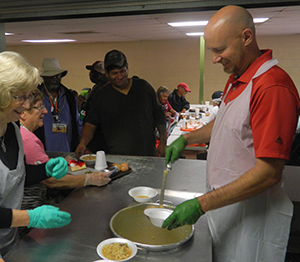
Jason White 300Pastor Jason White and other volunteers from Manchaca Baptist Church in South Austin serve noon meals at Austin Baptist Chapel. (Photo / Ken Camp)Manchaca Baptist Church in South Austin sends a volunteer team the first Monday each month. The practice predated Jason White’s arrival as pastor about a year and a half ago, but White fully supports it, dishing up soup alongside other volunteers whenever he can.

“Once our people get a taste of what it’s like, getting the chance to serve, it’s contagious,” he said.

After three decades working seven days a week at the ministry, God also provided Deutsch a break. Last year, Mark and Cindy Smith sold their home in Dublin and nearly all their possessions to relocate to Austin to direct the work of Austin Baptist Chapel—although Deutsch continues to work at the ministry on a regular basis.

Mark Cindy Smith 200Mark and Cindy Smith moved from Dublin to direct Austin Baptist Chapel, providing a much-needed respite for founder Frank Deutsch. (Photo / Ken Camp)For more than 17 years, Mark Smith ran a tire store. As time permitted, he worked as a layman in ministries at First Baptist Church in Dublin, but he longed for an opportunity to do more.

“I wanted to spend the second half of my career serving the Lord,” he said.

Working with Austin Baptist Chapel seemed like a perfect fit, his wife added.

“It’s like snapping in the last missing piece of a puzzle,” she said. “It feels complete.”

That’s how Deutsch feels about the ministry he believes God led him to launch. In a newsletter published on the first anniversary of Austin Baptist Chapel, he reported: “We ended our first year with a home, food in the pantry and $1,507.74 to pay bills with. Isn’t God great!”

Three decades later, he still offers the same testimony.

“We’ve never had a lot of money, but we’ve always have what we needed,” Deutsch said. “God provides.”


Prestidge and Burgin to receive 2016 Legacy Awards

INDEPENDENCE—Texas Baptists will honor Sam Prestidge, founder of Singing Men of Texas, and Tillie Burgin, founder of Mission Arlington, with Legacy Awards June 5 at the historic Independence Baptist Church near Brenham.

Prestidge felt God’s call to ministry at age 14. He earned a bachelor’s degree from Baylor University and a master’s degree in sacred music from Southwestern Baptist Theological Seminary. Hardin-Simmons University awarded him an honorary doctorate.

Sam Prestidge 200Sam Prestidge After going to work in the church music department at the Baptist General Convention of Texas, his passion for music motivated him to establish the Singing Men of Texas in 1975. He went on to establish the Texas Baptist All-State Choir in 1976, All-State Band in 1978 and All-State Strings in 1994. In 1980, he founded the Texas MusiConference, an event that averaged more than 1,000 music leaders in attendance annually.

Prestidge retired from the BGCT in 1994 as director of church music after serving 34 years.

When asked what advice he would offer others to stay motivated in ministry, he responded: “Love the Lord with all your heart, mind and soul. Study God’s word. Pray and be faithful to your church. Get a good education, both college and seminary. And, by all means, love people.”

Burgin was born and raised in Arlington, the city where she dedicated much of her life and ministry. She earned her bachelor’s and master’s degrees from the University of North Texas.

Tillie Burgin 200Tillie Burgin In 1966, she and her husband, Robert, accepted God’s call to serve as missionaries in South Korea with their two young sons, Jim and Rick.

After a decade on the international mission field, they returned to Arlington.

In August 1986, she founded Mission Arlington, which has touched countless lives for 30 years by assisting people with their physical, intellectual, emotional and spiritual needs.

Burgin received an honorary doctorate from Dallas Baptist University and Arlington’s Martin Luther King Jr. Sharing the Dream Award for community service, and she was named Pastor of the Day for the Texas House of Representatives. The City of Arlington honored her with Tillie Burgin Day declarations in 2000, 2004 and 2006, and Gov. George W. Bush named her to the Texas Woman’s Hall of Fame in 2000.

Burgin offered this advice to others who serve God: “Stay constant in prayer and constant in your Bible readings, and learn to worship God wherever you are. Worship of God is what keeps us motivated. We walk and live to please him.”

The Legacy Awards will be presented during a 10 a.m. worship service June 5 at Independence Baptist Church, with lunch to follow. The public is invited, and reservations are requested for the meal. Contact Becky Brown at (214) 828-5301.


Baylor Alumni Association approves legal settlement with university

WACO—Members of the Baylor Alumni Association voted to approve a legal settlement with Baylor University, resolving a lawsuit filed in 2014. And representatives of both parties in the suit hope it ends a feud that dates back about 15 years.

The organization’s charter required two-thirds support from dues-paying members for ratification of the agreement announced in early March, less than three weeks before a scheduled trial date. It received 98.5 percent support, with 3,548 voting in favor and 53 against.

“The overwhelming and enthusiastic support of so many members of the BAA demonstrates a commitment and—more importantly—a steadfast desire to move onward in our support of the university we all hold dear,” said Tom Nesbitt of Austin, president of the alumni association.

Richard Willis, chair of Baylor’s board of regents, called the vote “a bold step forward,” saying the association’s members approved “a forward-looking agreement that brings all legal differences to a unified conclusion and, more importantly, strengthens scholarship support for Baylor students and engagement with all alumni.”

Alumni association receives $2 million

The Baylor Alumni Association received $2 million from the university, to be used in any way that advances the organization’s charitable purposes. In exchange, the association waives its rights to a replacement for the Hughes-Dillard Alumni Center, the organization’s home from 1978 to 2013.

Baylor demolished the building as part of the McLane Stadium construction project, to clear a plaza leading to the pedestrian bridge that connects the main campus to the stadium.

According to other terms of the settlement:

  • The university will continue to operate the outreach, events and engagement programs of its in-house Baylor Alumni Network.
  • The Baylor Alumni Association will remain an independent nonprofit entity and change its name to the Baylor Line Foundation.
  • The renamed association will continue to publish the Baylor Line with editorial and operational independence.
  • The Baylor Line Foundation will focus its fund-raising efforts on student scholarship programs and will sponsor activities and events that support its membership and purpose.
  • Three alumni-elected representatives will serve on the university’s board of regents.

At its May meeting, the board of regents will consider Don Chapman of Dallas, Wayne Fisher of Houston and Julie Hermansen Turner of Dallas as the first alumni representatives. When their terms expire, Baylor alumni will be invited to participate in open elections to determine their representatives on the board.

“The board looks forward to welcoming future alumni-elected regents whose additional diverse perspectives as members of the Baylor family will enrich and inform the work of the university,” Willis said.

Decade and a half of discord

Tension developed between the independent Baylor Alumni Association and Baylor University’s administration and regents during the latter years of Robert Sloan’s time as university president—particularly after Baylor created its own alumni relations network and launched its own magazine in June 2002.

The relationship continued to degenerate when the alumni association accused the university of blocking its access to graduating seniors and minimizing its presence at Baylor functions. The university, in turn, asserted the association related to an increasingly small percentage of alumni and failed to provide the expected level of support for Baylor.

In September 2013, alumni association members voted on an agreement that would have disbanded the organization, turning over all alumni-relations activities to Baylor and creating the Baylor Line Corporation as a separate entity. The measure failed to receive the required two-thirds majority vote.

About three months later, the university sought to cut off its licensing agreement with the alumni association. The school’s lead attorney subsequently sent a letter demanding the Baylor Alumni Association “cease and desist” using the school’s licensed trademarks.

On June 6, 2014, the university filed suit against the alumni association. In turn, the alumni association filed a counterclaim, asserting Baylor breached its license and recognition agreements and its promise to provide the alumni association a building.

‘A clear path forward’

Officials expressed their hope the legal settlement will allow both the university and members of the alumni association to put the past behind and move forward.

“The BAA membership has come together in a unified effort to strengthen relationships among all members of the Baylor family and with a firm commitment to support students who, as future Baylor alumni, remain actively connected and engaged with their alma mater,” Baylor President Ken Starr said.

“We are deeply grateful for the dedicated servant-leaders who—motivated by a unity of purpose and a deep and abiding love for Baylor University—worked diligently and thoughtfully to provide a clear path forward to serve the best interests of Baylor students and alumni worldwide.”