Messengers decrease 2015 budget, expand annual meeting’s purpose

WACO—Messengers to the Baptist General Convention of Texas annual meeting approved a decreased 2015 budget and voted to expand the purpose and programming of the annual meeting beyond its traditional focus as a business event.

annual-meeting-banner300The 2015 BGCT budget depends on $31.9 million in Cooperative Program receipts from churches. It also requires $2.6 million in investment income and $500,000 from nonchurch donors. The $35 million budget reflects a $2.14 million reduction from this year’s financial plan.

Counting additional revenue from the North American Mission Board, conference and booth fees, product sales and other miscellaneous sources, the BGCT anticipates $37,784,297 for its total budget—down $2.62 million.

The approved giving plan for undesignated receipts continues, with 79 percent allocated for BGCT expenditures and 21 percent for worldwide causes. Each church determines the recipient or recipients of its “worldwide” giving—the portion that goes beyond the BGCT.

Less for partnership missions

Messengers approved $1.47 million for Texas world missions initiatives and partnerships, down from $1.8 million in 2014. Recipients include missions mobilization, River Ministry and Mexico missions, Texas Partnerships, the Baptist World Alliance, Go Now Missions involving college students, Texas Baptist Men international ministries and intercultural international initiatives.

At the recommendation of a study committee and the BGCT Committee on Convention Business, messengers approved a change in the convention’s bylaws to include an expanded and inclusive purpose statement for the annual meeting.

Revised bylaws, constitution

The revised bylaw states: “The annual meeting of the convention shall be a gathering for the purpose of worship, fellowship, mobilizing, encouraging, informing and uniting Texas Baptists to accomplish the Great Commission, as well as to elect officers; receive recommendations and reports of officers, committees, and boards; and for any other business that may arise or be scheduled.”

In a related move, messengers voted to amend the BGCT constitution to rename the Committee on Convention Business as the Committee on the Annual Meeting. They also amended the bylaws to expand the committee’s size from 16 to 18 members, changed the term of each member from two years to three years, and changed terminology from “preacher” and “music director” to “worship leaders” to give annual meeting worship planners greater flexibility.

Messengers also approved an amendment striking the physical street address for the BGCT principal office from the constitution. The BGCT Executive Board approved the sale of the Baptist Building in Dallas to Baylor University for its Louise Herrington School of Nursing, and the Baptist Building staff will relocate within the next year.

Other business

In other business, messengers approved a relationship agreement with the Christian Education Activities Corporation, operating as the South Texas School of Christian Studies. The corporation is the legal heir and successor to the University of Corpus Christi, which broke ties with the BGCT in 1972.
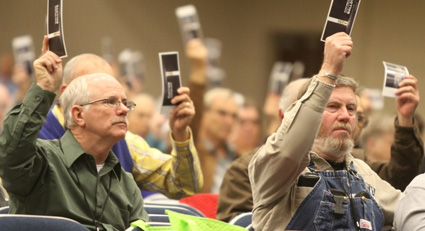
bgct more voting425Messengers vote on proposals at the BGCT annual meeting in Waco. (BGCT Photo)Under the agreement, the convention will elect three of the corporation’s 21 trustees, with 15 of the remaining 18 trustees required to be members of Baptist churches. The school—which trains nontraditional students for vocational Christian service—will not request Cooperative Program budget funds, but it may seek ministerial financial aid for its students.

Ed Jackson from First Baptist Church in Garland presented two motions. The first—which passed with minimal opposition—called on the BGCT Executive Board’s evangelism committee to study the feasibility of a statewide evangelism and missions conference beginning in 2017 “for the purpose of encouraging, energizing and uniting Texas Baptists in the task of winning the lost.”

Jackson also proposed the Executive Board staff study the possibility of remote voting in multiple locations for the annual meeting, starting in 2018. He particularly asked the staff to explore the possibility of electing officers with electronic ballots and allowing early voting.

Wesley Shotwell, pastor of Ash Creek Baptist Church in Azle, spoke against the motion, noting a recent committee already studied the possibility and discovered legal problems.

After questions and discussion, the motion failed.

Resolutions

The annual meeting approved only three resolutions—appreciation to the hosts, appreciation to the convention officers and staff, and a statement on Christian life urging Texas Baptists to “accept the biblical challenge to shine the light of Christ in to our communities, our state, our nation and throughout the world.”

The 2015 BGCT annual meeting will be Nov. 8-11 in Frisco. Taylor Sandlin, pastor of Southland Baptist Church in San Angelo, will preach the annual sermon, and Travis Burleson, pastor of First Baptist Church in Salado, is the alternate preacher.

The 2014 annual meeting drew 1,240 messengers and 515 registered visitors from 466 churches and 91 associations.


Bad idea for ministers to sign marriage licenses, pastors insist

WACO—Marriage licenses signed by ministers create an unhealthy union of church and state, and they historically have been used as instruments of racial oppression and the subjugation of females, a trio of Baptist pastors told a group of their peers.

“Signing marriage licenses is a bad idea. We should stop doing it. The marriage license is a way for the state to assert its power over people,” Kyle Henderson, pastor of First Baptist Church in Athens, told a gathering of pastors on the eve of the Baptist General Convention of Texas annual meeting.

Given their deeply rooted commitment to religious liberty, Baptists should not participate in a system that mingles church and state, he insisted.

‘Agents of the state’

“We should stop acting as agents of the state,” he asserted. “How did we ever get snookered into this deal?”

Instead of signing a state-issued marriage license, ministers should consider exclusively performing covenant marriage ceremonies that emphasize the New Testament ideal for marriage taught in Ephesians 5, he said.

Click on the image above to download a complete sample Certificate of Covenant Marriage as a PDF. More resources are available at the end of this article.Brent Gentzel, pastor of First Baptist Church in Kaufman, and Kris Segrest, pastor of First Baptist Church in Wylie, joined Henderson in organizing the event focused on religious freedom and sexual ethics, particularly in light of changing definitions of marriage at the national level

In the past, the state used marriage licenses to prevent intermarriage between races and essentially to transfer ownership of a woman from her parents’ family to her husband, Henderson explained.

“We need to stop letting the state have pre-eminence over people and their lives,” he said.

The state has the right to regulate contracts and inheritance laws, and it should protect children, he added. But Christians should reclaim a higher standard for marriage, he insisted.

The state and the church both use the term “marriage,” but they don’t mean the same thing, he asserted.

Benefits of ‘covenant marriage’ ceremony

Texas couples joined in a Christian covenant marriage ceremony without benefit of a state-issued marriage license can complete a “declaration of informal marriage” form at their local county courthouse, Henderson explained. It provides all the legal protection of a marriage license and costs less, he added.

While increased acceptance of same-sex marriage prompted many Christians to think deeply about what marriage means, a watered-down definition predated current debates about homosexual unions, speakers stressed.

“The steps the courts have taken completely eroded the definition of marriage, even if the homosexual issue were not on the table,” Gentzel said.

When the state passed no-fault divorce laws, it ceased to consider marriage as a life-long commitment, he noted. The state does not require married couples to live together or share medical information.

“There is almost no expectation of spousal responsibility,” he said.

Christian marriage mirrors the relationship between Christ and the church, and it is a “high and holy” institution, Segrest said.

‘A picture of the gospel’

“We have to contend for marriage, because it is a picture of the gospel,” he said.

Rather than sign marriage licenses, ministers should consider exclusively signing covenant marriage certificates that couples also sign as an expression of their commitment to each other and acceptance of the New Testament definition of marriage, speakers asserted.

“This conversation transcends the conversation about homosexuality,” Dennis Wiles, pastor of First Baptist Church in Arlington, noted from the audience during a question-and-answer session at the event.

Churches need to clarify their own convictions about marriage and sexual ethics—and express them in writing, speakers emphasized.

While all churches and Christian organizations should approve statements of their beliefs about marriage and family, Texas Baptist churches particularly need to consider revising their articles of belief, Henderson asserted.

Many BGCT-related congregations—especially churches that distanced themselves from the Southern Baptist Convention—have governing documents that identify the 1963 Baptist Faith & Message as their statement of faith. Unlike the version of the Baptist Faith & Message the SBC adopted in 2000—which includes a statement added in 1998 defining marriage as “the uniting of one man and one woman in covenant commitment for a lifetime”—the 1963 faith statement does not directly address marriage and family.

Amending church statements of faith

First Baptist in Athens recently voted to amend its statement of faith to include an article on covenant marriage, Henderson said.

The revised statement says: “Covenant marriage is the uniting of one man and one woman in commitment for a lifetime. It is God’s unique gift to reveal the union between Christ and his church, and to provide for the man and the woman in marriage the framework for intimate companionship, the channel for sexual expression according to biblical standards and the means for procreation of the human race. We believe that Ephesians 5:21-33 is the normative expression of covenant marriage. First Baptist Church Athens believes that the Bible mandates sexual activity is to be enjoyed exclusively between a man and a woman that have been joined together in covenant marriage. All other sexual activity is a violation of biblical standards.”

The church also amended its personnel handbook to stipulate staff members are authorized only to perform covenant marriage ceremonies as defined by the statement of faith and sign covenant marriage certificates exclusively, and they will be held to the standards of covenant marriage as defined in the statement of faith. The church instructed the governing board of its related school to update its personnel handbook accordingly.

The Athens congregation also amended its rental policy to prohibit the use of facilities by individuals or groups in direct conflict with the church’s sincerely held beliefs.

Amending the state constitution

Henderson, Gentzel and Segrest also expressed their hope to see Texas amend its state constitution to include language modeled after the national Religious Freedom Restoration Act.

The amendment would take language currently in Texas statutory law—based on RFRA—and add it to Article 1, Section 6 of the Texas Constitution’s Bill of Rights. RFRA—passed by Congress in 1993 at the urging of a broad-based coalition spearheaded by the Baptist Joint Committee for Religious Liberty—was intended to prevent laws that substantially burden any individual’s free exercise of religion.

The proposed amendment would ensure no government entity could burden a person’s free exercise of religion unless it is “necessary to further a compelling state interest,” and provided that it is “the least restrictive means of furthering that interest.” Adding the RFRA-based protections to the state’s constitution would raise the threshold, so any state legislative session could not overturn it, the pastors noted.

The pastors provided sample documents for statements of faith, personnel and rental policies, and covenant marriage certificates for churches to consider.

Resources

Denison Ministries statement on marriage (PDF)

Denison Ministries sample model code of conduct (PDF)

First Baptist Church, Athens, amendments to its policies (PDF)

Proposed religious freedom amendment to the Texas Constitution (PDF)


Hillman elected BGCT president

WACO—In the first contested presidential election since 2008, messengers to the Baptist General Convention of Texas annual meeting elected Kathy Hillman, a convention officer and missions leader.

BGCT messengers cast 402 votes for Hillman (56 percent), compared to 316 votes (44 percent) for Ronny Marriott, pastor of First Baptist Church in Temple.

Hillman, the convention’s incumbent first vice president, was president of Woman’s Missionary Union of Texas from 2000 to 2004 and served on numerous BGCT committees.

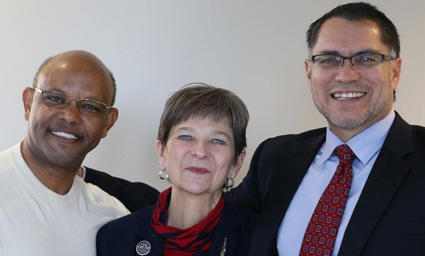
bgct officers425New officers of the Baptist General Convention of Texas are (left to right) Second Vice President Bedilu Yirga, President Kathy Hillman and First Vice President Rene Maciel. (BGCT Photo)Messengers also elected by acclamation First Vice President Rene Maciel, president of Baptist University of the Américas in San Antonio, and Second Vice President Bedilu Yirga, pastor of Ethiopian Evangelical Baptist Church in Garland.

Hillman is second woman elected as BGCT president. Joy Fenner, former executive director-treasurer of Texas WMU, served as BGCT president in 2007-2008.

Duane Brooks, pastor of Tallowood Baptist Church in Houston, nominated Hillman, characterizing her as “sister in the faith” and a “faithful servant” with “the time, the touch and the tenacity” to lead Texas Baptists during a crucial period of change.

Hillman completed undergraduate and postgraduate studies at Baylor University, where her great-grandmother, both grandfathers, both parents and two of her children all attended. Her daughter and grandmother graduated from Howard Payne University.

She has worked in various faculty positions at Baylor University since 1976. She now is director of Baptist collections, library advancement and the Keston Center for Religion, Politics & Society at Baylor.

She served on the executive council and executive board of Waco Regional Baptist Association, and she was the association’s first female vice moderator in 2008-2009 and its first female moderator in 2009-2011.

Hillman chaired the BGCT Committee to Nominate Executive Board Members and its Committee on Order of Business. She also served on the BGCT Executive Board, and she serves on the board of directors for Paisano Baptist Encampment.

She and her husband, John, have three adult children and three grandchildren, but their family will expand when their daughter and son-in-law complete the adoption of a sibling group of four children, ranging in age from 7 to 12.


Mission Lone Star presents gospel to bikers

GALVESTON—When motorcyclists from across the country wheeled to Galveston Island in search of a weekend of good times, about 400 found eternal joy in Jesus.

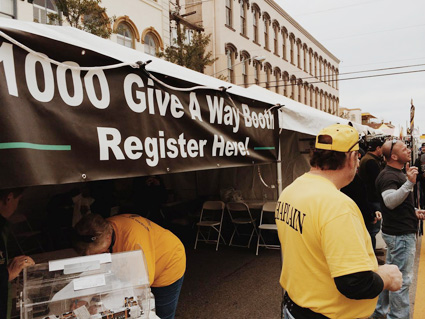
lonestar motorcyclerally425When more than 400,000 cyclists crowded onto the Gulf Coast island, Mission Lone Star volunteers shared Christ with more than 1,000 who stopped at a booth and heard a presentation of the gospel. About 400 made professions of faith in Jesus Christ. (PHOTO/ David Williams, Trinity River Baptist Association)As more than 400,000 cyclists crowded onto the Gulf Coast island, Mission Lone Star volunteers shared Christ with more than 1,000 who stopped at a booth and heard a presentation of the gospel.

“The numbers represent people,” said Jim Hamilton, executive director of Golden Triangle Baptist Network. “The stories associated with many of these who prayed to receive Christ are just amazing and reflect the greatness of our God.”

He realizes follow-up on the decisions is crucial.

“Those folks who led them to Christ will call them next week. They will be the first contact they have in follow-up and an attempt at assimilation into a local church,” Hamilton said.

That stems from a lesson learned from a similar evangelistic outreach to bikers at the Black Hills Motor Classic in Sturgis, S.D.: If the new believer gets a call from someone they don’t know, it doesn’t work as well as hearing from someone they already know and trust.

“Then I can say: ‘Hey, I’ve got some friends—because us Baptists have friends everywhere—I’ve got some friends right where you live. I’d like to have one of them give you a call. Can I do that?’ Chances are, they are going to say, ‘Sure,’” Hamilton said.

lonestar motocycle street425Chaplains contacted more than 3,000 vendors at the rally, four of whom prayed to receive Christ as their Savior. (PHOTO/ David Williams, Trinity River Baptist Association)
Fifteen chaplains also ministered to the many vendors who flocked to the island. Chaplains contacted more than 3,000 vendors, four of whom prayed to receive Christ as their Savior.

Volunteers from Golden Triangle, Galveston and Trinity River Baptist associations and beyond staffed the evangelism booth for the Mission Lone Star outreach effort. Everyone who stopped and heard a three-minute gospel presentation became eligible for a drawing to win a $1,000 cash prize, given away each evening during the three-day event.

The money to fund the effort came from the Baptist General Convention of Texas’ Mary Hill Davis Offering, as well as local associations and churches.

“Two things create relevancy for bikers—bikes and money,” Hamilton said. In the future, organizers may offer a chance to win a motorcycle as the incentive to listen to the gospel presentation.

lonestar rally booth425The Galveston rally outreach was inspired by the success of witnessing efforts at the popular Black Hills Motor Classic in Sturgis, S.D. (PHOTO/ David Williams, Trinity River Baptist Association)
Hamilton moved to Texas two years ago from South Dakota, where he was instrumental in beginning witnessing efforts at the huge bike rally held annually in Sturgis.

When he discovered no Christian group reaching the masses flocking to Galveston Island, he prayer-walked the event last year. Then he began talking to associational and church leaders in the area about what could be done, culminating in Mission Lone Star.

Evangelist Ronnie Hill of Fort Worth trained the volunteers to give their testimony in three minutes.

“I’ve realized the personal testimony is the most effective way to share your faith. Paul did it before Festus and Agrippa in Acts 16, so I train people to do the same thing,” Hill explained.

“Basically, when you share your life before you met Christ, you are connecting with that person, so they don’t feel like they’re being preached at. But the most important part is to get the gospel in. The power is in the cross. So we get to the death, burial and resurrection and that we’ve sinned against God and the only way we can have a relationship with him is through Jesus Christ.

“It’s the power of the cross. I tell everybody: ‘Your story doesn’t change people’s lives. I can read your story in Reader’s Digest. It’s the gospel.’”


Garrison to retire as San Marcos Baptist Academy president

SAN MARCOS—John Garrison plans to retire next spring as president of San Marcos Baptist Academy, a position he has held since August 2008.

john garrison130John Garrison“My six years at the academy have been among the most meaningful in my 47 years in educational administration,” Garrison said. “I have felt privileged every day to be part of such a special student ministry and such a caring and engaging learning community. I will work closely with the board to ensure a smooth transition to new leadership at the academy, and I will be available to assist the board and the new president in any way that I can once the new president has been named.”

Clay Sullivan, chair of the academy’s board of trustees, praised Garrison for his exceptional leadership.

“I thank him for so faithfully giving of himself, his knowledge, his talents and his life. John and his wife, Carol, have been a great team and have touched the lives of so many students, families and staff who fill the many varied roles at San Marcos Baptist Academy,” Sullivan said.

During Garrison’s tenure as president, the academy more than doubled its day student enrollment.

100 years of accreditation

Garrison guided the academy twice through successful accreditation site visits by the Southern Association of Colleges and Schools. In April 2013, the academy celebrated 100 years of continuous accreditation—one of only three private schools in Texas to achieve this milestone.

Under Garrison’s leadership, the academy constructed the Lee Hage Jamail Special Event Center, which includes a varsity gymnasium, alumni Hall of Honor and the first academic classroom space added to the campus in more than 30 years.

Other capital improvement projects included addition of a ropes/challenge course, renovation of the Katherine Shultz Lecture Hall and the school cafeteria, addition of a new front entrance with a security gate and roadway upgrades, and completion of a riding arena, along with rebuilding the agricultural barn and equestrian facilities.

Garrison led development efforts that raised more than $4.5 million for the academy, and he developed strategic partnerships and relationship with foundations that resulted in almost $1 million in campus improvements, Sullivan noted.

‘We are on the right track’

Garrison expressed appreciation to the academy’s students, faculty, staff, parents and alumni. He praised the leadership and devotion of the trustees for their support.

“I could not be more pleased with the progress we have made, which is a tribute to the dedication and hard work of our academic priorities committee, our faculty and staff, and our development and alumni affairs office,” Garrison said. “I firmly believe that we are on the right track, and that the future of the academy will be in good hands as we transition to new leadership.”

A three-person search committee, composed of trustees, is conducting the search for Garrison’s replacement.

Prospects are invited to submit documentation of interest and qualifications to San Marcos Baptist Academy, 2801 Ranch Road Twelve, San Marcos, TX 78666, Attn: Presidential Search Committee, or email humanresources@smba.org for an application.


Church leaders urged to bridge gaps

DALLAS—To bridge the spiritual and cultural gaps in churches and ministries, Christians first need bridge gaps in their thinking and realign their thoughts with the Bible, speakers told the Texas Baptist Men fall convention.

john snyder mug130John SnyderObvious problems in churches may be symptoms of less-obvious deeper issues, said John Snyder, pastor of Christ Church in New Albany, Miss. He compared American evangelicals to people sitting in a room who look at a nearby wall and notice a crack running through it. While their initial response is to “spackle and paint” the problem, that will not fix the underlying issue, he said.

“If the crack is caused by a foundational problem, you know the crack will just reappear again and again and again,” Snyder explained. Similarly, “if we don’t deal primarily with the spiritual gap, then everything we do becomes shallow, and our efforts become ineffective.”

Dealing with root issues

Snyder acknowledged finding “time and spiritual energy to stop and deal with the root issues that lie at the bottom of our spiritual gaps” can be difficult.

henry blackaby130Henry BlackabyBut it’s something the people of God have to do, said Henry Blackaby, co-author of the Experiencing God discipleship curriculum.

“God doesn’t make suggestions,” Blackaby said. God gives commands that serve as the foundation of a Christian’s life and ministry.

“How would you describe your life?” he asked. “Do you diligently seek to understand what Christ has commanded and then diligently seek to practice in your life everything that he has commanded? We call him ‘Lord’ but often do not do anything that he commands us.”

And that’s where gaps form, speakers agreed.

To fix these gaps, Snyder said, Christians and ministries often respond in one of two ways— “conservatism” or “relativism.”

Christian conservatives see a moral decline and think the answer is to erect more rules and standards, but that cannot “fix the nation,” he said. The solution involves more than rules and regulations, Snyder insisted. It requires falling in love with the person of God, with his truth and with his way.

Christian relativism

On the flip side, Christian relativists try to “save the world by relating to the world,” Snyder said. They think they’re not making an impact on people in the world because non-Christians can’t relate to them.

“The question is: When we get everyone to attend our relativistic churches, does God ever attend?” Synder asked. “There is one person you cannot afford to be irrelevant to—it’s God. Everyone else is optional.”

Ministries may need “radical work,” but the work doesn’t necessarily call for “extreme changes,” he asserted.

“The problem with extreme changes is, they’re never extreme enough,” Synder said. “I could grow a soul patch. I could change the way I talk. But if I only change the exterior, I haven’t really done what’s necessary to make a lasting change.”

Christians need to go deeper to find the root issue, which originates in their thinking, “because who you think God to be will determine everything about how you carry out your ministry,” he said.

Many Christians allow a gap to exist between their concept of who God is and what the Bible says about him, he continued. So, they limit God in their minds.

Getting to know God

“Like Job, we all need to be introduced to God in a way that radically alters us,” Snyder said. “Your job is to get to know God. Get to know him better than you know anybody else.”

The good news is there doesn’t have to be a gap, he added, though there often is “a normal gap” in one’s life as God leads them and teaches them by the Spirit.

“Sadly, because we’re not perfect, there is a gap between what he’s teaching us and where we’re at,” he said.

He recommended each Christian engage in the “methodical lifelong task” of “searching through the Bible, getting those truths out and dusting them off … and then finding a way to apply them to my life, my home, ministry and service.”


B. H. Carroll defies narrow theological labels, historians assert

ARLINGTON—Neither Baptist progressives nor fundamentalists have the right to lay exclusive claim to the legacy of B.H. Carroll, two church historians told a fall colloquy sponsored by a theological institute that bears Carroll’s name.

Baptists who view Carroll only as a conservative controversialist or solely as the founder of Southwestern Baptist Theological Seminary paint an incomplete portrait of a pastor/theologian and mentor to future denominational leaders, said Alan Lefever, director of the Texas Baptist Historical Collection and author of Fighting the Good Fight: The Life and Work of B.H. Carroll, and Jim Spivey, senior fellow and professor of church history at the B.H. Carroll Theological Institute.

alan lefever130Alan Lefever“B.H. Carroll was a very complex man” who defied easy categorization, Lefever said in his biographical sketch of Carroll.

As a young adult, Carroll rejected Christianity. His bitterness toward the church—and God—grew after his first marriage ended in divorce due to his wife’s infidelity.

“He went to a dark place,” Lefever said, noting how Carroll volunteered for the riskiest missions available in the Confederate army, and he publicly refuted the chaplains’ sermons. “He preached against God in the Confederate army camps and attracted larger crowds than the chaplains.”

After suffering severe wounds in battle at Mansfield, La., he returned to Caldwell, where he attended a Methodist camp meeting at his mother’s insistence. Due to the sermon he heard that night and his reading of a copy of Pilgrim’s Progress his mother gave him, Carroll converted to Christianity in the fall 1865 and felt God’s call to preach. The following May, Caldwell Baptist Church licensed him to the gospel ministry, and the church ordained him in November 1866.

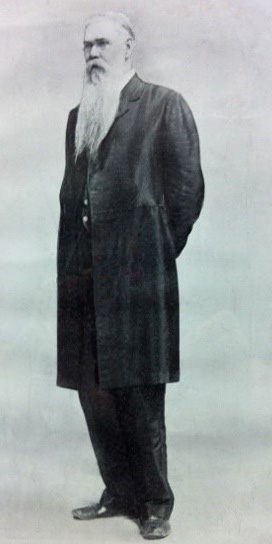
bh carroll vertical272B. H. Carroll, a towering figure in Baptist history, was also a complex personality.After preaching at several churches and serving as pastor of a couple of churches, he accepted a call from First Baptist Church in Waco in 1870 to assist Pastor Rufus C. Burleson, who also served as president of Baylor University. When Burleson left the church a few months later to devote his full attention to the university, the church called Carroll as pastor, a position he held nearly 28 years.

For most of that time, he served a mentor and teacher to young ministerial students, created an “embryonic seminary” that met at the church and established the Bible department at Baylor University, Lefever noted.

The Whitsitt Controversy

“He was, in many ways, a progressive theological educator,” he said—a fact ignored by many Baptist historians east of the Mississippi who focus solely on Carroll’s involvement in the so-called “Whitsitt controversy.”

William H. Whitsitt, third president of Southern Baptist Theological Seminary, denied the popular Landmark Baptist notion of Baptist succession—the belief Baptists could trace their heritage through a “trail of blood” by martyrs all the way back to apostolic times. He also noted early English Baptists did not practice baptism by immersion until 1641.

Although Carroll believed in Baptist succession, he viewed Whitsitt’s beliefs on Baptist succession as “not a doctrinal issue, but an issue of human history,” Lefever insisted. However, as a member of the school’s board, Carroll argued the seminary needed to be accountable to the churches of the convention, a position that failed to prevail.

So, he announced at the 1898 Southern Baptist Convention in Norfolk, Va., his intent to recommend at the 1899 SBC a motion to sever the seminary from the convention. In time, Whitsitt resigned under pressure.

Many Baptist historians outside Texas have maligned Carroll unfairly as “a Landmarker,” when he actually rejected several key Landmark Baptist beliefs—particularly regarding cooperation in missions, Lefever asserted. He specifically noted Carroll’s role in rallying support for the SBC’s Home Mission Board and his opposition to T.P. Crawford’s Gospel Mission Movement, which attacked the SBC Foreign Mission Board.

“If he was a Landmarker, he was a denominational Landmarker—and that doesn’t make sense,” he said.

Complex personality

The complexity of Carroll’s personality also appears in his impact as mentor to two widely divergent figures—George W. Truett, the pre-eminent Baptist statesman and denominational loyalist in the first half of the 20th century, and J. Frank Norris, the father of Fundamentalist Baptists, Lefever said.

“B.H. Carroll could be seen as Patient Zero of the SBC controversy” that divided the convention in the 1980s and 1990s, he insisted. Both the moderate “Truett strain” and the fundamentalist “Norris strain” found a common source and inspiration in Carroll, he noted.

jim spivey130Jim SpiveySpivey likewise emphasized Carroll’s complexity, asserting historians need to give due attention to “the two B.H. Carrolls—the extroverted controversialist and the introverted unifier.”

Carroll left a multifaceted legacy as a pastor/theologian, denominational leader, innovative educator and mentor, he said.

“He became a truly larger-than-life personality who cast a very long shadow and whose abiding influence endured long past his death,” Spivey said.

Carroll’s role in creating institutions—most notably Southwestern Seminary—grew out of his love for churches, and he never ceased to view himself first as a preacher of the gospel who wanted to help equip other ministers, he said.

“Beginning with thousands of students he himself trained at Baylor and tens of thousands more who attended the seminary he established, innumerable churches, mission fields, and seminaries on those fields around the globe have been touched by his educational vision, which is still alive among Texas Baptists,” he said.

Observers today should take care not to view Carroll as “the fountainhead of traditions he did not support,” Spivey insisted.

An independent thinker

“His theology was Calvinistic, but he was not a doctrinaire Calvinist with a dogmatic agenda. He believed in the fundamentals of the Christian faith, but he was not a Fundamentalist with a narrow and judgmental spirit. He believed in the plenary verbal inspiration of Scripture, but he never used inerrancy as a political weapon. … He was a true guardian of Scripture who spoke with conviction and certainty, but he was not blinded by narrow-mindedness,” Spivey said.

“He was an independent thinker who pursued the truth wherever it led, and he encouraged students to do the same. He knew the difference between indoctrination and education, and he preferred the latter.”


Still eager to preach and serve after 65 years at one church

PRAIRIE HILL—Fred Sain has filled the same pulpit 65 years. More importantly, he has been pastor of Prairie Hill Baptist Church in the truest sense of the word.

Sain grew up attending First Baptist Church in Slaton, where he father owned a cotton gin.

prairie hill front425Prarie Hill Baptist Church draws worshippers from Mart, Waco, Groesbeck, Mexia, Mount Calm and other small communities in addition to Prairie Hill, population 125.“At about 14 years old, I began to feel an inclination that I needed to do something more for the Lord in my life. I surrendered to preach when I was 15,” he recalled.

Soon after he began attending Wayland Baptist College in Plainview at age 17, he was called to be the pastor of McClung Baptist Church near Lubbock.

“I preached there about a year and a half, and the Lord began to bless my ministry, and I began to learn what it was to preach,” he said. About the same time, however, he felt God leading him to attend Baylor University.

A trial sermon in 1949

In August 1949, Prairie Hill Baptist Church northeast of Waco invited him to preach a trial sermon. He already had committed to preach a revival for another congregation, but Sain preached his first sermon as pastor of the Prairie Hill congregation Sept. 25, 1949.

“From the time of my calling, I told the Lord I would serve wherever he had for me to serve, and evidently it has pleased him for me to stay here these years. I don’t know that I’ve been here longer than anyone else has, but I’ve been here more than half the life of the church, because it is 129 years old,” Sain said.

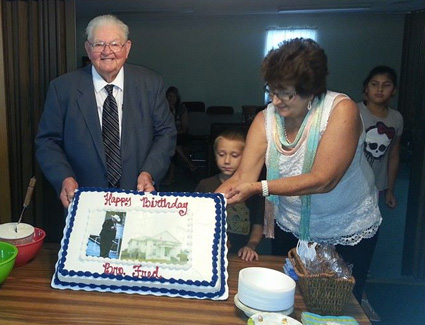
fred sain birthday425Church members helped celebrate with Pastor Fred Sain on his birthday in July. (Photo: Prairie Hill Facebook page)“This has always been a strong church. When I came here, there were eight to 10 churches around here in about a 10-mile radius, but they’re all gone. We’ve been the only one that’s stayed, and I believe it was because I was here preaching the word. I’ve almost given up several times, but in the last two years, we’ve had 20 new members come into our church.”

Not many people live in the rural community anymore, but Prairie Hill draws people from a wide area—Mart, Waco, Groesbeck, Mexia, Mount Calm and other small communities in addition to Prairie Hill, population 125.

In thinking of the several adults he has baptized in recent months, he said, “The Lord has been smiling on our work here, and I appreciate that.”

Continuing to learn

Even after all these years, God still teaches him new things from Scripture, Sain said.

“It’s been my habit for years to start my morning by spending an hour with the Lord and his word. I’m still finding things I didn’t know were there. It’s a blessing for me to continue to study,” he said.

While he has no plans to leave Prairie Hill, it has crossed his mind from time to time.

“I’ve thought several times I needed to step down. They had a big celebration here when I reached my 50th anniversary, and I think everybody thought I was about ready to retire, but here I’ve been another 15 years. As long as my strength holds out and the Lord affirms my ministry here, I’ll stay. But I’ll be the first one to leave when I see I’m encumbering the church,” he said.

“We have a very loving church. The two rules of my ministry have been to be faithful and magnify love. We don’t have squabbles and problems in our church—everyone seems to be happy and love one another, and they love their church. We’re not a great, huge church, but we are carrying on the Lord’s work.”

prairie hill cemetery425Prairie Hill Baptist Church has a large cemetery within yards of the its back door, and Pastor Sain has preached about 500 funerals. (Photo: George Henson)Prairie Hill Baptist Church has a large cemetery within yards of the its back door, and it has been a large part of Sain’s ministry.

“Since I’ve been here, I’ve preached in the neighborhood of 500 funerals,” he said.

He also has officiated at about same number of weddings. He has preached more than 5,000 times at Prairie Hill. And each preaching experience has been different, he added.

Even after all those sermons, Sain said, he comes to church each Sunday with a sense of excitement and expectation.

“Enthusiasm is something I think a pastor needs to have. If he’s not enthused in what he’s called to do, he needs to get in another line of work,” he said.

‘The best is yet to be’

He credits that positive outlook to his literature professor at Baylor University many years ago who began each class with a verse from Robert Browning: “Grow old along with me! The best is yet to be.”

That’s his prayer for Prairie Hill Baptist Church. “God hasn’t accidently kept us here. It’s been for a purpose,” Sain said.

At age 85, Sain looks forward to being reunited with many of the saints who have preceded him to heaven during his 65 years as pastor.

“I’ve told them many times, when I get to heaven, the first thing I’m going to do is ask permission to have a meeting of the Prairie Hill Baptist Church,” he said. “And I’m sure I’ll preach my best sermon when we all get together. And we’ll have a good time.”


Rural East Texas church has global missions vision

BOIS D’ARC—A heart for people near and far keeps the century-old Bois D’Arc Baptist Church connected to missions and active as ever.

Pastor Mike Drinkard leads a stable congregation, halfway between Athens and Palestine. All the members of the pulpit committee who recommended the church to call him as pastor in 1978 still attend.

boisdarc westmemphis425Bois D’Arc Baptist Church members renovated homes as part of a World Changers project in 2011 in West Memphis, Ark.“The church’s strongest characteristic is that it is a missions-minded church—of course on a small scale, since we’re a small, rural church,” he said. “We give 25 percent of our offerings and tithes to various missions causes.”

About half of the church’s missions gifts are directed through Baptists’ Cooperative Program unified budget, and the remainder support ministries to which the congregation has a personal connection.

The church is not afraid to give sacrificially. When Drinkard took a trip to Peru to visit his sister who is a missionary there, the poverty he saw burdened him.

“When I came back, I told the church: ‘We’ve got to help those people. They are so poor. They don’t even have shoes, Bibles or anything.’ We had started a fund to build a multipurpose building with several thousand dollars in it, and I said, ‘As far as I’m concerned, we ought to empty that fund out and send all that money to Peru.’ And they voted to do it,” he recalled.

That devotion to missions keeps the congregation from becoming too inwardly focused, Drinkard said.

“They just want to concentrate on the Great Commission,” he said.

The church members emptied a fund they had established to build a multipurpose building and, instead, sent the money to Peru.

But missions means more than writing a check for the Bois D’Arc congregation. The East Texas church that draws about 100 in attendance each week has sent teams to 18 countries, from Peru to the Ukraine.

“Those mission trips open their eyes. They come back, and they want to do more. They realize how blessed we are. They want to do more; they want to give more,” he said.

Mission trips not only involve the church’s youth group. Senior adults participate in mission trips, as well, particularly focusing on Operation Christmas Child. The ministry of Samaritan’s Purse collects shoeboxes filled with toys, other small gifts and a gospel presentation and delivers them to children in developing nations.

Now Operation Christmas Child has a processing center in the Dallas-Fort Worth area where the senior adults have volunteered, but for years, the group spent a week at a processing center in North Carolina, making sure children around the world learned of God’s love for them.

In addition, the congregation fills 600 shoeboxes of its own to aid the ministry, collecting items for the boxes all year and culminating in a churchwide packing party the first Wednesday night each November. The children who attend Vacation Bible School pay the shipping charges—usually about $4,500—for the boxes with their offerings each year.

“It’s amazing what 100 kids can do, because every year, they raise that money during Bible school,” Drinkard said. “We try to teach our children—our RAs and GAs—about missions, and about how children around the world need Jesus.”


Texas Tidbits: UMHB, Baylor Scott & White create degree program

The University of Mary Hardin-Baylor is developing a doctor of physical therapy degree program in partnership with Baylor Scott & White Health. The collaborative partnership will give UMHB doctor of physical therapy students the opportunity to interact with physicians, therapists and nurses daily, and it will help facilitate a collaborative learning environment with health-care professionals across Central Texas. Doctor of physical therapy faculty and Baylor Scott & White faculty also will collaborate on research projects. While the program will start on the UMHB campus, the university plans to build a permanent home for the program on the Baylor Scott & White campus in Temple. UMHB anticipates a fall semester 2015 start date and is accepting applications, with the first round of conditional acceptances beginning this month. The deadline for applying to the program is March 31, 2015. The program start date is contingent on achieving candidacy status through the Commission on Accreditation in Physical Therapy. The Southern Association of Colleges and Schools—the university’s regional accrediting agency—also must approve the program.

Del Risco named Texas Baptist Hispanic evangelism director. joshua del risco130Joshua del RiscoJoshua del Risco, a former Oklahoma Baptist pastor and coordinator for the North American Mission Board’s church mobilization team, was named director of Hispanic evangelism and associate director of evangelism for the Baptist General Convention of Texas, effective Nov. 3. He was pastor of Living Word Hispanic Baptist Church in Oklahoma City from 1995 to 2001. He served with NAMB in various capacities from 2001 to 2014. He and his wife, Esther, have two grown sons, Andrew and Timothy.

Baylor receives naming gift for Robbins College of Health and Human Sciences. William K. and Mary Jo Robbins, members of Tallowood Baptist Church in Houston, provided Baylor University a major gift for its newest academic unit focused on health-related education and research—the Robbins College of Health and Human Sciences. He is founder and CEO of Houston-based North American Corp. She served 27 years in the nursing profession, and she opened and managed 10 dialysis facilities in Texas. Baylor regents established the College of Health and Human Sciences last May, uniting four health-related academic units—communication sciences and disorders; family and consumer sciences; health, human performance and recreation; and the Louise Herrington School of Nursing.

Baylor adds doctoral program in environmental science. Baylor University regents approved a new Ph.D. program in environmental science, beginning in January 2015. Core specialty areas will include environmental health, environmental chemistry and toxicology. In 2014, Baylor produced 28 Ph.D. graduates in STEM—science, technology, engineering and math—fields. By 2019, the university expects it will award 44 STEM doctoral degrees.


Documentary records 13-year-old cancer victim’s story of hope

MIDLOTHIAN—I Am Second held the premiere showing of its first 45-minute documentary at First Baptist Church in Midlothian. But unlike many of the ministry’s previous projects, the film did not feature a celebrity’s Christian testimony. Rather, it told a “story of hope” involving a 13-year-old boy who died of cancer the month before.

Many are the Wonders: The Second Story of Ethan Hallmark, focuses not only on ethan treatment425Ethan Hallmark is prepped for a cancer treatment at Cook Children’s Medical Center in Fort WorthEthan, but also on his mother, father, friends and the difference one young man’s four-year battle with stage-4 neuroblastoma had on his community.

After being contacted by a minister in Midlothian, I Am Second dispatched a staff member to see if Ethan’s story might be right for one of the five-minute videos shown at iamsecond.com. The videos follow a simple format—a camera trained on a single individual in a white chair telling his or her Christian testimony.

“We were just blown away from the manner in which God has worked through Ethan and the family over these four years. It’s been incredible how from what started out to be just a devastating situation for the family and for him, God had grown the family,” said John Humphrey, director of communications for I Am Second.

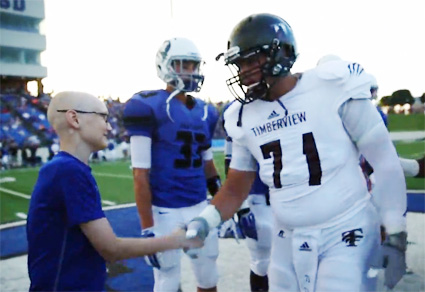
ethan football425Ethan Hallmark greets teams participating in a Midlothian high school football game.“The more we delved into the story, the more layers came about. We said: ‘We have to do something different. This is not just a five-minute white-chair film. We have to tell this differently.’”

The ministry’s budget didn’t include funds for a longer film, but people from Midlothian raised the extra money needed to produce it.

The documentary pictures the Hallmark family in their home and follows Ethan to the hospital. Ethan does sit in the white chair used in other I Am Second videos, but so do his mother and father, Rachel and Matt Hallmark.

The nature of the video and the length of the relationship offered the I Am Second personnel a level of emotional intimacy that doesn’t usually occur, Humphrey said.

“We’ve gotten to know this family well. We have hurt with them, rejoiced with them, cried with them. And we don’t usually get to do that, particularly with a celebrity Second. This is probably the deepest relationship we’ve been able to establish with a family,” he said.

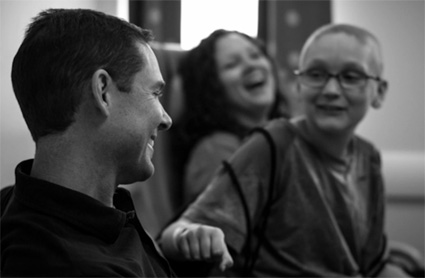
ethan parents425Ethan Hallmark with his parents.That emotional intimacy and the seriousness of the situation caused the producers to confront some hard questions during the process of making the film.

“At each step, we were presented with all sorts of decisions—how to involve the family, how to be sensitive to their needs, how to be sensitive with the opportunity. We would ask ourselves, ‘Are we being too selfish in taking this story and using it in our movement when it is their story?’ At every step of the way as we prayed about it, we felt God urging us to go ahead but also consulted with the Hallmarks. And every step of the way, they said, ‘We just want God to use Ethan’s story,’” Humphrey recalled.

“Ethan loved God with his whole heart. The hope he had stemmed from that,” Matt Hallmark said. “He was a kid who truly lived out his faith.”

That faith was a gift from God, he added.

“It came from God. I know that’s cliché, but it’s true. It’s not because of us. We’re not special parents or anything. We’re just regular parents. But God gave him an amazing spirit,” he said.

“It would not surprise us at any point in the day to walk in and see him sitting there with his Bible, reading it. I don’t care where he’s at—at the hospital, at a soccer game, at home, at school. That’s Ethan.”

The large crowd who attended the premiere of the documentary “means Ethan’s cancer is not wasted. A lot of people get cancer. A lot of people suffer. It’s what you do with it, who’s benefitting from it,” Hallmark said.

The video proves hope is possible even in horrific circumstances, Rachel Hallmark observed.

“A lot of people would say that’s a story of despair. This poor child has only lived to the age of 13. He’s not going to get to grow up; he’s not going to get to go to high school; he’s not going to get married. I guess by worldly standards, that’s a story of despair,” she said.

ethan hallmark chemo300Ethan Hallmark prepares for a session of chemotherapy.“Ethan never saw it that way, and surely, neither did we. Don’t get me wrong. We’re heartbroken that he is gone. We’re heartbroken that he had to spend a third of his life fighting cancer. But it ultimately is and always has been a story of hope.

“One of his pet peeves was for people to say, ‘It’s OK to be angry at God. This is a horrible disease. It’s OK to be angry every once in a while.’ He would tell me: ‘Mom, why do they say that to me? How could I be angry? I know God loves me. I don’t like this cancer. I’m upset I have to go through surgery, chemo and radiation, but I could never be angry at God.’”

Through the film, Ethan’s Christian testimony of hope will be shared long after his death, and that is important to the Hallmarks.

“It allows us to see the good even in the ashes,” Matt Hallmark said. “It’s being able to see that even though Ethan suffered, even though he died, people are still coming to know the Lord. People are still getting closer, getting intimate with God because Ethan endured.”


Ken Hall fired as Baylor senior vice president

A former president of the Baptist General Convention of Texas and former CEO of Buckner International involuntarily has become a former senior vice president of Baylor University.

Ken Hall, who has served as senior vice president for development and strategic initiatives at Baylor since January 2013, “no longer will be serving at Baylor,” President Ken Starr announced in a letter to the university’s faculty and staff.

Hall ceased to be employed by Baylor at the conclusion of homecoming weekend, Starr wrote in a Nov. 4 letter announcing the “unfortunate news.”

No reason given

In his letter, Starr offered no reason for Hall’s dismissal. Lori Fogleman, assistant vice president for media communications at Baylor, said the university does not comment on personnel matters.

“I was notified Friday afternoon (Oct. 31) that my services no longer would be needed,” Hall said, adding he received official written notice Monday, Nov. 3, and he was terminated without cause. “It’s been a wonderful couple of years at Baylor, and I am grateful for the experience. The judge (Starr) obviously felt he needed to go in another direction.”

Hall served on the 10-member presidential search advisory committee that helped bring Starr to the university. Starr also noted Hall’s time as a BGCT-elected member of Baylor’s board of regents “where he served with great distinction” before accepting the senior vice president’s position.

“He has been a wise counselor to all his executive council colleagues, especially in regard to Texas Baptist life,” Starr wrote. “He effectively reorganized and refocused our university development office, and his energy and creativity have helped Baylor reach historic milestones in private giving. In short, Ken Hall has made a positive and enduring impact on Baylor University. For his many talents and his able service to Baylor University, we are immensely grateful.”

‘Wonderful experience’

Hall expressed appreciation to his colleagues on Baylor’s executive council and the university’s development staff.

“It’s been a wonderful experience,” Hall said. “Baylor is a great, great place doing kingdom business.”

Hall served as president and CEO of Buckner International from 1994 to 2010 and as CEO there from 2010 until his retirement in April 2012.

He was elected to a one-year term as BGCT president in 2003.

A Louisiana native, Hall earned a bachelor of science degree from the University of Texas at Tyler and master of divinity and doctor of ministry degrees from Southwestern Baptist Theological Seminary in Fort Worth. He also is an honorary alumnus of Baylor’s George W. Truett Theological Seminary and received an honorary doctor of divinity degree from Dallas Baptist University.

Hall and his wife, Linda, have two grown children, Kevin and Kayce.