Study: Seminaries fail to train pastors to help mentally ill congregants

WACO—People struggling with mental illness often turn to pastors for help, but seminaries do little to train ministers in how to recognize serious psychological distress and when to refer someone to a doctor or psychologist, a Baylor University study reveals.

Matthew S. Stanford“Many people in congregations continue to suffer under well-meaning pastors who primarily tell them to pray harder or confess sin in relation to mental health problems,” researchers wrote in the study, published in the Journal of Research on Christian Education.

Nearly half of all Americans will meet diagnosis criteria for at least one mental disorder in their lifetime, and in a given 12-month period, more than 25 percent of Americans meet that criteria, said lead researcher Matthew S. Stanford, professor of psychology and neuroscience at Baylor University. Halle E. Ross, a doctoral candidate in clinical psychology at Baylor, worked with Stanford on the research.

The article—“Training and Education of North American Master’s of Divinity Students in Relation to Serious Mental Illness”—is based on a survey of 70 seminaries in the United States, Canada and Puerto Rico, with 14 church traditions represented.

Earlier research by Stanford showed many families affected by mental illnesses leave the churches, and many church communities seem to ignore their need.

An overwhelming majority of Americans—95 percent—claim to believe in God, and 42 percent report attending church in the past week, according to previous research.

Clergy vs. psychiatrists

“Perhaps for these reasons, clergy are pursued more often in times of emotional distress than other professions, and perhaps more commonly than psychologists and psychiatrists combined,” the current study notes.

Complicating the issue, some antagonism exists between clergy members and psychologists. That is largely because clergy do not fully understand all the services psychologists provide, and psychologists tend to be less religious than the general population, previous research by Stanford showed.

While pastors should not be expected to make psychiatric diagnoses, they do have a “gatekeeper” responsibility to provide interventions for which they are qualified or to refer an individual to an appropriate professional, Stanford said.

Because pastors often are concerned about the role sin may play in psychological distress—and how that will be handled in therapy—they are more likely to refer congregants to psychologists who share their religious values.

Most of the counseling classes offered by seminaries focused on premarital counseling, couples counseling, family counseling or grief counseling. The survey showed 59 of the seminaries—88 percent—offered courses in which the topic of mental health was addressed in some way, although it may not have been a counseling course. And of the 30 seminaries that offered counseling courses, only 21 offered a course or courses specifically dedicated to mental illness, according to the study.

Lack of counseling electives offered

Students often were not able to find time in their program requirements to take counseling courses as electives, said directors of master’s of divinity programs. And even if they did, “there was a distinct lack of counseling elective options for the M.Div. student who wants to become a pastor,” the study found.

While seminaries offered many types of internships, none were in organizations in which students would regularly interact with mentally ill people, researchers said.

Seminaries were asked to provide their official stance on the subject of mental illness, but they overwhelmingly responded that no such official stance exists.

Because there is no cohesive theological position on mental illness, Christian church members throughout the nation do not receive a similar standard of referrals, respect and support from their pastors and other congregation members, the study concluded.

“In order for the church to move past the belief that all mental illness is the result of spiritual warfare or a personal failing, the church must come together to discuss the views of mental illness and establish a systematic stance on the topic, taking into consideration both the biological and spiritual aspects of sin.”


Alumni association to submit settlement offer to Baylor University

The Baylor Alumni Association will submit a final settlement offer to Baylor University in what a public statement from the organization characterized as “a last-ditch effort to avoid protracted litigation” between the group and the university.

The association’s board of directors voted Sept. 6 to submit a final settlement offer, but the group did not release details of the offer pending a response from Baylor’s board of regents.

baylor alumni assoc logo425“We are not aware of the details of any proposal from the association,” said Lori Fogleman, Baylor University spokesperson.
“There is no question that Baylor is firing on every cylinder, and alumni worldwide are coming alongside the university in record numbers and in a multitude of ways to help fuel the upward trajectory of their alma mater,” she said. “We look forward to receiving the proposal, and we hope that it reflects the sentiment of the majority of Baylor alumni who are actively partnering with the university in this period of unparalleled progress.”

The alumni association believes “it is important for the entire board of regents to have an opportunity to proceed in a deliberative manner with regard to our settlement proposal with no outside influence,” BAA President Keith Starr said. “We believe that is what is in the best interests of the entire Baylor family.”

Finding a mutual framework

Representatives from the alumni association and the university met during the summer to find a framework that would be mutually acceptable, Starr said.

keith starr150Keith Starr“We were all gratified that Baylor President and Chancellor Ken Starr was an active participant in this summer’s meetings and that he appeared to support a settlement,” said Keith Starr, no relation to the Baylor president.

“We thought we had a framework that would work for both parties, but the university has been reluctant to move forward. So, we’ve decided to offer one final streamlined proposal.”

Earlier, Baylor’s regents, acting through their attorneys, gave the alumni association until Sept. 6 to approve their settlement offer.

The alumni association wants “to settle without further pain” and “move toward a brighter future for all of us, united as the Baylor family,” Keith Starr insisted.

Suits and counter-suits

One year ago, members of the alumni association voted 830 to 669 to approve an agreement that would have disbanded the association, turned over all alumni activities to Baylor University and created the Baylor Line Corporation as a separate entity. However, the measure failed because it required a two-thirds vote. The university subsequently terminated its licensing agreement that allowed the alumni association to use the Baylor name and its registered trademarks.

In May, the alumni association published an issue of the Baylor Line. It featured a 12,000-word cover article that described the BAA’s perspective on the 12-year dispute between the association and the university’s board of regents and administration.

In June, the university filed suit against the BAA, seeking a judgment to prevent it from representing itself as the school’s official alumni association and compelling the organization to fulfill its charitable purpose by limiting itself to providing financial aid to Baylor students.

About two months later, the alumni association filed a counterclaim asserting the school breached its license and recognition agreements and its promise to provide the alumni organization a building. The claim seeks a judgment compelling Baylor to perform its obligations under the agreements and preventing the university from operating its Baylor Alumni Network.

“We believe that the Baylor board of regents does not have the right to unilaterally terminate long-standing, formal agreements that make the BAA the officially recognized alumni association on campus, and that the regents’ effort to do so wrongfully undermines the association’s ability to function,” Starr said.

“We have made every effort to find a way to resolve our differences, but if pressed, we intend to prevail if the case goes to trial.”


Missions Foundation celebrates 30 years of making a difference  

DALLAS—The Texas Baptist Missions Foundation celebrated 30 years of encouraging giving to support missions and ministries with a luncheon held at Park Cities Baptist Church in Dallas.

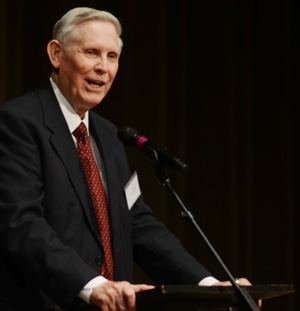
bill pinson300Bill Pinson, former executive director for the Baptist General Convention of Texas.Bill Pinson, former executive director for the Baptist General Convention of Texas, described the time when the need to raise more funds first became apparent, and Texas Baptists developed what became the missions foundation.

In 1984, the BGCT launched the office that grew into the Texas Baptist Missions Foundation as a two-year experiment to raise funds beyond traditional sources to start churches as part of the Mission Texas emphasis, Pinson recalled.

In 30 years, the foundation has worked with more than 33,000 donors to support 250 mission projects throughout Texas and around the world.

David Hardage, current BGCT executive director, desribed the BGCT’s future as “challenging … uncertain … but an exciting adventure,” emphasizing the continued need for missions funding.

“God brought us to this place and is preparing us for what’s ahead. Join me in praying God will raise up a fresh spirit of generosity among Texas Baptists,” he said.

“It will take resources, and it will take you and me being good stewards of those resources.”

tbmf logo250More than 160 missions foundation donors and friends attended the anniversary luncheon, where they heard beneficiaries of the foundation tell how funding has helped their ministries, churches and mission projects.
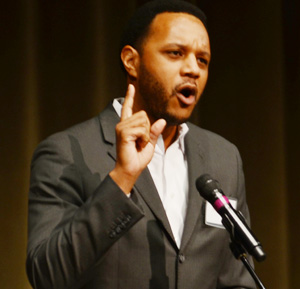

Ernest Baylor, a Dallas Baptist University graduate, described his experience working with Unlimited Partnerships and Cornerstone Baptist Church, a Dallas congregation in the inner-city area near Fair Park.

“What Texas Baptist Missions Foundation has done—not just for 30 years but 10,950 days—is contribute to students looking to make a difference in their communities,” he said.

Contributions from the missions foundation help Unlimited Partnerships connect college students with churches and universities to respond to the call of Christ, he explained.

Jay Lawson from Texoma Cowboy Church in Wichita Falls said gifts made possible through the missions foundation help Texans attracted to the western culture find a church home.

“The appeal of the cowboy church—whether it’s romantic in nature because of cowboy life, the music or the atmosphere—reaches those people that would not come to church for any other reason,” Lawson said.

tbmf ernest baylor300Ernest BaylorAdditional video and in-person testimonials from Baptist Student Ministries, the Bounce program to involve students in disaster recovery, Texas Baptist Men, Vietnamese Baptist Church in Garland and others gave donors insights into how gifts continue to make a difference.

Bill Arnold, president of the missions foundation, said donations have and are continuing to fulfill the Texas Baptist Missions Foundation’s purpose: To the glory of God, develop innovative partnerships with people who want to use their resources to change the world.

“By keeping our focus on the cross, we’re going to be able to stay true to our purpose,” Arnold said.

Three things have helped guide the missions foundation in the past and will help guide it in the future—clear mission, a clear focus and freedom to support new ministries, he said.

“The funds given to the missions foundation are God-directed before we even get them,” Arnold said. “When we couple (the donations) with prayer, resources, ministry skills and God’s timing, then we get about our goal of making a difference for God’s kingdom.”

The missions foundation also introduced 30 Ways $1,000 Can Make a Difference, a booklet highlighting specific giving opportunities. To download the booklet and learn more about the missions foundation, visit texasbaptists.org/tbmf.


Sept. 18 giving day to benefit Baptist Standard Publishing

The Baptist Standard is participating in North Texas Giving Day. On Sept. 18, every donation of $25 and above will be multiplied when donors contribute to the Standard through www.NorthTexasGivingDay.org, a website powered by Communities Foundation of Texas that connects donors with nonprofit organizations in North Texas.

www.NorthTexasGivingDay.orgDonors may visit NorthTexasGivingDay.org Thursday, Sept. 18, between 6 a.m. and midnight, search for Baptist Standard Publishing and click “Donate Now.” Donors do not need to live in North Texas to participate.

Tax-deductible donations will go a long way in helping Baptist Standard Publishing continue to fulfill its mission to inform, inspire, equip and empower Texas Baptists and Christians everywhere, noted Editor-Publisher Marv Knox. Plus, gifts of $25 or more given through www.NorthTexasGivingDay.org on Thursday, Sept. 18 will receive a portion of more than $1.5 million in bonus funds—making all donations go further.

Your financial support is vital to our mission. Please help us make the most of your support by donating to Baptist Standard Publishing on North Texas Giving Day.

Because of friends and supporters, Baptist Standard Publishing is able to produce:

• The Baptist Standard, the weekly digital news journal

• BaptistStandard.com, website updated continually

• CommonCall, a monthly magazine of inspiring human-interest stories

“We work hard to make sure your investment in our ministry touches lives,” Knox said. “After all, we’re stewards of the Lord’s resources—time, talent and funds.

“Your financial support is vital to our mission. Please help us make the most of your support by donating to Baptist Standard Publishing on North Texas Giving Day. We appreciate it—and you—far more than we can express.”

Donations made through the North Texas Giving Day website will be processed through the Communities Foundation of Texas. Donors will receive an acknowledgement email, as well as an official gift substantiation/tax receipt. Donations will appear on credit card statements as being payable to “CFTexas NTX Giving Day.”

Participating organizations will be notified and receive the donor’s contact information, unless they wish to remain anonymous. All donations are tax deductible and irrevocable and will be for the unrestricted use of the chosen charity. A credit card processing fee of 5.62 percent of the amount of the gift will be deducted, with no additional charge to the organization.

For more information and to donate on Sept. 18, please visit www.NorthTexasGivingDay.org.


Texas Baptists seek to raise $4.2 million for state missions

Texas Baptists aim to raise $4.2 million through the Mary Hill Davis Offering for Texas Missions this fall—about $448,000 more than they gave last year.

maryhilldavis verse425The Woman’s Missionary Union of Texas board of directors set the goal for the 2014 offering, which will be distributed in 2015.

If Texas Baptists meet the goal, it will provide:

• $1 million for church-starting cooperative ventures between sponsoring congregations, leaders of new churches, Baptist associations and the Baptist General Convention of Texas, plus an additional $262,200 for related ministries, such as $170,000 for Mega Focus outreach in the five largest and most ethnically diverse associations.

• More than $1.73 million to strengthen churches to be on mission, including $998,000 for the ministries of Texas WMU. It also includes $64,000 for scholarships to ethnic/minority students enrolled in Texas Baptist universities.

• $638,625 to share the gospel of Jesus Christ with unchurched people. That includes $87,000 to provide BaptistWay Press resources in varied language and cultural contexts, $60,000 for an ongoing Hope 1:8 project to develop innovative initiatives to reach Texas for Christ and $50,000 for Harvest Field Churches in poor, inner-city areas.

• $565,000 to help Texas Baptists serve others and put their faith into action. It includes $95,000 for River Ministry missionaries and field service coordinators and $118,000 for community ministry and outreach along the Texas/Mexico border.

Hispanic initiatives

The 2014 offering will help provide funding for several new ministries, including $30,000 to provide scholarships for Hispanic missionaries serving church, communities and campuses and to cover travel and field expenses for mission projects, as well as $29,000 to provide training and travel for Hope 1:8 missionaries, who serve in variety of mission settings around the state.

The offering will supply $25,000 for English-speaking Hispanic initiatives, to help provide teaching, training and resources in methods to reach third- and fourth-generation Hispanics with the gospel. It also will provide $25,000 for ministries among oilfield workers, including evangelism in “boom towns” springing up in the Eagle Ford, Cline and Barnett Shale areas.

Bivocational training

The 2014 offering also will provide $15,000 to develop a new paradigm to dramatically increase the number of equipped bivocational pastors serving Texas Baptist congregations.

A $10,000 item in the 2014 offering will enable the Hispanic Baptist Convention of Texas to devote one day of its annual meeting to challenging participants to minister to human trafficking victims. It would include age-appropriate workshops in English and Spanish focused on prevention and ministry to victims, as well as a service project at a shelter.

In addition, the offering would provide $15,000 to promote overall church education efforts regarding human trafficking.


Texas Tidbits: Three Texas Baptist ministers named CBF Fellows

Three Texas Baptists—Mary Alice Birdwhistell at Calvary Baptist Church in Waco, Jakob Topper at Second Baptist Church in Lubbock and Kyle Tubbs at Grace Baptist Church in Round Rock—are among 25 ministers in their first full-time ministerial position who have been named Cooperative Baptist Fellowship Fellows, a two-year program to help support their healthy transition into congregational ministry. Each CBF Fellow enters into a covenant with CBF and his or her congregation, which agrees to provide non-vacation time for the fellow to participate in retreats where fellows learn together, build community and provide support to each other. Fellows also are provided access to a trained and experienced ministerial coach. The Lilly Foundation supports the CBF Fellows program, facilitated in partnership with the Center for Congregational Health and FaithHealthNC.

rebecca obanion130Rebecca O’BanionO’Banion named UMHB associate VP. Rebecca O’Banion was named associate vice president for development and alumni relations at the University of Mary Hardin-Baylor. Prior to joining the UMHB staff in 2006 as director of alumni relations, O’Banion served as executive director of Hope for the Hungry, an interdenominational organization that works to meet physical and spiritual needs of children around the world.  She earned her undergraduate degree and her doctorate in higher education administration from UMHB, and she holds a master’s degree from Liberty University.


Ethiopian Baptist pastor nominee for BGCT second vice president

A Filipino-American pastor from the Houston area will nominate an Ethiopian-American pastor from the Dallas area as second vice president of the Baptist General Convention of Texas.

bedilu yirga130Bedilu YirgaErnest Dagohoy, executive pastor of First Philippine Baptist Church in Missouri City and vice chair of the BGCT Executive Board, announced plans to nominate Bedilu Yirga, pastor of Ethiopian Evangelical Baptist Church in Garland, for the post.

“I believe he will represent our ethnic churches well,” Dagohoy said. “He is a proven leader among ethnic churches, and he has served our convention well.”

BGCT Executive Board member

Yirga serves on the BGCT Executive Board and as chair of the BGCT’s affinity groups and cultural connections committees. He also is a board member and treasurer of the Ethiopian Evangelical Christian Association of America and secretary of the All-Ethiopian Pastor’s Associations in North America.

“He is a person of integrity who will follow up on what he promises to do and serve Texas Baptists well as our second vice president,” Dagohoy said.

If elected, Yirga said, he hopes to promote greater involvement of ethnic churches within the larger Texas Baptist family.

Wants greater community involvement

“I have a burden for unity and a desire to see greater community engagement by our ethnic churches,” he said.

Since Yirga became senior pastor at Ethiopian Evangelical Baptist Church in 1998, the church has grown from about 140 members to more than 800 adults and 300 children.

Previously, he served as associate pastor of Ethiopian Evangelical Baptist Church in Dallas.

Yirga has traveled internationally and to multiple states to train Christian leaders.

“I am interested in teaching and training pastors, teachers and leaders in local churches. I am also involved in church planting and training indigenous church planters,” he said.

Under his leadership, the Garland church worked with Howard Payne University and Wayland Baptist University to establish a ministry school where students can earn up to 18 credit hours toward an undergraduate certificate program. So far, 42 students have completed the program, and 15 are enrolled.

Native of Ethiopia

Yirga was born in Addis Ababa, Ethiopia, and he served in Ethiopia as an auditor and senior accountant for World Vision International.

He earned his undergraduate degree from Southwestern Assembly of God University in Waxahachie, his master of divinity degree from Southwestern Baptist Theological Seminary in Fort Worth and his doctor of education degree from Southeastern Baptist Theological Seminary in Wake Forest, N.C.

He and his wife, Almaz, have one daughter, Essey, and two sons, Levi and Addis.


New students show community ETBU cares

MARSHALL—Freshmen and transfer students at East Texas Baptist University fanned out in the community the day after they moved into their dorms, showing their new neighbors “ETBU Cares.”

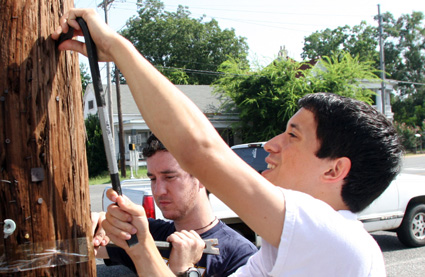
etbu cares groups425As a community service project new East Texas Baptist University students pulled nails from poles located on East Grand Avenue and surrounding streets. Nails and staples are a safety hazards to power company employees who have to climb utility poles. (PHOTO / Mike Midkiff)As part of Welcome Week at ETBU, the students served in all six Marshall elementary schools and at a food pantry, a ministry to the homeless, two apartment complexes, a therapeutic equestrian center and at Boys and Girls Clubs.

They also removed nails and staples from utility poles along East Grand Avenue, near the university campus.

Franklin Atkinson, retired religion professor and vice president for spiritual affairs at ETBU, presented the pole-cleaning idea to Baptist Student Ministry Director Mark Yates.

Atkinson cited an article in a local electric co-op publication that reported the nails and staples—left in poles after people posted signs advertising garage sales or offering rewards for lost pets—present a safety hazard to utility linemen. Yates suggested the nail-removal service project to Lisa Seeley, director of the ETBU Great Commission Center.

“I feel like sometimes that the simple things that people don’t think about, as well as the dirtiest jobs of service, make the most impact,” said freshman Lexi Pyle of Beaumont. “I like doing things outside the box that no one else wants to do.” 

More than 200 students divided into 15 teams to complete community service projects as part of the Great Commission Center’s ongoing “ETBU Cares” emphasis.

etbu cares right425East Texas Baptist University students Taylor Talbert of Waco and Isaac McTaggart of Fort Worth pull nails and staples out of a utility pole at the corner of Franklin and East Grand in Marshall. (PHOTO / Mike Midkiff)At My Friend’s House, students worked on tasks to benefit the homeless and people in need, and at Mission Marshall, they restocked food pantry shelves with canned goods. At the Dayspring Therapeutic Equestrian Center, student volunteers removed brush and dead limbs. 

Other students led Kid’s Club, a recreation and Bible-teaching activity, at two apartment complexes. Additional teams cleaned facilities at the Boys and Girls Clubs of the Big Pines.

Students who served at Marshall elementary schools helped teachers prepare their rooms for the first day of classes.

“ETBU students don’t mind doing the dirty jobs,” said Taylor Talbert, a student from Clifton. “Jesus did the dirty jobs in his time, like wash the feet of his disciples.”


Fort Worth missionary doctor recovered from Ebola

ATLANTA (RNS)—An American doctor treated for Ebola, Kent Brantly, was discharged from Atlanta’s Emory University Hospital Aug. 21. Another American aid worker, Nancy Writebol, was discharged Aug. 19.

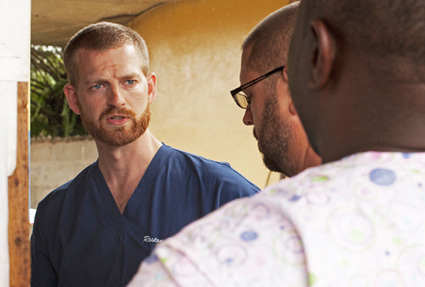
brantly doctors liberia425Kent Brantly of Samaritan’s Purse talks to health workers in Liberia before he was infected with the Ebola virus. (Samaritan’s Purse Photo)“God saved my life,” said Brantly, looking gaunt, at a press conference in which the room applauded his appearance. He thanked his medical team and the millions of people around the world praying for his recovery. “Please do not stop praying for the people of West Africa.”

Bruce Ribner, medical director of the hospital’s infectious disease unit, said Brantly, who was working in Liberia with Samaritan’s Purse when he became infected, would go to an undisclosed location with his wife and children after the press conference.

Brantly and Writebol, a volunteer with SIM USA, were flown to Emory from West Africa in early August and were treated in the hospital’s specialized unit.

No risk to the public

Ribner said the hospital performed extensive blood and urine tests on both patients and consulted with the Centers for Disease Control and Prevention before deciding the two missionaries were ready to be released. Neither pose any risk to the public, he said. Five doctors and 21 nurses cared for Brantly and Writebol during their stay.

In his statement, Brantly said his family arrived in Liberia last November and he saw his first Ebola patient in June. “We took every precaution to protect ourselves from this dreaded disease,” Brantly said.

nancy writebol425American worker Nancy Writebol, was discharged Aug. 19 after being treated for Ebola. (RNS Photo couresy of SIM)On July 23, just a few days after sending his family home, however, Brantly said he woke up feeling sick, and soon learned that he was infected.

Writebol chose not to make a statement. However, Brantly related that, as she left her isolation unit, she said, “To God be the glory.”

Ribner said he hopes what he and his colleagues learned about treating Ebola can help save other patients in Africa.

While in Liberia, Brantly received a blood transfusion from an Ebola survivor.

Was experimental drug effective?

Both Brantly and Writebol received doses of an experimental drug, called Zmapp, which includes man-made antibodies against Ebola. Although Zmapp has shown promise in animals, it has not yet been tested in humans. Experts have said it’s not possible to conclude that Zmapp cured their disease, although getting good supportive care at Emory, one of the world’s best hospitals, likely improved their chances of survival.

“If the question is, ‘Did Zmapp do this?’ The answer is that we just don’t know,” says Anthony Fauci, director of the National Institute of Allergy and Infectious Disease. “People who are in much less sophisticated medical care conditions in West Africa are recovering 50 percent of the time.”

Without a carefully designed trial—involving a comparison group that doesn’t receive the drug—doctors can’t make conclusions about how a treatment works. About half of Ebola patients in the current outbreak are surviving without the experimental drug. But a Spanish priest who received Zmapp died, Fauci said.

Three Liberian health workers also received Zmapp. The drug’s manufacturer, Mapp Biopharmaceutical of San Diego, has said there is no more of the drug left.

Outbreak continues to grow

The Centers for Disease Control and Prevention has sent at least 50 staff to West Africa to help contain the epidemic.

“We must re-commit to doing all we can to increase their chances of survival and to stop the spread of Ebola,” CDC director Thomas Frieden said. “This outbreak is unprecedented, and it’s likely to get worse before it gets better. We must respond in unprecedented way to stop the outbreak as soon as possible.”

Brantly said he is “glad for any attention my sickness has attracted to the plight of West Africa in the midst of this epidemic. Please continue to pray for Liberia and the people of West Africa, and encourage those in positions of leadership and influence to do everything possible to bring this Ebola outbreak to an end.”


Expert offers tips to develop meaningful church-school relationships

WACO—Relationships between churches and schools are less about money and more about mentoring, said Diana Garland, dean of Baylor University’s School of Social Work.

Diana Garland, dean of Baylor University’s School of Social Work.With students and teachers headed back to the classroom, it’s the time of year when many congregations engage with local schools, and Garland believes churches need to consider carefully their approach to school ministries.

She offers these tips:

Consider service rather than simply sending money.

“It’s easy to write a check,” Garland said. “It’s a lot harder to spend an hour a week to help a kid learn to read. Both are important, but the latter is often more meaningful.”

Churches can collaborate with school officials to do a number of things—from upgrading facilities and organizing events to staffing mentoring programs and praying with teachers.

The impact of this type of service is twofold, she said. The people on the receiving end can benefit, and those who serve can grow in their faith.

“Our research shows that the most effective way to grow the faith life of Christians is to engage them in meaningful service to others,” Garland said.

“We were surprised to find that service is more effective than any other single approach to faith development—including attending worship study groups and Bible study groups. Of course, that doesn’t mean that worship and Bible study are unimportant. They are. But without service, they are insufficient in growing a lasting faith.”

Don’t assume you know the needs of the school.

“We bring our sense of calling, but then it’s time for our church to sit down and say, ‘We want to help but we don’t know how.’ We need to be respectful and understand that we don’t have the answers and that we need to collaborate,” Garland said.

For example, churches that collect school supplies for classrooms might incorrectly assume felt-tip markers would be helpful, but a conversation with teachers and administrators could reveal the school doesn’t permit students to use felt-tip markers. Instead, the school might need its cafeteria painted or assistance in providing uniforms, she said.

Think relationally.

“Relationships are the most important and profound gift we can give,” Garland said. “As important as school supplies are, they are even more effective when they come from people who know the people, know the children.

“There is nothing more powerful than service that builds an ongoing relationship between two people, which is why tutoring and mentoring and befriending are so valuable.”


Attorney named CLC director of public policy

AUSTIN—Austin attorney Kathryn Freeman has been named director of public policy for the Christian Life Commission of the Baptist General Convention of Texas.

Freeman, a member of David Chapel Missionary Baptist Church in Austin, will lead the CLC’s efforts related to government and legislation.

Kathryn FreemanShe earned her undergraduate degree from Texas A&M University and her law degree from the University of Texas School of Law. She formerly served as attorney for Texas Appleseed and policy coordinator for the Institute of Urban Policy.

CLC Director Gus Reyes expressed confidence Freeman will be a great addition to the commission.

“Kathryn brings the CLC a skillset that enhances our capacity to establish connections between legislative efforts, pastors and church members,” he said.

In her new role, Freeman wants to educate Texas Baptist churches on the importance of governmental awareness and involvement.

“I would really like to contribute to a better understanding of the way public policy affects our lives and why your church, or you as a Texas Baptist, should really engage in what the Christian Life Commission is doing,” she said.

Freeman also wants to enlighten churches about the collaboration that can take place with the government on often-overlooked community issues, such as child poverty, hunger and human trafficking.

“For Texas Baptists, or Christians in general, if there’s an issue that you care about and if we take God’s command to care for the widows and orphans seriously, the government does have a role to play in providing that care,” she said.

Freeman also hopes to see Texas Baptists advocate for their communities with local officials. She wants to put a structure in place that will help churches engage more effectively with elected officials and policy makers about issues that are important to Texas Baptists and their communities.


Maciel nominee for BGCT first vice president

René Maciel, president of Baptist University of the Américas, will be nominated for first vice president of the Baptist General Convention of Texas.

rene maciel200René Maciel, president of Baptist University of the AméricasJulio Guarneri, pastor of Calvary Baptist Church in McAllen, announced his intention to nominate Maciel, current BGCT second vice president, at Texas Baptists’ annual meeting in Waco, Nov. 16-18.

“BUA serves as a bridge, connecting people cross-culturally, and René Maciel personifies that,” Guarneri said. “He has the ability to relate to Texas Baptists cross-culturally.

“Texas is changing, and it is a critical time to have leaders who can reach across barriers and relate to different cultural groups and different types of ministries.”

With the sale of the Baptist Building in Dallas and anticipated relocation of BGCT Executive Board staff to new offices, Texas Baptists face significant changes in the next year, he noted.

Understands change

“René understands change,” Guarneri said, pointing to his experience both at BUA and as assistant dean at Baylor University’s Truett Theological Seminary when the seminary moved to the Baylor campus from its original location at First Baptist Church in Waco.

Guarneri characterized Maciel as “loyal, a person of integrity, possessing a high level of commitment and a servant spirit.”

Maciel expressed appreciation to Texas Baptists for allowing him to serve as second vice president and pledged to represent them faithfully if elected as first vice president.

“It has been such a blessing to be able to serve,” he said, affirming the leadership provided by President Jeff Johnson and First Vice President Kathy Hillman.

This summer, Maciel was called as interim pastor at First Baptist Church in Castroville, where he previously served as music and worship leader and volunteer youth minister.

Importance of the local church

“It’s giving me a chance to see firsthand how important the local church is to the life of our convention—to see people growing up in Christ, in fellowship and in their understanding of God’s word,” he said.

The church is experiencing remarkable growth and making an impact in its community, in large part because of its willingness to reach out cross-culturally, Maciel added.

“Half of the congregation at Castroville is Hispanic. That’s at a historically Anglo church in a German Catholic town,” he said.

Texas Baptists need to train pastors, missionaries and church leaders to work across cultures, said Maciel, who has spent more than a quarter-century in higher education and administration with Baptist institutions.

Since 2007, he has served as president at BUA, a BGCT-related institution in San Antonio committed to training cross-cultural Christian leaders in a Hispanic context. About 275 students at the school are pursuing undergraduate degrees in biblical and theological studies, Spanish or business leadership. Another 750 students are enrolled in Baptist Bible Institutes, mostly along the Texas/Mexico border, but also in South Africa and India.

Before he arrived at BUA, Maciel served at Truett Theological Seminary—first as director of student services and later as assistant dean for administration and academic services. He also served in administration at New Mexico Baptist Children’s Home in Portales, N.M.

He earned his undergraduate degree from Hardin-Simmons University and his master’s degree in higher education administration from Baylor University, and he later served in administrative positions at both schools.

He and his wife, Sabrina, have two daughters—Brianna and Carmen.