BUA, Texans on Mission partner to grow Christian leaders
August 14, 2024
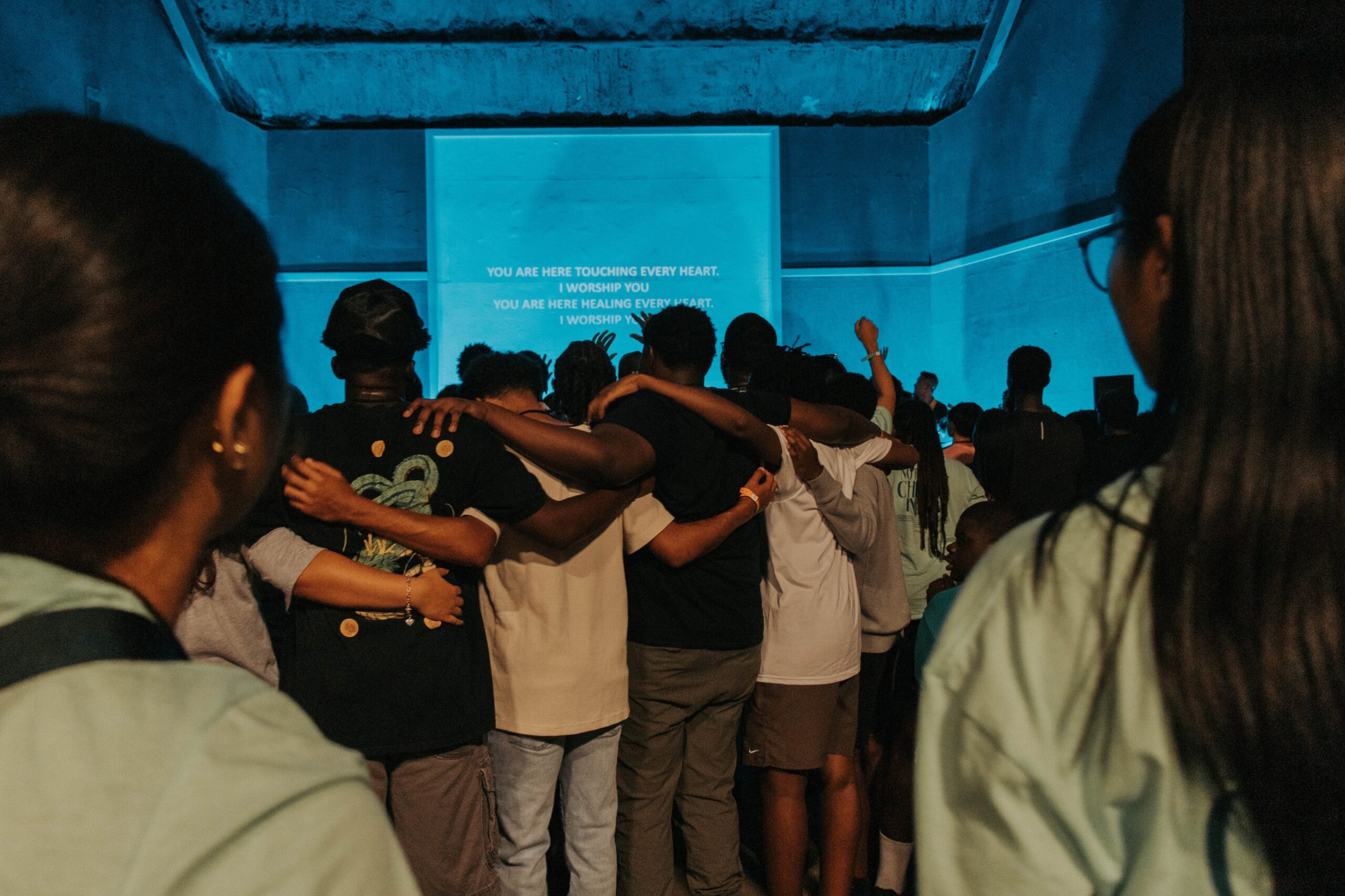
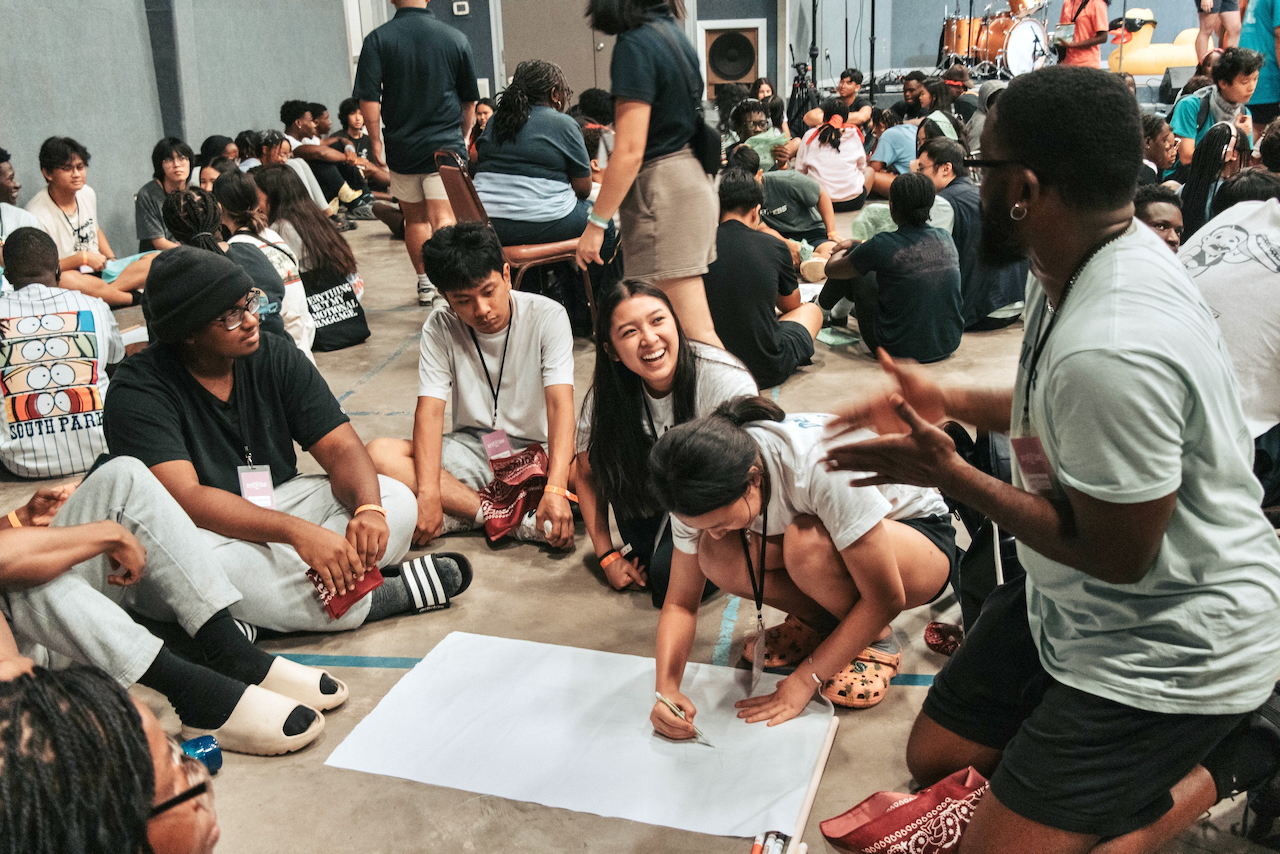
Baptist University of the Américas and Texans on Mission have entered an agreement to work together to develop Christian leaders for a global impact.
Leaders from both groups signed a memorandum of understanding July 30 outlining the cooperative effort. It seeks to pair BUA’s longstanding ability to train leaders for churches and ministries with Texans on Mission’s ability to deploy volunteers for maximum impact.
BUA will educate, train and develop leaders who will seek to take the gospel to the next generation of Texans and people around the globe. Thanks to the school’s cross-cultural curriculum, BUA alumni are positioned to serve in unique places globally.
Texans on Mission will help expand those educational opportunities, as well as give students practical opportunities to serve through disaster relief and water impact ministries.
“This partnership represents a significant step forward for both BUA and Texans on Mission,” BUA President Abe Jaquez said.
“Students will gain extensive awareness of the work being done by Texans on Mission and how they can contribute to similar efforts in their future churches and communities. By integrating their initiatives with BUA’s educational programs, a unique and impactful synergy is being created.”
For more than 75 years, BUA has met the growing need for Spanish-speaking and Latino Christian leaders to take the gospel across Texas and around the world as demographics continue to shift.
The school has provided pastors for up to 75 percent of the Hispanic Baptist churches in Texas, and its curriculum has empowered alumni to serve around the world. The training particularly has been helpful in Central and South America, as well as Arabic regions that have cultural and language connections.
Since 1967, Texans on Mission—historically known as Texas Baptist Men—deployed Christian volunteers to deliver help, hope and healing in Christ’s name. The ministry largely is known for its disaster relief and water impact efforts through which it has responded to every disaster in Texas, most across the United States and many around the world.
Texans on Mission’s global imprint has grown in recent years as it has established significant efforts in places like Poland, Ukraine, Israel, Uganda and Peru.
“The world needs beacons of hope more than ever,” said Mickey Lenamon, chief executive officer of Texans on Mission. “BUA students want to be that in the name of Christ, and we’re excited about how they can pursue that calling through Texans on Mission ministries.”
Lamar University student drowns at BSM retreat
August 14, 2024
A 23-year-old Lamar University graduate student drowned Aug. 10 while attending a Baptist Student Ministry retreat at the Toledo Bend Reservoir.
According to reports, the student was swimming in a cove with a group when he went underwater and did not resurface.
The Newton County Sheriff’s Office identified the student as Noah Roden. The sheriff said Roden drowned at 4:36 pm on Saturday, and his body was recovered at 9:25 am on Sunday.
“We are devastated by this student’s passing,” said Darin Ford, director of the Lamar BSM. “What was supposed to be a time of fellowship and growth has turned into a tragedy. We are just in shock right now.”
The Lamar BSM had been hosting a two-day leadership retreat at a lake house on the reservoir in advance of the upcoming fall semester.
Classes are scheduled to begin on campus on Thursday, Aug. 22. The home where the students gathered was about a two-hour drive from the university.
Ford said Roden had been an active member of the Lamar BSM for about a year.
Mark Jones, director of Texas Baptists’ Center for Collegiate Ministry, said he was thankful Ford was able to personally connect with Roden’s family members.
“Darin was able to speak directly with the student’s family and expressed our deepest condolences from the Texas Baptists family,” Jones said.
“Right now, we just want to love on these family members, BSM students and leaders and anyone touched by this horrific accident.”
Jones was working with Lamar BSM leaders to mobilize counselors to be available to meet with BSM students and others impacted by the tragedy.
A memorial service honoring Noah Roden will take place in the coming days.
“Our hearts are broken, but we sense God’s presence and are so grateful for this student’s faith walk through the Lamar BSM,” Jones said.
“Though we may not understand why this tragedy occurred, we know that God is good, he is in control, and we have an opportunity to point others to him, even in their grief.”
EDITOR’S NOTE: When the article originally was published on Aug. 14, the student’s name was withheld to allow time for all family members to be notified. It was updated at 5 p.m. on Aug. 15 to identify the deceased student.
Houston layman seeks to transform health care in Ukraine
August 14, 2024
A Ukraine-born Houston Baptist layman is seeking to help his homeland rebuild its health care system by offering young Ukrainian medical professionals continuing education opportunities in the United States.
In addition to professional development, Rostyslav Semikov also makes sure the Ukrainian health care workers are exposed to the gospel as they interact with Christian medical specialists and educators.
Visiting health care professionals from Ukraine receive a warm welcome at West University Baptist Church in Houston. (Courtesy Photo)
“I invite them to church. And I invite them to visit with outstanding Christian professionals in the field, who share not only their professional expertise, but also about their spiritual path and their faith—their testimony of how they combine science and their faith,” he said.
When they return to Ukraine, Semikov—a physician, cancer researcher and bioscience entrepreneur—hopes the medical professionals will “be salt and light” in their nation.
“They are the future leaders of our country,” Semikov said.
Semikov, a member of West University Baptist Church/CityRise Church in Houston, is the co-founder and director of the Peace and Development Foundation.
The foundation brings Ukrainian health care professionals to the United States for two- to three-week learning experiences at institutions such as the University of Texas MD Anderson Cancer Center and Johns Hopkins University.
Since 2022, the foundation has enabled about 80 Ukrainian medical personnel to spend time at more than 20 top U.S. medical and educational institutions and attend several professional conferences.
Inspired by similar ministry nearly 20 years ago
Semikov found inspiration in the work of Ronald Hoekstra, a neonatal-perinatal pediatrician from Minneapolis, Minn., nearly two decades ago.
Hoekstra first traveled to Ukraine to introduce medical personnel there to a multispecialty team approach to caring for prematurely born babies. Semikov served as his translator and helped him connect with hospitals in Ukraine.
With Semikov’s assistance, Hoekstra then selected two neonatal pediatric doctors, two gynecologists and two nurses from Ukraine to travel to Children’s Minnesota Hospital in Minneapolis for training.
“Besides sharing professional experience with them as a top expert in the field, he was also a follower of Jesus—a committed believer—and he brought them to the church where he goes,” Semikov said. “He shared with them what he does and told them he was doing it for God’s glory.”
The program continued to grow and made a significant impact on neonatal care in Ukraine, he noted.
Semikov saw the opportunity to use a similar approach for other health care workers, as well as professionals in other fields such as business and law.
In 2011, he was instrumental in the formation of the Alliance of Christian Professionals to help young doctors, lawyers and entrepreneurs “grow professionally and also develop spiritually, to serve God and people through our professions,” he said.
Peace and Development Foundation formed
When funding conferences and training opportunities became challenging, Semikov and a few others saw the need to create a charitable foundation to carry on the work and expand its mission to include peacemaking initiatives.
Rostyslav Semikov is co-founder and director of the Peace and Development Foundation. (Screen capture image)
The Peace and Development Foundation first was formed in Kyiv in July 2016 and then established in Houston in 2020 after Semikov relocated to Texas.
In the immediate aftermath of the heightened Russian assault on Ukraine in February 2022, the foundation also raised about $200,000 to provide humanitarian and medical aid for displaced people in Ukraine.
In December 2022, Bill Frist—a transplant surgeon and former majority leader in the U.S. Senate—worked with Seth Karp, surgeon-in-chief of the Vanderbilt University Medical Center, to facilitate a visit of Ukrainian health care professionals to Nashville, Tenn.
The Peace and Development Foundation enabled eight Ukrainian doctors to make the trip to observe health and lung transplant operations and learn transplant protocols at the Vanderbilt University Medical Center.
Last year, in addition to several visits to major hospitals in the United States, the foundation helped:
Five Ukrainian doctors attend the annual meeting of the American Association for Cancer Research in Orlando, Fla.
10 Ukrainian physicians attend the American Society of Clinical Oncology annual meeting in Chicago.
A group of Ukrainian surgeons and cancer researchers attend the Society of Immunotherapy for Cancer annual meeting in San Diego.
Some of the visiting physicians were from Okhmatdyt National Children’s Hospital in Kyiv. In July, a Russian attack on the children’s hospital claimed the lives of 27 civilians, including four children. Another 117 people, including seven children, were injured.
Visited Houston in the spring
In April, seven Ukrainian oncologists and cancer scientists attended the American Association for Cancer Research annual meeting in San Diego.
They also visited the Stanford University Medical Center, the Louisiana Cancer Research Center and MD Anderson Cancer Center in Houston.
Other visiting Ukrainian family physicians visited several educational institutions and hospitals in the Houston area.
During their visits to Houston, Semikov invited the visiting medical professionals to attend the West University Baptist Church campus of CityRise Church with him.
Stephen Spann (center), founding dean of the Tilman J. Fertitta Family College of Medicine at the University of Houston, hosts a meal for visiting young health care professionals from Ukraine. (Courtesy Photo)
He arranged for them to meet two other members of West University Baptist—Stephen Spann, founding dean of the Tilman J. Fertitta Family College of Medicine at the University of Houston, and James Tour, professor of chemistry, computer science, materials science and nanoengineering at Rice University.
The group of Ukrainian family physicians toured the Fertitta Family College of Medicine, met with Spann in his workplace and enjoyed a meal with him.
Tour, who teaches a Sunday school class at West University Baptist, and his wife Shireen host students for lunch after church every Sunday. Sometimes, they meet in the Tours’ garage to accommodate the large numbers who are eager to discuss spiritual issues with a renowned scientist.
James Tour (2nd from left), professor of chemistry, computer science, materials science and nanoengineering at Rice University, visits with a group of visiting young health care professionals from Ukraine in his “gospel garage.” (Courtesy Photo)
“He is a great example for our young people,” Semikov said.
The Ukrainian visitors enjoyed a question-and-answer time with Tour in what Semikov called his “gospel garage.”
In particular, interacting with dedicated Christians such as Spann and Tour who are experts in their fields enables the Ukrainians to see how intellectual inquiry and faith in God can coexist, he said.
During seven decades of Soviet communist domination of Ukraine, its people were indoctrinated in atheistic teaching, and professing Christians were denied educational and occupational opportunities, Semikov noted.
For example, after his father—who was pursuing a Ph.D. in physics—became a Christian, he was given an ultimatum. He either could renounce his faith, or give up the opportunity to defend his dissertation and receive his doctorate.
“He had to withdraw from the Ph.D. program,” Semikov said.
The Peace and Development Foundation actively seeks to bring together professional excellence, scientific inquiry, Christian faith and moral integrity, he added.
“I believe if we have leaders who are experts and who are people of integrity, that’s the way we can be salt and light in society,” he said.
Investing in the professional development of the rising generation—and introducing them to the gospel—can make a huge impact on Ukraine, he asserted.
“There may be few of them, but they can make a big difference to impact other people’s lives and bring glory to God,” he said.
Stark College president called as co-pastor in Georgetown
August 14, 2024
GEORGETOWN—After nearly 30 years with their beloved pastor, Crestview Baptist Church in Georgetown decided on a novel approach to moving forward with a successor.
Pastor Dan Wooldridge and Tony Celelli, president of Stark College and Seminary in Corpus Christi, will co-pastor for the next year, until Wooldridge’s retirement.
Dan Wooldridge
The church needed a new associate pastor a couple of years ago, Wooldridge said. However, he suggested to the personnel committee that the church specifically consider hiring an associate pastor with the intent of becoming his successor as senior pastor, because he planned to retire in the not-too-distant future.
According to Wooldridge, the church put a lot of research and thought into the succession plan, because they knew the transition to a new pastor after a long-term pastor can be quite difficult.
“When a long-tenured pastor retires,” Wooldridge said, “the transitions often, maybe not every time but often, have been very rough.
“We wanted a continuity,” Wooldridge explained, where the handoff could go more smoothly.
The church wanted the new pastor to have time to understand the congregation and why it does what it does, with the outgoing pastor there to provide support, both to the congregation and the new pastor as they get to know one another.
Lead up to co-pastoring
Last summer, at the Texas Baptists Family Gathering in McAllen, Wooldridge ran into Celelli, who had served as youth minister at Crestview Baptist Church in 1995, not long after Wooldridge was called there as pastor.
He’d kept up with Celelli, but he’d never asked Celelli back to Crestview to preach after he moved on to other ministries. He asked Celelli if he’d fill in for him for a couple of weeks in August 2023.
On one of the days Celelli was to preach, the son of a young man Celelli had served as youth minister in the 1990s was set to be baptized. The family was delighted to have Celelli perform the baptism, Wooldridge said.
The personnel committee began to ask whether they might be able to call Celelli, Wooldridge said. But knowing his dedication to Stark College and Seminary, Wooldridge doubted that course would be likely.
Because it was not his desire to choose his successor, Wooldridge told the selection committee, while they certainly could try to pursue Celelli as a candidate, he would not be part of that process.
He may have favored Celelli, but the church needed to call who God led them to, he asserted.
Crestview Baptist Church Photo
Before he became a candidate, Celelli provided consulting to the church on how to go about the co-pastor transition they had decided upon. Celelli had expertise in this area from working with several churches who’d attempted similar transitions, Wooldridge explained.
During the course of working together in a consulting capacity, the call to the church became clearer and clearer to the candidate, Wooldridge suggested, and culminated with Celelli accepting the call as the new co-pastor of Crestview Baptist Church on Aug. 5.
Transition year explained
A release to the congregation explained: “You will begin to see Pastor Tony around campus starting August 12, 2024.
“During the initial phase of the transition period, Tony will concentrate on getting to know the church, its members, ministries, and the community here in Georgetown, TX. During this period of orientation, you will also see Pastor Tony in the pulpit as he and Pastor Dan will share preaching duties among other aspects of ministry.
“During the second phase of transition, co-leadership, Pastors Tony and Dan will share all pastoral duties. In the final phase of transition, as we celebrate 30 years of faithful service of Pastor Dan, Pastor Tony will take on the leadership of Crestview Baptist Church with the support of Pastor Dan.”
Each of the phases will last four months, Wooldridge said. In the third phase, responsibilities will switch so that he will function essentially as Celelli’s associate pastor. At the end of the transition year, Wooldridge’s ministry at Crestview will conclude.
The church release also stated Celelli will remain president of Stark College and Seminary during the transition and expressed gratitude to the school for its mission.
During the call process, Celelli explained to the congregation the technology he utilizes and the trust he has in the vice-presidents at Stark—with whom he has worked for 11 years—which will support his efforts to lead both the seminary and the church effectively.
As long as he is doing both satisfactorily, Celelli will hold both the title of Stark College and Seminary president and co- /senior pastor of Crestview Baptist Church, he said in an email.
Celelli explained to the congregation he will manage this task “carefully,” “intentionally,” “honestly” and “humbly.”
Wooldridge named First Baptist Church in San Antonio, Fielder Road Baptist Church in Arlington, Pioneer Drive Baptist Church in Abilene and Green Acres Baptist Church in Tyler as other Texas Baptist churches who have adopted a similar co-pastor transition model.
Mission ‘stay-cation’ brings missions home
August 14, 2024
First Baptist Church in Waxahachie has a long history of robust mission action, but it’s been a while since the youth have participated in a mission trip.
NextGen Director Whitley Shaw said she knew the church’s youth needed to take on a more intentional mission project, but she thought, “We weren’t quite ready to go off anywhere.”
Last fall, Buckner International President and CEO Albert Reyes spoke at the church, piquing her interest in the many ways Bucker serves people.
Shaw said she reached out to Buckner not long after Reyes spoke at the Waxahachie church to schedule a tour of the Buckner campus and learn more.
She learned about the Healthy Housing remote build projects on the tour and “immediately thought that was something our church could do, because of the talent we have in our church and the way our kids are excited to serve.”
Idea leads to action
But, it was Chet Haynes, worship pastor, who first mentioned Buckner as an avenue to a “mission trip.”
Whitley Shaw, NextGen director (behind), and Belle Winn help sort shoes at Buckner. (FBC Waxahachie Photo)
At his suggestion, Shaw connected with Chris Cato, missions director for Buckner International—to begin to plan for a remote build project—and with Laina Wells, volunteer engagement coordinator for Buckner Children and Family Services to discuss the other pieces of the service week.
Wells “gave the go-ahead” to plan for a group from First Baptist Waxahachie to hold a backyard Bible club the next summer for the kids who are served through Family Pathways and Foster Care—as a part of the “mission trip” idea beginning to take shape, Shaw explained.
She said it was exciting to partner with Buckner. Collaborating and bouncing ideas off Cato, Wells and others encouraged her confidence to follow where God was leading.
“God has really ordained every step of this,” Shaw said, “opening doors.”
“Even when we started talking about the backyard Bible clubs,” she continued, the Buckner response was: “Nobody’s ever done something exactly like this. Can you tell me more what your idea is?”
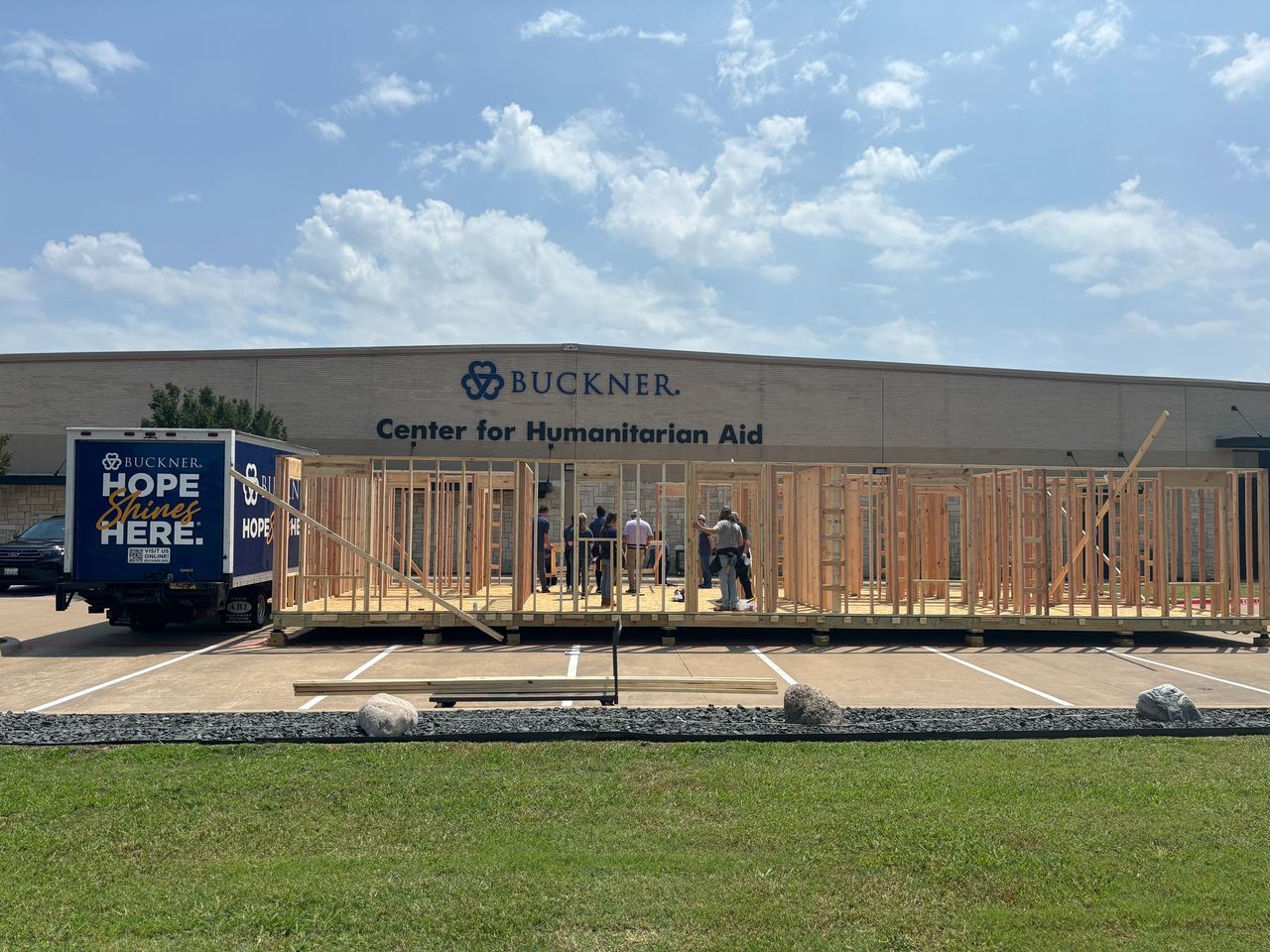
First Baptist Church Waxahachie students bring a section of framed wall to the subfloor for installation. (Photo / Calli Keener)
In addition to the remote build on the First Baptist Waxahachie campus and backyard Bible clubs for the Family Pathways kids, the mission week also included a day for both the build team and the Bible club team to work together at Buckner. They processed shoe donations for Shoes for Orphan Souls and spent a day serving locally in Waxahachie.
While there’s not a “Buckner mission week package,” Buckner is in First Baptist Waxahachie’s “backyard,” Shaw noted. So, partnering with them in several areas of ministry offered the church’s NextGen ministry the mission stay-cation Shaw hoped to achieve.
Trust God’s plan
While fewer kids than the church had hoped to serve participated in backyard Bible clubs, Buckner and the church team still found the partnership meaningful.
Wells commented, while things didn’t always work out the way they were planned, “The lesson in this is also that God will still meet the one and leave the 99.” The kids who were there were supposed to be there and got what they needed, she said.
“To be honest,” she said in an email, “as staff were dropping in, I feel like we were more blessed than the kids because the intentionality and presence was SO FELT. Jesus was truly in the room and working through each and every one of them.”
She explained their central theme was “leaving room for God to do what He wanted despite our plans, trusting that it’s enough, and we do believe the impact was made.”
Shaw said 25 youth and 20 adults served in at least one aspect of the mission trip during the week. Adults who didn’t help with Bible clubs or building prepared and served meals.
Assembling framing by sections. (Photo / Calli Keener)
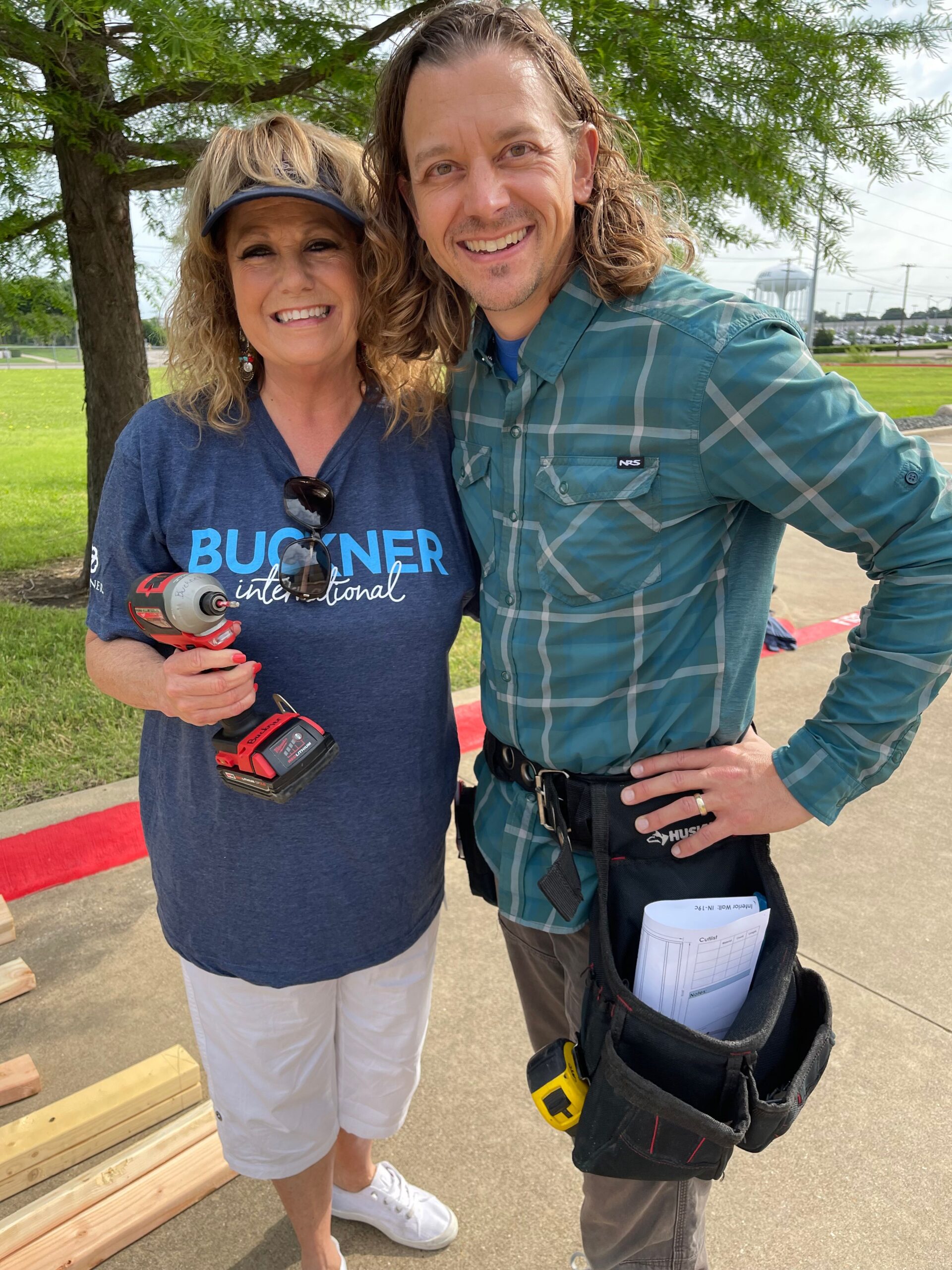
Some of the skilled builders who helped oversee the youth on the construction team and teach them building skills, which most did not have going into the project, are active Texans on Mission volunteers.
Texans on Mission loaned the church a shower truck for the youth, who stayed on the church campus all week, to supplement single locker room shower stalls, increasing the kids’ knowledge of this valuable ministry, too.
Passing on skills and missions-mindedness
“It’s really cool, too” Shaw said, “because some of our, essentially, master builders who’ve come and helped—they could’ve knocked it out in two days and been done, but it’s really cool to see our adults teaching and showing, and the kids did it.”
The church raised $17,000 of the funds for the $45,000 estimated cost of the build from a cake auction in the spring, which paid for the framing materials, food, transportation to Buckner in Dallas and a fun Friday activity for the kids.
The adult builders who participated had most of the tools needed, so that cut down on estimated build costs, as well.
The rest came from the church mission budget, approved by the mission team.
Steve Garrett, whose professional background is in project management, served as project manager for the build. He and his wife, Amy, also helped oversee students, staying on campus as sponsors all week.
Garrett explained despite coming to understand the full scope of the remote build project as they went, the project worked well for First Baptist Waxahachie, “because we were able to build a part of the home here and involve the kids.
“But then also go down to the Rio Grande Valley in South Texas and finish building the home with a group of adult volunteers, and then actually meet the family [who is receiving the home].”
Volunteers and other church members dedicated the build with scriptures on the framing. (Photo / Corbin Keener)
Blessed in the blessing
Those additional volunteer groups would go to the Valley the week following the remote build youth mission week to reassemble the home and rough-in plumbing and electric under the supervision of contractors in the Valley.
Then the next week, contractors in the Valley will complete the installation of plumbing and electrical and get everything ready for the last volunteer group to come finish out the build, Garrett explained.
Excluding planning, First Baptist Waxahachie will have worked on the project for four weeks. That includes the week before the remote build—when the builder heavy weights came to cut materials to specifications and set up for youth and supervisors to assemble—the NextGen mission week and the two weeks in the Valley when adult volunteers will work to complete the build.
“It was pretty evident that the enemy did not want this week to go over,” Shaw mentioned, with thing after thing going wrong. But, the “kids have been amazing, just their attitudes and encouragement to one another have been great.”
“We’ve only cried a few times,” she said, “all happy tears.”
Calli Keener is a member of First Baptist Church in Waxahachie.
Pastor Care facilitates journey of healing and hope
August 14, 2024
Haynes Searcy carried a burden of pain and shame from childhood, a secret so dark it led him down troubled paths, even while serving in ministry.
“I held onto things I was ashamed of,” he acknowledged.
When Haynes Searcy needed counseling, he contacted STCH Ministries and its Pastor Care program. (Courtesy Photo)
Haynes’ journey with STCH Ministries began at a crucial point in his life when he needed refuge. The trauma he had carried for years was overwhelming.
He knew about STCH Ministries and its Pastor Care ministry through his church. Trusting them, he reached out for help.
“When I reached the point where I knew I needed help, I reached out to STCH Ministries, and they connected me with an awesome counselor,” Haynes said. “It was important for me to meet with someone who wasn’t in my area, because I didn’t want to talk to someone I previously knew, and STCH Ministries was able to do that. It was good.”
Dealing with a childhood secret
Haynes held a secret from his childhood that impacted him deeply.
“I was abused by a family member when I was 7 or 8 years old,” he said. “I never said anything to anyone, because I loved that family member. I was also introduced to pornography and other unhealthy things, thinking they were normal.”
These early experiences led to addictions that followed him into adulthood and his marriage.
“My wife didn’t live a life like mine and had no clue,” Haynes said. “I was able to hide it all, thinking I had given it to the Lord until one Thanksgiving morning.”
That Thanksgiving, everything came crashing down. The trauma Haynes had suppressed resurfaced.
“I began reliving some things from my past,” he recalled. “My counselor later said this moment was God telling me that it was time to deal with it. I had been preaching God’s word on Sundays, but I had unforgiveness and hate in my heart. It was time to practice what I preached.”
While in counseling, Haynes was asked to write his story.
“There were things from my childhood I had forgotten about that only came out as I began to think back and tell my story,” he said. “It was hard.”
Before and after he received counseling made possible by STCH Ministries’ Pastor Care program, Haynes Searcy said his wife Kim was a constant source of support. (Courtesy Photo / STCH Ministries)
His wife, a constant support, helped him even when he did not feel he deserved it. During this time, Haynes stepped down from his role as a youth pastor to focus on healing.
“My church was very gracious and understood I needed a break while I went through counseling,” he said.
The process of healing brought significant changes to Haynes’ life.
“I can forgive those who have passed on, which is hard to do,” he said. “I’ve shared my story with other men, and there are pastors like me who feel there’s no place to go. STCH Ministries cares for the people who come to them. If you’re on the fence about getting help, just make the call.”
Able to share his story with others
Haynes emphasized the importance of seeking help, especially for pastors.
“It’s OK to take a break if you need to get help through counseling,” he encouraged. “It’s OK to stop and breathe while you receive help. On this side of things, I’m able to breathe and help other men with their addictions.”
Haynes Searcy (left), pictured with son Nicholas, received counseling to help him deal with childhood trauma, thanks to STCH Ministries Pastor Care program. (Courtesy Photo / STCH Ministries)
Haynes—who serves on the staff of E320 Church in Victoria—sees God’s plan in his experiences as he reflects on his journey.
“I know what I experienced in childhood and the healing process is all a part of God’s plan,” he said. “I’m thankful I can share my story and minister to other men who have been through the same hurt. It helps them and me.”
Many men have approached Haynes, thanking him for sharing his story.
“There aren’t very many men who will be vocal about trauma from childhood,” he said. “But when I’ve shared my story, many men have come up to me afterward and said: ‘Thank you for sharing your story. The same thing has happened to me.’”
Haynes expressed his appreciation for the support he received from STCH Ministries and gratitude to its donors.
“I’m so grateful for the people who support STCH Ministries, because it helps pastors like me get through struggles,” he said. “Many pastors, families and individuals need a refuge, a place to go for help. We find that in STCH Ministries because of the continued support.”
Haynes’ story is a testament to the power of healing and God’s work through STCH Ministries.
“There’s a lot of freedom in recovery,” he said. “I’m still recovering, but I’m able to share my story, and that is everything.”
Buckner projects provide homes for Rio Grande Valley
August 14, 2024
Buckner Healthy Housing remote builds offer churches the opportunity to “work-from-home” to build homes and bring generational change to Rio Grande Valley families.
Buckner has been involved in providing housing in the Valley for about 15 years, explained Chris Cato, director of missions for Buckner International, building about 150 homes in that time frame.
Chris Cato, right, with a Buckner Healthy Housing volunteer. (Buckner Photo)
The remote build approach to this ministry came up around eight years ago, when First Baptist Church in Lufkin dreamed up the idea of building a house in their church parking lot and transporting it to South Texas.
The congregation had become concerned with the dwindling number of people able to go to the Valley and wanted to get more people involved in missions, Cato explained.
Remote build beginnings
One of the church members was an engineer, Art Nelson. Nelson and David Sanders, a jack-of-all-trades, got together and perfected the process.
“From a Buckner side, we just kind of got out of the way,” and marveled, Cato said.
“Oh, the Lufkin boys are in town. They know what they’re doing. They do amazing stuff,” was the general sentiment at Buckner, regarding the work First Baptist in Lufkin was doing.
But during the COVID-19 pandemic, so few churches were able to go down to the Valley for mission projects, Buckner needed to find a way to keep meeting the housing needs of the people there.
So, Buckner reached out to First Baptist in Lufkin and asked them to teach Buckner how to do remote builds.
Enthusiastically, “the Lufkin boys” came up to partner with an engineer at Cottonwood Creek Church in Allen, and “we just did this massive brain dump,” Cato explained.
They worked to get the knowledge out of the engineers and builders heads into a formalized plan that could be replicated at other churches.
Cato saw the remote-build Healthy Housing project plan as God’s provision through the terrible time of the pandemic.
“God took a really terrible situation and just multiplied our ministry,” he said.
Families who receive the homes have come through Buckner’s Family Hope Center, a family-focused program that provides hope, family coaching, spiritual development, counseling, financial empowerment and other vital assistance to help family members reach their fullest God-given potential.
The program takes 12 to 18 months and results in families ready to move forward, breaking the cycles that have kept them down. Once families have completed core classes and the family-coaching piece of Family Hope Center’s program, they receive a certificate and become eligible to apply for a Healthy Housing project.
These are not necessarily families in crisis, Cato explained. Buckner has known and worked with the families for years by the time they move to the housing side of service.
But they are families who are ready: “They have a base level of financial stability. And then they also have made the mental shift and kind of emotional shift on saying, ‘Hey, you know what, we’re going to take our family development seriously, and we’re ready to create this environment for our kids where they can reach their God-given potential.’”
The families either own the land where the homes are set up or have a pathway to ownership for the land. So, the families are prepared to steward the asset they receive.
“Owning a house is not free,” Cato pointed out. So, only families who are able to cover the costs of insurance, taxes and maintenance are eligible to receive a Healthy Housing build.
Partnering churches fund the cost of materials and provide the bulk of the labor, but families who receive homes are expected to contribute “sweat equity,” or labor, to some part of the construction at the on-site stage of the build.
Cato said Buckner and partners will complete 11 Healthy Housing homes this year. Many of the families work together on each other’s builds, and participants come together as a community, he added.
Investing in generational change
A remote build in process. (Buckner Photo)
The estimated cost per build is around $45,000. But Cato said churches interested in a remote build project should not let money get in the way if they want to participate in a build project.
“For as long as I have been doing this,” Cato said, “I have never seen God not provide the resources to take care of the family.”
Buckner has helped facilitate collaboration between congregations to take a home build project from materials to foundation and completion.
When a church takes on a remote build for the first time, Buckner pairs them up with an experienced church to mentor the first-time church through the process.
Additionally, these projects are flexible and can be tailored to the capacity of partnering churches, meaning churches are free to structure the projects in the ways that work best for their calendars and congregations.
Some churches with master builders will finish the framing in a day, then take the home down to the Valley for setup. Others schedule to build one day every week for 6 weeks until the remote work is completed.
However a church decides to approach the project, the impact of giving their time and money is significant, Cato said.
One recipient family last year shared what a difference their new home would make for them: “Because we’re not saving money to purchase a house, we are able to take that money and put it into college for our kids.”
Their kids now will be the first ones in their family to go to college, Cato explained.
“That’s the type of generational change that we’re able to have,” he said. “It’s incredible. It’s just so cool.”
Baylor BSM receives Mabee Foundation challenge grant
August 14, 2024
The Texas Baptist Missions Foundation announced July 30 the Mabee Foundation has awarded a $1.3 million Challenge Grant toward the construction of the new Baptist Student Ministry Center at Baylor University.
Conceptual drawing of the new Baptist Student Ministry center on the Baylor University campus
“This Mabee Challenge Grant is a strong endorsement of the BSM Center at Baylor project,” said Jerry Carlisle, president of the Texas Baptist Missions Foundation.
“Over the past 75 years, the Mabee Foundation has made strategic grants totaling over $1.5 billion for impactful buildings. Their process encourages increased generosity in every project,” Carlisle said. “We are grateful to partner with this kingdom-focused organization.”
Will Bowden, director of the Baylor BSM, said God is at work on the university campus.
“BSM at Baylor already engages over 6,000 students each year. This new 12,000 square-foot Baptist Student Ministry Center will give us room for incredible growth,” Bowden said. “The center will serve as a home for campus ministry to raise up student leaders who can articulate their Christian faith and be sent out to make a global impact for the gospel.”
Baptist General Convention of Texas Executive Director Julio Guarneri and Baylor University President Linda Livingstone sign th documents to transfer ownership of a parcel of land where the new Baylor Baptist Student Ministry facility will be built. (Texas Baptists Photo)
Baylor University conveyed to Texas Baptists the deed for a one-acre parcel of land at the intersection of 4th Street and Daughtrey Avenue during an April ceremony in Waco. In keeping with a 2023 agreement, that transfer was initiated once the $3 million fundraising goal was reached.
Carlisle noted the Texas Baptist Missions Foundation has raised $3.253 million of the $7 million needed to construct the new center. To receive the Mabee Challenge Grant, an additional $2.447 million must be given or pledged within the next 11 months.
“The entire project depends upon the generosity of God’s people,” Carlisle said.
He urged those connected to the university and the BSM to consider participating “prayerfully and financially” in the days to come.
Once the $7 million cost of construction is met, the Texas Baptist Missions Foundation intends to raise a $2 million endowment fund to operate the building.
Texas Baptist Student Ministry engages 1.6 million Texas college students to follow Christ and transform the world. Texas BSM currently has a presence on 130 campuses around the state.
Headquartered in Midland, the Mabee Foundation has helped fund new construction and building renovations for nonprofit organizations since 1948. It funds projects in Texas, Oklahoma, New Mexico, Arkansas, Missouri and Kansas.
Camp Fusion is raising new leaders
August 14, 2024
Camp Fusion might look like any other summer camp to the casual observer. But there is more going on than meets the eye.
Mark Heavener, director of intercultural ministries in Texas Baptists’ Center for Cultural Engagement, built Camp Fusion on two pillars—spiritual formation and leadership experience. After 15 years, he is proud to see his efforts bearing good fruit for the international and intercultural churches he serves.
Mark Heavener Texas Baptists’ director of intercultural ministries. (Photo / Eric Black)
This year, 350 campers from 30 churches and 15 cultures attended Camp Fusion, which since its inception has been held at Latham Springs Camp and Retreat Center southwest of Hillsboro.
Camp Fusion is open to youth who have finished sixth through 12th grades. The leadership experience is designed for all ages.
“No one is left out,” Heavener said.
As an example, a member of the security team took under his wing a youth who struggled with social interactions when he arrived at camp this year. The team member gave the youth a security vest and a job, and within a day, the youth was interacting well with dozens of other campers.
In addition to the security team, Camp Fusion leadership includes a media team, rec team, adult sponsors and Camp Fusion counselors, or CFCs. Each group is populated by young adults—by design. In fact, these young adults—who usually were campers themselves—may have just graduated from high school. They often become leaders in their churches, also.
Becoming church leaders
Chris Sok, Camp Fusion camp speaker. (Photo / Eric Black)
Chris Sok gave his life to Christ in 2005 at the precursor to Camp Fusion. He had just graduated from high school and wanted to experience the same fun his friends had the year before.
Sok grew up the son of a pastor and knew about the Bible. When people at school asked him about Christianity, he said, “Oh, it’s just something my parents do.”
When the speaker said campers were lucky to get to go home and share with their friends who Jesus is, Sok was struck that he had missed so many opportunities to bring people “into the family of God,” eternity and hope. “What have I been doing with my life?” he wondered.
At that point, he committed to living for God and started serving his church. He returned to the camp the next year as an adult sponsor, was asked to serve as rec director in 2007 and eventually served in almost every leadership role possible at Camp Fusion. This year, Sok was the first camper to become camp speaker.
Sok, English pastor for West Houston Vietnamese Baptist Church, is one example among many of how Camp Fusion is raising new leaders for the church.
Leadership training
“Camp Fusion is our life,” not just one week of our lives, Lauren De La Calzada said.
Laruen De La Calzada, Camp Fusion rec director, speaking during a workshop on how to serve at Camp Fusion, July 26, 2024. (Photo / Eric Black)
De La Calzada, Camp Fusion rec director since 2020, was describing the time commitment leaders—who are almost exclusively young adults—make to Camp Fusion. As soon as camp ends, leaders begin preparing for the next year.
During a workshop on how to serve at Camp Fusion, De La Calzada, who started as a camper 11 years ago and joined the Camp Fusion core staff at age 19, and other leaders told campers interested in leading next year what to expect and how to prepare.
“These people become part of your life forever,” she said, explaining leaders hold regular Bible studies throughout the year to feed themselves spiritually in preparation for camp the following summer.
Youth who want to serve on the rec team or as a Camp Fusion counselor should expect weekly meetings by Zoom lasting two to three hours each. The meetings also are late in the evening to accommodate college, work and young family schedules. Monthly in-person meetings are held in Houston and Dallas.
Serving as a Camp Fusion counselor is a journey of making friends among brothers and sisters in Christ, Kurt Suello said. Camp Fusion counselors “build a community of godly people who give praise to God and support each other,” he added.
“We like to foster the growth of our leaders,” partnering new and younger leaders with older and more experienced leaders, Daniel Dipasupil, Camp Fusion counselor coordinator, said. Older leaders often are one or two years older.
Prospective leaders need to be aware of their weaknesses, because those are the areas veteran leaders will focus training and development. Leaders also are trained how to deal with disrespect, discouragement and spiritual warfare, and taught how to pay attention to people’s skills and aptitudes, energy levels, and facial expressions and other nonverbal cues.
Perspectives on Camp Fusion
Danny Aguinaldo, Camp Fusion assistant director, sees the intentional effort to find youth with leadership potential and to develop them as “the beautiful thing about Camp Fusion.”
A worship service during Camp Fusion, July 2024. (Camp Fusion courtesy photo)
“We’re able to … put them into our volunteer team, where we’re able to disciple them and be able to cultivate those skills” they can take home and to their home churches, Aguinaldo said. They’re “able to lead ministries … serve well [and] deal with conflicts,” he added.
A lot of the campers are second-generation immigrants, Aguinaldo noted. They’re navigating through life with a confusing identity: “My parents are African or Asian. I am that culture also, but I’m also American now.” Camp Fusion teaches they have a more encompassing identity in God’s kingdom.
Zach, a fourth-year camper who attended the leadership workshop, said he fell in love with Camp Fusion the first time he attended and comes back for the community and time away from distractions from focusing on God.
This year, Zach learned if you want a fire to grow and burn, you can’t just put twigs in it. You have to add logs. Spiritual growth and one’s relationship with God requires God’s word, he said. After being poured into by others and seeing the example of one of his friends serving as a Camp Fusion counselor this year, Zach wants to give back and serve next year.
Camp Fusion history
Campers making a team flag during Camp Fusion, July 2024. (Camp Fusion courtesy photo)
In response to requests from Texas Baptist Filipino pastors, the first Asian youth camp was held in 2003 and called Take Out Youth Camp. Soon after, Texas Baptist African churches requested a camp for their youth, leading to two separate camps—one for Asian youth and one for African youth. The last of these camps was in 2009.
Financing and staffing two camps were unsustainable. Texas Baptists Intercultural Ministries started holding combined youth events. In time, Heavener and Asian and African pastors saw positive results of the combined events and started Camp Fusion in 2010.
Most campers still come from Asian and African Texas Baptist churches, though the Brazilian American Baptist Church in Plano has sent youth in recent years.
Baylor regents align board with expanded motto
August 14, 2024
During its annual July retreat, the Baylor University board of regents adopted a task force recommendation to make the board more representative of Baylor’s personnel, student body and expanded motto. The change comes in response to changing denominational demographics and the need to recruit the most qualified Christian leaders.
Baylor regents voted to lower the percentage of board members from Baptist churches from 75 percent to 67 percent. Baylor will continue “to be governed by a majority Baptist and entirely Christian board,” a July 29 memo to Baylor faculty, staff, students, alumni, parents and friends stated.
Regents “shared this change with Texas Baptist leaders and select pastors across the state, and they understand the rationale behind the change and remain supportive of the University and its continued role in Baptist higher education,” the memo explains.
The last time Baylor regents lowered the percentage of Baptists on its board happened in 2011. Up to that point, Baptists comprised 100 percent of Baylor regents. That percentage was changed in 2011 to 75 percent Baptist and 25 percent other Christians.
On July 29, regents also approved incorporating “other Christian leaders, including from outside Texas and internationally, given Baylor’s worldwide impact as a Research 1 university.”
Of the 33 current regents, only one—Paula Hurd of Atherton, Calif.—is outside Texas. She and her late husband Mark provided the lead gift for Baylor’s Give Light campaign, funding Baylor’s Mark and Paula Hurd Welcome Center that opened in September 2023.
Rationale for change
Baylor’s current Governance Review Task Force—as part of a regular five-year governance review—recommended changes to board size, structure, practices and policies “to help ensure the long-term viability and optimal effectiveness of the board and Baylor University,” according to a Baylor board of regents fact sheet.
The regents’ memo cited continuing change in the demographics within Protestant Christianity—and particularly among Baptists. Regents gave the same rationale in 2011.
“More than 20 percent of Baylor’s undergraduate students identify as non-denominational, followed by 19 percent Baptist and 16 percent Catholic,” the memo stated.
“Out of Baylor’s 14,401 undergraduate students enrolled for the Spring 2024 semester, 2,961 students identified as non-denominational (20.6 percent), 2,736 as Baptist (19.0 percent), and 2,313 as Catholic (16.1 percent). The balance of students represents a wide variety of denominational, religious and even non-faith backgrounds,” according to the fact sheet.
The memo and fact sheet also note declines in membership and number of churches within the Baptist General Convention of Texas and the Southern Baptist Convention. Baylor relates to the BGCT by special agreement.
In addition to making the board more representative, the change in board make-up increases the “flexibility to incorporate other Christian leaders, including from outside Texas and internationally given Baylor’s worldwide impact as a Research 1 university,” according to the memo.
“This change permits the Board to recruit from a broader pool of highly qualified Christian leaders to serve as Regents and continues the progress made to date toward a Board that is as broadly experienced and diverse as its student, faculty and staff populations,” the fact sheet explains.
In other business
Regents also reduced the number of vice chairs from three to one, reviewed the authority of the board’s executive committee to strike an appropriate balance between items reserved for full board and items able to be delegated to the executive committee, and recommended keeping the number of regents between 24 and 35.
Four new regents announced in May were welcomed during the board’s July meeting: Andrew Arterbury, faculty regent and professor of Christian Scriptures in Baylor University’s Truett Theological Seminary; Kyle Deaver, Baylor Law School graduate and Waco attorney; Charles Williams, at-large regent and president of Baylor Scott & White DFW-West Region and Baylor Scott & White All Saints Medical Center in Fort Worth; and Meghan Fletcher, student regent.
Of current regents, 29 of 33 (88 percent) “are either Baylor alumni, professors or current students.” Several are parents of current Baylor students.
Baylor University President Linda Livingstone also updated regents on the university’s admittance as a full member partner of the Baptist World Alliance during BWA’s 2024 annual gathering in Lagos, Nigeria. Livingstone noted the BGCT also is a full member partner of BWA.
BWA admitted Baylor as an associate member in 2022, “with the intent of seeking full membership once educational institutions were given access.” The first educational institutions —Dallas Baptist University and Howard Payne University—were given full membership during the 2023 BWA annual gathering in Stavanger, Norway.
Baylor regents’ next regular meeting is scheduled for November 2024.
Catholic migrant shelter wins victory against Texas AG
August 14, 2024
(RNS)—In the latest legal defeat for a Republican-led investigation of Catholic migrant shelters, a Hidalgo County judge on July 24 denied a request from Texas Attorney General Ken Paxton to depose a Catholic Charities leader in the Rio Grande Valley.
District Judge Bobby Flores denied the petition after lawyers for Catholic Charities of the Rio Grande Valley, one of the largest migrant shelters on the U.S.-Mexico border, argued the nonprofit already had cooperated with the investigation by providing more than 100 pages of documents.
The lawyers for Catholic Charities also argued the attorney general’s request imposed “a significant expenditure of resources” on the Catholic agency and its ability to exercise its faith.
“We hope that we can put this behind us and focus our efforts on protecting and upholding the sanctity and dignity of all human lives while following the law,” Sister Norma Pimentel, Catholic Charities of the Rio Grande Valley’s executive director, said in a statement.
Pimentel, a member of the Missionaries of Jesus, was named one of Time Magazine’s 100 Most Influential People of 2020 for her three decades of work with migrants.
Deposition demand timing
According to filings by both Paxton’s office and Catholic Charities of the Rio Grande Valley, the attorney general’s office sent a notice to the nonprofit on March 25 demanding a representative of Catholic Charities sit for a deposition.
March 25 was the first weekday of Holy Week, when Catholic schedules are packed with events commemorating the death and resurrection of Jesus.
Paxton’s office did not respond to a request for comment. In explaining his request for the deposition, Paxton’s office cited Texas Gov. Greg Abbott’s Dec. 2022 call for an investigation into the “role of NGOs in planning and facilitating the illegal transportation of illegal immigrants across our borders.”
Abbott, a Catholic, launched the multibillion-dollar initiative Operation Lone Star in 2021, shortly after President Joe Biden’s election, arguing the federal government was failing to protect the state’s border.
The operation deployed thousands of Texas soldiers at the border, where razor wire, pepper balls and patrols with guns and drones have been used to prevent migrants from crossing. Abbott’s office claims the operation is responsiblefor at least 516,300 migrant apprehensions and more than 45,300 criminal arrests.
Paxton’s office also cited a Feb. 2022 letter by Texas Republican Congressman Lance Gooden to Catholic Charities USA—the national membership organization Catholic Charities of the Rio Grande Valley belongs to—that accuses the national Catholic nonprofit of fueling “illegal immigration by encouraging, transporting, and harboring aliens to come to, enter, or reside in the United States.”
Gooden’s letter is part of a broader far-right campaign targeting Catholic Charities agencies that has resulted in several agencies receiving threats.
Paxton often participates in legal action through the Republican Attorneys General Association, which has received millions in donations from the Concord Fund, a dark money fund linked to conservative Catholic legal activist Leonard Leo.
Catholics, like Americans more broadly, have split views on immigration. In a Dec. 2023 poll by the Center for Applied Research in the Apostolate at Georgetown University, 43 percent of Catholics said immigration should be decreased, while 23 percent said it should be increased and 34 percent said it should be kept at its present level.
Nineteen percent of Catholics said their Catholic faith “very much” informed their opinions about immigrants and refugees, and 35 percent answered it informed their opinions “somewhat.”
Responding to Paxton’s request to the court, Catholic Charities of the Rio Grande Valley’s lawyers said, “The Attorney General’s investigation of CCRGV is based solely on CCRGV’S religiously motivated provision of charitable services to asylum seekers, which do not violate any law.”
The nonprofit emphasized it cooperates closely with U.S. Customs and Border Protection and that all migrants it serves have been processed by the federal government.
In a back-and-forth after Paxton’s initial request, Catholic Charities of the Rio Grande Valley provided sworn testimony in addition to documents to the office, but the attorney general’s office continued to press for a deposition, calling some of Catholic Charities of the Rio Grande Valley’s answers “non-responsive and evasive.”
Saying Paxton’s office failed to provide any evidence or “even concrete factual allegations” that would show the benefit of the deposition would outweigh its burden even after the Catholic nonprofit’s “extensive cooperation with his overreaching inquiry,” Catholic Charities of the Rio Grande Valley’s lawyers said Paxton’s request represented “a fishing expedition into a pond where no one has ever seen a fish.”
The attorney general’s filing says its office is investigating the possibility Catholic Charities of the Rio Grande Valley is assisting migrants who have not been processed by U.S. Border Patrol, a legal violation the office said would have “a cause of action to strip CCRGV’s right to operate in the State of Texas.”
Annunciation House lawsuit
Migrant parents talk at the Annunciation House in El Paso in this June 26, 2018, file photo. (AP Photo/Matt York)
In February, about a month before Paxton’s office requested the deposition from Catholic Charities of the Rio Grande Valley, the office sued to attempt to revoke the nonprofit registration of another Catholic migrant shelter organization, Annunciation House in El Paso.
Annunciation House had sued the state and sought a restraining order after Paxton’s office demanded it quickly turn over documents about its operations, which would have included identifying information about the migrants it serves. Paxton’s office framed the attempt to shut down the network of migrant shelters as a “consequence” of that legal action.
El Paso District Court Judge Francisco Dominguez ruled Paxton had violated the U.S. Constitution’s Fourth Amendment, which protects against unreasonable searches and seizures, as well as the Texas Religious Freedom Restoration Act.
Dominguez said the Paxton office’s request for documents was “a pretext to justify its harassment of Annunciation House employees and the persons seeking refuge.”
Dylan Corbett, executive director of Hope Border Institute, a Catholic organization that supports migrants across the El Paso and Ciudad Juárez, Mexico, border, called Paxton’s legal strategy a “troubling attack on religious liberty” and part of a broader “escalation in the campaign of state leadership—not only to criminalize those who migrate but now to go after those who living out our faith seek to offer a compassionate response to those who migrate.”
Now that judges have ruled Paxton “out of bounds” in both El Paso and Hidalgo County, Corbett urged the state to “desist in its attack on what is actually working at the border and pivot to real, humane solutions that work for our state, our border communities and those who migrate.”
In Catholic Charities of the Rio Grande Valley’s statement after Flores’ decision, the organization wrote: “A deposition would have been a waste of time, distracting CCRGV from its work serving all residents of the Rio Grande Valley.”
The nonprofit previously had written in its legal filing that Paxton’s inquiry was harming the individuals Catholic Charities of the Rio Grande Valley serve by taking away resources to serve them.
The Catholic organization houses about 1,000 migrants a week, sometimes soaring to 2,000 women and children at once, who usually stay only a few days before moving on. In addition to migrants, the charity aids homeless people, veterans, people impacted by natural disasters, children who do not have access to school lunch during the summer and more.
“CCRGV will always strive to fulfill its legal obligations while continuing to steadfastly pursue its mission, inspired by Sacred Scripture and the Social Teaching of the Catholic Church: ‘For I was hungry and you gave me food, I was thirsty and you gave me drink, a stranger and you welcomed me,’” the organization wrote in a statement, citing Matthew 25:35.
Answering the call to be houseparents
August 14, 2024
STCH Ministries houseparents are on the frontlines of ministry daily, serving children who need a place to call home.
Mark and Becky Martin (Courtesy Photo)
Many of the ministry’s houseparents initially felt called to serve children in another way. For some, it was as a teacher or a bus driver. For others, it was as foster families or pastors. However, for all of them, God eventually called their hearts to minister in a specific way—as houseparents caring for the children who call Boothe Campus home.
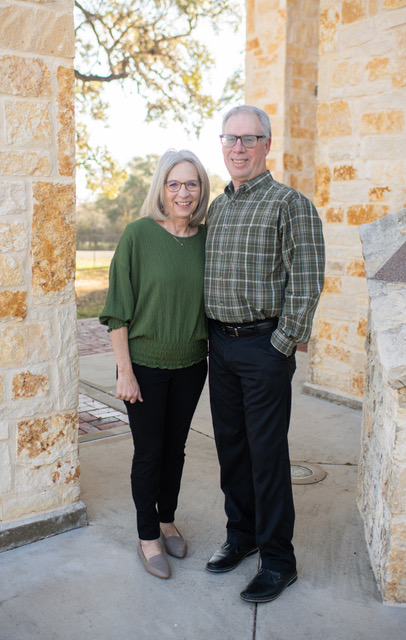
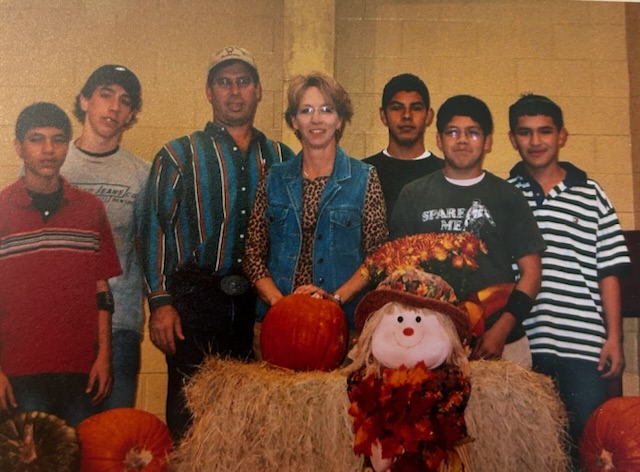
A little over 30 years ago, Mark and Becky Martin were unsure what God had in store for their family next. Mark had become disillusioned with working for Shell Oil Company, so he was becoming more open to God’s call.
The Martins stumbled across an ad in the Baptist Standard for STCH Ministries, expressing a need for houseparents. Shortly after, Becky attended a ladies’ conference in West Texas where two of the speakers at the conference were from STCH Ministries. Becky began to sense God’s calling and went home to tell Mark.
Sensing the call
Courtesy Photo
Mark was not as receptive to the idea initially. “Miraculously, I was able to remain silent as God revealed the calling to Mark,” Becky said.
She did not want to pressure him, but she continued to feel the pull toward this type of ministry.
Every message they heard from multiple pastors in multiple churches all spoke of children in need—at least in the Martins’ eyes—which they understood as the Lord revealing his plan to them, Becky said.
Mark suffered a crisis of faith, because he did not want to become a houseparent, but Becky stayed steadfast in her pursuit of the Lord’s direction.
Over time, Mark’s heart opened to the idea of becoming a houseparent. He clung to the story of Jonah as he started to surrender to God’s will for their lives.
Slowly, every obstacle began to break, opening their path toward STCH Ministries. Both the Martins became joyously aware this was God’s plan for them. In August 1994, they moved to Boothe Campus.
Upon arriving, the Martins moved into Dimmick Cottage with their two biological sons, Caleb (7) and Jacob (5). They were anxiously excited about this new opportunity and went in with open minds.
Over the years, they have seen many children come and go from Dimmick Cottage where they have stayed throughout their 30 years of ministry. They watched as their sons grew up interacting with the boys in their cottage. Jacob is now on staff with STCH Ministries, serving as the social services director for Homes for Children.
Houseparent rewards
Courtesy Photo
The Martins reflected on the most rewarding parts of being houseparents and how it impacts not just themselves, but the lives of those they serve.
“One of the most rewarding parts of being a houseparent is hearing from some of our ex-students about how their lives are now,” Becky said.
“It’s extra special to see them committed to being the best parents they can be, to know that their time at STCH Ministries is now something they can remember as a positive chapter that brought healing and growth.”
Mark included: “Seeing the families they are building trying to break the cycle that led to them being placed in care is special. It is also always interesting to hear what kind of memories they have of the time they spent here.”
When asked what being a houseparent means they shared, “It has always meant being an example, modeling a lifestyle that is centered on Christ.
“As older houseparents, I love the idea that we’re demonstrating what it looks like to stick with relationships even when it’s not easy—to stick with a job, stick with a marriage and to stick with Jesus through all that life brings your way. They see plenty of examples of disposable relationships. This isn’t that,” Becky continued.
Long-term call
Courtesy Photo
When the Martins initially came to STCH Ministries Homes for Children, they did not know how long they would be staying. They shared their biggest prayer since before coming has been “that God would make it clear when it is time for us to go, just as he did that it was time for us to come.”
STCH Ministries has been blessed by the Martins’ dedication over the last 30 years, but not nearly as blessed as the children they have cared for.
They are the ones whose graduations, baptisms and weddings the Martins have attended—the ones who return for holidays or special occasions and whose lives were shaped deeply by the love and dedication they received while at Homes for Children.
“I am grateful to Mark and Becky for faithfully following their calling on the Boothe campus since 1994, providing loving care for children where they can thrive,” said Greg Huskey, vice president of campus ministries.
“If you feel called to serve as a houseparent at STCH Ministries Homes for Children, we would love to talk to you,” Huskey continued. Visit https://www.stchm.org for more information or to apply.