Texas Tidbits: Shalom Builders launching

Texas Baptists launch construction ministry. The Texas Baptist disaster recovery office is launching Shalom Builders, a ministry to mobilize church and community groups with tool trailers and skilled construction volunteers. For more information, contact Marla Bearden at (214) 828-8382 or marla.bearden@texasbaptists.org or Gerald Davis at (214) 828-5392 or gerald.davis@texasbaptists.org.

Host sites needed for training. Texas Baptist Men is seeking associations or churches that would be willing to serve as hosts for training events for first-time volunteers in Restorative Justice Ministry. Bill Glass Champions for Life ministry has asked Inmate Discipler Fellowship, a partner ministry of TBM whose materials are made available through the Mary Hill Davis Offering for Texas Missions, to provide follow-up for all inmates who make professions of faith in Christ during prison crusades. Significant numbers of volunteers will be needed to fulfill requests. Interested churches or associations can contact Don Gibson at don.gibson@texasbaptistmen.org or (214) 275-1111.

Texas Baptists develop international first-responder teams. The Baptist General Convention of Texas disaster recovery office is seeking firefighters, emergency medical technicians, police officers, nurses and physicians who are interested in being part of a special force of first responders to international disasters. For more information, contact Chris Liebrum at (214) 828-5292 or chris.liebrum@texasbaptists.org or click here


TBM relief workers move mud, debris in Colorado

JAMESTOWN—Texas Baptist Men disaster relief volunteers continue to serve in Jamestown, Colo., clearing debris from the flood-ravaged mining town.

When the James River flooded, it destroyed much of the town’s infrastructure, leaving many residents without clean water and electricity and rendering some roads impassible.

tbm tractor400Heavy equipment operators remove debris caused by flooding in Jamestown, Colo. (TBM PHOTOS/ Courtesy of Cookie Slate)Mud-out crews with shovels, high-pressure hoses and disinfectant continue to clean homes damaged by flooding.

“It’s not mud as much as it’s houses filled with sand, rock and gravel several feet high,” said Judge Camp from First Baptist Church in Lewisville, who served as on-site coordinator. “Our volunteers go in with buckets and shovels and take it outside.”

Homes swept into river

Some homes were swept off their foundations by raging water, and volunteers filled sandbags to hold back water that continued to erode the land around some buildings, he added.

“Some houses were washed into the river,” Camp reported.

One Jamestown couple who married two months ago saw their home washed away by floodwaters and deposited as a pile of rubble about 100 yards away. TBM volunteers removed lumber and other heavy debris so the couple could retrieve some personal belongings, including a few treasured wedding presents.

Chainsaw crews

Chainsaw crews removed fallen tree limbs and felled trees in danger of falling due to heavy erosion. Volunteers using skid-steers and other heavy machinery removed boulders, trees and debris from yards.

Chaplains accompany each work crew to talk with residents and offer them prayer and spiritual counsel.

An emergency food-serve team cooked and served meals in the town hall, providing food for local residents and volunteers who arrived to help with recovery efforts.

An incident-management team is on site to coordinate the disaster relief effort.

Volunteers are racing to complete work before winter. The Baptist General Convention of Texas disaster recovery office is enlisting additional volunteers to assist trained TBM disaster relief volunteers with light and heavy debris removal. Volunteers need to bring work gloves, hard-soled work boots and clothes for both warm and cold weather. For more information, contact Marla Bearden at (214) 537-7358.

–Stephanie Midkiff of Texas Baptist Men contributed to this report.


Wise Choices saving lives and changing lives

DECATUR—One year ago, teenaged Hannah Griffith went to Decatur’s Wise Choice Pregnancy Resource Center convinced she wanted an abortion.

Then she heard the ultrasound.

“I think that they let me hear the baby’s heartbeat first. So, they helped me to realize that I actually did want to have the baby, instead of an abortion,” she said.

She gave birth to her son, Braxton, in the spring.

wise choices sign400The staff and volunteers at Wise Choices guided, encouraged and counseled her through all stages of her pregnancy, just as they do for hundreds of women who find themselves in a crisis pregnancy each year.

Wise Choices takes a holistic approach, seeking to serve their clients’ physical, educational and spiritual needs.

Wise Choices offers a variety of free, confidential services. They include, but are not limited to, pregnancy tests, counseling, limited sonograms, abortion-recovery programs and youth education classes.

Although Wise Choices offers a broad spectrum of services and resources to its clients, Executive Director Branda Thomas said one service stands out.

Ultrasound and a beating heart

“The best thing Wise Choices offers is an ultrasound, because whenever you see a beating heart, you cannot deny life,” she said.

As opposed to strictly a “pro-birth” organization, the center is considered “pro-life,” seeking to empower clients to make life-affirming decisions. Wise Choices does not perform or refer for abortions, but recognizes abortion as an option to discuss with the client, after discussing parenthood and adoption options.

Education and counseling are two primary resources Wise Choices offers its clients.

The Resource Center of Wise Choices allows clients to earn coupons for donated baby items, such as diapers, wipes, car seats and baby formula. Upon completion of educational pregnancy courses, clients can purchase the donated items with the coupons. Wise Choices offers care for babies up to 1 year old.

Parenting classes

A majority—57 percent—of its clients are between age 15 and 24, and 20 percent of those clients are between 15 and 19 years old. So, Wise Choices offers teenage clients parenting classes at Decatur High School.

The goal of the “Success in Mothering in Schools” parenting classes is to help the teenage girls—who either are pregnant or already have a child—graduate from high school. Volunteers are trained to give the girls the resources they need to stay in school and continue their education.

Hannah Griffith was thankful for the encouragement to stay in school Wise Choices volunteers gave her. Volunteers came to her school and ate lunch with her once every-other week, she said. Every week, they encouraged her just to make it through school one more week. Ultimately, Griffith graduated.

Wise Choices believes education is vital to success in crisis pregnancies.

“Anything we can do to provide education for them gets them to the point where hopefully in the future they don’t need our services anymore,” Thomas said. “One of their tickets to prosperity is through education.”

A post-abortion healing program

Wise Choices also provides a post-abortion healing program, led by two licensed counselors who work with men and women. Volunteers include some women who aborted their pregnancies and later suffered from guilt and regret. The volunteers want to prevent anyone else from experiencing the pain they felt.

“We know that anyone who has an abortion is probably going to, at some point, need healing,” Thomas said. “So, we want to be there for them in a very nonjudgmental way.”

The opportunity for spiritual healing begins the first time a client enters the Wise Choices office. The client meets with a volunteer who offers to pray for her before tests are run or counseling begins. The goal of the first meeting is to let her know volunteers are there to help her and to love her, no matter what, Thomas said.

Optional biblical counseling

Wise Choices offers optional biblical counseling and Bible studies for clients who express interest in living a healthy spiritual life.

Gerry Lewis, executive director of Harvest Baptist Association, said Wise Choices is unique in that it is a life-giving ministry, not just concerned about preventing abortions.

“They really are seeking to address the whole of life and not just making sure the babies get born but that they are born into a family who knows who Jesus is, and has an opportunity to grow and serve him,” he said.

Although the gospel is not forced on clients, volunteers openly share the message of Jesus with clients, if they are willing to listen. In 2012, Wise Choices staff and volunteers presented the gospel 321 times, with 59 professions of faith.

“There are not many of our churches that reached that many people last year,” Lewis said. “They are saving lives and helping to change lives. “


Chaplain guidelines on same-sex issues released

DALLAS—Texas Baptist chaplains cannot perform same-sex marriages, but they otherwise are permitted to provide pastoral care “shaped by the Bible and Baptist tradition,” according to guidelines issued by the Baptist General Convention of Texas chaplaincy relations office.

The office issued the guiding principles regarding same-sex issues to its endorsed chaplains in the wake of the military repeal of the “Don’t Ask, Don’t Tell” policy and the U.S. Supreme Court’s decision to strike down the Defense of Marriage Act.

chaplaincy samesexmarriage300Supervisors have asked many of Texas Baptists’ approximately 200 military chaplains for guidelines from their endorser regarding how they can minister to same-sex couples.

Chaplains must follow military regulations, but they also are bound to the guidelines set forth by their endorsing body, which the military has pledged not to infringe upon.

At the 2009 BGCT annual meeting, messengers adopted a resolution stating: “Texas Baptists affirm the biblical sexual ethic of celibacy in singleness, fidelity in marriage, and affirm the biblical image of marriage as the union, before God, between a man and a woman.”

“Therefore, consistent with this resolution, Texas Baptist chaplains will always conduct themselves in a way that complies with our Texas Baptist belief that marriage is a life-long union between a man and a woman,” the guidelines read.

Biblical standards

“Our ministry practices must adhere to these biblical standards and historical principles irrespective of any civil law to the contrary. The Texas Baptists Office of Chaplaincy Relations expects full compliance by all of its endorsed chaplains.”

The guidelines prohibit Texas Baptist chaplains from officiating at same-sex marriages, but they encourage pastoral ministry to all personnel.

“Our approach to pastoral care in specialized settings is to perform the ministries we can or seek to provide someone else to do those ministries we cannot,” the statement continues.

“We expect our chaplains to be pastoral as servants of our Lord who loved unconditionally and sought to redeem all with whom he interacted. Jesus Christ is our model—redemptive, gracious and merciful.”

People struggling with sin

Chaplains serve in specialized settings, creating vast opportunities for ministry to people struggling with a variety of sins, said BGCT Chaplaincy Relations Director Bobby Smith. In ministering to each of them, chaplains will stand on the word of God as they care for individuals and address their sins, he added.

“Texas Baptist chaplains want to do a Jesus-type of ministry where we love people and address their sin in a caring manner,” he said. “We are Texas Baptist ministers of the gospel of Jesus Christ. We are seeking to have an authentic, caring Christian ministry where we reflect the light, love and grace of God in Jesus Christ.”

In August, the Southern Baptist Convention’s North American Mission Board issued guidelines stating: “In harmony with Holy Scripture, NAMB-endorsed chaplains will not conduct or attend a wedding ceremony for any same-sex couple, bless such a union or perform counseling in support of such a union, assist or support paid contractors or volunteers leading same-sex relational events, nor offer any kind of relationship training or retreat, on or off a military installation, that would give the appearance of accepting the homosexual lifestyle or sexual wrongdoing.”

With additional reporting by Managing Editor Ken Camp


Vietnamese immigrant uses martial arts to point people to Jesus

DALLAS—Johnny Le helps his martial arts students not only learn how to care for their bodies better, but also care for their spirits by introducing them to Jesus Christ.

tai chi300Hanh Le demonstrates some tai chi moves.Le grew up in Vietnam as a Buddhist and a student of tai chi and kung fu. He became a Christian in a North Vietnamese prisoner of war camp.

While Le recognized he was taken prisoner because he had been fighting against the North Vietnamese, he met another prisoner of war who was a Christian pastor, not a combatant.

Many died in the P.O.W. camp, either from beatings or disease, and all Le’s ribs were broken at one time or another from being struck by rifle butts. Le was angry all the time, but he noticed the Christian was not.

Body and soul

“He told me, ‘My body, my soul belongs to God,’” Le recalled.

The guards often beat the man Le grew to think of as his pastor. During the seven years he was imprisoned, the minister taught Le the Bible even though there was no copy of Scripture in the camp.

“He had it in his head. He had in his heart,” Le said. After one particularly brutal beating, the man knew he was going to die and told Le and the others who had become Christ-followers Le was the new camp pastor.

Le arrived in Dallas July 4, 1987. Since that time, he has experienced many trials, but God has helped him through them all, he said.

With the idea of serving the God who had been so faithful to him, Le thought about opening a tai chi and kung fu center as an evangelistic outreach about 15 years ago.

“A lot of the younger people and a lot of the older people, they are sick and they never know God,” Le said. “I want to be a missionary and talk about God with them, so they can trust in God.”

Attempts to serve
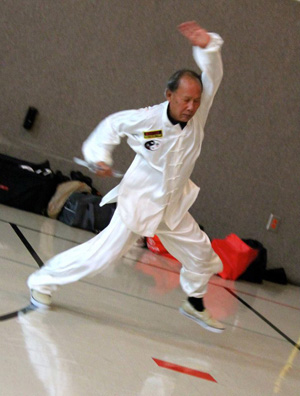
johnny le demonstration300Johnny Le gives a Tai Chi demonstration at Arapaho Road Baptist Church in Garland.His first effort never gained any traction. About three years ago, he opened a martial arts center that was a financial success, but Le’s dream of being a ministry still floundered.

“I was making money, but my heart is not like that. My heart is to grow someone and talk to them about God,” he said.

“But when I take their money, when I talk about God, they say: ‘No, master. I have come here to learn and spar. I am coming here to learn about tai chi. I am coming here to learn kung fu. I am not coming here to learn about Jesus.’”

So, he shut the doors of the center. Still, he felt called to use tai chi and kung fu to reach people for Christ.

Re’creation Outreach Center

Last November, he received permission to teach tai chi at no charge at the Re’creation Outreach Center in Garland. While it took longer than he originally anticipated to build a following, Dallas Baptist Association vouched for him, encouraging the center to grant him a little more time to develop his ministry.

Less than a year after he launched the classes, they typically draw about 40 people a week at the center and another 80 at classes he teaches at three other locations around the Dallas area.

Lazaro Chapa, a church consultant with Dallas Baptist Association, started attending in February, and Chapa said he has lost 27 pounds and is continuing to lose about one pound per week.

“I’m not on a diet or anything. I’m just working the tai chi,” he said, adding the exercise also offered him freedom from knee pain.

Tai chi provides health benefits, including lowering blood pressure and cholesterol levels, and helping with diabetes, Le said. One man who attends the classes has lost 47 pounds, he noted.

The classes involve many Buddhists and several Muslims, Chapa said.

Beginning with prayer

“At the beginning of every session, we start with prayer. And that’s everybody,” he said. “At the beginning, 90 percent were non-Christians.”

Advertisements placed in local Vietnamese-language newspapers attract some students, but most respond to personal invitations from class members.

“When they start seeing results—the fruit of their work—they invite other people. They always bring in someone else,” Chapa said.

Midway through each session, participants divide into groups that either continue with tai chi or begin to work in kung fu.

“The kung fu is for the young people who want more action,” Chapa said.

At the end of each session, Le tells a story he connects to the way God works through his life and the lives of others.

Through the ministry, 12 people have made professions of faith in Christ—four of them baptized recently in a joint service at Arapaho Road Baptist Church in Garland, which also is the location for the Richardson Vietnamese Baptist Church. All four of the new Christians came from a Buddhist background.

Reaping a harvest

While sessions also are held at Arapaho Road Baptist Church, Iglesia Bautista Internacional in Dallas and First Baptist Church in Carrollton, Le’s ministry isn’t tied to one church. That sets it apart from most ministries the association partners with, Chapa noted.

“I’m so glad the association was so open and ready to embrace it,” he said. “It’s a way to reach out to the community—a way to help them with their health, but also a way to help them with their hearts—their relationship with the Lord.”

In addition to a new site expected to open soon in Dallas, visitors have arrived from Tulsa, Okla., and Maryland to learn how to start a center in their communities.

As for Le, he is thrilled to see the ministry he prayed for across 15 years come to fruition.

“I’m 65 years old. How much time do I have? So, I give all I have to the Lord,” he said.


Refugee ministry means serving as trusted guides

DALLAS—One by one, refugees from around the world arrive in Texas, landing at the airport with a single bag in hand.

 Texas ranks nationally as the leading point of arrival for refugees, who often carry all their belongings in an issued bag. With this small cache of items, a family begins a new life in an unfamiliar place with unfamiliar customs.

refugees whiteman400Refugees want friendship more than they want religion, Darrell Whiteman, vice president for mission mobilization and training for The Mission Society, told participants at the Texas Baptist Refugee Summit. By building relationships, Christians can share their faith with refugees, he said.“There’s gold in those bags,” said John Parsons, World Relief regional director. “Actually, what’s in there is worth more than gold.”

Beyond objects of sentimental value, the bags contain the paperwork refugees need to live and work in the United States. As refugees settle in a land where little is like the society they fled, those documents are some of the only navigation tools they have—unless they have trusted guides, presenters noted during the recent Texas Baptist Refugee Summit at Wilshire Baptist Church in Dallas.

When Jalil Dawood left his native Iraq, he first traveled to Rome, where a street preacher introduced him to the gospel. Later, he immigrated to the United States, completed seminary and now serves as pastor of Arabic Bible Church in Dallas.

God has a plan for every refugee, Dawood said.

“You might see him as a refugee, but God sees something in him,” he said. “He’s here for a reason. Your work is not in vain.”

Congregations can cultivate relationships and ultimately share the gospel as they meet a need—refugees’ need for friendship.

refugees dawood400Jalil Dawood, a former refugee from Iraq, serves as pastor of Arabic Bible Church in Dallas.“These refugees, frankly, they don’t want your religion. They want your friendship,” said Darrell Whiteman, vice president for mission mobilization and training for The Mission Society. “Through friendship, Jesus will show through.”

A desire to minister alongside refugees and journey with them rather than ministering to refugees radically changes a church’s approach in this arena, Whiteman said.

In many ways, Whiteman sees refugees as similar to the Samaritans of biblical times. Refugees are geographically nearby but culturally different. Just as Jesus chose to travel through Samaria and minister there, Christians must do likewise, he said.

Different people and churches minister in different ways, he noted. Ministry could mean providing furniture, clothing and household supplies for a refugee resettlement agency. Church members might connect more personally with refugees by helping them get situated, drive them to appointments, listen to them and encourage them, Whiteman explained.

“With everything you do, preach the gospel—the way you live, the way you do friendship,” he said.

Christians offer support, help and the gospel to refugees, Whiteman said. In turn, refugees bring their own insights, wisdom and worldview from which American Christians can learn important lessons.

Through extended relationships, Christ shines through, Whiteman continued. People grow in Christ, their worldviews are transformed and disciples are made who will go on to disciple others.

“Decisions for Christ are quick and easy,” Whiteman said. “Discipleship takes time and is difficult.”

 For more information about reaching out to refugees, contact Texas Baptists’ intercultural initiatives office at (888) 244-9400.


Detention center volunteers not weary in well doing

DENTON—For about a decade, Ken and Shannon Koonsman from First Baptist Church in Lewisville have coordinated Bible study classes for youth incarcerated in the Denton County Juvenile Detention Center—not because they see measurable results but because they feel called by God to do it.

The center is a short-term secure facility designed to protect both the community and the children detained there. It provides professional custodial care, crisis intervention, counseling, education and other services.

denton detention400The Denton County Juvenile Detention Center provides professional custodial care, crisis intervention, counseling, education and other services for the youth incarcerated there.“These are children who have gotten sideways with the law,” Ken Koonsman said. “They range in age from 10 to 17. Some are awaiting adjudication of crimes they’re accused of committing. Others have been convicted already and are just waiting to be transferred to more permanent facilities. Either way, we have a narrow window of opportunity to share the Lord Jesus with them.”

The juveniles are not required to attend Bible studies, but most choose to do so, Shannon Koonsman noted.

A diversion and an opportunity

“It’s a diversion from their troubles. And it gives us a chance to teach them about God’s love,” she said.

The couple “more or less inherited this ministry from others who began it years ago,” her husband explained. Macedonia Ministries in Lewisville launched the ministry about 20 years ago. Lay volunteers Steve and Ollie Combs from Macedonia Ministries serve a role similar to the Koonsmans.

“Between us, we assure that volunteers are ready and equipped to teach the Bible study classes,” Ken Koonsman said.

“Ollie Combs has been faithfully teaching the Bible to children at the Detention Center for 18 years or more,” his wife added. “We work hand in glove with them.”

Meeting in ‘pods’

Every Tuesday, each volunteer—and a helper, if available—meets with a “pod” of up to 12 young people. Usually, four pods meet at once.

“We meet in a secured room overseen by a guard,” Shannon Koonsman said. “There are also security cameras. We read Scripture and discuss what each verse means. We’ve all been through difficult things in our lives, so we can relate to these kids.”

Being able to share the story of Jesus with juveniles in a way they can understand is a “very sweet” experience, her husband said. “When they get it, when they understand for the first time that Jesus loves them and that he gave his life for them, you see a light go on in their eyes. … That’s worth all the effort you put into it.”

Since the children cycle in and out of the facility quickly, the ministry has little opportunity for follow-up, the Koonsmans acknowledged.

“We measure success simply by our being obedient to the Lord,” he said. “We’re doing what he’s called us to do. We’re sharing the gospel with these kids.”

Praying for salvation

From time to time, the couple have been able to guide an incarcerated child to pray for salvation.

“We tell them these aren’t magic words. It’s what’s in your heart that matters. God is a reader of hearts,” he said.

The most heartrending aspect of the ministry involves hearing the children’s stories she noted.

“Many of these children do not know what it means to have a loving mother or father in their lives. You begin to realize what contributed to their getting into trouble in the first place, and why they are in the detention center,” she said.

“One girl, who had been in and out of 15 different foster homes, told me: ‘Shannon, I’ve been praying for something special. I’ve been praying that a Christian family would adopt me.’ When that young girl said that to me, I thought my heart was going to break. I heard later that she was reunited with her mother, who had gotten herself off drugs. I’m praying it all works out. Jesus is there for her now.”

Staying motivated

Staying motivated for the ministry can be challenging, Ken Koonsman acknowledged.

“There are times when I feel like not going at all. Oh, I know it’s selfish of me—I’m tired, and I want to stay home to watch a ball game or something,” he said.

“Shannon and I have a rule. If we catch ourselves saying, ‘Tonight we have to go to the juvenile facility’ we immediately correct one another. We remind ourselves that we ‘get to go’ to the juvenile facility. The blessings are all ours.”

On occasions when they least feel like continuing, God intervenes, Shannon Koonsman added.

“It is always when we are down emotionally that the Lord does something amazing and special. Always, those are the nights we have a breakthrough with a difficult kid, or one of them prays to invite Jesus into his or her heart. Something spectacular like that seems to happen just when we grow most weary. And it always revives us,” she said. “It pumps you up to see God at work.”


Texas Tidbits: Baylor, Scott & White merger complete

Baylor completes merger with Scott & White. The governing boards of Baylor Health Care System and Scott & White Healthcare completed the merger of the two health systems to form the largest not-for-profit health system in Texas. The deal creates an $8.3 billion organization, Baylor Scott & White Health, that includes 43 hospitals, more than 500 patient care sites, more than 6,000 affiliated physicians and 34,000 employees. Joel Allison, chief executive officer of Baylor Health Care System, is chief executive officer of the new Baylor Scott & White Health. Robert Pryor, president and chief executive officer of Scott & White Healthcare, is the new organization’s president, chief operating officer and chief medical officer. Baylor and Scott & White first announced the merger plans in December 2012 and signed a definitive agreement in June 2013.

Baylor CEO among most influential nationally in healthcare. The governing boards of Baylor Health Care System and Scott & White Healthcare completed the merger of the two health systems to form the largest not-for-profit health system in Texas. Joel Allison, president and chief executive officer of Baylor Health Care System and CEO of the newly created Baylor Scott & White Health, ranked in the top 20 of Modern Healthcare magazine’s “100 Most Influential People in Healthcare.” The publication named Allison No. 19 on the list, which includes Kathleen Sebelius, secretary of the U.S. Department of Health & Human Services, and President Barack Obama. It marks Allison’s ninth appearance on the top 100 list in the last 10 years.


TBM disaster relief volunteers relocate to mining town

After preparing more than 600 meals and cleaning mud from several homes in Loveland, Colo., Texas Baptist Men disaster relief volunteers relocated to a previously isolated mining town northwest of Boulder.

tbm relief jamestown400Terry Henderson and Harold Patterson from Texas Baptist Men visit with a Jamestown, Colo., resident about plans to move the debris in front of his home. (TBM PHOTO)While disaster relief teams worked in Loveland, TBM Disaster Relief Director Terry Henderson and his wife, Barbara, traveled to Jamestown, Colo., to assess needs.

“The trip to Jamestown was perilous, through rain and snow, and many of the dirt roads and overpasses were washed out,” TBM spokesperson Stephanie Midkiff noted.

The Hendersons discovered homes destroyed by flooding, with mounds of rock and debris littering the landscape. One home was filled with 4 feet of sand, and a mound of debris in the homeowners’ front yard topped 10 feet.

Access to some homes in Jamestown had been cut off, and when the Hendersons arrived, the town lacked running water and electricity.

“The ray of hope in this devastation is that the director of missions has indicated this could open the door for a church plant,” Barbara Henderson said.

North Carolina Baptist Men assumed responsibility for remaining disaster relief projects in Loveland, and TBM began work with skid-steers and clean-up crews in Jamestown.


Chaplains on frontline in battle against military suicides

WAXAHACHIE—For military personnel, the fight rages well beyond the battlefield, and chaplains are on the frontlines.

In 2012, military suicides hit a record high since the armed forces began tracking such tragedies. Through April this year, the U.S. military recorded 161 potential suicides—a pace of about one suicide every 18 hours.

bgct chaplains325Texas Baptists have stepped up their efforts to combat the suicide epidemic by offering Applied Suicide Intervention Skill Training.Many times, chaplains are the first wave of defense against suicide, said U.S. Navy Chaplain Fred McGuffin, who is assigned to the Marine Corps in New Orleans. Junior chaplains “deal with it often.”

Military personnel turn to chaplains because they know them, McGuffin said. Chaplains spend time with the personnel they’re assigned to serve, get to know them and build trust.

When something troubling takes place, troops understand they can go confidentially to a chaplain. If a soldier, sailor, Marine or airman reports suicidal thoughts to any other military personnel, it will be noted on their record.

“We are already known as the helping agent in the unit,” McGuffin said.

Tools for chaplains

Texas Baptists have stepped up their efforts to combat the suicide epidemic by offering Applied Suicide Intervention Skill Training—ASIST—to all of its nearly 800 endorsed chaplains, including about 200 who serve in the military. The program provides tools for chaplains to discern root issues in people’s lives that may lead to suicidal thoughts and work toward a resolution.

“Many times, chaplains are the first responders, and this equips them to know how to figure out if suicide is the real issue and how to help,” McGuffin said before helping teach the training during Texas Baptists’ recent retreat for chaplains.

Ministering in a suicidal situation requires bravery, said Bobby Smith, director of Texas Baptists’ chaplaincy relations. Smith has taught ASIST for 10 years. Asking someone if they’re considering harming themselves and responding appropriately is difficult for any minister, he noted.

Providing a format

“Suicide is an issue all chaplains have to face and deal with at some point in their ministries,” Smith said. “Most pastors will have to deal with it. That is a reality. There is very little training to help people understand how to minister in that situation. ASIST enables them to have the courage and a format to address suicide when they recognize it in someone else’s life.”

An increase in military suicides reflects a surge in suicides throughout the country, Smith noted. More people now die of suicide than car accidents annually. Suicide among middle-aged people rose nearly 30 percent from 1999 to 2010.

 “It’s becoming an acute need everywhere,” he said. “I have more and more people talking to me about this situation. We’re living in a society that’s taking away hope. When people lose hope, that’s when they consider suicide. They see no hope for a better tomorrow.”

Immediate relevance

Chaplain Scott Speight of the Army Reserves, who co-taught the ASIST class with McGuffin, seeks to be part of the solution in the military. Each time he teaches the program, someone deals with suicide within a few weeks. The last time Speight taught ASIST, a chaplain called him 24 hours later to tell how it helped him minister to someone.

“I hear the numbers,” Speight said. “I see the need of how many soldiers, how many Navy men, how many Marines are committing suicide each day.”

Texas Baptists’ chaplaincy program and access to the ASIST training program is made possible by gifts to missions through the Texas Baptist Cooperative Program. Smith and other chaplaincy leaders are willing to train pastors and church leaders in ASIST, as well. For more information about Texas Baptists chaplaincy or the ASIST training, call (888) 244-9400. 

“Texas Baptist chaplains are servants of churches and associations of Texas,” he said. “We want to help meet their training needs.”


Regional casinos prey on problem gamblers, study says

Forget images of glamorous high rollers gambling in exotic resort casinos. Modern regional casinos use the lure of highly addictive computerized slot machines to prey on the weakness of low-income to middle-income patrons, according to a new study by experts in the behavioral, health and social sciences.

casino gambling400“Casino gambling as a once- or twice-a-year vacation has largely given way to casino gambling as a once- or twice-a-month or once- or twice- or more-a-week pattern of life,” the study by the Council on Casinos says.
“Whether or not you personally gamble in them, the new casinos matter. They are influencing the nation as a whole. They are affecting our health, our economics, our politics, our ideas and social values, and perhaps even our sense of who we are as a people and what obligations we have toward one another.”

‘Why Casinos Matter’

The 33-member council—which includes Earl Grinols, distinguished professor of economics at Baylor University’s Hankamer School of Business—produced the report, “Why Casinos Matter: Thirty-one Evidence-based Propositions from the Health and Social Sciences.” Financial support for the study came from the Bodman Foundation, the John Templeton Foundation and other contributors to the Institute for American Values.

earl grinols130Baylor University professor Earl Grinols helped produce the report.Regional casinos in the 21st century differ significantly from Las Vegas-style resort casinos, the study asserts. Instead of drawing customers from around the country or the world to play table games of skill, they typically attract patrons from within 70 miles who arrive at casinos filled primarily with computerized slot machines engineered to create fast, continuous and repeat betting.

“Modern slots are hooked up to a central server that collects player information, preferences, and speed of play and has the capacity to program each machine to each player’s style. In short, the laws of pure chance or probability no longer dictate wins and losses. The modern slot experience is deliberately engineered to take in much more than it pays out,” the report states.

Computerized gambling machines are designed to ensure the longer someone plays, the more he or she loses—but with just enough small victories along the way to keep them playing, research shows.

Highly addictive

“Modern slot machines are engineered to make players lose track of time and money,” the report says. “Modern slot machines are highly addictive because they get into people’s heads as well as their wallets. They engineer the psychological experience of being in the ‘zone’—a trance-like state that numbs feelings and blots out time/space. For some heavy slot players, the goal is not winning. It’s staying in the zone.”

Slot machines draw 40 to 60 percent of their revenue from problem gamblers, and proximity to a casino increases the odds of becoming a problem gambler, the study notes.

Economic impact studies that tout the short-term benefits of casinos fail to measure long-term social costs more difficult to quantify, the report asserts. Furthermore, casinos tend to reduce property values in host communities and hurt local businesses—at least most of them.

“There appears to be at least one exception to the rule that casinos tend to weaken nearby businesses. Regional casinos do seem to promote the flourishing of nearby pawn shops, check-cashing operations and high-interest lending establishments such as payday lenders,” the report says.

Special concessions

States typically grant special concessions to casinos, giving them legal, administrative, regulatory and promotional advantages over other businesses, the study adds.

“Like big banks, state-sponsored casinos are not allowed to fail. When casinos come up short, states usually provide new infusions of money, reduced taxes, reduced funding for gambling addiction measures or other concessions such as lifting smoking bans, in order to sustain revenues and profitability,” the report states.

Regional casinos represent a regressive revenue source for states, the study asserts.

“With the spread of regional casinos into economically struggling communities, more working and middle-class people are drawn to casino gambling. … Easy access increases local participation and drains dollars from local residents into the state’s coffers,” the report says. “As a consequence, women, low-wage worker and retirees are contributing a disproportionate share of states’ take of casino revenues.”

State-sponsored casinos contribute to social and economic inequality in the United States, the study concludes.

Draws in lower-income Americans

“As gambling has spread into economically distressed communities, it has drawn more Americans in the lower ranks of the income distribution into its venues. Low-income workers, retirees, minorities and the disabled include disproportionately large shares of regional casino patrons,” the report says.

“In this way, state-sponsored casino gambling creates a stratified pattern that parallels the separate and unequal life patterns in education, marriage, work and play that increasingly divide America into haves and have-nots.”

Gambling industry disputes findings

A prominent gambling industry leader disputed the findings of the study.

“Basically, they have just taken out of mothballs a lot of long-discredited arguments against casinos that have been made by gambling opponents for decades,” Judy Patterson, executive director of the American Gaming Association, told Deseret News.

Gaming industry representatives insist casino opponents overstate the prevalence of problem and compulsive gambling, asserting it affects only 1 percent of the adult population in the United States.

However, the Council on Casinos study criticizes that statistic as misleading, since it includes only the most severe form of problem gambling—people who exhibit three or more clinical symptoms observed by professionals who diagnose mental health disorders.

“It excludes gamblers who have less severe gambling problems and people whose lives and livelihoods may be adversely affected by their gambling but who do not meet any of the criteria of a mental health diagnosis,” the report says.


Baylor School of Social Work honors social justice trailblazers

WACO—The School of Social Work at Baylor University recently recognized two daughters of the segregated South who served as forerunners for change and equality when they broke the color barrier at the Carver School of Missions and Social Work in Louisville, Ky., in 1955.

Freddie Mae Bason and Verlene Farmer Goatley recalled their story at a Baylor School of Social Work board of advocates meeting and were honored during a worship service that evening.

Gbaylor social lawson300Bill Lawson, founding pastor of Wheeler Avenue Baptist Church in Houston, challenges social work students to see their vocation as a divine calling rather than simply as a career. (PHOTO/ Nikki Wilmoth/Baylor School of Social Work)uy Bellamy, who worked in the “Department of Work with Negroes” at the Southern Baptist Convention’s Home Mission Board, recruited the two African-American women—members of the National Baptist Convention’s Women’s Auxiliary—to desegregate Carver in 1955. This came on the heels of the U.S. Supreme Court’s Brown v. Board of Education ruling in 1954, which declared racial segregation in public schools unconstitutional.

Both women, aware of the social ramifications of integrating the all-white private school, felt honored to receive the invitation. Bason took the challenge head-on with little fear.

“I did not feel intimidated. I felt no danger,” she said. “For me, God was taking care of me.”

Goatley was pleasantly surprised at the warm hospitality shown by fellow classmates and grateful for God’s provision throughout her time at the Carver School.

“I was just thankful some of the stories I had heard were not true when we got there,” she said. “We just saw God taking care of us wherever we went.”

Challenges in an all-white student body

Carver students played a pivotal role in helping Bason and Goatley adjust to the challenges of being the only African-Americans in an otherwise all-white student body.

“They always went out of their way to let us know we were welcome here,” Bason said. “Some were from the deep South and really prejudiced, but the others made up for it, and said this is the way it was supposed to be.”

The two women followed strikingly similar paths to the Carver School. Both women grew up in Oklahoma and attended Langston University and the Oklahoma School of Religion before attending the Carver School.

Goatley became interested in missions as a child and dedicated her life to serving others from an early age. Bason had a similar heart but didn’t find her place in Christian ministry until the Carver School.

“I always wanted to help people,” she said. “All I ever saw was white women doing it, (but) God opened that door to help somebody every single day.”

Seeking God continually

For Goatley, the Carver School experience marked the beginning of a life devoted to seeking God continually through prayer.

“God can do anything but fail, and I thank God for the power of prayer,” she said. “I believe any place is a place of prayer.”

Upon completion of their Carver studies, Bason and Goatley continued to break down the walls of racial segregation as African-American women in church leadership.

Goatley’s journey took her to Liberia seven years, where she served as a missionary, and then back to Langston University, where she taught religious education classes 25 years.

After the Carver School, Bason worked with the SBC Home Mission Board where she did what she always had dreamed of doing—helping people. She spent her career providing after-school and family programs to low-income children and families in the Atlanta area.

Honored as trailblazers

The Baylor School of Social Work honored Bason and Goatley as trailblazers in Christian social work at a worship service that featured music by the Baylor Men’s Choir and a sermon by Bill Lawson, retired founding pastor of Wheeler Avenue Baptist Church in Houston.

Lawson, who serves on the Baylor School of Social Work board of advocates, challenged social work students to view their studies and future service as a divine calling of God, rather than just another career. He urged them not to view social work as a “kneejerk reaction to social injustice,” but as a high calling grounded in the gospel of Jesus Christ.

“At its worst, social work is a charity (or) a profession” he said. “At its best, social work is not a profession. It’s a calling of Jesus Christ to look at the weak of the world as Jesus himself.”