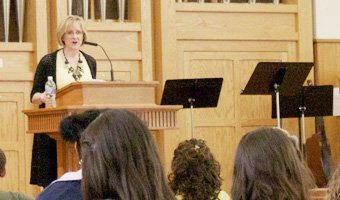
SAN ANTONIO— Julie Webster was making her Sunday morning rounds as a hospital chaplain-in-training when she recognized First Baptist Church was a frequent part of the décor.
"I realized that almost every-other room I was going into had our church on TV. I would go in and say, 'That's my church,'" she recalled.
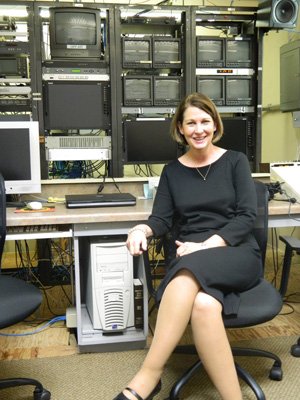
Julie Webster
|
In talking with the patients and their families, she found many of them believed it to also be their church and Pastor Don Guthrie to be their pastor—even though they never actually attended a service there.
"When I realized how many people were watching us, it blew me away to think this is my church where I am normally sitting and worshipping every Sunday morning, but there's 30,000 people out there worshipping with me that feel like they're my brothers and sisters in Christ, that feel like they are part of my church family, that we don't have a name for, that we don't have an address or telephone number for.
"We were just saying, 'We're so glad you watch us on TV,' and that's great. And we're praying with them, which is a little better than ignoring them, but I just thought, 'We need to be following up with these people,'" Webster said.
After completing the requirements for her chaplaincy certification, she went to Guthrie with the idea of designating a chaplain for the people who "attend" the church through its television ministry.
The church has televised its services 40 years. For at least 30 of those years, members have answered telephones during the service, taking prayer requests.
"But we never reached back to them," Webster said. "We would pray with them when they would call, and sometimes we would take their names, but it really didn't matter, because we didn't follow up. We just prayed with them in that moment, and we were done."
Last year, First Baptist increased the number of people answering the phones to seven, and Webster came on board as chaplain to the television ministry as a pilot program. Rather than just praying with people who called, the volunteers ask if a follow-up call or visit from a chaplain would be acceptable.
"Every single one were willing to give us whatever we wanted," Webster said. "Last name, phone number, address, email —'what do you want to know?' They were wanting us to love them."
"Some are regular callers—little lonely ladies whose only regular contact is with us every Sunday morning. They call us by name," she said.
About 20 people rotate on the phones. Most take one Sunday each month, but a few people answer the telephones every week as their personal ministry. They attend one of church's other worship service times so they can be available to answer the telephones during the 11 a.m. service.
Webster follows up with at least 20 people each week, and sometimes the number hits 45.
"The needs out there are just astronomical. It blows my mind sometimes the deep burdens so many people are carrying. Heavy burdens of broken relationships; the call to pray for 'my daughter who hasn't spoken to me in 18 years, and I don't know where she is.' From that to, 'I'm afraid my granddaughter is being abused,'" Webster said.
"We encourage our telephone people that they are prayer warriors—they are not trained counselors. They are not to offer advice or counseling. They are to listen and pray about what need they heard," she pointed out.
"I'm the one who follows up during the week to say: 'We need to call Child Protective Services. I want you to call, or I will. So, will you make that phone call?'" Webster said.
Many people who call are experiencing grief.
"Last week was a man who didn't feel like he could put one foot in front of the other because he was missing his wife and was just ready to be with the Lord. Just wanting someone to tell him he could keep living, keep hanging on until it was the Lord's time for him," she said.
"The gamut is amazing. If you can dream it or think of it, I've had it this year," Webster said.
"There have been some instances of where people have been carrying a hidden sin that they want to confess to a stranger. I've been able to tell them they can be forgiven for that sin, that God is waiting to forgive them.
"I think about 75 percent of the people who call don't know the Lord, and I pick up on that real quick. They'll say, 'I hope I've been good enough to go to heaven.' I tell them it's not earned or deserved; it's a free gift. They don't have to hope; they can know they have eternal life, and I get to share the gospel with them," she said.
The youngest person to call was a 17-year-old boy who asked, "How much do you charge to pray for me?"
"It broke my heart," Web-ster recalled.
"I have God story after God story. I get so excited, because every day I get to be in on something God is doing. God is at work."
She recalled a man with four young children. He called to ask for prayer for his wife who was about to undergo emergency surgery while he was home with the children. When Webster visited the woman that afternoon in the hospital, the woman couldn't believe her husband would watch a religious service or that he would call to request prayer for her. "I didn't know he loved me that much," she told Webster.
"If we had never started taking numbers, taking names, returning phone calls, these God things we now get to be a part of wouldn't be happening," she said.
Webster has conducted 25 to 30 funerals in the last 15 months.
"People call in and ask me to do their loved one's funeral because they don't go to a church, and they don't have a pastor," she said.
"It's amazing how they feel loved and cared for because we're reaching back to them."