Texas Baptists conduct medical clinics in two villages in Senegal

The language of love in action communicates around the globe, an 11-member Texas Baptist team recently discovered as they shared the hope of Christ in two Senegalese villages.

In a trip facilitated by Texas Baptists’ Office of African-American Ministries, the team served in villages in South Senegal alongside Southern Baptist Convention International Mission Board Missionary Bertha Vaughns, who formerly led the Texas Southern University Baptist Student Ministry.

Charlie Singleton from the Texas Baptist Office of African-American Ministries works at a human needs project in Senegal. (PHOTO/Courtesy of BGCT Office of African-American Ministries)

The group conducted two medical clinics in villages that had never before had easy access to any medical care. The team served more than 200 people, providing donated medicine as they could and shared the gospel with the use of French audio players.

Avis Reynolds, a member of Fellowship Missionary Baptist Church in Texas City, said the doctor leading the clinic treated a variety of issues, including aches, pains and rashes. In one case, he had to give a patient a cortisone shot.

“She got up and started praising (God) she could walk without pain,” Reynolds said. “It was just an amazing experience.”

Baba Diop, Passe village chief, examines gifts from Texas Baptists.

At a school in one of the villages where the Texans served, the team noticed the institution lacked any shade where students could rest or play out of the sun. Touched by the need, the group gave enough money to provide roughly 100 shade trees and a green space on the campus.

The Texans also built relationships with students at the school, visiting with the ones who are learning English. Trip participants distributed more than 200 flying discs with Scripture to the students.

Despite the condition of the 1,000-year-old village—little electricity or modern transportation and housing in thatched roof huts—students remained upbeat and determined, Reynolds said. They worked hard to learn English, understanding how important it is to improving their living conditions. Young people dreamed of being teachers and even a correspondent for a major news network.

In response to the teams’ efforts, students at the school created an environmental club to learn about cultivating and caring for the green space. The young people who are learning English asked their new American friends to be their pen pals and conversation partners via letters and Internet video conferencing.

Texas Baptist missions volunteer Avis Reynolds, a member of Fellowship Missionary Baptist Church in Texas City, enjoys time with nationals in Senegal.

“It was just awesome to see God work,” said Charlie Singleton, director of Texas Baptists’ Office of African-American Ministries.

Singleton said the trip is part of an effort to get more African-American congregations involved in international mission work. He hopes every African-American Texas Baptist church will have a Hope 1:8 vision, based on Acts 1:8’s directive to share the hope of Christ locally, statewide and around the globe.

As a result of the Senegal trip, several participants have volunteered to return to serve in the area again. Singleton believes seeing God’s work globally encourages people to get involved in it.

“We’re really trying to get more African-American churches involved in missions,” he said. “Some are already involved, but we’re trying to expose more to missions.”


SMBA renames main road Robert Fanning Drive

San Marcos Baptist Academy honored Robert Fanning, who served on the school’s board of trustees longer than any other individual, by naming the main road through the school campus “Robert Fanning Drive.”

Many current and former trustees, students and staff, as well as friends and family of Fanning, attended the dedication ceremony.

Students and staff of San Marcos Baptist Academy gather around and Robert Fanning following the official opening of Robert Fanning Drive on the academy campus. Fanning served the school longer than any other individual on the board of trustees, from 1962-2002. (Photo by Don Anders/SMBA)

Taking part in the ceremony were Academy President John Garrison, President Emeritus Jack Byrom, board of trustees Chairman Jimmie Scott, retired Baylor University Chaplain Milton Cunningham, and two representatives of the student body, Tiara Hansen and Zachary Middleton.

After the ceremony, Fanning cut a ribbon by the newly installed street sign to officially open Robert Fanning Drive.

A practicing attorney for more than 50 years, Fanning is chairman emeritus and the founding shareholder of Fanning Harper Martinson Brandt & Kutchin in Dallas. He earned his bachelor’s degree at Baylor University in 1953 and his law degree from Southern Methodist University School of Law in 1959. He was awarded an honorary doctorate in humanities from Dallas Baptist University in 1997.

In 1961, Fanning was named to the board of trustees at San Marcos Baptist Academy. Twice appointed as chairman of the board, he continued to serve until 2002. In 1970 and again in 2003, Fanning received the Exemplary Service Medal, one of the academy’s most distinguished honors. He is the only individual to receive this award twice.

Fanning has served on numerous other boards, including the Council for Institutional Development at Baylor Univer-sity; the Dallas Baptist University Foundation; the Texas Baptist Christian Life Commission; and the Annuity Board of the Southern Baptist Convention.

A military veteran, he served as a prosecutor in the U.S. Air Force, Judge Advocate General’s Office, Fifth Air Force, Japan. Fanning has had a distinguished career as a trial lawyer and is licensed by the Supreme Court of the United States.

Fanning and his wife, Margaret, have two sons, Barry and Marc.


Texas Baptists to provide van for Japan tsunami relief effort

DALLAS—Texas Baptists are providing a van for the Japan Baptist Convention to transport people and supplies in the area affected by the tsunami.

The Baptist General Convention of Texas has wired money to the Japan convention for the van and hopes to provide funds for the Japan convention to purchase as many as five additional vans they need for relief efforts. The Japanese Baptist Church in North Texas in Dallas also has raised enough money to pay for a van for the Japan Baptist Convention.

A Texas Baptist relief team returned in late March from asessing needs in the devastated region around Sendai, Japan.

“Unlike most churches and individuals in the United States, many Japanese do not own personal or church vehicles,” said Chris Liebrum, who leads Texas Baptists’ disaster response.

“Most people use the advanced mass transit systems. However, current conditions require that the Japan Baptist Convention have the ability to not only be more flexible with their transportation but to have vehicles that they can use to haul supplies such as food and cooking equipment to the areas around Sendai. Japanese leaders also need these type of vehicles to transport relief workers both from their country and others who will come to Japan to help with the relief.”

To give funds to provide vans in Japan, visit www.texasbaptists.org/give. Money given to the Texas Baptist Disaster Relief offering will go to purchase these vehicles.  If additional money is given beyond what is required, those funds will be used for other disaster response needs.

The decision to purchase the van is the latest effort in Texas Baptists’ work with the Japan Baptist Convention following the tsunami. The BGCT already wired $25,000 to Japanese Baptists, Texas Baptist Men sent an assessment team to Japan, and Yutaka Takarada, pastor of Japanese Baptist Church of North Texas, plans to return to Japan to talk with Japanese Baptists about relief efforts.

Meanwhile, Texas Baptist Men disaster relief volunteers continue to distribute water and other provisions to victims of wildfires in West Texas and provide chain-saw units to clear debris following tornadoes in Alabama. To support TBM disaster relief ministry financially, visit www.texasbaptistmen.org.


‘How shall they hear without a preacher?’

CEDAR HILL—The Bible says faith comes through hearing, and now Billy Fuller is ready to lead others to faith, because he can hear again.

Fuller, interim minister of outreach at Colonial Hills Baptist Church in Cedar Hill, was a pastor until deafness caused him to leave the pulpit. But after a cochlear implant, he considers himself ready to lead a congregation again.


Billy Fuller (left), interim minister of outreach at Colonial Hills Baptist Church in Cedar Hill, received the gift of restored hearing thanks to cochlear implants—a process aided by John Ayers, a layman at Colonial Hills who received cochlear implants several years ago. (PHOTO/George Henson)

Efforts by a layman John Ayers, a layman at Colonial Hills, help bring about the restoration of Fuller’s hearing. The two men met when Fuller, who was visiting his mother, noticed Ayers’ cochlear implants.

“He tapped me on the shoulder and said: ‘I see you have cochlear implants. How do those work for you?’” Ayers recalled. He said the question always makes him laugh, because if they did not work, he would not hear the question.

Even after Fuller returned to Oklahoma where he was living, Ayers tried to help him find resources for a cochlear implant, but it did not work out. When Fuller returned to Texas to live with his mother, Ayers renewed efforts.

A state rehabilitation agency helped Fuller gain funding, because an implant costs more than $30,000 per ear. The process took about a year, but at last he could hear.

People need cochlear implants when the 33,000 hairs inside the cochlea stop functioning, Ayers explained. While the eardrum and the small bones inside the ear can be repaired, the cochlea cannot.

Ayers knows, because he began to lose some hearing by age 25 and by age 50 was “really struggling,” he said. He lost all hearing in 2004. He spent one month in bed with vertigo and nausea that accompanied his hearing loss.

He first had an implant for his left ear and, a few years later, his right.

“There are flaws, and there are faults. They are not perfect,” Ayers said of cochlear implants. “But praise God, I catch a whole lot that I wouldn’t.”

The implants send digital impulses to the brain, which is not the brain’s natural way of hearing sounds, he explained. Humans are designed to hear through auditory or percussion methods. So, the brain has to learn to hear in a different manner.

Also, while the human ears are synchronized, cochlear implants are not. They also are not directional. While a person with implants can hear things, he doesn’t know where the sound originated.

Even with their faults, Ayers praises God daily for giving people minds to design the cochlear implants, because without them, he could not hear anything.

Ayers serves Colonial Hills as a deacon and Sunday school director. He also speaks to senior adult groups about hearing loss.

“I do it to bring people out of the closet of deafness. People pretend they hear and you’re in a conversation with them, and they’ll grin and say ‘Uh huh’—they weren’t hearing a thing. They’re just being polite.

“I’m trying to draw them out and say, ‘Everyone doesn’t need a cochlear implant, but there are a bunch of very good devices that can help you,” he explained.

Ayers has done so well with his implants, five universities around the country fly him in for research studies. He also counsels people about cochlear implants online.

Fuller is glad Ayers is such an advocate, because it helped move him closer to where he wants to be—back in the pulpit. Fuller was pastor of First Baptist Church in Graford when he first began to notice a loss of hearing in his right ear about 23 years ago. Tinnitus and dizziness soon followed. A trip to the doctor confirmed he was losing his hearing.

As pastor of a small church, he didn’t have insurance that would cover improving his hearing, so he compensated.

When Fuller moved to Bethel Baptist Church in Weatherford to be pastor there, he also led the music. To help him hear the piano, he moved it to the side from which he could still hear well. Then he began to lose hearing in that ear, as well.

“We tried the hearing aids, and louder was plenty loud, but the understanding of words began to leave,” he said. “Finally, it got to the point where I could not communicate. I couldn’t understand people.

“Preaching wasn’t a problem. Now many times I would be in the pulpit and just have to hang on because the earth began to move,” Fuller said, describing the vertigo that would come on. The vertigo also made it difficult to drive.

“But it was just me, so I did it anyway, and I’ve jumped the curb many times,” he confessed.

The only thing that would halt it was to lay flat on his nose in a dark room for an hour or more, “but you can’t do that and drive,” he said.

“Those things became normal for me, and I worked my way through it, but it got to the point where I could not hear prayer requests, and that’s a major function, at least of the churches where I’ve been pastor,” Fuller said.

“One of the last straws was when a little girl walked the aisle to receive Christ as her Savior. … I couldn’t hear her. That’s heartbreaking, and I realized these people need a hearing pastor,” he said.

He then went to Oklahoma to try to start a deaf church, but it never got off the ground, so he began working at Wal-mart, “mopping 15 miles of floor every night.” He did that until he returned to Texas—and to hearing.

“Now I can hear. I can communicate—I always could talk, but communication goes both ways, and now I can communicate.”


Bike Out Hunger participants insist: ‘It’s not about the ride’

TEXARKANA—More than 35 cyclists, grueling hills, daily rides often longer than 70 miles, and an adventure in faith from Beaumont to Texarkana—that’s Bike Out Hunger.

But at its heart, participants said, it was not about any of that. It’s about people coming together across the state to do something to help others in Christ’s name.

Bike Out Hunger participants included (from left) Sammy Elliott, pastor of First Baptist Church in Levelland; Edward Drake, member at First Baptist Church in Arlington; Meredith Steffen, member of Jersey Village Baptist Church in Houston and the youngest rider on the team, having just finished her freshman year at the University of Mary Hardin-Baylor; and Matt Robb, minister of instrumental music at Green Acres Baptist Church in Tyler.  (PHOTOS/Kaitlin Warrington/BGCT)

“It’s a great way for folks to come together that have a passion for cycling and a passion for reaching out for people—to put those two things together to eradicate hunger in Texas and in the United States and all over the world,” said Matt Robb, minister of instrumental music at Green Acres Baptist Church in Tyler.

The amateur cyclists from around the state rode across East Texas to raise funds for the hungry through the Texas Baptist Offering for World Hunger and raise awareness of the hunger needs in Texas.

Gifts continue coming in as a result of Bike Out Hunger, but more than 300 sponsors already have given more than $20,000. A portion of the funds raised by riders from The Heights Baptist Church in Richardson also supported the congregation’s Uganda water project.

“People are worth it,” Charity Stephens of Hewitt said about the ride. “People are worth my time. They’re what motivate me. I think the need is so great. It’s the least I can do.”

Along their roughly 400-mile, six-day trek, the riders—stay-at-home mothers, ministers, professionals and students—provided information about the ride to people they encountered and shared the gospel when they had the opportunity.

A Dairy Queen employee hugged one of the riders when she found out why he was riding. She had received some food assistance in the past and was grateful the cyclists were trying to help others. A Hindu employee at a gas station engaged in a discussion about the hope of Christ. A Christian worker at a gas station shared his struggles and desire to feed 25 local hungry children.

Emily Prevost, director of community ministries at First Baptist Church in Marshall, told how she recently encountered a young boy who was sent to her after hitting someone during the church’s Wednesday night activities.

For a snack, the church provided each student with half a peanut butter and jelly sandwich. As Prevost visited with the boy, she discovered that would be all the food he would have that night. He was trying to get another sandwich to eat and acted out.

Bike Out Hunger participants (from right) Scott Shelton, a student minister at Jersey Village Baptist Church in Houston; Casey Cockrell, a student pastor at First Baptist Church in Plano; and Charity Stephens from Hewitt, pedal in a pod as they ride the second leg of the trip from Woodville to Nacogdoches. (PHOTOS/Kaitlin Warrington/BGCT)

“To everyone we come into contact with, we are ambassadors—not just for the ride, but for the cause of Christ,” Robb told the cyclists one morning of the ride. “Today, I pray we have spiritual eyes—that we won’t care about our speed or who gets finished first. Care about the people you meet and sharing about the ride and what Jesus is doing.”

Michele Dixon, one of the riders from The Heights Baptist Church in Richardson, knows first-hand what it means when someone takes being Christ’s ambassador seriously. Her mother died when she was young, and she went to live with her brother, who struggled with addiction issues.

She vividly remembers being hungry but finding only water and ramen noodles in her kitchen. She was embarrassed of her situation and became shy in school. Eventually, a drill-team coach discovered her need for food, and his church provided food for Dixon’s family.

Years later, she’s in a position to help others like that coach once helped her. She encourages people to look for the hunger needs around them.

“It really touches my heart, because I know what it feels like when you’re starving and there is nowhere to get the food,” she said.

The cycling journey taught the riders about themselves, the fight against hunger and the God they follow, several participants said. The East Texas hills presented an obstacle that required the cyclists to work together, encouraging each other, drafting off each other and occasionally giving another rider a helpful push. When a rider got one of the more than 20 flat tires that group suffered, several other riders stopped to help change it and help everyone pull back together as a group.

In a similar way, Sammy Elliot, pastor of First Baptist Church in Levelland, said God is calling Christians to work together to help the hungry. Each person should play the role God is asking him or her to play. Together, the body of Christ can share the hope of Christ in action and words, he said.

“Not one of us on our own can stomp out hunger,” he said. “It’s clear in Scripture that Christ has a heart for the poor, hungry and disenfranchised. If we are Christ followers, we should have the same heart. We should be proactive in helping those less fortunate and hungry.”

From reporting compiled by Kaitlin Warrington, Rex Campbell, Brian Hurst and Dennis Parrish.


Texas Tidbits

Academy receives $1 million gift. Houston attorney Joe Jamail presented a $1 million gift to San Marcos Baptist Academy—the largest cash donation in the school’s 104-year history. It will serve as the lead gift for the construction of a special event center on the campus in memory of Jamail’s wife, Lee, who graduated from San Marcos Baptist Academy in 1944. In 2000, the Jamails gave $200,000 to establish an endowed scholarship at the academy, and the family has made other contributions to the school.

Student missionaries need VBS supplies. Students serving with Go Now Missions, the student missions-sending program of the Baptist General Convention of Texas, need Vacation Bible School supplies. A 23-member Go Now team expects to minister to more than 300 children through VBS events at churches throughout the Rio Grande Valley, May 30 to June 19. Supplies are requested by May 26, but they will be accepted throughout the duration of the Bible schools. For a complete list and details about the project, contact Sharon Rueda at (956) 750-1660 or sharon.rueda@utpabsm.org. Financial contributions, designated “Valley VBS,” can be sent to Baptist Student Center, 1601 W. Schunior St., Edinburg 78539.

New director named at Breckenridge Village. Keith Bruce, former director of institutional relations with the Baptist General Convention of Texas, has been named executive director of Breckenridge Village of Tyler, a Baptist Child & Family Services assisted-living campus for adults with developmental disabilities. He succeeds Charles Dodson, who announced his retirement plans in January. In addition to holding several management positions on the BGCT Executive Board staff, Bruce served as pastor of churches in Texas and Oklahoma. He received his undergraduate degree from Baylor University, and he earned his master of divinity degree and doctorate from Southwestern Baptist Theological Seminary. He also holds honorary doctorates from the University of Mary Hardin-Baylor and Dallas Baptist University.

Gift to business school boosts Baylor fund-raising initiative. The Callaway Foundation has made a commitment to Baylor University’s Hankamer School of Business to increase to $1 million the Callaway Foundation Endowed Scholars Fund. With that pledge, total fund-raising of the President’s Scholarship Initiative—a three-year effort Baylor President Ken Starr launched last year—exceeds $24 million.

ETBU trustees approve increased budget. The board of trustees of East Texas Baptist University approved a $30.2 million operating budget for the 2011-2012 academic year—an 11 percent increase over the current year’s budget. The 2011-2012 budget, which takes effect June 1, includes more than $7.5 million for student scholarships, an increase of 8 percent over the current budget.


On the Move

Louis Brewer has resigned as pastor of Denton Valley Church in Clyde.

Bobby Cooley to Green Acres Church in Tyler as middle school minister.

Charles Fake to Bethel Church in Ingleside as interim pastor.

Bobby Floyd to First Church in Center as minister to youth and recreation.

Gary Fore to Central Church in Luling as interim pastor.

David Hartwig to First Church in Sterling City as pastor from Mount Pleasant Church in Valley View.

Brian Hill to First Church in Littlefield as pastor from First Church in Levelland, where he was minister of education.

Andy Hollinger to Hillcrest Church in Brownwood as pastor.

Jim Ivins to Central Church in Crockett as worship leader.

Abe Jaquez has resigned as Baptist Student Ministry director at Texas State University in San Marcos to take a position with Buckner International in Dallas.

Wayne Keller has completed an interim pastorate at First Church in Sterling City.

Marco Mejia to Iglesia La Hermosa in Sterling City as pastor.

Cody Miller to White Oak Church in White Oak as associate pastor of students.

Diego Silva to First Church in Pettus as youth minister.

Rye Taylor to First Church in Cherokee as pastor.

Chris Walker Jr. has resigned as pastor of Whitsett Church in Whitsett.

Michael Wright has resigned as executive director of Plains Assembly in Floydada.


Around the State

Robert Brooks has been named dean of the School of Music and Fine Arts at Hardin-Simmons University.

Bruce Barber, pastor of First Church in Roanoke, has received a doctorate in ministry from Southern Seminary.

Howard Payne University has honored eight students for their servant leadership. Seniors named recipients of the Nat Tracy Servant Leader Award are Scott Perkins, Santa Clarita, Calif.; Rebekah Reed, Cedar Park; Tiffany Warner, Tolar; and Chase Woodhouse, Waxahachie. Jun-iors presented the HPU?Servant Leadership Award are Ciera Culpepper, Zephyr; Leah Gon-zalez, San Antonio; Adam Hardy, Corpus Christi; and Katie Riley, Las Cruces, N.M.

Katrina Fritz-Mills of Telephone was named the University of Mary Hardin-Baylor’s Senior Girl Call-Out. The senior girl call-out has been selected each year since 1947, using the same script each year. The recipient of the award is chosen for Christian character, social conciousness, personal poise, academic achievement and spiritual vision.

Anniversaries

Craig Windham, 10th, as minister of education and outreach at First Church in Canyon Lake, May 15.

Tan Flippin, fifth, as minister of education at Parkside Church in Denison, June 26.

Glenn Scruggs, fifth, as pastor of First Church in Thrall.

First Church in Slaton, 100th, July 3. Steve Vernon, associate executive director of the Baptist General Convention of Texas, will be the guest speaker. Cleve Kerby is pastor.

Retiring

Tommy Billings, after eight years as director of missions of Guadalupe Association, June 30. He previously served as a director of missions in Oklahoma and as a pastor in Oklahoma and Kentucky. Early in his 46-year ministry, he was minister of youth at First Church in Caldwell and pastor of First Church in Christine.

James Mitchell, after 21 years as pastor of Immanuel Church in San Angelo, June 30. He also served churches in Kansas, Missouri and New Mexico during 45 years of ministry. He will reside in San Angelo and will be available for supply preaching or interims.

Deaths

Dorothy Parker, 88, May 11 in Abilene. She was a graduate of Hardin-Simmons University, where she was a White Horse rider. Following graduation, she taught music in the Abilene school district 25 years. She was a member of First Church in Abilene 75 years, serving as a deacon since 2002. She taught 3- year-olds in Sunday school 25 years and sang in the church choir 55 years. She served on the HSU alumni board and board of development. She received the school’s Keeter Alumni Service Award in 2004. She was preceded in death by her husband of 59 years, Jimmy; son, David; daughter, Nancy Parker; brothers, Millard and Guy Shaw; and sister, Gerri Weatherby. She is survived by her daughters, Cindy Parker, Susan Montalvo and Elizabeth Parker; son, James; nine grandchildren; seven great-grandchildren; and two great-great-grandchildren.

James Pleitz, 82, May 15 in Pensacola, Fla. He retired in 1993 after 17 years as pastor of Park Cities Church in Dallas. Prior to that, he had been pastor of First Church in Pensacola 18 years. After his retirement, he returned to Pensacola. He chaired the Southern Baptist Convention Executive Committee in 1968-69 and a committee that studied the Cooperative Program unified bud-get plan. He was president of the Florida Baptist Convention 1971-72 and president of the SBC Pastors’ Conference 1974-75. He preached the sermon at the SBC annual meeting in 1983. He also was a trustee and board chairman of the SBC Radio and Television Commission. He served on the boards of trustees at Baylor University and Dallas Baptist University. He was a founding director of Associated Baptist Press in 1990. Prior to serving in Pensacola, he was pastor of two churches in Arkansas. He was preceded in death by his wife of 61 years, Margaret, in 2010. He is survived by his son, Dan; daughter, Nancy Hinson; five grandchildren; and two great-grandchildren.

Glenn Murray, 85, May 16 in Newport. A U.S. Air Force World War II veteran, he was a graduate of Hardin-Simmons University and Southwestern Seminary. He served several Texas churches in music and education ministry. He was preceded in death by his son, Robert; brothers, Bill and Ben; and sister, Margaret Savage. He is survived by his wife, Lena Sue; son, Ben; daughter, Ann Beardslee; brother, John; and two grandchildren.

Ordained

Tasha Gibson to the ministry at Wilshire Church in Dallas.


Baylor School of Social Work welcomes alumni from Carver School

WACO—A movement birthed more than a century ago from passion to obey Jesus’ commandment to love one’s neighbor as oneself lives on through Baylor University’s School of Social Work.

Recently, the Baylor School of Social Work served as host for a reunion for alumni of the Carver School of Church Social Work—a pioneering institution in the area of Christian social work.

Sandy Wisdom-Martin (left), executive director of Woman’s Missionary Union of Texas, enjoys a visit with Diana Garland, dean of the Baylor School of Social Work, during a reunion of the Carver School. (PHOTOS/Baylor School of Social Work)

Established in Louisville, Ky., the school was founded in 1907 as the Woman’s Missionary Union Training School—a place for women who wanted to serve in ministry but were not allowed to attend seminary.

Over time, the school relinquished ownership to the Southern Baptist Convention, changed its name to honor prominent professor W. O. Carver, and prepared hundreds of men and women for careers in church and community ministry.

Diana Garland, dean of the Baylor School of Social Work, served as the Carver School’s dean from 1993 to1995.

“I am the grandmother who knows all of you and where you come from even though you may not know your distant cousins in the room,” Garland told participants at the reunion.

“It brings tears to my eyes to gather a group like this who have been through so much in their own personal lives and in our own history together—one of tragedy and one of triumph—and we are here tonight to celebrate the triumph.”

Garland referred to a history written in fresh ink, as the alumni listening to her speech knew all too well their school’s history. Their alma mater erupted in controversy in the mid-1990s after a change in leadership in the Southern Baptist Convention and the seminary.

Southern Baptist Theological Seminary dismissed Garland as dean and eventually shut down the institution in 1997. That same year, the Carver name and some of its physical assets were sold to Campbellsville University. The university changed the name slightly, from the Carver School of Church Social Work to the Carver School of Social Work.

Elizabeth Smith, an alumnae of the Carver School of Social Work, examines a timeline showing the school’s history. (PHOTOS/Baylor School of Social Work)

Patty Villarreal, Carver class of 1993, recalled the difference the school made in her life and expressed sorrow over its demise.

“I had grown up with a tradition that, as a Latina, the place and the role of the woman was not very prominent. She was not worthy to stand behind the pulpit,” said Villarreal, national director for church and community initiatives for Buckner International.

Carver transformed her theology, Villarreal said, and gave her hope.

“The training that I received there is just so valuable, and it is sad that that it ended the way that it ended,” she said.

Seven years after the school closed, national Woman’s Missionary Union called a summit in Birmingham, Ala., to discuss what should be done to keep alive the school’s mission.

“The outcome was the group’s blessing and encouragement for Baylor to lead out in organizing the church social work network, including alumni of all the graduate schools that Baptists have supported to prepare women and men for social work and leadership of the Christian social ministries and missions of Baptist congregations,” Garland reported. So, Baylor adopted the graduates as “alumni-by-choice.”

“Indeed we do share a collective sorrow as to the circumstances but are reminded of the scripture that ‘except a seed die, it does not grow again.’ The seed must die, and then it gives fruit, and it’s not just one thing, but much fruit,” said Timothy Johnson, a former professor at the Carver School.

Johnson then offered his advice on how to view the situation.

“It’s important to let the sorrow of the past go, because that is the fertile soil in which God prepares the next blessing. In his providence, (Carver’s closure) happened, and it pushed us out much as the disciples had to be pushed out from Jerusalem to do what Jesus said—go into all the world—and so we’ve gone across this country.”

Alumnae Darla Bailey called the transition a “work in progress.”

“We’ve been talking about this and talking and wanting to get together to celebrate who we are and celebrate not just the Carver legacy, but also what is happening here at Baylor University,” said Bailey, a Carver School representative on the Baylor School of Social Work board of advocates.

“I hope this is the beginning of something great that’s going to happen on an ongoing basis—something that’s going to start tonight and continue—and I’m looking forward to watching us and seeing where we end up on our journey.”


Missions volunteer brings message of God’s love to children

In mid-June, Heather Herschap leaves her South Texas home and heads back to India—her third journey to one of the most populous nations on earth and a trip that was more than two years in the planning.

But this time, the wheelchair-bound missionary takes with her three things she didn’t have on her first two visits—a certificate of ordination, a new book she wrote just for the children to whom she will minister and a dedicated group of three friends who’ll help her accomplish her mission.

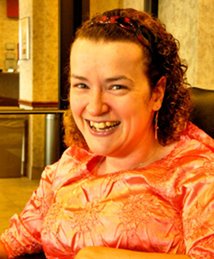
Heather Herschap

The children’s book, My Friends and I, is meant to teach children, especially disabled children, that no matter who they are or where they’re from, they are entitled to the unqualified and never-ending love of God.

“I didn’t want to write it,” said Herschap, a graduate of Baylor University’s Truett Theological Seminary. “I wanted to go to India. But if it hadn’t taken two-and-a-half years to get the trip together, I wouldn’t have had time to write it or time to get ordained. That was all God’s plan.”

While she was in Laredo waiting to go to Laredo, Herschap had a conversation with a church friend about how she could be more purposeful.

“She said ‘You need to write something about the disabled community,” Herschap said.

That was the birth of her writing career.

Disabled by cerebral palsy, Herschap said she has a special love for all children, but because disabled children in India are shunned by both their families and society, she feels a special calling to teach those children they are entitled to God’s love.

In India, people “see disabled children as a curse on the family,” she said. She wants those special children to know they are loved and they are special.

One page in her book reads.

“Whether we are strong or weak,

My friends and I have dreams to seek.

With or without our disabilities,

There’s always room for possibilities.”

The book is written in simple rhymes and is easy for youngsters to read. It tells simple messages in powerful ways.

While Herschap noted her book is introspective, it is not about her childhood experience.

“I think a writer who writes seriously always thinks about their own life, … but I knew I was loved and wanted and supported from the get-go,” she said. “I do think the message that the book has is the message I’ve been called to preach.”

Herschap was ordained last October at Seventh and James Baptist Church in Waco, where she also was baptized and commissioned.

She says she chose Seventh and James because “I feel like that’s where I grew up from a baby Christian to a confident, strong woman of God. So, I chose Seventh and James to kind of complete the process. Not that I think God is finished with me, because I know he’s not,” Herschap said.

Published by Tate Publishing and Enterprises, it is available now only in English, but Herschap hopes that will change soon.

Herschap beams when she talks about India. And as to her writing career, she’s already started on her second book and plans a third in collaboration with one of her former professors.

My Friends and I currently is available from the publisher at www.tatepublishing.com or on Amazon.com.

Herschap also beams when she talks about one of the three friends who will serve with her in India—her boyfriend, who teaches at a university near where she lives.

For now, they are partners in missions and ministry. Asked about a more long-term partnership involving a wedding ring, Herschap responded: “We’ve talked about it. We’ve talked about it several times. We’ll see what God says.”


Student group provides service to churches, hands-on experience

PLAINVIEW—For ministerial students at Wayland Baptist University who want hands-on experience, internships typically take the form of volunteer or part-time staff roles at area churches, most of them small congregations. But a new student-led venture at Wayland provides future ministers with another venue for honing their skills.

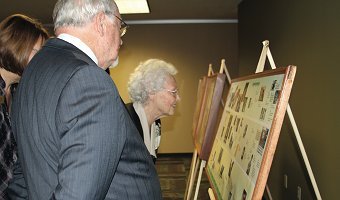
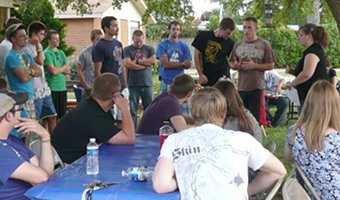
Wayland Baptist University students serving in the Eleazar Project group discuss their experiences at a fellowship at the home of a religion faculty member. The group met monthly for fellowship and networking. (PHOTO/Wayland Baptist University)

The Eleazar Project, housed in Wayland’s School of Religion and Philosophy, consists of groups of students who travel to churches around the region to provide their services for a Sunday. The specifics vary from church to church depending on their needs.

Organizers chose the name “Eleazar” after a common Biblical name that translates from Hebrew as “May God help,” echoing the sentiment of students who feel called to serve churches with leadership from God.

“We call the churches beforehand and explain to them what the point of the project is, which is two-fold—to serve churches and to gain experience,” said Chris Winegar, a senior religion major from Rock Rapids, Iowa, who plans to be a preacher. “Some churches want only preaching, some want everything from Sunday school teachers and children’s workers to music leaders.”

After the team leaders have defined the church’s needs, the group meets to lay out the plan of action, forming the team based on what students are needed and the strengths and talents of those studying for ministry at Wayland. Not all of the 40 students in the Eleazar group are religion majors or minors. Some, Winegar noted, are just interested in serving churches and getting more experience in doing so.

The group’s services are not limited to small churches, and the group likes the variety of experiences they’ve been able to have. A key element is an evaluation form the group receives from church staff members providing helpful feedback on how students can improve their skills.

Miguel Garcia, a freshman from Livingston, has found his Eleazar Project visits to churches helpful as he hones his skills as a worship leader. Although Garcia is a religion major with an emphasis in youth ministry, he enjoys leading music and playing his guitar at churches.

“I have learned a lot during this. It has helped me to prepare for the services more,” he said. “This has helped me learn more hymns and challenged me to know not only contemporary songs but to fuse traditional music into the services as well. I also used to be pretty nervous in leading worship but now I’m much more comfortable.”

Garcia leads worship for the youth program on Wednesdays at Seth Ward Baptist Church and enjoys the opportunity to practice flexibility in his worship role.

Although he is preparing to preach, Winegar has let other students take the pulpit with Eleazar since he gets the opportunity to preach locally at College Heights Baptist Church, where he has been a member a few years. He enjoys the role of coordinating experiences for other students and seeing them really benefit from the field trips.

“It’s been nice to go into a church you’re not used to, because all churches do some things differently,” Winegar said. “We’ve been able to hone our skills with these services, and it’s given us exposure to different people and personalities.”

Junior Wes Tayntor, a religion major from Wichita Falls, said he also has enjoyed the exposure to varied churches. He has preached with Eleazar at Highland Baptist Church in Lubbock and at First Baptist in Earth. While he is considering a career in encampment ministry, Tayntor enjoys preaching and is glad to be able to use that skill and sharpen it.

“I enjoy preaching and having the chance to get more experience in that area. I think both times I have benefited in the time of preparing and the chance to speak in front of different groups,” Tayntor said. “The feedback forms have been helpful too to know what to change the next time—what worked, what didn’t work.”

Debbie Wiley, who directs the theological research and writing lab for the school, said she original proposed the group idea to school dean Paul Sadler, believing ministerial students needed a new option to give them practical experience. With his approval, she pulled together students to form the original leadership team of four, then promptly moved out of the way, desiring the group to be student-led all the way. She has been pleased at the outcome.

“Students may leave here and never have the opportunity to have actual experiences with churches in the field in which they want to serve,” Wiley said. “In the fall we were going somewhere almost every week, and in the spring we’ve been several times.”

The leadership team now stands at seven members, Winegar said, with some freshmen added to give them several years of leadership.

The group has regular fellowships each month to establish bonds and network about their experiences. They had a fall formal and a fellowship that ended in a surprise reenactment of an underground church experience. A barn dance was planned to close out the spring semester.


Former foster child finds forever family, hope for future

ROUND ROCK—For Pamela Roberts, life looks much different now than in her early years. The first half of her life was characterized by uncertainty and chaos, but now she knows the love of a family and anticipates a bright future.

Pamela first came to STARRY—a program of Children at Heart Ministries—when she was 11 years old. Her biological parents struggled with addiction and often left their seven children unattended for hours at a time. When Child Protective Services learned about it, Pamela was sent to the STARRY Emergency Shelter.

Pamela Roberts

Pamela stayed at STARRY 90 days, the maximum allowable time for children, then she began a journey from one foster home to the next. It wasn’t long before she ended up back at the STARRY Emergency Shelter for another 90-day stay.

From there, she was placed in a cottage at Texas Baptist Children’s Home, where she met the people she now calls her parents.

The campus life program is designed to provide a temporary living situation for children experiencing crisis, but when house parents James and Angela Roberts decided to leave their roles at the children’s home, they didn’t want to go without Pamela.

“They asked me to come with them when they left, but I just needed more time to think,” Pamela said.

So the couple left, and Pamela moved into another cottage with house parents John and Brenda Toner. She stayed there a year before she made up her mind to accept the offer from the Roberts family.

STARRY and the children’s home worked together to orchestrate the transistion process, and in May 2008, James and Angela Roberts became Pamela’s foster parents.

“James and Angela always had a special place in their hearts for Pam and welcomed her into their home as their daughter with open arms,” said Sara Henderson, a former STARRY case manager and mentor to Pamela. “I had the privilege of becoming employed with STARRY just as Pam transitioned into foster care and was able to see Pam and the Roberts grow in love and support of one another throughout the transition.”

Shortly after she moved in with the Robertses, Pamela realized they had become her family, so she decided to take their last name.

“I felt like God put me with them to be my family,” she said.

Several years later, life still is changing for Pamela. Last year, the Robertses left for Poland, where they are serving with the Southern Baptist International Mission Board. They will be there for three years, and Pamela hopes to visit soon.

“I talked to Pam the other day, and she misses her family now that they are overseas, but there is no doubt in her mind that she is theirs and they are hers,” Henderson said.

Pamela currently attends Temple Community College but plans to transfer to the University of North Texas in the fall. She wants to pursue a degree in early childhood development and become a preschool teacher.

“Pam has an amazing love and compassion for children,” Henderson said. “She will excel in whatever she puts her mind to.”

When Pamela thinks about how her life has changed, she sees the blessings Children at Heart Ministries have been, and how they allowed her to enjoy being a kid.

“My life became so much easier when I came” to Children At Heart Ministries, Pamela said. “It taught me how to be able to be me and not have to grow up so fast taking care of my siblings and having all the responsibilities that an adult would have.”