Hundreds make spiritual decisions at Tulia crusade

TULIA—Some thought an evangelistic crusade in Swisher County wasn’t economically possible, but the sacrifice proved worth it when hundreds made life-changing decisions.

Although planning took almost nine months, local residents were astonished as hundreds attended the Panhandle Plains Go Tell Crusade led by evangelist Rick Gage. By the crusade’s end, 343 spiritual decisions had been recorded, including 175 first-time professions of faith.

Many people made first-time professions of faith in Christ during a crusade held at the Tulia football field.

“It was an amazing week,” said Bryan Schrader, crusade chairman. “I knew God was really about to do something big in our community when we started out Saturday evening with a precrusade youth rally. When Rick Gage talked to an area high school football team, 15 of them made life-changing decisions for Jesus Christ. The crusade was the greatest, most impactful event our county has ever seen.”

“What I witnessed happen in our county cannot be humanly explained,” said Pastor Eddy Helms of Calvary Baptist Church. “Our community needed hope, and God moved in mighty power. Our people have watched Billy Graham on television, but to see that same kind of thing happen here has deeply touched and moved us. This is just the beginning for us.”

“The economic downturn has hurt our community, but we believed God and stepped out in faith to see this crusade happen,” Helms continued. “When Rick Gage left town, all the bills were paid. People were sacrificial in their giving, knowing their gifts will reap eternal rewards. One lady in my church was asked by her hairdresser when she was coming in for her regular permanent. She said: ‘I’m skipping this one. I gave my perm money to the crusade.’ We are continuing what the crusade started and will feel its impact for years to come.”

Helms’ congregation held a block party for those who had made decisions during the crusade, complete with bounce houses, face painting, games, hamburgers and hot dogs.

“Our people just walked around and asked them if they had found a place to go to church yet, and if they hadn’t, to let them know we would be glad to see them,” he said.

The church followed that up the next week with notes and then with personal visits to homes.


Evangelist Rick Gage

More than 80 first-time professions of faith were made Wednesday night following a pizza supper that drew more than 600 youth.

A counselor for the crusade, Barry Street, took his mission of loving young people seriously. He hired two school buses from another county and brought 40 students from Kress, a neighboring community, to the Wednesday night crusade service. Of those, all but seven made first-time salvation decisions for Christ at the crusade.

“What Barry did for those students was phenomenal,” Schrader said. “The demeanor of those kids going up and going back was totally different. It was a God thing.”

Counseling Co-chairman Don Sanders said: “We had trained what we thought were a lot of counselors, but nothing could have prepared us for what we experienced the last night of the crusade. As young people began to respond to the invitation, I told the counselors, ‘You’re each going to have to counsel two people.’ But as waves kept coming, some had to help even more.”

Greg Culwell, executive director of Driscoll House, a faith-based halfway house recovery program, was elated when each of the men going through his program made a decision for Christ. “The sight of the men huddled together at the altar—with their arms wrapped around each other praying–was priceless. The work the Lord did and continues to do in their lives will be felt in their homes and communities. One young man, who was 19 years old, had the greatest change I have ever seen in an individual. We are deeply grateful to God.”

Linda Foster worked with children during the crusade. “An orphanage from the Plainview area brought some children, and several of those precious ones were saved,” she said. “When one of the little girls was asked what happened to her, she replied, ‘I found Jesus in my heart.’”


Texas Baptists Committed leader says group has moved to ‘next level’

DALLAS—A recent e-mail appeal from six former Baptist General Convention of Texas presidents encouraging attendance at the state convention’s annual meeting in McAllen and an announcement regarding a new blog devoted to historic Baptist principles marked the first—but not the last—efforts of Texas Baptists Committed to reconnect with Baptists in the state, said Michael Bell, chairman of the group’s board of directors.

“Texas Baptists Committed is alive and well,” said Bell, pastor of Greater St. Stephen First Baptist Church in Fort Worth.

Some Texas Baptists had wondered if the organization—formed two decades ago to resist a “fundamentalist takeover” of the BGCT—was alive at all after its executive director, David Currie, stepped down last year and the board closed its San Angelo office.

At the high point of its influence, Texas Baptists Committed mobilized thousands of messengers from churches around the state to attend BGCT annual meetings and elect a series of officers endorsed by the group—including the state convention’s first Hispanic, African-American and female presidents. In recent years, Texas Baptists Committed experienced financial hardship and endured questions about its continued reason for being.

While Texas Baptists Committed wants to retain its “edge” in speaking out regarding historic Baptist principles, Bell said, the organization now primarily wants to be a resource to help Baptist churches in the state.

“We have evolved. This is a new day,” he said. “This is the next level.”

The organization wants to be a positive voice in encouraging the BGCT and Texas Baptist churches, Bell insisted.

“We don’t think we are running away from our roots,” he said. “Different times call for a different approach. This is a new day, and we want to approach issues and challenges in a way consistent with the current context.”

Texas Baptists Committed has set up a blog site, http://texasbaptistscommitted.blogspot.com, but the organization will be more than just an Internet presence, Bell insisted.

The board is involved in a “thoughtful process” searching for an executive director, he said, and the Texas Baptists Committed offices probably will be somewhere in the Dallas-Fort Worth area.

“David Currie served Texas Baptists well, contrary to the preachments of some,” Bell insisted. “We don’t run away from the positive things he has done. We are not going to fail to recognize our past and the gigantic, monumental contributions he made. But David Currie is not part of our leadership, and he is not on our board.”

A complete roster of the Texas Baptists Committed board is posted at http://www.txbc.org/TBC/BoardofDir.htm.


Poverty moves into suburbia; creates ministry opportunities

Suburban churches don’t need to leave the state, travel to colonias along the Rio Grande or drive into the inner city to meet the needs of the poor. A recent study shows they may not even have to leave their own neighborhoods.

For the first time in U.S. history, the majority of poor people now live in the suburbs, a recent Brookings Institute study revealed. Although poverty remains more concentrated in inner-city areas, there are more poor people spread across suburbia.

Poverty is not exclusive to inner-city areas or remote colonias, but also has grown increasingly prevalent in suburbs, as well as and small towns. Members of First Baptist Church in Decatur staffed a summer feeding program that provided for children who receive free or reduced meals during the school year. (BGCT FILE PHOTO)

Ferrell Foster, associate director of Texas Baptists’ advocacy/care team, is encouraged by the prospect of financially secure Christians living closer to the poor. It increases chances for the economic classes to interact, increasing the likelihood of Christians understanding the plight of people in poverty and responding to needs.

“One of the things that has happened in the past 40 years is people with means have moved away from people without means,” he said. “Hopefully, we can now get a mix in the cities and in the suburbs.”

But some question whether suburban Christians will see poor people living closer to them as an opportunity for ministry or as a threat to their lifestyles. Some believers and non-believers view an increase in nearby poverty levels as a danger to their home values, quality of local schools and public safety.

Gaynor Yancey, associate dean of the Baylor University School of Social Work, believes many Christians will respond like people outside the faith—making decisions based on fear and perceived economic implications like the generation that abandoned the inner city decades before.

Yancey prays she’s wrong about her forecast, but she believes it is realistic.

“I think their culture will take (Christians) away,” she said. “I think their economic status will take them away.”

Yancey praised people who chose to live intentionally for Christ—no matter who lives near them. Regardless of people’s income, these Christians seek to show the love of Christ by meeting needs and sharing the gospel. Poor people have a variety of needs, and Christians can help meet them, she emphasized.

Steve Corbett, co-author of When Helping Hurts: How to Alleviate Poverty Without Hurting the Poor and Yourself, agreed, saying helping the poor is a matter of living out Christ’s call upon people’s lives.

While acknowledging the significant challenges of economic poverty, Corbett reminds people that everyone is impoverished in one way or another. “We’re all poor, because we’re all broken,” he said.

Joel Kotkin, distinguished presidential fellow in urban futures at Chapman University in Orange, Calif., said meeting needs is one way churches can add value to their communities.

If faith groups become known for taking care of people, and if people find help through church-based efforts, the poor will have a positive view of Christianity and find some relief from economic pressure.

The No Need Among You conference in Waco, Oct. 28-30, will focus on how churches can be involved in community development ef-forts that help people long-term.

For more information about the No Need Among You Conference, visit www.texasbaptists.org/noneedamongyou or call (888) 244-9400.


Galveston church returns to sanctuary two years after Hurricane Ike

GALVESTON—Worshippers once again gathered in the sanctuary of First Baptist Church in Galveston Sept. 12—two years after Hurricane Ike struck Galveston Island.

While many of the faces are the same, Pastor Ray Meador says it is a different church.


Pastor Ray Meador shows where the water filled the facility at First Baptist Church in relation to previous storms that flooded the church building.

“We buried old First Baptist Church, Galveston,” he said. “The first time we met after the hurricane was at a funeral home in Texas City. That was the funeral for old First Baptist Church.”

Minister of Music Jay Carnes, 43, was a member of the church’s cradle roll. He agreed the church he grew up in is not the same one that meets now.

“The storm did more for me and more for the church than anything else could have,” he said. “The storm reminded us that the church is so much more than the building.

“That’s not to take away from the excitement of being back in the building. I’m as excited as anybody, but we’ve learned what the church is,” said Carnes, who has served bivocationally the last dozen years. After the storm, the church initially met at the funeral home Carnes operates.

“It’s a new church. The storm brought so many good things. God had to bring us to our knees to see it,” he continued.


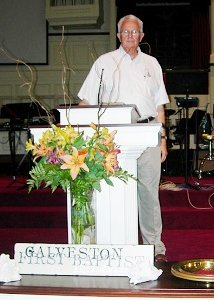
Pastor Ray Meador returned to the pulpit in the sanctuary of First Baptist Church in Galveston on Sept. 12—two years after Hurricane Ike devastated the church’s facility. (PHOTOS/George Henson)

The celebration of the church moving back into its sanctuary began when about 250 people from around the country came to a Saturday “thank you” lunch. Invited guests included people who had worked at the church as volunteers or sent money to help with the recovery.

“It was a good day,” Meador said. “The Lord blessed. It was just a time to say thank you to so many people who had blessed us.”

The crowd was so large the meal had to be served in the newly refurbished sanctuary, which Meador admitted worried some who thought the carpet might be damaged by spills.

“This is God’s house; this is God’s tool; this is God’s instrument. … We don’t worship the carpet. We didn’t even think we were going to get carpet, but God gave us carpet.”

While a meal in the sanctuary won’t happen often, Meador said, it was only possible because the storm destroyed the fixed seating that had been in place before it hit. Seawater rusted out the theater seats that had been in the sanctuary, and the estimated cost to refurbish them was $150,000. Instead, the church bought folding chairs for about $5,000.

As soon as possible after the storm, the church started meeting back on the island in the church’s chapel, which seats about 120. When the congregation outgrew that facility, worshippers moved to the fellowship hall, which seats about 200.

As that meeting space neared capacity, renovation allowed the church to move back to the sanctuary, which has about 325 chairs in it. Before the storm, it had seating for about 650.


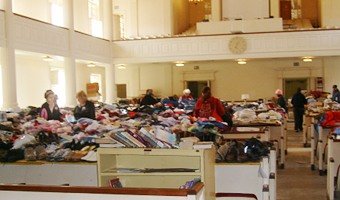
Volunteers placed plywood across the top of the seats in the sanctuary at First Baptist Church in Galveston, and clothing and other items were spread across them so people whose homes were damaged by Hurricane Ike could take whatever they needed.

“I remember the first time we met back here after the hurricane. We met in the chapel. There were two people who introduced themselves, and they’d both been members for 30 years, but didn’t know each other because they’d come in and gone out different doors,” Meador said.

While the numbers in attendance roughly equal what they were before the storm, Meador senses a difference in spirit.

“Right now, there’s a closeness, a commonality about it, a concern for missions. They’ve seen missions work in their lives. Churches gave sacrificially so we could do what we’ve been able to do. It’s something more than I can understand,” Meador said.

Since the storm, the church has exceeded each of its mission offering goals. In the past, the church set goals rather arbitrarily, Meador said. “Sometimes we got it; sometimes we didn’t. Now, people are more concerned. I think God has touched us, and I pray it stays the same way.”


Civil discourse endangered in U.S., noted Yale law professor insists

WACO—Democracy depends on something in short supply today in the United States—civil discourse involving people who disagree, author and legal expert Stephen Carter said.

Carter, professor at Yale Law School and author of The Culture of Disbelief, delivered the keynote address at the inauguration of Ken Starr as Baylor University’s 14th president, Sept. 17 in Waco.

“I worry deeply that we are losing the ability to debate” in meaningful ways, Carter said. Democracy demands that citizens “do the hard work of actually sitting, talking and working things out,” he insisted.

“The great symbol of the collapse of dialogue is the bumper sticker,” Carter said, bemoaning the tendency to “reduce complex ideas to slogans and applause lines.”

Americans should hold convictions deeply and vigorously defend their beliefs, but they should not dismiss people who have opposing views as bringing nothing valuable to the conversation.

“The more we express life that way, the less democratic we will be,” he said.

Too many activists of all political persuasions focus only on winning and getting their way, rather than engaging people with whom they disagree in a dialogue characterized by mutual respect, he insisted.

Carter pointed to the positive example of Supreme Court Justice Thurgood Marshall, for whom he worked as a law clerk. In Marshall’s later years, Carter worked with him on an oral history project, recording Marshall’s recollections from his years as a civil rights attorney.

Carter noted Marshall’s tendency to speak even of the most ardent segregationists with some fondness, because he recognized their essential humanity. That perspective enabled him to negotiate groundbreaking advances in civil rights, because even his opponents knew he not see them as enemies, and they were able to find some common ground.

“We need to see people with whom we disagree as fully human and equally beloved by God,” Carter said.


Little by little, San Antonio pastor builds home for his family

SAN ANTONIO—One nail at a time, Pastor David Cavazos’ home nears completion.

Cavazos, pastor of Iglesia Bautista Oriente in San Antonio, has been building a house for his family since August 2009. Since he learned the construction trades from his father, he not only has handled the carpentry, but also has done the plumbing and electrical work.

Cavazos and his family lived in a 950-square-foot apartment in Baptist University of the Américas student housing—tight quarters for a family of seven with a small baby.

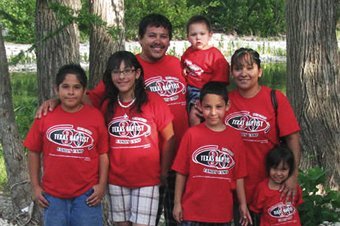
With the occasional help of volunteers, David Cavazos, pastor of Iglesia Bautista Oriente in San Antonio, has been building a house for his family since August 2009. (PHOTOS/Courtesy of David Cavazos)

“We had a newborn, and we felt embarrassed from time to time with our neighbors because they would hear our little one cry at night. Thank God they were such a nice family and understood our situation,” he said.

Cavazos’ older children began asking if the family would have to move after their father completed his studies. They had grown to like San Antonio and did not want to be uprooted.

Cavazos previously had served Connell Baptist Church in Fort Worth two years as a church planter and then had moved to La Blanca, near the Rio Grande, so his wife could help take care of a family situation. From there, the family moved to San Antonio, where Cavazos could further his education.

Once they secured land, Cavazos began to build a house, starting with setting the pier-and-beam foundation. The family moved in during April, but the house was far from completed. Only two rooms had sheetrock. There were no interior doors and no water heater.

“We had to bring in water to take a shower,” Cavazos said.

David and Dora Cavazos and their five children lived in a small student apartment at the Baptist University of the Américas until Cavazos built a house for his family.

Bit by bit, the family added a little more. Baptist General Convention of Texas funds enabled them to buy interior doors and two windows.

In recent weeks, a small group led by Pastor Baldemar Borrego of Iglesia Bautista Neuva Esperanza in Wichita Falls helped Cavazos hang drywall someone had left for him at South San Filadelfia Baptist Church in San Antonio.

“I never found out where it came from. They just told us it was there, and I could come and get it,” he said.

The 1,500-square-foot house still has uncovered plywood for flooring. It also needs doorknobs, interior paint and cabinets. The exterior needs siding.

“Right now, I just paint the outside over and over to keep the rain from hurting the wood,” Cavazos said.

Anyone interested in helping with the building project can contact Cavazos at cavazos313@yahoo.com


UMHB students help with flood relief

BELTON—After Tropical Storm Hermine dumped rain on Central Texas, students from the University of Mary Hardin-Baylor helped business and home owners in the area clean up in the storm’s aftermath.

UMHB Student Body President Tommy Wilson and Shawn Shannon, Baptist Student Ministry director at UMHB, coordinated two days of volunteer work involving students in cleanup efforts.

University of Mary Hardin-Baylor women’s head basketball coach Kim Kirkpatrick-Thornton and several UMHB students assist by sorting cloths at the flood-damaged Scott & White Hospice Thrift Store in Belton. (PHOTOS/Jennifer Jones/UMHB)

“We’re giving a lot of help as far as cleaning and repairing, and we’re also building relationships,” Wilson said. “Some believe that UMHB and Belton are two different entities. To me, being a part of one means being a part of the other. This demonstrates in a physical way that we want to be a part of the community. … We’re fellow Beltonians.”

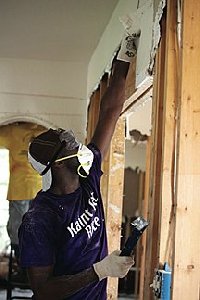
University of Mary Hardin-Baylor senior Christian studies major Edwin Robinson assists with pulling off sheetrock at a flood-damaged home in Salado.

More than 30 students and faculty members turned out for the first day of volunteer service. Some were sent to businesses in downtown Belton, some helped at the First Assembly of God Church in Belton, and others went to First Baptist Church of Salado to assist homeowners in that community.

Freshman Bethany Jenkins heard about the damage and wanted to help in any way she could.

“I really felt God calling me and telling me to serve not only those that are in other countries, but also those that are in our own backyard,” she said. “I’m really glad we’re able to help out.”

Local businesses and homeowners also were happy to have the extra hands for all the work needed.

The Scott & White Hospice Thrift Store in Belton flooded with about 48 inches of water. Even as cleanup was taking place at the store, donations already were arriving, staff member Amy Mesecke said.

“You feel overwhelmed when you have so much to do. We have two trailers full of donations, so it’s great to have the extra help to keep us going,” Mesecke said. “We have volunteers that come on a regular basis, but this in the first time we’ve had such a large group come out and help at one time.”


It definitely lifts your spirits.”


Texas Tidbits

ETBU trustees approve two master’s degree programs. East Texas Baptist University’s board of trustees at their regular fall meeting approved curriculum for two new graduate programs—the Master of Arts in Religion degree and the Master of Education degree.   The Master of Education program will begin in summer 2011, and the Master of Religion program will begin in the 2011 fall semester, pending approval by the Commission on Colleges of the Southern Association of Colleges and Schools. The board elected current officers to another year of service —chairman, Tom Lyles of Lindale, a member of Green Acres Baptist Church in Tyler; vice chair, Sam Moseley, attorney and member of First Baptist Church in Marshall; and secretary, Ray Delk, hospital administrator and member of Immanuel Baptist Church in Marshall.

Baylor chief ranks high on health-care list. Joel Allison, president and chief executive officer of Baylor Health Care System, has been included on Modern Healthcare magazine’s list of “100 Most Powerful People” in health care for the seventh year. At No. 23, Allison is the highest-ranked Texan on the list in terms of influence in the health-care industry, including both the public and private sector. Allison was nominated for the honor along with nearly 56,000 other health-care leaders from around the country. The final ballot—which included 300 nominees—drew more than 800,000 votes by Modern Healthcare readers.

BCFS family violence program receives grant. A Baptist Child & Family Services program in Del Rio to provide services to victims of family violence has received about $95,000 from the Texas Health & Human Services Commission family violence program’s special projects fund to sustain its work for the next two years. BCFS launched its Val Verde Family Violence and Victims’ Services program last year in response to community requests after Del Rio’s only domestic violence shelter closed. The grant will allow BCFS to continue providing services to abuse victims, as well as launch a community awareness campaign aimed at preventing future violence.


On the Move

Brad Borstadt has resigned as pastor of J-Bar-C Cowboy Church.

Will Easter has resigned as minister of children/preschool at First Church in Joshua.

Georgia Gaddy to Corinth Church in Cisco as youth director.

Richard Koons has resigned as pastor of First Church in Ovilla.

Josh Lake has resigned as minister of music at First Church in Joshua.

Charles Moore to Westwood Church in Tyler as pastor.

Ben Morris to Living Proof Church in Grandview as minister of music.

Tim Penney to Lake Leon Church in Eastland as minister of music/youth.

Nathan Presley has resigned as minister of youth at First Church in Joshua.

Sean Torrence has resigned as youth pastor at First Church in Ovilla.

Bill Ulrey to Friendship Church in Albany as pastor.

Scott Whitson to Southwest Metroplex Associa-tion as director of missions from Cross Timber Church in Burleson, where he was pastor.

Gary Yates to College Heights Church in Plainview as associate pastor of education.


Around the State

Baylor University will be the site of the “Fantastical” church music conference Sept. 30 through Oct. 2 in Waco Hall. Award-winning Christian musician and Baylor graduate David Crowder will lead the conference. Nearly 30 presenters and musicians will lead workshops, concerts and panel discussions. Among them will be Jars of Clay, Louie Giglio, Rob Bell, Francis Chan and Charlie Peacock. In addition to ideas generated druing discussion, participants will go home with new songs to be used in worship, organizers said. Registration is from 2 p.m. to 7 p.m. Thursday, with the first session beginning at 6:30 p.m. If tickets still are available at the door, they will cost $199 for individuals, $189 for groups of five or more and $179 for students. Meals and lodging are not included. For more information, call (256) 737-7565.

East Texas Baptist University will hold homecoming activities Oct. 8-10. The Tiger football team will play Louisiana College at 6 p.m. Saturday. For a full schedule of activities, see www.etbu.edu.

James and Angela Roberts have been appointed by the International Mission?Board to serve as strategy coordinators in Europe. He previously was student minister at South Oaks Church in Arlington, and the couple served as houseparents at Texas Baptist Children’s Home in Round Rock. He presently is student minister/campus minister at First Church in Temple. They have two daughters—Ella, 7, and Macie, 4.

The University of Mary Hardin-Baylor has launched a pre-engineering program in conjunction with the engineering degree program at Baylor University. It allows students to complete the first three years of course work in Belton, and then transfer to Baylor for the final two years of their degree requirements. Upon completion, students will have earned two bachelor degrees—one from each university.

Mike Hammack has been appointed executive director for institutional advancement at Hardin-Simmons University. He has worked on the university’s development team since 2007.

Baptist Child & Family Services has named Ashley Krimmel assistant vice president of program development. She joined BCFS in 2004, most recently working as director of annual fund development and marketing.

Max and Debbie Underwood of Colleyville were honored as Baylor University’s Parents of the Year during halftime of the Baylor-Buffalo football game. Both are Baylor graduates and are involved in a number of university organizations. Their son, Brad, is a Baylor graduate, and their daughter, Emily, is a senior at the university. The Under-woods are members of Bear Valley Community Church in Colleyville.

Mark Denison, pastor of First Church in Conroe, presented the fall convocation address at Howard Payne University.

Anniversaries

Howard Batson, 15th, as pastor of First Church in Amarillo, Sept. 12.

Clif Abshier, 15th, as pastor of First Church in Bishop, Oct. 1.

Preston Highlands Church in Dallas, 120th, Oct. 3. A lunch and afternoon service commemorating the congregation’s past, present and future will be held. Former pastors and staff are invited to be a part of the program. People planning to attend the lunch are asked to notify the church at (972) 248-6296. Jeremy Johnston is pastor.

Calixto Morin, 10th, as pastor of Primera Iglesia in Marlin.

Deaths

Charlie Jones, 90, Aug. 19 in Votaw. A pastor for 54 years, he served churches in Louisiana, Ohio and Arkansas, as well as First Church of Wild Peach in Brazoria; Victory Church in San Augustine and Wild Country Church in Ace. He was preceded in death by his first wife, Leola, to whom he was married 54 years. He is survived by his wife, Anice; son, Johnny; daughter, Charlene Boggus; sister, Christine Brink-ley; six grandchildren; and 10 great-grandchildren.

Wilma Barrentine, 93, Sept. 8 in San Angelo. After her husband’s retirement from military service, they became Southern Baptist Mission Service Corps volunteers, serving the next 10 years in Texas, Oklahoma, Washington, Canada and Senegal. After their service, they moved to Baptist Memorials in San Angelo and joined First Baptist Church. She taught Sunday school there until a short time before her death. Serving in a variety of places, she taught Sunday school almost 80 years. She was preceded in death by her husband, Jim, in 1994. Also preceding her in death were her sisters, Gladys Whitaker, Alleene Fearnow and Pauline Wharton; and her brother, Grady Fair.

B.J. Martin, 92, Sept. 12 in Pasadena. A graduate of Baylor University and Southwestern Seminary, he was awarded an honorary doctor of divinity degree from Howard Payne University. He was pastor of churches in McCamey, Hamlin, Ballinger and Childress, and he served 26 years as pastor of South Main Church in Pasadena. After eight years as the vice president of church relations at Houston Baptist University, he retired and was named South Main’s pastor emeritus in 1988. He served as a trustee of Howard Payne University, Baylor University, Houston Baptist University, Hendrick Memorial Hospital, Memorial Baptist Hospital in Houston, the Baptist Standard, Baylor College of Medicine (42 years), the Sunday School Board and the Foreign Mission Board. He was chairman of the trustees of the Baptist General Conven-tion of Texas Executive Board and the Southern Baptist Conven-tion’s Annuity Board. He is survived by his wife, Marylyn; sons, Bill and Sid; five grandchildren; and 10 great-grandchildren.

Stacy Blair, 56, Sept. 17 in Dallas. A graduate of Hardin-Simmons University, he was one of the world’s leading trumpet players. A performer in more than 50 countries, he was the winner of the Maurice Andre International Trumpet Soloist Competition in Paris, and twice won the International Trumpet Guild Solo Competition. Legally blind, he had more than 160 trumpet concertos memorized. He was the trumpet soloist with the concert band and Cowboy Band while a Hardin-Simmons student. He performed in concert with more than 16 symphony orchestras including the Israel Philhar-monic with Leonard Bernstein conducting, and with the Boston Pops. He also played at two National Prayer Breakfasts, and in 1984, he worked with the Billy Graham Crusade in Amsterdam. He was the recipient of the HSU distinguished alumni award in 2007. He is survived by his twin brother, Steve, and older brother, Ed.

Eudora Braswell, 84, Sept. 21 in Gainesville. She was a graduate of what is now East Texas Baptist University as well as Howard Payne University. She taught school in Valley View, Woodbine, Lindsay and Era, and she retired in 1991 after 23 years with the Texas Youth Commis-sion in Gainesville. She was a member of First Baptist Church in Gainesville. She was a 1995 golden anniversary honoree at Howard Payne University. She was preceded in death by her husband of 50 years, James Braswell, in 1996, and her sister, Martha Chandler. She is survived by her second husband, Robert Renfro; sons, James Jr., Jonathan and Billy Braswell; daughter, Becky Davis; stepsons, Marty and Paul Renfro; stepdaughter, Sue Lowry; nine grandchildren; and six great-grandchildren

Events

Al Fike, Michael Smalley and Carolyn Murray will perform “A Comedy of Love” at 7:30 p.m. Oct. 1. The comedy performance will be held in The Brick, a basement performance venue at The Heights Church in Richardson. Tickets are $10 for adults and $8 for youth. They are available at (972) 238-7243.

A community rally called “The Jesus Test” will be held at Brownfield’s Coleman Park Oct. 8-10. Robert Barge will be the speaker and Flight Plan will lead the music. It will begin after the football game on Friday night and at 7:30 p.m. the next two days. Six churches are participating.

First Church in Onalaska will hold a homecoming celebration Oct. 24. Bobby Smith will preach, followed by a meal and a classic car display. In preparation for the homecoming, revival messages will be brought by Steve Vernon Oct. 10 and Andy Pittman Oct. 17. Don Wilkey is pastor.

Primera Iglesia Mexicana in Brownsville will celebrate 101 years of service to the community Oct. 13-16. Evangelistic events will be held at 7 p.m. Wednesday, Thursday and Friday with Raul San Martin preaching. Saturday’s celebration will begin at 4 p.m. For more information, call (956) 546-4843. Leocadio Baltazar is pastor.

Crossroads Association in Big Spring is sponsoring the erection of a replica of the tabernacle constructed by Moses and the Israelites in the wilderness. The tabernacle is the precise size and layout described in the Bible. It will be open for tours Oct. 22-31 from 9 a.m to 9 p.m. The interactive exhibit has seven stations to educate visitors on the various facets of the tabernacle. Contributions of $5 per person or $20 per family are suggested. The tabernacle will be erected on South Highway 87 next to the Buffalo Fina.

A benefit catfish fry will be held from 11 a.m until 2 p.m. Oct. 23 at First Church in Granite Shoals to benefit Joseph’s Food and Clothing Pantry, a ministry of the church. Funds are being raised to construct a building to meet increased demand for the ministry’s services.

Revivals

Marlow Church, Cameron; Oct. 3-6; evangelist, Robert Barge; music, Gary Newman; pastor, Wayne Kirk.

First Church, Somerville; Oct. 3-7; evangelist, Darren Donaldson; music, Bob Morris; pastor, Corby Brizendine.


Board rejects study committee motion on challenging messengers

DALLAS—The Baptist General Convention of Texas Executive Board overwhelmingly rejected a study committee’s proposal to change how the BGCT handles messenger-seating challenges at its annual meeting.

At the 2009 BGCT annual meeting, Kyle Henderson, pastor of First Baptist Church in Athens, recommended a process to deal with messenger-seating challenges in advance of the annual meetings.

The proposal grew out of concern related to an anticipated challenge involving messengers from Broadway Baptist Church in Fort Worth. The Southern Baptist Convention had cut ties with the church on the basis of its perceived acceptance of homosexual members.

The anticipated challenge was defused last year when Broadway Baptist decided at the last minute not to send messengers to the BGCT annual meeting.

In recent weeks, the church voted to approve a statement indicating it was severing its relationship with the BGCT.

Specifically, Henderson proposed an amendment to the bylaws that would require any messenger challenging the seating of another messenger to contact that messenger’s church at least 18 days before the annual meeting. He also proposed that a statement of intent to challenge the seating be presented to the BGCT credentials committee at least one week prior to the meeting.

Henderson’s proposal was referred to the BGCT Executive Board, and the board created an ad hoc study committee chaired by Bob Fowler of Houston.

The committee felt Henderson’s proposal would be inappropriate, because it mandated a church respond to allegations made by any messenger.

However, he noted, the committee saw merit in providing some advance notice of a messenger-seating challenge.

The study committee modified Henderson’s proposal, recommending an amendment to the BGCT bylaws that would have said, in part: “Any messenger intending to challenge the seating of another messenger should verify the grounds upon which such a challenge is being made. At least two weeks in advance of the convening of a meeting of the convention, the challenging messenger should present the challenge to the Committee on Credentials, including steps taken to verify the basis of the challenge. …

“The Committee on Credentials shall provide a copy of the information it has received from the challenging messenger to the challenged messenger and to that messenger’s church. Challenges may also be presented to the Committee on Credentials any time prior to the presentation of its report to the assembled messengers. However, adequate time should be afforded the committee to consider a challenge, including time to communicate with the challenged messenger and the messenger’s church and to permit an appropriate response to be received.”

The study committee also added an additional statement: “The Committee on Credentials shall determine, based upon the information provided it … and upon its further consideration, whether to exclude a challenged messenger or messengers from the roll to be presented in its report to the assembled messengers.”

Fowler noted the “should” language in the committee’s proposal, saying the change was “aspirational in nature,” providing a more orderly process while preserving the right of any messenger to challenge the seating of another messenger.

“Our committee does not view these changes as critical to the success of the convention, but we do believe these changes would improve the process,” he said.

Van Christian, pastor of First Baptist Church in Comanche, noted he appreciated the original intention of the proposal, but he was concerned the recommended change violates the BGCT constitution and bylaws. The only requirement for a messenger currently is that he or she must be duly elected by an affiliated church, he noted.

But the proposal would put the credentials committee in the position of determining whether a church is in good standing with the convention, Christian said.

The credentials committee only should consider the constitutional requirement, reserving the assembled convention’s right to accept or reject messengers, Fowler agreed.

Royce Measures of Pasadena noted the convention is composed of elected messengers, and the convention only exists for two or three days a year. “To be able to challenge messengers before there is a convention is contradictory,” he said. “It is moving from being messengers to being delegates.”

Fowler acknowledge the complexity of references to messengers, noting they become prospective messengers when elected by a church, they become registered messengers when they sign in at the annual meeting, and they become seated messengers when the convention takes that action.

BGCT Executive Director Randel Everett noted the convention is dealing with two related but distinct issues—seating of messengers and determining whether a church is affiliated.

Noting he could speak only as an individual board member and not for the study committee as a whole, Fowler agreed the recommendation could have unintended consequences.

“We are not in a parliamentary or constitutional crisis at this time,” he said.

With additional reporting by Editor Marv Knox


Annual meeting needs major overhaul, study committee asserts

DALLAS—The Baptist General Convention of Texas annual meeting needs an extreme makeover in focus and format, the chair of a study committee told the Baptist General Convention of Texas Executive Board.

Only 502 churches sent messengers to the 2009 annual meeting in Houston, said Kyle Henderson, chair of the committee appointed to study ways to increase participation at the event. The number of eligible churches sending no messengers to the annual meeting grew from 3,722 in 2006 to 3,836 in 2009.

“We can’t stay here. We’re got to do something different,” said Henderson, pastor of First Baptist Church in Athens.

Noting he has attended state convention annual meetings for about 25 years, he pointed to the lack of young church leaders present in recent years.
“I used to be the youngest guy at the meetings,” he said. “And I kind of still am.”

The study committee Henderson chairs developed a report and series of recommendations to be considered by messengers at the 2010 BGCT annual meeting in McAllen.

“We believe we are at the beginning of a great new adventure,” the report states. “We believe that our gatherings will be kingdom meetings that will influence the world. We believe people will look forward to these events, that they will be equipped and encouraged, and will leave with a sense of purpose of mission.

“We believe that there should be a sense of urgency in pursuing this renewed vision of our annual meetings. The gap between the number of churches attending and the possibility of churches attending has grown too large to ignore. We believe we must respond now.”

The study committee recommends two measurable goals focused on the number of churches participating in the annual meeting rather than the number of people in attendance—double the percentage of participating churches by 2013 and involve every Texas Baptist church at least once every five years.

Key recommendations include:

• Showcase one area of ministry each year. Focus on a different theme annually, rotating between five key areas—evangelism/missions, education/discipleship, advocacy/care, Baptist identity and Baptist community.

• Gather the Texas Baptist family. Every fifth year, for the Baptist community emphasis, schedule “The Gathering”—a three-day event that would bring together Texas Baptist ethnic groups and interest groups. Schedule the 2013 meeting in summer to appeal to vacationing families, and then evaluate the change.

• Involve institutions in innovation. Consider a multi-site event in 2017 using video simulcast technology, involving as many Texas Baptist institutions as possible.

“Many people have called for the use of technology, simulcast broadcasting and regional meetings. We believe we need to make the commitment to innovate in this area,” the report says.

“Through the use of our education institutions who frequently use this technology, we believe that we can have a creative, productive, life-changing event that could be a model for the future. It would take work, but we can do it.”

• Plan beyond the current year. Coordinate and plan the annual meeting starting 18 months in advance of the event to secure speakers, gather resources, facilitate institutional cooperation and build momentum.

• Add value. “People go to learn. They want to hear the best information, the best speakers and the most innovative approaches,” the report says.

• Move business discussion out of the general sessions. Schedule breakout sessions for detailed discussion of business. “The process of representative governance means that most of the decisions have been made in a deliberative way by the time they reach the convention,” the report says. “This system still allows for broad final input, while not dominating the main sessions of the meeting.”

• Abolish resolutions. “Few things have taken as much time and produced as few results as the process of resolutions,” the report says. “We tend to argue, put our worst foot forward and then produce statements of which the churches are largely unaware.”

• Lengthen the meeting to three days. “We think Texas Baptists need more time together,” the report says. “It is also a historical reality that our meetings have been much longer and were much better attended when they were longer.”

• Shorten individual presentations. Increase the number of presenters.

• Schedule a local ministry event. “We could help the cause of evangelism if we left the places we visit better than we found them,” the report says.

• Make time for fellowship. Schedule time for informal networking. Increase the time available in the exhibit halls.

• Look outside. “Reach outside of Texas Baptist life to bring fresh insights and draw an increasingly diverse crowd,” the report says.

The committee also suggests the convention give consideration in the future to moving to locations outside downtown areas, to where lodging would be more affordable, and consider a mid-week schedule, rather than beginning on a Monday.