New abolitionists shine light on human trafficking

FORT WORTH—In many places across the state, a darkness that most people overlook clouds the eyes of hurting children, their stares serving as silent cries for help. They’re the glazed-over gazes of trafficked children in Texas who live enslaved, beaten down and hopeless. In someone else’s possession and under their control, victims of human trafficking silently struggle to survive in this darkness.

Despite living in and going to many of the same places other children do, they are forced into lives that most people never see — shuttled from home to home, sold on the streets as prostitutes, beaten and abused by pimps and gang members. Afraid to tell anyone of their predicament and with a public that knows little about domestic trafficking, these children silently suffer over and over again.

{youtube}utjtLRqQuJI&hl=en&fs=1&rel=0{/youtube}
Scenes from "Playground," a documentary on the worldwide child sex trafficking problem.

“You may be at the mall and one of these kids walk right past you,” said Deena Graves, director of Traffick911 , the anti-human trafficking ministry of Southside City Church in Fort Worth .

“You may be sitting in McDonald's and one of these kids is sitting next to you. People don’t know this exists. And if they know it exists, they don’t know what to look for to identify victims.”

Joining a new abolitionist movement

Citing biblical passages, a growing number of Texas Baptists are showing that light defeats darkness, exposes what is taking place and puts an end to it. Using a variety of methods, they are seeking to raise awareness about human trafficking as an issue, prevent it from taking place and aid victims of the atrocity.

Many of these “new abolitionists” will be taking part in the Freedom Sunday on Feb. 21, the first-ever day that churches worldwide have set aside to pray for human trafficking victims.

Southside City Church has launched activities for at-risk children, including a karate class, in hopes of stopping trafficking of children before it happens. The programs are held in an area where children are known to become involved in gangs, which increases the likelihood of a child being trafficked or forced into prostitution.

The activities, which Pastor Darrel Auvenshine said are helping the congregation establish a “presence” in the community, are only the beginning for the church. Traffick911 is working with law enforcement officials to aid trafficking victims as it can and has a long-range goal of creating a residence where victims can be ministered to.

“Our focus is to do all this so they find the hope of the gospel and in the end restoring them — restoring life and hope, and preparing them to live a healthy life,” he said.

Becoming Citizens of Purpose

Baptist General Convention of Texas Director of Community & Restorative Justice Tomi Grover recently introduced an effort called Traffick Stop, which can help guide congregations in launching or enhancing a ministry for victims of human trafficking.

She helps congregations pray through understanding how God is calling them to respond to human trafficking through casting a vision for a ministry for trafficking victims and then creating that ministry.

Grover is asking Texas Baptists to become COPS — citizens of purpose — intentionally looking for ways to end modern-day slavery. The effort is part of Texas Hope 2010 , an initiative to pray for others, care for hurting and hungry people and share the hope of Christ with every person by Easter 2010.

Although clearly accurate statistics of trafficking victims are difficult to find, the U.S. Department of Health and Human Services believes as many as 325,000 American children are at risk each year of being sexually exploited.

Texas is a major hub for human trafficking, and the National Human Trafficking Hotline receives more calls from Texas than any other state. Fifteen percent of the calls come from the Dallas-Fort Worth area, but human trafficking takes place in large cities and small towns across the state.

“Texas is one of the primary states through which people are trafficked,” she said. “In many ways, it serves as the gateway to the rest of the nation. This abomination is happening right under our noses, and many of us don’t even realize it. Victims of human trafficking have no hope. Many of them no longer believe they can escape their situation. We as the body of Christ need to wrap our arms around them, care for and about them and introduce them to everlasting hope – the gospel of Jesus Christ.”

Norma and Mike Mullican, members of First Baptist Church in Palestine , are trying to bring Christians together on this issue to do the very tasks Grover noted. They regularly speak at churches and other events about human trafficking. They talk about practical ways people can make a difference, such as buying fair trade products or supporting organizations that already are fighting trafficking.

“We would love to see the Christian community come together here in East Texas and all across the state and us take the lead in this, us say this is a crime against our children and we’re going to do something about it,” Norma Mullican said.

“God calls us to do something, not simply sit back and take care of ourselves. God calls us to take care of the children. I don’t know how people, once they become aware of it, can sit back and do nothing. I can’t.”

Even though Southside City Church is not as prepared as it would like to be, it has encountered two people who have been victims of trafficking, Auvenshine said. One has been restored, but one went back to her pimp. The congregation is determined to do whatever it can to help. Each day that goes by, more people fall into trafficking.

“These children are voiceless, and they are silently crying out,” Graves said. “The question is, are we listening because night after night and john after john, these kids are being brutalized in ways we can’t even imagine.”

Warning signs that point to trafficking

Graves notes these indications a child is a victim of trafficking:

• Appears to be under someone else's control; submissive or fearful behavior
• Restricted or scripted communication; inconsistencies in story
• Exhibits feelings of helplessness, shame, humiliation, shock, denial or disbelief
• Bruises, cuts, scars on wrists, ankles and legs, or other signs of battering
• Branded with a tattoo of a man’s name or “Daddy;” often on neck
• General poor health; malnutrition; extreme weight loss
• Inability or fear to make eye contact
• Chronic runaway; homeless youth
• Disappears for blocks of time
• Lying about age; false identification
• Dating much older, abusive or controlling man
• Not attending school or has numerous school absences
• Multiple people living in one house.
• Lacks knowledge about community or whereabouts
• Frequently moved from place to place

For more information about how to fight human trafficking locally, visit www.texasbaptists.org/traffickstop or call Grover at (888) 244-9400. For more information about Traffick911, visit www.traffick911.com .


Starr receives enthusiastic—not unanimous—welcome at Baylor

WACO—Kenneth Starr received an enthusiastic—but not unanimous— welcome to Baylor University when he arrived at the Bill Daniel Student Center to be introduced to faculty, staff and students as the school’s president-elect.

Starr, best known as the independent counsel whose investigation led to the impeachment of President Bill Clinton, drew a standing-room-only crowd and two extended ovations during the event in the Barfield Drawing Room . Outside the building, students lined the sidewalk carrying signs—some protesting his selection by the Baylor board of regents and others expressing their support.

The Baylor board of regents had unanimously elected Starr as the Baptist university’s 14th president Feb. 12.

Affirming Pro Ecclesia, Pro Texana

In his initial address to the “Baylor family,” Starr voiced his support for freedom of thought, expressing his belief that “all truth is God’s truth” and his desire to build a vibrant intellectual community where “all voices are welcome” and where governance is shared with faculty.

Starr paid homage to the past, beginning by underscoring his commitment to the university’s motto—Pro Ecclesia, Pro Texana. And he touched on themes important to various Baylor constituencies.

He identified himself as a fifth-generation Texan whose family arrived in 1848, just three years after the Republic of Texas chartered Baylor University. But he noted Baylor’s impact now extends far beyond the state’s borders.

“Today, Baylor’s sphere of influence truly is the world,” he said.

Starr, whose father was a Church of Christ pastor and who has been a member of a nondenominational Bible church in suburban Washington, D.C., praised Baylor’s Baptist heritage.

“Let us give thanks for all the Baptist community continues to do around the world,” he said.

Starr praised Baylor’s entrepreneurial spirit and the culture of servant leadership it engenders and nurtures in students. He noted Baylor was home to the first student Habitat for Humanity chapter, and students are engaged in service throughout the community and the world.

Regents praise president-elect

In introducing Starr, Regents Chairman Dary Stone of Dallas characterized his selection as “an answer to prayer” and the result of “a lot of hard work.” He praised Starr as a distinguished academician, an exemplary Christian, a servant leader and “probably one of the greatest lawyers of our time.”

Joe Armes of Dallas, chair of the presidential search committee, pointed to the “open, honest, inclusive process” that led to Starr’s selection. The candidate’s academic vision and his personal Christian commitment made him the committee’s unanimous choice, he noted.

“He is an articulate advocate for Christian values in the public square,” Armes said.

Advisory committee commends choice

Ken Hall, chief executive officer of Buckner International and a past president of the Baptist General Convention of Texas, chaired the advisory committee that provided counsel to the presidential search committee.

“I was asked to participate in this process because of my ties to the Baptist community of faith in Texas and throughout the country. Looking at the choice of Kenneth Starr through that particular prism, I can tell you that he brings to this task an uncommon and even uncanny understanding of Baylor’s unique and distinct mission as a national Christian university with historic Baptist ties,” Hall said. “He represents the very best of what it means to be an active churchman who, along with his wife, puts his belief into action through his local congregation.”

As the leader of a Christian social-service ministry, Hall also noted he was impressed by Starr’s “progressive thinking and personal action” regarding ministry to the disadvantaged.

“It is refreshing to meet someone who combines a high academic mindset with practical application of his faith,” he said.

Jaime Diaz-Granados, chairman of the Baylor psychology and neuroscience department, served as a faculty representative on the advisory committee. He assured faculty in attendance at Starr’s public introduction as president-elect that he has  demonstrated commitment to academic freedom and shared governance.

“The measure of success of any president is directly related to the success of faculty,” Diaz-Granados said, adding that Starr understands that.

'Something totally unexpected'

Regent Emeritus Drayton McLane of Temple congratulated the search committee for the leadership they demonstrated in Starr’s selection as Baylor’s next president.

“You came up with something totally unexpected,” McLane said.

Stone introduced Thomas Phillips, retired chief justice of the Texas Supreme Court, as “the guy who came up with the name” in nominating Starr.

“It’s a little nerve-racking to be the guy who came up with the name of the guy,” Phillips acknowledged.

“But I have no doubt we have done the right thing for Baylor University. … This school has had good luck with judges,” he quipped, pointing both to R.E.B. Baylor and Abner McCall.

Phillips voiced confidence, based on Starr’s track record as a law school dean at Pepperdine University in Malibu, Calif., that he can bring unite the Baylor community and effectively lead the university.

“It’s hard to know Ken Starr and not like him,” he said.

Challenges Starr faces

Unity in the Baylor family—or lack of it—has been a hot topic for nearly a decade.

During the last two years of Robert Sloan’s 10-year presidency at the university, the Baylor Faculty Senate twice gave him “no confidence” votes, and the board of regents voted three times on Sloan’s continuing employment. Sloan stepped down as Baylor’s president in 2005.

About nine months after Sloan and the regents agreed to the terms of his departure, the board unanimously elected John Lilley as president. Lilley had earned two degrees from Baylor and had been a licensed Baptist minister, but he had been away from Texas 40 years and had been an ordained ruling elder in Presbyterian churches in recent years. The board of regents fired him in July 2008, halfway through his contract, for failing to “bring the Baylor family together.”

A key flashpoint has been the relationship between the university’s administration and regents and the Baylor Alumni Association.
About seven years ago, Baylor developed its own alumni services office and began publishing its own magazine mailed to alumni and donors—a move viewed as direct competition by the Baylor Alumni Association.

Last year, the university removed the alumni association from its toll-free phone line, alumni association staff lost their university e-mail addresses, and the alumni association link disappeared from the “Alumni and Friends” page of Baylor’s website.

In mid-September, the university presented a proposal asking the alumni association to give up its independent nonprofit status and come under the authority of Baylor administration. Within six weeks, Baylor withdrew its proposal to the alumni association, citing lack of a positive response to the request.

Experience in law, academia

Starr comes to the Baylor presidency after a noted career both in legal practice and academia.

Starr served as independent counsel for five investigations between 1994 and 1999, including the death of White House counsel Vince Foster, the Whitewater real estate dealings of the Clinton family and Clinton’s sex scandal involving White House intern Monica Lewinsky. The resulting Starr Report asserted Clinton lied about his relationship with Lewinsky in a sworn deposition—an allegation that led to Clinton’s impeachment.

He was U.S. solicitor general from 1989 to 1993 and argued 25 cases before the U.S. Supreme Court. He was a U.S. circuit judge for the District of Columbia circuit from 1981 to 1983.

Since 2004, Starr has been the Duane and Kelly Roberts Dean and Professor of Law at Pepperdine University in Malibu, Calif. He also is affiliated with the Kirkland and Ellis law firm, where he was a partner from 1993 to 2004.

Starr, 63, was born in Vernon and grew up in San Antonio. His father was a Church of Christ pastor, and Pepperdine is a Church of Christ school. During their years in the Washington, D.C., area, Starr and his wife, Alice, became active in McLean Bible Church, a nondenominational church.

He is a graduate of George Washington University, Brown University and Duke University Law School. Early in his career, he clerked for Fifth Circuit Judge David Dyer and U.S. Supreme Court Chief Justice Warren Burger.

Starr is the author of more than 25 publications, including First Among Equals: The Supreme Court in American Life.


Some Baptists gaze at Starr with cautious optimism for Baylor

WACO—When Baylor University regents announced Kenneth Starr as their unanimous choice as the school’s president, Baptist General Convention of Texas President David Lowrie acknowledged, “It caught me off guard.” But after meeting Starr at a gathering of Texas Baptist leaders, Lowrie noted he was “very impressed.”

“He impressed me as a genuine Christian gentleman, a scholar, very articulate and very committed to applying Christian values to the challenges faced in Christian higher education,” he said.

Lowrie, pastor of First Baptist Church in Canyon, acknowledged Starr’s religious background as a non-Baptist who was baptized in the Church of Christ and has been member of a nondenominational evangelical congregation could mean he has “two strikes against him” in the eyes of some Texas Baptists.

“But I believe him to be a genuine follower of our Lord and Savior, and in regard to principles, he seems to espouse the Baptist beliefs we hold onto,” he said.
Lowrie held out the possibility Starr has already been Baptist in belief but not in church affiliation.

“Time will tell,” he said. “He is willing to align himself with us, knowing who we are.”

Seems principled, rather than partisan

Lowrie voiced hope that Starr’s background will help Baylor “make a stronger connection to the world we are trying to impact.”  

At the same time, he acknowledged Starr’s role as the independent counsel whose investigation led to the impeachment of President Bill Clinton also could be an obstacle to unity. But, he insisted, based on first impressions, he was surprised by Starr’s lack of overt political partisanship.

“He wasn’t the man I anticipated meeting,” he said, noting he left the meeting with Starr convinced his “relentless pursuit (during the Clinton investigation) was driven by a commitment to principle rather than by partisan politics.”

He noted Starr’s personal involvement in ministries to the disadvantaged and his advocacy for death row prisoners as evidence of principles that transcend political labels.

“He didn’t strike me as wanting to position Baylor as Republican school,” Lowrie said.

Testimonial tributes of Starr presented by the search committee included representatives of the Baylor faculty and Baylor Alumni Association, as well as the board of regents, Lowrie noted, offering cautious optimism about Starr’s ability to unite the divided Baylor family.

Major endorsements noted

Material provided by the search university to the media included an endorsement by President George H.W. Bush, who characterized Starr as “one of the very finest public servants with whom I had the privilege to work as President of the United States.”
“When he represented the United States before the Supreme Court, the American people had a tireless advocate who not only represented their values and interests—but shared them. Both Baylor University, and Dean Starr, have chosen wisely, and Barbara joins me in wishing the Baylor University family every success moving forward,” Bush continued.

Nadine Strossen, former president of the American Civil Liberties Union, described Starr as “not only a zealous, brilliant advocate on the biggest issues of the day, but also someone who is deeply concerned about and kind to every individual he encounters.”

“From the students for whom he is impressively available, to the death row inmates whose legal appeals he has handled on a pro bono basis, he is unstintingly generous with his time, expertise and wisdom,” Strossen said. “Ken Starr is deeply committed to academic freedom and to the robust exchange of ideas, including ideas with which he personally disagrees. He will be a superb leader of Baylor University and a wonderful mentor and role model for all of Baylor’s students.”

Advisory committee, regents offer perspective

Ken Hall, chief executive officer of Buckner International, chaired the advisory committee named to work alongside the presidential search committee, which was comprised entirely of regents. Hall insisted Starr brings to the university “an uncommon understanding of Baylor’s unique and distinct mission as a national Christian university with historic Baptist ties.”

Regent Duane Brooks, pastor of Tallowood Baptist Church in Houston, praised Starr as “a brilliant thinker” who “listens carefully to others and deliberates before making decisions.”

“Starr is Baptistic in his theology,” Brooks continued. “He greatly treasures and convictionally contends for the Baptist distinctives which we Baptists have long held dear.”

Starr possesses “a keen understanding of the American academy and the distinctive role of faculty as members of the academic community,” said Georgia Green, immediate pastor chair of the Baylor Faculty Senate, who served on the presidential search advisory committee.

“His commitment to servant leadership, combined with his experience as a teacher, scholar and academic administrator make him uniquely qualified for the position,” said Green, associate dean of the Baylor School of Music. “Under Judge Starr’s leadership, Baylor faces an exciting future brimming with hope and possibility.”

Baylor Alumni Association pledges support

Emily Tinsley, president of the Baylor Alumni Association, congratulated the regents on their unanimous selection of a new president and pledged the alumni association’s  “continued support of our new president to the benefit of Baylor.”

“It is critical that Ken Starr be a president around whom the Baylor family can unite and work together to assure that Baylor’s best days are ahead of her,” Tinsley said. “We are very encouraged to hear so many positive affirmations of Ken Starr’s personal and professional leadership skills and of the respect those who have worked with him in the past have for him.”

Tension between the Baylor Alumni Association and the university developed about seven years ago, when Baylor developed its own alumni services office and began publishing its own magazine mailed to alumni and donors.

Last year, the university removed the alumni association from its toll-free phone line, alumni association staff lost their university e-mail addresses, and the alumni association lost its link on the “Alumni and Friends” page of Baylor’s website.

In mid-September, the university presented the alumni association a proposal asking the group to give up its independent nonprofit status and come under the authority of Baylor administration. Less than six weeks later, Baylor University withdrew its proposal to the Baylor Alumni Association, citing lack of a positive response to the request.

Jeff Kilgore, executive vice president and CEO of the Baylor Alumni Association, offered Starr a “welcome back to Texas” and expressed his thanks to the search committee and advisory committee for their work.

“Throughout the listening sessions held by regents to initiate this search process, we heard alumni agree upon a number of traits that they were looking for in a new president, including servant leadership, transparency, and a collaborative, consensus-building approach, and I look forward to working with and helping President Starr to the fullest possible extent,” Kilgore said.

Kilgore thanked the regents for including Tom Phillips, former chief justice of the Texas Supreme Court and current BAA board member, on the advisory committee.

“Ken Starr has shown the intellect, patience, eloquence, humility, and integrity to be a transformative leader of the world’s largest Baptist university,” Phillips said. “His unique gifts match Baylor’s need to unite all parts of the Baylor family in a renewed dedication to provide a world-class education at a faith-based institution of higher education.”

Open letter to regents posted

When the initial announcement of Starr’s election appeared on the Baptist Standard website, Chris Seay, pastor of Ecclesia, a Baptist church in Houston, posted an open letter to the regents voicing his concerns. He pointed to “intense bickering, verbal assaults and entrenched separation” that has divided the larger Baylor family since the late 1990s.

“It seemed clear to all that the next president of our great university must be more Billy Graham than Karl Rove. We need someone who is able to remind us that our diverse views and experiences allow for the kind of educational environment that we can all be proud to offer our children. Instead of seeking a peacemaker, the board of regents has selected one of the most polarizing public figures in recent history, and in doing so, has injected partisan politics as one more reason to seek division rather than unity in the Baylor family,” Seay wrote.

“I know and respect many who serve as regents of Baylor University. In the end, I must trust their judgment. But I do not understand a selection that increases division and on the surface makes the work of healing much more difficult. I am choosing to be supportive of this new President; primarily because I have seen the way that resentment distracts us all from our mission.

“But I encourage the board of regents to take significant steps toward bringing all of Baylor together. If this is to happen they must begin to give influence to a new generation of leaders that will move Baylor into the future, instead of fighting the battles of our divisive past.”


New Baylor president affirms school’s heritage, plans to become Baptist

WACO—Although Kenneth Starr grew up in the Church of Christ and has been a member of a nondenominational church for decades, the newly elected Baylor University president affirmed the Baptist school’s heritage and pledged to “readily, cheerfully and enthusiastically” join a Baptist church by the time his tenure begins June 1.

Starr also said he would welcome all of Baylor’s divided constituencies to the conversation about the university’s future.

Starr discussed his impending role Feb. 15, three days after the board of regents unanimously elected him as the university’s 14th president.

Texas Baptists founded Baylor in 1845 in the Republic of Texas, before statehood. The university is affiliated with the Baptist General Convention of Texas, which elects 25 percent of its board of regents. The board itself elects the other 75 percent.

Starr was born to a Church of Christ pastor June 21, 1946, in Vernon and was raised in San Antonio.

“I accepted the Lord Jesus as my Lord and Savior at the age of 12,” Starr recalled, noting his father baptized him. “I remained in the Churches of Christ tradition through high school.”

“But beginning at about the age of 18, I began having questions about certain practices, beginning with instrumental music,” which the Churches of Christ do not allow in worship services, he said. “As time wore on, I found myself moving into the larger evangelical world.”

Several influences nudge him in that direction, including evangelicals involved in the legal circles of which he was a part, as well has his “home congregation,” McLean Bible Church in the Washington, D.C., suburbs.

Starr and his wife, Alice, have been active in the church in McLean Va., where they lived from 1978 to 2004, he said. Since then, they have attended University Church of Christ on the campus of Pepperdine University in Malibu, Calif., where he is dean of the law school. But the McLean congregation continues to capture their passion and involvement.

“We’ve been very involved” and continue to be involved in McLean Bible, where he has taught Sunday school, he said. The Starrs also have been engaged in two of the church’s ministries—founding The House, an outreach to inner-city youth in Washington, and Jill’s House, a ministry to special-needs children and their parents.

Starr also has participated in professional groups that reflect his faith, such as the Christian Legal Society, which he described as a broadly inclusive evangelical Christian organization, and the board of directors of Advocates International, which promotes religious freedom worldwide.

Baylor’s next president said he anticipates becoming a Baptist as he steps to the helm of the denomination’s largest university.

“I feel a great sense of kinship and fellowship with the Baptist community,” Starr said, noting he has studied a treatise on key Baptist doctrines and practices written by David Garland, Baylor’s interim president and dean of its Truett Theological Seminary.

“I’m comfortable with the articulation of Baptist distinctives—including the role of baptism,” Starr reported. The doctrine of baptism has provided a theological sticking point between the Churches of Christ, which believe baptism is essential for salvation, and Baptists, who do not.

Starr particularly affirmed twin doctrines championed by Baptists for four centuries—soul competency and the priesthood of all believers, he said.

“Our great mediator is Christ Jesus, our Lord,” he added, affirming the individual’s right and responsibility to relate directly to God, as well as Baptists’ nonhierarchical view of divine relationship that reflects those principles.

“We have been given gifts of reason to seek to discern biblical truth and then to exercise our conscience,” he said. And this manifestation of soul competency results in “the precious, almost quintessentially American but deeply Baptist, commitment to the separation of church and state.”

Asked about his feelings for Baylor’s J.M. Dawson Institute, which historically has championed church-state separation, Starr said Baylor should be a leader in affecting culture. “Baylor is particularly situated to reflect on the growth of the central government” and to grapple with questions regarding the role and relationship of religious institutions to the state and to individuals within the state, he said.

Acknowledging he will have a lot to learn from his fellow Texas Baptists, Starr affirmed his commitment to Baylor’s strong, historic relationship to the BGCT.

For its part, Baylor can contribute to the strength of Texas Baptists by training young people to be strong people of faith throughout their lifetimes.
This should begin with freshman orientation, with a lesson on the Baptist principles that led Texas Baptist to found the university 165 years ago, he explained. Baylor should teach students to develop a “moral sense of connection to this cloud of witnesses who have gone before, to what led them to found this Baptist university that has had a global impact.”

Starr also affirmed Baptists for their historic commitment to establish institutions that minister to “the least” of society. That commitment continually manifests itself in “current, active, purposeful engagement … through all avenues of Baptist life, pouring themselves into kingdom service.”
During the administrations of Starr’s two immediate predecessors—Robert Sloan and John Lilley—the “Baylor family” sharply divided over the university’s nature and future.

The president can make an impact on the future and the relationships of Baylor’s constituencies through his style of leadership, Starr said.

“It’s the duty of a servant leader to take seriously the Baylor mission of the creation and fostering of a caring community,” he said. “We are in fellowship with one another in common cause, and each voice needs to be listened to with dignity and respect.”

Starr noted one of his tasks would be to explore ways to honor traditions and find new avenues for community creation. A practical approach would be for the president to say to all parties, “Welcome to the conversation,” he said. “Your views, borne of love for the institution and its traditions, will be weighed in the balance and viewed with great respect.”

Regarding the president’s role in that process, he said, “Servant leadership is a useful safeguard for what might otherwise be termed executive unilateralism. The communities are best served when the leader strives mightily to remain connected to all elements of the community, who … are the stakeholders.”

 “This is a timely opportunity for the conversation” regarding Baylor’s future, Starr said. Baylor 2012, the school’s strategy plan, is near its end. The university will establish “an intentional process of listening the faithful voices who love the community, while being a faithful steward of reporting to the board of regents and taking the eventual, ultimate guidance from the board of regents,” he added.

Acknowledging it would be premature to announce a business plan, “Step 1 would be an assessment of where we are in 2012 and what remains to be done,” he noted.

A practical goal would be to focus on reaching Baylor’s $2 billion endowment target.

“We must focus on this quickly, not just because it’s a goal, but because of what underlies that goal—to build the financial stability and to empower the university to serve more fully and actively the kingdom,” Starr explained.

Baylor also will continue to assess its intention to integrate faith and learning, he said, noting the university must provide a “holistic approach to discerning truth.

“We uniquely have been given the gift of reason, and it should be used,” he said. “Baylor has been at the lead of thinking in the Christian world, … and I would want to encourage the deepening of that.”

In recent years, the university administration and regents have become increasingly estranged from the Baylor Alumni Association. Starr noted it’s “early and premature” to speculate on specific plans for how his administration will relate to the organization.

“The prefix ‘uni’ in ‘university’ means ‘one,’” he observed. “And Scripture teaches us …, ‘A house divided cannot stand.’ And so we all need to be pulling together as we can.”


Kenneth Starr elected Baylor University president

WACO—Kenneth W. Starr, an attorney and academician best known as the independent counsel whose investigation led to the impeachment of Bill Clinton, has been elected president of Baylor University.

The Baylor board of regents unanimously elected Starr as the Baptist university’s 14th president Feb. 12. They introduced him to representatives of the school’s constituencies Feb. 15.

Starr succeeds John Lilley, who was fired for failing to “bring the Baylor family together” in July 2008. Lilley’s two-year tenure followed the 10-year presidency of Robert Sloan, which was marked by discord over the university’s future and Baylor 2012, a decade-long strategy plan. David Garland, dean of Baylor’s Truett Theological Seminary, was elected interim president in August 2008.

Since 2004, Starr has been the Duane and Kelly Roberts Dean and Professor of Law at Pepperdine University in Malibu, Calif. He also is affiliated with the Kirkland and Ellis law firm, where he was a partner from 1993 to 2004.

He was U.S. solicitor general from 1989 to 1993 and argued 25 cases before the U.S. Supreme Court. He was a U.S. circuit judge for the District of Columbia circuit from 1981 to 1983.

From 1994 to 1999, he was independent counsel for five investigations, including the death of White House counsel Vince Foster, the Whitewater real estate dealings of Bill and Hillary Clinton, and Bill Clinton’s affair with White House intern Monica Lewinsky.

His investigation resulted in the Starr Report, which asserted Clinton lied about his affair with Lewinsky in a sworn deposition. That allegation led to Clinton’s impeachment.

Starr is a native Texan, born July 21, 1946, in Vernon and raised in San Antonio. His father was a Church of Christ pastor, and Pepperdine is a Church of Christ school. Starr and his wife, Alice, reportedly are active in a nondenominational church in California.

He is a graduate of Sam Houston High School in San Antonio, George Washington University, Brown University and Duke University Law School.
Early in his career, he clerked for Fifth Circuit Judge David Dyer and U.S. Supreme Court Chief Justice Warren Burger.

He is the author of more than 25 publications, including First Among Equals: The Supreme Court in American Life.


Texas Baptists pray for hurting, lost

DALLAS—Texas Baptists made Jan. 31 the Day of Hope and Prayer, petitioning God to provide avenues for churches to help the hurting and hungry and to take the hope of Christ to all people by Easter 2010, the goal of Texas Hope 2010.

Tom Billings, executive director of the Houston-based Union Baptist Association, promoted the Sunday prayer emphasis to the churches in his area through a weekly prayer e-mail.

Tracie Jernigan, associate pastor of worship and the arts at Willow Meadows Baptist Church in southwest Houston, said one of the church’s prayer leaders, Ginger Hill, saw the prayer e-mail and urged the church to be involved with the day of prayer.

“The prayer emphasis is really a strong reminder to people that any person you encounter in Houston has a different story, and many are very different (from the Christian) one that we have. But we are called to be who we are, showing people who Jesus is in the process,” Jernigan said.

“We took some time in both services to pray, and we talked about how God is a God of justice and how he has called us to go out and feed the hungry and help the sick. I wanted to be very intentional about singing songs and calling people to live out justice in their lives.”

In the Basin Baptist Network in the Midland/Odessa area, Director of Missions Donny Cortamilia said many churches such as First Baptist Church in Midland and Second Baptist Church in Odessa already have been delivering Texas Hope multimedia compact discs with gospel presentations to their communities. So, participating in the Day of Hope and Prayer was just the next step for these churches in reaching non-Christians.

Greg Ammons, pastor of First Baptist Church in Garland, said the day of prayer was a natural effort following the church’s recent delivery of more than 700 gospel compact discs to the area around the church in an attempt to share the hope of Christ with their neighbors. In addition, the church is attempting to help with poverty issues in the area through the church’s benevolence ministry, Friendship House, and weekly English-as-a- Second-Language and GED classes.

“This is about reaching our state with the gospel of Jesus and eliminating hunger in our state,” Ammons said. “I pray through these efforts that the church will develop a greater heart for evangelism and ministry. They already have a great heart for that, but I hope that they will develop a greater heart personally for evangelism and eradicating hunger.”

For Bruce Prindle, pastor of First Baptist Church in Midlothian, the prayer emphasis fell on a day he was preaching on the church’s Vision 2020, teaching the church to become more involved with taking compassion and the gospel to people in their community and to others around the world.

Prindle challenged the church to have a “farsighted” vision of global missions and a “nearsighted vision,” taking the hope of Christ to their community.

Billie Downing, director of the Lubbock area Woman’s Missionary Union, rallied churches to plan a prayer walk for the hurting and hungry. The event was scheduled Jan. 30, but due to snowy and icy weather conditions, the prayer walk was postponed until Feb. 20. 

The walk will begin at Wayland Baptist University’s north campus in Lubbock and end at Bacon Heights Baptist Church with a dove release. The WMU group also is gathering cans to help fill the food pantry at Mission Lubbock, a local ministry that provided food, clothing and encouragement to more than 3,700 families in the Lubbock area in the past year.


Texas Tidbits

Baylor School of Social work fills endowed posts. Dennis Myers has been named the Dorothy Barfield Kronzer Professor in Family Studies and Jon Singletary has been named the Diana R. Garland Chair in Children and Family Studies within the Baylor University School of Social Work. The two inaugural endowed positions in the social work school were established last August and become effective June 1. Myers, associate dean for graduate studies, will transition from that position to accept the responsibilities of the family studies professorship. Singletary is an associate professor and has been the director of the Center for Family & Community Ministries since 2005. Jim and Dorothy Kronzer of Houston provided an undesignated gift in 1985 to establish a Baylor endowment fund. Their children chose to designate the gift to the School of Social Work. An anonymous donor gave the lead gift for the Garland chair in 2005. Babs Baugh of San Antonio completed funding through a gift to the Eula Mae and John Baugh Foundation.

Baylor program gains national approval. Baylor University’s school psychology program has received national approval from the National Association of School Psychologists, one of the specialized professional associations of the National Council for Accreditation of Teacher Education that conducts national program reviews. Recognition by the national organization serves as an important indicator of quality graduate education in school psychology, comprehensive content, and extensive and properly supervised field experiences and internships, as judged by trained national reviewers, according to Eric Robinson, interim chair of the department of educational psychology in Baylor’s School of Education and director of the school psychology graduate program.

BCFS Healthy Start Laredo program receives grant. Baptist Child & Family Services received $231,395 from the U.S. Department of Health and Human Services to bolster the organization’s Healthy Start Laredo program, which provides critical medical care to families living in colonias. The funding will allow the program to serve 100 additional families in need, continue its pilot mental health project, and hire four new staff. Since its launch in 2001, Health Start Laredo has increased significantly the number of pregnant women in the Laredo area who receive prenatal care and the number of children receiving pediatric services.

Wayland receives foundation grant. Wayland Baptist University has received a $250,000 grant from the James A. “Buddy” Davidson Charitable Foundation in Midland for missions work. Wayland will use the gift to establish an endowment in the foundation’s name, the annual interest from which will assist students make foreign mission trips through the Wayland Mission Center. The foundation donated $150,000 up front, with the additional $100,000 to be given in 2011.

DBU benefits from $1.75 million gift. Dallas Baptist University has received a bequest of $1.75 million from the estate of Erma Barnett. Mrs. Barnett served three terms on the DBU board of trustees. She was a member of the DBU Legacy Society and a lifetime member of the Women’s Auxiliary Board, from which she received the Ruth Award in 1997.


Texas Baptists aim to eradicate hunger by 2015

SAN ANTONIO—Working with government and faith partners, Baptists are taking aim at hunger.

Cooperating on a policy and practical level, Baptists are gathering with fellow Christians as well as with the U.S. Department of Agriculture and the Texas Department of Agriculture in an effort to make Texas food secure—with every person getting three healthy meals a day—by 2015, starting with San Antonio by 2012. If successful, San Antonio would be the first food-secure city in the nation.

The cooperation, spearheaded by the Texas Hunger Initiative—an effort sponsored by the Texas Baptist Christian Life Commission and the Baylor University School of Social Work—has brought a variety of leaders across denominations to work together to provide food for the 1.4 million Texans who do not know where their next meal is coming from, including more than 250,000 children.

The hunger initiative is bringing together groups who serve the hungry in seven pilot areas to brainstorm ways local food ministries can be more effective and create other outreaches. The initiative also is bringing together groups to discuss public policy and legislation that affects hungry people and efforts to help them.

Texas Hunger Initiative Director Jeremy Everett believes San Antonio can achieve food security in the next two years because groups are used to working together and already have achieved much. Baptists are strongly represented in the effort, with local leaders including San Antonio Baptist Association Director of Missions Charles Price participating in the first citywide gathering of food ministry leaders. Redeeming Christian Church, a congregation affiliated with the Baptist General Convention of Texas, fed more than 40,000 people last year by itself.

The goal of ending hunger may seem like a daunting task, Everett said, but grand tasks have been undertaken throughout American history, particularly the struggle for civil rights. Large goals can be accomplished if people are committed to the task.

“Today really begins a journey that you are going to work together for the next several years until your city reaches food security,” Everett said.

The hunger initiative focuses particularly on two areas—summer feeding programs for children and increased participation in the Supplemental Nutrition Assistance Program.

Two million Texas children participate in the free or reduced school lunch program during the school year. Only 9 percent of children are enrolled in a summer feeding program, meaning many of them may be going hungry.


Rowlett church found super opportunity to feed the hungry

ROWLETT—The big NFL game was a super time for First Baptist Church to care for the hungry.

On Super Bowl Sunday, the congregation gave $561—with $100 for local children in need and $461 for the Texas Baptist Offering for World Hunger—through its Souper Bowl of Caring emphasis.

The congregation has participated in the Souper Bowl of Caring for years, Minister of Education Gail Leatherwood noted. This year’s effort is part of the church’s involvement in Texas Hope 2010, a Texas Baptist initiative to pray for others, care for people in need and share the hope of Christ with every Texan by Easter 2010. The Texas Baptist Offering for World Hunger is one way Texas Baptists are caring for the hungry.

“It’s amazing how many hungry people there are,” she said.

For more information about Texas Hope 2010, visit www.texashope2010.com.


Terminally ill pastor, Odessa church on journey together

ODESSA—Five years ago, Mike Johnson served Caprock Baptist Church in Odessa as interim pastor. Last September, Deacon Paul Miller asked him to return as interim. A few weeks later, the congregation asked him to become their pastor.

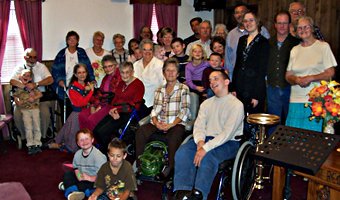
Sandie Johnson stands beside her husband, Pastor Mike Johnson, both figuratively and literally as he leads Caprock Baptist Church and faces an inevitable decline in health. (PHOTO/Courtesy of Caprock Baptist Church)

Caprock Baptist Church issued the call knowing Johnson suffers from a terminal illness.

While both Johnson and the congregation enjoyed his previous interim pastorate at Caprock, Miller admitted making the initial call to Johnson this time was difficult.

“When I was considering who could be our interim, the Lord brought the name Mike Johnson to my mind,” Miller recalled. “I wanted to argue with him. I said, ‘Lord, you know he’s ill and is on oxygen 24/7.’ But God just left me hanging, and after a few days, I made the call.”

When Johnson began preaching there last September, he relied on a cane. Later, he became dependent upon a walker, then a wheelchair and now a motorized wheelchair.

Johnson was diagnosed with interstitial lung disease in September 2008. He believes he contracted the disease through exposure to Agent Orange during military service, but so far, the Veteran’s Administration has not confirmed that.

The disease causes the tissue lining of the lungs to harden, making it impossible for blood to bring the oxygen needed to the lung tissue. The disease is progressive, and doctors told Johnson his life expectancy after diagnosis is four years maximum.

Mike Johnson (left) celebrates the affirmative vote by the members of Caprock Baptist Church who called him as pastor, knowing of his irreversible lung condition. Suffering from the debilitating illness has given him a special affinity for members of the church who likewise are confined to wheelchairs or suffer other physical limitations, he said. (PHOTO/Courtesy of Caprock Baptist Church)

He remembers clearly the day he first became aware he had a problem, when he stepped out of the cab of his pickup and couldn’t make it to the door of the building he needed to enter.

His doctor told him he probably had been making small adjustments for diminished lung capacity for months or even years before the day he had no more oxygen reserves. Doctors estimated his lung capacity on the day of his diagnosis at 46 percent. It has decreased since then.

“It’s a terminal thing. If I get pneumonia, then it’ll be real quick. So, it’s one of those things where you can’t dwell on it, because it could take a while, or it could take a short time,” he said.

About a year after the diagnosis, Miller called to ask if Johnson would preach at Caprock again. The church is located about 12 miles south of Odessa, near the intersection of Midland, Crane and Ector counties. Twenty-eight people were present the Sunday Johnson was called. Since then, Johnson has baptized four more.

Johnson praises the church for extending the invitation to him .

“I think it’s more a tribute to them than it is to me,” Johnson said. “I don’t see myself as the big guy here, the important person. I think for the church to take that risk—I mean, who would hire a pastor they know is terminal?”

However, he pointed out, many churches call pastors and other staff that they know will soon be gone after they graduate or find a larger church.

“They hire preachers they know are terminal, but they don’t mean it in physical sense, but they’re going to be gone all the same,” Johnson said. “But who would be willing to take on a pastor who they knew physically was terminal?”

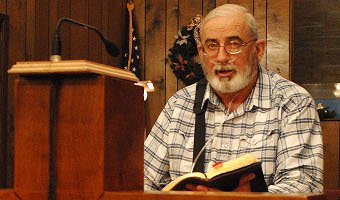
Relying on oxygen from a tank and seated in a wheelchair, Pastor Mike Johnson preaches at Caprock Baptist Church. The congregation called Johnson as pastor knowing about his terminal illness. (PHOTO/Courtesy of Caprock Baptist Church)

Caprock Baptist Church includes members who have terminal diagnoses of their own. Johnson believes he may be able to speak to their trial with a bit more insight than someone who isn’t in the same predicament.

Johnson has shared with his congregation his appreciation for heaven.

“People for years have said that we need more hell and brimstone preaching, but I’ve come to realize we need more heaven preaching than hell and brimstone,” he said.

“I’ve known many men through the years who have told me, ‘Hey, I’m going to hell, that’s where all my friends are.’ So, they are looking at hell as a continuation of the party they’re having here, which it isn’t. But I think it’s because we’re pretty ignorant about what heaven’s like—that it’s far superior, not just in the sense of damnation versus salvation, but that there’s far more to look forward to in heaven than there is to be afraid of in going to hell.”

Maybe Christians spend so much time “selling fire insurance,” they neglect extolling the wonder of heaven, he continued.

“When you’re talking about the excitement of heaven, about what’s there, then the reason you want people to come to know Jesus is so they’ll be there to experience it, not just so they’ll not be somewhere else,” Johnson said. “The good news really is good news—not just not bad news.”

As a Christian, Johnson says, has been a citizen of heaven since he was 8 years old. Now, 55 years later, he is getting closer to seeing that homeland for himself.

“The thing I’m looking forward to is all these glimpses I’ve had of heaven all these years are not just going to be glimpses anymore,” he said.

{youtube}S1QzTCJ3Y34&hl=en&fs=1&rel=0{/youtube}
Mike Johnson, pastor of Caprock Baptist Church in Odessa, talks about his calling and his illness.

Johnson also has found his illness has given him a point of connection with others who have serious illnesses. He recalled a recent counseling session with a man who had been diagnosed with cancer.

“I shared with him and his wife that what Sandie (Johnson’s wife) and I have discovered about being terminally ill is what a blessing this is, because it gives an opportunity to have conversations with your kids, your wife, your spouse, so the people you are close to can have closure,” he said.

Last Father’s Day weekend, his three daughters and their husbands and his 16-year-old son all came together so Johnson could answer any questions they wanted to ask. He didn’t want there to be any conversations that went unsaid.

“To me, it’s far more of a blessing than just dropping dead with a heart attack,” Johnson added. “Now many people say, ‘I don’t want to suffer,’ but you can be healthy and suffer.

“We were going through the same experience, so we had common language, common understanding. I wouldn’t recommend a preacher become terminal to deal with people like that. I’m just saying uniquely you’re able to not just say, ‘This is what you ought to do.’ Not just, ‘I sympathize with you,’ but, ‘I know exactly how you feel,’” he explained.

Recently, Johnson realized he had not fully considered how hard it would be for his congregation to see his health worsen, and he told them that. One woman responded, “We’re all going to get there, and maybe your being here helps prepare us for that time.”

Johnson remains certain of one thing—being pastor of Caprock Baptist Church is the right thing for him at this time. That made accepting the call easy.

“I didn’t expect to get an opportunity to (be a pastor), and it was my calling, so for God to do that, it would be kind of stupid on my part for that opportunity to come along and say ‘I don’t think I can handle it,’” he said.

With the same certainty, he knows he is on the receiving end of as much ministry as he delivers.

“This is a wonderful group of Christians who come together and they’ve been together for many years, some of them. They love each other,” he said. “The people come and encourage, push my wheelchair if I need it, help with my oxygen bottles.”

And he acknowledges the last few months have included struggles.

“It meant a lot of changes. It’s been a lot harder than I thought it was going to be. But it was the right choice in hindsight. As I look back, now I say that I can’t think of a better place to be than doing what I’m doing. The church I’m at, it was uniquely prepared for me,” he said.

“God called me to this church, so who am I to say, ‘Sorry, not qualified’—healthwise or otherwise?”


Texas Baptists urged to send ‘buckets of hope’ to help Haiti

DALLAS—Texas Baptists can provide buckets of hope to Haitians affected by the Jan. 12 earthquake that rocked the nation.

The Baptist General Convention of Texas is encouraging churches to collect buckets of food that will be picked up across the state by Texas Baptist Men and shipped through the Florida Baptist Convention to hurting and hungry people in Haiti.

The primary needs identified for Haitians right now are clean water and food. Texas Baptist Men workers are installing water purification systems and will soon be distributing water filters to families.

The “Buckets of Hope” campaign is a tangible way congregations can help provide food for hungry Haitians, said Marla Bearden, who leads Texas Baptists’ church2church partnership disaster response efforts.

{youtube}F4AeuD9fcFo&hl=en&fs=1&rel=0{/youtube}
Handy Tibert describing the Haiti earthquake first hand.

The bucket must include specific food items, be packed in a particular manner and include $10 for shipping in order to make sure it quickly passes through customs and is delivered to people affected by the earthquake. Directions can be found at www.texasbaptists.org/bucketsofhope. The buckets can be put together for less than $40 dollars each, including shipping. The site also includes the regional drop off locations.

On a national level, the Buckets of Hope campaign is being coordinated by the Southern Baptist Convention North American Mission Board, Southern Baptist disaster relief groups and the Florida Baptist Convention.

For additional information, visit www.texasbaptists.org/haitiearthquake.


Amarillo layman among 10 workers jailed in Haiti

On Feb. 11, Haitian authorities continued to hold 10 Baptists from the United States charged with child kidnapping, but Reuters news service reported the judge overseeing their case had decided to release them.

Liberty Legal Institute, a conservative group based in Plano, filed a motion Feb. 10 seeking the release of one of the Americans—Jim Allen, a construction worker and owner of a small business in Amarillo and a member of Paramount Baptist Church there.

Allen is one of 10 Baptist volunteers who were arrested Jan. 29 by Haitian authorities for failing to obtain proper documentation to transport 33 Haitian children into the Dominican Republic where the Baptist team’s leader, Laura Silsby of Idaho, was seeking to open an orphanage.

Leaders of the Southern Baptist Convention urged President Obama Feb. 5 to do everything within his power to secure release of the volunteer missionaries.

Morris Chapman, president and CEO of the SBC Executive Committee, SBC president Johnny Hunt and former president Frank Page sent a letter to the president voicing concern “that the continued detainment and possible conviction of these Baptist mission volunteers will distract the world’s attention and undermine the relief efforts so desperately needed by the Haitian people.”

The Baptist leaders said they don’t know all the facts of the case and therefore cannot speak with authority about the motives and actions of the group comprised mainly of members from two Southern Baptist congregations in Idaho.

“What we can assure you of, however, is that many Southern Baptists are currently in Haiti—and elsewhere around the world—for the sole purpose of doing whatever is necessary to meet the physical and spiritual needs of the poor, the hungry and the oppressed,” they wrote. “It is possible that the Baptist mission volunteers currently detained in Haiti have acted with the noblest of intentions in a desperate situation to meet an immediate need. We pray that is the case.”

They called for diplomatic negotiations toward “a solution that respects the rule of law, honors international agreements and ensures the best possible care and full legal representation for these Baptist mission volunteers.”

They also asked Obama to provide medical treatment and spiritual counsel to the missionaries while they are detained and to arrange for a representative of their churches, the SBC or both to visit them in Haiti as soon as possible.

The two churches where most of the detained Americans attend are both affiliated with the SBC, but they acted independently and did not coordinate the trip with either of the convention’s two mission boards.

But the leaders said their understanding is that the 10 volunteers went to Haiti with intent to help Haitian children and attempted to transport them into the Dominican Republic for “humanitarian purposes.”

Because the woman leading the team runs a nonprofit organization that provides services including adoption, some speculated that the group intended to talk Haitian parents into giving their children up for adoption so they might find a better life.


Compiled from reports by Baptist Press and Associated Baptist Press