Student ministries intern touches the world—from Plainview

PLAINVIEW—When Katie Trimble signed on to serve as a Baptist Student Ministries intern at Wayland Baptist University, she anticipated a special year. What she didn’t expect is that she would get to “see the world” without ever leaving Plainview.

Trimble, who graduated from Wayland last year, stayed on at her alma mater as a volunteer with Go Now Missions through the Baptist General Convention of Texas. And during the one-year term, she’s confirmed her call to minister to college students—with a bit of a twist.

Katie Trimble (center), Baptist Students Ministries intern at Wayland Baptist University, enjoys time with a group of international students during a San Antonio Spurs game. Pictured are (from left) Joshua Brown, son of BSM Director Donnie Brown, Marcos Chenthitta of Dubai, Jerry-Lee Davis of Barbados, Nickie Coutinho of Comoros and Mario Scott of Barbados. (PHOTOS/Wayland Baptist University)

“While we were planning this year, we decided that one big part of my job would be to work with international students, which we really hadn’t done much of before,” Trimble said. “We got lots of ideas from other campuses about what they do and just sort of started from scratch.

“We wanted to focus on this because it wasn’t a big focus anyone else was doing. We just wanted them to know that we were here for them if they needed anything.”

BSM leadership students and Trimble made themselves available to international students for rides to the grocery store, help with doctor visits and other day-to-day needs.

“We forget sometimes that many of them don’t have cars or don’t know the lingo here as much as we do,” she said. “They just sometimes need a hand.”

Trimble began the year making contact with all the international students on campus—many of them connected to Wayland’s athletic programs—and beginning a series of monthly dinner nights where students shared dishes from their home countries.

Anika Voigt of Germany, a Wayland Baptist University student, tries out the roller coaster seat before boarding a ride at Sea World San Antonio.

That effort proved a success from the standpoint of just getting to know the students and letting them share a piece of their own heritage, instead of just acclimating them to American traditions, Trimble said. About two-dozen students regularly participated.

“I don’t think I’ve ever eaten so much,” she said. “The students are good cooks and really enjoy sharing their culture.”

In October, the BSM took 12 students to the Wayland cabin in Glorieta, N.M., for a long weekend retreat to relax and enjoy the mountains. Similar BSM programs from Texas Tech and West Texas A&M joined them at the retreat; so, the internationals got to visit with peers from nearby schools.

The year-long outreach effort culminated recently in a trip to Austin and San Antonio, where about a dozen students enjoyed sightseeing at the state capitol and Sixth Street and had fun at Sea World and a San Antonio Spurs basketball game.

“We wanted to give them a chance to see more of Texas and experience our culture as well,” said Trimble, who noted a marked difference in the relationships between internationals from the start of the school year.

The students said the experience was enjoyable, and they got a glimpse of a new world in a different part of Texas.

“I loved it. It was cool to get of town and see the sights,” said Anika Voigt, a sophomore from Potsdam, Germany, who plays on the Wayland Pioneers volleyball team. “My favorite part was Sea World and the Riverwalk. It was very pretty there, and I was surprised at how pretty San Antonio is. It reminds me more of home with more trees and water.”

Voigt and Marcos Chenthitta, a senior from Dubai in the United Arab Emirates, said they enjoyed the educational aspects of the trip as well, even though it was during a break from school.

“The capitol in Austin was very pretty, and we learned a lot about the state and the city of Austin. We got to learn on this trip too,” said Chenthitta, who is studying business.     Latanya Nation, a sophomore from Jamaica, enjoyed the chance to see another side of Austin besides the place where she’s competed as part of the track and field team.

“I enjoyed every moment of the trip,” Nation said, including the van ride there. “I enjoyed the capitol building, and we got to see the old stuff and the historical things, and learned a lot that we didn’t know. I really enjoyed the rides at Sea World, too, and the shows and animal exhibits.”

Her first time on a rollercoaster admittedly was scary at first, but Nation said the trip was a great getaway for her and other international students.

“We got to know Katie better, so that was good too,” Voigt said. “We are pretty far away from home, but we’re just like the other kids.”

That sentiment sums up the reason the BSM set its goal to reach out to internationals, Trimble said. And while the students may have benefited from new friends, new experiences and helping hands, Trimble said she’s grown herself from the yearlong ministry.

“It’s been awesome for me. I was nervous about what to do or how it would work out,” she said. “But it’s been so good just to get to know them and see them come to trust us as friends. I see things with a whole new view of the world.”

While conversations about faith are a natural part of the process at a Baptist university, Trimble said just reaching out to students with unique needs has been the first priority.

“They are open to talk about religion and what they believe,” she said. “We really want to just love them and show them Christ’s love.”

Trimble will accompany students on a mission trip to England this summer to close out her time with Wayland. Students will be working with two churches, leading Bible schools for children specifically.

Trimble emphasized her internship experience has helped her discover her passion for ministry, and she believes college students are a group she’s called to serve. International students are also special to her as a ministry field—one she might not have discovered if not for this year’s experience.


Small-town students make big impact on children’s home campus

ROUND ROCK—Gina Bradshaw didn’t realize a five-hour drive to visit her daughter at the University of Texas in Austin would lead to a community-wide effort to help Texas Baptist Children’s Home, but she’s glad it did.

Sixteen high school students and two teachers from Garrison made the 250-mile trek from their East Texas hometown to deliver much-needed food items and provide some hard labor.

“Honestly, I was surprised they wanted to come this far,” said Brenda Gilbert, volunteer coordinator at Texas Baptist Children’s Home , part of Children at Heart Ministries. “They are the only school that has made such a long drive just to help us out.”

Garrison High School students who volunteered at Texas Baptist Children’s Home included (left to right) Micah Hammer, Evan Delafield, Presley Cook, Jaemee Lilly and Tatum Greer.

The idea came about after Bradshaw, a member of Holly Springs Baptist Church in Garrison , passed the children’s home campus on her way to visit her daughter at college. Seeing the home reignited a long-held desire to help, in some small measure, the children who live there.

“I’ve always said I wanted to do some service at a children’s home,” she said. “And because we are such a small community, we don’t have the opportunity to do this type of outreach very often.”

Bradshaw approached the principal at Garrison High School, where she is the business teacher, and found him supportive—so supportive he encouraged the whole school to become involved.

Bradshaw also is the adviser to the school’s Fellowship of Christian Athletes, which took the lead in raising money and collecting 1,000 boxes of cereal for the children’s home.

“We feed 150 residents on this campus every day,” Gilbert noted. “So, cereal and other breakfast foods are a huge help to house parents.”

Bradshaw worked with another faculty member, Leslie Nichols, to help sponsor the trip, but she gives most of the credit to the students who were involved.

“The kids really turned up the heat on this one,” she said. “Everyone got excited about this project. Kids held signs out by the bus stop and held fund-raisers. Even our churches began holding cereal box drives to help out. It really became a community effort.”

After arriving in Round Rock on a Sunday afternoon, the group had barely put their bags down before joining the children on campus for chapel and then heading out to buy supplies to refurbish the recreation room inside the children’s home activity center.

The student volunteers also repainted a relief apartment adjacent to a family care cottage.

“This was probably one of the best groups I’ve ever worked with,” Gilbert said. “The kids are just so polite, and everyone was willing to do whatever needed to be done. They were just wonderful.”

Besides experiencing their first school-sponsored road trip, the students from Garrison High took away something else back home with them to East Texas.

“It’s pretty eye opening,” said Lauren Lackey, a Garrison High School student. “Being here makes us appreciate our parents and just how good we have it.”

And the Garrison students were happy to help the children.

“These kids have gotten so much out of this experience just by doing something for someone other than themselves,” Bradshaw said. “I hope, more than anything, that they have learned the joy of serving others. That alone more than makes up for the miles.”


Gregory inducted into MLK International College of Preachers

Morehouse College President Robert Franklin recently inducted Joel Gregory, professor at Baylor University’s Truett Theological Seminary, into the Martin Luther King Jr. International College of Preachers.

The College of Preachers recognizes pulpiteers who embody the principles of peace, justice and reconciliation proclaimed by Martin Luther King Jr. Gregory recently was the keynote speaker at the 142nd Founders Day Celebration at Morehouse School of Religion.

Morehouse College President Robert Franklin inducts Joel Gregory into the Martin Luther King, Jr. International College of Preachers.

“American history does not know a preacher who moves with such ease and grace across what many have considered the unbridgeable chasm of race as does Joel Gregory,” Presidential Medal of Freedom Winner Gardner C. Taylor said. “Possessed of a rare integrity in the proclamation of the Savior’s gospel with stellar gifts as a preacher and a heart strangely warmed, Joel Gregory is messenger of Christ to all of America.”

This induction followed other recognitions of Gregory’s cross-cultural preaching. At the National Mighty Men of Valor conference at Valley Forge, Pa., Gregory was recognized with the “Man Behind the Men” award for his influence on both preachers and laity in cross-cultural ministry. Conference director Cliff Ashe presented the award.

Recently, Gregory was the first Anglo preacher to address the Prairie View A&M Pastor’s Conference in the 59-year history of the conference at the historic African-American university.

Commenting on Gregory’s cross-cultural preaching, Robert Smith Jr. of Samford University’s Beeson Divinity School said, “As one of the most effective preachers of the gospel in the English-speaking world, Joel Gregory builds a bridge between the black and white culture without compromising the uniqueness of human personality.”

This summer, for the fifth year, Gregory will lead a group of predominantly African-American preachers in an intensive study of preaching at Regents Park College, Oxford University under the sponsorship of Georgetown College in Kentucky.


Anglo church responds to ‘mission field across the street’

DALLAS— Every Sunday morning 8-year-old Omar Quintero wakes up, combs his hair and jumps on a church bus just in time to make it to Bible study at the Amigos de Dios mission of Park Cities Baptist Church.

Families worship together during a Spanish-language service held in the gym at Park Cities Baptist Church. More than 120 people attend Amigos de Dios service on a regular basis.

Omar is one of about 125 people who attend the Spanish congregation. Many are Mexican immigrants or children of immigrants—like Omar—living in the Vickery Meadows Community in Dallas.

Amigos de Dios started in the summer of 2007, when seven people began meeting in a crowded office at the Park Cities missions building, said Sam Silva, a Buckner International staff member and pastor of Amigos de Dios.

“We got so big that by the summer of 2007, we moved to a conference room in the missions office and by 2008 we were meeting in the church gym.”

The money for that outreach came from the Wise Trust, a $500,000 donation given by Leola Lyons Wise after her death. The money was to be used for missions.

“Our stated purpose was to seek to meet the needs of the community and to do everything possible to encourage those living in Vickery to join Park Cities Baptist Church,” said Bob Hefner, chair of the committee in charge of allocating the Wise donation.

“Therefore we feel we have honored Ms. Wise’s hope and that the gift, which continues to support our efforts at Vickery, has been of substantial kingdom-building benefit, for which we give God all the glory.”

Victorino and Angelica Trujillo were two of the original seven people to join Amigos de Dios. They said they remember the first time they walked in to Park Cities. They loved it, but they didn't understand what the preacher was saying. (PHOTOS/Analiz Gonzalez Schremmer/Buckner)

When Spanish-speaking families from Vickery, where Buckner operated a community center, started going to the church, they encountered a language barrier. So, the church launched its Spanish-language Bible study, which has grown into a thriving congregation.

The love demonstrated by church members and the power of the Scriptures to touch her heart kept Mayra Falcon, 20, attending Amigos de Dios.

“I went to church as a kid, but it was here that the message of the Bible penetrated. So I stayed,” she said in Spanish. “I love the fellowship and how they treat each other here— how they love each other.

“I don’t mind that we are the minority. Even though our services are separated, there are times in which we all come together and we know that we are seen as equals. The important thing is that we all stay together and keep learning from each other so that we can be better Christians and learn about the word.”

Buckner International has partnered with Park Cities Baptist to serve the children and families in the Vickery Meadows community more than 10 years.

“The collaboration that Buckner has with Park Cities is one that we would like to duplicate with other churches,” said Felipe Garza, vice president of national operations at Buckner. “We want to integrate the church into the community and the community into the church life, as well.

“Here is a large, predominantly Anglo church, which has a largely Hispanic community as a next-door neighbor. Well, the church saw it as a mission field across the street and they put funding into the collaboration with Buckner, established Kids Hope USA (a mentoring program) and Cool Kids to serve children in the area, and then started a Bible study that became a Spanish congregation.”

Two of the many members who have benefited from the collaboration are Victorino and Angélica Trujillo. They were some of the first to join the group and clearly remember the days when they used to meet in the crowded office.

“The first time we walked in, we went to the English service,” she said. “We were under-dressed and couldn’t understand most of what was said, but we liked it. We started meeting with Sam in an office with five other people.

“When we were baptized, we emerged from the water with peace, and we’ve grown in our relationship with God. God has blessed us so much that people wouldn’t believe us if we told them.”

Her husband said at first, it felt odd to be the minority in the church.

“But God doesn’t care about the color of your skin. He just loves you and we know that. In some places you will experience racism. But it isn’t like that here. It’s different that way.”


CERI volunteers meet medical, dental needs in rural Nigeria

OTUTULU, Nigeria—A volunteer team of Houston, San Antonio and Brownville-area health care professionals treated about 1,200 orphaned children and needy families in Nigeria during a one-week trip sponsored by Children’s Emergency Relief International.

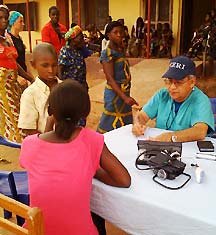
Chris Perkins, a dentist from First Baptist Church in Kingwood, performed extractions and a few oral surgeries for patients in Nigeria. The modest facility where he worked had simply a straight-backed wooded chair and no electricity. (PHOTOS/CERI)

The doctors, nurses, dentist and other health care providers treated resident of the Ministry of Mercy orphanage and villagers in Otutulu, Nigeria.

“The need for medical care in rural villages throughout Nigeria is tremendous. Each time CERI leads a mission trip to Africa or other impoverished countries, we are reminded how important it is that volunteers, like the team members on this trip, share their healing gifts with struggling children and families throughout the world,” said Dearing Garner, executive director of CERI, the overseas arm of Baptist Child & Family Services.

“We can’t heal the whole world on a single trip, but our organization and our devoted supporters will continue to reach as far as we can to touch the lives of those who are hurting.”

Family Physician Saul Camacho, a member of First Baptist Church in Brownsville, provided medical care to residents of Ministry of Mercy orphanage in Nigeria. (PHOTOS/CERI)

The Texas team—joined by volunteers from Georgia and Colorado—distributed more than 500 pounds of medication and provided treatment ranging from neonatal care to geriatrics, dealing with issues such as typhoid, malaria, abscesses, chronic pain and wound care.

“It was a life changing experience to see the satisfaction and smile on each person’s face after receiving the care they needed,” said David Marks, a physician from San Antonio. “It was all worth it for them to know that someone cared about them. It really is a testament that people can make a difference in this world.”

The Ministry of Mercy orphanage provides care for more than 230 children and teenagers, including many with special medical needs.


Texas WMU elects new president, challenged to ‘walk victoriously’ through rubble

DALLAS—For the first time in Woman’s Missionary Union of Texas history, the organization elected a president who was nominated from the floor.

Continuing the change that has characterized the organization in recent months, Texas WMU at it annual meeting in Dallas elected as president Texas WMU Executive Director Emeritus Joy Fenner of Gaston Oaks Baptist Church in Dallas.

Fenner, a veteran missionary to Japan and past president of the Baptist General Convention of Texas, defeated incumbent Paula Jesser of El Paso.

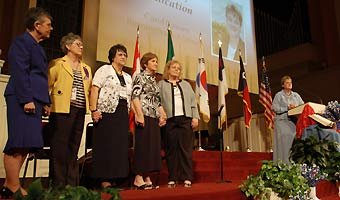
Carol Causey of national Woman’s Missionary Union leads a prayer of dedication for new officers elected at the Woman’s Missionary of Texas annual meeting— (left to right) President Joy Fenner from Gaston Oaks Baptist Church in Dallas; Third Vice President Suzie Plunk from Fellowship Baptist Church in Morgan’s Point; Second Vice President Margery Flowers from Fellowship Baptist Church in Marble Falls; First Vice President Gloria Mills from First Baptist Church in Henderson; and Recording Secretary Kay Kolb from First Baptist Church in Midland. (BGCT PHOTO)

Another former missionary, Betty Law from Gambrell Street Baptist Church in Fort Worth, nominated Fenner, who served Texas WMU as executive director-treasurer from 1981 to 2001.

In the past two years, Texas WMU has seen an executive director resign, an interim executive director fired by the WMU board’s executive committee and the entire program staff leave.

The board hired Nelda Seal, former executive-director of Louisiana WMU, as interim executive director last June.

During the annual meeting, Seal called Texas WMU leaders to move past the division and hard feelings that have hurt the organization’s cause. If the organization is going to be a successful group in the future, these types of actions must cease, she stressed.

WMU of Texas “has been blighted by hurts, disappointments, wrongs and resentments,” she said. “But do we want to dwell amid this rubble of our lifetime and allow these emotions to shape our future? I think not. If there is rubble, through rubble we must walk, but we must walk victoriously.”

For Texas WMU leaders, that process begins with forgiving each other, Seal said.  That can be a hard road to travel, but the women must go through it.

“Forgiveness must be asked for the wrongs that have been done, whether intentional or not intentional. Forgiveness must be granted, even when it’s not asked for.”

Unity is crucial for Texas WMU to carry out its task, Seal said. Sixty-five percent of churches and missions in Texas do not have a missions organization. People in these congregations need to understand God calls them to share the gospel to their neighbors around the globe and across the street.

“Our task it too big and too important for us to dwell in the past of hurts and disappointments and wrongs and failures,” she said.

Texas WMU must work together to help the hurting, be a friend for the lonely and serve people in need, Seal said. If members cooperate and follow God’s call, they will help expand God’s kingdom across the state and around the world.

“We have a huge job as WMU of Texas,” she said. “We do it one-by-one, day-by-day.”

In the other elections, the slate of candidates put forth by the Texas WMU nominating committee were elected without opposition—First Vice President Gloria Mills from First Baptist Church in Henderson; Second Vice President Margery Flowers from Fellowship Baptist Church in Marble Falls; Third Vice President Suzie Plunk from Fellowship Baptist Church in Morgan’s Point; and Recording Secretary Kay Kolb from First Baptist Church in Midland.


Board affirms proposal to dissolve WorldconneX, let BGCT assume its functions

DALLAS—The WorldconneX board of directors affirmed a move April 17 that would dissolve the organization and incorporate its primary functions into the work of the Baptist General Convention of Texas Executive Board staff.

The BGCT Executive Board must approve the action, initially put forth by BGCT executive leadership, before it takes effect.

If approved, WorldconneX as a corporate entity will be dissolved and at least two WorldconneX staff members will become part of the BGCT staff.

The staff will continue to provide three services to churches—helping them directly send long-term missionaries; assisting them in finding God’s unique calling and giftedness; and connecting with international networks for mission work. The move also will inject more than $1 million into the BGCT missions budget.

“I can’t think of a time in church history where congregations had a greater opportunity to fulfill the Great Commission than today. Communication, travel and globalization bring people groups together from around the world. WorldconneX discovered educational tools and missions partners that will provide resources for our Texas Baptist churches to respond to this kingdom challenge,” BGCT Executive Director Randel Everett said.

“Integrating WorldconneX into the larger missions outreach of the BGCT will provide our churches with the potential of supporting traditional Baptist mission agencies, as well as partnering together to respond to unique gospel possibilities.  Using the biblical analogy of the seed dying to give new life, the dissolution of WorldconneX will bring living mission realities perhaps for decades to come.”   

WorldconneX Leader Bill Tinsley affirmed this new direction.

“I am gratified to hand off to the BGCT the unique assets of WorldconneX that will help forge a missions future that builds on the past and carries forward the innovative and creative legacy of Texas Baptists,” said Tinsley, who will work for the BGCT on a contract basis through 2009. “I am confident these elements will take root, flourish and bear great fruit for the kingdom of Christ.”

Started in 2002 as a network that would help churches chart a new direction for missions in the 21st century, WorldconneX helped churches work through the process of sending members to serve as long-term missionaries around the world.

Recently, the group created a fund that would help smaller congregations finance the direct sending of missionaries. Those funds are helping support missionaries in South America, Africa, Asia and Eastern Europe.

WorldconneX also helped bring together groups and churches ministering in a region internationally to help them better coordinate efforts. The strongest of these affinity groups were in Kenya and Guatemala.

The organization was instrumental in Texas Baptists ministering in the wake of the Southeast Asia tsunami, helping connect Texas Baptist Men, Children’s Emergency Relief International and numerous churches to missions opportunities throughout South Asia in the wake of the disaster.

“As the BGCT takes action to dissolve WorldconneX as a corporation and to integrate the key components that WorldconneX has created into the life of BGCT, I am gratified to have been given the opportunity to contribute to a new missions future for Texas Baptists,” Tinsley said.

“I returned to Texas in 2001 from my position as executive director of Minnesota-Wisconsin Baptist Convention with that goal in mind and a sense of call for that purpose.”


From $20 seeds, church yields $12,500 for hunger offering

With leadership from children and youth, members of Wilshire Baptist Church gave about $12,500 to the Texas Baptist Offering for World Hunger on Palm Sunday.

That sets a new record for a hunger offering at Wilshire and puts the church within reach of exceeding its previous annual total in hunger giving before the year is half passed.

Joel Spreier of Wilshire Baptist Church in Dallas fires up the grill for a Hotdogs for the Hungry event. He raised more than $100 for the Texas Baptist Offering for World Hunger.

The offering increase was sparked by a finance committee decision to use 10 percent of the overage from last year’s ministry fund as seed money for the hunger offering.

The church set aside $4,000 in $20 bills for distribution to any child or teenager willing to take the money and either multiply it, keep it safe or use it in direct local ministry to the hungry.

On Super Bowl Sunday, the missions committee distributed $2,440 in $20 bills to 122 children and youth who agreed to participate in the challenge.

That investment came back multiplied many times over, not only by the actions of children and youth, but also by other Wilshire members who were inspired by the cause and contributed to the offering.

In previous years, Wilshire had sponsored a soup luncheon on Super Bowl Sunday and asked members to donate to the hunger offering rather than paying for the soup. When ongoing construction and renovation at the church facility made that event impractical this year, the church’s missions and finance committees worked together to create the seed money challenge as a hunger offering fund-raiser. And it more than doubled the highest amount ever raised through the Souper Bowl of Caring event.

That coincided with an increased emphasis from the Baptist General Convention of Texas on its Texas Baptist Offering for World Hunger.

Julie Francis holds a bake sale in her front yard. Julie took the $20 bill in seed money given by Wilshire Baptist Church and made $216.50 for the Texas Baptist Offering for World Hunger.

News of this success especially was rewarding for Wilshire member Carolyn Strickland, first vice president of the BGCT and widow of Phil Strickland, who as director of the Christian Life Commission led in creating the Texas Baptist Offering for World Hunger.

“The united effort at Wilshire to support the hunger offering is a blessing beyond measure,” she said. “I can’t tell you how many times I’ve mentioned about the missions committee handing over $20 to individual youth to decide on how they will make it grow to feed the hungry. Being led by children to invest in the lives of others is just short of being led by the Spirit of God, in my book.”

In some cases, siblings or classmates combined their $20 bills to do something big. For example, the 11th grade Sunday school class held a bake sale one Sunday morning and turned $100 into more than $400.

Josh Bonar and his brother, Zac, combined efforts. “My brother and I put our money together and got donations of clothes and furniture to sell in a garage sale. We also bought some Cokes and sold them for 50 cents each. We made $156.”

The Nadalini brothers—Taubert, Travis, Austin and Alex—also worked as a team. They wrote: “Rather than growing our money and putting it in the offering plate on Palm Sunday, we grew our money from $100 to $120 with the help of a generous Wilshire member who heard how we were using our money. We then gave our money to an 80-year-old woman (who) needed money for groceries.”

Friends Bryn Anderson, Ryan Meazell and Sean Swift engaged all three of their families in a joint project to host a party at a business that offers a variety of inflatable bounce houses. They explained: “We sent an invitation to our friends and invited them to come to Pump-It-Up to jump and play and then have pizza, cookies and lemonade. For a donation of $12, the parents could drop their kids off for two hours. Pump-It-Up kept $4 of every $12, so we kept $8 of every $12 donated. We used our $20 to buy cookies, lemonade, plates, cups and napkins. We had a great time and raised $315.”

Brothers Drew and Mitchell Easley cooperated to meet a local need. “We pooled our money to buy 40 boxes of macaroni and cheese and 25 cans of tuna. We then delivered them to the White Rock Center of Hope and even stayed a bit to stuff grocery bags.”

Joel Spreier hosted a Sunday afternoon football game and meal at his home, an event he called “Hotdogs for the Hungry,” which he promoted on Facebook. He used his $20 to buy supplies, then charged friends $5 each to attend. He raised more than $100.

Several children used their $20 to buy candy in bulk and then sell it to friends at school.

“I kept on buying boxes of candy,” said Karlee Langley. “I took the candy to my daycare, my family and my street. Out of the all this, my total amount of money that I raised was $62. I am very proud of myself because I am now feeding the hungry.”

Shelby Patterson also sold the candy to friends after school. “Some of my friends paid more than a dollar for the candy because they knew it was for a good cause,” she said.

Christopher Granberry took his $20 to the grocery store and bought ingredients to make banana bread and cinnamon rolls. He sold his baked goods at his dad’s workplace for $109.75.

Harper McKenzie developed her own line of designer rocks. “I painted rocks and sold them. I painted inspirational words and pictures on the rocks. I painted almost 40 rocks. I started with $20 and ended with $201.”


First-century Jerusalem brought to life by North Texas church

DESOTO—Windsor Park Baptist Church saw more than 20 people make professions of faith in Jesus Christ through its outdoor dramatization of Passion Week.

Roman soldier stands guard in Windsor Park Baptist Church's Jerusalem Marketplace simulating first-century life at the time of Christ's crucifixion. (PHOTOS/Micaela Henson)

Jerusalem Marketplace began four years ago at the prompting of the church’s children’s director. In the days leading to Easter, the marketplace was bustling with about 20 vendors plying their wares, such as the moneychanger, the cloth merchant and the animal tender. Also included were the upper room, the jail and the synagogue.

While 168 members of the church played costumed roles, people who came to see the production also were given the opportunity to don the garb of biblical times. The church had 99 children’s robes available to those who came to watch so that they also could participate in the living drama that played out on Thursday, Friday and Saturday evenings.

Pastor Chris Seidlitz for the first three years played the role of Annas but this year portrayed Caiaphas.

“I love it. It’s so much fun,” he said. “The children are so fun. The other night, one of them looked at me and asked, ‘Don’t you love Jesus?’ because they know me as pastor, but here I am shouting, ‘Crucify him!’

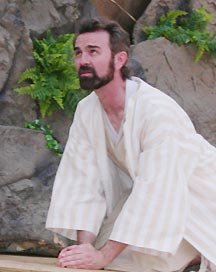
Assistant Pastor Steve Armstrong portrays the role of Jesus in the Jerusalem Marketplace outdoor dramatization performed by members of Windsor Park Baptist Church in DeSoto.

He recalled another child who saw the woman playing the role of Mary weeping. The child began yelling at the Roman guards, “Let her son go.”

“It becomes so real for them. They are in the concrete stage, and it’s really a great visual representation,” he said.

The drama has several vignettes such as Jesus’ triumphal entry, the Last Supper, the garden of Gethsemane, Jesus’s arrest, his trials before the high priests and the Roman rulers, and finally his crucifixion. Assistant Pastor Steve Armstrong played the role of Jesus.

In between the larger vignettes, church members continually role-played life in Jerusalem, many of them engaged in conversation about who Jesus really was—lunatic, troublemaker, prophet or Son of God. They willingly engaged those who came to watch in their conversations.

After the resurrection scene, Seidlitz presented an opportunity to respond to the gospel presentation.

This year, at least 21 people made professions of faith in Christ. There probably were more, Seidlitz said, but the crowd was so large Friday night that some who raised their hands indicating a spiritual decision were unable to be reached with materials to document it. Saturday night, weather forced the production to be stopped midway.

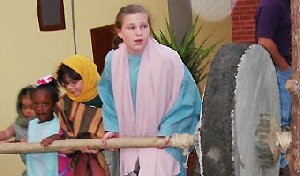
Participants take a turn grinding at a mill.

Decisions also were made during Sunday morning’s worship service that may have stemmed from the production, he said. “Now we get to start on the follow-up,” Seidlitz said.

Previous productions not only added to the church rolls, but also to the cast, as people who made professions of faith during the performances now are putting it on for the benefit of others.

The three nights of the drama make a good lead-in to Easter, Seidlitz said.

“By the time Sunday rolls around, they are exhausted, but they are also so excited. There’s just an anticipation of what’s going to happen on Sunday morning. It’s exciting around here,” he said.


Christian student from India preaches Easter message to Hindus

DALLAS—How does a Dallas Baptist University student get the opportunity to preach the gospel on Easter Sunday on a radio station with a predominantly Hindu audience?

“I don’t know,” Sastry Meesala said. “It can only be the working of the Holy Spirit.”

Meesala, a native of India, was called on the morning of March 14 and asked if he would conduct the Lord’s Supper for the meeting of the Bible Believers Telegu Association. The group of about 70 Indian Christians of various denominations meets once a month in Richardson for prayer and fellowship.

Sastry Meesala, a Dallas Baptist University student, had a unique opportunity to preach the gospel on Easter Sunday on a radio station with a predominantly Hindu audience.

Telegu is the language spoken in Meesala’s home region of Andhra Pradesh in South Central India. The pastor who was to conduct the Lord’s Supper could not attend because of car trouble. As Meesala conducted the rite, he also gave a short sermon.

After the service, a man from the Telegu Association of North Texas asked Meesala if he would like to preach on the local Indian station.

“He said they had other cultural programs but nothing about Christianity. He was a Hindu, and I don’t know why he wanted a Christian program. It could only be the Holy Spirit,” Meesala said.

Since Easter was not far away, they agreed that would be a great time for the broadcast.

Meesala quickly began enlisting the prayers of fellow DBU students and the congregation at First Baptist Church in Duncanville, where he is routinely the youngest person present for Wednesday night prayer meeting.

“The prayers of those people should get the credit,” Meesala said.

In addition to three New Testament scriptures, Meesala also mentioned a Hindu scripture in his Easter sermon.

“In the Hindu scriptures, there a place that says there can be no forgiveness of sins without the shedding of blood. But in the Hindu religion, there is no one who provides that blood. I told them that Jesus was that sacrifice,” he said.

At the of end the service, the radio station received many text messages and e-mails about the sermon, most asking questions about Christ as a sacrifice for sin.

While no plans have been made for another Christian sermon on the station, Meesala received a call on Monday after Easter telling him his time slot had one of the largest audiences the station has recorded.

Whether this station chooses to carry Christian programming for Indians or not is uncertain, but Meesala is certain the need is there.

“One hundred and fifty thousand Indians live in the Dallas-Fort Worth area, and no other station is doing this type of ministry, but if any church or ministry comes forward to support this sort of thing, many will be saved and know the resurrected Lord,” he said.


Beloved community built on spiritual, biblical foundations

ABILENE—The beloved community—a vision that shaped the American Civil Rights Movement—was built upon the Bible, Emmanuel McCall stressed during the annual Maston Lectures at Hardin-Simmons University’s Logsdon School of Theology.

McCall, founding pastor of The Fellowship Group in Atlanta, Ga., is vice president of the Baptist World Alliance and past moderator of the Cooperative Baptist Fellowship.

For more than 23 years, he directed black church relations for the Southern Baptist Home Mission Board. He is an adjunct faculty member at Mercer University’s McAfee School of Theology and writes for the Baptist Standard’s “Right or Wrong?” ethics column.

Emmanuel McCall

The idea of the beloved community emerged after Martin Luther King Jr. delivered his famous “I Have a Dream” speech in 1963, McCall said.

“The idea embraced the concepts of fairness, justice, equality of opportunity, enabling each other; living with race, class or religious preference without incrimination; people living in peace, safety and security—God-respected and honored,” he explained.

McCall pointed to three Scripture passages that form the biblical foundation for the beloved community.

The Old Testament story of Cain and Abel has been misinterpreted to mean people are to be their “brother’s keeper,” he claimed. In the story, Abel offers God a meat sacrifice, and his brother, Cain, offers fruits and vegetables. God affirms Abel’s offering and rejects Cain’s. Raging with jealousy, Cain kills Abel. When God asks about his brother, Cain retorts, “Am I my brother’s keeper?”

McCall theorized God accepted Abel’s gift because he gave his best and rejected Cain’s because he “took life’s shortcuts” and failed to offer his best produce.

“Rather than change his attitude about worship, Cain decided to remove the competition,” McCall said.

“He reasoned if Abel were no longer around, God would always affirm his gifts. … When God raised the question, ‘Cain, where is Abel your brother?’ Cain gave back a smart-aleck reply. In essence, he said: ‘Why are you asking me? Am I supposed to keep up with him? Am I to look after him? Am I my brother’s keeper?’”

Be your brother's brother 

People are supposed to be their brother’s brother, not their brother’s keeper, McCall said.

He illustrated by describing his younger brother, Tim. When they were young, McCall was his brother’s keeper, protecting and looking after him. But when Tim grew up, they became equals.

“The biblical foundation is to respect the freedom God grants each of us while also working for the good of the other,” he said. “Brothering is indeed loving your neighbor as yourself.”

The beloved community also involves “community consciousness,” McCall said, describing the story of four lepers whose story is told in the Old Testament book of 1 Kings.

The lepers were social outcasts who had been excluded from Samaria because their disease was believed to be highly contagious. So, they lived outside the community when the Syrian king laid siege, nearly destroying the city.

When God confused and frightened the Syrian troops, they fled and left everything behind—including food, clothing, the spoils of other battles and, most especially, precious food. Soon, the lepers discovered the empty camp.

Although the lepers could have hoarded all the army left behind, “they possessed a commodity every community must have—a community consciousness,” McCall reported.

So, the lepers ran to Samaria to tell the inhabitants about the good fortune and the abundance of food. “These former beggars became heroes,” he said. “Community consciousness looks after the welfare of each other.”

Servanthood of the towel 

Turning to the New Testament, McCall focused on the “servanthood of the towel” exemplified by Jesus when he washed his disciples’ feet.

They gathered for a banquet, and the 12 followers jostled and competed with each other to get the “best” places at the table beside Jesus. So, Jesus—their teacher and leader—got on his knees and took on the lowliest task, washing the feet of each disciple, and then telling them:

“If those seeking the beloved community are stressed out on titles, positions, control, bossing and ‘feathering their own nests,’ community will not be achieved,” McCall warned. “We must cultivate the disciplined mindset that we serve because it is right to do so, not for the expected reward.”

In Jesus’ model prayer, he said, “Thy kingdom come, thy will be done on earth, even as it is in heaven,” McCall recalled, pointing out Jesus believed the beloved community “could be a reality.”

“If it is to happen, it must be established on solid spiritual foundations,” he said. “Piece by piece must be structured with love.”

The Maston Lectures are named for T.B. Maston, a pioneer Christian ethicist and professor at Southwestern Baptist Theological Seminary, and sponsored by Logsdon’s Maston Chair of Christian Ethics.


Every dinner table was a teaching opportunity for Jesus

ABILENE—Jesus taught important ethical lessons while dining, Emmanuel McCall told participants at Logsdon School of Theology’s annual Maston Lectures.

McCall pointed to three ethical themes Jesus emphasized as he dined with his disciples and others.

Compassion. The Gospels describe two occasions when Jesus fed large crowds who had gathered to hear him teach and perform miracles.

“The ethical imperatives in both instances are similar,” McCall said. “Jesus had compassion on the people. He felt concern and sorrow for their plight. They had left home in search of truth or in need of a blessing. Without food, they would perish.”

Compassion is different from pity, sorrow or feeling bad, he said. “Compassion is an ethical response to human situations. … Compassion does not send people away without some resolution to their problem, or at least willingness to work on a solution.”

Care for others. Jesus once told a story about a host whose intended guests all turned down his invitation. So, he sent his servants into the streets to invite day laborers, hungry people and the poor to participate in his sumptuous banquet. McCall acknowledged most Christians cite this parable as an evangelistic lesson about sharing the gospel with all kinds of people. But in so doing, “we gloss over the ethical imperatives” of the story, he said. “We must not miss the fact that the generous patron wanted everyone included in his banquet. … Those who cannot care for themselves, society’s unfortunates, the social ‘misfits’ … cannot be helped by remote control,” he said. “They have to be touched and nurtured.”

Focused singularity. After Jesus’ resurrection, Peter and some of the disciples returned to their previous occupation, fishing. Early in the morning, Jesus prepared breakfast for them on the beach. When they finished eating, Jesus focused his attention on Peter, who had denied knowing him, and asked, “Do you love me more than these?”

“The real concern is on the ethic of singularity,” McCall said, stressing Jesus’ straightforward question carried a raft of implications: “Do you love me more than you love these? These fish? These men over whom you function as a leader? These boats? This security of employment? What is the most important thing to you? To what can you or will you give your complete loyalty? Is it necessary to keep a career option alive, or can you turn loose and become singularly focused on me? You can’t be the ‘Rock’ and lead these men to do my biddings with divided loyalties. What is it going to be Peter, me or these?”