Texas Baptists serve neighbors hit hard by winter storm

As Texans struggled with bitter cold, prolonged power outages, burst pipes and water-boil mandates, Texas Baptists reached out to neighbors in need.

When the winter storm dropped temperatures to the single digits and dumped record snowfall across the state, churches that still had utilities opened their facilities as shelters and warming stations.

Providing a warm welcome

Like many churches, First Baptist in Temple cancelled in-person worship services on Feb. 14, offering an online alternative. But two days later, the church opened its doors as a warming center and shelter.

“Some on our staff still have no power and water, like many in our community,” Evan Duncan, the church’s teaching and communications pastor, wrote in a Feb. 18 email. “Last week, we partnered with another church to prep their warming center, but as things worsened, we knew we needed more placed throughout our community.”

For those who needed shelter from the cold but were unable to navigate treacherous roads, First Baptist in Temple offered free rides to the nearest warming center.

Vista Community Church, another Texas Baptist congregation in Temple, partnered with local assisted living facilities to house residents in its church facility.

About 35 miles to the north, Highland Baptist Church in Waco posted a Facebook notice Feb. 15: “Highland will be a warming center from this evening (Monday) at 6 p.m. until 6 a.m. on Thursday morning. If anyone needs a place to come and rest, warm up or recharge your phones, our doors are open the next 60 hours to serve others.”

The church asked members to volunteer for three-hour shifts throughout the week, offering snacks and a warm welcome to people seeking shelter.

In downtown San Antonio, First Baptist Church opened its facility as a temporary winter shelter for unhoused people who normally live on the city’s streets and as a warming center for anyone who needed it.

Offering hospitality

Some Texas Baptists who had electricity posted open invitations on social media, saying their homes were available to any friends or neighbors who needed a hot meal or a warm place to rest.

Grateful individuals around the state posted “thank you” notices on Facebook to Texas Baptists who opened their homes to families who were without power or whose houses were damaged by burst water pipes.

“Our pastor and his family hosted our kiddos at their home today,” one deacon at a Garland church wrote on social media, adding he and his wife also enjoyed a hot meal at the pastor’s home.

The deacon and his family were without power 54 hours, and their home sustained serious water damage from burst pipes, but he wrote, “We are well provided for. God’s taking care of us.”

‘Thankful to find relief from the cold’

In Dallas, Buckner International opened its Family Hope Center at Bachman Lake as a warming center, providing residents of the surrounding neighborhood respite from the cold.
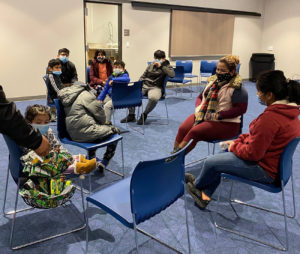
Local residents find warmth and shelter at the Buckner Family Hope Center at Bachman Lake. (Buckner Photo)

“It has been a hard year for the families in our community,” said Ricardo Brambila, director of the Family Hope Center. “They come into the warming center anxious. They keep their heads up, but they have sadness in their hearts. They’re so thankful to find relief from the cold.”

At mid-week, about two-thirds of the families the center normally serves were without power. The center made its warming station available to anyone in the community who needed relief from the cold and a place to recharge cell phones. The Texas Rangers Baseball Foundation provided funds to enable the center to offer food to people who were seeking shelter.

“We are all in this together,” Brambila said. “This is our community, and we want to be a good neighbor. Families are hurting, especially children. When the families are here, we hope they see the compassion and love we have for them. We want them to leave with hope.”

Caring for senior adults

In Houston, Tallowood Baptist Church delivered 115 cases of water to senior adults at Buckner Parkway Place after local officials issued a boil-water mandate. Church members scattered throughout the city purchasing cases of water for the senior living community.

Volunteers from Tallowood Baptist Church in Houston deliver bottled water to the Buckner Parkway Place senior living community. (Buckner Photo)

Parkway Place already had a 700-gallon emergency reserve of bottled water on hand before the winter storm. Workers at the senior living community distributed the available water to more than 220 residents on Feb. 16 and 17, but Parkway Place eagerly accepted the extra water from Tallowood in light of the uncertain duration of the water-boil order.

Abraham Mathew, executive director of Parkway Place, praised Tallowood—as well as Gateway Church, a nondenominational congregation that provided residents 100 blankets—for “their selflessness and dedication to supporting the seniors in our community.”

“While we feel confident in the resources we had on-site already, knowing that kind people are thinking about us and want to ensure our well-being during this difficult time has been uplifting for the residents and associates in our community.”

Churches throughout the state reported flooding and damage to their facilities due to burst pipes. Pastor Joseph Fields of New Beginnings Church in Lewisville posted a video on Facebook showing water from a broken pipe spraying across the lobby of the church’s new facility, along with the message: “By God’s grace, we will be stronger after this ordeal is over.”

Even as temperatures began to creep above the freezing mark, some churches cancelled in-person worship services on Feb. 21—partly due to uncertainty regarding the conditions in their buildings and partly in response to calls for energy conservation.

TBM at work around the state

Texas Baptist Men deployed a shower and laundry unit to Cedar Hill, where 700 residents were without water due to broken pipes. At the request of city officials, TBM also provided a large generator.

TBM volunteers in East Texas provide meals for families affected by the winter storm. (TBM Photo)

TBM volunteers delivered to East Texas Baptist University two pallets of bottled water and 50 water filters that screw onto faucets after Marshall was placed under a boil-water order. Additional water filters will be delivered to churches in Houston.

A TBM food-service team in East Texas prepared meals and snacks for families affected by the winter storm at several locations around Lindale.

TBM provided a generator to supply electricity for about 24 hours for a warming station at First Baptist Church in Edgewood, and it provided shower and laundry units to warming stations in Comanche and Allen.

Another TBM shower and laundry unit was committed to First Baptist Church in Marble Falls once the roads in the area are clear enough for it to be delivered.

“This is truly a statewide emergency in every sense of the word,” said TBM Disaster Relief Director David Wells. “Every city, every region of Texas is being affected. We are seeking to provide help, hope and healing as quickly as possible.”

Across the state, TBM placed its regional shower and laundry units, flood recovery crews and emergency food-service teams on standby to meet needs in their areas.

“People are hurting,” Wells said. “They’re tired. They’re overwhelmed by the situation. We are mobilizing volunteers to meet their needs, help them and lift their spirits.”

To support TBM disaster relief financially, give online at TBMTX.org/donate or mail a check to Texas Baptist Men, 5351 Catron Drive, Dallas 75227.

Includes reporting by Aimee Freston of Buckner and John Hall of TBM.


Churches offer warm welcome to Texans hit by winter storms

As a winter storm left millions of Texans without electricity in below-freezing temperatures for hours—sometimes even days—some Texas Baptist churches opened their doors to provide warmth and food to affected individuals.

‘So that no one would have need’

Community Missionary Baptist Church in DeSoto opened its facilities as a registered secondary shelter and emergency rescue center.

The church continues to provide food, showers and shelter to anyone in need, including families whose homes are without electricity and the local homeless population.

To comply with COVID-19 safety protocols, the church has placed families in their own individual rooms when possible.

Despite the overwhelming amount of need the church faces, Lynn Harper, young adults pastor at Community Missionary Baptist Church, praised God for giving the church the resources to continue serving people.

He explained that community and service always has been at the heart of the congregation’s mission, as led by Pastor Oscar Epps.

“The root of our ministry is community-style fellowship, like Acts 2, which says, ‘so that none would have need.’ So for us, this service is not a disposition that started from this snow storm, because community has always been in the forefront of our hearts and our pastor’s heart,” he said.

A place of respite and refreshment

First Baptist Church in Richardson partnered with the city to provide a warming station for the community.

Families are encouraged to come and enjoy complimentary hot chocolate and coffee as they warm up and charge their devices. They may also stay the night in the activity center, where cots and blankets have been set up.

Missions Pastor Ron Evans said the church wants to provide respite from the stress and harsh conditions many have had to endure—to be a place where people can relax and temporarily forget about their problems.

Keith Lowry, discipleship pastor at First Baptist in Richardson, explained there are families that have been without power for two days or more in below-freezing temperatures, and providing a space for warmth is essential for peoples’ health.

Whenever there are needs in the community, he said, the church follows Jesus’ command in Matthew 25:40, “‘Truly I tell you, whatever you did for one of the least of these brothers and sisters of mine, you did for me.”

‘God allow us … to be a part of his work’

In Conroe, Under Over Fellowship has been providing shelter to more than 60 people since Feb. 14, when the city contacted the church about opening as a warming center.

Volunteers serve three meals a day to those staying at the church facilities, and they also began delivering hot meals to families and individuals in areas with no power or water, including a community of elderly residents.

Under Over Fellowship Pastor Jerry Vineyard told about an elderly woman in nearby Montgomery, who called the church to say her electricity had gone out. She was frightened that the frigid temperatures could seriously injure her and her two pets.

Vineyard was able to locate a propane heater and drove on icy roads to deliver it to her. Since then, the church has checked in on the woman daily, replacing the propane and providing hot meals for her.

“I think it is a prime opportunity for the gospel. Anytime there is a crisis, people are looking for an answer. And we have the greatest answer to any problem—Jesus,” Vineyard said. “The greatest blessing that comes from all of this is that God allows us to serve. He allows us to be a part of his work.”


CommonCall: Ministry of Grace

When Mark Grace retired at the end of January as chief mission and ministry officer at Baylor Scott & White Health, it marked the end of a career in institutional chaplaincy. But it doesn’t mean Grace will stop serving in what he calls “ministry on the boundaries.”

Growing up as a preacher’s kid, Grace felt a call to ministry early in life and started preaching at age 13. He followed the typical path to the pastorate, earning an undergraduate degree in religion at Howard Payne University and a Master of Divinity degree from Southwestern Seminary.

As a college student, Grace spent three summers on the Rio Grande, working as a student missionary with Texas Baptists’ River Ministry. He points to Elmin Howell, founding director of River Ministry, as a major influence in his life.

“A lot of what shaped my approach to ministry I learned on the River,” he said. “I learned that you meet people where they are, and you go serve them.”

‘Where I needed to be’

With his Spanish skills and educational background, Grace assumed he likely would serve as pastor of a Hispanic Baptist church after graduating from seminary in 1983. But near the end of his time at seminary, personal involvement with the Azle Pastoral Counseling Center pointed him in a different direction.

“I went to Baylor University Medical Center,” he recalled. “I lacked a lot of skills. But I learned the difference between ham-fisted helping and real helping. … After three weeks, I just knew it was where I needed to be.”

Grace felt more comfortable in a setting where he ministered among people of all faiths and no faith and trained others to do so, rather than “moderating a business meeting in a Baptist church.”

“Chaplaincy is ministry on the boundaries,” he said. “Hospital chaplaincy is on the boundaries of science and faith, of the church and the world. I’m not necessarily interested in just doing ministry that’s limited to within the church walls.”

After several years working as a chaplain and as coordinator of chaplaincy ministry, Grace became director of pastoral care and counseling at Baylor. He worked in that role 16 years.

“I was free to make it up as I was going along,” he said.

‘We can do better’

Along the way, Joel Allison—then CEO of the Baylor Health Care System—talked to him about how the hospital system could do more in terms of its Christian ministry of healing.

“Joel said, ‘Mark, I think we can do better,’” Grace recalled.

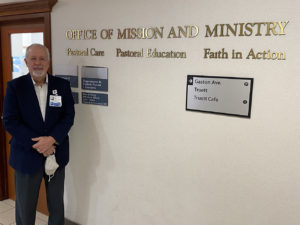
That led to the creation of the office of mission and ministry at the health care system and Grace’s appointment as vice president overseeing it. The office coordinates three components—spiritual care to patients, their families and hospital staff; pastoral education programs for ministers and seminary students; and Faith in Action initiatives.

When it launched, Allison outlined a four-fold purpose for the office of mission and ministry:

  • Re-envision ways to strengthen and streamline the health care system’s Christian ministry of healing.
  • Explore new ways to engage and support employees as they live out their faith and values in service to others.
  • Embed mission and ministry across the entire health care system.
  • Partner with other Christian agencies to help meet medical missions needs locally and globally.

Don Sewell, who had worked with the Baptist General Convention of Texas as its director of Partnership Missions, joined the staff to lead the Faith in Action initiatives. Among other ministries, Faith in Action has enabled the hospital system to direct outdated but perfectly good equipment and supplies to medical and humanitarian missions causes around the world.

As Sewell said after the health care system sent a 40-foot container filled with examining tables, hospital beds, stretchers and other supplies to an overseas hospital: “It’s old to us, but it’s gold to some hospitals in other countries.”

Helped shape institutional culture

In his role as chief mission and ministry officer, Grace has helped shape the culture throughout Baylor Scott & White Health.

Mark Grace retired at the end of January as chief mission and ministry officer at Baylor Scott & White Health. (Photo courtesy of Baylor Scott & White)

“Our core commitment is advocating for genuine whole-person care, which I believe is at the heart of the ministry of a Christian healing institution,” he said.

“Sometimes I hear people say (about the health care system), ‘We need to be uncompromisingly Christian,’” Grace said. “I understand what they are saying, but I think we need to be uncompromisingly caring and compassionate.”

Looking at the statistics, he noted, a rising percentage in the general population either claim no religious affiliation or have walked away from the religious traditions they once followed.

“The nones and the dones show up in the hospital every day,” Grace said.

Those individuals are unlikely to respond to someone preaching to them, but they are receptive to loving actions, he noted.

“If the gospel is not there at the worst moments of life for a person, it’s not worth the paper it’s printed on,” Grace said.

Innovation and creativity

During the COVID-19 pandemic, bringing the gospel message of hope to people in crisis has demanded creativity. Fortunately, prior to the pandemic, the health care system already was exploring the potential for telecare and video-based chaplaincy.

Grace has felt comfortable in an environment that embraces innovation.

Mark Grace, recently retired chief mission and ministry office at Baylor Scott & White Health, visits with Karla Ramberger, chief nursing officer for Baylor University Medical Center. (Photo courtesy of Baylor Scott & White)

“You’ve heard of a calf looking at a new gate? I never saw a new gate I didn’t like,” he said.

In addition to ministering to patients and their families, the hospital chaplains have offered spiritual support to physicians and nurses during a time of exceptional stress, anxiety and uncertainty.

“I’ve been amazed at their courage and their willingness to throw themselves into the breach,” Grace said.

Early in his retirement, he plans to take three months off for rest and renewal—and spend time with grandchildren.

After that, he wants to minister among the residents of West Dallas through Iglesia Bill Harrod, where he and his wife Linda were senior pastors eight years before transitioning to pastor emeritus status.

“I love West Dallas,” Grace said of the neighborhood served by Iglesia Bill Harrod—located in one of the region’s poorest ZIP Codes.

He also hopes to do more writing, particularly on the subject of prayer.

“I’ve grown to have a deeper and deeper understanding of the importance of prayer,” he said. “I want to help people understand especially the power of prayer in their lives.”

Read more articles like this in CommonCall magazine. CommonCall explores issues important to Christians and features inspiring stories about disciples of Jesus living out their faith. An annual subscription is only $24. To subscribe to CommonCallclick here.


Logsdon supporters plan seminary in San Antonio

A group of alumni and supporters of Logsdon Theological Seminary announced plans to open a freestanding seminary at Baptist Temple in San Antonio—which may or may not bear the Logsdon name.

One year ago, Hardin-Simmons University trustees approved a recommendation from university administration to begin the process of closing Logsdon Seminary. HSU leaders cited a $4 million deficit and asserted the graduate program in theology was low-performing and not sustainable.

At that time, HSU President Eric Bruntmyer said a group of individuals were considering a freestanding seminary in San Antonio, where Logsdon had an extension campus. Bruntmyer said HSU was “ready to assist with any consultation and assistance” in that effort.

Seeking resolution of support

Don Williford, dean at Logsdon from 2011 to 2017, said he wasn’t part of the group Bruntmyer referred to at that time. But as acting president of the seminary that is proposed now, he sent a letter to the HSU trustees to remind them of Bruntmyer’s pledge and to request a resolution of support for a San Antonio seminary.

The letter also included a request “to purchase [from HSU] the classroom furnishings, white boards, and flat screen televisions for use in hybrid distance education courses at a reasonable price based on the original purchase price and standard depreciation rates.”

Jonathan Davis, vice president of the Logsdon Alumni Council, likewise urged the HSU trustees to approve a resolution of support for the San Antonio seminary, saying, “Such a resolution would not cost the university anything, but would carry great symbolic weight in building bridges among HSU and her many diverse constituents.”

The trustees met on Feb. 12, but the university did not announce any actions taken at the meeting regarding the seminary.

Using the Logsdon name

Regarding the HSU board and administration, Williford said in a Feb. 15 phone interview, “We’d like to see them give us their blessing to use the Logsdon name.”

Williford added “some of the heirs” of Charles and Koreen Logsdon—whose original gifts made Logsdon Seminary possible—granted oral permission to use the family name, but no documents had been signed to that effect.

HSU continues to use the Logsdon name for its “teach-out” program for students who were enrolled in Logsdon Seminary last year, as well as for the undergraduate Logsdon School of Theology as part of HSU’s Cynthia Ann Parker College of Liberal Arts.

If the proposed seminary in San Antonio is not able to call itself “Logsdon Theological Seminary,” Williford expressed confidence it would be able to “continue the Logsdon legacy” through an endowed scholarship and possibly an endowed chair bearing the Logsdon name.

Davis added it will benefit from the strong relationships Logsdon already established in the San Antonio area—regardless whether the new seminary bears its name.

Making plans

In his letter to trustees and on social media, Williford mentioned plans to launch the San Antonio seminary in the fall. On Feb. 15, he said his group still hopes to launch classes in the fall, but that could be delayed until January 2022.

Williford reported the seminary in San Antonio anticipates a $250,000 to $300,000 budget in its first year and a $350,000 budget in its second year. He also expects the seminary to have between $2 million and $4 million in endowments by its third year.

The group forming the seminary still awaits approval of its legal status as a 501(c)3 nonprofit organization, he said. They already have received significant pledges from donors, and he anticipates those pledges will be honored soon after the nonprofit status is granted.

The proposed seminary will offer on-site instruction and hybrid courses that combine online distance learning with in-person instruction for limited periods each semester.

“We will not have any full-time faculty for the first year,” Williford said.

Some former Logsdon Seminary faculty—as well as potentially some faculty formerly associated with the Baptist Theological Seminary at Richmond—will teach on a part-time basis, he said.

Some San Antonio pastors with terminal degrees who previously taught at the Logsdon campus in San Antonio also likely will teach, he added.

Practical orientation

The seminary likely initially will seek accreditation through a “reputable agency” that doesn’t require the length of time typically associated with accreditation through the Association of Theological Schools, Williford said.

Don Williford

As the new seminary plans its degree programs, it will rely heavily on ATS-conducted research regarding perceived gaps in traditional seminary programs, he said. The San Antonio seminary will seek to provide practical instruction for congregational ministry.

“It will have a practical orientation,” Williford said. “We will not lessen the rigor of instruction of the traditional disciplines, but we will offer the value-added benefit of the practical elements.”

Davis noted the seminary will be distinctive in offering a practicum for students beginning with their first semester, and in providing an integrated approach to teaching that bridges academic disciplines that sometimes operate in silos.

Growing number of San Antonio seminaries

If successful, the new seminary will be launched in a city with a growing number of options for Baptists and other evangelical Protestants seeking graduate degrees to prepare for ministry.

  • Baylor University’s Truett Theological Seminary will begin offering classes in the fall at Trinity Baptist Church, the former home of a Logsdon extension campus.
  • Wayland Baptist University offers several master’s level degrees in Christian ministry at its San Antonio campus.
  • Northern Seminary—an Illinois-based American Baptist school—opened an extension center last fall in San Antonio’s Midtown area.
  • Dallas Theological Seminary—an independent evangelical school—also has an extension campus in the Castle Hills area of northwestern San Antonio.

Last May, Truett Seminary—which already has an extension in Houston—announced its plans to launch its extension campus in San Antonio. The extension campus will offer Master of Arts in Christian Ministry and Master of Theological Studies degrees.

Truett already has obtained ATS accreditation for its San Antonio program and anticipates  accreditation from the Southern Association of Colleges and Schools Commission on Colleges.

Todd Still, dean of Truett Seminary, said the seminary in San Antonio will “launch lean” with instruction provided by some faculty from the Waco campus, along with some “friends of Truett and Baylor” in the San Antonio region who have doctoral degrees and practical pastoral experience.

He noted San Antonio is the nation’s eighth largest city, and “the need remains” for theological education in the greater South Central Texas area.

Still pointed to Truett’s status as a “seminary embedded in a major research university” as a strength it offers—not only to students at its Waco campus, but also to those at its Houston extension now and San Antonio extension in the future.

Davis noted the new seminary Logsdon alumni and supporters plan to launch in San Antonio, will seek to “create ecumenical partnerships,” and he anticipates broad-based support for the freestanding seminary.

“If there’s one thing the last year taught us, it’s that the future of a seminary within a university can be just as fragile as one that’s not embedded in another institution,” he said.


Texas gambling opponents ready for battle

With major professional sports teams supporting efforts to legalize sports betting and one of the world’s largest gambling companies backing a multimillion-dollar lobbying effort on behalf of casinos, gambling opponents recognize the potential for a David-and-Goliath battle in the Texas Legislature.

However, veterans in the fight to stop gambling expansion in Texas are accustomed to being outnumbered and outspent. And they remember who won the biblical battle between a shepherd boy and a giant.

Formidable lobbyists represent gambling interests

The Dallas Morning News reported Feb. 8 the Sports Betting Alliance is supported by the biggest sports teams in Texas—including the Dallas Cowboys, Texas Rangers and Dallas Mavericks—as well as online betting platforms.

The newspaper cited draft legislation that would open betting on sports—including college sports—to anyone age 21 or older. The article quoted Rep. Dan Huberty, R-Houston, as saying it could generate “several hundred million dollars” for special education in the state.

In addition to efforts to legalize sports betting, the late Sheldon Adelson, owner of Las Vegas Sands, assembled a group of high-powered lobbyists to advocate for casinos in Texas. He launched the lobbying initiative after he and his wife Miriam first donated $4.5 million to a Texas account affiliated with the national Republican State Leadership Committee.

The Dallas Morning News reported Adelson also donated $500,000 to Gov. Greg Abbott and $25,000 to House Speaker Dade Phelan last year.

Even after Adelson’s death, the Texas Tribune reported Las Vegas Sands continued its push to expand gambling in Texas, hiring 51 lobbyists to advance its agenda and spending somewhere between $2.3 million and $4.5 million on lobbying efforts.

Concern about daily fantasy sports

Rob Kohler, consultant with the Texas Baptist Christian Life Commission, remains convinced a direct frontal assault by casino interests has little chance in this session of the Texas Legislature—even with all the out-of-state money invested in pro-casino lobbyists.

However, the threat of legalized online sports betting—in the form of daily fantasy sports by DraftKings and FanDuel—presents a challenge. If the state permits legalized sports gambling, it will open the door to Native American tribes operating casinos by triggering a change in classification under the Indian Gaming Regulatory Act of 1988, he warned.

“With the recent action by the IRS in declaring daily fantasy sports a form of gambling, and subject to wagering excise taxes, the stakes this session are high to stop companies like DraftKing and FanDuel from trying to trick legislators that their legislation is simply an attempt to protect traditional fantasy sports leagues, or is a simple game of skill,” Kohler said.

“ It is neither, and the ramifications as it relates to moving the state of Texas to Class III federal gaming classification is real.”

Texans Against Gambling enlists lobbyist

To help fight efforts to expand gambling in the current legislative session, Texans Against Gambling—also known as Stop Predatory Gambling-Texas—has hired veteran lobbyist Ted Delisi, founding president of Delisi Communications in Austin.

A former legislative aide to John Cornyn when he was state attorney general, Texas Monthly in 2005 named Delisi one of the 25 most powerful political leaders in the state. In 2015, Ballotpedia identified him as a top influencer in Texas.

When he served in the attorney general’s office, Delisi worked closely with Weston Ware—then director of citizenship and public policy for the Texas CLC—and Texans Against Gambling when Cornyn shut down a casino operated by the Tigua tribe in El Paso.

Delisi said he looked forward to working with Texans Against Gambling again “to demonstrate the true fiscal reality of our state and the costs—economic and other—that come from the unneeded expansion of casino gambling.”

When Texas Comptroller Glen Hegar released his biennial revenue estimate last month, the shortfall was substantially less than anticipated, and Delisi noted Texas already received significant COVID stimulus money from the federal government and easily could gain $4 billion from the latest federal stimulus bill.

“Also, Texas has a Rainy Day Fund in excess of $11 billion. Texas needs casino gambling for revenue like Eskimos need more ice,” Delisi said.

He is the son of Dianne Delisi, former member of the Texas House of Representatives. His wife Deirdre, a partner in Delisi Communications, previously was Gov. Rick Perry’s chief of staff and chair of the Texas Transportation Commission.

‘Casinos and their phantom revenue’

Rodger Weems, chair of Texans Against Gambling, said his organization looks forward to working with Delisi to help lawmakers realize it is both unwise and unnecessary to provide a constitutional pathway to casino gambling in Texas. The “Texas economy remains resilient,” he insisted, adding the state doesn’t need “casinos and their phantom revenue to pass a balanced budget.”

“Casinos in Texas? Over my dead body, and I have no intention of being the guest of honor at any funeral,” Weems said. “There are a few times in life when it’s important to draw a line in the sand. This is one such time. Texas doesn’t need the crime, the addiction and the cannibalization of retail business that invariably comes when casinos come to our cities.

“We understand that our small grassroots nonprofit cannot hire an army of high-priced lobbyists, fund lavish dinners and trips, or make gigantic campaign contributions. However, our strength lies in the tens of thousands of grassroots friends and activists who know, quite simply, that Texas would not be Texas with Las Vegas-style casinos in our major cities.”


UMHB art professor tells the story of the Bible visually

BELTON—David Hill was sitting in a worship service one day when he realized he needed to use his God-given artistic talents to serve his church.

Hill, an associate professor of art at the University of Mary Hardin-Baylor, began sketching his idea. He want­ed to give Vista Community Church, a Texas Baptist congregation in Temple, a work of art that could engage and even enrich faith. He envisioned a creation that would be both a learning tool and an expression of faith. So, the Bible Project was born.

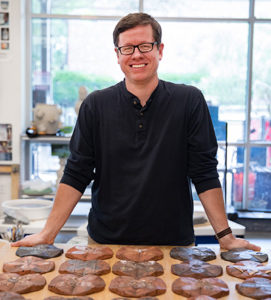
Instead of using words, UMHB Associate Professor of Art David Hill’s goal was to communicate with images and symbols to illustrate the story of the Bible. (Photo / Blair Dupre)

When completed, the Bible Project will be made up of 66 individual ceramic tiles, each with low-relief sculptural elements that correspond with a book of the Bible. Hill’s tiles are designed to be installed together on a wall to form one unified work of art.

Each tile has a styl­ized cross, and when all 66 pieces are arranged together, a larger cross is formed by the orientation of the smaller crosses.

“The big idea behind this is that each book individually tells part of the story of Jesus and the gospel. The full image of the cross can only be appreciated when viewing the totality of Scripture,” Hill said.

Instead of using words, Hill’s goal is to communicate with images and symbols to tell the story of the Bible. However, he doesn’t simply want to illustrate the stories.

Christ in every book of the Bible

“There is plenty of Bible illustration out there,” he said. “I would rather allow images and symbols to speak to the deeper themes of who Jesus is within each book.”

He wants to show others how Christ is revealed in each book of the Bible—from Creator in Genesis to Alpha and Omega in Revelation.

For instance, on the tile representing the book of Ruth, Hill wanted to show how God is seen as provider and kinsman redeemer. So, he molded and painted ears of barley growing in the sun.

Hill started work on the Bible Project in 2014, but he’s only been able to work part-time because it is such a massive undertaking, and he has had to prior­itize his job as an educator and practicing artist with an active exhibition record.

The process of researching and creating the 66 tiles has been long but worth it, because he has “learned more about who God is, as revealed in his word,” he said.

Hill grew up as a self-described “missionary kid” in the mission field with parents who served with the Southern Baptist Convention’s In­ternational Mission Board in Manila, Philippines. Even though he says he spent his entire life going to church and reading the Bible, Hill said, the Bible Project has allowed him to discover things in Scripture he didn’t know.

“Finding the connections between the different books and how the history moves through the books—you don’t necessarily learn about the Bible that way in Sunday school and church,” he said.

Learning and teaching

“I enjoyed learn­ing about the interesting connections between the books and the historical details of the biblical figures. This project has fed my desire to continue reading and stay in the Bible.”

UMHB Associate Professor of Art David Hill is creating a composition made up of 66 individual ceramic tiles, each with low-relief sculptural elements that correspond with a book of the Bible. (Blair Dupre Photo)

Hill said “The Bible Project” is only a work­ing title, since he typically doesn’t title an artwork until it is finished. His dedication to meticulous research is evident when an observer looks closely at the intricate detailing of his work.

“My ideas for imagery came quickly for some of the books, but other books have been much harder and have taken a lot of reading through the Bible, as well as various Biblical commentaries and art history books,” he said.

“Early on, I set some challenges and limitations for myself to direct my research. I wanted to communicate primarily with images and visual sym­bols rather than words, because I firmly believe that images speak to people in unique and often powerful ways, even if that is simply seen in communicating across language barriers.”

As a professor, he often uses his artwork and cre­ative practice as a teaching tool.

“This project, in particular, has allowed me to pro­vide students with an example of how art can engage issues of faith as well as serve the church and the community at large,” he said.

In addition to the tiles, Hill also loves making bowls, mugs and other functional vessels.

Even when his art is not always explicitly about the Bible or Christian themes, Hill’s faith has been an inte­gral part of how he sees the world and what he values. So, in a sense, his artwork always is influenced by his faith, he said.

“I find value in hand-made items that are used daily for sustenance as well as to build community,” Hill said. “So, whether I am creating a Bible-inspired sculpture or a simple mug for daily use, I believe I am living out God’s call in my life as an image-bearer of my Creator.”


Settlement restores control to Baylor and Southwestern

A legal settlement has returned control of the Harold E. Riley Foundation to Baylor University and Southwestern Baptist Theological Seminary.

The settlement—reached after former Southwestern Seminary President Paige Patterson was subpoenaed but before he testified—required three foundation trustees to resign and bars them from employment and board service to any Texas charitable organization or Southern Baptist Convention entity.

The university and seminary had filed a lawsuit in September, claiming the Riley Foundation was trying to misuse millions of dollars in assets intended for the two schools.

The suit asserted some members of the foundation’s board led a “secret coup” to seize control by rewriting the foundation’s bylaws without notifying Baylor or Southwestern and changing the foundation’s stated charitable purpose. As part of the changes, the schools lost their ability to name board members, removing the foundation’s sole beneficiaries from any governance role.

Terms of the settlement

The settlement, entered in a Feb. 8 hearing in the 67th Tarrant County Judicial District Court, restored the rights of Baylor and Southwestern Seminary to name trustees to the foundation’s board.

It also required Mike C. Hughes, Charles Hott and David August “Augie” Boto to resign from the board and from paid positions of the foundation.

Hughes was president of the foundation and had been vice president for institutional advancement during most of Patterson’s time as president at Southwestern Seminary. Hott was former chief investment officer at the foundation and a former trustee at the seminary. Boto was former executive vice president and interim president at the SBC Executive Committee.

The settlement was reached after one week of trial testimony in a temporary injunction hearing in which Hughes testified.

It also was reached soon after the office of Texas Attorney General Ken Paxton issued a subpoena compelling the testimony of Patterson, who was fired as Southwestern Seminary president less than two weeks before the foundation governance was changed.

A news release from Southwestern Seminary stated: “The subpoena was issued after evidence was presented showing involvement of Patterson, coupled with information provided to the Texas attorney general indicating efforts by Patterson and his associates to divert funds and redirect gifts away from the seminary to the Sandy Creek Foundation, his personal nonprofit organization.”

In December, Paxton had filed a motion to intervene in the lawsuit, alleging Hughes and Hott “began to develop a scheme … to receive substantial salaries and benefits from this charitable foundation and find a way to change the structure of the foundation to the detriment of its sole charitable beneficiaries, Baylor and Southwestern.”

Limits placed on former foundation board leaders

Under the terms of the settlement, the former foundation board members are prohibited from any efforts to discourage third parties from supporting the schools financially or to divert gifts elsewhere.

Hughes, Hott and Boto also are barred from accepting employment or appointment as an officer, director or trustee of any Texas public or private nonprofit charitable organization, as well as all SBC entities.

Southwestern Seminary pledged to cooperate fully with any further investigation by state and federal officials following settlement of the civil suit.

(Southwestern Baptist Theological Seminary Photo)

Adam W. Greenway, president of Southwestern Seminary, said the settlement “returns the foundation to its original purpose” consistent with the donors’ wishes.

“This agreement vindicates our desire to honor Mr. Harold E. Riley’s legacy and to hold accountable those individuals whose actions served to undermine his donative intent. While painful and costly, this cause of action was necessary to protect charitable donors who deserve the confidence that the purpose of their generous gifts will be fulfilled with integrity and without interference,” Greenway stated.

“This victory is not only for Southwestern Seminary and Baylor University, but for all who are committed to ensuring that resources intended to advance kingdom purposes are not misused.”

(Baylor University Photo)

Likewise, Baylor officials expressed appreciation for the generosity of the family for whom the foundation is named, along with pleasure that the civil dispute was settled.

“We are pleased this matter has been resolved, and that the funds entrusted to Baylor by the Riley Foundation will now be used for their intended purposes. We appreciate the generosity of the Riley family on behalf of Baylor students and faculty,” said Jason Cook, vice president for marketing and communications at Baylor.

Responses from former board leaders

Baptist Press, the SBC news service, quoted a statement from Joe Cleveland, Hughes’ attorney, saying his client was “pleased that a settlement was reached … resulting in a complete dismissal of all claims against him without any admission of liability.”

“Mr. Hughes resigned as president and trustee of the Harold E. Riley Foundation to obtain peace and in hopes that Baylor and Southwestern will continue to do everything in their power to achieve Harold Riley’s wishes,” the attorney’s statement said.

Hughes was honored “to serve the foundation over these years,” he said, adding “his sole and only purpose was to achieve Harold Riley’s desire to help students at Baylor and Southwestern for generations to come.”

In a text message to Baptist Press, Boto stated: “The services rendered by the foundation’s trustees have always been in keeping with Harold Riley’s wishes, as well as in the best interests of both Southwestern Seminary and Baylor University. I trust the new trustees that the beneficiaries have chosen will commit themselves to do those same things. I wish them well.”

Hott declined comment, and Patterson did not respond immediately to the Baptist Press request for comment.

Newly named Baylor representatives on the Riley Foundation board are Jeff Wallace, senior director of investment operations, finance and legal; and Doug Welch, chief compliance officer.

Newly named Southwestern Seminary representatives on the foundation board are Colby T. Adams, vice president for strategic initiatives and chief of staff; and F. Edward Upton, associate vice president for institutional relations.


Scholar frames biblical narrative as immigrant story

Human history in general and the biblical narrative in particular are collections of immigrant stories, an Old Testament scholar told an online audience and an in-person group of Howard Payne University students and faculty.

M. Daniel Carroll (Rodas), a professor at Wheaton College and Graduate School, delivered the 14th annual Currie-Strickland Lectures in Christian Ethics at HPU on Feb. 4-5.

‘An immigrant book’

“The Bible is an immigrant book,” said Carroll, the son of a Guatemalan mother and immigrant Irish father. He challenged Christians to read Scripture from the perspective of immigrants’ experience.

The story of God’s people begins with Abram’s migration from his homeland to a land promised to him, Carroll noted. Along the way, “the father of the faith” told lies and risked his wife’s safety to cross borders, he observed.

In the book that bears her name, Ruth is referred to by others only as “the Moabitess,” he said. But the immigrant peasant woman becomes an ancestor of King David and, ultimately, Jesus.

The history of the Jewish exiles in Babylon essentially is the story of forced migration and deportation, he said. The prophet Daniel and his three friends were removed from their families, had their identities taken from them as they were given Babylonian names, and were compelled to learn the language and culture of an unfamiliar land. The four Hebrew young men resisted the majority culture the same way immigrants today assert their cultural identity—by taking a stand regarding food, Carroll noted.

The story of immigration is “as old as time,” and the reasons for migration generally remain the same—family, jobs, natural disaster and armed conflict, Carroll said.

The ancient Egyptians hated the Hebrews and feared them when their numbers grew, but Egypt needed Hebrew labor—a pattern seen repeatedly throughout human history and particularly evident in American history, he noted.

Welcoming rhetoric, unwelcoming reality

Carroll examined not only current challenges facing immigrants from Latin America, but also the forced migration of Africans and historic American prejudice toward Chinese laborers, Italian and Irish Catholics, and European Jews.

The tension in U.S. history—welcoming rhetoric and unwelcoming reality—is illustrated by the fact that assembly of the Statue of Liberty began the same year the Chinese Exclusion Act became law, he noted.

Progress with respect to immigrants in the United States and humane immigration policy has been—and continues to be—“slow, painful and messy,” he observed.

Rather than looking first at laws and public policy, Carroll suggested Christians launch any discussion of immigration from a different starting point.

“Begin by recognizing the immigrants’ humanity and its significance for engaging the topic and framing legislation,” Carroll said.

God loves the immigrant

One aspect that made the Torah unique among ancient law codes was its concern for foreigners, sojourners and outsiders, he noted.

The Law of Moses included gleaning provisions, sabbath rest commands and other protections for the vulnerable. Those laws were accompanied by reminders that the people of Israel should treat strangers with dignity and kindness because they, too, were strangers in an unfamiliar land. The rituals of Israel, such as observance of Passover, served as tangible reminders from the Hebrews’ history of deliverance from forced labor in a foreign land.

Beyond the personal experience of Israel, passages such as Deuteronomy 10:17-19 also appeal to concern for immigrants based on God’s character.

“Why love the immigrant? Because God does,” Carroll said.

In both the Old Testament and New Testament, migration is used as a metaphor for faith, he observed.

“We have a different king. We have a different citizenship. And we should live different kinds of lives,” he said.

“We are strangers, and this should be a very strange place to us. … The problem that happens for Christians is that this place is no longer strange. We kind of like it and want to keep the strangers out.”


UMHB community clinic offers therapy and counseling

Belton residents once walked through the doors of the church building on Pearl Street to feed their spiritual needs. Now, the landmark structure serves as a place where residents can get physical and occupational therapy, along with help for their mental health needs.

In 2019, work began to transform the building—once the site of a Church of the Nazarene and later the home of the University of Mary Hardin-Baylor Baptist Student Ministry—into the Cru Community Clinic.

The renovated space provides a setting where UMHB students who are studying physical therapy, occupational therapy and counseling gain hands-on training in an interprofessional environment.

Providing students clinical experience

Each of the three programs provides integrative free services to the community while giving students opportunities to work with actual patients.

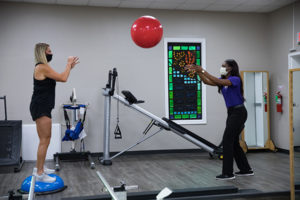
Renovations to the Cru Community Center turned the chapel space into a large, open occupational and physical therapy gym. (UMHB Photo / Blair Dupre)

“Clinic experience is priceless, and we are so blessed to have this opportunity for our students,” said Giulianne Krug, program director and professor for the new Master of Science in Occupational Therapy program at UMHB, which welcomed its first cohort last January.

“I have seen firsthand how bringing the book and classroom work to life in the clinic facilitates professional reasoning and evidence-based practice like nothing else. It prepares students for excellence as entry-level occupational therapists.”

Barbara Gresham, program director and professor of the Doctor of Physical Therapy program at UMHB, said before the clinic opened, they brought volunteers to the lab to act as “patients” and have simulated interactions with students.

“Now they can get real practice with real patients before they go into their clinical experiences,” Gresham said.

Working as a team

Ty Leonard, professor and director of the professional counseling program at UMHB, said the goal of opening a clinic with all three practices together is to provide students with integrative practical experiences so they can learn to work with different professions as a team when serving clients.

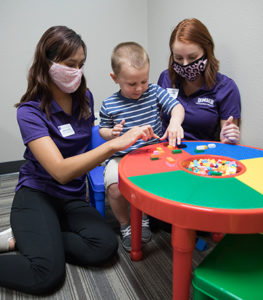
UMHB occupational therapy students Tiffany Nguyen (left) and Madison Rhew demonstrate play therapy with Barrett Woeller. (UMHB Photo / Blair Dupre)

“We may have a client who is struggling with an injury, has chronic pain, has possibly lost the ability to work, and is having to start over,” he said. “That person would need physical therapy for the injury, occupational therapy to learn how to adapt and adjust to his or her new life, and counseling to deal with the emotional and mental issues that go along with that.

“If we work together as a team, we can more integratively serve the client in a way that provides continuous care.”

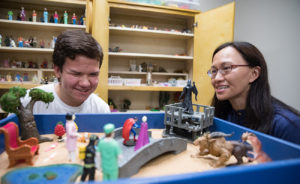
Renovations to the Cru Community Center turned the chapel space into a large, open occupational and physical therapy gym. Former office spaces were turned into private treatment rooms for occupational and physical therapy, as well as into counseling rooms. The counseling spaces include a group therapy room, a play therapy room for pediatric patients, an observation room and a sand therapy room with miniature figures that help trauma patients with counseling.

The new clinic also provides a fully functioning kitchen and laundry for training and retraining in home management skills. There’s also a hand therapy area for individuals who need occupational therapy after a hand or upper extremity injury, including physical agent modalities and splinting capability.

Occupational therapy students are also able to provide sensory-based therapy in the pediatric lab in Hardy Hall as part of the Cru Community Clinic.

“All of this is in addition to being able to provide the same high-quality occupational services that are available at most outpatient rehabilitation clinics,” Krug said.

Serving an underserved population

The spacious therapy gym also includes special­ized equipment that typical physical and occupational therapy clinics use, including a treadmill, elliptical and weight ma­chines, training stairs and a traction device.

Wen-Mei Chou, coordinator of the UMHB Marriage, Family and Child Counseling Program, demonstrates sand therapy with her son, Jett.
(UMHB Photo / Blair Dupre)

Before the new clinic opened with all three disciplines, counseling services had been provided in a nearby building called the Community Life Counseling Center, which opened in 2005. Over the last 15 years, the center had become a primary support service for people in need of counseling, and the program had long outgrown its space in the old facility.

“There’s a large and underserved population of people who can’t afford therapy except through social services,” Leonard said, explaining that the Cru Community Clinic targets clients who are either uninsured, underinsured or have exhausted their insurance benefits.

“UMHB’s sup­port of this new clinic has been phenomenal. They really believe in giving back to the community and living their Christian mission.”

Leonard, Krug and Gresham agree the new center has become a unique selling point for each of their programs. They are also enjoying working with each of the other programs to help fill the gaps for those clients who are unable to receive the full spectrum of therapy services.

“We are committed to providing the best education to our students and pouring into our community while providing that education, and this clinic allows us to do just that,” Krug said. “I am be­yond excited to have this space and programming available, and we can’t wait to see more and more referrals come rolling in.”


Experts say marketplace mentality toward schools hurts society

Society suffers when education is viewed as a commodity rather than as a common good, two public education advocates told participants in a teleconference sponsored by Pastors for Texas Children.

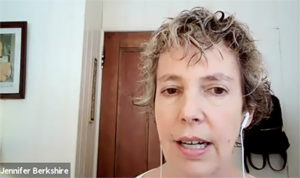
Journalist Jennifer Berkshire and education historian Jack Schneider, co-authors of A Wolf at the Schoolhouse Door: The Dismantling of Public Education and the Future of School and co-hosts of the “Have You Heard” podcast, addressed ministers and other advocates for public schools during a Zoom teleconference Jan. 27.
When citizens view education only in terms of their own self-interest rather than in light of shared interests, that leads to “the further atomization of American society” and “fragmentation of communities,” Schneider said.

A market that encourages individuals to make decisions about education based only on personal interests creates no incentive to seek common ground or promote the common good, he said.

“When we are appealed to as consumers, we operate differently than when we are appealed to as citizens,” Schneider said.

When the marketplace mentality toward education becomes government policy, it puts parents in the position of shoppers who are targeted by slick, expensive advertisers who “promise the moon,” Berkshire asserted.

“You can imagine a system in which we advertise educational products to people like we advertise pharmaceuticals—the difference being, of course, that pharmaceuticals are regulated,” she said, but there is no required “fine print” in the education ads.

“You can see how parents—vulnerable parents who are now untethered from any institution—are kind of sitting ducks,” she added.

Bipartisan blame for marketplace mentality

Republicans who support vouchers for private schools and Democrats who promote charter schools share the blame for fostering a marketplace mentality toward education, said Cameron Vickrey, associate director of Pastors for Texas Children—an assertion the two authors echoed.

“Charters are a slippery slope” toward the privatization of education, Schneider asserted. “It’s hard to just stop there, because they introduce a new kind of mindset for people and a new kind of rhetoric—a new worldview that you are a consumer; you are a shopper.”
Charter schools also create “a beachhead for other forms of privatization,” he said. Charters particularly appealed to centrist Democrats and mainstream Republicans during the Clinton, Bush and Obama administrations.

“But, of course, once Betsy DeVos assumed office [as U.S. Secretary of Education], they had laid a very lovely runway that allowed for her to try to land the voucher airplane,” Schneider said.

The Texas Public Charter Schools Association asserts high-quality charter schools “serve an essential purpose in public education, offering a variety of educational models and achieving impressive outcomes for more than 300,000 students in Texas, including some of the state’s most underserved students.”

The association states its mission is to “protect the Texas charter school community’s ability to grow and innovate free from red tape that would make it harder for schools to educate students according to their missions.”

‘Not what many people think’

Charter schools purport to enhance innovation by stripping away bureaucracy and unnecessary regulation, but those goals could be achieved within existing public school systems, Schneider asserted.

“Charters are not a pedagogy. They’re not a way of teaching. They’re not resources. It’s not like charter schools are suddenly bringing everything to the table that our community schools might lack,” he said.

“Charters aren’t what many people think they are. They’re just an opportunity to gain some flexibility in an existing system that could already have that flexibility baked into it. I think it should.”

Berkshire and Schneider acknowledged the potential positive aspects of charter schools in some situations. They noted some areas where a “charter school of instrumentality” is incorporated into a public school system specifically to meet a need existing community schools were unable to meet. For instance, a charter school may be created to provide a “diverse by design” learning environment where neighborhoods are not racially diverse.

Find other ways to measure success

Turning to the subject of high-stakes standardized tests, Schneider noted many ways schools “game the system” by denying admission to some students, teaching to the test and narrowing the curriculum.

“The key phrase here is ‘high-stakes tests.’ If we get rid of the stakes, we get rid of most of the negative unintended consequences,” he said.

Other metrics and measures can be used to evaluate educational outcomes beyond the narrow scope of a standardized test, Schneider noted.

“You also want to measure the other things you care about,” he said. “How engaged are kids? How happy are they? What are their relationships with their teachers like? How safe do they feel? Are they getting art and music? Is there a chance to play? Is there an opportunity for creativity? How are they developing as citizens?”

The emphasis on high-stakes standardized tests in public schools actually has benefited private schools that market themselves to parents who don’t want their children experiencing that kind of pressure, Berkshire added.
She urged the faith community to advance a holistic view of addressing “learning loss” students have experienced during the pandemic.

Rather than looking only at “narrowing the gap” in math and reading test scores, pastors and other congregational leaders can advocate for a broader understanding of public education, she suggested.

Pastors for Texas Children’s 2021 legislative priorities include calling on lawmakers to “find new measures of meaningful assessment and pause state accountability and punitive testing.” The group’s legislative agenda also includes opposition to the expansion of charter schools and a call for existing charter schools to be held to the same standards as public schools.

Halt grants to charter schools

Five days prior to the teleconference, Pastors for Texas Children Executive Director Charles Foster Johnson wrote a letter to the Department of Education advocating against further grants for charter schools.

CommonCall: Mobilizing advocates for Texas schoolchildren
Charles Foster Johnson, executive director of Pastors for Texas Children, makes a point during a gathering at Baylor University’s Truett Theological Seminary. (File Photo / Robert Rogers / Baylor University)

Charter schools drain public funds from community schools that serve all students while enacting policies and following practices that do not make educational opportunities broadly available, he asserted.

“In Texas, charter schools are allowed to exclude any student with a discipline history from enrollment in the charter, which research has shown discriminates specifically against children of color and students with special needs who have disproportionate percentages of discipline issues,” Johnson wrote.

“In addition, existing charter schools in Texas are allowed to expand through a simple administrative process without any notice to the general public, any public hearing, and without posting the expansion requests on any public website. The only way some neighborhoods have become aware a charter plans to open a new campus is when construction starts.”

Johnson pointed to documentation showing charter schools have been allowed to expand even though they serve only 2.1 percent of students with special needs—well below the state average of 10.5 percent.

“Clearly, charters that significantly underserve students with special needs should not be rewarded by allowing them to expand, and in fact, the department should investigate the practices of such charters,” he wrote.

“I ask that the department take a pause in funding the expansion of charter schools through this program until there is a review of practices and policies such as these that raise serious issues about education equity for our most vulnerable children and practices that ensure authentic public participation. We need to reset what the priorities of federal funding should be based on shared community values, actual outcomes and hard data.”


Vocaré initiative helps UMHB students understand ‘calling’

Ashley Boutte has always known she was meant to be a missionary.

As a child, she was fascinated by the verse in Matthew 24 that said Christ would return after the gospel had been preached to all nations.

“I knew I wanted to go tell people about Jesus who hadn’t heard about him,” said Boutte, who graduated from the University of Mary Hardin-Baylor last May with an undergraduate degree in Christian studies.

Last summer, she began working to save up money to prepare to do long-term mission work and church planting in Japan, which has one of the largest unreached people groups in the world, with less than 1 percent of the population professing to be Christian.

“When I knew God was calling me to become a missionary, I didn’t know anything about unreached people groups,” she said. “It was a calling I’ve had on my heart since I was a kid, and it’s been confirmed as I’ve learned more about it. There’s never been any­thing else I’ve wanted to do in my life.”

Initiative helps students find calling

For many young college students, finding their calling and knowing their purpose in life may not be as cut-and-dried as Boutte’s experience. That’s why leaders at UMHB have been working to develop the Vocaré initiative, a program designed to help students do just that.

Closely related to the word for “voice” in Latin, “Vocaré” literally means “to call.”

“Vocaré represents the belief that every person has a call or calling in life and that, if you find and live out that call, you’ll have the best life you could possibly have,” said Bill Carrell, director of Vocaré. “Finding your calling is about two things—it’s about self-discovery and the discovery of how you can make a difference in the world.”

Calling is not just a job or an occupation, he explained. It’s much bigger than that, although for many people, their occupation or career is an expression of their calling, Carrell said.

“Calling is something that stays with you all your life, no matter what you’re doing at any given time,” he said. “It expresses the idea that ‘meaningful living’ stems from an awareness of a guiding, moral purpose that forms a person’s identity and links that identity to social goods and community needs.

“At UMHB, we believe that calling comes from God. As a Christian university, UMHB is grounded in the view that God created and cares for the world, and that he has a purpose for every person in the world. That purpose grows out of every per­son’s unique gifts, talents and abilities. That purpose involves each person in God’s care for the world.”

Invitation, not indoctrination

Evangelism isn’t an overt or primary objective of the Vocaré initiative. Carrell stressed Vocaré is not indoctrination, but “invitation.” It represents the best of the Baptist vision for higher education, he asserted.

“Many students who are already believers in Christ may have little or no sense of a personal life purpose. Many students who are non-believers may be open to conversations about meaning and purpose, but have no interest in direct, evangelistic approaches,” Carrell said.

“So, a basic approach of the Vocaré initiative is to engage students with the questions surrounding meaning and purpose rather than prescribed an­swers.”

Some of the questions students can explore in finding their “calling” include:

  • Who am I?
  • What are my gifts, passions and abilities?
  • What is truly important?
  • How can I make a difference in the world?

“We certainly hope that through the Vocaré initia­tive many students will find God and come to know Jesus Christ, but if they do not, they may still en­hance the quality of their lives and make positive differences in the world,” Carrell said.

Faith in the midst of uncertainty

Sometimes, stu­dents think they will automatically find their calling by taking courses and completing a college degree. Larry Locke, associate dean for McLane College of Business, insisted it’s not always that easy, and some­times the ambiguity in finding their “true calling” can plague them.

“Students struggle with the uncertainty that comes with being 18 to 22 years old and not knowing what will happen in the future,” Locke said. “They don’t know what they will do for their careers, where they’re going to live, how they’ll make money, or if they’ll have a spouse or family.”

Through all their anxiety about what the future holds for them, Locke pointed out God wants students to learn to walk in faith and obedience in the midst of their uncertainty.

Any career—whether it’s teaching business courses at a Baptist university in a small Central Texas city or cleaning latrines in Botswana—can be meaningful and have purpose in serving the kingdom, he said.

UMHB freshman Caleb Guenther is excited about the Vocaré initiative and believes students don’t have to wait for their careers to begin living their calling.

“College students can have meaningful lives too, even if they haven’t started their careers,” said Guenther, a music business major. “For instance, we can change our lifestyles to better fit a Christian lifestyle. I think it’s important because that’s where the foundation of your career can come from.”

Think intentionally about purpose and vocation

The idea to create the campus initiative began to take shape in November 2015 when former Provost Steve Oldham called a small group of faculty and staff together to discuss how to help students think more intentionally about purpose and vocation. The vision was to help enable grad­uates of UMHB to live meaningful lives that fulfill the will of God and contribute to the common good.

“Through Vocaré, we want to help foster a campus culture of meaningful life exploration,” said John Vassar, provost and senior vice president for academic affairs. “The goals of the initiative also include training faculty and staff to engage students in conversations that explore life purpose, providing opportunities for students to explore and experi­ence potential life callings, and shaping our curric­ulum to help students consider the spiritual, moral, and societal commitments that produce meaning­ful lives.”

Yvette Shackelford, assistant to the vice president for student life at UMHB, loves working with students, and it helps fulfill her calling.

In the fall 2019 semester, the Vocaré initiative was awarded a NetVUE grant, which was used to cre­ate workshops and trainings for staff and faculty.

“There is much enthusiasm for the initiative and a growing awareness of its goals across the campus,” Carrell said.

According to a freshman seminar report from fall 2019, 68.9 percent of students moder­ately or strongly agreed they have a specific calling in life.

“It is clear that the majority of first-year students are at least receptive to the language of ‘calling,’” Carrell said. “From this, we know it’s prudent that we give them regular opportunities to identify and reflect on their own personal strengths and gifts.”

Yvette Shackelford, assistant to the vice presi­dent for student life, said working alongside stu­dents and helping them see their gifts and talents has given her own life and work meaning and purpose.

Bill Tanner, UMHB department chair and professor of computer science, engineering and physics, says he feels called to be a professor.

“I love helping give students a sense of direc­tion,” she said. “I love to serve other people and work alongside the students and see them happy. That truly makes me very happy.”

William Tanner also finds meaning and purpose in his work as a professor and depart­ment chair of computer science, engineering and physics. He is excited to share the initiative with his students to help them on their journeys to find “calling.”

“I have always felt that there is a need for folks to be able to work with students in a way that they can become aware of their potential and to achieve that,” Tanner said. “I really enjoy being a part of that process.”

Even though someone’s calling may evolve and change as they get older and go through life, Carrell says the process is essentially about discern­ment.

“It’s our hope that while at UMHB students will listen thoughtfully, read broadly, and think deeply about calling,” he said. “So, when they discover their gifts, develop their talents, and explore their passions, they can go out and make a difference in the world.”


Eastridge Mission Center meets multicultural needs in Amarillo

Eastridge Baptist Church in Amarillo and its mission center serve an international group of immigrants and refugees who work in the city’s meat processing plants.

More than 12 years ago, Pastor Mike Garman recognized the need for multicultural ministry in northeast Amarillo, home to about 10,000 foreign-born residents representing 26 language groups.

Garman wanted to develop a mission center that could minister to community residents, only 8 percent of whom speak English. But he questioned how a congregation that consisted then of about 20 senior adults could meet that great need.

“I had to wait on the Lord,” Garman said. “The Lord had a better plan than I could have ever imagined.”

Help from an unexpected source

For several years, someone left groceries by the church door for hungry people in the community. No one saw who was making the deliveries, but the person who left the groceries included a note indicating the gifts were from “Mr. Eastridge.”

After an extended time, Garman learned Bill Hughes—a person in the community he did not know—died and left Eastridge Baptist his estate. Years earlier, Hughes had been a member of the church and been involved in its bus ministry.

When Hughes drew up his last will and testament more than 35 years ago, he left his entire estate, including several properties, to the church.

When Garman went to the deceased Hughes’ house, he sat down at a desk and opened a drawer. Written on a stack of cards was the name: “Mr. Eastridge.”

That bequest made it possible for Eastridge Mission Center to open its doors in 2013. Garman does not accept a salary as pastor of the church, but he is paid as executive director of the mission center, which is incorporated now as a separate nonprofit organization.

Ministry center provides community service

The mission center, adjacent to Eastridge Baptist church, is located across the street from the largest elementary school in Amarillo, which serves 1,000 students.

Families need afterschool care for their children, and Eastridge Mission Center supplies it at no cost. The Kingdom Kids afterschool program, offered from 3 p.m. to 6 p.m. on weekdays, provides food, supervised play, a Bible lesson and prayer time.

Volunteers pack food boxes at Eastridge Mission Center.

Local business and civic groups have shown their appreciation to Eastridge Mission Center, naming it as Outstanding Community Service Organization in 2020.

The mission center offers housing for visiting volunteer mission groups. Bunk beds, showers and kitchen are provided. Church groups are asked to supply their own food.

Multiple mission service opportunities are available in Amarillo. The mission center welcomes church youth groups who conduct Vacation Bible School and day camps for refugee children in the community.

Volunteers are needed to unload produce, organize the items, pack boxes and distribute food to people in the community. Volunteers also can work in the center’s community garden, preparing the soil, planting seeds, caring for plants and harvesting vegetables.

Providing food for children and families

Before the pandemic, Eastridge operated a monthly food distribution that provided groceries for up to 100 families per month, and the Mission Center served about 50 children per day after school.

“During the pandemic, we began serving families with food boxes,” Garman said. “During the summer, we distributed about 3,000 food boxes.”

At Eastridge Mission Center, children receive food and learn about God’s love for them.

Many of those food boxes were delivered to homes of families who were forced to quarantine, and the mission center also provided a daily lunch delivery to children when the center temporarily had to close its doors to visitors.

“With the help of High Plains Food Bank and its Kids Café program, we home delivered about 30,000 meals,” Garman said.

He recalled the home deliveries he made last summer.

“A group of children would stand on the street in front of their house waiting with anticipation for the food. It was like a hero’s welcome,” he said. “One little girl drew me pictures every time I delivered a box. Those smiles are something I’ll never forget. I miss that now.”

Eastridge Baptist Church has received ongoing financial support made possible by the Texas Baptist Hunger Offering, as well as Community Care Grants from Texas Baptists’ Christian Life Commission and Woman’s Missionary Union of Texas.

At one point, Amarillo was a COVID-19 hotspot, but the need for food is subsiding slowly, Garman said. Still, it continues to be greater than before the pandemic, he added.

Pandemic presents new ministry opportunities

Other ministries have grown, even as the pandemic continues.

“Attendance to our afterschool programs is up because of new mentoring programs,” Garman said.

Eastridge offers worship services both in English and Karen, a Burmese cultural and language group, and a Laotian congregation also meets in its facility.

“Church attendance is back to about 100, which is about what it was before. But one of the differences is about 150 watch online, which wasn’t available before the virus,” Garman said.

“With refugees from so many countries, they tell relatives and friends about our Facebook page and online services, and they watch also. The message of God’s love is reaching people all over the world.”

Like other ministers, Garman had to adapt ministry during the pandemic, but he is grateful for new doors that have opened.

“I was reminded that the building isn’t the church. The church is the people,” he said. “I was reminded that new ministry opportunities would come that would go beyond the crisis time.”

Each day is ‘a gift in its own way’

Garman acknowledged early in the pandemic, he prayed for “a better day tomorrow.” Then he was reminded of Psalm 118:24, which says, “This is the day the LORD has made; let us rejoice and be glad in it.”

“Now I realize all days are good. They are his days,” Garman said. “They are filled with opportunities, challenges and blessings. Each one is a gift in its own way.

“So, I learned to be thankful—no matter what. Of course, this was not easy when we lost people, we had to plan outdoor services—even drive-by funeral viewing—and I had to tell the refugees they couldn’t gather and have celebrations in their homes. But in all those days, each one made us lean on God and trust him. I’m grateful for that.”

Carolyn Tomlin writes for the Christian magazine market. She teaches the Boot Camp for Christian Writers.