Updated: HSU trustees vote to close Logsdon Seminary

ABILENE—Hardin-Simmons University’s board of trustees voted to close Logsdon Seminary.

President Eric Bruntmyer announced the board’s action in a letter released about 9 p.m. on Feb. 7.

“The board approved new programs, and it closed other programs at the undergraduate and graduate level including Logsdon Seminary and its programs,” Bruntmyer stated. “In the next week, the appropriate deans and vice presidents will be communicating the details of these actions.”

He went on to write the trustees “made these decisions with prayerful consideration and spiritual discernment, emphasizing that Hardin-Simmons will continue to hold to the Christian values on which it was founded.”

Students will continue to participate in chapel services and weekly Bible studies, and they will have “expanded opportunities to participate in ministry events locally and abroad and to take additional Bible courses,” he wrote.

Financial considerations noted

Bruntmyer noted the board had adopted The Way Forward, a strategic financial plan that calls for an annual evaluation of all academic programs and provides “a sustainable framework” that positions the university favorably in “an increasingly competitive marketplace.”

“Under The Way Forward, Hardin-Simmons University will always pursue financial excellence, which will allow us to maintain our academic excellence,” he wrote. “In the coming weeks, months and year, the HSU campus will change. Structural adjustments like these are important as we strive toward achieving financial excellence not only for ourselves, but for those to come.”

In Oct. 2018, HSU trustees voted to close four Logsdon Seminary extension campuses in Coppell, Lubbock, Corpus Christi and McAllen, along with other cuts in programs and personnel.

At the time, Bruntmyer noted “some external revenue sources are evaporating,” pointing particularly to decreased Cooperative Program support. He also noted the Baptist General Convention of Texas was eliminating pro-rata funding for all its partnering universities.

Current students offered ‘teach-out’ program

In a subsequent statement from HSU issued Feb. 8, the university clarified that the trustee decision affects Logsdon Seminary and its graduate programs, but the Logsdon School of Theology will continue to provide undergraduate Christian education.

Logsdon300“Current seminary students will be provided a teach-out program to finish their degrees,” according to the statement.

That same day, Bob Ellis, dean of the Logsdon School of Theology and Seminary, sent a letter to Logsdon students saying he was “deeply saddened” by the decisions the trustees made.

Ellis announced the “teach-out program” and assured the current students that “the university is under obligation to provide a way for you to finish your degree with the seminary if you choose to continue.”

He also noted “the Logsdon School of Theology will become a school within the Parker College of Liberal Arts,” adding that “ongoing employment of the full-time Logsdon university (undergraduate) faculty is not impacted by these developments.”

Reactions to the announcement

“I am heart-broken over these decisions,” Ellis wrote. “I tried everything within my power to persuade the administration and trustees to maintain their commitment to Logsdon, but that was not their choice. I will be serving as dean through the end of this semester and will do everything I can to provide for your needs and the needs of faculty.

Bob Ellis, dean of Hardin-Simmons University’s Logsdon Seminary, offers a prayer of dedication for the Logsdon Seminary in San Antonio campus at Trinity Baptist Church. (File Photo / Isa Torres)

“This is a very sad day for Logsdon. But on this day we are upheld by God’s grace, by our calling to follow Christ in ministry, and by the certainty of Christ’s faithfulness.”

The Feb. 8 statements addressed some questions the Baptist Standard raised in emails sent earlier that day to Bruntmyer, Ellis and Laura Moore, chair of the HSU board of trustees. Moore did not reply to the email.

Bruntmyer subsequently released a letter to the “HSU Family” on Wednesday afternoon, Feb. 12, in which he addressed many of the concerns that had been raised and answered many—but not all—of the questions.

Ellis responded to a series of questions and offered additional comments on the trustees’ action.

“HSU has been struggling for several years to increase economic efficiency, a concern of every small, private university. My sense is that the faculty are fully on board with the need to improve our financial situation. However, there are differing perspectives on what kind of changes should be made,” Ellis said.

“The decision to close the seminary as a part of restructuring the university is a heart-breaking choice for the Logsdon community. We have spent 25 years building an excellent place to prepare ministers, a place into which the university and its donors have invested significant resources, a place to which the BGCT has given hundreds of thousands of dollars in scholarships, and a place where very dedicated faculty and staff have invested their lives. We have graduated 417 students from the seminary who are serving Christ across the state and some around the world.”

Insisted students ‘think deeply and prayerfully about the Bible’

Ellis noted he became part of the extended HSU family at age 2 when his father accepted a faculty position in 1957.

“An immediate member of my family has been on the HSU faculty for over six decades, with the exception of a three-year period. We are deeply invested in the university,” he said. “I have personally known every faculty member of the Bible department and theology school since the 1960s. I have great respect for those professors because they were deeply committed to the Scripture and preparing students to interpret it well, as led by the Holy Spirit.

“They have been focused on serving the church and upholding Baptist heritage and values. They have been rigorous in their academic expectations for students because service for Christ demands it. And they have insisted on students learning to think deeply and prayerfully about the Bible and theology, rather than simply parroting what someone else has said.

“In short, the faculty for decades have been about theological education in a Baptist tradition, rather than indoctrination in a narrow way. I am privileged to have been a part of that legacy, and it deeply saddens me that its contributions at the graduate level will be lost for future students. Faculty who remain in place look forward to continuing the good work of Logsdon with undergraduate students after the seminary teach-out is completed.”

David Hardage, executive director of the Baptist General Convention of Texas, said he was certain the decision reached by the HSU board of trustees to close Logsdon Seminary was “difficult and painful for them.” He asked Texas Baptists to pray for Bruntmyer, the board and “all those in the Logsdon family at this time.”

“Logsdon was an important part of Texas Baptist life, and we understand the disappointment many friends and alumni share,” Hardage said. “We believe in and are praying for a bright future for Hardin-Simmons University and our many Texas Baptist educational institutions. As a convention of churches, we continue to support theological education across the state.”

Logsdon Alumni Council appealed for dialogue

Prior to the trustees’ meeting, officers of the Logsdon Alumni Council—Kyle Tubbs, president; Scott Sharman, vice president; and Yvonne Harold, secretary—sent a letter signed by more than 50 other Logsdon alumni and friends of the seminary to the HSU president, provost and chair of the board of trustees.

“We understand Hardin-Simmons experienced challenges over the last few years financially. Many beloved faculty and staff are no longer part of the university. We kept your tough decision making and actions in our prayers as you guided the university into the present as well as the future,” the letter stated.

Those who drafted the letter said they wanted to voice support for Logsdon Seminary and to invite the administration to engage in dialogue with the Logsdon Alumni Council and other graduates.

“Logsdon Seminary cultivated and prepared us for our callings,” the letter stated. “Logsdon Seminary proudly averages a 90 percent placement rating, meaning 90 percent of all students who graduate Logsdon Seminary go on to serve in a related field. This number is incredibly impressive and is evidence of the good work of the staff and faculty of Logsdon Seminary over the years.

“Logsdon Seminary has been a Christ-centered place where we have found unity in the gospel of Jesus Christ, through the guidance of Scripture. While graduates serve in various contexts and capacities, we are brought together through preparation of the good news.”

Those who signed the letter included pastors and other ministers on church staffs, chaplains, counselors and teachers.

(As a matter of full disclosure, others who signed the letter included Marv Knox, coordinator of Fellowship Southwest and former editor of the Baptist Standard, and Julie Sorrels, marketing manager for the Baptist Standard. A current member of the Logsdon faculty, Meredith Stone, serves on the Standard board. Bruntmyer attends the church where John Whitten, current chair of the Standard board, is pastor.)

‘Positive impact’ of seminary and its graduates cited

“Logsdon Seminary has been a true education for students over the years. Rather than indoctrinate, Logsdon Seminary educates. Former HSU President Jesse Fletcher once said that an  education serves a student best when it teaches a student ‘how to think over what to think.’ This serves Logsdon’s graduates well as they do ministry under the guidance of the Holy Spirit in the real world and have to think/feel/do for themselves,” the letter states.

“The faculty and staff of Logsdon Seminary has been top notch over the years. They have invested in students and continue to do so. The faculty and staff are committed to the mission of the seminary to equip students to respond to God’s call through academic and spiritual formation for a lifetime of servant leadership in the kingdom of God. The seminary simply centers itself on the Lordship of Christ, guided by the authority of Scripture, focuses itself on the global mission of the church, and affirms historic principles of Baptist identity.

“Thousands of individuals and hundreds of churches have experienced the positive impact of Logsdon Seminary graduates. We believe in both the importance of the seminary now and in the world moving forward.”

The letter concluded with an invitation to “conversation surrounding how wonderful and important Logsdon Seminary is, as well as how we graduates can help grow the university and seminary moving forward.”

The Logsdon Alumni Council received no response either before or after the trustee meeting, Tubbs said.

CBF leader responds to Logsdon closing

HSU’s Logsdon School of Theology was created in 1983 by a gift from the Charles and Koreen Logsdon family. The school began offering seminary programs leading to a Master of Divinity degree in 1995, the year after trustees of Southwestern Baptist Theological Seminary fired Russell H. Dilday as that school’s president for criticizing a political movement within the Southern Baptist Convention.

In 2004, Logsdon Seminary was created as an entity with in the Logsdon School of Theology in 2004 and achieved accreditation with the Association of Theological Schools.

The Cooperative Baptist Fellowship—formed in 1991 in response to what critics called the “takeover” of the SBC—has provided scholarship support to students at Logsdon Seminary as one of its partner institutions.

Paul Baxley, executive coordinator of CBF, learned about the HSU trustees’ action on Saturday morning, Feb. 8.

“Certainly, there is much we do not yet know about this decision. One thing we know is the closure of this school is a tremendous loss,” Baxley said.

“For 25 years, the ministry of Logsdon Seminary has blessed Cooperative Baptist partner congregations and indeed our whole Fellowship, as well as Baptists and communities far and wide. From its beginning until now, the faculty of this school has demonstrated a deep love for Christ and his church, a commitment to the Scriptures, and a deep desire for the thriving of congregations.

“While being intensely committed to the core theological curriculum, Logsdon has also demonstrated a capacity for faithful innovation. Logsdon has embodied the best of a Baptist vision of church, pursuing faithfulness in a context of freedom, knowing the most meaningful love for God and the most faithful service of the church must arise from freedom because it cannot be coerced.”

Baxley noted more than 400 Logsdon Seminary alumni serve around the world as pastors, ministers on church staffs, missionaries, church starters and chaplains. He also applauded the faculty as being “not only impressive scholars but also deeply committed Christians whose lives are run through with the fruit of the Spirit and evidence of genuine commitment to Christ.”

“Today, my hope is that all Baptists who have been touched by the life of Logsdon Seminary will join me in praying for the school’s current faculty and students, as well as for the larger community of alumni and congregations who are most profoundly shaped by this unique school, and therefore, most deeply grieve the news that came from the university,” he said.

Baxley pledged CBF will “offer its full support to current students, faculty and alumni in this time of transition.”

“We will also continue our pursuit of a new and still more faithful covenant between congregations, theological schools and our Fellowship for the calling and preparing of new generations of women and men whom God is calling to the ministry,” he continued. “We do so in full recognition of the challenges facing theological education and congregations. But we also believe that the ministry of congregations and the calling to congregational leadership has never been more important than it is today.

“In these days of gratitude for what has been at Logsdon and grief for what is being lost, may we care for those who grieve most and take up the task of calling and preparing ministerial leaders with renewed determination.”

This article originally was posted at 8 a.m. on Feb. 8. It was updated at 8 a.m. and 4 p.m. on Feb. 10 with additional information. It also was updated at 4 p.m. on Feb. 11 and at 9 p.m. on Feb. 12.


Alumni, Texas Baptists react to Logsdon Seminary closing

ABILENE—Alumni of Logsdon Seminary at Hardin-Simmons University and many other Texas Baptists expressed shock, sorrow, disappointment and—in some cases—anger about the university trustees’ decision to close the seminary graduate programs.

Steve Bezner, senior pastor at Houston Northwest Church, noted the “rigorous education” he received as an undergraduate and graduate student in the Logsdon School of Theology and Seminary prepared him well for later doctoral studies at Baylor University.

“My Logsdon degrees prepared me at a level where I never felt inadequate or incapable. I had loving, knowledgeable professors and made life-long friends during my studies,” Bezner said.

“I was shocked and saddened to hear the news about Logsdon Seminary, not only because of my deep love for Hardin-Simmons, but also because of my overwhelmingly positive experience,” Bezner said.

“Although I have not been privy to any of the discussions, I must believe that the trustees agonized over such a decision and ultimately felt that the financial weight of operation was too great for the overall institution to bear. I pray that men and women will continue to be trained ‘for Christ’ at Hardin-Simmons and that, Lord willing, one day, the graduate programs will return.”

‘Very difficult’ but ‘necessary’

Some West Texas pastors characterized the action as difficult but necessary.

“I’m sure this was a very difficult decision for the Hardin-Simmons board of trustees. Having served before on institutional boards of higher education, I do not envy the task of those entrusted with the stewardship of sustainable financial models that proactively fulfill their faith-based initiatives in the 21st century,” said Bobby Dagnel, pastor of First Baptist Church in Lubbock. “I’m confident that the mission of Hardin-Simmons University will continue to have a lasting impact upon West Texas and beyond.”

Howie Batson, pastor of First Baptist Church in Amarillo, offered a similar perspective.

“President (Eric) Bruntmyer inherited some challenges and has provided bold leadership with grace,” Batson said. “Academic programs must be affordable to be sustainable, and, unfortunately, residential seminary programs are facing declining enrollment across the nation as online substitutes provide an alternative.

“Fortunately, HSU plans to strengthen its commitment to undergraduate theological education and partnering with Texas churches. Transition is always tough, but, nonetheless, necessary.

‘Kingdom of God is better because of Logsdon’

Other Texas Baptist ministers expressed their views on social media.

“My heart is broken and angry tonight,” Matthew Broyles posted on Facebook. Broyles, minister to emerging adults at First Baptist Church in Abilene, included the text of a letter he sent to the HSU president and board of trustees.

Although he grew up as a pastor’s son and received “meaningful and thoughtful teaching as a child and teenager,” Broyles said in his letter that Logsdon helped him wrestle with difficult questions that arose as a young adult.

“I was listened to, encouraged, and given hope from professors who had been on this journey themselves. Logsdon Seminary comforted and nurtured me into a person who possessed a faith that could hold up to the questions existing within it,” he wrote.

“Logsdon taught me how to think, not what to think. In our polarized world today, teaching people what to think only furthers division and hostility. Helping people learn how to think removes fear toward different beliefs and allows for other valid opinions to exist. It helps create unity in diversity centered on Christ rather than uniformity centered on ‘me’ being right and ‘you’ being wrong.

“The greatest gift I received from Logsdon was a deeper concern and compassion for people and an example of discipleship to follow. I have been able to model this method of disciple-making with students and adults in both my ministry and those I encounter in everyday life who have no faith. Logsdon helped me know how to minister to people where they are on their faith journey not where I think they ought to be. I became a minister who was more humble, empathetic, and a better listener because of my role models at Logsdon.

“The kingdom of God is better because of Logsdon Seminary. … Because of Logsdon, there are many more people in the world who are doing what the Lord requires, ‘to do justice, love mercy and walk humbly with God.’”

‘Bright light in Texas Baptist life’

Texas Baptist Women in Ministry leaders posted a statement on their Facebook page saying they were “saddened to hear of the decision” to close Logsdon Seminary and offering prayers for “the students, faculty, staff, administration and friends of Logsdon impacted by this decision.”

“Logsdon Seminary has been a bright light in Texas Baptist life,” the post said, adding that Texas Baptist Women in Ministry “exists in large part because of the prayerful collaboration of many associated with Logsdon.”

“Logsdon Seminary’s Christ-centered theological education guided by the authority of Scripture, focus on the global mission of the church, and commitment to diversity has provided its students an educational experience that prepares them for ministry in the 21st century. The loss of Logsdon will be felt across Texas Baptist life and beyond,” the group’s post said.

“We greatly appreciate Logsdon’s deep commitment to the calling of God on women and men in all aspects of the church, academia and institutional leadership. We are grateful for the innumerable contributions of Hardin-Simmons and Logsdon students, alumni and faculty to the kingdom of God and Texas Baptist Women in Ministry. We will cherish those contributions and look forward to many more years of fruitful partnership with HSU and with the Logsdon network in whatever form it exists in the future.”

‘Devastated’ by the news

Kyle Tubbs, president of the Logsdon Alumni Council, said he was “devastated” by the decision to close Logsdon Seminary. He noted many current and former students had expressed their grief to him following the Feb. 7 announcement, saying, “It is hard to articulate the collective pain we feel.”

“Logsdon has brilliant professors and staff, incredibly bright students, and alumni serving the kingdom of God throughout the globe. Logsdon has a 90 percent placement rate, meaning 90 percent of Logsdon graduates serve in a field related to their education. The sad reality that Logsdon will no longer train students for kingdom ministry is tragically sad,” said Tubbs, new church starts manager for the Cooperative Baptist Fellowship.

“I am deeply thankful for the Christ-centered education Logsdon graced me with during my Master of Divinity degree. I am grateful for the women and men who served on faculty and staff of Logsdon Seminary. My hope and prayer is that I will continue to carry the education given to me at Logsdon forward into my ministry for the rest of my life.”

On social media, Tubbs offered a more pointed response, asserting the closure of Logsdon Seminary echoed what occurred in the Southern Baptist Convention in the 1980s.

In a Feb. 8 Facebook post—widely shared over the weekend—Tubbs cited an unnamed trustee at HSU as describing a “slow poisoning against Logsdon.” Tubbs alleged the existence of “a small, but very influential, fundamentalist group” that worked to undermine support for Logsdon.

“For the last couple of years, they have smeared Logsdon’s professors,” he wrote. “They lied about Logsdon’s theology. At first they tried to use LGBTQ the same way fundamentalists used inerrancy decades ago. That didn’t stick. Then they tried to use the Bible itself again, which also didn’t have merit.

“The playbook was the same: Use a certain issue to try to create division and trap Logsdon. Time and time again, it didn’t stick. Then, the broad label of ‘liberal’ was thrown around to accuse Logsdon, which is where we are today.”


Pastor for the Deaf hears God’s call to make disciples

McALLEN—To make disciples for Jesus in the Deaf community, Rogelio Rocha believes a Christian mentor must understand from personal experience the distinctive spiritual challenges non-hearing people face.

He distinguishes between the Deaf—individuals who are born unable to hear and who grow up in that cultural context—and the deaf—people who lose their hearing at some point in life but who grew up hearing.

The Deaf have a distinctive culture, language and worldview, Rocha noted. He wants to bridge the gap between the Deaf community in the lower Rio Grande Valley and the hearing world. Eventually, he wants to disciple pastors from within the Deaf culture.

“I was born hearing and lost my hearing due to a high fever,” he explained. “So, I grew up as hard-of-hearing, meaning I grew up with at least 70 percent hearing in one ear only.”

Although his hearing was impaired, Rocha was able to learn vocal language—both English and Spanish. He also learned to read and write in both languages.

However, about 17 years ago, his life changed when he lost all remaining hearing in his “good ear,” he said.

“I was in college at the time and had to drop out due to severe hearing loss,” he said.

‘God touched my heart’

At that same time, he suddenly felt alienated from the church he attended. He felt as if its members “kind of kicked me out due to not being able to help me,” he said.

“I did my own Bible study at home by myself in my own room,” taking notes as he studied. Rocha worshipped in solitude—“without music, of course,” he added.

“This happened for seven long years until I finally got my first cochlear implant,” he said.

Rocha prayed, asking God to grant him direction for his life.

“God touched my heart and affirmed that I was called to prepare and become a pastor for the Deaf,” he said.

With the blessing of his home church, Iglesia Bautista Emmanuel in McAllen, Rocha wants to plant a church for the Deaf in the lower Rio Grande Valley. Within the next month, he plans to launch a Deaf discipleship class that he hopes eventually will grow to be Emmanuel Deaf Baptist Church.

Different language and learning style

Rocha insists neither offering American Sign Language interpretation in a predominantly hearing congregation nor providing closed captions on a video monitor is adequate to meet all the needs of the Deaf community. Abstract theological concepts do not necessarily translate easily into sign language, and the Deaf have a different learning style than the majority population, he explained.

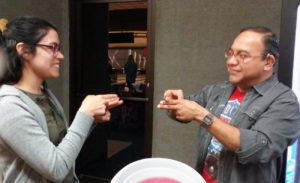
Rogelio Rocha teaches a university student how to spell her name, Carmen, in American Sign Language during a “Deaf Bowling Night” event at a McAllen bowling alley. (Courtesy Photo)

“Their learning is more visual, creative and practical. They would need to see visual explanations, such as the use of PowerPoint slides or other visual aids, either in the classroom or during a service,” he said.

“Worship is different, as well. They can’t hear music—unless some hard-of-hearing are present. They would want you to crank up the volume as high as it can go. They love it that way. The Deaf can feel its vibrations from the loudness.”

Reaching the Deaf community in a multicultural context like the lower Rio Grande Valley presents its own unique set of challenges, he noted. For example, the Deaf in many parts of Mexico communicate through Mexican Sign Language, which is distinct both from American Sign Language and Spanish Sign Language, with its own grammatical structure and vocabulary.

Still, as a person who can communicate in English, Spanish and American Sign Language—and who has personal experience with hearing loss—Rocha believes God has equipped him to begin a church for the Deaf in McAllen.

“For the glory of God, I can preach in all three languages. I know what it means to be in these three worlds and understand them,” he said. “You know, to be exact, to become a pastor for the Deaf means to become a missionary for the Deaf. A Deaf ministry or Deaf church is, indeed, a mission work.”

Becoming equipped to be an equipper

To prepare for the role of pastor and maker of disciples, Rocha enrolled in Stark College and Seminary, formerly known as the South Texas School of Christian Studies.

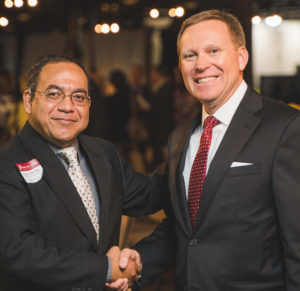
Tony Celelli, president of Stark College and Seminary, greets student Rogelio Rocha at a banquet. (Courtesy Photo)

“I am in this seminary by the grace and favor of God—very thankful for this great blessing,” he said. “Stark College and Seminary is helping me acquire skills in conducting proper research for teaching and preaching, acquiring deeper knowledge in each of the Old Testament and New Testament books, learning about other cultures and religions, church history, missions and much more.”

Stark College and Seminary purposefully seeks to make theological education accessible, Tony Celelli, president of the school, noted. Recently, the Ygnacio G. Moreno Encouraging and Equipping Endowment was created at Stark College and Seminary to provide scholarships for students with disabilities, he noted.

“Rogelio is the exact kind of student Stark seeks to equip,” Celelli said. “Pursuing higher education comes with all sorts of challenges for Rogelio, but he overcomes those challenges because of God’s call.”

Deaf disciples making more deaf disciples

Currently, Rocha is preparing a manual and a set of PowerPoint presentations for the discipleship classes he wants to start. After leading a group through basic and advanced discipleship courses, he plans to offer a leadership training to enable Deaf disciples to become disciplers. In time, he wants to train and equip indigenous Deaf pastors.

“The Lord wants me to just focus on making disciples for Jesus and train the Deaf to make more disciples,” he said.

“Without disciples, there will be no pastors, and no Deaf pastors means no churches for the Deaf. … It would work best for Deaf to reach other Deaf—that is, Deaf disciples making more Deaf disciples for Jesus.”


Hardin-Simmons trustees vote to close Logsdon Seminary

Note: An updated version of this article is available here.

ABILENE—Hardin-Simmons University’s board of trustees voted to close Logsdon Seminary.

President Eric Bruntmyer announced the board’s action in a letter released about 9 p.m. on Feb. 7.

“The board approved new programs, and it closed other programs at the undergraduate and graduate level including Logsdon Seminary and its programs,” Bruntmyer stated. “In the next week, the appropriate deans and vice presidents will be communicating the details of these actions.”

He went on to write the trustees “made these decisions with prayerful consideration and spiritual discernment, emphasizing that Hardin-Simmons will continue to hold to the Christian values on which it was founded.”

Students will continue to participate in chapel services and weekly Bible studies, and they will have “expanded opportunities to participate in ministry events locally and abroad and to take additional Bible courses,” he wrote.

Logsdon300Bruntmyer noted the board had adopted The Way Forward, a strategic financial plan that calls for an annual evaluation of all academic programs and provides “a sustainable framework” that positions the university favorably in “an increasingly competitive marketplace.”

“Under The Way Forward, Hardin-Simmons University will always pursue financial excellence, which will allow us to maintain our academic excellence,” he wrote. “In the coming weeks, months and year, the HSU campus will change. Structural adjustments like these are important as we strive toward achieving financial excellence not only for ourselves, but for those to come.”

In Oct. 2018, HSU trustees voted to close four Logsdon Seminary extension campuses in Coppell, Lubbock, Corpus Christi and McAllen, along with other cuts in programs and personnel.

At the time, Bruntmyer noted “some external revenue sources are evaporating,” pointing particularly to decreased Cooperative Program support. He also noted the Baptist General Convention of Texas was eliminating pro-rata funding for all its partnering universities.

In a subsequent statement from HSU issued Feb. 8, the university clarified that the Feb. 7 trustee decision affects Logsdon Seminary and its graduate programs, but the Logsdon School of Theology will continue to provide undergraduate Christian education.

“Current seminary students will be provided a teach-out program to finish their degrees,” according to the statement.

HSU’s Logsdon School of Theology began offering seminary programs in 1995, the year after trustees of Southwestern Baptist Theological Seminary fired Russell H. Dilday as that school’s president for criticizing a political movement within the Southern Baptist Convention. HSU trustees officially established Logsdon Seminary about nine years later.

The article originally was posted at 8 a.m. on Feb. 8. It was updated at 8 a.m. on Feb. 10 to include information in the 2nd and 3rd paragraphs from the end. Further updates will be posted as new information becomes available.  


Houston church still rebuilding, reaching out after hurricane

HOUSTON—When Houston Northwest Church recently welcomed children and their families to the congregation’s newly constructed HNW Kids Building, it marked a milepost in recovery and rebuilding after Hurricane Harvey.

Harvey hit the Texas Gulf Coast in August 2017, flooding almost every building on the Houston Northwest Church campus and causing $14.5 million in property damage.

“Our worship center was the only one that didn’t take on three to four feet of water,” said Karen Stamps, director of connections and communication at the church.

In the immediate aftermath of the hurricane, the worship center became the staging area for mud-out disaster relief teams and a distribution hub for supplies and assistance in the community.

Building had to be demolished

The floodwaters caused extensive damage to the church’s adult and student facilities, but its children’s building was most severely affected.

Floodwaters caused by Hurricane Harvey filled the former children’s ministry building at Houston Northwest Church. The building had to be demolished due to structural damage, but the church recently held the grand opening of its new HNW Kids Building. (Photo courtesy of Houston Northwest Church)

Years earlier, the church’s original sanctuary had been converted into the building that housed the congregation’s children’s ministry. The 40-year-old building had not been constructed with reinforced steel beams designed to withstand severe storm damage. Structural damage was so severe, the building had to be demolished.

“The area where the kids’ building stood was repurposed as green space for community use,” Stamps said.

For more than two years, Houston Northwest Church offered limited children’s activities in temporary space on campus. Students relocated to a nearby YMCA. Adult Bible study groups either met in homes or temporarily suspended operation until the renovated adult building reopened in January 2019.

In mid-December, the church held a ribbon-cutting ceremony marking the completion of its newly construction HNW Kids Building. The facility includes several worship venues, classrooms and multiple play areas.

Grand opening featured outreach events

In January, the church observed the grand opening of the HNW Kids Building with a series of outreach events over several weekends.

“We’re grateful for the support of our community and church family during our rebuilding phase, and we look forward to sharing this new space with our neighbors as we bring up future generations to know Jesus,” Pastor Steve Bezner said.

Houston Northwest Church brought in more than 40,000 pounds of snow, giving Houston children had a rare opportunity to play in the snow. Snow Jam was one of several outreach events sponsored by the church to mark the grand opening of its new kids’ building. (Photo courtesy of Houston Northwest Church)

On Jan. 11, the church offered a breakfast reception for families who live in an apartment complex behind the church campus. FamBlitz Live—a high-energy event with games and music designed to involve whole families—immediately followed the reception, and activities continued the next day with KidzBlitz Live.

The next two Sundays featured a Winter Wonderland theme. On “Frozen” Sunday, Jan. 19, the church invited families to enjoy hot cocoa and have their photos taken with volunteers dressed in costumes portraying characters from the popular Disney movie.

For “Snow Jam” on Jan. 26, the church filled the lawn outside the children’s building with more than 40,000 pounds of snow. Children who rarely—if ever—see snow in Houston threw snowballs and sledded down a snow-covered slide.

In the process, visiting parents had opportunities to get acquainted with each other and with families who already were part of Houston Northwest Church.

“We’ve been glad to see parents lingering in the kids’ building—sitting down and visiting with each other, not rushing out right after the service,” Stamps said.

Prior to Hurricane Harvey, the church’s children’s ministry averaged just under 400 in attendance, she noted. Since the new building opened, the number of children and volunteers has surpassed 550.


Texas Baptist leaders participate in Rally for Life

AUSTIN—Baptist General Convention of Texas Executive Director David Hardage and BGCT President Michael Evans addressed a crowd of more than 20,000 people from the steps of the State Capitol during the Texas Rally for Life on Jan. 25.

Hardage brought greetings on behalf of Texas Baptist churches and read from Psalm 139:14, emphasizing God is the creator and giver of life.

David Hardage, executive director of the Baptist General Convention of Texas, brought greetings from Texas Baptists during the Texas Rally for Life at the Capitol. (Photo / Kinsey Oates)

“We stand not just in opposition to abortion, but we stand for something, and what we stand for is life,” Hardage said. “We believe in, and we support with all of our hearts, life.”

Evans offered a prayer of benediction at the rally.

Other program participants included Sylvia B. Johnson-Matthews, executive director/CEO of Houston Pregnancy Help Center; Jairo Sandoval-Pilego, pastor of San Jose Catholic Church in Austin; U.S. Representative Chip Roy; Claire Culwell, an abortion survivor; State Rep. Jeff Leach; Terry Beatley, president of the Hosea Initiative; and Joe Pojman, executive director of Texas Alliance for Life.

The Texas Alliance for Life, a nonprofit organization that advocates for pro-life issues in the state, coordinated the rally on the south steps of the Capitol.

Worship service prior to the rally

Prior to the rally, Hardage and Evans participated in a celebration worship and prayer service at Hillcrest Church in Austin, coordinated by the Texas Baptist Christian Life Commission. The choir from Bethlehem Baptist Church in Mansfield, where Evans is senior pastor, performed at both the worship service and the rally.

During the worship service, Evans preached from Exodus 1 on the sanctity of life. He encouraged the crowd of more than 200 to “speak up for those who are speechless, to advocate on behalf of those who cannot advocate for themselves … and to wave the banner of life.”

Evans noted the 47th anniversary of the landmark Roe v. Wade Supreme Court decision, and he expressed sorrow for more than 60 million unborn children who were the victims of the “earth-shattering decision.”

“Our stance today is for life,” he said.

‘Every human being is precious’

Evans explained he was born out of wedlock.

“If … [my parents] had taken my life, I would not have had the opportunity to contribute to the well-being of this society,” he said.

Evans expressed gratitude to his parents for choosing to give him life, despite the many sacrifices it required, including his mother dropping out of college and his father enlisting in the military at a young age.

“Every human being is precious in the sight of our mighty God,” Evans said.

In Exodus 1, God remembered each life, he explained. Moses owed his life to women who did not follow the law of their government, which used genocide as a means of population control. After the two midwives ignored the decree of Pharaoh to kill male babies, God blessed them for their choices.

“God will bless us today. God will walk with us today,” Evans said. “He will encourage us. He has already gone before us. … My prayer is that God would give you courage that on this day you will advocate for the lives of the unborn.”

‘God is faithful. Life is beautiful’

During the service, Katie Frugé, hunger and care ministry specialist with the CLC, also testified to the power of life through the birth of her three daughters. She told how God walked with her and her husband through her first pregnancy when they were told their daughter would be born with abnormalities. She then pointed to Eve, now age 8, who stood and waved from the front row.

During her second pregnancy, Frugé was again met with news of abnormalities, but she “leaned into an unknown future, trusting a known God.”

The couple named their second daughter Felicity and describe her as someone who brings joy to all who know her.

Then, Frugé was diagnosed with deadly stomach cancer at 31 and had her entire stomach removed.

“God is faithful. Life is beautiful,” Frugé testified.

Three years later, she gave birth to a third daughter, Noelle, who is 7 weeks old.

“We are happy and privileged to stand with you today,” Frugé said. “We have lived and experienced that life is worthy of celebration.”

Another program participant, Jayme Bates, a member of First Baptist Church in Georgetown, told her personal story of the pain and heartache she suffered after two abortions. Bates spoke about God’s redeeming power in her life as she became a Christian. She started a redemptive ministry to those who have been impacted by abortion.


Replanting focuses on giving struggling churches new life

HOUSTON—Pastors who want to breathe new life into struggling churches by replanting them—rather than starting new congregations—need a special set of skills, attendees learned at a recent conference at Houston’s First Baptist Church.

About 50 people from throughout the United States who want to help churches in decline attended the conference that challenged them to ask, “Am I a replanter?”

The conference represented a collaborative effort between the Baptist General Convention of Texas, Union Baptist Association and the Southern Baptist Convention’s North American Mission Board.

“We need to figure out how we can draw people to be replanters themselves,” said Tom Howe, associate director of missions for Texas Baptists. “How do we call people to meet this need? This conference came out of that question, to help people see what it is and to learn about the skills needed.”

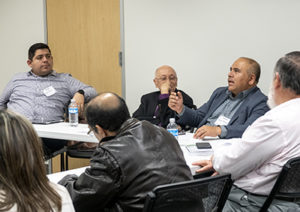
Participants of the Spanish-speaking cohort at the Replanting Conference in Houston share advice with one another.

Conference participants included current replanters and those interested in becoming involved with a replant. During the two-day event, experienced replanters led general sessions that addressed various attributes replanters must have and the challenges they face.

The attendees divided into small groups to discuss the specific challenges faced by urban, suburban, rural/small town and Spanish-speaking replanters, as well as replanters’ spouses.

‘Visionary shepherds’ needed

Jimbo Stewart, a replant pastor of Redemption Church in Jacksonville, Fla, spoke about the attributes needed to persevere through being a replanter. Stewart, who has been at Redemption Church for five years, warned that replanting can be challenging—especially through the first few years.

Replanters need to be visionary shepherds, always looking ahead to how things can be improved, but never forgetting about the flock they still need to minister to now. He also discussed “pastoral grit” and being strong enough to continue despite setbacks and hardships.

Even so, the hardships are worth it, he insisted.

“Every time a local church dies in a neighborhood, a gospel light goes out,” Stewart said. “That is not OK with us. Those churches are in places that desperately need the gospel.”

Replanting is not a new trend or unprecedented approach, he added.

“In fact, we’re going back to the oldest way of doing things, centering it all on Jesus Christ. It’s a dependence on Christ to do what you cannot do,” he said.

A powerful picture of rebirth

Keelan Cook, associate director of Union Baptist Association, noted plateaued or declining churches are on the rise in the United States. It is important to address the problem head-on, instead of waiting until it is too late, he asserted.

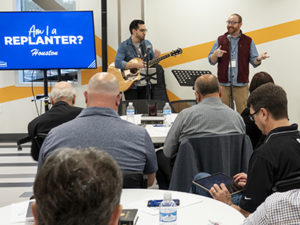
Keelan Cook, associate director of Union Baptist Association, welcomes attendees of the “Am I a Replanter?” conference.

Cook emphasized that each replanted church is a place with people who are getting important spiritual nourishment and fellowship because of them, he told the replanters.

“I think replanting is one of the most significant conversations we need to be having in North American missions today,” he said. “We have a wave of plateaued churches that are on the cusp of dying, and as that happens, we need people to think of replanting and revitalizing that church as their calling.”

For Cook, one of the most powerful pictures of salvation can be found through replanting.

“Church replants do a really good job of talking about rebirth,” Cook said. “The gospel is about bringing dead things back to life. And replanting is a great example to the community of what that looks like.”

In an effort to help more churches thrive, the BGCT expanded its replanting ministry in recent years, Howe noted. Nine churches currently are going through the replanting process with Texas Baptists, and Howe extended an invitation for interested churches to reach out. Texas Baptists will walk with churches through the replanting process and offer support, he said.

For more information about church replanting, email Tom.Howe@txb.org.  


Iraqi refugees experience abundant life

FORT WORTH—For Nabeha and her daughter Hanin, the most painful part of immigrating to the United States was leaving their family behind in Iraq.

“Always, I’m thinking about our family—my sister, brother, nephews, nieces,” Nabeha said.

Like many Iraqi refugees, Nabeha worked as a contract translator for the U.S. Army, helping military personnel communicate in Kurdish, Arabic and Persian. Every month, Nabeha reported to Joint Base Balad for duty and occasionally braved missile attacks from militant fighters.

But when terrorist outfits began threatening the safety of her daughter and husband, she sought the special immigration visas to which she and her immediate family were entitled.

Before departing for their new home in Fort Worth, however, Nabeha’s American colleagues gave her one piece of advice: “Look for the churches. They will help you.”

Reaching out to refugees

That’s how Nabeha and Hanin met Cooperative Baptist Fellowship field personnel Karen Morrow, who was hosting a block party at the family’s apartment community in 2010. For 10 years, the CBF Offering for Global Missions has supported Morrow as she shares abundant life with refugees and immigrants resettling in Fort Worth.

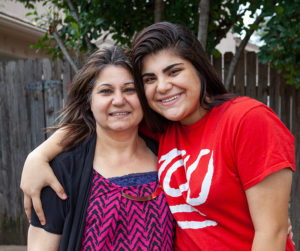
Before Nabeha (left) and daughter Hanin (right) departed from Iraq to their new home in Fort Worth, they were advised: “Look for the churches. They will help you.” (CBF Photo)

Nabeha, who already spoke English, shared Morrow’s calling to help refugees attain education, housing, health care and beloved community. So, she asked for Morrow’s partnership in reaching out to refugees in southeast Fort Worth.

“When refugees come to the United States, they don’t know English, how to get legal documents, how to get their children into school or even which grocery store to go to,” Nabeha said.

“So, I always help and advise other people. They contact me about everything—jobs, food stamps, how to apply for Medicaid—and I help them and answer their questions. And if somebody needs help speaking English, I go to the Social Security Administration office with them. I do all of that, and so does Karen.”

Morrow and Nabeha also started a Bible study for a small group of Iraqi women in Nabeha’s neighborhood. Once a month, the group meets in homes to share their experiences of patience and forgiveness and the faith that God will care for their families. Nabeha and Morrow even host a baby shower each time a member of the group is expecting.

Mostly, the group focuses on the example of Jesus, Nabeha explained, who revealed God’s unique love for vulnerable people.

“Our Bible study has taught me patience, and that God is always there to take care of you,” Nabeha said. “I have faith that God is going to always take care of my daughter. This I understand from the Bible: Always trust God. God is always there, giving life to people.”

Along the way, Nabeha and her family have also learned to be cared for, Hanin explained. Shortly after meeting Morrow in 2010, Nabeha’s husband endured surgery and an extended stay in the hospital, despite not yet having a vehicle or driver’s license. Morrow drove them to and from the hospital every day. She also helped Hanin enroll in school and adjust to American academics.

Comfort in hard times

A year later, Hanin was diagnosed with a nonmalignant brain tumor. Morrow accompanied the family to periodic checkups, as doctors monitored the tumor’s growth over several years. Eventually, Hanin required surgery and chose to visit her extended family in Iraq before the procedure. While in Iraq, Hanin’s escalating symptoms forced her to undergo surgery there. But surgeons were unable to remove the full tumor.

As a result, the tumor is growing again and Hanin will require another procedure in the U.S. to prevent brain damage. Until then, she balances her grief and fear with the constant love of family and the many prayers they offer for her safety.

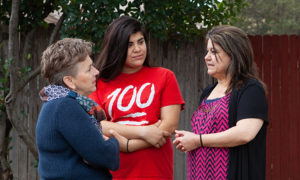
When Nabeha (right) and her daughter Hanin (center) met CBF field personnel Karen Morrow, she shared Morrow’s calling to help refugees like herself in the Fort Worth area. (CBF Photo)

Now a senior in high school, Hanin plans to attend the University of Texas at Arlington and continue on to medical school. She said friends like Karen Morrow have not only helped her family survive in the United States, but have illuminated her own capacity to comfort and heal a hurting world.

“Karen has been a great help to our family’s life,” Hanin said. “If not for her, we wouldn’t have had so many opportunities here. She has helped me with school. She has helped my parents figure out life here in getting settled. She has helped us meet new people and get so many different sources of help. And she’s just been a really good friend to me and my mother.

“She’s given us comfort in hard times and made sure we know that it’s okay to have struggles here, especially considering how different the United States is from Iraq. We’d be very lost without her.”

View a related video here.

This article appeared in the Winter 2019-20 issue of fellowship! magazine, the quarterly publication of the Cooperative Baptist Fellowship and is reprinted with permission. Read online here and subscribe for free to fellowship! and CBF’s weekly e-newsletter fellowship! weekly at www.cbf.net/subscribe.

Karen and Frank Morrow were CBF field personnel serving with Kurdish refugees in Germany beginning in the mid-1990s. He previously was pastor of First Baptist Church in Covington.   


Results negative for Baylor student tested for coronavirus

WACO—Test results were negative for a Baylor University student who had been suspected of having a case of coronavirus, the Waco-McLennan County Public Health District announced Jan. 27.

Samples from the student, who had traveled to China, had been sent to the Centers for Disease Control in Atlanta to be tested for the 2019 novel coronavirus several days earlier.

“This is very good news, and we are deeply grateful to our local and university health care providers and officials and the Waco-McLennan County Public Health District for their approach to this case, their proactive guidance and expertise and the compassionate care extended to our student while we awaited the CDC results,” said Sharon W. Stern, medical director for Baylor University Health Services.

“We continue to take this issue seriously and remain vigilant. Our prayers are with all those affected and for the doctors, nurses and other health officials who are working to understand and contain the virus. At this time, we ask our campus community to continue to take actions to prevent the spread of the flu and other respiratory illnesses.”

University officials stressed there are no other suspected cases of novel coronavirus within the Baylor community at this time. Baylor will keep students, faculty and staff apprised in the event the situation changes, officials said.

On Jan. 24, the local public health district reported the student had met CDC criteria for further testing and evaluation after being treated at an area hospital.

The CDC believes at this time that symptoms of novel coronavirus may appear in as few as two days or as long as 14 days after exposure.

As part of a coordinated response, the public health district and Baylor informed the campus community about the possible case.

Baylor followed CDC and public health guidelines

While waiting for results, Baylor followed guidance from the public health district and the CDC. As a precaution, the individual was moved to an isolated room on campus with its own HVAC system. That room was not located in a residence hall, the university confirmed.

Facility Services thoroughly sanitized the student’s residence hall room, as well as the residence hall where the individual lives. During the isolation period, the student was monitored by Baylor, state and local health officials. The university also worked with the student to make sure needs were being met during the isolation period.

Mark G. Childers, associate vice president of public safety and security at Baylor, expressed appreciation for the university’s emergency response team, as well as the coordinated response between local, state and federal officials as they handled this case.

“We are continuously assessing and reassessing our protocols, procedures and training to ensure the safety and security of our students, faculty and staff,” he said. “That is our mission every day—to keep our campus safe, and we appreciate our partners in helping us fulfill that mission.”

Baylor will continue to work closely with University Health Services, the Waco-McLennan County Public Health District and state and federal health officials, officials said.

Due to government and university privacy policies, Baylor is unable to disclose additional information regarding the student such as residence location or class attendance.

Recommended action

According to the Centers for Disease Control, any individual who traveled to China on or after Dec. 1, 2019, and who feels sick with fever, cough or difficulty breathing should:

  • Seek medical care right away. Before going to a doctor’s office or emergency room, call ahead and tell them about your recent travel and your symptoms.
  • Avoid contact with others.
  • Not travel while sick.
  • Cover your mouth and nose with a tissue or your sleeve (not your hands) when coughing or sneezing.
  • Wash hands often with soap and water for at least 20 seconds. Use an alcohol-based hand sanitizer if soap and water are not available.


Baylor student tested for coronavirus

WACO—A Baylor University student who recently traveled to China is being tested for a possible case of coronavirus.

Baylor announced Jan. 24 the Waco-McLennan County Public Health District notified the university that a student is being tested for the 2019 novel coronavirus. The health district is waiting for test results from the Centers for Disease Control and Prevention.

Public health officials said the immediate health risk to the Baylor campus community is low.

The Centers for Disease Control believes at this time that symptoms of novel coronavirus may appear in as few as two days or as long as 14 days after exposure.

Working through a coordinated response with the Waco-McLennan County Public Health District and following guidelines by the Centers for Disease Control and Prevention, Baylor moved the individual to an isolated room on campus as a precaution.

Student monitored by health officials

Baylor’s facility services also thoroughly sanitized the student’s residence hall room, as well as the residence hall where the individual lived.

The student is being monitored by Baylor, state and local health officials. The university also is working with the student to make sure needs are being met during the isolation period.

Baylor continues to work closely with University Health Services, the Waco-McLennan County Public Health District and state and federal health officials. An informational call center has been established at (888) 283-2158 for students and parents who have questions or concerns.

According to the Centers for Disease Control, any individual who traveled to China on or after Dec. 1, 2019, and who feels sick with fever, cough or difficulty breathing should:

  • Seek medical care right away. Before going to a doctor’s office or emergency room, call ahead and tell them about your recent travel and your symptoms.
  • Avoid contact with others.
  • Not travel while sick.
  • Cover your mouth and nose with a tissue or your sleeve (not your hands) when coughing or sneezing.
  • Wash hands often with soap and water for at least 20 seconds. Use an alcohol-based hand sanitizer if soap and water are not available.


CWJC of Rusk County helps women discover true worth

HENDERSON—When it comes to making an impact on women’s lives through the ministry of Christian Women’s Job Corps, Christie Gambrell’s basic perspective is simple.

“At CWJC, we help meet the felt needs of women as we help them find their true worth through Jesus,” Gambrell said.

As executive director of Christian Women’s Job Corps of Rusk County, Gambrell has worked with hundreds of women over the past several years. CWJC of Rusk County, which opened its doors in 2002 in Henderson, seeks to reach women with the love of Jesus while helping equip them for life and employment.

Among the ministry’s diverse offerings are English-as-a-Second-Language, which includes citizenship classes, and life skills training that addresses money management, healthy relationships, computer classes, Bible storying and mentoring.

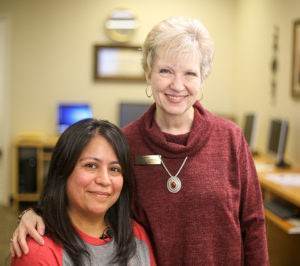
Computer classes are among the many practical life skills taught at Christian Women’s Job Corps of Rusk County. The CWJC site located in Henderson has helped equip women for life and employment since 2002. (WMU photo by Pam Henderson)

Volunteers also provide literacy and high school equivalency tutoring. Additionally, the Rusk County ministry is one of six CWJC programs in the nation that include a WorldCrafts artisan group, a fair trade compassion ministry of national Woman’s Missionary Union.

“We work with about 50 women every year and usually about that many volunteers,” Gambrell said, “When you work with this many women, you see women who succeed and women who don’t. But that’s true in every form of education and Christian ministry.

“We’ve had some wonderful successes. Each semester, we see women successfully enter the workforce. This past year we had four women who received their citizenship. We have women who’ve gone to college. We have one who’s working on her master’s degree right now.”

CWJC success story

She said they also have participants “who we’ve gotten to see their children go to college and their children get awards which is so fantastic because that goes back to the founding thought of Christian Women’s Job Corps that you’re changing the children’s lives and changing the family.”

Nita Tirado, a participant in CWJC of Rusk County, said mentoring she has received through CWJC “has been the biggest thing that has helped me in my life,” She said the mentoring program has helped her and her husband “to be better parents and to guide our kids on God’s path.” (WMU photo by Pam Henderson)

Nita Tirado is among those success stories. She first came to CWJC to get help with earning her GED. She then enrolled in the life skills classes, where she gained computer skills and other practical training.

Even more significantly, she learned about the gospel of Christ and accepted Jesus as her Savior. Following her CWJC involvement, she successfully found employment before eventually getting married and becoming a stay-at-home mom.

Her CWJC classes “gave me confidence in general,” Tirado reflected. “My favorite class out of life skills was Bible study,” she added. “It was amazing for me. It really was. I just felt peace. It was something that I was needing at that time in my life.”

Mentors matter

Over the past few years, Tirado and her husband have been paired with a CWJC volunteer couple who provide mentoring and Bible study.

That connection “has been very important in my family’s life because our mentors are the sweetest people,” she emphasized. “In my life, I’ve never had anybody like them.

“They show you love as a couple. They’re older and they’re still holding hands, and that just gave me this really nice feeling of that’s how I want to be with my husband when we’re old.

“The mentoring has been the biggest thing that has helped me in my life. It helps us to be better parents and to guide our kids on God’s path. That’s the biggest blessing of coming here for me.”

Gambrell noted recruiting mentors typically is one of the biggest challenges for most CWJC sites.

Participants “who are able to have mentors are the ones that I always see the greatest success with,” she added. “I don’t think people understand the importance of having somebody who’s your personal cheerleader, someone to stick with you and encourage you. That’s especially true with single women or women who don’t have a supportive family.”

Partnership with WorldCraft

Christie Gambrell points out the earrings crafted by the WorldCrafts artisan group affiliated with CWJC of Rusk County, Texas. She affirmed that “it’s been such an amazing thing for our ladies to be part of WorldCrafts,” National WMU’s fair trade artisan ministry. (WMU photo by Pam Henderson)

Along with CWJC’s primary emphases of mentoring, tutoring, ESL classes and job skills training, Gambrell said, the program’s partnership with WorldCrafts has been a significant resource.

“Our county is rural. We have over 900 square miles, lots of little communities, and there aren’t a lot of good work opportunities for women,” she explained. “Early on in our program, we began to look for ways to help women supplement their incomes.

“It’s been such an amazing thing for our ladies to be part of WorldCrafts,” Gambrell said. “Having a student artisan business allowed our ladies to be able to do something to help earn income. I remember one girl who had never made anything in her life. She couldn’t believe that people were buying things that she made.”

In addition to the WorldCrafts partnership, CWJC of Rusk County artisans also produce products that are distributed locally, including crocheting chemo hats for chemotherapy patients in area hospitals.

“Christian Women’s Job Corps has been a wonderful way to reach women in the community with the gospel of Jesus Christ, with encouragement for their lives and with support,” Gambrell said. “Our mission field is right here.

“The national WMU has been such an encouragement to us. They help us with promotional materials, with training, with so many things, and our state WMU has been a great support as well,” she affirmed. “There are always needs in your community and we as people of the Lord are called to reach out to those around us.”

‘I enjoy helping people learn’

Christie Gambrell (right), executive director of CWJC of Rusk County, visits with Sandra Jimenez, a CWJC participant who also serves as an aide to assist other women involved in the program. Jimenez emphasized that CWJC is “an amazing place to learn.” (WMU photo by Pam Henderson)

Diana Willis, one of the CWJC volunteer tutors committed to helping meet those needs, has 16 years of experience as a high school math teacher. Noting that many of the participants pursuing their GED needed help with math, she said, “I felt like I could make a little bit of a difference.

“I enjoy helping people learn something that they don’t know,” she added. “I feel like my spiritual gift is service and I feel like it’s a service to help someone improve their life and work toward their GED if they don’t have it. It’s just fulfilling to know that I’m helping somebody along that path.”

Citing CWJC of Rusk County’s practical impact in the lives of participants, Gambrell said she has seen many of the women go on to gain “a variety of jobs that make them feel like they’re women of worth.”

“It’s great to see them become someone that they didn’t think they could be,” she concluded. “It’s because somebody believed in them and somebody invested in their lives. That’s what Christian Women’s Job Corps is all about.”


Partnership benefits multiple congregations in Garland

GARLAND—A growing Ethiopian church, a once-thriving Anglo congregation and a start-up congregation of Millennial and Gen-X Christians share a common facility and vision for reaching their area with the gospel. And two of the three congregations share the same pastor.

Nearly four years ago, Ethiopian Evangelical Baptist Church had outgrown its home on Jupiter Road in western Garland, just east of the I-635 loop around Dallas.

“There was nothing on the market we could afford to buy” to accommodate the rapidly expanding Amharic-language congregation, Pastor Bedilu Yirga said.

About that time, Yirga learned through Dallas Baptist Association about Orchard Hills Baptist Church in Garland, just eight miles to the east.

Decades earlier, Orchard Hills had twice ranked second among Texas Baptist churches in the number of people baptized in a single year. The congregation built a facility that could accommodate more than 1,300 worshippers.

However, as the surrounding neighborhood changed and the church experienced challenges, its membership had declined to about 100 senior adults, and fewer than 50 were able to attend.

Creating a mutually beneficial partnership

Ethiopian Evangelical Baptist Church in Garland now occupies the facility that originally housed Orchard Hills Baptist Church. The once-thriving Anglo congregation continues to meet in the onsite chapel, as does a new congregation seeking to reach the rising generation. (Photo / Ken Camp)

For two years, leaders of the two congregations met, talked and prayed together about how their churches could develop a mutually beneficial partnership. Eventually, they crafted an agreement: Ethiopian Evangelical Baptist Church would assume ownership of the property, and Orchard Hills Baptist Church would meet in its chapel for worship and in newly renovated classrooms for Bible study.

In the meantime, two other key developments took place at Ethiopian Evangelical Baptist Church. Iglesia Casa de Dio el Todopodersoso purchased the Ethiopian congregation’s property on Jupiter Road, and Nebiye Kelile joined the staff to plant an English-language next-generation church, Pathway Dallas.

Actually, two buyers made offers on the former home of Ethiopian Evangelical Baptist Church—and the Hispanic congregation offered $50,000 less than the other potential purchaser.

However, leaders of the Ethiopian church believed Casa de Dio was more “kingdom-minded” and had a greater passion for reaching the community with the gospel than the other prospective buyer. So, they chose to accept the lower bid.

In gratitude, members of the Hispanic congregation volunteered their labor to help Ethiopian Evangelical Baptist Church renovate and repair the Orchard Hills building, which had extensive deferred maintenance. The cost repairing, remodeling and repurposing of the facility originally was estimated at $4.7 million.

“It ended up costing $2 million—plus prayer—with the help of the Hispanic group,” Yirga said.

Ethiopian-born, California-raised pastor

About the same time, Kelile arrived in the Dallas area to help Ethiopian Evangelical Baptist Church launch a congregation focused particularly on reaching young English-speaking people of Ethiopian heritage.

Kelile was born in Ethiopia, but his family moved to the United States when he was 2 years old. He grew up in California, where he initially attended an evangelical church serving other immigrants. He later worshipped at a predominantly Anglo church before returning to work with an immigrant church in Sacramento, helping that congregation develop an English-language ministry to reach and disciple the rising generation.

Through a network of churches devoted to reaching Ethiopian immigrants in the United States, leaders of Ethiopian Evangelical Baptist learned about Kelile. They talked to him about starting a congregation for second- and third-generation Ethiopians in the Dallas area.

After he and his family prayed about it, “the Lord released us” from the call to the Sacramento congregation, he said, and they relocated to North Texas.

As Pathway Dallas has taken root, it not only attracted English-speaking individuals with family ties to Ethiopia and Eritrea, but also several interracial couples from other backgrounds. In addition to an extensive apartment ministry, Pathway meets for worship in the chapel at the Ethiopian Evangelical Baptist Church at 10:15 a.m. on Sunday—immediately after Orchard Hills ends its 9 a.m. worship service in the same location.

The shared arrangement began in spring 2018, when the Ethiopian congregation moved into its newly renovated facility.

Bridging generations

Soon afterward, Orchard Hills needed someone to fill the pulpit one Sunday, and Kelile offered to preach. One Sunday led to another, and before long, Kelile found himself serving as pastor of two congregations—each meeting in the same space.

Orchard Hills’ members range in age from 50 to 101 years old, and about 50 people attend on a typical Sunday. About 70 to 80 people, ranging in age from 19 to 36 years old, worship at Pathway.

At age 38, Kelile is the youngest person at the Orchard Hills worship services and the oldest person worshipping with Pathway. With his background ministering both within and outside the Ethiopian community, Kelile serves as a bridge between the two congregations.

“I have to be the best representative I can be of my generation,” he said.

Dickson Rial was pastor of Orchard Hills from 1963 to 1971 and again from 2001 to 2015. Rial, age 85, now serves the congregation as minister to senior adults, providing pastoral care for members who are homebound or hospitalized.

Orchard Hills’ members find satisfaction in knowing they can continue to be part of reaching their community with the gospel, he noted.

“These senior adults are open to looking at new ways to reach people,” Rial said. “The people are upbeat and excited about the opportunities, and I believe great things are going to happen. We’re not sure exactly when it will be or what it will look like, but this is a great group of people.”

Both Kelile and Rial emphasized they spoke only for themselves, and the congregations had not made any firm decisions about what the long-range future holds.

However, both mentioned the possibility of Pathway and Orchard Hills merging at some point—bringing the wisdom and resources of the older generation and the enthusiasm and energy of the younger generation together.

Whatever is ahead, both ministers mentioned the longtime members of Orchard Hills not only are grateful they can continue to gather for worship, but also see the facility they built fully utilized to reach the changing community.