


When in Louisiana, don’t even think about sending anyone a surprise pizza, or you may face a hefty $500 fine. And, next time you’re in Denver, avoid driving a black car on a Sunday.
Even though laws like these two are outdated and no longer enforced, some bizarre laws remain on the books. Many were in place more than a century ago when they may—or may not—have made more sense.
During the early years of the University of Mary Hardin-Baylor, the school also had its fair share of unusual rules.
Some rules from the early 1900s may seem like common sense now, like “Do not pull flowers” and “Do not throw trash out of windows.”
But many rules that guided student behavior during this time came from Elli Moore Townsend, who oversaw the first work-study program for women in Texas called the Cottage Home System. According to museum records, six of the first 12 girls in the program were orphans, and all came from abject poverty.
“They were deserving girls, but they were very, very poor and had no means to go to college,” said Beth Norvell, associate director of museum and alumni engagement.
She speculates some rules perhaps were drafted specifically for the orphaned girls, because they hadn’t been exposed to common formalities of the day.
Mrs. Townsend’s Household Directory from the early 1920s laid everything out for them:
- Each girl must bathe at least twice a week in summer and once a week in the winter.
- No candy making, except on the first Monday.
- Do not walk on the floor without your shoes from Oct. 1 until April 21.
- You can read but three novels a year, unless required in your schoolwork.
- With the permission of their parents, girls may spend the Christmas holidays at home. One other trip home is allowed those whose round-trip ticket does not exceed $300.
During these early years, the dining hall had some strict rules around proper etiquette—along with many other guidelines—ladies were expected to follow. Students stood behind their chairs while prayers were said.
Sign up for our weekly edition and get all our headlines in your inbox on Thursdays
At each meal, the head of the table appointed a “table critic” whose duty was to see that proper etiquette was observed.
Table rules included:
- Do not crumble bread into the soup.
- Do not chew when passing food.
- Do not sop from the plates.
- Do not use the knife to carry food to the mouth.
- Always talk on pleasant subjects at the table, but do not talk or laugh too loudly.
- You are not excused from the supper table until after the bell rings.
Even though Mrs. Townsend was a stickler for the rules, students appreciated and respected her, even calling her their “Shepherdess.”
“The Cottage Girls definitely had a bond with her, and I think they knew she was giving them an opportunity to get an education they wouldn’t have gotten otherwise,” Norvell said.
She points out Mrs. Townsend had a nurturing and motherly side to her and provided spiritual guidance to the students.
“They viewed those rules as much as an education as the education itself, because the rules taught them how to operate within a lifestyle that they had never been accustomed to,” she noted.
Mrs. Townsend always wanted her girls to feel at home and reminded them the dormitories were “home and not a boarding house.”
Household rules included:
- Never use a chaffing dish in your room after 9:30 on Saturday evenings and after 8:00 Sunday morning.
- Do not sleep between blankets but between sheets.
- Never sweep dirt from rooms into halls.
- Never do other people’s laundry.
- Upon the discovery of a fire … slip on kimono and slippers and hasten to assigned exit.
- Never run, whistle, call or laugh loudly in the halls; or call from one floor to another, or from one building to another, or out of the window to those on the ground, except from the first floor.
Keeping the Sabbath was not optional. The house chairman—now known as a resident assistant—had the uncomfortable job of making sure every student went to church, even if it meant pulling her from hiding places in closets and under the bed.
Students also were expected to know and follow specific correspondence rules about how, when and to whom they could write.
Rules governing correspondence:
- You must write your home people at least once a month.
- You can correspond with but one young man. Only in some special cases can you write to a young man oftener than once a month.
- All letters must be written with pen and ink.
- Do not open your mail in the dining room.
- No letter-writing during study hall or study hours.
- No mail is to be sent off until it has passed through the girl’s hands who tends to the mail. Except it be sent by Mrs. Townsend.
From the rules and regulations she has come across, Norvell said she sees a strong desire to protect not only the college’s reputation as a place where “daughters would be safe,” but also to protect the girl’s reputation.
“I feel like a lot of their value was wrapped up in how well-behaved they were,” she said. “The letters parents were writing to the college back then were very specific with instructions like ‘Don’t let my child ride with boys in the car’ or ‘Don’t let my daughter hang out with this person.’”
Strict curfews imposed
By today’s standards, the rules from around 100 years ago may now be considered unusually strict, especially when it came to leaving campus, hanging out with boys and meeting curfew.
“Students will not be permitted to go with boys on the blacklist.” And “every girl must be in by 10:10 on Saturday night.”
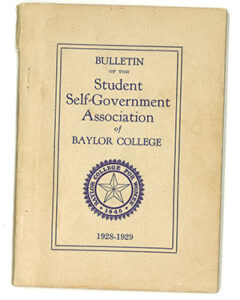 According to the 1928-29 Student Self-Government Association handbook, first-year students could go into Belton with permission two times each week in groups of two, but only on Monday morning or during the afternoons. Special permission to go shopping in Temple with a chaperone could be secured from the hostess.
Freshmen were also allowed three visits from young men friends three times a month in the college parlors, provided they had direct written permission from a parent or guardian. Permission to “go riding with friends” was granted at the discretion of the hostess, but only if they were “properly chaperoned.”
Upper-class students unquestionably had the most freedom and could “go walking, shopping or visiting any time,” but only if it didn’t interfere with schoolwork and they were back by 10:30 p.m.
They also had the special privilege of walking to the post office on Sunday afternoons and playing “popular music in the Senior room at any time except on Sunday.”
Dreaded ‘call downs’ in chapel
For less severe offenses, students who broke the rules could receive demerits or even “call downs,” where names of the misbehaving pupils were read aloud during chapel services.
“Shame is a great motivator,” Norvell said with a chuckle, pointing out that a “call down” was probably today’s equivalent of outing a friend via a social media blast.
“It had to be super embarrassing,” she said. “I don’t think it promoted sisterly affection when you have these girls who are not only spying but tattling. I feel like that would have isolated some people, and it gave the students a lot of control. I think at that time, maybe, the mindset was a little different. They viewed it in a more protective way.”
For more serious offenses or if trouble with a student intensified, parents received detailed letters of their daughters’ mischief.
In a letter dated Nov. 25, 1919, Opal’s parents learned she got caught “riding with some boys in a car,” which was cause for a trial and fines. The letter informed Opal’s parents she “had to appear in court as a witness against them, and I hope that she has learned a lesson that will stay with her through life.”
And when students were deemed uncontrollable, like Anna Bell in July 1919, they were sent back home. In a letter to her parents, the school apologetically reported Anna Bell was “defiantly disobeying our rules and regulations.”
The writer continued that she was “a bright girl, and I have tried my best to help her overcome the desire to do wrong. … I sincerely hope that you can place Anna Bell somewhere where she will have a greater desire to do right than she has here.”
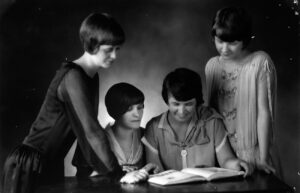
In 1922, the school president, John Hardy, requested no more girls “bob their hair without written permission from home.” Uniforms were part of the students’ attire in the early years.
“Ladies were required to dress in stark, unadorned clothes to promote unity within the student body,” Norvell said. There were even rules about how much jewelry one could wear and an etiquette class on how makeup should be applied.
The Bobby Sock Rebellion
But perhaps one of the most disliked rules was the one that led to a confrontation in front of Hardy Hall—the notorious “Bobby Sock Rebellion.”
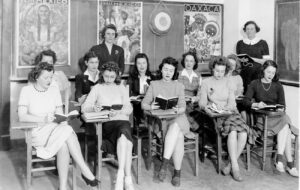
Almost a century ago, students were required to wear silk stockings, and socks were prohibited except during physical education classes. Their hosiery constantly snagged on the wooden classroom chairs, which proved to be a costly snafu.
After protesting, the administration finally allowed students to wear socks to class the following semester in the fall of 1938, but they still were required to wear hosiery when going into downtown Belton.
“It’s one of my favorite stories because they were rebellious,” Norvell said. “It wasn’t practical anymore, and the girls wanted practicality, and the administration just wasn’t catching up.”
As the decades passed, the school saw other rules evolve, like in the 1970s when trousers became fashionable for women. Until then, women were required to wear skirts and dresses, except in physical education class. When the campus went co-ed in 1971, the rules in the student handbook changed again to accommodate more men on campus.
Readers in 2023 may find themselves chuckling or even scoffing at some of these outlandish early edicts. However amusing they may be, it’s worth considering a word of advice from the 1928-29 Student Self-Government Association handbook: “DON’T FORGET—That the person who finds rules unreasonable is regarded as the one who usually needs restrictions.”
This article originally appeared in UMHB Life Magazine and is republished with permission.






We seek to connect God’s story and God’s people around the world. To learn more about God’s story, click here.
Send comments and feedback to Eric Black, our editor. For comments to be published, please specify “letter to the editor.” Maximum length for publication is 300 words.