NASHVILLE (BP)—Ukrainian Baptist Theological Seminary President Yaroslav “Slavik” Pyzh and his wife Nadia don’t stay in airport hotels when traveling outside their war-torn country. Jets signal danger.
“The first four days, as soon as we hear the sound of a jet, we will be looking for cover, instinctively. I mean it’s not like a logical thing,’’ he said Nov. 5 during their latest trip to the United States. “Because in Ukraine if you hear the sound of jet, you’re looking for cover. And here you have jets all the time, planes flying back and forth.
“In Ukraine, the only plane that we have is military jets.”
Biggest thing? ‘To show up’
Pyzh is in the U.S. thanking Southern Baptists and others for support that has allowed the seminary to provide humanitarian aid alongside tuition-free education during Russia’s war on Ukraine. Tuition has been waived for the 2,000 students currently enrolled in the seminary in Lviv on Ukraine’s western border.
Preaching the Nov. 6 sermon at First Baptist Church in Nashville alongside interim pastor Darrell Gwaltney, Pyzh expressed confidence God positioned him to serve as the seminary’s president during Russia’s attack on Ukraine.
“I never thought, in all my dreams, that I live through war. I never thought that God is preparing me for what I’m going through right now,” Pyzh said at Nashville First Baptist in the sermon taken from I Kings 18:20-39, which tells of Elijah’s battle with the prophets of Baal.
“If you had told me, I wouldn’t have totally believed you. But the biggest thing I have done for my people in the last eight months was to actually show up on Feb. 24 when the war started.
“Was I afraid? Yes. A lot of people have left Ukraine, but I think that was the moment that God was preparing me for. And not only me,” Pyzh said. “Elijah thought he was the only one; there were a few more.”
Pyzh, who has since February asked Christians to pray for a miracle to end the war, focused on God’s miracle in defeating the idol prophets at Mount Carmel.
Gwaltney chose the sermon text long before he knew of Pyzh’s visit.
“I chose that text and topic maybe two to three months ago, and then when I learned he could be in Nashville this weekend, it seemed like the perfect text for our time together,” Gwaltney said.
“The imagery is so appropriate when you think of him, leading his seminary, equipping leaders, when it looks like they are all alone against a world superpower.
“I so appreciated his focus on leadership development. In my conversations with him, I knew he is passionate about developing the next generation of leaders. It is a good word for us to hear as that should be our purpose as well.”
‘Seize the opportunities’
Ukrainian Baptist Theological Seminary served as a refugee center during the first months of the war. The seminary is strengthening internally displaced people through humanitarian We Care Centers across Ukraine, and it is helping restore pastoral leadership at perhaps 450 churches that have closed as a result of the war.
“Slavik continues to give exemplary prophetic leadership for the Ukrainian Baptist Theological Seminary, and I thought it a great opportunity for the church to hear from his heart about the work he is doing,” Gwaltney said. “I thought it would encourage us to be faithful in the small ways God calls us to serve.
“Since we have been supporting his leadership, I wanted the church to hear him in person so they could be more engaged and more supportive in the future.”
Elijah exemplifies the opportunity all believers have to serve in critical roles God has designed, Pyzh preached.
“I think what Elijah is doing here is living that life that God gave him. He came in that time. He came to do that,” Pyzh said. “The thing that I really, really want to emphasize (is) we all have an opportunity to live. We have different opportunities, and all these opportunities are as unique as our lives (are).
“But the question is: Do we seize these opportunities? Do we seize these specific times? Do we use them, or do we miss them?” Pyzh said.
As others sought to kill Elijah, “he was not afraid to show up among those 850 prophets, because that was his opportunity. That was his time. That was his life.”
In addition to the sermon, Pyzh updated individual small groups on Ukrainian Baptist Theological Seminary, thanked members for their support and received prayers for continued success.
About 6,400 killed in Ukraine
Nashville First is among numerous Southern Baptist churches supporting the seminary through direct donations and gifts through Southern Baptist Send Relief, Woman’s Missionary Union and the Ukraine Partnership Foundation.
About 6,400 civilians have been killed in Ukraine since the war began February 22, including 403 children, the United Nations High Commissioner for Human Rights said in its Nov. 7 update. Just under 10,000 have been injured, and millions have fled the country.
The U.N. High Commissioner for Human Rights “believes that the actual figures are considerably higher, as the receipt of information from some locations where intense hostilities have been going on has been delayed and many reports are still pending corroboration,” the U.N. reported in its update.
“This concerns, for example, Mariupol (Donetsk region), Izium (Kharkiv region), Lysychansk, Popasna, and Sievierodonetsk (Luhansk region), where there are allegations of numerous civilian casualties.”
In addition to God’s miracle of ending the war, Pyzh asks Southern Baptists to pray God would restore leadership to churches that have suffered during the war, and that he would offer provision and safety to residents during Ukraine’s freezing winter temperatures.
Russia has destroyed 40 percent of Ukraine’s electrical power plants, Pyzh said.
“Thank you for praying for us and helping us,” Pyzh said. “Pray for God’s miracle, because it will take God’s miracle to stop the war.”
Burmese army attacks Baptist seminary in Myanmar
November 8, 2022
The Burmese military attacked a Kachin Baptist seminary in northern Myanmar on Nov. 3, injuring four young men in a dormitory, International Christian Concern reported.
The military—known as the Tatmadaw—reportedly launched three attacks on the seminary in Kutkai, Shan State, founded by the Kachin Baptist Convention. At the time, no active fighting between junta forces and armed local ethnic group was occurring, ICC stated.
The four individuals who were hit by shrapnel, sustaining non-life-threatening injuries, were identified as Myitung Doi La, 24; Ndau Awng San, 27; Nhkum Sut Ring Awng, 21; and Sumlut Brang San, 22.
Marip La Hkwang, a Kachin Christian, posted a Facebook video showing damage caused by the shelling, and another video showed an injured student being helped out of the dormitory to receive medical attention.
‘Deliberately targeted a Christian facility’
“The attack against this Kachin Bible school was certainly not an accident,” said Gina Goh, International Christian Concern’s regional manager for Southeast Asia.
“Instead, the Tatmadaw deliberately targeted a Christian facility, knowing how important the faith is to Kachin people. This despicable junta regime should not be tolerated any further by the international community and needs to be removed at once.”
The attack on the school occurred four days after shelling partially destroyed a Baptist church and hall in Momauk township, Kachin State.
Since the Tatmadaw staged a coup in February 2021, more than 2,400 people in Myanmar have been killed and at least 16,000 have been jailed by the junta, including many who have been tortured.
BWA condemns ‘campaign of terror and violence’
At its annual gathering in Birmingham, Ala., the Baptist World Alliance general council adopted a resolution condemning the military coup that led to “a campaign of terror and violence” in Myanmar. The resolution called for “the establishment of a true democracy that respects the rights of religious and ethnic minorities in Myanmar.
“Since the coup, the military has terrorized communities in Kachin, Karen, Kayah State, Chin State and Sagaing Region by burning villages, destroying churches, and detaining pastors and religious leaders,” the resolution stated.
More than a year ago, the Tatmadaw shot and killed Cung Biak Hum, a Baptist minister in Thantlang who was helping a member of his church extinguish a fire after the man’s home was set ablaze during military attacks.
EDITOR’S NOTE: Nov. 6 is the International Day of Prayer for the Persecuted Church.
TBM brings clean water to Amazon village in Peru
November 8, 2022
Even in a place surrounded by water, clean drinking water can be hard to acquire.
In October, a team of seven Texas Baptist Men volunteers helped drill a water well and start a church building for an Amazon River island village in Peru.
Drastic difference for isolated community
TBM purchased drilling equipment in 2019 for a ministry called Access Water Peru. The new well in San Pedro became the first TBM Water project since the pandemic and will change the community radically.
“You can see the Amazon from the village, but the river water is never clear in this area, because it has a very muddy bottom,” said Mitch Chapman, TBM water ministry director who led the volunteers. “It looks like chocolate milk.”
Villagers normally get their drinking water by capturing rain from their roofs and from “what they call a lake half a kilometer from the village,” Chapman said.
The lake is formed by water which remains after Amazon flooding. It is muddy and is a breeding ground for anacondas. As for the captured rainwater, it flows along metal roofs and drains and can sit stagnant for days.
The new well hit water at a depth of 26 meters—about 85 feet—and went down another five meters to determine the depth of the water sand from which drinking water is extracted, Chapman said.
“We had no problems. We set up the drill in about a day and a half and drilled for four and a half hours. After setting the well casing, we flushed the well until we got clear water,” Chapman said.
“It was the neatest thing to watch when all of the kids and some adults were playing in the water and laughing. Most have never seen flowing water out of a pipe.”
Journey to remote location
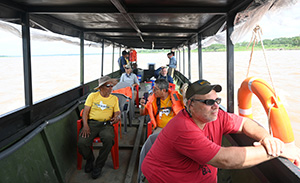
After taking connecting flights to Iquitos, Peru, TBM volunteers took a two-hour riverboat trip to San Pedro. (Photo / Noel Tucker)
The TBM team reached the island by flying to Lima, Peru, then taking another flight over the Andes mountain range to Iquitos, followed by an almost two-hour riverboat trip. San Pedro residents can reach the outside world only via the river.
The first well is simply a beginning. The TBM crew continued work on a platform dwelling where this and future mission teams can eat and sleep.
“This first team walked about 30 minutes to the drill site. Future teams will work their way down the river, drilling wells in different villages within a 30-minute boat trip,” Chapman said.
Twenty-five more village wells can be staged from this location using the drilling rig provided by TBM.
Beyond the cost of the rig, each well costs between $8,000 and $14,000 in supplies and ongoing maintenance across the world, Chapman said. The price varies by region and available infrastructure. Drilling rigs cost $18,000 to $45,000, depending on the type and region.
“As TBM donors give, we are able to provide wells in places around the world where clean drinking water is needed,” Chapman said. “And as TBM volunteers step forward we are able to help provide workers for both labor and ministry through churches in those places.”
TBM facilitates the process in different countries by working with local ministries. Keny Ojanama, of Access Water Peru, did the advance work for the October TBM trip. Churches along the Amazon make their request to Ojanama and he sets priorities based on location and distance from drinkable water, Chapman said.
“Before our team went to Peru, Keny determined that the big problem in this village was how dirty the water was becoming” because villagers used the lake water for all of their water needs, Chapman noted. “The water gets very soapy and contaminated as it gets lower.”
On the plus side, the Peruvian villagers have plenty of healthy food.
“They will never starve to death,” Chapman said. Fresh fruit and fish are plentiful and free. There is no refrigeration or electricity, so villagers gather food each day for consumption. And, thanks to the chickens, the TBM team joined villagers in eating lots of eggs.
Supporting churches and ministries
The TBM team included seven men and one woman. They flew out of Dallas/Fort Worth Oct. 7 and returned Oct. 18.
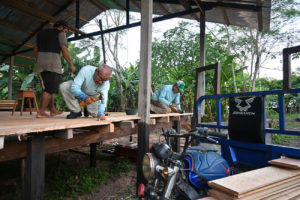
A TBM volunteer team in Peru began construction of a new church building, with the elevated platform floor and roof being completed by the team. (Photo / Noel Tucker)
TBM water projects include other work to support churches and their ministries. The Peru team began construction of a new church building, with the elevated platform floor and roof being completed by the team. They also shared the gospel with children through varied activities and with adults through preaching and teaching.
Teams also include people with varied abilities and strengths. Noel Tucker served as team photographer, children’s minister, and all-around support. It was her first “formal” mission experience.
“Being a mom, athlete, open-water sailor and attorney, my brain is always ‘on’ and covers a lot of ground in this type of environment,” Tucker said.
“Because I was not specifically tasked for most of the day, … I could see to minor health/injury issues and do whatever physical labor was needed that didn’t need direct supervision. I pretty much always had something in my day pack to accommodate the need. I thoroughly enjoyed that part of the service as well.”
The trip has given Tucker much to reflect on since returning. She still is pondering the “difference between [the villagers’] existence and ours in the U.S. Their lives are boiled down to the basics of food, shelter, procreating and hopefully developing their relationship with Jesus.
“They have all day and need all day to manage those tasks. We fill our days with so much unnecessarily, partly due to advancements in civilization but also because we are materialistic and enjoy our creature comforts,” she said. “There is a lesson in there somewhere.”
Religious freedom panel criticizes China-Vatican deal
November 8, 2022
VATICAN CITY (RNS)—Members of the U.S. Commission on International Religious Freedom criticized a recently renewed Vatican deal with China, saying it emboldens the Chinese government to crack down on Christian communities.
The secretive provisional agreement, originally signed in 2018 and renewed Oct. 2, allows Beijing to have a say in the appointment of bishops in the officially recognized church.
Catholic officials hope the agreement will help to reconcile the government-approved church and the Catholic community, which is led by priests sanctioned by the Vatican.
But some members of the U.S. Commission for International Religious Freedom—an independent bipartisan federal commission tasked with reporting to Congress and the administration on the state of religious freedom in the world—spoke out against the agreement, claiming it has made the situation worse for Christians in China.
Conditions deteriorate in recent years
Stephen Schneck, a commissioner who served in the Obama White House’s faith-based partnership office, says reports show conditions of Catholics in China have significantly worsened over the past four years since the agreement was signed.
“So much worse, in fact, that we think the agreement no longer makes any sense,” he told Religion News Service.
An advocate for Catholic social justice and former dean at the Catholic University of America, Schneck said he especially is concerned about the situation of 90-year-old Cardinal Joseph Zen of Hong Kong, who was arrested along with five others by Chinese authorities in May for a bureaucratic error in a humanitarian fund viewed as a danger to China’s national security.
Zen has been an outspoken advocate for religious freedom in China and a strong critic of the Vatican agreement with Beijing. He played a crucial role in the wave of pro-democracy protests in Hong Kong in 2020 protesting the broadly written Chinese National Security Laws, which strongly limit the right to assembly. Zen’s trial resumed on Oct. 27, only days after the Vatican-China agreement was renewed.
“I don’t think that we cannot notice the timing of the restart of this trial,” Schneck said, adding, “It’s not a good sign.”
Vatican officials defend the deal
Vatican officials, including Secretary of State Cardinal Pietro Parolin, defended the deal. While not perfect, it keeps a channel open for dialogue with Beijing and has led to short-term positive results with the appointment of six bishops recognized by the pope and the Communist Party, he said.
“Whatever communication they are having hasn’t thus far affected the release of their cardinal in Hong Kong, of folks who have been imprisoned for practicing their Catholic faith,” David Curry, another commissioner, said Oct. 28.
“I personally think the Vatican is willfully overlooking the egregious use of the agreement as justification of a crackdown on the underground church.”
While Schneck praised the “long game” approach that characterizes Vatican diplomacy, he voiced skepticism that the agreement would lead to significant change.
“When it was originally signed,” Curry said, “I believe the rationale from the Vatican was to show good faith with the Chinese Communist Party with the hope that it would open up some kinds of freedoms for other Christians within the country.
“Unfortunately, that hope has not panned out,” he added.
‘Things have gotten worse in China’
Curry, whose organization Open Doors USA advocates for persecuted Christians around the world, pointed to the technological means the Chinese government uses to monitor the religious activity of its citizens as an example of the “crackdown on religious expression” under President Xi Jinping.
The members of the so-called underground church, meeting online and in people’s homes, sometimes are arrested for practicing their faith, he said.
“Things have undoubtedly gotten worse in China, no question, as it relates to religious freedom,” said Curry, adding any religious practice in the country is allowed only under the watchful eye of the government and must obey Communist Party rules.
“In some ways,” Curry continued, the Sino-Vatican agreement “has emboldened the Communist Party because they are using the agreement to say that anyone who doesn’t practice in an officially recognized church is therefore operating illegally.”
The U.S. Commission on International Religious Freedom plans to file a report to Congress and the administration that addresses the effect that the Vatican deal with China has had on religious freedom in the country. The commission mentioned the agreement and Zen’s arrest in its 2022 report.
This isn’t the first time U.S. government officials have been at odds with the Vatican’s rekindling of relations with China. While visiting Rome and the Vatican in September of 2020, former U.S. Secretary of State Mike Pompeo suggested the agreement compromised the Vatican’s ability to act as “a moral witness” for human rights in China.
“I think it would be very difficult for the Vatican now to be able to hold China accountable later for whatever is occurring under this agreement,” Schneck said.
Schneck, who described himself as a loyal Catholic and “a strong supporter of Pope Francis,” lamented the fact that the Sino-Vatican agreement has become a battleground for conservative and liberal factions in the church.
Catholics who have been critical of Pope Francis more broadly tend to criticize the deal, while defenders of the agreement praise it as a symbol of the pope’s efforts to build bridges and promote dialogue with Beijing.
“It’s too bad that it’s become a political football between left and right within the church,” Schneck said. “This is something that needs to be looked at with much more objectivity and separate from the polarization and squabbles on one side and the other.”
Zimbabwe Baptist leaders killed in auto crash
November 8, 2022
An Oct. 21 automobile accident claimed the lives of the longtime former president of Zimbabwe Theological Seminary, his son and the seminary’s current president.
Lott Carey—an African American Baptist missions society—reported the deaths of Henry Mugabe, noted theologian and former seminary president; his son Munyaradzi Johannes Mugabe; and Dudzirai Chimeri, seminary president.
The three reportedly were traveling from Harare to Gweru when the crash occurred.
Henry Mugabe
Lott Carey President Gina Stewart praised Mugabe as “a gentle giant” and as “a man of tremendous intellect, … an outstanding theologian and a true ambassador of the gospel of Jesus Christ.”
Emmett Dunn, executive secretary-treasurer of Lott Carey, called Mugabe “an innovative leader who combined the practical and spiritual in crafting the church’s response to the ills of society.”
Mugabe was “a provocative theologian who believed that the word of God must be interpreted using the lenses of marginalized Africans, and a firm believer in the fight for justice in defending the rights of the indigenous church against foreign intervention,” Dunn continued. “He enters heaven bearing the scars as evidence of his fight for justice.”
Elijah Brown, general secretary and CEO of the Baptist World Alliance, expressed appreciation for the life and ministry of Mugabe, who led the seminary for an extended time during a difficult period.
“Dr. Mugabe was an instrumental leader for theological education for many years, and his faithful service will undoubtedly bear fruit for generations to come through the lives of those he taught,” Brown said. “The entire global Baptist family grieves his death and the death of his son Munyaradzi and Dr. Dudzirai Chimeri.”
In 2011, Mugabe was principal of the Baptist Theological Seminary of Zimbabwe, which was supported by the Southern Baptist Convention’s International Mission Board. He was fired for refusing to accept changes made to the school’s governing documents—particularly a requirement that academic staff adhere to the 2000 Baptist Faith & Message and its prohibition of women pastors.
When Mugabe refused to meet with a new council the Baptist Convention of Zimbabwe formed to replace the school’s board of trustees, he was locked out of his office and given seven days to move out of his home, owned by the Baptist Mission of Zimbabwe.
Two years later, a labor court ruled he had been improperly dismissed and ordered he be reinstated with back pay. However, he left the school to form the Zimbabwe Theological Seminary, with support from Lott Carey and the Alliance of Baptists.
Mugabe held a Master of Divinity degree and a Ph.D. from Southern Baptist Theological Seminary. In addition to his teaching and administrative duties in Zimbabwe, he also taught at the Baptist Theological Seminary at Richmond, Campbell University’s Divinity School, McAfee School of Theology at Mercer University and Wake Forest University Divinity School.
Religious freedom group seeks inquiry into Iran’s crackdown
November 8, 2022
WASHINGTON (RNS)—The U.S. Commission for International Religious Freedom called on the Biden administration Oct. 14 to establish a commission of inquiry at the United Nations to examine Iran’s brutal suppression of protests.
A wave of demonstrations described as a widespread rebellion have spread across Iran following the Sept. 16 death of Mahsa Amini. The 22-year-old Iranian woman died in the custody of the morality police after she was arrested on charges of not obeying the hijab law that requires women to cover their heads.
But the commission was particularly concerned with the deaths of Sunni worshippers at the hands of the Iranian security forces on Sept. 30. Iran is a majority Shiite nation, and Sunni Muslims are a religious minority.
The city of Zahedan is home to the ethnic Baluch—sometimes spelled “Baloch”—minority. Protesters emerging from prayers at the Great Mosalla prayer complex shouted anti-government slogans when they were confronted by security forces firing into the crowd. The New York Times reported the community may have been protesting the alleged rape of a young girl by a police officer.
Amnesty International reported up to 82 people may have been killed—66 during the Sept. 30 riot and 16 more in separate incidents in the city since then.
“Iran’s use of excessive and lethal force against protesters asserting their religious freedom is a deplorable violation of international law for which there must be full accountability,” said Nury Turkel, chair of the U.S. Commission for International Religious Freedom.
The victims of the Islamic Republic’s crackdown are not limited to religious minorities. Iran’s Committee to Protect Children’s Rights cited the killing of 28 children or adolescents by security forces during or connected to demonstrations in which many protesters stripped off their hijab in defiance of the ruling clerics.
The U.S. Commission for International Religious Freedom recommended in its 2022 report that Iran be designated a country of concern by the U.S. State Department for its systematic and egregious religious liberty violations.
Human Rights Watch has documented videos showing security forces using shotguns, assault rifles and handguns against protesters. The organization has compiled a list of 47 individuals killed, most by bullets.
The protests rocking Iran are considered the most serious since 2009.
United Nations commissions of inquiry are designed to bring to light situations of serious violations of international human rights law.
The United States is one of 47 nations on the U.N.’s Human Rights Council, the main inter-governmental body within the United Nations system responsible for addressing situations of human rights violations.
In April, the Human Rights Council established a commission of inquiry into violations of human rights as a result of the Russian invasion of Ukraine.
Baptist pastor and wife kidnapped in Ukraine
November 8, 2022
MARIUPOL, Ukraine (BP)—A Baptist pastor and his wife remain missing after being kidnapped Sept. 21 from their church in Russian-occupied Mariupol, Forum 18 News Service reported Oct. 6.
Armed masked men in Russian military uniforms took Pastor Leonid Ponomaryov and his wife Tatyana from their home in the Kalmiusky District of northern Mariupol, neighbors told Forum 18. Officials reportedly searched the home for about two and a half hours.
The Russian military also searched and sealed Ponomaryov’s church—identified as Kurchatov Street Baptist Church with the Council of Churches Baptists group—and seized religious literature there, Forum 18 said, attributing reports to Mariupol Baptists.
“The neighbors distinctly heard groans and cries” as the Ponomaryovs were taken “in an unknown direction,” Mariupol Baptists told Forum 18. Church members began seeking answers the following day. “But neither then nor on subsequent days could they get any answers,” local Baptists told Forum 18.
Russian officials initially claimed the couple were involved in “extremist activities,” but it is unclear whether they have been charged with any crime. The Ponomaryovs’ children, friends and fellow pastors have been unable to determine the reason for the abduction or the couple’s whereabouts.
History of persecution in occupied territories
“Since 2014, Baptists in occupied territory have been targeted and persecuted. Forty-six Baptist churches have been damaged or completely destroyed by war since February,” said Elijah Brown, general secretary of the Baptist World Alliance.
“Even as we continue to hear of people of faith who have been harassed, kidnapped, or face intentional violence, we have a responsibility to pray and stand together with gospel generosity as Baptists in Ukraine and across the region remain at the forefront of peace building and providing care in the love of Christ for all who are being traumatized by this ongoing war.”
Brown noted he did not have direct confirmation about the details of the incident involving Leonid and Tatyana Ponomaryov.
The Baptist Standard sought independent verification of the report but did not receive a response from sources in Ukraine.
The Ponomaryovs’ children issued a statement Oct. 1 thanking the Baptist community for their prayers, as several churches were praying and fasting for the couple’s return.
“For 10 days already, we know nothing about them,” Forum 18 quoted the statement. “A group of church members from Mariupol and Rostov went (around) all the agencies and institutions, not only in Mariupol but in the regional center [Donetsk], and were told nothing about our parents anywhere.”
While Russian officials have not responded to Forum 18’s requests for information, reportedly an officer of the Russian Interior Ministry told relatives the couple would be released after the Sept. 27 Russian-controlled referendums to annex Donetsk and three other Russian-occupied regions in Ukraine. The Sept. 27 referendums were illegal under Ukrainian and international law and have not been officially recognized by the United States and the international community.
Russia has officially occupied Mariupol since May in the war Russia launched on Ukraine in February. Russia has sealed many churches and confiscated equipment.
But despite the referendum and the forced closure of some Christian churches, other congregations, including at least two Council of Churches Baptists congregations, are still able to hold Sunday worship services. Forum 18 described the Council of Churches Baptists as unregistered churches in Ukraine that meet in property owned by one or two church members.
With additional reporting by Managing Editor Ken Camp.
Christians murdered, thousands displaced in Nigeria
November 8, 2022
BENUE, Nigeria (BP)—Dozens of Christians were murdered and 6,000 displaced in terrorist attacks in Nigeria’s middle belt in September.
International advocates are urging the U.S. State Department to cite Nigeria for religious liberty violations.
“Armed herdsmen and terrorists have not stopped their unprovoked attacks on Christians in Benue state,” Akpen Leva, chairman of the Benue State Chapter of the Christian Association of Nigeria, said Sept. 24 in a press statement. “These attacks are aimed at killing defenseless Christians and to force them out of their communities.”
Multiple attacks
Those killed in a series of September attacks in Benue included “dozens” murdered in eight majority-Christian villages Sept. 23 and 21, 13 killed in two additional villages Sept. 9-10, and nine killed Sept. 1-3 in the same two villages, Morning Star News reported, quoting law enforcement and religious leaders. Fifteen villagers were killed Sept. 15 in Logo Local Government Area of Benue, the Daily Post reported.
Others were killed in smaller attacks, including three killed Sept. 18 in a Christian village in Guma County, Benue; two on Sept. 25 in Plateau State, two on Sept. 24 in Kano state, and a woman working on her farm Sept. 19 in Plateau State, Morning Star reported. Others were injured, kidnapped or displaced in the attacks. Homes, farms and churches were destroyed, and food was stolen.
Attackers displaced more than 6,000 from three Benue counties in September, according to Emmanuel Shior, executive secretary of the Benue State Emergency Management Agency.
“Recent attacks by herders on some Christian communities in Benue state have left 6,000 Christians displaced in Logo, Guma and Gwer West local government areas of the state,” Morning Star quoted Shior.
“These continuous attacks by herdsmen on Christian communities in the state have also resulted in the destruction of facilities like churches, schools, markets and health care establishments.”
Militant herdsmen, the Islamic State West Africa Province and bandits have been blamed for the murders and attacks, with animist worshipers also blamed for church attacks.
“These attacks by the herdsmen have left dozens of Christians dead and several more with gunshot injuries and machete attack wounds,” Morning Star quoted a text message from resident Ukan Kurugh after the Sept. 23 attack.
“Survivors of these herdsmen attacks have been taken to some hospitals, and they need urgent medical attention but lack the funds to pay for their medical bills. Some of them need urgent surgeries but they can’t afford to pay for the charges.
“Our people have suffered immensely in the hands of these marauding herdsmen.”
More than 100 worshipers were kidnapped in September from churches in northwest Nigeria, the Southern Kaduna Peoples Union reported in a press release, citing attacks Sept. 12 and 13 at two separate sites of the Cherubim and Seraphim Church in Niger and Kaduna states.
“There is still no breathing space for Christian communities in southern Kaduna, as terrorists, jihadists, bandits and armed herdsmen have continued to plunder and wreck Christian communities in the southern part of Kaduna state,” Morning Star quoted National President Awemi Maisamari Sept 22.
Calls to return Nigeria to CPC status
The U.S. State Department dropped Nigeria from its 2021 list of Countries of Particular Concern or egregious violators of religious freedoms. The Southern Baptist Ethics & Religious Liberty Commission and 21 Wilberforce are among the groups urging the return of Nigeria to the list released annually in November.
Nigeria, which has led countries in deaths of Christians by terrorists, was first included on the State Department’s list of Countries of Particular Concern in 2020, but was not retained the next year.
“As religious minorities face increasingly intense persecution for their faith in Nigeria, it is imperative that Secretary (Antony) Blinken re-designate Nigeria as a country of particular concern. Over the past year, we’ve continued to see deteriorating conditions in Nigeria as thousands of Christians have been martyred for their faith,” ERLC policy manager Hannah Daniel said.
The U.S. government “must do more to pressure the Nigerian government to take action and protect its people from these heinous acts of violence against people of faith, and the CPC designation is an essential piece of such a strategy.”
More than 2,500 Christians were killed in the first six months of 2022 in Nigeria, the advocates said in their letter, referencing a report by the International Society of Civil Liberties and Rule of Law.
The Observatory of Religious Freedom in Africa counted more than 4,300 Christians and 2,200 Muslims killed in “jihadist-related contexts” from Oct. 1, 2020, to Sept. 30, 2021, according to the Observatory of Religious Freedom in Africa.
How Samaritan’s Purse became a global relief powerhouse
November 8, 2022
NORTH WILKESBORO, N.C. (RNS)—Each week, in a hulking warehouse in this small, western mountain town, Samaritan’s Purse employees load semi trailers full of supplies for the people of Ukraine: medicines, food, tarps, blankets, hygiene kits and school bags for kids.
Samaritan’s Purse’s North Wilkesboro, North Carolina, warehouse is 160,000 square-feet. (RNS photo by Yonat Shimron)
The trucks are then driven 80 miles east to the Piedmont Triad International Airport where they are loaded onto the nonprofit’s DC-8 aircraft, specially configured to carry up to 84,000 pounds of cargo. From there, the goods are airlifted to Poland and then trucked across the border into Ukraine.
Samaritan’s Purse, headed by evangelical leader Franklin Graham, recently made its 30th airlift since Russia began its offensive against Ukraine in February.
The Christian relief organization estimates it has helped 5.5 million Ukrainians with medicine, food and water. Earlier in the conflict, it also operated an emergency field hospital and outpatient clinic in Lviv, treating an estimated 17,758 patients. It now supports 30 medical facilities across the war-ravaged country.
The organization’s 160,000-square-foot warehouse in North Wilkesboro employs 385 people who buy, repair, maintain and retrofit millions of dollars’ worth of medical equipment, generators and water filtration systems, much of them donated.
The warehouse has six emergency field hospitals ready to ship, four with tents, hospital beds, anesthesiology equipment, X-ray machines and surgical suites—all engineered to fold into a plane’s fuselage. There are also miles of plastic tarps, mountains of used clothing and boxes full of small brown teddy bears with the Samaritan’s Purse logo—a cross inside a circle.
Provides aid in up to 120 countries a year
Samaritan’s Purse, now in its 52nd year, has become a powerhouse of faith-based international relief.
Ukraine is now drawing on much of that relief, but in any given year, the organization aids people in 110 to 120 countries. It sent supplies to Pakistan after unprecedented flooding from monsoon rains this past month. It has a mobile medical team at 11 different sites across civil war-torn Yemen. It is helping farmers in Iraq’s Sinjar Mountains plant strawberries.
Closer to home, Samaritan’s Purse volunteer teams recently sawed off tree limbs and cleared damaged homes in Kentucky and Missouri, where a rash of disastrous floods ruined homes and businesses.
The nonprofit’s mission is based on the parable of the Good Samaritan as told in Luke’s Gospel, in which a man is stripped, beaten and left for dead on the side of the road. He is rescued, not by those with power or authority, but by an outsider—a Samaritan—who bandages his wounds, takes him to an inn and pays the innkeeper to look after him.
To many, Samaritan’s Purse may be best-known for giving shoeboxes full of toys to needy children around the world. But over the past 10 years, it has grown into one of the largest U.S. faith-based nonprofits, with annual revenues last year of $1 billion.
A review of its annual 990 IRS form shows Samaritan’s Purse’s revenue has doubled since 2014, and its assets have quadrupled. It now ranks at No. 23 in the Chronicle of Philanthropy’s 25 largest U.S. charities, a list that includes mostly non-religious charities.
Today, Samaritan’s Purse is in a league with the American Red Cross, Catholic Charities and Lutheran Services in America. In 2020, it surpassed in cash revenue the Christian charity World Vision, with whom it shares a founder—former missionary and evangelist Bob Pierce, Franklin Graham’s inspiration and mentor.
On the front lines of crises and disasters
That growth has come largely on the strength of its frontline work in public health crises and natural disasters around the world.
Franklin Graham (right) visits with medical staff at a Samaritan’s Purse emergency field hospital in Lviv, Ukraine. (Photo courtesy of Samaritan’s Purse via RNS)
Even before the COVID-19 pandemic, Samaritan’s Purse designed and assembled emergency field hospitals. In the past two years it put them to use in Italy; the Bahamas; New York City; Los Angeles; Jackson, Miss.; and Lenoir, N.C.
Its quick response to emerging health crises was tested in 2014, when two of its medical personnel contracted the deadly Ebola virus while treating people in Liberia. They were evacuated to Atlanta’s Emory University Hospital, where they were treated and recovered.
“When we say we run to the fire, that’s not idle talk,” said Ken Isaacs, vice president of programs and government relations and the logistical and regulatory brain behind the group’s sophisticated international enterprise.
Samaritan’s Purse has built up a corps of Christian doctors, nurses and other medical professionals who volunteer on short-term trips to mission hospitals across the world and a cadre of domestic volunteers trained in debris removal, mud-out and light construction.
The organization’s headquarters are in North Carolina’s Blue Ridge Mountain town of Boone. It has warehouses in Coppell and Southern California, field offices in 17 countries across the world and a lodge in Alaska where it runs marriage seminars for wounded soldiers and law enforcement officers.
Lightning-rod leader
But unlike many other Christian charities, Samaritan’s Purse is distinct in a particular way: It has a galvanizing, and sometimes polarizing, leader.
Franklin Graham, on the steps of the Columbia, S.C., Statehouse for part of his 50-state Decision America tour, calls on an audience of 7,100 to pray and vote for evangelical Christian candidates and run for office themselves. (Religion News Service photo / Cathy Grossman)
“I think most people today would be hard-pressed to name the president of Catholic Charities, World Vision or Compassion (International),” said David King, director of the Lake Institute on Faith & Giving. “Many organizations are not led by personalities in the same way that Franklin Graham leads Samaritan’s Purse.”
As the son and successor to Billy Graham and the president of the Billy Graham Evangelistic Association, Graham, 70, has outsize stature in the evangelical fold. With his 10 million Facebook followers and 2.5 million Twitter followers, he inveighs regularly on some of the hottest issues of the day, drawing supporters and detractors for his conservative and partisan views.
He is a staunch supporter of former President Donald Trump; most recently he blasted the FBI for raiding Trump’s Mar-a-Lago home, claiming—falsely—that Trump would return the documents, if asked.
A culture warrior on the social issues of the day, whether it’s abortion, same-sex marriage or gender identity, Graham regularly denounces what he sees as a godless America set adrift by secular culture.
Graham applauded the Canadian Freedom Convoy. He labeled Disney a “moral failure” for its gay-friendly policies. He pushed a domestic abuse victim to return to her pastor husband.
But when it comes to running Samaritan’s Purse, he has also proven to be an effective leader committed to helping people in crisis in the most nimble and resourceful ways possible.
“Franklin always liked the challenge of getting on the ground fast and cutting through red tape and bureaucracy,” said Mark DeMoss, a now-retired public relations executive who represented Graham. “He wants to go where others can’t go, get set up quicker than others and show (people) you’re on the ground.”
Samaritan’s Purse draws broad support
Graham is unconventional in more ways than one. He doesn’t hire outside companies to produce direct mail appeals. He doesn’t socialize with charity professionals.
“We’ve never used outside fundraisers,” Graham said in a telephone interview. “We tell people what we’re doing, and people decide if they want to help us.”
Evangelicals have responded. Graham claims thousands of people make small donations of $100 or less, and while that may not be entirely accurate, the charity draws from a large net of donors, many in evangelical circles.
Only 5.1 percent of Samaritan’s Purse’s revenue in 2021 came from federal dollars. In past years, it has partnered with the U.S. Agency for International Development to provide aid in Iraq, Sudan, Congo, Liberia and Colombia.
It also worked with the United Nations’ World Food Program, the United Nations’ High Commissioner for Refugees and the International Organization for Migration, another U.N. organization.
Despite Graham’s social views, Samaritan’s Purse is committed to providing services to everyone regardless of race, ethnicity, religion or sexual orientation. It will, however, tell them about Jesus.
Part of Samaritan’s Purse’s growth and financial success may be due to the Graham brand. Graham inherited from his evangelist father a reputation for personal integrity and financial transparency.
“There was no scandal in Billy’s life, and I think that’s true of Franklin, too,” said Grant Wacker, a historian and the author of America’s Pastor: Billy Graham and the Shaping of America. “Whatever one thinks of his politics, he has stayed on track in terms of his personal ethics. What that does is it creates a consistency between the message and the public appeal.”
While some donors may be unaware of Graham’s politics, Wacker said, some give precisely because of it.
“The inclination to contribute is based on trust,” he said. “For evangelicals, both black, white and Latino, personal trust is to a good extent based on a perception of your personal life.”
Filling shoeboxes for needy children
Then there’s Operation Christmas Child. The longstanding program, begun by Samaritan’s Purse in 1993, partners with local churches, who in turn enlist members to buy small gifts and pack them in shoeboxes for needy children around the world. It also helped Samaritan’s Purse to be reclassified by the IRS as an association of churches.
Volunteers of all ages from Parkway Baptist Church in College Station join in packing shoeboxes for Operation Christmas Child. (2013 FILE PHOTO/ George Henson)
Samaritan’s Purse estimates it has 90,000 volunteers each year. In 2021, those volunteers packed and shipped more than 10.5 million shoeboxes worldwide.
Operation Christmas Child remains a signature program, but it no longer is the central focus of the organization.
In 2001, more than half of the charity’s revenue came from Operation Christmas Child, and about two-thirds of the organization’s expenses were spent on that program, according to a 990 report. By 2021, less than a third of Samaritan’s Purse’s revenue came from Operation Christmas Child, and the program made up about 44 percent of the organization’s expenses.
The sanctuary of Central Baptist Church in Dnipro, Ukraine has been turned into a shelter for Ukrainians fleeing their homes because of the Russian assault. Central Baptist Church receives regular shipments of food and medicines from Samaritan’s Purse. (Courtesy of Samaritan’s Purse)
But the relationships formed with churches who either donate shoeboxes or receive them for distribution has given the organization global reach and quick access when disaster strikes.
Sergii Syzonekno, pastor of Central Baptist Church in the Ukrainian city of Dnipro, had been participating in Operation Christmas Child for eight years. When the war began, he, like other churches already in Samaritan’s Purse’s Operation Christmas Child network, immediately received $5,000 in cash.
That support has now ramped up with weekly shipments of supplies. The church has opened its building to shelter Ukrainians fleeing the war. Some 430 people slept there one night at the height of the war. Church volunteers use their own cars to go out and evacuate people under siege from the Russians and deliver food and water.
“We are very thankful to Samaritan’s Purse for food, medicine and encouragement,” said Syzonekno. “We are partners. We are doing God’s work together.”
Queen Elizabeth II spoke openly of her Christian faith
November 8, 2022
LONDON (RNS)—Elizabeth II of England, Britain’s longest-serving monarch and official head of the Church of England, died Sept. 8 at Balmoral Castle in Scotland at age 96.
She came to the throne in 1952 but had dedicated her life to service of her nation six years earlier, as a 21-year-old princess, saying, “God help me to make good my vow.” And in later years, she spoke openly about the importance of her Christian faith.
When Elizabeth was crowned following the death of her father, George VI, Britain was still recovering from World War II and its heavy bombing campaigns; Winston Churchill was prime minister and the country still had an empire.
The young queen’s coronation suggested a new era—as the millions of television sets purchased to watch the live broadcast of the ceremony from London’s Westminster Abbey signaled.
But the coronation itself was steeped in tradition and confirmed the intertwining of the monarchy and religion. The more-than-1,000-year-old ceremony involves the anointing of the monarch, who commits himself or herself to the people through sacred promises.
Defender of the Faith
One of those, to uphold the Protestant religion, is also a reminder of the religious divisions of the nearer past.
The queen’s two titles of Defender of the Faith and Supreme Governor of the Church of England, given to her at her accession, also owe their existence to Reformation history. The first was first bestowed on Henry VIII by a grateful pope for the king’s rebuttal of the teachings of Martin Luther. Henry defiantly held onto it even after breaking with Rome to declare himself head of the new Church of England.
His daughter, the first Elizabeth, dubbed herself Supreme Governor of the Church of England, saying Jesus Christ was its head. To this day, the British monarch retains constitutional authority in the established church but does not govern it.
The modern Elizabeth left that to the bishops, though she addressed general synods and maintained a role as a listener and guide to her primate, the Archbishop of Canterbury.
On Sept. 8, Archbishop of Canterbury Justin Welby released a statement noting the “signs of a deeply rooted Christian faith” in the queen’s life: her courage even as she mourned her husband, Prince Philip, the Duke of Edinburgh, who died in April 2021; her reminders in the darkest days of the COVID-19 pandemic that darkness cannot overcome light; her service to “her people and her God.”
“As a faithful Christian disciple, and also Supreme Governor of the Church of England, she lived out her faith every day of her life. Her trust in God and profound love for God was foundational in how she led her life—hour by hour, day by day,” Welby wrote.
Delivered annual Christmas messages
While Defender of the Faith has been an inherited title and little more, Elizabeth II embraced it and in recent years made it her own, speaking very openly about her faith and explaining how it provided the framework of her life.
She did this mostly through her annual Christmas message, a tradition begun by her grandfather, George V, in 1932, and continued by her father. Her early Christmas Day broadcasts were platitudinous—the holidays as an occasion for family was a frequent theme. In 2000, however, she spoke of the millennium as the 2,000-year anniversary of the birth of Jesus Christ, “who was destined to change the course of our history.”
She went on to speak personally and frankly about her faith: “For me, the teachings of Christ and my own personal accountability before God provide a framework in which I try to lead my life. I, like so many of you, have drawn great comfort in difficult times from Christ’s words and example.” Similar sentiments have been aired at Christmas ever since.
Lynn Green, general secretary of the Baptist Union of Great Britain, mentioned the queen’s Christmas messages in a tribute to her posted on the union’s website.
“The queen was a woman of deep Christian faith. Her speech each Christmas was arguably the most listened-to Christmas sermon each year,” Green said. “She preached the hope of Christ born to our world. She recognized her calling and followed that with unwavering humility.”
‘A woman of rare modesty and character’
The queen led the nation at regular services honoring the war dead, or offering thanksgiving for her jubilees, but worship was not, for her, only a public show. She attended church regularly throughout her life and is said to have had an uncomplicated, Bible- and prayer-book-based faith.
That love of the Bible was something she shared with American evangelist Billy Graham, whom she invited to preach for her on several occasions. While the closeness the Netflix series “The Crown” suggested between them seems far-fetched, Graham’s son Franklin Graham said the queen and his father shared a friendship that “was built on a shared love for Jesus Christ and belief in God’s Word.”
“My father said he found Queen Elizabeth ‘to be a woman of rare modesty and character,’ and made a pledge to pray for her and her family every day. He also appreciated how she often talked about Jesus Christ during her public addresses—there was never any question about where she placed her faith,” said Franklin Graham, who heads the Billy Graham Evangelistic Association and Samaritan’s Purse.
He added: “The queen was a friend to my father, but more importantly, she was a true friend of the Christian faith. She will be profoundly missed.”
In a telegram offering his condolences to Britain’s new monarch, King Charles III, Pope Francis reportedly wrote, “I willingly join all who mourn her loss in praying for the late Queen’s eternal rest, and in paying tribute to her life of unstinting service to the good of the nation and the commonwealth, her example of devotion to duty, her steadfast witness of faith in Jesus Christ and her firm hope in his promises.”
Presiding Bishop Michael Curry of the Episcopal Church, who spoke at the wedding of Prince Harry and Meghan Markle, said in a written statement he was praying for all those who knew and loved Elizabeth.
“Her resilience, her dignity, and her model of quiet faith and piety have been—and will continue to be—an example for so many,” Curry said.
Many figures of faith and the church will be among the dignitaries paying their respects at her lying in state at Westminster Hall and at her funeral at Westminster Abbey. According to plans outlined in Politico in 2021, she will be buried in the King George VI Memorial Chapel at Windsor Castle, outside London, after an Anglican service at St. George’s Chapel there.
Adapted from an earlier profile that appeared in June 2022. RNS national reporter Emily McFarlan Miller and Baptist Standard Managing Editor Ken Camp contributed to this updated report.
Ukrainian Baptists sow ‘seeds of hope’ in war zone
November 8, 2022
Six months after the Russian invasion of Ukraine, Baptists inside the embattled nation and in neighboring countries continue ministry in a war zone and begin preparation for what could be a hard winter.
“The war has become a powerful catalyst for creativity and sacrifice,” the European Baptist Federation stated in a Sept. 7 update. Ukrainian Baptists “continue to sow seeds of hope to those in need,” the report continued.
The federation noted eastern and southern Ukraine remain the areas with “the highest concentration of fighting and the most desperate need.”
“Limited access to food, water, electricity and transit out of occupied regions continues to press the region into a humanitarian crisis. Many fear the consequences of the harsh winter approaching,” the EBF update stated.
At the same time, violence is not limited to occupied areas in the east. Western cities in Ukraine continue to experience “sporadic missile strikes and air raids,” the EBF noted.
“Despite this, many who were internally displaced from the north and central regions have risked returning to rebuild their lives. Baptists continue to serve across every region caring for the physical, mental and spiritual needs of their neighbors.”
Baptists continue to “embrace their opportunity” to meet needs through humanitarian aid projects, and they “delight in the chance to share Christ in the midst of suffering,” the federation noted.
“Churches in the central and eastern regions continue to provide aid, electricity and water to those on the front lines and, when possible, in occupied areas as well,” the EBF update stated. “As people continue to move across the countries, Baptists provide transportation to those seeking safety.”
During the summer, pastor retreats offered ministers times of respite, the federation noted.
Baptists in Ukraine also provided youth camps, a day camp for individuals with special needs and a women’s prayer breakfast that focused on interceding “for those fighting and for those who are displaced.”
Baptists gather for worship, even when it involves great personal risk. The EBF report singled out Nikolaev Baptist Church as a place where worshippers filled the sanctuary in spite of heavy shelling.
“Despite explosions and the difficult situation in the city, these people came to God’s house looking for support, stability and peace,” the EBF update stated.
Looking to the future with hope
While focusing on meeting immediate needs, churches also look to the future, the federation observed. At the dedication service for a new church building in Bilhorod-Dnistrovs’kyi, leaders said: “The consecration of a new house of pray during war means God always has a view of tomorrow. God started something yesterday and is developing it today for tomorrow.”
Baptists in neighboring nations also continue to demonstrate the love of Christ to hurting people, the EBF added.
“In Romania, All4Aid partners have been asked numerous times by locals: ‘Why are you doing this? Why are you still helping?’ Their answer mirrors that of countless churches, leaders and volunteers around the EBF region: We serve because Christ first loved us,” the federation reported.
“In fact, numerous reports from Germany, Romania, Moldova, Poland, Hungary, and, of course, Ukraine have all highlighted the professional, quality care and aid Baptists have been able to provide across the region. Local authorities, international NGOs and aid organizations have all praised the quality work of Baptists. Our brothers and sisters are shining the light of Christ brightly in this dark time.”
Violence by Islamist groups, mob violence against people accused of blasphemy, identity-based violence and violence targeting worship threaten freedom of religion in Nigeria, a new report from the U.S. Commission on International Religious Freedom states.
“Poor governance” drives much of the violence, as the government finds itself unable to provide services, security and justice in an equitable manner, according to “Violence and Religious Freedom in Nigeria,” a report and policy update released Sept. 6.
Militant Islamist groups expand their territory
“Nigeria is battling several concurrent security crises,” the report states, noting first the territorial expansion of militant Islamist groups.
“In the northeast and part of the northwest, militant Islamist groups conduct violence in pursuit of political and ideological objectives, often with devastating humanitarian and religious freedom consequences,” the report says.
The commission report identifies the Islamist State in West Africa Province as the “largest threat,” but also noted activity by factions of Boko Haram and the al-Qaeda affiliate Ansaru.
“ISWAP, Boko Haram and Ansaru have all stated political objectives to overthrow secular governance in Nigeria and enforce a particular interpretation of Islam,” the report states. “Militant Islamist groups target non-Muslim communities, as well as Muslims who disagree with or oppose their interpretation of Islamic practice and tradition.”
Government investigations blamed ISWAP for a Pentecost Sunday attack on a Catholic church in Ondo State, in which 40 people were killed, the report noted.
Earlier in the year, ISWAP was alleged to be responsible for three deaths when a church in Chibok was burned, as well as another three killed and 19 injured when a bar was bombed in Taraba State in an attempt to target a gathering of “infidel Christians.”
“ISWAP cruelly punishes those it sees as contravening its interpretations of Islam, including amputating the hands of alleged thieves, killing adulterers, and massacring civilians in communities that disobey orders or refuse to pay religious obligation taxes,” the report states.
Mob violence against accused blasphemers
The commission report also points to mob violence against people accused of blasphemy, particularly in the eyes of Islamist militants.
A mob of university students in May stoned a Christian student to death and burned her body in response to a comment she made on social media they considered insulting to Islam.
Mob violence—or the likelihood of it—“creates an atmosphere of fear and insecurity for people with dissenting beliefs and worldviews,” the report states.
“The high risk of mob violence against people who are perceived to insult religion, combined with poor governance and weak justice institutions, constitutes the state’s justification for enforcing blasphemy laws to prevent mob justice and maintain public order,” the report states.
“These laws disproportionately impact individuals with minority or dissenting opinions or religious interpretations.”
Religious and ethnic groups targeted
The report notes instances of violence in which attackers target individuals or groups based on their perceived identification with a particular group.
“In some states, religion, ethnicity and geographic heritage intersect to create in-groups and out-groups against which violent actors mobilize,” the report states. It notes religious communities “have grown increasingly mistrustful of one another and fearful of being targeted on the basis of religion.”
The report also documents instances in which “armed actors target worshippers and religious congregations.”
“In March 2022, alleged bandits reportedly abducted 14 worshippers from a mosque during Isha prayers in Kaduna. In June, two simultaneous attacks on churches in Kaduna State reportedly killed eight people and resulted in 38 abductions,” the report states. “In July, armed actors abducted two priests in Kaduna State, resulting in the death of one.”
‘Poor governance a core driver of violence’
The report states during the commission’s June 2022 visit to Nigeria, “various stakeholders identified poor governance as a core driver of violence in the country and lamented the government’s inability to provide services, security and justice equitably across its population.”
Poverty, corruption and religious scapegoating also contribute to violence and human rights abuses, including violations of religious freedom, the report notes.
“The risk of atrocities for Nigeria is high,” the report states. “In 2021, the U.S. Holocaust Memorial Museum’s Early Warning Project ranked Nigeria’s risk of experiencing a new mass killing event in the coming year as the eighth highest in the world and noted that it had experienced at least one mass killing event the previous year.
“Nigerians also face abduction, torture, inhumane treatment, sexual and gender-based violence, trafficking, and forced or coerced recruitment. Apparent territorial and tactical advancement by powerful armed groups in 2022 heighten atrocity risks still further.
“These atrocities pose risks to religious freedom, among other rights and freedoms, for Nigerians.”
Violence and its impact on religious freedom—as well as elevated risk of atrocities—“warrant significant U.S. government action,” the report concludes.
The commission report calls on the U.S. government to:
Designate the nation as a priority country for the Atrocity Prevention Task Force or name a special envoy to regions where violence based on religion is particularly high. “Alternatively, Congress passing a high-profile emergency atrocity prevention package could demonstrate a similar show of commitment to protecting freedom of religion or belief and other fundamental rights for all Nigerians.”
Make financial aid to Nigeria “conditioned on demonstrated, calculable progress on human rights and atrocity prevention indicators by the Nigerian government.”
Redesignate Nigeria as a Country of Particular Concern “for engaging in and tolerating systematic, ongoing and egregious violations of religious freedom.”
Increase funding to violence reduction programs in Nigeria, particularly programs that support interfaith civil society action to promote religious freedom and give victims of attacks increased access to justice.
Request the Government Accountability Office investigate the effectiveness of U.S. assistance to Nigeria to achieve U.S. policy objectives there and then adjust policy based on outcomes of the assessment.
Randel Everett
Randel Everett, founding president of 21Wilberforce, said the findings in the report are consistent with what his human rights organization discovered several years ago, and he lamented that “violence and the rising risk for atrocity has increased significantly.”
“Six years ago, 21Wilberforce’s executive team traveled to Nigeria to document the impact of violence and marginalization on religious freedom and human rights in northern and central Nigeria, and to listen to and learn from a wide range of actors pointing to approaches that could build reconciliation and reverse trends that threatened to fracture Nigeria along religious fault lines,” said Everett, former executive director of the Baptist General Convention of Texas.
“Our team traveled to multiple sites in four states and met with representatives from seven other states. We traveled past dozens of villages that had been burned to the ground and met with both Christian and Muslim victims of massacres perpetrated by Boko Haram and Fulani militants. Upon our return, we released the report ‘Nigeria: Fractured and Forgotten.’ Since that initial trip in 2016, 21Wilberforce remains actively engaged with local and international partners to seek solutions to the problems that face Nigeria and to help those who are suffering.
“The situation in Nigeria was complex and multi-faceted then and tragically, the violence and rising risk for atrocity has increased significantly.
“We strongly support recommendations presented in USCIRF’s policy update on violence in Nigeria, including a call to redesignate Nigeria as a Country of Particular Concern.”