BWA appoints French theologian to ambassador role

The Baptist World Alliance announced the appointment of Valérie Duval-Poujol from France as the first BWA ambassador for standing against gender-based violence.

Approved unanimously by the BWA trustee committee, the role includes a five-year term of service and membership within the BWA Leadership Council.

“The BWA celebrates Valérie and her historic appointment to this position which demonstrates our commitment as a global Baptist family to respond to this worldwide issue,” said Elijah Brown, BWA general secretary and CEO.

“I am grateful for Dr. Duval-Poujol’s years of faithful engagement and advocacy, and I look forward to how God will continue to work through her in this new role.”

BWA ambassadors serve as volunteer leaders who provide pastoral presence, specialized expertise and global representation in advancing strategic ministry priorities.

Working under the guidance of the BWA general secretary and alongside a designated staff liaison, ambassadors serve as catalysts for strengthening relationships, equipping churches and elevating the global witness of the Baptist family.

Advocate for gender justice

Duval-Poujol, a theologian and Bible translator, brings years of experience and passion to this role. She has long been an advocate for gender justice and launched the gender-based violence advocacy initiative known as the Red Chair Project.

Typically implemented annually during the United Nation’s 16 Days of Activism Against Gender-Based Violence, the Red Chair Project involves reserving an empty red chair in a public place alongside information about domestic abuse and violence against women. The empty chair symbolizes the many women who have been killed through acts of gender-based violence.

The French government awarded her the National Order of Merit in 2023.

 “I thank BWA leadership for showing their commitment to stand against the terrible plague of gender-based violence through this appointment,” Duval-Poujol said.

“Together, we will fight against this as a witness to God’s love and justice for this broken world. I ask the BWA family to pray for this position and to support it in all ways possible.”

Involved with BWA Women

Duval-Poujol has been involved in various BWA Women advocacy efforts, including serving as a delegate to the United Nations Commission on the Status of Women.

She also was co-leader of numerous BWA Women workshops related to domestic abuse, presented research as a panelist at the 2025 Baptist Women’s Summit, and helped launch the Stand Against Domestic Violence resource hub.

“It has been a profound honor to work alongside Dr. Duval-Poujol to advance our shared commitment to raise awareness, offer support and provide resources that stand against the scourge of gender-based violence,” said Merritt Johnston, BWA Women executive director.

“Her passion, wisdom and collaborative spirit make her an instrumental voice in the world to address this critical issue. I look forward to continuing this important advocacy together as she steps into this new role with the potential for even greater global impact for the glory of God and the good of women across the globe.”

Committed to BWA global ministry

Drawing from her personal passion for the Bible and her educational background that includes doctorates in history of religions and theology, Duval-Poujol is the author of several books and serves on various theological faculties.

In her work as a Bible translator, she was also the chief editor for the revision of the French Bible Nouvelle Français courant.

Within BWA’s global ministry, she has been a presenter at numerous BWA and European Baptist Federation events and served as vice chair of the Commission on Baptist Doctrine and Christian Unity from 2020 to 2025.

She also represented the BWA as a fraternal delegate at the Synod on Family in 2013 and the Synod on Synodality in 2023 and 2024.

Duval-Poujol also serves in her local church alongside her husband who is a French Baptist minister.

Her commissioning will take place in March 2026 when the BWA Leadership Council convenes in Falls Church, Va., with global leaders in attendance from all six of the BWA’s regional fellowships, commissions and standing networks.
Texans on Mission volunteers deliver aid kits in Jamaica

After Hurricane Melissa ravaged Jamaica, Texans on Mission deployed an initial task force to support local partners on the ground as they look to find their way through the destruction to restore and rebuild.

They discovered evidence of the powerful storm across the island—damaged roofs and homes, flooded roads and piles in the streets containing families’ belongings and other debris.

As part of the Texans on Mission Emergency Response Team, volunteers Melanie and Robert Howington began working closely with churches in Jamaica.

Their team visited three churches near Montego Bay to meet with pastors, provide immediate aid to families and serve as a listening ear to those in need.

“Every Jamaican we’ve met has been very kind and gracious to us,” he said.

The initial response team was “not seeing very many relief groups,” he added.

Assembled and distributed aid kits

The Texans on Mission team scoured local stores to create 250 aid kits in canvas bags, full of food and hygiene necessities. But putting the kits together was no easy feat, as store shelves were quickly becoming bare.

Volunteers distributed the kits to churches to disperse among those in their community.

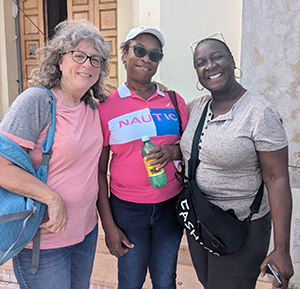
Melanie Howington visited with Nadine and Madine, sisters living in the Montego Bay area. The women not only are trying to piece together life following Hurricane Melissa, but also honor their grandmother who recently died. (Texans on Mission Photo)

While visiting these churches to drop off kits, the Texans on Mission team had the chance to spend time with Jamaicans facing life after the storm.

Melanie Howington visited with Nadine and Madine, sisters living in the Montego Bay area.

The women not only are trying to piece together life following Hurricane Melissa, but also honor their grandmother who recently died.

While her death was not related to the hurricane, its timing makes it hard to grapple with all the tragedy at once, she noted.

“Nadine was in the church we were visiting to ask the pastor to please let her have her grandmother’s funeral there. It was her church home.” Melanie said. “But the pastor told her it’s just too damaged.”

The church has water damage, broken windows and roof damage, making it unsafe to host a service.

“I reminded Nadine: ‘You are the church. You lost a building, you didn’t lose the church. So, wherever you go, have your church to have your service,’” Melanie Howington said.

“She had such a sweet spirit, but was facing a lot of tragedy all at once.”

The Texans on Mission team was able to distribute aid kits to these two women and offer a glimpse of hope in a challenging time.

Hearing stories of people who needed to talk

Keisha, a proud mother and grandmother, was sitting quietly in a damaged church. Melanie Howington saw her and knew she needed someone to hear her story.

When Hurricane Melissa rushed into Jamaica, Keisha was sitting outside. She knew the storm was coming, but was enjoying the beautiful breeze during a season that’s typically hot and humid. She was home with her children and grandchildren.

 “But then she said it turned into a not-so-beautiful breeze,” Melanie Howington said. “The windows started shaking, things started flying around. She was trying to hold her things down so she wouldn’t lose them—putting her body weight on them.”

Her 2-year-old grandson was outside with her when a window flew past them, and then a tree flew by and struck him in the back. While the hit could’ve been life-threatening, a doctor examined her grandson and found him healthy.

Even so, Keisha mourned the loss of her home.

“It took years to get it, and in one minute, it’s gone,” she said.

Entire homes and livelihoods in the Montego Bay area washed away with nothing but silt and receding waters left behind. Not only will it take time to rebuild, but it will take time to heal.

The volunteer team is continuing to assess needs in the storm’s aftermath and Texans on Mission continues to develop response strategies in the Caribbean island nation.

“Based on the few people I’ve been able to talk to, they’re all just still in crisis mode. They’re still reeling from it [the storm],” Melanie Howington said.

“The prayer need for them is just that they’d feel God’s presence, know God is there and that they’re not alone. God is walking through this with them.”


Texans on Mission volunteers assess needs in Jamaica

KINGSTON, Jamaica—In the wake of Hurricane Melissa’s damage across Jamaica and the wider Caribbean, Texans on Mission has deployed an initial task force to support local partners on the ground.

The four-person team is working primarily with the Jamaica Baptist Union to assess immediate needs, develop recovery plans and implement actionable strategies for long-term community resilience.

More than planning though, they are responding to local needs by providing food and hygiene kits sourced on the island nation.

Texans on Mission volunteer and chaplaincy coordinator Melanie Howington said the team has been building relationships with on-the-ground partners and expected to move toward the most-affected areas near Montego Bay.

Assembling care kits for families

Volunteers also are responding to requests from the Jamaica Baptist Union to provide immediate aid to families.

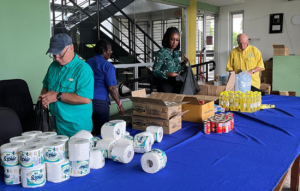
Local ministry partners worked with Texans on Mission volunteers to assemble aid kits. (Texans on Mission Photo)

“Their big need is to get some kind of a kit to some of their people in areas where the churches have had bad damage or were destroyed,” she said.

“And so we spent yesterday and today going to multiple stores. We had to divide up and buy canvas bags because you can’t have plastic here, then piece out kits for 250 people.”

The team worked with Jamaica Baptist Union members to assemble the bags with food staples like flour and rice, plus hygiene items needed by affected families.

The group’s efforts were slowed by some food and hygiene item shortages that forced them to source from several locations over two days, Howington said.

Even so, she added: “God does provide. God is good.”

The team also is networking with other aid providers. They’ve attended coordinated meetings with other governmental and NGO disaster response organizations for daily briefings.

They also met with a medical relief group, MedGlobal, and provided them with water purifiers destined for use at a local hospital.


Palestinian Christians learn to ‘trust in God’

David Azar and his young family awoke at 2:30 a.m. on Oct. 12 when they realized they were in danger.

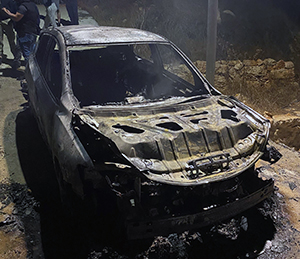
David Azar’s car was completely destroyed by fire. (Photo courtesy of David Azar)

“Israeli settlers attacked. They burned our car,” Azar, a deacon at Ramallah Church in the occupied West Bank, told the Baptist Standard on a WhatsApp call. “It was completely destroyed.”

Although their house was not damaged in the assault, Azar and his wife Hiba, along with their 3-year-old daughter Maribelle, left their home in the village of Taybeh.

“We can’t go back,” Azar said. “It’s not safe for our daughter.”

Pastor Munir Kakish of Ramallah Church, president of the Council of Local Evangelical Churches in the Holy Land, invited Azar and his family to move into a room at the church building until they are able to find permanent lodging.

Azar is uncertain what the future holds, but he remains sure of one thing.

“We trust in God,” he said.

‘Daily dependence’ on God

Trust and dependence upon God characterizes Palestinian Christians, said Jay Abernathy, pastor of First Baptist Church in Woodville.

“They practice daily dependence on the leadership of the Holy Spirit, the guidance of Scripture and the community of believers,” he said.

Abernathy, who has developed a close relationship with Palestinian Christians in the Middle East over the past two decades, returned early last month from a weeklong trip to Jordan, Israel and the West Bank.

Abernathy’s recent trip to the West Bank occurred prior to the ceasefire agreement between Israel and Gaza.

“The ashes of Gaza figuratively fell on every conversation,” he said.

Even so, the Palestinian Christians he encountered held no animosity toward Israel.

“I never met a believer over there who harbored any ill will toward Israel,” Abernathy said. “They pray that Israel will do well.”

‘God wants you’

While Azar’s trust in God and desire to follow his leadership are typical among Palestinian Christians, Abernathy said, his testimony is extraordinary.

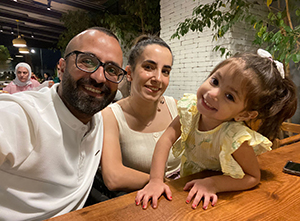
David Azar, a deacon at Ramallah Church, is pictured with his wife Hiba and their daughter Maribelle. (Photo courtesy of David Azar)

Azar grew up in a Greek Orthodox family in Gaza and dreamed of becoming a priest one day. However, when a bishop who had promised to send him to Greece to study reneged on that pledge, Azar grew disillusioned and turned his back on the church.

During the Fatah-Hamas conflict in 2006, Azar found himself on a street during heavy gunfire.

“That’s when I heard a voice saying: ‘Do not fear, for I have redeemed you. I have called you by my name, and you are mine,’” Azar said.

After escaping the crossfire and returning home, Azar continued to think about the unexpected message of reassurance. He remembered a card the pastor of Gaza Baptist Church had given him much earlier.

When Azar contacted the pastor and repeated the words he heard, the minister told him he was quoting Isaiah 43:1. He assured Azar, “God wants you.”

“That moment marked the beginning of my journey of faith,” Azar said.

Serving and preaching at Ramallah Church

After he committed his life to Christ, Azar moved to the West Bank and began attending Ramallah Church. Pastor Kakish helped him enroll in a Bible college in Bethlehem and supported him in his studies.

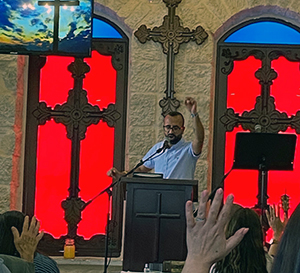
Deacon David Azar preaches at Ramallah Church. (Photo courtesy of David Azar)

In the years that followed, Azar distributed Bibles and Christian literature locally and internationally. He was ordained as a deacon, and he often preaches at Ramallah Church.

In fact, Azar preached on Oct. 12—the same morning his car was burned and his family had to seek shelter at Ramallah Church.

His sermon text was Numbers 23:23, with a special emphasis on the final phrase of that verse: “See what God has done.”

Instead of focusing on the dangers his family endured, he gave thanks for God’s protection in keeping them from harm.

“It bothers me that more American evangelicals are not aware of what so many of their evangelical brothers and sisters in the Holy Land experience,” Abernathy said.


Trump denounces Nigeria, points to possible military action

President Donald Trump announced on social media the United States is designating Nigeria a Country of Particular Concern due to the “mass slaughter” of Christians at the hands of “Radical Islamists.”

In a subsequent post, Trump indicated he instructed the Department of War to prepare for possible military intervention, going into Nigeria with “guns-a-blazing.”

“Christianity is facing an existential threat in Nigeria,” Trump wrote. “Thousands of Christians are being killed. Radical Islamists are responsible for this mass slaughter.”

The Country of Particular Concern designation is reserved for nations guilty of “systemic, ongoing, egregious violations of religious freedom.” The U.S. Secretary of State typically announces the designation, acting under the president’s delegated authority.

“The United States cannot stand by while such atrocities are happening in Nigeria, and numerous other Countries,” Trump posted on social media. “We stand ready, willing, and able to save our Great Christian population around the world!”

Sanctions likely, military action possible

In his post—first released on his personal account and later on the official White House account—Trump suggested he would pursue economic sanctions against Nigeria.

Trump stated he was asking Rep. Riley Moore, R-W.Va., a member of the House Committee on Appropriations Committee, and Rep. Tom Cole, R-Okla., committee chair “to immediately look into this matter, and report back to me.”

In a later post first appearing on Truth Social, Trump raised the possibility of direct military intervention.

“If the Nigerian Government continues to allow the killing of Christians, the U.S.A. will immediately stop all aid and assistance to Nigeria, and may very well go into that now disgraced country, ‘guns-a-blazing,’ to completely wipe out the Islamic Terrorists who are committing these horrible atrocities,” Trump wrote.

“I am hereby instructing our Department of War to prepare for possible action. If we attack, it will be fast, vicious, and sweet, just like the terrorist thugs attack our CHERISHED Christians! WARNING: THE NIGERIAN GOVERNMENT BETTER MOVE FAST!”

Call to ‘strengthen peace efforts’

International religious freedom advocates applauded the decision to designate Nigeria as a Country of Particular Concern, without endorsing Trump’s threat of military action.

“The crisis in Nigeria is indeed worthy of the urgency and moral imperative that the Trump administration is conveying. However, U.S. military intervention would not only escalate the violence; it would undermine those most capable of bringing peace—the Nigerian people themselves,” said Wissam al-Saliby, president of 21Wilberforce.

“True and lasting security cannot be imposed by force,” al-Saliby asserted.

“Government corruption and fecklessness are among the roots of the failure to protect citizens, and this cannot be bombed away,” he said.

“The most effective way to protect lives, steward resources wisely, and prevent deepening anti-American sentiment is through sustained investment in conflict prevention, peacebuilding, and support for local initiatives that promote reconciliation, justice and accountable governance.

“As Christians, we believe every person is made in the image of God, and that peace rooted in justice is both a moral calling and a practical necessity. We urge U.S. policymakers to pursue strategies that expand and strengthen local peace efforts rather than replace them with military might.”

‘Engage positively’

Christian Solidarity Worldwide noted “particularly acute” violence in Nigeria’s Plateau State, including the raiding of a hospital that led to the repeated gang-rape of two Christian girls who were abducted.

The Country of Particular Concern designation “should be regarded by the Nigerian government as an encouragement to address grave violations of freedom of religion or belief that have persisted for decades with greater urgency,” said Scot Bower, CSW chief executive officer.

“We urge Nigeria to engage positively, and to view this designation as an opportunity to secure the assistance needed to trace and hold funders, facilitators and perpetrators of religion-related violations to account, and to close the protection gap by tackling every source of security definitively.”

Vicky Hartzler, chair of the U.S. Commission on International Religious Freedom, affirmed the CPC designation for Nigeria and applauded Trump “for speaking out on the religious freedom crisis in Nigeria.”

“The U.S. government can now develop a tough plan with Nigeria to ensure that perpetrators of violence are held to account, people of faith are protected, and those held hostage are released.”

Asif Mahmood, vice chair of the commission, also called on the U.S. to “hold the Nigerian government accountable for allowing the enforcement of blasphemy laws in 12 states.”

Official denies Christians are targeted

Last month, a high-ranking Nigerian official told the Baptist Standard the presence of violence in his country is perpetrated by “some extremists,” but he rejected the assertion Christians are targeted.

Mohammed Idris Malagi, minister of information and national orientation for Nigeria, insisted: “It is sad that this has been characterized as a religious conflict. We don’t believe that it is. It never has been a religious conflict. It actually is an extremist conflict.”

Malagi asserted both Muslims and Christians are victims of extremist violence, and disputed statistics about the scope of the violence reported by multiple international human rights groups as “not supported by the facts on the ground.”

“Nigeria will continue to fight extremists that perpetrate violence toward both Christians and Muslims,” he said.

Nigeria is “a country governed by laws,” where religious freedom for all its people is guaranteed in the constitution, Malagi insisted. Islamic Sharia law in 12 northern Nigerian states applies only to the Muslim population, he asserted.

‘Religious conflict … reached a critical juncture’

Dapo Ipaddeola, senior network coordinator for the Global Freedom Network, offered a significantly different perspective.

“The ongoing religious conflicts and violence in Nigeria, particularly in the Middle Belt and Northern regions, have reached a critical juncture,” he said in a prepared public statement.

“Attacks on Christian communities, widespread killings, kidnappings, and destruction of properties have sparked widespread concern.”

Attacks on entire communities—including non-Christians—represent a “new dimension” to the violence in Nigeria, Ipaddeola stated.

“Reports from human rights organizations, eyewitness accounts, and church bodies indicate that Christian communities in Nigeria’s Middle Belt and Northern regions are facing unprecedented levels of violence and persecution,” he stated.

In his statement—issued prior to Trump’s social media posts—Ipaddeola called on the international community to condemn violence in Nigeria, support humanitarian efforts, ensure accountability and urge the Nigerian government “to address root causes, such as poverty, inequality, and religious extremism.”

“The international community should support dialogue and reconciliation efforts, ensuring the rights and concerns of all parties are respected,” he stated. “By working together, we can prevent further violence and promote peace and stability in Nigeria.”


Study looks at religious repression by Axis of Upheaval

China, Russia, Iran and North Korea form an “Axis of Upheaval” whose members collude to repress religious freedom both within—and often outside—their borders, a new study says.

“As societies around the world become less free, religious freedom is under global assault, which is also being increasingly coordinated among autocrats, who share their playbooks,” a 74-page report from the McCain Institute of Arizona State University states.

The State of Religious Freedom Worldwide” focuses on four authoritarian governments—China, Russia, Iran and North Korea—that “collude to advance their agenda on the world stage—discriminating against religious practices and attacking those who participate ‘illegally,’” the institute’s report states.

‘League of tyrants’ engage in persecution

International human rights lawyer Knox Thames and Alexis Mrachek of the McCain Institute respond to questions about a new study focused on religious repression by China, Russia, Iran and North Korea. (Screen capture image from Zoom call)

In writing the foreword to the study, international human rights lawyer Knox Thames refers to China’s Chairman Xi Jinping, Russian President Vladimir Putin, Iranian President Masoud Pezeshkian and North Korea’s Supreme Leader Kim Jong Un as a “league of tyrants” whose regimes are “world-class religious persecution machines.”

“Not without reason, these four authoritarian regimes are globally renowned for their oppression: they brook no dissent and relentlessly crack down on any political opposition,” Thames writes.

He expanded on that idea in a Zoom interview with the Baptist Standard.

“The commonality is fear of some type of idea that would lead individuals to pursue something beyond what the regime wants them to think,” Thames said. “They are afraid of religion. They are afraid of faith. … They are afraid of their own people.”

The four authoritarian regimes “are able to bring to bear the power of the state to crush any religious activity that they deem illegal or unorthodox,” he said.

‘Industrial-scale persecution’

Thames noted the “industrial-scale persecution” in China of Uyghur Muslims and Christian churches that “don’t play by the Chinese Communist Party’s rules.”

He also cited Iran’s theocratic repression of women who refuse to wear hijabs and persecution of the Baha’i faith and the country’s Sufi and Sunni communities. In North Korea, the government requires worship of the nation’s “Supreme Leader.”

Russian Orthodox Patriarch Kirill in the Christ the Saviour Cathedral in Moscow, on Jan. 7, 2021. (AP Photo/Alexander Zemlianichenko)

Alexis Mrachek, senior program manager of the human rights and freedom program at the McCain Institute, wrote the chapter in the study on religious repression in Russia and the territories it controls, including occupied areas of Ukraine.

Mrachek pointed to the relationship between the Russian Orthodox Church and the Putin regime as an example of the distinction between religious nationalism and freely practiced faith.

“Of course, Russia calls itself a Christian nation. They are officially Orthodox Christian. But really, that is the state’s religion, and it’s all tied into the politics and power that Putin holds, together with Patriarch Kirill, who is Putin’s crony” Mrachek told the Baptist Standard.

In Russia, religious identity and national identity are promoted by the state as “one and the same,” she noted.

Recommendations for action

The McCain Institute report includes multiple recommendations for the U.S. government, including:

  • Integrate international religious freedom and human rights into foreign policy and diplomatic engagements.
  • Expand designations, sanctions and legal measures against nations and leaders of governments that perpetrate severe religious persecution and repression.
  • Enforce corporate responsibility and apply economic pressure on countries that violate international standards of protection for freedom of religion and belief.
  • Strengthen congressional oversight of actions promoting international religious freedom.
  • Amplify support for civil society, religious minorities and freedom of information.
  • Counter authoritarian propaganda and influence.

The McCain Institute issued the report on the 27th anniversary of the International Religious Freedom Act of 1998, legislation that established freedom of religion or belief as a core objective of U.S. foreign policy.


Samaritan’s Purse to play a larger role in Gaza aid delivery

(RNS)—Franklin Graham confirmed Samaritan’s Purse, the international humanitarian relief organization he heads, is ramping up its role in delivering aid to Gaza as the embattled Gaza Humanitarian Foundation is being shut down.

“I don’t have all the specifics, because these details about the plan are still being developed,” Graham told RNS in an Oct. 25 phone interview from Greensboro, N.C., where the organization’s new Boeing 767 took off for Israel loaded with humanitarian supplies.

Graham said he understood the Gaza Humanitarian Foundation—with which Samaritan’s Purse worked earlier—was being phased out.

“It’s being folded,” said Graham, a longtime supporter of President Trump who has served as one of his evangelical advisers. “They operate with government funding, and I think their government funding has run out. It’s not going to be carried forward.”

The Gaza Humanitarian Foundation, created by Israel and the U.S. to deliver aid in the ravaged Gaza Strip, had come under heavy criticism for its militarized distribution sites, where more than 1,000 Palestinians were killed by Israeli forces as they approached the sites.

Reuters recently reported many European nations were opposed to the Gaza Humanitarian Foundation having any future role in Gaza.

‘Asked to pause operations’

Gaza Humanitarian Foundation spokesperson Chapin Fay responded in an email, “GHF was asked to pause operations during the hostage release phase which is still ongoing.”

The group, which began delivering aid to Gaza in March, ceased operations since the ceasefire deal between Israel and Hamas was signed nearly two weeks ago.

While acknowledging the Gaza Humanitarian Foundation was being paused, Fay did not say the organization is shuttering.

“While the situation remains fluid on the ground, GHF has been instructed to remain ready to re-engage and specifically not to take any actions that would preclude us from resuming operations immediately,” Fay said.

Johnnie Moore, the evangelical PR guru who has served as Gaza Humanitarian Foundation chairman, recently stepped down.

Delicate ceasefire in place

The fragile ceasefire deal—brokered by the United States, Qatari and Egyptian mediators—has been strained by violent flare-ups and tensions over the exchange of deceased Israeli captives.

All the living captives have been returned to Israel, and Israel has released some 2,000 imprisoned Palestinians.

The Gaza Strip remains in ruins after a devastating two-year campaign that damaged or destroyed 90 percent of buildings, razing hospitals, universities, mosques and water and sewage plants. Israel has killed more than 68,000 people, according to the Gaza Health Ministry, and thousands of corpses remain buried under the rubble.

The Gaza ceasefire plan names the United Nations, the Red Crescent and other international institutions as the entities responsible to deliver aid to some 2 million Palestinians.

Immediately following the ceasefire, Israel allowed more aid to enter Gaza, where a global hunger monitor warned in August that famine had taken hold. But that aid has since been restricted in the wake of ongoing clashes.

‘Don’t like to be tethered to incompetence’

Samaritan’s Purse would prefer not to work with the United Nations to deliver aid, Graham said.

Franklin Graham speaks in Israel on Jan. 23, 2024. (Photo courtesy of Samaritan’s Purse)

“If we have to, we can work with anybody,” he said. “But they have such a bureaucratic organization, it just really slows you down. We don’t like to be tethered to incompetence.”

On Saturday, Graham prayed with the aviation team before it took off. The new Boeing 767 airlift, which was carrying 290,000 packets of Ready-to-use Supplementary Food, used to treat acute malnutrition, as well as blankets and solar lights, was due to land at Israel’s Ben Gurion Airport later Saturday.

It was not clear how the supplies would be delivered to Gaza.

In the wake of the Oct. 7, 2023, Hamas attack on Israel that killed 1,200 people, Samaritan’s Purse began assisting Israel’s recovery, as well. It donated 42 ambulances and is building nine community centers and bomb shelters in the north of the country.

Samaritan’s Purse has also deepened its relationships with the Israeli government and is now working with the U.S. State Department to assist Gaza in a larger way.

The faith-based operation, one of the U.S.’s largest humanitarian relief organizations, also benefits from its close ties to U.S. Ambassador to Israel Mike Huckabee, a former Southern Baptist pastor. Graham said Huckabee’s wife, Janet, is a longtime volunteer with Samaritan’s Purse.

Graham confirmed all the aid donated to Gaza was privately funded. However, he said, Samaritan’s Purse would be open to accepting government funds.

It also is considering building an emergency field hospital in Gaza, a service in which it has developed unique expertise. In the past, it has erected temporary hospitals in Ukraine, Sudan and Myanmar, among other hotspots.


U.S. missionary reportedly kidnapped in Niger

NIAMEY, Niger (BP)—An evangelical Christian missionary from the United States was kidnapped late Oct. 21 in Niamey, Niger, less than 100 yards from the presidential palace, CBS News reported.

Several news outlets, including Crosswalk and the Long War Journal, identified the missionary as Kevin Rideout of Serving in Mission International.

Rideout was taken from his home by three unidentified, armed men suspected to be jihadists, according to news reports.

Baptist Press requested comments from SIM’s U.S. office in North Carolina, but had not received a reply by deadline.

Embassy issued security alert

The U.S. Embassy in Niger issued a country wide security alert Oct. 22 in response to the kidnapping.

“American citizens remain at a heightened risk of kidnapping throughout Niger, including in the capital city,” the embassy alerted Americans there.

“Due to heightened concern about the threat of kidnapping, the Embassy has modified its security posture to require armored vehicles for all travel of Embassy personnel and family members, restricted movements of Embassy personnel and family members, and instituted a mandatory curfew and routine accountability. All restaurants and open-air markets are off-limits to U.S. Embassy personnel and family members.”

The U.S. State Department issued a statement regarding the kidnapping, but did not name the victim.

The State Department is “aware of reports of the kidnapping of a U.S. citizen in Niamey, Niger. Since we were alerted of the situation, our Embassy officials have been working with local authorities,” the Associated Press quoted a department spokesperson.

“It is a top priority for the Trump Administration to look after the safety of every American, and we are seeing efforts from across the U.S. government to support the recovery and safe return of this U.S. citizen.”

Tony Lynn, a North American Mission Board Send Network catalyst who formerly served in Niger, requested prayer for Rideout and his family in a Facebook post.

“Missionary kidnapped this week in a country we called home, with our children, for years,” Lynn posted with a Rideout family photo. “Pray w/ us for his rescue/release. He is a pilot w/ SIM International.”

Persecution increased since military coup

Christian persecution has increased in Niger since the July 2023 military coup by Gen. Abdourahamane Tiani, head of the presidential guard unit.

The coup interrupted the work of a Southern Baptist mission team from Harmony Hill Baptist Church in Lufkin, which returned safely home that August.

Coup instigators, calling themselves the National Council for the Safeguarding of the Country, closed Niger’s borders and airspace and enacted a curfew, preventing the team from returning July 30 as originally planned. The team sheltered in place while leaders in the United States and abroad worked to get them home.

Persecution watchdog group Open Doors ranks Niger as the 28th most dangerous country for Christians globally in its 2025 World Watch List. The jihadist group al-Sunnah wa Jama’ah is a major driver of the persecution, Open Doors said of the country where Christians number about 69,200, comprising an estimated 0.2 percent of the population. Islam is the majority religion there.

“The presence of radical Islamist groups has led to frequent attacks and kidnappings, significantly limiting the freedom and safety of Christians,” Open Doors wrote. “It’s also led to a rise in attacks on Christian property, such as churches, schools and health-care centers.”


Ministry offers trauma healing to women in Ukraine

More than 1,000 women in Ukraine recently attended conferences, workshops and seminars designed to offer Christ-centered trauma healing.

Leonid Regheta, pastor of River of Life Church in Plano, facilitated the events in Kyiv, Odesa and Kharkiv in his role as Eastern European missions director for Hope International Ministries, with support from Texans on Mission and several Texas Baptist churches.

“We were able to see how God moved. There were a lot of tears. There were a lot of prayers. There were a lot of hugs. There were a lot of testimonies,” said Leo Regheta, Eastern European missions director for Hope International Ministries. (Photo courtesy of Leonid Regheta)

While wailing sirens warned Ukrainians of approaching drone missiles and cities experienced rolling blackouts, women gathered from around the war-torn country looking for emotional, psychological and spiritual peace.

“We had a strong prayer team here in the U.S., as well as locally in every place we went to. Sometimes, we had a conference or seminar going on as the prayer teams were uplifting us and asking God for protection,” Regheta said.

“We were able to see how God moved. There were a lot of tears. There were a lot of prayers. There were a lot of hugs. There were a lot of testimonies.”

One woman told Regheta she attended hoping to receive some help in coping, but she never expected the “breakthrough” she experienced.

Over the last three and a half years, Hope International has conducted 10 conferences in countries with large concentrations of Ukrainians—Poland, Germany, Latvia, Italy and Belgium, as well as in Ukraine.

Park Cities Baptist Church in Dallas and LakePointe Church in Rockwall were among the first congregations to provide start-up financial support for Hope International’s trauma healing ministry in Ukraine, Regheta noted.

The trauma healing events follow a “culturally nuanced and accepted format,” while also incorporating “best practices” from outside of Ukraine, Regheta said.

Encouraging long-term ministry locally

Rather than bringing in large teams from the United States, Hope International works with local Christian mental health professionals—as well as local churches and pastors—to support their work.

“One of our main approaches to ministry is to encourage long-term, sustainable, efficient ministry locally,” Regheta said.

As part of that emphasis on supporting local churches, Hope International has worked in partnership with the Baptist Union of Ukraine to offer summer retreats for pastors and their families the past two years.

At the same time, while trauma healing events sometimes are scheduled in churches, they often meet in a “neutral site” such as a civic center, making them more accessible and inviting to non-Christian participants.

Mental health professionals who lead sessions follow a “Christ-centered, biblically based approach,” he noted.

Prayer constitutes a significant part of the trauma healing events in Ukraine. While non-Christians are not compelled to receive prayer, “many of them do,” said Leo Regheta, Eastern European missions director for Hope International Ministries. (Photo courtesy of Leonid Regheta)

“We understand true healing comes from Jesus,” Regheta said. “New life comes from him.”

He recalled one woman who told him she felt like she was “in the Sahara Desert,” because it seemed as if everything in her experience had become dry and lifeless.

“Sometimes resurrection needs to happen—emotional, spiritual resurrection,” he said. “And that is something only Jesus can provide.”

Prayer constitutes a significant part of the events. While non-Christians are not compelled to receive prayer, “many of them do,” Regheta said.

He recalled praying with some women who lost a husband in the war and others who had a son who was killed. The trauma of living in a nation at war and suffering loss drives some people to seek God, while it drives others to become angry with God or doubt his goodness, he said.

“We come with Jesus to invite others to become closer to him,” Regheta said.

Hope Trauma Healing Center opens in Kharkiv

In addition to participating in the three events in Kyiv, Odesa and Kharkiv, Regheta joined in the formal opening of the Hope Trauma Healing Center in Kharkiv on Oct. 7.

Leo Regheta, pastor of River of Life Church in Plano and Eastern European missions director for Hope International Ministries, joined in the formal opening of the Hope Trauma Healing Center in Kharkiv on Oct. 7. (Photo courtesy of Leonid Regheta)

“We realize there are only so many trips per year we can make. So, why not pray and work on establishing something on the ground locally that will be manned by local psychiatrists, psychologists, trauma healing therapists and Christian volunteers,” Regheta said.

The center, built in partnership with Kharkiv’s mayor and with financial support from Texans on Mission, will provide consistent, localized mental health support to people dealing with trauma.

“It takes time to walk alongside somebody. It takes intentional effort to help them deal with their emotions, with their feelings, with their devastation, with their grief. And it takes time for all that to be processed,” Regheta said.

Rand Jenkins, chief strategy officer for Texans on Mission, sees involvement in trauma healing in Ukraine as part of the mission organization’s decades-long commitment to disaster relief and recovery.

“Texans on Mission is supporting trauma healing work in Ukraine because we recognize that true recovery after war goes beyond physical rebuilding—it requires tending to the mind and soul,” he said.

“In Ukraine, where families are still reeling from the psychological scars of invasion, displacement and loss, we understand that trauma doesn’t fade on its own. It fractures relationships, silences hope and paralyzes communities.”

‘Restoring dignity, rebuilding relationships, rekindling faith’

Texans on Mission works with Hope International Ministries because the two groups share a common commitment to working with pastors and churches in the communities being served.

“These leaders speak the language, understand the cultural context, and carry the trust of their people,” Jenkins said.

Rather than “parachuting in solutions,” Texans on Mission and Hope International are “equipping local ministers with trauma-informed care tools so they can walk alongside their congregations with compassion and competence,” Jenkins said.

“Healing trauma isn’t just about counseling. It’s about restoring dignity, rebuilding relationships and rekindling faith amidst brokenness. By empowering local leaders, we are helping to plant sustainable, Spirit-led recovery that will outlive any short-term aid program.”

Jenkins views the work in Ukraine as “a quiet but powerful witness—that even in the darkest valleys, the church can be a place of refuge, restoration and resurrection.”

Regheta expressed appreciation for the support Texas Baptist churches, ministries and individuals have provided. He requested their continued prayers as Hope International seeks to bring comfort to hurting people in Ukraine.

“Pray for the reality of God’s presence in the midst of war, in the midst of grief, in the midst of tragedy and in the midst of trauma,” he said. “We don’t just want to talk about Jesus. We want Jesus to manifest himself in the midst of what we do.

“We’re trying to do what we can. But we’d rather let Jesus speak through us.”


Hearing focuses on state control of religion in China

WASHINGTON (BP)—Chinese Pastor Ezra Jin Mingri—one of 22 pastors jailed in China on erroneous charges—lived in the United States with his wife Chunli Liu and their children before returning to China in 2007 to plant Zion Church.

His wife, who has remained in the United States to raise their children, who are U.S. citizens, is appealing for prayer as the United States advocates for her husband’s release.

The U.S. Commission on International Religious Freedom noted Chunli’s comments Oct. 16 among testimony of the Chinese Community Party’s religious persecution, including transnational aggressions, during the virtual hearing it hosted on the atrocities.

Chinese Communist Party officers raided the home of Zion Church Pastor Sun Cong in its increasing crackdown on unregistered churches. (CSW Photo)

Commission Chair Vicky Hartzler, joined by Vice Chair Asif Mahmood, is among those condemning the persecution of Jin and others.

“I condemn these arrests and I call for the release of Ezra Jin and of all those who have been detained by the CCP for exercising their right to practice their faith,” Hartzler said in opening the hearing. “China’s treatment of religious groups blatantly contradicts international human rights standards.

“No government has the right to dictate the beliefs of its citizens. No government has the right to choose which religious leaders are legitimate.

“No government has the right …  to impose its political interest onto its citizens’ conscience and its citizens’ faith. And no government has the right to imprison religious leaders for leading their religious communities.”

Christians branded as ‘disruptors’

Among those appearing before the commission was Jin’s friend Corey Jackson, founder and president of The Luke Alliance, advocating for the religious freedom of persecuted Christians in China.

“The CCP intends to control every area of your life including your heart, your mind, your soul and your emotions. They want to control your gathering in public, in private, online, even gathering with your own children to teach them about your faith,” Jackson told USCIRF.

“So how should we respond? Our concern should go beyond prisoners of conscience to the 99 percent of other Christians who do not make the headlines. There are between 80 (million) and 100 million Protestants in China, maybe 10 million Catholics, potentially more. Xi (Chinese President Xi Jinping) brands Christians as disruptors, and in reality, they are a cohesive force for good in society.”

Jackson, a former North Carolina Presbyterian pastor who served several years in China in ministry, documents on the Luke Alliance website the arrest of Jin and 21 others held at Beihai No. 2 Detention Center in Guangxi Province.

The Luke Alliance also posts an open letter from Chunli, describing Jin’s commitment to the ministry. Before his arrest and since 2018, Jin had been forbidden to leave China under a CCP-issued exit ban, and he had been subjected to constant surveillance.

“I feel a mixture of shock, sadness, worry, anxiety and anger,” Chunli wrote. “I firmly believe that Pastor Jin simply did what any good pastor would do. In whatever circumstance, online or in-person, he did what every pastor in the universal church does: preach the gospel to everyone and proclaim his faith in Jesus Christ. He is innocent!”

‘Dissent is occurring … every single day’

In the hearing, “State-Controlled Religion in China,” Commissioner Stephen Schneck posed the question of whether USCIRF’s advocacy under the International Religious Freedom Act, as well as sanctions imposed by the U.S. State Department, has exacted any improvements for persecuted Christians and other religious adherents in China.

Schneck, who is in his fourth year at the commission, said: “I have to say that in the course of those four years, I’ve seen things only get worse and worse in regards to China. Sinicization is continuing apace. The genocide of the Uyghurs and the cultural genocide of the Tibetans is continuing apace.

“And I’m really wondering if, over these four years, USCIRF has had any effect at all. If any of the recommendations that we’ve made to Congress, if any of the recommendations that we’ve made now to two different administrations, have had any success at all in changing the situation of religious freedom in China.”

Annie Wilcox Boyajian, president of Freedom House and a speaker at the hearing, assured commissioners of their positive impact.

“I would jump in and say ‘yes, and.’ There are a whole bunch of recommendations that the religious community has made for decades that haven’t ever been fully implemented,” Boyajian said.

“The other thing to remember is dissent is occurring, and just because we don’t necessarily see it from where we sit here in the United States, it happens every single day.”

Advocacy makes a difference

Boyajian noted Freedom House’s China Dissent Monitor, sourced from on-the-ground contacts and others, to document dissent from religious communities.

“We have seen more than 400 instances over the last three years where people see religious restrictions and choose to worship anyway, or where they’re even actually protesting,” Boyajian said. “This comes back to, from our perspective, the deep and utter importance of raising individual cases because we do hear that it makes a difference.

“And when USCIRF encourages the State Department to designate China as a Country of Particular Concern, it matters. The Chinese government cares about that. They raise it in meetings.”

The commission’s hearing followed U.S. Secretary of State Marco Rubio’s Oct. 12 statement urging China to release Jin and others.

At its hearing, USCIRF also heard from additional advocates and Congressional leaders including U.S. Sen. James Risch, chairman of the Senate Foreign Relations Committee; U.S. Rep. James McGovern, a member of the Congressional-Executive Commission on China and the bipartisan Tom Lantos Human Rights Commission; Rushan Abbas, founder and executive director of the Campaign for Uyghurs, and chairwoman of the Executive Committee of the World Uyghur Congress; and Norgay Tenzin, a research analyst with the International Campaign for Tibet.


U.S. urges release of jailed Chinese pastors

BEIJING (BP)—China falsely claimed Oct. 13 to protect religious freedoms after U.S. Secretary of State Marco Rubio urged the country’s government to release several pastors arrested in house church raids.

“The Chinese government governs religious affairs in accordance with law, protects the religious freedom of the citizens and the normal religious activities,” Foreign Ministry spokesman Lin Jian said Monday at a regular briefing, MSN reported. “We firmly oppose the U.S. interfering in China’s internal affairs with the so-called religious issues.”

China persecutes Christians and other religious groups through an intensive campaign to control religious activities and communication, claiming churches oppose the government, several religious liberty watchdog groups have reported with extensive evidence.

Rubio called for the release of an estimated 20 house church pastors and leaders arrested in at least seven cities since Oct. 10, Christian Solidarity Worldwide reported, as the Chinese Communist Party raided several locations of Zion Church, an unregistered Protestant congregation.

“We call on the CCP to immediately release the detained church leaders and to allow all people of faith, including members of house churches, to engage in religious activities without fear of retribution,” Rubio said, naming Senior Pastor Ezra Jin Mingri among those arrested.

“This crackdown further demonstrates how the CCP exercises hostility towards Christians who reject Party interference in their faith and choose to worship at unregistered house churches.”

China and U.S. in trade policy dispute

The exchange comes as U.S. President Donald Trump spars with China over trade policy, threatening a 100 percent tariff on China in addition to a 55 percent tariff already in place. Trump threatened the increase after China announced export controls on rare earths, effective in November. China holds 49 percent of the world’s rare earths, including 17 metallic elements considered crucial for modern technology and energy, NBC News reported.

Rubio called for the release of leaders after China initially arrested 30 leaders, with about 20 remaining in custody as recently as early Oct. 14, CSW reported.

“CSW sources suggest these arrests form part of the largest nationwide crackdown on house churches in decades, and many Chinese house church leaders have openly expressed support for Zion Church despite facing significant pressures themselves,” CSW stated.

“One church member also pointed out that repression targeting house churches typically intensifies whenever relations deteriorate between China and the West.”

Sean Long, a Chinese Zion Church pastor studying in the U.S., told the Associated Press the leaders may face charges of “illegal dissemination of religious content via the internet,” although it’s not currently known whether the pastors are charged with any infraction.

“This is a very disturbing and distressing moment,” the AP quoted Long. “This is a brutal violation of freedom of religion, which is written into the Chinese constitution. We want our pastors to be released immediately.”

‘Cease harassment of unregistered churches’

Zion Church has perhaps 5,000 members who worship at 100 sites across 40 cities, Long told AP, with services held in apartments, restaurants and even karaoke bars. Jin was handcuffed and arrested the morning of Oct. 11 after officers raided his home in Behai, Guangxi Province the previous evening and searched the home throughout the night, CSW reported.

CSW’s CEO Scot Bower also urged China to release the pastors and leaders.

“CSW echoes calls for the immediate release of Pastor Jin and the other leaders and members of Zion Church who were detained in this latest crackdown,” Bower said.

“We call on the Chinese Communist Party to cease its harassment of unregistered churches and religious groups, and to guarantee to all religious and belief communities, in law and in practice, the right to publicly manifest their religion or belief in worship, observance, practice and teaching without interference.”

Commission cites China as among worst violators

China’s religious freedom policies are among the worst in the world, the U.S. Commission on International Religious Freedom said in its 2025 Annual Report.

Through its “sinicization of religion” policy, China requires the “complete loyalty and subordination of recognized religious groups to the CCP, its political ideology, and its policy agenda,” USCIRF wrote in its report.

China is widely condemned for its stringent restrictions and persecution including unwarranted arrests, forced disappearances, high-tech surveillance of churches, suppressed speech, removal of crosses, confiscation of religious materials and the criminalization of Bibles and evangelism.

The U.S. State Department as recently as 2023 named China a Country of Particular Concern for systematic, ongoing, and egregious violations of religious freedom, as defined by the International Religious Freedom Act.


Aid to Gaza resumes, including from faith-based agencies

(RNS)—With President Donald Trump announcing “the war is over” on Oct. 13—and Israel and Hamas trading hostages for Palestinian prisoners—aid from the United Nations and faith-based agencies began to flow into the Gaza Strip, with hopes of stemming a humanitarian disaster.

Trump’s 20-point Gaza ceasefire plan names the United Nations, the Red Crescent and other international institutions as the entities responsible to deliver aid to Palestinians who are in the grips of a profound humanitarian crisis.

It does not cite the Gaza Humanitarian Foundation, a private entity created by the United States and Israel to circumvent the United Nations, which the latter alleged was allowing Hamas to steal aid.

Over the past 36 hours, the United Nations, which has seen its agencies hampered or outright banned by Israel during the two-year war, resumed its work in Gaza.

The United Nation’s Office for the Coordination of Humanitarian Affairs reported that “for the first time since March, cooking gas entered the Strip,” and frozen meat, fresh fruit, flour and medicines also crossed into Gaza throughout the day on Monday.

Israel broke an earlier ceasefire agreement in mid-March, leading to an 11-week halt of all humanitarian relief entering Gaza. Since then the Israeli government has been allowing a small amount of aid into Gaza but has been unable to stamp out spreading starvation.

U.N. has 60-day plan for humanitarian relief

Tom Fletcher, undersecretary-general for the U.N. humanitarian affairs office, briefed the media late last week on 60-day plans to immediately scale up distribution of food and medicine, repair water and sewage lines and provide thousands of tents, tarps and other supplies to the strip, which now lies in rubble.

“This is the plan. We can deliver it. We’ve done it before, and we will do it again,” Fletcher said.

Until last week, the Gaza Humanitarian Foundation was operating four militarized distribution sites.

But Sunday night, The Associated Press reported that three of its four distribution points, where more than 1,000 Palestinians were killed by Israeli forces guarding from the perimeters, have been abandoned. Palestinians had torn down the structures, dragging off wood and metal fences.

The report cited an unnamed official suggesting that the Gaza Humanitarian Foundation no longer would be involved, but the group denied it was shutting down.

In an email to RNS, a spokesman said: “There will be tactical changes in GHF operations and temporary closures of some distribution sites may occur. There is no change to our long-term plan.”

But it wasn’t clear if the Gaza Humanitarian Foundation was prepared to continue to function without the Israeli military in the vicinity.

Nor was it clear why Palestinians would choose to receive aid from militarized sites guarded by U.S. contractors, especially given the number of Palestinians killed approaching those sites, when they could revert to the U.N.’s civilian delivery system that included some 400 distribution locations before the war.

Samaritan’s Purse in ‘wait-and-see pattern’

Samaritan’s Purse, which joined the Gaza Humanitarian Foundation—primarily to provide supplemental food packets and first aid at its distribution sites—suspended its flights from North Carolina to the region.

“We’re in a wait-and-see holding pattern,” said Ken Isaacs, vice president of programs and government relations for Samaritan’s Purse.

“We want to help the people of Gaza in any and all ways that we can, and we’re waiting to see what the finalized results of the peace agreement are so that we know where and how are the best ways to help.”

The lifting of restrictions on aid was welcomed by a host of humanitarian groups, including Catholic Relief Services. Bill O’Keefe, executive vice president for mission, mobilization and advocacy at CRS, said the organization was “aggressively ramping up.”

“We are anticipating deliveries of large supplies of shelter materials that we’ve had in Jordan and Egypt, and we’ve secured more warehouse space,” O’Keefe said.

“We reopened our office in Gaza City and are really doing everything we possibly can to meet as many needs as we can as quickly as we can.”

Catholic Relief Services has a staff of 65 in Gaza, all of them Gazan residents, but its work has been slowed significantly by Israel’s restrictions on aid. When Israel has allowed in aid, it has mostly privileged the Gaza Humanitarian Foundation.

O’Keefe said his staff has seen a big opening for aid and hopes the end of hostilities will allow even more.

“There are lots of questions in terms of how many access points will be opened,” he said, adding, “We hope all of them.”