More than 3 million Uyghurs in forced labor camps in China
January 15, 2021
XINJIANG, China (BP)—More than 3 million Uyghur Muslims reportedly are held forcibly in “re-education camps” in northwest China.
Uyghur American human rights advocate Rushan Abbas describes them as university presidents, doctors, entrepreneurs and artists. The Chinese Communist Party calls them criminals.
China’s work to kill Christianity is highlighted in persecution watchdog Open Doors USA’s 2021 World Watch List. But China’s persecution of religious groups also includes the imprisonment and forced labor of Uyghur Muslims at concentration or “reeducation” camps in the Xinjiang Uyghur Autonomous Region.
“The Chinese government tried to say that those are religious extremists or people who are engaged in illegal religious activities,” Abbas, a Virginia resident advocating for the freedom of Uyghurs in her homeland, said Jan. 13 during an Open Doors press conference.
“Just saying ‘salam alaikum,’ which is Arabic greeting, means ‘peace be with you’—most peaceful way to say ‘hello,’ basically—even saying that could cause you to end up in the concentration camps.”
Abbas, whose sister Gulshan is among Uyghurs held in China, said “the Chinese Communist regime is waging a war against religion.”
“To me, this is a test for the conscience of the world. This is about humanity,” she said. “Anybody who hears about what’s happening to Uyghur people, anybody who vowed never again after World War II, should take action with their conscience and of course to pray for my sister and for those Uyghur people.”
In 2017, Abbas founded the Campaign for Uyghurs human rights advocacy group and works to mobilize the international community around the cause.
No products from forced labor
The Southern Baptist Ethics & Religious Liberty Commission supported the bipartisan Uyghur Forced Labor Prevention Act, passed by the U.S. House of Representatives in August 2020 and referred to the Senate Foreign Relations Committee in September.
“Currently, any brand sourcing apparel, textiles, yarn or cotton from [Xinjiang Uyghur Autonomous Region] is almost certainly profiting from forced Uyghur labor,” the ERLC wrote in support of the legislation.
“The United States must send a strong message to the CCP that products made through forced labor will not be accepted because these egregious inhumane practices will not be tolerated.
“It is unconscionable for a free country like the United States to ultimately be accomplices in this Communist Party’s plan to profit from slave labor,” the ERLC wrote. “In holding the [Chinese Communist Party] accountable for the horrors that occur on a daily basis in the labor camps of Xinjiang, the United States has the opportunity to send a clear message that total disregard for human life will not be tolerated.”
Although the bill died in Congress, U.S. Customs and Border Protection on Jan. 13 restricted entry into the U.S. of any cotton and tomato products produced in the XUAR.
The Department of Homeland Security “will not tolerate forced labor of any kind in U.S. supply chains,” acting DHS Deputy Secretary Ken Cuccinelli said. “We will continue to protect the American people and investigate credible allegations of forced labor. We will prevent goods made by forced labor from entering our country, and we demand the Chinese close their camps and stop their human rights violations.”
‘Inhumanity against Uyghur Muslims is shocking’
Open Doors CEO David Curry cited the enslavement of Uyghurs among the reasons China is listed as 17th on the 2021 World Watch List of the most dangerous places for Christians to live.
“The inhumanity against Uyghur Muslims is shocking,” Curry said in releasing the World Watch List. “I encourage every Christian, every person of any faith, and anybody who wants to have freedom of conscience, to speak out for the Uyghur Muslims. … They’re not criminals.”
Open Doors has estimated the number of detained Uyghurs at more than 1 million, but Campaign for Uyghurs estimates the number has surpassed 3 million and quotes a document from CCP secretary Chen Quango ordering that detention centers “teach like a school, be managed like the military and be defended like a prison.”
Detention centers “must first break their (Uyghur) lineage, break their roots, break their connections and break their origins,” the Campaign for Uyghurs quotes the document.
Watch list shows impact of pandemic on religious persecution
January 15, 2021
WASHINGTON (RNS)—The COVID-19 pandemic has exposed a number of existing problems—political divides, inequities, conspiracy theories. It also has exposed religious persecution in a number of countries, Open Doors reports.
In India, the Christian watchdog organization said 80 percent of Christians who received pandemic aid from its partner organizations reported they had been turned away from other food distribution points because of their faith. Others reported they’d been passed over for employment.
Some had walked miles and hidden their religious affiliation in order just to get food, it said.
“We’ve definitely seen that both extremists and governments are taking advantage of or using this opportunity to justify an increase in persecution,” Open Doors USA President and CEO David Curry told Religion News Service.
Not surprisingly, the impact of COVID-19, the disease caused by the novel coronavirus, featured prominently in Open Doors’ 2021 World Watch List report, released Jan. 13.
Christians denied aid during pandemic
India is No. 10 in Open Doors’ ranking of the 50 countries where Christians face the most persecution for their faith in 2021, due to what Curry called the BJP party’s “nationalist agenda that wants to solidify around the Hindu faith.”
Other hot spots where Christians face discrimination while seeking COVID-19 relief include Myanmar, Nepal, Vietnam, Bangladesh, Pakistan, Central Asia, Malaysia, North Africa, Yemen and Sudan, according to the report.
“The global pandemic made persecution more obvious than ever—simply because so many people needed help,” according to Open Doors’ report accompanying its annual World Watch List.
“The clear discrimination and oppression suffered by Christians in 2020 must not be forgotten, even after the COVID-19 crisis fades into our collective memory.”
North Korea tops the World Watch List again
North Korea leads the organization’s annual World Watch List for the 20th straight year.
The rest of the top 10 lineup also remains largely unchanged from last year, with Sudan dropping off the list and Nigeria appearing at No. 9.
More Christians are murdered for their faith in Nigeria than in any other country, according to Open Doors. The organization blames violent attacks by Islamic extremist groups like Boko Haram and the Fulani, which Curry said mimic the rise of ISIS in Iraq.
The president and CEO said Sudan’s drop to No. 13 is the rare bit of good news this year, coming as the country scraps its blasphemy law.
Those 10 countries where Open Doors reports Christians face the most persecution are North Korea, Afghanistan, Somalia, Libya, Pakistan, Eritrea, Yemen, Iran, Nigeria and India.
Most of the countries in the top 10 have been there since 2015, which, at the time, Open Doors proclaimed to be the “worst year in modern history for Christian persecution.”
“I’m afraid I could repeat that same statement,” Curry said before the 2021 report’s release.
China back on the Top 20 list
China entered Open Doors’ top 20 for the first time in a decade this year for its increasing surveillance and censorship of Christians and other religious minorities, according to the report. Last year, Open Doors raised the alarm over the “rise of the surveillance state” and its impact on Christians and Uighur Muslims there.
In the 50 countries on the World Watch List, 309 million Christians experience “very high” or “extreme” levels of persecution and discrimination, according to Open Doors. That’s one in eight Christians worldwide, it said.
Open Doors defines persecution as “any hostility experienced as a result of one’s identification with Christ. This can include hostile attitudes, words and actions toward Christians.”
It creates its ranking by measuring and tracking reports of violence, as well as surveying field staff about pressures Christians face from governments, family and other institutions in each country.
It’s important for people to be informed about the patterns of persecution happening around the world, which could be replicated elsewhere, Curry said.
“But right now, I think what we see is it’s much more intense in every region around the world than anything you might see here in the West,” he said.
Pakistani Christians charged under blasphemy laws
January 15, 2021
Less than two weeks after a court in Pakistan acquitted an imprisoned Christian who was serving a life sentence under the nation’s blasphemy laws, organizations focused on religious persecution reported at least four other Christians were arrested for blasphemy.
CLAAS-UK—the Centre for Legal Aid, Assistance and Settlement—said three Christians in the village of Kotli Muhammad Sadique were charged with blasphemy for allegedly burning pages from the Quran. Azeel Mehmood was jailed, while Abbas Gulshan and Irfan Saleem were released on bail, CLAAS-UK reported.
Nasir Saeed, director of CLAAS-UK said his organization’s Pakistan-based team personally interviewed the families of the three men and were convinced of their innocence. They believed the men were implicated because of personal grievances.
“It is very sad that blasphemy continues to be used as an easy tool to settle personal scores and grudges against Christians and other religious minorities,” Saeed said. “Unfortunately, Pakistani society has become more intolerant than ever before.”
International Christian Concern reported Raja Warris, a Christian pastor in the Charar area of Lahore, was charged with blasphemy after posting comments on social media critical of Islam.
A mob gathered outside Warris’ home the day after Christmas and threatened to behead him and set fire to Christians’ homes unless the police arrested him, Morning Star News reported. Local sources told International Christian Concern hundreds of Christians fled Charar.
Warris was taken into custody and charged the next day with blasphemy. If convicted, he could face up to 10 years in prison for committing “deliberate and malicious acts intended to outrage religious feelings.”
“We here at International Christian Concern remain concerned by the situation in Charar,” said William Stark, the organization’s regional manager. “We call on Pakistani authorities to continue to protect the homes of Charar’s Christians. Even though Pastor Warris has been officially charged with violating the blasphemy laws, there is still the potential for mob violence against the Christians of Charar. No one should be forced to flee their home because of a social media post.
“Pakistan’s blasphemy laws must not be misused to justify mob violence. Too often these laws have been a tool in the hands of extremists seeking to stir up religiously motivated violence against minority communities.”
International Christian Concern reports 24 Christians currently are imprisoned on blasphemy charges in Pakistan.
On Dec. 15, the Lahore High Court acquitted Imran Ghafur Masih after he spent more than a decade in prison for violating blasphemy laws by allegedly burning the Quran.
Both the U.S. House of Representatives and U.S. Senate passed resolutions in December calling for the repeal of blasphemy and apostasy laws around the world. The Baptist Joint Committee for Religious Liberty was part of a coalition of more than six dozen organizations calling for an international ban on blasphemy laws.
Nigerian Christians killed in Christmas Eve attacks
January 15, 2021
At least a dozen Christians were killed and several churches burned in Christmas Eve attacks on villages in northern Nigeria following death threats by Boko Haram Islamist militants.
It marked the second consecutive year Christians in the region were targeted during the Christmas season.
International Christian Concern reported Boko Haram terrorists invaded Pyemi, a village near Chibok, and killed seven. The Christmas Eve violence followed a threat Boko Haram issued after a previous attack on a town in Southern Niger left 27 dead.
“The threat said that Christians would be attacked and killed during the Christmas season,” International Christian Concern stated.
Ekklesiyar Yan’uwa a Nigeria —EYN, the Church of the Brethren in Nigeria—reported three churches in Garkida, another village in northern Nigeria, were set on fire by Boko Haram, five individuals in the village were killed and five remained missing after a Christmas Eve attack.
Yuguda Z. Mdurwva, who leads EYN disaster relief ministry, reported separately that a church on the outskirts of Garkida was burned on Christmas Eve, and robbers looted stores in the town and stole drugs from the Garkida General Hospital.
On the day after Christmas, three more churches and multiples homes were destroyed in Tashan Alade, Kiritu and Debiro, said Zakariya Musa, head of media for EYN.
“The renewed attacks are coming almost on a daily basis in different ways, resulting in killings, kidnapping, destruction of properties,” Musa said.
EYN General Secretary Daniel Mbaya said rumors of an attack were known days prior.
“We had the information three days before the attack, and security agencies were informed,” Mbaya said. “They (Boko Haram) had sent word that they were coming to do ‘Christmas’ in town and specifically mentioned Garkida. Most people fled into the bush.”
Nathan Johnson, International Christian Concern’s regional manager for Africa, said: “Boko Haram promised that they would attack Christians and fulfilled this promise. Many say that Boko Haram does not hate Christianity, however, this attack shows their true intention towards Christians in Nigeria. This is the second year in a row where Christians have been slaughtered by the group on Christmas Eve. It is time for the Nigerian government to end these atrocities.”
The U.S. State Department recently added Nigeria to its list of countries considered most egregious violators of religious freedom, designating it as a country of particular concern. The U.S. Commission on International Religious Freedom had recommended that action since 2009.
Pakistani court acquits Christian imprisoned for blasphemy
January 15, 2021
A court in Pakistan acquitted a Christian who was serving a life sentence in prison under that nation’s blasphemy laws.
International Christian Concern, a human rights watchdog organization that focuses particularly on religious persecution, reported the Lahore High Court on Dec. 15 acquitted Imran Ghafur Masih after spending more than a decade in prison for allegedly burning the Quran.
Masih’s acquittal came as a surprise to his family, who moved into hiding after the court’s decision was announced to avoid retribution by Islamist extremists.
“It is a day of resurrection for us,” his brother Naveed Masih told International Christian Concern. “God has heard our cry, and we are very thankful to him. It’s a Christmas gift for us.”
The incident that prompted Masih’s imprisonment occurred in July 2009. He was cleaning out his family’s bookstore and burning trash, including some old books and papers, when he discovered a textbook with Arabic writing.
Masih asserted he asked his Muslim neighbor, Hajii Liaquat Ali, if the book contained religious writings and received assurance it was fine to burn it with the trash. However, Ali later recovered the partially burned book and used it as evidence to accuse Masih of burning a Quran. Masih’s family alleged Ali wanted the storefront leased to the family’s bookstore to expand his own business next door.
Ali reportedly repeated his accusations throughout the local Muslim community, and mosques announced over their public address systems that a Christian had burned the Quran. A mob of 400 people gathered at Masih’s home, beat him and other members of his family, and then doused them with paraffin in an attempt to burn them alive, according to a report on the U.S. Commission on International Religious Freedom website.
After local law enforcement intervened and took Masih into custody, about 1,000 people gathered outside the police station, demanding that he be handed to them. Police registered a blasphemy charge against Masih and distributed copies of the charge among the assembled crowd. The Session Court of Faisalabad on Jan. 11, 2010, sentenced Masih to life in prison.
Blasphemy laws violate ‘a fundamental human right’
Masih’s acquittal occurred eight days after the U.S. House of Representatives voted 386-3 to pass a bipartisan resolution calling for the global repeal of blasphemy, heresy and apostasy laws.
Jennifer Hawks, associate general counsel for the Baptist Joint Committee for Religious Liberty, identified the Masih case as an example of “blasphemy laws being used to settle personal scores.”
“While the Lahore High Court has finally corrected this 11-year travesty of justice, we should keep in mind that this is not just something that affects our Christian brothers and sisters in foreign countries. Muslims in Pakistan are charged with blasphemy in higher numbers than all other religious groups combined,” Hawks said.
“Blasphemy laws strike at a fundamental human right—the ability for each person to decide whether to be religious and, if so, what that religion will be,” she continued. “No government should have the ability to dictate the nature of religious belief.
“Increased attention on the injustice of blasphemy laws over the past decade have led many countries to repeal their laws. Pakistan should follow suit and live up to its international obligations to protect the religious freedom for all those living within its borders.”
Two years ago, Hawks participated in a U.S. Senate briefing opposing blasphemy laws.
She expressed hope the Senate will join the House in passing a resolution urging global repeal of blasphemy laws so “the U.S. Congress will be speaking in one voice to unequivocally reaffirm America’s commitment to religious freedom for all people.”
Nigeria listed among worst religious freedom violators
January 15, 2021
WASHINGTON (RNS)—The U.S. State Department has added Nigeria to its list of countries deemed to have the most egregious violations of religious freedom.
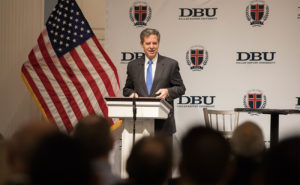
Sam Brownback, U.S. ambassador-at-large for international religious freedom, speaks at Dallas Baptist University as part of the Institute for Global Engagement’s leadership lecture series. (DBU Photo)
Sam Brownback, the department’s ambassador-at-large for international religious freedom, said in a Dec. 8 telephone briefing the African country was designated as a “country of particular concern” because of an increasing number of organized terrorist groups and “a lot of religious-tinged violence.”
“You’ve got expanded terrorist activities, you’ve got a lot of it associated around religious affiliations, and the government’s response has been minimal to not happening at all,” Brownback said of Nigeria, according to a State Department transcript. “The terrorism continues to happen and grow, in some places unabated.”
He spoke on the day after Secretary of State Mike Pompeo announced the latest designations of countries cited for violating religious liberties, including the addition of nine other nations now designated as countries of particular concern: Burma, China, Eritrea, Iran, North Korea, Pakistan, Saudi Arabia, Tajikistan, and Turkmenistan.
The U.S. Commission on International Religious Freedom hailed the State Department’s decisions.
“We particularly welcome Nigeria’s designation for the first time as a CPC for tolerating egregious violations of religious freedom, which USCIRF had been recommending since 2009,” said commission Chair Gayle Manchin. “Nigeria is the first secular democracy that has been named a CPC, which demonstrates that we must be vigilant that all forms of governments respect religious freedom.”
State Department declines to add India to list
The commission had also suggested the State Department give India, Russia, Syria and Vietnam the CPC designation but it did not. The commission had said in its April report that India should be added because of its passage a year ago of the Citizenship Amendment Act, a law that gives Hindus and religious minorities from neighboring countries a fast track to citizenship but excludes Muslims.
Asked why India did not get named to that list, Brownback said “we watch the situation in India very closely” and Pompeo has visited there a number of times.
“These issues have been raised in private discussions at the government—high government level, and they will continue to get raised,” he said.
The State Department listed again Comoros, Cuba, Nicaragua and Russia on its second-tier “special watch list.”
It removed Sudan and Uzbekistan from that watch list. In July, Sudan repealed its apostasy law that previously called for the death penalty for persons convicted of renouncing Islam.
“Their courageous reforms of their laws and practices stand as models for other nations to follow,” Pompeo said.
The commission had urged that those two nations stay on the list earlier this year. But Tony Perkins, vice chair of the watchdog group, stated “it is undeniable the historic progress that has been made in these two countries. We hope that their progress encourages positive change in other places around the world.”
The State Department also listed numerous militant groups as “entities of particular concern”—al-Shabab, al-Qaida, Boko Haram, Hayat Tahrir al-Sham, the Houthis, the Islamic State group or ISIS, ISIS-Greater Sahara, ISIS-West Africa, Jamaat Nasr al-Islam wal Muslimin and the Taliban.
But it removed that designation from al-Qaida in the Arabian Peninsula and ISIS-Khorasan, due to loss of territory those terrorist organizations had controlled.
Brownback reiterated on the call the work of the Trump administration to encourage peaceful cooperation among leaders of the Abrahamic faiths, an effort that he said continued with an online peace summit he attended with prominent Christian, Muslim and Jewish theologians the previous day, which emphasized opposing religious violence.
“I still want to get the picture of top theologians of Judaism, Islam, and Christianity standing in front of Abraham’s tomb, pointing to—this is the starting point of our faith, this person,” he said. “I think the world needs to see that, because we’re seeing so much division in the world, particularly between Christians and Muslims, but also Jews as well.”
Hunger offering grant provides hurricane relief in Nicaragua
Hurricane Iota slammed into Nicaragua’s coast as a Category 4 storm on Nov. 16, hitting an area already reeling from the devastation caused by Hurricane Eta only two weeks earlier.
The hurricanes destroyed homes and businesses, and thousands of people were forced to leave their villages in search of safer conditions.
In response to recovery efforts coordinated by ministry partners, the Texas Baptist Hunger Offering designated a $15,000 grant to Missional Team, Inc. to provide meals for Nicaraguan families returning to their homes and villages along the coast following the hurricanes.
Missional Team is a ministry centered on serving others, training leaders and sharing Christ with people in Nicaragua and Ethiopia.
Jim Palmer, executive director of Missional Team, and Peter Murrell, a stateside missionary to Nicaragua, traveled to the hard-hit area to help the already established Nicaraguan leadership team in the emergency response.
In addition to providing meals made possible by the hunger offering, the ministry also partnered with the Southern Baptist Convention’s International Mission Board to set up feeding centers.
Hope Springs Water—a ministry with ties to First Baptist Church in Athens—also committed to help with water well decontamination and building new wells for the indigenous people and mosquito netting.
Significant needs in Nicaragua
Needs in Nicaragua are great following the hurricanes, Palmer explained. Many people were left homeless from the first hurricane and gathered in churches and schools when the second storm hit. Any food the families had stored at home was destroyed.
“The next morning [after the hurricane], the pastors woke up and had 100 families in their churches and needed to find ways to feed them and provide for them,” Palmer said.
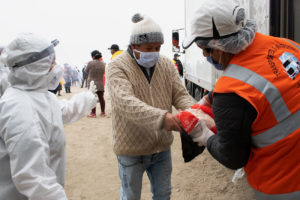
Families in Nicaragua receive kits of food made possible by a Texas Baptist Hunger Offering grant as they return to their villages and begin rebuilding. (Photo courtesy of BGCT)
In response, the Nicaraguan team set up feeding centers throughout the villages in partnership with local churches. They also prepared survival kits for families ready to return home and begin rebuilding.
The boxes of food, provided through hunger offering funds, will give families returning home from refugee centers enough food for two weeks as they begin the long process of rebuilding. In addition, the families are also given a machete, family-sized mosquito net, a water purification dropper and bleach.
Palmer described a Nicaraguan team coordinator who had a truck of people show up to his door, asking for him by name. They were coffee farmers from northern Nicaragua, and they had arrived with coffee for those hit by the disaster. When they asked locals where they should distribute the coffee, they were immediately directed to the coordinator because the efforts of the mission team were well-known and respected throughout the area.
“Our goal is to come alongside these local churches and efforts,” Palmer explained. “We want to empower their ministry so that people know they can come to their local church for help.”
Katie Frugé, director of hunger and care ministries with the Texas Baptist Christian Life Commission, expressed joy at working alongside Missional Team and their ministry in Nicaragua.
“Part of the hunger offering’s mission and work is to unite the body of Christ and provide holistic transformation in the name of Jesus. The devastation caused by back-to-back direct hits by hurricanes Eta and Iota further damaged an already fragile community,” Frugé said.
“The hunger offering is thrilled to work in collaboration with others to provide emergency food supplies as families begin the long process of rebuilding.”
CommonCall: Local leaders continue global ministries
January 15, 2021
When a global pandemic halted most international travel and forced U.S. mission teams to cancel planned trips, overseas ministry involving Texas Baptist partners continued.
Remote villages gained access to pure water. Refugees received food. Indigenous missionaries provided pastoral ministry. Vulnerable children and their families continued to have essential care.
People around the world continued to experience loving care in Christ’s name because Texas Baptist churches, agencies and ministry partners spent years building relationships and nurturing local Christian leaders.
TBM continues to provide pure water
A Texas Baptist Men water ministry team had to cut short its March trip to Uganda when the COVID-19 pandemic reached a crisis level, and TBM cancelled another team’s scheduled summer trip to Papua New Guinea.
TBM had sent a well-drilling and training team to Papua New Guinea last November. When TBM cancelled the June trip, villagers knew they would not have another opportunity to drill wells until months later, after the rainy season.
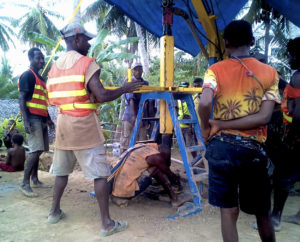
A drilling team in Papua New Guinea drills their second well. Because of COVID-19, TBM water ministry volunteers were unable to be there, so they guided the local team through the process with cell phones and photos. (Photo / Tim Wint)
“They were so anxious to go ahead and drill,” said Dee Dee Wint, TBM vice president of water ministries. “We had taught them health and hygiene, and we had trained trainers.”
The villagers had installed latrines, organized a local water committee and raised enough money to fund the well’s maintenance, she noted.
“It’s been a challenge, but they have been so determined, and they were so anxious,” Wint said. “They are working hard and very excited about it.”
In Peru, TBM began five years ago training local teams to train others in drilling, maintenance and hygiene.
“We were working in anticipation of something happening that might close the door there. We wanted them to be self-sufficient. They are pretty much independent now,” Wint said, noting local teams have drilled three wells in 2020.
TBM water ministry also has continued in Kenya, where a newly drilled well will provide clean water for a vocational school, and in northern Ghana, where local Christians have distributed soap and rice while teaching health and hygiene to people in 11 villages that benefit from TBM wells.
“The water ministry is making a tremendous difference in the spread of the gospel in northern Ghana and the planting of churches there,” Wint said. “When we go home, we don’t want the work to stop.”
Mickey Lenamon, TBM executive director, noted in mid-summer that seven wells already had been drilled and two more were in progress because of TBM’s long-term commitment to investing in local Christian leaders.
“For years, we have been training local church leaders how to drill their own wells,” Lenamon said. “Now we are seeing them thrive on their own, giving thousands of people clean water around the world, as well as an opportunity to respond to the Living Water that is Jesus. In times of crisis, God continues to provide.”
Houston church continues ministry to Burma
Five years ago, monsoons flooded much of Burma, also known as Myanmar. Thong Lun, pastor of Greater Houston Burmese Christian Fellowship, a mission of Tallowood Baptist Church in Houston, worked with ministry partners and humanitarian relief groups to deliver 32 tons of rice to people displaced by floods and mudslides.
Although floods destroyed much of the country’s infrastructure, Thong was part of a small team that visited seven camps—including some accessible only by specially equipped four-wheel-drive off-road vehicles.
“To be physically present is important,” he said at the time. “The importance of our presence was greatly appreciated by the local people.”
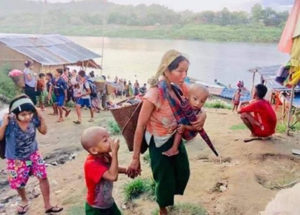
Through the work of indigenous church planters and in partnership with the Karen Baptist Convention and other regional Baptist groups, Greater Houston Burmese Christian Fellowship has continued its ministry to internally displaced people and refugees in Myanmar, even when COVID-19 prohibited international travel. (Photo courtesy of Greater Houston Burmese Christian Fellowship)
Thong and other mission volunteers from his church have been unable to travel to Burma since mid-March because of COVID-19. However, his congregation has continued their ministering presence there through eight indigenous missionary church planters the congregation supports. One of the missionaries is a former Buddhist monk who is now a Christian church planter.
Through the ongoing work of those missionary church planters—as well as partnerships with the Karen Baptist Convention and a regional Baptist group in the Shan State—Thong and his church have supported ministry to refugees, internally displaced people and residents of a “leper’s village” on the border with China.
“We continue our ministry there when we cannot go ourselves through our work with the churches and organizations there,” Thong said.
Greater Houston Burmese Christian Fellowship also provides hand sanitizer and face masks to displaced people through a Christian nongovernmental organization.
“We cannot be there in person at this time, but our partners are working there,” Thong said. “And we are working with them, side-by-side, through the support we provide. We cannot go and conduct the training we would like, but we can partner in ministry with local churches and organizations.”
Abilene church expands ministries in Africa
Similarly, Manassee Ngendahayo, pastor of Rest for the Nations Baptist Church in Abilene, has been able to continue and even expand ministry in Central Africa—even in the midst of a global pandemic—because of personal relationships and established connections there.
More than a quarter-century ago, after 100 days of Rwandan genocide, Ngendahayo felt God calling him to leave his home in the Democratic Republic of the Congo to start a church in Kigali, Rwanda, where he began ministering to widows, orphans and displaced people. When he and his family moved to the United States a few years later, he continued the work in Rwanda through the charitable organization he founded, Rest for the Nations Ministry.
About six years ago, after the Ngendahayo family moved to Abilene, he planted Rest for the Nations Baptist Church as a mission of Lytle South Baptist Church. With help from the Texas Baptist Hunger Offering and Rest for the Nations’ sponsoring church, the mission congregation began meeting the physical needs of refugee families who relocated from Central Africa to West Texas.
At the same time, Rest for the Nations worked in Rwanda by providing scholarships that enable children and teenagers there to attend school, supporting pastors and helping meet other needs in partnership with Rwandan Christians.
While he has not been able to travel to Central Africa after the pandemic reached a critical level early this year, Ngendahayo has produced videos for pastors there—both as teaching tools and as an encouragement to them as they preach and provide food for hungry people.
Hunger Offering grants help meet needs
In addition to ministry in Rwanda, Ngendahayo felt an acute need to help people in his homeland. According to the United Nations, about 4.7 million people in the Democratic Republic of Congo suffer acute malnutrition, and even before the COVID-19 pandemic, the country suffered from prolonged outbreaks of Ebola, measles and HIV-AIDS.
More than 5.5 million people in the nation are internally displaced, due not only to famine and disease, but also to ongoing armed conflict.
“Churches and houses have been bombed—put to the fire,” Ngendahayo said.
Some people who were forced from their own lands due to violence fled to surrounding countries, but that abruptly ended in March when Congo’s president closed the nation’s border due to COVID-19. Now they live as refugees in their own nation, said Rodney Watson, pastor of Lytle South Baptist Church.
“They are a people without a country,” Watson said.
With a grant made possible by the Texas Baptist Christian Life Commission, Rest for the Nations has been able to work with pastors and churches in Congo to provide food for internally displaced people—including a distribution to 3,000 people this summer.
Buckner International ministries in Peru and Kenya also benefited from funds made possible by the Texas Baptist World Hunger Offering. And those ministries have continued life-saving and life-transforming work in the midst of the pandemic because of Buckner’s long-term investment in developing strong local leaders.
Buckner provides help in hard-hit Peru
On a per-capita basis, Peru has been hit harder than any nation in terms of deaths due to COVID-19—not only due to its prevalence, but also because of lack of access to medical facilities.
“Many people are dying, with hospitals filled to capacity, tents outside the hospitals and 40 people in line for every ICU bed,” said Dexton Shores, senior executive director of international operations for Buckner Children and Family Services.
Buckner International has continued to meet urgent needs in Peru throughout the COVID-19 pandemic. (Buckner Photo)
Due to high demand and low supply, the price of an oxygen tank jumped from $35 to more than $1,400, he noted. In spite of the cost, Buckner purchased two oxygen tanks to make available to client families who cannot receive help otherwise.
Claudia Leon, director of Buckner Peru, described one family—a couple, Christian and Lida, with three small children, ages 7, 4 and 1—who all contracted COVID-19.
Because Christian has diabetes, he developed complications. At one point, his oxygen saturation level dropped to 80 percent, down from a normal 95 percent level. When he was taken to the hospital, he was sent home because no bed was available.
However, Buckner intervened and—with the help of local officials who know and respect Buckner’s ministry—helped secure care for Christian and all his family.
“Finally, finally they are all doing better—stable now,” Leon said. “They are going to make it.”
Staff who work with Buckner Family Hope Centers in Peru and other ministries of Buckner Peru develop deep connections to the families and individuals they serve, she noted.
“They all have lost people they love and cared for, but they remain committed to serve,” Leon said.
Buckner continues to care for families in Kenya
In Kenya, the COVID-19 outbreak is complicated by the significant number of people in high-risk groups—such as those living with HIV-AIDS—who are reluctant to seek medical attention when they need it, said Dickson Masindano, director of Buckner Kenya.
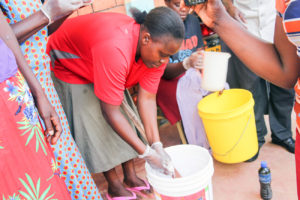
While mission teams from the United States cannot travel to Kenya as they once did, people in the East African nation continue to benefit from the seeds they planted, he noted. TBM teams and others drilled wells that continue to provide pure water. Kenyan women continue to make cooking oil from sunflower seeds, as well as produce homemade soap, using methods Texas Baptist church groups taught them.
“If you don’t have clean water and soap, you’re as good as dead now,” Masindano said.
Clients at the Buckner Family Hope Center in Bungoma, Kenya, make soap using techniques they learned from Texas Baptist mission teams. (Buckner Photo)
The women who make the cooking oil and soap not only use them in their own households, but also sell them to earn extra income for their families, he noted.
Individuals involved in a Buckner sewing and tailoring economic development project have made masks for all of Buckner’s clients and staff, and they also have been able to sell some to generate income, he added.
Self-sustainability has been Buckner Kenya’s goal since Masindano arrived in 2001, and it has enabled the ministry to continue not only during the ongoing pandemic, but also in times of domestic turmoil after contested presidential elections a few years ago.
Because Masindano has devoted nearly two decades to ministry in Kenya, he has been able to see some who were small children when he first started work there grow into young adulthood. That makes it all the more painful when one is lost to COVID-19 and its complications.
His voice choked with emotion as he described one college-age young woman he first met when she was 8 years old who died recently.
“That was very tough for all of us. It was the worst experience of this pandemic, that we could not be there for her” in her final hours, he said.
Social workers and other Buckner staff have received counseling to help them handle the deep loss.
“It hurt all of us. … It affected all of us who knew her so well,” he said. “You know, this is your child.”
Shores noted the international staff—those who minister day-to-day over a course of years—develop deep emotional connections to those they serve.
“These kids are like family. They have been working with them for years,” he said. “Yet in spite of all the emotional trauma they are living with, they manage to continue to serve clients with excellence.”
Read more articles like this in CommonCall magazine. CommonCall explores issues important to Christians and features inspiring stories about disciples of Jesus living out their faith. An annual subscription is only $24. To subscribe to CommonCall, click here.
Gospel message fills the airwaves in Croatia
January 15, 2021
ZAGREB, Croatia (BP)—After living in Croatia more than 22 years, missionary Eric Maroney understands why some people describe life and ministry as difficult in this part of Europe.
IMB missionary Eric Maroney preaches in Croatia. His sermons are also broadcast twice weekly on a local radio station. Though it takes 20-30 hours for Maroney to prepare a radio sermon in Croatian, he believes the time is worth it to reach the more than 40,000 people who tune in to the program. (IMB Photo)
Maroney has witnessed the reluctance of people to believe the gospel and has endured the skepticism toward evangelical churches. Only one Baptist church stands in western Zagreb—an area of 250,000 people—where his team lives and works.
As church planters, Maroney and his wife Julie looks for new strategies to share the gospel. In 2014, when a Brazilian ministry partner pitched the idea of a radio ministry, Maroney saw it as a part of a larger strategy to spread the gospel and connect seekers with local congregations. Gifts to the Lottie Moon Christmas Offering for International Missions support the effort.
“We approached the local radio station, Radio Martin, and they were willing to host us, despite the fact that the station is affiliated with the Catholic church,” Maroney said. “The first contract was for two 15-minute programs Monday and Wednesday afternoons.
“Over the years, as we’ve developed a relationship with the station director, we’ve been able to negotiate for lower fees and have moved to a live 45-minute program on Wednesday and Friday evening recorded at the radio station.”
A ministry team records an evangelistic program, which airs twice a week and reaches more than 40,000 people in Croatia with each broadcast. (IMB Photo)
The ministry team now includes nine local partners who serve as speakers, translators and technical support. The group fills the airwaves twice a week with a sermon, spiritual songs, interviews with believers and questions from callers. Ratings reported from the radio station’s director reveal more than 40,000 people listen to each broadcast. In a country with only 7,000 evangelical Christians, the number of listeners is significant.
Maroney knows not all listeners are intent on hearing the gospel when they tune in, but they are still opening themselves to a message of truth, he said. Maroney and his team trust the “broad seed sowing” of the broadcasts touch people’s hearts and offer an alternative to those living without the hope of Christ. They have already seen a key impact of the radio ministry, he noted.
“A year after we began broadcasting, a man visited the Dugo Selo [church] plant. After several months of visiting he invited us to start meeting on Tuesday evenings in an empty storefront that he owned in” another city, Maroney said.
“Six months later, he casually mentioned that the reason he had first visited the Dugo Selo church was that he had been listening to our radio broadcast from the beginning.”
Although it takes Maroney 20 to 30 hours to prepare a radio sermon in Croatian, he is willing to put in the time to reach the multitudes.
In addition to the broadcasts, Maroney and his partners work with a local church to distribute Christian literature, provide a monthly article for the town magazine and host evangelistic events and public concerts. They also teach ESL classes and host summer camps.
Baptist World Congress slated as virtual event in 2021
January 15, 2021
Due to the COVID-19 global pandemic, the Baptist World Congress—originally scheduled for July 2020 in Rio de Janeiro, Brazil—will instead become an online event July 7-10, 2021.
In March, the COVID-19 crisis prompted the Baptist World Alliance to postpone the Baptist World Congress, typically held every five years, and reschedule it for summer 2021. In light of continued health concerns and travel restrictions, the BWA Executive Committee voted last month to transition to a virtual event next year rather than an in-person gathering.
Elijah Brown
“We wanted to have a Baptist World Congress that is as globally inclusive as possible,” BWA General Secretary Elijah Brown explained.
At Pentecost, BWA held an online prayer meeting that drew thousands of participants around the world, demonstrating the openness of Baptists globally to a virtual gathering, Brown noted.
So, just as the pandemic inspired churches around the world to use available technology to connect members in Bible study and worship experiences, BWA pivoted to a completely virtual format for the Baptist World Congress.
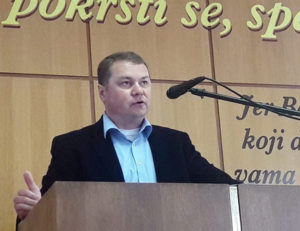
“This virtual opportunity to gather will allow us to seek the wisdom and strength of the Lord during such a special time in the world,” said BWA President Tomás Mackey. “Together we will share the experiences that have enriched us in so many different communities, and thereby strengthen our hope. We will be sensitive to the pains of peoples and individuals, interceding for one another, and plan for ministry that will help in these circumstances.”
The 2021 Baptist World Congress holds the potential to be the largest event uniting Baptists in their 400-year history, as well as the most diverse and accessible event since the Baptist World Congress launched in 1905, organizers asserted.
“After this unprecedented season of physical isolation, we need the encouragement of our Baptist sisters and brothers more than ever,” said Carolina Mangieri, BWA director of global events and fellowship. “I am prayerful that this transition will enable more people than ever before to experience the beautiful unity amidst diversity of our global Baptist family.”
Accessible regardless of time zone
The 22nd Baptist World Congress will include a combination of livestream events—which will be recorded and made available on demand later—and prerecorded sessions accessible at any time, to accommodate all time zones.
In addition to Paul Msiza, past president of BWA, speakers include Elie Haddad, president of the Arab Baptist Theological Seminary in Beirut, Lebanon; Karen Kirlew, president of the Jamaica Baptist Union; John Kok, senior pastor of Kuala Lumpur Baptist Church in Malaysia; Fanyana Peter Mhlophe, past president of the Baptist Convention of South Africa; Gabriel Stephen, originally from Nigeria and now a doctoral student and youth pastor in Norway; and Robert Smith Jr., preaching professor at Beeson Divinity School in Birmingham, Ala.
The congress will feature more than 30 breakout sessions on a variety of ministry topics, along with virtual roundtable discussions about worship, missions, aid to people in need, religious freedom and transformational leadership.
Three related events are scheduled prior to the opening session of the Baptist World Congress—the “Life” Global Conference of Baptist Women, the Youth Leadership Conference and the “Together with the Persecuted” Religious Freedom Summit.
To register or find more information about the 2021 Baptist World Congress, click here.
BWA responds to COVID-19 crisis
The transition to a virtual Baptist World Congress represents one in a series of actions BWA has taken to respond to the COVID-19 pandemic, Brown noted.
In March, the global fellowship launched its Standing Together Response Plan, receiving and praying for thousands of requests from around the globe and making available 132 emergency aid grants that benefited more than 130,000 people in 82 countries, he said.
In addition, through the BWA Forum for Aid and Development, more than 30 Baptist aid agencies worked collaboratively to respond to refugee challenges, meet the needs of vulnerable populations, help women recover from human trafficking and work on economic development projects to generate jobs in the midst of a global pandemic.
At the same time, BWA has closely monitored human rights abuses and religious persecution, and its racial justice task force worked on issues that particularly came to the forefront in 2020.
“BWA has made every effort to respond holistically,” Brown said.
TBM/Ghana partnership links clean hands and clean hearts
January 15, 2021
During his public ministry, Jesus met human needs and pointed people to God. A new Texas Baptist Men water ministry partnership in Ghana is helping Ghanaian believers follow that model.
The initiative led 200 people to faith in Christ during October alone.
“We ought to apply kingdom perspective to all of life,” Pastor Moses Sana Konjon said, referencing several Bible verses. “When people look at the church, they should see the very embodiment of Jesus. Christ’s ministry was holistic.
“During his earthly ministry, Jesus—apart from preaching the word of God—healed the sick, fed the hungry, comforted the bereaved … . Therefore, we must cease to be spectators in the economic and social scene. Instead, we must be actively involved in addressing the social needs of the people we evangelize.”
Dubbed the Clean Hands, Clean Hearts campaign, Frontier Missions Network is leading hygiene classes in rural northern Ghana as they first were taught by TBM water ministry leaders earlier this year.
“It is thrilling to see how these simple lessons have impacted the rural areas of Northern Ghana bringing better health and more importantly, the hope of Christ.” said DeeDee Wint, vice president of the TBM water ministry.
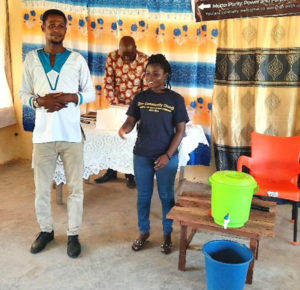
Christians in Ghana teach hygiene classes first brought to the country by TBM water ministry. (Photo courtesy of Frontier Missions Network)
In October, the Ghanaians led hygiene classes in two locations. The lessons are particularly helpful in a country where roughly half of the households have a designated place to wash their hands, but only 20 percent have access to soap at home, according to UNICEF.
About 30 percent of the nation practices open defecation. More than 75 percent of Ghanaians are at risk of drinking water contaminated by fecal matter.
“We take seriously the impact that pandemics and public health emergencies have on the majority of our people in the rural communities in northern Ghana,” Konjon said. “Most of the diseases that claim many lives in the area are hygiene-related diseases. This is due to lack or poor education on sanitation—even on basic personal hygiene and resources which is a key precautionary measure.”
Teaching people how to stay clean and healthy provides an easy avenue for Ghana Christians to share about Christ, who cleans hearts and saves people.
“As a faith-based organization, our mission is primarily to proclaim the good news of salvation, to be the light of the world and salt to season our society,” Konjon said.
The TBM partnership with Frontier Missions Network is ongoing as Ghanaians seek to minister in many northern Ghana villages.
Nigerian Christians killed and churches burned during protests
January 15, 2021
NIGERIA (BP)—An untold number of evangelical Christians are likely among growing deaths in Nigeria, an advocate for Christians in Nigeria said.
Police attacked peaceful protestors Oct. 20 at Lekki Toll Gate bridge in Lekki, Lagos. The protestors were marching against alleged longstanding police brutality and killings by Nigeria’s Special Anti-Robbery Squad, according to news reports.
The situation has fueled prayer walks and marches against economic insecurity and violence in other parts of the country, Christian Solidarity Worldwide representative Khataza Gondwe told Baptist Press on Oct. 28.
Police confirmed seven deaths of Christians in Abuja, according to Morning Star News in an Oct. 23 report. The news service said at least three Christians were killed in Abuja. Violent counter-protestors and “Muslim hoodlums” have also burned at least three church buildings in the capital city of Abuja and in Plateau and Kano states, Morning Star said in its report.
At least four Christians have been killed in Kano, Gondwe told Baptist Press from her office in London.
“It’s still early days to find out who has been killed,” said Gondwe, Christian Solidarity Worldwide’s Africa and Middle East team leader. “Nobody knows who has been killed in Lekki or elsewhere. The four that were killed, definitely (Christians) were killed in Kano state.”
Particularly, when the Christian Association of Nigeria sponsored prayer walks in Plateau, Kano and Kogi states Oct. 19-20, Gondwe said Muslims joined Christians in prayer because insecurity, violence and lawlessness are affecting both religious groups.
But criminal gangs, referred to as “thugs,” interrupted the prayer walk in Koji and attacked Christians as they retreated to a church, violently beating several pastors. The four Christians are believed to have been killed in Kano Oct. 19.
“We can’t really give you numbers, particularly because this movement was across the board,” Gondwe said. “There were no divisions along religious lines. There have been efforts to divide them along religious lines.”
“It’s pretty unusual” for Muslims to join in prayer with Christians, Gondwe said. “But in times like this when everybody’s marching, and everybody’s marching for the same thing, it would be quite straightforward. … It’s this coming together to pray because we’re all in this.
“People are pretty tired of the insecurity. Everybody’s suffering from it. Everybody’s being kidnapped. Everybody’s having to pay ransoms. Everybody’s losing people on highroads because armed robbers … are there, attacking and killing people.”
Gondwe described Kano as one of the most religiously volatile Nigerian states. The four were killed in a Christian district in the overwhelmingly Muslim Kano.
Christian churches continue to call for justice, Gondwe said, although prayer walking will be difficult in the current climate of unrest.
Protests began in early October against SARS forces after cellphone video surfaced of SARS police appearing to kill a young man in broad daylight when he refused to turn over his cellphone. According to longstanding accusations dating back several years, SARS forces routinely have robbed and attacked private citizens instead of protecting them.
Gondwe said the death toll from the police attack on protestors in Lekki, recorded on personal phone cameras, is unknown, but has been reported by Nigerian authorities as one or two.
Amnesty International and other groups have called the Lekki attack a “massacre.”
“What happened at Lekki Toll Gate has all the traits of the Nigerian authorities’ pattern of a cover-up whenever their defense and security forces commit unlawful killings,” said Osai Ojigho, Amnesty International’s country director.
“One week on, the Nigerian authorities still have many questions to answer: who ordered the use of lethal force on peaceful protesters?” Ojigho said. “Why were CCTV (security surveillance) cameras on the scene dismantled in advance? And who ordered electricity being turned off minutes before the military opened fire on protesters?”
Nigeria President Muhammadu Buhari’s office announced Oct. 11 that SARS had been disbanded, but Gondwe and others said the forces have continued attacks after previous such announcements. Protestors continue to call for an end to police brutality, regardless of whether such brutality is connected to SARS.
The young adults protesting in Lekki are “in deep shock,” Gondwe said. “I don’t think they expected anything like that to happen.”
Violence related to the SARS protests and other police brutality is jelling with violence in other areas of Nigeria from militant Fulani herdsmen and Boko Haram terrorists, Gondwe said.
“The two parts of Nigeria were pushing for different things,” she said, “but definitely in the center and north, Christians are suffering terribly. … Pray that government is held to account for every insecurity, every source of violence, whether it is religious violence and their inaction to it, whether it is violence by banditry (or) violence by police.”



 “This virtual opportunity to gather will allow us to seek the wisdom and strength of the Lord during such a special time in the world,” said BWA President Tomás Mackey. “Together we will share the experiences that have enriched us in so many different communities, and thereby strengthen our hope. We will be sensitive to the pains of peoples and individuals, interceding for one another, and plan for ministry that will help in these circumstances.”