GAZA STRIP (BP)—“A love offering from the Baptist Church in Gaza” proclaims the sign as Christian Mission to Gaza serves hot meals to both Christians and Muslims in the Gaza Strip, where people are starving to death.
Christian Mission to Gaza served about 2,000 hot meals July 24-26 in the name of Gaza Baptists, said Hanna Massad, who served as the church’s first Palestinian pastor before founding the nonprofit organization. But the meals only touch a small fraction of those in need.
Massad continues to hold online prayer services each Sunday with about 30 online connections, including members of Gaza Baptist Church and other Gazans, he told Baptist Press as he prepared to preach and teach at two Baptist churches in Texas July 27-29.
At least 63 people died of starvation in the Gaza Strip this month, the World Health Organization reported July 27, including 25 children and 38 adults, with 24 of the children under age 5. The bodies of the dead bore “clear signs of severe wasting,” the organization stated.
Malnutrition is spiraling out of control in Gaza, WHO reported, with more than 5,000 children under five seeking outpatient treatment for malnutrition in the first two weeks of July alone, about 20 percent suffering Severe Acute Malnutrition, the most life-threatening form.
In June, 6,500 children were admitted for treatment, the highest number recorded since October 2023, WHO reported.
The Christian Mission to Gaza meal distributions have managed to avoid the Israeli attacks WHO said killed 1,060 people and injured 7,200 others at food distribution sites in Gaza since May 27, including friends of the church community.
Massad tells of a friend whose 40-year-old nephew died while trying to retrieve food.
“I have a friend, my neighbor, he lost his nephew,” Massad said. “He went to get a bag of flour to feed his family, and he’d been shot, killed.”
The Israeli government, which had accused Hamas of fabricating news of a hunger crisis and starvation deaths, began food airdrops July 27 and announced tactical pauses in attacks on three highly populated areas of Gaza for 10 hours daily to allow food distributions, the Associated Press and other news outlets reported.
‘We continue to minister to the Christian community’
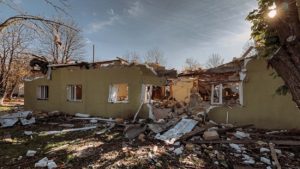
Gaza Baptist Church, heavily damaged in the Israel-Hamas War, was occupied by Israel Defense Forces, Pastor Hanna Massad said. (Photo distributed via BP)
Two families are living in what remains of Gaza Baptist, Massad said of the church that had dwindled to 60 members because of persecution before the Israel-Hamas War. Its building was heavily damaged by Israeli bombs in late 2023.
“We’ll need to see after the war what to do,” Massad said of the church. “But we continue to minister to the Christian community.”
Massad preached the morning sermon July 27 at PaulAnn Baptist Church in San Angelo, updating worshipers on the war’s impact on Gaza and the work of Christian Mission to Gaza.
He is scheduled to speak to adults at Vacation Bible School July 28 and 29 at First Baptist Church in Garland.
President Donald Trump recognized the starvation crisis July 28, pledging U.S. food aid and urging Israel to secure its distribution.
Israeli attacks continue to strike the Christian community, Massad said, with airstrikes hitting the Latin Church in Gaza July 18, killing three Christians and injuring 10 others, including a priest.
Commission spotlights religious freedom threats in Nigeria
“Attacks targeting religious communities remain a major and ongoing threat to religious freedom in Nigeria and are increasing in frequency,” the commission’s July update on Nigeria states.
The Nigerian government “is often slow to react to violent attacks by Fulani herdsmen, bandit gangs, or insurgents” such as JAS/Boko Haram and the Islamic State West Africa Province, the report asserts.
“This violence severely restricts religious practice and observance by Christians, Muslims, and traditional religious communities across many Nigerian states in the Middle Belt and in the northeast,” the commission report states.
“Perpetrators of the violence have attacked religious sites including churches and mosques, kidnapped or killed religious leaders, and—in some cases—used violence or threats of violence against religious communities while demanding so-called taxes, invoking Shari’a law as justification.”
The commission reports multiple attacks with fatalities in Benue and Plateau states, particularly highlighting the slaughter of 200 people in June—including internally displaced persons sheltered in a Catholic mission.
The report points out armed Fulani herdsman also are spreading to the south, with 55 herder groups active in the region. That, in turn, is leading to increased internal displacement.
“While the south historically has experienced relatively peaceful coexistence between religious groups, this new presence carries a risk of increased instability,” the report states.
“Furthermore, the significant number of Christians killed in the attacks exacerbates the community’s fear that its members will be violently targeted over their faith.”
Blasphemy laws used to restrict religious freedom
The report also highlights how the Nigerian government uses blasphemy laws to restrict religious freedom.
Although Nigeria’s 1999 constitution stipulates federal and state governments cannot adopt an official religion, the nation’s federal penal code criminalizes actions or statements a person could consider “as a public insult on their religion,” the report notes.
“The constitution also grants state governments the authority to adjudicate criminal and noncriminal proceedings through Shari’a courts,” the report states.
Twelve states in northern Nigeria use Shari’a-based law to criminalize blasphemy, allowing stoning, caning and amputation for a variety of offenses, the commission reports.
Leaders of the Center for Global Religious Freedom at Dallas Baptist University, Texas Baptists’ Christian Life Commission and the Baptist World Alliance encouraged Texas Baptists to dedicate time during worship service on July 27—or the first available date in the future—to pray for victims of religious persecution in Nigeria.
In addition to praying, they also are urging Texas Baptists and other concerned Christians to sign an online letter to Secretary of State Marco Rubio, calling for the U.S. Department of State to designate Nigeria as a Country of Particular Concern.
The CPC designation is reserved for nations that commit or permit systemic, ongoing and egregious violations of religious freedom. Both in its annual report and its July update, the U.S. Commission on International Religious Freedom reiterated its recommendation that Nigeria be designed as a CPC.
Around the World: BWA presents Human Rights Award
July 30, 2025
At the Baptist World Congress in Brisbane, the Baptist World Alliance presented its Human Rights Award to Sano Vamuzo of Nagaland, India. The award recognizes a lifetime of achievement to an individual who has shown significant accomplishments in global advocacy for human rights and the pursuit of social justice and peace. Vamuzo has dedicated more than four decades to promoting justice, gender equity and reconciliation. “This recognition strengthens our resolve to walk with the unheard, speak peace where there is pain, and build bridges where there are walls,” Vamuzo said. She is a founding member and the first president of the Naga Mothers’ Association, the first voluntary women’s organization for all Naga women. In that role, she led the association in confronting social evils, advocating for the welfare of youth, and raising the visibility of women in public life. Vamuzo served as the first chairperson of the Nagaland State Commission for Women for two terms, where she worked to ensure the protection and advancement of women’s rights across the state. Her service was recognized nationally when she was awarded the Padma Shri in 2024—one of India’s highest civilian honors—for her contributions to social work.
Julio Guarneri
At the annual meeting of the Baptist Convention of Tanzania, Baptist General Convention of Texas Executive Director Julio Guarneri signed a memorandum of understanding with Tanzania Baptists, committing to collaborate with six MAP (Missionary Adoption Program) missionaries, with a goal of adding four additional missionaries in one year. MAP connects Texas Baptist churches to indigenous missionaries outside the United States who serve under Baptist entities, associations or conventions. In his “Texas Baptists Weekly” e-mail, Guarneri noted the six MAP missionaries “are starting churches with great diligence and often with great personal sacrifice.” Guarneri and other Texas Baptists who traveled to Tanzania met with the four potential MAP missionaries. “These church starters are passionate and ready to do Great Commission, Great Commandment work,” Guarneri wrote.
Elijah Brown
Baptist World Alliance leaders called for all parties involved in the most-recent armed conflict in southern Syria “to immediately cease hostilities, exercise restraint, and work toward de-escalation and peace.” BWA General Secretary Elijah Brown noted in a July 20 social media post families living in Sweida who are affiliated with Baptist churches have been affected directly by the conflict between the Druze community and Bedouin tribes. “We pray for the protection of innocent civilians and affirm the dignity and right for every person to live in safety,” Brown wrote. “We pray for those who have been impacted, for the churches as they minister, and for love to prevail over violence, hope over fear, and life over death.”
Katie Frugé
Texas Baptists’ Christian Life Commission director Katie Frugé participated in a panel with 21WilberForce President Wisam al-Saliby and BWA General Secretary Elijah Brown in a Baptist World Congress breakout session on technology, faith and human rights. Frugé discussed ethical considerations of artificial intelligence, urging tech users not to lose sight of the importance of humanity in considering ethical uses of AI. Al-Saliby explained ways technology is being used around the world to dehumanize people, including AI being used to make decisions about who to target in a war-torn region, or large-scale surveillance that invades privacy or treats people like data. Brown noted a number of tech sector leaders think they can save the world through technology. But with technology, possibility also comes peril—if transhumanism erodes what it means to be human. Brown urged BWA participants to reaffirm the imago dei—the image of God—in humanity and seek wisdom in how technology continues to be developed and intertwine with life.
Johnnie Moore defends embattled Gaza aid group
July 30, 2025
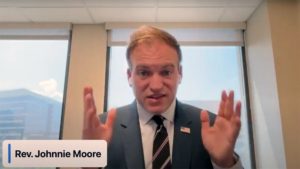
(RNS)—Johnnie Moore, the evangelical Christian who chairs the Gaza Humanitarian Foundation, defended the workings of his controversial food distribution system to a friendly audience in a July 22 Zoom call.
During the one-hour call, presented by the American Jewish Congress and the World Zionist Organization, Moore described the foundation’s work as “unbelievably effective.”
He said the group is getting meals to about 800,000 people in Gaza, or nearly half its population, while working in an active war zone and facing an onslaught of disinformation.
“We work around the clock in order to ensure safety and effectiveness, to be as principled as we possibly can be,” he said. “We are dedicated to the humanitarian principles of humanity and of impartiality, of independence and of neutrality.”
More than 1,000 killed trying to access food
He did not mention the foundation is a private Israel-supported and U.S.-backed group, whose distribution sites are guarded by private American contractors and, on the outskirts, by Israeli soldiers who have repeatedly opened fire daily on people approaching the food aid sites.
Since the Gaza Humanitarian Foundation began operating in May, 1,054 people have been killed trying to get food—766 of them in the vicinity of GHF sites and 288 near United Nations and other humanitarian organizations’ aid convoys, a U.N. human rights office spokesman said. The recent bloodshed has led to increasing outrage across the world.
Twenty-one European countries plus Canada and Australia issued a joint statement July 21 condemning “the drip feeding of aid and the inhumane killing of civilians, including children, seeking to meet their most basic needs of water and food” in Gaza.
“The Israeli government’s aid delivery model is dangerous, fuels instability and deprives Gazans of human dignity,” the statement said.
Moore, who may be best known for serving on President Donald Trump’s evangelical advisory board during the first Trump administration, said no one has been shot inside the distribution sites.
Moore attributes violence to Hamas
He acknowledged some were killed near the sites but disputed the figures, saying they were given to the media by Hamas. The numbers come from the Gaza Health Ministry.
“We do not deny that there have been civilians that have been killed trying to seek aid in the Gaza Strip while we’ve been operating,” Moore said. “By the way, the IDF doesn’t deny that they are responsible for some of that, and Hamas, by the way, does deny that they’re responsible for it.
“The fact is, Hamas has intentionally harmed Gazans in order to allege that it was the IDF or that it was GHF in order to disincentivize people from coming to our aid distribution site.”
Assaf Weiss, vice president of the American Jewish Congress, raised the question. Weiss is a former chief of staff for the speaker of the Knesset. The congress is an association of American Jews organized to defend Jewish and Israeli interests and committed to “an improved understanding of Israel,” according to its website.
Throughout the Zoom session, there were repeated calls for the return of some 50 Israeli hostages, some alive, some dead, still in Hamas captivity.
Moore was not asked about the Gaza Humanitarian Foundation’s funding source, which remains shrouded, though in late June, the Trump administration said it would supply $30 million to GHF operations. The Israeli government has publicly denied paying for it, though it is intimately involved in the operation.
A July 21 Washington Post story identified several private U.S. donors, including the Chicago-based private equity firm McNally Capital, which specializes in acquiring aerospace, defense and technology companies.
Moore did not mention the GHF’s own American security contractors.
Foundation designed to avoid diversion of aid
The Gaza Humanitarian Foundation operates four aid distribution sites, three of which are in militarized zones in the far south of Gaza and another in a militarized zone in central Gaza. Moore said he would like to expand to eight distribution sites.
Previously, the U.N. distributed aid through a coordinated delivery system with around 400 locations across Gaza, many controlled by Hamas.
Moore said the Gaza Humanitarian Foundation was founded to prevent Hamas from stealing, stockpiling and selling the aid, for which Israel blames the U.N.
“GHF was designed from the very beginning to avoid the problem of the mass diversion of aid,” he said. “Unfortunately, our challenge is compounded by the fact that the United Nations, from really the top of the organization, and other NGOs are not getting their own aid where it needs to go.”
He said he has pleaded and begged the U.N. to help it carry out its mission.
“Just earlier today, about an hour and a half ago, I wrote another letter to the head of OCHA (the U.N.’s Office for the Coordination of Humanitarian Affairs), Tom Fletcher, who’s the head humanitarian official in the United Nations,” Moore said.
“I wrote to him again, and I expressed our alarm that there is all this U.N. aid that is sitting inside the Gaza Strip. There’s U.N. flour there that’s about to expire—the medical supplies that either have expired or are about to expire. Thousands upon thousands of pallets sitting in the Gaza Strip.”
‘Politics … prevailing over the needs of these people’
Israel has mostly blocked the work of various U.N. agencies. In January, it banned the main U.N. agency for Palestinian refugees, the United Nations Relief and Works Agency, from operating in the country, alleging some of its employees were involved in the Oct. 7, 2023, Hamas attack on Israel that started the war. On July 21, Israel refused to renew the visa of a senior U.N. official in the OCHA office.
Other humanitarian groups have declined to work with the Gaza Humanitarian Foundation, saying they have concerns about its model of aid. No faith-based humanitarian group has yet to join forces with the GHF.
“The whole international system declines to work with us because of politics,” Moore said. “Despite everything that they say about being concerned about the needs on the ground, it is politics that is prevailing over the needs of these people.”
He did not deny starvation is a fact in Gaza. The World Food Program has said the population of Gaza was at the brink of famine.
“The situation is real, and the world needs to respond to it,” he said.
“I’m a Christian, an evangelical Christian. There’s nothing more Christian than feeding people.”
Kenyans adapt as churches are destroyed by flooding
July 30, 2025
BUDALANG’I, Kenya (RNS)—Every Sunday morning, Pastor Pascal Ogutu walks barefoot across the cracked mud of what was once the foundation of his church.
He passes submerged gravestones and the sagging roof of the altar, now half-buried in water and overgrown reeds.
“This used to be holy ground,” he said softly, gazing across the shimmering expanse where Lake Victoria has swallowed not only farmland and homes but faith sanctuaries, like his Free Pentecostal Fellowship in Kenya.
In the flood-prone plains of Budalang’i in western Kenya, dozens of churches—some more than 50 years old—have been submerged or structurally weakened due to rising water levels and unpredictable rainfall.
Scientists attribute the changes to climate shifts intensifying across the Lake Victoria basin, one of Africa’s most populous and ecologically fragile regions.
“The water does not just take land,” said Ogutu, of the Free Pentecostal Fellowship in Kenya, whose tin-roofed sanctuary collapsed last November after months of flooding. “It takes our memory. It takes our worship. It takes the place we felt closest to God.”
Floods more frequent and destructive
Budalang’i, a rural constituency in Busia County near the Uganda border, sits along a natural floodplain where the lake’s waters spill out during seasonal rains. But residents say the floods have become more frequent, intense and destructive.
In the past five years, the lake’s water levels have risen by more than 2 meters, or just over 2 yards, according to Kenya’s Water Resources Authority.
This backflow, combined with erratic rainfall and clogged drainage from nearby rivers, has displaced thousands of families and inundated schools, churches and cemeteries.
Scientists say the region’s flooding crisis is a visible symptom of broader climate disruptions, some of which are caused by global warming.
“Lake Victoria is a giant climate mirror,” said Godfrey Khamala, a climate specialist who leads the flood victims committee in Maumau Village, Budalang’i.
“What’s happening here is a direct result of regional warming, changing rainfall patterns and human-driven land degradation.”
Deforestation in upstream areas, coupled with poor urban planning and unregulated development, has worsened sedimentation and reduced the land’s ability to absorb rainwater, he said.
‘Casualties of a system under stress’
At the same time, climate change has intensified the Indian Ocean Dipole, a weather pattern that brings extreme rainfall to East Africa.
“These churches are casualties of a system under stress,” Khamala said. “But their loss also reveals how deeply intertwined environment and community life are.”
As a result, faith leaders are speaking out about climate justice. In April, a coalition of churches in Busia organized an interdenominational prayer walk calling for action to protect the lake and relocate vulnerable communities.
“We are stewards of creation, not just victims of it,” said Pastor Moses Okello of Assemblies of Pentecostal Churches in western Kenya. “We cannot preach hope while ignoring the rising waters around our feet.”
The Church of Christ, a concrete structure with wooden pews and stained-glass windows in Budalang’i, now sits half-sunken in marshland. Its bell tower is partly still visible from a distance.
“We had baptisms here. We buried our elders here. This was our sanctuary,” said Mary Anyango, 58, a longtime congregant who now worships with her neighbors under a mango tree. “Now, it feels like God is further away.”
Resilient churches find ways to adapt
Like Anyango, across the region, churches and congregants are adapting in creative and resilient ways. Services have been held in classrooms, tents, market stalls and even boats.
Pastors have converted living rooms into altars, where worshippers sit on mats or plastic chairs as chickens cluck in the background.
One Sunday in June, more than 80 people gathered under a thatched shelter in Bunyala village, also in Busia County, to pray and sing.
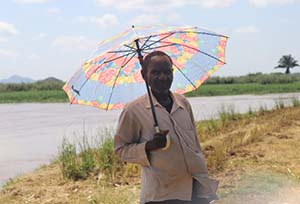
Pastor John Musumba in Kenya near Lake Victoria. (Photo by Tonny Onyulo)
“This is what church means now—people, not buildings,” said Pastor John Musumba, who leads a Pentecostal community that lost its church to flooding in 2022. “The gospel doesn’t need walls. It needs hearts.”
Still, religious leaders say attendance has dropped. Some elderly members have stopped coming to church entirely, fearing the floods or unable to walk through the mud. Tithes have declined, and efforts to rebuild are stalled by poverty and uncertainty, they said.
For many congregations, efforts to rebuild have been slow or symbolic. Some have erected temporary churches on higher ground with salvaged wood and tarpaulin. Others are fundraising to purchase plots farther away from the flood zone, but many cannot afford to do so.
“We are competing with families who need land for shelter,” said catechist Vincent Okumu, who coordinates emergency aid for displaced families with a local ecumenical relief committee. “Everyone is trying to move uphill. There is not enough space.”
‘This is not just about Kenya’
But faith remains a source of strength and solidarity. Congregants said the loss of physical buildings has not shaken their belief in divine presence, but in some cases has deepened it.
“In this crisis, we have learned that God is not confined to concrete,” said Patrick Okumu, a lay local preacher who now holds weekly Bible studies under a baobab tree. “He is with us in the mud, in the storm, in the rebuilding.”
Still, many hope the outside world will act.
“This is not just about Kenya,” Khamala said. “This is about how climate change is eroding not only coastlines and crops, but culture, heritage and spiritual life. These churches are the canaries in the coal mine.”
Back at the waterlogged remains of Free Pentecostal Fellowship in Kenya on a recent Sunday, Ogutu led his congregation in a song of lamentation.
“Lord, do not pass us by, even when the waters rise,” they sang in Luhya, as children clapped along and elders wiped away tears.
Texas Baptists urged to pray for the persecuted in Nigeria
July 30, 2025
The Center for Global Religious Freedom at Dallas Baptist University, Texas Baptists’ Christian Life Commission and the Baptist World Alliance have issued a call to prayer for victims of religious persecution in Nigeria.
Leaders at the DBU Center for Global Religious Freedom, the CLC and BWA are urging Texas Baptists to dedicate time during worship services on July 27—or another date in the near future—to pray for persecuted believers in Nigeria.
They also are encouraging concerned Christians to sign an online letter to Secretary of State Marco Rubio, calling for the U.S. Department of State to designate Nigeria as a Country of Particular Concern.
The CPC designation is reserved for nations that commit or permit systemic, ongoing and egregious violations of religious freedom. Several global experts and advocates for international religious freedom have deemed Nigeria one of the most dangerous nations in the world for Christians.
“Due to the ongoing and particularly severe religious freedom violations occurring throughout the country, especially in its northern states, the Trump Administration should redesignate Nigeria as a CPC and take immediate action to engage with the Nigerian government to confront this growing violence,” the letter to Rubio states.
“From April to June, violent attacks by nomadic Muslim Fulani militants on Christian farmers in Benue and Plateau states claimed more than 150 lives, displacing many more.”
Baptist pastor killed this month
In a July 12 video interview with BWA General Secretary Elijah Brown at the Baptist World Congress in Brisbane, Nigerian Baptist Convention President Israel Akanji said, “While we have been here in the past one week, one of our pastors was killed by terrorists who attacked his church.”
During the July 7 attack, another church leader also was killed, and Maryam Ezekiel, wife of the local Redeemed Church of God pastor, was abducted and remains in captivity.
Eight days later, more than 30 people in the Bindi community Riyom Local Government Area in Nigeria’s Plateau State were killed by heavily armed militia, CSW reported. Davou Musa, the local Christ of Christ in Nations pastor, reportedly lost nine family members in the attack.
In the video interview, Akanji also noted more than 200 individuals—most of whom were Christians—were killed in mid-June in Benue State.
When asked how Texas Baptist can pray for Christians in Nigeria, Akanji responded: “The prayer is that we should not lose our hope in God.
“We have the faith that in spite of the persecution, the church of God will continue to grow. Please pray that our hope will be sustained.”
BWA leaders note ‘What women these Christians have!’
July 30, 2025
BRISBANE—J. Merritt Johnston, executive director of Baptist World Alliance Women, urged women to live Jesus-shaped lives so the world will note, as a 4th century pagan intellectual did, “What women these Christians have!”
Delivering the final keynote address of the BWA Women’s Summit in Brisbane, Johnston explained Libanius made the comment after hearing a story of John Chrysostom’s mother, Anthusa, who was renowned for her dedication to Christ.
After summarizing who makes up the BWA sisterhood, Johnston noted as she has traveled around the world to meet with BWA Women in their home countries, “It’s overwhelming to me, the good that I see you doing.”
While people often feel overwhelmed by all the challenges happening in the world, she asserted, “There is good happening. And as I travel it is often, very often, the women that are leading that charge.”
Johnston said if the world could see what she sees and hears about the work of BWA Women, the world would be saying, “What women these Christians have!”
The evidence
As evidence, Johnston spoke of the work BWA Women have done with the United Nations promoting equality for women worldwide, a goal experts have suggested is at least 300 years away from being achieved.
Johnston said it’s not only equality the BWA Women U.N. participants are fighting for.
“We’re fighting not for equality, but eternity,” she said, noting she sees BWA Women standing strong in the worst situations.
Before the full-scale Russian invasion of Ukraine, for example, BWA assembled a group of Baptist women in Ukraine to pray. Johnston sent a message to check on the women to find out if they were OK when the situation worsened.
“Yes,” came the reply. “We’re in the basement of the church, and we can feel the walls shaking.”
Yet with bombs as the background accompaniment, the Ukrainian women sang “Count Your Blessings,” Johnston recalled, saying, “What women these Christian have.”
She spoke of “sisters in Manipur” who were stripped naked and paraded through the streets and whose churches and homes were under attack.
One “sister just had her home burned down,” but she wouldn’t be homeless because her Baptist sisters would stand with her, Johnston said.
She pointed to Scripture for the answer to the question: “How am I supposed to live the good news where I am?”
The world sees limitations—a 300-year timeline to equality. Yet, Johnston said, “time and time again women” like Jesus’ mother Mary, Mary Magdeline and the other Mary bore witness—to the birth, death and resurrection of Jesus.
The world may “see through the lens of limitation, but the Lord sees through the lens of love,” Johnston observed.
“Jesus loves you,” she said. “Jesus loves me,” but sometimes “we forget what it is to feel loved.”
Because Jesus loves “you, we have the best news,” that needs to be shared with those who do not know Jesus yet.
She urged women to live into the charge in Luke 4:18-19, to proclaim the good news, so that the world would note, not only “What women these Christians have,” but even more, “What a God these women have!”
General secretary’s address
Elijah Brown offers the opening address of the BWA Women’s Summit in Brisbane. (Photo / Calli Keener)
BWA Women is a fully integrated ministry arm of the Baptist World Alliance. In BWA General Secretary and CEO Elijah Brown’s opening address to the BWA Women’s Summit, he affirmed women’s equality and disavowed limitations upon how God uses them.
“BWA Women,” Brown began. “You are at the heart of the Baptist World Alliance, just as you are at the heart of the biblical narrative.”
Providing a list from Scripture, he backed up his claim, noting, Shiprah and Puah were the midwives fighting for justice and stood against government oppression to bring forth life.
Rahab provided refuge to strangers. Ruth “embraced isolation and risk … to provide for her family,” and Hannah’s “prayer and sacrifice sets in motion the search for a king … and gives rise to a deepened worship and understanding of God,” Brown said.
“It was Huldah, who was trusted to provide theological reflection and insight into the ways of the Lord.”
And he noted, Esther bravely prevented a genocide. Elizabeth sensed the Spirit in ways her husband, a priest, did not, and she bore and reared “the voice of one calling in the wilderness.”
Mary the mother of Jesus changed history. Mary Magdelene and the other Mary were “commissioned as the first evangelists with a transformative declaration that ‘Jesus is risen,’” Brown said.
He said Mary the mother of Mark likely owned the home where the Last Supper was hosted and where Jesus gathered with his disciples after the resurrection, the home where the disciples reflected on the Holy Spirit’s outpouring at Pentecost and perhaps where the first church in the world was organized.
Lydia was the first Christian in what is today, Europe. Priscilla, with her husband planted a church. Junia was well known to the apostles and imprisoned for her faith, Brown reminded the women.
“We could go on,” Brown said, because the Scriptures are clear: “women are equal custodians of faith leadership.”
Brown noted, “the BWA continues to affirm the calling God places on the lives of women to serve him fully and completely.”
Yet, Brown observed, women continue to face “disproportionate levels of gender discrimination,” forced marriages and higher levels of violence—including “sinful domestic abuse.”
Women “often face religious persecution in ways less visible than men,” including “house arrest, abduction and loss of custody.”
Brown noted, women “even within the church, are too often discounted and dismissed.”
“I am sorry,” he said. “And BWA affirms every woman, equally alongside men,” to be created in God’s image and filled with the same Holy Spirit as the resurrected Jesus when they accept him.
“You are equally called to join Jesus in his redeeming mission in the world today,” Brown said, whether as ordained pastors or in other equally important ways.
Brown pointed to the first sermon given in the church by Peter: “In the last days, God says, I will pour out my Spirit on all people. Your sons and daughters will prophesy. Your young men will see visions. Your old men will dream dreams and even on my servants, both men and women, I will pour out my Spirit in those last days.”
Brown noted his prayer is for everyone in the world to have an opportunity to know Jesus and affirmed the important role BWA Women play in helping to accomplish that mission.
He prayed for God to “do it again”—send a global revival and pour out his Spirit as he had at Pentecost—“and Lord, let it begin right now, and right here, with BWA Women.”
Bible study leaders challenge Baptist World Congress
July 30, 2025
BRISBANE—Ralph West, founding pastor of The Church Without Walls in Houston, challenged global Baptists to embrace a “theology of reconciliation.”
He was among more than 50 speakers representing about 30 countries who presented Bible studies in 10 languages—with each presenter teaching the same passage each day—during the Baptist World Congress, July 10-12.
In a study of 2 Corinthians 5:18-21, West encouraged Baptists to recognize they worship a God who is reconciling his creation to himself.
“God’s ultimate act of reconciliation was to send his only Son,” he said. “All reconciliation comes through Christ.”
Through the incarnation, God reconciled himself to humanity by taking on humanity, he noted.
“People need a Jesus who they can identify with and a Jesus who can identify with them,” West said.
Baptists and other Christians need to answer the call to be “ambassadors for Christ,” he said, recognizing an ambassador’s role is not to make policy but to represent faithfully the policy of the one who is sovereign.
“We are not given authority to change the message,” West said.
Rather, Christians are to proclaim “a message of peace and a message of freedom” as presented in Scripture and to “set the message loose in the world,” he said.
Disruptive good news
Julio Guarneri teaches on 2 Corinthians 5:17-6:2 at the Baptist World Congress in Brisbane. (Photo / Calli Keener)
Julio Guarneri, executive director of Texas Baptists also taught on 2 Corinthians 5:17-6:2. He focused on the disruptive nature of the good news.
Recalling a series of disruptive events from his own history—beginning with his parents’ coming to Texas from Mexico as missionaries to Spanish-speaking people in his teen years—Guarneri asserted surrender to God’s direction moved him to a deeper plane, no matter how imperfect his surrender may have been.
In the passage, Jesus sets his kingdom agenda of reconciliation—an agenda that is clear: “through his perfect work on the cross, he proclaims good news to the poor, freedom for the captive,” sight to the blind, healing for the sick and the beginning a new era of the Lord’s favor.
“Our agenda ought to reflect Jesus’… the metric for success ought to be the same as that of Jesus,” Guarneri noted.
Jesus’ agenda is comprehensive, including proclamation, healing and liberation. “It is physical, it is spiritual, and it’s emotional,” he said.
“The nature of the gospel requires us to be holistic in our approach,” Guarneri noted, continuing, “Our ministry is about words and about works … It is about loving, and it’s about living the good news.”
Paul reminded the Corinthian Christians they are partners with God, he said.
God’s coworkers cannot be mere recipients of God’s redemption, but also must be reconcilers, Guarneri asserted.
God’s heart has always been for the nations, but the Holy Spirit’s power took an ethnocentric understanding of God and “reframed it to be inclusive of all people.”
When God sends the disciples, it starts a global movement that extends to the ends of the earth.
Guarneri noted 60 percent of the world’s Christians today can be found in the Global South where Christianity is growing rapidly.
So, “the church, the academy and the mission” are at a pivotal moment.
“To be disruptible disciples in the rest of the world is to change our paradigm from simply thinking that we send from the West to the rest of the world, to coming alongside the Global South to send from everywhere to everywhere.”
Godly fasting
Micheline Makkar from the Baptist Church of Damascus, Syria, leads a Bible study at the Baptist World Congress. (Photo / Ken Camp)
God wants his people to fast—not to deprive themselves of needed nourishment but to meet the needs of others, said Micheline Makkar from Damascus, Syria.
“True fasting is doing good and loving justice,” Makkar said, focusing on Isaiah 58:6-12. “A godly fast is not about afflicting oneself but about liberating others.”
When a devastating 7.8 magnitude earthquake rocked Aleppo in 2023, no international humanitarian aid was able to reach the affected people because of sanctions imposed on Syria, she recalled.
Many members of the Baptist Church of Damascus struggled to feed their own families and had experienced deprivation themselves due to war.
However, leaders of the congregation encouraged church members to share what little food and other resources they had with the people of Aleppo.
“Our church gave 1,000 bags of blessing to Aleppo—from the poor to the poor,” Makkar said. “Our church learned fasting.”
God honors acts of “costly compassion” as expressions of worship, she said.
“God answers those who answer the needs of others,” Makkar said. “God responds to human mercy with divine favor.”
Acts of kindness and pursuit of justice are never in vain, even if their results are not immediately apparent, because they plant “the seeds for generational renewal,” she said.
Makkar urged global Baptists to ask: “What legacy of justice am I leaving?”
With additional reporting by Calli Keener.
Persecution and violence addressed at BWA Congress
July 30, 2025
BRISBANE—Bruce Webb, pastor of The Woodlands First Baptist Church, recounted the history of Baptist advocacy for freedom of religion during a breakout session at the Baptist World Congress focused on the persecution of Christians.
Webb started with Thomas Helwys and John Smyth becoming the first Baptists in direct response to the lack of complete religious freedom in England.
He traced Baptist championing of religious freedom through the American colonies, noting persecution of dissenting Christians by the official state churches—during that period.
“Using political power to achieve spiritual gains … is always short-sighted,” Webb said, alluding to Christian nationalism.
“If we give Congress or any political leader the power to give Christianity an advantage, then we also give them the power to remove it and grant that advantage to another ideology we oppose.”
“Baptist Christians have historically believed, if put on equal footing, Christianity will win because it is true,” Webb continued.
“We have never asked for an advantage, have never supported coercion, but have passionately advocated for the freedom to worship, serve God and share the good news of Jesus Christ with everyone everywhere.”
Samson Aderinto Adedokun, pastor of New Dawn Baptist Church in Lagos, Nigeria, described the situation for Christians in his country. He and his family have experienced religious persecution firsthand by what he called “Islamic fundamentalists.”
Adedokun described the positive results of persecution. Persecution scatters the church, but for a purpose.
“When you cannot escape the fire, carry the flame where you land,” he said.
Persecutors also need God’s love, Adedokun said. So, persecuted Christians need to act in love. This love can be demonstrated in kindness toward persecutors. “Your kindness may be someone’s miracle,” he said.
“Persecution is temporary. Kingdom joy is permanent,” Adedokun concluded. “Joy flows from obedience [to God], not comfort.”
Lessons for churches from areas of conflict
Igor Bandura participated in a breakout session focused on lessons learned from churches facing war, violence and terror. (Photo / Eric Black)
Igor Bandura, vice president for international affairs with the Union of Ukrainian Baptists, participated in a breakout session focused on lessons learned from churches facing war, violence and terror.
Bandura began by pointing to Psalm 46:1—“God is our refuge and strength, an ever-present help in trouble.”
“This promise anchors us,” he said.
Bandura shared four lessons—“practical wisdom for any church facing trials”—Ukrainian Baptists have learned in the current war.
“Plan for the worst. Act in faith.”
Even though their prayers expecting God to stop the war were not answered, “not one pastor said God failed us,” Bandura said. “War became our call to serve.”
“Pace yourselves for the long haul.”
Likening war to a marathon, Bandura said: “The finish line is unknown. … Be sure you’re not alone. … Never face trials alone.”
“Adapt your theology to war’s challenges.”
Bandura made clear he was not speaking of core theology, but theology of concepts like peace and evil.
“Peace-time theology often crumbles in war. … Theology written in a soft chair does not work because life is bloody,” he said.
“Evil is very intentional,” Bandura added. “Propaganda deceives even good Christians. … War demands sober realism. … A deceived church cannot stand.”
“Community preserves mental and spiritual health.”
Knowing their No. 1 plan would be to serve their community when Russia launched its full-scale invasion of Ukraine, Ukrainian Baptists provided water, generated electricity and offered church basements as bomb shelters.
To maintain their mental and spiritual health and build resilience, “we laugh a lot,” cry together and pray together, Bandura said.
Global Baptists challenged to live the gospel
July 30, 2025
BRISBANE—Featured speakers at the Baptist World Congress challenged global Baptists to live out the gospel by caring for neighbors, making disciples, pursuing justice, advocating for freedom, and bearing witness to the transforming power of Christ.
With “Living the Gospel” as their theme, more than 3,000 Baptists from about 130 nations gathered in Brisbane, Australia, for the 23rd Baptist World Congress.
Throughout the international event, speakers focused on different aspects of what it means to join in the “Acts 2 movement” as presented by Elijah Brown, general secretary of the Baptist World Alliance.
Brown urged Baptists around the world to mark the 2,000th anniversary of Jesus’ resurrection and the coming of the Holy Spirit at Pentecost by committing to follow principles demonstrated in Acts 2.
Disruptiveness of the gospel
John Kim, executive director of South Korea-based Good Steward, urged Baptists to embrace radical discipleship that transforms lives and disrupts the status quo.
“Jesus came to disrupt things,” Kim said, noting a life spent following Jesus is “not for the faint-hearted.”
Being a follower of Jesus and making other disciples requires making an investment in the lives of others, he noted.
“We invest in people because people matter to God,” Kim said.
Discipleship demands self-denial and challenges followers of Jesus to examine their lifestyles, he said.
“We are comfort-driven creatures,” Kim said. “We don’t want to let go of our stuff.”
Australian Baptist pastor Dale Stephenson rejected the notion that making disciples is a spiritual gift limited to only a few Christians.
“Disciple-making is everybody’s responsibility,” said Stephenson, pastor of Crossway Baptist Church in Melbourne.
“There is not a gift of disciple making. There is the command of disciple making.”
Christ gave his Great Commission—to “make disciples” of all nations—to “ordinary people” equipped and empowered by the Holy Spirit, he noted.
“Listen for the prompting of the Holy Spirit,” Stephenson said. “Do what God is prompting you to do.”
Pursuing freedom in a broken world
Christians should count the cost of pursuing freedom in a broken world, said Jennifer Lau, executive director of Canadian Baptist Ministries.
“The gift of freedom does not have a price, but it does have a cost,” Lau said.
While some view freedom in terms of individualistic, self-centered autonomy, true freedom in Christ is “meant to be experienced in community and in relationships,” she said.
And that connectedness carries an emotional cost, she acknowledged.
In a world “rife with injustice,” Christians cannot be emotionally detached “bystanders” to oppression, she continued. Instead, Christians are called to be people who “move toward the suffering.”
In a world “rife with injustice,” Christians cannot be emotionally detached “bystanders” to oppression, Jennifer Lau, executive director of Canadian Baptist Ministries, told the Baptist World Congress. Instead, Christians are called to be people who “move toward the suffering.” (Photo / Ken Camp)
“We don’t get to stand at a comfortable distance,” Lau said.
Rather, Christians should “emulate the character of Christ” and be willing to love deeply and without restraint,” she said.
“The freedom we have in Christ compels us to be neighbors to those on the margins,” Lau said.
Kay Warren, cofounder of Saddleback Church in Southern California, called on Baptists to offer care and support to individuals who wrestle with mental health issues and to their families.
She and her husband Rick discovered the challenges families face when a loved one experiences mental illness. Their son Matthew battled mental health issues 20 years before eventually taking his life 12 years ago.
Families whose lives are touched by mental health struggles need the love of a caring community, she stressed, and churches can meet that need.
“Every church—no matter its size, location or financial status—can make an intentional, deliberate decision to become a caring and compassionate sanctuary for individuals living with mental illness and their families,” Warren said.
She urged churches to minister to families affected by mental illness by helping meet practical needs, training volunteers and putting them to work, removing the stigma attached to mental illness, collaborating with the community and offering hope.
Courageous truth-telling
“Perilous times” compel Baptists to be courageous truth-tellers, said Marsha Scipio, director of Baptist World Aid.
“Truth-telling can get you into trouble,” Scipio said. “It can have painful consequences. But truth-telling can lead to transformation.”
Sometimes, Christians must assume a prophetic posture and offer “frank speech” that challenges the status quo, she stressed.
“Prophetic speech names what is wrong that needs to be made right,” Scipio said.
While “frank speech” may produce sadness, it can become godly sorrow leading to repentance that produces transformation, she said.
“Be about the business of prophetic agitation,” she urged. “Take up the mantle of truth-telling.”
Kethoser Kevichusa of Nagaland, director of intercultural learning and collaboration with BMS World Mission, described the state of the world and Christ’s impact on it.
“We all know our world is in a mess,” he said.
The coming of Jesus did not bring an immediate end to violence, poverty, hunger and injustice, he acknowledged. However, it brought something far greater.
“Jesus brought God in the flesh,” he said. “We now have God with us.”
God has “staked his claim” on all of creation, and he has given his Holy Spirit to his people to guide, equip and empower them to proclaim the gospel, Kevichusa said.
The New Testament book of Acts emphasizes the role of the Holy Spirit in the growth of the church and the spread of the gospel, he noted.
“If the early church needed the Holy Spirit so much, how much more do we?” he asked.
Chicago pastor Charlie Dates challenged global Baptists to be bold proclaimers of the gospel. (Photo / Ken Camp)
Charlie Dates, pastor of both Progressive Baptist Church in Chicago and Salem Baptist Church in Chicago, called on global Baptists to be “anointed proclaimers” who are “not ashamed of the gospel.”
“The gospel is the only message that cures what it diagnoses. The gospel has unlimited capacity. The gospel is the power of God,” Dates said.
Unfortunately, some churches go to the wrong source for power, he noted. In the United States, some Christians hope to gain power from political candidates and elected officials.
“We have moved from megachurches to MAGA churches,” Dates said.
Christians need to recognize the church does not need worldly power, because it already has been entrusted with a powerful gospel that has “incomparable rearranging power,” he observed.
The gospel has the power to transform lives, and that transforming power is available personally to all who will receive it, he emphasized.
“The gospel is for everybody,” Dates said. “It reveals the righteousness of God.”
Following Jesus means caring for the poor
July 30, 2025
BRISBANE—Good news for the poor exists, and his name is Jesus, Tim Costello, executive director of Micah Australia, told a July 9 symposium on aid, immediately prior to the Baptist World Congress.
“Yes, we worship Jesus, but Jesus didn’t say, ‘Worship me.’ He said, ‘Follow me.’ … You cannot follow Jesus without being profoundly concerned for the poor,” Costello told the symposium sponsored by the Baptist Forum on Aid and Development.
In his “signature sermon” in Nazareth at the beginning of his public ministry, Jesus proclaimed “good news for the poor,” Costello said.
When Jesus told his disciples “the poor you will have with you always,” he was not telling them there was no point in trying to alleviate poverty, he stressed. Rather, he asserted, Jesus was emphasizing his disciples’ continuing responsibility to the poor.
“There is no escaping the claims of the poor,” Costello said. “This isn’t an option. … This is fundamental to following Jesus.”
Need to ‘prioritize the poor’
A world that “is retribalizing fast” needs Christians who are not focused on the greatness of any single nation but upon the greatness of the mission of following Jesus by embodying good news for the poor, he insisted.
“It’s not about seizing power. It’s about being a witness,” Costello said.
Jesus has called his followers to “prioritize the poor” in a world that seeks to disregard them, he asserted.
“In a retribalizing, populist, post-truth, polarizing world, is there good news? Yes, there is. The answer is Jesus. He is the good news,” Costello said.
‘This is a humanitarian disaster’
Costello described what he witnessed one week earlier, spending eight days on the Thai-Burma border among the Chin, Kachin, Karen and other persecuted ethnic minority groups.
“Please, in their moment of Gethsemane, do not forget the Baptists of Burma,” Costello urged.
Talking with Chin leaders, he heard about 60 churches that had been bombed.
“Sadly, with the cessation of USAID, the TB, malaria, HIV treatments and emergency health care is no longer getting into the ethnic areas,” he said.
A Baptist doctor with whom he spoke wondered how the hospital where she serves could continue running without USAID funds.
“The nine refugee camps on the Thai-Burmese border—mainly with Karen refugees, mainly Baptist—will all close at the end of this month. Why? Because the $1 million to feed them from USAID has ceased,” Costello said.
Other governments also have cut their aid budgets, leaving the camps without resources.
“This is a humanitarian disaster. … The churches in the ethnic areas of Burma are literally the only humanitarian centers left. There is really no aid getting in,” he reported.
“It’s the churches alone, even with churches being bombed and under attack, who are trying to feed some 1.6 million Karen internally displaced people in their state.”
Direct action, advocacy and generosity
Costello described the Australian “Safer World for All” campaign to mobilize Christians to direct action, advocacy and generous giving to help the poor.
Christians who have a passion for the world’s poor not only are contrary to society at large that sees empathy as a “fundamental weakness,” but also are at odds with some evangelicals who talk about “the sin of empathy,” he noted.
“I want to say that because it has been so profoundly influenced by the story of the Good Samaritan, the fundamental strength of western civilization is empathy,” Costello said. “It’s good news for the poor.”
In a panel discussion, Irene Gallegos with Texas Baptists’ Christian Life Commission emphasized the importance of working not only at the “macro level” through large-scale organizations and international efforts, but also at the “micro level” through personal ministry to neighbors.
A vision of shalom
Johnathan Hemmings with the Jamaica Baptist Union focused on the need to serve the poor, stand with the poor and walk alongside the poor.
Missional engagement must be informed by a vision of shalom—biblical peace and wholeness, he asserted.
Hemmings described how the “haves” and the “have nots” perceive peace differently. Those who have abundance may be willing to practice charity but not be open to transformational initiatives because they benefit from the status quo, he observed.
“Charity never transforms systems and structures. It requires justice, mercy and humility,” he said.
Wissam Nasrallah, chief operations officer for Thimar, a Christian nonoprofit based in Lebanon, decried any form of the gospel that is focused exclusively on improving one’s own life, rather than doing good for everyone.
“What the gospel does, first and foremost, is that it destroys self-centeredness,” he said. “This is the source of our ills. We are too self-centered.”
Move beyond charity
Amanda Khozi Mukwashi, United Nations resident coordinator in Lesotho, not only participated in the panel discussion, but also as keynote speaker at a luncheon sponsored by Baptist World Aid.
Amanda Khozi Mukwashi, United Nations resident coordinator in Lesotho, challenged the Baptist World Congress to reject and resist unjust systems and structures. (Photo / Ken Camp)
“I think we have become too comfortable,” Mukwashi said, challenging churches to move beyond charity and instead pursue freedom and justice for the poor by seeking to dismantle unjust systems and structures.
“We live in a turbulent and volatile world. … It is a world where poverty, war and injustice persist,” she said. “But it is a world where the church is called to respond not just with charity, but with prophetic clarity and moral courage and fortitude,” she said.
She drew a sharp contrast between allegiance to the empires of this world and the kingdom of God.
The church too often mirrors the unjust systems and structures of empire, but it is called to disrupt and dismantle them, she stressed.
“It involves breaking free from both external domination and internalized oppression, from inherited injustice and distorted images of God, self and others,” Mukwashi said. “It means calling out the gospel of Caesar masquerading as the gospel of Christ.”
Deliverance from the grip of empire
The Exodus story not only was the central event of God’s people in the Old Covenant, but also informs how the church should view liberation today, she emphasized.
Exodus focused on “God delivering his people from the grip of empire not only physically but spiritually,” she said.
“Pharaoh and empire did not see the Israelites as people or as neighbors. It saw them as threats, laborers and problems to manage and to solve. Their identity was stripped. Their worth was reduced to simply economy. I hope that sounds familiar,” Mukwashi said.
“Many of our churches and institutions have inherited theologies shaped by empire—prioritizing hierarchy over service, order over justice, control over compassion, and charity over restoration—and God help us if we mention the word ‘reparations.’”
‘Are we preaching a gospel of freedom?’
Even humanitarian aid to the poor can become an instrument of manipulation and oppression, she noted.
“When humanitarian efforts treat people as problems instead of partners, they unintentionally mirror Pharaoh’s mindset. Aid is offered, but voice is silenced. Needs are met, yet dependency is perpetuated,” she said.
“The church must ask itself, ‘Are we empowering communities, or are we replicating Egypt draped in religious language?’”
The people of God are called to a reimagined world and to create community “where dignity is restored and the image of God is recognized in every one of us,” she said.
“Are we preaching a gospel that liberates or one that domesticates? … Are we preaching a gospel of freedom?” she asked.
“Are our churches places of refuge or replicas of Pharaoh’s palace? Have we accepted theologies and structures that mimic empire more than the kingdom of God?”
Christians are called to challenge empire—including empire within the church, she said.
BWA Women’s Summit celebrates global work
July 30, 2025
BRISBANE—The Baptist World Alliance Women’s Summit celebrated the work of Baptist women around the globe and connected them to support one another with renewed sense of purpose in living the good news.
Along with BWA Women Executive Director J. Merritt Johnston and outgoing President Karen Wilson and Secretary/Treasurer Sherrie Cherdak, the women who comprise BWA Women Executive Board lead continental unions of Baptist women.
These serve voluntarily as BWA Women vice presidents and as presidents of their continental conferences.
The African delegation introducing their countries and ministries. (Photo / Calli Keener)
Each regional leader reported on special projects their organizations have undertaken, as well the ongoing work of Baptist women in her continent or region.
Union leaders reported work related to ministering to victims of domestic violence and sexual abuse, religious persecution, literacy education for children and adults, disaster relief, ministry in areas of conflict and to internally displaced people and otherwise meeting basic human needs.
All the while, women proclaimed the good news of Jesus and sought to disciple and intentionally seek to engage young Baptist women to become Jesus-shaped leaders.
The unions and their leaders include: Verónica León Caro, Unión Femenil Bautista de América Latina; Siham Daoud, European Baptist Women United; Karlene Edwards-Warrick, Caribbean Baptist Women’s Union; Patty Lane, Baptist Women of North America; Elissa Mcpherson, Baptist Women of the Pacific; Jane Mwangi, Baptist Women’s Union of Africa; and Vernette Myint Myint San, Asia Baptist Women’s Union.
Live counter-cultural lives
Tamiko Jones, executive director of Woman’s Missionary Union of Texas, challenged BWA Women to live counter-cultural lives, formed by the Holy Spirit, and do good even if it means suffering like Jesus.
Jones noted four teachings found in Romans 12 showing how to live lives on the basis of Christ.
First, Christians are to demonstrate love—not a transactional love, but a genuine love that seeks to outdo one another in showing honor.
Christians are not to wait until someone is “worthy” to show love, but rather to love one another as Christ, who died for us while we were still sinners, loved us, Jones said.
Also, Christians are to serve enthusiastically, “not as unto man, but unto the Lord Jesus,” who though he was worthy to be served, chose instead to serve.
Following Christ means that we are servants first, “as we serve in a global community, as we serve right where he has placed us,” Jones said.
Romans 12 also compels Christians to keep on praying even through the most difficult circumstances and to practice hospitality, holding each other accountable in community and giving testimony to the ways our lives never have been the same since meeting Jesus.
“Our sisters” around the globe need hope, Jones asserted, noting “we have more in common than our differences.”
“For such a time as this, we must be unified and demonstrate the love of Jesus Christ to the world,” she said.
Baylor University President Linda Livingstone participated in a panel featuring global Baptist women leaders, which included Penetina Kogoya, who has served for 20 years as representative for Paupua Indigenous peoples in the Papuan Parliament and Melissa Lipsett, CEO of Baptist World Aid. (Photo / Calli Keener)
Two panels discussed the global issue of gender-based violence and sexual abuse and global Baptist women leaders.
Gender-based violence panel
French Baptist theologian Valérie Duval-Poujol began the Red Chair Project to raise awareness of domestic abuse and sexual abuse. She shared startling statistics to answer the question of “why” there is a need for global advocacy on this matter to begin panel discussion.
Duval-Poujol noted:
Globally, 12 million girls are forced into marriage each year “which often means a sentence to domestic violence for life” she asserted.
6,000 girls are subject to female genital mutilation each day.
Excluding marital rape, which were those numbers included the statistics would be even higher she pointed out, in the United States every 1.5 minutes a woman is raped.
Worldwide, 1 in 3 teenage girls aged 16 to 19 in settled relationships has been the victim of emotional, physical and/or sexual violence at the hands of her husband or partner.
Globally a woman or girl dies at the hand of an intimate partner or family member every 11 minutes.
Globally, 1 in 4 women has experienced sexual violence from her intimate partner in the last 12 months.
And in every denomination, 1 in 4 Christian women has experienced domestic violence in her current relationship.
Other panelists included Ruta Aloalii, community conversations facilitator and leader of Village Connect in Australia, and Zandile Tshabalala, general secretary of the Baptist Convention of South Africa National Women’s Department and manager of Ndawo Yahko, a women’s shelter for abused women and their children in South Africa.
Aloalii and Tshabalala discussed with Duval-Poujol and moderator Pastora Nohemy Acosta, of Honduras, their efforts to combat domestic and sexual violence in their countries.
Baylor University President Linda Livingstone participated in the second panel featuring global Baptist women leaders, which included Penetina Kogoya, who has served for 20 years as representative for Paupua Indigenous peoples in the Papuan Parliament and Melissa Lipsett, CEO of Baptist World Aid.
Introduction of new leaders
Outgoing BWA Women President Karen Wilson of Australia introduces the incoming president and first vice president and their families. (Photo / Calli Keener)
Outgoing BWA Women President Karen Wilson of Australia explained the term for the new officers beginning their terms will be shorted from 5 years to 2.5 years. Caribbean Baptist Women’s Union President Karlene Edwards-Warrick was announced as incoming president, the first Caribbean woman to hold the position.
Wilson noted the second officer now will serve under a new title as first vice president. That officer’s term also is reduced to 2.5 years but with the hope that the first vice president then would step into the role of president. Rula Abassi form Jordan was announced as the new first vice president.
BWA President Tomás Mackey of Argentina prayed a blessing over the women as they assume their new leadership roles.