Religious leaders shocked by attack on Ramadan and Pentecost

LONDON (RNS)—Religious leaders prayed for London after another terrorist attack in Britain left seven dead and scores injured on the eve of the Christian holiday of Pentecost and during the Muslim holy month of Ramadan.

The attack, in which three men drove a van deliberately into pedestrians on London Bridge and then stabbed passers-by, took place less than two weeks after the bomb attack in Manchester and just over two months after an Islamist attack in Westminster at the heart of Parliament.

The three assailants, all shot dead by police, are understood to be Islamist terrorists, with witnesses saying they heard one of them shout “This is for Allah,” as he stabbed one victim.

Muslim leader condemns attacks

The deadly events coincide with two of the holiest times in the Muslim and Christian calendars—Ramadan and Pentecost, which fell on Sunday, June 4—and left religious leaders shocked at not only the violence but the timing.

Harun Khan, the secretary general of the Muslim Council of Britain, condemned the attacks in his home city.

“That this should happen in this month of Ramadan, when many Muslims were praying and fasting, only goes to show that these people respect neither life nor faith,” he said.

‘Come Holy Spirit,’ archbishop prays

Christian leaders who expected to spend Sunday celebrating Pentecost instead turned their attention to the attacks that took place a day earlier in the London Bridge area, which has become one of the capital’s most popular neighborhoods for restaurants and bars.

Archbishop of Canterbury Justin Welby tweeted: “Again we grieve with wounded and bereaved, as they face pain and struggle. Today we pray ‘Come Holy Spirit’, Spirit of peace and of healing.”

Later the archbishop, who was preaching at a Pentecost service in Kent, about 40 miles east of London, warned that the United Kingdom could end up “hiding behind closed doors” and urged Christians not to be afraid. He was referring to the disciples hiding behind closed doors at the time of Pentecost.

“There is a risk of our nation becoming a people who flee danger and try and lock themselves away when our culture, our history and our calling is to be those who overcome danger and overcome those who cause danger,” Welby said.

Impact on Pentecost worship services

Road closures continued around the London Bridge area as police and forensic officers searched for evidence, cutting off nearby Southwark Cathedral and forcing its diocesan Pentecost service, to which people from all over the south London diocese were due to travel, to be moved a few miles away.

At the nearby Catholic cathedral of St. George’s, which was not affected by the cordon, at all Masses, a minute’s silence was observed and prayers offered for those killed and injured in the attack.

Political leaders outraged

Political leaders also expressed outrage, with Prime Minister Theresa May saying there had been too much tolerance of extremism, interpreted by political analysts as a reference to terrorists being able to get their messages out on the Internet.

London’s Muslim mayor, Sadiq Khan, said the capital remained safe, although many Londoners disagreed.

Community leaders urged calm, but at Speakers’ Corner in London’s Hyde Park—one of the capital’s most famous places for public speaking—there was evidence of growing tensions in the capital as a Muslim speaker holding a copy of the Quran was denounced by some passers-by as “a disgrace.”

Catherine Pepinster is a correspondent based in London.


50 years after the Six-Day War, Israeli Jews reflect on the victory

JERUSALEM (RNS)—Ron Kronish was an American college student when Israel defeated the Egyptian, Syrian and Jordanian armies during the 1967 Six-Day War.

Israel marked the war’s 50th anniversary June 5, and the conflict had a profound effect on many Israeli and Diaspora Jews that is felt until this day.

Jews—as well as many Christians—viewed Israel’s capture of East Jerusalem and the West Bank from Jordan as a kind of miracle. Israel had beaten three much larger countries and, for the first time in 2,000 years, Jewish holy sites were in Jewish hands.

But the war—which also saw the capture of the Golan Heights, Gaza and the Sinai—displaced up to 325,000 Palestinians. Now, an estimated 2.5 million refugees and their descendants live in the West Bank; Israel has relinquished the Sinai and the Gaza Strip.

Victory made Jewish identity ‘very Israel-centric’

For Kronish, now 70 and a Reform rabbi dedicated to interreligious peace building, Israel’s lightning victory over its hostile neighbors “was life-changing. It made our Jewish identity very Israel-centric.”

Until then, Kronish said, young American Jewish activists largely were preoccupied with the Vietnam War and the American civil rights movement.

“I was caught up in the victory, I felt that history was happening, and I wanted to be part of it,” Kronish said. As it did for tens of thousands of other North Americans, the war spurred him to move to Israel, albeit several years later.

Inspiration to persecuted Jews

The war, which reunited the eastern and western parts of Jerusalem, also inspired Jews being persecuted in what was then the Soviet Union to fight for the right to emigrate and freely practice their religion.

“When the soldiers of the Israel Defense Forces broke through the gates of Jerusalem’s Old City, they also punched a hole in the Iron Curtain, inspiring us Soviet Jews to start our struggle for freedom,” recalled Natan Sharansky, a former Soviet refusenik and current chairman of the Jewish Agency for Israel.

“This struggle, supported by Jews around the world, ultimately brought down the Iron Curtain and enabled a million (Soviet) Jews to come home to Israel,” Sharansky said.

North American immigration, though far more modest, jumped from 739 people per year in 1967 to 8,100 in 1969, for example.

‘A watershed moment’

Sara Yael Hirschhorn, whose new book City on a Hilltop explores why thousands of North American Jews decided to settle in the West Bank in the aftermath of the Six-Day War, said the war was “a watershed moment for American Jewry, emotionally, intellectually and spiritually.”

Jews in Israel and abroad watched in dread as Egyptian, Syrian and Jordanian troops amassed on Israel’s borders in May 1967 and viewed Israel’s victory as a “modern-day miracle, something that prevented a second Holocaust,” Hirschhorn said.

The Americans who moved to the West Bank—she estimates 15 percent of Jewish settlers are American citizens—viewed the captured territory “as the unconquered or newly conquered frontier, and they wanted to be pioneers. They felt that founding a settlement was taking an active role in their realization of Jewish and Zionist aspirations.”

Two kinds of Israelis

Yossi Klein Halevi, a senior fellow at the Shalom Hartman Institute and author of Like Dreamers, which examines the divergent ideologies that have shaped Israel since the Six-Day War, said the war created two kinds of Israelis:

“There are the ones whose primal memory of May 1967 is the sense of existential fear, aloneness and the world’s abandonment. Then there are the June 1967 Israelis whose primary experience from the war was one of empowerment and who insist that Israel needs to take responsibility for the moral consequences of power.”

In practice, Halevi said, most Israelis have elements of both sensibilities, and the political debate over whether to relinquish the land Israel captured during the war “is often between which of these experiences is more powerful today.”

“Are we as a people still existentially threatened or under siege or a people who know unprecedented power and face agonizing moral dilemmas vis-à-vis the Palestinians? My answer to both questions is yes,” Halevi said.

What makes the debate so difficult is that Israel still faces long-term threats from Iran, Hezbollah, Hamas and ISIS, Halevi said, noting that “there are hundreds of thousands of rockets and missiles aimed at Israeli cities.”

On the other hand, the political “disintegration” of much of the Middle East “has ended any credible conventional threat to Israel, and growing numbers of Arab leaders are looking to Israel to defend the Sunni world against Iranian expansionism,” Halevi said.

Moral questions

Yisrael Medad, an American-born settler activist and resident of the West Bank settlement of Shilo, believes there is no contradiction between living on land Israel captured in 1967—most of which the Palestinians claim as their own—and Jewish moral values.

Shilo was a Jewish town in biblical times, “and if the Arabs refuse to make peace, refuse to negotiate, they are the ones who are immoral,” Medad said.

The biblical land of Israel “is our homeland, and it was the Arabs who, between 1920 and 1948, ethnically cleansed the Jews who lived in Jerusalem, Gush Etzion, Hebron and Gaza. People forget that chapter of history,” Medad said.

Decades after the Six-Day War, Kronish—who lives in Jerusalem, reared his children here and now is mostly retired—said he was “naïve and enthusiastic” when he immigrated in 1979.

“I didn’t think about the consequences of what it would mean to rule over another people,” he said. “What it would mean to have a proper democracy. What it was going to do to our morals and ethics. It wasn’t uppermost in my mind.”

Which is not to say he regrets having moved to Israel.

“I feel generally positive about Israel. It’s my home. My disenchantment in recent years comes from the failure of the governments of Israel to seriously seek peace with our neighbors. I would be happy if the Palestinians were prepared to make similar painful compromises.”

Moving to Israel “has made it possible for me to contribute to peaceful relations between people of different faiths. I still believe peace is possible,” Kronish said.

Michele Chabin is Jerusalem correspondent for Religion News Service.


China, once officially atheist, now booming with religion

DAVIS, Calif. (RNS)—When Ian Johnson first went to China as a student three decades ago, he pronounced religion there “dead.”

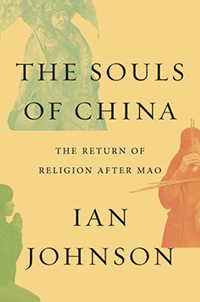
Souls of China 200But Johnson, a Pulitzer Prize-winning American journalist now based in Berlin and Beijing, has witnessed a transformation, one he documents in The Souls of China: The Return of Religion After Mao

China is experiencing “one of the great religious revivals of our time,” Johnson writes. “Across China, hundreds of temples, mosques and churches open each year, attracting millions of new worshippers. … Faith and values are returning to the center of a national discussion over how to organize Chinese life. … This is not the China we used to know.”

Growth since the death of Mao Zedong

No, it is not. Once officially atheist, China has roared with growth since the death of Mao Zedong in 1976. The upheaval of mass migrations from the countryside to the cities disrupted families and support systems. Many have grown distrustful of the government since the 1989 massacre in Tiananmen Square. Globalization has brought outside influences—despite tight governmental control—through the Internet and popular culture.

The result is a society adrift, confused and looking for mooring, Johnson said.

In the new China, “churches and religious societies provide a sense of community, a sense of belonging, a sense of being in a group of people who share your values,” Johnson said before talking to a group at the University of California, Davis.

IAN JOHNSON 200Ian Johnson“Chinese people perceive society to be so corrupt and so chaotic, without any center of gravity or morality,” he said. “Religious associations are refuges from the radical secular society they find themselves in.”

As one person Johnson interviews in the book says: “We thought we were unhappy because we were poor. But now a lot of us aren’t poor anymore, and yet we’re still unhappy. We realize there’s something missing and that’s a spiritual life.”

That has not always been true. At the end of the 19th century, there were 1 million temples in China, and religion flavored every aspect of public and private life. Mao destroyed half of the country’s temples. Religion—what was left—went underground.

A 2015 WIN/Gallup poll found China the least religious country in the world, with atheists making up 61 percent of the population. Only 7 percent said they were religious.

But Western pollsters often botch their Chinese numbers, Johnson writes. Because religion is so highly politicized in China, most Chinese respond “no” when asked if they adhere to one. Instead, when questions focus on religious behaviors—Do you attend a church or believe in heaven?—the level of religiosity rises.

Survey reports 40 million Christians in China

A 2005 survey conducted by a Chinese university found 31 percent of the population—about 300 million people—are religious. Two-thirds of those are Buddhists, Daoists or members of other folk religions, while 40 million people said they are Christian.

In the book, Johnson experiences the ongoing revival firsthand. An Episcopalian, he attends church with Protestants in Chengdu, participates in Daoist ceremonies in Shanxi and travels with Beijing Buddhists to meditate in caves.

Critics have been generally rapturous, citing his reporter’s eye and writer’s patience in illustrating China’s journey from underground “house churches” to open religious revivals in the space of about 35 years.

“I think what Ian conveys is the diversity of religious beliefs that are being revived,” said Jeffrey Wasserstrom, a University of California, Irvine, professor of history who specializes in China and appeared with Johnson at the Davis talk.

“He does ethnographic work—getting to know people who practice these beliefs, where an academic would probably just specialize in one of the traditions.”

But the boom has its limits. The Chinese government recognizes only five faiths—Buddhism, Daoism, Islam, Catholicism and Protestantism. And it still bans Falun Gong, the suppression of which Johnson reported on for The Wall Street Journal, coverage that earned him a Pulitzer.

There are state-run churches led by clergy in the government’s employ who give government-sanctioned sermons. Other houses of worship are monitored; one of the most chilling segments of Johnson’s book describes a Christmas Eve service with government agents watching from the back.

Still, the recovery from the time of Mao is significant. Johnson likens it to America’s own Great Awakening, the widespread 19th-century revival that led to many new religious movements, including evangelicalism and Mormonism.

Johnson thinks the religious boom in China will continue and predicts Christianity will see the most growth.

“When the Cultural Revolution—a 30-year period—ended, people wondered, ‘Are there any Christians left in China?’” he said. “But what is happening is Christianity, especially Protestantism, exploded underground during the Mao period. There were 1 million. Protestants in 1949, and there are 50 million today. That is huge.”

But Christianity—and any other religion—may blossom only so far. The state will not relinquish its role in controlling religion.

“Even though the government is officially atheist, they see themselves as wanting to have a hand in religion. They fear religion,” Johnson said.

“It is a force that is outside of political control. You can try to control it, but if you are religious, your allegiance is partly to this world, but the allegiance to God is higher and sometimes stronger.”


Commission identifies Russia as major violator of religious freedom

WASHINGTON (RNS)—The State Department should add Russia to its list of the worst violators of religious freedom, a U.S. commission declared in its annual report.

The U.S. Commission on International Religious Freedom—founded to advise the federal government—comes out with its list of shame each year, citing the most abusive countries in a lineup consistently longer than the State Department’s.

This year, the commission report included a dissenting report from its vice chair criticizing the commission for failing to investigate Israel.

Designated Russia a country of particular concern

The commission recommended the United States should designate Russia as a “country of particular concern,” for wielding an anti-extremist law to violate the religious freedom of Muslims and other minorities.

Most recently, Russia banned Jehovah’s Witnesses, labeling them “extremist” and ordering the state to seize their properties.

“They’re treating these people like they’re terrorists,” said Tom Reese, a Jesuit priest who chairs the commission, referring to Russia’s treatment of the Witnesses. “They’re pacifists, they don’t want to be involved in politics and they just want to be left alone. The (Russian) Supreme Court has basically said they’re illegal.”

Globally, “the commission has concluded that the state of affairs for international religious freedom is worsening in both the depth and breadth of violations,” Reese said.

Iraq and Egypt not included on list

The commission’s list this year differs from its 2016 list with the addition of Russia, but also dropping Egypt and Iraq, a move that may surprise some, given continuing deadly attacks on Christians in those countries.

But while violence against Christians in those nations remains a horrific problem, Reese said, the commission wanted to highlight the concrete steps both the Egyptian and Iraqi governments have taken to protect religious minorities.

Inn Egypt, for example, President Abdel-Fattah el-Sissi “consistently has made noteworthy public statements and gestures encouraging religious tolerance and moderation, has condemned sectarian attacks and assisted victims, and has urged reform of textbooks and religious discourse in society, an important shift in tone and rhetoric from his predecessors,” according to the report.

Still, Egypt and Iraq are on the commission’s list of “Tier 2” countries, which are considered violators of religious freedom, but not as problematic as the countries of particular concern.

Commissioner faults group for not critiquing Israel

On the same day of the report’s release, one commissioner, Arab-American and Democratic Party activist James Zogby, held a news conference to discuss his dissent to the report, in which he criticizes the commission’s refusal to investigate Israel.

Zogby, flanked by sympathetic Christians in a Lutheran church on Capitol Hill, said Israel discriminates against Muslims, Christians and non-Orthodox Jews but gets a free pass from the commission.

“I did not look for this issue; it came to us,” said Zogby, who cited a lengthy study from young lawyers in the West Bank—occupied by Israel—that concluded Israel fails to meet international standards on religious freedom on which other nations are judged.

Other commissioners, Zogby said, were “bullied” to oppose an investigation. Those petitioning for an investigation were dismissed as anti-Semites, and some commissioners feared the commission would lose congressional support for investigating Israel, he said.

Joining Zogby were Aundreia Alexander, associate general secretary of the National Council of Churches; Wesley Granberg-Michaelson, general secretary emeritus of the Reformed Church in America; and Drew Christiansen of Georgetown University’s Berkley Center for Religion, Peace & World Affairs.

Many groups and individuals, including Zogby, propose the commission launch investigations, Reese said, but without a majority vote of commissioners, those investigations don’t go forward.

“Jim proposed it, but he didn’t get a majority,” said Reese, who added the commission reports often include dissents.  

Worst offenders identified

Sixteen countries are on the 2017 list of countries of particular concern: Burma, Central African Republic, China, Eritrea, Iran, Nigeria, North Korea, Pakistan, Russia, Saudi Arabia, Sudan, Syria, Tajikistan, Turkmenistan, Uzbekistan and Vietnam.

The 10 countries on the State Department’s list of prime religious freedom offenders, designated in 2016, are Burma, China, Eritrea, Iran, North Korea, Saudi Arabia, Sudan, Tajikistan, Turkmenistan and Uzbekistan.


Worldwide downward trend in restrictions on religion reversed

WASHINGTON (RNS)—The number of countries with “high levels” of restrictions on religion due to government policies or actions of people increased in 2015, reversing a downward trend, according to a new study.

GOV RESTRICTIONS 400Forty percent of surveyed countries registered “high” or “very high” levels of overall restrictions, according to the Pew Research Center’s annual study on global restrictions on religion—up from 34 percent in 2014.
The percentage had declined during the previous two years, tumbling from 43 percent in 2012 to 39 percent in 2013, said Katayoun Kishi, the primary researcher on the study.

Of the 198 countries Pew surveyed, 25 percent reported “high” or “very high” levels of government restriction, up just slightly from 24 percent in 2014. Also, 27 percent reported “high” or “very high” numbers of acts of religious hostility by individuals, organizations or groups, a jump from 23 percent in 2014, according to the data.

That happened in a year when European countries welcomed an increasing number of refugees, religion-related terror attacks rocked France, and people with albinism were targeted for rituals by witch doctors in sub-Saharan Africa, the report said.

EUROPE RESTRICTIONS 250It’s too soon to tell if the increase is a blip or a trend, Kishi said.
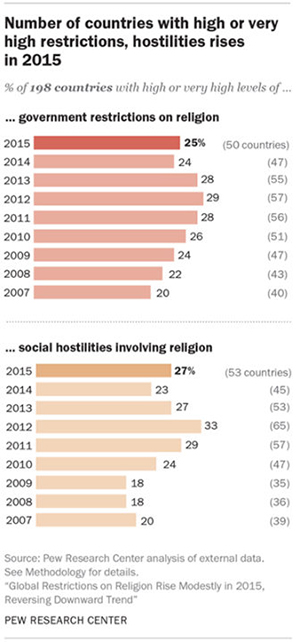
“I think we’d have to wait and see till next year whether or not this trend continues or if this is sort of a one-off just because it is such a modest increase,” she said.

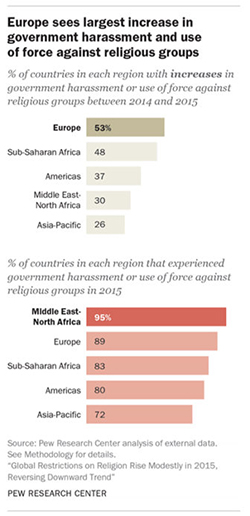
Of the five regions surveyed by Pew, the Middle East-North Africa region had the highest percentage of countries registering government harassment or use of force against religious groups—95 percent.

But Europe saw the largest increase, with 53 percent of the countries in the region experiencing an uptick in government harassment or force between 2014 and 2015. It came in second to the Middle East-North Africa, with 89 percent of European countries experiencing harassment or force, Pew reported.

Some of those instances in Europe could be linked to the influx of refugees to the region, according to Pew.

The number of people seeking asylum in Europe nearly doubled in 2015, reaching 1.3 million migrants. Of those, more than half were from Syria, Afghanistan and Iraq, where the majority of the populations are Muslim, and Kishi noted some European public officials made the assumption most refugees also were Muslim.

Instances of harassment included derogatory statements such as those by Hungarian Prime Minister Viktor Orban, who wrote in September 2015 that Europe should close its borders to Muslim immigrants in order to “keep Europe Christian.” There also were incidents of force, like the German police raid of the Islamic Cultural Center in Bremen, later ruled unlawful.

RESTRICTIONS 300The uptick came as Europe experienced several religion-related terror attacks, such as the shooting at the offices of Charlie Hebdo magazine and the shootings and bombings at the Bataclan concert hall and across Paris, attacks later claimed by ISIS.
Muslims in France and other European countries faced violence by groups or individuals after those attacks, and the report noted a considerable rise in social hostilities against Muslims in Europe in general, from 58 percent of European countries experiencing such hostilities to 71 percent, Pew revealed. Those numbers rose less significantly for Christians (from 38 percent to 47 percent) and remained high for Jews (71 percent to 73 percent).

Overall, Egypt had the highest levels of government restrictions on religion in 2015, and Nigeria the most social hostilities toward religion.

Pew’s eighth study of global restrictions on religion rates 198 countries using two 10-point indexes, the Government Restrictions Index and the Social Hostilities Index. Its primary sources include reports from U.S. government agencies, the United Nations and nongovernmental organizations such as the Anti-Defamation League.


Muslim births projected to outnumber Christian births by 2035

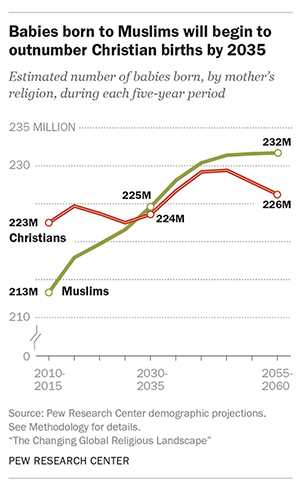
WASHINGTON (RNS)—Within 20 years, the number of Muslim babies being born is expected to surpass Christian births, but there still will be more Christians in the world.

Muslims currently account for about 24 percent of the world population, compared with 31 percent for Christians, according to the Pew Research Center.

But a new Pew study found that due to higher fertility rates and a relatively young population, the share of Muslim babies being born is growing.

MUSLIM BABIES 300The study shows 31 percent of all births between 2010 and 2015 were in Muslim families as compared with 33 percent in Christian ones.
However, between 2030 and 2035, analysts predict babies before to Muslims will outnumber babies born to Christian families, 225 million to 224 million.

The study projects that two decades later, between 2055 and 2060, around 36 percent of babies will be born to Muslim mothers and 35 percent to Christian women. That will amount to a gap of 6 million babies.

While Christianity is growing in sub-Saharan Africa and other parts of the world, Christians generally are older and are dying at a faster rate than Muslims—particularly in Europe, the study’s authors conclude.

“In Germany alone, for example, there were an estimated 1.4 million more Christian deaths than births between 2010 and 2015, a pattern that is expected to continue across much of Europe in the decades ahead,” the report notes.

People who identify with no religion, who now make up 16 percent of the world population, had 10 percent of the world’s babies during that period.

But in four decades, 9 percent of babies will be born to the religiously unaffiliated.

The report relied on a database of more than 2,500 censuses, surveys and population registers from around the world.


TBM seeks funds to feed mothers and their children in Kenya

National Woman’s Missionary Union has asked Texas Baptist Men to help provide food for 350 World Crafts artisans and their families in Kenya who are experiencing drought and famine.

WMU will pay for 20 tanker trucks filled with water through the Pure Water Pure Love program. However, the missions organization needs help to provide food to the Kenyan mothers and their children.

Funds will benefit women employed by Mother Care Handcrafts in Kenya, one of the artisan groups associated with WMU’s World Crafts fair-trade program. For more information, click here

To contribute, send checks designated “Kenya Food Relief” to Texas Baptist Men, 5351 Catron, Dallas, TX 75227.


Buckner International sends food, filters to flood survivors in Peru

LIMA, Peru—Buckner International is shipping more than 500,000 meals and 400 water filters to Peru to help 630,000-plus people who have been affected by the worst floods to hit the nation in 20 years.

The international humanitarian aid arm of the ministry has sent more than 272,000 meals donated by Feed My Starving Children and 400 water filters to Lima.

Buckner has wired funds to Buckner Peru for use in immediate relief efforts, and another shipment of more than 272,000 meals will be sent soon.

Scope of destruction

In recent days, about 80 people have died and more than 200,000 homes have been destroyed in the arid landscape of coastal Peru. The torrential rain burst riverbanks, created mudslides, collapsed bridges and closed roads, leaving more than 630,000 people displaced as the flooding rages through rural and urban areas.

Buckner operates two Family Hope Centers in Pamplona, an impoverished community just outside Lima, plus two transitional home programs for young women in Lima and Cusco, as well as offering foster care services. Most of the families Buckner serves in Bucker programs have not been affected directly.

“Because of this tragic devastation in Peru, thousands have lost all of their material possessions and dozens have lost their lives,” said Dexton Shores, Buckner senior executive director of Latin American programs.

“Even though most of the families we serve in Buckner programs were not directly affected, our natural compassion for the most vulnerable calls us to pray and actively respond to the needs of these suffering multitudes nearby.”

State of emergency

A state of emergency has been declared for half of Peru and the need for food and clean water is immense. Clean water is scarce, and stores are limiting the sale of water to only two small bottles per individual.

Intense flooding is expected to continue for two more weeks.

“When you see homes, vehicles and animals … being swept away by the raging waters, our passion for those who are being affected motivates us to action,” said Henry Jackson, vice president of Buckner Children and Family Services.

“To help, serve and be the hands and feet of Christ is a natural response. Responding in this way is just one way to demonstrate the love and compassion Buckner has been providing for 138 years.”


Canadian churches cross denominational lines to welcome Syrian refugees

DAUPHIN, Manitoba (RNS)—Ken Yakielashek, a Roman Catholic semiretired farmer in the Canadian Prairies, says he remembers when Christians of varying denominations “wouldn’t talk to one another.”

To Yakielashek, that makes what’s happened in Dauphin—a rural community 200 miles northwest of the provincial capital of Winnipeg—all the more remarkable.

Helping neighbors in need

A year and a half ago, Yakielashek’s parish and two other churches put aside theological differences and came together to sponsor the resettlement of three Syrian refugee families to this town of 8,500.

“We have three different theological outlooks on things, but they’ve been pushed to the background,” said Ron Marlin, a lay leader for Dauphin First United Church, a liberal mainline Protestant congregation.

“The focus was very much on helping our neighbors in need,” agreed Cordell Lind, whose wife, Lorayln Lind, is pastor of the evangelical First Baptist Church of Dauphin.

In the United States, new President Trump’s effort to bar refugees from certain Muslim-majority nations deemed terrorism threats—including Syria—has dominated headlines for weeks.

But in Canada, the government has welcomed more than 40,000 men, women and children fleeing Syria’s civil war since Prime Minister Justin Trudeau’s October 2015 election.

“Canada is doing the right thing by providing refuge for those so desperately seeking safety,” Trudeau has said.

Back in September 2015, a 3-year-old Syrian boy named Aylan Kurdi drowned after a 15-foot boat ferrying him to a Greek island capsized. Pictures of the toddler’s lifeless body on a beach horrified millions around the globe, including Yakielashek, a parish council member at St. Viator’s Catholic Church in Dauphin.

‘Somebody has to do something’

Yakielashek felt a personal connection to the Syrian refugees because his Polish grandfather “escaped from situations similar to that in eastern Europe.”

“This isn’t right,” Yakielashek said he told his parish priest, John Legitimas. “Somebody has to do something.”

Legitimas talked to Richard Gagnon, archbishop of Winnipeg, and received approval to look into sponsoring a refugee family.

The same boy’s death spurred Dauphin First United Church to act: “That galvanized us to say, ‘OK, we can’t just write a check and send it somewhere else,’” said Marlin, a retired Royal Canadian Mounted Police district supervisor.

Meanwhile, First Baptist Church already had connections to the Middle East and was moving forward with plans to help, Cordell Lind said.

Interchurch refugee team formed

When the three churches learned of one another’s efforts, they committed to pool resources and share ideas where they could. The churches formed the Dauphin Interchurch Refugee Team—“which, by the way, has the acronym DIRT,” Lind said with a chuckle.

Refugees Canada 300In the rural Canadian community of Dauphin, Manitoba, Cordell Lind (left) of the evangelical First Baptist Church and Ron Marlin of the mainline Dauphin First United Church put aside theological differences to focus on helping resettle Syrian refugee families. Joining in the effort was St. Viator’s Catholic Church, a parish of the Archdiocese of Winnipeg. (RNS photo by Bobby Ross Jr.)While working together, each church maintained its individual sponsorship of a Syrian family. The refugees—15 men, women and children in all, plus a baby born after their arrival—began new lives in Dauphin a year ago.

Months later, the Arabic-speaking immigrants—still learning English—told Canadian media their church sponsors and other community friends had become like family.

“It feels like home,” Asya Alassaf, one of the Syrian mothers, told the Winnipeg Free Press.

“It’s good,” said Louai Alassaf, Asya’s husband. “Mainly, people are very nice.”

Not universally welcomed, but mostly positive

But not everyone. Soon after news broke that the families were coming, a man made threatening telephone calls saying he hoped Dauphin First United Church “would burn in hell,” according to local media reports.

Still, most area residents—like the majority of Canadians in general—have responded positively, said the sponsoring churches’ representatives.

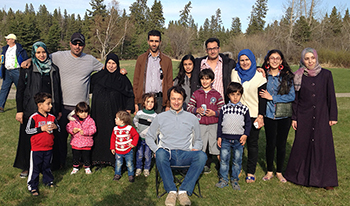
Canada Refugees 350The three Syrian families that resettled in Dauphin, Manitoba, gather for a photo at a going-away celebration held for their interpreter at Riding Mountain National Park. (Photo courtesy of Ron Marlin)“It still gives me goose bumps when I think about it,” Lind said. After picking up one Syrian family at the Winnipeg airport, he said, “we stopped in a little town called Neepawa for a cup of coffee on the way home, and everyone in the McDonald’s had to come over to welcome them to Canada.”

Ukrainian immigrants first settled in Dauphin more than a century ago, but the community has become much more multicultural in the last 15 years, Yakielashek said.

“For the most part, the reaction (to the Syrian refugees) has been welcoming from all walks of life, from doctors to lawyers to dentists to farmers to accountants to ordinary laborers and teachers,” he said.

“We’ve got lots of land here. We have lots of opportunities for the country to grow. Why can’t we bring people in here to contribute? I don’t expect them to have any more or less than we do, but just a chance at life.”

Congregations drawn closer together

Not only have the churches helped make life better for the refugees, but they also have built bridges drawing Dauphin’s Christians closer together, the representatives said. The Dauphin Interchurch Refugee Team is making plans to bring more Syrian refugees to town.

To be sure, the days of Christians refusing to communicate across confessional lines because of theological differences began to fade long before the refugees’ arrival. And the cooperation on their absorption didn’t remove the differences that remain.

For example, Marlin said Dauphin First United Church sees no need to proselytize the refugees—all Muslims.

“It’s not our job to convert them from their lifelong religion to another,” Marlin said. “It’s our job to support them in the celebration of their religion and the celebration of their humanity.”

Cordell Lind, on the other hand, said First Baptist Church “would love for Mahmoud and Hala (the couple sponsored by the congregation) to meet Jesus.”

“So, we pray for our family, and we pray for the other families and would be very excited if they did” become Christians, Lind said. “If they don’t, they will still be our lifelong friends and part of our family.”


Religious discrimination fuels ‘crisis of insecurity’ in Nigeria

WASHINGTON, D.C.—Denial of religious freedom has fueled a “crisis of insecurity” and humanitarian tragedy in Nigeria, a scholar with the 21st Century Wilberforce Initiative said.

About 75,000 Nigerians—mostly women and children—are likely to starve in the next 12 months, and Elijah Brown drew a “direct line” from religious discrimination to the famine.

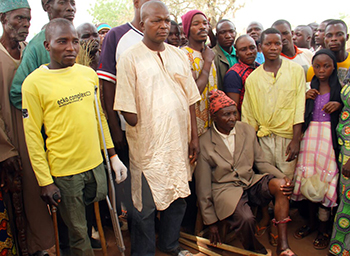
Elijah Brown 150Elijah Brown “Right now, we are looking at a situation where the hunger is so real that 208 people could die every day, eight people every hour,” said Brown, executive vice president of the 21st Century Wilberforce Initiative. “One child every eight minutes in northeastern Nigeria could starve to death. God help us.”

Brown, former religion professor at East Texas Baptist University, participated in a March 21 panel discussion co-sponsored by his organization and the Religious Freedom Center of the Newseum Institute.

Impact of Boko Haram

Boko Haram—a radical Islamist terrorist group—has destroyed 30 percent of the homes, more than 1,600 water sources and more than 200 health centers in one northeastern Nigerian state, he reported.

“Boko Haram’s violence—horrific and gut-wrenching—does not just emerge from nowhere,” Brown said. “It emerges from a foundation of discrimination that stretches across northern and central Nigeria.”

Discrimination against religious and ethnic minorities results in limited educational and vocational opportunities, the inability to build houses of worship and denial of healthcare, community services and the right to vote, he noted.

“Children in particular have been impacted,” Brown added. As a direct result of violence by Boko Haram, 1,500 schools have been closed, denying 950,000 children the opportunity for education, he said.

“This foundation of religious discrimination, combined with a lack of economic development, lack of rule of law and elements of radicalization, has resulted in massive insecurity,” he said.

“Or to put it another way, a lack of religious freedom has helped contribute to the humanitarian tragedy unfolding in northeastern Nigeria. And let us be clear, it is a massive tragedy.”

Officially, Nigeria is home to 2.2 million internally displaced people, but the number more likely is between 5 million and 7 million—second only to Syria, Brown said.

“Denied religious freedom helped contribute to the violence of Boko Haram and is now resulting in famine,” he said. “And unfortunately, this is not the only insecurity crisis facing the country.”

Role of Fulani militants

In recent years, violence perpetrated by Fulani militants in Central Nigeria has increased significantly, Brown noted. The scale of attacks and sophistication of the weapons goes far beyond traditional antagonism between herdsmen and farmers, he added.

“Without question, cattle rustling exists within the Middle Belt to the detriment of Fulani pastoralists,” he said. “However, the attacks of the past two years cannot be construed solely as reprisals when multiple credible reports from across the region describe assaults involving supply helicopters, machine guns mounted on vehicles, AK47s, scorched-earth policies that level entire communities and sustained offenses that may last for months in particular locations without government intervention.”

Fulani militants seem driven primarily by economic interests, seeking to gain grazing territory. However, their attacks focus almost exclusively on areas with high percentages of Christians, Brown noted, saying it is “an economic driver being played out along religious lines in an environment of general insecurity and impunity.”

“What is unfolding in the Middle Belt is an evolving conflict with significant geographical spread,” he said. “Dismissing or minimizing this as simply traditional farmer-herdsmen conflict does not adequately address a reality where thousands have been killed, weaponry and sophistication of attacks are increasing, dozens of villages have been utterly destroyed, and tens of thousands displaced. Should this reality further escalate, its impact on the country of Nigeria could be substantive.

“This is not a situation without hope. There are many within the Buhari government who are working hard to address these realities. But there is more we can do as well. It is a call to world leaders from Nigeria to the United States and to all of us to stand with Nigeria.”

Fractured and forgotten

Nigeria is fractured by religious and ethnic turmoil but forgotten by most of the world, Frank Wolf, former member of the U.S. House of Representatives and distinguished senior fellow with the 21st Century Wilberforce Initiative, told the panel.

Nigeria 350Last year, Frank Wolf traveled to Nigeria as part of a team that interviewed more than 500 people and heard firsthand testimony of violence, religious persecution and economic oppression. Last year, Wolf traveled to Nigeria as part of a team that interviewed more than 500 people and heard firsthand testimony of violence, religious persecution and economic oppression. He highlighted key findings from the detailed report the 21st Century Wilberforce Initiative issued based on its research. 

Wolf called on President Trump to appoint a special envoy to Nigeria and the Lake Chad region of Africa to deal with the humanitarian crisis, which he said presents a serious security threat. 

Conflict in modern Nigeria cannot be understood apart from the historical reality of colonialism, said panelist Peter Pham, director of the Atlantic Council’s Africa Center.

At the same time, the changing religious dynamics of the nation also must be considered, he added. Outsiders who “buy into no-longer-relevant narratives” cannot confront the problems Nigeria faces today, he insisted.

Religion and ethnicity matter deeply to Nigerians, but when either religious or political leaders view themselves as responsible only to one group, the nation suffers, said Charles Obiorah Kwuelum, legislative associate with the Mennonite Central Committee.

Unless government officials enforce the rule of law equitably and protect the rights of religious and ethnic minorities, “jungle justice” rules, he asserted.


Physician to Karen refugees will receive BWA human rights award

FALLS CHURCH, Va.—Cynthia Maung, a medical doctor who has devoted nearly 30 years to providing healthcare to refugees living on the Thailand-Myanmar border, will receive the Denton and Janice Lotz Human Rights Award from the Baptist World Alliance.

The award recognizes individuals for significant and effective activities to secure, protect, restore or preserve human rights as stated in the United Nations Universal Declaration of Human Rights and other declarations on human rights.

The BWA General Council will present the award to Maung during the BWA annual gathering in Bangkok, Thailand, July 2-7.

“Dr. Cynthia Maung is a woman of faith who has committed her life selflessly for the welfare of the poor and oppressed,” the BWA Executive Committee was told. “She is a member of the Kawthloolei Karen Baptist Churches and involved with the Asia Pacific Baptist Federation women’s work.”

Work among displaced Karen people

Maung was among the displaced Karen people who fled to and settled in Mae Sot, on the border between Thailand and Myanmar, also known as Burma.

Since 1949, the Karen, an ethnic minority group in Myanmar, have been fighting for an independent Karen state. Hundreds of thousands of Karen and others from various ethnic groups have been killed in the conflict, and many Karen have fled across the border into Thailand.

Humble beginnings of Mae Tao Medical Clinic

In February 1989, five months after escaping Myanmar, Maung established the Mae Tao Medical Clinic with a staff of six in a dilapidated building. In the early days, she sterilized her medical instruments in a rice cooker. At its original location, the clinic frequently was affected by natural disasters such as floods. It since has relocated to a safer building.

The clinic opened in response to the prevalence of infectious and other diseases such as malaria and pneumonia in Mae Sot and other refugee camps. It received support from Baptists in Thailand and elsewhere, as well as the Karen and residents of Mae Sot.

Using donated medical supplies, Maung brought the malaria epidemic under control. Trauma victims with gunshot wounds and injuries from landmines received treatment, as well as those who needed maternity care and HIV counseling.

Medical clinic’s ministry expanded

By 2003, the clinic treated more than 42,000 patients per year and had a staff that included six doctors, 86 health workers, 150 other medical and administrative staff members and up to 40 international volunteers per year. 

The clinic, which now has a staff of more than 600, delivers up to 15 babies per day and fits 250 new and replacement prosthetic limbs each year. It treats between 300 and 400 patients daily, or up to 150,000 annually, including refugees, migrant workers and locals.

In addition to medical treatments, the Mae Tao Medical Clinic trains medical interns, nurses and hygienists. Its social programs include feeding more than 500 people twice each day.

Maung’s clinical interests in obstetrics and women’s reproductive health have broadened to include issues of domestic violence and human rights.

More than 50 nongovernmental organizations, international organizations, educational institutions and individual donors have supported the clinic and its programs.

Maung receives international recognition

Maung, the fourth of eight children, was born into a Baptist Karen family near Moulmein, Myanmar, in 1959.

She entered the Institute of Medicine II in Yangon (formerly Rangoon), the medical school in which Karen, Mons, Arakanese and other minority students in Myanmar are concentrated.

After graduating from medical school in 1985, she worked in a private maternity clinic in Bassein, operated by her great-aunt, a nurse, in the beginning of her specialization in obstetrics and gynecology. She left that facility and worked at a clinic in the village of Eaim Du to be near her ill mother. Political crisis and unrest in the country in 1988 led her and others to flee.

Maung previously received the Jonathan Mann Award, sponsored by Swiss and United States health organizations, in 1999, as well as Southeast Asia’s Ramon Magsaysay Award for community leadership in 2002, the Sydney Peace Prize in 2013 and the South Korean POSCO TJ Park Prize in 2015. She was named one of Time magazine’s Asian Heroes in 2003.


Texas Baptist named to BWA general secretary search committee

FALLS CHURCH, Va.—The Baptist World Alliance executive committee named a Texas Baptist to an 11-member search committee for the global organization’s next general secretary.

Chris Liebrumchris liebrum 200Chris Liebrum , director of the office of Cooperative Program ministry for the Baptist General Convention of Texas, was elected to serve on the committee to find a successor to Neville Callam, who will retire Dec. 31.

The committee also includes John Upton, executive director of the Baptist General Association of Virginia, and Elaine Smith with the American Baptist Churches USA.

Others on the search committee are BWA President Paul Msiza of South Africa, Luiz Roberto Silvado of Brazil, Jan Saethre of Norway, Ernest Adu-Gyamfi of Ghana, Miyon Chung of Korea, William Thompson of the Carribean, Ksenija Magda of Croatia and John Beasy of Australia.

Liebrum pointed to BWA as an important missions partner with the BGCT. BWA accepted both the Texas Baptist and Virginia Baptist state conventions as full members in 2005, after the Southern Baptist Convention withdrew from the global organization.

“Our involvement with BWA provides an avenue of access and relationships with 235 Baptist unions, conventions and associations around the world,” he said. “It is a privilege to serve on the search committee for the next general secretary.”

The committee will seek the 10th general secretary for the international Baptist fellowship. Callam, a Jamaican, was elected in July 2007. Since the BWA’s founding in 1905, all previous general secretaries were American or European. During his tenure, BWA membership expanded from 214 to 235 member organizations in 122 countries and territories.

To nominate an individual for BWA general secretary or download the position profile, click here