




In the past decade, Save Ukraine has rescued and returned to Ukraine more than 500 children who had been deported forcibly to Russia and Russian-controlled territories.
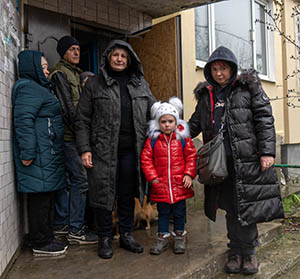
But those rescue missions only scratch the surface of the Kyiv-based nonprofit organization’s work, which also includes evacuating more than 110,000 vulnerable people from combat zones and safely relocating them.
In addition, CEO Mykola Kuleba has led Save Ukraine to develop more than 20 Education and Empowerment Centers in Ukraine—often based in churches—that provide access to “catch-up” classes for children and youth whose education has been interrupted.
Save Ukraine also sponsors six Hope and Healing Centers that offer temporary shelter, trauma-informed counseling, parenting programs and rehabilitation services for children and families.
The organization’s hotline responds to more than 300 requests for assistance daily.
More than 200 professionals and volunteers work with Save Ukraine to provide psychological support, legal aid, social work and humanitarian assistance to children and families who have been traumatized by war.
In the future, the organization envisions opening Children’s Justice Centers in Ukraine where traumatized victims of sexual abuse can receive treatment and therapy.
‘Children suffering every day’
“God loves all children, and there are Ukrainian children suffering every day,” Kuleba said.
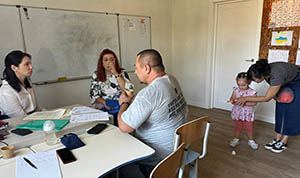
He and some of his colleagues visited Dallas to confer with Buckner International about the Buckner Family Hope Center model, which emphasizes engaging, equipping and elevating families, along with Buckner’s other programs.
Sign up for our weekly edition and get all our headlines in your inbox on Thursdays
“We want to learn more about evidence-based best practices for strengthening families,” said Heather Dyer of Save Ukraine U.S.
The Ukrainian government’s Children of War portal documents more than 19,500 children have been deported forcibly to Russia or Russian-controlled territories without the consent of their parents or guardians.
Save Ukraine works with relatives of deported children, investigators and others to rescue children who have been abducted and relocated to Russian-controlled areas.
Russian officials mischaracterize Save Ukraine as a “terrorist group” that “kidnaps children from Russian areas and sends them to Ukraine,” said Kuleba, the 2023 recipient of the Magnitsky Award for Human Rights Activism.
“It’s all Putin propaganda,” he said.
Kuleba understandably is reluctant to discuss specific strategies his nonprofit organization uses to find and rescue the Ukrainian children who were abducted. However, he compared it to the “underground railroad” in the United States that helped enslaved people relocate to free states.
Rescue, relocation and reintegration
“We focus on rescue, relocation and reintegration,” he said.
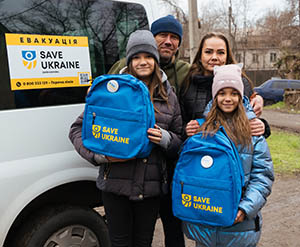
The process of reintegrating children back into their families and communities requires therapy and counseling, he noted. Rescued children consistently have described their experiences in Russian boarding schools, orphanages or “summer camps” as daily regimens of indoctrination.
“The Russian goal is to eradicate their Ukrainian identity,” Kuleba said. “Children are told they must speak only Russian, and they are punished if they are caught speaking Ukrainian.”
Children are taught a distorted Russian-centered view of history and are compelled to sing the Russian national anthem, he said.
Russian military personnel allow children as young as kindergarten age to handle their weapons, and students are given military-style uniforms, he added.
“The goal is to make future Russian soldiers,” Kuleba said. “It is abusive. It is a war crime and a crime against humanity.”
Called to care for children
Nearly 80 percent of the children Save Ukraine has rescued are returned to their parents or guardians. The remaining 113 orphaned children have been placed in homes of Ukrainian families—“not orphanages,” Kuleba emphasized.
“The Bible tells us pure religion is to care for orphans,” he said, referencing James 1:27.
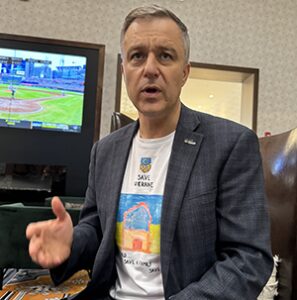
More than 20 years ago, Kuleba felt called to launch a ministry to care for children who were living on the streets in Ukraine. Eventually, he developed a network of centers to help place orphaned children with relatives or foster families. He was head of children’s services in Kyiv from 2006 to 2014.
In 2014, Kuleba was appointed commissioner of the president of Ukraine for children’s rights, where he helped develop programs and policies to prevent and combat the trafficking of children. He served in the commissioner’s role until 2021.
Also in 2014, after the Russian invasion of Crimea and Donbas, he founded Save Ukraine—primarily to evacuate children and families from the front lines of conflict.
“We went to the combat zones to help evacuate people,” he said.
That work—including providing follow-up trauma counseling and other mental health services—escalated after the full-scale Russian invasion of Ukraine began in February 2022.
“At times, we were rescuing up to 1,000 people a day,” Kuleba said.
Seeking to involve local churches
Churches in Ukraine have been at the forefront of providing support for internally displaced people since the 2022 invasion, he noted.
Based on what they learn from Buckner and other agencies in the United States, he envisions Save Ukraine developing a model for strengthening families that can be replicated by congregations throughout Ukraine.
“It’s not strictly a church-based program, but we want to develop a model and provide training so that it can be easily adapted by any local church,” Kuleba said.
He hopes Christians in the United States understand the suffering of people in Ukraine.
“Families are depressed, exhausted and traumatized. But we are still standing,” Kuleba said. “We need you to pray with us and pray for us. We need you to stand with us.”
While some in the United States debate policy and partisan politics, Dyer said she hopes American Christians will focus instead on the needs of children and families in Ukraine.
“It’s not about politics. It’s about people,” said Dyer, who adopted a daughter from Ukraine several years ago.
“It’s about God’s children. I think we’ve lost sight of that.”








We seek to connect God’s story and God’s people around the world. To learn more about God’s story, click here.
Send comments and feedback to Eric Black, our editor. For comments to be published, please specify “letter to the editor.” Maximum length for publication is 300 words.