Interview: Rethinking apologetics for the black church

When Lisa Fields started college, she was a preacher’s kid who’d grown up inside of the church and never encountered opposition to her faith. That changed in her first New Testament class when she studied a textbook by Bart Ehrman, a professor of religious studies at the University of North Carolina, Chapel Hill, who argues against the inerrancy of Scripture.

“I’d been in church my whole life,” says Fields. “I was in a Christian bubble. I thought the class would be like Sunday school, I thought it was going to be an easy A, but I really struggled. Through that experience, my dad introduced me to Ravi Zacharias and that helped me start thinking critically about my faith.”

In the years since then, Fields has founded an organization called the Jude 3 Project, which uses apologetics to address the unique “intellectual struggles of Christians of African descent in the United States and abroad.” The organization offers lectures and seminars, training courses, podcast discussions, and a conversation forum called Courageous Conversations, which pairs black scholars and pastors trained in both conservative and progressive seminaries. …

CT spoke recently with Fields about the first fruits of her project and why black suburbia is one of her main areas of outreach.

Continue reading this interview at Christianity Today.


Commentary: Christians are calling for better family leave policies. That wasn’t always the case.

A prominent Christian think tank has come out fiercely in favor of better family leave policies, defending federally mandated family leave policies on theological grounds.

“Christian families can form themselves along a divine vision of work and family as holistic complements,” a report released Tuesday reads. “As citizens and culture-shapers, Christians should advocate for and develop policies and practices that protect, rather than fragment, family time.”

The report, authored by Katelyn Beaty and Rachael Anderson of the Center for Public Justice, advocates for changes on a federal scale, calling for an expansion of the Family Medical Leave Act. Pushing beyond public policy, though, the report also specifically targets gender imbalances within families.

The report follows a Senate finance subcommittee hearing last week on paid family leave, and a growing debate over the government’s role in providing resources for child care.

Continue reading this article at Vox.


Commentary: Artificial intelligence shows why atheism is unpopular

Imagine you’re the president of a European country. You’re slated to take in 50,000 refugees from the Middle East this year. Most of them are very religious, while most of your population is very secular. You want to integrate the newcomers seamlessly, minimizing the risk of economic malaise or violence, but you have limited resources. One of your advisers tells you to invest in the refugees’ education; another says providing jobs is the key; yet another insists the most important thing is giving the youth opportunities to socialize with local kids. What do you do?

Well, you make your best guess and hope the policy you chose works out. But it might not. Even a policy that yielded great results in another place or time may fail miserably in your particular country under its present circumstances. If that happens, you might find yourself wishing you could hit a giant reset button and run the whole experiment over again, this time choosing a different policy. But of course, you can’t experiment like that, not with real people.

You can, however, experiment like that with virtual people. And that’s exactly what the Modeling Religion Project does. An international team of computer scientists, philosophers, religion scholars, and others are collaborating to build computer models that they populate with thousands of virtual people, or “agents.” As the agents interact with each other and with shifting conditions in their artificial environment, their attributes and beliefs—levels of economic security, of education, of religiosity, and so on—can change. At the outset, the researchers program the agents to mimic the attributes and beliefs of a real country’s population using survey data from that country. They also “train” the model on a set of empirically validated social-science rules about how humans tend to interact under various pressures.

And then they experiment: Add in 50,000 newcomers, say, and invest heavily in education. How does the artificial society change? The model tells you. Don’t like it? Just hit that reset button and try a different policy.

Keep reading this article at The Atlantic.


Commentary: 8 ways to wound a minister

Shepherds play an important role in the biblical narrative. Shepherds appear frequently in both the Old and New Testaments, often in reference to leaders.

One of my favorite images of a shepherd is that of a caregiver. It is common for a shepherd to examine sheep for wounds as they gather in a pen or cove after a day of grazing. The shepherd cleans the wound and applies an ointment to it before bedding the sheep down for the night.

Congregational ministers are trained to be good shepherds. Identifying and binding wounds are significant parts of a minister’s job. This was certainly true for Jesus.

Instead of conducting his ministry in the temple in Jerusalem like many of his colleagues, Jesus chose to walk down dusty Palestinian roads where he could interact with people from all walks of life. He listened to their stories so he could respond to their needs with mercy and grace.

Being the good Shepherd did not prevent Jesus from being wounded. Nor does it keep today’s ministers from being wounded.

Continue reading this article at Baptist News Global.


Spain: Show the love of God

When we talk about doing missions, surely many of us think of going somewhere far from home and possibly preaching the gospel to a lot of people or having a place with a big crowd surrounding us and telling them about Jesus. If that had never crossed your mind, at least it has crossed mine. Until a few weeks ago, I had that idea about doing missions. Now I realize that it is not like that.

I couldn’t understand how God was going to use me here if I wasn’t able to talk about God with the children. If I spent my time sweeping the floor in the mornings or washing a pile of dishes, how I would reach souls if I did not preach about the gospel. I thought: “I don’t think I’m doing missions. I’m sure I’m in the wrong place.” I thought I was not contributing at all to the kingdom of God. But, how can we be missionaries if we do not understand the meaning of missions?

God has made me understand that missions is not what we do; it is who we are in Jesus Christ. It is to show the love of God in everything we do—no matter if we feel or think we are not making a big impact around us. Surely, God is working something big at that moment, and you do not even realize that.

God is love. Therefore, when we do things under his authority, everything we do will be done with love and humility. God is never wrong when he put us in the place where we are. God wants to use us where we are, and he wants us to shine that light that he has given us.

Karla Magana Gonzalez, a student at Tarrant County College, is serving in Spain with Go Now Missions.


Colorado: Gateway to family ministry

I love working with kids. I have been doing it ever since I aged over the threshold of being a kid myself. In the past, however, I’ve always thought of children’s church and Vacation Bible School as lots of fun but not super important. That’s why they let the volunteers and teenagers work it, right? Somewhere in my church life, I got the idea that children’s ministry is on the back burner, and all the focus should be on adults and youth.

I have been terribly wrong.

Since I have been in Colorado, I have spent a lot of time at children’s church, sports camps and block parties. While entertaining games and activities are important, it is the people called to children’s ministry who are vital in sharing God’s word with these kids. I know the words “called to” are intimidating, but that’s actually how it is. Whether it is your full-time job or you volunteer once a month, God has called you to play a significant role in influencing his children to follow him.

One thing I have learned this year is how important it is that kids see familiar faces and have a routine ministry experience, just like the adults.

“Wait, are you teaching this week? Yay! Miss Gracie is teaching this week!” Those words made me so happy multiple times this summer. Children want to see you today, and they want to see you again next time.

Sunday school is probably the most chaotic time of the week. Kids are not using their inside voices, we can’t find the glue, and someone needs to go potty. It’s easy to get lost in the busyness, but those few minutes of learning about God’s word and praying together go a long way. I like asking kids after church what they learned about, and I’ve found that they actually listen.

Most of the time, we get told exactly what to do in children’s ministry—read this story, sing this song, etc. But as a leader, you still have the responsibility to let the Holy Spirit guide that time. One of my favorite moments this summer was when the Sunday school teacher decided to do an interactive gospel presentation before doing whatever the curriculum guided us to do. Do you think the kids remember the video that they usually see, or the new fun activity? The classroom was absolutely chaotic, but they definitely learned something new about Jesus and his saving grace.

Through talking with our supervisors and pastors, my partner and I have learned about the church and the demographics of the population here. They told us families with young children are the most likely to reconnect with the church. This means the kids get to come, but their parents who have disconnected are coming back, too.

At some time or another, parents are faced with questions they do not know how to answer. This curiosity—along with their child’s need to share experiences with their parents—has led many families back to church. If we make children’s ministry as crucial to the church as it is to the kids, we extend that importance to the rest of the family as well.

I think that puts it into perspective. Children’s ministry is an integral part of the church as well as the gateway to family ministry.

Gracie Humphrey, a student at the University of Texas in Austin, is serving this summer in Loveland, Colo., with Go Now Missions.


Eastern Europe: Teaching English and sharing the gospel

Being surrounded by thousands of college students, I thought I was going to spend 100 percent of my time with them when I arrived in Eastern Europe. The pamphlet describing the position always talked about grabbing coffee with college students and investing time building relationships through sports and entertainment around the city. While this is the main focus of this trip, God continues to demonstrate just how powerful he is and how his love tears through spiritual barriers.

One of the ways we serve and share is through English classes offered every Tuesday and Thursday. The people who attend? Far from college students. Most who attend the English class are over the age of 40 and have pretty much settled down their lives while having years rooted in their Orthodox religion.

During one of the first weeks we got here, we held an English Intensive week, which means offering English class Monday through Thursday. During these four days a certain older gentleman was put into my group. Before this, he had had a bad reputation in groups and actually was asked to leave, but for some reason, he attended these four days of English Intensive. Once that week was over, he wanted to continue with the classes that we held twice a week and for some reason, God put him in my group again.

Once I thought about the fact that God was doing this on purpose, I tried to discern the best course of action to continue sharing the gospel with him effectively. During the English Intensive week, we would read Bible stories and talk about them, but it was difficult to get personal because there were so many people. Fortunately, this wasn’t the case after the English Intensive week ended.

In the first lesson, we focused on Genesis 1-2. He and I talked about different moral concepts, but for the most part he was closed off to talking about anything relating to spirituality. The second lesson focused on the fall of humanity, based on Genesis 3.We talked again about moral concepts and understanding of sin.

As we continued to talk and complete different lessons, his heart slowly started to open up. Around the sixth lesson, I felt the Spirit put it in my heart to ask him a question about Jesus. I really didn’t know what to say. So, when it was time for English class, I began by asking him: “What do you think about Jesus? Who is he to you?”

We proceeded to talk about Jesus for the next hour and a half, and it was something he wanted in his life. God has been hard at work in him previously and was pursuing him relentlessly.

Since then, he has gotten plugged into the local home church and is growing in his faith. Please pray for his spiritual growth.

Manuel, a student at the University of Texas at El Paso, is serving in Eastern Europe with Go Now Missions. His last name is withheld due to security concerns.


Central Asia: Victory won

Who am I? What is my purpose? Where do I come from? When will I feel satisfied? How can I know truth? These were the kind of questions I asked myself the year before my first year of college, not knowing that all these questions were about to be answered by someone greater than I—one whose existence I dedicated myself to disproof.

Now, I know who I am and who he is—the purpose of my being since the beginning of it all. My satisfaction is fed by the Truth. That is my story.

On my first week here in Central Asia, I met a good friend. Since then, we have done fun things together. We walked around town, visited coffee houses, shared meals and watched the World Cup, always sharing deep conversations and lots of laughter.

The time when I shared my story, he sat there staring in my eyes as I stared back. I could feel we both were thinking the same thing about each other, “He knows my story.”

My friend told me about a dream, in which he saw a man carrying wood on his back. Before I could tell him about the man, he told me that it was Jesus, who was telling him about the way he should follow. I had a big smile on my face followed by some chuckles. I had never heard about something like this from a person I knew. That night concluded with him telling me he knew what had to be done, but he wasn’t ready and did not know when he would be ready.

A couple of weeks later, we were hanging out for his birthday—just the two of us watching a football match. That night, he shared with me that he had been thinking about being reborn. I asked if he knew what that meant and then got to explain it in the following way: “If a football team wins the World Cup, they get to celebrate and lift up that cup at the ceremony. However, the match must first be won before they get to proclaim the victory in view of the whole world.”

I proceeded to share about the victory Christ won that ended the match already. Before I could finish, I saw a man breaking down at the sound of the news, saying the time for him to pick up that victory given to him was now.

My story seems to have been translated to a different language in order to speak answers to my friend. Both our stories speak of one who is greater than us, who holds the answers to our deepest questions and desires.

Franky, a graduate of the University of Texas at El Paso is serving in Central Asia with Go Now Missions. Franky’s last name is withheld due to security concerns.


Editorial: Jesus and Gaga Ball: Summer Camp in Texas

This week marked my son’s last summer of children’s camp. Next year, he begins the glorious (cough) teenage years. But let’s not get ahead of ourselves.

When I was his age, I was finishing my summers of Royal Ambassador camps in the mountains of New Mexico—Inlow on the east slope of the Manzanos south of Albuquerque and Sivells in the Sierra Blanca south of Cloudcroft.

For an elementary-age boy, few things compare to shooting .22 rifles and bows and arrows, making crafts from leather and stone, enjoying overnight hikes and cooking your own dinner under the stars. Equally magical were the tents we slept in all week at Sivells. Sadly, those tents were lost to a forest fire threatening the entire camp.

Less romantic was KP duty and the blisters from the army surplus canteen strung around my waist for a day hike.

What follows are some highlights from the Next Level Kids Camp 2018 at Latham Springs.

Day 1:

We weren’t at camp long before the incessant refrain began: “Can we go play Gaga Ball?” For those unfamiliar with the sport, I invite you to Google it or look for a YouTube video because it takes too long to explain. For now, it’s enough to know Gaga Ball is highly addictive.

Dinner consisted of fajitas with all the trimmings, including pico de gallo and guacamole. I ate as though I’d fasted the week prior to camp.

Each camp features a memory verse of the week, or MVOTW (pronounced Muh-Vawt-Wuh). Our verse was Isaiah 60:1, memorized with the help of motions: “Arise, shine, for your light has come, and the glory of the LORD rises upon you.”

Lights out was 10:30 p.m. Don’t let that fool you. Two of the boys kept their “lights” on all night, talking and giggling despite my protestations.

Day 2:

Breakfast was barely over before the kids asked, “Can we go play Gaga Ball?” Morning worship was barely over before the kids asked, “Can we go play Gaga Ball?”

Camp pastor Jesse Joyner, juggler extraordinaire, taught the story of Lazarus being raised from the dead and explained the concept of resurrection. Jesse’s an incredible teacher and performer I recommend to anyone.

He is the son of a pastor, and he wasn’t particularly happy about it. While he kept his public persona clean, his inner life was angry and rebellious. Jesse also was a small kid and not part of the “cool kids.” He was bullied and pushed around and then found juggling, something he was good at and enjoyed.

Jesse came to trust Jesus at a church camp when he was 13, putting his faith in Jesus, expressing his sorrow for his sin and thanking Jesus for forgiveness. Afterward, Jesse said he felt free.

Lunch was barely swallowed before the kids asked, “Can we go play Gaga Ball?” I kid you not.

The afternoon consisted of team building games, encouraging a homesick child, and a swim and paddle at the lake.

During worship on the evening of Day 2, three children from our church chose to follow Jesus. One of those children is part of a family I’ve cared for more than eight years. There’s nothing like being with a family through so many life-changing decisions.

Day 3:

One of the adults from our church was named Sponsor of the Day for going above and beyond in serving his kids. His reward? A bright yellow cape, fuzzy antennae and plastic clapping hands to wear all day.

We learned the story of Daniel and the lion’s den from Daniel 6, playing a version of rock/paper/scissors substituting in lion/administrator/Daniel.

The heat, the oppressive summer heat of Texas, is as ubiquitous as games of Gaga Ball. And how good to be forced to stop and hydrate throughout the afternoon!

Paul Bowman, co-director of Next Level Kids Camp and children’s and recreation pastor at First Baptist Church in Maypearl, reported six leadership staff, two interns and 14 recreation staff members, all 22 of whom are volunteers and members of local Baptist churches. Three hundred and forty campers from 19 churches attended the camp.

One of the rec staff members was born without ligaments in his feet, making it difficult to walk. He recently had surgery to correct one foot and was still recovering before camp started. Despite the pain, he was determined to be at camp for the kids, saying: “ I will be there. The kids won’t know I’m in pain.” He kept his promise; he gave not the slightest hint of his pain.

Frankie Levings, food service director for Latham Springs, reported making fresh on sight more than 500 churros for dinner on Day 3. After running out, she had to make another batch. They were worth the wait.

Day 4:

The children are also memorizing John 11:25-26, Daniel 6:26b and Acts 4:12. They amaze us with their ability and desire to learn.

You have to scrutinize statistics to discern the truth, but not here. The following statistics are completely made up.

Julie Swift, girls’ dean for the camp and member of First Baptist Church in Grandview, said 75 romantic relationships started this week among 5th and 6th grade boys and girls. That’s 150 children, folks. Ron Russek, boys’ dean and member of Nolan River Road in Cleburne, said 12 such relationships started.

It’s noteworthy the boys’ dean reported far fewer relationships than the girls’ dean. It should also be noted I spoke with Julie and Ron independently and asked them to make up the statistic. Parents, I only saw one relationship begin, starting with smiles and sheepish eyes.

The Sponsor of the Day today is Kirk Howard, a member of New Life Baptist Church in Covington, who has brought children to camp for many years. Kirk, an unassuming and gentle person, was nominated this year by one of the boys in his group. The boy has severe juvenile diabetes requiring 24-hour monitoring. The boy thanked Kirk for his willingness to care for him, waking even through the wee hours of the morning, so the boy could attend camp.

On our way to lunch, we were asked by at least three kids, “Can we go play Gaga Ball?”

As of the evening of Day 4, 36 children have decided to follow Jesus, six have rededicated their lives to Jesus, and others have made other decisions about their relationship with God. Who knows what Day 5 will bring? That’s a rhetorical question.

These stories can be repeated many times over at the other Texas Baptist camps this summer. In addition to the stories of God’s work in children’s lives, I’m particularly struck by the stories of the dedication of local churches, their staff and their members to create experiences for children during which they will encounter Jesus and his life-changing power. I am grateful for how my life has been changed and for what God is doing in the lives of children and adults through summer camp.

If you love children and want them to follow Jesus, you can improve the odds by sending or taking a child to summer camp at a Texas Baptist camp. Talk with a church near you, a local Baptist association or one of our state camps to find out how you can get involved. Or email me.

Cara Callaway, camp nurse, said the most common ailments are headaches caused by dehydration and sprained or twisted ankles. She doesn’t like Gaga Ball.

UPDATE: After publishing this editorial, I was reminded by one of the other adult sponsors in our group of a miraculous occurrence we witnessed at one of the Gaga pits. A boy on crutches was brought by golf cart to the pits where he got off the cart and made his way up to one of the games. A moment later, the miracle happened.

According to the rules of Gaga Ball, if the ball leaves the pit, whoever recovers the ball from outside the pit gets to enter the game. Wait for it.

The ball left the pit right next to the boy on crutches, who immediately dropped his crutches and sprinted after the ball, retrieved it, sprinted back and jumped over the wall to enter the game. All the while his crutches lay on the ground. I wish I’d caught it on video with my phone, but it happened so fast.


Eric Black is the executive director, publisher and editor of the Baptist Standard. He can be reached at eric.black@baptiststandard.com or on Twitter at @EricBlackBSP.


Voices: Five books that made me a better Christian

Lately, I’ve seen a trend on Facebook of people sharing the “books that have shaped me.” Naturally, I’ve considered what my life-changing books might be.

I read a lot of books — many of them difficult and technical as I pursue a Master’s degree with an eye toward a Ph.D.

My first thoughts were mostly technical theological works that changed the way I think about God and trickled down into the rest of my life. But I also considered some that were more directly influential on my spiritual growth and some that taught me what it means to be a follower of Christ.

Here are five of those and what I learned from them. (The Bible obviously goes without saying here.)

“Confessions,” Augustine of Hippo

“Confessions” is Augustine’s autobiographical reflection on his conversion to Christianity. At its core, it is a meditation on the nature of God and God’s relationship to the human experience of faith.

Augustine recounts his life from birth through his early rejection of Christianity to his ultimate conversion experience. In doing so, he offers himself as an example of how a wandering soul comes to know Christ.

“Confessions” is surprisingly readable, psychologically profound and theologically astute. I’ve lost track of how many times I’ve read it at this point, and each read still makes me think more deeply about God’s work in all people’s lives.

“The Godly Man’s Picture,” Thomas Watson

“The Godly Man’s Picture” is a devotional work by Puritan preacher Thomas Watson. “He that hath clean hands, and pure heart; to describe such a person is the work of this treatise.”

Watson’s work is a compendium of reflections of characteristics of a godly person listed in Scripture. He offers 24 such meditations, each of them compelling and profound.

Some of them are self-explanatory and hardly need to be said: a godly person is a person of faith, a person of prayer and so on.

Others are less commonly considered: a godly person is “careful about worship” and “one who weeps.”

It’s hard to describe reading this work, and my summary doesn’t do it justice. Watson spiritually breaks the reader down and rebuilds him or her through an incredible balance of exhortation to holiness and a reminder of God’s grace and understanding.

I could recommend this book more easily to anyone than any other book on this list. No book on the Christian life balances challenge and assurance in a better manner.

“Discipleship,” Dietrich Bonhoeffer

“When Christ calls a man, he bids him to come and die.”

Bonhoeffer’s words are even starker when considered in light of his death at the Flossenburg concentration camp in 1945.

Bonhoeffer’s classic work is a reminder that free grace is not easy grace, but a call to radical, costly faithfulness.

His chief concern in this work is pointing out that following Christ requires a reorientation of one’s life that will, inevitably, produce conflict with the larger culture one finds oneself within. Discipleship requires conflict with existing values systems; it requires suffering.

“Discipleship” is a somber read but an important one that remains timely and prophetic.

“Silence,” Shusaku Endo

“Discipleship” asks if we are willing to suffer for Christ’s sake; “Silence” asks if we are willing to cause others to suffer for Christ’s sake.

“Silence” is a historical novel about two Portuguese Jesuit priests who travel to Japan in the midst of an intense persecution of Christians during the 17th century.

The less said about the plot from here the better. “Silence” is an uncomfortable but poignant meditation on the relationship between faith and suffering.

“Just As I Am: The Autobiography of Billy Graham,” Billy Graham

The title says it all. I’ve written before about my deep admiration for Billy Graham. Everything I’ve written about in that article is on full display in “Just As I Am,” Graham’s account of his life from his childhood on a dairy farm during the Great Depression through his reflections on his old age and hopes for the new millennium.

Graham recounts in full honesty the doubts and difficulties that accompanied his enormous ministerial successes. There’s something I find comforting about the world’s greatest evangelist dealing with self-doubt even as he preached to millions. The lifelong faithfulness of God is on full display in Graham’s life.

What books have made you a better follower of Christ?

Jake Raabe is a student at Baylor University’s George W. Truett Theological Seminary in Waco, Texas. He is also a co-founder of Patristica Press, a Waco-based publishing house.


Rhonda Roberts: Getting away and finding God

Rhonda Roberts has served in camp ministry off and on since 1987. She has been with Heart of Texas Baptist Camp and Conference Center for a total of 24 years, 17 of those as executive director. From deep in the heart of one Texan, she shares her background and thoughts on camp ministry. To suggest a Baptist General Convention of Texas-affiliated leader to be featured in this column, or to apply to be featured yourself, click here.

Background

Where else have you worked, and what were your positions?

  • Glorieta Baptist Conference Center: summer staff (1987), summer staff leadership team (1988)
  • Howard Payne University: admissions counselor (1991–1993)

Where did you grow up?

  • Elementary school in Stanton, Texas
  • High school in Fairfield, Texas

How did you come to faith in Christ?

I had a strong heritage of faith from my parents and grandparents.

My father, Frank O’Banion, was a career minister of music, education and administration in Texas Baptist churches.

My salvation experience was at a GA camp at Permian Basin Baptist Encampment (now known as Circle 6 Ranch).

I felt the call to full-time Christian service during a youth camp at Latham Springs Baptist Camp.

Where were you educated, and what degrees did you receive?

Howard Payne University: Bachelor of Business Administration (1991)

Ministry/Profession

Why do you feel called into camp ministry?

I feel Christian camping is a fit for me only God could have orchestrated.

Camp is a unique crossroads of guest service through hospitality and ministry. As primarily a rental facility, our staff may not be “on stage,” but we have so many opportunities to show the love of Jesus through our hospitality to our guests.

There are hundreds of lives changed each week in summer camps and throughout the year with retreats, and our staff has the opportunity to play a unique role in ministering to our guests.

Although I often feel humbled and unqualified for this ministry, God always equips me with the skills and wisdom needed for the task at hand.

I like the quote by Martin Luther: “The Christian Shoemaker does his duty not by putting little crosses on the shoes, but by making good shoes, because God is interested in good craftsmanship.”

I feel by serving God’s people with excellence in hospitality, we are ministering to others.

What is your favorite aspect of camp ministry? Why?

I love seeing our guests who come from populated areas and are in awe of nature. The trees, birds, stars and sunsets over Lake Brownwood all come alive when you are at camp.

There is a peace and a freedom about being near nature that draws people to their Creator. When people get away from their normal routine and busy lives, they find God and hear his voice.

What one aspect of camp ministry gives you the greatest joy?

It is a joy to see God provide for our ministry through people.

God provides financial support through some churches and individuals, and then sends others to volunteer and work along with us. I can look all over our campus and point out projects where God provided through people.

I have been privileged to work with some wonderful and talented people who have been a blessing to our camp. I have learned through the years that volunteers are not just people who have extra time and money; they may not have either, but they all have the heart of service!

Some of our staff and volunteers have had a life-changing experience at camp and want to give back with grateful hearts.

How has your ministry or your perspective on ministry changed?

The last several years have shifted to higher levels of regulations and security, which involves background checks and education for sponsors for the protection of our students. Most of the regulations are state mandated; however, they are great precautionary measures and have made our camps much safer.

When the regulations were first imposed, it was a hurdle to cross with our groups; however, I have come to a greater appreciation for this process and desire to do everything we can to make camp a safe and secure place for our guests.

Name the three most significant challenges and/or influences facing your ministry.

  1. Funding for operations and improvements. When the camp was founded in 1946, it was owned and supported by the area churches and associations. We are blessed by many area churches who still support our camp in their budget; however, many churches have been faced with challenges of budget cuts, which in turn has affected camp ministry. Camps are now challenged to discover other sources of funding without losing the connection and tradition with our founding churches.
  2. Serving a generation who is addicted to social media and technology and learning how to adapt camp ministry to appeal to this generation.
  3. Promotion and marketing of traditional camp facilities today with many competing options.

What do you wish more people knew about camp ministry?

I wish all churches realized how significant a camp experience can be to children and youth. It is intentional targeted evangelism, so it can be a tremendous outreach tool for the students in a local community as well as unchurched families.

Some people (students or adults) will come to camp before they would ever go to a church. Throughout the years I have seen many lives changed through divine appointments at camp. Many of those experiences would not have been possible without camp and the encouragement from a local church.

Traditional camp experiences provide the opportunity for students and adults to get away from the distractions of the world such as social media, TV, family problems or work stress. When distractions are removed, the stage is set for God to work in the hearts of campers.

If you do the math, figuring an average day at camp lasts 13 hours, four days equals a year of our Sunday morning meetings in terms of hours. In these 52+ hours, the students aren’t being distracted by “the world.” They are worshiping, getting teaching and having conversations about God; and they are in the middle of his amazing creation. There is no denying God uses the unique environment of camp to powerfully change lives.

About Rhonda

Who were/are your mentors, and how did/do they influence you?

I was grounded in the faith by my parents, who lived in service to churches where they were called. I was blessed to be raised in a home where I never doubted I was loved, accepted, safe and encouraged to excel. I was influenced by my parents with character, integrity and a strong work ethic.

I have been mentored in Christian camping by my predecessor at Heart of Texas, Marlin Felts. I worked for him for 12 years before he retired in 2000. He was gracious to give me opportunities of leadership, which provided valuable experience in later years.

I have also gained wisdom from directors of other camps, as well as some great board members and staff members here at Heart of Texas Camp.

What is the impact of camp ministry on your family?

Camp has impacted my family over multiple generations. My father grew up attending Alto Frio Camp, and it was there he surrendered to full-time ministry at the age of 12.

As a child, my mother and her family enjoyed camp at Leuders for many years.

I attended camp at Permian Basin Baptist Encampment as a child, and all of my siblings and I have attended Latham Springs. I can easily say most of my immediate family have made life life-changing decisions at camp.

I met my husband through his mother, who was on staff here at Heart of Texas Camp. We were married in our camp worship center in 2007.

Other than the Bible, name some of your favorite books or authors, and explain why.

My top three favorite authors are Andy Andrews, Mark Batterson and Bob Goff. I like reading their material because they challenge my thinking and perspective with very practical and profound ways to live and grow as a Christian.

What is your favorite Bible verse or passage? Why?

One of my favorite verses is our theme verse for the camp staff this summer: “Perhaps this is the moment for which you have been created” (Esther 4:14). This reminds me of the many provisions God has shown us through staff and volunteers.

For over 70 years, God has been blessing the ministry of Heart of Texas Camp by orchestrating skills with needs. He brings people to camp to serve or to be served at just the right time.

Name something about you that would surprise people who know you well.

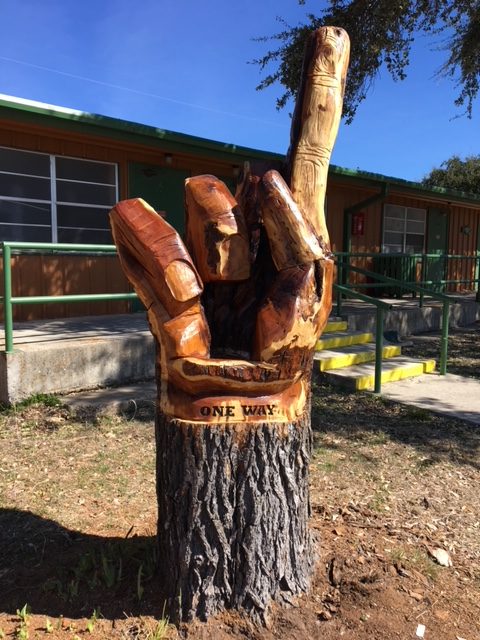
God has given me a creative nature, which has inspired many places and objects around camp through my years of service. In 2016, I created a chainsaw carving in one of our dying camp trees. What was an old forgotten tree is now the image of a human hand pointing to God as “One Way” to salvation.


Commentary: Singing is praying twice

On the bookshelf in my office is a gift from a church member and former adult choir member, Frances. The ceramic plaque reads, “Singing is praying twice.” It’s an adaptation of a quotation usually attributed to St. Augustine, “One who sings prays twice.”

What does this mean? At its best singing together in worship helps us express well our praise of God, creates a space for us to offer ourselves to God and binds us to one another in community. Pastors and ministers of music and worship leaders dream that worshipers would experience the presence of God weekly. Singing well helps us pray more deeply, puts us in a place to hear the voice of God.

Churches vary widely in the assets they have to support singing. “Sustained excellence” is the way a colleague in another state recently described music ministries with strong legacies and abundant resources. But what about the many churches who continue to be faithful Sunday after Sunday but are in a musical recession or simply lack leadership or resources?

Sing anyway. There is an expectation that when we worship together we are going to sing. So, let the people sing. Take some time to figure out what your people sing and sing well.

Last fall at Wilshire Baptist Church, to celebrate the 500th anniversary of the Reformation, we planned a hymn festival for morning worship. Our theme was “Hymns We Love.” I did an informal poll of some key leaders in our church: staff, deacons, Worship and Music Committee and a few other members and asked them the question: “What hymns do you think our congregation loves and sings well?”

Based on this information we selected about a dozen hymns in a variety of styles: classic traditional hymns, gospel hymns, new hymns. Some hymns were accompanied by organ and brass, others by piano, mandolin and violin. There were a few moments the people sang without accompaniment, the voices filling the sanctuary. Simply put, it was wonderful.

What is the soundtrack of your congregation? What are their heart songs? What are the hymns that speak to the identity of your community of faith? Can you list 10 hymns or songs that make up a core playlist? This is an opportunity to get to know your people and just as important have them get to know one another. The conversation is just as important as the information.

Another way to engage your people in singing and praying twice is to invite church members to write new texts. This past spring a Wilshire member who is a writer and I led a three-session Hymn Writing Seminar. About a dozen Wilshire members met weekly to learn how to create texts for worship. Several people composed original hymns. LeAnn Hampton composed a pair of stanzas we have been singing in worship this summer as the offering is presented. We are singing this to the traditional melody of the Doxology, OLD 100TH.

Our God is making all things new, a promise that we know is true.

Through eyes of faith we long to see a love-transformed community.

A place where truth and justice reign and healing triumphs over pain,

Where all have dignity and worth and peace is passed throughout the earth.

Another hymn composed in this laboratory is “We Adore You, God, Creator,” a new text by James Steel, a member of Sanctuary Choir. We sing this to the hymn tune NETTLETON, a melody most often sung to the familiar text “Come, Thou Fount of Every Blessing.”

It is such a beautiful gift to the church when poets and writers create something new for the church. Such gifts are received with gratitude. “Sing to the Lord a new song” must surely be an imperative for every generation. Even “Amazing Grace” was a new song once upon a time.

Years ago, I served a small church in Mobile, Alabama. One Sunday evening the service was built around singing familiar gospel hymns. Following the singing the pastor asked people why they loved these particular hymns. With just a little encouragement the people began to tell their stories and they told how these hymns were woven into the fabric of their lives. The songs were part of the journey of faith and I began to realize there was much more going on in the hearts of people than simply the notes on the page. Those who sing pray twice.

Doug Haney has served as Minister of Music at Wilshire Baptist Church in Dallas, Texas since 2004. Haney coordinates a new service from CHC for churches seeking to infuse vitality, quality and vision into their worship and music ministry.

This article originally appeared on the Center for Healthy Churches blog.