Editorial: Danger—and possibility—in the middle of the road

Life is dangerous in the middle of the road.

Just ask New York Times columnist/PBS commentator David Brooks, a moderate Republican, who has spoken out against presidential candidate Ted Cruz, also a Republican, but from the Tea Party wing.

knox newEditor Marv KnoxBrooks recently wrote a piece titled “The Brutalism of Ted Cruz.” He focused on how Cruz, when he was Texas’ solicitor general, fought all the way to the U.S. Supreme Court to force an incorrectly punished prison inmate to serve a 16-year sentence, rather than the maximum two years, as required by law.

Brooks contrasted Cruz’s strong appeal to evangelical Christian voters, even though, he said, “Cruz is a stranger to most of what would generally be considered the Christian virtues: humility, mercy, compassion and grace.”

Fire from both sides

Not surprisingly, Brooks caught fire—from both directions.  

Conservatives criticized Brooks for being to harsh on Cruz. Liberals chastised him for claiming Cruz’s behavior defies evangelical ethics and for failing to paint all evangelicals with the Cruz brush. 

If you, like Brooks, happen to take a moderate approach and claim friends from both the far right and the far left, then you probably know what he feels like right now. The only thing those polar adversaries agree on is that you, like Brooks, are wrong. 

The current political climate ups the ante. We live in an era where people rarely agree to disagree. “If you don’t agree with me, then you’re absolutely wrong.” But it’s worse. If you disagree, then you must be angry about it. “You’re not only wrong, but you’re an anti-American anti-patriot, and you represent everything that’s wrong with this country, and you should rot you-know-where.”

Illogical and dangerous

Of course, if you manage to maintain friendships with people on both ends of the political spectrum—or the end of the spectrum opposite yours—you know those positions are both illogical and dangerous.

They’re illogical, because if we allowed passions to cool, we could think of many points we hold in common. We want the economy to be strong. We want the rising generation to be well-educated. We want our nation to be safe. We want our allies to be secure. We want potholes to be fixed. We want the Internet to work. We may disagree about how to achieve those goals, but if we could recognize we hold some goals in common, we could find enough ground to begin working on them.

They’re dangerous, precisely because they do not provide ground to work on common solutions. We live in a season when politicians reap rewards for preying on fear and playing to narrow self-interest. If that mindset and approach prevails, an unbridgeable chasm will cleave our nation.

Part of the solution

We should be talking about this because it’s vital for our future, and Christians should be part of the solution, not part of the problem. If we can model how conservatives, moderates and liberals—if not always coexisting in the same congregation, then attending churches down the street from each other—can strive together for the common good, maybe we can provide a template for society at large.

We can begin by recognizing many Christians are conservative and many other Christians are liberal because of their faith. Conservatives tend to emphasize personal responsibility, as well as adherence to the Ten Commandments and guidelines that point toward moral rectitude. Liberals tend to focus on community and grace, as well as Jesus’ teachings in the Gospels of Matthew and Luke that admonish compassion for the poor, disadvantaged and otherwise marginalized.

We can begin by gathering around Jesus. The earliest baptismal confession, “Jesus Christ is Lord,” provides a sturdy platform on which we can stand together.

Then we can acknowledge the other group finds support in the Bible. Our Scripture provides teaching on myriad topics for every aspect of life. We’re all flawed, so none of us balances all of it or follows all of it perfectly. Because we gravitate toward the sections that appeal to us most deeply, we become passionate about them. And because we’re practicing faith in a tense and fractious context, we’re tempted to focus so intently on our passions and our issues that we lose sight of the source of others’ passions and issues.

Not the “enemy”

But we can remember Christians of the other party—even those from the edges of the party—are not the “enemy.” We may feel strong and emotional responses to their positions. We may feel they misread the Bible. But we, sinners who ourselves are saved by grace, can offer grace to them. 

We can speak charitably to one another. We can ask how we can understand each other better. We can clarify our positions and seek to understand theirs, and point out common places of agreement. And perhaps we can provide a model for how our larger society can conduct itself in community.

That’s dangerous, of course. The person in the middle of the road catches fire from both sides. Just ask David Brooks.




Letter: Grateful for Maciel’s leadership

I am so impressed with Baptist General Convention of Texas President René Maciel’s column

Raising the profile of Texas Baptist institutional ministry gives us all a great sense of purpose in “pursuing all the interests of the Redeemer’s kingdom.” 

I am grateful for Rene’s leadership.

Albert Reyes

Dallas


Oregon: God’s love a bigger deal than all else

God was abundant in his faithfulness and provision as our team served in Eugene, Ore. We had the opportunity to meet and interact with so many University of Oregon students and create relationships with those who are intrigued and are being called to the Lord’s hands, all while working with an awesome team at the university.

We handed out flyers and explained the intentionality found in Northwest Collegiate Ministry to students. We wanted to let them know why God’s love is such a bigger deal than all else. We also prayer-walked and evangelized students.

Getting an idea of what ministry and evangelism looks like in the Northwest was incredible, and it’s something I am very blessed to say I have under my belt now.

The people of Eugene were not only open-minded to Christianity in light of our prayer- oriented servant hearts, but also are in search for a truth that some know to be found through Christ.

Please pray for the Northwest Collegiate Ministry and the people of Oregon.

Kay Dausin, a student at Tarleton State University, served with Go Now Missions in Oregon.


New York: A conversation on the doorstep

Between Christmas and New Year’s Day, I was blessed to serve with other students from Texas and several other states to spread the gospel in New York City. Together, we served many Chinese churches by handing out flyers and little gifts or simply having conversations with the locals. One congregation my team served—the Lighthouse Chinese Church in Brooklyn—was very small but willing to spread the good news with the locals.

To be honest, it was very difficult for me—as well as some of the others—to understand how simply passing out flyers would benefit the church or help the community know about Christ. I wasn’t very excited about going out to random streets and handing out bags that contained a card with the church’s information. I was willing and happy to talk to people and let them know about the church. Unfortunately, not many of us got to experience that. After my group walked for about an hour and a half, we had yet to come across someone to talk to.

On our walk back, I decided to go up to a house and knock on the door. No one answered at first, so I left a bag on the doorstep. As I walked down the steps, a man came out the side of the house. He asked if I was looking for someone in particular. I explained we were there to invite people to the Lighthouse Chinese Church. The man, Richard, was very curious why we wanted to invite people to a local Chinese church, since we weren’t even Chinese ourselves. I explained to him we were college students from several different states, working with this church, and we also wanted to share with people a little about our faith.

I asked Richard about his religious background and what he believed. He told me he was Catholic for a while, but he wasn’t anymore because he didn’t agree with some of the church’s teachings. I told him I believe in God, who gave up his one and only Son on the cross for our sins. He said he couldn’t understand that, but he respected it.

I asked Richard what he did on his everyday life, and he said, “Nothing, really.” He said he was very close to his family once, but everyone had either died or moved out of the country. He also mentioned the love his family showed to one another. This interested me, so I asked how he felt about that now. Richard said it was a bit depressing and sad really, because he didn’t have that any longer. I explained to him that us as humans, we long for love and that there is One greater than any other love who would satisfy us eternally. I told him love comes from God alone. Again, he wasn’t very receptive to that, but he respected it.

We had about a 20-minute conversation about what he believed and what we know to be the truth. I could tell Richard was hungry for the truth, but he was also cautious why everything we said pointed back to God. I closed our conversation by saying: “Richard, we are servants of God. And we strongly believe this is no coincidence that we are here now talking with you. God put us here at this specific moment to share our faith with you. We care about you and that is why we have been here talking to you. Is there anything we can pray for in your life?”

At that moment, a lady and another man came out of the same house screaming that he had a very important phone call and to get inside. He immediately turned away and said, “I have to go.” The expression on his face said to me, “I’m still curious about what you guys are saying.”

Once again, I felt disappointed because we were going to return to the church as we had gone out, without a person to talk to and pray for that he/she would come to know Christ. So we stepped off Richard’s property and off to one side then started praying for him. I prayed God would continue to use others to reach out to him, for God to work in Richard’s life and prepare him to be a person of peace. Throughout the rest of the day, my heart was heavy as I wondered if I had done enough for that man. Through constant prayer and communication with God, I was reminded that even through the smallest gesture of obedience, God can work miracles. It was not about what I did that day or any other day but rather what God worked through me. The New Testament talks abut us being God’s workmanship, created in Christ Jesus to do his work, which he prepared in advance. Now my heart is at peace, knowing God will place someone else to continue his perfect will in Richard’s life.

This moment helped me understand that everything we do for God’s purpose, whether small or big in our eyes, is enough for God to continue his will. God worked through our little acts of service in every place we went and, with whomever we came across, whether at a church, or out on the streets, at a restaurant or on a subway.

Eliud Valle, a student at University of Texas Rio Grande Valley, served in New York City with Go Now Missions over Christmas break.


New York: God’s perfect timing

Serving with a mission team in New York’s Chinatown was a lot more difficult than I expected. The first couple of days were trying, because not many of the people in the community seemed to respond to our attempts to have intentional conversations. I was having a difficult time presenting the gospel to anyone.

cindy saavedra 130Cindy SaavedraI had a few nice conversations with people on the subway about what our team was doing in New York, but my conversations never really went any deeper than that and asking those people needed if they prayer.

As the week went on, I began wondering whether I was missing opportunities to serve the Lord in New York. I wanted so badly to share the gospel, but I also wanted to make sure I did so according to God’s timing. I took comfort of knowing that just being obedient to God’s will would be enough, and I also took in everything I could about the people’s culture as I learned from the Christian leaders of the various boroughs. It wasn’t until my last full day in New York that God reminded me of his perfect timing.

subway station 300God provided an opportunity for a meaningful conversation with a young woman after the mission team exited the subway at the station in Flushing, Queens.As my team got off at a subway stop in Flushing, Queens, I prayed I would meet at least one person with whom I could share the gospel. While I waited for my order of dumplings in the food court, I searched for a person of peace. I finally saw a young woman about my age sitting alone. I prayed she wouldn’t leave before I got a chance to talk to her, and she didn’t. She politely let me sit across from her, and we began getting to know each other. She told me about her passion for languages, and I told her my passion for teaching. The conversation was really good, but I still couldn’t think of a way to transition into the gospel.

As we ate our lunch, I prayed for guidance, and the Lord finally told me simply to ask her if she knew who Jesus was. I thought it was a little straightforward of me to do so, but I did it anyway. The young woman wasn’t bothered at all by my question. Instead, she thought about it and simply said that she didn’t really know who Jesus is because no one had ever told her about him, in China or in New York. I was surprised, but I also was excited. because that meant I could tell her the Good News from beginning to end. I began explaining how sin entered the world through Adam and Eve’s disobedience, but God gave people a second chance to have a relationship with him through the sacrifice of his Son, Jesus Christ.

After I explained the gospel, I asked her if it made sense, which was something I had recently been taught to do with people of other cultures, and she nodded her head in agreement. Although she did not want to give her life to Christ when I offered, soon after the explanation, she asked a few questions. I tried to answer her to the best of my ability, and I explained the Bible’s role in the spiritual growth of a Christian. As I talked to her about the importance of Scripture, I offered her a pocket-sized Bible my grandparents bought me specifically to take with me on the trip. She gladly took it, and she then asked if I knew any songs that could further explain the story I had just shared with her. I lit up with excitement, because I knew God was working in our conversation. He knew how much I loved listening to music, so the Lord gave me the chance to share one of my delights with the young woman.

By the end of the conversation, we had exchanged numbers, and I could tell she was genuinely interested in what God had done to mend the relationship between himself and us. As she walked away from the table, I knew then that she was person God had wanted me to share the gospel with during my time in New York. The best thing about the experience I had with young woman was that it was only possible through God’s perfect timing.

Cindy Saaedra, a student at Dallas Baptist University, served with Go Now Missions in New York over Christmas break.


Letters: Terrorism & ‘vigilante culture’; Religious freedom for Muslims

What legislation will work?

I just finished reading Marcia Pally’s guest editorial on the gun-loving vigilante culture in America, which, by whatever definition you would choose, I’m sure that I’m a member of.

My question is: Precisely what legislation would you suggest would be effective in keeping guns away from terrorists? Isn’t an inherent part of being a terrorist the fact that terrorists don’t obey the laws of the land?

Robert Blankenship
Glade Spring, Va.

Speed up death penalty

This lady is incompetent and not informed at all.

People kill people because they have no fear. They get illegal guns because they have no fear. We have too many people with this mentality, many in prison, and it will not change.

The death penalty is the ultimate equalizer and a “real” call to stopping gun violence. It needs an express lane, too.

Jason Streiff
Midland

Why oppose religious freedom for Muslims?

Regarding “Americans prize religion freedom for Christians, less for Muslims“: It’s not real complicated. Muslims are murdering human beings around the world, daily. Give them more freedom of religion?

Fred Rosenbaum
Gainesville


Richard Ray: It’s time to re-engage your church

A new year is upon us, which always brings new opportunities to serve our Lord. It is a time to evaluate the past year, while looking forward to the new year.

richard ray130Richard RayI always used the first three months of each year to re-engage my church family and emphasize the importance of worshipping, fellowshipping and serving together. We all know in the time between Thanksgiving and New Year, many of our church family are absent due to traveling to be with family and/or on vacation. As you are aware, in a small church, everyone is missed.

Therefore, from January through March, I would create opportunities for the church family to re-engage with one another by having a monthly joint Sunday school class with breakfast, taking the widows out to lunch, spending time with my leaders, attending school activities to encourage the youth and children, having a game night at the church and anything else I could think of.

As I pastor, I know the importance of church family in a small congregation, because everyone is important for the church to make an impact on the kingdom of God. When God’s family is together and are encouraged by one another, the whole community becomes encouraged and will find favor with the church. Acts 2:46-47 says, “They broke bread in their homes and ate together with glad and sincere hearts, praising God and having favor with all the people. And the Lord added to the church daily those who were being saved.”

texas baptist voices right120This time of year, it is important for the church to create an atmosphere of togetherness to give its community a small taste of what heaven will be like. I encourage you to use these next couple of months to re-engage your church family, and you will be amazed at how the church will impact the community it serves all for the glory of our Lord.

We are here to serve you as you serve the Lord. Remember, the Lord has called you to serve, but he has not called you to serve alone. Visit our website (www.bivocational.com) for more information on how the Bivocational/Small Church Association can minister to and serve you. We continue to enroll those who desire unlimited healthcare coverage through Christian Healthcare Ministries. For more information on this healthcare coverage, contact me at brother_ray@juno.com.

Richard Ray is executive director of the Bivocational/Small Church Association and director of missions for the Tri-Rivers Baptist Area. You can reach him at brother_ray@juno.com.


René Maciel: Texas Baptists’ special places

Happy New Year! I am truly excited about the New Year and what God has in store for Texas Baptists as we serve and care for families and children, educate and train many through our universities and seminaries, and provide for the sick and suffering through our hospitals.

rene maciel headshot130René MacielTexas Baptists are so blessed to have 28 institutions we can call our lifeline. So much of the work done in Texas Baptist life is done through our institutions, and this year at our annual meeting, Nov. 13-15 in Waco, we will highlight our Texas Baptist institutions. Make plans to join us for this special emphasis, and please keep our institutions in your prayers.

The next several weeks, I will share with you a brief history of several of these special places, and I would like to start with two that are very special to me.

Chartered in 1845, Baylor University in Waco is the oldest continually operated university in Texas and has stayed true to its mission of being a Christian university for the ages. Enrolling more than 16,000 students from 50 states and 86 countries, Baylor has an international reputation for academic excellence, a high ranking as a research university, and a faculty committed to teaching and scholarship.

Pat Neff300Pat Neff Hall sits at the center of the Baylor University Campus.Students not only receive a superior education in the classroom, but the university also offers an active community of faith that prompts students and employees to volunteer in the Waco area and abroad through mission activities. Among many efforts, students and professors have brought light to a slum in Nairobi and created a health clinic for Waco’s homeless. George W. Truett Theological Seminary sits on the campus.

Baylor also is among the top 10 percent of schools in number of attending National Merit Scholars and one of only 212 universities in the nation with a chapter of Phi Beta Kappa, one of the oldest and most prestigious honor societies. The student-faculty ratio is 15-1.

Baylor’s rank of alumni include missionaries and pastors, heads of Fortune 500 companies, governors of Texas and professional athletes. For more information, visit the university website.

Hardin-Simmons University began as Abilene Baptist College in 1891 after pioneer settlers dreamed of locating a college in their fledgling town. With support of Sweetwater Baptist Association, citizens raised $5,000, and an Abilene businessman and his Fort Worth partners donated 16 acres of land and an additional $5,000.

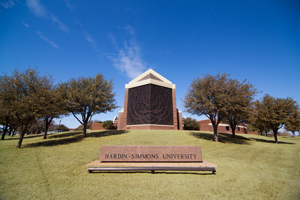
Logsdon300The Logsdon School of Theology building greets visitors to the Hardin-Simmons University campus.Financial struggles prompted trustees to accept funding from a New York preacher, James B. Simmons, and to rename the school Simmons College. The college became Simmons University in 1925 and struggled to the point of collapse during the Great Depression. John and Mary Hardin of Burkburnett donated part of their fortune to the school. The Hardins’ generosity and commitment brought the university long-term stability and, in 1934, a new name: Hardin-Simmons University.

Hardin-Simmons enrolls 2,200 students in undergraduate and graduate classes with a 12-1 student-faculty ratio. Sitting on 96 acres in Abilene—a large community of 120,000 people with a small-town feel—the university has more than 50 student clubs and organizations. It also is the home of the Logsdon School of Theology. Learn more at the university website.

Please continue to pray for the many ways Texas Baptists are assisting with the relief work being done around Garland and the other areas affected by the Dec. 26 tornado.

René Maciel is president of the Baptist General Convention of Texas and president of Baptist University of the Américas in San Antonio.


2nd Opinion: Christians should support freedom for all faiths and for no faith

Americans overwhelmingly are concerned about religious liberty. That’s good. What’s troubling, but perhaps not surprising, is they are less enthusiastic about protecting those liberties for some religions.

According to a recent poll by the Associated Press and the University of Chicago’s National Opinion Research Center, 82 percent said religious liberty protections were important for Christians, compared with around 60 percent who said the same for Muslims and the religiously unaffiliated.

Yet religious freedom is not merely an important issue. It is our “first freedom.”

What Americans, especially Christian Americans, must understand is this: Religious freedom for some is not religious freedom for long.

LifeWay Research data might help explain the lower enthusiasm for the religious freedom of Muslims. About 40 percent of Americans believe Muslims are a threat to religious liberty. However, that does not explain why Mormons, who are not seen as a threat to religious liberty, get lower favorable responses in polls.

Partly, it may be that religious freedom means different things to different people. Another reason may be that these faiths are smaller and less mainstream.

Clarify “religious freedom”

Yet we must be clear about religious freedom, its definition and value to our nation. Regardless of people’s faith, or lack thereof, it is important for Christians, Hindus, atheists, Muslims and everyone in between to work for religious freedom for all.

So, what do we mean when we talk about religious liberty?

For some, it brings to mind a Kentucky clerk not signing a same-sex marriage certificate or Hobby Lobby not providing certain contraceptives.

Many may believe the religious freedoms of Jews and Christians are beneficial to the “Judeo-Christian” nation but think granting those same freedoms to others would endanger our safety. I get it: Working for the religious freedom of someone else may appear to be endorsing their beliefs.

Pursue freedom

This is a faulty line of thinking. We must pursue religious freedom for all. Here’s why:

1. The First Amendment does not protect certain faiths, but all faiths and people of no faith.

It’s a dangerous idea to let majorities and government decide whose religious freedom is worth protecting. Historically, U.S. Christians have recognized this. A well-known agitator pushing for what would become the First Amendment was a preacher named John Leland. He made it clear: “All should be equally free—Jews, Turks, Pagans and Christians.” And for what it’s worth, Turks were Muslims.

2. Minority faiths, like minority viewpoints, are the ones that need most protection.

Those in the majority rarely see their liberties curtailed legally and culturally. Minority faiths, often misunderstood by others, need additional protection from the inherent power of the majority.

We see a similar reality with freedom of speech. Popular opinions do not need protection. This is why freedom of the press and freedom of religion both are mentioned in the First Amendment.

3. When those of us who identify as Christians allow the government to pick whose freedoms are recognized, we undermine our own religious liberties.

As an evangelical, whose beliefs increasingly are out of touch with the majority culture, I defend religious freedom now, because I may need those protections later.

The majority of Americans and Protestant pastors believe religious liberty is on the decline in our nation. We should recognize we can prevent those erosions by standing for the religious freedom of others.

As a Christian confident in my faith, I want freedom of religion because I believe the gospel will advance in a free and open market of religious ideas. I want all to hear the gospel, even those who think I should not share it. But as an evangelical, I believe all are made in the image of God and, as such, all must have the freedom to choose their faith or to change their faith.

A better way …

Yes, religion has been—and is—used to promote and condone violence, and we would be naïve not to see the link between Islam and Islamist radicalism. But we can address such issues in any faith without undermining the general founding principles of our nation. The actions of a minority of Muslims do not mean the entirety of that faith should forfeit religious freedom. Most Americans see that.

Around the world, nations often deny religious freedom. So, let’s show the world a better way—one our Founding Fathers laid forth.

When Christians demand religious freedom for ourselves and do not speak up for others, we miss the teaching of Jesus, “So in everything, do to others what you would have them do to you, for this sums up the law and the prophets” (Matthew 7:12).

Ed Stetzer is executive director of LifeWay Research. Religion News Service distributed his column.


Guest editorial: Why Americans should quit watching football

Imagine a major motion picture about NFL football, featuring Will Smith as the superstar lead actor, which got solid reviews. How do you think its opening weekend would go in our football-obsessed culture?

Just such a movie, Concussion, opened on Christmas Day and finished the weekend in an embarrassing sixth place—behind a terrible Alvin and the Chipmunks film.

The reason is related to the reason meat-eaters don’t like to look at animals in factory farms and abortion-rights activists don’t like to look at what abortion does to prenatal children. The ostrich approach keeps us from thinking about the moral implications of the practices we support.

Americans are addicted to football—especially this time of year—and we simply don’t want to be confronted with the results of the violence inherent in the game.

Confronted with violence

But no fan can watch Concussion without being so confronted. Smith plays Dr. Bennet Omalu, a man who heroically challenged the NFL juggernaut and forced it to admit the game was causing serious brain damage to many of its players. His medical breakthrough came with examining the brain of the great Pittsburgh Steeler Mike Webster—who died at age 50, living in a van, regularly firing a Taser on himself to deal with the pain.

Since then, we’ve come to know the stories of many others who have been affected by football concussions. Brett Favre cannot remember his daughter’s childhood and has said he would not permit any child of his to play football. Dave Duerson and Junior Seau had brain injuries that led them to take their own lives. Super Bowl-winning quarterback Jim McMahon said of his struggles: “I am glad I don’t have any weapons in my house, or else I am pretty sure I wouldn’t be here. It got to be that bad.”

Even if one’s life is not in immediate jeopardy, plenty of NFL players can relate to Super Bowl winner Leonard Marshall, who said: “I just noticed that my behavior was starting to change. … I would forget things, forget financial responsibilities, take things for granted, have a short fuse with my daughter, a short fuse with my ex.”

Some steps … not enough

The NFL, under severe legal and social pressure in recent years, has taken some steps to address the problem, adding new penalties for “targeting” the head of an opposing player and putting protocols in place for those who suffer head injuries. But as Concussion director Pete Landesman rightly notes, “There’s a very limited range of things they can actually do” with the game as it currently exists.

I take a back seat to no one when it comes to love of football. The game has been a very important source of community for my friends and family. (Indeed, because my parents met on a train going to see Notre Dame play Alabama for the 1973 national championship, I literally wouldn’t exist if it weren’t for football.) Left unrestrained, I could easily watch five, six games in a typical weekend. Football is an intoxicating combination of ridiculous athletic talent, the complexity of a grand master chess match and raw caveman force.

Growing up a football fan in Wisconsin during the 1990s, I was obsessed with the rise of the Green Bay Packers’ Mike Holmgren, a coach who pulled no punches in connecting the sport to violence. “Football is about physically pounding the opponent. If you want to win this game, you have to beat the crap out of these guys,” he said.

As much as I love to try to recognize a zone blitz or am awed by a wide receiver laying out for a diving touchdown reception, I have to admit there is a primal part of me that loves the violence. I’m not proud of it, but a blind-side hit on the opponent’s quarterback or a ball-hawking safety taking out an opponent’s wide receiver as he comes over the middle gives me a thrill.

Implicated in violence

But it is precisely this aspect of the game that is so morally problematic. As long as we continue to support a game deeply connected to violence, each of us is implicated in the terrible toll this is taking on football players in their retirement.

The game has changed its relationship to violence before. In 1905, 18 players died from their football injuries. In response, President Teddy Roosevelt summoned coaches and athletic directors to the White House with the goal of “reducing the element of brutality in play.”

Football must again fundamentally change its relationship with violence. Though such changes likely will cause short-term growing pains and complaints from the fans, the wild popularity of fantasy football, which focuses on things like touchdowns, yards, receptions and interceptions, indicates football still would flourish without the violence.

But this will not happen without pressure from the fans. We must make our desire for change loud and clear. And, yes, we should refuse to watch and otherwise support the game as it currently exists.

Perhaps this should be the final weekend we watch football until it fundamentally changes its relationship with violence.

Charles C. Camosy is associate professor of theological and social ethics at Fordham University. Twitter: @nohiddenmagenta. Religion News Service distributed his column.


Editorial: Facts, not fear, provide way forward for Muslim relationships

Despite what you hear from the presidential campaign trail and most news outlets, worldwide Muslim attitudes toward the United States are improving, and most Muslims despise the Islamic State.

knox newMarv KnoxAccording to Foreign Policy, strong majorities in two countries with the largest Muslim populations, Indonesia and Nigeria, see the United States favorably. Meanwhile, anti-American sentiment has ebbed in areas such as the Palestinian territories, Pakistan and Turkey.

Although anti-Americanism is strong in Middle Eastern countries where polls have been conducted, Egypt stands alone as the only country where negative U.S. sentiment has increased.

“Attitudes toward the United States are the product of multiple factors,” Foreign Policy notes. “The U.S. invasion of Iraq in 2003 and the subsequent chaos were deeply unpopular in many predominantly Muslim countries and harmed the U.S. image both in the region and as far afield as Indonesia and Pakistan.

“But Muslim stereotypes of people in the West also help explain some of this anti-Americanism. Six in 10 or more Muslims across seven largely Muslim countries considered Westerners to be selfish, violent, greedy and immoral. … Only about three in 10 saw Westerners as honest, tolerant and generous.”

No Islamic consensus

Still, a solidified Islamic consensus does not exist, Foreign Policy reports, explaining, “Muslims outside the United States are divided in their view of America, just as Americans are divided in their views of Muslims.”

On the other hand, even though the Islamic State claims to represent its faith accurately, most Muslims worldwide hold the resurgent movement in lower regard than they do the United States.

The Christian Science Monitor reports reports the majority of people in countries with large Muslim populations “disdain” the Islamic State, also commonly known as ISIS.

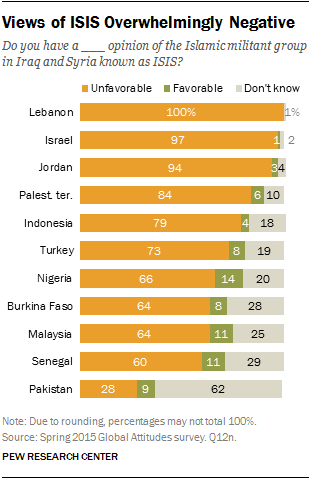
Muslims on ISIS PewThe Monitor cites a Pew Research Center survey conducted last year in 11 strongly Muslim countries.

In Lebanon, 99 percent of the population views ISIS unfavorably. Not surprisingly, that sentiment is shared by 97 percent of Israelis. But vast majorities in other countries agree—such as Jordan (94 percent), the Palestinian territories (84 percent), Indonesia (79 percent) and Turkey (73 percent).

The only surveyed country in which a minority see ISIS unfavorably is Pakistan (28 percent). But even there, the vast majority (62 percent) say they don’t know what they think about ISIS.

The strongest national favorable rating for ISIS is only 14 percent in Nigeria, where 66 percent of the population thinks unfavorably of ISIS.

No Muslim monolith

Despite what we hear from politicians, pundits and provocateurs, Americans make a mistake when we think of Islam as monolithic. Yes, some Muslims interpret the Quran as condoning terrorism. But that is only a subset. Research shows millions of Muslims—and a number that continues to grow—worldwide see Islam as a faith of peace, do not condone terrorism and do not wish to be at “war” with Christianity and the West.

Of course, we must be on guard against terrorism of any form. We live in a dangerous world, and responsibility demands vigilance. That said, we are neither truthful nor fair when we treat Islam and all Muslims as synonymous with terrorism and violence.

Lessons learned …

So, what—in addition to the facts—can we learn from these recent surveys?

• Politicians, cable news anchors and others who treat Muslims as a violent monolithic whole are dishonest and prey on fear. Their actions cast doubt on their credibility. If they’ll mislead and manipulate regarding Islam, they’ll do the same on other issues.

• The safest path forward—particularly in the United States and elsewhere in the West—involves cooperation between Christians, peace-loving Muslims and other faith groups. And the strongest foundation for cooperation is honesty, mutual respect and open dialogue, which only can be achieved by acknowledging the character and virtue of peaceful Muslims.

• If we follow Jesus’ Great Commission and wish to share our faith in him with Muslims, we cannot expect to be successful apart from building authentic, caring relationships. Love and acceptance provide the basis for these relationships.

Christians who treat all Muslims as terrorists and/or condemn peaceful Muslims for the terrorism of Muslim extremists might as well deny the Great Commission and tell all Muslims to go to hell.


New York: Meeting people without hope

In the months leading up to my mission trip to New York, one word kept surfacing in conversations with friends and family. As I began to process events after the trip, I noticed that same word seemed to lace itself through the week. That word was hope.

Hope: A feeling of expectation and desire for a certain thing to happen.

What does it mean for us to have hope? What do we hope in? We have hopes, or expectations, for our futures. We find ourselves constantly hoping for or expecting something better than what we have. As Christians, we have hope, or expectation, that God will fulfill his promises. This isn’t a new thought, right? Having hope in Christ is something we all have heard as Christians. It’s not a new concept. But for this first time, I really began to think about the depth of what it’s like to find hope in something, anything, but Christ.

Visiting a Buddhist temple

Buddhist Temple formerly Baptist Church 200This Buddhist Temple formerly was a Baptist church.At the end of the week in Chinatown, we visited a Buddhist temple to learn more about the religion. I have passed temples like this one before; however, this was the first time I had been inside. As we approached the bright red doors of what had once been a church, we could hear a faint humming sound that tuned into the chanting of almost 50 people as the doors opened. We stepped inside a foyer that opened into a main room, with a shrine of colorful flags, flowers and candles surrounding a picture of a man dressed in orange on the front wall. Lining the three remaining walls of the room were two to three rows of men, women and children. Most were holding combinations of prayer books, prayer chains and prayer wheels, as they followed the lead of a man praying into a microphone.

Buddhist Temple 450Worshippers pray and perform rituals in a Buddhist temple, trying to undo any bad karma.I watched as two older women preformed repeated worship-type bowing motions as they faced the front of the room. When one of these women slowly lay down on the floor face down, with only her palms and fingers, ever so slightly rising up and down, I became sick to my stomach. I sat helplessly and watched as this woman laid herself out in a stance of complete surrender and poured 100 percent of herself into chanting a prayer to a picture on the wall, hoping that this action would be enough to cancel out her “bad karma” for the day—hoping in an uncertain eternity, hoping for better luck tomorrow, hoping to be reincarnated as something or someone better than herself in her next life.

As we stood outside the temple, listening to our leader explain the foundations of Buddhism, I watched as people filtered out onto the street, tossing us a sweet smile and a nod as they went on with their day with a hope that they would be able to keep a good balance of “good karma” for the rest of the day.

Empty: Containing nothing; not filled or occupied.

A subway conversation

The next day, as we were heading to ring in the New Year with a Chinese congregation in Brooklyn, I chatted with the man sitting next to me on the subway. He informed me while he was not currently “in church,” he had been raised Jehovah Witness and even attended school to be a priest. I asked him if he would mind answering some of my questions about his religion to help me understand the differences in our beliefs. He very willingly agreed and began the process of explaining to me several key differences in my faith and his. He informed me he did not believe in heaven or hell.

“There is no such thing,” he proclaimed as he waved his hand in the air as one might do to scare off a dog.

He explained that according to his beliefs, when one died they were buried in the ground and their spirit stayed there to rest until Jesus came back. At that point, they would come back and continue life here on earth. Earth was his heaven.

As he talked, I began to realize he seemed to be hanging on to the idea that if everything was OK now, it would be OK later. He had no hope in or expectation for the future, other than death and lying in a cold grave until the end of time, only to come back and keep doing what he had been doing. When I asked him where he found his hope, he scrambled for an answer, only to eventually evade it and pushed the conversation on to my next question. This man defined to me what seemed to be a distant nonpersonal relationship with God and a contentment to just keep on keeping on.

Blessed to experience hope in Christ

As we arrived at the New Year’s Eve worship service that night, we were asked to pair off and give thanks to the Lord for whatever was on our hearts. We sat down, and I found myself speechless as I flashed back over the last 48 hours and gained a new realization for how empty hope is when it is not found in Christ, and how blessed I was to have a hope full of Christ’s promises.

That night, I gave thanks for hope. I prayed thanksgiving to God for sending his Son to die for me, so that I may have a personal relationship with him. I gave thanks I did not have to count my prayers to balance out my bad karma and that I have salvation and the promise of a eternity spent with God, not just going back to what I do now.

When I go on mission trips, it never fails that I come home with refreshed gratitude for the gospel. This, however, comes with a fresh heartbreak for the lost and the greatly appreciated reminder of why I am told to take the gospel to my peers, the nations, my neighbors, my family, my friends. God had mercy on me when he shouldn’t have, and he offered me hope in something so much more than myself. I am reminded that this hope is not something that I am meant to keep to myself, but instead to offer to those around me.

Morgan Little, a student at Tarleton State University, served in New York City with Go Now Missions over Christmas break.